




Abstract
This study aimed to investigate the perceptions of Cambodian first-year university students regarding their use of AI-assisted writing tools (e.g., ChatGPT, Grammarly, QuillBot) and the impact on their writing autonomy, confidence, motivation, creativity, critical thinking, and experience with AI-assisted writing tools in their academic writing. First-year university English major students (n = 77) were randomly invited to participate in this study. Descriptive statistics, Pearson correlation coefficients, and hierarchical multiple regression analyses were conducted using the Statistical Package for the Social Sciences (SPSS) version 27. The results from the analysis indicated that AI-assisted writing tools support students’ writing autonomy, confidence, motivation, and critical thinking/creativity. However, 77.92% of students expressed their concerns regarding overreliance, which potentially weakens their independent writing skills. A significant majority (83.12%) believed that AI should complement, not replace, teacher feedback. The results from correlation analysis revealed positive relationships among all variables, with the recognition of AI's limitations strongly predicting students’ perception of using AI in writing. Hierarchical multiple regression analysis further revealed that the perceived AI enhances critical/creative thinking, confidence/motivation, and the students’ awareness of challenges and limitations of AI-assisted writing tools positively predict their perceptions of using AI in academic writing. These findings underscore the importance of developing AI literacy and integrating AI to enhance learning by balancing pedagogical strategies that foster independent writing and critical thinking skills.
Keywords
Introduction
Artificial intelligence (AI) writing tools such as ChatGPT, Grammarly, and QuillBot have rapidly gained popularity in educational contexts worldwide. The result from a 2024 global survey has shown that 86% of university students are using AI to support their studies, mostly for functions of grammatical correction, content generation, and writing improvement (Digital Education Council, 2024). The integration of artificial intelligence (AI) has also been found to play a significant role in fostering 21st-century skills and contributing to the transformation of the education. A systematic review across 175 articles by Gómez Niño et al. (2024) revealed that the integration of AI and gamification in education has led to students developing key skills, such as critical thinking, communication, creativity, and collaboration. This is because AI-powered tools have provided a personalized learning experience for learners through adaptive feedback. This finding supports the previous study by Trisnawati et al. (2023), which found that numerous educational issues can be solved by leveraging AI in education. They also found that integrated AI in education not only fosters communication, creativity, collaboration, and critical thinking but also influences students’ characters and citizenship. In addition, AI can serve as a powerful tool for educators by providing deep insights into student progress, thus enabling timely interventions and support. Such tools help educators customize resources for diverse learners while revolutionizing content delivery and consumption, automating administrative tasks, and enhancing teaching efficiency (Prajapati et al., 2024; Pum & Sok, 2024).
In Cambodian educational contexts, while empirical data remain limited, several studies have revealed emerging similar patterns. For instance, Cambodian EFL students reported that they frequently employed AI-assisted tools for assignments and various learning tasks, despite receiving minimal training prior to application (Sol et al., 2024). While AI has assumed a role in supporting students’ academic tasks, further questions remain about AI’s potential in improving students’ learning outcomes and its unforeseen implications. Research indicated that AI-assisted writing tools can support writing organization, vocabulary development, revision, and stylistic improvement of the learners (Younis et al., 2023). Notably, AI tools boost students’ confidence and motivation in writing. A study by Mohammadkarimi and Qadir (2025) with IELTS students in Iran revealed that using AI in academic writing can improve students’ writing structure, creativity, and student self-confidence in their writing tasks. Additionally, the AI-powered tools such as Grammarly and QuillBot have been found effective in improving grammar, coherence, and content development (Al-Shaboul et al., 2024; Sok et al., 2025).
Even though AI-assisted writing tools have been found to support students in their academic work in various ways, using such AI tools also has raised concerns regarding overreliance and the subsequent decline in independent thinking, as shown in several studies (Al-Shaboul et al., 2024; Mohammadkarimi & Qadir, 2025). Results from Al-Shaboul et al. (2024) and Mohammadkarimi and Qadir (2025) studies suggested that while AI may scaffold in students’ writing process, it could also reduce students’ independent thinking and the originality of their work if learners become overly dependent on algorithmic suggestions. Complementing this, studies in the Cambodian context by Pum and Sok (2024) and Sol et al. (2024) have found that despite AI’s immense capability to support students in their education, many students lacked a critical understanding of the tools’ limitations. Such problems lead to overreliance on AI tools. Additionally, ethical issues and academic integrity, including plagiarism, data privacy, have become the main concern among educators (Cardon et al., 2023; Pum & Sok, 2024). The unregulated and overuse reduces creativity, critical thinking, and independent writing skills. These concerns are raised about the need for balanced integration of AI in education as advocated by Pum and Sok (2024).
Several studies conducted on AI in education in Cambodia have focused on policy and ethics (Islam, 2024) or general attitudes toward AI tools (Pum & Sok, 2024; Sok et al., 2025; Sol et al., 2024). However, little research has explored how students, especially first-year university English majors, who have just transitioned from high school to higher education, perceive the influence of AI tools on their writing autonomy, motivation, creativity, and independent writing skill development. Thus, understanding these perceptions is crucial. The study aims to:
Explore students’ perceptions of the benefits and limitations of AI in supporting their writing autonomy, confidence, motivation, and creativity.
Examine the relationships among writing autonomy, confidence, and motivation in writing, critical thinking and creativity in writing, challenges and limitations of AI in writing, and students’ general perception of AI in writing.
Identify key predictors of students’ perceptions of AI in writing.
Theoretical Framework
This study draws upon the self-determination theory (SDT) and social cognitive theory (SCT) theories to explain how students’ perceptions of AI-assisted writing tools are linked to their writing autonomy, confidence/motivation, and creativity. SDT emphasized that learners’ intrinsic motivation and sense of autonomy are the keys to self-regulated learning (Ryan & Deci, 2000). The use of AI-assisted writing tools may augment or hinder these needs, depending on how they are integrated into learning environments. For example, tools that provide adaptive feedback may enhance students’ confidence and writing autonomy, while overreliance on automation may diminish intrinsic motivation. SCT, on the other hand, posited that self-efficacy and confidence are the main factors of learners’ engagement and performance (Bandura, 1997). Interaction with AI tools can heighten students’ confidence by offering immediate feedback and error correction, which gradually reinforces their belief in their writing capabilities. Finally, creativity and critical thinking are seen as higher-order outcomes of autonomous and confident learning, aligning with 21st-century skill frameworks. When students use AI tools reflectively and purposefully, these technologies can serve as catalysts for creative idea generation and deeper critical engagement with their writing.
Conceptual Model
Figure 1 illustrates the conceptual framework guiding this study. The model integrates principles from self-determination theory (Ryan & Deci, 2000) and social cognitive theory (Bandura, 1997) to explain how students’ perceptions of using AI-assisted writing tools (SPW) are shaped by their autonomy, confidence/motivation, and creativity/critical thinking in writing. According to SDT, the core psychological needs that drive self-regulated learning are autonomy and intrinsic motivation. Therefore, confidence and motivation in writing (CMW) are proposed to positively influence students’ perceptions of AI-assisted writing tools by enhancing their sense of control and engagement. In addition, based on the SCT, learners’ self-efficacy and confidence are essential for effective learning behavior, suggesting that higher confidence levels contribute to more positive attitudes toward AI use. In addition, creativity and critical thinking in writing (CCW) represent higher-order cognitive skills that mediate how students apply AI tools meaningfully and productively. These skills help students use AI supportively, rather than dependently, thus strengthening their overall perception and acceptance of AI in academic writing. Finally, the model also recognizes students’ awareness of the challenges and limitations of AI in writing (CLW) as a contextual factor that shapes responsible and balanced perceptions of AI usage. Overall, the model proposes that CLW, CCW, and CMW jointly predict students’ perceptions of using AI in writing (SPW).

Conceptual framework linking motivation, cognition, and perceptions of AI-assisted writing tools.
Literature Review
AI-Assisted Writing Tools in Education
AI-powered writing tools are increasingly integrated into educational writing instruction, supporting various stages of the writing process (Younis et al., 2023). People integrated AI in their writing because of the tools’ capabilities in giving instant feedback and providing revision for their written task, which used to be done by human instructors (Mohebbi, 2024; Younis et al., 2023). For instance, according to Al-Shaboul et al. (2024), AI tools such as Grammarly, QuillBot, and ChatGPT have been found to be widely utilized by foreign language instructors. Grammarly is applied for surface-level corrections, while QuillBot is used for improving coherence and paraphrasing; on the other hand, ChatGPT is used for generating ideas and supporting logical structuring (Al-Shaboul et al., 2024). University students in Cambodia have been found to frequently rely on AI-assisted writing tools for help with assignments and language learning (Sol et al., 2024). Despite such, there remains limited formal training on the effective use of AI in education (Sol et al., 2024). This highlights infrastructural and pedagogical gaps in AI implementation across Cambodian universities. Robust policy frameworks need to be established, and teacher development programs to support ethical and productive use of AI in education need to be implemented immediately (Islam, 2024; Sok & Heng, 2024).
Writing Autonomy and Independent Skill Development
Autonomy in writing is defined as a student’s ability to initiate, organize, and revise written work by themselves without excessive reliance on external feedback (Assiddiq, 2025; Mohammadkarimi & Qadir, 2025). Whether AI tools may foster or hinder students’ writing autonomy is a central concern in the literature. In a study by Mohammadkarimi and Qadir (2025), students reported that they may need teacher help with ideas and high-level feedback while using AI tools for organization and surface-level feedback. This indicates that AI serves more as a structural aid than a comprehensive writing partner, a partial development of autonomy, which means that while AI tools may support writing autonomy, students still require considerable scaffolding for productive use of such AI tools (Kamarullah et al., 2024). Otherwise, it may lead to a reduction in their thinking skills (Pum & Sok, 2024) and inhibit their independent thinking (Al-Shaboul et al., 2024).
Confidence and Motivation
AI-supported writing tools integration has been found to consistently impact students’ writing confidence and motivation (Mohebbi, 2024; Silitubun, 2023). For instance, Mohebbi (2024) and Silitubun (2023) have found that AI-supported writing tools often give objective, timely, and accessible feedback that may support student who lack self-confidence in their writing abilities. This result is further supported by several studies across the globe that found that learners who utilized the power of AI-supported writing tools are motivated and reported a higher level of self-efficacy in writing compared to those who received traditional instruction (He, 2024; Mohammadkarimi & Qadir, 2025; Song & Song, 2023). The instant feedback and low-stakes environment that using AI tools can further make the writing experience less stressful and more engaging, which can foster a sense of accomplishment among students who utilize those tools (Silitonga et al., 2023). In addition, according to a study by Sol et al. (2024), when students have limited access to their teachers to ask for feedback, they feel encouraged to use AI tools to help them improve their writing tasks. Furthermore, Silitonga et al. (2023) emphasized that the use of an AI tool, specifically ChatGPT, can foster students' English writing motivation because the feedback that AI provided was more detailed and comprehensive than feedback from teachers. With such feedback, the students are more engaged in writing and can identify the strengths and weaknesses in their works (Mohammed & Khalid, 2025; Silitonga et al., 2023). This finding can be explained through the lens of self-determination theory (SDT), which frames motivation as a set of interconnected need states, influenced by individuals’ perceptions of the desirability, utility, or necessity of fulfilling these needs (Mohammed & Khalid, 2025; Ryan & Deci, 2000). It can be explained that when the students interact with AI tools in their writing process, the instant feedback and error correction from AI tools strengthen their belief in their writing abilities. Thus, they feel motivated to write.
Critical Thinking and Creativity
The effect on students’ critical thinking and creativity when integrating AI tools in their writing process is another key area of interest among educators around the world. Many researchers argue that AI generative tools like ChatGPT can scaffold students’ higher-order thinking by providing model arguments, prompting revision, and enabling stylistic experimentation (Cardon et al., 2023; Daju & Moldovan, 2024; Li, 2025; Nabilla et al., 2024) and further inspire creativity (Mohammadkarimi & Qadir, 2025). However, other researchers warn that overuse may lead to formulaic writing and reduced cognitive engagement (Thurlow, 2023) as the responses from AI tools may sometimes be too generic to stimulate their deep critical engagement (Mohammadkarimi & Qadir, 2025). Furthermore, the limitation of AI tools in understanding the specific context and culture may also limit the student's ability to produce a text that reflects the original and culture-relevant argument (Al-Shaboul et al., 2024). The concerns are further supported by studies conducted in Cambodia, which have shown that employing such tools blindly may lead to a decrease in students' ability to evaluate information and express their personal perspective (Pum & Sok, 2024). From these findings, we can understand that while AI may support cognitive aspects of writing. However, to effectively integrate these tools without weakening the human thinking capacity, educators must implement pedagogical strategies that promote metacognition and originality. To fully integrate these tools successfully, academic integrity policies that address not only plagiarism but also the potential intellectual stagnation caused by overreliance on AI need to be established (Sok & Heng, 2024).
Ethical and Pedagogical Considerations
Regarding academic dishonesty, plagiarism, data privacy, and the erosion of authorship have been widely discussed and debated while integrating AI tools in education (Ateriya et al., 2025; Cardon et al., 2023; Doyal et al., 2023; Harati, 2024). In the Cambodian educational context specifically, while the AI tools are widely used among students, there are no clear rules or regulations to address this unethical and unregulated integration (Islam, 2024; Sok & Heng, 2024). Such concerns raised the need to advocate for the development of “AI literacy,” which may in turn help students to navigate these tools in their education responsibly (Biagini, 2025; Hossain, 2025; Merceron & Best, 2024). Educators and teachers need to teach students to critically evaluate AI outputs and engage ethically with AI-generated content through principles of authenticity, application, accountability, and agency (Cardon et al., 2023), supported by curriculum integration and teacher training (Islam, 2024; Sok & Heng, 2024).
Methodology
Participants
The participants in this study were first-year university students majoring in English for Education from one private university in Cambodia. During the 3-week survey, 85 student volunteers from the first-year English major cohort had been randomly invited to participate in this study. However, eight responses from the survey were excluded due to incomplete data and their inconsistent pattern in answering the questionnaire, resulting in a final sample of 77 participants. The majority of participants (92.2%) were aged between 18 and 24 years; most of them (71.4%) were female. All participants were enrolled in academic writing courses and reported prior experience using AI-assisted writing tools, including Grammarly, ChatGPT, and QuillBot.
Ethical Consideration
Ethical guidelines for conducting research that involves human participants were followed. The participants were informed that their participation in the survey was entirely voluntary, and they could withdraw from the study at any time without providing any reason. The data was collected anonymously and was treated with strict confidentiality. In the questionnaire, no identifying information was recorded. The data were used for research and publication purposes only. In addition, on the cover page of the Google Form, the researcher clearly stated that by submitting the complete questionnaire, participants provided their informed consent to participate in the study and to have their responses used for academic analysis and dissemination.
Research Measurement
The questionnaire was adapted from Mohammadkarimi and Qadir (2025) and demonstrated good internal consistency, with a Cronbach’s alpha of .84. Prior to the main analysis, the confirmatory factor analysis (CFA) was conducted to ensure the instrument’s validity and reliability. CFA results on the current dataset supported the factor structure (CFI = 0.93, TLI = 0.92, RMSEA = 0.09, SRMR = 0.11). In addition, the internal consistency of the subscale is assessed via Cronbach’s alpha. The values of Cronbach’s alpha for writing autonomy (WA), confidence and motivation in writing (CMW), critical thinking and creativity in writing (CCW), challenges and limitations of AI in writing (CLW), and students’ overall perception of AI in writing (SPW) were (0.66, 0.66, 0.77, 0.65, 0.60, respectively) acceptable for exploratory research with adapted instruments (Griethuijsen et al., 2014; Taber, 2018), confirming the reliability and validity of the instrument for this study.
In addition, to adapt the questionnaire for the Cambodian education context, we employed the translation and back-translation techniques, as outlined by Behling and Law (2000). The adaptation process began with the researcher modifying the original English items to suit the local educational setting. The revised items were then translated into the Khmer language by two bilingual Cambodian lecturers. After that, a back-translation of the Khmer version into English was performed by the researcher and the two lecturers. The original and back-translated versions were then compared to ensure conceptual and linguistic equivalence across languages. Twenty-nine items were using a 5-point Likert scale ranging from 1 (strongly disagree) to 5 (strongly agree) for this survey questionnaire, presented in both English and Khmer, the participants’ first language, to ensure clarity and accessibility. The instrument assessed students’ perceptions of AI in writing, including writing autonomy, confidence and motivation, critical thinking and creativity, and the challenges and limitations.
Data Analysis
To address the three research questions, a series of descriptive, correlational, and inferential statistical analyses was conducted using SPSS Version 27. Descriptive statistics (means, standard deviations, and frequency distributions) were calculated to examine students’ perceptions of the benefits and limitations of AI-assisted writing tools in supporting writing autonomy, motivation, creativity, and independent writing skills. These calculations were performed across five key dimensions: writing autonomy (WA), confidence and motivation in writing (CMW), critical thinking and creativity in writing (CCW), challenges and limitations of AI in writing (CLW), and students’ overall perception of AI in writing (SPW). Furthermore, to explore relationships among writing autonomy, confidence, and motivation, creativity, perceived challenges and limitations, and overall perceptions of AI, Pearson product-moment correlation coefficients were computed. Skewness and kurtosis indices were assessed to check the normal distribution of the respondents. As can be seen in Table 2, the results showed the acceptable ranges (skewness <±2, kurtosis <±7), indicating no significant violations of normality assumptions (Byrne, 2010; Hair et al., 2010). Although the Shapiro–Wilk test indicated slight deviations from normality for CCW (p = .05) and CLW (p = .01), given that normality tests are sensitive to sample size (Field, 2024; George & Mallery, 2024), the data were considered suitable for parametric analyses, including regression and structural equation modeling, without transformation. Finally, a hierarchical multiple regression analysis was conducted to examine the extent to which students’ perceptions of AI in writing (SPW) were predicted by challenges and limitations of AI in writing (CLW), critical thinking and creativity (CCW), and confidence and motivation (CMW). Following established guidelines, our sample of 77 exceeds the minimum thresholds suggested for various analyses: simple regression generally needs 50 to 100 participants (Hair et al., 2018), and Green’s (1991) formula (N≥50 + 8m, m is the number of predictors) as well as recommendations for regression-based research N≥25 (Jenkins & Quintana-Ascencio, 2020) indicate that our sample provides sufficient statistical power for reliable inference.
Result
Research Question One: How Do Students Perceive the Benefits and Limitations of AI-Assisted Writing Tools in Supporting Their Autonomy, Motivation, Creativity, and Independent Writing Skills?
Table 1 presents the first-year university English major students’ perceptions of the benefits and limitations of AI-assisted writing tools. Descriptive analyses were conducted across three dimensions of AI benefit in writing: writing autonomy, writing confidence and motivation, critical thinking and creativity, challenges and limitations of AI-assisted writing tools, and general perceptions of AI in writing to understand students’ perceptions of the benefits and limitations of AI-assisted writing tools.
Perceptions of the Benefits and Limitations of AI-Assisted Writing Tools.

Note. Level of agreement: 1 = Strongly disagree; 2 = Disagree; 3 = Neutral; 4 = Agree; 5 = Strongly agree.
Writing Autonomy
The result from Table 1 revealed that students generally agreed that AI tools support their autonomy in writing (M = 3.39, SD = 0.94). A significant majority of students (77.92%) reported that they felt more comfortable tackling writing assignments independently due to AI feedback, while more than 50% of the students who participated in the survey questionnaire reported that AI has helped them become more independent in revising and editing their work, and 48.05% reported that AI helped them structure their writing without depending on others. However, the lower mean score (M = 2.92) was reported by students with the statement “AI tools help me generate original content without needing input from others,” indicating that while AI may facilitate independence in process and revision, it may be perceived as less useful for content ideation.
Confidence and Motivation in Writing
According to results presented in Table 1, students reported that using AI-assisted writing tools moderately enhances their confidence and motivation in writing tasks (M = 3.49, SD = 0.94). The highest percentages of agreement (72.73%) were shown in the statement “AI tools make me excited to experiment with new writing techniques,” followed by the item “AI-based writing tools encourage me to take on more challenging writing tasks” (55.85%). Similarly, over 50% of respondents agreed or strongly agreed that they feel more motivated to improve their writing when using AI tools.
Critical Thinking and Creativity
As seen in Table 1, overall, students reported high levels of agreement in all items, indicating that AI tools support critical thinking and creativity (M = 3.76, SD = 0.80). A significant majority of students (81.82%) agreed or strongly agree with the item “AI tools help me identify flaws or weaknesses in my arguments during writing,” followed by the statement “AI tools encourage me to explore new and creative ideas in my writing assignments” (M = 3.83), and “AI suggestions inspire me to try new styles or approaches in my writing” (M = 3.81). This reflects that students perceived AI tools as valuable for supporting higher-order thinking in their writing process.
Challenges and Limitations of AI
Based on results in Table 1, students acknowledged several limitations of AI tools when integrating them into their writing process, despite their perceived benefits of AI-assisted writing tools (M = 3.58, SD = 0.89). A significant majority of the students (77.92%) expressed concern that overreliance on AI tools might weaken their independent writing skills (M = 4.13), followed by 70.13% of students reporting feelings of overdependence on AI feedback. In addition, the technical issues and generic suggestions of AI tools were also mentioned as barriers when using such tools, though less critically than the potential impact on writing independence and creativity.
Overall Perception of AI in Writing
According to Table 1, students generally held positive yet cautious views of AI in writing (M = 3.57, SD = 0.93). Most students agreed with the statement that “AI tools make the writing process faster and more efficient” (M = 3.74) and the statement “AI feedback helps me better understand grammatical and stylistic mistakes” (M = 3.64), followed by the item “AI tools have positively impacted my overall writing experience” (M = 3.36). In addition, a significant majority of students (83.12%) agreed or strongly agreed that AI should not replace teacher feedback, reinforcing the perceived value of human guidance in the writing process.
Overall, students perceive AI-assisted writing tools as supportive of autonomy, motivation, and creativity, particularly in revision and critical engagement with their work. However, they also express concerns about overreliance on AI and potential limitations in adaptability and contextual understanding. These mixed perceptions highlighted the importance of integrating AI tools complementarily with teacher support to enhance learning without undermining independent skill development.
Research Question Two: What Are the Relationships Among Students’ Writing Autonomy, Confidence, Creativity, Perceived Challenges, and Perceptions of AI Tools in Writing?
Table 2 presents descriptive statistics and correlation analysis. The results from the analysis showed that WA was significantly positively correlated with CMW (r = .53), SPW (r = .44), and CCW (r = .38). In addition, CMW also showed a strong, significant positive correlation with CCW (r = .60) and SPW (r = .49). All correlations are significant at p < .001. CCW was similarly correlated with SPW (r = .49, p < .001). Interestingly, CLW was only modestly correlated with WA (r = .17, p < .001), but no significant association with CMW (r = .07) or CCW (r = .06) was found. However, CLW demonstrated the strongest bivariate correlation with SPW (r = .54, p < .001), suggesting that students’ recognition of AI’s limitations is an important aspect of how they perceive its use in writing.
Means, Standard Deviations, Skewness, Kurtosis, Shapiro–Wilk, and Intercorrelations Among Study Variables.

Note. Most variables showed skewness and kurtosis within the normal range (|Z| ≤1.96), except CLW, which exhibited a slight negative skew. WA = writing autonomy; CMW = confidence and motivation in writing; CCW = critical thinking and creativity in writing; CLW = challenges and limitations of AI in writing; SPW = students’ perception of AI in writing.
p < .05. **p < .01. ***p < .001.
Research Question Three: To what extent do students' perceptions of the challenges and limitations of AI, their critical thinking and creativity, and their confidence and motivation in writing predict their perceptions of using AI in writing?
Table 3 shows the results of hierarchical multiple regression analysis. A hierarchical multiple regression analysis was conducted to examine the extent to which students’ perceptions of using AI in writing (SPW) were predicted by their views on the challenges and limitations of AI in writing (CLW), critical thinking and creativity in writing (CCW), and confidence and motivation in writing (CMW). Predictors were entered sequentially based on theoretical rationale: Model 1 included students’ perceptions of the challenges and limitations of AI in writing (CLW), reflecting prior research suggesting that recognition of AI limitations influences initial perceptions. Model 2 added critical thinking and creativity in writing (CCW), as cognitive engagement with AI is expected to further shape perceptions. Model 3 included confidence and motivation in writing (CMW), as students’ self-efficacy and motivation are theorized to contribute additional explanatory power.
Hierarchical Multiple Regression Predicting Students’ Perception of Using AI in Writing.
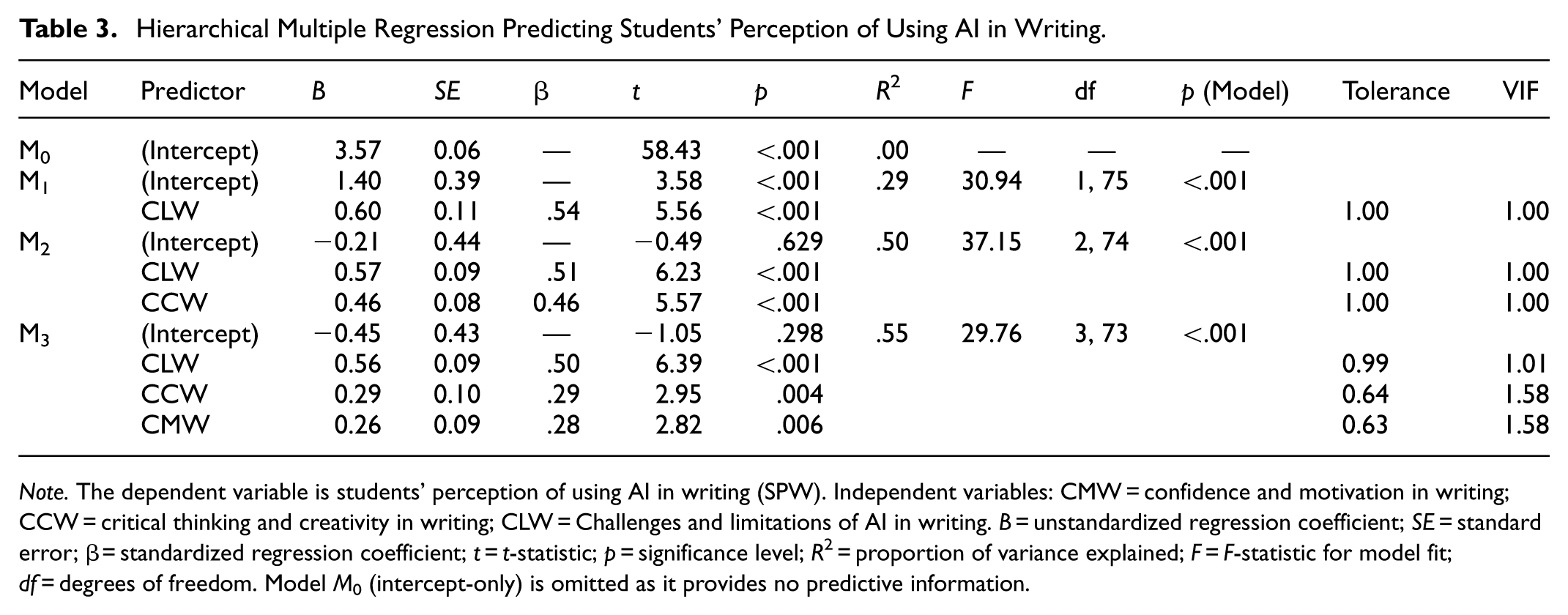
Note. The dependent variable is students’ perception of using AI in writing (SPW). Independent variables: CMW = confidence and motivation in writing; CCW = critical thinking and creativity in writing; CLW = Challenges and limitations of AI in writing. B = unstandardized regression coefficient; SE = standard error; β = standardized regression coefficient; t = t-statistic; p = significance level; R2 = proportion of variance explained; F = F-statistic for model fit; df = degrees of freedom. Model M0 (intercept-only) is omitted as it provides no predictive information.
In Model 1, CLW was entered as the sole predictor. The model was statistically significant, F (1, 75) = 30.94, p < .001, and accounted for approximately 29% of the variance in students’ perception of using AI in writing, R2 = .29. CLW was a significant positive predictor (β = .54), indicating that students who recognized more challenges and limitations in AI use also tended to report stronger perceptions about using AI in writing.
Model 2 added CCW to the regression. The model was statistically significant, F (2, 74) = 37.15, p < .001, and explained 50% of the variance in SPW, R2 = 0.50. Both CLW (β = .51) and CCW (β = .46) were strongly significant positive predictors. This result indicated that students who perceived AI as supporting critical and creative thinking also reported more favorable perceptions of its use in their writing tasks.
In Model 3, CMW was added. This final model was also statistically significant, F (3, 73) = 29.76, p < .001, and explained 55% of the variance in SPW, R2 = .55. All three predictors remained significant: CLW (β = .50), CCW (β = .29, p = .004), and CMW (β = .28, p = .006).
VIF and tolerance values were calculated to assess multicollinearity; all VIFs <2.0 and tolerance >0.50, confirming no multicollinearity issues. These results support the theoretical rationale that students’ recognition of AI limitations, cognitive engagement, and confidence/motivation jointly influence perceptions of AI-assisted writing.
Discussion
This study investigated Cambodian first-year university students' perceptions of AI-assisted writing tools, focusing on their perceived impact of AI-assisted writing tools on their writing autonomy, confidence, motivation, creativity, and independent skill development. The results revealed both the perceived benefits and concerns associated with the integration of AI tools in academic writing.
Due to AI feedback, the majority of participants reported that they felt less pressure in handling writing assignments and structured their writing independently. This result is consistent with prior research, such as the study by Mohammadkarimi and Qadir (2025), which found that AI tools improved students’ writing structure and self-confidence. In addition, students expressed that AI tools provide nonjudgmental and timely feedback, consistent with the previous findings by Mohebbi (2024) and Silitubun (2023). Such support from AI-assisted writing tools, which in turn contribute to increased confidence and motivation, makes the students less pressured and more engaged in the writing process (Mohebbi, 2024; Silitubun, 2023). The results from this study also revealed that student expressed their excitement to experiment with writing techniques and their motivation to accept more challenging tasks. This indicates that AI-assisted writing tools have a positive influence on students' willingness to self-edit and improve their writing tasks. However, regarding AI's utility for generating original content without external input, the mean score is slightly low (M = 2.92), which indicates the students’ perception of AI-assisted writing tools' limitation in this area. This suggests that while AI may facilitate independence in the revision and structuring process, students perceive it as less useful for initial content ideation. It means that students potentially view such AI-assisted writing tools more as a structural aid than a comprehensive creative partner.
Furthermore, a significant majority of the participants expressed that AI tools help them identify errors in arguments, encourage exploration of new and creative ideas, and inspire experimentation with a new style in their writing. This finding is consistent with the prior studies, such as Cardon et al. (2023) and Li (2025), which found that through prompting revision and stylistic experimentation, generative AI can scaffold students’ higher-order thinking. Furthermore, our findings suggest that students, in this context, predominantly leverage AI as a catalyst for refining existing ideas and exploring stylistic rather than simply generating content superficially, which prevents them from formulaic writing and reduces their cognitive engagement (Thurlow, 2023). This indicates that their engagement with AI supports a more active process of critical evaluation and creative adaptation, rather than passive acceptance. Unlike previous international studies that primarily examined AI as a technological aid, this research uniquely explains AI within a pedagogical framework that emphasizes learner autonomy, motivation, and creativity.
Despite these perceived advantages, students also acknowledged significant limitations and concerns regarding the risk of overreliance. A substantial majority of students worried that overusing AI might weaken their independent writing skills. Most of the students feel they are overdependent on AI feedback. This corroborates the study in this context by Sol et al. (2024) and Pum and Sok (2024), who highlighted that students lack a critical understanding of AI limitations and the potential for being overly dependent. The finding also found that AI's challenges and limitations (CLW) strongly correlated with the perception of AI use in writing. This finding underscores the importance of this cautious awareness, suggesting that a realistic understanding of AI's drawbacks is integral to students' holistic and more informed view of these tools.
In addition, the findings in this study show that writing autonomy, confidence, motivation, and critical thinking and creativity are positively correlated with each other and with overall perceptions of AI. The challenges and limitations of AI also play a significant role in shaping students' overall perceptions. These results suggest a balanced perspective, comprising both the perceived benefits and the awareness of limitations, thus contributing to a more favorable overall perception of AI's role in writing. The hierarchical multiple regression analysis further revealed that students' perceptions of AI in writing (SPW) are significantly predicted by their recognition of AI's challenges and limitations (CLW), their beliefs about AI enhancing critical and creative thinking (CCW), and their confidence and motivation in writing (CMW). Notably, the strong predictive power of recognizing challenges and limitations (CLW) suggests that students are not merely embracing AI uncritically. They are engaging with its complexities and understanding its boundaries. The findings of this study highlight the multifaceted role of AI-assisted writing tools in supporting students’ writing development—not only by enhancing grammatical accuracy and coherence but also by fostering confidence, motivation, and independent learning.
The study contributes empirical evidence from the Cambodian higher education context, where limited research has explored how first-year English majors perceive AI as a tool for developing writing-related competencies. It provides a comprehensive understanding of how AI can be integrated responsibly into writing instruction to balance technological support with critical and creative engagement, a perspective rarely addressed in developing educational systems. The outcomes of this study reinforce the need for a balanced integration of AI in education, as advocated by Pum and Sok (2024) and Sok and Heng (2024). Students strongly agree that AI should not replace teacher feedback–the value of contextualized and personalized feedback that human instructors can provide to their students, which AI tools may not fully replicate. While AI tools support writing development in areas like feedback and organization, concerns about overreliance and the potential loss of independent thinking cannot be overlooked. The development of AI literacy among students to foster responsible and ethical engagement with these tools by explicitly teaching them how to analyze AI feedback instead of passively accepting it is important. The integration of AI literacy in English academic writing courses may develop students’ awareness about the benefits and limitations of the AI-assisted writing tools. The guidance from teachers or educators plays a significant role in supporting students to use such AI-assisted writing tools ethically and effectively in order to develop their confidence, enhance their motivation, autonomy, and writing competence. Educators/teachers should balance AI-assisted writing feedback and human instructor feedback, ensuring that students are engaged in their writing, developing their creativity in writing, rather than overdependence on AI-assisted writing tools. In addition, higher educational institutions should prioritize providing training or workshops for teachers/students to develop their capacity on effective and ethical AI use in academic writing. These programs may be fostering critical digital literacy and reducing dependence on AI tools. Furthermore, the Ministry of Education, Youth and Sport (MoEYS) could establish guidelines/frameworks by working with higher education institutions in Cambodia for responsible AI integration in education.
Conclusion
The findings of this study indicated that students generally view AI tools as beneficial for enhancing writing autonomy, confidence/motivation, and fostering critical thinking/creativity. Specifically, these AI-assisted writing tools are perceived as supportive tools to help students revise their work independently. In addition, it also helps the potential to help student structure their writing and explore new ideas. However, the concerns regarding the potential for overreliance on AI and the associated risks to weakening independent writing skills were also identified by this study. The study also revealed that while students valued the AI-assisted writing tools’ capability, they also recognized their limitations. The study shows that students still identified human instructors’ feedback as playing a significant role in the student writing process. The strong relationships observed between students' perceptions of AI’s challenges and their overall perception of AI-assisted writing tools underscore the importance of this nuanced understanding for effective integration of such tools in education.
This quantitative study provides valuable insights into Cambodian first-year university students' perceptions of AI-assisted writing tools, addressing a significant gap in research within this specific context, where there is limited formal training in AI tool utilization. Understanding students’ perceptions in integrating AI-assisted writing tools in their writing tasks has become more significant. These first-year students may be susceptible to relying heavily on external support, as they are in the early stages of developing their academic writing habits.
The findings suggest that educators should prioritize developing AI literacy and guiding students to critically evaluate AI feedback. By doing so, teachers can help their students integrate AI in their writing more effectively. In addition, educators need to foster a balanced approach that leverages AI's supportive capabilities without undermining the development of essential independent writing and critical thinking skills of the students. This study's findings advocate for pedagogical strategies that integrate AI tools with robust teacher guidance to promote genuinely independent and creative writers. Future research could be conducted with EFL students across school years to understand the perception and preference in integrating such tools into the studies. Future research should further compare the student perceptions of AI-assisted writing tools across school years, or between urban, suburban, or rural areas in the context of Cambodia, to understand how demographic factors impact students' perception of AI-assisted writing tools integration in education. The exploration of the long-term impact of AI tool use on student writing development through longitudinal studies or investigating qualitative insights into how students actively integrate AI into their writing processes across different academic disciplines.
Limitations
This study has several limitations. First, the small sample size (n = 77) of first-year English major students from one university may limit the generalizability of the findings. Second, the reliance solely on self-reported survey data may introduce potential bias. Third, the use of a quantitative cross-sectional research design, collecting data at a single point in time, prevents the establishment of causal conclusions. Future research with larger, more diverse samples, mixed methods, and longitudinal designs is recommended to address these limitations and further validate the findings.
Footnotes
Acknowledgements
The author would like to thank a friend for assistance with language editing and for providing helpful feedback on the clarity and style of the manuscript.

Ethical Considerations
Ethical guidelines for conducting research that involves human participants were followed. The participants were informed that their participation in the survey was entirely voluntary, and they could withdraw from the study at any time without providing any reason. The data was collected anonymously and was treated with strict confidentiality. In the questionnaire, there is no identifying information that was recorded. The data were used for research and publication purposes only. In addition, on the cover page of the Google Form researcher clearly stated that by submitting the completed questionnaire, participants provided their informed consent to participate in the study and to have their responses used for academic analysis and dissemination.
Consent to Participate
All participants were verbally informed of consent, and no personal information was collected or used in this article.
Author Contributions
I confirm that I am the sole author of this work and was responsible for all aspects of the research and writing process, including conceptualization, methodology, data collection, analysis, and manuscript preparation.
Funding
The author received no financial support for the research, authorship, and/or publication of this article.
Declaration of Conflicting Interests
The author declared no potential conflicts of interest with respect to the research, authorship, and/or publication of this article.
Data Availability Statement
The data supporting the findings of this study are available from the corresponding author* upon reasonable request.