




Abstract
The purpose of this study is to provide a comprehensive profile of out-of-school youth (OSY) in Quezon City. This study employed a descriptive research design and was conducted in three selected barangays of District 5, Quezon City. A total of 194 respondents were purposively selected based on specific criteria related to their educational status and employment situation. Structured survey interviews were used to gather data from the respondents regarding their demographic profiles, socioeconomic situations, educational attainments, and skill gaps. The findings revealed that 49% of the OSYs want to return to school, 21% want to be employed, and another 12% aspire to become entrepreneurs. While the results provide valuable insights into the challenges and aspirations of OSYs in these communities, the study’s limitations include the non-generalizability of the findings due to the limited geographical scope and small sample size. Additionally, the reliance on purposive sampling may restrict the applicability of the results to broader populations. Despite these limitations, educational institutions in the city should consider revisiting and improving their extension plans and programs to ensure that projects involving OSYs as participants equip them with the necessary skills and competencies for their chosen pathways, such as education, entrepreneurship, and employment, particularly in areas like urban farming, food and beverages, and cooking.
Plain language summary
The goal of this study is to give a detailed picture of out-of-school youth (OSY) in Quezon City. The research was done in three barangays in District 5 of Quezon City, using a quantitative approach. A total of 194 participants were specifically chosen based on their education and employment status. Data was collected through structured interviews that focused on their background, economic conditions, education levels, and skill gaps. The results showed that 49% of OSYs want to return to school, 21% are looking for work, and 12% hope to start their own business. While the findings offer useful insights into the needs and goals of OSYs in these areas, the study’s limited focus and sample size mean the results can’t be applied to other areas. Also, the selection method used may limit how much the results reflect the wider population. Despite these limitations, educational institutions should rethink and improve their programs for OSYs to ensure they are equipped with the skills they need, particularly in fields like urban farming, food and beverage services, and cooking.
Introduction
Over the years, education has emerged as the cornerstone of personal growth, societal progress, and global development, taking a new dimension in recent years due to the fast-paced development of technology. At present, the role of education in shaping the future of the youth has gained paramount significance in preparing the youth to have the essential skills to stay competitive and productive in a continuously developing society (Global Education Monitoring Report Team, 2023).
However, due to a combination of different factors such as poverty, lack of personal interest, family matters, high cost of education, and continuing stagnation in education progress across the world, many youth have found themselves outside the education system, deprived of the opportunities such as gainful employment. These people are considered Out-of-School Youth (OSY) who are essentially part of the broader category of out-of-school children, adolescents, and youth (UNICEF, 2018; Vayachuta et al., 2016).
According to the UNESCO (2019) Institute of Statistics, one in five children, adolescents, and youth aged 15–17 years old is an out-of-school, which is equivalent to around 53% or an estimated 138 million of the total population of this age bracket. The figures may be higher since the abovementioned age bracket that is included in the said statistic did not include young individuals aged 18 to 24, who can still be considered as OSY (United Nations, 2020).
The high number of OSYs globally presents a complex challenge to many governments, considering the goal of attaining the 2030 Agenda for Sustainable Development Goal, specifically Goal No. 4 – Quality Education. However, how do we properly establish the situation of OSY if governments do not have the exact figure and data on how many and who are the OSY in their respective localities?
The challenge of figuring out the exact number of OSY in any locale is further aggravated by the seemingly confusing definition of who composes the OSY sector, encompassing not only variations in age criteria but also in the essential “requirements” to properly identify the youth who are excluded from formal education (Delprato & Frola, 2022). This issue underscores the significance of developing and implementing projects or activities that will help profile the OSY in any given area to thoroughly understand the different challenges of the youth belonging to this sector, which will help facilitate targeted focus and interventions (Singh & Mukherjee, 2018).
This issue poses an important reminder that a categorized population of youth, who are supposedly contributing to the community’s progress, are being deprived of opportunities provided by the educational system (Khin, 2017). Moreover, studies show that OSYs often participate in the ills of society and are prone to involving themselves in unlawful and precarious behaviors (Pareja et al., 2019; Vayachuta et al., 2016). In light of this phenomenon, as the general population recognizes the significance of quantifying the population of OSY, it is equally valuable to profile them by assessing their educational achievements, acquired skills, and the skills they need. This profiling can significantly help create focused programs to address the growing issue of out-of-school youth.
In the Philippines, it is fortunate that the government, through the Philippine Statistics Authority (PSA), has provided a specific definition of OSY, who are persons aged 15 to 24, not attending school, have not finished any college or post-secondary course, and are not working. Meanwhile, 6 to 24-year-olds who are not attending school are defined as out-of-school children and youth or OSCY (Philippine Statistics Authority, 2024).
Based on this government-accepted definition, the 2020 PSA Census of Population and Housing reported that about 25% or 10.7 million of the 42.8 million Filipinos aged 6 to 24 years old are OSCYs (Desiderio, 2024). Of these, 68.5% are aged 20 to 24 and 15.6% are aged 15 to 19 (Desiderio, 2024; PSA, 2020). Furthermore, more than half, or 51.3%, of the OSCYs are males, while 48.7% are females. According to the Philippine Government, the main reasons among OSY for not being at school were the following: (a) marriage or family matters (44.3%), (b) lack of personal interest (18.8%), and (c) high cost of education or financial concerns (18.6%) (Philippine News Agency, 2021).
Some people are unable to study due to a lack of educational resources, restrooms, or facilities for pupils with impairments (Baccal & Ormilla, 2021). These pressing issues have caused educational authorities to reevaluate how they would reduce illiteracy and the scarcity of educational chances in society (Hero, 2022) since some of its effects are an increase in child maltreatment, crime rate, pregnancy, and exposure to illegal drugs (ChildHope, 2022).
The situation of OSYs was exacerbated by the COVID-19 pandemic, with approximately four million learners not participating in the academic year 2020 to 2021 (CNN, 2020). In Quezon City alone, the number of out-of-school youth increased significantly to around 60,000, representing 10% of the total youth population in the city (Quezon City, 2021). Quezon City, a first-class city in the Philippines, is composed of 142 barangays with a total land area of 171.71 km2 and a population of 2.96 million. It is the largest city in the National Capital Region of the Philippines and the second-largest city in the entire country (Quezon City, 2021). Due to the large size of its youth population, the city government has made significant investments in social welfare and education. Addressing the challenges associated with the large population of OSYs will help improve the lives of many individuals who lack access to education or cannot be employed due to insufficient skills and experience resulting from not attending formal education.
However, beyond the challenge of addressing this issue, one of the more pressing difficulties lies at the local community level, specifically in the barangays of the Philippines. A barangay is the lowest political administrative unit of the Philippine government (Porio & Roque-Sarmiento, 2019). For example, interviews with several barangay chairpersons—who serve as the elected heads of the barangays in District 5, the second most populated district in Quezon city with about 596,045 residents according to the latest 2020 Census of Population—revealed that they do not have accurate data on the number of OSYs in their respective areas. Consequently, they are unable to develop relevant programs, projects, and activities to serve this vulnerable sector of their communities. This gap can only be addressed through the existing and continuous updating of the OSY profiles.
While considerable research has explored the challenges and characteristics of Out-of-School Youth (OSY) by various scholars both locally and internationally, a notable research gap exists in the comprehensive profiling of OSY at the barangay or community level. Existing studies have predominantly focused on broader national or regional statistics, often overlooking the diverse educational attainments, skills acquired, and skills needed within specific local contexts. Therefore, profiling out-of-school youth is a crucial endeavor that provides insights into this diverse and complex group of individuals who are currently outside the formal education system.
Addressing this research gap is significant in light of the principle of subsidiarity, where decision-making occurs at the most localized level possible (Campos-Rudinsky, 2023). Failing to profile OSY at the community level, results in lost insights that could inform targeted interventions and policies that align with the unique needs and aspirations of OSY within specific communities.
Knowing how many OSYs are in the community and who they are will help local leaders design and implement relevant and sustainable education and skill development programs that contribute to OSYs’ meaningful integration into the workforce and society. For this reason, the researchers pursued documenting the profile of OSY in selected barangays in District 5, Quezon City. Specifically, this study sought to:
Establish the profile of the OSY in terms of their (a) demographic profile (age & and gender) and (b) social, economic, and health situation. (c) educational attainment, (d) skills acquired and skills needed.
Determine their educational attainment, skills acquired, and skills needed as a basis for designing effective university extension services and skills development programs.
Identify the preferences of OSYs regarding their chosen pathways (i.e., education, employment, or entrepreneurship).
Find out the type of youth programs that the OSYs suggested or recommended for potential implementation.
Theoretical Framework
The study adopted the graphical framework of Needs Assessment as outlined in the Needs Assessment Guidebook for Extension Professionals by Donaldson and Franck (2017) (Figure 1), which is a widely utilized approach in designing targeted community programs. This framework is structured around three phases of implementation: Pre-assessment, Assessment, and Post-assessment (Lepicki & Boggs, 2014).

Conceptual framework of the study adapted from Lepicki and Boggs (2014).
The Pre-assessment phase provides the methodological foundation, which dictates the collection of data, focusing on the demographic, social, economic, and educational attainment characteristics of the OSYs. This directly correlates with the study’s aim to determine the skills acquired and needed by OSYs, which can inform local leaders in designing relevant youth programs. Moreover, in the pre-assessment phase, the potential users of the data are identified, including educational institutions and government agencies, further supporting the study’s objective to identify the types of extension services and skill development programs needed by OSYs.
The Assessment phase provides the methodological foundation, dictating the collection of data on OSYs’ demographic characteristics, educational attainment, and skills. This directly correlates with the study’s aim to determine the skills acquired and needed by OSYs, which are central to shaping university extension programs. Through this phase, the researchers assess how well the respondents’ skills and educational experiences align with their preferred pathways—education, employment, or entrepreneurship. The connection between this phase and the research hypotheses is evident: realizing where the OSYs are and what they intend is essential to developing appropriate interventions.
Finally, the Post-assessment phase is linked to the design of actionable recommendations, including the creation of specific youth programs and strategies that are based on the expressed OSYs’ needs. This phase addresses the study’s objective to explore the types of youth programs suggested by OSYs themselves, ensuring that the interventions are grounded in the community’s realities and preferences.
By employing the needs assessment framework, specifically the pre-assessment phase, this research aims to delve into the multifaceted dimensions of OSYs’ educational attainment, skills acquired, and skills needed to serve as a foundational cornerstone in the design and formulation of university extension programs and other skills development programs that are not only responsive to OSYs’ expressed needs but also aligned with the dynamic demands of their pathways (education, employment, & entrepreneurship).
Methodology
The study adopted a descriptive research design with a quantitative approach involving structured survey interviews to collect information from the residents of the selected barangays in District 5 of Quezon City. The respondents were selected through purposive sampling, which is a non-probability sampling technique where individuals are selected based on predetermined characteristics relevant to the study objectives.
The predetermined selection criteria in the cases were individuals aged between 15 and 24 who were bona fide residents of District 5. However, they must have met one of the following criteria: (a) dropped out of Junior High School or Senior High School, (b) are Junior High School or Senior High School completers, graduated from the previous education level more than six months ago and did not enroll in the subsequent education level, and (c) College undergraduates who were not gainfully unemployed. This method was used to make the sample size representative of the out-of-school youth.
The study focused on three barangays – Gulod, Bagbag, and Greater Lagro – due to their active participation in OSY-related programs. In addition to that, there exists a pre-existing Memorandum of Understanding (MoU) between the barangays and the researchers’ institution. The data collection was conducted through house-to-house visits, which is an approach that enabled the identification of potentially suitable respondents.
A total of 219 youths were initially identified from the three barangays. However, after applying the predetermined inclusion criteria, 194 respondents were confirmed to meet the criteria and, therefore, included in the study.
The data analysis involved the use of descriptive statistics to summarize all the demographic characteristics of the sampled respondents. Measures such as frequencies, percentages, and means were calculated to give an overall picture of the OSY population in the selected barangays. The use of quantitative data analysis helped the researchers gain a better understanding of the educational and employment status of the youths from these three barangays and the general picture of OSY across District 5 of Quezon City.
Instrumentation
A profiling survey instrument was derived from several studies, including the Profiling of Out-of-School Youth in General Santos City (POSY-GEN) survey questionnaire that was prepared by USAID and the Education Development Center (EDC). The 25-question instrument was divided into six parts, namely, (a) Data Privacy and Informed Consent Form, (b) Personal Information (Demographics), (c) Social, Economic, and Health Situation, (d) Youth Organization, (e) Programs/Scholarships, and (f) Skills.
The Instrument underwent face and content validation from three academic experts and industry partners to ensure that the questions comprehensively covered the intended content and were relevant to the construct being measured. A pre-test survey was then conducted among 30 respondents. The results of the validation and pre-test served as the basis for the final survey instrument.
Research Procedures
The profiling survey was conducted from June 17 – July 31, 2022 (45 days) through survey interviews. Local interviewers composed of Barangay (Community) purok or cluster leaders and college students also served as volunteer interviewers, who underwent an extensive Training Workshop facilitated by the researchers. Face-to-face survey interviews were conducted to ensure the accuracy of the responses of the target respondents. The researchers and volunteer survey interviewers went house-to-house to identify the youth who belong to the OSYs as indicated in the sample criteria. Once identified, they were invited to participate in the survey.
The researchers followed strict research protocols and adhered to strict ethical guidelines to ensure the voluntary participation of the participants and the confidentiality and privacy of the respondents. Only one computer was used to encode and record the data sets from the accomplished survey forms, and it was only accessible to the researchers of the study.
Results
Respondents’ Demographic Profile
A majority of the respondents who participated in the profiling survey are male out-of-school youth (OSY) (58%), while 41% are female, and 2% identified themselves as LGBTIA++. In terms of age distribution, the highest number of respondents are aged 21 to 22 (27%), followed by 19 to 20 years old (23%), 17 to 18 years old (20%), 23 to 24 years old (19%), and 15 to 16 years old (9%) (Table 1).
Respondents’ Demographic Profile.
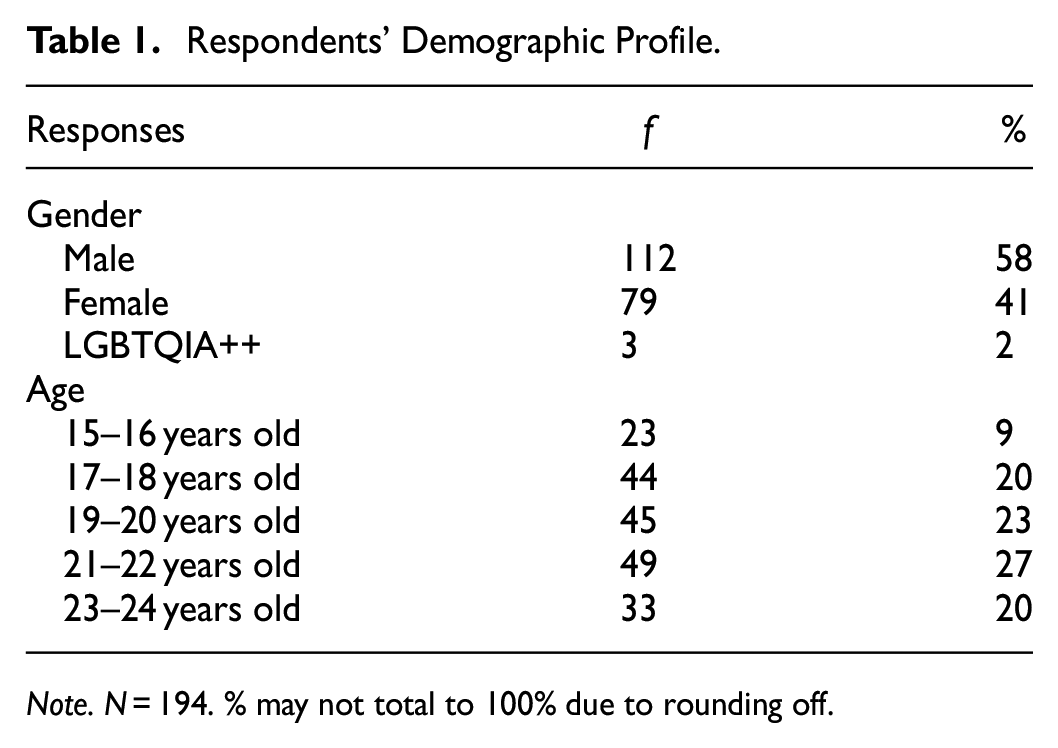
Note. N = 194. % may not total to 100% due to rounding off.
Respondents’ Educational Attainment
In terms of the respondents’ educational attainment, the researchers found out that most respondents are Junior High School (JHS) Undergraduates who have never pursued education or courses under Alternative Learning Services (ALS) or Technical Education and Skills Development Authority (TESDA) (24%), followed by those who finished Senior High School (SHS) but did not pursue Tertiary Education (21%), and college undergraduates (15%). Around 12% are SHS undergraduates who never pursued ALS/TESDA, and another 12% completed JHS but did not pursue SHS/ALS/TESDA (Table 2).
Respondents’ Educational Status.

N = 194.
Respondents’ Social, Economic, and Health Situation
In terms of the respondents’ health situation, only 3% or six individuals are persons with disabilities (PWD), of which four have visual disabilities (77%), one with hearing and speech disabilities (2%), and another one with late development (2%) (Table 3).
Respondents’ Health Situation.

Note. % may not total to 100% due to rounding off.
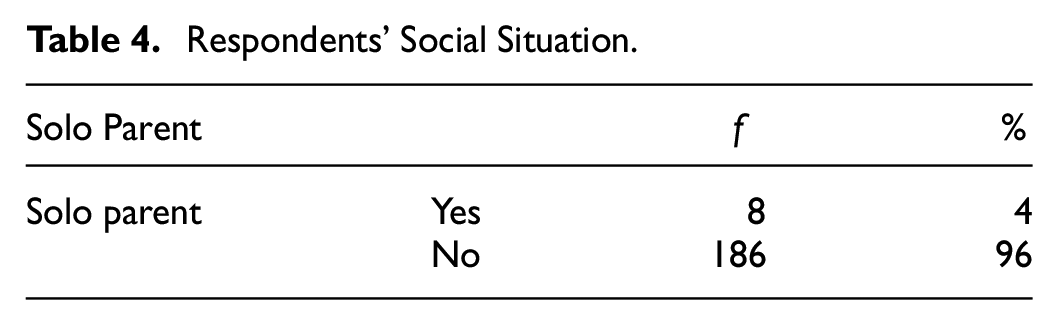
Eight (4%) of the OSY respondents are also solo parents (Table 4). Solo Parents, as defined by the Expanded Solo Parents Welfare Act of 2021, are individuals who have undertaken the sole responsibilities of parenthood due to different circumstances such as spouse’s death, detainment or criminal conviction for at least 3 months, physical and/or mental incapacity as certified by a public medical practitioner, at least 6 months legal separation or de facto separation, nullity or annulment of marriage as declared and decreed by a court of law, and abandonment for at least 6 months.
Respondents’ Social Situation.
Respondents’ Acquired Skills and Skills Needed
In terms of the respondents’ acquired technical skills with certification, a large number of the respondents have no skills with certification (72%) (Table 5). Meanwhile, 29% of the respondents who have certified skills from TESDA or other relevant training centers answered Food and Beverages, followed by ICT and Business Process Management (13%) and footwear making (13%).
Respondents’ Types of Technical Skills with Certification.

Moreover, in terms of respondents who have technical skills yet have not undergone any related training or certifications, around 21% know about cooking, followed by driving (9%) and carpentry (9%). Other skills mentioned were auto mechanic (3%), baking (3%), welding (3%), hairdressing (3%), and masonry (2%) (Table 6).
Respondents’ Technical Skills With no Training or Certification.

Note. Multiple Response.
In terms of the technical skills needed by the respondents, most of them answered Urban Farming (30%), followed by culinary (13%), basic web development (6%), driving (5%), welding (4%), computer-related skills (4%), automotive (3%), electronics (3%), hairdressing and make-up (3%), auto-mechanic (2%), entrepreneurship (2%), communication (2%), hotel and restaurant (2%), basketball (1%), seaman (1%), bartending (1%), computer programming (1%), construction (1%), digital arts (1%), education (1%), nursing (1%), while less than 1% answered the following skills respectively, Cellphone Repair, Electrical, Encoding, Modelling, Music Engineer, Office Work, Painting, Photography, Volleyball, and WiFi Installer. Meanwhile, 7% of respondents were undecided about the technical skills they needed (Table 7).
Respondents’ Technical Skills Needed.

Note. Multiple Response.
Respondents’ Chosen Pathway and Recommended Programs
In terms of the chosen pathways of the respondents, almost half of them said that they want to finish college (49%), while others want to work (21%), start a business (12%), or enroll in skills training or technical vocational school (10%) (Table 8).
Respondents’ Chosen Pathway.

Note. Multiple Response.
Lastly, in terms of the respondents’ recommended programs, most of them recommend education-related programs (70%), followed by health-related programs (13%), social-services programs (7%), youth focused-programs (5%), socio-economic programs (3%), and socio-cultural programs (1%) (Table 9).
Respondents’ Recommended Programs.

Discussion
This study provides a detailed profiling of the selected out-of-school youth, aged 15 to 24, not attending school, have not finished tertiary education, and are not gainfully employed from selected barangays in District 5, Quezon City, aiming to understand their (a) demographic profile (age & gender), (b) social, economic, and health situation. (c) educational attainment, (d) skills acquired, and (e) skills needed. The profiling of OSY is critical in designing university extension services and skill development programs to help them transition to preferred pathways such as education, employment, or entrepreneurship.
The application of the Needs Assessment Framework in the present study fills a critical gap in understanding the OSY population at the micro, mezzo, and macro levels. For example, the findings highlight key demographic patterns, including a majority of male respondents (57%), predominantly aged 19 to 22 (50%), and a notable portion who completed senior high school but did not pursue alternative learning systems (ALS) or Technical Education and Skills Development Authority (TESDA) programs (21%). These results are consistent with Van der Waldt’s (2019) argument that profiling surveys provide a baseline understanding that enables the development of tailored community programs. On a micro-level, the individual circumstances of these OSYs—such as the small number of persons with disabilities (3%) and solo parents (4%)—suggest heightened vulnerability for these groups due to their compounded social challenges. This aligns with the findings of Gupta et al. (2023), who demonstrated the importance of targeted interventions for vulnerable youth populations in enhancing their technical and employability skills.
At the micro level, these profiles help expose individual features of the OSY populations in Quezon City. It is essential for the analysis of this data because, as reported by the Global Education Monitoring Report Team (2023), education is not only a fundamental human right but is a cornerstone of personal and societal development, and equipping youth with the skills to stay competitive in today’s advanced technological world. Profiling these youth provides a critical foundation for barangay officials to address the pressing needs of the OSY population in their localities, as argued by Singh and Mukherjee (2018).
On a mezzo level, the data on technical skills acquisition is revealing. Only 28% of respondents reported possessing certified skills, and among those, the highest concentration was in food and beverages (29%), with lesser representation in footwear making (13%) and ICT/Business Process Management (13%). Technical skills are defined as practical or very concrete and tangible skills or specialized knowledge and expertise required to do a job successfully, which vary enormously from industry to industry (Coursera, 2025; Marr, 2022). They are skills and competencies practically required to perform job-specific tasks, whether digital or physical, such as safe driving, hair styling, and delivering patient care. However, the gap in skill acquisition suggests a significant opportunity for local programs to focus on expanding certification opportunities, particularly in skills aligned with market demand, such as customer service, project management, and data literacy, as noted by Esquire Philippines (2023) and LinkedIn’s report on in-demand skills. According to an article in Forbes.com, aside from data coding, data science, and other IT skills, some of the most essential 21st-century technical skills include customer relationship management, product development, social media management, video and other content creation, mechanical maintenance, and data literacy (Marr, 2022). In the Philippines, some of the most in-demand skills companies are looking for, according to LinkedIn customer service, management, and communications, as well as sales, project management, research, and analytics (Bessalel, 2024).
Interestingly, many respondents expressed interest in acquiring skills related to urban farming, which presents a strong mezzo-level opportunity for local government programs. The Quezon City government’s urban agriculture initiative, “Joy of Urban Farming,” could serve as a meaningful platform for OSY engagement. This program not only addresses the local food security agenda but also provides a potential pathway for OSY to develop sustainable agricultural skills, which are increasingly relevant in urban settings. Engaging OSYs in such initiatives could simultaneously tackle the macro-level issues of urban poverty, food insecurity, and sustainable development.
The results of this study should guide local officials in crafting relevant programs, especially those that will help enhance the OSY’s skills and capabilities to become more productive citizens of their communities, as well as promote an alternative path to productive employment or education. This has been proven effective by scholars such as Yahya et al. (2017), who concluded that the implementation of a scientific approach contributes significantly to the technical skills and employability skills of the students in the Vocational High School in Indonesia. The broader macro context also suggests that young people in urban settings often experience significant social and economic pressures. While some OSYs must face their parent’s expectations of working to bring money to the household or pay the rent, others will succumb to peer pressure, for example, engaging in drugs and crime. As demonstrated by Yahya et al. (2017) in Indonesia, effective programs that combine education and employability skills development can significantly reduce these risks and improve the youth’s integration into the workforce.
Though this study provides valuable information about the profile and needs of OSYs in selected barangays of District 5, Quezon City, several limitations must be acknowledged to arrive at a more balanced understanding of the presented findings. First, the use of purposive sampling, where 194 respondents were selected based on specific criteria rather than randomly, may introduce selection bias. As a result, the sample may not fully represent the broader OSY population across Quezon City, limiting the generalizability of the findings. Additionally, the study focused on only three barangays, which further restricts the applicability of the results to other areas with potentially different socioeconomic and educational conditions.
Second, since the study relied on self-reported data, the respondents’ answers may not accurately reflect their actual skills and socio-economic status. Self-reporting may be subject to the social desirability bias with respondents’ subjective perceptions. Future researchers may want to use more objective methods like skill assessment or third-party evaluation to cross-check self-reported data.
Moreover, the rapidly changing societal, economic, and educational environments could affect the relevance of the study’s findings over time. As external conditions evolve, the challenges and opportunities faced by OSYs may shift, necessitating continuous research to keep interventions and policies responsive. Future studies must employ probability sampling across a larger number of barangays to increase the validity and applicability of the findings. Despite these limitations, the study laid the foundation for future research on out-of-school youth profiling and the development of programs tailored to meet their needs.
Conclusion
Out-of-school youths (OSYs) are a growing concern, not only at the community level but also in the international aspect, which is why the importance of community-level profiling cannot be overstated. In light of this, the granular understanding obtained through this research serves as the cornerstone for formulating targeted interventions and programs that will be relevant to helping the OSYs transition back into the umbrella of the education system and/or employment. By tailoring strategies to align with their needs and recommended programs, involved organizations can craft more effective outcomes and improved prospects for the future of the OSY. Furthermore, the results of the profiling survey have illuminated a clear consensus among the profiled OSY. Their expressed desire for education-related programs underscores the significance of initiatives that enhance their pathways, whether it be completing their education, entering the workforce, or embarking on entrepreneurial ventures.
In terms of the community extension services, the QCU colleges and its programs may consider revisiting and improving its extension plans and programs to ensure that projects involving OSY as participants will acquire the necessary skills and competencies that can equip them toward their chosen pathways, such as education, entrepreneurship, and employment, specifically in areas like urban farming, food and beverages, and cooking.
Moreover, the dissemination of profiling results to the respective barangays in District 5, Quezon City, presents a valuable opportunity for collaboration. By forging partnerships with local governments within the district, universities in the city can advocate for its expert services through their individual community engagement or extension units, specifically the Quezon City University (QCU), which is the only local university of QC. This collaboration would facilitate the provision of targeted training programs, thus further enhancing the skill sets of the OSY and aligning with their education-focused aspirations.
In essence, this research underscores the transformative potential of community-focused profiling. By harnessing the identified profile of the OSY, the University can take concrete steps toward fostering a more inclusive and empowered role within the community. Through tailored interventions and strategic partnerships, the University will have the means to catalyze positive change and contribute to the holistic development of both individuals and communities.
Footnotes

Funding
The author(s) received no financial support for the research, authorship, and/or publication of this article.
Declaration of Conflicting Interests
The author(s) declared no potential conflicts of interest with respect to the research, authorship, and/or publication of this article.
Data Availability Statement
Data sharing not applicable to this article as no datasets were generated or analyzed during the current study.