




Abstract
Nigerian government through its various agencies, World Bank, nongovernmental organizations, and even private philanthropists, has recently resorted to committing a lot of resources to training and empowering the youths in various entrepreneurships. This is done with the aim of enhancing creation of jobs, reduction of poverty, and generation of income both to individuals and government thereby bringing about economic diversification which will help reduce overdependence on government and oil revenue, hence leading to economic growth and development. While these initiatives are steps in the right direction, this study therefore empirically examined whether empowering the youths has significantly contributed to the growth of entrepreneurship thereby leading to economic diversification in Nigeria using the Nigeria Enterprise Survey Data (2014) and applying the multinomial logistic regression model. It was found among others that almost all the variables used to capture entrepreneurship growth and development in Nigeria were statistically significant except for tax rates, transportation cost, and land access (comparing micro and large enterprises with the small-scale enterprise) and tax rates, subsidy, and land access (comparing medium enterprise with small-scale enterprise). It was recommended among others that governments at all levels and its various agencies, World Bank, nongovernmental organizations, and even private philanthropists, need to do more on entrepreneurship training programs of youths. The training should be accompanied with sustained financial and nonfinancial support and monitoring the business activities of these entrepreneurs after empowering them.
Introduction
Youth unemployment is one of the most cancerous problems inhibiting sustained economic growth and development in Nigeria. Youth unemployment has led to a lot of the social vices. Prominent among them include internet and other frauds, kidnapping, armed robbery, destitution, prostitution, terrorism, political thuggery, among others (Okoye et al., 2014).
Every country’s growth and development depends on the level of the resourcefulness of its citizens, majorly the youths (Olajide & Akojenu, 2017). This corresponds to the quality of the training levels and planned entrepreneurships’ development in the country in question. Growth and development could also be encouraged when youths in the society are gainfully employed and a rise in per capital income of the economy is seen. Job creation and also self-reliance of youths could be enhanced through deliberate government policies geared toward a functional entrepreneurial program. It is no gain saying that entrepreneurship is the antidote to unemployment problems in developing countries (Olajide & Akojenu, 2017).
However, empowering and preparing Nigerian youths to thrive well in the unstructured and uncertain nature of today’s entrepreneurship environment is not an easy task. Nigeria youths face a lot of challenges that can only be met if they are innovative, well-educated, and entrepreneurial citizens who have the spirit and inquisitiveness to think in new ways and the courage to meet and adapt to the challenges facing them in all facets of life (Aja & Adali, 2013).
Nigerian youths have recently been targeted and a lot of resources committed to their training and empowerment in various entrepreneurships by Nigerian government through its various agencies, World Bank, nongovernmental organizations (NGOs), and even private sector philanthropists (Central Bank of Nigeria [CBN], 2012).
Government through the CBN initiated and supported Entrepreneurship Development Centres (EDCs), launched the Microfinance Policy, Regulatory and Supervisory Framework for Nigeria, introduced between 2006 and 2008 the NYSC sensitization, Venture Prize Competition, and NYSC Entrepreneurship Training Programmes, among others, to help empower the youths and diversify the economy (CBN, 2012). It has also indulged in some programs such as Youth Enterprise with Innovation in Nigeria (YouWIN!), Youth Initiative for Sustainable Agriculture in Nigeria (YISA), Subsidy Reinvestment and Empowerment Program (SURE-P), Graduate Internship Scheme (GIS), Africa Youth Empowerment Nigeria (AYEN), Youth Entrepreneur Support Program (YES-P), and N-Power Empowerment Program.
Some NGOs and private-sector philanthropists have also committed some resources too. Examples include Youth Empowerment and Development Initiative (YEDI), Diamond-Crest for Youth Education Foundation, Tony Elumelu Foundation for Entrepreneurship in Africa, New Era Foundation, Youth for Technology Foundation, LEAP Africa, among others.
All these were done with the aim of enhancing creation of jobs, reduction of poverty, generation of income both to individuals and government thereby bringing about economic diversification which will help reduce overdependence on government and oil revenue, hence leading to economic growth and development.
In addition, governments, NGOs, and private-sector philanthropists have made several efforts in recent times to develop entrepreneurships by granting youths start-up capitals in the form of loans, entrepreneurship trainings, among others. However, after the entrepreneurship trainings, the start-up capital or loans are very meager to actually start up the business. The loans are also accompanied by interests which make it difficult to Nigerian youths to take up the loan and breakeven. Some loans which have low interests on them have very stringent conditions that make it unobtainable by average Nigerian youth. They are given to rich and already established entrepreneurs, people they know very well, or to their relatives.
Irrespective of all the above-mentioned policies and programs aimed at increasing youth employment and entrepreneurship development, hence leading to economic diversification, economic growth, and development, Nigeria still faces a lot of challenges toward creating sufficient job opportunities for her unemployed youths. The motivation for this study is to add to the growing literature on youth empowerment and entrepreneurships with the aim of examining whether empowering the youths has significantly contributed to entrepreneurship growth and hence lead to economic diversification in Nigeria through the application of Nigeria Enterprise Survey Data (2014) and multinomial logistic regression model.
Previous studies such as Okoli and Okoli (2013), Olajide and Akojenu (2017), Yusuf (2017), Egbefo and Abe (2017), Ogbondah and Nwogu (2017), Abasilim et al. (2017), Mukhtar et al. (2018), Ogamba (2019), Organisation for Economic Co-operation and Development (OECD, 2019), Tagwai (2020), among others, have tried to look at either youth entrepreneurship or entrepreneurship development differently without looking at youth empowerment and entrepreneurship development together especially with reference to Nigeria. None of the reviewed studies have tried to examine the implication of economic diversification brought about by youth empowerment and entrepreneurship development in Nigeria’s case. Some studies such as Okoli and Okoli (2013), Egbefo and Abe (2017), Ogbondah and Nwogu (2017), Abasilim et al. (2017), Ogamba (2019), Mukhtar et al. (2018), and Tagwai (2020) concentrated on youth empowerment and entrepreneurship education, x-rayed only with empirical review method and no application of empirical or survey data analysis from Nigeria. However, Yusuf (2017) applied survey data but used descriptive statistics and multiple regression analysis based on ordinary least squares (OLS). Other studies such as OECD (2019), Yang and Li (2008), Ahlstrom and Ding (2014), Daniel and Kent (2005), Bjorvatn (2015), Guelich and Bosma (2019), Halabisky (2012), Massimiliano and Martina (2015), Semimalaki (2017), and United Nations (2020), among others, also applied empirical review method and descriptive statistics in different countries to study youth empowerment and trade/economic sustainability. However, these studies were not done in Nigeria. This study therefore tries to bridge this study gap by examining youth empowerment and entrepreneurship development, laying emphasis on its implication for economic diversification in Nigeria. This study departs entirely from previous studies in Nigeria (such as Abasilim, et al., 2017; Egbefo and Abe, 2017; Mukhtar et al., 2018; Ogamba, 2019; Ogbondah & Nwogu, 2017; Okoli & Okoli, 2013; Tagwai, 2020) by adopting multinomial logistic regression model and applying Nigeria Enterprise Survey Data to examine the study’s objective.
The rest of the article is structured in a way that section “Literature Review” captures the literature review after the introductory part given in section “Introduction.” The literature review is followed by the methodology in section “Method,” section “Results and Interpretations” captures results and interpretations, whereas section “Conclusion and Recommendations” is the conclusion and recommendations.
Literature Review
The literature review of this study is divided in to two: theoretical and empirical literature. These can be seen as follows.
Theoretical Literature
This study is anchored on the theory of empowerment. This theory was first used by Zimmerman (1995). It was further developed and popularized by Zimmerman (2000). The theory of empowerment was later modified by Sazama and Young (2006) and Reischl et al. (2011) The theory states that empowerment and entrepreneurship development relies heavily on series of actions that make people/youths to participate in entrepreneurial activities, improve their quality control of decisions, and bring about circumstances/opportunities where learning, practice, and skills of youths could be enhanced (Zimmerman, 1995, 2000). The theory further posits that making youths to indulge in pro-social, worthwhile, and community-based activities established and controlled by the youths enables them to acquire important skills, abilities, and confidence that would help them to be more productive, healthy, and independent (Reischl et al., 2011).
The empowerment theory forms the theoretical foundation of this study as it has very strong implication for the study. This is because, from the theory, it could be understood that creating and implementing empowerment programs with regard to entrepreneurship development would enhance youth development and raise their entrepreneurial skills, assets, and motivate them to effectively apply the skills and knowledge so acquired to become positive agents of change in their communities and country at large (Ledford & Lucas, 2013). This would make Nigerian youths to build more assets through their entrepreneurial activities and as such engage in community development services that lead to speedy growth and development of the Nigerian economy.
Empirical Literature
Ukpong and George (2012) looked at the relationship that exists between socioeconomic development and youth empowerment in Akwa Ibom State. Utilizing survey data generated from 5000 “socioeconomic development and job creation questionnaire” and applying the Pearson product-moment correlation, it was found that foreign investments and industrialization have failed to provide meaningful jobs to majority of youths in Akwa Ibom State and credit facilities create jobs for the unemployed youths in Akwa Ibom State. It was recommended among others that youth empowerment program should be carried out by government and NGOs while seminars on entrepreneurial development need to be conducted often for them.
Aja and Adali (2013) tried to study how youth empowerment could be achieved through entrepreneurial education in Nigerian universities using empirical literature review method and no data. It was found by the study that there is no educational degree requirement to become an entrepreneur but they have a great diversity of personal traits and are willing to take risks for profit. It was recommended by the study that entrepreneurial education be addressed in tertiary levels and incorporated at all levels of education to enhance the achievement of the desired goal of self-reliance among Nigerian youths.
Okoli and Okoli (2013) examined how Nigerian youths can be empowered by developing them in entrepreneurships using no data and empirical literature review method. It was found by the study that youths cannot be prepared for every situation; however, giving them skills and support to help them deal with challenges they encounter means that they have been given something of great value. The study hence recommended among others that youths should be dissuaded on the get-rich-quick syndrome through value reorientation.
Ayoade and Agwu (2016) examined how employment generation could be achieved through entrepreneurial development using Nigerian experience. The study utilized annual time-series data and descriptive statistics to find that many government intervention programs failed to produce the expected results because of some bottlenecks such as corruptions, bureaucratic bottleneck relating to inconsistencies in government policies, political instability, and lack of entrepreneurial skill by many unemployed citizens. It was, however, recommended by the study that there should be combined effort of governments at all levels in developing entrepreneurship through the provision of enabling environment and infrastructures, introduction of relevant entrepreneurial educational programs in all institutions of learning, development of entrepreneurial skills, and making available reasonable start-up loans without interests to youths.
Okoye et al. (2014) examined to what extent entrepreneurship in Nigeria has helped to reduce youth unemployment using no data and empirical literature review method. It was found by the study that policy initiatives of governments have affected the “transformation question” due largely to a rise in corruption, inadequate and inefficient infrastructural facilities, and maladministration. It was therefore recommended by the study that countries with entrepreneurships enormously have job creation, innovation, and diversity; hence, governments should strive to provide enabling and secured environment for youths to gain employment for sustained economic growth and development.
Bogoro (2015) tried to look at a way where the dire need for economic development amid dwindling oil resources can be enhanced through deepening skills acquisition and wealth creation. Utilizing empirical literature review method, it was found among others that Absence of Infrastructural Facilities, Inadequate Working Capital, Low Standard of Education, and Lack of Adequate Training were the major factors militating against entrepreneurship development in Nigeria. It was recommended by the study that there is need for innovation, risk-taking, breaking the barriers to entrepreneurship development, and revealing new business models that can resolve the long-standing problems of entrepreneurship development.
Ogbondah and Nwogu (2017) utilized empirical historical perspective to study entrepreneurship education and sustainable youth empowerment in Nigeria. It was found that youth empowerment is not sustainable in Nigeria and entrepreneurship education is also very low. It was recommended among others by the study that school curriculum should be redesigned to make empowerment of the youths realizable and sustained.
Ndubuisi-Okolo et al. (2015) used Robert (1991) human capital theory and secondary data to empirically examine how entrepreneurship education can assist in nation building and the challenges militating against its success. The study found that youths abandon their country for greener pastures overseas as a result of unemployment. The study recommended among others that entrepreneurship education should be incorporated into curriculums of secondary schools, colleges of education, polytechnics, and universities.
Ekong and Ekong (2016) were interested in how to tackle unemployment problem through skill acquisition in Akwa Ibom State. Utilizing survey data and annual time-series data from 1987 to 2012, the study adopted descriptive statistics and found that there exists positive link between skill acquisition and unemployment reduction in Akwa Ibom State. It was recommended by the study that there is need to spread more of National Directorate of Employment (NDE) training centers in all the Local Government Areas in the State.
Mtenga (2013) utilized survey data generated from 145 trained youths in Makangarawe to study how empowering the youths through entrepreneurship skills training can bring about economic growth and development. Using descriptive statistics and pair-wise ranking correlation, it was found by the study that majority of youth in Makangarawe do not have entrepreneurial culture and skills and hence spend most of their time loitering and indulging in promiscuous activities. It was recommended among others by the study that there is need for capacity-building program to help empower the youths on value reorientation and create more awareness on enterprise development for their self-employment.
There are also some studies in Nigeria that looked either at youth entrepreneurship or entrepreneurship development and/or entrepreneurship education differently. For instance, Egbefo and Abe (2017) used only empirical review method to examine entrepreneurship education in Nigeria and found that it is a vital tool for youth empowerment. The study recommended among others that there is need for strategy synergy by relevant agencies to collaborate in the effective implementation of entrepreneurship education programs. Yusuf (2017) assessed the link that exists between youth empowerment in businesses and their entrepreneurship skills in Doguwa local government, Kano State, Nigeria, using cross-sectional survey data of 22,628 youths, descriptive statistics, and multiple regression analysis based on OLS. It was found by the study that a positive, strong, and significant association exists between youth empowerment in businesses and their entrepreneurship skills. The study recommended that Nigerian government should continue to support youths through grants, loans, entrepreneurial education, and trainings that would increase their ability to be self-reliant to reduce their household’s poverty levels. Mukhtar et al. (2018) also used only empirical review method without data to examine how entrepreneurship development could be used to diversify Nigerian economy. It was found among others by the study that entrepreneurship is a practical mechanism for Nigerian economy diversification. It was recommended by the study that government should support entrepreneurship with finance, licenses/permit access, taxes holidays, and inclusion of entrepreneurship education in school curriculum of primary to tertiary education. Abasilim et al. (2017), Ogamba (2019), and Tagwai (2020) in a similar study utilized empirical review method without data also to study how entrepreneurship could be used as a tool for economic diversification in Nigeria and how youth empowerment/entrepreneurship could be used to achieve sustainable economic development. It was found that poor entrepreneurship development, poor YouWIN program implementation process, among others, were the main factor that militates against Nigeria’s economic diversification and sustainable development. It was recommended among others by these studies that government needs to encourage entrepreneurship development by providing social amenities, economic infrastructure, grants in the form of soft loans, and tax holiday.
In another vein, there are also foreign studies that have examined entrepreneurship development, youth empowerment and sustainable business, and a whole lots of entrepreneurship overviews. For example, Yang and Li (2008) used empirical literature review method of 68 studies to examine how entrepreneurship in China has developed. It was found by the study that China’s entrepreneurship arrangements such as private-owned enterprises, collective/township-owned enterprises, and state-owned enterprises emerged as the most vital driving factors that have transformed China to its rapid economic development. The study recommended among others that Chinese government should encourage various entrepreneurships in different ways to help them in their innovations, job creation, and sustainability. Ahlstrom and Ding (2014) also in a similar study utilized empirical literature review method to give an overview of entrepreneurship in China. It was found among others by the study that within the early stage of China’s market transition, significant strategies and entrepreneurial skills have grown among firms. It was recommended that there is need to understand and explore China’s entrepreneurship experience and transferring same to developing countries by removing obstacles to entrepreneurships and improving incentives to entrepreneurs to make them flourish. OECD (2019) applied firm-level data and descriptive statistics to assess how youth skills and innovation could be harnessed to encourage SMEs’ export capacity. Access to finance was found, among others, by the study that to be the major challenge for youth-led firms than that of older-led firms. It was recommended by the study that there is need for aid for trade programs to be granted to youth-led firms in a bid to enhance their access to finance, skill improvement, SME competitiveness enhancement, and increased youth employment.
In another similar study, Daniel and Kent (2005) also used empirical literature review analysis method to assess youth entrepreneurship programs in the United States. It was, among others, found by the study that about 11.3% adult youths were into entrepreneurial activities with entrepreneurship sparking-up innovations, rise in employment, and rise in economic growth. It was recommended by the study that there is need to improve upon youth entrepreneurship programs in the United States by the government. Bjorvatn (2015) also looked at youth entrepreneurship and development in Sweden also adopting empirical literature review analysis method and descriptive statistics. It was found among others by the study that there was no business training given to youths through entrepreneurship programs in developing economies. The study recommended that there is need for increased supply of communication technology to the youths for increased education and health access and more incomes. Guelich and Bosma (2019) utilized cross-sectional data from 10 countries in Asia-Pacific region and applied descriptive statistics to look at youth entrepreneurship and entrepreneurial ecosystems. It was found by the study that the major factor militating against youth entrepreneurship and development availability of entrepreneurial skills encourages employment. The study recommended among others that governments of Asia and the Pacific need to fully and effectively implement the Sustainable Development Goals to help resolve societal problems and reduce poverty. Halabisky (2012) in a related study examined youth entrepreneurship and entrepreneurial activities in Europe using panel data from 2001 to 2011 and applying descriptive statistics. It was found by the study that youth entrepreneurial skills still need to be supported. It was recommended by the study that youth entrepreneurship should be supported more through entrepreneurship learning in all the educational systems, information access, business mentoring and coaching, business start-up financial access, among others.
In yet another related study, Massimiliano and Martina (2015) assessed the values and attitudes of youths have in the European entrepreneurship and policies geared toward entrepreneurship using panel data and descriptive statistics. It was found among others by the study that irrespective of increasing policy interest on youth entrepreneurship, only 6.5% of youths got engaged in entrepreneurship in 2013 and these were predominantly male-based entrepreneurship. The study recommended among others that youth entrepreneurs with the right kind of ideas, skills, and values should be targeted the more in a bid to maximize public investments in this area. Semimalaki (2017) in a similar study examined how youth entrepreneurship is being supported in Oceania using empirical literature review method. It was found among others by the study that youth entrepreneurs face a lot of constraints like limited capital access as a result of inadequate collateral, inadequate entrepreneurship skills, experience, knowledge, restricted business networks, and market exposures. It was recommended among others by the study that concerted efforts are needed to harness youth potentials and encourage them to engage in entrepreneurships as the main mechanism for addressing youth unemployment. United Nations (2020) also tried to look at how youth social entrepreneurship could be used to create jobs and encourage youth involvement in developmental strides of the nations, using time-series data from World Bank, world development indicators, and descriptive statistics. It was found among others by the study that unexploited youth potentials are greater in yet-to-develop countries given that labor market restrictions were not favorable to youths to engage in entrepreneurships and formal jobs in these economies.
Method
Theoretical framework of this study is anchored on the theory of empowerment propounded by Zimmerman (1995) and further developed and popularized by Zimmerman (2000). The theory was later modified by Sazama and Young (2006) and Reischl et al. (2011). According to the theory, empowerment and entrepreneurship development relies heavily on series of actions that make people/youths to participate in entrepreneurial activities, improve their quality control of decisions, and bring about circumstances/opportunities where learning, practice, and skills of youths could be enhanced (Zimmerman, 1995, 2000).
In line with this theory, this study adopts the multinomial logistic regression model to examine whether empowering the youths has significantly contributed to entrepreneurship growth thereby leading to economic diversification in Nigeria through the adoption of Nigeria Enterprise Survey Data (2014).
The multinomial logistic regression model uses a linear predictor function
Hence, if the first category is the reference, then, for k = 2, . . ., the multinomial logistic regression model can be specified as follows:

where i is the ith individual and k is the kth category of the dependent variable (in this case, entrepreneurships).
For each case in Equation 1, there will be K − 1 predicted log odds, one for each category relative to the reference category. As there are more than two groups of entrepreneurships (micro, small-, medium, and large-scale enterprises), the probabilities for k = 2, . . ., K, yield

While the reference category yields

Here, the K − 1 log odds are computed and exponentiated making the calculation of the probabilities to be straightforward.
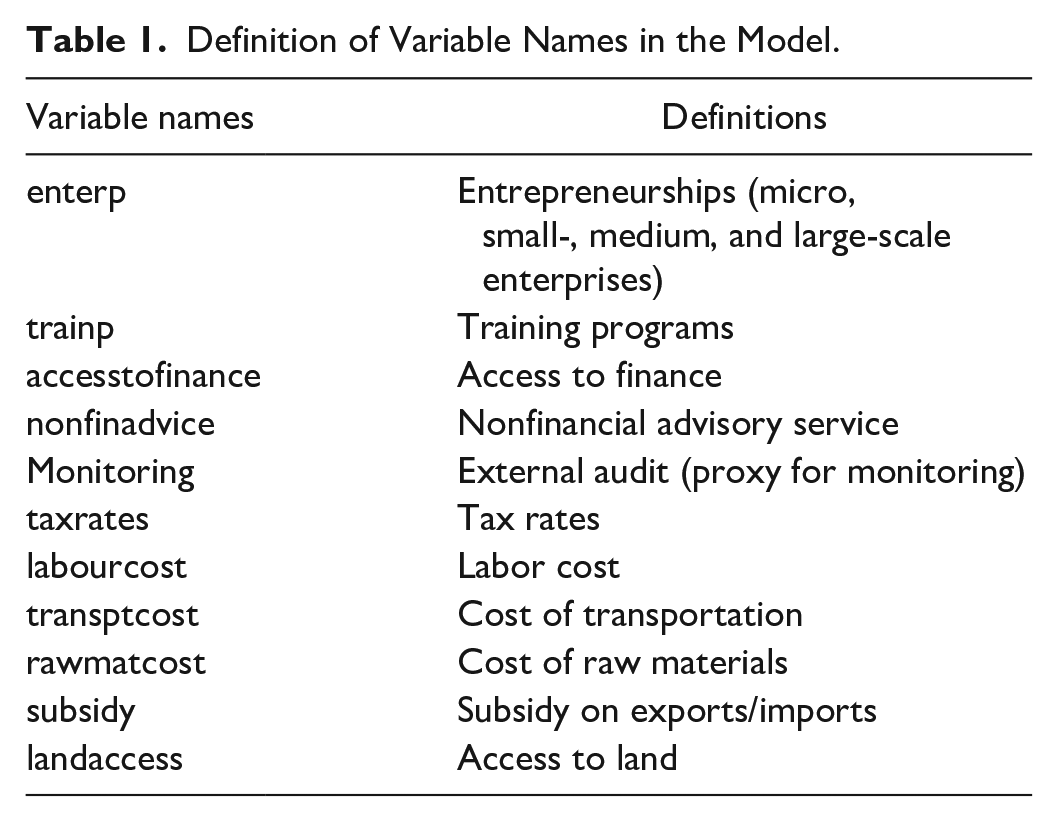
However, itemizing the variables of the model and respecifying them in functional form yield Equation 4:

where the variables are as defined in Table 1.
Definition of Variable Names in the Model.
Data Sources
The data used in this study came from Nigerian enterprise survey data (2014). The survey is a firm-level survey of a representative sample of Nigerian economy’s private sector (Enterprise Surveys & The World Bank, 2014). The survey covers a broad range of business environment topics including access to finance, corruption, infrastructure, crime, competition, and performance measures. This firm-level survey has been conducted since the 1990s by different units within the World Bank. Since 2005–2006 till date, most data collection efforts have been centralized within the Enterprise Analysis Unit. The sampling methodology for this Enterprise Survey is stratified random sampling. The survey captured 2,676 firms in Nigeria and this forms the sample size for the study.
Results and Interpretations
The likelihood ratio (LR) chi-square, χ2(29), of 94.25 with a p value of .0000 indicates that the model as a whole fits significantly better than an empty model (i.e., a model with no predictors). The base or reference category is the small-scale enterprise (that comprises 5–19 entrepreneurs). Hence, it forms the base to which other categories would be compared.
Comparing Micro and Small-Scale Enterprises
The summary results of the Mlogit model comparing micro and small-scale enterprises can be seen in Table 2.
Summary Results of Mlogit Model Comparing Micro and Small-Scale Enterprises.

The results of the multinomial logistic regression model indicate that a unit increase in the training program (trainp) is associated with a 0.0668003 significant decrease in the relative log odds of being in micro enterprise versus youths in small-scale enterprise. The implication here is that even as entrepreneurship trainings are being provided to youths in Nigeria, the trainings received by youths in micro enterprises with respect to those in small-scale enterprises have not yielded the desired result due to the fact that they have not been sustainable, prone to corruption, nepotism, and other bottlenecks in the country. This finding is in line with the finding of Ukpong and George (2012), Okoye et al. (2014) and Ayoade and Agwu (2016) who found that majority of government training and intervention programs failed to produce the expected results and meaningful jobs to majority of youths because they are not sustained and are bedeviled with some bottlenecks such as corruptions, bureaucratic bottleneck relating to inconsistencies in government policies, political instability, and lack of entrepreneurial skill.
An improvement in access to finance (accesstofinance) is associated with a 0.0208964 significant increase in the relative log odds of being in micro enterprise against youths in the small-scale enterprise. The implication here is that if youth entrepreneurs who are in micro enterprises relative to those in small-scale enterprises have more access to finance, they will be more empowered and the tendency to fail would be very minimal with more financial access. This is in line with the study of Ukpong and George (2012) and Okoli and Okoli (2013) who found that giving more credit access, skills, and support to youth entrepreneurs will create more jobs for the unemployed youths.
The relative log odds of youths in micro business getting nonfinancial advisory services (nonfinadvice) compared with those in small-scale enterprise significantly decrease by .0380293. The implication here is that after training and financial support, young entrepreneurs who are in micro enterprise compared with those in small-scale enterprises are left without other business advices which can help them grow and sustain the business. This actually militates against entrepreneurship growth and development. This finding supports the findings by Bogoro (2015) and Ogbondah and Nwogu (2017) who found that entrepreneurship education is very low in Nigeria.
A unit rise in monitoring (external audit) is associated with a 0.1131828 significant decrease in the relative log odds of youths being in micro businesses compared with those in small-scale enterprise. The implication here is that after training and financial support, young entrepreneurs in micro businesses compared with those in small-scale enterprises are also left without monitoring by their benefactors to help sustain the business. Benefactors feel that once the empowerment is done, the process is completed. Without adequate monitoring and offering of business advices which can help them grow and sustain the business, micro businesses compared with those in small-scale enterprises may not grow in Nigeria.
It was further found that the relative log odds of being in micro enterprise compared with those in small-scale enterprise would fall insignificantly by 0.1321009 if entrepreneurs in Nigeria have unfavorable tax rates. The implication here is that if government taxes are high and inconvenient to entrepreneurs in micro businesses compared with those in small-scale enterprises, it will definitely retard entrepreneurship growth and development. Hence, if government plans to increase per capita income of young entrepreneurs in micro businesses compared with those in small-scale enterprise, it can decide to reduce their taxes.
A one Naira increase in labor cost (labourcost) is associated with a 0.0531209 significant decrease in the relative log odds of youths being in micro enterprise compared with those in small-scale enterprise. The implication here is that with a high labor cost, entrepreneurs in micro businesses compared with those in small-scale enterprises will start losing interest in investing in businesses in Nigeria. With high labor cost, entrepreneurs in micro businesses compared with those in small-scale enterprises may start moving to other countries where labor cost is relatively cheap. The reverse is the case when labor cost is cheap.
Improved transportation system and/or favorable transportation cost (transptcost) is associated with a 0.1743084 insignificant increase in the relative log odds of being in micro enterprise against youths in the small-scale enterprises. The implication here is that with a high transportation cost, entrepreneurs in micro businesses compared with those in small-scale enterprises may start looking for alternative means of transport, but where it is unavailable, they may start considering investing in other countries with better ease of doing businesses. They may as well shift the transportation burden to consumers of the products if the good is inelastic. The reverse is the case when transportation cost is cheap.
A one Naira increase in the cost of raw materials (rawmatcost) is associated with a 4.841209 significant increase in the relative log odds of youths investing in micro enterprise with respect to those in small-scale enterprise. This result is not surprising as it is expected that high cost of raw materials would scare away investors, whereas low cost of raw materials will encourage investors. The implication here is that youths investing in micro enterprise with respect to those in small-scale enterprises will rise with cheap raw materials but would fall with expensive raw materials. Hence, low cost of raw materials would encourage entrepreneurship growth and development, hence leading to economic diversification.
It was further found that the relative log odds of being in micro enterprise against those in small-scale enterprises would rise significantly by 0.0856687 if Nigerian government improves on the exports/imports subsidies (subsidy). This result is not surprising as it is expected that an increase in export/import subsidies would on an average attract more entrepreneurs to invest more in micro enterprise compared with those in small-scale enterprises. However, the implication here is that with increased export/import subsidies, goods exported/imported would be cheap and hence make consumers to consume more of the goods, thereby making demand to skyrocket. When this occurs, investors in micro enterprise compared with those in small-scale enterprises would be faced with significant profits surge as expected and as such would lead to sustained business operation. This will make micro enterprise compared with those in small-scale enterprises to remain in business, thereby leading to entrepreneurship growth and development, which, in turn, brings about economic diversification of the country.
An improvement in access to land (landaccess) is associated with a 0.1200678 insignificant increase in the relative log odds of being in micro enterprise against youths in the enterprise of small-scale business. The implication here is that increased and easy access to land by youth entrepreneurs in micro business with respect to those in small-scale enterprise would on an average encourage entrepreneurship growth and development, hence leading to economic diversification that will bring about economic growth and development.
Comparing Medium Enterprise and Small-Scale Enterprise
The summary results of Mlogit model comparing medium enterprise and small-scale enterprise can be seen in Table 3.
Summary Results of Mlogit Model Comparing Medium and Small-Scale Enterprises.

It was found from the results of the multinomial logistic regression model that a unit increase in the training program (trainp) is associated with a 0.0601907 significant decrease in the relative log odds of being in medium enterprise versus youths in small-scale enterprise. The implication here is that irrespective of the entrepreneurship trainings provided to youths in Nigeria, the trainings received by youths in medium enterprise with respect to those in small-scale enterprise have not yielded the desired result due primarily to the fact that they have not been sustainable, prone to corruption, nepotism, and other bottlenecks in the country. This finding is also in line with the finding of Ukpong and George (2012), Okoye et al. (2014), and Ayoade and Agwu (2016) who found that majority of government training and intervention programs failed to produce the expected results and meaningful jobs to majority of youths because they are not sustained and are bedeviled with some bottlenecks such as corruptions, bureaucratic bottleneck relating to inconsistencies in government policies, political instability, and lack of entrepreneurial skill.
An improvement in access to finance (accesstofinance) is associated with a 0.0834725 significant increase in the relative log odds of being in medium enterprise against youths in the small-scale enterprise. The implication here is that if youth entrepreneurs who are in medium enterprise relative to those in small-scale enterprise have more access to finance, they will be more empowered and the tendency for business expansion with more financial access will rise significantly. This is in line with the study of Ukpong and George (2012) and Okoli and Okoli (2013) who found that giving more credit access, skills, and support to youth entrepreneurs will create more jobs for the unemployed youths.
The relative log odds of youths in medium business getting nonfinancial advisory services (nonfinadvice) compared with those in small-scale enterprise significantly decrease by 0.0764041. The implication here is that after training and financial support, young entrepreneurs who are in medium enterprise compared with those in small-scale enterprise are left without other business advices which can help them grow and sustain the business. This actually militates against entrepreneurship growth and development. This finding supports the findings by Bogoro (2015) and Ogbondah and Nwogu (2017) who found that entrepreneurship education is very low in Nigeria.
A unit rise in monitoring (external audit) is associated with a 0.0400363 significant rise in the relative log odds of youths being in medium businesses compared with those in small-scale enterprise at 5% level of significance. The implication here is that after training and financial support, young entrepreneurs in medium businesses with respect to those in small-scale enterprise are also left without monitoring by their benefactors to help sustain the business. Benefactors feel that once the empowerment is done, the process is completed. Without adequate monitoring and offering of business advices which can help them grow and sustain the business, medium businesses compared with those in small-scale enterprises may not grow in Nigeria.
It was further found that the relative log odds of being in medium enterprise compared with those in small-scale enterprise would rise insignificantly by 0.0066299 if entrepreneurs in Nigeria have favorable tax rates. The implication here is that low and convenient government taxes levied on entrepreneurs in medium businesses compared with those in small-scale enterprise will on an average encourage entrepreneurship growth and development. Hence, if the government tax policy option is to empower and/or to increase per capita income of young entrepreneurs in medium enterprises compared with those in small-scale enterprises, it can decide to reduce taxes levied on them.
A one Naira increase in labor cost (labourcost) is associated with a 0.8970912 significant rise in the relative log odds of youths being in medium enterprise compared with those in small-scale enterprise at 5% level of significance. This result is surprising as it is expected that with a high labor cost, entrepreneurs in medium businesses with respect to those in small-scale enterprises would like to move to other areas or countries where labor cost is relatively cheap. They would like to maximize the benefit of cheap labor, to reduce cost, for more global competitive advantages.
Very high transportation cost and/or unfavorable transportation system (transptcost) is associated with a 0.0824484 significant decrease in the relative log odds of being in medium enterprise against youths in the small-scale enterprise. The implication here is that with a cheap transportation cost, entrepreneurs in medium compared with those in small-scale enterprise would on an average increase the ease of doing businesses in the country, hence making more entrepreneurs in medium enterprise compared with those in small-scale enterprise to invest more. This will lead to entrepreneurship growth and development and as such contribute significantly to economic diversification.
A one Naira increase in the cost of raw materials (rawmatcost) is associated with a 7.791033 significant decrease in the relative log odds of youths being in medium enterprise with respect to those in small-scale enterprise. This result is not surprising as it is expected that high cost of raw materials would scare away investors, whereas low cost of raw materials will encourage investors. The implication here is that youths investing in medium enterprise with respect to those in small-scale enterprise will rise with cheap raw materials but would fall with expensive raw materials. Hence, low cost of raw materials would encourage entrepreneurship growth and development, thereby leading to economic diversification.
It was further found that the relative log odds of being in medium enterprise against those in small-scale enterprise would fall insignificantly by 0.0138662 if Nigerian government improves on the exports/imports subsidies (subsidy) of entrepreneurs. This result is surprising as it is expected that an increase in export/import subsidies would on an average attract more entrepreneurs to invest more in medium enterprises compared with those in small-scale enterprise. However, the implication here is that with increased export/import subsidies, goods exported/imported would be cheap and consumers may think they are inferior goods, thereby making demand to be low. When this occurs, investors in medium enterprises compared with those in small-scale enterprise may not make profits as expected and as such may go out of business, thereby hampering economic diversification.
An improvement in access to land (landaccess) is associated with a 0.0587224 insignificant decrease in the relative log odds of being in medium enterprise against youths in the small-scale enterprise. This result is surprising as it is expected that increased and easy access to land by youth entrepreneurs in medium business with respect to those in small-scale enterprise would on an average encourage entrepreneurship growth and development, hence leading to economic diversification that will bring about economic growth and development.
Comparing Large Enterprises and Small-Scale Enterprises
The summary results of the Mlogit model comparing large enterprises and small-scale enterprises can be seen in Table 4.
Summary Results of Mlogit Model Comparing Large and Small-Scale Enterprises.

The results of the multinomial logistic regression model indicate that a unit increase in the training program (trainp) is associated with a 0.0531171 significant increase in the relative log odds of being in large enterprise versus youths in small-scale enterprise. The implication here is that in Nigeria, the entrepreneurship trainings received by youths in large enterprises with respect to those in small-scale enterprises yields more significant desired results due to the fact that they are more sustainable, compared with the trainings being received by those in small-scale enterprise. This therefore implies that entrepreneurship trainings received by youths in large enterprises are less prone to corruption, nepotism, and other bottlenecks in the Nigeria. This finding disagrees with the finding by Ukpong and George (2012), Okoye et al. (2014), and Ayoade and Agwu (2016) who found that majority of government training and intervention programs failed to produce the expected results and meaningful jobs to majority of youths because they are not sustained and are bedeviled with some bottlenecks such as corruptions, bureaucratic bottleneck relating to inconsistencies in government policies, political instability, and lack of entrepreneurial skill.
An improvement in access to finance (accesstofinance) is associated with a 0.0321428 significant increase in the relative log odds of being in large enterprise against youths in the small-scale enterprise. The implication here is that if youth entrepreneurs who are in large enterprises relative to those in small-scale enterprises have more access to finance, they will be more empowered and the tendency to fail would be very minimal with more financial access. Business expansion and economic diversification would also be possible given increased financial access by large enterprises. This is in line with the study of Ukpong and George (2012) and Okoli and Okoli (2013) who found that giving more credit access, skills, and support to youth entrepreneurs will create more jobs for the unemployed youths.
The relative log odds of youths in large enterprise getting nonfinancial advisory services (nonfinadvice) compared with those in small-scale enterprise significantly decrease by 0.1588974. The implication here is that after training and financial support, young entrepreneurs who are in large enterprise compared with those in small-scale enterprises are left without other business advices which can help them expand their business capabilities and sustain the business as well. This actually militates against entrepreneurship growth and development that in turn hamper economic diversification in the country. This finding supports the findings by Bogoro (2015) and Ogbondah and Nwogu (2017) who found that entrepreneurship education has not been sufficient and sustainable in Nigeria.
A unit rise in monitoring (external audit) is associated with a 0.0722809 significant rise in the relative log odds of youths being in large enterprise compared with those in small-scale enterprise at 5% level of significance. The implication here is that after training and financial support, young entrepreneurs in large enterprises with respect to those in small-scale enterprise are also left without monitoring by their benefactors to help expand and sustain the business. Benefactors feel that once the empowerment is delivered to the youths, the process is completed. Without adequate monitoring and offering of business advices to help them expand and sustain the business, large enterprises compared with those in small-scale enterprises may also not survive business complexities in Nigeria.
It was further found that the relative log odds of being in large enterprise compared with those in small-scale enterprise would rise insignificantly by 0.1590309 if entrepreneurs in Nigeria have favorable tax rates. The implication here is that low and convenient government taxes levied on entrepreneurs in large enterprises compared with those in small-scale enterprise will on an average encourage entrepreneurship expansion, growth, and development. Hence, if the government tax policy option is to empower and/or to increase per capita income of young entrepreneurs in large enterprises compared with those in small-scale enterprises, it can decide to reduce taxes levied on them. This would encourage entrepreneurship expansion, growth, and development, and hence lead to economic diversification of the Nigerian economy.
A one Naira increase in labor cost (labourcost) is associated with a 2.770284 significant rise in the relative log odds of youths being in large enterprise compared with those in small-scale enterprise. This result is surprising as it is expected that with a high labor cost, entrepreneurs in large enterprises with respect to those in small-scale enterprises would like to move to other areas or countries where labor cost is relatively cheap. They would like to maximize the benefit of cheap labor, to reduce cost, for more global competitive advantages.
Improved transportation system and/or favorable transportation cost (transptcost) is associated with a 0.1298346 insignificant increase in the relative log odds of being in large enterprise against youths in the small-scale enterprises. The implication here is that with a high transportation cost, entrepreneurs in large enterprises compared with those in small-scale enterprises may start looking for alternative means of transport, but where it is unavailable, they may start considering investing in other countries with better ease of doing businesses. They may as well shift the transportation burden to consumers of the products if the good is inelastic. The reverse is the case when transportation cost is cheap.
A one Naira increase in the cost of raw materials (rawmatcost) is associated with a 3.721022 significant fall in the relative log odds of youths being in large enterprise with respect to those in small-scale enterprise. This result is not surprising as it is expected that high cost of raw materials would scare away investors, whereas low cost of raw materials will encourage investors. The implication here is that youths investing in large enterprise with respect to those in small-scale enterprise will rise with cheap raw materials but would fall with expensive raw materials. Hence, low cost of raw materials would encourage entrepreneurship growth and development, thereby leading to economic diversification.
It was further found that the relative log odds of being in large enterprise against those in small-scale enterprises would rise significantly by 0.1446063 if Nigerian government improves on the exports/imports subsidies (subsidy). This result is not surprising as it is expected that an increase in export/import subsidies would on an average attract more entrepreneurs to invest more in large enterprise compared with those in small-scale enterprises as they have more incomes available to them for business. However, the implication here is that with increased export/import subsidies, goods exported/imported would be cheap, and hence make consumers to consume more of the goods, thereby making demand to skyrocket. When this occurs, investors in large enterprise compared with those in small-scale enterprises would be faced with significant profits surge as expected and as such would lead to sustained business operation. This will make large enterprises compared with those in small-scale enterprises to remain in business, thereby leading to entrepreneurship growth and development, which in turn brings about economic diversification of the country.
An improvement in access to land (landaccess) is associated with a 0.0591366 insignificant increase in the relative log odds of being in large enterprise against youths in the enterprise of small-scale business. The implication here is that increased and easy access to land by youth entrepreneurs in large enterprises with respect to those in small-scale enterprises would on an average encourage entrepreneurship growth and development, hence leading to economic diversification that will bring about economic growth and development.
Conclusion and Recommendations
The study tried to examine whether empowering the youths has significantly contributed to the growth of entrepreneurships, thereby leading to economic diversification in Nigeria. It was therefore found by the study that almost all the variables used to capture entrepreneurship growth and development in Nigeria are statistically significant except for tax rates, transportation cost, and land access (comparing micro and large enterprises with the small-scale enterprise), tax rates, subsidy, and land access (comparing medium enterprise with small-scale enterprise).
The training variable has negative significant impact on micro and medium enterprises compared with small-scale enterprises. This indicates that the efforts of Nigerian government and its various agencies, World Bank, NGOs, and even private philanthropists initiatives of training and empowering the youths in various entrepreneurships, have not yet transcended to significant entrepreneurship growth and development in Nigeria.
Thus, for government to reduce overdependence on oil revenue, poverty, and enhance creation of jobs for increased incomes to individuals and government, enormous efforts are still required to achieve economic diversification that will lead to speedy economic growth and development in Nigeria.
For example, governments at all levels and its various agencies, World Bank, NGOs, and even private philanthropists, need to do more on entrepreneurship training programs of youths. The training should not end there. It should be accompanied with sustained financial and nonfinancial support and monitoring of these entrepreneurs after empowering them. This is because it has been observed that after the usual empowerment training and financial support, entrepreneurs are left alone by their benefactors. For this reason, they tend to divert the funds and go away entirely from the objective of the empowerment programs they received.
In addition to the above, the cost of transportation, raw materials, and obtaining land is still very high for these young entrepreneurs owing to the fact that there exist poor/inadequate infrastructure, poor development of local raw materials, and the problem of land tenure system. Hence, governments at all level should strive harder to provide more infrastructure, develop and encourage the utilization of local raw materials in production, and address the land tenure system. This will lead to more job creation, poverty reduction, a boost in per capita income generation of the people, and hence more income to the government. This will eventually lead to economic diversification, thereby bringing about economic growth and development.
Tax rates should also be looked at by government to avoid multiple taxes as it was found by the study that it retards entrepreneurship growth, especially that of micro enterprise. Subsidy should also be granted to young entrepreneurs to help them in global competitiveness. This will increase entrepreneurship growth and development, encourage economic diversification, and bring about economic growth and development.
Footnotes
Declaration of Conflicting Interests
The author(s) declared no potential conflicts of interest with respect to the research, authorship, and/or publication of this article.
Funding
The author(s) received no financial support for the research, authorship, and/or publication of this article.
