




Abstract
Out of school youth (OSY) are adolescents who have not completed their schooling and are not currently enrolled in school. This study sought to understand why learners drop out of school by interviewing 41 OSY (aged 13–20 years). Respondent Driven Sampling was used to recruit OSY. Content analysis was used to analyze the data. Gender differences were found in the reasons for leaving school. Males dropped out due to poor school performance, vocational aspirations, and social interactions at school. Females dropped out due to family-related reasons. In males and females, friends played a role in students dropping out of school. Participants who performed well academically left school to be with their OSY friends. Those who did not pass and had friends who progressed to the next grade also dropped out of school. Preventing students from early school leaving involves targeting the interpersonal, school and policy levels with gender-specific intervention.
Plain Language Summary
The benefits of attending school until full completion include increased employment opportunities, skills development, reduced crime, and risky behaviour, equality, better health, and an increased sense of self-worth. With these benefits, preventing early school leaving is a global priority. This study investigated why learners drop out of school in South Africa, by interviewing 41 school dropouts between 13-20 years of age. The study found that males were more likely to leave school due to poor school performance or problems with their peers or teachers. Males also left school to pursue artisanal college training, with the aim of securing employment. Females were found to leave school due to caretaking responsibilities and financial insecurity. Participants who performed well academically left school to be with their friends who dropped out of school. Those who did not pass and had friends who progressed to the next grade also dropped out of school. Giving voice to adolescents who have dropped out of school gives us clues on how to prevent school dropout at the school, community, and policy levels. The study implications include the introduction of remote learning resources, exempting students from paying tuition fees, better tracking and tracing tools for school dropouts, and support for pregnant learners.
Introduction
In 2018, approximately 258 million youth globally had either never started or left school early (UNESCO, 2019). Of these, 24 million are at risk of not returning to school because of the COVID-19 pandemic (UNESCO, 2020). Out of school youth are adolescents who have not received a school diploma and are not currently registered at a school (UNESCO, 2015). Over half of all out of school youth (OSY) live in sub-Saharan Africa (UNESCO, 2019). In South Africa, 232,000 out of 11.6 million youth (7–17 years) were not attending school in 2018, and this rate has more than tripled during the pandemic (UNESCO, 2020). South Africa also has the highest unemployment rate in the world (World Bank, 2020), with youth (15–24 years) accounting for 63.9% of those unemployed, and only 44% had completed secondary school (Stats SA, 2021).
The benefits of attending school until full completion include increased employment opportunities, skills development, reduced crime and risky behavior, equality, better health, and an increased sense of self-worth. In low-middle-income countries such as South Africa, school dropout is related to poverty and inequality, which are threats to the current generation and future generations to come (Sulla & Zikhali, 2018). Understanding student’s reasons for leaving school is therefore necessary and a global priority.
South African studies conducted before the COVID-19 pandemic found that the reasons for dropout differed between studies and were due to poverty (De Wet & Mkwananzi, 2014; Flisher et al., 2010), high use of substances (De Wet & Mkwananzi, 2014; Desai et al., 2019; Flisher et al., 2010; Townsend et al., 2007; Weybright et al., 2017), bullying (Townsend et al., 2008), boredom (Wegner et al., 2008; Weybright et al., 2017), family needs (helping with the household income, pregnancy and caretaking responsibilities) (De Wet & Mkwananzi, 2014; Flisher et al., 2010; Lloyd & Mensch, 2008), illness (Branson et al., 2014; De Wet & Mkwananzi, 2014), disability (De Wet & Mkwananzi, 2014), community violence (De Wet & Mkwananzi, 2014), and school factors (poor school performance, disliking school, conflict with teachers and being too old for the class and disciplinary consequences) (Branson et al., 2014; De Wet & Mkwananzi, 2014; Flisher et al., 2010; Motala et al., 2009). In addition, a large number of participants in two South African studies by Desai et al. (2019) and Branson et al. (2014) cited “other” reasons for leaving school which warrants further exploration.
There may be multiple contributing pathways leading to school dropout. A longitudinal cohort study in the USA tested five theories in predicting school dropout (academic mediation theory, general deviance theory, deviant affiliation theory, poor family socialization theory and structural strains theory). This study found that no theory was fully adequate in explaining school dropout, but there was partial support for aspects of each theory in predicting school dropout and the best model in predicting school dropout included aspects of the family, school, peer, and community (Battin-Pearson et al., 2000). This study, therefore, proposes an ecological model, adopted from Bronfenbrenner (Bronfenbrenner, 1977). The ecological model posits that school dropout is based on the interrelationships between individual learners and multiple systems connected to them. These systems exist at the community level (relationships with friends, family and teachers), societal level (poverty, social norms, gender roles and cultural values), and political level (public educational policy and political structures). This study, therefore, proposes that the construction of adolescents’ realities is dependent on their interaction and relationship with these systems that could have a direct or indirect influence on their life. An accumulation of challenges within the wider social systems and the individual may result in learners dropping out of school.
Many studies that have investigated the reasons for leaving school in South Africa have been quantitative. While these studies are useful in identifying at risk youth and understanding the extent of the dropout problem, it is important to investigate these reasons from the adolescents’ own perspective and how they experience and describe their school dropout. These voices are important in initiating public debate and drawing policy maker’s attention to a subject and to a population who are usually overlooked. Only one South African study has used a qualitative method to examine the reasons for dropout and it showed that poverty contributed to children dropping out of school (Porteus et al., 2000). However, that study focused on a sample of 7- to 15-year-old dropouts. To our knowledge, no study has been conducted on 13- to 20-year-old dropouts using a qualitative approach. Our study includes slightly older participants because schooling is mandatory for all South Africans from 6 years of age (grade 1) to 15 years (grade 9). Furthermore, studies have shown that the rate of dropout dramatically increases from 16 years of age onward (Grade 10) (Desai et al., 2019; Hall & De Lannoy, 2019). Therefore, it is useful to study slightly older individuals (13–20 years) as they may have reasons for leaving school that are not applicable to younger children such as leaving school for employment, and caretaking responsibilities. The aim of this study is to elucidate rich narratives of lived experiences from adolescents who have dropped out of school for the purpose of identifying new intervention entry points for adolescents, their parents, schools, and policy.
Materials and Methods
Study Setting
This study was conducted between January and September 2018, in the City of Cape Town an urban district, located within the Western Cape, the fourth largest province in South Africa.
Schooling in South Africa spans from Grade 1 to Grade 12, with 9 years of compulsory schooling for all South Africans from 6 years of age (Grade 1) to 15 years (Grade 9). Based on the socio-economic profile of the community, South African schools are divided into quintiles and have different funding allocations. Schools located in the lower socio-economic communities are classified as quintile 1, while quintile 5 schools are the schools located in higher socio-economic communities. Learners in schools that are classified as quintiles 1 to 3 are declared as “no fee schools” and students from Grade 1 to 9 benefit from a fee waiver. Those classified as quintile 4 and 5 public schools must supplement government funding by charging school fees. Conditional, partial, or full exemption from paying school fees are considered for caregivers who cannot afford to pay school fees (Department of Basic Education, 2019b). Although participants were not asked which school they had attended, they were recruited from urban communities that comprised of schools in quantiles 1 to 4.
Participants
Youth between the ages of 13 and 20 years who had not completed their high school diploma and were not attending school at the time of the study were eligible to participate. We consider OSY to be a hidden population because according to our knowledge, in South Africa, there is no sampling framework to determine the number of OSY. Thus, the size and boundaries of the population are unknown. Accessing such populations is therefore difficult. Studies have shown that although house to house recruitment may be feasible, chain referral such as Respondent Driven Sampling (RDS) is an efficient method for recruiting such samples (Heckathorn, 2002).
Procedures and Instruments
Qualified data collectors were trained in qualitative research methods and consenting procedures. They were all fluent in English, Afrikaans, or IsiXhosa; the local languages spoken in the communities. Using RDS to recruit participants, data collectors purposefully recruited the initial sample of OSY from youth groups and by approaching people in their community who appeared to be eligible for the study. The initial sample of OSY formed the “first wave” of sampling and consisted of eight participants. Each participant was asked to recruit at least two other OSY (Figure 1). Two waves of recruitment were conducted. Given the nature of RDS sampling, contacts that the potential participant provided were used to confirm the eligibility of the participant. Of the participants that were recruited, one participant was unavailable to do the interview, and another became ineligible due to not being between the ages of 13 and 20 years. The researchers hypothesized that 52 participants at most would be sufficient to reach saturation and answer the study research questions. Upon analysis, saturation was obtained after recruiting 41 participants. The interviews were conducted face-to-face and using text messaging on WhatsApp, an instant messaging cellular phone application. Twelve participants conducted the interview using WhatsApp while 29 interviews were done face-to-face.

A representation of the Respondent Driven Sampling approach using four initial OSY.
Using WhatsApp to conduct qualitative interviews was appropriate for this sample, given that OSY are considered a “hidden population” with no sampling frame (Matthews & Cramer, 2008). Previous studies have also shown that adolescents favor communicating using instant messaging (IM) Apps due to the increased anonymity and virtual distance created between researcher and participant (Shapka et al., 2016). Although the face-to-face interviewing method has been considered the gold standard, online interviewing saves cost and time, and it is convenient (Matthews & Cramer, 2008). Interviewers conducting online interviews using text built rapport by using emoticons and internet slang abbreviations such as “LOL,” which are commonly used and acceptable ways to convey emotion (Jowett et al., 2011). A study by Shapka et al. (2016) systematically compared face-to-face interviewing techniques to instant messaging interviewing via a computer and found no difference in number, depth and types of themes discussed (Shapka et al., 2016). Testing this latter assumption is beyond the scope of our study, but it is appropriate to use the content obtained from both interview types.
The face-to-face interviews were conducted in locations mutually agreed on between participant and interviewer, which was usually in the participant’s home, in a private space. The face-to-face interviews took approximately 30 minutes. WhatsApp interviews were conducted at a convenient time for the researcher and participants. With 1 hour of chat time per day, the WhatsApp interview took approximately 3 to 5 days to complete. Upon completing the interview, participants received a monetary reimbursement (50 ZAR) for their time. In addition, every participant who successfully recruited an individual and completed the interview received a monetary incentive (20 ZAR). The transcripts for both types of interviews were translated into English from Afrikaans and IsiXhosa and then back translated to check for consistency and correctness.
A semi-structured discussion guide was used to conduct the individual in-depth interviews. All authors had input in creating the questions for the discussion guide through a reflexive, iterative, and dialogic processes. The semi-structured discussion guide was designed in English and translated into the local languages as well. Participant’s basic demographics (age, gender, and race) and why they left school were recorded. Sub-questions and probes were developed such as the participant’s attitude toward early school leaving, how they currently spend their time and the role of their friends and family on their decision to leave school early. These open-ended questions were used to guide the interview.
Ethics Approval
Ethics approval was obtained (Protocol number: REC 2/23/08/17). Each participant gave full written informed consent. Permission for independent consent for minors was obtained, in line with the South African National Department of Health (2015) Ethics guidelines section 3.2.2.4. Obtaining independent consent from minors was appropriate for this study because youth may not have participated if they had to disclose their reasons for leaving school with their caregivers to gain their consent to participate.
Analysis
Atlas.ti Version 8 (Scientific Software Development GmbH) was used to code and analyze the data (Erlingsson & Brysiewicz, 2017). Data were analyzed using thematic content analysis. Thematic content analysis is an appropriate method for systematically organizing and identifying patterns of themes in a data set (Braun et al., 2019). The data analysis followed the six-phase approach for coding and analyzing qualitative data according to (Braun & Clarke, 2006). The first author carefully read all transcripts and noted initial ideas. Authors RD and AM coded four transcripts independently and blindly using an inductive approach. Both researchers discussed all discrepancies in the individual coding and reached consensus on the final codes. The final codebook (Table 1) was applied to the transcripts. The researchers assembled the data according to categories and overarching themes. A review of the identified themes was conducted where the researchers combined, refined, separated, or discarded initial themes. Lastly, the themes and potential subthemes within the data were refined and defined, and then produced in a logical and meaningful way in the manuscript.
Codes Used to Generate Themes.

Results
A total of 41 OSY comprising 22 females and 19 males participated in the study (Table 2). The average age of participants was 18 years. Multiple reasons for leaving school were found which were categorized into the following main themes: school performance and vocational aspirations, social interactions at school, and family-related reasons for leaving school. Attitudes toward school leaving were also captured. Extracts below are conversations between interviewer (I) and participant (P).
Sociodemographic Characteristics of the Sample.
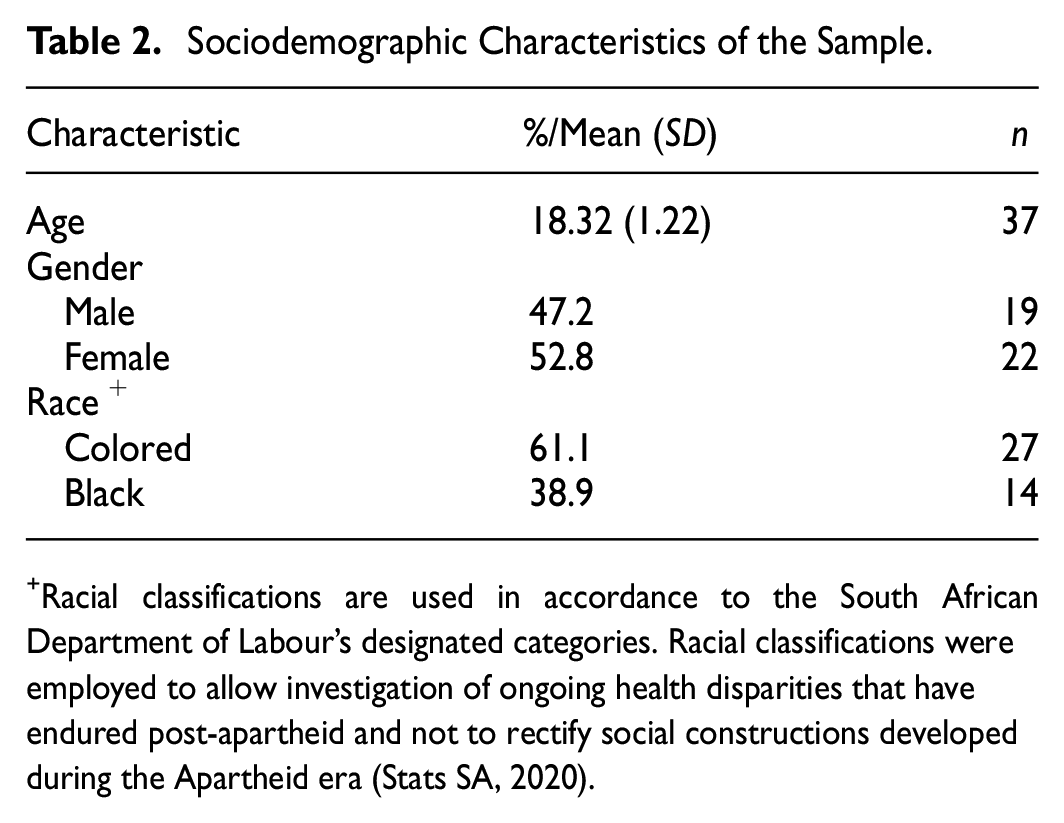
Racial classifications are used in accordance to the South African Department of Labour’s designated categories. Racial classifications were employed to allow investigation of ongoing health disparities that have endured post-apartheid and not to rectify social constructions developed during the Apartheid era (Stats SA, 2020).
School Performance and Vocational Aspirations
Reasons for leaving school that were related to school performance included poor academic performance and being too old. This reason was common among females in this sample.
Most participants (females n = 8, males n = 2) in this sample left school due to poor academic performance.
I dropped out when I was 18 in grade 12. I failed the previous year in grade 12 so when I had to repeat I didn’t go back. (Female participant, 20 years old)
In one instance, being pregnant led to poor academic performance due to being away from school for a protracted period.
I did not actually leave school I just stayed away because of circumstances. I gave birth in February 2017 and returned to school in May 2017. I could not catch up on all the work in that short period of time and the pressure was too much… (Female participant, 16 years old)
Some male participants (n = 2) in the sample did not want to return to school because they were too old for their grade and wanted to further their education at a college.
Even my mom wants me to go back to school but they cannot allow me at high school and doing Grade 10. I am old for going back to high school, I want to go to the college. (Male participant, 20 years old)
In South Africa, colleges offer career focused skills training which permit learners who have dropped out of school. In some cases, male (n = 2) and female (n = 1) participants left school early with the intention of attending college in the pursuit of a diploma certificate, allowing them to gain better job opportunities. However, at the time of the interview, these participants dropped out of school and were not currently enrolled in a college.
I passed grade 9, then I dropped. Then I…I tell myself no, I must go back to school, otherwise I’m not gonna make it, you see. That’s why I go to a college in Stellenbosch. (Male participant, 18 years old)
Social Interactions at School
Reasons for leaving school that were related to social interactions at school included friends who drop out of school, bullying and conflicts with teachers or peers. In our study, males commonly cited these reasons for leaving school.
Friends who had failed had a major influence on the participants’ decision to join them in not attending school. Those who performed academically well would drop out of school to be with their friends who dropped out. This was found in both male and female participants.
…I will say it was stupid of me because I was at the point to finish and it was when I was in grade 11 when all my friends dropped out. I was the only one still in school, so I decided that I also want to drop out… (Female participant, 19 years old)
Moreover, while some participants performed poorly academically and were not allowed to progress to the next grade, these participants also had friends that had passed and progressed to the following grade. Not being with friends in the same grade may have contributed to participants leaving school early.
“Why you want to move to another school?
Because I failed and my friends moved to another grade and I stayed in the same class, then I decided to stop.” (Female participant, 16 years old)
Although less commonly cited in this study, bullying (n = 1) at school was a factor that led participants to leave school among males.
The reason why I left school was in the mornings when I went to school, I was bullied at school or on my way to school they bullied me. So I could not go back to school, so I left school. (Male participant, 17 years old)
Another participant left school due intimidation by gang members, which may be related to bullying.
“I …And how has leaving school not been so good for you? So, you said that it hasn’t been good. How has it not been so good?
Ja because it was, at school the other gang was looking for us there man. So I must leave school.
So the other gangsters were looking for you in school? So you must… you were forced to leave school, because of them?”
[Nods with his head] (Male participant, 18 years old)
Some males (n = 6) in our study left school due to conflicts with teachers or peers.
This other boy and myself we were gambling in class, he failed, and I passed. When I got to grade 7, the teacher was scared of this boy. While we were gambling, she came straight to me and said [name] I don’t want you in my class. The next day when I went to school, she put me out her class again. Every day she put me out. After a while I decided what is the use of going to school just to come back home again. (Male participant, 17 years old)
In one case, a female participant left school due to sexual harassment by a teacher.
what made you leave school?
I was abused at school by my [name] teacher, whilst I was doing grade 9.” (Female participant, 17 years old)
Family-Related Reasons for Leaving School
Reasons for leaving school that were family related included financial problems, lack of family support, and falling pregnant. Family-related reasons were common among female participants in this study.
Males (n = 3) and females (n = 6) in this study left school due to their parents or guardians not being able to afford the school fees or other school related costs due to their caregivers being unemployed and being from single-parent households.
The reason I didn’t go back to school it’s because I struggled to get a bursary and they want lots of things. My mom is not working, I don’t have a father and my mom is struggling to get a grant. My mom has chronic illness and she takes pills every day, but she is not getting any government support. There is no income in our household. (Female participant, 19 years old)
Male (n = 1) and female (n = 1) participants cited that the traumatic death of a parent or guardian resulted in no family support to continue attending school.
The reason why I don’t attend school any longer is because they shot my mom dead, understand sister, and lots of things at school which my mom attended and now she can’t be there, she is buried. All those things and I couldn’t cope with that, understand, I came to that point. That is how things are. (Male participant, 19 years old)
Some participants (males n = 1, females n = 4) felt that they were neglected by their parents or guardians, which also led them to leave school.
I left school because my mother did drugs, my father was in jail so I thought that there is no one that cared about me. So I left school. (Female participant, 20 years old)
Other participants (n = 5) left school due to being pregnant and feelings of embarrassment for being pregnant at school.
Because I found out that I was pregnant, so I was shy…
And then you decided that you don’t want to attend school anymore…?
Yes I was too scared that they would judge me.” (Female participant, 19 years old)
Attitudes Toward Early School Leaving
All participants had the perception that school completion would have increased their sense of self-worth, provided better financial opportunities, and enabled them to be positive role models for others.
No, it’s not a good thing. My dreams didn’t go as I wished. My aims were to finish school, get married, buy a house, to have kids, to buy a car, get a good job, and fix my home. But I cannot do all of those things because I am a school dropper (Male participant, 18 years old)
However, barriers encountered either at school or in their home environment provoked them to drop out. Most participants (n = 31) stated that at the time they made the decision to leave school, they felt a sense of relief, but this perception evolved into feelings of regret. Participants who left school with the intention of looking for employment and becoming independent from their family found challenges in seeking employment and were all unemployed at the time of the interview. Participants also stated that their perceived inadequacies at school, particularly in their academic competence and not getting along with peers or teachers made them unmotivated to return to school. On the other hand, they also reported on how they miss the routine and social aspects of going to school. Circumstances independent of the participants such as lack of financial support and motivation from their families to continue school also led to their dropout.
“How has leaving school been good for you?
At first it was good I enjoyed the freedom of not waking up to go to school and sleeping late and going out with friends but now I regret it because I miss school and I should’ve been doing my second year so that I can improve my economic status. (Female participant, 20 years old).
“I did not have a choice I had to quit school due to circumstance that was beyond my control. I am not happy about to leaving school. I get very sad when I see others progress to Universities….I was not struggling at school at all, I enjoyed studying my books. I was also an SRC (student representative council) member when I started in high school. (Female participant, 19 years old).
Some participants associated positive experiences with leaving school. A female participant who fell pregnant felt that her responsibility had shifted to taking care of her new-born. Leaving school had also given adolescents a new sense of purpose, independence, and freedom, relieving the financial burden on their family, and relief of not having to feel inadequate at school.
“How did it benefit you to have left school?
I can spend more time with my baby because of circumstances because he is teething. I have nothing else to do at the moment other than sitting at home.” (Female participant, 16 years old)
Discussion
This study explored the reasons why youth in South Africa drop out of school, with a focus on older youth between 13 and 20 years of age. The findings indicate that there is a complex association between interpersonal, home, and school level factors that contribute to a learner’s decision to drop out of school. The overarching reasons for dropping out of school reported by OSY in this study were school-related reasons such as poor school performance, vocational aspirations, social interactions and family-related reasons such as falling pregnant, lack of family support and financial difficulties, all of which concur with previous findings of South African studies (Branson et al., 2014; De Wet & Mkwananzi, 2014; Desai et al., 2019; Flisher et al., 2010; Porteus et al., 2000; Townsend et al., 2007, 2008). Unique reasons and lived experiences leading to school dropout were also found in this study which were being too old for school, seeking employment to alleviate household financial difficulties and leaving school with the intention to pursue a college diploma.
Our study found that friends tend to play a role in students leaving school, and these were two-fold. Those who performed academically well would drop out to be with their friends who had also dropped out of school. Similarly, a previous study conducted among high school students in Canada found that actual dropouts and future dropouts have more peer social networks containing friends who have dropped out of school (Ellenbogen & Chamberland, 1997). Those who were the only ones among their friends who did not pass and progress to the next grade also dropped out of school. This is not surprising given that adolescence is a critical period during which peers play an important role in developing a sense of belonging, identity and support (Johnson et al., 2011). Since peer networks play a crucial role in youth development, it would be useful for studies to examine the differences in peer networks between those prone to dropping out and their counterparts in the South African context.
This study found gender differences in the reasons for dropping out of school. We found that more males left school due to school-related factors such as poor academic performance, vocational aspirations, and social interactions at school, compared to females. These findings concur with other South African studies which cited poor academic performance (De Wet & Mkwananzi, 2014), being too old for school (Branson et al., 2014; Motala et al., 2009) and conflict with peers or teachers as reasons for school dropout (Branson et al., 2014). Schools are active, dynamic settings that may contribute to student success. A study in the United States found that schools with low dropout rates tend to have clear policies and disciplinary procedures; provide a nurturing and safe learning environment and had additional support systems for teachers and students (Christle et al., 2007). Although there is a dynamic interplay of interpersonal, household, and community factors that may place youth at risk for early school leaving, schools can provide protective factors that may reduce early school leaving by providing a nurturing and safe learning environment that is central to the student and teacher needs. More studies are needed to explore the characteristics of South African schools with high dropout rates, with a view to improve the school climate, resources, infrastructure, policy, and practice.
Males in our study also reported bullying as a reason for dropping out of school. This is in contrast to a previous South African study which found that females were more likely to leave school due to bullying (Townsend et al., 2008). Gang violence culture is entrenched in the Western Cape and gang involvement and bullying are significant problems in South African schools, which contribute to early school dropout among males (Mncube & Madikizela-Madiya, 2014; Mncube & Steinmann, 2014). School and community violence need to be addressed to foster better learning environments for youth.
Other South African studies have suggested that males are more likely than females to leave school to contribute to the household income (Branson et al., 2014; De Wet & Mkwananzi, 2014; Flisher et al., 2010). We also found that males left school with the intention to pursue a college diploma, possibly to ensure better employment opportunities. A previous study in Ghana also found that students dropped out of school because they could see no value in it, or they struggled academically and left to pursue a vocational or artisanal training (Ananga, 2011). To motivate further artisanal and vocational training among early school leavers, the new South African regulation has introduced a General Education Certificate (GEC) at the end of Grade 9 in 2020. The introduction of this new policy, however, needs to further be evaluated to determine its success in increasing youth employment (Department of Basic Education, 2019a).
Consistent with previous studies, we found that females left school due to family- related factors such as pregnancy (De Wet & Mkwananzi, 2014; Grant & Hallman, 2008; Karabo & Natal, 2013; Lloyd & Mensch, 2008) and felt embarrassed returning to school. These social factors directly affect educational attainment in females and their ability to reach their full potential, perpetuating the cycle of poverty and inequality. Ending violence against children, providing more support for pregnant teenagers to return to school, and access to youth friendly health services should be a national priority for South Africa.
Females in this study also cited that the death of a caregiver contributed to their reason for leaving school. Orphanhood has previously been shown to contribute to higher school dropout among females, possibly due to the emotional and social difficulties faced with this traumatic event, and the need for orphaned youth to assume adult responsibilities (Case & Ardington, 2006; Case et al., 2004; De Wet & Mkwananzi, 2014; Karabo & Natal, 2013).
Lastly, the COVID-19 pandemic has deeply affected educational attainment, further exacerbating poverty and inequality. In the context of the pandemic, the lack of contact with peers and teachers, disrupted routines and limited educational resources may have also led to students being unmotivated and possibly seeing no value in returning to school. Furthermore, during the pandemic, South Africa recorded a dramatic increase in teenage pregnancies due to challenges in accessing sexual and reproductive healthcare services (Jonas, 2021), and an increase in gender-based violence, with one in five youth under 18 years experiencing sexual abuse (Hsiao et al., 2018). The death of family or caregivers from COVID-19 may also contribute to further psychological distress and an increased strain in the household and youth taking on more household responsibilities. Youth may also be at higher risk of being drawn into gangsterism due to them spending more time at home (Zero Dropout, 2020).
Limitations
Some limitations of the study include selection bias as recruitment of participants took place in a single urban area. Although the views expressed in this study may not be representative of all OSY, this qualitative study emphasizes transferability—the idea that the findings of this study will be of value to other researchers in other contexts. The method of collecting interviews using WhatsApp text versus face-to-face may have influenced participants responses. However, in line with Shapka et al. (2016), there were no mean differences in the number and depth of themes that emerged between online text interviews and face-to-face interviews. The method of collecting interviews online versus face-to-face is currently under review for publication elsewhere. The authors, unfortunately, did not ask the participants for their exact- school leaving age, but through the narrative nature of the interviews, participants on average, left school in Grade 9 at approximately 16 years of age (n = 25). Furthermore, due to limited resources, transcripts could not be returned to participants for comment and or correction. We acknowledge that there may be some overlap between themes, however, each theme was evaluated against the overall story about the entire data set in relation to the research questions. Notwithstanding these limitations, our study provides important insight into the reasons why South African youth leave school.
Conclusions
The findings of this study show that the reasons for leaving school are multifaceted and highlight the complexity of the reasons for leaving school among youth in South Africa. Preventing students from early school leaving involves targeting the interpersonal, home and school levels. Strategies to improve learner retention include tracking and tracing mechanisms to follow up with learners who dropped out or never attended school. Gender-specific interventions to retain students at school should also be employed such as providing more support for pregnant teenagers to return to school, increasing the number of funding streams to support those without financial support and expanding learning and employment opportunities for vocational students. School and community violence need to be addressed to foster better learning environments for youth. The school climate, resources and infrastructure should be continuously improved and monitored. More research is needed on understanding the role of peer networks on school dropout in South Africa. More studies are also needed to understand the impact of the COVID-19 pandemic on learner dropout. Currently, South African policies such as permitting the re-enrolment of pregnant learners (Runhare & Vandeyar, 2011), the introduction of remote learning resources, exempting students from paying tuition fees (Naong, 2013) and the introduction of the General Education Certificate for early school leavers need to be evaluated.
Footnotes
Acknowledgements
We would like to acknowledge the scholarship of the Foundation Study Fund for South African students in the Netherlands and the participants who were willing to share their stories.
Declaration of Conflicting Interests
The author(s) declared no potential conflicts of interest with respect to the research, authorship, and/or publication of this article.
Funding
The author(s) received no financial support for the research, authorship, and/or publication of this article.
Ethics Statement
Ethics approval was obtained (Protocol number: REC 2/23/08/17). Each respondent gave full written informed consent.

Data Availability Statement
The datasets generated and analysed during the current study are not publicly available due to participant confidentiality but are available from the corresponding author on reasonable request.