




Abstract
The disparity between the ongoing use of criminal profiling and the lack of empirical evidence for its validity is referred to as criminal profiling illusion. Associated risks for society range from misled police investigations, hindered apprehensions of the actual offender(s), and wrongful convictions to mistrust in the police. Research on potential explanations is in its infancy but assumes that people receive and adopt incorrect messages favoring the accuracy and utility of criminal profiling. One suggested mechanism through which individuals may acquire such incorrect messages is the consumption of fictional crime-related media which typically present criminal profiling as highly accurate, operationally useful, and leading to the apprehension of the offender(s). By having some relation to reality but presenting a distorted picture of criminal profiling, fictional crime-related media may blur the line between fiction and reality thereby increasing the risk for the audience to mistake fiction for fact. Adopting a cultivation approach adequate to examine media effects on one’s perception, the present study is the first to investigate whether the perception of criminal profiling may be influenced by the consumption of fictional crime-related media based on a correlation study. Although the results provide support for the assumption that misperceptions of criminal profiling are widely spread in the general population and associated with the consumption of fictional crime-related media, the found cultivation effects are small and must be interpreted cautiously. Considering that even small effects may have the potential to influence real-life decision-making, they may still be relevant and affect society at large.
Keywords
Introduction
Criminal profiling (CP) describes the process of analyzing available information on a given crime to infer characteristics of the unknown offender(s) (Chifflet, 2015). The resulting profile typically involves information about the offender’s physical characteristics (e.g., age, sex), cognitive processes (e.g., planning of the crime, motive), social status (e.g., level of education, employment status, marital status), and behavior while committing the crime (e.g., how the offender approached the victim) (Kocsis et al., 2000). The aim is to assist police investigations in identifying unknown offender(s) by narrowing down the suspect pool or suggesting new directions of investigation (Homant & Kennedy, 1998; Wilson & Soothill, 1996).
Originally starting as an ad hoc practice (Chifflet, 2015), the use of CP has grown immensely during the past decades and is now commonplace worldwide (Snook, Eastwood et al., 2007). As surveys among police officers that have previously been working with CP exhibit, most consider CP to have been operationally useful (69–89%), advanced the understanding of the case (61–89%), and provided accurate predictions (74%), only the number believing that CP has helped identifying the offender (3–78%) varies considerably (Copson, 1995; Snook, Haines, et al., 2007; Trager & Brewster, 2001). Beyond, most police officers view CP as a valuable investigative tool (88%) and believe that profilers use sound scientific techniques (59%) (Snook, Haines, et al., 2007). Contrary to the police’s positive view on CP, the scholarly literature is increasingly drawing attention to the lack of empirical support for the validity of CP questioning its usage (Chifflet, 2015).
The disparity between the ongoing use, the overall positive attitudes toward CP, and the lack of empirical evidence is also referred to as criminal profiling illusion (CPI) (Snook et al., 2008) and has far-reaching implications for society. Using CP despite no evidence for its validity is fraught with risks such as misled police investigations, hindered apprehensions of the actual offender(s), and wrongful convictions of innocent citizens (Muller, 2000; Snook et al., 2008). Theoretical accounts to explain this discrepancy share the core idea that people receive and adopt incorrect messages about CP through mechanisms such as the reliance on anecdotes, the continuous repetition of the message that CP works, the myth of profiling experts, and reasoning errors (for a review see Snook et al., 2008). Combining several of these mechanisms, the consumption of fictional crime-related media which typically provide a distorted portrayal of CP (Dowler et al., 2006) presents a holistic account to explain the CPI. However, there has to date only been little research on media consumption as an explanation to the CPI. To address this research gap, the present study investigates whether the consumption of fictional crime-related media may influence one’s perception of CP and thus may serve as an explanation to the CPI.
Why is Criminal Profiling an Illusion?
The Lack of Scientific Scrutiny
Since CP has only during its globally increasing use gradually become subject to scientific scrutiny, large parts of its literature have been published without peer-review (Chifflet, 2015; Homant & Kennedy, 1998). As a result, articles on CP to a large extent use common sense type justifications such as anecdotal arguments, testimonials, authority, and intuition as source of knowledge (Snook, Eastwood, et al., 2007). Unlike scientific evidence, common sense type justifications often rely on retrospective self-report and thus are prone to bias and inaccuracies (Chifflet, 2015; Muller, 2000). Beyond, reviews demonstrate that the theoretical assumptions underlying CP are to a large extent outdated and lack empirical support (Petherick & Ferguson, 2013; Snook et al., 2008). The basic idea behind CP is that the characteristics of an unknown offender can be inferred from their behavior during the crime and rests upon two main assumptions: behavioral homology (offenders committing similar crimes possess similar characteristics) and behavioral consistency (offenders behave consistently across their offenses) (Turvey, 2012b). The few available studies examining these assumptions provide no or only partial empirical support (Bateman & Salfati, 2007; Bennell & Canter, 2002; Bennell & Jones, 2005; Mokros & Alison, 2002; Sjöstedt et al., 2004; Woodhams & Toye, 2007). Moreover, the assumptions have been criticized for neglecting that criminal behavior is influenced by numerous different and particularly situational factors (Alison et al., 2002; Turvey, 2012a).
The Validity Dilemma
The lack of scientific scrutiny is closely related to the lack of validity. Validity is generally defined as “the degree to which empirical evidence and theoretical rationales support the adequacy and appropriateness of conclusions drawn from some form of assessment” and is divided into criterion (how well a test is correlated with an established criterion of comparison), construct (how well a test measures what it is supposed to measure), and content (how well a test captures a representative sample of the construct of interest) validity (American Psychological Association [APA], n.d.-a, n.d.-b, n.d.-c, n.d.-h). A fourth but less scientific form is face validity, a subjective assessment of how appropriate a test appears to be for measuring the construct of interest, irrespective of the actual empirical support (APA, n.d.-f). The validation of CP is faced with two main issues. The first refers to the need for validation. Although the need to validate CP is obvious from a scientific point of view, the law enforcement perspective may attach greater weight to the perceived utility of CP in the investigation process (Homant & Kennedy, 1998). The second problem is the lack of objective validation criteria and methods (Chifflet, 2015). The few available studies examining the validity of CP mainly focus on its face validity and thus rely on subjective assessments (Ribeiro & Soeiro, 2021). According to Chifflet (2015), the absence of objective validation criteria and methods has led to a highly fragmented validation research focusing on three criteria: the accuracy, utility of profiles, and the skills of profilers.
Accuracy
Considering the potential risks related to flawed predictions, the need for accuracy in profiling is crucial (Muller, 2000). Accuracy evaluations are typically done by a retrospective measurement of how many of the predictions fit the actual offender(s) (Chifflet, 2015). Two major problems hinder this procedure. The first problem lies in the lack of an objective criterion leading to a large degree of subjectivity in the assessment of how well a profile fits a person (Homant & Kennedy, 1998). As a content analysis of 21 profiles by Alison, Smith, Eastman, et al. (2003) shows, large proportions of the statements made about potential offender characteristics are not verifiable (55%) or ambiguous referring to inner thoughts, fantasies, personal abilities, and emotional or social skills (24%). However, the ambiguousness of profile statements does not seem to be identified as such. Alison, Smith, and Morgan (2003) found support for a tendency to interpret vague or ambiguous profile statements as relatively accurate. The large amount of not verifiable and ambiguous claims renders a comprehensive accuracy analysis of profiles difficult and makes room for cognitive biases increasing the risk of distorted evaluations. The second problem is the lack of published data based on large samples due to the reluctance of the police to make their evaluations publicly (Muller, 2000; Petherick, 2009).
Utility
Due to the absence of objective measurements, the effect of CP and thus its utility in police investigations is unknown (Fox, 2022; Snook, Eastwood et al., 2007). Available studies are based on consumer satisfaction surveys and are highly subjective (Chifflet, 2015). As reviewed earlier, most police officers consider CP as operationally useful and a valuable investigative tool (Copson, 1995; Snook, Haines, et al., 2007; Trager & Brewster, 2001). However, retrospective utility assessments are prone to reasoning errors such as the fundamental attribution error (e.g., investigative success is falsely attributed to a profiler’s skills instead of the police officer’s work), illusory correlation (e.g., falsely creation of links between the resolution of a case and the profile), and confirmation bias (e.g., selective processing of information confirming already existing beliefs) (Snook et al., 2008). Consequently, it remains unknown to what extent the results of utility assessments are influenced by reasoning errors or mirror the actual utility of CP.
Skills of a Profiler
Due to the lack of a regulating body, there is neither consensus nor any formal requirements regarding who is qualified to work as a profiler (Eastwood et al., 2006; Kocsis, 2004). As a result of the reluctance of profilers to participate in research, there are only a few experimental studies examining profiler skills systematically (Chifflet, 2015; Kocsis, 2004). A first meta-analysis of four studies comparing the ability to predict offender characteristics between self-labeled profilers and a control group was done by Snook, Eastwood, et al. (2007). Although the self-labeled profilers seemed to have outperformed the control group in four of five predictive criteria (overall offender characteristics, cognitive processes, physical attributes, social status), statements regarding statistically significant differences are difficult due to the imprecision of the estimated effect sizes (Snook, Eastwood et al., 2007). Beyond, three of the four studies included in the meta-analysis were conducted by the same group of researchers and have been criticized for a range of methodological and conceptual shortcomings (see Bennell et al., 2006).
How May the Consumption of Fictional Crime-Related Media Contribute to the Criminal Profiling Illusion?
In view of that crime is a mediated experience for most individuals, their knowledge about and perception of crime and the actors of the criminal justice system is typically derived from and thus determined by their representation in the media (Dowler, 2002; Surette, 2015). This may be especially true for CP since some authors argue that only its depiction in the media has raised public awareness to its existence (Homant & Kennedy, 1998). Considering that television shows featuring crime have entrenched as one of the most watched entertainment programs (Donovan & Klahm, 2015), it is worth looking at how CP is presented medially and how its medial depiction may influence the general populations’ perception of CP.
How Criminal Profiling is Presented in the Media
Since the early 1990s, CP has constantly been featured both in fictional and non-fictional media and has gradually evolved to an omnipresent topic in crime-related media (Herndon, 2007; Muller, 2000). As for non-fictional media, CP has been displayed in numerous biographical books written by profilers, television documentaries, magazines as well as newsmagazines (for a review see Herndon, 2007). However, CP is most featured in fictional crime-related television shows (CRTS) (e.g., Silence of the Lambs, Criminal Minds) (Bolton, 2019; Herndon, 2007).
Although being fictional, many CRTS dealing with CP have some relation to reality, for example by portraying notable real-life profilers or resting their storylines on real-life cases (Bolton, 2019; Dowler et al., 2006; Doyle, 2006). Although CRTS are therefore often presented as providing a realistic insight into police investigations, they tend to depict a distorted picture of CP (Dowler et al., 2006). According to Herndon (2007), fictional crime-related media often sensationalize and dramatize CP for the effect of entertainment. As a content analysis by Donovan and Klahm (2015) shows, police investigation teams including profilers portrayed in CRTS such as Criminal Minds and NCIS: Naval Criminal Investigative Service reach success rates of 100 respectively 88% in apprehending the offender(s) and never mistakenly suspect innocent citizens. Profilers are hence portrayed as making highly accurate predictions that are operationally useful and lead to the apprehension of the offender(s). By referring to but conveying a distorted picture of reality, CRTS blur the line between fiction and reality (Donovan & Klahm, 2015; Dowler et al., 2006). This blur may make it difficult for the audience to differentiate between fact and fiction. According to a nationally representative survey among U.S. citizens, more than 40% believe the content provided in CRTS to be somewhat to very accurate (Dowler & Zawilski, 2007). Considering the availability and popularity of CP in CRTS (Snook et al., 2008), it is likely that individuals to a large extent derive their knowledge about CP from fictional media increasing the risk for the individual to mistake fiction for fact.
How Consumption of Fictional Media could Influence Perception
A theoretical approach commonly applied to study how media consumption may influence one’s perception is the cultivation theory by Gerbner and Gross (1976). Originally developed to investigate the effects of television viewing on one’s perception of violence and fear of crime, cultivation theory is nowadays also used to examine other crime-and-justice-related topics such as perceived police effectiveness and the willingness to become a police officer (Dowler, 2002; Gerbner et al., 1978; Morgan & Shanahan, 1997; Pollock et al., 2022). The theory focuses on television as it has for a long time been considered as the only media type that could reach large and heterogenous audiences (Gerbner et al., 2002).
Theoretical Assumptions
The two main underlying assumptions are that television depicts a distorted version of reality and that frequent exposure to this distorted reality-version results in its internalization (Shrum & Lee, 2012). A key mechanism by which the distorted reality-version is conveyed to the individual is the continual repetition of a relatively coherent set of messages that is shared across programs (Gerbner et al., 2002). As pointed out, such messages regarding CP refer to a high accuracy and utility (Donovan & Klahm, 2015). It is assumed that the more an individual is exposed to such coherent sets of messages portraying a distorted version of reality, the more it develops a perception of reality that is consistent with the image conveyed in television shows (Gerbner et al., 2002).
Cultivation Effects
Resulting cultivation effects are measurable and divided into first- and second-order effects as they are assumed to have different underlying processes (Potter, 1991; Shrum et al., 2011). Both effects are traditionally studied with correlational designs using surveys that entail questions about the participants’ media consumption and the respective concept of interest (Gerbner et al., 2002). First-order effects refer to the overestimation of frequencies such as the number of doctors, lawyers, and police officers and the prevalence of violence (Gerbner et al., 1980; Hawkins & Pingree, 1982; Shrum, 1996; Shrum et al., 1998). The overestimation occurs in consequence of a construct’s overrepresentation on television which is transferred to its representation in memory and thus is likely to influence the frequency judgment (Shrum et al., 2011). In contrast to this, second-order effects refer to subjective judgments such as attitudes and beliefs and are assumed to be constructed during the viewing process as the media content is encountered (Hastie & Park, 1986; Shrum, 2002). Since second-order judgments do not rely on memory, they are considered as less effortful and more reliable (Shrum et al., 2011). Examples for second-order effects are higher levels of fear of crime and anxiety linked to heavier television consumption (Bryant et al., 1981; Gerbner et al., 1978).
Previous Studies
To date, there has only been little research on cultivation effects on the perception of CP. The only available studies are a non-peer reviewed bachelor’s thesis (Lutfy, 2013) and doctoral dissertation (Bolton, 2019). In a sample of 96 undergraduate students, Lutfy (2013) found positive correlations between the overall level of television consumption and the belief that profilers can accurately predict the characteristics of a suspect as well as between the consumption of CRTS and the belief that investigators can predict an offender’s marital status respectively that CP provides credible information for an investigation. Beyond, an experimental comparison between the participants’ attitudes before and after watching an episode of a fictional CRTS featuring CP yielded a post-exposure increase in the belief that investigators can predict the marital status of a suspect (Lutfy, 2013). Bolton (2019) conducted a similar experiment with 123 participants and found mixed results. After watching an episode of a fictional CRTS featuring CP, participants were more likely to agree that CP contributes useful information but less likely to agree that profilers can accurately predict the characteristics of an offender compared to the pre-test. No change was observed regarding whether CP can provide credible information for an investigation (Bolton, 2019).
Research in related fields provides support for cultivation effects regarding the perception of police investigations more generally. As Donovan and Klahm (2015) showed, viewers of CRTS considered the police as more successful in apprehending offenders and were less likely to believe that police misconduct leads to wrongful convictions compared to non-viewers. These results perfectly mirror the medial portrayal of police efficacy in fictional CRTS identified in the authors’ content analysis (mentioned in How Criminal Profiling is Presented in the Media) (Donovan & Klahm, 2015). Another example is the so-called CSI Effect describing the increase in expectations by crime victims and actors of the criminal justice system regarding the level of resources invested in the investigation of real-life crimes after the rise of fictional CRTS (Dowler et al., 2006).
Regarding public attitudes toward the police on a more general level, there is extensive research examining both the importance of and potential drivers for public attitudes toward the police. Public attitudes toward the police have shown to play an important role in law-related behavior such as the willingness to support and cooperate with the police (e.g., Jackson & Gau, 2016; Mazerolle et al., 2013; Tyler, 2004; Tyler & Jackson, 2012). Besides socio-demographic characteristics, victimization experiences, perceived safety as well as perceived disorder, public attitudes toward the police seem to be primarily dependent on police behavior, more specifically on whether the police are perceived to act fairly and according to shared values with the public (Jackson & Bradford, 2010; Jackson et al., 2012; Jackson & Bradford, 2019). The few available cultivation-approach-based studies examining public attitudes toward police-related concepts focus either on different types of media such as CRTS (Dowler, 2002; Dowler & Zawilski, 2007; Intravia et al., 2018) or news media (e.g., Chermak et al., 2006; Jackson et al., 2012; Rosenberger & Dierenfeldt, 2021) or on crime-related media more generally (Choi et al., 2020). Although indirect cultivation effects mediated by fear of crime, perceived incivilities, and race were found (Choi et al., 2020; Rosenberger & Dierenfeldt, 2021), there is currently no evidence for direct cultivation effects on public attitudes toward police-related concepts (Chermak et al., 2006; Dowler, 2002; Dowler & Zawilski, 2007; Intravia et al., 2018; Jackson et al., 2012). Instead, in particular studies investigating cultivation effects due to the consumption of CRTS found controls such as problems in neighborhood, age, gender, race, education, and experience with the criminal justice system to be more important predictors (Dowler, 2002; Dowler & Zawilski, 2007; Intravia et al., 2018).
The Present Study
Following cultivation theory, the recurring exposure to the in CRTS continuously repeated messages that CP is highly accurate, operationally useful, and leading to the apprehension of offenders (Donovan & Klahm, 2015) may increase the risk for the audience to falsely rely on and internalize them—and thus to mistake fiction for fact. The few previous studies (Bolton, 2019; Lutfy, 2013) yield mixed results but provide tentative support for cultivation effects promoting the consumption of CRTS as an explanation to the CPI describing the disparity between the ongoing use, the overall positive attitudes toward CP and the lack of empirical support (Snook et al., 2008).
The present study builds on and extends this research by conducting the very first correlation study testing for second-order cultivation effects on the perception of CP. Adopting a cultivation approach, the present study subjects a holistic theoretical explanation to the CPI to empirical scrutiny: the internalization of incorrect information about CP due to the consumption of fictional CRTS. By targeting the general population, potential cultivation effects could help to explain the CPI and why the CPI has so far been given little public attention to. Research on cultivation effects on the perception of CP does not only contribute to advance the knowledge about the CPI helping to close the currently existing research gap but also is crucial from a societal perspective. Given the availability and popularity of fictional CRTS (Snook et al., 2008), cultivation effects may affect large parts of society leading to widespread misperceptions of CP. Such misperceptions may influence real-life decision making resulting in real-life consequences affecting the society at large such as misled investigations, hindered apprehensions of the actual offender(s), wrongful convictions of innocent citizens (Muller, 2000; Snook et al., 2008) and mistrust in the police and their methods more generally.
Aim
The overall aim is to investigate whether the consumption of fictional CRTS may serve as an explanation to the CPI. Since the CPI is characterized by both positive attitudes toward and the ongoing use of CP despite no scientific support (Snook et al., 2008), the present study has two subgoals: to examine whether the consumption of fictional CRTS affects the participants’ (1) attitudes toward and (2) acceptance of CP as a tool used in police investigations. Applying cultivation theory, it is expected that a higher consumption of CRTS is associated with
more positive attitudes toward CP, independent of demographic variables, and prior knowledge about CP (Hypothesis 1).
a higher level of acceptance of CP, independent of demographic variables, and prior knowledge about CP (Hypothesis 2).
An additional exploratory analysis examines to what extent the attitudes toward, and the acceptance of CP may differ between participants with different levels of CRTS consumption (e.g., no, low, medium, heavy viewers).
Methods
Study Design
The present study adopts a cross-sectional, correlational study design commonly used in cultivation research (Gerbner et al., 2002) and is based on an online survey. The variables are divided into dependent variables referring to the perception of CP, and independent variables, more specifically control and media variables.
Sample
The sample consists of 734 participants and was drawn based on opportunity sampling. The participants were recruited online via research-, psychology-, or criminology-related groups in social networks and thus could take part no matter their current location. The data were collected from March 22 to April 18, 2021, within the scope of the first author’s degree project in Criminology (see Greiwe, 2021). The data collection was done using SoSci Survey (Leiner, 2021, Version 3.2.23), a free tool to carry out online surveys for research purposes. The survey was specifically developed for the present study and based on self-report. To make the access to the survey and thus participation in the study as easy as possible, the survey was distributed online via a certain link and could be filled in using any technical device with access to the internet such as smartphones, tablets, and computers. The completion rate was 69.2% and the average time to fill the survey was 4 minutes 25 seconds. To ensure that the items were understood correctly and to prevent potential technical issues, the survey was tested in a pilot study with seven participants. To calculate the optimal sample size, an a-priori power analysis was conducted using G*Power (Version 3.1.9.4). For a multiple regression analysis with one tested predictor and five covariates, α = .05 and 1 − β = .80, the power analysis yielded a sample size of 395, 55, 25 to detect small (f² = .02), medium (f² = .15), large (f² = .35) effects. To take part in the study, the participants had to be 18 years of age or older and give written informed consent. No further requirements for participation were set. Consequently, anyone meeting the above-mentioned inclusion criteria could take part in the study. Incomplete questionnaires (n = 226) and participants with basic English skills (n = 48) were removed. In total, 460 individuals were included in the analysis.
Measures
Independent Variables
The independent variables are divided into control variables to account for potential covariates and media variables to capture the participants’ television consumption.
Control Variables
The control variables refer to demographic characteristics such as age (in years), gender (0 = male, 1 = female, 2 = other), highest level of completed education (0 = compulsory education, 1 = high school diploma, 2 = bachelor’s degree, 3 = master’s degree, 4 = doctor’s degree) and English level (0 = basic, 1 = intermediate, 2 = advanced) and were measured with one item each. An additional item asked for prior knowledge about and experience with CP. The item had to be answered based on a 5-point-likert scale (0 = very unfamiliar, 1 = unfamiliar, 2 = neutral, 3 = familiar, 4 = very familiar) and has previously been used by Bolton (2019).
Media Variables
The media variables refer to the television consumption in general and regarding fictional CRTS. Both were measured with one item each asking the participants to indicate how many hours they spend watching any kind of television respectively fictional CRTS (such as Criminal Minds, CSI, Mindhunter, etc.) in a typical week. The items were similar to those used in previous studies on cultivation effects due to CRTS (Bolton, 2019; Donovan & Klahm, 2015; Intravia et al., 2018).
Dependent Variables
The dependent variables refer to the attitudes toward and acceptance of CP. Both concepts were measured with scales that were specifically developed for the present study based on items used in previous studies as well as recurring themes in the CP literature and CRTS. In both scales, the participants were asked to indicate on a 7-point-likert scale (0 = strongly disagree, 6 = strongly agree) to what extent they agreed to the respective statements (see all items in Supplemental Appendix A). To provide comparability between the scales, mean scores ranging from 0 to 6 were calculated for each scale with higher values indicating more positive attitudes toward respectively more acceptance of CP.
Attitudes
The scale to capture the attitudes toward CP consists of 11 items and is divided into three subscales. The subscale accuracy consists of three items developed based on previous studies measuring attitudes toward CP (Bolton, 2019) or investigating the accuracy of CP (Snook et al., 2008; Snook, Eastwood et al., 2007). The items ask for the attitudes toward (1) the accuracy of predictions based on CP, (2) whether CP contribute useful and (3) reliable information about an offender. The subscale skills is made up of five items dealing with the skills of profilers to predict offender characteristics. Each item picks up a skill that is often depicted in fictional CRTS and has been tested in experimental studies (e.g., Kocsis, 2004; Kocsis et al., 2000). The five items refer to the ability to predict the offender’s (1) personality, (2) thinking before, during or after the offense, (3) physical attributes, (4) behavior while committing the crime, and (5) social status. The subscale evidence contains three items that were created based on studies examining the empirical validity of CP (Snook et al., 2008; Snook, Eastwood, et al., 2007). The items ask the participants to indicate how rigorously they think (1) the accuracy of CP has been tested and how well, (2) the utility of CP in police investigations respectively, and (3) the validity of CP is supported scientifically. The internal consistency was excellent for the total scale (α = .92) and ranged from acceptable to good for the subscales (accuracy: α = .80, skills: α = .83, evidence: α = .79).
Acceptance
To measure the acceptance of CP, three items were used (see Bolton, 2019). The participants were asked to indicate the extent to which they agree to that (1) police investigations can benefit from CP, (2) the police should rely heavily on CP as an investigative tool, and (3) that CP should be implemented by all police departments. The internal consistency was good (α = .77).
Statistical Analysis
The data were prepared and analyzed using the statistic software IBM Statistics SPSS (Version 21). The data preparation was done in two steps. The first step involved checking for outliers. Two participants were removed from the analysis of the overall television consumption due to unrealistic values (140 hours). Due to a skewed distribution, both media variables were truncated. The scale for the overall television consumption ranged from 0 to 21 hours (21 ≥ 21) and the scale for the consumption of CRTS ranged from 0 to 10 hours (1 = .1 to 1, 2 = 1.1–2, 10 ≥ 10). The second step was creating the mean scales for the attitudes and acceptance including reliability analyses.
The data analysis was divided into univariate (relative frequencies, descriptive statistics), bivariate (Pearson’s r), and multivariate analyses to test the hypotheses (multiple linear regressions) respectively to conduct the exploratory analysis (analyses of variance). Before multiple linear regression analyses were run, the visual inspection of a scatter plot with the unstandardized predictive values and the studentized residuals approved homoscedasticity and linearity of the relationship between the dependent and independent variables. Multicollinearity was ruled out (all VIFs ≤ 1.3). A histogram of the standardized residuals indicated that the residuals were normally distributed. Regarding the analyses of variance, the values for the consumption of CRTS were classified into groups of no (0 hour), low (1–2 hours), medium (3–5 hours), and heavy (6 or more hours) consumption. The Levene-test indicated homoscedasticity. Q-Q-diagrams approved normal distribution of the dependent variables in each group. Post-hoc t-tests were run using the Bonferroni correction.
Results
Univariate and Bivariate Analysis
The sample consists of 156 (33.9%) male, 301 (65.4%) female, and 3 (.7%) other participants with an average age of 35.95 (SD = 12.25). The majority had at least a bachelor’s degree (1.7% compulsory education, 19.6% high school diploma, 32% bachelor’s degree, 37.6% master’s degree, 9.1% doctor’s degree) and advanced English skills (28.9% intermediate, 71.1% advanced). Similar numbers stated to be unfamiliar and familiar with CP, while a fourth was neutral (12% very unfamiliar, 27.2% unfamiliar, 25.4% neutral, 29.8% familiar, 5.7% very familiar). On average, the participants spend 10.73 (SD = 6.48) hours watching television and 2.60 (SD = 2.96) watching fictional CRTS in a typical week.
The distribution of both the attitudes and the acceptance (Table 1) is negatively skewed since the participants mainly used the upper range of the scales indicating a general tendency toward positive attitudes (M = 3.95, SD = 0.9) and acceptance (M = 4.13, SD = 1.09). As for the attitudes, the most positive values were found for the accuracy (M = 4.05, SD = 1), followed by the skills (M = 3.91, SD = 0.98) and evidence (M = 3.89, SD = 1) subscale. Whereas more than half of the participants at least somewhat agreed that predictions based on CP have high accuracy (58.5%), more than three-fourths at least somewhat agreed that profiles contribute useful (86.1%) and reliable (75.2%) information about an offender. Beyond, more than two-thirds at least somewhat agreed that profilers can predict an offender’s personality (75%), thinking (69.6%), physical attributes (78%), offense behavior (73%), and social status (69.1%). Although more participants were neutral regarding the scientific evidence compared to the other subscales, still almost half of the participants at least somewhat agreed that the accuracy of CP has been rigorously tested scientifically (48.3%) and about two-thirds at least somewhat agreed that the utility of CP in police investigations (65%) and its validity (72.8%) is supported by scientific evidence. Regarding the acceptance, the majority at least somewhat agreed that the police should rely heavily on CP (55.4%) and that CP should be implemented by all police departments (66.5%). Almost all participants at least somewhat agreed that the police can benefit from CP (92.2%).
Distribution of the Attitudes and Acceptance.
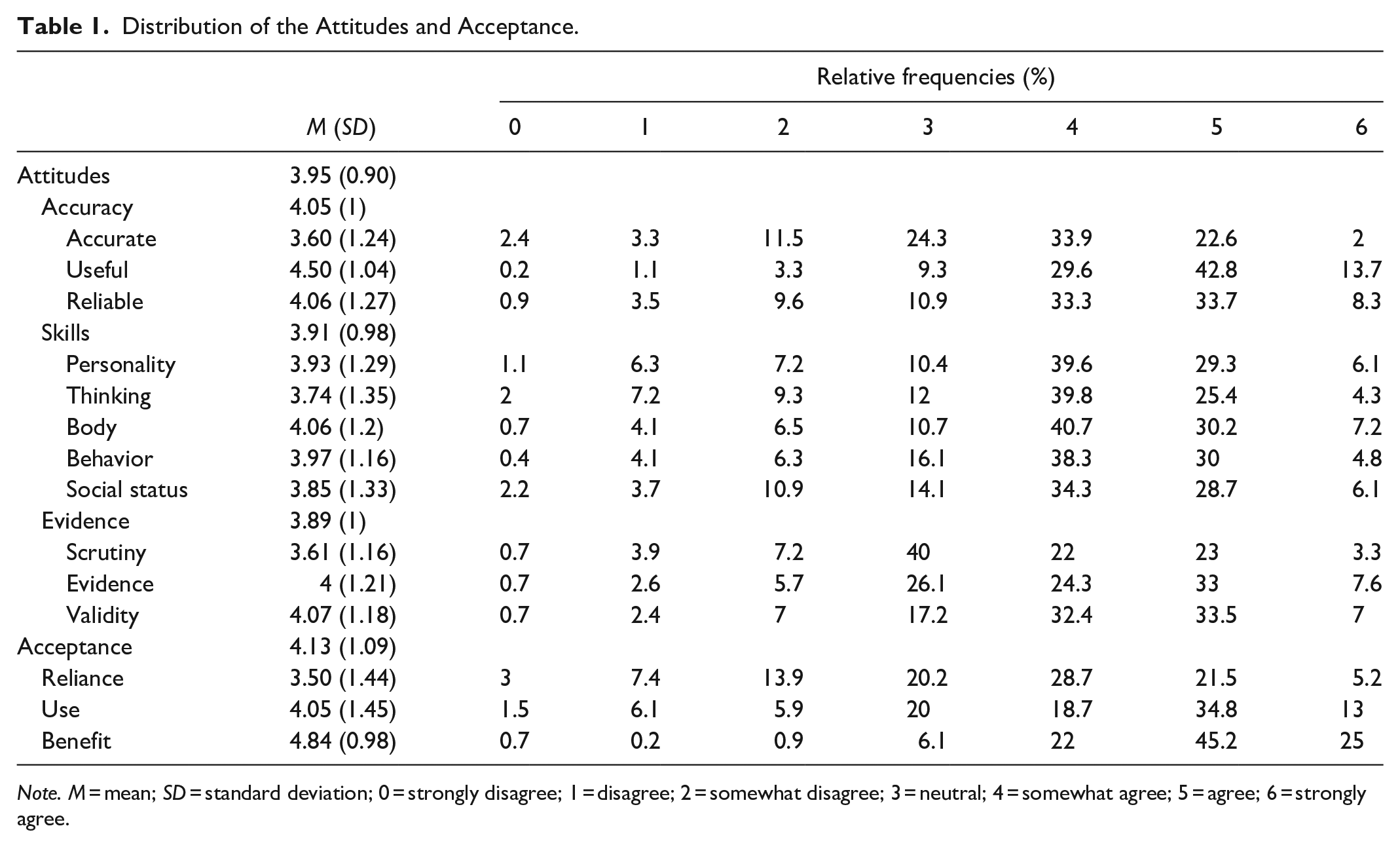
Note. M = mean; SD = standard deviation; 0 = strongly disagree; 1 = disagree; 2 = somewhat disagree; 3 = neutral; 4 = somewhat agree; 5 = agree; 6 = strongly agree.
All bivariate correlations are shown in Table 2. Apart from a medium positive correlation between the overall television consumption and the consumption of CRTS (r = .38) and a large positive correlation between the attitudes and the acceptance (r = .82), all other effects were small. The consumption of CRTS, the attitudes and the acceptance are associated negatively with the educational level and positively with prior knowledge. In other words, a higher consumption of CRTS as well as more positive attitudes toward and a higher level of acceptance of CP are significantly correlated with a lower level of education and a higher level of prior knowledge. Beyond, the attitudes and the acceptance are positively associated with age and the consumption of CRTS. As an additional analysis revealed, the positive correlation between the acceptance and gender is most likely due to the overrepresentation of females and thus can be disregarded.
Bivariate Correlations (Pearson’s r).

Note. AG = age; GD = gender; ED = education; KN = prior knowledge; TG = television in general; CRTS = crime-related television shows; AT = attitudes; AC = acceptance.
p > .05. **p > .001.
Multivariate Analysis
Multiple Linear Regressions
The multiple linear regressions on the attitudes and acceptance were conducted block-wise to examine the influence of the control variables (model 1), the overall television consumption (model 2), and the consumption of CRTS (model 3) separately and collectively. The coefficients of both analyses are summarized in Table 3 and reveal a similar pattern with all models being significant and the third model showing the best, but still weak, model fit (attitudes: R² = .106, acceptance: R² = .102). In both analyses, the most important predictors across all models are education and age as indicated by the standardized coefficients. In both final models, the consumption of CRTS is the third most important predictor. The amount of additional explained variance due to the consumption of CRTS is 1.5% regarding the attitudes and 2.2% regarding the acceptance.
Multiple Linear Regressions Predicting the Attitudes and Acceptance.
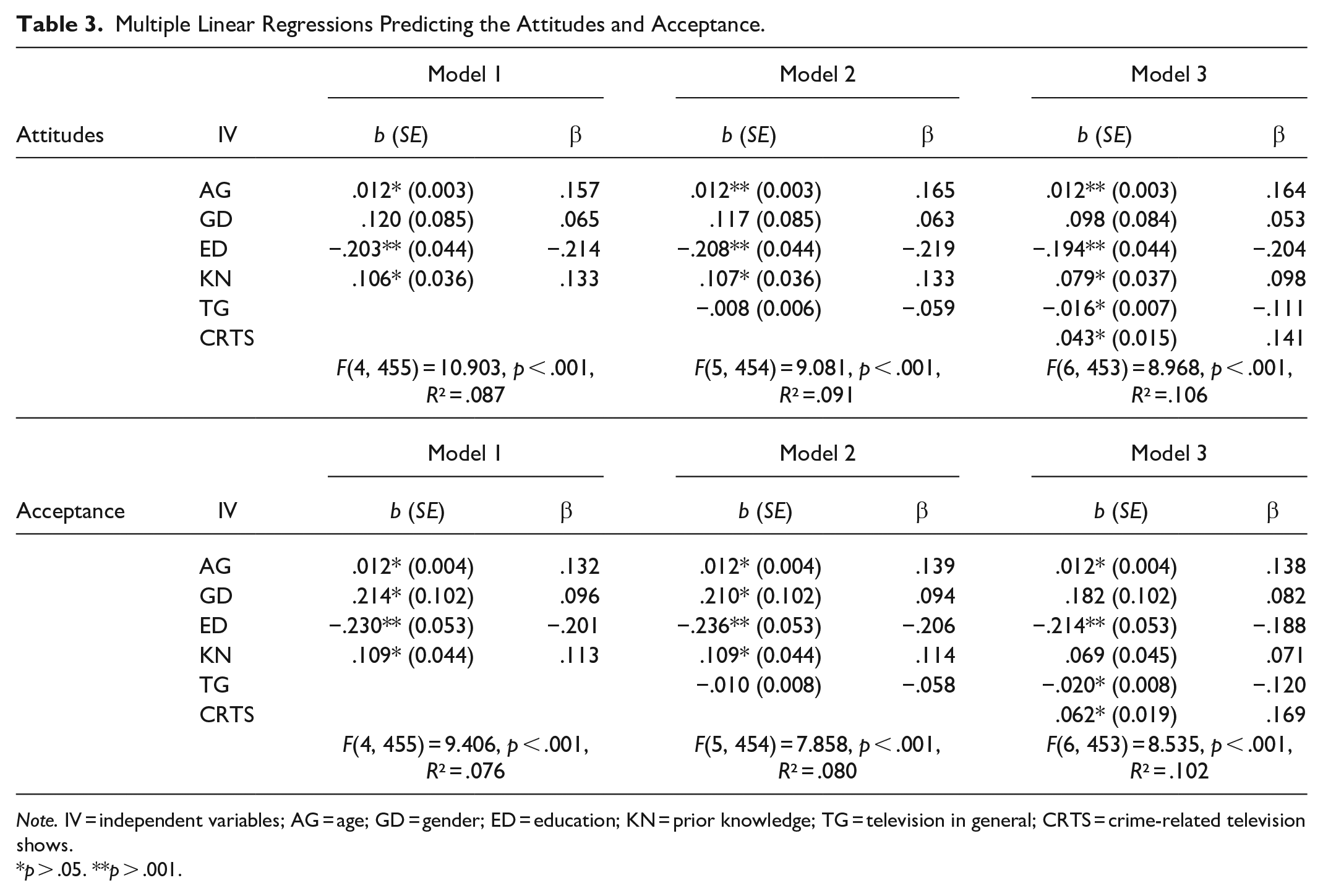
Note. IV = independent variables; AG = age; GD = gender; ED = education; KN = prior knowledge; TG = television in general; CRTS = crime-related television shows.
p > .05. **p > .001.
Overall, the analyses mirror the bivariate correlations yielding significant associations between the independent variables age, education, prior knowledge as well as consumption of CRTS and both dependent variables. Considering the many significant correlations, it was tested for potential moderation effects. Separate moderation analyses for each control variable were run but did not reveal any significant results. Thus, it could be assumed that the relationship between the consumption of CRTS and the dependent variables is not moderated by the participants’ age, gender, education, prior knowledge, or level of television consumption in general. Potential mediation effects were ruled out due to the block-wise procedure of the multiple regression analyses controlling for the effect of the control variables. Unlike the bivariate correlations, both final models of the multiple linear regression analyses contain a significant negative association between the overall television consumption and both dependent variables.
Exploratory Analysis
To explore whether the attitudes and acceptance may vary between different consumption levels of CRTS, the participants were divided into groups with no (0 hour), low (1–2 hours), medium (3–5 hours), and heavy (6 or more hours) consumption. The analyses of variance were conducted without and with covariates (Table 4). Without covariates, significant differences in both the attitudes and the acceptance were found explaining 2.6% respectively 3.6% of their variance. Regarding the attitudes, the effect is due to heavy viewers holding significantly more positive attitudes than no viewers (p = .008). As for the acceptance, both heavy (p = .001) and medium (p = .033) viewers were found to show a higher acceptance compared to participants not watching CRTS. Beyond, the acceptance was higher among heavy than light viewers (p = .039). When including the covariates, the group differences regarding the attitudes were no longer significant. Regarding the acceptance, only the group difference between non- and heavy viewers remained significant. As in the bivariate correlations and the multiple linear regressions, the attitudes, and acceptance were significantly influenced by age, education, and prior knowledge.
Distribution and Analyses of Variance of the Attitudes and Acceptance.

Note. AT = attitudes; AC = acceptance; M = mean; SD = standard deviation; IV = independent variable; CRTS = crime-related television shows; AG = age; GD = gender; ED = education; KN = prior knowledge; TG = television in general.
Without covariates.
p < .05. **p < .001.
Discussion
The ongoing use of and positive attitudes toward CP despite the lack of scientific evidence for its validity, also known as CPI (Snook et al., 2008), is fraught with numerous risks for society (Muller, 2000; Snook et al., 2008). However, there has to date only been little research on potential explanations. The present study addresses this research gap and investigates whether the positive perception of CP among police officers (Copson, 1995; Snook, Haines, et al., 2007; Trager & Brewster, 2001) may also be prevalent in the general population and associated with their consumption of CRTS. The underlying rationale is based on a cultivation framework resting on the popularity and availability of fictional CRTS (Snook et al., 2008), that individuals typically derive their crime-related knowledge from the media (Dowler, 2002) and that CRTS convey and continually repeat a coherent set of incorrect messages favoring the accuracy and utility of CP (Donovan & Klahm, 2015).
Misperceptions of Criminal Profiling Are Widely Spread
Like police officers (e.g., Copson, 1995; Snook, Haines, et al., 2007; Trager & Brewster, 2001), most participants hold positive attitudes toward CP as manifested in the belief that profilers can predict various offender characteristics and that CP is highly accurate, provides useful and reliable information. In line with the positive attitudes, the participants seem to accept CP as a tool used in police investigations. Contrary to forensic psychologists and psychiatrists as well as police psychologists (Bartol, 1996; Torres et al., 2006), the participants did not severely question the validity of CP. Instead, the participants’ positive attitudes toward and acceptance of CP impeccably mirror its medial portrayal as an accurate, operationally useful tool that leads to the apprehension of offender(s) (Donovan & Klahm, 2015). The results thus support the notion that CP is widely misperceived in society, regarding both its accuracy and scientific validity as well as the skills of profilers to predict offender characteristics. Considering that such misperceptions may influence real-life decision-making processes leading to real-life consequences for society, the high prevalence of positive attitudes toward and acceptance of CP is alarming.
The Consumption of Crime-Related Television Shows Matters
Based on the cultivation theory by Gerbner and Gross (1976), it was expected that a higher consumption of fictional CRTS is associated with more positive attitudes toward (Hypothesis 1) and a higher acceptance (Hypothesis 2) of CP as an investigative tool, independent of control variables. The multiple linear regression analyses provide support for both hypotheses and thereby underpin the underlying rationale that the recurring exposure to incorrect messages about CP may lead to their internalization. The internalization of such incorrect messages may in turn explain the widely spread misperceptions of CP resulting in a positive perception of CP despite the lack of evidence for its validity (Snook et al., 2008).
In contrast to prior studies investigating cultivation effects of CRTS on police-related concepts such as police effectiveness, misconduct, and legitimacy (Dowler, 2002; Dowler & Zawilski, 2007; Intravia et al., 2018), the present study is the first to find support for direct crime-genre-specific cultivation effects. However, the amount of variance explained solely by the consumption of CRTS is small for both the attitudes (1.5%) and the acceptance (2.2%). Although small effects are a common finding in cultivation research as indicated by a previous meta-analysis (Morgan & Shanahan, 1997), their practical relevance as explanation to the CPI may be questionable. On the other hand, considering that cultivation effects, no matter their size, can affect real-life actions such as decision-making processes in favor or against using CP in police investigations, they may have a high societal relevance.
Nevertheless, control variables such as education and age explain more variance in both the attitudes and acceptance. Similar patterns were found by Dowler and Zawilski (2007) and Dowler (2002) suggesting that education and age may be more important variables to explain attitudes toward police-related concepts than the consumption of CRTS. In the present study, the comparatively strong negative association between education and the attitudes respectively the acceptance, as indicated by the standardized coefficients in the multiple regression analyses, suggest that more educated participants tend to hold fewer positive attitudes toward CP and to accept CP as a tool used in police investigations to a lesser degree. Following Gerbner et al. (1980), more educated individuals tend to be less imbued with the distorted version of reality displayed in television shows, also because they tend to be lighter viewers. The found negative bivariate correlation between the educational level and the consumption of CRTS supports this notion. However, the moderation analyses testing education as a potential moderator on the relationship between the consumption of CRTS and the dependent variables were not significant. Consequently, it can be assumed that the educational level has a direct influence on the attitudes toward and the acceptance of CP.
The Level of Consumption May Matter
A common finding in cultivation research is that cultivation effects predominantly occur among heavy compared to light and medium viewers (e.g., Bryant et al., 1981; Gerbner & Gross, 1976; Gerbner et al., 1978). Generating control groups naïve to television consumption is generally considered difficult (Gerbner & Gross, 1976). Since the present study focused on crime-genre-specific effects, it was possible to establish a control group not watching CRTS on a regular basis. Consistent with previous research, the exploratory analysis tentatively suggests that cultivation effects on the perception of CP mainly occur among heavy viewers as indicated by more positive attitudes and a higher acceptance among heavy compared to light respectively non-viewers. As the results only partially remain significant when controlling for covariates, they must be interpreted cautiously.
Strengths and Limitations
The present study has two fundamental strengths. The first strength is the correlational design. The few previous studies on cultivation effects on the perception of CP (Bolton, 2019; Lutfy, 2013) adopted an experimental design which has been criticized for not being adequate to study cultivation effects due to its inability to simulate the long-term aspect of media exposure assumed to underlie cultivation (Gerbner & Gross, 1976). In contrast to this, correlational designs can capture associations between variables in a real setting and thus are more appropriate and commonly used in cultivation studies (e.g., Dowler, 2002; Dowler & Zawilski, 2007; Intravia et al., 2018). The second strength is the use of the a-priori calculated sample size to ensure that even small cultivation effects could be detected.
The limitations concern the internal and external validity of the results. The internal validity describes the extent to which a study design allows conclusions about causal relationships among the observed variables (APA, n.d.-g) and may be undermined through several problems dealing with the present study’s correlational design. Due to the directionality problem in correlational research (APA, n.d.-d), inferences about the causality underlying the found associations cannot be made. However, based on Homant and Kennedy (1998) stating that CP has only due to its depiction in the media come to the awareness of the public, it could be argued that the consumption of CRTS must precede the perception of CP opening the door for an interpretation toward a causal influence of the consumption of CRTS on the attitudes and acceptance. But, since the present study is cross-sectional capturing only a single point of time, temporal influences on the results cannot be ruled out rendering causal interpretations even more difficult. Another aspect reducing the internal validity is the low level of variance explained by all variables collectively. It may be possible that other important variables which may bear on the attitudes and acceptance have been missed out, a problem also referred to as underfitting (Eid et al., 2013). Another more general limitation of the present study is that the collected data were based on self-report. Considering that response bias is a common finding in behavioral research (Rosenman et al., 2011), it cannot be ruled out that the collected data are influenced by as for example the social-desirability bias. This limitation may be less relevant for variables such as age and gender but more relevant for the estimation of the weekly media consumption as well as the self-assessed prior knowledge about CP and education. The potential response bias could reduce the validity of the instruments used for the data collection.
The external validity refers to the generalizability of the results (APA, n.d.-e). In the present study, the generalizability of the results may be limited as a consequence of the techniques deployed to the data collection. As the present sample was drawn based on opportunity sampling and is characterized by an overrepresentation of women, young and well-educated individuals, it may not be representative for the general population. Additionally, the participants were recruited online implying that people without access to the internet and especially social networks may have been underrepresented. Beyond, it is unknown whether the proportions of viewers and non-viewers of CRTS in the general population has been adequately represented. Considering that cultivation effects are typically found among heavy viewers and that heavy television consumption is associated with lower education (Gerbner & Gross, 1976), it is possible that a sample with a more representative level of education would have yielded stronger cultivation effects. Moreover, the fact that temporal influences (e.g., releases of CRTS) on the results cannot be ruled out questions whether the results represent enduring or situational effects.
Conclusion and Future Research
The present study raises awareness to the CPI and its associated far-reaching implications for society but also sheds light on one of its potentially underlying mechanisms: the receipt and adoption of incorrect information on CP provided by fictional media, or more simply put, the mistaking of fiction for fact. Despite limitations reducing the internal and external validity and thus the causal interpretation and generalizability of the results, the present study is the first to find empirical support for the assumption that misperceptions of CP are widely spread in the general population and associated with the consumption of CRTS. Although the found cultivation effects are small, they may have a high societal relevance due to their potential to influence real-life decision-making affecting the society at large.
The present study can be seen as a starting point for a societal debate of how to act on the finding that our attitudes—and potentially our actions—are influenced by incorrect information derived from fictional media. From a scientific point of view, the present study contributes to a more comprehensive understanding of the CPI and paves the way for future research: To allow for causal interpretation and generalizability of the results, future studies should address the limitations of the present study. To achieve this, a longitudinal design with participants representative for the general population randomly assigned to groups with different consumption levels of CRTS and a control group naïve to CRTS is necessary. Since the variables considered in the present study can only partly explain the perception of CP, a further investigation of potentially relevant variables is needed. For example, it should be examined whether the portrayal of CP in other media types such as non-fictional television shows may also influence one’s perception of CP.
Supplemental Material
sj-docx-1-sgo-10.1177_21582440221091243 – Supplemental material for Do We Mistake Fiction for Fact? Investigating Whether the Consumption of Fictional Crime-Related Media May Help to Explain the Criminal Profiling Illusion
Supplemental material, sj-docx-1-sgo-10.1177_21582440221091243 for Do We Mistake Fiction for Fact? Investigating Whether the Consumption of Fictional Crime-Related Media May Help to Explain the Criminal Profiling Illusion by Teresa Greiwe and Ardavan Khoshnood in SAGE Open
Footnotes
Declaration of Conflicting Interests
The author(s) declared no potential conflicts of interest with respect to the research, authorship, and/or publication of this article.
Funding
The author(s) received no financial support for the research, authorship, and/or publication of this article.

Supplemental Material
Supplemental material for this article is available online.
References
Supplementary Material
Please find the following supplemental material available below.
For Open Access articles published under a Creative Commons License, all supplemental material carries the same license as the article it is associated with.
For non-Open Access articles published, all supplemental material carries a non-exclusive license, and permission requests for re-use of supplemental material or any part of supplemental material shall be sent directly to the copyright owner as specified in the copyright notice associated with the article.
