




Abstract
This longitudinal mixed-method study investigated effects of the reading-while-listening mode on the incidental learning of two dimensions of vocabulary knowledge, namely receptive knowledge and productive knowledge, in a Chinese EFL classroom context. Additionally, EFL learners’ attitudes toward the reading-while-listening mode of incidental vocabulary learning were examined. Seventy-eight Chinese EFL students with typical vocabulary sizes around 2,000 from two intact classes at a senior high school participated in the study and assigned as the experimental and the control groups. Over a 10-week intervention, the experimental group engaged in incidental vocabulary learning through reading while listening, whereas the control group retained a traditional reading-only mode. The results from three vocabulary tests showed that the reading-while-listening mode was more effective for incidental vocabulary learning and retention than the traditional reading-only mode on the dimensions of sound recognition, meaning recognition, and meaning recall but not on the dimension of form recall. Questionnaire and interview data unveiled that Chinese EFL learners have positive attitudes toward reading while listening as a means of incidentally learning vocabulary. Through reading while listening, they developed learning interest, increased classroom engagement, improved learning efficiency, and built confidence in English learning. The study contributes empirical evidence supporting multimodal language learning approaches, offering practical recommendations for EFL instructional design and vocabulary learning strategies.
Plain language summary
This study looked at how learning vocabulary by reading and listening at the same time works for Chinese students learning English as a foreign language (EFL). Two groups of students were prepared: one group learned vocabulary by reading and listening, and the other group learned by just reading. The study found that the reading-while-listening method helped students better remember the sounds and meanings of new words, but not so much the spelling. The students also liked this method because it made them more interested in learning, more engaged in class, more efficient in learning, and more confident in their English skills.
Keywords
Introduction
Vocabulary is the foundation of language learning and the prerequisite for meaningful communication. The English Curriculum Standards for China’s General Senior High School (2017 edition, 2020 revised) (hereinafter Standards) stipulates that Chinese senior high students are required to acquire a vocabulary size of approximately 4,000 to 4,200 general English words and emphasizes the significance of contextualized vocabulary learning facilitated through theme-based activities. However, the vocabulary breadth of Chinese high school students is actually far from expected due to both the less favorable non-English environment outside of the classroom and the input-poor teacher-oriented challenge within the classroom. Specifically, the prevalent use of traditional decontextualized teaching approaches such as rote learning and mechanic drills in senior high school instruction results in students’ inability to appropriately utilize vocabulary within theme-related contexts. The pivotal role of language input in L2 acquisition is widely recognized (Krashen, 1981). However, English as a foreign language context in China presents challenges in providing a context-rich immersive foreign language environment. Under such circumstances, the English classroom emerges as the primary arena for language input in China.
Vocabulary learning is mainly categorized into two types: intentional learning and incidental learning. Unlike the explicit nature of the former, the latter distracts learners’ attention from direct vocabulary learning, facilitating vocabulary growth as the by-product of other goals (Laufer & Hulstijn, 2001; Laufer, 2003; Webb & Nation, 2017). Given the time constraints associated with classroom-based intentional vocabulary instruction, incidental learning relying on the amount of language input can offer abundant contexts that serve to, on one hand, enlarge students’ vocabulary sizes, and on the other hand, fulfill the prerequisites of contextualized vocabulary learning.
Numerous empirical studies have been conducted on incidental vocabulary learning, with some through reading (Chen & Truscott, 2010; Webb, 2007) while others through listening (Jin & Webb, 2020; Pavia et al., 2019; Shin et al., 2023; Vidal, 2011). Brown et al., (2008) introduced a third mode - through reading while listening - into their comparison. This combined visual and auditory input offered fresh insights into vocabulary instruction in Chinese EFL classroom contexts. However, previous studies on the reading-while-listening mode for EFL learners are relatively scarce and their results are inconclusive (Brown et al., 2008; Chen, 2021; Teng, 2018; Vu & Peters, 2022; Webb & Chang, 2012, 2015). A critical gap exists particularly in longitudinal investigations: while most studies examine vocabulary gains through immediate posttests, few track learning over extended periods (e.g., Rodgers & Webb, 2020; Webb & Chang, 2015), and even fewer have specifically focused on the mode of reading while listening longitudinally (e.g., Webb & Chang, 2015).
Additionally, the affective dimension of vocabulary learning represents another significant research gap. For instance, learners’ attitudes toward classroom-based vocabulary learning significantly influence both vocabulary teaching and learning. Although studies have demonstrated positive correlations between learners’ attitudes and vocabulary development across various modes - extensive reading (Zimmerman, 1997), L2 documentary (Peters & Webb, 2018), and English songs (i.e., through listening) (Isnaini & Aminatun, 2021) - research specifically examining learners’ attitudes toward reading-while-listening remains scarce. Only Brown et al. (2008), Serrano and Pellicer-Sánchez (2022), and Tragant et al. (2016) have explored this aspect, revealing learners’ preference for this dual-mode approach. Given that emotional engagement significantly influences language learning outcomes (Elley 1989), it is essential to explore students’ attitudes toward incidental vocabulary learning through reading while listening for understanding its effects in Chinese EFL contexts.
This study addresses these research gaps through two primary objectives: (a) investigating the longitudinal effectiveness of reading-while-listening on incidental vocabulary acquisition and retention in Chinese EFL classrooms through multiple learning sessions, and (b) examining learners’ attitudes toward this dual-mode approach. By combining these cognitive and affective dimensions in a longitudinal design, this study offers unique insights into the sustainability and learner reception of reading-while-listening as a vocabulary learning approach in EFL contexts.
Literature Review
Incidental Vocabulary Learning
Incidental vocabulary learning 1 was initially introduced by Nagy et al. (1985) as a context-based unintentional vocabulary learning of native speakers. Different from intentional learning, incidental vocabulary learning emphasizes its unintentional nature as a by-product of meaning-centered activities (Chen & Truscott, 2010). Despite the perception that vocabulary gains from incidental learning are less substantial than those from intentional learning (Laufer, 2003; Nation, 2013), numerous studies have confirmed the effects of incidental vocabulary learning via various input modes, such as reading (Waring & Takaki, 2003), listening (Jin & Webb, 2020; Shin et al., 2023; Vidal, 2011), and viewing (Peters & Webb, 2018; Rodgers & Webb, 2020).
Early research predominantly focused on vocabulary learning through reading (e.g., Chen & Truscott, 2010; Waring & Takaki, 2003; Webb, 2007). The frequency of occurrence has been identified as a key predictor influencing the effects of incidental learning. Webb (2007) explored the impact of the repetition rate (1, 3, 7, and 10 times) of the target word on vocabulary knowledge learning. The findings indicated that each repetition of the target word enhanced at least one aspect of vocabulary knowledge to a greater extent, necessitating more than ten repetitions for a full knowledge of a word. The influence of frequency of occurrence on incidental vocabulary learning has also been demonstrated in many empirical studies (e.g., Chen & Truscott, 2010; Song & Sardegna, 2014). What’s more, Waring and Takaki (2003) found that compared to newly acquired vocabulary, previously known vocabulary was more likely to be learnt and retained.
Vocabulary can also be acquired incidentally through listening (Brown et al., 2008; Feng & Webb, 2020; Jin & Webb, 2020; Pavia et al., 2019; Shin et al., 2023; Vidal, 2011). Pavia et al. (2019) confirmed the facilitative role of listening to songs in incidental vocabulary learning, indicating that repeated listening contributed to vocabulary gains, with a positive correlation between frequency of exposure and learning outcomes. Jin and Webb (2020) identified the potential of teacher talk in incidental vocabulary learning, but failed to find frequency of occurrence to be a significant predictor in incidental learning. Shin et al. (2023) investigated the mediating effects of metacognitive awareness and motivation on incidental vocabulary acquisition through listening comprehension among Korean EFL learners. The findings indicated that motivation served as a significant moderating variable in the treatment effects, with highly intrinsically motivated learners demonstrating greater vocabulary gains through listening tasks compared to their less motivated counterparts. Some comparative studies have reported inconsistent results regarding vocabulary gains through reading or listening. Vidal (2011) reported greater vocabulary gains from reading than listening across different proficiency levels. Similar findings were also shown by Brown et al. (2008). However, Feng and Webb (2020) compared the effects of three different input modes (i.e., reading, listening, and viewing) but found no significant differences among the three.
To summarize, the facilitative role of reading/listening in incidental vocabulary learning has been confirmed in numerous contexts of massed learning in which incidental learning occurred only through exposure to a single text in a single learning session. However, an authentic learning environment necessitates a more spaced learning style with longitudinal studies of incidental learning spanning multiple sessions. This is particularly pertinent for EFL learners, who predominantly depend on the English classroom as their primary language input channel. However, only a handful of studies have focused on spaced learning till now. For example, Webb and Chang (2015) executed a classroom-based longitudinal study over a period of 13 weeks to explore vocabulary learning facilitated by audio-supported reading. The results revealed substantial vocabulary gains when students engaged with multiple texts, as opposed to a single text. However, they did not identify significant correlations between the frequency of occurrence and learning gains. Similarly, Rodgers and Webb (2020) took over 13 sessions to explore the impact of incidental vocabulary learning through television viewing. Their results not only confirmed significant vocabulary gains attributable to watching television but also discovered a positive correlation between the frequency of occurrence and vocabulary learning.
Reading While Listening on Incidental Vocabulary Learning and Retention
Recently, the integration of reading and listening in incidental vocabulary learning has garnered increased attention. Brown et al. (2008) conducted the first empirical study to compare three modes of input, namely, reading only, listening only, and reading while listening, on the vocabulary learning of Japanese EFL learners. Their results showed the greatest vocabulary gains in the reading-while-listening mode, followed by reading only and then listening only. Webb and Chang (2012) also provided evidence supporting the benefits of audio-assisted reading on vocabulary learning for Taiwanese EFL learners. Serrano (2024) proposed specific methodological protocols for replicating Brown et al.’s (2018) seminal study, emphasizing the importance of systematic replication in validating and extending the original findings. In a subsequent study, Webb and Chang (2015) extended their research from individual texts to multiple texts, reaffirming the substantial vocabulary gains achieved through reading while listening. Teng (2018) echoed these findings, favoring the reading-while-listening mode of input over the reading-only mode for incidental vocabulary acquisition. Similar findings were also shown in Chen (2021). Her results indicated that, compared to the reading-only mode, the reading-while-listening mode facilitated participants in form and meaning recognition of the target vocabulary, rather than the lexicalization of new words. However, Vu and Peters (2022) found no significant differences in vocabulary gains between the reading-while-listening and reading-only modes. Webb et al. (2023) also failed to find significant differences in incidental vocabulary learning gains on immediate and delayed posttests across reading, listening, and reading while listening.
Students’ Attitudes Toward Incidental Vocabulary Learning Through Reading While Listening
While considerable research has examined the effectiveness of reading-while-listening on incidental vocabulary acquisition, including both learning and retention, the affective dimensions of this approach remain understudied. Limited attention has been given to learners’ attitudes toward this learning mode. In one notable study, Brown et al. (2008) investigated Japanese EFL learners’ perceptions and found that participants expressed significantly higher comfort levels and stronger preferences for reading-while-listening compared to single-mode approaches (reading-only or listening-only). Specifically, their participants reported that the dual-mode presentation enhanced their comprehension and provided a more engaging learning experience. In another significant study, Serrano and Pellicer-Sánchez (2022) examined the effects of reading-while-listening on Catalan/Spanish English learners’ incidental vocabulary acquisition, revealing that learners not only preferred this dual-modal approach but also demonstrated enhanced reading comprehension outcomes. These findings align with Tragant et al.’s (2016) year-long investigation of Canadian English learners, which documented substantial linguistic gains and positive attitudes toward English learning through synchronized reading-listening interventions. These findings suggest the potential motivational benefits of reading-while-listening, yet more research is needed to comprehensively understand learners’ affective responses across different contexts.
To sum up, in spite of the positive role of reading while listening in incidental vocabulary learning, there is a dearth of research examining its impact within classroom contexts. What’s more, the combined effects of reading and listening on vocabulary acquisition have not been fully confirmed, with existing studies yielding inconclusive results. Notably, previous studies have predominantly focused on the impact of reading while listening on incidental vocabulary learning, lacking qualitative concerns into learners’ perceptions and attitudes toward this method of incidental learning. Therefore, the present study seeks to investigate the impact of reading while listening on incidental vocabulary learning and retention and also aims to explore learners’ attitudes toward the use of the reading-while-listening mode within classroom contexts. The following three research questions were addressed:
How does reading while listening influence incidental vocabulary learning of Chinese EFL learners?
How does reading while listening influence incidental vocabulary retention of Chinese EFL learners?
What are Chinese EFL learners’ attitudes toward the reading-while-listening mode of incidental vocabulary learning?
Research Methodology
Participants
Seventy-eight year-two senior high school students from East China participated in the study. The cohort comprised 41 boys and 37 girls with ages ranging from 16 to 18. They had been randomly allocated by the school to two parallel classes. Each student had a minimum of 8 years of English learning experience. Their vocabulary sizes were around 2,000 according to Vocabulary Size Test (Nation & Beglar 2007). One class was assigned to be the experimental group with the reading-while-listening mode, whereas the other class retained their existing reading-only pattern. Prior to the study, both groups’ English proficiency levels were measured based on their periodical English tests results and they were comparable with no statistically significant difference (t (76) = .103, p = .919). None of the students were explicitly informed about the authentic purpose of the experiment before the study. It helped ensure the authenticity of the incidental learning process.
Materials
The materials used in the study were six passages extracted from Yilin edition senior high school English supplementary books. These passages were carefully chosen based on several key criteria. First, they maintained consistent length (691–720 words) to ensure comparable reading time and cognitive load. Next, the texts represented diverse genres while featuring themes relevant to students’ academic and personal experiences. What’s more, the lexical difficulty was controlled, with unknown words comprising less than 5% of each text, 2 thus optimizing comprehensibility and creating favorable conditions for incidental vocabulary acquisition. The passages demonstrated similar syntactic complexity, incorporating compound-complex sentence structures, passive voice constructions, subjunctive mood, and various clause types. For audio materials, all passages were recorded by professional British native speakers at a controlled speed of 130 to 135 words per minute - a rate identified as optimal for EFL learners. The recordings maintained high clarity and standardized pronunciation to ensure quality auditory input. Detailed information regarding the selected passages is presented in Table 1.
Selected Passages.

Target Vocabulary
Thirty-two single-word items and eight collocations were selected as the target vocabulary (See Table 2). To ascertain the students’ unfamiliarity with these words, a pilot study was first conducted with 2-two senior high students (N = 13) who were not part of the main study. They were required to read the chosen texts and identify their unknown words. Finally, 32 single-word items together with eight collocations were annotated as their shared unknown words. The single-word items including 14 nouns, 12 verbs, and 6 adjectives were selected based on their relative infrequency (i.e., frequency of occurrence of 3,000 and above) as per Nation’s (2012) vocabulary frequency lists. Meanwhile, these words were part of the 1,000 compulsory keywords according to the Standards (2017 edition, 2020 revised). The eight target collocations consisted of two noun phrases, four verb phrases, one prepositional phrase, and one adjective phrase. These collocations were initially searched in the Corpus of Contemporary American English (COCA) to verify their frequency of occurrence. All eight collocations had Mutual Information (MI) scores above three in the COCA, indicating a statistically significant cooccurrence typical of collocations.
Target Vocabulary.

Note. Single words (FoC) means frequency of occurrence of single words in Nation’s (2012) BNC/COCA lists. Collocations (FoC) means frequency of occurrence of collocations in the COCA.
Ethical Concerns
Prior to the study, ethical approval was obtained and appropriate procedures were implemented. All participants were informed of the study’s purpose and voluntary nature of participation. Written informed consent was obtained, with participants assured that their responses would remain confidential and would not affect their course grades. All data were anonymized to protect participant privacy, and the collected information was used solely for research purposes.
Treatment
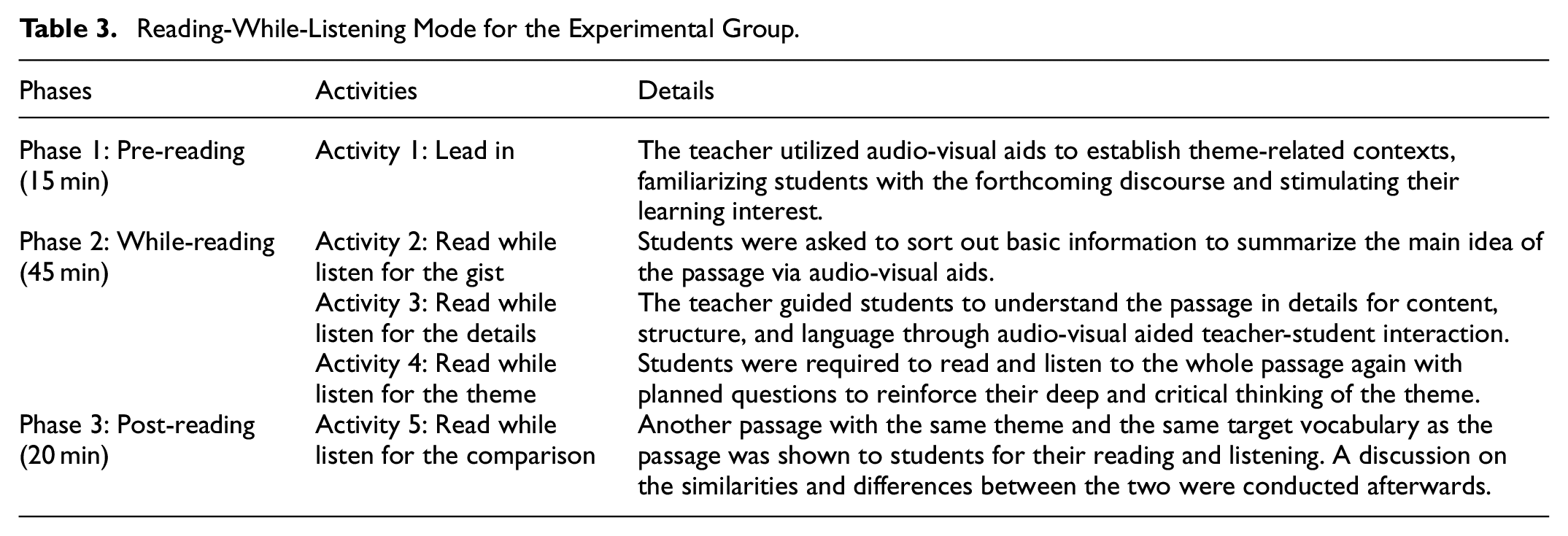
The treatment for the experimental group was incidental vocabulary learning via a reading-while-listening mode. This intervention spanned a duration of 6 weeks, with one passage per week (totaling over 80 min). The reading-while-listening process was structured into three distinct phases: pre-reading, while-reading, and post-reading. The target vocabulary for each passage was predetermined to ensure equal exposure, thereby mitigating the potential influence of frequency of occurrence on vocabulary acquisition. The reading-while-listening mode encouraged students to notice and then acquire the target vocabulary in word sound, word form, word meaning and even word use through sufficient audio-visual input. All theme-related activities were designed to deepen students’ understanding of the passage and unrelated to any of the target vocabulary, nor were they likely to elicit any of them. Table 3 outlines the specific procedure for the reading-while-listening mode for the experimental group.
Reading-While-Listening Mode for the Experimental Group.
The control group was subjected to a traditional reading-only English-language course (See Table 4), which had the same duration contact time as the experimental group. The entire lesson was centered on thorough reading and comprehension of the text’s theme, facilitated by teacher-student and peer interactions. Notably, no vocabulary either single words or collocations was elicited during classroom-based activities.
Reading-only Mode for the Control Group.

Instruments
Vocabulary Tests
Three vocabulary tests, namely, pretest, posttest, and delayed posttest, were employed to measure the effects of reading while listening on incidental vocabulary learning and retention. These tests included four sections with a total of 50 items, specifically sound recognition, meaning matching, sentence completion, and blank filling. The receptive knowledge was assessed with the first two sections. The sound recognition section focused on word pronunciation with ten multiple-choice items. Students were required to identify the word in which the pronunciation of the underlined letter differed from the others in each item. The Receptive Vocabulary Knowledge Test by Nation and Webb (2011) was adopted and modified for the design of the meaning matching section. This section, consisting of ten multiple-choice items, tested students’ recognition of word meanings. Students were required to match the target word with its corresponding Chinese meaning. The last two sections assessed productive vocabulary knowledge. The sentence completion section, based on the Controlled Productive Knowledge Test by Laufer and Nation (1999), presented fourteen incomplete sentences with initial letters provided for target vocabulary to be completed. This section aimed to test whether students could recall word forms. In contrast to the decontextualized nature of sentence completion, the blank filling section focused on the use of target vocabulary within specific contexts. Students were asked to select an appropriate word in its appropriate form from a given word box to complete an article, thereby testing their recall of word meanings. All three vocabulary tests shared the same test items which included all the target single words and collocations. However, the item order varied to avoid sequence effects. Each test had a total score of 100 points and a time limit of 40 min.
Questionnaire
A questionnaire was utilized to assess students’ attitudes toward the reading-while-listening mode of incidental vocabulary learning. The Vocabulary Learning Questionnaire developed by Gu and Johnson (1996) was adopted and modified to align with the theme of incidental vocabulary learning through reading while listening. To mitigate the potential language barrier for the students, the questionnaire was translated into Chinese. The questionnaire comprised 10 items designed to assess two dimensions of students’ attitudes: their beliefs about vocabulary learning, and their perceptions of the reading-while-listening mode. A five-point Likert scale ranging from 1 (completely disagree) to 5 (completely agree) was prepared for students to respond. The questionnaires were distributed in classrooms and collected immediately upon completion.
Interview
To deepen our understanding of students’ attitudes toward the reading-while-listening mode of incidental vocabulary learning, a semi-structured interview was conducted with six students randomly selected from the experimental group. Three open-ended questions concerning the mode impact on students’ vocabulary learning, its influence on their attitudes, and their suggestions for improvement were addressed to elicit students’ rationale for their questionnaire responses. The interview was conducted in Chinese to minimize language-related interference. There was no imposed time limit on students’ responses, allowing them to express their thoughts fully and without pressure.
Procedure
The mixed-method study was conducted over a ten-week period from April to June during the second semester of the 2022 to 2023 academic year. The research design incorporated systematic progress monitoring to ensure consistent learning experiences and individual accountability. On the first day of the initial week, a brief overview of the mixed-method study was provided to the participants from both the experimental and control groups. On the second day, a 40-min pretest was administered to assess the participants’ vocabulary knowledge. From the third day of the 1st week to the 5th day of the seventh week, participants engaged in their respective vocabulary treatments: reading-while-listening mode for the experimental group and reading-only mode for the control group. Weekly individual progress reports were generated for both groups, documenting time spent in each session, their reading comprehension levels, and changes of individual reading attitudes. On the first day of week eight, an immediate posttest of vocabulary knowledge was conducted to test the immediate effect of the reading-while-listening mode on vocabulary learning. By the fourth day of the tenth week, a delayed posttest of vocabulary knowledge was administered to test its long-term effect on vocabulary retention. On day five of the same week, questionnaires and interviews were sequentially assigned to gather data on students’ attitudes toward this mode of incidental vocabulary learning.
Data Collection and Analysis
Quantitative data were collected through three vocabulary tests and a questionnaire. The vocabulary test data were analyzed using the Social Science Software SPSS 26. In the sound recognition section, two points were given to each correct choice and a zero point was given to the incorrect one. For the meaning matching section, correct matching was awarded two points, while mismatching received zero points. Regarding the sentence completion section, students scored two points for correctly producing a target vocabulary in its correct form, and one point for selecting an accurate word but in an incorrect form. Incorrectly chosen words received zero points. For the blank filling section, two points were given to each correct choice while zero points were provided for incorrect choices. The maximum score for the vocabulary test was 100 points. A mixed-design ANOVA was conducted to compare vocabulary test scores between the experimental and control groups and to simultaneously assess the pretest-posttest gains in vocabulary learning for the experimental group. The significance level was set at 0.05. Effect sizes for vocabulary tests were calculated using η2 and interpreted as small (η2 = .01), medium (η2 = .06), and large (η2 = .138) based on Pallant (2013).
The questionnaire data were also analyzed using SPSS 26 to quantitatively assess the extent of students’ agreement/disagreement with the given statements about vocabulary learning and the reading-while-listening mode of incidental learning. Qualitative data were collected from the mixed-method study through interviews. The interview data were first transcribed verbatim and then thematically analyzed with a qualitative interpretive paradigm (Miles et al., 2014). Two researchers performed double coding to ensure reliability, identifying and summarizing key themes. Representative excerpts were selected to illustrate students’ perspectives.
Results
Reading While Listening on Incidental Vocabulary Learning and Retention
The descriptive statistics pertaining to the vocabulary test scores for both groups with the overall and each dimension of vocabulary knowledge are presented in Table 5. To address the initial two research questions, mixed-design ANOVA were used to compare the scores within each group (i.e., the experimental group and the control group) at various testing phases (i.e., pretest, posttest, and delayed posttest).
Descriptive Statistics of Vocabulary Scores on Each Dimension and the Whole.
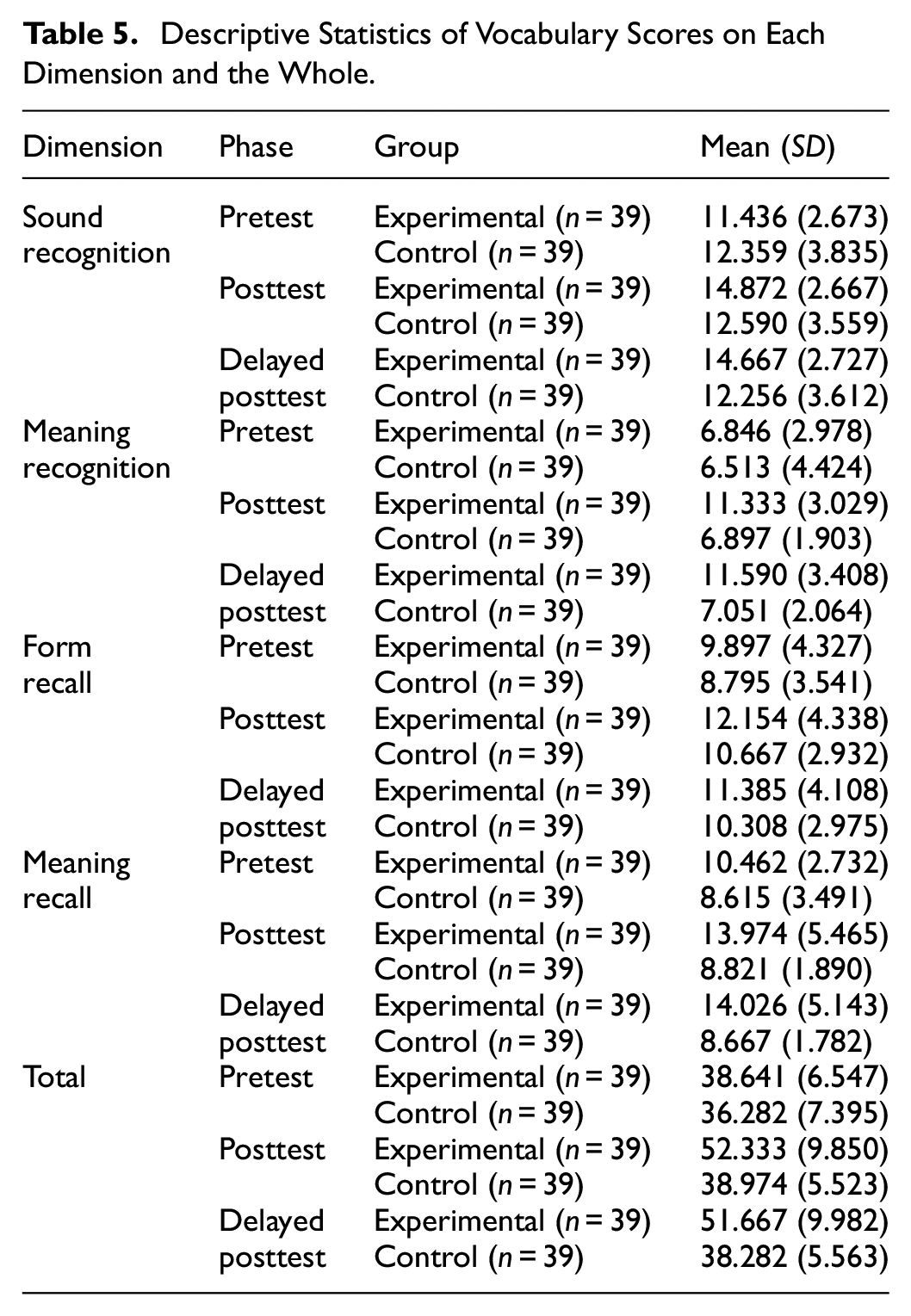
Collectively, there were statistically significant main effects of Phase (F (1, 76) = 47.818, p < .001, η2 = .386), Group (F (1, 76) = 49.867, p < .001, η2 = .396), and a statistically salient interaction effect between Phase and Group (F (1, 76) = 23.382, p < .001, η2 = .235), indicating superior performance by the experimental group compared to the control group across the three phases of vocabulary learning. Post-hoc analyses performed with Bonferroni correction showed a statistically significant difference between pretest and posttest (p < .05) but no difference between posttest and delayed posttest (p = .056). This signifies an increase in vocabulary learning from pretest to posttest and the maintenance of vocabulary learning from posttest to delayed posttest.
Specifically, as shown in Tables 6 and 7, for dimensions of word sound recognition, word meaning, and meaning recall, statistically significant main effects were observed for both Phase and Group, along with a significant interaction effect between Phase and Group. Post-hoc analyses revealed a statistically significant increase in all the three dimensions from pretest to posttest which was maintained from posttest to delayed posttest. However, in the dimension of form recall, statistically significant main effects were observed for Phase with notable differences between pretest and posttest as well as between posttest and delayed posttest. However, no statistically significant main effect was found for Group nor was there a salient interaction effect between Phase and Group was found.
Main Effects and Interaction Effects on Different Dimensions.

Note. Phase includes pretest, posttest, and delayed posttest; Group refers to the experimental group and the control group.
p < .05. ***p < .001.
Pairwise Comparison for Different Dimensions.
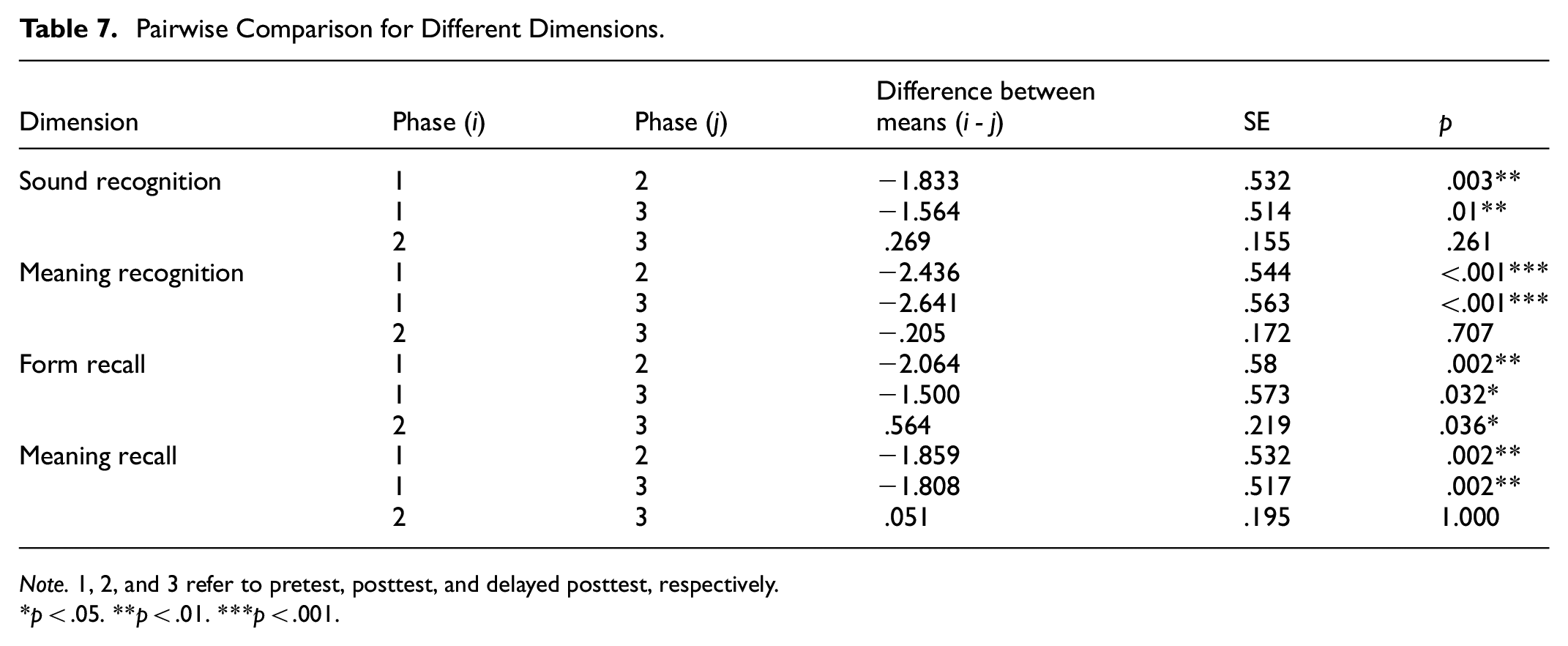
Note. 1, 2, and 3 refer to pretest, posttest, and delayed posttest, respectively.
*p < .05. **p < .01. ***p < .001.
In summary, incidental vocabulary learning through reading while listening appears to have facilitated vocabulary learning as a whole for the experimental group rather than the control group. The participants demonstrated an increase in their vocabulary learning and retention from the aspects of receptive knowledge (i.e., sound recognition and meaning recognition) and productive knowledge (i.e., meaning recall) but did not show an increase in their recalling of word forms.
Students’ Attitudes Toward Incidental Vocabulary Learning Through Reading While Listening
Both questionnaires and semi-structured interviews were employed to explore Chinese senior high school students’ attitudes toward incidental vocabulary learning via reading while listening. Prior to the study, the reliability and validity of the questionnaire were rigorously tested. The overall reliability of the questionnaire (Cronbach’s α = .738) as well as that of each dimension (Cronbach’s α = .713 for attitudes toward vocabulary learning; Cronbach’s α = .775 for attitudes toward the reading-while-listening mode) demonstrated sound internal consistency. The validity of the questionnaire was also confirmed (KMO = .712, p < .001), thereby affirming its suitability for investigating students’ attitudes toward incidental vocabulary learning through reading while listening.
Five items were incorporated in the questionnaire to elicit students’ attitudes toward vocabulary learning. The results provided insights into how senior high students perceive English vocabulary learning. As shown in Table 8, a majority of students held positive attitudes toward vocabulary learning, admitting that vocabulary learning extends beyond mere word memorization to cover vocabulary use, and that reading and listening could serve as modes of vocabulary learning. Specifically, 69.23% of the participants agreed/totally agreed that vocabulary learning was integral to English learning, with 7.69% expressing disagreement and the remainder adopting a neutral stance. Regarding Item 2, 71.79% of the participants strongly agreed that vocabulary learning included word form, meaning and use, with 25.64% in agreement and 2.56% abstaining from expressing their opinions. In relation to Item 3, 97.43% of the participants thought that vocabulary use was more crucial than rote learning, with 2.56% expressing disagreement. Pertaining to Item 4, 84.61% of the participants agreed that vocabulary learning could be facilitated through reading, with 2.56% disagreed and the rest somewhere in the middle. With regard to Item 5, 46.16% of the participants agreed/totally agreed that vocabulary learning could be facilitated through listening. However, 48.72% disagreed/totally disagreed and the rest adopted a neutral stance.
Students’ Attitudes Toward Vocabulary Learning.

Data pertaining to students’ attitudes toward reading while listening for incidental vocabulary learning was elicited through another five items. These items explored students’ perceptions about their learning focus, interest, interaction, and participation. As depicted in Table 9, students agreed that reading and listening materials were closely related to the English course (Item 6) as indicated by a high mean score (M = 4.21). their primary focus was on materials comprehension rather than on intentional vocabulary learning (Item 7) with a high mean score (M = 4.44). Items 8 to 10 probed students’ satisfaction with their learning interest, engagement, and efficiency, yielding high mean scores of 4.10, 4.49, and 4.67, respectively. Item 8, which focused on students’ interest in vocabulary learning, revealed that 82.05% of the participants reported an increased interest in learning vocabulary through reading while listening. Item 9, which examined students’ engagement, indicated that 79.49% of the participants were willing to participate in reading and listening activities and were more active in classroom interaction. According to Item 10, a staggering 97.44% of the participants believed that their vocabulary learning efficiency improved through reading while listening.
Students’ Attitudes Toward Incidental Vocabulary Learning Through Reading While Listening.

To further supplement the quantitative findings from the questionnaire, qualitative data were elicited through a semi-structure interview. Six students, randomly chosen from the experimental group, participated in the interview conducted in Chinese. Utilizing a thematic analysis approach, three principal themes - interest, efficiency, and confidence, were extracted from the transcribed corpus data.
Interest
Echoing the findings from the questionnaire, the term interest was recurrently cited in the students’ interview. Four students expressed that the combination of reading and listening sparked their interest in vocabulary learning. They attributed this to the audio and visual materials provided interesting theme-related contexts. It was preferred over the monotonous, uninspiring rote learning of decontextualized words typically associated with vocabulary learning. Excerpts from their responses are presented below:
S1: My experience in English classes has been quite enriching, and I’m fond of reading and listening. It enlivens my vocabulary learning. I’m not afraid of making mistakes, as our teacher encourages rather than reprimands us, fostering a supportive atmosphere that allows me to relax and concentrate more in class.
S4: In our English class, our teacher would assign reading and listening tasks for us to actively collaborate with peers or group members to accomplish the given tasks. I find this kind of interactive classroom setting really interesting since it facilitates mutual learning among my peers and me.
Efficiency
In the collected interview data from students, the term efficiency emerged as another recurring theme. Five students expressed their preference for this particular mode of vocabulary learning, claiming an enhanced learning outcome in comparison to previous conventional learning approach. Excerpts from two such students are shown as follows:
S2: During reading and listening, our teacher never intentionally introduces new vocabulary in a way that we absorb it without direct memorization. It’s surprising, but I find myself remembering the words after class and learning them more quickly.
S3: Learning English, I always struggled to remember words. But this term, our teacher led to learn vocabulary contextually through listening and reading activities without consciousness, which helps me grasp and spell the words by their sounds. It’s made word memorization much simpler and faster.
Confidence
The term confidence was notably elicited from the students’ interview data but not from the questionnaire. The pressure associated with learning a new language often leads to a decrease in students’ confidence. However, through engagement in reading and listening activities, students reported an increase in their confidence pertaining to English vocabulary learning. Excerpts from three such students are presented below:
S5: Language environment is very important for me to learn English. I begin to use my iPad to immerse myself in English stories, picking up new words as I go. Reading and listening really work for vocabulary learning and then boost my English scores, and I’m gaining confidence in my English abilities.
S6: In the past, my mother would dictate words to me daily, which was quite exhausting. Now, I memorize words while engaging with texts both through listening and reading, making the process feel effortless and productive. This newfound confidence encourages me to excel in English.
Discussion
Reading While Listening on Incidental Vocabulary Learning and Retention
The present study investigated the impact of a reading-while-listening input mode input on the incidental learning of receptive and productive vocabulary knowledge among Chinese senior high school students. The findings revealed that incidental vocabulary learning via reading while listening resulted in vocabulary gains in three dimensions: sound recognition, meaning recognition, and meaning recall. These gains were sustained for 2 weeks, suggesting that incidental vocabulary learning with audio-visual support could potentially enhance vocabulary learning and retention. These results align with previous research on the effects of input mode on incidental vocabulary learning (Brown et al., 2008; Chen, 2021; Teng, 2018; Webb & Chang, 2012, 2015).
In terms of sound recognition, it is understandable that audio support facilitated the learning process. Repeated audio input likely increased students’ awareness and retention of target word pronunciations. Regarding meaning recognition and recall, audio and visual support served as potential facilitators in text comprehension (Webb & Chang, 2012), stimulating students’ interest in understanding the text and thereby increasing attention to unfamiliar words. This support also aided in text segmentation into larger chunks, enabling students to comprehend the texts with enhanced working memory and increasing the potential for inferring unfamiliar words (Brown et al., 2008). What’s more, meaning-oriented activities such as classroom discussions, although focused on text comprehension, could lead to negotiation of unknown word meanings and occasional usage of these words. The use of multiple texts instead of a single one minimized the risk of losing reading interest and simultaneously increased the likelihood of target vocabulary appearing in different contexts. From a frequency of occurrence perspective, students who repeatedly encountered target vocabulary could develop more extensive receptive and productive knowledge, potentially facilitating form-meaning mapping (Webb & Chang, 2012).
However, this study did not find vocabulary gains in recalling word forms, presenting a discrepancy with Webb and Chang (2012). The methodological differences likely contribute to this discrepancy. Webb and Chang used a modified Vocabulary Knowledge Scale (VKS), which allowed students to demonstrate word recognition and meaning by judging their prior exposure and ability to write the word’s definition. In contrast, this study employed a more cognitively demanding sentence completion task, where participants had to construct a contextually appropriate sentence using only an initial letter prompt. This methodological variation introduces significant complexity, especially within the context of incidental learning. The sentence completion approach requires deeper linguistic processing and active language manipulation, potentially making word form recall more challenging compared to the VKS method. Consequently, the divergent research instruments may explain the different outcomes in word form retention, highlighting the nuanced nature of vocabulary acquisition measurement techniques.
Students’ Attitudes Toward Incidental Vocabulary Learning Through Reading While Listening
This study showed that senior high school students exhibited positive attitudes toward reading-while-listening mode for incidental vocabulary learning. This finding aligns with the research conducted by Brown et al. (2008) which suggested that Japanese EFL learners demonstrated a stronger preference and comfort level for the reading-while-listening mode over the reading-only or listening-only modes. The consistency of attitude patterns toward the dual mode has also been found in other studies (Serrano & Pellicer-Sánchez, 2022; Tragant et al., 2016).
First, the combined approach of reading and listening was found to stimulate students’ interest in language learning which in turn enhanced their vocabulary acquisition. This can be attributed to the fact that audio and visual input encouraged students to immerse themselves in theme-related contexts, bringing the text to life, and facilitating effective comprehension in an engaging manner. The same evidence was shown in Brown et al. (2008) that Japanese EFL learners preferred reading-while-listening over single-mode approaches in story learning. What’s more, this combined approach was also found to increase students’ engagement. As vocabulary learning occurred incidentally, students primarily focused on meaning-oriented communication with their teacher and peers. This high frequency of interpersonal interaction potentially stimulated their engagement in these theme-related activities. Moreover, reading while listening, which provided ample language input with vocabulary embedded in meaning-oriented activities, contributed to learning efficiency. Additionally, some students favored this mode of input for vocabulary learning due to its potential to build confidence. For instance, one student initially found word dictation and memorization drills exhausting but later felt effortless when listening and reading were involved. The improvement in learning outcomes boosted her confidence in vocabulary learning, indicating an association between attitude involvement and vocabulary learning outcome, as suggested by Kassa et al. (2022). Understandably, positive attitudes toward reading-while-listening created a psychological environment conducive to incidental vocabulary learning. Students’ intrinsic motivation transformed vocabulary acquisition from a mechanical task to an enjoyable, meaningful experience. Likewise, improved learning outcomes directly reinforced students; confidence, creating a positive feedback loop. As students experienced success, their attitudes became more favorable, potentially enhancing future learning potential. The multimodal approach reduced perceived learning difficulty, shifting students’ attitudes from viewing vocabulary learning as challenging to viewing it as accessible and manageable.
Pedagogical Implications
The findings of this study offer some pedagogical implications for English vocabulary instruction in Chinese senior high schools. First, the integration of multimedia support in incidental vocabulary learning is crucial and necessary for expanding students’ vocabulary breadth and facilitating accurate and appropriate usage of vocabulary within theme-related contexts, particularly given the limitations of time-constraint intentional vocabulary teaching/learning. Second, reading and listening, as effective language input modes, could be actively and efficiently incorporated into classroom-based English teaching using abundant available audio and visual resources. This is especially beneficial for students who lack interest and motivation in learning, as listening and reading can alleviate learning pressure and enhance motivation.
Also, it is imperative for teachers to pay attention to the comments and feedback from students regarding innovative vocabulary teaching approach, such as periodic surveys and self-reflection reports, allowing students to provide input on learning preferences, and creating flexible learning pathways that accommodate individual learning styles. For example, some students in the study conducted by Vu and Peters (2022) disliked the reading-while-listening input mode, citing it as a source of distraction. Therefore, it is essential to thoroughly take into account the students’ practical competencies and personal experiences. Tailoring tasks to align with the proficiency levels of different students is a crucial step in addressing their individual requirements. To address varying student proficiency levels, teachers should implement a differentiated approach. For instance, low-proficiency students might benefit from resources with simplified vocabulary and more visual context, such as graded readers with accompanying audio at a slower pace, while advanced students could engage with more complex authentic materials like podcasts or news clips. When assessing resource appropriateness, educators should aim for texts where unknown word coverage is around 90% to 95% to ensure comprehensibility. Sometimes, the most effective strategy involves strategically combining incidental and intentional learning approaches which could yield optimal results.
Conclusion
Our study found that the reading-while-listening mode of input facilitated Chinese senior high school students’ incidental vocabulary learning and retention. Chinese EFL students primarily gained receptive vocabulary knowledge to recognize word sound and word meaning and also developed their productive knowledge abilities in recalling word meaning from contexts. However, it failed to show any significant gains in decontextualized form recall. Additionally, students exhibited positive attitudes toward reading and listening, as evidenced by an increase in learning interest, classroom engagement, and overall learning efficiency and confidence.
Despite these promising findings, the study is not without its limitations. Due to the relatively small sample size (N = 78), statistical power and generalizability of findings may be limited. Future research should employ larger samples to enhance statistical robustness and external validity. What’s more, the study did not account for variations in language proficiency among participants, which is a significant limitation that cannot be overlooked. Future research should investigate the potential influence of individual differences in language proficiency on incidental vocabulary acquisition. Additionally, future studies could further conduct comparative studies across different modes of input which might provide valuable insights into the most effective teaching methods for students at varying levels of language proficiency.
Footnotes

Ethical Considerations
Approval was obtained from the ethics committee of Jiangsu Normal University. The procedures used in this study adhere to the tenets of the Declaration of Helsinki.
Informed Consent
Informed consent was obtained from all the participants.
Author Contributions/CRediT
Both authors have accepted responsibility for the entire content of this manuscript and approved its submission.
Funding
The author(s) disclosed receipt of the following financial support for the research, authorship, and/or publication of this article: This work was supported by Jiangsu Province Education Sciences Planning Project (Grant No. C/2023/01/24) and Philosophy and Social Sciences Project in Higher Education Institutions of Jiangsu Province (Grant No. 2024SJYB0804).
Conflicting Interests
The author(s) declared no potential conflicts of interest with respect to the research, authorship, and/or publication of this article.
Data Availability
The data used to support the research results are available from the corresponding author upon request.