




Abstract
The study examined students’ attitudes toward online learning classes introduced during the pandemic lockdown among students at the University of Lusaka. The study adopted a quantitative methodology with descriptive and comparative design methods. The study developed an attitude scale toward online learning and administered it to 1,542 students registered at the University of Lusaka. The data obtained from the scale were analyzed by using SPSS 26.0 package software. The study results show that students hold a negative attitude toward online learning, implying that they are more unlikely to accept online classes. The Pearson Chi-Square test statistics show that gender, age, work status, study mode and internet access significantly influenced students’ attitudes toward online learning classes. The results are not encouraging regarding introducing online learning classes, especially for full-time and younger students. Therefore, we recommend that the introduction of online learning classes at the University of Lusaka be approached with caution to students in the full-time learning mode without neglecting the importance of face-to-face learning. Implications of this research are relevant to educational interventions, academic achievement, and technological advancement concerning university students.
Introduction
Online learning is not a new event, but it is something we can trace back to the late 1990s. However, after the emergence of the novel coronavirus disease, the world has witnessed the flourishment of online platforms (Ismaili, 2021). For instance, institutions of learning across the globe have explored and implemented the option of teaching and learning online (Uleanya et al., 2021). Moreover, the higher learning institutions in Zambia are no exception. Institutions like the University of Lusaka introduced an online or blended learning approach. Students attend a physical school part-time and spend the remaining hours in remote asynchronous instruction. Besides, all students were introduced to online learning classes through various platforms, such as Moodle, Google Meets, Microsoft Teams and Zoom, to attend classes. However, little is known about students’ experiences concerning online learning. This study, therefore, examined the attitudes of students in higher learning institutions toward online learning and the associated factors.
The COVID-19 pandemic dramatically changed the way learning was delivered globally. In Zambia, higher education institutions had to shift to online education delivery to curb further virus transmission. This trend has continued (Mukuka et al. (2021). However, the sudden shift to online classes raised concerns among many teachers and students due to the country’s unstable internet access and limited electronic devices.
Further, transitioning rapidly to online learning has been a severe struggle (Himoonga & Phiri, 2020). The challenge has seriously affected everyone, including institutions, teachers and students. According to Zambia Information and Communications Technology Authority (ZICTA, 2020), the high costs of ICT ownership, digital literacy, and access to Internet services remain significant barriers to access for many people. Besides, many people have lost their job or had a salary cut due to the coronavirus pandemic (ZICTA, 2020), negatively impacting their internet access. Hence, making the research on the effects of these challenges on student attitudes toward online education delivery more interesting.
Furthermore, several colleges and universities worldwide shifted to online learning, and a surge in a virtual learning environment was witnessed in many countries worldwide. The disruptions have compelled students to adjust their traditional learning habits and adopt new online learning habits. According to UNESCO (2020), more than 80% of the global student population has been affected by the crisis.
According to Chola et al. (2020), the Covid-19 pandemic brought panic among parents and students. Further, Veletsianos and Houlden (2019) observed that the pandemic has both health and social problem effects. For instance, many students experienced fear, loneliness, and uncertainty during lockdown concerning academic activities such as classes, exams, and graduation (Veletsianos & Houlden, 2019). Conventionally, online learning is now part of Internet learning for trainers and learners. However, its success depends on its acceptability by the learners. Therefore, lessons from the covid-19 predicament allow researchers to research how the lockdown during the pandemic affected the learners. Thus, the study focuses on students’ experiences in higher learning institutions by examining their attitudes toward online learning classes introduced during the lockdown due to the covid-19 pandemic.
Student attitude toward online learning is a critical factor in the learning environment supported by online learning tools. According to Albarracin and Shavitt (2018), people’s attitudes relate to their knowledge, belief, feeling, and behavior toward an attitude object. Maio and Haddock (2009) further indicate that strong attitudes influence behavior. Thus, learners’ positive attitudes lead to the effective delivery of learning strategies.
Several studies have assessed students’ attitudes toward online learning (Johnson, 2013; Kisanga & Ireson, 2016; Zhu et al., 2013). However, many of these were conducted during normal times. The emergency of the Covid-19 pandemic created a unique situation for us to examine students’ attitudes in virtual classrooms during the pandemic. While much is written on students’ perceptions of e-learning modalities in some countries, much less is known about students’ attitudes toward online learning in Zambia, especially after the introduction of online classes that arose due to the Covid-19 pandemic.
Internet connectivity remains poor and costly for most Zambians (ZICTA, 2020), thus, making the delivery of online classes more challenging to institutions, teachers and students. It was, therefore, essential to undertake this study and contribute to developments in delivering education online during pandemics such as Covid-19. The findings contribute to the potential prospects online education delivery can hold in the future, especially in resource-strained countries like Zambia.
The eLearning in Zambia
Like other countries, the education system in Zambia is based on traditional classroom education, where pupils and students attend physical classes (Nyashanu et al., 2023, p. 15). However, with the coming of Covid-19, the delivery of general and higher education systems changed (Lufungulo et al., 2021). Schools were forced to close and seek other alternative means of education delivery. The country became one of the many countries globally that prematurely closed all schools to adhere to the international and national guidance for social distancing, quarantine and self-isolation (Lufungulo et al., 2021). Thus, all higher learning institutions were recommended to shift to online learning. The use of e-learning helped several universities across the globe to ensure continuous delivery of education amid the pandemic in a manner that is flexible, at a low cost to education providers and a high cost to a learner, and user-centered, among many others (Nyashanu et al., 2023, p. 20). Today, e-learning has become part of many universities’ teaching and learning approaches nationwide. However, its adoption is still immature, like in other low- and middle-income countries (Gachanja et al., 2021). The adoption of e-learning faces many challenges that include individual, technological, cultural, environmental, and pedagogical barriers (Gachanja et al., 2021). For instance, many teachers had to adopt new pedagogy without sufficient training, with students facing internet challenges and navigating new learning platforms. Besides, higher learning institutions faced challenges converting materials to the online platform and insufficient technological infrastructure support (Nyashanu et al., 2023, p. 30). This paper examined students’ attitudes toward online learning classes introduced during the pandemic lockdown among students at the University of Lusaka.
Theoretical Framework
The attitude construct remains a crucial area of research in the social and behavioral sciences (Wood, 2000). Thurstone (1931) defined attitude as an effect for or against a psychological object; early theorists used to affect in a sense we now refer to as attitude (Ajzen & Fishbein, 2005). Looking into students’ attitudes toward online learning classes, the study adopted the Theory of Reasoned Action developed by Ajzen and Fishbein (1975) as its framework. The theory explains how behavioral intentions, attitudes and subjective norms are linked. Based on this understanding, we can say that attitudes are helpful predictors of actions. For Jogezai et al. (2021), the theory is relevant to anyone who intends to know about a person’s attitude toward an object (online learning). This study has theorized TRA with students’ attitudes toward online classes during the lockdown experienced due to the pandemic. The shift to online learning classes by higher learning institutions during lockdown was, thus, assumed to affect students’ behaviors due to its abrupt introduction.
Online Learning
Online learning, also called online education, is a vital element of e-learning (Jogezai et al., 2021). According to Uleanya (2022), this type of learning occurs virtually online. Thus, in this paper, online learning is conceptualized as a formal type of education where teaching and learning activities are conducted over the internet with students joining the classes from their homes.
Students’ Attitude to Online Learning
According to Brown (2012) and Rogers-Estable (2014), students’ attitudes and learning expectations strongly influence participation in online classes. Brown considered learners’ pedagogical beliefs and current practices as integral to students’ participation in learning activities (Brown, 2012). In literature, several studies have been done on the impact of the covid-19 pandemic on education, including those focusing on attitudes (Anwar & Wahid, 2021; Oraif & Elyas, 2021; Tanjung & Utomo, 2021). For instance, Tanjung and Utomo (2021) investigated EFL undergraduate students’ perception of online learning environments through a questionnaire that included background questions and students’ experiences of the learning environment before and after the pandemic. Research findings showed that students had different amounts of familiarity with social media and educational websites and that the use of these platforms has increased slightly due to the government’s instructions to use these platforms for learning (Tanjung & Utomo, 2021).
Furthermore, a study in Saudi Arabia explored 379 female EFL students’ engagement in online courses through Student Course Engagement Questionnaire (SCEQ). The findings revealed that teachers should be engaged in the learning process and change their position of authority to that of a supportive member. Other results showed that students were involved in online classes (Oraif & Elyas, 2021).
Anwar and Wahid (2021) have researched the students’ perceptions of online learning. The study questionnaire included close-ended and open-ended questions that captured learners’ participation, the teacher’s role, and instructional design and delivery. The authors found that students were content with online classes’ instructional design and delivery (Anwar & Wahid, 2021). However, they believed there was still room for improvement. Students also complained about internet connection problems. Another finding was that students were not satisfied with the level of interaction during online classes. The authors suggested that teachers be more encouraging and have the role of facilitator (Anwar & Wahid, 2021).
Adnan and Anwar (2020) studied 126 higher education students to perceive their perspectives on online education. They used an adapted version of Bernard et al.’s (2004) questionnaire. It was concluded from the data analysis that students believed traditional classes were more efficient than online classes. The writers stated that online learning could not have effective outcomes in underdeveloped countries. Another study was done by Lengkanawati et al. (2021), who examined EFL learners’ views or experiences with virtual classes. The study findings indicated that learners agreed to have classes virtually as the best learning method during the pandemics such as covid-19. However, face-to-face learning was still favored (Melvina et al, 2021). Another point was that instructors do not have enough experience with online teaching.
Further, Mukuka et al. (2021) explored the experiences of students in primary schools with remote learning during the school closures in Zambia. The study reported that most students had no access to ICT, electricity, and internet services. The researchers further recommended that developing countries build ICT infrastructure supporting virtual learning environments (Mukuka et al., 2021) because the online or virtual learning modes may not favor schools with limited resources such as ICT services and electricity (Olivier, 2020).
Factors Associated With Students’ Attitudes Toward Online Learning
The research explored factors associated with the attitudes of students toward virtual classes. Several factors influence online learning attitudes from the literature review, so combining them all in one study would be hard. Thus, we have reviewed some recent literature that aligns with this study’s objectives. For example, gender influences students’ attitudes (Cai et al., 2020). The meta-analysis shows that a male learner holds a more positive attitude toward online learning than a female learner (Cai et al., 2020), despite a reported small effect size. However, others, like Alothman et al. (2017), found no gender differences in the attitudes among undergraduate students toward virtual learning environments.
Further, access to high-speed internet is another factor that can influence positive learning experiences among students. Olaniran and Uleanya (2021) explored why international students leave their home country to study in a nation like South Africa at a postgraduate level. The availability of reliable and stable internet service was reported as a reason for this preference. This implies that internet connectivity is pivotal in students’ learning experience. According to Uleanya and Gamede (2019), online learning environments usually require computers and a reliable internet connection. Lack of these services tends to affect the learning abilities of students, consequently, their academic performances. According to different studies (Anifowoshe et al., 2020; Kapasia et al., 2020; Owusu-Fordjour et al., 2020), during the outbreak of Covid-19, many students had limited access to internet connectivity. This suggests that students’ learning abilities and academic performances during the pandemic were affected negatively based on limited internet connectivity.
Other factors include learners’ engagement with the learning environment, ability to control and manage their learning, and constant interactions with the instructor. For instance, Holley and Oliver (2010) explored students’ biographical narratives via their learning accounts. They revealed that students’ ability to control technology and manage learning experiences and expectations played a pivotal role in students’ engagement with online learning (Holley & Oliver, 2010). Additionally, Lee et al. (2011) found that students valued and benefited from virtual learning environments with constant interaction with instructors and their peers.
Furthermore, Gilbert et al. (2007) found that lacking resources and outdated materials could leave students dissatisfied and unhappy with their online learning experience. According to Felix (2001), several other external factors also impact satisfaction with online courses. Specifically, he reported that time flexibility, reinforced learning, privacy, a wealth of information, the ability to repeat exercises, and gaining computer literacy were all advantages of online learning by students (Felix, 2001). This is promising, as it suggests that students appreciate the pedagogical benefits of online education.
In summary, a literature review has shown that several factors can cause satisfaction and dissatisfaction and further influence their attitudes positively or negatively. Therefore, this research builds upon various studies by examining students’ attitudes toward online learning and factors that can significantly affect students’ perceptions. Among the factors reviewed are internet access, control of the learning environment, experience, expectations, and remote support. Specifically, the study provides answers to the questions below:
Research Questions
What are some of the prevailing student attitudes toward online learning?
What are some of the factors associated with students’ attitudes toward online learning?
Methods
The research is quantitative in methodology with descriptive and comparative design methods. The research design enabled us to collect quantitative data. The study was conducted at the University of Lusaka using a questionnaire. The research aimed to answer questions according to assumed differences in attitudes toward online learning due to demographic factors, internet access and previous experience with online learning among the students.
Measures
The study describes the prevailing attitudes toward online learning among students at the University of Lusaka. In addition, it determines whether attitudes toward online learning are associated with demographic factors, internet access and previous experience with online learning among the students. Socio-demographic variables include age, gender, mode of study, year of study, and work status. Other factors included were internet access and previous experience with online learning measured based on their questions (Figure 1).

Assumed factors associated with attitudes towards online learning.
Data Collection Instrument
The research developed a standardized questionnaire. The questionnaire consisted of two sections: (a) demographic information, access to the internet and previous experience with online learning; and (b) attitudes toward online learning. The attitude scale consisted of 20 attitudinal items measured on a five-point Likert scale (1 = strongly disagree to 5 = strongly agree) regarding students’ attitudes toward online learning. Based on the research about students’ online learning attitudes (Knowles & Kerkman, 2007; Yudko et al., 2008), the instruments measuring online learning attitudes included the students’ affective perception of belief in and intention of learning online. Similarly, this research consisted of such items.
Reliability of the Instrument
The questionnaire was pre-tested with separate students 3 months before the data collection phase. Both the pre-test and post-test results indicated high reliability of the scale items. The Cronbach’s Alpha for the pre-test and post-test were .874 and .908, indicating high overall internal consistency among the 20 items of students’ attitudes toward online learning at the University of Lusaka, respectively.
Participants
A sample of 1,542 students registered at the University of Lusaka was recruited for the study through a convenience sampling method. Among the 1542 participants who completed the online questionnaire, 52.8% were females, and 47.2% were males. Most students (35.7%) were in the age group of 21to 25 years old. Furthermore, most students were not working (66.4%), and most were studying full-time (61.5%). Concerning the year of study, the majority of the participants were first-year students (36.6%), followed by second-year students (30.4%). Table 1 shows more details on the descriptive statistics.
Descriptive Characteristics of the Participants.

Data Collection
The study collected data through a questionnaire that had closed-ended questions. The questionnaire was administered online in Google Forms. Participation in this study was voluntary. Any student registered and studying at the University of Lusaka during data collection was eligible to participate. Data were collected for 1 month.
Ethical Consideration
Before data collection, permission from various schools to access the students was sought, and the management granted overall permission to conduct the study at the University of Lusaka. Further, the ethical waiver was obtained. The study obtained informed consent from all the respondents, and no personal details were captured during data collection.
Data Analysis
The data obtained from the scale were analyzed by using SPSS 26.0 package software. The analysis was divided into two sections; the first was descriptive. The second section consisted of inferential statistics. Pearson Chi-square test statistic was computed to explore the association of demographic factors, internet access and previous experience with attitudes toward online learning among the students. Pearson Chi-square test was useful due to its ability to compare observed frequencies with the statistically generated values that would be expected if there was no relationship between the two variables under investigation (Field, 2013). Further, the minimum assumption of greater or equal to five of the allowed frequency in any was observed (Field, 2013).
The scale consisted of a total score of 100 for a participant with a stronger positive attitude and 20 for a participant with a stronger negative attitude toward online learning. Thus, before the analysis, scores were grouped into two attitudinal categories: Negative attitude (0–55) and Positive attitude (56–100).
Results
Prevailing Students’ Attitudes Toward Online Learning
The average attitude score was 56, with minimum and maximum scores of 20 and 100, respectively. The score range was 79. According to Table 2, most participants scored from 20 to 55 and were categorized as having negative attitudes toward online learning (50.9%). Furthermore, 49.1% of the participants scored from 56 to 100 and were categorized as having positive attitudes toward online learning (Table 2).
Students’ Attitudes Toward Online Learning.
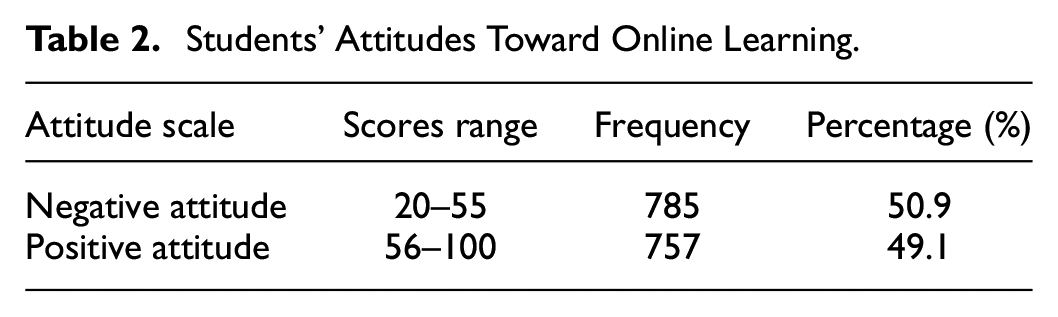
Table 3 shows that male students had better attitudes toward online learning than female students, with average attitudinal scores of 57 and 55, respectively. The average attitudinal score for working students (65) was better than for non-working students (52). Similarly, the average attitude scores for the part-time (65) and distance learning (63) students were better than the score for the full-time (51) students. Across the years of study, third-year students scored the lowest average attitude score (53) compared to first-years (56), second-years (57), fourth-years (57) and fifth-year students (57). Across age categories, the older students expressed stronger positive attitudes toward online learning compared with younger students, 17 to 20 years (51), 21 to 25 years (52), 26 to 30 years (63), and 31 years and above (66).
Students’ Attitudes Toward Online Learning by Demographic Factors.

Table 4 shows that students with access to the internet hold a stronger positive attitude toward online learning, with an average attitude score of 57 compared to those without internet access (45). Furthermore, students who had previously used the internet for online learning scored similarly to those who had not, with average attitudes scores of 56 and 55, respectively.
Students’ Attitudes Toward Online Learning by Internet Access and Previous Experience.

Factors Associated With Students’ Attitudes
According to Table 5, the results show that 52.7% of the male and 45.8% of the female students favored online learning. At the same time, 47.3% of the male and 54.2% of the female students responded negatively to online learning classes. Further, the Pearson Chi-Square test of independence showed that there was a significant association between gender and attitude toward online learning, χ2 (1) = 25.36, p < .007 (Table 5).
Cross-Tabulation of Gender Attitude Scale Cross-Tabulation.
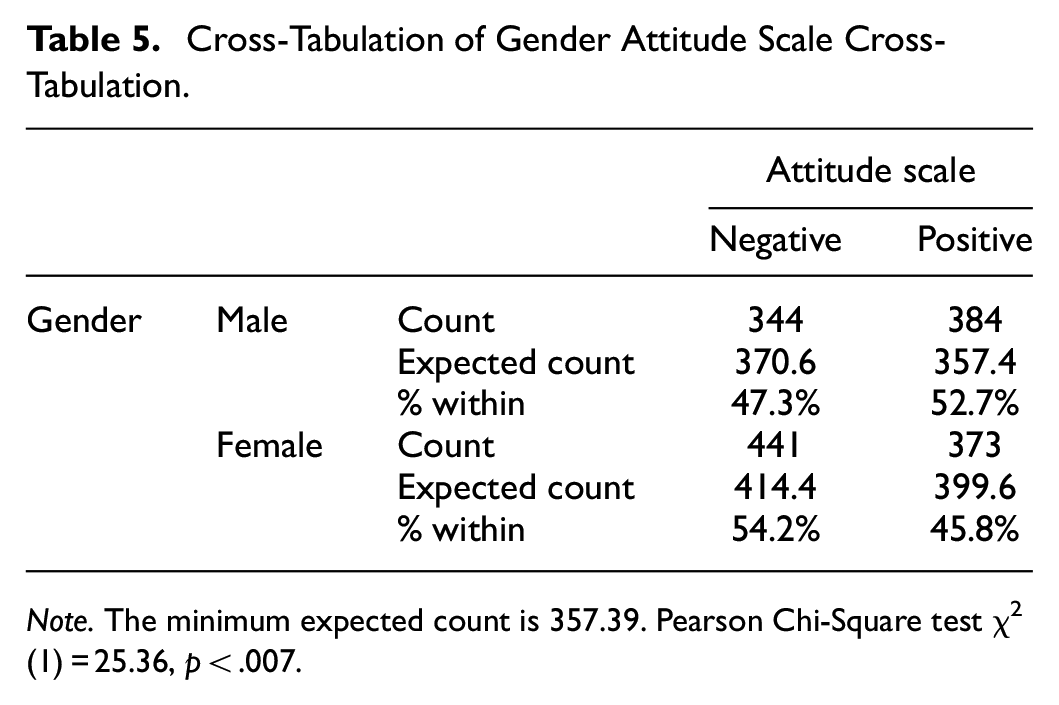
Note. The minimum expected count is 357.39. Pearson Chi-Square test χ2 (1) = 25.36, p < .007.
Data analysis revealed a statistically significant dependence between work status and students’ attitudes toward online learning, χ2 (1) = 257.216, p < .000. Further study in Table 6 shows that 77.8% of the employed and 34.6% of the non-employed students favored online learning classes. On the other hand, only 22.2% of the employed and 65.4% of the non-employed students did not favor online learning.
Cross-Tabulation of Work Status and Attitude Scale.

Note. The minimum expected count is 254.30. Pearson Chi-Square test χ2 (1) = 257.216, p < .000.
Interestingly, results revealed that part-time and distance learning students expressed stronger positive attitudes toward online learning than full-time students. Table 7 shows that only 33.3% of full-time students favored online learning classes compared with 66.7% of those who responded negatively. In comparison, part-time and distance students responded positively, 77.7% and 73.2%, respectively, against those who responded negatively, 22.3% among part-time students and 26.8% among distance students. The results also show interdependence between the mode of study and students’ attitudes toward online learning, χ2 (1) = 247.260, p < .000.
Cross-Tabulation Mode of Study and Attitude Scale.

Note. The minimum expected count is 77.07. The Pearson Chi-Square test χ2 (1) = 247.260, p < .000.
Similarly, there is also an interrelation between age and attitudes toward online learning, χ2 (1) = 251.032, p < .000 (Table 8). From the distribution of responses by age group in Table 8, it is clear that most of the respondents who would prefer online learning are from the age groups of 26 to30 years old (72.2%) and 31 years old and above (80.5%) showed positive attitudes toward online learning, respectively. On the other hand, only 37.3% of students with positive attitudes were 21 to 25 years old, and only 32.6% among those between 17 and 20 years old responded positively to online classes.
Cross-Tabulation of Age and Attitude Scale.

Note. The minimum expected count is 88.37. The Pearson Chi-Square test χ2 (1) = 251.032, p < .000.
Another factor associated with students’ attitudes toward online learning is internet access. Results in Table 9 revealed that internet access significantly influences students’ attitudes toward online learning, χ2 (1) = 34.831, p < .000. Internet accessibility is associated with positive attitudes toward online learning; 51.1% of those who said yes to having Internet access showered positive attitudes. At the same time, only 48.9 of those who said yes to having internet access responded negatively (Table 9).
Cross-Tabulation of Internet Access and Attitude Scale.

Note. The minimum expected count is 51.06. The Pearson Chi-Square test χ2 (1) = 34.831, p < .000.
Therefore, the research results show that the significant dependencies are gender, work status, study mode, age and internet. However, factors like previous experience with online learning and year of study were found to be nonsignificant.
Discussion
This study aimed to describe the prevailing attitudes toward online learning among students at the University of Lusaka and to determine some associated factors. Firstly, the study found that students hold strong negative attitudes toward online, which was high among full-time students. In the same vein, the study reported negative attitudes among young students, contrary to the findings of Forsyth et al. (2018). Their study found that young people perceived technology as an instrument both for entertainment and learning. However, one limitation of their research is that it was conducted before the Covid-19 pandemic and leaned more toward distance students. Our findings are interesting because full-time students comprise a young population that tends to be more proactive in using technology. On the other hand, the results showed a positive attitude toward online learning among part-time and distance-learning students. Students in distance learning mode favored online learning, and these findings are consistent with the works of other scholars (Forsyth et al., 2018; Oraif & Elyas, 2021; Zhu et al., 2013).
Furthermore, the research results show that the significant factors associated with students’ attitudes toward online learning are gender, work status, study mode, age and internet access (results in Tables 5–9, respectively). Specifically, we concluded from the statistical tests that male students hold more positive attitudes toward online learning than female students. This finding is important because gender differences in attitudes toward online learning are generally insignificant. However, some researchers have different results (Yu, 2021). Including conclusions of this research implies that gender differences do exist. The study findings are consistent with other researchers (Cai et al., 2020; Harreiter et al., 2011), who reported significant gender differences in attitudes toward online learning classes. For instance, Cai et al. (2020) found gender differences as a factor influencing students’ attitudes toward online courses in higher education. The meta-analysis showed that male learners hold more favorable attitudes toward online learning than female learners.
Further, we can conclude from the statistical tests in Table 7 show that students in the distance and part-time learning modes favored having classes online. This finding might be due to their employment, which makes most prefer part-time and distance learning modes. Besides, the results show that working students endorsed online learning more positively than non-working students and that their attitudes were significantly associated with work status (Table 6). Working students could have found it easier to learn online during the pandemic because remote learning was not entirely new compared to full-time students. Similar results are reported by Forsythet al. (2018), who found that employed students, part-time and distance students favored online learning. Therefore, we concluded that employed students have a greater need for online education, which would respond to their needs to a greater extent than those of unemployed students.
Further, these findings align with a well-replicated social psychology finding that people’s attitudes increase positively through mere exposure. The more experience a person has with the attitude object, the more favorably they will evaluate it (Zhu et al., 2013). The remote learning experience by distance and part-time students can be said to have increased their exposure to more online learning activities, which may lead to more positive attitudes toward online learning among them. These findings can further be supported by the fact that online learning is considered a critical component of distance learning, aiming to enhance users’ knowledge and improve learning quality (Jogezai et al., 2021). According to Uleanya et al. (2021), online learning is considered one of the different types of distance learning. Thus, part-time and distant students might already have an established favorable attitude toward online classes.
Furthermore, other factors determined are internet access and previous internet usage for online learning. Students with access to the internet hold a stronger positive attitude toward online learning than those without internet access. Besides, these results show that internet access significantly influences students’ attitudes toward online learning. The findings by An and Frick (2006) indicated that the students’ access to the internet could influence their attitudes toward online learning. Similarly, studies conducted during the pandemic, like Olivier (2020), indicated that an online mode of lesson delivery might not favor schools with limited resources whose teachers may not be sufficiently skilled and motivated.
Moreover, Mukuka et al. (2021) advanced that COVID-19 school closure in Zambia and elsewhere could be a wake-up call for education systems to build infrastructure that supports blended and online learning modes (pp. 23–25). Providing ICT products and services is bound to make teaching more accessible remotely and during physical classroom interactions. Furthermore, different studies conducted by Anifowoshe et al. (2020), Kapasia et al. (2020) as well as Owusu-Fordjour et al. (2020) during the outbreak of Covid-19 found that many students had limited access to internet connectivity. This suggests that limited internet connectivity affected their attitudes toward online classes.
Support for internet access in influencing attitudes is replete in literature before and after the pandemic. For instance, Gunnarsson (2001) and Suanpang (2007) reported a significant relationship between having a stronger internet connection and students’ online learning attitudes. However, the research results show that previous internet usage for online learning was not associated with differences in attitudes toward online learning. According to Table 4, students who had previously used the internet for online learning scored similarly to those who had not, with average attitudes scores of 56 and 55. The findings here are inconsistence with some researchers’ findings that students’ prior experiences of internet usage could influence their attitudes toward online learning (Stephens & Creaser, 2002).
Conclusion
The study results allow us to draw meaningful conclusions regarding students’ attitudes toward online learning at the University of Lusaka. It is evident from the results that students have a negative attitude toward online learning, which implies that they are more likely not to accept online classes. Regarding factors that could significantly influence students’ attitudes toward online learning, significant dependencies are gender, age, work status, study mode, and internet access. Generally, the results of this study are not encouraging in terms of the introduction of online learning classes at the University of Lusaka, especially for full-time and younger students. Therefore, the study recommended that the introduction of online learning classes be approached with caution to students in full-time learning mode without neglecting the importance of face-to-face learning. It is further recommended that the university should continue monitoring the attitude of students toward online learning because attitude is a variable that can change anytime.
Limitation
The data obtained in the present study are limited only to the responses received during data collection. In addition, the research findings can be generalized only to the students at the University of Lusaka.
Footnotes
Appendix
Scaled Items.

| No. | Items | For each statement, put a tick to show your level of agreement or disagreement (Strongly Disagree, Disagree, Agree, and Strongly Agree) | ||||
|---|---|---|---|---|---|---|
| Strongly disagree | Disagree | Neutral | Agree | Strongly Agree | ||
| 1 | I believe learning online is good alternative to face-to-face learning during pandemic such the Covid-19 | |||||
| 2 | Attending classes online is interesting | |||||
| 3 | I prefer reading articles online on the internet to reading hardcopies | |||||
| 4 | It is easier to login and attend classes on online learning platforms like Moodle, Google meet, Zoom | |||||
| 5 | Online learning requires extensive technical support from lecturers | |||||
| 6 | I like receiving online support from the lecturers | |||||
| 7 | Online learning reduces quality of knowledge | |||||
| 8 | Learning online is often frustrating | |||||
| 0 | A face-to-face method is more learner-centered than online learning methods | |||||
| 10 | Learning online increases learners’ social isolation during the pandemic such as Covid-19 | |||||
| 11 | Learning online is tiresome | |||||
| 12 | Communicating through social networks is fun | |||||
| 13 | Available online learning platforms like Moodle, Google meet, Zoom are difficult to use | |||||
| 14 | I make errors frequently when using a computer for online classes | |||||
| 15 | Attending online classes or lectures at home is very frustrating | |||||
| 16 | Online delivery of courses is a threat to quality of education | |||||
| 17 | I find online discussions assignments unexciting | |||||
| 18 | I prefer to submit papers (home assignments, course projects, scientific papers and essays, etc.) online instead in face-to-face mode | |||||
| 19 | I use social networks for communication with lecturers | |||||
| 20 | I prefer physical delivery of classes to online learning | |||||
Declaration of Conflicting Interests
The author(s) declared no potential conflicts of interest with respect to the research, authorship, and/or publication of this article.
Funding
The author(s) received no financial support for the research, authorship, and/or publication of this article.
Compliance with Ethical Standards
The study complied with Ethical Standards.

Data Availability Statement
Data sharing not applicable to this article as no datasets were generated or analyzed during the current study.