




Abstract
Blended learning, therefore, involves the use of conventional face-to-face teaching and the application of information technologies that support learning in the classroom. This research investigates the effect of implementing blended learning in the Saudi Arabian context on fourth-grade students’ reading and writing in Arabic and English regarding the mediating effects of student engagement and academic attitudes. A cross-sectional descriptive survey design distributed a structured questionnaire among 200 teachers and educational experts. The analysis of Structural Equation Modeling (SEM) suggests that blended learning enhances language skills; student engagement and academic attitudes act as mediating variables. There is evidence that well-planned and executed blended learning strategies can promote improvement in language learning and motivation, providing valuable recommendations for practice and policy about the education of bilingual students.
Plain language summary
Blended learning combines traditional classroom teaching with technology to create a more interactive and tech-focused learning environment. This study investigated how a mix of online and in-person learning impacts the language proficiency of fourth-grade students in Arabic and English in Saudi Arabian schools. The study focused on student engagement and academic attitudes as mediators of this impact. Researchers surveyed 200 teachers and experts from Saudi Schools using a self-administered survey. The study used Smart PLS structural equation modelling, cross-research, and quantitative research methods. The results showed that blended learning significantly improved students’ acquisition of Arabic and English language skills in fourth-grade students in Saudi schools. Student engagement and academic attitudes played important mediating roles in this improvement. Blended learning was found to enhance student engagement, leading to more positive attitudes and better performance overall. The study also highlighted that implementing well-planned blended learning methods could significantly enhance students’ language skills. However, the outcomes varied based on students’ proficiency levels and backgrounds. This research provides valuable insights for improving language education through blended learning approaches.
Introduction
In Saudi Arabia, people must be fluent in English and Arabic to be relevant to the job market, especially in educational and professional placements. This is true as the Saudi education system requires students to take both languages as their first and foreign languages starting from primary, secondary, and tertiary institutions (Ahmad, 2021). The intended purpose of this curriculum is to enable students to develop the appropriate linguistic resources crucial to academic achievement and to prepare them for their future careers. To support various learner characteristics, improvements to the classroom environment and instructional strategies and the use of face-to-face and technology-enriched approaches have been attempted (Ando et al., 2022).
A language, mainly English and Arabic, is essential for student success and career progress in Saudi Arabia. Consequently, education development plans pay attention to adopting technology that can enhance second-language learning, as well as to address the needs of learners with learning difficulties, including students with learning disability (Stanislaus, 2022; Wang & Zhang, 2022).
In the 21st century, technology has drastically changed how skills, content knowledge, and communication are taught and acquired in instructional settings (Abbacan-Tuguic, 2021). One of these innovations for effective and efficient delivery of instructional content is blended learning, which entails integrating traditional face-to-face instruction with technology in the delivery of instructional content. Such an approach has emerged with the attribute of improving student engagement and performance, as evidenced by the learning of language (Geronimo et al., 2022; Vitobina et al., 2023). One of the main benefits of blended learning is that it is highly flexible and can be used in many ways to tailor the classroom further.
Despite the necessity for further investigation, literature reviews examining the value of learning languages in online courses are rare. Utilizing the Web of Science database, authors I discovered a limited number of reviews on the efficacy of relevant components of online language learning (Topping et al., 2022). Chen (2022) conducted a study to assess the effectiveness of digital games on high school second language learners. The study researched the methodology, gaming platform, genre, design aim, and essential game aspects. Researchers noted that digital learning games were effective as an educational tool in 70% of the research included in the review (Wang & Zhang, 2022). Studies examining analysis, specifically (Riwayatiningsih & Sulistyani, 2020; Yudhana, 2021), have collected user feedback and assessed the effectiveness of online analysis courses. Few studies have focused on the effectiveness of online learning in other domains, such as health professions (Fan et al., 2024; Iswatiningsih et al., 2021; Rafiola et al., 2020; Syakur et al., 2020). Multiple studies have shown that the incorporation of technology into teachers’ classes leads to a notable improvement in students’ language proficiency levels (Ali, 2022; Drigas et al., 2020; Osman & Hamzah, 2020; Rudhumbu, 2022; Setiawan et al., 2022; Sumarmi et al., 2021; Zeqiri et al., 2021). According to Zeqiri et al. (2021) and Fisher et al. (2021), online education encourages students to actively pursue new material, evaluate its quality, collaborate in sharing it, and ultimately incorporate it into their knowledge base.
However, not all research has looked into the advantages of blended learning activities substantially impacting academic performance (Shamsuddin & Kaur, 2020). In a survey conducted, the author examined the viewpoints of English language learners at Arabian Gulf University and presented findings on the results of using a blended learning strategy. The results indicated no significant differences between the two groups regarding their English proficiency or perspective(Fenech, 2021; Hatiti et al., 2021; Li & Wang, 2022). Sheik Abdullah et al. (2021) and Hussein Al Noursi (2020) have undertaken similar studies inside the college impact model framework. Education is a collaborative endeavor, and the Internet and social media aid in this process (Mohd Amin et al., 2022). Dascalu et al. (2023) assert that students widely embrace internet-based learning due to its popularity, effectiveness, and inherent appeal. This is mainly attributed to its round-the-clock availability, universal accessibility, and adaptability.
Incorporating technology to support conventional teaching practices has led to blended learning getting much attention as a teaching model. Studies show that blended learning improves learners’ interest in learning and engagement and promotes language learning (Gazica et al., 2022; Sanjeev & Natrajan, 2019). The frequent and intensive interactions in blended learning conditions enhance students’ activity levels, improve the language content of what has been learned, and enhance the cognition processes since it influences the affective, sensory, and motor systems.
Again, academic attitudes also come in handy when determining how receptive the students will be to the blended learning environments. It was found that positive academic attitudes are associated with increased interest and practical completion in language learning activities (Obispo et al., 2023; Tang et al., 2024). Nonetheless, as with most technology applications in language learning, research has shown that blended learning may positively and negatively impact language outcomes, so the effects should be analyzed concerning particular cultural and education contexts such as Saudi Arabia (Tong et al., 2022).
It must be noted that bilingual education is a worldwide practice; however, few studies explore its application in the Saudi context, including programs designed to address the Saudi educational requirements (Chiu, 2021; Mohajer et al., 2023). This is why this study will seek to assess the efficiency of blended learning as a medium of language acquisition in Saudi Arabia. In so doing, it aims to contribute to the conceivable knowledge of the effects of blended learning on learner performances in second language learning.
Although various educators worldwide have integrated blended learning, the effect of this concept in developing language skills among Saudi students from the point of view of teachers/educators is still a research gap (Magbanua & Bearneza, 2023). To this end, this study aims to fill this gap by exploring the effects of blended learning on learning Arabic and English grammar among fourth-grade students of primary school in Saudi Arabia, particularly regarding the mediating roles of engagement and academic attitudes (Alfaki, 2021). Realizing these objectives, the study advances knowledge and understanding concerning the effectiveness of the fusion of traditional and online learning methodologies in raising learners’ educational performance in language instruction.
Although most of the literature supports blended learning as having an overall benefit on learning performance, not all articles demonstrate enhanced achievement. For example, (Li & Wang, 2022) were unable to evidence a related improvement in student achievements on English tests outside a blended learning environment and traditional classroom approaches at the Arabian Gulf University. This leads to the necessity for a review of factors in the blended learning frameworks that may affect the impact across various cultural and educational settings (Zhou & Zhang, 2022).
In this regard, the present study seeks to fill the above gaps by evaluating the effectiveness of online Arabic and English language courses on students’ achievement in those languages. In this context, its aim is twofold: It seeks to give standards by which the impact of these courses can be assessed, together with suggestions for improvement when delivering them in Saudi Arabia. Thus, by enhancing the knowledge of how successful online language learning is, this study wants to target education authorities, teachers, and policymakers and help develop bilingual education in the kingdom.
In School settings, the issue of student disengagement and subpar academic performance has consistently been a cause for concern. Technology has revolutionized how individuals communicate. It is essential as it empowers students to personalize their learning experience (Bangkom & Sukavatee, 2021; Ishak et al., 2022; Mabni et al., 2020). Technology in the classroom enables students to participate and collaborate with their peers actively, resulting in increased engagement(Rodríguez-Abad et al., 2023). Furthermore, the students refine their social and emotional skills. Traditional instructional practices do not empower students (Prieto et al., 2022). Conversely, a blended learning approach promotes the development of analytical thinking through collaborative assignments and individual autonomy in managing study schedules(Tettamanzi et al., 2023).
The level of students’ engagement in environmental class and other academic and lecture activities significantly impacts their learning abilities. Like educators, children aspire to succeed academically (Tiana & Rahayuningsih, 2022). Students must actively engage in their education to attain emotional, behavioral, and cognitive success. The school’s efforts to engage students in learning and encourage their participation in activities are called “student attraction” (Istiara et al., 2023). Huang (2021) found that blended learning can positively affect Chinese junior middle school students’ vocabulary growth, listening skills, and overall attitude.
Students’ attitudes play a crucial role in adopting E-learning (Darmawansah et al., 2022). Studies have demonstrated that students’ attitudes significantly influence their acceptance of E-learning, their intent to utilize technology, and their behavior (Fu et al., 2022; Lu, 2021; Yin & Yuan, 2021). The overall research on students’ views toward E-learning has yielded varied outcomes, with specific studies reporting positive attitudes (Novita et al., 2022) while others have said unfavorable attitudes (Akkara et al., 2020). The overall results of M. Zhang and Chen (2022) indicate that effective second language learning is associated with positive attitudes and motivation. Astrid et al. (2020) conducted research at the UAE Technological High School to investigate students’ attitudes toward learning English. The findings indicated that most students held a positive perspective toward acquiring English, and the teacher’s nationality did not influence students’ favorable disposition toward learning English (Bin-Hady & Hazaea, 2022).
This study aims to explore the impact of blended learning on students’ language performance in Arabic and English and examine the mediating roles of student engagement and academic attitudes in the relationship between them. The paper’s findings may help educators and policymakers in Saudi Arabia design and develop more effective strategies to promote blended learning processes to improve language skills in educational institutions. More precisely, the present research aims to investigate the potential of the blended learning paradigms in delivering relevant, valuable learning experiences to the students enrolled in the bilingual educational environment. The study addresses the following research questions in this study:
How does blended learning impact the direct acquisition of Arabic and English language skills among fourth-grade students in Saudi Arabia?
What is the mediating role of student engagement in the relationship between blended learning and language acquisition among fourth-grade students in Saudi Arabia?
How do academic attitudes mediate the relationship between blended learning and language acquisition among fourth-grade students in Saudi Arabia?
To answer these research questions of the study, the following hypotheses are proposed:
H1: Blended Learning has a significant impact on language skills acquisition.
H2: There is a significant relationship between Blended Learning and Student Engagement.
H3: There is a significant relationship between Student Engagement and Language Skills Acquisition.
H4: There is a significant relationship Between Blended Learning and Academic Attitudes.
H5: There is a significant relationship Between Academic Attitudes and Language Skills Acquisition.
H6: There is a mediating role of Student engagement in the relationship between Blended learning and Students’ acquisition of language skills.
H7: Academic attitudes have a mediating role in the relationship between blended learning and students’ acquisition of language skills.
Research Methodology
Participants
The institutional review board approved the ethical practice of this study to meet the standard practice of ethical research. The non-probability sampling technique, convenience sampling, was used to recruit participants. The main aim of using convenience sampling was due to the ability to recruit participants who were easily accessible and willing to participate. This method is advantageous for more practical concerns, including time and geographical convenience (Mohd Amin et al., 2022). But, to mitigate this, complex criteria were employed depending on the nature of the case during sample selection.
This study restricted participants to teaching professionals implementing blended learning explicitly in fourth-grade language classes. This helped to ensure that all the respondents had a good prior exposure to the study variable, hence improving the reliability of the results. Participants in the study were 200 teachers and educational experts drawn from Saudi Arabian Schools. Data were obtained through a structured, self-complete online questionnaire because it has several advantages over other means of data collection. This approach proved effective and engaging, offering the researchers the desired control over the sampling method.
To ensure that the sample was as accurate as possible, different demographic attributes were considered during the participants’ recruitment process. The study used a cross-sectional survey design that adopted a post-positivism philosophical orientation. The structured questionnaire was presented meticulously to represent theoretical and empirical models inherent in the blended learning paradigm. Two hundred respondents were considered appropriate for the current study to acquire statistical credibility for the study questions and objectives.
Instruments
The study was employed a data collection tool designed based on three approaches: asking new questions, modifying questions used in previous studies, and borrowing standard questions endorsed by other questionnaires. The adaptation and inclusion of different components from prior research raised the questionnaire’s relevance, understandability, and dependability of the questionnaire (Alfaki, 2021).
Three critical criteria were prioritized to ensure the instrument’s robustness: reliability, validity, and sensitivity. Due to the need to ensure that items relate closely to the requirements, items were reviewed carefully and evaluated to develop a sound and official measurement tool. They used a closed-ended questionnaire format to allow the participants to respond on a 5 Likert scale ranging from 1, representing strongly disagreeing with a statement, to 5, representing strongly agreeing with a statement. This format made it easier to gather measurable data than an open-ended format that produces uniform answers. When used, the instrument was completed in English and was believed to be suitable for the intended target respondents.
The constructs measured in the self-administered questionnaires relied on prior studies and were modified to fit the current study’s environment (Clavero & Briones, 2023; Sanjeev & Natrajan, 2019). These important realities were studied in a pilot and key expert assessment to ensure face and content validity. The feedback helped improve the modifications to increase clarity and the level of study items that met the objectives. In terms of reliability, Cronbach’s alpha co-efficiency was computed, which is more than .70 for all the constructs, hence asserting acceptable reliability across the constructs.
Consequently, using a validated and reliable instrument provided the measure of confidence into the targeted constructs being measured with precision and enhanced the study’s validity. Respondents’ answers in the questionnaires were on a five-point Likert scale, with one being strongly disagree and five being strongly agree. Cronbach’s alpha (above .7) and expert review were used to test the reliability and validity of the instruments used in the current study.
Blended Learning
Blended learning, also known as hybrid learning, combines traditional classroom-based approaches with online instructional resources and chances for online participation (Geronimo et al. (2022). The participants were asked eight questions related to the Blending Learning to be assessed by the participants, the Tested variables, and their respective items listed in the questionnaire survey (BL1, BL2, BL3 BL4, BL5, BL6, BL7, BL8) for example, “The students attend videoconferencing classes the same way they participate in face-to-face classes,” “Course content shown or displayed on the smart board is clear,” “The video image is clear and comprehensive when the lecturer is on the other side of the blended learning classroom,” “Technical problems are not frequent and they do not adversely affect my understanding of the course” etc. The questionnaire items used in this study were derived from (Sanjeev & Natrajan, 2019).
Students’ Acquisition
The process of student’s language acquisition includes developing their ability to grasp and perceive words. Simply put, it is the process by which newborns learn to understand, use, and generate language to communicate successfully (Al-Nassar et al., 2023). The participants were asked seven questions related to the Students’ Language Acquisition to be assessed by the participants, the Tested variables, and their respective items listed in the questionnaire survey (SAL1, SAL2, SAL3 SAL4, SAL5, SAL6, SAL7), for example, “Interaction is adequately maintained with the lecturer when he/she is on the other side of the blended learning classroom,” “Feedback on evaluation of tests and other assignments was given in a timely manner,” “Students understanding is improved compared to similar courses they studied before” etc. The questionnaire items used in this study was derived from Sanjeev and Natrajan (2019) and Clavero and Briones (2023).
Students’ Engagement
Student engagement refers to the degree to which students are positive, curious, attentive, and interested in the subject matter being taught. It may show students’ cognitive engagement in their education, which involves active participation and dedication to their academics(Tiana & Rahayuningsih, 2022). The participants were asked seven questions related to the Students’ Language Acquisition to be assessed by the participants, the Tested variables, and their respective items listed in the questionnaire survey (SE1, SE2, SE3 SE4, SE5, SE6, SE7), for example, “A blended learning session keeps Students always alert and focused,” “Students are satisfied with the process of collaboration activities during the course,” “Students are satisfied with their participation in the class” etc. The questionnaire items used in this study were derived from Clavero and Briones (2023).
Academic Attitudes
Students’ academic attitude toward blended learning refers to their opinion on the use of a combination of traditional face-to-face teaching methodologies and online platforms to provide educational information(Darmawansah et al., 2022). The participants were asked eight questions related to the Students’ Language Acquisition to be assessed by the participants, the Tested variables and their respective items listed in the questionnaire survey (AA1, AA2, AA3, AA4, AA5, AA6, AA7, AA8), for example “Students study and do their homework first before anything else (video games/watching drama etc.),” “Students give extra effort to work on their projects and assignments,” “Students used to ask someone when there is something they did not understand esp. in their assignments” etc. The questionnaire items used in this study were derived from Clavero and Briones (2023).
Survey Procedure
A pilot research with ten participants was undertaken to validate the survey instrument and identify areas the participants struggled to understand. Modifications were made where needed to ensure that the survey instrument was appropriate and unambiguous for its intended use. In addition to the pilot study, an expert review was carried out to assess the content validity of the survey instrument(Ando et al., 2022).
A comprehensive validation was carried out to ensure the survey apparatus’s dependability and precision. A group of subject matter experts in blended learning then examined the items and scales originally obtained from known sources in the literature. As a result, an initial investigation was undertaken with a limited number of experts and instructors who work with fourth-graders in Saudi Arabian institutions. This inquiry aimed to determine the items’ clarity and comprehensibility. In response to input from the pilot study, small changes were made to increase the instrument’s legibility. Following validation, the survey instruments were subjected to reliability and validity tests, which included calculating Cronbach’s alpha, composite reliability, and extracting the average Variance.
The study’s aims were presented to participants via an email invitation, including a consent form and a link to the online survey created with Google Form, an internet-based survey platform (Zhou & Zhang, 2022). Each participant completed an informed consent form to affirm their willingness to participate. The survey lasted about 10 to 15 min, and participants had no time limit. This enabled them to give thoughtful and detailed comments. A total of 200 people reacted positively to the 250 invitations. Finally, 200 participants successfully finished the entire research.
Validation and Pilot Study
To avoid measurement errors in the survey instrument, the survey instrument was subject to a rigorous validation procedure, which entailed a pilot study and expert review. The pilot study included 10 subjects who met the inclusion criteria of the primary research. These participants were required to fill out the questionnaire and comment on the items’ readability, understandability, and relevance. Feedback was considered when editing the survey instrument for readability and precise wording of questions.
Apart from the pilot study, another study was conducted through an Expert Review involving a panel of academic experts who specialize in blended learning in education. These experts determined the face and content relevance of the questionnaire and checked whether the items on the questionnaire fully captured the constructs of the study. In addition, the expert review also included an assessment of the relevancy of the questions set concerning the objective of the planned research and the appropriateness of the questions for the intended sample.
The internal consistency of the constructs was calculated using Cronbach’s alpha, and all values were above the recommended level of .70. Composite reliability and Average Variance Extracted (AVE) analysis were also done to establish convergent validity. The validation averted any flexible situation and ensured that both the reliability and validity of the survey instrument were achieved in measuring its corresponding data.
Data Collection
Data was collected through an online survey using Google Forms to make it easier to administer and participate in. Invitations for the study were sent to 250 teachers and educational experts who are perceived to meet the study’s inclusion criteria within the Saudi Arabian educational sector. All invitations consisted of a description of the study, the signed consent form, and a link to the survey.
The survey was conducted for 2 weeks, and the participants could fill out the questionnaire at any time. To increase the level of response, the researchers pointed out that the answers will remain anonymous, and the research is crucial for furthering educational methods. Self-completion reduced social desirability bias, and the participants had enough time to respond to the questions.
Out of the 250 invitations sent, 200 acceptable responses were obtained, and therefore, a response rate of 80%. Data collection respected ethical research guidelines such as consent, informed and participants’ identity. Through this approach, the researchers established themselves in a way that enabled them to obtain sound quality data and, simultaneously, took minimal time for the participants besides acknowledging their dignity.
Data Analysis
The data analysis was undertaken employing the Partial Least Squares Structural Equation Modeling (PLS-SEM) with the help of the Smart PLS 4 tool. Then, upon accessing the dataset, the variables were checked and cleaned first to avoid having an incomplete and inconsistent data set. PLS-SEM was deemed appropriate because of the potential for several mediator variables and the fact that it can handle data that is not normally distributed, which is common in research with human subjects. Thus, this approach complies with the study goals and the specific properties of the dataset.
SEM was adopted to examine both the direct and mediated effects of BL on the acquisition of language skills, student engagement, and academic attitudes as mediators. Compared to traditional analysis techniques, SEM is specifically useful for analyzing the interactions between at least two or more latent variables, offering the best analysis of the direct and indirect connections. For this reason, this method is suitable for exploring the complex connections in this research (Zhou & Zhang, 2022).
The validity and reliability of the measurement model were analyzed in relation to standard guidelines. To examine the convergent validity, the AVE was calculated where the distinct elements of all the constructs were higher than 0.50, meaning that the constructs provided adequate capture of the Variance of the indicators. Discriminant validity was assessed through the Fornell-Larcker criterion and cross-loading test, which confirmed that all the constructs were distinct. Besides, the composite reliability of all the constructs was above 0.7, which was the minimum acceptable reliability value.
The structural model was then examined to assess the hypothesized interrelationships between the variables. Using path coefficients, t-statistics, and p-values, the studies analyzed the significance and strength of these relationships. The model’s validity was tested employing the coefficient of determination (R 2) for endogenous variables, which offered the idea about the proportion of Variance in the dependent variable that the independent variable might explain.
The reasons for selecting PLS-SEM were its usability for big and complex models and its ability to handle multiple reactions and non-normal distributed data. The present analytical framework offered a systematic account of the impact of blended learning on language development as assimilated directly and indirectly by the perceived means of students’ engagement and academic dispositions. Both measurement and structural model checks provided confirmatory evidence of the soundness of the findings that formed the basis for interpreting the results in the study.
Data Analysis
The results of the study are presented in two key parts: (1) Measurement Model Evaluation to test the reliability and validity of the constructs and (2) Structural Model Evaluation to test the structural relationships between the variables.
Measurement Model Evaluation
The validity of the measurement of the constructs was also checked to ensure the reliability and validity of the various constructs.
Figure 1 below shows the measurement model of this study before deletion.

Measurement model before deletion.
The Deleted SE-M5 (0.33) value is less than 0.5 of factor loading.
Figure 2 below shows the final measurement model for this study.

FINAL measurement model.
The constructs were tested to confirm the validity and reliability of the measurement model. The initial measurement model is illustrated in Figure 1, in which one item (SE-M5) displayed a factor loading of 0.33, below the typical standard of 0.5. It was removed from the analysis to enhance the construct validity of Student Engagement (SE-M), which includes SE-M5. This adjustment is indicated in the final developed measurement model presented in Figure 2 below.
Construct Reliability and Validity
It can also be seen from Table 1 that all the constructs had Cronbach’s alpha of more than .7, which confirmed a high internal consistency. Table presents measures of construct reliability and validity for four constructs, Academic Attitudes (AA-M), Blended Learning (BL), Students’ Acquisition of Language Skills (SAL), and Student Engagement (SE-M), within the context of evaluating the impact of blended learning on language acquisition.
Construct Reliability and Validity for Study Variables.
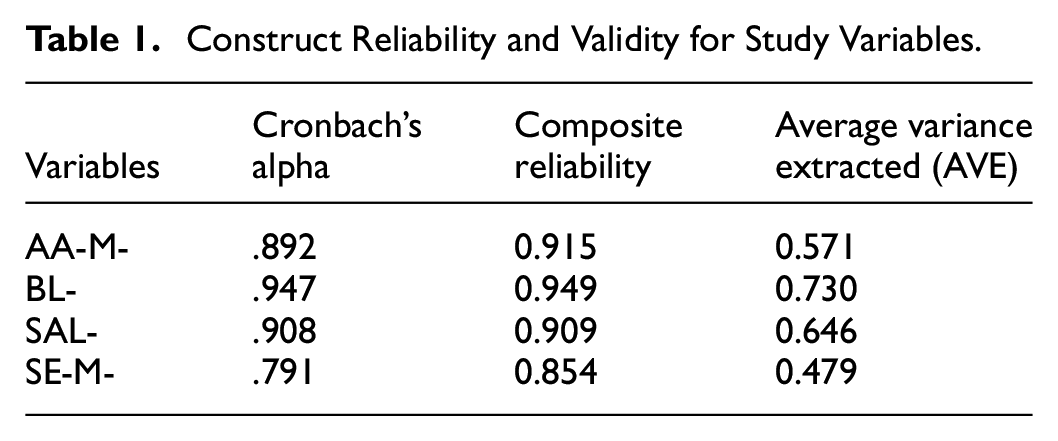
Cronbach’s Alpha values for all constructs—AA-M (.892), BL (.947), SAL (.908), and SE-M (.791)—exceed the commonly accepted threshold of .7, indicating high internal consistency. This suggests that items within each construct are closely related and consistently measure the same underlying concept. Such high internal consistency indicates the constructs’ reliability, ensuring that the variability in responses can be attributed to the constructs rather than random measurement errors.
The Composite Reliability (CR) scores further support these findings, with all constructs showing CR values well above 0.7: AA-M (0.915), BL (0.949), SAL (0.909), and SE-M (0.854). These values not only reinforce the internal consistency of the constructs but also highlight the precision with which they measure the underlying concepts, taking into account the differing item loadings on each construct, which is a refinement over Cronbach’s Alpha in assessing reliability.
Convergent validity was assessed using Average Variance Extracted (AVE). Most of the constructs presented AVE values greater than 0.5, which is an important standard in that it affirms that the constructs identify considerable variance from their respective indicators. Average Variance Extracted (AVE) provides insight into convergent validity, with AA-M (0.571), BL (0.730), and SAL (0.646) demonstrating AVE values above the desired threshold of 0.5, indicating that the constructs account for the majority of the Variance in the indicators. This evidences good convergent validity, showing that the constructs effectively capture the essence of what they are intended to measure. However, SE-M stands out with an AVE of 0.479, slightly below the threshold. This suggests that the construct may not be capturing as much of the Variance of its indicators as desired, pointing toward potential issues in its ability to fully represent the concept of student engagement. The deletion of the item SE-M5, due to its low loading (0.33), was an attempt to improve this metric, indicating that further refinement of the SE-M construct or reassessment of its items might be necessary to enhance its validity.
Convergent Validity
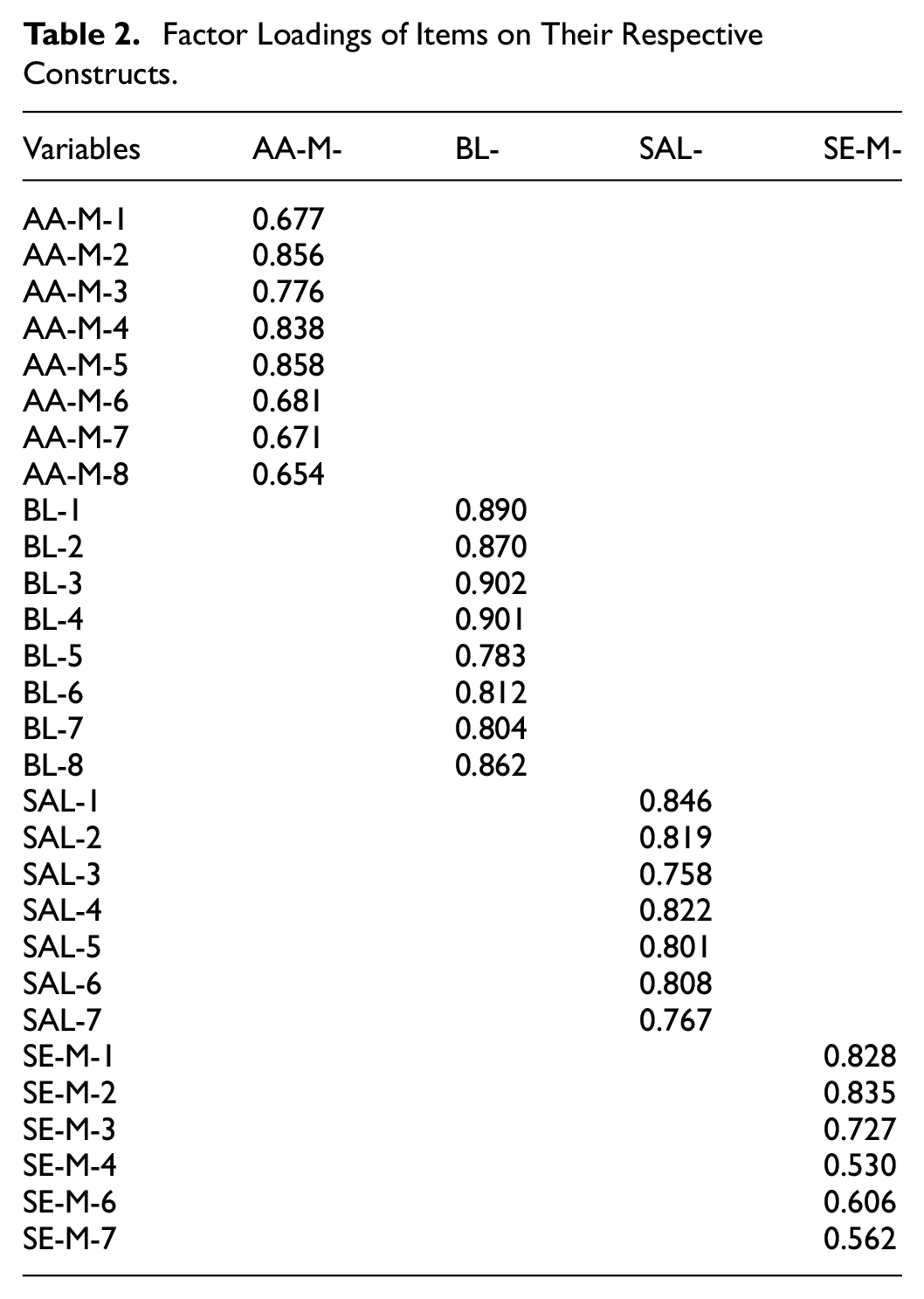
Convergent Validity was examined to establish the extent in which the items representing a given construct are good measures of the theoretical construct being measured. The results of this evaluation entailed sample cross-loadings for each item to its own construct, highlighted on Table 2. The factor loadings of most items were greater than 0.5, proving that the items are valid reflecting the aspects assigned to them.
Factor Loadings of Items on Their Respective Constructs.
Cross Loadings
Table 2 shows the factor loadings of items on their respective constructs: Academic Attitudes (AA-M), Blended Learning (BL), Students’ Acquisition of Language Skills (SAL), and Student Engagement (SE-M). Convergent validity is supported as all items load significantly on their respective constructs, with loadings well above the recommended threshold of 0.5, indicating that items are good indicators of their constructs. The high loadings, particularly for BL items (ranging from 0.783 to 0.902) and SAL items (ranging from 0.758 to 0.846), demonstrate strong associations with their respective constructs, reinforcing the constructs’ validity. However, SE-M shows a few lower loadings (notably SE-M4 at 0.530 and SE-M6 at 0.606), suggesting these items might not be as strongly related to the student engagement construct as others.
Discriminant Validity
Discriminant validity was checked to ensure that each construct differed and was uniquely measured. The Fornell-Larcker criterion and the Heterotrait-Monotrait (HTMT) ratio were used to evaluate discriminant validity.
Fornell-Larcker Criterion
The Fornell-Larcker criterion requires comparing the square root of the AVE for each construct listed in the diagonal of Table 3 with the correlation value between each pair of constructs shown in Table 3 off-diagonal. The test indicates discriminant validity exists when the diagonal values exceed the correlation in the off-diagonal boxes.
Divergent Validity Based on the Fornell–Larcker Approach.
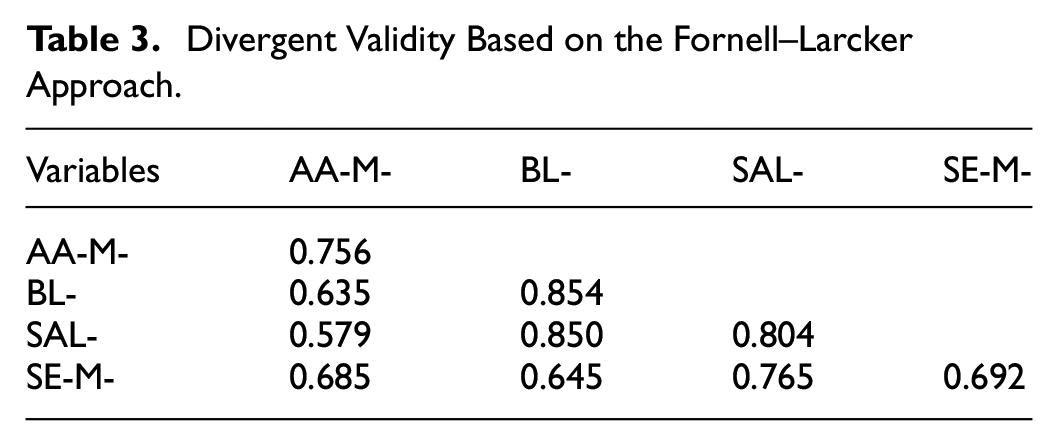
This criterion in Table 3 compares the square root of the Average Variance Extracted (AVE) for each construct (diagonal values) against the correlations between constructs (off-diagonal values). For discriminant validity to be established, each construct’s diagonal value (AVE square root) should be greater than its correlations with other constructs.AA-M, BL, SAL, and SE-M all show diagonal values (square root of AVE) higher than the off-diagonal values (correlations with other constructs), confirming discriminant validity. This indicates that each construct captures a variance distinct from that of other constructs in the study.
Heterotrait-Monotrait Ratio (HTMT)
The HTMT ratio is another approach that presents discriminant validity by comparing heterotrait and monotrait correlation mean. Cronbach’s alpha values of less than 0.85—or less than 0.90, are considered satisfactory as depicted in Table 4.
HTMT.

The HTMT in Table 4 is an alternative approach to assess discriminant validity, comparing the mean of the item correlations across constructs (heterotrait) with the mean of the item correlations within the same construct (monotrait). Values below 0.85 or, in more conservative assessments, below 0.90 suggest good discriminant validity.
AA-M and BL (0.668), AA-M and SAL (0.625), BL and SAL (0.900), SE-M with AA-M (0.855), BL (0.664), and SAL (0.815) indicate acceptable levels of discriminant validity for most comparisons, suggesting that constructs are distinct. However, the HTMT ratio between BL and SAL is at the upper threshold of acceptability, suggesting their discriminant validity is borderline and may require further scrutiny.
Moreover, the assessment using both the Fornell-Larcker criterion and the HTMT ratio supports the discriminant validity of the constructs, indicating that they measure distinct concepts. While most HTMT ratios are within acceptable limits, indicating good discriminant validity, the borderline ratio between BL and SAL suggests these constructs, though distinct, share a high degree of similarity in what they measure.
Structural Model Evaluation
The structural model was evaluated to analyze the hypothesized linkages between the variables. This evaluation entailed incorporating path coefficients, t-statistics, and p-values, together with the model’s ability to forecast results using the coefficient of determination (R2).
Path Coefficient Analysis: Direct
Table 5 provides the constructs’ direct effects, revealing that all the hypotheses are significant and positive.
Direct Relationship Between Variables.

The structural model evaluation in Table 5 through path coefficient analysis provides significant insights into the relationships between blended learning (BL), student engagement (SE-M), academic attitudes (AA-M), and students’ acquisition of language skills (SAL). Here’s a detailed interpretation of the results for each hypothesis based on the sample mean (M), standard deviation (STDEV), T statistics, and P values provided:
H1: There is a significant impact of Blended Learning on Language Skills Acquisition.
Path Coefficient (BL -> SAL): The significant path coefficient of 0.653 with a T statistic of 19.142 and a p value of .000 strongly supports H1, indicating a substantial positive impact of blended learning on students’ acquisition of language skills. The high T statistic far exceeds the critical value (usually around 1.96 for a 0.05 significance level), confirming the robustness of this relationship.

H2: There is a significant relationship between Blended Learning and Student Engagement.
• Path Coefficient (BL -> SE-M): With a coefficient of .648 and a T statistic of 25.569, alongside a p value of .000, H2 is also strongly supported. This suggests that blended learning significantly contributes to student engagement, highlighting the effectiveness of blended learning environments in engaging students.

H3: There is a significant relationship Between Student Engagement and Language Skills Acquisition.
• Path Coefficient (SE-M -> SAL): The coefficient of 0.435, a T statistic of 13.407, and a p value of .000 provide strong evidence supporting H3. This indicates that higher levels of student engagement are significantly associated with better acquisition of language skills, reinforcing the importance of engagement in the learning process.
H4: There is a significant relationship Between Blended Learning and Academic Attitudes.
• Path Coefficient (BL -> AA-M): The significant coefficient of .637, a T statistic of 15.834 and a p value of .000, validates H4. This demonstrates that blended learning positively affects students’ academic attitudes, suggesting that such learning modalities can foster more favorable attitudes toward learning.

H5: There is a significant relationship Between Academic Attitudes and Language Skills Acquisition.
• Path Coefficient (AA-M -> SAL): With a relatively lower coefficient of 0.133 but a significant T statistic of 3.942 and a p value of .000, H5 is supported, albeit the effect size is smaller than other relationships. This indicates that while academic attitudes positively impact the acquisition of language skills, the strength of this relationship is less pronounced than that of blended learning or student engagement.

The analysis conclusively supports all five hypotheses, indicating that blended learning significantly impacts students’ acquisition of language skills directly and indirectly through mediating factors such as student engagement and academic attitudes. The statistical significance of all paths (p values of .000) underscores the robustness of these relationships. Notably, the direct impact of blended learning on language skills acquisition and its influence on student engagement are powerful, highlighting the critical role of blended learning environments in enhancing educational outcomes.
Mediating
The mediating roles of student engagement (SE-M) and academic attitudes (AA-M) were tested to determine the moderating effect of blended learning (BL) on the student’s language acquisition (SAL). Table 6 shows the mediation test results. The mediating effect analysis in Table 6 provides insights into how student engagement (SE-M) and academic attitudes (AA-M) mediate the relationship between blended learning (BL) and students’ acquisition of language skills (SAL). Based on the provided statistics (sample mean, standard deviation, T statistics, and p values).
H6: There is a mediating role of Student engagement in the relationship between Blended learning and Students’ acquisition of language skills.
H7: Academic attitudes have a mediating role in the relationship between blended learning and students’ acquisition of language skills.
•
•
Mediating Effect.

Both H6 and H7 are supported by the data, suggesting that blended learning directly and indirectly influences students’ acquisition of language skills by enhancing student engagement and fostering positive academic attitudes. The statistical significance (p values of .000) for both mediation paths underscores the reliability of these effects. The larger mediation effect of student engagement compared to academic attitudes highlights the crucial role of engaging students in learning as a mechanism through which blended learning environments facilitate language skills acquisition.
The structural model results are presented in Tables 5 and 6 where hypotheses were tested and assessed according to their performance. The findings of each hypothesis are further endorsed by statistical analysis to assert the reliability of inter-relations among constructs. The structural model is shown in Figure 3 below and explains the direct and indirect relations between Blended Learning (BL), Student Engagement (SE-M), Academic Attitudes (AA-M), and Students’ Language Acquisition (SAL). The model depicts the standardized path coefficients, showing the nature and intensity of the link between the variables and the degree of end-user exclusion explained by the model, marked as R2 values, for each dependent variable.

Structured model.
Discussion, Conclusion, and Implications
Discussion
The purpose of this study was to find the impact of blended learning on the learning and achievement of Arabic and English skills in the fourth-grade Saudi Arabian school with the mediating roles of engagement and attitudes. The findings presented above afford strong radical support to the hypothesis concerning the positive impact of blended learning on second language acquisition and demonstrate that student engagement and academic attitudes act as mediation variables.
The results validate the research hypothesis H1, which posits that blended learning statistically enhances language learning, with a path coefficient of .653. This appears to support earlier findings from other studies, such as Anthonysamy et al. (2020); Venkatesh et al. (2020), where integrated face-to-face and using technology improves language performance. The use of teaching aids in the classroom probably offers what can be described as an interactivity and buildup experience in learning Arabic or English for the students. Specifically, multimedia and technologies such as adaptive learning will address different learning modalities, increasing the ease with which learners can acquire language knowledge.
H2 hypothesized that there is a positive correlation between blended learning and student engagement. To support this hypothesis, the path coefficient of 0.648 supports the notion that blended learning environments play a huge role in increasing student engagement. This finding concurs with Sheik Abdullah et al. (2021), where studies claim that learners who use blended learning have better attention, intention, and performance, thus improving students’ academic results. Other advantages that are attributed to blended learning environments may be pointed to the interactivity and collaborative component as making learning a fascinating process with probably more engagement from learners.
H3 assumed that the level of student engagement determines the levels of students’ language skills. This hypothesis is also confirmed by the path coefficient of 0.435 estimated in the context of the analysis. Students who are engaged are likely to work harder at what they are learning, which, evidenced by the results, has enhanced their language learning. These results are also in accordance with Fahd et al. (2021) and Sheik Abdullah et al. (2021).
H4 predicted a significant correlation between the level of blended learning and academic attitude. The findings indicate that the path coefficient is equal to 0.637. This explains that the blended approach proactively impacts students’ academic attitudes. As earlier discussed by Syakur et al. (2020) and Iqbal et al. (2022), students who learn in blended learning environments are likely to have a positive attitude toward learning. A positively aligned attitude toward education might result from implementing technology and improving students’ learning paths.
According to the hypothesis of H5, academic attitudes positively affect language skills. The result provides a path coefficient of 0.133, a little weaker but statistically significant. As much as it can be argued that positive academic attitudes contribute to language acquisition, this study opens up engagement as a more influential force within language learning environments. This finding is in line with Nieva and Prudente (2022), who stated and affirmed that the engagement of students in learning in a blended learning environment is a better indicator than a positive attitude toward learning.
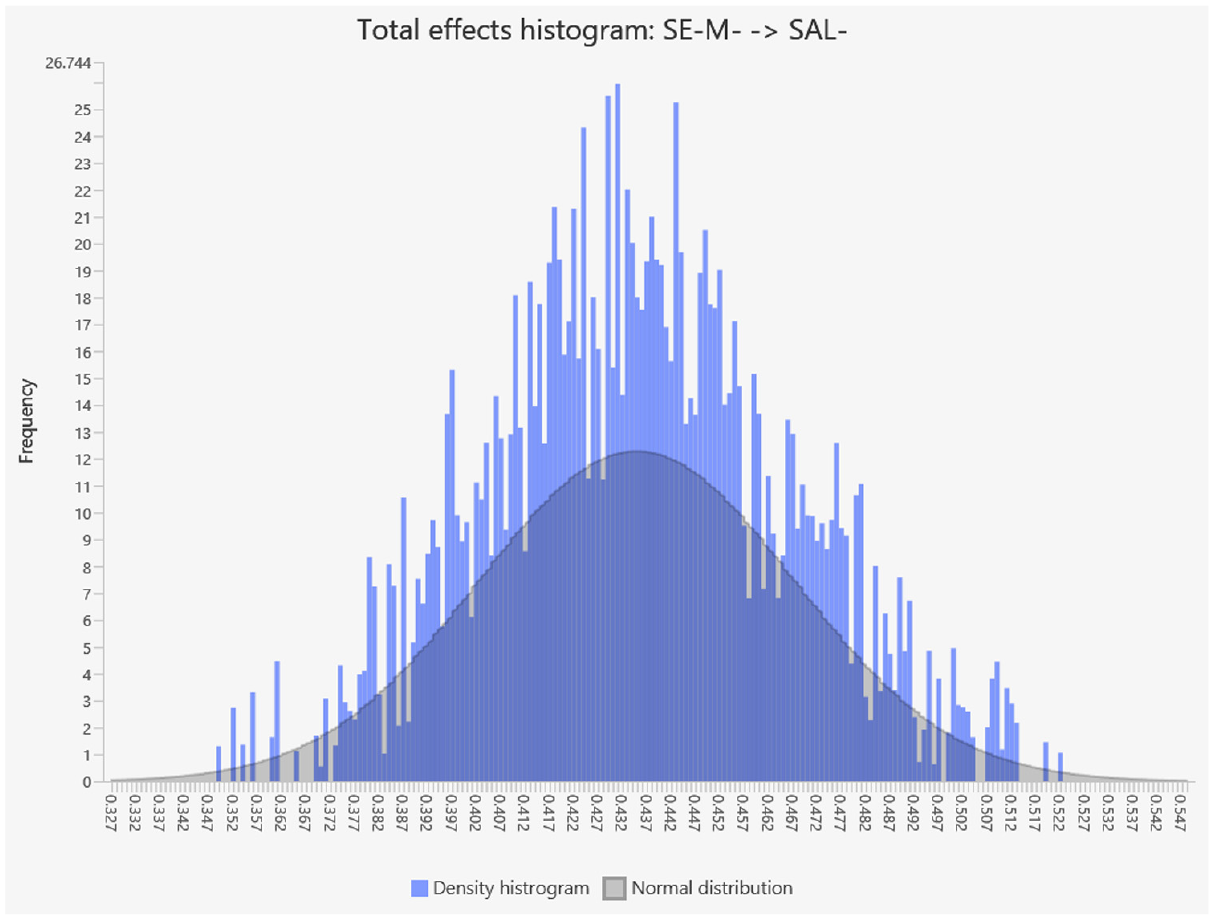
The analysis also establishes the importance of the mediating variable of engagement, with a path coefficient of .282 for the H6. For this reason, this research finding confirms student engagement as a mediator between blended learning and better language learning results. Like Sheik Abdullah et al. (2021), the present study proves that engaged students show more interest, attention, and persistence to learn, which are significant learning outcomes. Experiences in blended learning, encouraging interactivity and collaborations along with immediate feedback, seem to lend to enhanced language acquisition from a dramatic sense of involvement. These results indicate that it is not just that engagement is occurring but that it is the mechanism through which blended learning is effective.
Finally, the last hypothesis, H7, examined the mediating impact of academic attitudes. While academic attitudes mediated the relationship between blended learning and language acquisition, the effect was less influential (path coefficient = .085). This suggests that apart from having positive attitudes toward learning, which helps improve language acquisition, engagement plays a more dominant role than the two. These findings align with the prior literature (Iqbal et al., 2022; Syakur et al., 2020) that shows how learners approach their classes, which also supports blended learning situations. Even though always promoting positivity and self-belief with students is a key component, the study uncovered that motivation is a more potent stimulant for success in blended learning environments.
The observation highlights significant ideas about the educationists and policymakers of KSA Schools. The fact that blended learning strongly impacted language skills reaffirms the case for supporting digital education. Policymakers should ensure that requisite technology tools are procured and brought into classrooms and used appropriately by teachers should be encouraged. Furthermore, schools should employ student-centered strategies to produce optimum results from blended learning, such as game-based learning methods, peer activities, and feedback systems. Second, although student engagement proved to be the more robust mediator, cultivating positive academic beliefs is beneficial. Teachers must help students develop positive self-motivation, interests, and attitudes toward learning by Setting and achieving goals, acknowledging accomplishment, and providing vigorous learning conditions.
Conclusion
The present work offers relevant knowledge about the effects of the blended learning approaches on fourth-grade students in Saudi schools and their ability to learn Arabic and English languages. These results also support the hypothesis that blended learning improves language outcomes because student engagement and academic attitude are intermediary variables. However, student engagement was established as the more potent mediator in the overall analysis, underlining thus the importance of the interactive and engaging learning environment to unlock the potential of blended learning fully. These are consistent with findings in prior literature suggesting that increased participation and interaction enhance language acculturation.
Our work also provides significant conceptual and practical significance for educators and policymakers. Suppose blended learning has been adopted and implemented adequately. In that case, schools are in a position to design lively learning environments to address the cognitive and affective domains of learning. Educators are encouraged to wake up and focus on strategies for effective student involvement, like gamification and task-related collaborative processes that help promote a positive academic attitude. As with all the research studies, the present findings are encouraging, and it would be essential to look at blended learning for longer durations. Also, other constructs apart from culture and technological self-efficacy can be reinstated for more sustainable integration of blended learning in different contexts of education.
Implications
Therefore, the outcome of this study supports the idea that blended learning can boost primary school students’ vocabulary and language skills in both Arabic and English. Teachers should pay more attention to producing and implementing better instructional designs that increase the student’s engagement with the learning content since it was identified as a mediator to better language outcomes. Moreover, teaching positive academic attitudes based on blended learning should help students achieve better grades in school and, therefore, build the value of educational contributions.
Concerning the implementation of blended learning activities, educational authorities have to support teachers directly and adequately, supplying them with necessary resources and offering professional development (Wang & Zhang, 2022). These measures will enable the teachers to successfully implement blended learning, enhancing the student’s performance in terms of language standards and other related skills. Therefore, schools need to improve interactivity, collaboration, and a positive learning environment to adopt blended learning as a tool for bilingual education.
Limitations and Future Research
Some limitations are worth considering as we look at the findings of this study. Firstly, the study deals with Convenience sampling, and therefore, the results derived may not represent all the schools in Saudi Arabia. Second, to a certain extent, the analysis was based only on fourth-grade students. Therefore, whether the identified results can be applied to other grades or ages is questionable. However, the research was implemented in a particular cultural and educational environment, which implies limiting the generalization of the findings in different countries or regions.
Perhaps the following studies should supplement the present research methodologies with more generalizable methods of selection of the participants and recruit students from different grades and learning institutions. Someday, they should investigate other similar cultural and educational contexts to increase the external validity of the study and its conclusion. In addition, discovering other mediating factors, such as the level of involvement of the teachers or technological competence, could give a balanced picture of the factors that may affect blended learning outcomes. Additional longitudinal research focusing on the effects of blended learning in second language acquisition would also fill the gap within this field.
Footnotes
ORCID iDs

Funding
The authors received no financial support for the research, authorship, and/or publication of this article.
Declaration of Conflicting Interests
The authors declared no potential conflicts of interest with respect to the research, authorship, and/or publication of this article.
Data Availability Statement
Data sharing not applicable to this article as no datasets were generated or analyzed during the current study.