




Abstract
Research articles generate and disseminate disciplinary knowledge in a specific field of study. They are expected to be objective, faceless, and free from expressions of emotion. However, linguistic expressions of confusion that signal authors’ affective attitude toward the propositional information are not uncommon in research articles. To determine and describe the dynamic changes that occurred in the deployment of such expressions in communicating disciplinary knowledge, this study examined linguistically expressed confusion in a corpus of 160 research articles in applied linguistics that were published in two periods separated by 30 years. Drawing on a frame-based analytical approach, this study revealed that time of publication was a robust predictor of academic authors’ overall use of confusion markers and the presence of some subcategories across the four frame elements of the Confusion frame. This study sheds new light on the possibilities of applying frame semantics to academic discourse analysis. More importantly, it has pedagogical implications in terms of helping raise the awareness of novice writers about the necessity of acquiring a time-sensitive repertoire of discursive resources to convey an appropriate authorial identity for effective academic communication.
Keywords
Introduction
As a prestigious knowledge-making genre, research articles (RAs) constitute a form of cultural capital (Bourdieu, 1991) to secure academic positions and prestige in the highly competitive academic arena. RAs are not only deemed the endpoint of scientific research being conceived, conducted, written up, peer-reviewed, and finally accepted by peers but are also seen as an invaluable means for researchers to gain national and international recognition as disciplinary experts. RAs are traditionally expected to be objective, faceless, and evincive of detached rationality. However, linguistically expressed confusion (hereafter confusion markers) manifested in expressions such as confusing, ambiguous, and unknown are not uncommon in RAs, as illustrated by the example The data reported from the previous research is quite ambiguous. The emotive response of confusion, triggered by cognitive states involving discrepancies between novel information and activated schemata or a gap in prior knowledge (Nerantzaki & Efklides, 2019; Nerantzaki et al., 2021; Vogl et al., 2019), motivates our knowledge-seeking behaviors to resolve a potential problem (Muis et al., 2015). In other words, such induced emotions stem from the appraisal of an event characterized by unfamiliarity, novelty, complexity, and lack of comprehension (Silvia, 2019). Responding actively and thinking through something difficult to understand enable us to engage in deep learning, thereby fostering the growth of knowledge (Silvia, 2019). This may explain why confusion, included in the family of knowledge emotions, contributes to fostering, generating, and constructing scientific knowledge (Silvia, 2009, 2019). Confusion markers in academic writing belong to a subtype of attitude markers that index academic authors’ affective attitudes toward their propositions (Hu & Chen, 2019; Hyland, 2005). Such linguistic expressions are cognitive in nature and inherently connected with knowledge-making practices in scientific writing (Wang & Hu, 2022).
The past decade has witnessed increasingly scholarly attention to examining diachronic changes in the use of metadiscursive resources in academic writing (Gillaerts & Van de Velde, 2010; Hyland & Jiang, 2016a, 2016b, 2017, 2018). For example, Hyland and Jiang (2016a) examined diachronic changes in the use of engagement markers in RAs from two hard (electrical engineering and biology) and two soft disciplines (applied linguistics and sociology) and noticed the declining use of these markers in the two soft disciplines but a rise in electrical engineering and unchanged frequency in biology. Hyland and Jiang (2017) analyzed perceptions of the informality of academic writing and found an upward trend of “informal elements” due to the increasing use of first-person pronouns, unattended references, and sentences starting with conjunctions and conjunctive adverbs. Academic writing in the hard sciences became less formal, whereas the trend was the opposite for the soft disciplines. These studies on how disciplinary writing changes and develops with time have enlightened our understanding of current academic writing practices and helped us gain new insights into the evolution of scientific thinking and philosophy. However, it should be noted that inquiries focusing on a specific type of attitude markers, for example, confusion markers in academic discourse, are still very limited. In addition, previous research treated attitude markers as one homogeneous category, which may obscure our understanding of varying, sometimes even opposite, patterns of use exhibited by different types of attitude markers over time (Chen & Hu, 2020b; Wang & Hu, 2022). Moreover, they paid less attention to the possible interaction of attitude markers with other types of metadiscursive features (i.e., hedges, boosters, or self-mentions). As a result, it remains unclear whether the observed changes in the use of attitude markers apply to different types of attitude markers or just some of them. It is also unclear whether academic authors tend to boost/soften a specific type of attitude markers or use self-mentions with certain attitude markers over time. Finally, the existing studies adopting a metadiscoursal perspective fail to uncover distinctive cognitive properties of affective attitudes expressed in academic writing (Hu & Chen, 2019).
To address the research gaps mentioned above, this study sought to investigate the use of confusion markers in applied linguistics RAs over 30 years using a cognitive semantic approach. Specifically, an analytical framework proposed by Wang and Hu (2022) was adopted to examine how scholarly discursive practices instantiated in confusion markers are mediated by authors’ time of publication. Less arguably, this study could enrich our understanding of the epistemic nature of such linguistic expressions in applied linguistics RAs in general, and the dynamic changes in how such expressions contributed to conveying authorial stances and negotiating readers’ expectations in particular. Two research questions were proposed to guide this study.
(1) Are there any differences in the overall use of confusion markers between applied linguistics RAs published across different times?
(2) Are there any differences in the use of confusion markers between applied linguistics RAs published across different times in terms of the distribution of each frame element category?
Previous Research
Diachronic Variations in the Use of Metadiscourse in RAs
Research focusing on diachronic variations in the use of metadiscoursal resources for rhetorical persuasion has yielded fruitful findings. In one of the earlier studies that examined diachronic features of the interpersonal aspects of academic writing, Salager-Meyer et al. (1996) reported that shields (signaling the fuzziness between propositional content and the speaker, e.g., I guess) and expressions of doubt were almost absent in articles published in the 19th century but quite prevalent in those published in the 20th century. However, the use of approximators (signaling the fuzziness within propositional content, e.g., a bit, sort of) and emotionally charged intensifiers (e.g., extremely interesting) showed opposite patterns; they were quite commonly seen in the 19th-century articles but were rare in the 20th-century articles. The diachronic evolution of referential behavior in medical RAs from 1810 to 1995 was also addressed by Salager-Meyer (1999). It was found that while author-centered features were noticeably on the wane in medical RAs, self-references were regularly employed throughout the examined period and thus did not distinguish the 19th-century articles from the 20th-century articles.
More recently, Hyland and Jiang (2016a, 2016b, 2017, 2018) reported a complex interplay of disciplinary and diachronic influences on the use of metadiscourse in RAs sampled from four disciplines (electrical engineering, biology, applied linguistics, and sociology) across three time periods (1965, 1985, and 2015). For instance, Hyland and Jiang (2016b) noted the declining use of overt authorial stance expressions such as hedges in the soft disciplines (applied linguistics and sociology) but an increasing use of these features in the hard disciplines (biology and electrical engineering); boosters decreased markedly in applied linguistics, sociology, and biology but rose in electrical engineering. Furthermore, Hyland and Jiang (2017) observed that the use of self-mentions declined in applied linguistics but increased in the other three disciplines. Drawing on the same corpus, Hyland and Jiang (2018) focused on the interactive features of RAs and found a significant decline in the use of interactional metadiscourse markers in the soft disciplines, in contrast to a substantial increase in the hard disciplines. Along the same line, Poole et al. (2019) investigated diachronic variation in the use of epistemic stance features from 1972 to 2017 based on a specially compiled corpus of texts concerning a biochemical process known as chemotaxis. They reported a decrease in the use of modal auxiliaries and non-modal hedges but an increase in the use of boosters in these articles over time. Moreover, there was an increase in the use of epistemic stance markers connoting a level of certainty and confidence in formulating propositions but a decline in the use of hedges. Contrary to the decreasing use of boosters in biology found in Hyland and Jiang (2016b), Poole et al.’s study revealed divergent trends in the use of epistemic stance markers when a corpus of specialized texts focusing on a particular topic was examined. In a more recent study, Rezaei et al. (2021) reported an overall decline in stance features in RAs of applied linguistics except for self-mentions from 1996 to 2016.
These enlightening studies evidenced how stance features in academic writing have evolved with time. However, they lump together various attitude markers in one broad category and overlook the interaction of attitude markers with other types of metadiscursive resources such as hedges, boosters, and self-mentions (Hu & Chen, 2019). Thus, it is still unknown whether findings related to the diachronic differences in the use of attitude markers reported by, for example, Hyland and Jiang (2018) hold true for all attitude markers or whether co-occurrence patterns between attitude markers and other types of metadiscoursal resources vary across time. Additionally, these studies fail to capture the cognitive properties of attitude markers that fall into the same semantic field because they do not distinguish attitude markers at the semantic level. To date, only one study conducted by Chen and Hu (2020a) probed into diachronic changes in the use of a subtype of attitude markers, viz. surprise markers (linguistic expressions of surprise) in applied linguistics RAs from 1985 to 2015, which added to our understanding of the role of surprise markers in knowledge-making across different periods. To further extend this strand of research, the present study, drawing on a semantically oriented conceptual framework, sought to investigate diachronic changes in the linguistic expressions of confusion in applied linguistics RAs. Such research promises to further our understanding of current academic writing as a complex and multi-level task and help us gain new insights into the evolution of scientific thoughts and academic writing to communicate such thoughts. Notably, the investigation of how a specific type of attitude markers, that is, confusion markers, assisted academics in expressing their positions, connecting with their readers and disseminating scientific knowledge across 30 years is expected to yield more understandings of academics’ changing discoursal acts for writer-reader interaction in scholarly writing.
The Application of Frame Semantics to Academic Writing
Frame semantics (Fillmore, 1985), deemed a cognitive linguistic framework of language understanding, could provide a powerful apparatus for developing the analytical framework for the use of confusion markers in RAs. Frame semantics held that “a word’s meaning can be understood only with reference to a structured background of experience, beliefs, or practices, constituting a kind of conceptual prerequisite for understanding the meaning” (Fillmore & Atkins, 1992, p. 76). According to frame semantics, a semantic frame can be evoked or activated by lexical units, that is, linguistic expressions. The Commercial_transaction frame depicting participation in a scenario of commercial transactions with different roles can be used to exemplify what a frame is. Lexical units are verbs such as buy, spend, or charge, nouns such as price, goods, or money, and adjectives such as cheap and expensive. Although these lexical units essentially evoke the same semantic frame, the choice of a lexical unit reveals a particular perspective from which the frame is viewed. For example, the verb buy foregrounds the buyer role and backgrounds the seller role, while the verb sell does the opposite (Fillmore, 1985). Frame semantics relates linguistic semantics to our encyclopedic knowledge, assuming that our entire knowledge of lexical items’ frames is required before we can understand the meanings of these lexical items. A semantic frame comprises frame elements (FEs), namely semantic components of the conceptual structure captured by the frame. For example, the roles (i.e., buyer, seller, goods, and money) are participants, props, and conceptual elements that constitute the frame elements (FEs) of the Commercial_transaction frame.
Informed by frame semantics, the Berkeley FrameNet research project (Baker et al., 2003; Ruppenhofer et al., 2010) has annotated semantic frames, their frame elements, and relations between semantic frames for the core English lexicon. Moreover, FrameNet categorizes FEs as core and peripheral ones, with the former referring to those that specify and uniquely define a frame and the latter relating to those that generally characterize a frame (Ruppenhofer et al., 2010). Examples 1 and 2, taken from the present corpus and presented in line with FrameNet annotation format, illustrate the Obviousness frame and its FEs evoked by a typical confusion marker, unclear and the Stimulus_focus frame with its FEs evoked by confusing in applied linguistics RAs, respectively. In line with Ruppenhofer et al.’s (2010) criteria, the Phenomenon the neural path between… indicates what evokes the emotion of confusion and is the core FE; the Degree (i.e., intensity of the emotion) instantiated by somewhat and the Experiencer (i.e., who experiences the emotion) realized by us are peripheral FEs because they “do not uniquely characterize a frame, and can be instantiated in any semantically appropriate frame” (Ruppenhofer et al., 2010, p. 20). As seen from the two examples, if we do not have knowledge of these frame elements, the meaning of unclear and confusing is incomplete.
(1) Nevertheless, [Phenomenon the neural path between metacognition and working memory] remains [Degree somewhat] UNCLEARTarget to [Experiencer us].
(2) However, these studies also reveal some CONFUSINGTarget [Stimulus inconsistencies indicative of a nascent drive toward vindication of English spoken with Chinese accents].
The central idea of frame semantics is to identify and describe “schematic representations of the conceptual structures and patterns of beliefs, practices, institutions, images, etc. that provide a foundation for meaningful interaction in a given speech community” (Fillmore et al., 2003, p. 235). This suggests that frame semantics emphasizes contextualized meaning in a text because it also seeks to explain the reasons for the creation of a linguistic item in a speech community. However, the application of frame semantics in academic discourse research has been relatively limited. Several relevant studies to the present investigation of confusion markers in academic discourse were Hu and Chen (2019), Chen and Hu (2020a, 2020b), and Wang and Hu (2022). For example, Hu and Chen’s (2019) study proposed a Surprise frame for RAs in applied linguistics and counseling psychology, which augmented our understanding of the role of surprise markers in knowledge building and construction. Chen and Hu (2020b) examined how disciplinary background (applied linguistics vs. counseling psychology) and research paradigm (qualitative vs. quantitative) might affect the use of surprise markers. Chen and Hu (2020a) examined diachronic changes concerning the use of surprise markers in applied linguistic RAs and found some time-related discrepancies in the use of surprise markers in publications from two different periods separated by 30 years. Along the same line, Wang and Hu (2022) proposed a Confusion frame that could capture the semantic properties of confusion markers used in RAs. The analytical framework will be presented later.
Method
Corpus Construction
To address the research questions presented earlier, a 1-million-word corpus of 160 full-length empirical RAs published in two time periods (1985–1989 vs. 2015–2019) from applied linguistics was compiled. The year 1985 was chosen as a starting point. First, a large number of academic journals moved toward electronic publishing due to the effects of the Worldwide Web. Thus, the e-version of scholarly publications became available and accessible online around 1985 (Peek & Pomerantz, 1998). In addition, Hyland and Jiang (2016b), focusing on stance features in three periods (1965, 1985, 2015), found that disciplines of biology and sociology exhibited a notable decline in the use of stance markers over this time period. They also reported that academic writers in the soft knowledge fields (i.e., applied linguistics) tended to adopt a less visible stance, in contrast with those from the hard sciences (particularly electrical engineering), who seemed to show greater visibility. In addition, they detected an overall decline in signaling explicit affective responses using attitude markers in the soft disciplines (e.g., sociology and applied linguistics), in contrast to the opposite trend in electrical engineering. Based on these findings, Hyland and Jiang (2018) remarked that the year 1985 was “a turning point in the use of a number of stance features in different fields” (p. 144). Thus, it was posited that possible changes in the employment of confusion markers in RAs might have also occurred around 1985.
The selection of journals for inclusion in the corpus was, to some extent, constrained by the fact that journals may undergo drastic changes in terms of scope, target audience, and journal-title. For example, some journals that enjoyed international prestige and reputation in the 1980s can be eliminated from the current list of high-ranking journals. Nevertheless, efforts were made to choose the top journals (defined by Web of Science indexing and impact factors) with a long history. Four top peer-reviewed (English-medium) international journals in applied linguistics were selected according to journal rankings and the impact factors provided by ISI Web of Science (2020). Furthermore, disciplinary experts were consulted to nominate and recommend six reputable journals in applied linguistics. Journals nominated by experts and with a high impact factor were selected. The chosen journals are the top journals for their period and thus represent the research trends of applied linguistics. The journals included in the corpus are listed in Table 1.
Journals Selected for the Corpus.

For inclusion in the corpus, only full-length empirical RAs from all the issues of the chosen source journals were downloaded from the periods of 2015 to 2019 (Time 1) and 1985 to 1989 (Time 2). Brief reports, research reviews, book reviews, and other non-empirical items were excluded. Research Randomizer, a free online resource, was used to randomly sample RAs from each journal. Table 2 presents the descriptive information about the corpus.
The Profile of the Corpus.

The Analytical Framework: The Confusion Frame
To code the confusion markers found in the corpus, a Confusion frame proposed by Wang and Hu (2022) was adopted as an analytical framework. The confusion frame comprises four FEs including Trigger, Explanation, Degree, and Experiencer, as presented in Figure 1.
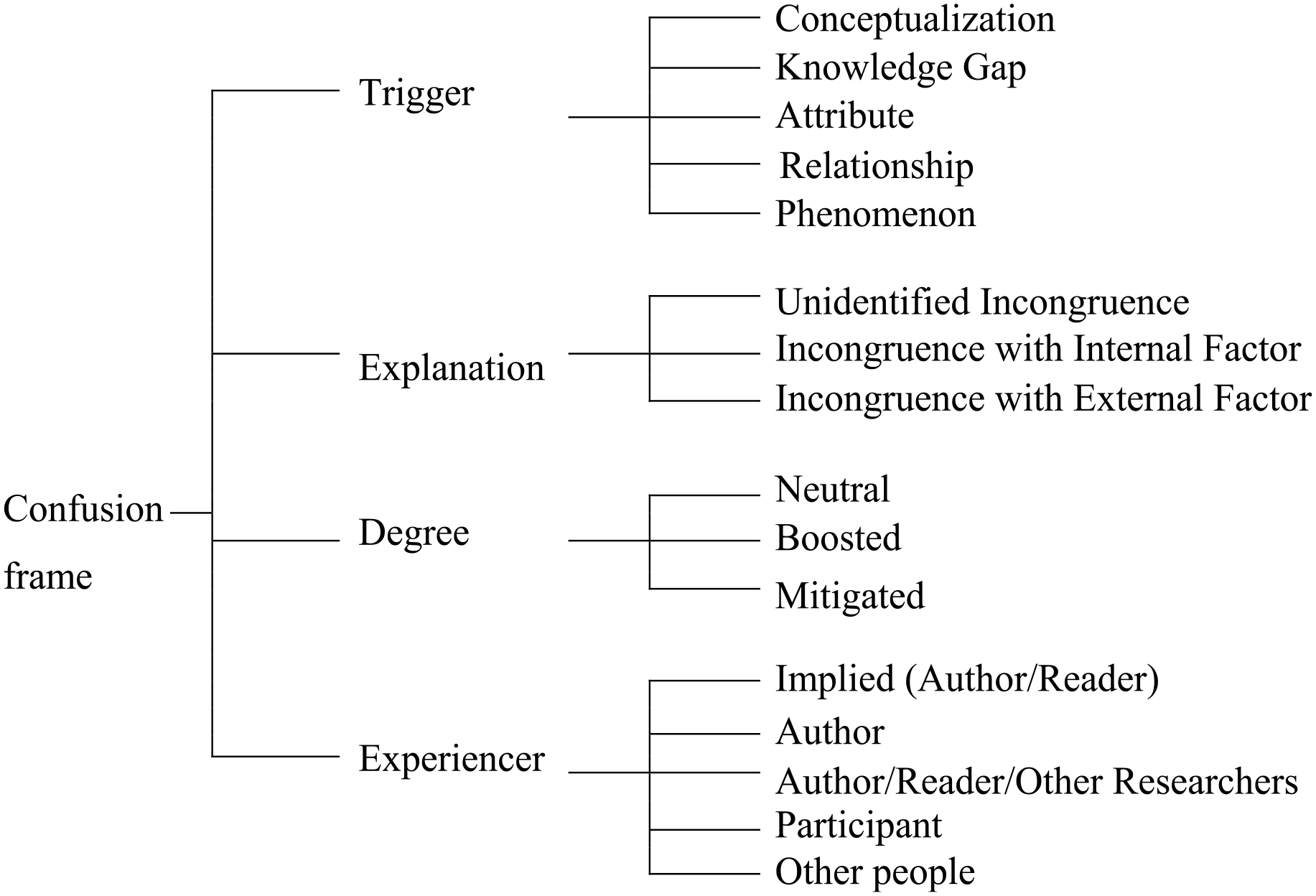
The confusion frame.
Trigger concerns what evokes the emotive response of confusion. Conceptualization, as the first type of Trigger, relates to terms, concepts, or definitions provided in previous research (Example 3). Knowledge Gap, as another type of Trigger, describes a lacuna in the literature or an area that has not been addressed adequately (Example 4). Attribute describes the distinctive characteristics and qualities of research methods, research objects, variables, or participants, as illustrated by Example 5. Relationship refers to the connection between different research variables or between results obtained in the current study or from different studies that confuses the author, as shown by Example 6. Phenomenon pertains to experiences, entities, and happenings that can be observed or encountered, as seen in Example 7.
(3) However, a significant barrier to progress in this area is [Trigger that many of the terms used to describe within-individual behavioural variability] are AMBIGUOUSTarget. (A1-86)
(4) Additionally, because most studies follow a pretest-posttest design and lack a delayed posttest, it is also currently UNKNOWNTarget [Trigger to what extent gains made in L2 fluency are maintained once learners are no longer living in a target language environment but are still enrolled in language programs back in their home universities]. (A2-153)
(5) Revision is a rather COMPLEXTarget [Trigger activity that involves the reading, evaluation, and internal or external alteration of text representation and production (Alamargot & Chanquoy, 2001; Hayes, 1996; Stevenson et al., 2006)]. (A2-11)
(6) However, it is somewhat PEPLEXINGTarget that [Trigger the results of the third cohort do not echo the more positive results of the first and second cohorts], even though all three simply represent the same student population sampled at three different calendar times, 2008, 2009, and 2010 but the same curricular time: the beginning of late FI in grade seven]. (A2-36)
(7) These concepts have provided tools for analyzing the seemingly PUZZLINGTarget [Trigger phenomena of language attrition during even the most productive period]. (A1-87)
Explanation refers to the reason for the triggered confusion. When frame instances did not provide information regarding why something was confusing, the explanation was unidentified (Example 8). A given explanation could be attributed to Internal Factors describing results or findings from the current study or characteristics of research objects, variables, or participants (Example 9) or External Factors pertinent to hypotheses, the results, and findings of previous research or characteristics of the research context (Example 10).
(8) The findings reinterpret and COMPLEXIFYTarget Ruusuvuori’s (2013) conclusion that emotion can serve as an affordance in institutional talk. (A2-141)
(9) Much of this CONFUSIONTarget can be attributed to [Explanation the fact that this research has not adequately distinguished writing expertise from second-language proficiency]. (A1-64)
(10) It is also possible that patterns regarding the relationship between participants’ initial proficiency level and gain scores were OBSCUREDTarget [Explanation because this study measured change in macrolevel constructs that consist of many sub-components (Rocha et al., 2015a)]. (A2-34)
Degree that concerns the intensity of the expressed confusion could be boosted (Example 11), mitigated (Example 12) or neutral (neither being intensified nor softened), as shown by Example 13.
(11) We propose that it is perhaps for this reason that these L1 studies also present [Degree highly] EQUIVOCALTarget findings. (A1-8)
(12) This conceptual and methodological variability may OBSCURETarget our understanding of the role and importance of environmental heterogeneity. (A2-25)
(13) Finally, what remained PUZZLINGTarget, was that “factor which fails to produce an effect in the laboratory might work well in the field”] (Phillips 1981:18). (A2-152)
Experiencers relate to who feels confused. When the Experiencers were not explicitly provided, they were implied (Example 14). When the Experiencers were identified, they could be Author(s) (Example 15), Author/Reader/Other Researchers (Example 16), Participant (Example 17), and Other People (Example 18).
(14) The paucity of studies has led to some MISLEADINGTarget generalisations in the earlier literature. (A2-92)
(15) From [Experiencer our] perspective, the regulatory role of AR in the process has been EQUIVOCALLYTarget reported and not adequately investigated. (A1-101)
(16) If [Experiencer one] attempts to correct it by the grid reference, [Experiencer one] is MISTAKENLYTarget assuming that the rapid growth is due to the spatial effect. (A1-57)
(17) Given such conflicting professional advice, many [Experiencer ESL teachers] are understandably CONFUSEDTarget and frustrated. (A1-105)
(18) Evidence for the conflicts, although possibly AMBIGUOUSTarget for [Experiencer Catherine], points to another direction for further investigation. (A1-87)
Data Coding and Analysis
Using the Confusion frame presented earlier, two coders (the author and a trained coder with a doctorate in applied linguistics) coded 30% of the frame instances of confusion markers found in the corpus for inter-coder reliability check. When the co-coding exercise was completed, the author discussed with the trained coder and resolved all disagreement cases before the comprehensive implementation of the coding. The results for inter-rater reliability showed Cohen’s Kappa values of 0.71 with a 95% confidence interval (CI) from 0.66 to 0.78 for the Trigger, 0.72 with a 95% confidence interval (CI) from 0.73 to 0.82 for Explanation, 0.84 with a 95% confidence interval (CI) from 0.77 to 0.86 for Degree, and 0.79 with a 95% confidence interval (CI) from 0.69 to 0.81 for Experiencer. These values indicated good inter-coder reliability (Hallgren, 2012; Landis & Koch, 1977).
For the RQs that aim to identify time-related differences in the use of confusion markers, binary logistical regression analyses were conducted using SPSS 23.0. Such analyses were intended to determine whether the predictor variable (time) could predict the absence/presence of frame elements and their subcategories of the Confusion frame. Given the binominal measures in this study, the outcome variables were coded as dichotomous variables, that is, the absence or presence of a confusion marker and its frame elements. Because there were not many instances of confusion markers across the data and the confusion markers that occurred multiple times in the corpus shared the same source of incongruence, logistical regression analyses were used to locate the possible differences. In the binary logistical regressions, the first period (2015–2019) was set as the reference value. Bonferroni correction was applied to adjust the alpha value because multiple statistical tests were conducted on the subcategories of frame elements.
Results
Overall Distributions of Confusion Markers by Time
As shown in Table 3, a statistically significant diachronic difference was found for the overall use of confusion markers (B = 1.645, Nagelkerke R2 = .087, p < .001, OR = 1.722), with the applied linguistics RAs published more recently being 1.7 times more likely to describe confusion than those published earlier. As reported below, significant diachronic differences were also found for some of the frame elements.
Results of the Binary Logistic Regression on the Use of Confusion Markers.

Distributions of the Frame Elements of Confusion Markers by Time
Core Frame Elements: Trigger and Explanation
As summarized in Table 4, a statistically significant difference was found for the subcategory of Knowledge Gap as Trigger (B = 1.732, Nagelkerke R2 = .286, p < .001, OR = 2.084), with the applied linguistics RAs published more recently being 2.1 times more likely to express confusion triggered by a Knowledge Gap than those published earlier. No significant differences were found for the other subcategories.
Results of Binary Logistic Regressions on the Frame Element of Trigger.

For the FE of Explanation, time significantly predicted Unidentified sources of confusion (B = −1.315, p < .001, Nagelkerke R2 = .154, OR = 0.553). This indicated that applied linguists in the recent period were 1.8 times more likely to explain why they felt confused than those in the earlier period (see Table 5). No diachronic differences were found for the other subcategories of Explanation.
Results of Binary Logistic Regressions on the FE of Explanation.

Non-Core Frame Elements: Degree and Experiencer
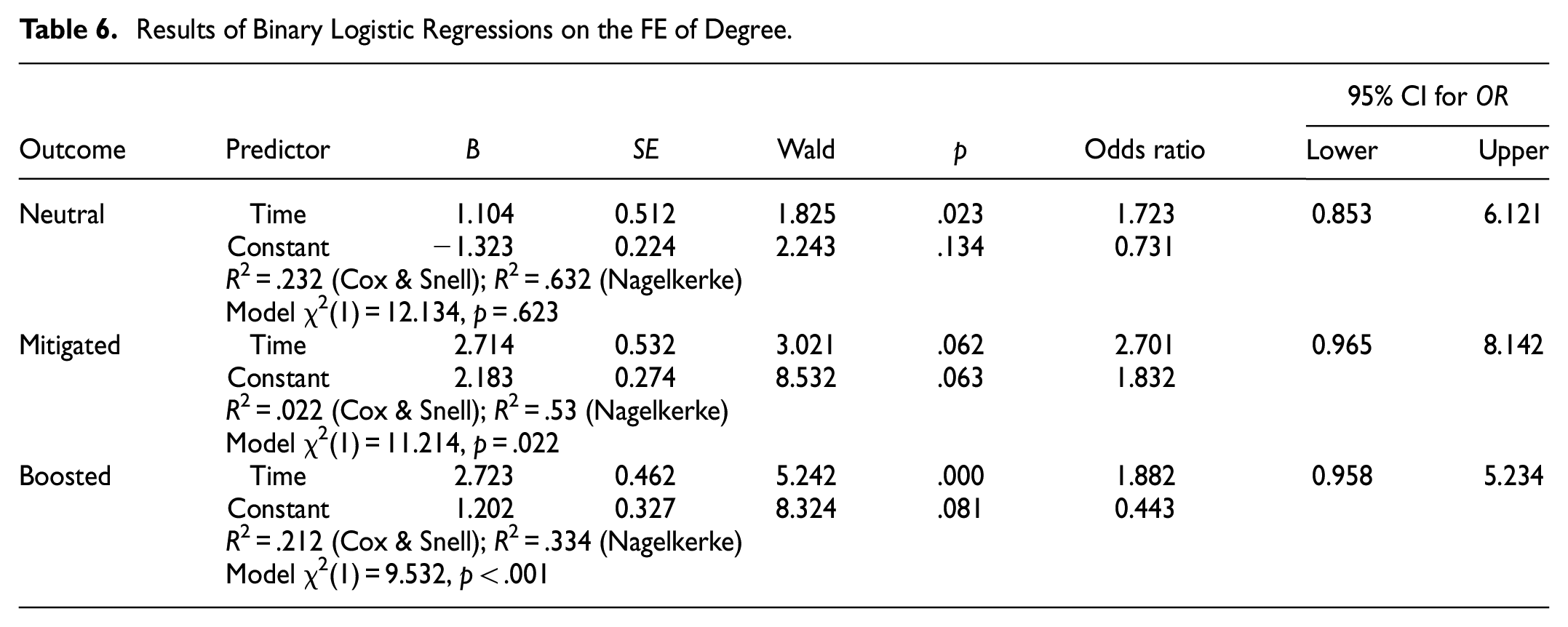
As shown in Table 6, a significant diachronic difference was located for the subcategory of Boosted confusion (B = 2.723, p < .001, Nagelkerke R2 = .334, OR = 1.882), with the applied linguistics RAs published in the more recent time being 1.9 times more likely than those published earlier to scale up expressed confusion.
Results of Binary Logistic Regressions on the FE of Degree.
As summarized in Table 7, significant diachronic differences were detected for the subcategories of Implied (B = −1.223, p < .001, Nagelkerke R2 = .033, OR = 0.428) and Author as Experiencer (B = 2.432, p < .001, Nagelkerke R2 = .236, OR = 1.432). The applied linguistics RAs published more recently were 2.3 times more likely to identify who experienced the triggered confusion and 1.4 times more likely than those published earlier to describe authors as Experiencers of expressed confusion.
Results of Binary Logistic Regressions on the FE of Experiencer.

Discussion
Overall Use of Confusion Markers Across Time
The quantitative results regarding the diachronic changes in the overall use of confusion markers showed that academic scholars preferred a greater use of these markers in their scholarly communication than 30 years ago. This indicated that academic communication today relies more on interpersonal elements manifested by affective stance-taking than on empirical and factual data compared to 30 years ago. However, applied linguists’ increasing use of confusion markers for authorial standpoints in the present study diverged from Hyland and Jiang’s (2018) diachronic study which reported the decreasing use of attitude markers in academic writing. In particular, this observation contradicted the results reported by Chen and Hu (2020a), who found that the time of publication did not influence the use or non-use of surprise markers in applied linguistics RAs published over a time span of 30 years. It could be speculated that the inconsistency with Hyland and Jiang’s (2018) findings may be plausibly ascribed to their investigation of attitude markers as a broad category, and the discrepancy with Chen and Hu’s (2020a) research may be due to the different linguistic markers examined. It is possible that specific types of attitude markers might exhibit different patterns of diachronic changes in academic writing.
At first glance, the finding that applied linguists expressed their confusion more frequently than 30 years ago was puzzling. When the discipline of applied linguistics has matured and solidified with a massive growth of literature, researchers undoubtedly have understood the field better than before and could be expected to feel confused less frequently. A close examination of expressed confusion in applied linguistics RAs revealed that these expressions were inherently strategic, helping underscore the significance of the study. In other words, confusion markers were mostly deployed to identify a research niche so that the necessity of the present study was justified. As an illustration, the authors employed UNKNOWN (Example 4 presented earlier) to indicate a potentially unresolved issue or a potential research topic worth exploring by claiming that “it is also currently
Overall, the upward trend of linguistically expressed confusion in applied linguistics RAs examined indicated that scholarly ethos evolved as a response to societal changes. In the academic world where scientific output has grown exponentially and the publication market has become more commercially oriented (Lillis & Curry 2013; Wen & Lei, 2022), how knowledge is claimed, disseminated and accepted has also changed. Academic writing, traditionally expected to refrain from emotions, has witnessed the increasing use of emotionally evaluative expressions as promotional tactics to sell research.
Influences of Time on the Occurrence of the Frame Elements Associated With Confusion Markers
The quantitative findings indicated that applied linguists publishing more recently were more likely to express their confusion triggered by a Knowledge Gap than those publishing 30 years ago. It seemed that they were increasingly prone to pinpoint inadequately addressed issues by articulating their unresolved confusion. As such, linguistically expressed confusion functioned as “persuasive promotional rhetoric” (Martín & Pérez, 2014, p. 1) to accentuate and justify current scholarly endeavors. When a current study carves out a niche, bridges the gap, and increases our understanding of a particular issue in the field, its significance is highlighted.
For the frame element of Explanation, the findings showed that publications in the more recent period were more likely to explain the reason for the expressed emotive responses than those published 30 years ago. This seemed to suggest that academic writers publishing in the earlier period interacted with potential readers by appealing to their shared epistemological beliefs, in contrast to the more recent period, when writers tended to claim knowledge more transparently and explicitly. In a globalizing academia where new fields, sub-disciplines, and interdisciplinary sciences continue to emerge and grow (Vanderstraeten, 2010), the readership is no longer comprised of only informed insiders but has become less homogeneous and predictable (Hyland & Jiang, 2018). Those readers might be disciplinary experts in the community, nonspecialists and practitioners who are interested in the research or even the general public (Berkenkotter & Huckin, 2016; Hyland & Jiang, 2016a, 2018; Rakedzon et al., 2017). To align readers with their viewpoints and achieve a persuasive effect, they needed to provide more contextual clues to guide the readers who were probably outside the immediate discipline by offering why their confusion was elicited. This may explain why the sources of expressed confusion were more explicitly identified in the more recent period of publication examined in this study.
Regarding the diachronic variation concerning the frame element of Degree, an increase in the incidence of boosted confusion in RAs was noted, suggesting applied linguists’ higher level of confidence in making arguments and formulating propositions than before. This result diverged from Chen and Hu’s (2020a) finding that no significant difference was observed in the use of boosted surprise over a 30-year period. As noted earlier, this discrepancy was perhaps related to the different linguistic markers examined in Chen and Hu (2020a) and the present study. However, the upward trend in the use of boosted emotions aligned with what was reported by Poole et al. (2019). Poole et al. examined the stance features of biochemical research articles published between 1972 and 2017 and found increasing use of boosters over time. Currently, academic authors have a greater need to construct an authoritative image and shut down the dialogical space for readers to challenge their interpretations due to the escalating pressure in the publication market. Moreover, in the more recent decade, the development and maturation of a field has made it increasingly acceptable to claim knowledge with assurance in a particular domain of study. As argued by Poole et al. (2019), epistemic devices signaling greater certainty about an issue would increase along with the solidification of knowledge in a field.
Finally, concerning the frame element of Experiencer, the RAs published more recently were more likely to describe “authors” as the people who experienced expressed confusion. In other words, the authors were more willing to increase their authorial visibility than 30 years ago. This finding contradicted Hyland and Jiang’s (2017) observation of a decline in the use of self-mentions in applied linguistics. As noted earlier, this discrepancy may be attributable to their examination of attitude markers as one category and my focus on a particular type of attitude markers. This, in fact, highlights the necessity of conducting more fine-grained analyses of attitude markers deployed in scholarly communication.
In my corpus, applied linguists’ preference for using boosting confusion with self-mentions in the more recent period was perhaps related to their intention to convey a more personal, authoritative persona in the publication market. They preferred to intrude into the text to reinforce their role as an arguer responsible for the propositional content. This discursive practice, to a large extent, possibly helped highlight their authoritativeness and contribution to their disciplinary community. In addition, the co-construction of meaning in a disciplinary conversation through building up a close tie with potential readers would also enhance the persuasiveness of knowledge claims. When a deeper level of bonding with potential readers is achieved, readers are likely to be more involved in knowledge claims and more willing to accept them (Li, 2021). In support of this interpretation, changes in academic writing from a more detached way to a more personal way have been evidenced in the more frequent use of “self-mentions” in academic prose over the years (e.g., Bondi, 2014; Hyland & Jiang, 2017, 2018; Li, 2021). These changes indicate a shift in scholarly ethos characterized by an author-evacuated and data-oriented style toward more personal, engaging, intimate, and egalitarian relationship-building with readers. Arguably, the diachronic variations manifested in the more frequent association between “self” and linguistically expressed confusion over time were also related to the increasingly competitive academic world, where researchers feel an ever growing need to construct a discoursal persona of visible agents for professional recognition and promotion.
Conclusions and Implications
Drawing on the Confusion frame generated for confusion markers in applied linguistics RAs that were published in two 5-year periods separated by 30 years, this corpus-based study examined how linguistic expressions of confusion were leveraged by the authors’ time of publication. The analyses revealed many diachronic differences in the use of confusion markers in applied linguistics RAs published in the two periods of time. Overall, applied linguists in the more recent period (2015–2019) were 1.7 times more likely to express confusion than their counterparts in the earlier period (1985–1989). Notably, it was found that academic authors from the more recent period were 2.1 times more likely to describe confusion triggered by a Knowledge Gap than the authors from the earlier period were. In addition, applied linguistic RAs published in the more recent period was 1.8 times more likely to explain the expressed confusion than those published earlier. Moreover, the former group was 1.9 times more likely than the latter group to scale up expressed confusion. Furthermore, academics in the recent period were 2.3 times more likely to identify who experienced the emotive response. Finally, the applied linguistics RAs published in the more recent period were more 1.4 times more likely to describe authors as experiencers of the expressed confusion than those published in the earlier period.
The diachronic investigation into linguistically expressed confusion in applied linguistics RAs through the lens of frame semantics has made several significant contributions to the current body of literature on academic writing. Conceptually, the proposed Confusion emotion frame enables us to capture the salient semantic properties of expressed confusion for academic communication. Furthermore, frame-based analyses make it possible to analyze the contextualized interplay or co-occurrence of different types of metadiscursive resources deployed by academic writers. Notably, the diachronic changes observed in this study regarding the use of a specific type of attitude markers differ from those reported in some previous research, underscoring the need to conduct more scholarly inquiries into the interplay of time-related factors and the deployment of metadiscursive resources. Pedagogically, the findings of the present study can inform students, L2 writers, and novice researchers of the role that linguistically expressed confusion can play in establishing knowledge claims and effectively communicating scientific information. The findings of the time-related differences in the use of confusion markers are particularly useful to inform both EAP instructors and students in applied linguistics that academic writing is situated in broader socio-cultural contexts and is constantly evolving. These findings can empower students with linguistic resources, for example, confusion markers, that can be deployed to establish a professional writing persona and become legitimate members of an academic community. Moreover, this study focusing on linguistic realizations at the micro level helps raise the awareness of graduate students or novice researchers about the importance of acquiring a more time-sensitive repertoire of discursive resources to convey an appropriate authorial identity for more effective academic communication.
Despite the contributions of and the implications derived from the study, it has some limitations that future studies can address. First, the proposed Confusion frame needs to be validated in other academic genres, such as book reviews, grant proposals, doctoral theses, academic blogs, or spoken discourse such as conference presentations, lectures, and seminars. Second, it is possible that an author’s writing style may influence the linguistic expression of confusion for epistemic purposes. It would be interesting and potentially revealing to examine the interplay of demographic factors such as the author’s gender, disciplinary background, and the deployment of confusion markers. Finally, future studies could use the Confusion frame to conduct comparative research across languages, writing groups (e.g., L2 writers and expert writers), and different sections (introduction, discussions, or conclusions) of RAs. These scholarly inquiries are expected to yield a more in-depth understanding of the role that these markers play in knowledge construction and scientific communication.
Footnotes
Declaration of Conflicting Interests
The author declared no potential conflicts of interest with respect to the research, authorship, and/or publication of this article.
Funding
The author disclosed receipt of the following financial support for the research, authorship, and/or publication of this article: This work was supported by the Social Science Foundation of Shaanxi Province (grant No. 2021K021) and NPU Research Fund of Academic Degrees and Graduate Education (Grant No. 22GZ230102).
Ethics statement
Not applicable.
