




Abstract
Management by Walking Around “MBWA,” also known as “management by wandering around,” is a common practice in healthcare institutions focusing on directly observing frontline work by managers and supervisors. Despite its popularity, to date, few scholarly studies have thoroughly examined the impact, consequences, and performance improvements of MBWA on healthcare institutions and, more specifically, in the Arab world. In this study, we investigated the influence of MBWA on hospital improvement within the Lebanese healthcare context. The research involves heads of departments observing their employees, seeking their opinions on work improvement opportunities, and collaborating with personnel to quickly identify and address problems. After receiving the participants’ acceptance through an informed consent form explaining the benefits, risks, and respect of anonymity to all participants, the study was conducted in 10 Class A hospitals, including 15 different medical departments and SBUs. The results indicated that using MBWA as an improvement tool had a positive impact on employee and department performance in Lebanese hospitals. To understand this outcome, a quantitative study was conducted using SPSS software to investigate the best problem-solving approach in compliance with MBWA. The study found that prioritizing simple tasks positively correlates with better overall performance, as it allows for quicker and more efficient action. Moreover, the study found that an approach focused on prioritizing the most critical issues did not significantly improve overall performance. However, assigning senior managers the responsibility of addressing identified matters led to better performance.
Introduction
Since the spread of Covid 19 and even before, hospitals worldwide are under pressure to improve treatment quality and reduce medical errors that harm patients. To achieve these goals, healthcare experts stressed, recommended, and were in favor of the implementation of Management by Walking Around, or “MBWA” for short, which has been widely adopted in the US and UK (Payne, 2020; A. Tucker & Singer, 2013). Shortly after the introduction of MBWA in healthcare systems, it became clear that the program was successful in enhancing safety culture and reducing medical errors, as well as reducing the need for medical intervention (Luria & Morag, 2012). Hospitals realized the crucial importance of such programs in producing positive outcomes. This is because MBWA involves senior managers visiting the front line and interacting with staff to identify and address various managerial concerns (Frankel et al., 2003; Jang et al., 2015), which represents a significant change in the traditional approach where a more top-down, hierarchical system where decisions are made at higher levels and directives are passed down the chain of command (Zaman et al., 2023).
This study builds on several key theoretical frameworks to underpin the proposed MBWA framework. Situational Leadership Theory (SLT) highlights the importance of aligning leadership styles with employee readiness, making it particularly relevant for adaptive managerial approaches like MBWA (Hersey & Blanchard, 1969). In addition, the Path-Goal Theory also complements this by emphasizing the role of leaders in identifying and clarifying employees objectives and removing obstacles to enhance team performance (House, 1971). Moreover, Transformational Leadership serves as a foundation for understanding the motivational and communicative aspects of MBWA, encouraging managers to inspire and mentor employees (Naidu, 2023).
However, despite its appeal, there needs to be more information about the effectiveness of MBWA. According to Frankel et al. (2008), only two out of seven healthcare institutions implementing Management-by-walking-around-based programs sustained for 3 years or more. While the program’s impact on the other five hospitals is unknown, it is clear that staff opinions on the safety atmosphere where medical error is reduced to the maximum improved significantly at the two hospitals that continued to use the program (Smith & Johnson, 2019). On the other hand, Hauan et al. (2023), Katopol (2018) and Singer et al. (2013) found that, in two units that adopted the program, the patient safety atmosphere worsened, while in two control units, it either remained the same or improved. These contradictory results highlight the need for further investigation in addition to the scarcity of research investigating this topic.
Previous studies have shown that hospitals incorporating MBWA into their overall improvement program did not perform better than other hospitals (Benning et al., 2011; Smith & Johnson, 2019; Thanh & Quang, 2022). The study aimed to clarify the conflicting outcomes associated with the “Management by Walking Around” (MBWA) strategy in hospitals. It involved a random selection of 20 hospitals actively engaged in an MBWA program from a pool of volunteers. The objective was to evaluate the impact of MBWA on hospital operations meticulously. This assessment focused on two main aspects: workflow efficiency and nurses’ opinions. For a comparative perspective, data from an additional 30 hospitals—divided into those implementing MBWA and those not—were analyzed. Interestingly, the study revealed that, in most cases, nurses’ perceptions of their performance were negatively influenced by the MBWA initiative. Moreover, the research suggested that MBWA could be effectively implemented in a variety of settings, extending beyond the domains selected by senior management (Smith & Johnson, 2019)
Moreover, studies have highlighted various mechanisms that may explain the contradictory findings regarding the effectiveness of MBWA-based improvement initiatives. For instance, Smith and Johnson (2019) and Payne (2020) suggested that the lack of clear objectives and standardized implementation procedures may hinder the program’s success. Benning et al. (2011) argued that the success of MBWA depends on the hospital’s overall culture, leadership, and management practices. This paper aims to address these mechanisms by developing a standardized MBWA-based improvement program and implementing it in a diverse set of hospitals. It will also carefully monitor the program’s implementation process and assess its impact on various dimensions of hospital work performance, including patient safety and employee satisfaction. By engaging with these mechanisms, the aim is to provide a more nuanced understanding of the factors that may influence the effectiveness of MBWA in healthcare settings and to identify best practices that can help hospitals optimize the program’s benefits while minimizing its potential drawbacks.
Literature Review and Hypothesis Formulation
Management by wandering around is linked to various theoretical aspects, including situational leadership, transformational leadership, and participative management, which focus on fostering effective leadership, employee engagement, and communication within an organization (Hersey & Blanchard, 1988; Northouse, 2018). Scholars suggest that improvement initiatives such as MBWA, which involve input from frontline staff members, can improve a company’s work performance (Ngahneilam et al., 2022; Womack, 2011). This type of program requires management to regularly visit the frontlines of the organization in order to check the given tasks and duties and gather feedback from subordinates (Packard, 1995). Hewlett-Packard, the company that originated the management by walking around, ascribed their achievements to this approach for having employees with good listening skills and a willingness to participate in the company development. Moreover, the company believes every job and every employee is a valuable asset and should have a good and healthy work environment where they feel comfortable speaking up (Ngahneilam et al., 2022; Packard, 1995).
Similarly, the “gemba walks” used in Toyota’s production system resembles MBWA (Womack, 2011). In these walks, managers visit the workplace to review the process and speak with staff (Durrah et al., 2020; Jyoti & Bhau, 2015; Mann, 2009), which helps contextualize problems and enhances problem-solving strategies. The relevance of investigating and understanding the impact of an MBWA improvement program within organizations is heightened in the Lebanese healthcare context. Lebanon, facing significant challenges such as a prolonged economic crisis, political instability, and the influx of refugees due to the Syrian war (World Bank, 2020), is under tremendous pressure to optimize its healthcare services. Efficient management practices like MBWA could be instrumental in improving organizational work performance amidst these challenges. Therefore, this research seeks to answer the following question: To what extent does implementing an MBWA Improvement Strategy affect Organizational Work Performance in Lebanese healthcare institutions?
Reviewing the literature shows that MBWA has been linked theoretically in many aspects to the Situational Leadership Theory (SLT). This theory stresses that for effective leadership, it is essential for leaders to match their styles with their employees’ levels of readiness and development. Active manager engagement through Management by Walking Around (MBWA) is viewed as a leadership strategy in the hypothesis for employee support and guidance. To align with SLT’s philosophy, it is necessary to adapt one’s leadership style to the unique abilities and demands of one’s team members (Hersey & Blanchard, 1969); it is equally important to mention that through literature, studies reported that MBWA has been shown to lead to positive organizational development by allowing for a deeper understanding of issues through context and fostering collaboration between managers and front-line employees to resolve them effectively (Al Shraah et al., 2012; Fadel Ibrahim et al., 2022; Jyoti & Bhau, 2015; Womack, 2011). This notion of adapting leadership styles is further exemplified in the transformative approach.
Transformational leadership, characterized by its emphasis on inspiring and motivating employees, finds a practical application in the concept of Management by Walking Around (MBWA). This leadership style encourages managers to step out of their offices and interact with staff on the front lines, fostering a culture of open communication and mentorship (Naidu, 2023). Studies, such as the one conducted by Ystaas et al. (2023), highlight the effectiveness of transformational leaders to not only convey their vision but also to actively engage with employees, thereby promoting an environment of continuous learning and improvement. This is particularly relevant in healthcare settings where rapid advancements necessitate adaptability and proactive leadership (Al-Thawabiya et al., 2023).
Moreover, both Path-Goal and Situational Leadership theories offer crucial insights that help implement MBWA successfully within healthcare settings. First, House (1971) findings focus that the Path-Goal Theory underscores the role of leaders in creating a clear pathway for subordinates to reach organizational goals, which aligns well with MBWA’s emphasis on direct engagement and barrier removal. In addition, SLT stresses the importance of adapting their style based on the developmental level of their team, providing situationally appropriate guidance and feedback (Hersey & Blanchard, 1969). These theories collectively support the participative and motivational elements of MBWA.
Similarly, Participative Management aligns seamlessly with the principles of MBWA. This approach involves leaders in the active engagement of employees in decision-making processes at all levels. By incorporating several techniques mainly MBWA, healthcare managers can democratize the flow of information and decision-making, ensuring that the insights and feedback of frontline staff are heard and valued (Paros, 2021). Research by Su et al. (2022) indicates that such participative approaches, enhance team cohesion and foster a sense of ownership among staff members, leading to improved patient care outcomes and increased employee satisfaction. The participative nature of MBWA is particularly evident in its support and engagement with employees.
Building on the principles of transformational leadership and participative management, the MBWA program exemplifies how managers can embody supportive and engaged leadership characteristics. Managers are proactive in interacting with employees by attentively listening to their concerns and addressing them accordingly while providing continuous motivation through feedback. Leaders who actively engage and support subordinates align with the philosophy of SLT’s selling or participating leadership style. The positive impact of the MBWA program on employees can manifest itself in many different ways; fostering an atmosphere of open communication plays an essential role in promoting inclusion and empowerment by providing ample opportunities for team members to voice their ideas. The MBWA program encourages proactive employee participation, leading to increased feelings of empowerment and motivation, resulting in better job satisfaction. As a result, better work performance may result from this (Womack, 2011).
Integrating Path-Goal Theory, Situational Leadership Theory, and Transformational Leadership further strengthens the framework. For instance, the component focusing on managerial walkarounds reflects Path-Goal Theory’s emphasis on two main things: eliminating barriers and supporting employees in achieving their objectives (House, 1971). By adopting such an approach to employee readiness and task requirements, as emphasized by SLT, managers can enhance the framework’s effectiveness (Hersey & Blanchard, 1969). In addition, the cyclical process of identifying and addressing issues through MBWA also enhances the organization’s ability to continuously improve, ultimately reducing the cost and effort of future improvement initiatives (Al Shraah et al., 2012; Ittner et al., 2001; Khan et al., 2020). Additionally, by involving frontline staff in communication about problems, managers’ perspectives and customer experiences become better aligned, leading to improved outcomes (Hansen et al., 2010; Huang et al., 2010). Searching the literature reveals scares and limited studies investigating MBWA, especially in Arab work in general and in Lebanese healthcare institutions in specific; following the footsteps of A. Tucker and Singer (2013), the first hypothesis was developed to test the impact and influence of participation on performance within Lebanese hospitals.
H1: Employee participation through MBWA improvement program positively influence work performance in Lebanese hospitals.
The Impact of Problem-Solving Techniques
While participation is an essential factor to be tested, many scholars expect that MBWA will lead to a positive impact among subordinates, whether in performance or attitude. Many results showed that the programs that gather employee feedback might reveal more issues and complications beyond company control and resources allocated (Frankel et al., 2003; Hickson, 2017; Ronald, 2019); these results stressing on participation importance are the same within the Lebanese context (Chaanine, 2021; Epaminonda et al., 2021). In such scenarios, the organization’s problem-solving support team must decide which issues to prioritize and which to temporarily set aside or ignore (Hickson, 2017; Morrison & Repenning, 2011). As such, the success of an MBWA program may hinge on the specific issues it chooses to tackle. One practical approach is to focus on addressing problems that have the potential to cause significant disruptions in medical units; such disruptions could lead to severe problems. Using a high-value prioritizing technique, based on the potential of occurrences impact, which evaluates problems based on their potential impact, the organization can prioritize and address the most critical issues first, ranking them from A, AA, and B priority (Stair & Reynolds, 2010). This approach is commonly used and employed in various improvement methods and techniques; Six Sigma is one of the examples that can referred to, especially in healthcare (E. G. Anderson et al., 2013; M. A. Anderson et al., 2013).
In this context, the Job Characteristics Model (JCM) is highly correlated theoretically to MBWA; this theory suggests that specific job characteristics, such as skill variety, task identity, task significance, autonomy, and feedback, can influence work motivation, satisfaction, and performance (Fadel Ibrahim et al., 2022; Hackman & Oldham, 1976). The JCM can provide insights into how job characteristics, precisely task significance, can influence this relationship. When employees are assigned to work areas that involve solving high-value problems, they will likely perceive their tasks as more significant. This increased task significance can enhance their motivation, job satisfaction, and performance. Therefore, the JCM suggests that managing high-value problems within work areas can strengthen the relationship between the MBWA improvement program and work performance, as employees are more likely to be motivated and engaged in their tasks when they perceive them as valuable and meaningful.
Identifying the problem’s severity and frequency of recurrence, in addition to creating a hospital incident reporting system (Hickson, 2017) and combining it with the Management by walking around techniques (Frankel et al., 2003), allows hospitals to identify an issue “value” which eventually helps to categorize both risk and impact. This, in turn, helps to provide better problem-solving techniques (Frankel et al., 2003). Moreover, when resources become scarce or the remaining issues fall below a certain threshold, it is recommended that organizations shift their focus to the second-highest-value problems; this should occur immediately after addressing the most pressing ones (Xu et al., 2023). It is essential to know that these steps are crucial for the success of every institution. Lebanese healthcare organizations are no exception. They are under massive pressure due to the COVID-19 pandemic and the economic recession. The devaluation of currency is another significant factor. Together, these issues are putting the entire healthcare system under huge burdens (Fawaz & Samaha, 2020). On the other hand, Xu et al. (2023) and previously Girotra et al. (2010) stressed that by prioritizing and addressing high-value issues, a significant performance improvement can be expected; these came in line with previous studies investigating the field (Xu et al., 2023). Such a strategy ensures that limited resources are directed toward the most critical problems (Frankel et al., 2003).
Additionally, according to queuing theory, focusing on high-value problems can also be beneficial as it allows for more straightforward problems that require fewer resources. The potential consequences of neglecting specific issues are considered relatively minor as they are often deemed “trivial numerous” and have minimal impact on performance (Durrah et al., 2020; Juran et al., 1999). Therefore, it is of high importance to investigate our second hypothesis, which focuses on solving high-priority problems through key work areas; the hypothesis is as follows:
H2: Work areas solving high value problems will perform better than the remaining work areas such that whenever managing high value problem increases the relationship between MBWA improvement program and work performance becomes stronger
On the other hand, an alternative strategy is to prioritize problems with straightforward solutions, as suggested by Shojaei et al. (2021), Umar et al. (2014), Stair and Reynolds (2010), and Johnson (2003). This approach allows organizations to tackle “minimal interaction” and simple issues that require minimal resources. However, traditional methods of assessing problem severity and frequency that omits MBWA can be resource-intensive, especially in industries such as aviation and healthcare (Johnson, 2003). As suggested by Umar et al. (2014), these problems can accumulate over time, so focusing on more minor problems can reap significant benefits for your organization in the long run. These results came in line also with the findings of Ronald (2019) and Jimmerson et al. (2005).
Before tackling more complex organizational challenges, it is essential to address simpler ones. Companies that first work on straightforward issues and develop problem-solving skills before moving on to more challenging problems tend to achieve better results, as noted by Durrah et al. (2020) and Morrison and Repenning (2011). They stressed that minor issues allow for regular troubleshooting processes, help subordinates improve problem identification, and enhance their problem-solving abilities over time. The rationale states that addressing issues and providing solutions is akin to a muscle that can be developed through use rather than a depletion of these resources through excess use (Fadel Ibrahim et al., 2022; Al Shraah et al., 2012; Ittner et al., 2001). Additionally, Literature shows that large-scale disasters often stem from an accumulation of tiny issues instead of one significant issue (Reason, 2000). The “Swiss Cheese Theory” posits that multiple minor issues within a company’s protective barriers can align negatively, permitting harm and thus negatively impacting a customer.
On the other hand, some argue that when top managers actively participate in problem-solving, it leads to more successful implementation of MBWA (Frankel et al., 2005; Katopol, 2018). This idea opposes Literature on quality improvement; it stresses the criticality of front-line workers’ participation in recognizing and addressing problems (Durrah et al., 2020; Jimmerson et al., 2005). On the other hand, top managers play an essential role in problem-solving due to their control over the financial resources required to address issues that require capital expenditure and their ability to view problems beyond organizational boundaries (MacDuffie, 1997).
Reviewing the Literature found a strong linkage between the MBWA and the Path-Goal Theory, which suggests that influential leaders clarify the path to goals, provide support, and remove obstacles to enhance employee motivation and performance (House, 1971). When managers actively engage in problem-solving and provide support, such as offering guidance resources and removing obstacles, employees are more likely to experience higher job satisfaction and performance. This aligns with the hypothesis that an increased manager’s role in problem-solving strengthens the relationship between the MBWA improvement program and work performance.
Furthermore, addressing problems takes time away from tasks directly contributing to production (Payne, 2020; Repenning & Sterman, 2002). However, this would be a risk because front-line workers may find it challenging. Senior management can provide front-line employees the time and resources to engage in problem-solving activities (Payne, 2020). Therefore, the researcher believes appointing senior executives to oversee problem resolution would result in improved results. Hence, our third hypothesis is as follows:
H3: Manager Role in solving problems will lead to a higher level of performance such that whenever the manager role in problem solving increases the relationship between MBWA improvement program and work performance becomes stronger.
The hypotheses are shown the below Figure 1, presenting the relationship between the different variables, mainly the independent one (MBWA improvement program) and the dependent variable (Work Performance).

Conceptual model for implementing an MBWA improvement program in Lebanese Healthcare.
Methodology
The researcher conducted a field study to test the derived hypotheses; through the combination of random and selective sampling approaches the aim was to ensure representativeness and relevance. Lebanese hospitals were randomly chosen, while participants were selected based on their active involvement or interest in the MBWA initiative. The analysis covered departments such as ICU, ER, and APU, which is consistent with MBWA’s emphasis on departmental performance improvements. Participants provided informed consent, and confidentiality and voluntary participation were guaranteed.
A pre-and post-test design was employed to evaluate the effectiveness of MBWA interventions, measuring baseline (pre-test) and post-intervention (post-test) performance. Senior managers conducted work system inspections lasting 25 min to 4 hr to identify safety hazards, study procedures, and improve operations (Frankel et al., 2008; A. Tucker & Singer, 2013; Zikmund, 2003). Safety seminars involving frontline staff were integrated into the program to promote workplace improvements. These activities aligned with evidence highlighting the importance of direct engagement through system visits for program success (A. Tucker & Singer, 2013).
Participating hospitals implemented prioritized improvement proposals, tracked changes, and ensured accountability. Patient safety officers documented recommendations in computerized spreadsheets, aligning with best practices in organizational improvement (Thadatritharntip & Vongurai, 2020; Pronovost et al., 2004).
Data Collection and Measurement Process
The methodology was meticulously revised based on reviewer feedback to ensure clarity, rigor, and alignment with best practices (Memon et al., 2023). After approval, the researcher communicated the study’s purpose to participants, safeguarding their rights. Sampling was purposefully designed to include individuals with an active interest or involvement in Management by Walking Around (MBWA), ensuring relevance to the research objectives. A multifaceted approach was adopted, involving frequent interactions between top management and employees to understand situations, devise solutions, and monitor progress comprehensively. The study employed a pre-and post-test design to assess the impact of an MBWA-based program on patient safety in Lebanese hospitals. Participants were randomly selected, focusing on institutions voluntarily participating without incentives to minimize bias (Agniel et al., 2008). Details of the intervention were not disclosed to protect the control group from contamination. First, the participating organizations were identified, and then individual respondents were chosen to produce the unit of analysis. By A. Tucker and Singer’s (2013) suggested methods, 15 of the 20 participating hospitals were assigned to the treatment group, while the remaining five as controls.
Data collection went through two main stages, carried out to assess employee performance prior to and after program implementation. An extra sample of frontline staff from different units, such as the OR, APU, ICU, and ER, was included in a follow-up survey. A random sample of 1,117 nurses from 10,300 registered members of the Lebanese Order of Nurses participated in the study. This sample size achieved a 3% confidence interval for a population of this size in accordance with the guidelines of Saunders et al. (2019). After a thorough evaluation, the reliability of the survey instruments was confirmed by Cronbach’s alpha, which is continuously above .7. The study’s methodological integrity was strengthened because there were no appreciable variations in pre-period staff performance metrics between the treatment and control groups. To ensure questionnaire clarity, relevance, and comprehensiveness, instrument validation followed guidelines that prioritized expert comments, thorough revisions, and iterative approaches (Memon et al., 2023).
To ensure methodological rigor, the study used validated scales modified from earlier research to measure important variables. A 5-point Likert scale was used to evaluate the independent variable, the MBWA improvement program, which had a high-reliability score (Cronbach’s alpha = .83). With a reliability score of .79, handling high-value problems, the moderating variable assessed how important concerns were prioritized and resolved using comparable scales.
Managerial responsibilities in problem-solving, another moderating variable, captured the degree of managerial involvement in addressing issues, with reliability confirmed at .81. Work performance, the dependent variable, was quantified using pre-and post-test assessments of perceived employee performance increases, with Cronbach’s alpha values of .82 and .87, respectively. Consistent with the approaches of Tucker and Singer, the data-gathering strategy involved distributing particular reports to partner institutions to identify patient safety issues. Of the 15 treatment hospitals, eight supplied analyzable data. To test Hypothesis 1 and evaluate the MBWA program’s performance, a variable was constructed to monitor program delivery in the work area, discriminating between treatment hospitals (value = 1) and control hospitals (value = 0).
Additionally, a factor combining criticality and risk, ranging from 1 to 8, was generated to analyze the high-value priority strategy (Hypothesis 2). A score of 8 signified the highest level of risk, suggesting potential issues that could lead to deadly effects. This methodology parallels established risk management practices, such as Risk Registers and Six Sigma’s risk prioritization number, which similarly apply severity and likelihood to evaluate hazards (Patel & Chudgar, 2020; Shah & Deshpande, 2015; Stair & Reynolds, 2010).
To further explore Hypothesis 2, the variable “Priority tasks problem fixed” was constructed to show whether the most critical issue in a work area was addressed. This approach coincides with research by Coccia (2021) and Girotra et al. (2010), demonstrating that addressing even a single high-value idea can drive success. For Hypothesis 3, “easily solved” referred to tasks requiring minimal administrative participation, with more enormous proportions suggesting the successful settlement of easy challenges. At the non-managerial level, the study calculated the proportion of problems senior management was responsible for, evaluating the hypothesis that their involvement is essential in issue resolution. The study utilized staff improvement performance perception to evaluate the program’s effectiveness, consistent with past studies (Chandrasekaran & Mishra, 2012; Frankel et al., 2003, 2008; Thanh & Quang, 2022). Four validated survey questions assessing the efficacy of quality improvement activities (Singer et al., 2013) were utilized and scored on a 5-point Likert scale ranging from 1 (“strongly disagree”) to 5 (“strongly agree”). Higher scores showed considerable perceived improvements in safety and quality performance.
The reliability of these measures was robust, with Cronbach’s alpha values exceeding 0.7—0.821 for 833 nurses in the pre-test and .872 for 826 nurses in the post-test (Churchill, 1979; Nunnally, 1967).
The researcher used change scores to evaluate the change in staff improvement performance perception from before to after the program (Fitzmaurice, 2001), following the steps of A. Tucker and Singer (2013). To do this, the researcher calculated the mean of the surveys targeting the nursing in the pre-data and then averaged them by work area to create a new composite score. The researcher subtracted the pre-score from the post-score using the same post-data process. To ensure that the aggregate improvement performance perception score was appropriate, the researcher computed the Correlation Coefficient and the Reliability of Work (rW). Table 1, shows the correlation coefficients, F-statistics, and significance values (p-values) for pre- and post-test reliability of work scores. The test confirms that the improvement performance perception measure was valid and consistent across the pre- and post-test phases.
Correlation Results Pre and Post for the Reliability of Work.

The reliability of work aggregation for staff development performance perception was 0.60, indicating the validity of score aggregation (Estabrooks et al., 2008). Following Tucker and Singer’s technique, the program’s impact was examined using staff improvement performance perception, a known indicator in past research (Chandrasekaran & Mishra, 2012; Frankel et al., 2003, 2008). Responses were scored on a 5-point Likert scale, where higher scores indicated perceived increases in quality and safety. The focus on employee perceptions was justified for two reasons: (1) employee input influences behavior and impacts objective outcomes (Zohar & Luria, 2003), and (2) employees are closely attuned to system changes and can reliably detect improvements or failures, making their perspective a widely accepted measurement tool in operations management (E. G. Anderson et al., 2013; M. A. Anderson et al., 2013; Chandrasekaran & Mishra, 2012).
Due to some hospitals’ non-cooperation in releasing safety event data, perceptual measures were employed as a substitute. Composite scores for each work area were generated by averaging four survey questions per nurse and computing the difference between pre-and post-scores. Change scores were validated as a dependent variable using criteria from Bergh and Fairbank (2002), with strong reliability for pre- and post-test perceptions. The researcher discovered that lower initial scores in improved performance perception were connected with more significant subsequent improvements (Fitzmaurice, 2001). To offset biases from missing variables, a random selection of participating hospitals was undertaken, and control variables, such as system implementation, coaching, participation, and training, were evaluated but found to be unimportant. Hypothesis testing on the role of top-level managers in problem-solving was undertaken using linear regression. To evaluate implementation effectiveness, the percentage of issues resolved per area was analyzed, incorporating variables such as the number of visits and whether a senior manager conducted the work system visit, with results transcribed as categorical variables into SPSS for analysis (Antonakis et al., 2010).
AMOS Model Fit
The model drawn by the researchers considered the presence of regression and covariance among the various variables (Figure 2). When the model was run to check its fit, it displayed a significant relationship between the variables, particularly the interaction effect between service quality and employee job satisfaction, which was significant at a p-value of .006. This finding aligned with the results obtained from the SPSS analysis conducted earlier.

AMOS factor loading.
In order to test the accuracy of the model, an analysis using AMOS was performed, and it showed that the different fit index values suggest an acceptable goodness of fit for the model under study. In particular, the comparative fit index (CFI) is estimated at 0.89. This value is widely considered an indicator of an acceptable level of fit. Furthermore, the mean squared error of the fit (RMSEA) calculated is 0.027, and the standardized mean squared residual (SRMR) is determined to be 0.019. Thus, these values further support the idea that the model fits well.
Moreover, an additional test for the overall fit of the model, as assessed by several other fit indices, also looks very good. For example, the work output value is estimated at 0.81, suggesting that this variable has a significant impact on the model. Similarly, the administrator’s role in problem-solving scores was estimated at 0.79, indicating that these variables are also in good agreement. The approximate probability (PCLOSE) is estimated to be .812, considered acceptable.
In addition, the significance values output (p) for the model is equal to .001, which is less than .05, hence indicating a significant relationship between the different variables of the model being tested. Moreover, the CMIN—Chi-Square was also very significant and is equal to 11.7, assuring a satisfactory model fit. Finally, the Goodness of Fit Index (GFI) test and the Normed Fit Index (NFI) were equal to 0.89 and 0.85, respectively, and thus, the researcher was assured of the goodness of fit of the model being tested.
Analysis of the Results
To evaluate our hypotheses, and as stated earlier, a linear regression test was performed using SPSS v24; this test was performed using robust standard errors that assist in minimizing the margin of error (Rabe-Hesketh & Everitt, 2004). Performing the Shapiro-Wilk test shows residuals with a normal distribution, as demonstrated by the (V near 1 and p > .10) (Royston, 1992). Furthermore, no multicollinearity problems were identified as none of the variance inflation factors in our equations exceeded 10. These results came in line with the recommendations of Chatterjee and Hadi (1986). Hence, based on the test, the different hypotheses can be investigated. In this context, to assess the first hypothesis addressing the impact of the management by walking around the program, the study analyzed data from different medical departments within the different hospitals operating in the Lebanese territory where the study addressed departments like ICU, APU, ER,… It is essential to mention that the data was collected in pre- and post-improvement performance perception assessments.
The data collection was a challenging task, and in order to increase the accuracy and validity of his test, the researcher used data from 11 different departments. During the intervention, the researcher visited the clinical sections of each treatment hospital and took part in various MBWA activities such as work system visits, critical safety assessment forums, medication, and hazard control, keeping in mind the need for debriefing sessions. Later on, the research evaluated the accuracy of the data provided by confirming the improvements made to resolve any errors that might have occurred or any inconsistencies discovered.
Results and Findings
Analyzing the collected data shows consistency in the results, where no statistical significance was reported in the mean of perception improvement performance in the different work areas that were investigated (see table below). A change was slightly noticeable in the pre- and post, where the mean in the pre-assessment was 4.11, and the post reported a 3.92. 87% had a work system visit with a mean of 2.93 and a standard deviation of 2.96. Note that 55% had a safety forum. A complete descriptive study is shown in the Table 2 below. The descriptive data is presented below based on the tests performed through SPSS. Note that the average mean score of the top quartile of detected issues was 15, with the highest average being around 22.
Basic Descriptive Results.

With a significance *p < .05.
In order to test our first hypothesis, the following steps entailing a linear regression process were performed through SPSS, and the analysis showed that the implementation of MBWA resulted in a statistically significant increase in the improvement performance perception (.41, p = .00) in comparison with the control hospitals, which was in line with what was predicted. This result contradicted the findings of A. Tucker and Singer (2013) as interpreted in their study. To further assess the result, it is predicted that it could be due to treatment work locations improvement in implementing the suggested tasks opposing to what Nembhard et al. (2020) assessed, and thus our first hypothesis is supported stating that which stated that “Employee participation through MBWA improvement program positively influence work performance in Lebanese hospitals.” Moreover, the data indicates that these areas did adopt the MBWA program successfully, where 83% of workers had work system visits with a mean of 3.11 visits and a standard deviation of SD = 2.88; however, it is worth mentioning that the program’s effectiveness varied among work areas., and that the control variables indicate whether a work area was in the bottom quartile of pre-period improvement performance perception was significant (=0.55, p = 000). This suggests that individuals with the lowest pre-intervention improvement performance perception scores experienced positive changes in improvement performance perception, similar to the overall work areas that showed an increase ranging from 0.521 to 1.73 points. Thus, we confirm that our first hypothesis is supported.
Investigating our second hypothesis, H2 stating that “work areas solving high-value problems will perform better than the remaining work areas such that whenever managing high-value problem increases the relationship between MBWA improvement program and work performance becomes stronger,” was not supported, and this is due to the following facts. The first step involved entering the independent variable, referred to as the MBWA Improvement Program and denoted as MBWA Imp Prog in SPSS, along with the moderating variable, referred to as Managing High-Value Problems and denoted as Managing_Val, into the initial regression equation. In the second equation, the interaction between Managing_Val and Work_perf was added to the equation, with employee work performance as the dependent variable. The analysis results, as presented in the Table 3 below, indicate that the MBWA Improvement Program and Managing High-Value Problems account for 11% of the variance in work performance. Furthermore, adding the interaction term SM_USED X SM_PURPOSE increases the contribution by 13%. It is noteworthy that the regression coefficient of the interaction term was found to be significant, with a p-value of .047. Consequently, the hypothesis H2 is not supported.
Moderating Test of Managing High Value Problem.

Work_Perf = work Performance; MBWA Imp Prog = MBWA improvement program; Managing_Val = managing high value problems.
Moreover, investigating the third hypothesis, H3 states that “work areas solving high-value problems will perform better than the remaining work areas. Manager Role in solving problems will lead to a higher level of performance such that whenever the manager role in problem-solving increases, the relationship between MBWA improvement program and work performance becomes stronger” was supported, and this is due to the following facts.
Applying the same logic and using the linear regression model, in the first step, the independent variable, referred to as the MBWA Improvement Program and denoted as MBWA Imp Prog in SPSS was entered, along with the moderating variable, referred to as Manager Roles in Problem Solving and denoted as Manager_Sol_Prob, into the initial regression equation. In the second equation, the interaction between Managing_Val and Work_perf was added to the equation, with employee work performance as the dependent variable. The analysis results, as presented in the table 4 below, indicate that the MBWA Improvement Program and Managing High-Value Problems account for 31% of the variance in work performance. Furthermore, adding the interaction term SM_USED X SM_PURPOSE increases the contribution to 51%. It is noteworthy that the regression coefficient of the interaction term was found to be significant, with a p-value of .000. Consequently, the hypothesis H3 is supported.
Moderating Test of the Manager Role in Solving Problems.
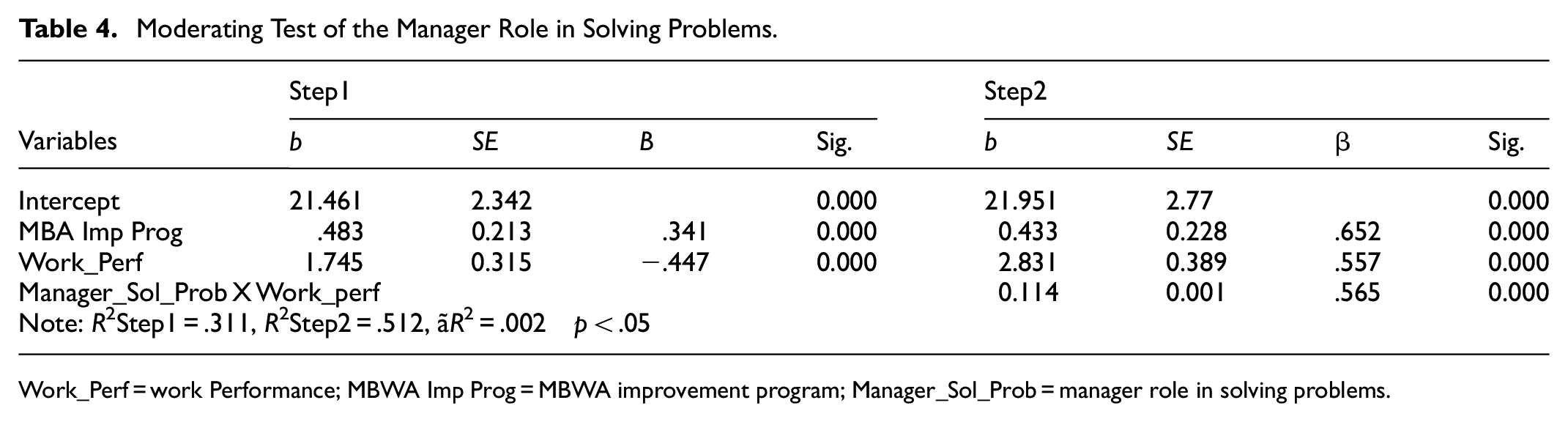
Work_Perf = work Performance; MBWA Imp Prog = MBWA improvement program; Manager_Sol_Prob = manager role in solving problems.
Study Impact and Implications
In this research, the researcher examined the performance of an MBWA-based program using a random sample of healthcare hospitals. The findings revealed that applying an MBWA improvement program had a positive impact on opposing a previous similar study conducted by Nair (2006). This could be interpreted as the cultural impact, especially the Middle Eastern ones and, more specifically, the Lebanese culture, noting that Lebanon, the United States, KSA, and Europe have adopted and are continuing to execute analogous programs. The findings are in line with the principles of key leadership theories. The improvement in employee perceptions of performance underscores the relevance of the Path-Goal Theory, which emphasizes the role of leaders in clarifying goals and reducing obstacles to improving employee outcomes (House, 1971). The situational adaptability demonstrated by managers in implementing MBWA aligns closely with SLT, which highlights the importance of tailoring leadership styles to the readiness and needs of employees (Hersey & Blanchard, 1969). Furthermore, the motivational and collaborative aspects of MBWA reflect the principles of Transformational Leadership, where managers inspire and mentor employees to achieve higher levels of engagement and performance (Naidu, 2023).
This finding needs to be taken seriously in the Lebanese context, especially in the current situation where the country is facing severe hyperinflation, devaluation of the currency, and turbulence in both the private and public sectors, where healthcare constitutes one of the pillars of the Lebanese economy. Opposing other research, the study suggests that the influence of top managers assisting and visiting the frontlines of an organization to gather ideas for the management of change is of great importance and leads to an improvement in workers’ perceptions of performance. Senior managers should be interacting with frontline employees and taking into consideration their ideas, comments, and concerns; if not taken from this perspective, this can be detrimental and can lead to personnel dissatisfaction, creating a toxic work environment and lack of motivation among employees (Epaminonda et al., 2021). Moreover, the result of this study showed that focusing solely on high-value problems was not associated with higher improvement in work performance perception. Previous research by Mathews and Katel (1992) had shown that formalization may be prioritized over genuine reform initiatives, leading to employee dissatisfaction with the program. However, addressing more straightforward issues proved beneficial, highlighting the importance of addressing “Minimal Interaction” (Morrison & Repenning, 2011).
Senior management may prioritize quick decision-making. The findings indicate that better improvement performance perception results are achieved by keeping senior managers accountable for resolving problems. This is likely because organizational changes often require senior management to provide funding for tools, resources, or labor and to gain support from other departments to make beneficial changes in the long term. These results suggest that it may be beneficial to empower front-line employees to identify and manage problems while also addressing organizational barriers to progress (Lluch, 2011).
Implications on Theory
Previous studies like A. Tucker and Singer (2013), Nair (2006), and Worley and Doolen (2006) have highlighted the importance of involving front-line staff in performance-enhancement activities for their success. This research found that a program emphasizing managerial participation was influential in the Lebanese context. Applying an MBWA-based program is critical and might fail if employees feel their ideas were disregarded. The findings came in line with previous scholars’ findings by Miles (1965), who found that when employees feel their ideas are not respected, they are less likely to be motivated to contribute in the future.
Woodruffe (2006) and Miles (1965) found that managers often had one of two views on the importance of employee engagement initiatives. The first perspective was that involving front-line employees was beneficial for morale, regardless of the practical value of their proposals. Managers who held this view were convinced of the importance of employee engagement initiatives, such as management, by walking around MBWA. However, improvement projects tend to fail when managers adopt this perspective. The second perspective, which Miles’ research linked to success, recognized the importance of relationships with front-line personnel as their contributions ultimately proved to be valuable, which was similar to the findings of this research.
Moreover, Respect for people is a fundamental principle; it requires a strong belief in the value of employees’ ideas (Carmeli et al., 2015). Miles’ research suggests that a key yet often overlooked element in the success of our MBWA program may have been top managers’ understanding of the perspectives and concerns of front-line workers. This implies that managers should place more emphasis on valuing the contributions of employees rather than just increasing engagement.
In addition, the study found that addressing more straightforward issues first, or “Minimal Interaction,” was effective in improving work performance improvement (improvement performance perception) scores. However, it is essential to note that addressing both simple and high-value problems is beneficial for organizations. While tackling high-value challenges may be necessary for specific initiatives, such as implementing an enterprise-wide information system, companies must prioritize and address fundamental issues. Hospitals must strive to develop the two types of problem-solving competency in order to reach optimal work performance improvement.
Thus, in order to effectively address both high-value and minimal interaction issues, organizations should utilize a combination of approaches. For example, they are utilizing Six Sigma methodologies for tackling high-value problems and Lean techniques or Kaizen for addressing more localized issues. It is important to note that addressing minimal interaction issues first can lead to improvements before tackling larger, high-value problems (Morrison & Repenning, 2011). For instance, developing methods to locate vital sign monitors in a nursing unit promptly necessitates problem-solving abilities distinct from those required for shortening hospital stays of patients.
Implications on Practice and Policy
It is equally essential for decision-makers to support organizations in building their problem-solving abilities. Rather than pushing companies to participate in untested change initiatives, they should promote the development of the ability to tackle urgent issues and contribute to process improvement. This research is an alarm against implementing improvement initiatives before fully understanding the conditions necessary for their success. One example may be the financial incentives used in the United States to encourage the use of digital health records. Policymakers should focus on promoting the development of problem-solving that helps to enhance any healthcare program (Blumenthal, 2010). The results highlight the significance of having proficient problem-solving abilities for any improvement initiative to be successful (Morrison & Repenning, 2011).
As stated earlier, this research echoes the principles of Six Sigma, Lean, and Kaizen, a method of problem-solving that involves both management and front-line staff, emphasizing the use of standardized approaches and the importance of taking action within a specific time frame. By shifting the focus from problem identification and resolution to problem selection, this approach helps to minimize wasted resources (Imai, 1986).
Limitations of the Study
It is essential to keep in mind the limitations of the study when interpreting our findings. The first limitation is the country context itself; this study was conducted in a country facing political and economic turbulence, which could have affected the accuracy of the result. Moreover, the high transportation cost limited the field experiment to employees from only 24 organizations over an 18 month period.. In addition, many healthcare institutions opted and refused to participate in the study, which might have affected the results, especially since they are highly qualified.The sample size was small and needs to be taken into consideration for future assessment in order to reach a 1% confidence; this is due to the challenges both hospitals and healthcare staff are facing in Lebanon. Thus, future research with larger sample sizes could provide a deeper understanding of complex issues such as how easily solvable priorities may be most effective for departments that necessitate immediate action, and how high-priority rankings may be most beneficial for experienced areas that can make more precise decisions. Additionally, obtaining actual safety incident data from hospitals proved difficult, and the study began when public clinical indicators such as high turnover, patient readmissions, and mortality rate data became available. Moreover, another limitation was the inability to assign random easy-to-solve and high-value prioritizing techniques among the different job areas in the Lebanese healthcare institutions, noting that doing so would have been a more effective method for testing our hypothesis.
Conclusion and Recommendations
Organizations considering implementing MBWA programs should consider these findings when making decisions. The research suggests that organizations with managers who are proactive in problem-solving achieve better results than those who are not. This implies that improvement initiatives are more effective at changing employees’ attitudes and perceptions when actual steps are taken to solve problems, rather than just a show of token concern by management and that applying a successful MBWA improvement program that affects work performance needs to take the role of managers in prioritizing and solving problems in collaboration with their employees seriously. Furthermore, the findings suggest that companies should focus on improving their ability to execute optimization strategies rather than spending more time and resources developing new ideas. This means that company’s specifically Lebanese healthcare institutions need to focus on developing their employees’ problem-solving skills. This leads to faster and more accurate decision-making by top managers. This, in turn, allows Hospitals to reduce time wasting and solve the most critical problems.
Finally, it is imperative to remember that the health sector, in general, and the Lebanese one specifically, is very complex. Difficulties always arise, and it is difficult to spot and identify them, especially with the high inflation rate and the turbulence the country is facing. Therefore, these hospitals must proceed systematically when solving problems. With tools like Kaizen and Six Sigma, the identification and solution of such problems will be efficient and effective. Hence, we conclude on the need to focus on solving problems proactively rather than generating new ideas. This would happen by improving the ability to execute and optimize well-defined business strategies, which will achieve better results.
Footnotes
Acknowledgements
This work would not have been possible without the support of my family and colleagues at Notre Dame University
I am grateful to all of those with whom I have had the pleasure to work during this research paper. Each of the involved parties has provided me extensive personal and professional guidance and taught me a great deal about managerial concept in healthcare. I would especially like to thank Mr Elie Boustany for his continuous support.
Most importantly, I wish to thank my loving and supportive wife, Rita, and my wonderful son Anthony who provide unending inspiration
