




Abstract
Academic listening skill is an indispensable necessity for English for academic purposes (EAP) students in English-medium universities and also critical for their future success in comprehending conference lectures. But due to the specific nature of such academic lectures, nonnative students all too often face challenges in getting a full command of this task. This study investigates the challenges of listening to academic lectures and the impact of related metacognitive strategies on academic lecture listening comprehension on a group of Iranian learners in an EAP workshop. Fifteen academic staff who took part in two intact classes at the University of Qom, Iran, were randomly assigned to treatment (N = 8) and control (N = 7) groups. The treatment group received 16 hr of metacognitive strategy instruction based on the models proposed by Vandergrift during academic listening instruction, while the control group was just exposed to academic lectures with no explicit strategy instruction. The academic listening sections of the British International English Language Testing System (IELTS) were utilized to measure the listening comprehension of both groups before and after the treatment. The results of the data analysis determined that the experimental group significantly outperformed the control group in the listening posttest. The interviews before and after the treatment revealed details of challenges in academic lecture comprehension and also shed light on the perception of the learners regarding metacognitive strategy instruction and the frequency of main metacognitive strategies used in comprehending academic lectures.
Keywords
Introduction
Listening in general is a challenging language skill for many learners in which they usually face frustration (Arnold, 2000; Goh, 2000). Graham (2006) in his study concluded that listening is recognized by his students as an area in which they felt the least success compared with other skills. He argued that the students during listening experienced difficulties about perception, especially regarding speed of delivery in which they usually encounter problems due to mishearing or missing supposedly vital words. According to the results of his interviews, students also commented on challenges in recognizing words in the speakers’ accent due to inadequate exposure to authentic listening input. All these challenges bring about demotivation regarding listening.
English for academic purposes (EAP) instructional settings require a higher level of listening skill (Ferris & Tagg, 1996) as learners should deal with deciphering both content and subject matter in the audio texts. The challenge of listening while taking notes or reading presentation slides and textbooks simultaneously makes listening task twice as complicated as before. It is evident that academic listening skills do not develop by themselves. They need to be fostered through explicit and extensive training (O’Malley & Chamot, 1990; Swan, 2011). Within these training programs, metacognitive strategy instruction has gained importance as a popular research topic among scholars (Goh, 2008; Mendelsohn, 1995, 1998; Vandergrift, 2004).
Academic lectures have become the most widely used method of instruction at many universities, workshops, and conferences. As English has become the lingua franca in tertiary and academic education (Long & Richards, 1994), many of these lectures use English as the medium of instruction for learners. Therefore, it necessitates the need for searching for effective listening strategies and techniques for EAP learners who attend English-medium universities, seminars, or institutions so that they can smoothly comprehend the subject matters delivered in English.
Theoretical Framework
Issues in Academic Listening and Lecture Listening Comprehension
It has been revealed that good listening comprehension contributes significantly to academic success (Jeon, 2007). There are various core academic activities like listening to teachers explaining courses and assignments or listening to classmates’ questions, reports, and summaries, which are dependent on active listening comprehension skills. Listening to lectures is the most essential requirement for EAP learners, which is itself quite a challenging area for most of the students due to their likely inadequate general English proficiency level and difficulties in comprehending and remembering the content of lectures (Huang & Finn, 2009).
EAP learners also have to cope with some other challenges during lectures such as taking notes and processing accompanying visual information (Gruba, 2004), understanding the use of metaphorical language used by lecturers (Littlemore, 2001), coping with stress when required to have active participation, and responding to questions during lectures (Arnold, 2000). Handling the variety of lecturing styles preferred by the lecturers such as conversational style, rhetorical style, and report and discussion style (Dudley-Evans, 1994) can be another source of difficulty for EAP learners. Recognizing nonverbal, syntactic, and phonological clues that signal the end of turns makes academic lecture comprehension more complex (Dudley-Evans & St. John, 1998). And finally, recognizing gestures and facial expressions in authentic lectures, which are absent in written texts, can also confuse listeners at academic context (Huang & Finn, 2009).
General language proficiency and listening ability are considered among the most important factors in academic success. Although general listening and academic listening seem to imply distinct categories, the two share many basic features (Goh, 2008). Fulcher (1999) in his discussion argued that EAP testing had concentrated too much on subject knowledge and this has led to deemphasizing language knowledge, skills, or abilities. He further pointed to researches that have revealed that variance in EAP test scores had been mostly due to language proficiency rather than subject knowledge. It is implied from his discussion that the general ability to listen in the target language would have a greater effect on overall academic listening performance than specificity in the subject matter. Therefore, academic material writers and researchers should be aware of discussion in general foreign/second language listening and its implications for academic listening pedagogy (Goh, 2008).
Despite the importance of general listening proficiency, it is still a challenging skill for many EAP learners to improve. The witness of this claim is that many EAP students who have gained admittance into academic programs through standardized tests like International English Language Testing System (IELTS) and Test of English as a Foreign Language (TOEFL) still report difficulties in academic listening and quick processing of low-level information necessary to comprehend higher level meaning construction (Huang & Finn, 2009). As cognitive processes in listening are recursive and reiterative, learners with inadequate bottom–up or decoding skills fail to catch up with the transient listening input. It leads to difficulties in deep processing and optimum recall (Goh, 2000). According to a research conducted by X. Liu (2005) on Chinese EAP students in Singapore, listening was perceived as their weakest skill over which they felt they had little control. Classroom activities and textbooks can support EAP listeners, but there is still the need to develop strategic competence among learners through more effective instruction and material preparation.
Metacognitive Processes in Academic Lecture Listening Comprehension
In the past, listening was only considered as a receptive skill (Johnson, 2008) where “students listened to repeat and develop a better pronunciation” (Vandergrift, 2011). Recent approaches to teaching listening have focused on strategy instruction, enabling students to effectively extract content information from input (Mendelsohn, 1995). There are three types of learning strategies that have also been applied in listening instruction: (a) cognitive strategies, (b) metacognitive strategies, and (c) socioaffective strategies (Chamot, 1993; Oxford, Lavine, & Crookall, 1989; Vandergrift, 1997). Cognitive strategies include inferencing, resourcing, and note taking, which are unconscious interactions with the material to be learned. Metacognitive strategies involve conscious management and regulation over learning process, like planning, concentrating, and monitoring. Socioaffective strategies include interacting with peers or management of affection to facilitate learning, such as asking questions, collaborating with classmates, and controlling stress (O’Malley, Chamot, & Kupper, 1989).
Metacognition is defined as “thinking about thinking” by Anderson (2002). In other words, because metacognitive strategies provide a context for interpretation, they can assist listeners select their goals, supervise their improvement, and assess learning results, and they may considerably facilitate and accelerate listening performance or develop self-regulated learning.
As Vandergrift (2004) in his review article stated, despite inadequate literature base in listening strategy instruction, some experts such as Goh (2000, 2002), and Mareschal (2007) have studied the differences between more skilled and less skilled listeners through strategy instruction in the past few decades. Initially, most of the listening strategy studies have been investigating patterns and strategies used by successful versus less successful learners. For example Vandergrift (2003) in his study on seventh-grade Canadian French students ranging from more to less skilled instructed them to think aloud during listening to French texts to compare their listening comprehension strategies. It was found that the more skilled listeners used more metacognitive strategies like monitoring and the less skilled listeners used more of translation. Chamot (2005) also reiterated that descriptive studies have supported this view that skillful language learners are adroit at applying appropriate strategies while working on various tasks, whereas less skilled language learners apparently do not have the metacognitive insight about task requirements required to choose relevant strategies.
Gradually, the line of research shifted to focus on effective strategies and process-oriented approaches to teaching listening skill to guide the students “learn to listen” so that they can better “listen to learn” (Vandergrift, 2004). Therefore, listening instructors have the responsibility of teaching students to take advantage of strategies rather than merely provide them with oral passages and test them (Mendelsohn, 1995).
The development of academic listening, and academic lecture listening comprehension in particular, requires high-level specific strategies relevant to academic context. Listening strategies assist listeners to monitor their listening comprehension and development consciously. As Chamot (1995) stated, such strategies are effortful and conscious behaviors that play significant roles in facilitating listening comprehension and development. The main contribution of listening strategies is manipulating and transforming the spoken input, directing and regulating cognitive processes, controlling emotions, and applying relevant resources to facilitate comprehension (Vandergrift & Goh, 2012). To meet these requirements, listeners should achieve a strong awareness of their mental processes engaged during listening process and also develop their managing capacity of these processes (Goh, 2008). The metacognitive approach has been one of the most popular research areas within this field, which contains strategies for coping with academic listening difficulties and facilitating its challenges. Selamat and Sidhu (2011), in their attempt to explore English as a Second Language (ESL) students’ perception about metacognitive strategy instruction to improve lecture listening comprehension, worked with 34 freshman students from the faculty of education in a public university in Malaysia using a questionnaire and semistructured interviews. Qualitative data analysis revealed that English for specific purposes (ESP) learners confirmed the positive impact of metacognitive strategies on their lecture listening comprehension. Findings also suggested the need for the students to play a more effective role in managing their listening problems.
According to empirical studies, metacognitive awareness about listening has been found to be one of the main features common to proficient second language listeners (Vandergrift, Goh, Mareschal, & Tafaghodtari, 2006). However, there is still little information on how EAP listeners engage in metacognitive processes or are influenced by them. More empirical studies are needed to clarify and verify this claim in methodology of academic listening because the few studies conducted in the field of strategy instruction in listening so far have not yet yielded consistent results to either confirm or refute the efficacy of listening strategy instruction (e.g., Carrier, 2003; McGruddy, 1995; Ozeki, 2000; Paulauskas, 1994; Rost & Ross, 1991; Thompson & Rubin, 1996). Given the significance of the five factors of metacognitive knowledge (planning and evaluation, problem solving, directed attention, mental translation, and person knowledge), it is hypothesized that activating metacognitive strategies can also contribute to overcoming challenges of academic lecture listening comprehension among EAP learners. Surveying the perception of learners in this regard through introspective measures, interviews, or other forms of qualitative methods would shed more light on this process.
Statement of the Problem
Although during recent years, some studies like O’Malley and Chamot and Kupper (1989), Goh (2002), Goh and Taib (2006), Vandergrift (2003), and Vandergrift and Tafaghodtari (2010) have started to highlight the value of a strategic and process-oriented approach to listening, issues related to challenges of listening to academic lectures for EAP learners and the concept of metacognitive strategy instruction in relation to academic lecture listening comprehension still need to be explored. Over the past three decades, listening in EAP contexts has captured the attention of English language teaching (ELT) scholars especially in the area of lecture comprehension. However, according to what has been reviewed in the literature, few studies, if any, have investigated the facilitating effects of metacognitive listening strategies on academic lecture listening comprehension. The present study is an attempt to fill this gap and shed more light on inherent challenges of this process by specifically addressing the following research questions:
Method
Research Design
The first and third research questions in this study rely on a qualitative approach as they apply interview to evaluate the opinion and perception of EAP learners regarding areas of difficulty in listening to academic lectures and also the most useful strategies used by them in class, whereas the second research question enjoys a quantitative approach and applies an experimental design as it has features of observation and treatment to measure listening comprehension in pre- and posttests.
The quantitative part of the study provides an analysis of the EAP learners’ listening comprehension under the influence of metacognitive strategy instruction. The qualitative approach of the study focuses on the interview results to analyze the perception of the learners and also to triangulate the quantitative results gained through IELTS test and increase the reliability of the study.
Participants
The participants of this study included 15 female academic staff who were technicians and instructors at the computer sites and physics and chemistry labs at the University of Qom, Iran. The staff at the university who mostly had an MA in engineering courses participated in two intact workshops at the university to improve their academic listening and speaking abilities to attend international conferences or to take part in PhD interviews to succeed in their higher education. They were randomly assigned to an experimental (N = 8) and a control (N = 7) group. Their age varied from 26 to 38 years. The participants mostly had attended English classes at institutes or at extracurricular programs at work for seven terms. They also had passed general English courses as part of their MA program. However, they all stated that their listening and speaking skills were not as fluent as their reading and writing and that was why they felt the need to take part in the workshop. According to the listening pretest, their listening level ranged from lower intermediate to intermediate level.
Instruments
Academic listening section of British IELTS
To investigate the second research question, that is, the listening performance of both experimental and control groups before and after eight sessions, academic listening samples of the British IELTS were used, which were about academic lectures and interactions between professors and students. After the pilot study and based on the students’ feedback and also the expert opinion of a panel of instructors, four question formats (sentence matching, multiple choice, table completion, and short answer items) were selected for both pre- and posttests. The content of both tests was identical, but the test formats were different to avoid test-wiseness given the short intervention time of 5 weeks. Each test consisted of 30 questions and took about 45 min to be answered. The questions were about what was stated or implied in the IELTS samples, and the tests were given to the students according to the standards of the IELTS listening exam. The Cronbach’s alpha reliability coefficient for the pre- and posttests was .76 and .79, respectively.
Academic lectures and listening passages
Sixteen academic lectures with good audio quality were selected from a variety of oral passages in academic listening and speaking skills considering the participants’ age and specialty. The topics consisted of academic issues and varied in length. An attempt was made to start with simpler and shorter lectures. The listening sections were parallel for both control and treatment groups during eight sessions, and the difference was just in metacognitive strategy instruction.
Pretest and posttest interviews
To gather information about the first and third research questions and provide details regarding the challenges of listening to academic lectures for EAP learners and also investigating the learners’ perception in the treatment group about each of the stages and related metacognitive strategies (planning, directed attention, monitoring, problem solving, selective attention, and evaluation), the participants were invited to take part in an interview, once before the research for both groups to answer the first question and once for just the treatment group to answer the third research question, to share their perceptions with the teacher-researcher. All the participants consented to take part in these interview sessions.
One week before the treatment, the teacher invited each member of both treatment and control groups to her office and asked them in English to talk about their areas of difficulty while listening to academic lectures. As the participants were all around intermediate level, they were quite comfortable to talk about their perceptions in English. Eight minutes were given to each interviewee to answer the questions. It took about 140 min to complete interviews with all participants. The answers were all recorded and were then transcribed by the teacher listing the challenges and ideas that the learners mentioned.
Likewise, the eight learners in the treatment group were invited one by one to take part in another interview session held in the teacher’s office. First, interviewees were given a short preview of the five factors related to metacognitive strategies taught during the treatment. Then, they were asked two general questions:
Which of the five factors of metacognitive strategies helped them the most in listening comprehension of academic lectures?
What is their perception about the effect of metacognitive strategies taught in the class on the listening comprehension of academic lectures?
Ten minutes were committed to each interviewee, and the interview session with all participants was completed in about 90 min. The answers were recorded and then transcribed by the teacher for qualitative analysis.
Procedure
One week before the treatment, the teacher visited the learners in the treatment group to administer the pretest for the listening section of IELTS, and then they were invited to the interview session to answer the question regarding the challenges faced by them through listening to academic lectures.
The teacher in the first session of the treatment explained metacognition to the learners briefly and gave them an overview of the process they were assumed to undertake based on the model proposed by Vandergrift (2003). EAP learners received strategy instruction during academic listening tasks for two sessions a week. Each session took about 90 min and involved various academic lectures. The process of strategy instruction took eight sessions and included the following metacognitive strategies:
Planning and directed attention;
Monitoring;
Monitoring, planning, and selective attention;
Monitoring and problem solving;
Monitoring and evaluation;
Selective attention and monitoring; and
Evaluation.
The lesson plan for each session consisted of four stages of listening instruction as proposed by Vandergrift (2003), including planning and predicting, first verification stage, second verification stage, final verification stage, and reflection stage. In the planning and predicting stage, learners were informed about the lecture topic and accordingly predicted kinds of information or likely words they may hear. This stage includes directed attention strategy, which is students’ ability to direct their attention to a subject matter. It is an essential strategy to enable comprehension and, especially during long lectures, to enable learners to consciously control their attention. During the first verification stage, learners verified their initial hypotheses, modified them, and also compared their hypotheses with their partners in the class. They also tried to focus on details needing attention (selective attention). In the second verification stage, EAP learners verified points of disagreement in comprehending lectures and made corrections. In this stage, the teacher held discussions in which all learners contributed to reconstruction of meaning of lectures and figuring out ambiguous details. In the final verification stage, the learners selectively listened to the information they could not have decoded earlier in their discussions (selective attention). And finally, in the reflection stage, they discussed the strategies they had used to make up for what they could not understand during lectures. Then, they jotted down the suitable strategies to implement for next sessions. This lesson plan adapted for academic lectures was replicated by the researcher-teacher based on Vandergrift’s listening instruction stages and related metacognitive strategies.
One week after the metacognitive strategy instruction, the teacher-researcher met EAP learners for another session to administer the IELTS posttest. The participants took IELTS academic listening posttest, which had identical content and difficulty with control group’s posttest. Pre- and posttests were also parallel in both groups.
After the IELTS listening posttest, the learners in the treatment group were invited to take part in another interview session to share their perceptions about the metacognitive process and its contribution to their listening comprehension with the teacher.
The learners in the control group after the initial interview regarding the challenges of academic lecture listening comprehension and the listening IELTS pretest received lectures and academic listening tasks during the research period with no metacognitive strategy instruction. After eight sessions, they were given the listening posttest of IELTS to measure their performance.
Data Analysis and Results
Quantitative Results
The second research question that was investigated in this study was whether metacognitive strategy instruction improved academic lecture listening comprehension among EAP learners. To address this research question, descriptive and inferential statistics (independent t test) were used to compare the level of academic lecture listening comprehension between control and treatment groups before and after teaching metacognitive strategies. The results of the analyses of pretest data on academic lecture listening comprehension for control and treatment groups are summarized in Table 1 below.
Independent Samples t test for Equality of Mean Scores in Academic Listening Comprehension (Pretest).

As mean scores for initial academic lecture listening comprehension illustrated in Table 1 reveal, both control and treatment groups were rather homogeneous before teaching metacognitive strategies regarding their comprehension of academic lectures, and there were no statistically significant differences between the groups (t = −.932, p ≥ .05). Independent t-test results (Table 1) indicate no differences between treatment and control groups at the outset of the study in terms of listening comprehension.
Having confirmed that treatment and control groups had equal academic lecture listening comprehension before teaching metacognitive strategies, it was decided to compare possible gains in listening comprehension of academic lectures after the treatment. Table 2 summarizes inferential statistics comparing the control and experimental groups in their posttest means.
Independent Samples t test for Mean Scores in Academic Listening Comprehension (Posttest).
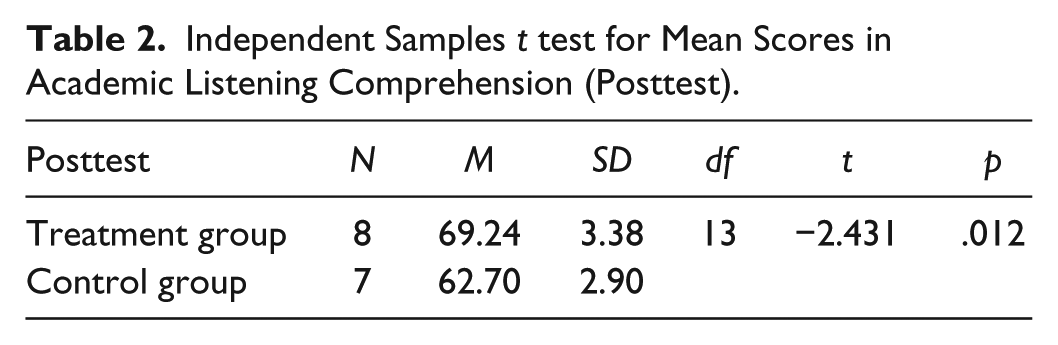
As results in Table 2 indicate, there is a statistically significant difference in academic comprehension mean scores between treatment and control groups at the posttest. Independent t-test results show that a significant difference has emerged between treatment and control groups by the end of the metacognitive strategy instruction period (t = −2.431, p ≤ .05). The hypothesis of the equality of means of posttreatment is rejected implying that the treatment group significantly outperformed the control group in gaining improvement in academic lecture listening comprehension as a result of metacognitive strategies. According to this analysis, applying metacognitive strategies significantly improves academic lecture listening comprehension among Iranian EAP learners.
Interview Results
Challenges of listening to academic lectures (pretreatment interview)
According to the interview results before the treatment, the majority of EAP learners (12 learners) perceive their lack of general listening proficiency as the main cause of difficulty for them in comprehending academic lectures. Many of them stated that despite gaining admittance into MA level and passing general English courses at the university, they still had difficulties in listening comprehension especially in coping with fast delivery of speech.
I have passed several courses in English at school, BA and MA level but still listening to lectures and comprehending them is a nightmare for me especially when the lecturers speak fast or have native accents . . . . (29 years old) . . . My academic writing is not bad and I have even written my articles in my field of study (physics) in English but when it comes to listening to lectures in conferences or classes I’m quite weak because during my English courses at school or university there was no emphasize on listening comprehension in classroom . . . . (31 years old) When I first attended at a physics conference in Turkey I got really disappointed at myself for not understanding the content of the lectures and speeches which were in English although I could easily understand the posters and brochures . . . I got really confused during lectures. I think that’s because in Iran, teachers and professors never teach listening to us and it is totally ignored n classes . . . . (27 years old)
The above findings corroborate Huang (2004) and Huang and Finn (2009) who observed tertiary-level students encountered challenges with academic listening although they had adequate proficiency in reading and speaking.
Some students also complained about maintaining concentration during lectures. They stated that on encountering the first few unfamiliar words in lectures, they lose their track of mind and cannot catch up with the rest of the lecture. In fact, they could not direct their attention during the process of listening.
If I don’t understand the meaning of a word or phrase in the lecture I get anxious and lose my concentration. I keep thinking about the meaning of unfamiliar words and I can’t remain focused on the rest of the lecture . . . . (29 years old)
Accordingly, it seems that most of the learners depend on just bottom–up processing to infer meaning while they mostly ignore top–down skills. That’s why they cannot construct meaning on a word by word basis due to their constraints of working memory or lack of proficiency. It supports the results found by Osada (2001) about the lack of success in listening.
Six of the students stated that because, after the lectures, they are sometimes required to discuss issues or reply to questions, during lectures they have to take notes, figure out video slides, and think of what to respond later. So integrating listening and note taking and responding to questions is a source of difficulty and challenge for them.
. . . During lectures I’m so overwhelmed with how to respond to questions or what to take as notes or making sense of video slides accompanying the speech that I can’t integrate all these with listening which is by itself a challenge for me. It makes me confused . . . . (28 years old)
The above finding is in line with what Huang and Finn (2009) and Gruba (2004) had distinguished as the areas of difficulty in lecture comprehension and interactive listening. It seems that the stated challenges by the learners is mostly affected by their inadequate general language proficiency and listening ability.
Most frequently used metacognitive strategies by EAP learners for lecture comprehension/learners’ perception (posttreatment interview)
The results of the posttest interview showed that among four stages of listening instruction and related metacognitive strategies implemented on academic lecture comprehension, planning and directed attention have been activated the most among EAP learners. Almost all interviewees stated that they had used these two strategies, and it was effective on their listening comprehension.
After I started paying attention to the topic of the lectures I was less confused in class. Although I didn’t get some words I could use my background knowledge more or less to relate information in the lectures . . . . (32 years old) . . . Before the workshop when I faced with some difficult words during lectures I lost my track of mind and couldn’t concentrate any more. But now I understood how to keep focused on topic and disregard the words I don’t understand. (27 years old)
Because planning strategy is considered as a kind of advance organizer for learners, it activates prior and background knowledge of the lecture content to facilitate listening comprehension. It corroborates the study by Flowerdew and Miller (1992) about the interrelation between lecture content comprehension and background knowledge of lecture topic. Moreover, as the learners stated, directed attention strategy helped them not to give up and stop listening when being encountered with comprehension difficulties at the outset or middle of the lectures.
According to the interview results, evaluation and monitoring were the second and third most frequently used strategies by EAP learners to comprehend lectures. Six of the participants who attended in the treatment sessions stated that during second verification stage and reflection stage in which they had discussion groups and shared their strategies with their peers they could learn from more successful listeners how they arrived at lecture comprehension and tried to apply those tactics and strategies for the next sessions.
Last year I got band score 4 on the listening section of academic IELTS. Since then I started to listen to academic conversations and lectures but I was still dependent on answer keys and transcriptions to comprehend or answer questions. I thought I have no talent in listening. But during discussions with partners after each lecture I learned which tactics they used to get the gist or details. It was very useful. (30 years old) I was always shameful to ask the teachers or classmates about the things I didn’t comprehend during lectures but discussions broke this spell. I could correct myself or correct others. I think listening without correction by teachers or better classmates is useless . . . . (35 years old)
The majority of the learners had no idea about the impact of the selective attention strategy either because they had no clear idea of that or they thought they did not use it appropriately in class.
Although EAP learners here have used major groups of metacognitive strategies (prediction, monitoring, problem solving, and evaluation) with different frequencies, all found them motivating and facilitative in the process of academic lecture comprehension. They overwhelmingly responded to the power of prediction and collaboration with peers for evaluation and monitoring in the process of listening to lectures. It supports the results found by Vandergrift (2002, 2003).
Conclusion
This study, which intended to investigate the challenges of listening to academic lectures for EAP learners in Iran and the relationship between metacognitive strategy instruction and the level of academic listening comprehension, confirms the results gained by Osada (2001), Vandergrift (2002, 2003), Gruba (2004), Huang (2004), and Huang and Finn (2009) and also provides more empirical support to the body of knowledge in the field of metacognition in academic listening. According to the outcomes of the statistical analysis, metacognitive strategy instruction can significantly improve academic lecture comprehension among EAP learners. The results of the interview sessions indicate that EAP learners find academic listening comprehension a demanding task mainly due to lack of general listening proficiency. Inability to maintain concentration during lectures, overdependence on bottom–up processing to infer meaning, ignoring top–down skills, and integrating listening with note taking and responding to questions were reported as other sources of difficulty in comprehending lectures. According to the discussion of results, metacognitive strategy instruction was analyzed to be facilitative in terms of making the learners take responsibility of their own learning through the cycle of planning, directed and selective attention, monitoring, and evaluation.
As the participants in the treatment group asserted during the second interview, they made use of some metacognitive strategies more frequently to comprehend academic lectures. Planning and directed attention turned out to be the most frequently used strategies used by learners and evaluation and monitoring were reported to be the second and third useful strategies. The participants had no idea about the effect of selective attention strategy on their academic lecture listening comprehension. It seems further qualitative research should be carried out in this area using introspective measures to reach a consensus regarding this aspect.
As listening comprehension is totally ignored at the school level in Iran and also underestimated in general English classes by professors at the universities, EAP learners face demanding challenges on encountering academic contexts in which they have to comprehend lectures in English. Listening professionals in this field have an important role to take the initiative and make up for this lack. They should introduce useful metacognitive strategies to learners to circumvent this challenging task so that they can be in charge of their learning and gain self-confidence to compensate previous years of English learning deprived from listening comprehension. The results of this investigation indicate the necessity for language teachers, especially in Iran, to pay more attention to a strategic approach to the listening task in EAP classrooms and replace product-oriented with process-oriented instruction of listening to enable their students to effectively extract content information from input.
Regarding some limitations in this study, generalization of the results should be done cautiously. As it was a research done at a segregated work place in Iran and due to opportunistic reasons, all the participants were of a single gender (female). The specific level of English proficiency (intermediate) and small sample size (which is of course natural in ESP/EAP workshops) make the generalization of the results more limited. In fact, there is a dire need to do more quantitative and qualitative studies and, with larger sample size and from both genders and with various levels of English proficiency, to come to a consensus regarding the effect of metacognitive strategies on the process of academic listening comprehension. Finally, given the overlapping aspects of general listening and EAP listening, especially academic listening, adopting integration of the best listening theories in both fields is useful.
Footnotes
Acknowledgements
The authors are grateful to the pioneer researchers in the research area who paved the way for further investigation. It is also a good opportunity to appreciate the patience of dear participants who contributed to this study.
Declaration of Conflicting Interests
The author(s) declared no potential conflicts of interest with respect to the research, authorship, and/or publication of this article.
Funding
The author(s) received no financial support for the research and/or authorship of this article.