



Abstract
This study examines the expectations and effectiveness of a teacher training program for early childhood music education, specifically focusing on the Holistic Music Educational Approach for Young Children (HMEAYC) and its integration with local cultural frameworks. Participants (n = 30) from a private university’s Department of Early Childhood Development and Education, aged between 22 and 25 years old, were about to obtain their early childhood education teaching qualification. The 36-week training, consisting of 3 hr per week, employed collaborative teaching methods and collective reflection to gather pre- and post-training data. The results indicate a 90.91% pass rate for participants who successfully obtained the HMEAYC teacher qualification. While overall expectations regarding course identity, musical skills, and pedagogical competence did not exhibit significant changes, participants with better training outcomes experienced significant positive changes in psychological cognition of musical skills and curriculum identity, with no significant difference in pedagogical competence cognition. Furthermore, Spearman’s correlation coefficient analysis revealed positive correlations between cognitive changes in musical skills, course identity, and pedagogical competence after training. Conversely, negative correlations were observed between cognitive changes in musical skills and both course identity and pedagogical competence before training, suggesting a strong association between changes in music skills and other variables.
Plain Language Summary
This study examines the expectations and effectiveness of a teacher training program for early childhood music education, specifically focusing on the Holistic Music Educational Approach for Young Children (HMEAYC) and its integration with local cultural frameworks. Participants (n = 30) from a private university’s Department of Early Childhood Development and Education, aged between 22 and 25 years old, were about to obtain their early childhood education teaching qualification. The 36-week training, consisting of 3 hr/week, employed collaborative teaching methods and collective reflection to gather pre- and post-training data. The results indicate a 90.91% pass rate for participants who successfully obtained the HMEAYC teacher qualification. While overall expectations regarding course identity, musical skills, and pedagogical competence did not exhibit significant changes, participants with better training outcomes experienced significant positive changes in psychological cognition of musical skills and curriculum identity, with no significant difference in pedagogical competence cognition. Furthermore, Spearman’s correlation coefficient analysis revealed positive correlations between cognitive changes in musical skills, course identity, and pedagogical competence after training. Conversely, negative correlations were observed between cognitive changes in musical skills and both course identity and pedagogical competence before training, suggesting a strong association between changes in music skills and other variables.
Keywords
This research study centers on a specific teacher training program in early childhood music education, serving as a case study aimed at providing evaluative feedback on the implementation of teacher development courses. In order to examine the effectiveness of teacher development programs and student expectations, an anonymous online questionnaire survey was conducted. The survey targeted university students aged between 22 and 25 years who had completed a 36-week teacher training course, with each session lasting 3 hr per week. By employing pre- and post-event questionnaires, the study analyzed participants’ ratings pertaining to curriculum recognition, musical skills, pedagogical competence, and academic performance before and after the training course. Furthermore, the study examined the impact of the program on pedagogical competence and academic performance. The findings from this analysis serve to investigate the requirements and outcomes associated with implementing the teacher training program and can be used as a point of reference for future recommendations concerning instructional enhancement and curriculum adjustments. The subsequent sections of this paper are structured as follows: Section I presents the Literature Review; Section II outlines the Data and Method Design; Section III presents the Results and Discussion; and finally, Section IV offers Conclusions.
Literature Review
Preschool teachers are essential for preschoolers. A child’s behavior in any preschool program is guided and influenced by their teachers. Therefore, to believe that for early childhood education’s success, teachers’ behavior and attitude are crucial (Brophy & Hancock, 1985). As early childhood education has been recognized as the foundation of lifelong learning, enhancing professional competence and strengthening quality assurance mechanisms are essential topics for quality early childhood education (Chan & Chan, 2003). Affected by this, the training program of teachers or staff in early childhood care has also been highly valued by international scholars in recent years (Fukkink et al., 2019; Hickey et al., 2017; Kalogiannakis, 2010; Serrano & Casanova, 2022; Yim, 2018; Yuen, 2021; Zhang et al., 2015). Pre-service training is influential in developing interactive skills and professional reflection in early childhood education and care, and it has been suggested that further investment in pre-service training is needed (Fukkink et al., 2019). Hickey et al. (2017) believed that early childhood teachers must constantly struggle to cope with behavioral problems in the classroom. Therefore, it evaluated the effectiveness of teacher training programs in classroom management to improve teacher competencies and children’s adaptation.
Coulter and Gallagher (2001) explored the results of staff and children following staff participation in training programs. Changes in staff and children were investigated using a comparative study design and after-to-before-training measures. The results showed that the training program did not change children’s receptive and expressive language skills. The methodological difficulties inherent in assessing the effectiveness of training and the need for further research were emphasized. Yim (2018) explored the benefits of professional teacher training programs in Hong Kong kindergartens, interviewing participants and instructors. The results showed that teachers train and care for students by supporting their families’ social and emotional aspects. It is recommended that advisory knowledge and skills should be tailored to local conditions and integrated into teacher training programs. Yuen (2021) studied the key measures of the Hong Kong government’s kindergarten education program since 2017. A call to rethink the ethical responsibility of teacher educators to address the complexities of teacher work and the policy/practice divide in teacher education that was often overlooked by the policy. In the past, there had been an emphasis on the integration of ICT (Information and Communication Technology) into training programs (Kalogiannakis, 2010). Colley (2006) conducted a detailed case study of a group of childcare students over a 2-year course. It was found that gender and class orientation should be combined with vocational education and training to construct the necessary conditions for the right emotions in childcare.
According to Miller (1992), Holistic Education encompasses a broad spectrum of philosophical approaches and pedagogical practices that aim to cultivate a comprehensive worldview and a dynamic perception of reality. This conceptual framework comprises discourses on educational and life experiences, emphasizing the necessity for a curriculum that aligns with an interdisciplinary social perspective rather than being confined to narrow interpretations of fundamental skills (Mahmoudi et al., 2012). At its core, Holistic Education considers learners the central agents and recognizes their holistic nature as complete individuals. Early childhood music education advancement in Taiwan has gradually taken shape within this educational framework and is guided by its underlying principles and values.
HMEAYC is a musical education approach based on the concept of holistic education and emphasizes the local cultural characteristics of Taiwan, which is suitable for preschool children to learn in general or with special needs (Lee & Ho, 2018; Lee & Liu, 2021a, 2021b). This set of early childhood music education systems was proposed in 2010, and the center of HMEAYC was established simultaneously, supplemented by technology and innovative educational equipment. After several studies and adjustments by participating educators, music therapists, and education experts, a set of music curriculum models suitable for preschool children has been designed and developed. It has been developed for many years and was gradually promoted in many preschool education institutions and systems in Taiwan (Lee, 2014, 2016a; Lee & Ho, 2018). This educational curriculum was also adapted and applied to children with special needs (Lee, 2006, 2016b; Lee & Ho, 2019). For children in general or special needs, it had a significant positive impact on attention, emotional stability, body movements, language ability, and interpersonal interaction (Chao et al., 2012; Lee, 2006; Lee & Ho, 2018, 2019; Lee & Li, 2016; Lee & Liu, 2012).
HMEAYC (Ho, 2020) comprises a series of early childhood music education courses developed over five distinct periods. Figure 1 provides a visual representation illustrating the chronological progression within HMEAYC. The figure is as follows:
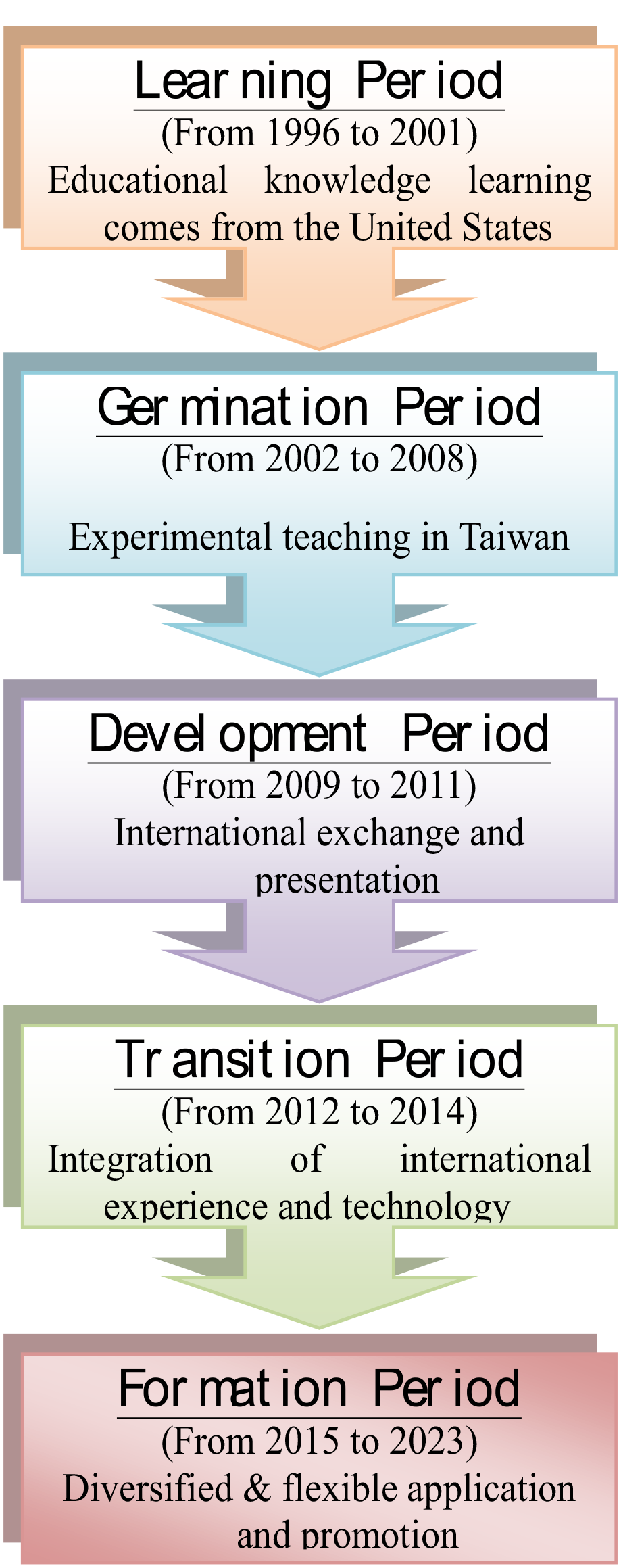
Illustrative diagram based on the period in HMEAYC.
Furthermore, HMEAYC is characterized by the following components: (1) a commitment to inclusive education and the holistic development of children, (2) a multifaceted and comprehensive approach to fostering holistic growth, (3) the integration of music, physics, functional and speech therapy, and special education to employ holistic methodologies, and (4) four educational objectives that stem from the complete assimilation and comprehensive integration of the Holistic faculty. The curriculum and activities within HMEAYC encompass nine distinct components: walking on the line/visual stimulation, hello song, attendance song, singing time, chanting time, musical storytelling time, music movement, relaxation time, and goodbye song. Depending on specific course programs, the inclusion or repetition of these activities may be flexibly adjusted. In order to facilitate multi-sensory learning experiences, HMEAYC utilizes music in conjunction with technological instruments. Regarding the physical infrastructure, a multi-sensory room is predominantly designed to cater to children’s visual, auditory, kinesthetic, and tactile learning needs. It is anticipated that the installation of technological equipment in this space will contribute to the comprehensive development of children across various domains. Different instruments and equipment serve distinct goals and activity methods and can be utilized independently or in combination with multiple instruments and their corresponding teaching methodologies. Such equipment includes the Korner Kurve Ball pool, Talking Cube, Circular Set of Musical Lights, Musical Jumping Pad, Star Master Projector Light Lamp, Sound Bed, Laser Lights, Soundbeam 5, and virtual interactive games. Additionally, the pedagogy of Figurenotes is also employed within HMEAYC (Ho, 2020).
Data and Method Design
This study was based on the 3-hr-week, 36-consecutive weeks training program offered by the Center of HMEAYC for the registered Seed Teacher Training Programme as the research subject. The trainees were registered voluntarily. A total of 33 trainees participated in the training program, of which three withdrew because of personal reasons, so the number of valid samples obtained was 30; the effective sample rate was 90.91%. Participants were between the ages between 22 and 25 old and had completed 3 years of study in the Department of Early Childhood Care of the University and were about to become early childhood educators. In the preparation and implementation of the teacher training curriculum, the planner of the HMEAEC Centre is mainly responsible for promoting this education system, selecting three professional and qualified teachers to carry out collaborative teaching (including teaching content, progress, and teaching material development, as well as review and improve).
Regarding the effectiveness of the training courses received by the participants, the self-evaluation of the participants, the mutual evaluation of the students, and the joint evaluation of the instructors were used to calculate the assessment score. However, the total grade at the end of the course is a weighted average calculated from the general, mid-term, and final assessment results, and the total score falls between 0 and 100 points. Each participant must have a passing score of 70 points or more (inclusive) upon completion of the training course to qualify as a qualified teacher for HMEAEC.
In this study, the measurement of participants’ intention was conducted through an online questionnaire, mainly after the teacher explained the objectives and syllabus of the training in the first week of training, and then completed an online anonymous questionnaire survey before the training. In addition, the second online questionnaire was conducted in the last training course session (after the training). The questionnaire’s content had three dimensions (see appendix), and each dimension was designed with a total of five questions. Among them, the answer to each question was designed as a 5-point Likert scale, divided into strongly disagree, disagree, no opinion, agree, and strongly agree, given 1 point, 2 points, 3 points, 4 points, and 5 points respectively, so the score for each aspect is from 5 points to 25 points, where the higher the score means, the better.
Results and Discussion
Figure 2 shows the distribution and histogram of the participants’ total and norm-adjusted grades after training. In the upper figure of Figure 2, the overall score is 85.83, and the standard deviation is 3.73; most of the grades fall between 82.5 and 87.5, and the participants who complete the training are all >70 in the total, showing that the pass rate of the teacher qualification of the whole children’s music education successfully obtained through the training is 90.91%. The figure below in Figure 2 shows the norm-adjusted grade, that is, z-grade = (total grade – learner’s average grade) / standard deviation of the total grade. When the participant’s z-grade is more significant than zero, it means that the learning effectiveness assessment in this training course is better than the participants’ average and can be regarded as a group with better learning effectiveness.

Distribution and histogram of the total and norm-adjusted grades.
Table 1 shows the results of the descriptive statistics (N = 30). It mainly estimates the total grade of training and norm adjustment grades, as well as the post-measured and pre-measured values of the dimensions of course identity, musical skills, and pedagogical competencies. Each dimension has five question scores and a total score for the dimensions. In Table 1, it can be found that the mean ± standard deviations of the post-measured course identity, musical skills, and pedagogical competencies are 21.133 ± 2.968, 21.333 ± 2.857 and 21.233 ± 2.897, respectively. The average score for musical skills is the highest, showing the results of the trainees’ evaluation of the course and the learning experience after the training. In addition, the mean ± standard deviations of before-training course identity, musical skills, and pedagogical competencies were 20.833 ± 2.995, 20.867 ± 3.115 and 20.933 ± 3.269, respectively. The results indicate that the mean scores for the three dimensions, namely course identity, musical skills, and pedagogical competencies, are higher in the post-measurement than the pre-measurement. Additionally, the standard deviation of the post-measurement scores is smaller than that of the pre-measurement scores. These results suggest that the training process has enhanced students’ cognitive understanding of the course, musical abilities, and pedagogical competencies. Furthermore, the reduction in standard deviation indicates decreased cognitive differences among the students.
Descriptive Statistics (N = 30).

The empirical tests above rely primarily on information and inferential outcomes derived from conventional experiments or studies. Nevertheless, it is essential to acknowledge the existence of potential unknown factors that may contribute to heterogeneity among the participants as a collective. These factors can potentially introduce significant variations in the inferential outcomes, and if left unaddressed and undiscovered, they can introduce research bias in both the experimental results and research conclusions. Therefore, this study undertakes further examination by categorizing the participants’ learning outcomes and investigating whether the empirical findings obtained from the subgroup with superior learning outcomes align with the overall sample results.
Table 2 is the online survey results of 15 questions on the participants’ training and education before and after the 36-week HMEAYC course training, including course identity, musical skills, and pedagogical competence. Paired Samples Test (Paired Differences) and Wilcoxon Signed Ranks Test were conducted for the post- to pre-measured values of the 15 questions in three dimensions to understand the changes in the cognitive psychology of the participants in the HMEAEC course after the implementation of the training course. In Table 2, the Paired Samples T-Test is used to determine whether the Paired Differences are not zero or whether there is a difference between the measured values and the previous values after the verification by the Wilcoxon Signed Ranks Test. At the significance levels of 5% and 10%, scores for these three dimensions and 15 questions can be found, and the estimated t-statistic and z-statistic show insignificant results (both p-values are more significant than .10). This result found that after implementing the 36-week HMEAYC training course, it could not be inferred that the participants would experience psychological and cognitive changes due to the implementation of the training course. It means that there is no evidence of significant changes in learners’ perceptions of curriculum identity, musical skills, or pedagogical competence.
Analysis of Paired Difference Values (Post- to Pre-Measured Value) (N = 30).
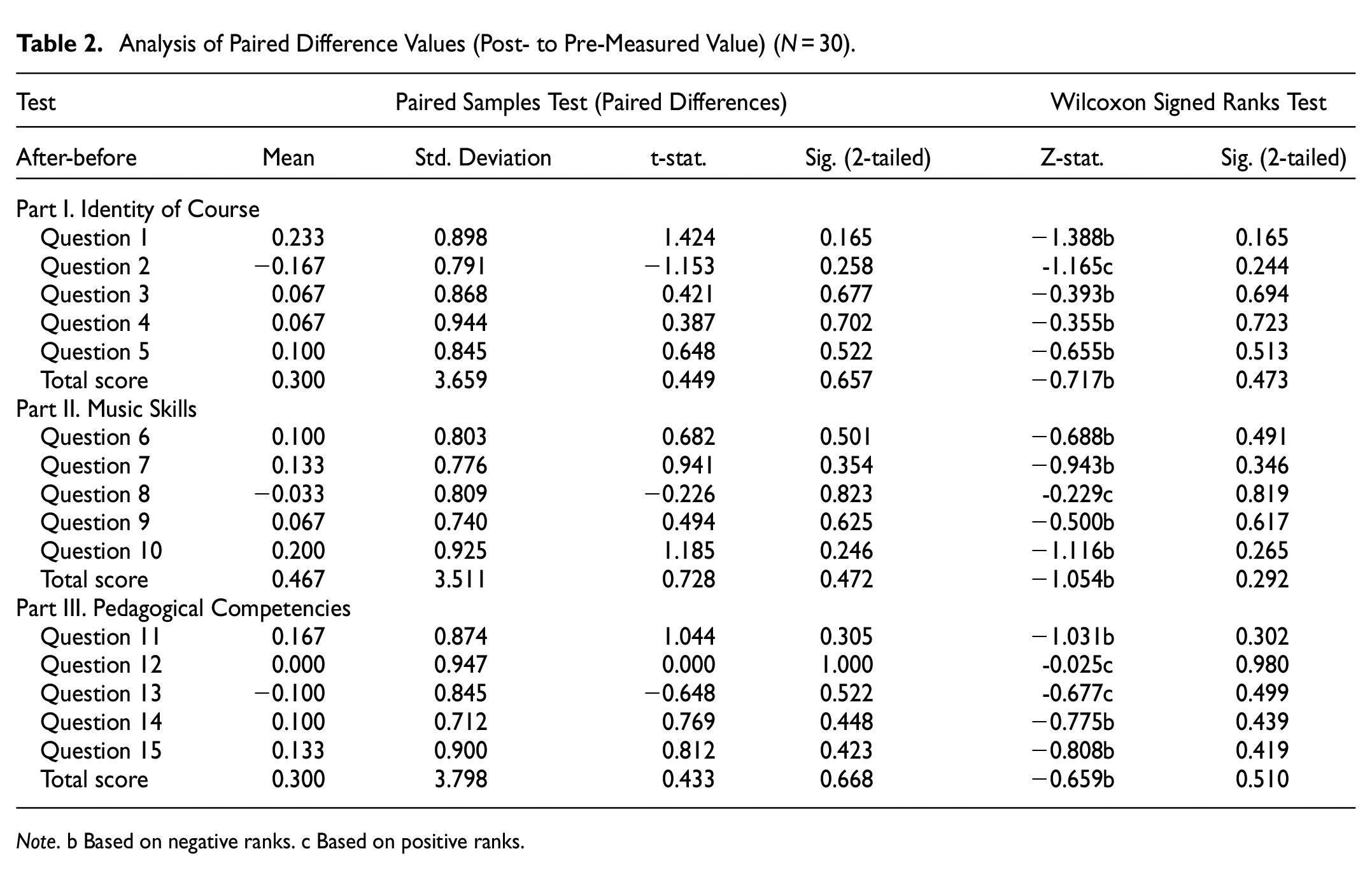
Note. b Based on negative ranks. c Based on positive ranks.
Although in Table 2, no evidence was found that participants experienced positive changes in their perception of HMEAEC after 36 weeks of the training course. In this study, the samples were further grouped and analyzed for the trainees with better assessment results after training. In this study, the sample was further divided into two groups and analyzed for the trainees in the group with better post-training assessment results. This group is examined with a norm-adjusted score higher than the average of the training sample, that is, z-grade = (total grade – learner’s average grade) / standard deviation of the total grade > 0 as the subsample.
Table 3 shows the analysis of the difference between the mean of the post- to pre-measured value for 15 questions, such as recognition of the training course, musical skills, and pedagogical competence for better training performance (N = 17 where z-grade > 0). It can be found that the average paired differences between musical skills and course identity after training are 1.765 and 1.529. At 5% or 10% significant levels, the estimated t-statistic and z-statistic showed substantial results (p-values < .05 or .10) using the Paired Samples Test or Wilcoxon results from Signed Ranks Test. There are four questions on music skills and three questions on curriculum identity, all of which are significantly improved (Paired Differences > 0). Therefore, it was found that after the implementation of the 36-week HMEAYC training course, those who performed better in training experienced cognitive changes due to the training. In particular, there were significant positive changes in the psychological cognition of musical skills and curriculum identity, but there was no evidence to support the difference in the cognition of pedagogical competence. It is, therefore, clear from the results in Table 3 that the lack of evidence in Table 2 can be compensated for and illustrated.
Analysis of Paired Difference Values (Post- to Pre-Measured Value) on the Group of the Better Effect of Course Training (N = 17 Where z-Grade > 0).

Note. b Based on negative ranks. c Based on positive ranks.
Table 4 shows Spearman’s correlation coefficient matrix. Firstly, it was found that the norm-adjusted grades (z-grade) showed a significant positive correlation with changes in curriculum recognition and musical skills, with correlation coefficients of .356 (p-value = .027 < .05) and .343 (p-value = .048 < .05), respectively. This result shows that the cognitive improvement of the participant’s sense of identity and musical skills in the course is significantly related to the training performance. Without losing generality, the pre-measured value negatively correlates with the changed value; the post-measured value is positively correlated with the changed value. Table 4 also confirms the relationship between the pre-measured, post-measured, and change values of curriculum identity, musical skills, and pedagogical competence. In addition, it also demonstrated that the curriculum’s sense of identity, musical skills, and pedagogical competence, these three dimensions of the pre-measured (post-measured value), are significantly positively correlated with each other.
Spearman’s Correlation Coefficient Matrix.
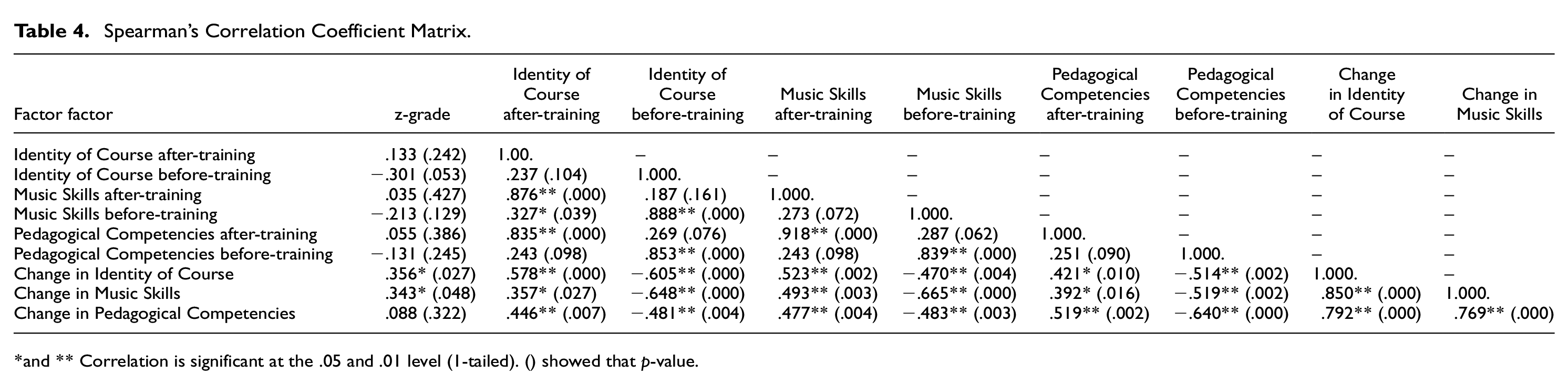
and ** Correlation is significant at the .05 and .01 level (1-tailed). () showed that p-value.
The interrelationships between variables in Table 4 are summarized in Figure 3, excluding the previously established associations. In Figure 3, variables indicated by black rays exhibit a significant positive correlation, while those denoted by red rays display a significant negative correlation. Figure 3 reveals a significant positive correlation between training outcomes (z-grade) and changes in musical skills (curriculum identity), underscoring the importance of variables on changes in music skills and curriculum identity. Specifically, changes in musical skills exhibit positive correlations with post-training course recognition and post-training pedagogical competence. Conversely, it shows negative correlations with pre-training course recognition and pre-training pedagogical competence, suggesting a strong association between changes in musical skills and other variables. Furthermore, changes in curriculum identity demonstrate a positive correlation with post-measurement musical skills and post-measurement pedagogical competence while displaying negative correlations with pre-training musical skills and pre-training pedagogical competence.
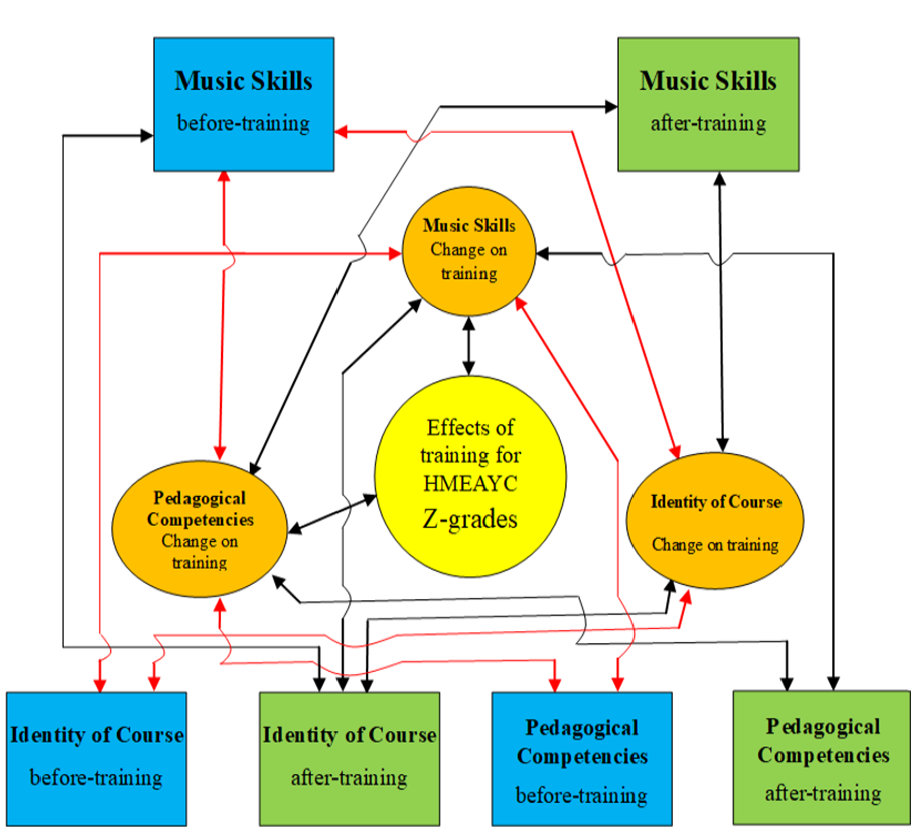
Relationship description diagram.
Conclusions and Suggestions
Conclusions
This study explores the perceptions of trainees participating after training in the Early Childhood Music Education Teacher Development Programme about their sense of the identity of the training course, musical skills, and pedagogical competence. There will be a noticeable change due to the training program’s impact. Through this approach, one can gain insights into the transformations occurring in the participants’ learning and educational psychology within the context of the teacher training course, thereby evaluating the suitability and responsiveness of the course content. After analyzing the data of all participants, it was found that after implementing the 36-week HMEAYC training course, it could not be inferred that the participants would have psychological and cognitive changes due to the implementation of the training course. There is no evidence of significant changes in participants’ psychological perceptions of course identity, musical skills, or pedagogical competence. After further analysis of the students with better post-training assessment results, it was found that there was a significant positive change in the psychological cognition of musical skills and curriculum identity but no change in the cognition of pedagogical competence. Therefore, it is believed that this teacher development course among students with better learning effectiveness will significantly positively impact the musical skills and psychological perception of curriculum identity. It shows evidence of a positive relationship between cognitive psychological changes and learning outcomes for some learners.
This study confirmed that there was a significant positive correlation between participants in terms of pre-training course identity, musical skills, and pedagogical competence. It was found that there was a significant positive correlation between changes in musical skills and curriculum identity and training effectiveness, and the changes in musical skills were highly correlated with other variables. Therefore, the direction of future training course improvement is provided, with a focus on enhancing students’ awareness of musical skills and curriculum identity.
Suggestions
In suggestions, it is advisable to carefully consider the latent disparities among participants (such as those with superior learning outcomes) when implementing future teacher training programs. Neglecting these differences may lead to the failure to identify or undervalue the psychological and cognitive shifts experienced by participants throughout the training course. Such oversight can potentially introduce biases among teaching faculty, evaluators, and researchers when drawing inferences from the evaluation outcomes.
This study underscores the importance of instructors engaged in training to possess the discernment required to recognize variations amongst learners. They should adeptly tailor both content and instructional methodologies and, when warranted, incorporate differentiated pedagogical approaches grounded in the distinctive attributes of individual students. In their role, evaluators are required to exhibit a keen awareness of the potential ramifications stemming from conceivable disparities among participants. This obligation extends to the phases preceding, during, and after the training initiation. Timely and constructive feedback aimed at the on-site instructional cadre and management personnel should be dispensed judiciously, contingent upon their perceptive appraisal of these ramifications.
Lastly, in the realm of statistical analysis and inference, researchers are advised to account for the conceivable heterogeneity prevalent among samples. The disparities observed between distinct groups may engender divergent conclusions during the process of inference.
Footnotes
Appendix: Assessment of the teacher development education curriculum of the HMEAYC
Note: Please fill in the appropriate options one by one according to the 15 questions.
Declaration of Conflicting Interests
The author declared no potential conflicts of interest with respect to the research, authorship, and/or publication of this article.
Funding
The author received no financial support for the research, authorship, and/or publication of this article.