




Abstract
This study comprehensively investigates the factors influencing university choice among Vietnamese high school students in the context of digitalization. By employing structural equation modelling with partial least squares, the research analyzes survey data from 1,049 students to reveal the significant direct and indirect effects of effort expectancy, facilitating conditions, price value, perceived behavioral control, and performance expectancy on university choice decisions. The study extends existing literature by highlighting the moderating role of personal innovativeness, a proxy for digital literacy, in shaping the relationships between various factors and students’ behavioral intentions. The findings underscore the transformative impact of personal innovativeness on higher education decision-making, challenging traditional assumptions and offering new avenues for research and theory development. By integrating insights from consumer behavior theories, the study proposes a comprehensive model that captures the complex interplay of factors influencing university choice in the digital age. The research offers actionable insights for Vietnamese higher education stakeholders to optimize marketing strategies, enhance digital infrastructure, and foster a culture of innovation. Ultimately, this study advances knowledge on university choice decisions and informs evidence-based practices to enhance student engagement and institutional performance in an increasingly digitalized higher education landscape.
Plain language summary
This study explores the factors that influence Vietnamese high school students’ decisions when choosing a university in the digital age. By analyzing survey data from 1,049 students, the research reveals that various factors, such as effort expectancy, facilitating conditions, price value, perceived behavioral control, and performance expectancy, have significant direct and indirect effects on university choice decisions. The study highlights the important role of personal innovativeness, which represents digital literacy, in shaping the relationships between these factors and students’ intentions. The findings challenge traditional assumptions and offer new insights for research and theory development in higher education decision-making. By combining ideas from consumer behavior theories and human capital theory, the study proposes a comprehensive model that captures the complex interactions of factors influencing university choice in the digital age. The research provides practical insights for Vietnamese higher education stakeholders to improve marketing strategies, enhance digital infrastructure, and promote a culture of innovation. Overall, this study contributes to the understanding of university choice decisions and informs evidence-based practices to enhance student engagement and institutional performance in an increasingly digitalized higher education landscape.
Introduction
The decision to pursue higher education and the choice of university are critical milestones in the lives of high school students, shaping their academic and professional trajectories while significantly impacting their personal growth and development (Hemsley-Brown & Oplatka, 2015). In the context of digitalization and the unique challenges developing countries face, understanding the factors that influence students’ university choices becomes increasingly essential for educational institutions, policymakers, and stakeholders in the education sector (Wilkins et al., 2013). The rapid advancement of digital technologies has transformed the landscape of higher education, offering new opportunities and challenges for students, particularly in developing countries (Tran, 2020). The digital divide, characterized by unequal access to technology and digital literacy, can significantly impact students’ university choices and their ability to navigate the complex process of university selection (Pimpa, 2005). Moreover, the increasing globalization of higher education has led to a more competitive and diverse market, further complicating the decision-making process for students (Mazzarol & Soutar, 2002).
In the context of Vietnam, the higher education landscape has undergone significant transformations in recent decades, with the emergence of private universities alongside the public system and an increasing number of collaborative programs with foreign institutions (MoET, 2022). These developments have expanded the options available to high school graduates, making the university decision complex and multifaceted. The COVID-19 pandemic has further reshaped the higher education sector, shifting preferences towards domestic institutions due to cost considerations and perceived improvements in quality (Ngo & Phan, 2022).
Existing research has identified several factors influencing students’ university choices, including institutional reputation, program offerings, location, cost, and family background (Briggs, 2006; Maringe, 2006). However, there is a need for further investigation into how these factors interplay with the unique challenges posed by digitalization and the socio-economic realities of developing countries (Foskett et al., 2008). While previous studies have examined the main effects of various factors on university choice, the inconsistent findings suggest that the relationships between these factors and university choice may be more complex and subject to individual differences. Notably, the role of personal innovativeness as a moderator in the university choice process has received limited attention in the extant literature. Examining personal innovativeness as a moderator can provide a more nuanced understanding of how these factors influence students’ decisions and help explain the heterogeneity in choice patterns. From a theoretical perspective, incorporating personal innovativeness into university choice models can extend and refine existing theories, such as the Theory of Planned Behavior (TPB) (Ajzen, 1991) and the consumer decision-making model (Blackwell et al., 2001), by considering the role of individual differences in the context of digitalization and the unique challenges faced by students in developing countries.
To address these research gaps, this study comprehensively investigates the factors influencing university choice among Vietnamese high school students using structural equation modelling with a partial least squares approach. By analyzing survey data from 1,049 students, the research aims to reveal the significant direct and indirect effects of effort expectancy, facilitating conditions, price value, perceived behavioral control, and performance expectancy on university choice. Moreover, the study seeks to highlight the moderating role of personal innovativeness, underscoring the transformative impact of digital literacy on higher education decision-making in the Vietnamese context. This research contributes to theoretical advancements by proposing an integrated model incorporating consumer behavior and human capital theories while offering practical implications for stakeholders in the Vietnamese higher education sector to enhance student engagement and institutional performance.
Literature Review and Theoretical Framework
Theoretical Foundations of University Choice Behavior
The decision-making process for university choice is a complex phenomenon studied through various theoretical lenses. This section explores the fundamental theories that form the foundation of our understanding of university choice behavior, particularly in the context of an increasingly digitalized higher education landscape. The Unified Theory of Acceptance and Use of Technology 2 (UTAUT2), developed by Venkatesh et al. (2012), provides a comprehensive framework for understanding technology adoption and use. In the context of university choice, UTAUT2 offers insights into how factors such as performance expectancy, effort expectancy, social influence, and facilitating conditions may influence students’ intentions to choose a particular university. The theory’s inclusion of hedonic motivation, price value, and habit as additional constructs make it particularly relevant for studying the role of digital technologies in university choice processes (Khechine & Lakhal, 2018; Wong et al., 2020; Venkatesh et al., 2012).
The Theory of Planned Behavior, proposed by Ajzen (1991), offers another valuable perspective on university choice. TPB posits that attitudes towards the behavior, subjective norms, and perceived behavioral control influence behavioral intentions. In the context of university choice, these constructs can be interpreted as students’ attitudes towards specific universities, the influence of essential others (e.g., parents, peers), and students’ perceptions of their ability to successfully apply to and thrive at a particular institution (Dao & Thorpe, 2015; Hemsley-Brown & Oplatka, 2015; Perna & Titus, 2005). Furthermore, the Theory of Reasoned Action (TRA), a precursor to TPB developed by Fishbein and Ajzen (1975), focuses on the relationship between attitudes, subjective norms, and behavioral intentions. While simpler than TPB, TRA remains relevant in understanding the social and attitudinal factors influencing university choice.
Integrating these theoretical perspectives provides a robust foundation for understanding the multifaceted nature of university choice decisions. By combining insights from technology acceptance models, behavioral theories, and economic frameworks, we can develop a more comprehensive understanding of how students navigate the complex landscape of higher education options in an increasingly digital world (Dao & Thorpe, 2015; Hemsley-Brown & Oplatka, 2015; Wong et al., 2020).
Factors Influencing the Behavior in Higher Education
Building upon the theoretical foundations discussed in the previous section, this part of the literature review explores the key factors influencing university choice decisions. These factors can be categorized into individual, social, institutional, and economic dimensions, reflecting the complex interplay of personal characteristics, social contexts, institutional attributes, and economic considerations in shaping students’ higher education preferences.
Recent applications of UTAUT2 in educational contexts have yielded valuable insights. For instance, Khechine and Lakhal (2018) utilized UTAUT2 to examine technology acceptance in higher education, finding that performance expectancy and facilitating conditions were significant predictors of behavioral intention. Similarly, Wong et al. (2020) applied UTAUT2 to study students’ intentions to seek advice on university choice, highlighting the importance of social influence and perceived credibility in the decision-making process. Additionally, studies by Perna and Titus (2005) and Hemsley-Brown and Oplatka (2015) have successfully applied elements of TRA and TPB to examine the complex interplay of factors influencing students’ higher education decisions. Individual factors play a crucial role in university choice decisions. Attitude towards university, a fundamental construct in both TPB and TRA, has been consistently identified as a significant predictor of students’ intentions to pursue higher education (Dao & Thorpe, 2015; Hemsley-Brown & Oplatka, 2015; Perna & Titus, 2005). Perceived behavioral control, another essential component of TPB, has also been shown to influence university choice. Studies by Perna (2006) and Fernandes et al. (2013) found that students’ confidence in their ability to succeed in higher education was positively associated with their likelihood of applying to more selective institutions. Moreover, social factors, particularly social influence, play a significant role in shaping university choice decisions. Drawing from UTAUT2 and the concept of subjective norms in TPB and TRA, research has consistently shown that the opinions and expectations of family members, peers, and teachers can significantly impact students’ higher education decisions (Dao & Thorpe, 2015; Hemsley-Brown & Oplatka, 2015; Perna & Titus, 2005; Wong et al., 2020). Deriving from UTAUT2, institutional factors, including performance expectancy, effort expectancy, and facilitating conditions, are crucial considerations in students’ university choice processes. Performance expectancy, which relates to students’ beliefs about how a particular university will enhance their academic and career prospects, is a strong predictor of university choice intentions (Jain et al., 2013; Khechine & Lakhal, 2018; Venkatesh et al., 2012; Wong et al., 2020). Effort expectancy, which refers to the perceived ease of studying at a particular institution, has also been identified as an essential factor. This may include considerations such as the perceived difficulty of the academic programs, the availability of support services, and the user-friendliness of the university’s digital platforms (Dao & Thorpe, 2015; Khechine & Lakhal, 2018; Venkatesh et al., 2012). Facilitating conditions, encompassing the perceived support and resources available to students, have gained increased attention in digitalized higher education. This may include factors such as the quality of a university’s IT infrastructure, online learning resources’ availability, and technical support provision (Khechine & Lakhal, 2018; Venkatesh et al., 2012; Wong et al., 2020). Economic factors, particularly price value, are crucial in university choice decisions. Drawing from the price value construct in UTAUT2, research has shown that students carefully consider the costs and potential returns of their educational investment (Fernandes et al., 2013; Jain et al., 2013; Perna, 2006; Venkatesh et al., 2012). The interplay between these factors creates a complex decision-making landscape for prospective university students. Recent research has increasingly focused on how these factors interact and how their relative importance may vary across different contexts and student populations (Dao & Thorpe, 2015; Hemsley-Brown & Oplatka, 2015; Wong et al., 2020).
The literature reveals a multifaceted set of factors influencing university choice decisions: individual characteristics, social influences, institutional attributes, and economic considerations. The growing body of research in this area provides a nuanced understanding of how these factors interact and vary across different contexts. However, there remains a need for more integrated models that can capture the complexity of university choice decisions in the context of rapid technological change and evolving higher education landscapes, particularly in developing countries like Vietnam (Dao & Thorpe, 2015; Hemsley-Brown & Oplatka, 2015; Wong et al., 2020).
Significance of Personal Innovativeness as a Moderating Factor in Higher Education Behavior
The rapid digital transformation of higher education has significantly altered the landscape of university choice, introducing new factors and reshaping traditional decision-making processes. This section explores the impact of digitalization on university choice and the emerging role of personal innovativeness in shaping students’ preferences and behaviors. The digital revolution has permeated every aspect of higher education, from delivering educational content to how universities market themselves to prospective students. Tran (2020) highlights how the COVID-19 pandemic has accelerated this transformation, forcing institutions to adapt to online and hybrid learning models rapidly. This shift has changed the nature of education and the criteria by which students evaluate potential universities. In this digitalized context, universities’ technological infrastructure and online learning capabilities have become increasingly important factors in students’ decision-making. A study by Guo et al. (2013) found that students’ perceptions of a university’s digital readiness significantly influenced their choice intentions, particularly those pursuing technology-intensive programs. Similarly, Cho et al. (2021) observed that the quality of online learning experiences during the pandemic has become a crucial consideration for prospective students.
Personal innovativeness, an individual’s willingness to try new technologies or experiences (Agarwal & Prasad, 1998), has been extensively studied in the context of technology adoption and consumer behavior. Numerous studies have demonstrated the moderating role of personal innovativeness in various domains, such as wearable devices (Jeong & Choi, 2022), solar energy (Vu et al., 2023), omnichannel retailing (Tran Xuan et al., 2023), voice assistants (Molinillo, 2023), Web 3.0 (Albaom et al., 2022), and electric vehicles (Khazaei & Tareq, 2021). These studies collectively highlight the importance of considering individual differences in innovativeness when examining the determinants of behavioral intention. Agarwal and Karahanna (2000) initially explored this concept in the context of technology adoption, but its relevance to educational decision-making has become increasingly apparent. Fagan et al. (2004) found that personal innovativeness was positively associated with computer self-efficacy and usage intentions in higher education settings. Recent research has begun to explore how personal innovativeness moderates the relationship between various factors in behavioral studies. For instance, Lu et al. (2005) demonstrated that individuals with higher levels of personal innovativeness were more likely to be influenced by performance expectancy when adopting new technologies. Jeong and Choi (2022) found that personal innovativeness moderates the adoption and purchase intention of wearable devices, influencing perceived usefulness, perceived ease of use, and perceived enjoyment.
Similarly, Vu et al. (2023) demonstrated that personal innovativeness moderates the relationships between attitudes, subjective norms, perceived behavioral control, and adoption intention in the context of rooftop solar energy adoption. In the banking sector, Tran Xuan et al. (2023) investigated the moderating role of personal innovativeness in omnichannel retailing. Their findings revealed that personal innovativeness moderates the effects of omnichannel properties (integration quality, perceived fluency, and assurance quality) on brand engagement and trust, with customers exhibiting high personal innovativeness showing weaker effects of these properties on engagement and trust. Molinillo (2023) further explored the moderating effects of personal innovativeness and experience on the impact of perceived value on the intention to use voice assistants. Syahreza (2023) studied the adoption of omnichannel retailing by SMEs in Indonesia and found that personal innovativeness moderates the relationships between effort expectations, performance expectations, and the intention to adopt the technology. In the tourism industry, Albaom et al. (2022) demonstrated that personal innovativeness moderates tourists’ intention to use Web 3.0 based on an updated Information Systems Success Model. Moreover, Khazaei and Tareq (2021) investigated the adoption of battery electric vehicles in Malaysia and discovered that personal innovativeness moderates the factors influencing adoption, such as perceived usefulness, perceived ease of use, and perceived risk.
Personal innovativeness may be crucial in shaping students’ preferences and decision-making processes in higher education choices. As the education sector increasingly embraces digital technologies and innovative teaching methods, students with higher levels of personal innovativeness may be more inclined to consider universities that offer cutting-edge programs and advanced technological infrastructure (Jahanshahi & Polas, 2023). Conversely, less innovative individuals may prioritize factors such as tradition, familiarity, or social influence when deciding on a university (Shahsavar & Sudzina, 2017). While the moderating effect of personal innovativeness has been extensively studied in various domains, its application in higher education choice remains relatively unexplored. Existing research on university choice has primarily focused on factors such as academic reputation, location, cost, and social influence (Hemsley-Brown & Oplatka, 2015; Stephenson et al., 2016). However, the increasing digitalization of higher education necessitates a closer examination of the role of personal innovativeness in shaping students’ preferences and decision-making processes. The significance of personal innovativeness in higher education choice is further underscored by the growing importance of digital competence and adaptability in the modern workforce (Falloon, 2020). As employers increasingly seek graduates with strong digital skills and the ability to navigate technological advancements, universities that cater to innovative students may be better positioned to meet the evolving needs of the labor market. Falloon’s (2020) research highlights the critical role of digital competence in preparing students for future careers, emphasizing the need for higher education institutions to foster these skills. This, in turn, may influence the university choice decisions of prospective students prioritizing employability and career prospects.
Furthermore, the COVID-19 pandemic has accelerated the adoption of digital technologies in higher education, with many universities shifting to online or hybrid learning models (Mualla & Mualla, 2024; Robertsone & Lapina, 2022). This rapid transformation has highlighted the importance of individual adaptability and innovativeness in navigating the challenges and opportunities of the digital frontier. As such, understanding the moderating effect of personal innovativeness on higher education choice has become increasingly relevant in the post-pandemic era.
This literature review has synthesized relevant research to explore the moderating effect of personal innovativeness on behavioral intention, both in general contexts and specifically in higher education choices. The findings underscore the importance of considering individual differences in innovativeness when examining the determinants of behavioral outcomes. While the moderating effect of personal innovativeness has been extensively studied in various domains, its application in higher education choice remains relatively unexplored. Given the increasing digitalization of higher education and the growing importance of digital literacy and adaptability in the modern workforce, understanding the role of personal innovativeness in shaping students’ preferences and decision-making processes is crucial for universities seeking to attract and retain innovative students. Future research should empirically investigate the moderating effect of personal innovativeness on the relationships between various determinants and behavioral intentions in the context of higher education choice, contributing to a more comprehensive understanding of the factors influencing students’ preferences and behaviors in the digital age.
Extrapolating this to the context of university choice, it suggests that more innovative students may place greater emphasis on a university’s technological offerings and digital learning opportunities. Furthermore, the role of social media and online platforms in university choice processes has become increasingly significant. Rutter et al. (2016) found that universities’ social media interactions significantly impacted their brand image and student recruitment performance. This highlights the growing importance of digital marketing strategies in attracting prospective students. However, the digital transformation of higher education also presents challenges. The digital divide, characterized by unequal access to technology and varying levels of digital literacy, can significantly impact students’ ability to navigate the increasingly digital landscape of university choice. Pimpa (2005) noted that this disparity is particularly pronounced in developing countries, potentially exacerbating existing inequalities in access to higher education.
Research Model Development
Building upon the theoretical foundations and empirical findings discussed in the previous sections, this part of the literature review presents the conceptual framework for the current study and develops the research hypotheses. The proposed conceptual model integrates elements from UTAUT2, TPB, and TRA while incorporating the moderating role of personal innovativeness. This integrated approach addresses the need for a more comprehensive model of university choice that accounts for the complexities of decision-making in the digital age, particularly in the context of developing countries like Vietnam. In detail, attitude towards the university is expected to impact students’ behavioral intention for higher education choice positively. This indication is grounded in TPB and TRA, supported by studies such as Perna and Titus (2005) and Hemsley-Brown and Oplatka (2015), consistently showing the importance of attitudes in shaping educational decisions. Social influence is believed to impact students’ behavioral intentions positively. Drawing from UTAUT2 and subjective norms in TPB and TRA, this statement is supported by research highlighting the role of family, peers, and societal expectations in university choice (Dao & Thorpe, 2015; Wong et al., 2020). Based on TPB, perceived behavioral control is expected to positively impact students’ behavioral intention (Fernandes et al., 2013; Perna, 2006), demonstrating the importance of students’ perceived ability to succeed in higher education. Regarding the economic perspective, price value positively influences students’ behavioral intention to choose a university, reflecting the economic considerations in university choice, as supported by Jain et al. (2013) and Venkatesh et al. (2012). Additionally, performance expectancy, effort expectancy, and facilitating conditions also positively impact students’ behavioral intention, consistent with the UTAUT2 model and findings from studies in technology adoption and education (Khechine & Lakhal, 2018; Wong et al., 2020).
Moreover, students’ behavioral intention positively affects their university choice decision, aligning with the TPB and the TRA, as evidenced by Hemsley-Brown and Oplatka (2015). This finding is further supported by Ajzen (1991), who posits that behavioral intention strongly predicts actual behavior, such as making a choice or decision. In the context of higher education, this suggests that students’ intentions to choose a particular university are likely to translate into their actual choice of that institution. Several other studies have also confirmed the impact of students’ behavioral intentions on their university choice decisions. For instance, Manoku (2015) found that students’ intention to choose a university is influenced by factors such as perceived quality, reputation, and social influence, leading to their actual choice of the institution. Similarly, Dao and Thorpe (2015) demonstrated that students’ behavioral intention, shaped by their attitudes, subjective norms, and perceived behavioral control, significantly predicts their university choice decision. Furthermore, a meta-analysis conducted by Imenda et al. (2004) revealed that behavioral intention is a consistent and robust predictor of students’ actual university choice across various contexts and student populations.
Personal innovativeness moderates the relationships between the factors mentioned earlier and behavioral intention. These hypotheses extend the existing literature by proposing that personal innovativeness plays a crucial moderating role in university choice decisions, particularly in digitalized higher education. This is based on research suggesting the importance of personal innovativeness in technology adoption (Lu et al., 2005) and its potential relevance to educational decision-making in the digital age. The moderating effect of personal innovativeness on the relationship between attitude and behavioral intention has been demonstrated in various contexts. For instance, Agarwal and Prasad (1998) found that individuals with higher levels of personal innovativeness are more likely to form positive attitudes towards new technologies, influencing their intentions to adopt them.
Similarly, in the context of mobile banking adoption, Thakur and Srivastava (2014) showed that personal innovativeness strengthens the relationship between attitude and intention to use mobile banking services. Regarding social influence, Zarmpou et al. (2012) found that personal innovativeness moderates the effect of social influence on the intention to adopt mobile services. Individuals with higher levels of personal innovativeness are less susceptible to social influence when forming their intentions to adopt new technologies. This finding suggests that innovative students may be less influenced by the opinions of others when making their university choice decisions. Personal innovativeness also moderates the relationship between perceived behavioral control and behavioral intention. In a study on the adoption of e-learning systems, Lee et al. (2011) demonstrated that the effect of perceived behavioral control on intention to use e-learning is more substantial for individuals with higher levels of personal innovativeness. This suggests innovative students may be more confident in navigating the challenges of choosing a university in the digital age.
Furthermore, the moderating effect of personal innovativeness on the relationship between price value and behavioral intention has been observed in online shopping. Liu et al. (2017) found that the effect of perceived value on purchase intentions in online environments is more substantial for individuals with higher levels of personal innovativeness. This implies that innovative students may be more willing to invest in universities that offer valuable digital resources and experiences, even if they come at a higher cost. The moderating role of personal innovativeness in the relationships between performance expectancy, effort expectancy, facilitating conditions, and behavioral intention has also been established in the literature. In a study on the adoption of mobile learning, Abu-Al-Aish and Love (2013) found that personal innovativeness strengthens the effects of performance expectancy and effort expectancy on intention to use mobile learning. Similarly, Joo et al. (2014) demonstrated that personal innovativeness enhances the relationship between facilitating conditions and the intention to use e-learning systems. These findings suggest that innovative students may be more responsive to digitally advanced universities’ expected benefits, ease of use, and support when forming their intentions to choose an institution.
From the discussion above, Figure 1 presents the conceptual model, illustrating the relationships between the various factors influencing university choice intentions and decisions.

Research model.
Research Methodology
This study employs a quantitative research design to investigate the factors influencing university choice among Vietnamese students. The following sections detail the research methodology, including sampling strategy, instrument development, data collection procedures, and analytical approach.
Research Design
A cross-sectional survey design was adopted, utilizing structural equation modelling (SEM) with partial least squares (PLS) for data analysis. This approach was chosen due to its ability to handle complex models with multiple latent variables and its suitability for exploratory research in the context of university choice decisions (Hair et al., 2017). The survey study followed the ethical standards and guidelines the Committee of Scientific and Training of the National Economics University (NEU), Vietnam set forth. The research proposal was reviewed to ensure that the study adhered to ethical research practices, including protecting participants’ rights, privacy, and confidentiality. All participants provided informed consent before participating in the study.
Regarding the estimation approach, PLS-SEM is particularly appropriate for this study as it allows for the simultaneous examination of the relationships among the latent constructs and the testing of the proposed hypotheses.
Sampling Strategy
The target population for this study comprises Vietnamese high school students who are in the process of making university choice decisions. To ensure robust representation and minimize sampling bias, a stratified random sampling technique was employed. The sample was stratified based on geographic regions, including North, Central, and South Vietnam, to account for potential regional variations in university choice preferences. Within each stratum, participants were randomly selected from a comprehensive list of high schools obtained from the Vietnamese Ministry of Education and Training, with proportional allocation ensuring balanced representation across regions.
The sample size determination followed rigorous statistical considerations based on structural equation modelling requirements. Following Hair et al.’s (2017) recommendations, which suggest a minimum sample size of 10 times the largest number of structural paths directed at a particular construct, we initially targeted 1,200 students. This target size was deliberately set above the minimum threshold to ensure adequate statistical power and account for potential non-responses or invalid data. While the initial target was 1,200 students, the final analyzed sample comprised 1,049 students after accounting for response rates and data cleaning procedures. This sample size was achieved through the stratified random sampling process across the three regions, with an effective response rate of 87.4%. The final sample size of 1,049 substantially exceeded the minimum required threshold for structural equation modeling analysis, ensuring robust statistical power for detecting significant relationships and testing the proposed theoretical framework.
This sampling approach not only satisfied statistical requirements but also ensured comprehensive geographic coverage and representativeness of the target population, thereby enhancing the generalizability of findings across different socio-demographic contexts within Vietnam’s educational landscape.
Instrument Development and Data Collection
The survey instrument was developed based on a comprehensive literature review on university choice factors and adapted to the Vietnamese context. The questionnaire consisted of items measuring the constructs of the proposed research model, including performance expectancy, effort expectancy, social influence, facilitating conditions, price value, attitude towards the university, perceived behavioral control, personal innovativeness, and university choice decision. All items were measured using a 5-point Likert scale, ranging from strongly disagree (1) to strongly agree (5).
The instrument was initially developed in English and then translated into Vietnamese using a forward-backwards translation approach to ensure semantic equivalence. The translated instrument was pilot-tested with 50 Vietnamese high school students to assess its clarity, comprehensibility, and reliability. A pilot test was then conducted to assess the validity and reliability of the measurement model, which consisted of 51 items. The validity of the measurement model was established through content, convergent, and discriminant validity. Content validity was ensured through a thorough literature review and expert opinions. Convergent validity was assessed using average variance extracted (AVE) values, which were all above the recommended threshold of 0.5, ranging from 0.597 to 0.823, indicating good convergent validity. Discriminant validity was evaluated using the Fornell–Larcker criterion and cross-loadings, and all constructs demonstrated satisfactory discriminant validity. The reliability of the measurement model was assessed using internal consistency reliability and indicator reliability. Cronbach’s alpha values ranged from .753 to .917, and composite reliability (CR) values ranged from 0.832 to 0.944, exceeding the recommended threshold of 0.7, indicating good internal consistency reliability. Item loadings were examined to ensure that each item loaded significantly on its respective construct, and all item loadings were above the recommended value of 0.7, ranging from 0.714 to 0.908, demonstrating good indicator reliability. Based on the pilot test results, the measurement model, consisting of 51 items, demonstrated satisfactory validity and reliability, providing confidence that the measurement model was appropriate for use in the main study.
Official data collection was then conducted through an online survey administered via Qualtrics, a web-based survey platform. The survey link was distributed to the randomly selected high schools, and school administrators were requested to forward the link to their students. The survey was open for 4 weeks, with reminder emails sent to school administrators at the end of the second and third weeks to encourage participation.
Analytical Approach
Data analysis was conducted using SmartPLS 4.1 software. The analysis followed a two-step approach, beginning with assessing the measurement model to evaluate the reliability and validity of the constructs, followed by the evaluation of the structural model to test the hypothesized relationships.
The measurement model was assessed using composite reliability, convergent validity, and discriminant validity. Composite reliability was evaluated using Cronbach’s alpha and CR scores, with values above 0.7 considered acceptable (Hair et al., 2017). Convergent validity was assessed by examining each construct’s AVE, with values above 0.5 indicating adequate convergence. Discriminant validity was evaluated using the Fornell-Larcker criterion and the heterotrait-monotrait (HTMT) ratio, with values below 0.9 confirming the distinctiveness of the constructs (Henseler et al., 2015).
The structural model was assessed by examining the endogenous variables’ path coefficients, significance levels, and coefficient of determination (R2). The significance of the path coefficients was determined using a bootstrapping procedure with 5,000 resamples (Hair et al., 2017). The moderating effect of personal innovativeness was tested by creating interaction terms and evaluating their significance and effect sizes. To address potential standard method bias, we employed Harman’s single-factor test and the marker variable technique (Podsakoff et al., 2003). Additionally, we conducted a full collinearity assessment to check for multicollinearity issues (Kock & Lynn, 2012).
By employing this rigorous methodology, we aim to provide robust and reliable insights into the factors influencing university choice among Vietnamese high school students, contributing to theoretical understanding and practical implications for higher education institutions and policymakers in Vietnam and similar contexts.
Research Results
Assessment of Measurement Scale’s Validity (Outer Model)
The descriptive statistics in Table 1 provide an overview of the variables used in the study. The mean values for all variables range from 3.48 to 4.02 on a 5-point Likert scale, indicating relatively positive perceptions and attitudes among the respondents. Performance Expectancy (PE) has the highest mean value (4.02), suggesting that respondents have high expectations regarding the university’s performance and outcomes. The standard deviations for the variables range from 0.79 to 1.11, indicating a moderate level of dispersion in the responses. Personal Innovativeness (PI) has the highest standard deviation (1.11), suggesting a more comprehensive range of individual willingness to try new technologies among the respondents. The mean Behavioral Intention (BI) value The final choice to attend the university (UD) has a mean value of 3.78, which is slightly lower than BI but still suggests a favorable decision towards attending the university.
Descriptive Statistics of the Variables.

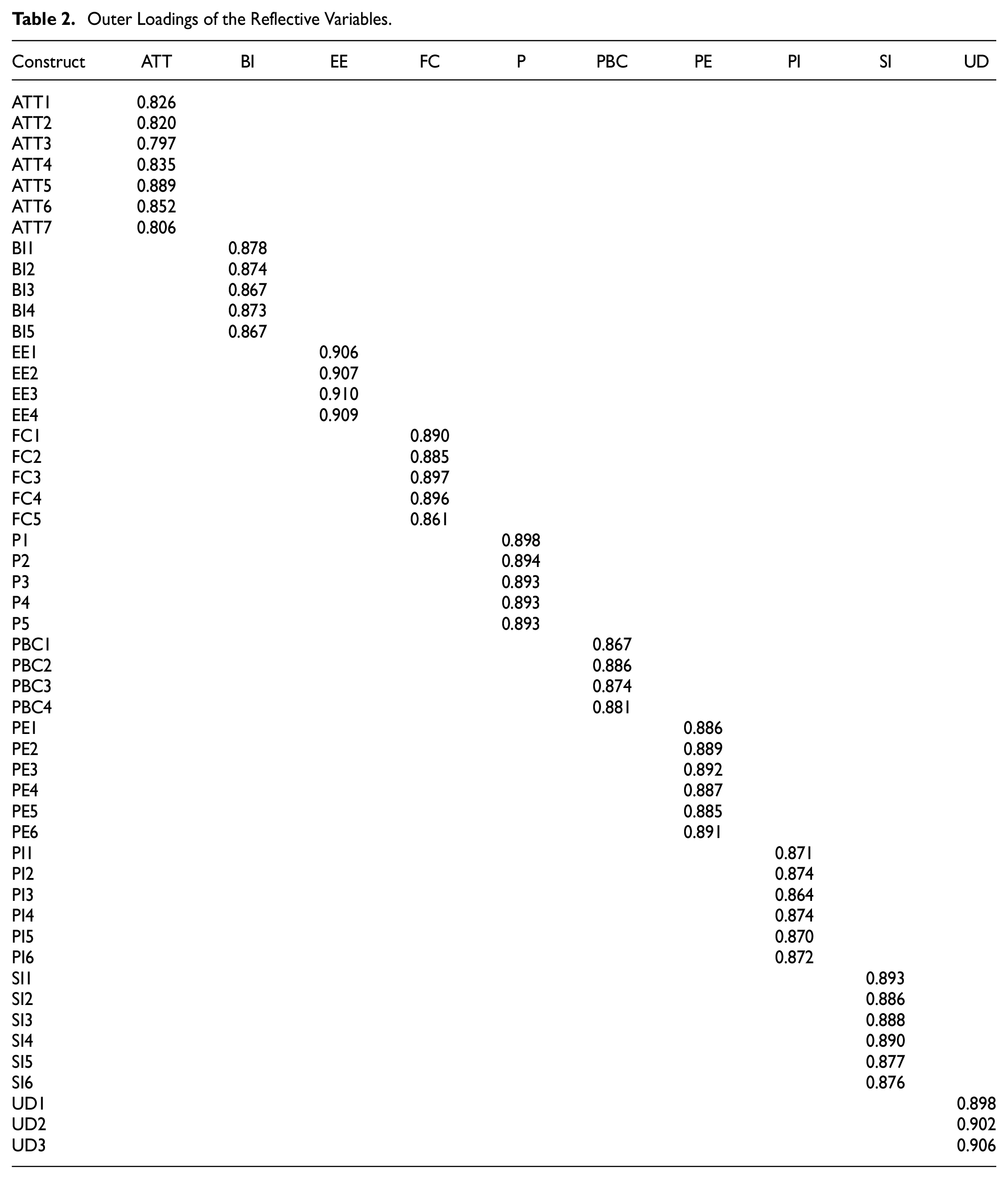
The structural equation model in this study is initially assessed for its validity using outer loadings of the reflective constructs, Cronbach’s alpha, composite reliability, convergent, and discriminant validity. According to Hair et al. (2017), the reflective variables with their observed variables are qualified with the outer loadings higher than 0.7. As can be seen from Table 2, all 51 observable variables in this study have their outer loadings at the accepted level.
Outer Loadings of the Reflective Variables.
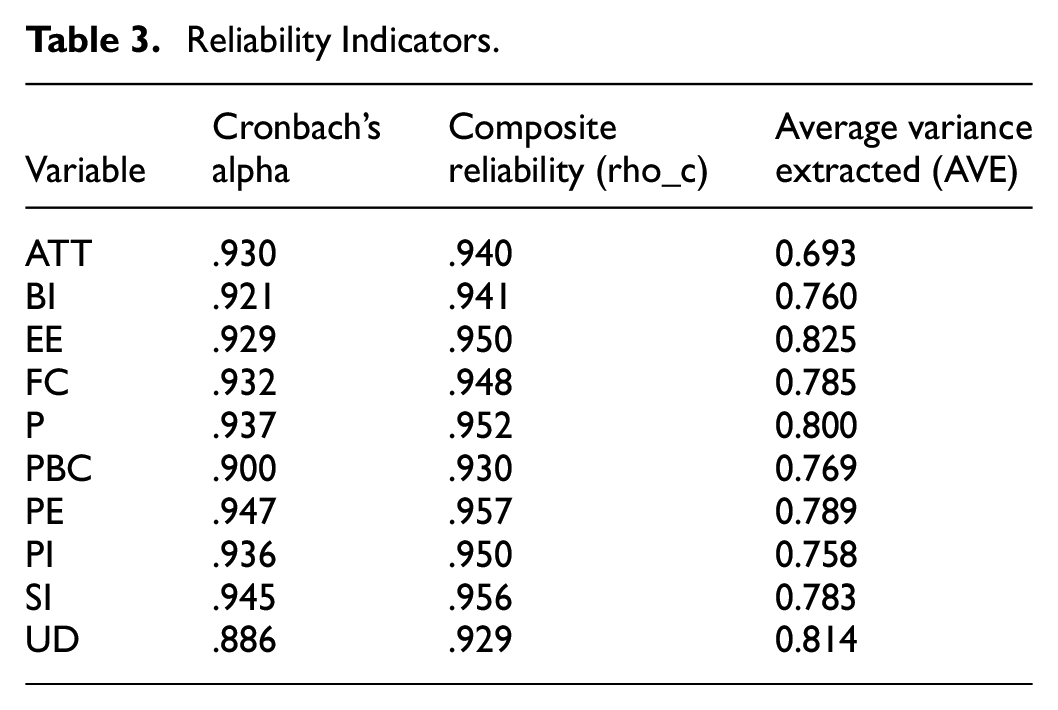
Regarding the model’s reliability, Hair et al. (2017) proposed focusing on two indices: Cronbach’s alpha and Composite reliability rho_c since Cronbach’s alpha is the traditional indicator to measure the reliability of the observed variables, which is suggested to be used in combination with the composite reliability rho_c to ensure the appropriateness of the outcomes. As stated by Hair et al. (2017) and Nunnally and Bernstein (1994), the results presented in Table 3 show that the proposed research model is highly reliable with reliability indicators of at least 0.886 (UD). Since the results suggest that no observed variable should be eliminated from the proposed model, the convergent validity test using average variance extracted (AVE) in Table 3 indicates that all 10 latent variables in this study are accepted. Hock and Ringle (2010) believe a scale has convergent validity if the AVE is 0.5 or higher. This level of 0.5 (50%) means that the average latent variable will explain at least 50% of the variation of each observed variable.
Reliability Indicators.
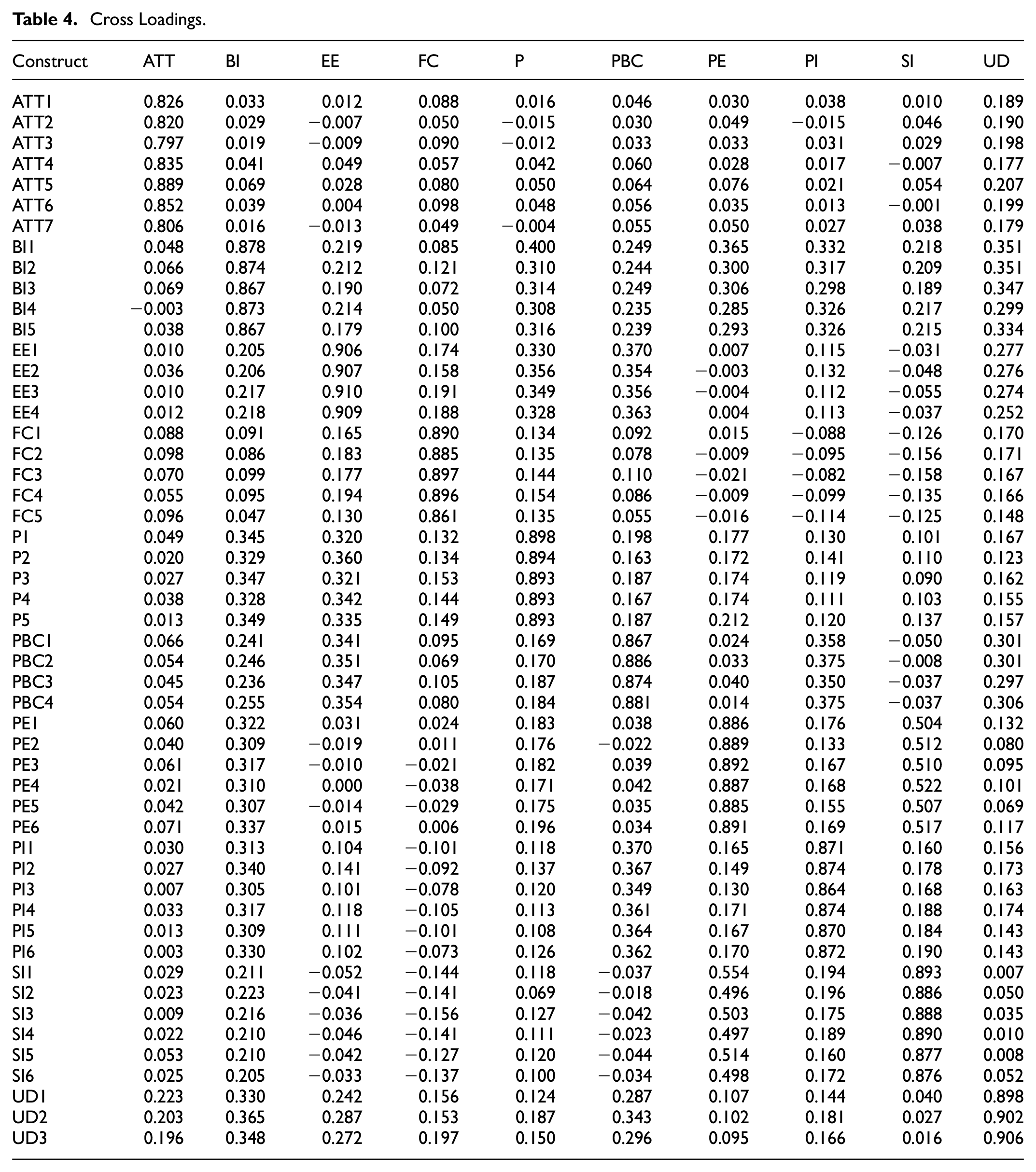
Considering the discriminant validity of the model, Hair et al. (2017) say that the outer loading of any observed variable in one reflective construct must be greater than the entire cross-loading of that observed variable with other constructs in the model. Additionally, Henseler et al. (2015) proposed to evaluate the discrimination of the scale using the heterotrait-monotrait ratio (HTMT) index. The basis for evaluating discrimination using HTMT is based on the idea that the greater the average correlation coefficient within a scale than the average of cross-correlation coefficients, the better. When the average correlation coefficient within a scale is higher, the latent variable shares more significant variation. If the average of the cross-correlation coefficients is low, the latent variable above shares less variation with other latent variables. Then, the indicators in the two latent variables will achieve discrimination. Henseler et al. (2015) said that if the HTMT index of a pair of factors is more significant than 0.9, the discrimination validity of the factor is violated. If the HTMT index is below 0.85, good discrimination is guaranteed.
Using cross-loading results in Table 4 and HTMT results in Table 5, it can be concluded that this proposed research model meets the discriminant validity of the study.
Cross Loadings.
Heterotrait-Monotrait Ratio Index.

Assessment and Estimation of the Structural Equation Model (Inner Model)
When conducting SEM, it is crucial to assess the presence of multicollinearity among the predictor variables. Multicollinearity occurs when there is a high correlation between two or more predictor variables, leading to unstable and unreliable estimates of the model parameters (Hair et al., 2010). One standard method for assessing multicollinearity in SEM is the variance inflation factor (VIF) (Kock, 2015). The VIF measures the degree to which the variance of an estimated regression coefficient is increased due to multicollinearity (Hair et al., 2010). A higher VIF value indicates a higher degree of multicollinearity, with values greater than 5 or 10 often considered problematic (Hair et al., 2010; Kock, 2015). The result in Table 6 indicates that the research model lacks multicollinearity phenomena.
Multicollinearity of Inner Model.

Figure 2 presents the estimation results for the proposed SEM by adopting the partial least square (PLS) approach and bootstrapping method. Researchers traditionally rely on maximum likelihood (ML) estimation in estimating SEM models, which assumes that the data follow a multivariate normal distribution (Hair et al., 2010). However, data often violate this assumption in practice, leading to biased parameter estimates and incorrect standard errors (Byrne, 2010). To address this issue, researchers have increasingly turned to the bootstrapping approach for model estimation (Preacher & Hayes, 2008). Bootstrapping is a non-parametric resampling technique that involves repeatedly sampling from the original dataset with replacement to create many bootstrap samples (Efron & Tibshirani, 1993). Each bootstrap sample is then used to estimate the model parameters and the distribution of these estimates across the bootstrap samples is used to construct confidence intervals and test the significance of the model parameters (Preacher & Hayes, 2008).

PLS-SEM result.
The bootstrapping approach offers several advantages over traditional ML estimation. First, it does not require the assumption of multivariate normality, making it more robust to violations of this assumption (Byrne, 2010). Second, it provides more accurate estimates of standard errors and confidence intervals, particularly for complex models with small sample sizes (Preacher & Hayes, 2008). Finally, it allows for the testing of indirect effects, particularly useful when examining mediation and moderation relationships in SEM (Shrout & Bolger, 2002). The study aims to provide more accurate and reliable results, contributing to the growing body of literature on university choice and informing the development of effective strategies for attracting and retaining students in higher education institutions.
The direct impact of independent variables summarized in Table 7 shows that Effort Expectancy (EE), Price value (P), Perceived Behavioral Control (PBC), Facilitating Conditions (FC), and PE have significant positive direct impacts on BI, with Price value having the most potent effect (strong impact of 0.246, 1% significant) and Effort Expectancy having the weakest (minor impact of 0.073, 5% significant). However, Attitude Towards University (ATT) and Social Influence (SI) do not directly impact Behavioral Intention since they witnessed p-values of .552 and .136, respectively. Furthermore, the results demonstrate that Behavioral Intention has a strong, highly significant positive direct impact on University choice Decisions (UD), suggesting that individuals’ intentions to engage in a particular behavior are strongly linked to their actual behavior. These findings provide valuable information for understanding the complex relationships between various factors and their influence on individuals’ intentions and behaviors.
Summary of Direct Impact Estimates.

and **, and * at coefficient estimates denote significantly different from zero at the 1%, and 5% levels, respectively.
The results of the indirect impact analysis conducted using Partial Least Squares Structural Equation Modeling (PLS-SEM) are presented in Table 8, which shows the indirect relationships between various factors and UD mediated by BI. The findings suggest that EE, FC, P, PBC, and PE have significant positive indirect impacts on UD through BI, with p having the most substantial influence (original sample estimate of 0.095, t-statistic of 7.99, and p-value of 0), followed by PE (original sample estimate of 0.089, t-statistic of 6.444, and p-value of 0). FC, PBC, and EE also have significant positive indirect impacts on UD through BI, with original sample estimates ranging from 0.028 to 0.036 and p-values below the conventional significance threshold of .05. On the other hand, ATT and SI do not have significant indirect impacts on UD through BI, as their p-values are .552 and .139, respectively, which violate the 5% significance level. These findings provide valuable insights into the complex relationships between various factors and their indirect influence on individuals’ actual behavior through their intentions, highlighting the importance of P, PE, FC, PBC, and EE in shaping individuals’ intentions and, consequently, their behavior.
Summary of Indirect Impact Estimates.

and ** at coefficient estimates denote significantly different from zero at the 1% and 5% levels, respectively.
The results of the moderating impact analysis conducted using Partial Least Squares Structural Equation Modeling (PLS-SEM) are presented in Table 9, which shows the moderating effects of PI on the relationships between various factors and BI. The findings suggest that PI significantly moderates the impact of several factors on BI. Specifically, PI positively moderates the effect of ATT on BI (original estimate of 0.164, t-statistic of 3.946, and p-value of 0) and the effect of EE on BI (original estimate of 0.128, t-statistic of 3.873, and p-value of 0). This indicates that the positive influence of Attitude and Effort Expectancy on Behavioral Intention is more vital for individuals with higher levels of Personal Innovativeness. On the other hand, PI negatively moderates the effect of PBC on BI (original estimate of −0.074, t-statistic of 2.881, and p-value of .004) and the effect of FC on BI (original estimate of −0.095, t-statistic of 3.056, and p-value of .002). This suggests that the positive influence of Perceived Behavioral Control and Facilitating Conditions on Behavioral Intention is weaker for individuals with higher levels of Personal Innovativeness.
Summary of Moderating Impact Estimates.

at coefficient estimates denote significantly different from zero at the 1% level.
The moderating effects of PI on the relationships between PE, P and SI with BI are not significant, as their p-values violate the 5% significance level. These findings provide valuable insights into the role of Personal Innovativeness in shaping the relationships between various factors and Behavioral Intention, highlighting its importance as a moderator in the context of technological innovation and adoption.
Discussion of the Results
This study comprehensively explains the factors influencing university choice decisions among Vietnamese high school students. By employing a rigorous quantitative approach using structural equation modelling with partial least squares, the research reveals the significant direct and indirect effects of effort expectancy, facilitating conditions, price value, perceived behavioral control, and performance expectancy on students’ university choice decisions. These findings align with the existing literature, confirming the importance of institutional factors (Briggs, 2006; Hoyt & Brown, 2003) and individual characteristics (Chapman, 1981) in shaping students’ decision-making processes. However, the study did not find significant evidence to support the influence of social factors on university choice, as suggested by some previous studies (Perna & Titus, 2005).
The empirical results of this study offer valuable insights into factors influencing students’ university choice decisions in the digital age. Our findings emphasize the significance of performance expectancy, price value, facilitating conditions, perceived behavioral control, and effort expectancy in shaping students’ behavioral intentions, subsequently influencing their university choice. Interestingly, our study reveals non-significant effects of attitude and social influence on behavioral intention, contradicting some earlier research (Gaspar et al., 2021). This discrepancy may be attributed to the evolving nature of decision-making in the digital era, where students have unprecedented access to information and rely less on traditional influencers like family and friends.
The significant indirect effects of performance expectancy, price value, facilitating conditions, perceived behavioral control, and effort expectancy on university choice decisions through behavioral intention are in line with the propositions of the TPB (Ajzen, 1991) and the Consumer Decision Model (Engel et al., 1995). These findings underscore the mediating role of behavioral intention in the relationship between various antecedents and the final choice decision, as suggested by these theoretical frameworks.
The moderating effect of personal innovativeness on the relationships between perceived behavioral control, facilitating conditions, attitude, and effort expectancy on behavioral intention adds a new dimension to understanding university choice decisions. The negative moderating effect of personal innovativeness on the relationships between perceived behavioral control and facilitating conditions on behavioral intention is somewhat surprising, as it contradicts the traditional notion that innovative individuals rely more on their abilities and external support when forming intentions. However, this finding aligns with recent research by Sánchez-Prieto et al. (2019), who found that highly innovative individuals may exhibit more complex patterns of technology adoption. This may be explained by the fact that highly innovative students are more confident in their decision-making abilities and are less influenced by external factors when forming their intentions to choose a university. On the other hand, the positive moderating effect of personal innovativeness on the relationships between attitude and effort expectancy on behavioral intention is consistent with the idea that innovative individuals are more likely to form positive attitudes towards new technologies and perceive them as more straightforward to use (Agarwal & Prasad, 1998). This finding suggests that universities should focus on creating positive attitudes and perceptions of ease of use among innovative students to increase their behavioral intentions and, ultimately, their likelihood of choosing the institution. The non-significant moderating effect of personal innovativeness on the relationships between performance expectancy, price value, and social influence on behavioral intention may indicate that these factors are equally important for students with varying levels of innovativeness. This finding aligns with the notion that performance expectancy and price value are universal determinants of technology adoption and decision-making (Venkatesh et al., 2012).
Conclusion
This study aimed to investigate the factors influencing students’ university choice decisions in the digital age by proposing a comprehensive research model that integrates the TPB, Consumer Decision Model, and Human Capital Theory. The model examined the direct effects of ATT, SI, PBC, P, PE, EE, and FC on BI, which in turn influences the UD. The moderating role of PI on the relationships between the factors mentioned above and BI was explored. The empirical results revealed that PE, P, FC, PBC, and EE had significant direct effects on BI, while ATT and SI did not. Furthermore, BI was found to have a significant impact on UD. The indirect effects of PE, P, FC, PBC, and EE on UD through BI were also significant, highlighting the mediating role of BI in the university choice decision-making process. The moderating effect of PI was significant for the relationships between PBC, FC, ATT, and EE on BI. Surprisingly, PI negatively moderated the effects of PBC and FC on BI, suggesting that highly innovative individuals may rely less on perceived behavioral control and facilitating conditions when forming their intentions. In contrast, PI positively moderated the effects of ATT and EE on BI, indicating that innovative students’ attitudes and perceptions of effort expectancy play a more crucial role in shaping their intentions.
Theoretically, the study proposes and empirically tests a comprehensive model that integrates insights from consumer behavior theories (Ajzen, 1991; Fishbein & Ajzen, 1975; Venkatesh et al., 2012). By examining the interplay of a wide range of factors and considering the moderating role of personal innovativeness, the research addresses the limitations of previous studies and provides a nuanced understanding of the decision-making process in the Vietnamese context. The study contributes to the growing body of knowledge on the role of digital literacy and individual differences in shaping students’ perceptions, preferences, and choices, extending the theoretical discourse on higher education decision-making.
The results have important policy implications for higher education institutions. Universities should focus on enhancing their performance expectancy and price value and facilitating conditions to attract students. They should also consider the varying effects of personal innovativeness on students’ decision-making processes and tailor their marketing strategies accordingly. For example, institutions may emphasize the ease of use and accessibility of their digital platforms to appeal to highly innovative students.
The current study has several limitations that should be acknowledged and addressed in future research. From a methodological perspective, future research should replicate the study in different contexts and with diverse samples to enhance the external validity of the findings. Moreover, while the current study used partial least squares structural equation modelling (PLS-SEM) to estimate the research model, future studies could employ alternative estimation approaches, such as covariance-based structural equation modelling (CB-SEM) or Bayesian estimation, to validate the robustness of the findings. From a theoretical perspective, future research could explore several avenues to extend and refine the current study’s findings. First, while the study incorporated several vital factors influencing university choice decisions, future research could investigate the role of additional variables, such as university reputation, campus infrastructure, and career prospects, to provide a more comprehensive understanding of the decision-making process. Second, the current study examined the moderating role of personal innovativeness. However, future research could explore the moderating effects of other individual characteristics, such as risk aversion, cultural background, or socio-economic status, to uncover potential boundary conditions of the proposed relationships. Third, while the current study focused on the mediating role of behavioral intention, future research could investigate other potential mediating mechanisms, such as perceived value or trust, to provide a more nuanced understanding of the underlying processes. Moreover, comparative studies could examine the relative importance of factors influencing university choice decisions across various student segments, such as domestic versus international students, undergraduate versus graduate students, or students from different disciplines. Qualitative studies, such as in-depth interviews or focus groups, could also be employed to gain deeper insights into students’ decision-making processes and the factors that shape their choices.
Footnotes
Acknowledgements
The authors would like to express their gratitude to the National Economics University for providing financial support for this research. We also thank the high school administrators who facilitated the distribution of our survey, and all the students who participated in this study. Special appreciation goes to our colleagues in the Business School and Faculty of Planning and Development for their valuable feedback and suggestions throughout the research process.
Author Note
Quoc Dung Ngo is the primary point of contact for correspondence at all stages of refereeing, publication, and any subsequent queries post-publication.
