




Abstract
Emotional experiences significantly affect students’ health, learning outcomes, productivity, and social interactions. Therefore, investigating learners’ emotional experiences in typical technology-related scenarios during the information age is crucial and meaningful. Utilizing assessment to bridge online and offline activities serves as a critical element in ensuring the success of blended learning and has become a widespread practice. This practice often elicits unique and intense emotional responses from learners. Yet, there is a paucity of research examining these emotional experiences. The present study aims to fill this gap by establishing a typical blended learning context (two periods of online learning alternating with two periods of face-to-face instruction) in a Chinese university and investigating the emotional experiences within the connecting assessment context through the administration of questionnaires and interviews. Analysis of the data reveals that during the process of connecting assessment, learners tend to exhibit more pronounced negative emotions as compared to other educational situations. Specifically, feelings of relief, anxiety, and pride emerged as having the highest mean values. Moreover, there is a remarkable difference in emotional experiences across different levels of academic achievement. Participants also identified several contributing factors to their emotional responses, such as the level of preparedness, the sense of accomplishment, the motivational function of assessment, and constraints on time. This study underscores the intricate nature of emotions within academic contexts and posits that certain established definitions of emotions may be contingent upon specific contextual factors.
Plain language summary
Utilizing assessment to bridge online and offline activities serves as a critical element in ensuring the success of blended learning and has become a widespread practice. This practice often elicits unique and intense emotional responses from learners. Yet, there is a paucity of research examining these emotional experiences. The present study aims to fill this gap by establishing a prototypical blended learning context in a Chinese university and investigating the emotional experiences within the connecting assessment context through the administration of questionnaires and interviews. Analysis of the data reveals that during the process of connecting assessment, learners tend to exhibit more pronounced negative emotions as compared to other educational situations. Specifically, feelings of relief, anxiety, and pride emerged as having the highest mean values. Moreover, there is a remarkable difference in emotional experiences across different levels of academic achievement. Participants also identified several contributing factors to their emotional responses, such as the level of preparedness, the sense of accomplishment, the motivational function of assessment, and constraints on time. This study underscores the intricate nature of emotions within academic contexts and posits that certain established definitions of emotions may be contingent upon specific contextual factors.
Introduction
The COVID-19 pandemic has triggered a significant “digital shift” in higher education, leading to in-depth integration of technology and learning, ushering in a new era of innovation and transformation for both educators and students. It calls for evidence-based practice in technology integration and continuous improvement based on data from multiple sources and methods (Luo et al., 2024). Blended learning (BL), characterized by the deep integration of technology into education, has been fully integrated into almost all educational settings. Research on BL has grown increasingly expansive and thorough, particularly in relation to students’ experiences and behaviors. Emotions, in particular, have garnered more attention as they are closely tied to students’ well-being, learning outcomes, and interactions (Diener, 2000). In the context of BL, students may experience a range of intense emotions, such as pride in achieving good grades, frustration in understanding course material, anger toward perceived unfair treatment by teachers, or boredom with uninteresting topics. Moreover, the necessity for students to navigate between virtual and real environments in a BL setting (Han & Ellis, 2020) inevitably yields emotional impact and unique experiences. Therefore, it is pertinent to delve into and unpack these emotions.
Blended learning is the thoughtful and planned integration of online and face-to-face learning. Hockly (2018) summarized that two of the nine essential elements of blended learning are connection and assessment. Connection is important because the true test of BL lies in effectively integrating its two key components, face-to-face and online learning (Garrison & Kanuka, 2004). From an educational standpoint, learning in a BL setting is dynamic and fluctuating, necessitating the seamless integration of face-to-face and online learning (Donnelly, 2010). Challenges in BL implementation often stem from the separation or overlap of online and face-to-face learning (Lai & Hwang, 2016). Insufficient preparation in online learning sessions can hinder active participation in face-to-face sessions, leading to a detrimental cycle in the long term (Sun & Xie, 2020). Assessment is important because a key stage in BL design is to assess whether learners are effectively participating in the course (Gikandi et al., 2011). When designing online materials, assessment design must be included from the initial stage (Black, 2015). It is no exaggeration to say that pre-class online learning aimed at mastery lays the foundation for success in face-to-face class. However, will these happen as we expected? How can teachers support, monitor, and assess students’ extracurricular learning (Wang & Qi, 2018)? In a BL context, students need to switch back and forth between virtual and real environments, demanding complementarity between the two components (Han & Ellis, 2020). This not only creates new ways of conceptualization but also requires new approaches to evaluate students’ learning experiences (Iskander et al., 2010). This study attempts to propose a new assessment context that connects online learning and face-to-face learning. Han and Ellis (2020) proposed to evaluate students’ mastery of the basic knowledge of pre-class preparation (online learning) through technical means in face-to-face teaching, promoting memory and understanding in self-directed learning. Assessment serves as a powerful tool for connecting online and face-to-face activities, eliciting intense emotional responses. It is widely recognized in higher education as a catalyst for student engagement (Biggs, 2011). Engaging assessment activities to link online and face-to-face components have become valuable in BL contexts, enabling instructors to evaluate online learning outcomes, address issues, and enhance engagement in face-to-face sessions.
In summary, connection between online and face-to-face learning is crucial in blended learning, and assessment, both formative and summative, has become an important way and common practice to ensure BL effectiveness and connect online and offline learning. Based on previous researches (Biggs, 2011; Gikandi et al., 2011; Lai & Hwang, 2016; Sun & Xie, 2020), this study attempts to propose the definition of connecting assessment in BL contexts, which refers to any evaluation method that integrates online learning and face-to-face instruction, designed to assess, detect, and evaluate the effectiveness of the complementary component (i.e., assessing online learning during face-to-face sessions and vice versa). That is to say, in the face-to-face session, learners’ pre-class engagement with online video content is assessed through quizzes and other methods to evaluate their level of mastery. In the online learning session, exams and quizzes are administered to assess the learners’ understanding and retention of the content delivered during the face-to-face session. This special connecting assessment process will inevitably lead to rich emotional experiences for learners. Despite the significance of connecting assessment, the emotional experiences associated with it in a BL context remain understudied compared to purely online or face-to-face settings.
Addressing this gap, this study seeks to explore students’ emotional experiences triggered by connecting assessment in a BL context, examining the various emotions experienced by students and the characteristics of these emotional encounters. To clarify these characteristics, we will compare emotional profiles in assessment with those in online learning. The latter serves as a reference for the same group of students in a related context, allowing us to better understand the traits of the former. Another approach to explore these characteristics is to compare the emotional experiences of student groups at varying levels of academic achievement. Specifically, this study aims to address the following research questions:
RQ1. What emotional experiences are elicited by connecting assessment?
RQ2. Are there differences in learners’ emotional states during connecting assessment compared to online learning? If so, what are these differences?
RQ3. How does students’ level of achievement impact their emotional experiences in connecting assessment?
Theoretical Background
Academic Emotions
Emotions, defined as affective states involving real or imagined individuals, thoughts, or scenarios, can be viewed as either a dependent variable, influenced by processes such as evaluation, or an independent variable impacting information processing and cognition (Pons et al., 2010). Specific emotions typically stem from clear and identifiable stimuli, characterized by brevity yet intensity (Jarrell & Lajoie, 2017). Academic emotions encompass a range of emotional experiences tied to students’ educational endeavors within the teaching and learning process, situated within a learning context, encompassing emotions linked to learners’ self-regulation, achievement, personal experiences, learning, and the social milieu (Pekrun et al., 2002). These emotions manifest during classroom instruction, routine assignments, and assessments (Pekrun et al., 2012).
Positive and negative emotions represent the two primary categories within the realm of academic emotions. Positive emotions are closely associated with fostering deep learning, engagement, and creativity (McConnell & Eva, 2012; Postareff et al., 2017). However, they can also lead to non-analytical information processing and complacency, as they may induce overly positive evaluations and convey a sense of smooth progress (Pekrun, 2011). On the other hand, negative emotions are strongly linked to diminished academic performance and can have implications for students’ mental well-being (Xiong et al., 2017). Despite this, negative emotions can also serve a constructive purpose by directing individuals’ cognitive focus (McConnell & Eva, 2012) and facilitating more precise decision-making (Staal, 2004). Stress and anxiety, as exemplars of negative emotions, can paradoxically facilitate learning under certain conditions (Pekrun, 2006).
Emotions may be categorized according to their valence, which can be either positive or negative, and their level of activation, which can be activating or deactivating (Pekrun et al., 2002). More specifically, these categories consist of positive activating emotions, positive deactivating emotions, negative activating emotions, and negative deactivating emotions. It is noteworthy that positive activating emotions are found to have a positive correlation with academic performance and facilitate the employment of deep cognitive learning strategies. Conversely, negative deactivating emotions, such as boredom, pose significant motivational challenges that can markedly impede the processes involved in learning within academic contexts (Pekrun et al., 2002).
Regarding the precipitants or determinants of emotions, Pekrun (2011) delineated the control-value theory, which argues that emotions are principally determined by two proximal antecedents: control and value. These elements pertain to whether individuals perceive their ability to control learning activities and whether they regard the outcomes of these activities as significant. For instance, learners might feel frustration or anger when they perceive that although learning activities are within their control, they consider these activities to carry minimal importance.
Assessment in a Blended Learning Context
The conceptualization of blended learning (BL) has undergone considerable evolution, evolving from a mere combination of online and face-to-face sections to an approach that underscores meticulous planning and forethought in design (Garrison & Kanuka, 2004). In recent years, BL is often conceptualized as an amalgamation of asynchronous and synchronous learning both inside and outside the classroom, incorporating both information technology and non-information technology components (Chan, 2021).
In the information and digital age, the significance of assessment as a catalyst for learning is widely acknowledged (Marinho et al., 2017). Consensus has been reached that assessment serves to engage students in the learning process, rather than solely to assess their learning outcomes (Lyle & Crawford, 2011). The design of assessment activities and associated feedback can influence the nature of learning (Vaughan, 2014). Moreover, the implementation of frequent formative assessment interventions has become a common practice. Formative assessment entails the ongoing monitoring of students’ work, continuous feedback provision, as well as the assignment of suitable tasks to aid in addressing any challenges they encounter (DeWaard & Roberts, 2021).
Assessment serves as a critical component of BL (Graham et al., 2013). It measures students’ ability to integrate, apply, and transfer knowledge and skills from online to face-to-face learning. Among various assessment approaches, formative assessment in a BL context may encompass clear learning objectives, the collection of learning evidence, timely feedback, and subsequent actions based on students’ performance, both online and offline, with the assistance of technology. Jordan and Bolton’s (2024) study found that formative assessment led to higher self-regulated learning, and students preferred computer-marked assignments to tutor-marked assignments. Conversely, assessment practices in a BL context entail multiple responsibilities, leading to additional tension. The integration and linkage between online and face-to-face elements serve as a crucial factor for the success of BL. This connection is frequently established through assessment strategies such as tests, questioning, and comprehensive tasks. Students’ emotional experiences within these assessment approaches are intense and noteworthy, warranting further research attention. Previous studies, such as Marchand and Gutierrez (2012), compared academic emotions between online and face-to-face learning and discovered significant differences. Riegel and Evans (2021) compared emotional experiences between tests and quizzes in the context of frequent online assessments, finding that quizzes elicited higher positive emotions and lower negative emotions compared to tests. Moreover, Jaam et al. (2021) posited that completing online team assessments can be challenging and emotionally draining. Stowell and Bennett (2010) found that traditional classroom tests induced higher anxiety levels compared to online assessments, although online tests posed a greater risk of cheating. While these studies serve as methodological references for this study, it is noteworthy that few prior studies have explored the emotional experiences of students in the connecting assessment of BL, presenting a compelling research topic of practical significance.
Research Methodology
To address the research questions, this study established a typical BL context comprising online, face-to-face, and connecting assessment elements. A hybrid research method was employed, integrating quantitative questionnaires and qualitative interviews. The benefit of using a hybrid research method lies in the synergistic relationship between qualitative and quantitative data, enabling a thorough and comprehensive examination of research topics (Ercikan & Roth, 2009). Two questionnaires were conducted: Questionnaire 1 focuses on students’ emotional experiences during the connecting assessment, while Questionnaire 2 assesses emotional experiences during online learning, allowing for a comparative analysis to highlight the unique aspects of emotional responses in the connecting assessment. Interview approach, targeting the same research questions, was employed to offer more vivid data and to triangulate quantitative results.
Teaching Context
The research takes place in a 4-credit (16 weeks) undergraduate course titled “International Business English” offered by a Chinese university in the spring and summer semester of 2023. The course instructors have carried out eight rounds of BL teaching practice, consistently seeking student feedback to enhance teaching design and develop a refined BL model. This model comprises weekly face-to-face lectures and online video learning sessions, alternating in sequence. The course evaluation includes formative tests and a final-term exam. The formative test conducted throughout the term comprises an online section where students watch videos and answer related questions on task sheets, complete video bullet questions, and take chapter tests. It also includes assessments during face-to-face sessions, such as questioning, dictations, and group presentations. Completion of online video viewing, chapter testing, questioning, and dictation in face-to-face classes are credit-bearing tasks. The questioning, dictation, and comprehensive tasks during face-to-face sessions aim to assess whether students have engaged with online learning, identify any challenges, and address them in subsequent classroom activities, thereby fostering a link between online and face-to-face components. It is the connecting assessment targeted in this study. A questionnaire on students’ emotional experiences with connecting assessments was administered after this stage. All the students in the class are the participants of the questionnaire.
Participants of the study included 50 students enrolled in the course that semester, comprising 48 girls and two boys aged 19 to 22, all of whom had prior experience with BL. They were categorized into three groups: high-achievement (four students), medium-achievement (25 students), and low-achievement (21 students). Grouping was determined by their academic performance in a comparable course, “Comprehensive Business English,” from the previous semester.
Questionnaire
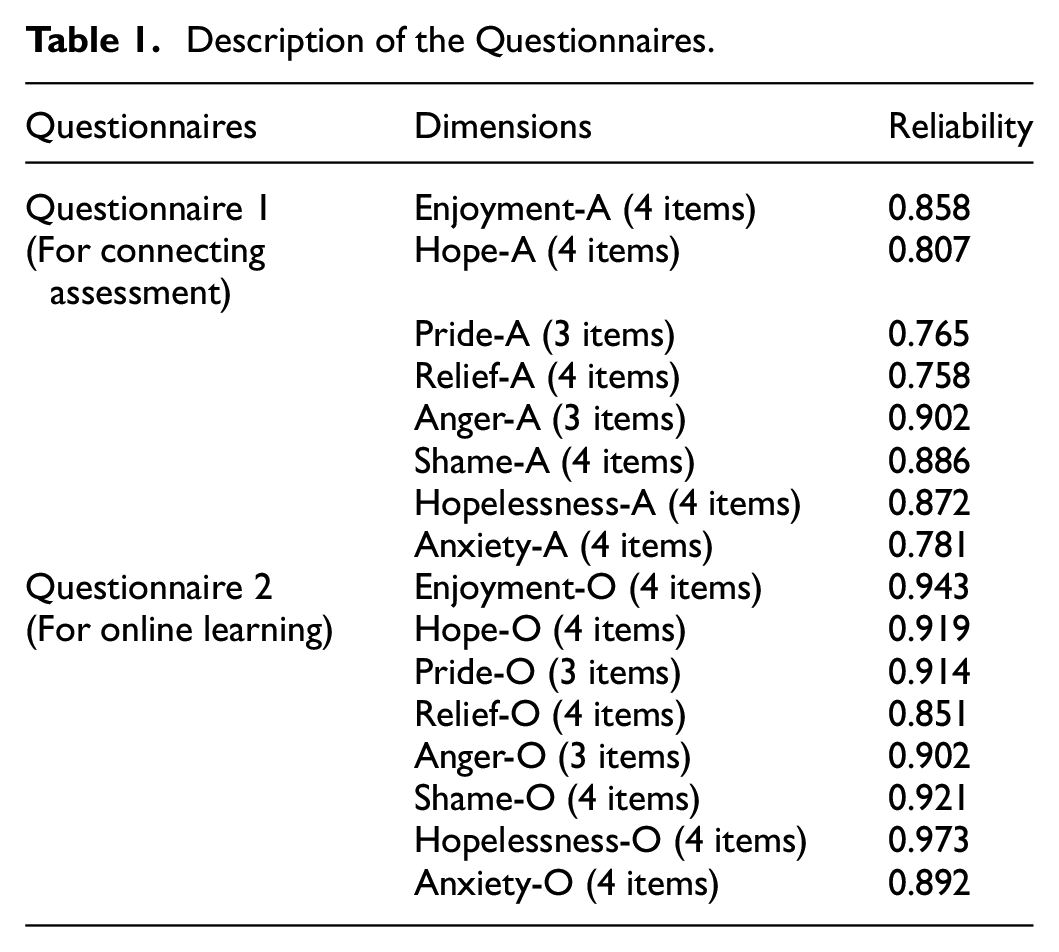
While the AEQ is a commonly used tool to investigate students’ academic emotions, it is noted for having a large number of items that may require considerable patience from the participants. To align with the context and objectives of this study, we opted for the simplified AEQ-S (Bieleke et al., 2021) and customized it to create two distinct questionnaires. Questionnaire 1 focuses on students’ emotional experiences during the connecting assessment, while Questionnaire 2 assesses emotional experiences during online learning, allowing for a comparative analysis to highlight the unique aspects of emotional responses in the connecting assessment. In addition to capturing demographic information, each questionnaire comprises 30 Likert-type questions (ranging from 1 = total disagree to 5 = total agree), categorized into eight dimensions: enjoyment (four items), pride (three items), hope (four items), relief (four items), anger (three items), anxiety (four items), shame (four items), and hopelessness (four items).
Questionnaire 1 took place during a face-to-face class in the 10th week of the semester. Following the commencement of the class, the connecting assessment (comprising questioning and dictation) was administered, after which students were instructed to complete the questionnaire. This approach aimed to capture students’ immediate and genuine emotional responses without allowing time for feelings to fade. Questionnaire 2, on the other hand, was administered following an online learning session in week 12. By selecting weeks 10 and 12, situated in the middle of the semester, students were afforded adequate time to acquaint themselves with each segment of the BL course, thereby minimizing the potential for information bias stemming from unfamiliarity.
The specific procedure for administering the questionnaire involved the teacher providing an explanation of the purpose and illustrating the items to prevent data bias due to misinterpretation. Subsequently, students anonymously completed the online questionnaire on Sojump, a popular crowdsourcing platform in China that offers functions similar to Amazon Mechanical Turk.
A total of 50 valid questionnaires were collected. The Cronbach’s α values for Questionnaire 1 and Questionnaire 2 were .817 and .911, respectively, with each dimension having a value above .75, indicating a high level of internal consistency and reliability (as depicted in Table 1). Descriptive analysis was utilized to examine the overall emotional experiences of students during the connecting assessment, while paired-sample t-tests were conducted to identify differences in emotional states between the connecting assessment and online learning. To address the third research question on the influence of students’ achievement levels on their emotional experiences, one-way ANOVA and descriptive analysis were employed.
Description of the Questionnaires.
Interview
In order to gain a clear understanding of the emotional states of students at different achievement levels, we divided all students in this class into high-score, medium-score, and low-score groups based on their grades from a similar course in the previous semester. The high-score group had the fewest students, followed by the low-score group, with the medium-score group having the highest number of students. Subsequently, we randomly selected three students from the high-score group, 15 from the medium-score group, and eight from the low-score group to participate in interviews. In total, 26 students were invited for the interview with their consent, which accounted for approximately half of the class (totaling 50 students). The interviews were conducted in a one-on-one discussion format. Prior to the interview, participants were briefed on the concepts of online learning, connecting assessment, and academic emotions to ensure a comprehensive understanding of the interview topics. The interviews took place in week 14, allowing learners to have accumulated a rich learning and emotional experience with various components of BL. Each interview lasted between 5 to 7 min and included two questions:
ITQ1: What is your emotional experience during the connecting assessment?
ITQ2: What is your emotional experience during online learning?
As the interview questions closely mirrored the questionnaire questions and were clear and straightforward, manual methods were employed to analyze the interview data. Initially, the interviews were transcribed and translated from Chinese to English, with identifiable information anonymized. A qualified researcher with research experience (the second author) read, typed, and re-read all participant responses to become familiar with the data. Subsequently, all interview records were coded using inductive topic analysis based on the research questions. Two researchers performed open coding in a back-to-back manner to identify emotional themes, engaging in discussions until consensus was reached on all discrepancies.
Findings
Learner’ Emotional Experience in the Connecting Assessment Context
A descriptive analysis of the questionnaire data was conducted using mean and standard deviation (see Table 2). Among the eight emotions experienced by students in the connecting assessment, relief, anxiety, and pride ranked as the top three with mean values of 3.59, 3.26, and 3.25, respectively. On the other hand, hopelessness and anger were rated as the lowest two. Notably, anxiety, as a negative emotion, had a very high mean score, which stood out as unusual. It is reasonable to infer that the connecting assessment elicits intense and unique emotional experiences among learners.
Descriptive Analysis of Emotional Experience in the Connecting Assessment Context.

Results of the thematic analysis of the interviews are depicted in Table 3. Nervousness was mentioned most frequently, with 21 out of 26 respondents acknowledging it. This was closely followed by worry and anxiety, with frequency counts of 7 and 6, respectively. In Table 3, we have included representative statements from participants to offer more tangible evidence. Within the AEQ-S, items pertaining to nervousness are categorized under the anxiety dimension. In language learning studies, nervousness is often grouped into anxiety (Chen & Lee, 2011; Ozcan, 2008). Therefore, the interview data align with the questionnaire data, suggesting that learners’ anxiety in the context of connecting assessment is profound and impactful.
Theme Analysis of Emotional Experience in Connecting Assessment Context.

Note. N = 26.
In the interviews, nearly all participants elaborated on the reasons behind the emotions they experienced, following a discussion on various emotions. Through these responses, themes related to the factors influencing emotional experiences in connecting assessment were identified, and representative quotes were included (refer to Table 4). Notably, preparation emerged as the most frequently highlighted factor, with nine out of 26 participants mentioning it. Participants indicated that their emotional responses were closely linked to their level of preparation, such as their engagement in online learning or mastery of the preceding lesson. A well-prepared individual tended to feel happy, relaxed, and confident, whereas a lack of preparation resulted in feelings of anxiety, nervousness, and worry. Following preparation, a sense of achievement was the second most commonly cited factor, with six out of 26 participants acknowledging it. Test-taking enabled participants to consolidate their knowledge, identify and bridge any gaps in learning, fostering a sense of accomplishment. According to the control-value theory (Pekrun, 2011), control and value are the two proximal antecedents of academic emotions. The third contributing factor was a drive for learning, mentioned by five out of 26 participants, who expressed that assessments served as a motivating force for their studies. Additionally, participants identified limited time as a factor contributing to their emotional responses, expressing dissatisfaction with inadequate test durations, which precipitated negative emotions.
Theme Analysis of Factors Contributing to Emotional Experience During Connecting Assessment.

Note. N = 26.
Differences Between Emotions in Connecting Assessment and Online Learning
In order to elucidate the emotional experiences of learners in connecting assessment, we conducted a comparison with another component within the same blended learning context - online learning. Descriptive analysis, thematic analysis, and paired sample t-tests were employed for this purpose.
The descriptive analysis of the questionnaire data was presented using mean, median, and standard deviation (refer to Table 5). Among the eight emotions reported by students in the online learning context, hope, enjoyment, and pride ranked as the top three, with mean values of 3.91, 3.87, and 3.69, respectively. These emotions are positive, indicating pleasant experiences in the online learning environment. The two negative emotions, anger and hopelessness, were ranked at the bottom.
Descriptive Analysis of Emotional Experience in Online Learning Context.
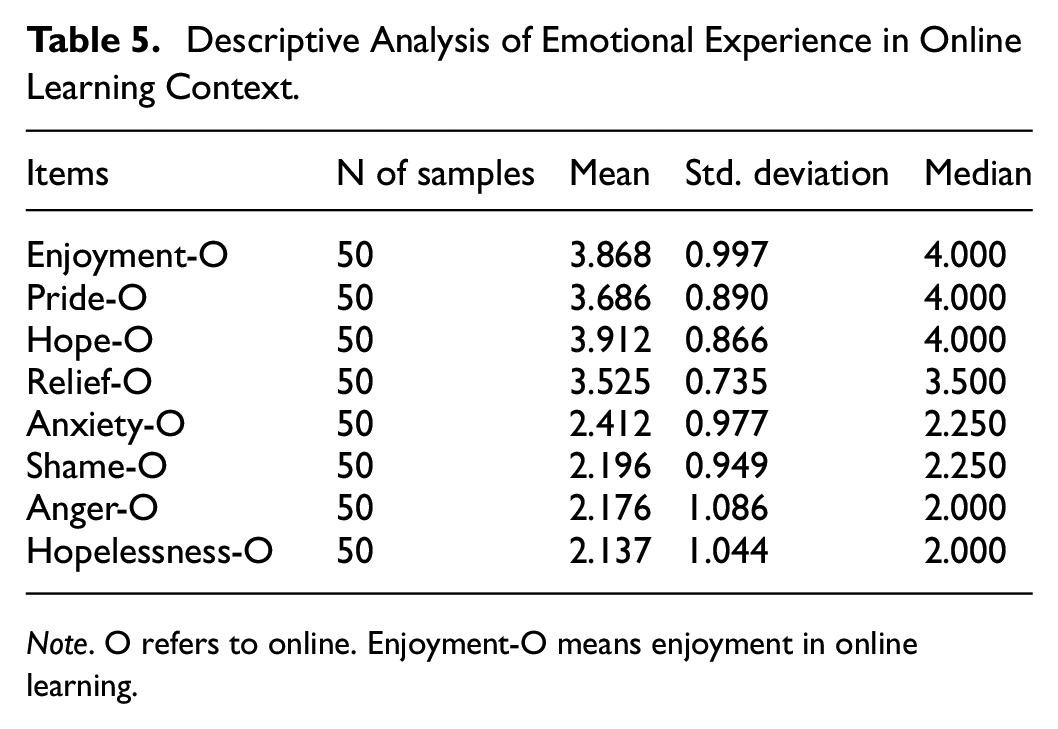
Note. O refers to online. Enjoyment-O means enjoyment in online learning.
Results of the thematic analysis of the interviews regarding online learning are depicted in Table 6. The most commonly mentioned emotion was relaxation, cited by 10 out of 26 respondents, followed by enjoyment with a frequency of 7. Representative statements from participants are listed in Table 6 to provide more concrete evidence. The thematic analysis also identified factors contributing to these emotions. Five participants attributed relaxation to learner autonomy, while four participants linked it to convenience. They found online learning relaxing due to the freedom it provided. For instance, when encountering difficulties in understanding videos, they could replay and pause, take notes, and learn at their own pace. Enjoyment, on the other hand, was associated by four participants with a sense of achievement, and by three participants with having adequate time.
Theme Analysis of Emotional Experience During Online Learning.
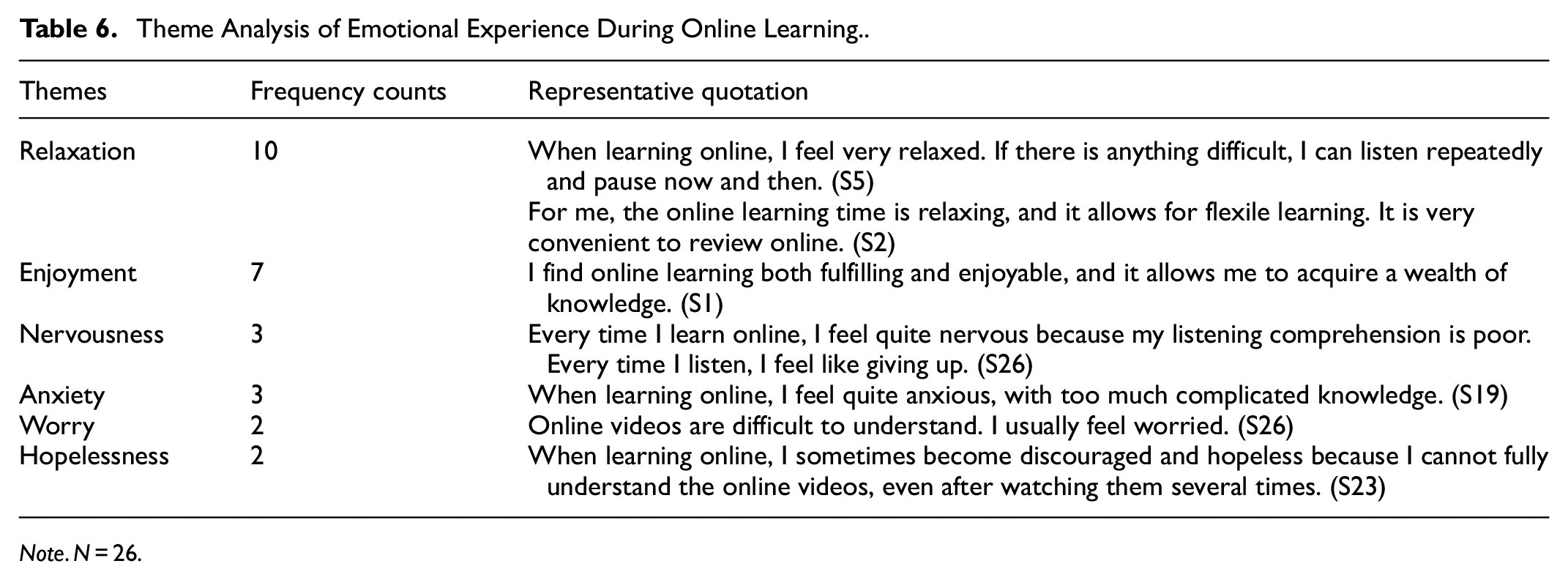
Note. N = 26.
A paired-samples t-test was conducted to compare the eight emotions in connecting assessment and those in online learning (refer to Table 7). The results indicate that the mean values of pride, hope, and enjoyment in connecting assessment are significantly lower than those in online learning (t = −2.856, p < .01; t = −5.027, p < .01; t = −4.262, p < .01). Additionally, the mean values of anxiety and shame in connecting assessment are significantly higher than those in online learning (t = 5.523, p < .01; t = 3.475, p < .01).
Comparison of emotional experience between connecting assessment and online learning.

p < .01.
Comparison of Emotional Experiences Among Learners of Different Achievement Levels
A one-way ANOVA was conducted to investigate whether students with varying academic levels had different emotional experiences during the connecting assessment. The results revealed significant differences in six dimensions, including enjoyment, pride, hope, anxiety, shame, and anger (F = 4.171, p < .05; F = 11.094, p < .01; F = 6.686, p < .01; F = 8.823, p < .01; F = 6.184, p < .01; F = 3.790, p < .05; refer to Table 8). Learners of high achievement levels reported the highest levels of enjoyment, pride, hope, and relief, as well as the lowest levels of anxiety and anger compared to the other two groups. Learners of medium achievement levels exhibited the highest levels of anger, while learners of low achievement levels reported the highest levels of shame and anxiety, and the lowest levels of enjoyment, pride, and hope. It can be inferred that learners of high achievement levels have the most positive emotional experiences, whereas learners of low achievement levels have the most challenging experiences in the connecting assessment context.
One-Way ANOVA of Emotional Experiences for Different Academic Levels in Connecting Assessment.

p < .05. **p < 0.01.
Discussion
Learner’ Emotional Experience in the Connecting Assessment Context
The data analysis conducted in this study revealed that learners experience both positive and negative emotions in the context of connecting assessment, with negative emotions being more prominent compared to other situations. Generally, positive emotions are more conducive to learning, fostering engagement and facilitating deep learning (Postareff et al., 2017). However, some researchers suggest that negative emotions may be beneficial for long-term learning. The challenges encountered by learners can result in a cycle of sustained cognitive imbalance, ultimately leading to deeper learning.
It is suggested that experiencing slight anxiety may be more beneficial than being completely stress-free or indifferent (Lonka & Ketonen, 2012). Interestingly, Cheng et al. (2020) found that students who initially exhibited positive emotions showed a significant improvement in academic performance, which then declined over time. In the assessment context, negative emotions are inherent and play a crucial role. However, excessively intense negative emotions can be detrimental to learning and the well-being of learners. Teachers should ensure that these emotions are kept within an acceptable range through well-designed assessments and supportive measures.
Among the eight emotions examined, relief, anxiety, and pride had the highest mean values. While relief is typically considered a positive deactivating emotion in other studies, in the context of connecting assessment, it is closely linked to anxiety. It is because of the intense anxiety experienced during the test that learners feel relieved afterward. This experience of relief may not necessarily be a deactivating emotion; it could also lead to students actively seeking knowledge thereafter. Hence, it can be inferred that the valence and activation levels of different emotions are not fixed and may vary depending on the context.
In this study, anxiety was identified as a strong and intense emotion experienced by participants in the context of connecting assessment. Tests, being uncontrollable and significant to learners, can trigger feelings of anxiety (Pekrun, 2011). However, anxiety can also serve as a motivator, encouraging the use of more determined learning strategies. Previous studies suggest that individuals with poor language learning abilities may be more prone to experiencing foreign language anxiety (Horwitz, 2001; Rouhani, 2008). This study revealed that students’ emotions are largely influenced by their level of preparation, with inadequate preparation leading to feelings of anxiety, tension, and worry. Moreover, time constraints can elicit negative emotions such as anxiety and anger. These findings highlight the importance of maintaining appropriate levels of anxiety through well-designed activities and effective management measures.
Pride is a typical positive activating emotion experienced by learners upon achieving learning goals (Cheng et al., 2020). This emotion can serve as a positive motivator for educators, inspiring continuous learning efforts and engagement in subsequent learning activities. Assessment design and emotional support should be tailored to nurture and sustain feelings of pride among learners.
On the Differences Between Emotions in Connecting Assessment and Online Learning
The data analysis from this study indicates that the mean values of pride, hope, and enjoyment in connecting assessment are significantly lower than those in online learning. Conversely, the mean values of anxiety and shame in connecting assessment are significantly higher compared to online learning. Evidently, the negative emotions experienced in connecting assessment are more pronounced, while the positive emotions in online learning are more heightened. In the preceding section, we discussed the potential long-term positive effects of negative emotions like anxiety, emphasizing the necessity of maintaining them at an appropriate level. Excessive negative emotions can potentially undermine students’ motivation to learn.
The core aspect of online learning lies in the symbiotic exchange and acquisition of knowledge between teachers and students through ongoing negotiation and interactive feedback (Zhao et al., 2018). The physical separation between teachers and students in online learning often results in a sense of “isolated learning.” Nevertheless, the data from this study did not reveal a significant feeling of isolation, possibly due to the collaborative pair work arrangement in online learning within the blended learning context of this study, effectively mitigating feelings of isolation. As suggested by Marković et al. (2021), it is imperative to address students’ educational, social, and emotional needs to alleviate the negative repercussions of online education. Thoughtful design of blended learning can help counteract negative emotions that hinder the learning process.
About Emotion Differences Among Learners of Varying Academic Levels
The data analysis reveals a notable variance in emotional experiences among learners across different achievement levels. Learners with high levels of achievement report the most positive emotional experiences, while those with low levels of achievement experience more negative emotions in the context of connecting assessments. In line with this, a study by Riegel and Evans (2021) observed that in quizzes, the high-achieving group predominantly felt pride, whereas the low-achieving group primarily experienced feelings of shame. Consistent with the educational setting of this study, several prior studies have indicated that individuals with limited language learning proficiency often face foreign language anxiety (Rouhani, 2008). The underlying reasons for these emotional disparities are linked to factors such as perceived control, task difficulty, and perceived importance. The cognitive discrepancies among students can present opportunities for deep engagement with challenging content. However, if students are unable to restore cognitive equilibrium, this state may lead to feelings of frustration and anxiety (D’Mello & Graesser, 2012). The study of Park et al. (2024) got different findings that students’ age and motivation were significantly associated with test anxiety, and Han et al. (2022) found that higher online-engaged learners reported having higher self-efficacy and lower anxiety, thus providing additional evidence that academic emotions vary depending on the context.
Limitations
The data in this study are solely based on self-reports from learners, and future research may benefit from utilizing technology-supported data collection methods to yield more objective and comprehensive results. Furthermore, the narrow scope of this study, limited to one university, may impede the generalizability of the findings. However, as Noddings (2012) suggests, educators can reflect on the extent to which their own circumstances and professional attributes align with those described in the study to determine the potential for deriving insights applicable to their teaching practice.
Conclusion
Utilizing assessment activities to bridge online and face-to-face learning environments is essential to the success of BL and has become a widespread practice. However, much of the existing research on students’ emotional experiences has focused solely on either online or face-to-face contexts. This study fills this gap by examining the characteristics of learners’ emotional experiences in the context of connecting assessments in a typical BL setting. Data analysis from questionnaires and interviews reveals that learners experience more pronounced negative emotions during connecting assessments, with relief, anxiety, and pride garnering the highest mean values. Significant differences in emotional experiences are observed among learners of varying achievement levels. Participants also cite factors influencing their emotional experiences, including level of preparation, sense of achievement, learning motivation, and time constraints. These findings offer insights into emotional experiences during connecting assessments and can inform the design of assessments and other components of BL for teaching practitioners, as well as provide guidance on emotional support and management to facilitate active and deep learning. It also provides another practical case of context-specific exploration of academic emotions.
By comparing the findings with previous research, we can infer that the valence and intensity of emotions are not fixed and must be contextualized. This study underscores the nuanced nature of emotions in educational settings, highlighting the importance of considering context-specific definitions. It is hoped that this study will inspire more thorough and contextually specific analysis of emotional experiences in the future.
