



Abstract
The aim of this study is to discuss the impact of firm’ business acquaintanceships on innovation. We adopt a sociological perspective and apply the concept of “The differential mode of association” to construct a theoretical framework to explain the principle of firms’ business acquaintanceships on innovation. To provide real-world evidence, we also empirically test the theoretical hypotheses using ESIEC data and some econometric models. The results reveal that: (1) Business acquaintanceships have a significant positive impact on innovation, but the impact of business acquaintanceships on product and process innovation is asymmetric. (2) Under the theory of “The differential mode of association” and the principle of individual pragmatism, profitability mediates the relationship between business acquaintanceships and innovation. The business acquaintanceships can improve profitability, nevertheless profitability hinders innovation. (3) Under “The differential mode of association,” the government and shareholders acquaintanceships have moderating effects. However, once the government and shareholders acquaintanceships are involved in business acquaintanceships, they have a negative impact on innovation within firms. (4) Individual heterogeneity in entrepreneurs’ gender, government experience, and prior entrepreneurial experience also affects the impact of business acquaintanceships on innovation. This study emphasizes the impact of social relationship structures on business acquaintanceships and innovation, further provides a new research perspective and marginal contributions in terms of theoretical and empirical evidence.
Introduction
The role of innovation in the growth process of firms is crucial, and innovation brings competitive advantages in terms of technologies and markets to the early growth of firms (Clarysse & Bruneel, 2007; Colombelli et al., 2016). Many factors can influence innovation in firms. Internal factors include R&D expenditures, managers ability to master the technology, access to finance, and on-the-job training (Hussen & Çokgezen, 2019), but some evidence suggests that external business relationships of start-ups are correlated to innovation (Ernawati & Hamid, 2020; Landry et al., 2002; Petrou & Daskalopoulou, 2013). A good and mutually beneficial business relationship will undoubtedly bring more opportunities and possibilities for firms and become a source of innovation (Afuah, 2000; La Rocca et al., 2015). Examining how firms’ business relationships contribute to innovation is critical to fully understanding the sources of their competitiveness and the “nutrients” they need to grow.
By summarizing the existing literature, we found that the previous research presents a multi-perspective pattern. Some scholars affirm the positive significance of business relationships on innovation. Holmen et al. (2005) argued that business relationships are characterized by complementarity; the diversity of business relationships and broad relationship boundaries provide positive incentives to innovate (Tsou et al., 2015). A network of relationships consisting of partner firms contributes to innovation in the focal firm. Thus, increasing the diversity and number of partner firms contributes to the growth of innovation outcomes (Sivakumar et al., 2010). From a firm life cycle perspective, the development of innovative solutions by firms requires significant investment over a long and sustained period, so firms establish strategic, long-term business relationships with partners (Iglesias et al., 2023). Nordman and Tolstoy (2016) argue that a more comprehensive network of business relationships creates more business opportunities for firms and that business relationships facilitate the expansion of the focal business into associated businesses, which helps firms implement innovation plans. Other scholars have implemented research on the impact of business relationships on innovation. Bakhshi and McVittie (2009) point out that thousands of informal or formal relationships between scientists, managers, engineers and others in the firms contribute significantly to the flow of information and accelerate knowledge transfer between networks of business relationships, thereby reducing the uncertainty of innovation (Gjergji et al., 2020). Many scholars have defined business relationships as customer or supplier relationships and studied their impact on innovation. Roy and Sivakumar (2010) argued that upstream suppliers must be qualified to bid (minimum knowledge redundancy) to enter a cooperation relationship with the focal firm and advance innovation by providing technical services or sharing knowledge. Wagner’s research (2013) clarified that customer feedback on knowledge and information will likely improve innovation more radically than that of suppliers and competitors.
Although the above previous research has contributed significantly to our understanding of the principle for the impact of business relationships on innovation, it still lacks explanatory power for some real-world phenomena. First, very little literature discusses the impact of innovation by embedding business relationships in specific social contexts. It does not consider the social background or acquaintanceships between business partners and entrepreneurs, such as suppliers and customers who are relatives or countrymen of the entrepreneur. Second, due to most of the previous research only considering the business context, the concept of knowledge, collaboration, learning are commonly utilized in the existing literature when exploring the impact of business relationships on innovation. Thus, the perspectives of theoretical explanations need to be broadened further (Perry et al., 2002; Tseng et al., 2016).
This research aimed to explore the impact of business acquaintanceships on innovation. To avoid conceptual confusion, we defined business acquaintanceships by embedding business relationships into the social context. This research focuses on three main research questions.
Q1. Referring to Wigren-Kristoferson et al. (2022) on “embeddedness,” we introduced the Chinese concept of “The differential mode of association” and embedded business acquaintanceships in specific social relationships.
Q2. We investigated how business acquaintanceships affect innovation. The main dimensions of our analysis are access to relational resources and the construction of emotional trust.
Q3. We also discuss the mechanisms by which other social relationship features of the “The differential mode of association” contribute to business acquaintanceships and innovation. These include individual pragmatism, shareholder and government acquaintanceships.
Our research expands on existing research by taking a socially embedded perspective and situating business relationships within a specific social structure. The most salient contributions of our research include the following:
(1) We offer a fresh socio-economic perspective. In this research, we choose “The differential mode of association” from China as the social context of business relationships, which is closer to observable reality in perspective.
(2) In the theoretical analysis section, we illustrate the impact of business acquaintanceships on innovation by using the concept of “relational resources” and “emotional trust” under “The differential mode of association,” which can broaden the theoretical perspective of prior research. In addition, we utilized the principles of “resource dependence” and “trust compromise” to explain the moderating role of shareholder and government acquaintanceship. These exploratory works is also not covered by existing studies.
(3) In terms of empirical research, we used the “Enterprise Survey for Innovation and Entrepreneurship in China” (ESIEC), and there are no relevant studies that have utilized the ESIEC for empirical testing in this research area.
The subsequent parts of this paper are organized as follows to validate our viewpoints: “Theoretical Framework and Research Hypotheses” section presents the theoretical framework and research hypothesis. “Research Design” section presents the research methodology, including data sources, variable structure, and model setting. “Results” section presents the empirical results. “Discussion” section discusses our findings, implications, limitations and future research.
Theoretical Framework and Research Hypotheses
The Concept of “The Differential Mode of Association”
“The differential mode of association” in Chinese is “ChaXuGeJu” (Barbalet, 2020; Sinha & Lakhanpal, 2022; Wu, 2018). “Cha” is a horizontal relationship that refers to the differentiation of social relationships in China. Family relationships are the closest of all social relationships, and the degree of closeness comes from the individual’s evaluation of the instrumental value of different horizontal social relationships. The “Xu” is a vertical relationship or hierarchical relationship. The more obvious hierarchical relationships in China are the superior-subordinate relationships within organizations or the managerial and managed relationships in government and firms.
In transitional China, “The differential mode of association” has the following characteristics (Chang, 2016; Chu, 2008): (1) “Individual-centered” social relationships are built around the individual. (2) The starting point for relationship building is profitability and pragmatism; both relatives and non-relatives can be included in the relationship network. (3) The network of relationships spreads outwards from the individual’s center, creating a rippling circle structure. The farther the relationships are from the individual’s center, the less instrumental they are. (4) Individuals will continuously adjust the relationship structure according to specific matters and interests, and interpersonal relationships are a kind of dynamic connection. (5) Horizontal and vertical relationships are often intertwined; an individual’s social relationships can be both horizontal and vertical. The fundamental motivation for establishing interpersonal relationships in China is individual pragmatism, which facilitates individual access to social and economic resources (Ruan, 2019). In short, “The differential mode of association” is a social structure in which firms and individuals rely on specific social relationships to conduct business and economic activities.
The Impact of Business Acquaintanceships on Innovation Under “The Differential Mode of Association”
The standard definition of an acquaintance is an individual who knows another person on an individual basis based on social conditions (D. Li et al., 2008). We define business acquaintanceships as potential business partners with a background in a particular social relationship, whether friends, classmates, relatives, or whatever. In this research, potential business partners mainly include relationships outside private entities, such as suppliers, customers, or technical service providers. As W. Zhang, Zeng et al. (2023) has pointed out, there is a strong link between the social context in which a firm operates and its performance. Thus, we explored business acquaintanceships under “The differential mode of association” to construct a theoretical framework. In terms of core concepts, much previous research has simplified business relationships to purely “market-based,” and some scholars generally adopt concepts such as knowledge spillover, innovation diffusion, collaborative innovation, or organizational learning that do not have social attributes (Belitski & Mariani, 2023; Bernal et al., 2022; Caiazza & Stanton, 2016; Markovic et al., 2020). Before constructing a theoretical framework, two issues need to be addressed. The first issue is what conditions business acquaintances can provide for the growth of a firm or entrepreneur in a given social environment. The second issue is the basis for a stable relationship and sustainable innovation between a firm and its business acquaintances in a world of risk. Thus, to improve the theoretical adaptation of “The differential mode of association,” we need to find the appropriate concepts with social attributes. For the first issue, we use the concept of “relational resources,” which is based on the idea that firm resources have social complexity (J. B. Barney et al., 2021; Varadarajan, 2023), and discussed the logical links among “The differential mode of association,” relational resources and innovation. Regarding the second issue, following Lou, et al. (2022) we use the concept of “emotional trust” to explain the impact of the social background of business acquaintances on entrepreneurs’ innovative activities. We also discuss the influencing mechanisms using the “horizontal-vertical” structure and individual pragmatism traits of “The differential mode of association,” which is also the original contribution of this research.
Relational Resources
Innovation is the driving force behind business progress and competitiveness, so innovation requires firms to integrate resources to meet the market challenges (Srivastava & Gnyawali, 2011), and firms must acquire external resources from outside through social activities (Granovetter, 1992). Thus, firms’ external behavior needs to be analyzed embedded in a network of social relationships (Paldam, 2015). In a sense, a firm’s innovations are social (Dionisio & de Vargas, 2020; Franks & Vanclay, 2013). The most significant challenge for firms is acquiring external resources for innovation. Generally speaking, there are two ways for firms to acquire external resources in the innovation process. The first way is through market transactions and open environments or platforms, such as borrowing funds, buying and selling intangible assets, and open-sourcing knowledge. This access to resources can be depersonalized. The second way is to use specific social relationships to obtain “Relational resources” (Morgan & Hunt, 1999).
Relational resources can be understood as resources embedded in an individual’s social relationships and are essentially social capital (Fu, 2015). Relational resources are scarce, irreplaceable, and difficult to imitate, and thus constitute a real competitive advantage for innovation (J. Barney, 1991). Relational resources are difficult to access in a very open social relationship environment. Therefore, inter-organizational access to relational resources has to take place in more closed business relationships; there needs to be relational solid stickiness and closure between entrepreneurs, suppliers and customers. Thus, “The differential mode of association” with these characteristics is conducive to the internal accumulation of relational resources by entrepreneurs. For example, the entrepreneur’s suppliers and customers are his hometown friends or classmates, which can quickly satisfy the social environment needed for firms to acquire relational resources. Knowledge is the most important of business resources. Acquiring tacit knowledge requires entrepreneurs to have a longer-term basis of cooperation with their business partners. Impersonalized business relationships that are unfamiliar with each other can complicate acquiring tacit knowledge, but acquaintances in business partnerships can increase communication efficiency and effectiveness (Dhanaraj et al., 2004; Shou et al., 2017), strengthening the relational resources character of tacit knowledge. Although “the differential mode of association” offers firms convenience in accessing into relational resources and innovation, this commercial convenience is affected by the closeness of the social relationships. In general, the closer the social relationships are to the “Individual-centered,” the easier it is for the entrepreneur to obtain the relational resources needed for innovation.
Emotional Trust
Firms’ innovation processes are subject to external risks and uncertainties (Jalonen, 2012). Trust is a positive expectation of business partners and an effective mechanism for reducing risk and uncertainty (Bijlsma-Frankema & Costa, 2005). Duenas and Mangen (2021) classify trust as cognitive and emotional. Cognitive trust requires the actor to identify the object of trust based on judgment from experience, while emotional trust is tied to the emotions of the interactants. It can be argued that cognitive trust is more market-based (e.g., Johnson and Grayson, 2005 believes that sales effectiveness is more correlated with cognitive trust but not emotional trust), whereas emotional trust is more socially oriented.
To develop cognitive trust, entrepreneurs need to interact with their business partners over a long period and with high frequency in order to generate accurate empirical judgments, and then build reputational mechanisms to reduce opportunism and improve the efficiency of dedicated investments (Delbufalo, 2021; Steinle et al., 2019). Building cognitive trust can reduce the uncertainty of innovation, but there is also an increase in transaction costs in building trusting linkages. Another potential negative aspect is that a lack of cognitive trust can lead to unequal business status and weakness of innovation. Some evidence shows that excessively strong customer bargaining power may lead to hold-up problems and force suppliers to reduce their innovation input (Krolikowski & Yuan, 2017). However, establishing a business relationship under “The differential mode of association” presupposes a social relationship in which the identity and status of the parties are clear. Therefore, emotional trust between business acquaintances based on stable social relationships is more sustainable for innovative activities, and emotional trust reduces the risk of mistrust. Further, emotional trust can avoid cognitive bias caused by erroneous empirical judgments; meanwhile, building emotional trust has lower transaction costs, such as sharing business information or keeping promises. Emotional trust also facilitates the diffusion of innovation elements between entrepreneurs and business partners, which is more favorable to the adoption of new products and technologies (Startseva & Deltsova, 2019) and improves the innovation efficiency of firms (J. Wang et al., 2017). Based on the above analyses, this research proposes the following hypothesis:
Moderating Effects of Shareholder and Government Acquaintanceships
Due to the extensive involvement of the strong government in market activities in China, a vertical “government-individual” (or “government-firm”) hierarchical relationship has been created under the administrative bureaucracy. Government inevitably potentially impacts the relationship between business acquaintanceships and innovation. Resource dependence theory suggests that organizations that hold resources can control organizations that wish to access resources. Resource dependence and resource allocation are at the heart of the relationship between government and firms (Salancik & Pfeffer, 1977). Under “The differential mode of association” in China, there is asymmetric dependence and power imbalance in the hierarchical relationship between the government and firms, and firms need to depend on government resources such as land and financial capital to grow. The government provides material resources and a policy environment for the development of the firms. While firms integrate resources and use policies to promote innovation, they must adopt particular political behaviors to achieve long-term development goals (Getz, 1997). Therefore, firm acquaintanceships are conducive to obtaining government resources and credit endorsement W. Li, Tsang et al., (2016). Nevertheless, government acquaintanceships directly intervening in the firm’s business relationship or marketplace will produce “Relationship dependence,” corruption and rent-seeking issues, which can hinder innovation. Based on the above analyses, this research proposes the following hypothesis:
In “The differential mode of association,” shareholders, the highest decision-makers in the private entity, are another type of vertical relationship. Shareholders’ capital, technology, and connections are significant factors for startups in China. Therefore, shareholder acquaintances have some significant effects on innovation. Firstly, shareholder acquaintanceships can form relationship endowments. Compared to the market approach, entrepreneurs are more likely to have access to business resources and fewer transaction costs through shareholder acquaintances. Meanwhile, Shareholder acquaintances can provide an interpersonal base for entrepreneurs to expand their business relationships. Second, trust is conducive to converging shareholders’ interests and goals. More vital shareholder control can reduce agency problems and monitoring costs (Chhillar & Lellapalli, 2015). Acquaintance shareholders’ trust links with entrepreneurs can promote goal convergence and generate “concerted action,” improving shareholder control and decision-making efficiency. However, shareholder acquaintances are potentially a barrier to the introduction of external resources and business relationships to innovative activities, and this barrier mainly stems from “Trust compromise.”“Trust compromise” refers to the compromising behavior between entrepreneurs and acquainted shareholders to maintain mutual trust and consistency of interests and goals when there is a difference of opinion between them. Under “The differential mode of association,” the level of trust between acquainted shareholders and entrepreneurs varies with the distance of the relationship; the closer the relationship, the higher the level of trust, and the more likely to occur “Trust compromise.” Diversity is a source of innovation (Garcia Martinez et al., 2016), but the convergence of perceptions and thinking resulting from “Trust compromises” is not conducive to fostering diversity and innovation within firms. If the innovation activity introduces external resources and business relationships which will weaken the control of shareholder acquaintances or the innovation activity entails risks and costs that shareholder acquaintances do not recognize, the trench effect of the “Trust compromise” would prevent firms from bringing in external resources (Lorenzo et al., 2022). Based on the above analyses, this research proposes the following hypothesis:
Mediating Effects of Individual Pragmatism
Under “The differential mode of association,” the link between business acquaintanceships and innovation must be based on individual pragmatism. Acquiring relational resources and building trusting connections in the entrepreneur’s business network are aimed at realizing the instrumental value of business acquaintances. Firms accumulate knowledge and innovate to maintain above-average profitability, which is the most intuitive phenomenon for observing the outcome of individual pragmatism (Madden, 2021). The impact of individual pragmatism on firm profitability is two-sided. On the one hand, entrepreneurs use relational resources to acquire knowledge and potential orders, enhance business credit tie-ups, and other aspects that would effectively improve firms’ internal profitability and positively affect subsequent innovation (D. Li et al., 2017). However, the negative side is that the widening scope of the network of business acquaintances with utility value strengthens the individual entrepreneur’s control over business resources. This situation facilitates enhanced bargaining power and control over costs but weakens innovation incentives (Peters, 2000). In addition, over-reliance on business acquaintances for profitability creates relational dependence, solidifying the original profit model and reducing entrepreneurs’ willingness to innovate. Based on the above analysis, this research proposes the following hypothesis:
Research Design
Data and Sample Selection
Our data comes from the Enterprise Survey for Innovation and Entrepreneurship in China (ESIEC), collected by Peking University’s Enterprise Big Data Research Centre from 2016 to 2020. The sample of ESIEC is small and micro enterprises in China. ESIEC uses structured questionnaires and household surveys to collect data on starting a business, social relationships, characteristics of entrepreneurs, innovation, inputs and outputs, supply chain, and investment and financing of the sample firms. To ensure the samples’ and data’s completeness and accuracy, ESIEC conducted three pilot surveys between 2016 and 2017, focusing on firms in Guangdong and Henan. In 2018, ESIEC established its first benchmark survey, with a sample of firms from six provinces: Liaoning, Shanghai, Zhejiang, Henan, Guangdong, and Gansu. The benchmark survey contacted more than 50,000 samples of firms and finally generated a dataset with 6,198 valid samples. In 2020, ESIEC conducted another thematic survey on the impact of COVID-19 on the sample firms, but the content of the thematic survey is not relevant to the scope of this research. Considering the sample size and regional distribution, we used the 2018 benchmark survey data, which is cross-sectional. A number of the surveys in the 2018 data are about the social relationships of firms, which provides strong support for our research. Notably, the 2019 survey is a sample supplement to the 2018 survey, so the 2018 dataset remains the most complete.
Variables Definition and Descriptive Statistics
Dependent Variable
The dependent variable is innovation. There are many categories of innovation, including product or process innovation, patents for inventions, or R&D expenditures. However, the ESIEC’s innovation surveys focus mainly on products and processes, so we have adopted the ESIEC’s structured data on innovation. The variable of product innovation is based on the question, “Has your firm made product innovations in the last two years?” which is a binary variable assigned a value of 1, meaning that the firm has made a product innovation, and 0 means that the firm does not have a product innovation. The process innovation variable is still binary, corresponding to question, “Has your firm implemented process innovation in the last two years?.” Furthermore, a value of 1 means that the firm has process innovation; otherwise, it assigned a value of 0 to the responses.
The ESIEC defines “product innovation” as the formation or essential characteristics (technical features, composition, integrated software, applications, user-friendliness, usability) of a new or significantly improved product (including services). “Process innovation” is defined as innovation or significant improvement in manufacturing/production processes, distribution methods, or product support activities. Organizational changes or the introduction of new management strategies are not considered process innovations.
Independent Variable
This research used business acquaintanceships of firms as the independent variable. Some previous studies have classified business relationships into two categories: supplier relationships and customer relationships (Anderson et al., 2001; Jääskeläinen, 2021), so we also adopt this categorization strategy. In order to measure the network of relationships between the sample firms and their suppliers, this research investigates the number of suppliers with acquaintanceships through the item “Number of suppliers with acquaintanceships.” Similarly, the number of customers with acquaintanceships was used to measure the customer acquaintanceships network.
Control Variables
As Atinc et al. (2011) and Becker (2005) suggested, it needs to “briefly explain” or “provide evidence” on which control variables to choose to avoid the incorrect use of control variables. If innovation is considered an entrepreneurial decision, specific characteristics of entrepreneurs will impact the innovation of firms (Ndemo & Wanjiku, 2007; Ürü et al., 2011). Therefore, this research applies the entrepreneur’s household registration, education level, gender, and political identity as control variables. Variables expressing the organizational characteristics of the firm also need to be controlled (Wei et al., 2022), including the three variables with total fixed assets, technical staff and corporatization. Finally, factors related to government regulation (Y. Li, Zhan et al., 2016; Lu & Lazonick, 2001), including government support, court fairness, and government compliance, are controlled too.
Mediating Variable
This research used profitability as a proxy variable for individual pragmatism. We use gross profit margin growth to measure a firm’s profitability, corresponding to the question, “How much did this firm’s gross profit margin increase last year (%)?,” which is a quantitative variable.
Moderating Variable
We use entrepreneurs’ government acquaintanceships as a proxy variable for hierarchical relationships, with the question, “Did you have acquaintances in the government sector when you created your business?” If the respondents select “Yes,” the answer is assigned a value of 1, while a value of 0 represents the answer of “No.”
Another moderating variable is the entrepreneurs’ shareholder acquaintanceships. We use the acquaintanceships between the natural person shareholders and entrepreneurs as a proxy variable. Regarding the question, “Whether some of the natural person shareholders of your firm have acquaintanceships with you,” respondents are assigned a value of 1 if they answer yes; otherwise, 0.
Instrumental Variable
Following Baiocchi et al. (2014), We use the degree of competition in the market where the sample firms operate as an instrumental variable, which refers to the question of “Degree of competition in the market that your firm faces.” The degree of market competition is a latent variable (Ye et al., 2015), and respondents make a subjective choice from 0 to 4.
Descriptive Statistics
Table 1 presents the definitions of the variables and descriptive statistics of this research. For the dependent variable, 2,059 sample firms have product innovation (33.2% of all 6,198 valid samples) and 1,656 sample firms have process innovation (26.7% of all 6,198 valid samples). Regarding the independent variables, the mean value of the number of suppliers with acquaintanceships is 2.84, while the mean value of the number of customers with acquaintanceships is 5.86. Regarding entrepreneurs and firm characteristics, the average education level of entrepreneurs is above senior high school, the average fixed asset value of firms is about 1.703 million RMB, and the average number of technical staff is 7.5.
Measurement and Statistical Description of Variables (N = 6,198).
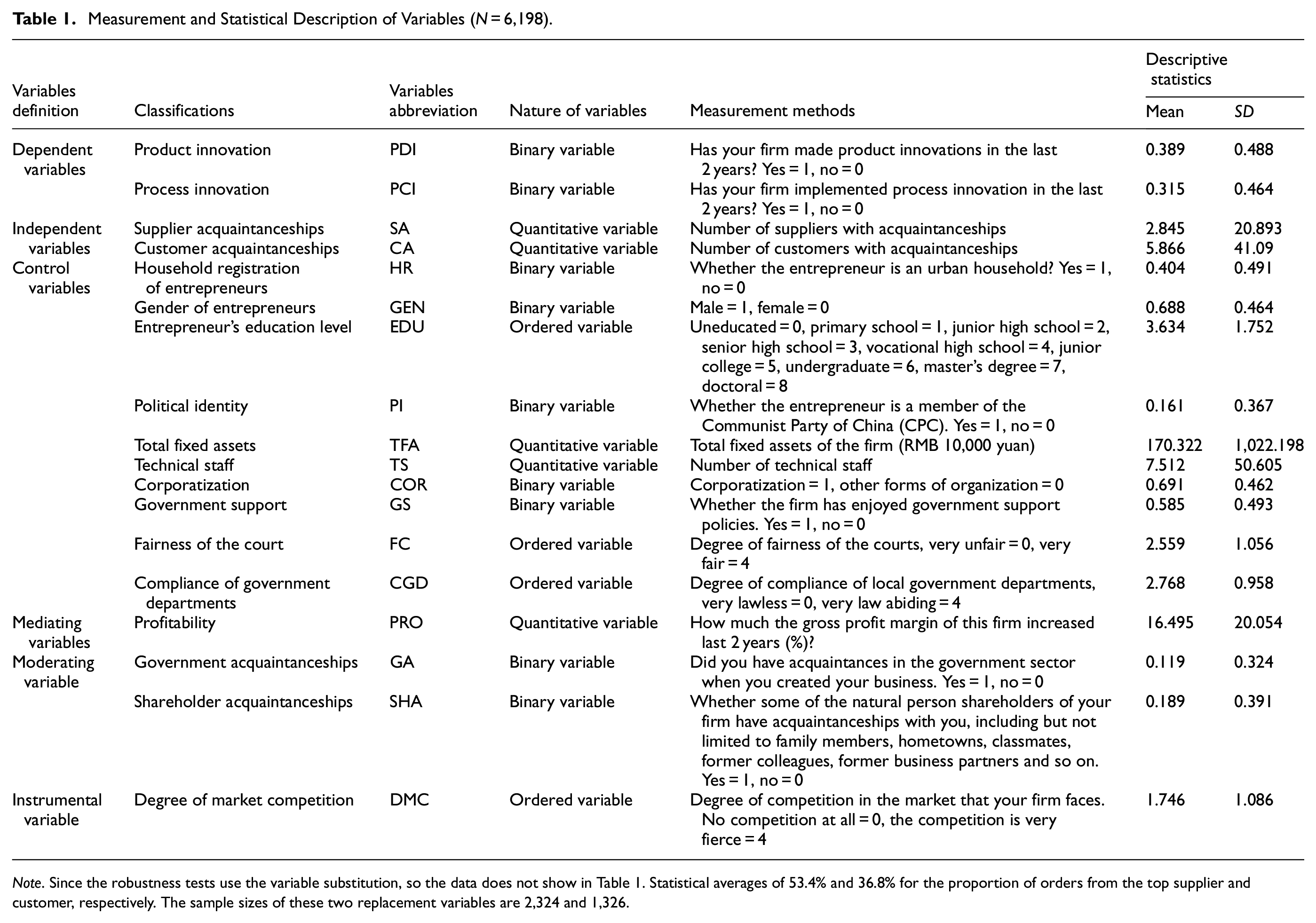
Note. Since the robustness tests use the variable substitution, so the data does not show in Table 1. Statistical averages of 53.4% and 36.8% for the proportion of orders from the top supplier and customer, respectively. The sample sizes of these two replacement variables are 2,324 and 1,326.
Empirical Mathematical Models
Benchmark Regression Model
We used econometric methods to test our theoretical hypotheses. In this research, the dependent variables, including product and process innovation, which are binary. Whether the sample firms chose to innovate is a self-selection process. Therefore, this research chooses the probit model as the benchmark model to test the theoretical hypotheses, which can firmly explain the self-selection process (H. Q. Zhang, Yang, et al., 2023). The benchmark model is defined as follows:

In the equation,
Mediating Effect Model
Referring to the research of MacKinnon and Dwyer (1993), this research constructed a system of recursive equations and used stepwise regression to demonstrate the mediating effect. The specific form of the model is as follows:


The
Moderating Effect Model
This research set the moderating effect model based on the research of Ma et al. (2021) and Castañeda et al. (2007). In order to verify the moderating effect of shareholder and government acquaintanceships, we added moderating variables

Results
Benchmark Regression Results
Multicollinearity Test
We need to test the variables for multicollinearity before conducting the benchmark regression. Following Benesty et al. (2008), this research utilized Pearson correlation coefficients. Table 2 demonstrates the Pearson correlation coefficients between the variables, and the table shows that the Pearson measurements are all less than |.5|, indicating no significant multicollinearity between the variables (Kim & Ergün, 2015). In addition, an auxiliary test was also applied, and the variance inflation factor (VIF) results are shown in Table 3. The variance inflation factors of all the variables are less than the threshold of 2.5, indicating no significant multicollinearity between the independent and control variables (Johnston et al., 2017).
Pearson Correlation Coefficients Matrix.

Note. *, **, and *** in the table indicate the significance at the 10%, 5%, and 1% levels, respectively.
Variance Inflation Factor (VIF).

Note. The mean VIF value is 1.17.
Benchmark Regression Results
Benchmark regressions were conducted for the two independent variables using the Probit model and robust standard errors. Moreover, Table 4 depicts the results of the benchmark regressions. Columns (1) to (4) are the regression results of the Probit model, which show that SA has a significant and positive effect on PDI and PCI at the 5% level. Thus, the regression results for the CA on innovation are somewhat different, with the independent variable having a significant positive impact on PDI at the 10% level but not on PCI. A linear probability model (LPM) and robust standard errors for estimation (Caudill, 1988) were used to ensure the estimation robustness. Columns (5) to (8) show the regression results for LMP, which are consistent with the Probit model. The hypothesis H1 is confirmed.
The Impact of Business Acquaintanceships on Innovation.
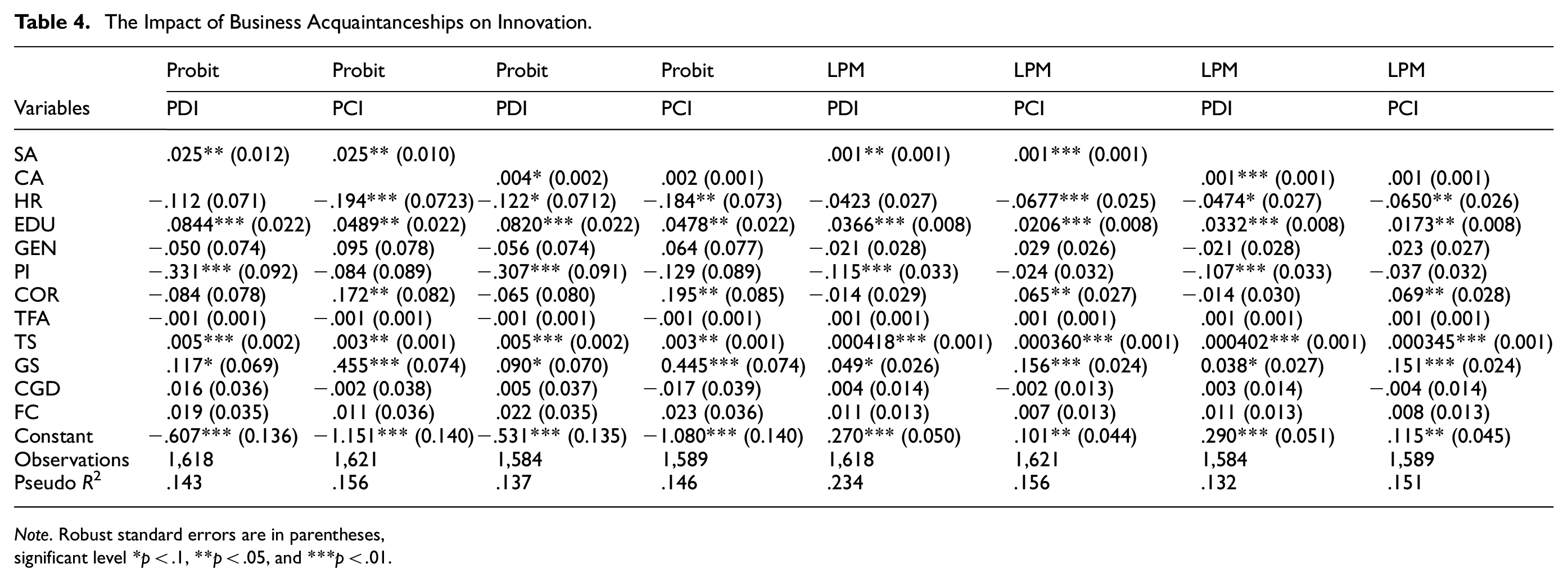
Note. Robust standard errors are in parentheses, significant level *p < .1, **p < .05, and ***p < .01.
Marginal Effects
Notably, the benchmark regression can only illustrate the significant level of the effect of the independent variables on the dependent variable. However, it cannot demonstrate the marginal effect. Therefore, As shown in Table 5, it followed with the tests about the average marginal effect of independent variables. Table 5 shows that the probability of PDI and PCI for each new SA added to the sample firms can increase by 0.9% (p < .05). Similarly, for each CA added to the sample firms, the probability of PDI can increase by 0.2% (p < .1).
Marginal Effects of Independent Variables.

Note. Table 5 simplifies the average marginal effects of the control variables for easy reading. 95% CI = 95% confidence interval. Significant level *p < .1, **p < .05, and ***p < .01.
Robustness Test
Replacement of the Independent Variables
“The proportion of orders from top supplier acquaintances” (TSA) and “The proportion of orders from top customer acquaintances” (TCA) were chosen to replace the independent variables, respectively. Pearson correlation coefficients test was applied to the replacement variables and independent variables. The independent variables are negatively related to the corresponding replacement variables at the 1% level. So, theoretically, the replacement variables negatively correlate with the dependent variable. Table 6 shows the regression results of independent variables after replacement, and the regression results confirm this. The TSA of the sample firms shows a significant adverse effect on both PDI and PCI, while the TCA only has a significant negative effect on PDI. This phenomenon supports the results of the benchmark regression.
Regression Results with Replacement of Independent Variables.

Note. Significant level **p < .05, and ***p < .01.
Adding Control Variables
Adding control variables is a method to minimize the negative impact of omitted variables on the robustness of the estimates. Attention should be paid to the impact of the industry and province of the sample firms on innovation; for example, manufacturing firms are more likely to innovate than agricultural firms, and firms in developed provinces have more substantial innovation capacity. Therefore, the following tests added industry and province dummy variables to the benchmark model. The regression results are shown in Table 7, which reveals that the regression results after controlling for province and industry dummy variables are consistent with the benchmark model.
Regression Results with Additional Control Variables.
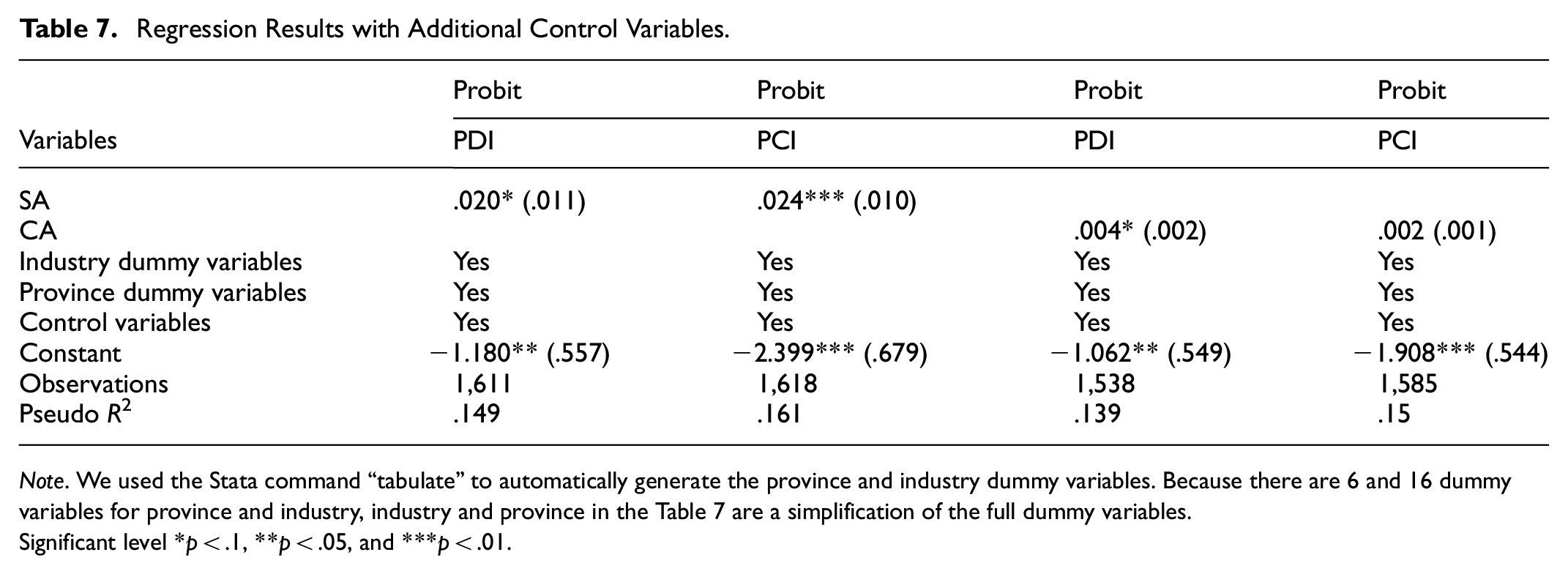
Note. We used the Stata command “tabulate” to automatically generate the province and industry dummy variables. Because there are 6 and 16 dummy variables for province and industry, industry and province in the Table 7 are a simplification of the full dummy variables. Significant level *p < .1, **p < .05, and ***p < .01.
Delete Sample Group
Although the data used in this research are based on provincial government statistics, Shanghai is one of the four provincial-level municipalities in China, which is not a province in the standard sense, so the following test removes the sample related to Shanghai. As shown in Table 8, the regression results after removing the Shanghai sample are consistent with the benchmark regression results.
Results of Excluding the Shanghai Sample.

Note. Significant level *p < .1, **p < .05, and ***p < .01.
Changes in Estimation Methodology
We first used the Logit model. The difference between the Logit model and the Probit model is that the outcome variable of the Logit model is a logistic function, whereas the Probit model is a cumulative normal function (Breen et al., 2018). Further, there are possible correlations between the dependent variables PDI and PCI; we use the bivariate probit model for joint estimation to ensure robustness (Masiero & Zoltan, 2013).
Columns (1) to (4) in Table 9 show the regression results of the logit model, which illustrate that the SA still has a significant positive effect on PDI (p < .1) and PCI (p < .05). In contrast, the CA only significantly positively affects PDI (p < .1). Columns (5) to (8) in Table 9 are the results of the bivariate probit model estimation for the two independent variables, respectively. The rho coefficients of the two systems of joint equations are significantly non-zero (p < .01), which proves that there is a correlation between PDI and PCI (Nkamleu & Adesina, 2000). From the estimation results, the effect of the independent variables on the dependent variable in the bivariate probit model is consistent with the benchmark model, which also supports the results of the benchmark model.
Results for the Changes in Estimation Method.
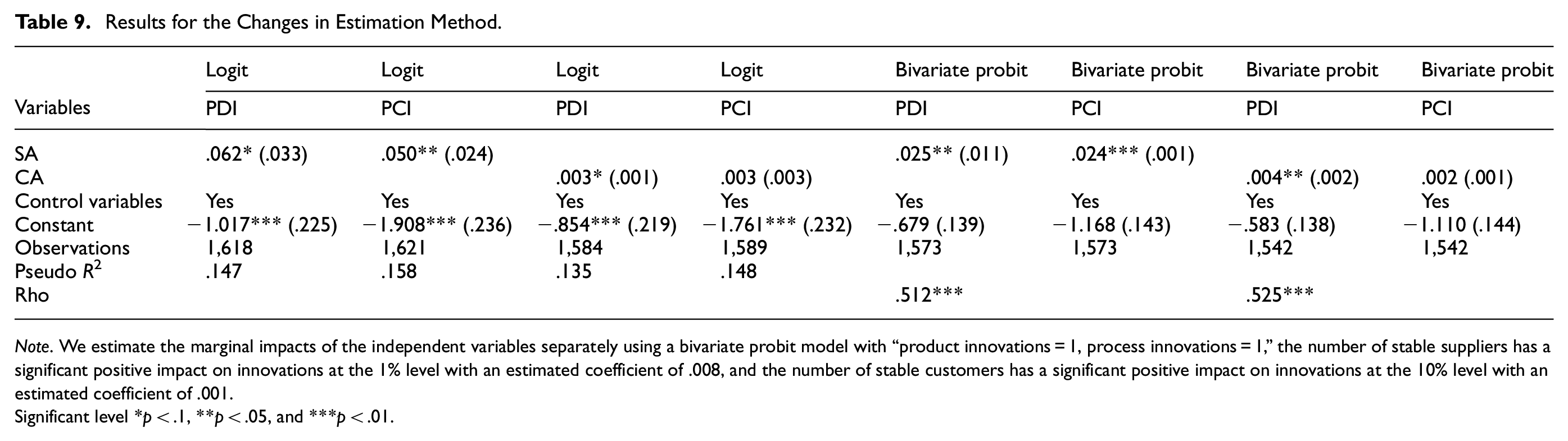
Note. We estimate the marginal impacts of the independent variables separately using a bivariate probit model with “product innovations = 1, process innovations = 1,” the number of stable suppliers has a significant positive impact on innovations at the 1% level with an estimated coefficient of .008, and the number of stable customers has a significant positive impact on innovations at the 10% level with an estimated coefficient of .001. Significant level *p < .1, **p < .05, and ***p < .01.
Endogeneity Issues and IV-Probit Model
The most critical issue to be addressed is the endogeneity of the independent variables. Referring to the work of Gupta and Bansal (2020), this research used the IV-Probit model and two-step regression to deal with endogeneity issues. “Degree of market competition” (DMC) is selected as an instrumental variable. Table 10 demonstrates that the Wald test results for all four models are significant at the 1% level, revealing that both independent variables are endogenous, and it makes sense to use instrumental variables. As shown in Table 10, both AR chi2(1) and Wald chi2(1) are significant, excluding the possibility of weak instrumental variables. The results of the first step of the regression in Table 10 depict that DMC has a significant positive effect on the SA and CA (p < .01), indicating that firms increase the number of stable suppliers and customers in response to the high degree of competition in the market. Likewise, Table 10 exhibits findings similar to those of the previous robustness tests, suggesting that the effect of the independent variables on the dependent variable under the influence of DMC remains consistent with the results of benchmark regression.
Results of IV-Probit Model.

Note. Significant level **p < .05, and ***p < .01. We chose only one instrumental variable in this research, so there is no instrumental variable overidentification.
Heterogeneity Analysis
In China, “The differential mode of association” constructed on an individual-centered basis, varies significantly for different individuals. For example, in terms of instrumental value and the number of members, the networks of powerful government officials are far superior to ordinary farmers or workers in China. It is also true for firms’ entrepreneurs, and we need to explain this heterogeneity. This research identified entrepreneur gender, prior entrepreneurial experience, and government experience as the main heterogeneity factors. To accurately assess the impact of sample heterogeneity on the causal relationship between the independent and dependent variables, this research used marginal effects to compare the estimated parameters across sample groups.
Gender of Entrepreneurs
First, this research prioritized the effect of entrepreneurial gender on causal inference. Furthermore, from Table 11, we find that the SA have a significant positive effect on PDI (p < .05) and PCI (p < .01) in the male sample group. The marginal impact coefficient is more significant than the female sample group (PDI: male group = .012 > female group = .006, PCI: male group = .013 > female group = .004). The female sample group, however, reflects the exact opposite result: CA has a significant positive effect on PDI and PCI, and a significantly larger marginal impact coefficient is found in the female sample group than in the male sample group.
Impact of Gender Heterogeneity of Entrepreneurs.

Note. Significant level *p < .1, **p < .05, and ***p < .01. The regression coefficients in this table are marginal effects.
Government Experience of Entrepreneurs
Table 12 shows the results of the heterogeneity analysis in entrepreneurs’ government experience. The entrepreneurs’ government experience was measured concerning the question, “Have you ever worked in a government department?.” If the entrepreneur has government experience, the variable is assigned a value 1. Otherwise, it is 0. In Table 12, columns (1) to (4) display the regression results for entrepreneurs with government experience and columns (5) to (8) show the regression results for entrepreneurs without government experience. The results show that the marginal impact of SA and CA on innovation is more significant for entrepreneurs with government experience than for entrepreneurs without government experience, and the sample group of entrepreneurs with government experience also has a better significance level.
The Impact of Heterogeneity in Entrepreneurs’ Government Experience.

Note. Significant level *p < .1, **p < .05, and ***p < .01. The regression coefficients in this table are marginal effects.
Entrepreneurial Experience
Finally, the research examined the effect of heterogeneity in entrepreneurs’ prior experience, with the variable corresponding to the question “Have you ever founded a business other than the one under investigation?” which is still a binary variable. Table 13 demonstrates the importance of entrepreneurial experience; both SA and CA have a significant positive effect on innovation for the sample group with entrepreneurial experience, while only SA have a significant positive effect on innovation for the sample group without entrepreneurial experience. Furthermore, the estimated parameters are more prominent for the sample group with entrepreneurial experience than those without entrepreneurial experience.
Impact of Heterogeneity of Government Experience.

Note. Significant level *p < .1, **p < .05, and ***p < .01. The regression coefficients in this table are marginal effects.
Mechanism Test
Moderating Effects of Shareholder and Government Acquaintanceships
The entrepreneurs’ government acquaintanceships (GA) were included as a moderating variable, and we added an interaction term between GA and SA in the benchmark regression. By including interaction terms, we implemented centralization for interaction terms to avoid multicollinearity interference. Table 14 displays the test results of the moderating effects of government acquaintanceships. Firstly, GA significantly positively affects PDI and PCI at the 1% level in four models, indicating the sample firms’ dependence on external government resources. However, the interaction term does not significantly affect innovation, pointing out the negative moderating effect of GA. Hypothesis H2 is confirmed.
Results of the Moderating Effect of Government Acquaintanceships.

Note. Significant level *p < .1, and ***p < .01.
We also tested the moderating effect of shareholders’ acquaintanceships (SHA) on the innovation. Table 15 demonstrates some interesting findings that SHA significantly positively affects PDI and PCI at the 1% level. However, the interaction term is negatively significant or not significant. It suggests that the SHA was beneficial for organizational innovation, but a hindering effect occurs once the SHA gets involved in the impact of CA or SA on innovation. Hypothesis H3 is confirmed.
Results of the Moderating Effect of Shareholder Acquaintanceships.
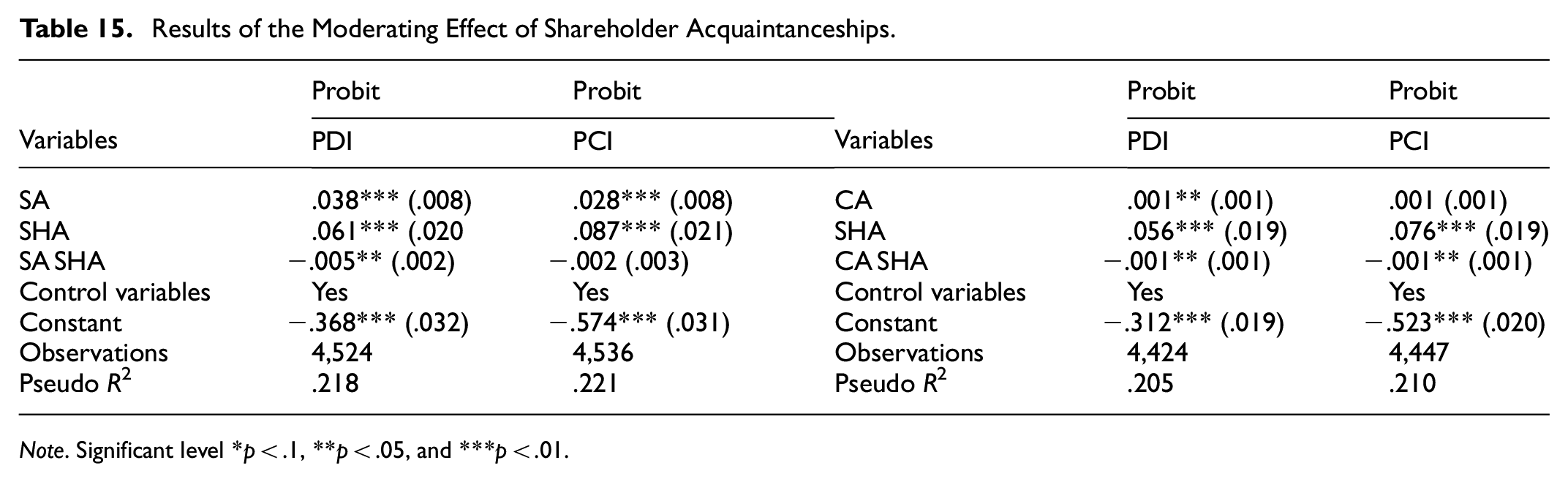
Note. Significant level *p < .1, **p < .05, and ***p < .01.
Mediating Effect of Individual Pragmatism
Next, this research tested the mediating effect of individual pragmatism using the stepwise regression method from the previous section. We used profitability (PRO) as a proxy variable measured by gross profit margin. The PRO is a quantitative variable, so a linear probability model is applied for the first step of regression. Columns (1) and (2) in Table 16 demonstrate the regression results of the two independent variables on the mediating variable, and it shows that the SA has a significant positive effect on PRO at the 1% level, while the CA does not reflect significance. Columns (3) to (4) in Table 16 subsequently test the indirect effects of the mediating variable on innovation, and it reveals that PRO has a significant negative effect on PDI at the 5% level, the PRO exerts a complete mediating effect (Ho et al., 2001). However, for SA, PRO’s mediating effect on PCI was insignificant. The results of the stepwise regression suggest that SA can significantly contribute to the PRO of firms, which in turn significantly inhibits PDI.
Results of the Mediating Effect of Profitability.

Note. Significant level **p < .05, and ***p < .01. GPM in the table is Gross profit margin. The number of iterations of the Bootstrap test is 1,000.
Then, to ensure the robustness of the stepwise regression to the mediating effect test, following the research of Peng et al. (2019), Sobel and Bootstrap tests were implemented afterwards. Sobel, Goodman-1 (Aroian), and Goodman-2 in Table 14 are the three statistics of the Sobel test, and it can be seen that all three statistics are significantly non-zero at the 5% level, suggesting that PRO has a mediating effect on the causality between the SA and PDI. The Bootstrap tests show that the 95% confidence interval for the indirect effect is [−0.0002, 0.0004] excluding 0; it indicates the presence of a mediating effect. In conclusion, all these results confirm the mediating effect of PRO. Hypothesis H4 is not confirmed.
Discussion
Findings
Our research focuses on the causal relationship between business acquaintanceships and innovation. Our research had some interesting findings.
Firstly, the results of the benchmark regressions demonstrate the asymmetric impact of business acquaintanceships on different forms of innovation. In short, firms’ customer acquaintanceships are more critical to product innovation. Compared to customer acquaintanceships, supplier acquaintanceships have a more decisive impetus to innovation and adaptability.
Secondly, we proved that some heterogeneous characteristics of entrepreneurs can interfere with the influence of business acquaintanceships on innovation. Considering the impact of the gender of entrepreneurs, female entrepreneurs’ customer acquaintanceships have a more significant impact on innovation than male entrepreneurs. Due to the subordinate position of Chinese women in a patriarchal, hierarchical society leads to differences and even discrimination in the division of labor (Khan et al., 2017; Y. X. Wang, 1996). In companies, women have less access to technical work and less contact with suppliers, while positions tending to be service-oriented bring women closer to customers. There is evidence that customer-facing female entrepreneurs are more risk-averse (Nissan et al., 2011), which may positively impact innovation.
Thirdly, vertical acquaintanceships in “The differential mode of association” negatively moderate horizontal business acquaintanceships. We tested the moderating effect using vertical acquaintanceships: shareholder and government acquaintanceships. We found that both shareholder and government acquaintanceships can promote innovation but weaken the positive impact of business acquaintanceships on innovation. Regarding government acquaintanceships, entrepreneurs’ personified interactions with government acquaintanceships are often motivated by economic objectives; the ensuing corruption and resource dependence can diminish the entrepreneur’s impulse to innovate (Ting, 1997).
Fourthly, we found a negative effect of individual pragmatism on innovation in our mediating effects test. Even though business acquaintanceships based on the principle of individual pragmatism are beneficial for increasing profitability, relational dependence can weaken entrepreneurs’ incentives to innovate.
Contribution
This research adopts a combined sociological and economic perspective, and further expanding our understanding of the impact of business relationships on innovation. Unlike some previous market-oriented research (e.g., collaborative innovation, patent transactions), our research discusses the motives of business acquaintanceship influencing innovation in a specific social context. Theoretically, our research can fill some gaps in previous research.
Although resources are crucial for innovation, the availability of resources (especially tacit knowledge) is a limiting factor for innovative progress (Andries & Hünermund, 2020). Our research suggests that “The differential mode of association” can give business partners the social status of “acquaintances,” which enhances the availability of “relational resources” for firms. Another new idea is that in “Individual-centered” circular social relationships, the closer the relationship is to the individual, the easier it is for the individual to obtain the relational resources needed for innovation. This idea could also explain the growth of family businesses in China (Y. Wang, 2016).
Trust is conducive to collaborative innovation, but changes in the business status or bargaining power between business partners can affect the sustainability of innovation. Some scholars claim that the socio-cultural context may determine the impact of different types of trust on innovation (Kmieciak, 2021). However, relatively little research places this proposition in the context of specific social relationships. In this research, we argue that the “emotional trust” generated by established social relationships between business acquaintances under “The differential mode of association” can reduce innovation uncertainty, which is different from the theoretical explanations of previous research.
As some scholars have said, there is a complexity in the interactions between various social relationships (Solomon et al., 2021). The positive effect of interpersonal interaction on knowledge sharing and innovation has been confirmed (Ghahtarani et al., 2020). However, our concern is whether business interactions still have a positive impact on innovation once the complex social relationships of the interactants are taken into account or whether the interaction of business acquaintanceships with other social relationships is also positive. Therefore, we examined the moderating effects of shareholders and government acquaintances based on the horizontal-vertical relationships characteristics of “The differential mode of association.” We found that shareholders and government acquaintances have negative moderating effects on innovation.
In short, this research has consistently emphasized the necessity of social relationships in connecting business interactions and innovation. The “business acquaintanceships” phenomenon produced by “The differential mode of association” can provide a new perspective. Based on the above analysis, we indicated that understanding the social structure of entrepreneurs and the social background of business partners will help to understand the social factors affecting firm innovation.
Limitations and Scope for Future Research
Like other empirical research, this research has some limitations that need to be improved in the future. First, the data samples used in this research are from the ESIEC data, which are mainly small and medium-sized enterprises (SMEs) and do not include large and micro enterprises. Furthermore, the data structure also does not clearly distinguish different types or sizes of enterprises. We believe there should be heterogeneous effects of business acquaintances on innovation among entrepreneurs in different sizes or types of enterprises, which is an important research direction in the future. Second, the rippling circle structure of “The differential mode of association” has been described in this research, where the closer the relationship is to the central individual, the more pragmatic it is. However, we have not categorized the different levels of acquaintance relationships. Further research may be needed in the future on the causal links between different levels of business acquaintanceships and innovation, such as the difference in the impact of kinship versus general partnership. Third, our research covered the individual market but did not go further. We need to consider further the cooperative basis of business acquaintances in the individual market. In this research, we have demonstrated the importance of emotional trust for innovation. However, this explanation should be extended to other behaviors of individual markets in future, such as purchasing, credit, and borrowing. Whether emotional trust (non-marketization) is more effective than cognitive trust (marketization) in external cooperation, the role of different trust mechanisms also requires attention. Fourth, our research demonstrates the impact of entrepreneurial heterogeneity on business acquaintanceships and innovation. However, we do not discuss this finding in depth. We argue that entrepreneurial heterogeneity may sometimes reflect differences in social values, such as different perceptions of gender or class across countries and races. The relationship among entrepreneurial heterogeneity, social values, and innovation is also a major direction for future research. Fifth, the empirical data from this research is cross-sectional. Future research could be conducted in the time dimension with long-term longitudinal studies, and optimization of the data layer could reduce common method bias when examining the causal relationships of critical variables.
