



Abstract
This study applied a three-step latent class analysis (LCA) approach to explore latent classes of learning strategy use and their moderation effects on the relationships between motivation and mathematics performance. The data of 15-year-old students from five East Asian educational systems related to Chinese culture in the Programme of International Student Assessment (PISA) in 2012 were analyzed. The findings indicated that Shanghai, Singapore, Taiwan, and Macau showed three latent classes of learning strategies, whereas Hong Kong had two latent classes. Most students in the five educational systems reported to use the control strategy, some students reported the use of combined learning strategies, and few students reported the use of memorization except for students in Shanghai. Furthermore, we found the moderation effects of learning strategy use on mathematics performance depended on the types of motivation and educational systems. This study provides insights into the advantages of a three-step LCA approach in educational research.
Keywords
Introduction
Learning strategy use plays a vital role in students’ academic performance. Students with high achievement are more likely to use deep learning strategies or a combination of various learning strategies (Greene et al., 2004; Metallidou & Vlachou, 2007; Pintrich, 1999). Researchers have attempted to classify students’ learning behaviors into different categories and label them as specific learning strategies (Pintrich, 1999; Weinstein & Mayer, 1986). Learning strategies are commonly recognized as cognitive and metacognitive strategies (Weinstein & Mayer, 1986). Cognitive strategies serve to help students process information through remembering, summarizing, and connecting prior and new knowledge. Metacognitive strategies allow students to assess whether they reach their goals, identify a knowledge gap, and adjust their learning behavior (Pintrich, 1999; Weinstein & Mayer, 1986). This established taxonomy of learning strategies in the literature is followed by an international large-scale achievement study, named the Programme of International Student Assessment (PISA) 2012, that includes memorization, elaboration, and control strategies (OECD, 2013a). Memorization strategies involve students learning only key terms or learning material repeatedly. In contrast, elaboration strategies involve students making connections to other ideas and developing alternative solutions. Control strategies involve students monitoring and planning throughout the learning process (OECD, 2013a). Generally, elaboration and control strategies are considered deep-level strategies, while memorization is a surface-level strategy (Pintrich, 1999; Weinstein & Mayer, 1986).
Previous studies focusing on learning strategy use have used a variable-centered approach that provides a single set of estimated parameters for a sample, which oversimplifies reality (Metallidou & Vlachou, 2007; Sorić & Palekčić, 2009; Yıldırım, 2012). However, scholars argued that learning strategy use may be a continuous process in which students apply various learning strategies during a learning process (Dinsmore & Alexander, 2016). Moreover, the phases of using learning strategies might be overlapped (Hattie & Donoghue, 2016). For example, students use memorization to acquire knowledge and then use elaboration to consolidate knowledge. In this process, it is impossible to differentiate when students use a specific strategy.
Given that the use of learning strategy is a dynamic and continuous process, person-centered approaches—latent class analyses (LCAs)—might be more appropriate for the use of learning strategy than variable-centered approaches. Recently, person-centered approaches have become popular in educational research (Häfner et al., 2018; Pastor et al., 2007; Shim & Finch, 2014) and were applied to identify different subgroups based on the patterns of responses to measured variables. The most appealing advantage of these person-centered approaches is that researchers can include multiple variables at once to investigate the interactions of students’ learning behavior and processes. Person-centered approaches can also identify heterogeneous profiles in characteristics of students’ learning such as motivation and learning behavior. For example, the interaction between homework time and homework effort (Flunger et al., 2015) and the interaction between achievement goals and motivation (Shim & Finch, 2014) were investigated using person-centered approaches. Thus, applying person-centered approaches in learning strategies could reflect theoretical arguments of the use of learning strategies.
Although considerable literature has shown the relations among students’ learning strategy use, motivation, and academic performance, most studies consider learning strategies as mediators between motivation and academic performance (Metallidou & Vlachou, 2007; Sorić & Palekčić, 2009; Yıldırım, 2012). However, it is unclear whether learning strategies may explain the relationship between motivation and academic performance. Thus, in this study, we attempted to examine the effect of learning strategies as moderators on the relationships between motivation and academic performance.
Only a few studies have examined these relations within East Asian educational systems (Lau & Chan, 2003; Lau & Ho, 2016; Law, 2009; Liu, 2009). Research focusing on an East Asian context is predominant in the reading domain with students from Hong Kong (Lau & Chan, 2003; Lau & Ho, 2016; Law, 2009). Yet, the features of learning reading or languages differ from mathematics, as assignments and tests in mathematics are likely to be multiple-choice or an open format with a specific solution. In the reading domain, students are often asked to write a summary or engage in reading comprehension. Thus, different types of assignments and tests are associated with the use of learning strategies within a specific academic domain (Clare & Aschbacher, 2001; Joyce et al., 2018). Given that motivation is contextual and domain-specific (Schunk et al., 2014), it is likely that students’ learning motivation may differ in mathematics compared to other content areas such as reading.
Moreover, mathematical knowledge is coherent, that is, basic mathematical concepts are linearly built upon another so that students can understand more complicated concepts once they master basic concepts (Vanderstoep et al., 1996). Regarding reading, the lists of topics seem to be loosely related. Thus, the features of subjects might result in a distinct tendency of learning strategy use (Donker et al., 2014). So far, little is known about the relations among students’ learning strategy use, motivation, and performance in mathematics using a wide range of East Asian samples derived from Chinese-related cultures.
Given that East Asian students’ outstanding mathematics performance has been documented in international large-scale assessments (Leung, 2017; OECD, 2013b), there is a need for more empirical evidence to support East Asian students’ outstanding mathematics performance. Focusing on learning strategy use, motivation, and mathematics performance may shed light on how East Asian students achieve high mathematics performance.
The present study makes a unique contribution to the field by applying a three-step LCA approach to explore latent classes of learning strategy use and their moderation effects on the relations between motivation and mathematics performance among students from five East Asian educational systems that are relevant to Chinese culture. A person-centered approach such as LCA is appropriate as learning strategies are a dynamic process, rather than using regression analyses or structural equation modeling. Further, although learning strategies have been examined as mediators, research examining them as moderating the relationship between motivation and academic performance is scarce. Lastly, this study examines these relations among students in a wide range of East Asian educational systems. Fifteen-year-old students from Shanghai, Singapore, Taiwan, Hong Kong, and Macau in the Programme for International Student Assessment (PISA) in 2012 were used.
Literature Review
Learning Strategies and Motivation Among East Asian Students
There is a stereotype of learning behavior among East Asian students that emphasizes the impact of memorization on high academic performance. Recent studies have challenged this stereotype. Cross-cultural studies evidenced that East Asian students used less memorization than other Western countries (Chiu et al., 2007; Liu, 2009; Wu et al., 2020). Liu (2009) demonstrated that American students reported greater memorization use than Hong Kong students while learning mathematics. Similarly, Wu et al. (2020) found that American students reported more memorization than Taiwanese students; Taiwanese students reported more elaboration and control strategies while learning mathematics. Building on evidence, East Asian students seem not to be stereotyped as rote learners.
Motivation is often conceptualized as intrinsic and extrinsic motivation. Intrinsic motivation refers to a focus on learning and mastery (Duncan & McKeachie, 2005). Students who are intrinsically motivated engage in learning tasks because they perceive them as inherently interesting. In contrast, extrinsic motivation is a focus on performance and approval from others (Duncan & McKeachie, 2005). Students who are extrinsically motivated engage in learning tasks because they view them as essential and useful for the future.
Previous studies have found that intrinsic motivation plays an important role in students’ learning in most countries (Chiu & Chow, 2010; Mullis et al., 2016; Zhu & Leung, 2011). Extrinsic motivation has revealed different patterns between East Asian and Western countries (Chiu & Chow, 2010; Jerrim, 2015; Liu, 2009; Zhu & Leung, 2011). Jerrim (2015) showed that East Asian students reported higher extrinsic motivation than students in Australia and England. Chiu and Chow (2010) found that the effects of extrinsic motivation on academic performance were lower for American students than Hong Kong students. Moreover, intrinsic and extrinsic motivation positively predicted mathematics performance in East Asian countries, but extrinsic motivation negatively predicted mathematics performance in Western countries (i.e., Australia, England, Netherlands, and USA) in the Trends in International Mathematics and Science Studies (TIMSS) 2003 (Zhu & Leung, 2011).
Effects of Learning Strategy Use on the Relations Between Motivation and Mathematics Performance
Self-regulated theory (SRL) hypothesizes students set goals and motivation that influences their learning behavior (phase 1), students evaluate their performance (phase 2), and students adjust their goals and motivation based on their self-reflection (phase 3; Zimmerman, 2000). Thus, motivation is related to the selection of learning strategies, and indirectly linked to performance. Aligned with this conceptualization, several studies have examined the extent to which motivation predicts academic performance through the mediation effects of learning strategies to understand the mechanisms underlying these associations (Chung, 2000; Lee et al., 2014; Metallidou & Vlachou, 2007; Sorić & Palekčić, 2009; Yıldırım, 2012). However, most studies have not found that the use of learning strategies was a potential mediator to explain the relationship between motivation and academic performance. Chung (2000) found that intrinsic motivation did not significantly predict language and mathematics performance through several mediators including learning strategies among fifth-grade Korean students. Similarly, Yıldırım (2012) showed that learning strategies did not mediate the relations of intrinsic and extrinsic motivation with students’ mathematics performance in a Turkish sample. In contrast, Metallidou and Vlachou (2007) found cognitive learning strategies as well as control strategies positively mediated the relations of motivation with language and mathematics performance. Although Lee et al. (2014) had similar findings as Metallidou and Vlachou (2007), their findings showed small positive to null relations between control strategies and academic performance, when control strategies were mediators between intrinsic motivation and achievement.
However, SRL only suggests the reciprocal relationships among motivation, learning strategies, and performance and does not explicitly state that learning strategies can only serve as a mediator. Conceptually, one might also expect that students with high levels of motivation and the use of deep-level strategies would perform well academically. Thus, it is reasonable to hypothesize that motivation may play a stronger role in predicting academic performance for students who use high-level learning strategies (e.g., deep-level strategies such as elaboration and control) than those who use low-level learning strategies (e.g., surface-level strategies such as memorization). Learning strategies may serve as a moderator to alter the magnitude of association between motivation and academic performance. (Baron & Kenny, 1986). Given that limited evidence exists regarding the role of a mediator for learning strategies, learning strategies may interact with motivation to moderate the strengths and directions of these relations. Considering learning strategies as moderators may help educational practitioners identify which type of learning strategies may enhance performance when students’ motivation is high.
The Selection of PISA 2012
Each PISA cycle focuses on a specific domain: (1) reading is the main domain in 2000, 2009, and 2018, (2) science is the main domain in 2006 and 2015, and (3) mathematics is the main domain in 2003 and 2012. Therefore, items of learning strategies and motivation are domain-specific. To investigate East Asian students’ mathematical learning, PISA 2003 and 2012 were the most suitable. However, only Hong Kong and Macao joined PISA 2003 (OECD, 2005). Thus, the number of educational systems related to Chinese culture is limited in PISA 2003.
In 2009, Shanghai joined PISA. Then, four major provinces in China—Beijing, Shanghai, Jiangsu, and Guangdong—started participating in PISA 2015. Since 2009, there has been a growing interest in investigating Chinese students’ learning outcomes (Areepattamannil & Caleon, 2013; Jiang et al., 2021; Kılıç Depren & Depren, 2021; Lau & Ho, 2016, 2020; Lee, 2014; Meng et al., 2017; Teng, 2020). Most literature focuses on the reading domain (Areepattamannil & Caleon, 2013; Kılıç Depren & Depren, 2021; Lee, 2014; Meng et al., 2017). For example, Kılıç Depren and Depren (2021) found that metacognition about assessing credibility (i.e., how do you rate the usefulness of the following strategies for writing a summary of this two-page text) was the most relevant variable to reading performance in the Chinese sample in PISA 2018. Meng et al. (2017) investigated how teaching factors and reading strategies contributed to reading performance in PISA 2009 by comparing the Chinese and American samples. They showed that teachers’ morality (e.g., most of my teachers treat me fairly) and simulation (e.g., my teacher gives me enough time to think about my answers) were important to American students, but not Chinese students. However, the reading strategy related to writing own words as a summary was important to Chinese students. One recent study compared high-performing educational systems—Hong Kong, China, Canada, and Finland—to investigate the association between motivation and science performance in PISA 2015 (Lau & Ho, 2020). Enjoyment of learning science was the strongest predictor of science performance across all countries; explicit and adaption instruction was positively related to enjoyment of science (Lau & Ho, 2020).
However, to our best knowledge, fewer studies have investigated the mathematics domain using a Chinese sample. Given that educational systems related to Chinese cultures perform well in mathematics, it is necessary to take Chinese students into account to examine associations among motivation, learning strategies, and mathematics performance. Among PISA datasets, PISA 2012 is the most appropriate for the current study because it directly measured mathematics-related motivation and learning strategies and included multiple educational systems related to Chinese cultures.
Latent Class Analysis With a Three-Step Approach
Although previous studies analyzed each type of learning strategy in a sample (Chiu & Chow, 2010; Yıldırım, 2012), this approach implies that students purely use one strategy during learning and that all students use the same strategy. These two assumptions might rarely occur in the real world. According to a model of learning (Dinsmore & Alexander, 2016; Hattie & Donoghue, 2016), the phases of learning processes start with surface learning, then deep learning and transfer of learning. These phases are partially overlapped; thus, students might combine different types of learning strategies simultaneously. Also, within a sample, subgroups might exhibit different typologies of learning strategies, depending on the levels of motivation and performance (Nylund-Gibson & Choi, 2018). Thus, to relax these two theoretical assumptions, a person-centered approach is appropriate.
A person-centered approach can overcome methodological assumptions and limitations of a variable-centered approach. First, a variable-centered method assumes that relations among variables are the same across individuals in a population or sample. Analyses using a variable-centered approach might be difficult to identify unobserved subgroups in a population or sample. Second, linear relations among variables in a variable-centered approach are built on a normal distribution assumption for variables. However, such a strong assumption does not always occur in real-world data. For example, the items of learning strategies in PISA use a forced-choice design (for details, see Method). Students are allowed to choose one learning strategy within an item. Thus, one cannot assume that the distributions of responses are normally distributed.
Given these theoretical and methodological arguments, a person-centered approach, latent class analysis (LCA), may be an alternative and useful approach. A person-centered approach relaxes the assumptions of a variable-centered approach in order to meet the natural features of variables. LCA can be used to identify unobserved subgroups (i.e., latent classes) in a population thereby grouping students with similar response patterns (Collins & Lanza, 2010). Furthermore, LCA does not require a normal distribution assumption for data. Thus, LCA is well-suited for the purpose of this study and the nature of learning strategies data.
In many LCA practical applications, latent classes can be used to predict outcomes (Asparouhov & Muthén, 2014). To conduct these analyses, researchers proposed a three-step approach that combines a latent class model and a regression model into a joint model (Asparouhov & Muthén, 2014; Vermunt, 2010). Including predictors or outcomes can capture heterogeneity of latent classes. In this study, we aimed to use motivation and mathematics performance to explain heterogeneity of latent classes that obtained from learning strategies.
Purpose of the Present Study
Most empirical studies have focused on East Asian students’ learning strategies, motivation, and performance, yet little research has addressed these relationships in the mathematics domain. To our best knowledge, there is no systematic investigation of East Asian students’ mathematical learning using a wide range of educational systems related to the Chinese culture (for details, see Selection of PISA 2012). In addition, there is limited evidence indicating that learning strategies may serve as a potential mediator. Theoretically, SRL implies learning strategies can potentially moderate relations between motivation and performance. Lastly, empirical studies assumed that all students use one learning strategy in a sample; however, this assumption might rarely occur in the real world, as students combine different strategies and students within a sample might display different learning behavior. Thus, to address previous limitations, this study applied a three-step LCA approach to explore latent classes of learning strategy use among East Asian students and examined their moderation effects on the relations between motivation and mathematics performance among five educational systems that are dominated by Chinese culture (i.e., Hong Kong, Macau, Shanghai, Singapore, and Taiwan; Yamamoto & Brinton, 2010). Thus, three research questions were addressed in this study:
To what extent do students in five East Asian educational systems apply learning strategies? We expected that few students purely used memorization and that many students used deep-level learning strategies (Chiu et al., 2007; Liu, 2009; Wu et al., 2020). We also expected that some students combined different strategies while learning mathematics (Dinsmore & Alexander, 2016; Donker et al., 2014). We did not make any specific hypotheses regarding how students combined learning strategies; this was exploratory in nature due to limited research.
To what extent do learning strategies moderate the relations between students’ motivation and mathematics performance? We expected that when students had high levels of intrinsic and extrinsic motivation, they tended to use deep-level strategies or combine different strategies to enhance their mathematical performance (Chiu & Chow, 2010; Jerrim, 2015; Zhu & Leung, 2011). In contrast, we expected that when students had low levels of intrinsic and extrinsic motivation, they tended to rely on memorization, which leads to low performance.
To what extent do five East Asian educational systems have the similarities and dissimilarities of learning strategies and their moderation effects? Given the limited number of studies focusing on East Asian students from a wide range of Chinese-related educational systems, this research question was exploratory.
Method
Participants
Participants in this study were 15-year-old students in PISA 2012. The sampling design was a two-stage stratified sample design (OECD, 2014). In the first stage, schools were systematically sampled based on probabilities proportional to the school size. Once schools were selected, students within the schools were randomly selected. PISA 2012 used a rotated design to distribute students’ questionnaires randomly (OECD, 2014). This two-stage stratified sample design aimed to collect a representative sample in each educational system. Three forms of student questionnaires (i.e., Forms A, B, and C) were distributed to students randomly. Form C was selected in this study because this form included learning strategy use and motivation variables. Choosing Form C due to the questionnaire design can provide a representative sample in each educational system. The present study examined five education systems in East Asia, including Hong Kong (N = 1,582), Macau (N = 1,784), Shanghai (N = 1,713), Singapore (N = 1,861), and Taiwan (N = 2,013). The full information maximum likelihood (FIML; Dong & Peng, 2013) was used to address missing values in Form C.
Measures
Three measures used in this study were from PISA 2012: learning strategy use, motivation, and mathematics performance.
Learning strategy use
Three learning strategies (i.e., memorization, elaboration, and control) were used to assess student mathematics learning behavior. PISA 2012 adopted a forced-choice format for learning strategy items (OECD, 2013a), which allowed each student to choose only one strategy to best describe their learning behavior. There were four items in the questionnaire, and each item included three mutually exclusive learning strategies: memorization, elaboration, and control strategies (see Table 1 for items). It is not recommended to calculate the reliability of a forced-choice format due to a violation of a basic assumption of independent errors between items (Brown & Maydeu-Olivares, 2013). Thus, we did not provide the reliability of learning strategy items.
Items of Learning Strategy Use and Motivation.

Motivation
Intrinsic and extrinsic motivation were measured using a four-point Likert scale with four items, respectively (see Table 1 for items). PISA 2012 provides indices of intrinsic and extrinsic motivation for each educational system. These indices are scaled with a mean of 0 and a standard deviation of 1 using an item response theory framework (IRT) (OECD, 2014). The reliabilities of indices of intrinsic and extrinsic motivation were high in OECD countries and partner countries. In our study, among the five East Asian countries, the range of reliability of intrinsic motivation was from .90 to .91; the range of reliability of extrinsic motivation was from .87 to .91 (OECD, 2014).
Mathematics performance
In the PISA assessment, mathematical contents cover: (a) change and relationships, (b) space and shape, (c) quantity, and (d) uncertainty and data. PISA 2012 adopted a booklet design whereby each student was randomly assigned to one of thirteen booklets and tested on a portion of items from the entire item pool. Thus, rather than using raw scores, five plausible values with a mean of 500 and a standard deviation of 100 across countries were provided to represent student mathematics performance in PISA 2012. These plausible values were drawn from the estimated posterior distributions using an IRT framework (OECD, 2014). Using either the average of five plausible values or one of five plausible values as student performance might lead to biased estimates (von Davier et al., 2009). Thus, we used five plausible mathematics values in the analyses.
Statistical Analyses
A three-step LCA approach
The three-step LCA approach is developed under the structural equation modeling (SEM) framework (see Asparouhov & Muthén, 2014; Vermunt, 2010). A three-step LCA approach was applied to explore latent classes in each educational system and to examine the moderating effects of learning strategy use on the relations between motivation and mathematics performance. The model specification of a three-step LCA approach involves three steps. The first step is an unconditional model without predictors and outcomes, with the aim to find a measurement model that fits the data well. In this step, we searched for the best fit model (i.e., class enumeration). The second step is to obtain the estimated parameters in the unconditional model that provided the fixed values for accounting for estimated errors of the assignment of a class. The third step is to include predictors and an outcome while fixing the estimated parameters in the unconditional model. This step is similar to a standard SEM approach where researchers include the structure part after finding the fitted measurement model. We describe the details of the three-step model specification in the following subsections.
Step 1: Class enumeration
In the first step, latent classes were explored using students’ responses to four learning strategy items. To explore latent classes in each educational system, the LCA models with 1-, 2-, 3-, and 4-class solutions were fitted to each of the seven education systems separately. The Akaike information criterion (AIC; Akaike, 1987), Bayesian information criterion (BIC; Schwarz, 1978) and adjusted BIC (a_BIC; Sclove, 1987), were used to select the optimal number of latent classes, because LCA models are not nested with each other. BIC and a_BIC have shown better performance in the LCA simulation compared with AIC (Nylund et al., 2007); thus, BIC and a_BIC were referred to model selection. BIC and a_BIC with lower values suggest a better model fit. In addition, the Lo–Mendell–Rubin (LMR) test was used to select the number of latent classes. The LMR compares a model with k classes against an alternative model with k-1 classes. If an LMR result has a significant p-value, it suggests that a model with k classes is favored. In addition to statistical evidence, we also considered the meaningful interpretations of latent classes in each educational system in order to make a final decision of the number of latent classes (Marsh et al., 2009). The interpretations of latent classes were based on the maximum number of highest conditional probabilities of the respective type of learning strategies. For example, if three or four out of four items have the highest conditional probabilities on the “Control strategy” option within one class, that class is labeled as the “Control” class. If one latent class has two items with the highest probabilities on two or three different strategy options, that class is categorized as the “Combination” class.
Step 2: Estimated parameters for a class
In the second step, each student was classified into one of the identified latent classes of learning strategy use based on the highest probability of class membership obtained from the first step. We obtained the estimated parameters of the final model from the first step. The estimated parameters that account for the measurement error can be found in the Mplus output. The estimated parameter of the last class is fixed 0 as a reference group. The details of manual calculations can be referred to Formula One in Asparouhov and Muthen (2014). These estimated parameters would be fixed in the third step to avoid the shift of class membership.
Step 3: Including predictors and an outcome
In the third step, we included intrinsic motivation and extrinsic motivation as predictors and mathematics performance as a dependent variable in the regression model. Latent classes of learning strategy use were moderators. In addition, we fixed the estimated parameters for each class. Figure 1 depicts the three-step LCA model to explain the relations between motivation, learning strategy use, and mathematics performance.

A three-step approach with a latent class variable of learning strategies as a moderator.
In the three-step LCA approach as shown in Figure 1, students’ five mathematics plausible values were dependent variables; intrinsic motivation and extrinsic motivation were two predictors; the types of learning strategy use as latent classes were moderators. Analyses were conducted with Mplus 7.4 (Muthén & Muthén, 2015). To include five mathematics plausible values, “Type=imputation” syntax was used in the Mplus.
Results
Descriptive Statistics
Table 2 presents descriptive statistics for motivation and learning strategies items. At the top of the table, the means and standard deviations of intrinsic and extrinsic motivation among the five educational systems are presented. Macau had the highest levels of intrinsic and extrinsic motivation, followed by Taiwan, Shanghai, and Singapore. Hong Kong had the lowest levels of intrinsic and extrinsic motivation. Across the five educational systems, the means of intrinsic motivation were higher than those of extrinsic motivation. The rest of Table 2 presents the proportions of students endorsing one of three learning strategies for four items of learning strategy use across the five educational systems. In the five educational systems, there were consistently the largest proportions of students endorsing the control strategy for Items 1, 2, and 3 of learning strategy use. For instance, excluding the missing data (i.e., 2.5%), there were 58.90%, 27.40%, and 11.20% of students endorsing learning strategies of control, elaboration, and memorization, respectively, in Shanghai. For Item 4, there were the largest proportions of students endorsing memorization in all educational systems except for Singapore. The missing data information is presented in Table 2 as well. Overall, there were extremely low missing data in the five educational systems in East Asia, ranging from 2.5% (Item 1 in Shanghai) to 0.20% (motivation items in Taiwan). Descriptive statistics for mathematical scores were not provided in Table 2 because mathematical scores were derived from five plausible values.
Descriptive Statistics of Motivation and Learning Strategies Items across Five Educational Systems.

Note. The means and standard deviation for learning strategies items are not available due to the forced-choice format. The proportions of each type of a learning strategy are presented within an item.
Typology of Learning Strategy Use
Table 3 shows the outputs of selection criteria for one-, two-, three-, and four-class solutions for five East Asian educational systems. As seen in Table 3, BIC, a_BIC, and the LMR test consistently favored the three-class solution in Singapore and Macau as well as the two-class solution in Hong Kong. BIC and the LMR test favored the three-class solution in Shanghai, but the a_BIC favored the four-class solution. We chose the three-class solution for Shanghai based on BIC and the LMR test. The three-class solution was chosen for Taiwan based on BIC as well as meaningful interpretations. Altogether, the three-class solution presented in Shanghai, Singapore, Taiwan, and Macau, whereas the two-class solution presented in Hong Kong.
Selection Criteria for Model Fit in Each Educational System.

Note. The values in bold represent the smallest value in BIC and a_BIC, and the significant p-value at .05 level in LMR. LMR = The Lo–Mendell–Rubin test.
The interpretations of the latent classes of learning strategies were defined based on the number of highest endorsement probabilities of the three types of learning strategies (i.e., control, elaboration, and memorization) for four items. Table 4 presents endorsement probabilities of the use of three different strategies and class sizes for latent classes for the five educational systems. The substantive interpretations of latent class characteristics based on the endorsement probabilities of three types of learning strategy are presented at the bottom of Table 4.
Endorsement Probabilities of Each Item for Latent Classes in Each Educational System.
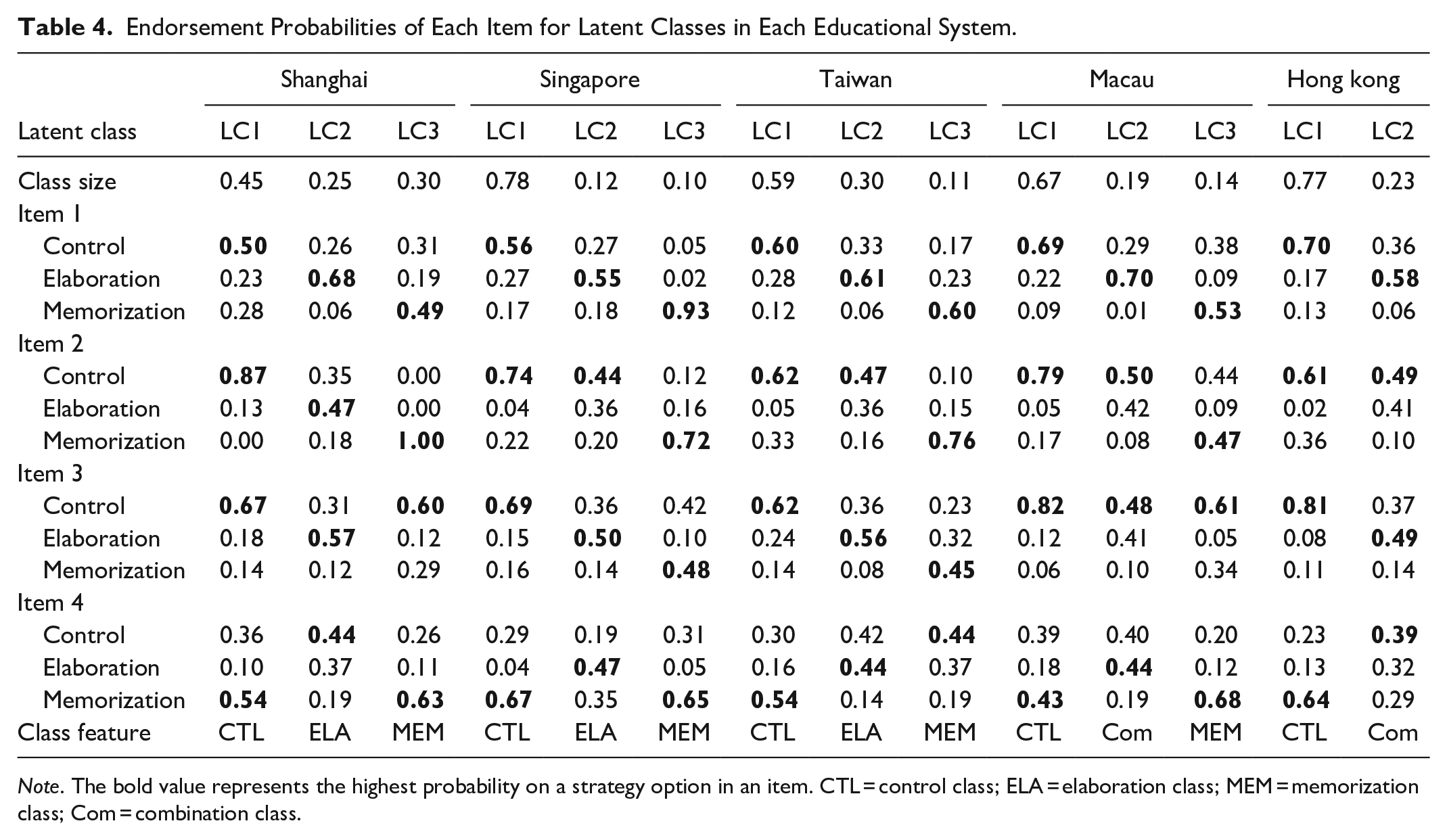
Note. The bold value represents the highest probability on a strategy option in an item. CTL = control class; ELA = elaboration class; MEM = memorization class; Com = combination class.
As seen in Table 4, Shanghai, Singapore, and Taiwan had the same characteristics of three latent classes: the memorization, elaboration, and control classes. In these educational systems, students in the control class reported three out of four items with the highest endorsing probabilities on control strategies, and one item on memorization (Item 4). In other words, students in the control class in Shanghai, Singapore, and Taiwan showed consistent response patterns. Students in the elaboration class had three items with the highest endorsing probabilities on elaboration, and one item on a control strategy (Item 2 for Singapore and Taiwan, Item 4 for Shanghai). Shanghai, Singapore, and Taiwan had a memorization class and Singapore had the highest probabilities endorsing on memorization across four items. Taiwanese and Shanghai students had three items on memorization and one item on control (Item 4 for Taiwan, Item 3 for Shanghai). Based on response patterns in these three latent classes, the use of learning strategies from Singaporean and Taiwanese students exhibited more similar than Shanghai students.
Macau also had three latent classes that involved the same control and memorization classes and the combination class of control and elaboration. In the control class, three items had the highest endorsing probabilities on control and one on memorization (Item 4), same as those in Shanghai, Singapore, and Taiwan. In the memorization class, three items had the highest probabilities endorsing on memorization and one on control (Item 3), same as those in Shanghai. In the combination class, two items had the highest endorsing probabilities on control (Items 2 and 3) and two items on elaboration (Items 1 and 4).
Hong Kong possessed the control class and the combination class. Like other four educational systems, the response pattern for the control class was that three items had the highest endorsing probabilities on control and one on memorization (Item 4). The combination class for Hong Kong was also the combination of control and elaboration with the two highest endorsing probabilities on control (Items 2 and 4) and the two highest endorsing probabilities on elaboration (Items 1 and 3). The control and elaboration combination classes were the same as that in Macau but were partially different in response patterns.
At the top of Table 4 shows the proportions of students in latent classes for the five educational systems. In the four educational systems with three latent classes, more students (45%–78%) were classified into the control class, and fewer students (10%–15%) were in the memorization class except for students from Shanghai (30%). Few students from Singapore (12%) and more students from Taiwan and Shanghai (30% and 25%, respectively) reported the use of elaboration. Approximately 20% of students in Macau reported the combined use of the control and elaboration strategies. As for Hong Kong with two latent classes, most students (77%) were classified in the control class, and fewer students (23%) reported a combined use of strategies, like those distributions in other four educational systems.
Moderation Effects of Learning Strategy Use
Table 5 presents the estimated standardized coefficients and standard errors of estimates of two predictors (i.e., intrinsic motivation and extrinsic motivation). For students who were classified in the control class, intrinsic motivation had significant and positive effects on mathematics performance in Hong Kong, Macau, and Taiwan, but not in Shanghai and Singapore. This result indicated that students who reported more control strategies with higher intrinsic motivation tended to have higher mathematics performance in Hong Kong, Macau, and Taiwan. For Shanghai and Singaporean students in the control class, intrinsic motivation did not significantly predict mathematics performance. Extrinsic motivation significantly and positively predicted mathematics performance when students were in the control class only in Taiwan and Hong Kong, but it showed a significantly negative prediction for Singaporean students who were in the control class. Extrinsic motivation did not have significant predictions on mathematics performance for students from the control class in Shanghai and Macau.
The Standardized Coefficients of Two Predictors for Each Class in Each Educational System.

Note. The value in the parenthesis is the standard error of the estimate. The value with boldness indicates significance at the .05 level.
Only Shanghai, Singapore, and Taiwan showed the elaboration class. For all three educational systems, intrinsic motivation significantly and positively predicted mathematics performance. However, only Taiwanese students in the elaboration class showed a significant and positive impact of extrinsic motivation on mathematics performance. Students in Shanghai and Singapore did not show significant effects of extrinsic motivation on mathematics performance.
Four educational systems had the memorization class, including Shanghai, Singapore, Taiwan, and Macau. Both types of motivation had no impact on mathematics performance in Taiwan and Macau. In Shanghai, only intrinsic motivation showed a significantly positive impact on mathematics performance. For Singaporean students in the memorization class, both types of motivation had significant impacts on mathematics performance. Intrinsic motivation positively predicted mathematics performance, whereas extrinsic motivation negatively predicted mathematics performance.
Macau and Hong Kong had the combination class of the control and elaborations strategies. As shown in Table 5, intrinsic motivation significantly and positively predicted mathematics performance in these two educational systems, while extrinsic motivation had no significant impacts on mathematics performance.
Discussion
This study used a three-step LCA (i.e., person-centered) approach to explore latent classes of learning strategy use. Specifically, this study examined the moderation effects of learning strategy use on the relations between motivation and mathematics performance (i.e., the effects of the interactions between learning strategy use and motivation on mathematics performance). The data of 15-year-old students from five East Asian educational systems related to Chinese culture in the Programme of International Student Assessment (PISA) in 2012 were analyzed, including Shanghai, Singapore, Taiwan, Macau, and Hong Kong. The results indicated that Shanghai, Singapore, Taiwan, and Macau showed three latent classes of learning strategies, whereas Hong Kong had two latent classes. Most students in the five educational systems reported to use the control strategy, some students reported the use of combined learning strategies, and few students reported the use of memorization except for students in Shanghai. The moderation effects of learning strategy use on mathematics performance depended on the types of motivation and educational systems. We discuss how this study provides insights into the advantages of a three-step LCA approach in educational research. Implications and future research directions are also discussed.
Similarities and Dissimilarities of Typology of Learning Strategy Use
The findings indicated that all five educational systems possessed the control classes and had similar response patterns in the control class. In addition, most students in these educational systems were classified in the control class. These findings reflected the similarities of learning strategy use among these educational systems. With outstanding mathematics performance among these East Asian educational systems in PISA 2012 (OECD, 2014), the use of control strategies may play a key role in promoting high academic performance. Similarly, most educational systems had the memorization classes, but few students (i.e., 14% or less) were classified in this class except for Shanghai (30%). On the one hand, these findings aligned with previous studies suggesting that few East Asian students reported memorization (Chiu et al., 2007; Liu, 2009; Wu et al., 2020). On the other hand, the findings indicated that some educational systems related to Chinese culture seem likely to choose memorization, even though few students reported to use it in this study. Over the past decades, some East Asian educational systems have been reformed to improve students’ critical thinking development and to help students to become independent learners (Cheng, 2017). For instance, new curriculum reforms in China emphasize critical and analytical thinking rather than passive and rote learning (Yin, 2013). A recent reform in Taiwan aims at encouraging students to be motivated and passionate about society, nature, and culture (Cheng, 2017). Recent efforts in these educational systems may have important implications for the learning strategy use among East Asian students and may serve as a plausible explanation of why most students reported using control strategies and few students used memorization strategies in these East Asian educational systems.
Although Shanghai, Taiwan, and Singapore had the same latent classes, the characteristics (i.e., response patterns) of learning strategy use in Singapore and Taiwan were more alike than those in Shanghai. Singapore and Taiwan had almost identical response patterns across three types of learning strategy use, except for one item response in the memorization classes. Likewise, the characteristics of learning strategy use among Shanghai, Macau, and Hong Kong shared many similarities. Both Shanghai and Macau possessed the control and memorization classes and shared the same response patterns. In addition to the control class, the response pattern of the elaboration class in Shanghai was similar to the combination class in Hong Kong, except for one item. Finally, Macau and Hong Kong had two same latent classes, and they were only two educational systems that exhibited the combination class of the control, and elaboration strategies. These findings revealed that students’ learning behaviors were close to Macau, Hong Kong and Shanghai, which might be due to the fact that these educational systems share some same features (Li & Choi, 2014).
Students in these five educational systems consistently reported the partial use of memorization in the control class and the partial use of control in the elaboration and memorization classes, except for Singaporean students in the memorization class. These findings suggested that most students in these educational systems may not consistently use one strategy in the process of learning mathematics, which aligned with the hypotheses from Dinsmore and Alexander (2016) as well as Hattie and Donoghue (2016). Both studies hypothesized that learning strategy use is a continuous process so that students may exchange surface- and deep-level strategies in the learning process based on their levels of domain knowledge and the nature of a task. These findings may also align with qualitative cross-cultural studies demonstrating that Chinese and Hong Kong students perceived memorization as boosting their understanding and combined memorization with deep-level strategies (Kember, 2000; Marton et al., 1996).
Similarities and Dissimilarities of Learning Strategies as Moderators
Regarding the moderation effects of learning strategy use, this study showed that these effects on mathematics performance depend on the types of motivation and various educational systems. Generally, the moderation effects of learning strategies with intrinsic motivation made more significantly positive impacts on mathematics performance than those with extrinsic motivation across educational systems. Especially with the elaboration class, intrinsic motivation showed consistently positive impacts on mathematics performance across all three educational systems (i.e., Shanghai, Singapore, and Taiwan). In contrast, extrinsic motivation had inconsistent effects on mathematics performance with different types of latent classes across five educational systems; that is, most moderations with extrinsic motivation had no impact (e.g., Shanghai and Macau across all latent classes), some showed positive impact (e.g., Taiwan with control and elaboration as well as Hong Kong with control and combination), but some had negative effects (e.g., Singapore with control and memorization). The findings contrasted with previous literature that suggested intrinsic motivation had no or small effect on mathematics performance when learning strategies were mediators (Chung, 2000; Lee et al., 2014; Yıldırım, 2012). The different results might result from learning strategies as moderators in this study, which highlighted that learning strategies could interact with motivation to moderate the strengths and directions of these relations.
From a perspective of an individual educational system, Taiwan and Hong Kong seemed to have consistently positive moderation effects of learning strategies with intrinsic and extrinsic motivation for students in most types of learning strategies, but not in the memorization class. Taking high proportions of students in the control classes into consideration, these findings partially supported Zhu and Leung’s (2011) study showing that intrinsic and extrinsic motivation positively predicted mathematics performance without taking learning strategies into account in Taiwan, Hong Kong, and other East Asian educational systems (i.e., Korea and Japan). Intrinsic motivation did not have significant impacts for Taiwanese and Macau’s students who report using memorization, which was in line with empirical studies evidenced that memorization was not an appropriate strategy to help students obtain desirable learning outcomes such as motivation or academic performance (Donker et al., 2014; Sorić & Palekčić, 2009). However, memorization had significantly positive effects on mathematics among Shanghai students, and especially for Singaporean students. Singaporean students with high intrinsic motivation could still obtain high mathematics performance, though they used memorization strategies. These results could indicate that Singaporean teachers do not have concrete concepts between metacognition and cognition learning strategies to teach students (Lee et al., 2019). In turn, students might not understand how to use appropriate learning strategies during learning mathematics, though they have high intrinsic motivation. Thus, these findings provided instruction implications in mathematics in Singapore.
Different patterns of the effect of extrinsic motivation may result from educational system structures and parents’ expectations. Most education systems in this study are competitive due to public examinations for enrolling high schools or universities (Cheng, 2017; Deng & Gopinathan, 2016), and parents often set high expectations on students (Kim & Bang, 2017; Mun & Hertzog, 2019). In the current study, only students in Taiwan and Hong Kong have additively positive impacts of extrinsic motivation that may be resulted from the school and family environment. Surprisingly, the control and memorization classes in Singapore showed negative effects of extrinsic motivation on their mathematics performance. Future research should explore why Singaporean students with higher extrinsic motivation tended to have lower mathematics performance when they use control and memorization strategies.
Conclusions and Future Research Directions
Learning strategy use and motivation are essential to students’ academic performance. The present study makes a unique contribution to the field by applying a three-step LCA approach to explore the combination of learning strategies and examine whether latent classes of learning strategy could serve as moderators to explain the relations between motivation and mathematics performance. This study captures the use of combined learning strategies and latent classes of learning strategy use as a moderator to explain the relations between motivation and mathematics performance among East Asian educational systems which are dominated by Chinese culture. Our study demonstrates that the use of learning strategies is a continuous process as students interchanged different learning strategies based on the context when learning mathematics. This has implications for mathematics classroom instruction in East Asian educational systems. For instance, teachers could instruct which different types of learning strategies are used, as well as how and when they are used, so that students could efficiently switch learning strategies while learning mathematics. Moreover, control strategies and intrinsic motivation appeared to be important for East Asian students to learn mathematics, compared to other strategies and extrinsic motivation.
There are suggestions for future research based on the limitations of this study. First, due to the nature of PISA data, learning strategies and motivation were assessed with limited scales, which might provide limited information on the use of mathematics learning strategies and mathematics motivation. Future studies could use more comprehensive scales possibly accompanied by personal digital assistants (e.g., videotaping) to collect qualitative data during or immediately following learning events and tasks that may more accurately assess the use of learning strategies and motivation. Second, this study used the samples from five East Asian educational systems that are highly related to Chinese culture. To understand the generalizability of the findings in this study, researchers could consider other cultural populations (e.g., English-speaking educational systems). Moreover, the heterogeneity of the five educational systems is not considered in this study, such as differences in economic development or education. Social, economic, and/or educational diversities (e.g., social-economic status, parental income, and education) can be incorporated in the future studies of learning strategy use. For instance, these variables can be added in three-step LCA analyses as covariates to examine if the latent class patterns of learning strategy use and/or the moderating patterns across the five educational systems are different. Moreover, to better understand similarities and differences in the use of learning strategies and motivation across these educational systems, teaching practices should be considered. Teaching practices can influence students’ psychosocial and learning outcomes. For example, if teachers adopt cooperative learning strategies in the classroom, students tend to be engaged in learning due to social interactions with classmates (Hoek et al., 1999). When teachers provide students with emotional support, students feel connected to the learning environment (Romano et al., 2020). Thus, fostering a positive learning environment may influence students’ motivation and selection of learning strategies. We encourage future studies to investigate how the quality of instruction influences motivation and learning strategies among East Asian students. Finally, the nature of the data in this study is cross-sectional. With the use of longitudinal data or repeated measures, the results may display different patterns. Researchers are encouraged to examine the effects of learning strategies as moderators with longitudinal data.
Footnotes
Declaration of Conflicting Interests
The author(s) declared no potential conflicts of interest with respect to the research, authorship, and/or publication of this article.
Funding
The author(s) disclosed receipt of the following financial support for the research, authorship, and/or publication of this article: This work was supported by the Bamberg Graduate School of Social Sciences which is funded by the German Research Foundation (DFG) under the German Excellence Initiative [GSC1024].
