




Abstract
In recent years, there has been exponential growth in research on the impact of digital technologies on business model innovation in enterprises. This paper provides an overview of the literature on business model innovation under the influence of digital technologies. We select 173 peer-reviewed papers and employ a combined quantitative and qualitative research approach to compare the results of different bibliographic analyses, such as citation analysis, co-citation, bibliographic coupling, and keyword co-occurrence, to identify the most influential journals, authors, papers, and three thematic clusters. For each cluster, we analyze the literature and the reasons behind the clustering results. Based on the publication dates of the literature, we identify potential research areas and future directions to address the shortcomings of existing research.
Keywords
Introduction
Along with the development of digital technology, enterprises have begun to closely follow the trend of digitization, trying to modify their strategies to align with the changing market trends and competition. The trend of digitization has disrupted some business models while bringing opportunities to others (Fakhar et al., 2020). Such as Kodak, which was eliminated due to a lack of new value propositions, and Airbnb which broke the traditional business model of the real estate intermediary industry by integrating idle housing resources. The inability to innovate business models means the inability to survive in the new economic paradigm centered around digital technology (Chesbrough, 2010). In recent years, digital technology has been widely used by many enterprises to shape various aspects of enterprise operations and production processes, becoming a new means for enterprises to create and capture value (Björkdahl, 2020; Kiel et al., 2017; Metallo et al., 2018).
Business model innovation (BMI), as a bridge between technology and firm performance, is believed to contribute to enterprises gaining competitive advantages (Baden-Fuller & Haefliger, 2013). Therefore, in the digital environment, integrating digital technology into business model innovation has become an important research trend in the development of digital technology (Chesbrough & Rosenbloom, 2002; Foss & Saebi, 2018; Li et al., 2023; Metallo et al., 2018; Xie et al., 2024). The emergence of digital technology and the increasing digitization of the public has thoroughly transformed society’s equilibrium. On one hand, under the influence of IoT, the form of products has shifted from static and stable physical forms to dynamic and resettable service-oriented forms. On the other hand, digital technologies represented by platforms have spawned new ways of stakeholder interaction, providing possibilities for enterprises to leverage market opportunities across boundaries. Digital technology has become pervasive across industries, revolutionizing traditional business models and operations (Manyika et al., 2016). Therefore, enterprises striving to survive in the constantly changing digital world must reconfigure their existing business models when entering the market and engaging in competition.
Although research on business model innovation (BMI) is mainstream in the digital context, our understanding of how technological changes and disruptive innovations influence business model innovation remains limited (Caputo et al., 2021). Therefore, this paper will focus on exploring business model innovation under the influence of digital technology, especially the changes in business model innovation triggered by digital technology over the last decade. Through citation analysis, co-citation analysis, and bibliographic coupling analysis, important research literature, authors, and journals in this field are identified. Keyword clustering is used to reveal and outline the research themes of business model innovation stimulated by digital technology. A literature quantitative analysis is conducted on 173 articles published in peer-reviewed academic journals to systematically review and summarize recent research related to business model innovation under the influence of digital technology. The research contribution of this paper is that descriptive analysis and bibliographic analysis are both applied to determine the research trends in this field. Descriptive analysis is used to identify annual publication trends, major research institutions, and countries involved. The bibliographic analysis is used to determine the most influential journals, authors, articles, and research themes in this field, and provide a research agenda for future studies. By combining bibliographic and content analysis, literature is summarized, compared, and selected to reduce inherent biases in various forms of bibliographic analysis.
Overview
Business Model and Business Model Innovation
The business model is considered a set of arrangements that enterprises configure in specific business dimensions (Baden-Fuller & Haefliger, 2013; Winter & Szulanski, 2001). It emphasizes how enterprises deliver value to end-users in a cost-effective manner (Zott & Amit, 2010). The business model aggregates the processes, activities, resources, and stakeholders of the enterprise, while also determining the overall realization of business activities and the sources of revenue. Business models are generally divided into three dimensions: value creation, value proposition, and value capture (Morris et al., 2005; Spieth et al., 2014; Zott & Amit, 2013). Value creation defines how enterprises create value along the value chain by utilizing internal and external resources and capabilities (Achtenhagen et al., 2013). Value proposition defines a series of solutions for customers and the channels through which these solutions are provided to customers (Johnson et al., 2008). Value capture defines how enterprises convert value propositions into revenue, including the revenue and cost models of the enterprise.
Baden-Fuller and Haefliger (2013) suggests that business model innovation revolves around the business model rather than products or processes. It encompasses but is not limited to innovations in coordinating products, services, technologies, and information flows within the enterprise. Thus, business model innovation involves adjustments or modifications to the three dimensions of the business model, seeking new logic for enterprise operations, and new methods for creating and capturing value for stakeholders. Business models play a vital role within organizations, serving as a collection of enterprise activities and a bridge between technological inputs and economic outputs (Chesbrough & Rosenbloom, 2002). Consequently, an increasing amount of research is focusing on how to innovate business models, particularly during times of market upheaval driven by digital technology, where business model innovation may play a crucial role in maintaining competitive advantages for enterprises (Amit & Zott, 2012; Casadesus-Masanell & Zhu, 2013; Chesbrough, 2010). Business model innovation entails changing previous business models under changing environmental conditions and technological transformations to gain competitive advantages and increase value. Chesbrough (2010) regards business model innovation as progressive or disruptive changes to enterprise business model dimensions, or as exploring new ways to develop or search for value creation and capture.
Digital Technology and Digitization
Technology has always played a crucial role in shaping society and driving social progress. New technologies are considered catalysts for industrial transformation, and unlike the new technologies of industrial societies, digital technology represents a combination of various technologies, leading to more profound changes than ever before. The lack of uniformity in the concept of digital technology is a significant factor hindering the development of related research. Existing studies mostly regard social media, mobile devices, big data, as well as cloud computing, the Internet of Things (IoT), blockchain, and other technologies as digital technologies (Elia et al., 2020). Rippa and Secundo (2019) suggest that digital technology consists of highly interrelated components such as the Internet of Things, cloud computing, and big data analytics, which can influence or lead to business innovation. Generally, the theoretical community widely accepts Nambisan et al.’s (2017) definition of digital technology, which identifies digital components, digital platforms, and digital infrastructure as its manifestations. Digital components represent digitized products and services. Digital platforms refer to a set of shared and general services and architectures. Digital infrastructure comprises tools and systems centered around communication, writing, and computing capabilities. However, value is only realized when technology interacts with enterprise business models. This implies that value is unlocked when enterprises transform their operations under the influence of digital technology.
This has led to the emergence of numerous concepts related to digital technology. Digitalization, digital transformation, digital business models, digital business model innovation, and so on. To understand how digital technology has influenced the innovation of business models, it is necessary to clarify the scholars’ definitions regarding the relationship between business model innovation and digital technology. Initially, the concept that linked digital technology with business model innovation was digitization (Fors, 2013). Scholars viewed digitization as a process of integrating digital technology into everyday life. In the context of enterprises, digitization implies three outcomes: pure physical products, digitally enhanced physical products, and fully digital products. The focus of research on digitization is primarily on “products,” rather than other dimensions of enterprise business models (value creation, delivery, and distribution).
Veit et al. (2014) and Verhoef and Bijmolt (2019) introduced the concept of digital business models (during the research process, it was found that there is no significant difference between digital business model innovation and digital business model concepts), meaning that if digital technology triggers fundamental changes in how businesses conduct operations and generate revenue, then the business model of the enterprise is digitalized. D’Ippolito et al. (2019) determine whether a company has engaged in digital business model innovation by identifying whether digital technology has led to gradual or radical changes in the company’s resources and capabilities and whether this change is cross-industry. This indicates that the impact of digital technology on business models manifests in several aspects such as how business operations are conducted, how revenue is generated, and the resources and capabilities of the enterprise.
Some scholars have introduced the concept of digitalization transformation in studying the interaction between digital technology and business models. Digitalization transformation essentially refers to the coordinated transformation of digital management, digital business, and digital business models across multiple dimensions. However, more scholars view it as related to business model innovation. Fitzgerald et al. (2013) argue that digitalization transformation involves using digital technology to enhance customer experience, streamline business processes, and develop new business models suitable for the enterprise. Hess, 2019 believes that companies undergoing digitalization transformation have successfully implemented business model innovation, meaning that business model innovation is a direct result of enterprise digitalization transformation. Kane et al. (2015) describe the process of enterprise digitalization transformation as moving from digital technology to digital strategy, and then to business model innovation. Therefore, digitalization transformation is defined as the process of using digital technology to reshape organizational structures and workflows, fundamentally changing the organization and forming new business models to provide a completely new customer experience.
According to some scholars, digital technology can impact the innovation of business models by combining digital and physical components to create new products, which is called enterprise digital innovation (Yoo et al., 2010). This process goes beyond market barriers and involves exploring, embodying, and combining one or more business models, each of which contains at least two new relationships between digital technology characteristics and components (Nambisan et al., 2017). Table 1 illustrates some concepts that are derived from business model innovation in the context of digital technology.
Research on Related Concepts.

Through the analysis of the definitions related to digital, we find intersections and connections among digitization, digital business models, digital technology, and digital innovation definitions. This convergence aims to achieve sustainable resource optimization and business strengthening by leveraging digital technology to achieve product and market innovation in platforms and digital environments. In other words, digital technology and digital business models trigger digital innovation. Based on previous definitions and our understanding of this field, we define digitization as “the use of digital technology to innovate business models, providing opportunities for new revenue streams and value creation in industrial ecosystems.” The core idea of this definition is that digitization is not just the application of various digital technologies but rather the use of digital technology for value creation.
Methodology
Methodology and Design
This article uses two different methods, descriptive statistical analysis and bibliographic coupling analysis. Initially, descriptive statistical analysis is conducted on the volume of publications, disciplines, research institutions, and countries involved in this field. Subsequently, VOSviewer is utilized to perform citation analysis, co-citation analysis, and bibliographic coupling analysis within the research domain of business model innovation under the influence of digital technology. This aims to identify the most influential journals, authors, and papers in this field. Additionally, VOSviewer is employed to conduct a cluster analysis of keywords, aiming to comprehensively grasp the knowledge structure under this concept. By integrating the results of various bibliographic analyses, such as co-citation, bibliographic coupling, and keyword co-occurrence, cutting-edge research issues are identified to provide a research agenda for the future of this field. Content analysis is then utilized to further analyze the clustering results, interpreting the reasons for intra-category document clustering and the relationships between categories by reading and evaluating the most relevant literature (see Figure 1 for a summary of the methodology followed.).

Summary of methodology.
Citation analysis observes the influence of a project by counting the number of times it has been cited. Co-citation analysis measures the similarity between articles, authors, or journals by independently citing two projects at different frequencies. Because citing documents are constantly changing, co-citation analysis provides a dynamic representation. Bibliographic coupling analysis refers to when two articles cite a common third article, indicating that these two articles may discuss a common topic. The basic assumption underlying this analysis is that the more overlap there is in citations between two articles, the stronger their connection. Since the number of cited articles in a source does not change over time, bibliographic coupling is considered a static analysis form and is not influenced by time bias (Caputo, Fiorentino, & Garzella, 2019; Caputo, Marzi et al., 2019).
Keyword co-occurrence analysis is a form of content analysis that uses keywords provided by authors to explore the conceptual structure of a field. This analysis is based on the assumption that when keywords coexist in a document, the concepts related to these keywords should be closely related. Because this form of analysis uses the actual content of articles, it is particularly powerful and suitable for developing semantic maps to help understand the conceptual structure of fields or topics.
Specifically, we employ both network visualization and density visualization functionalities. For network visualization, items are represented by labels and circles, with their sizes varying according to the importance of the elements. The larger the area of a circle in the visualization, the higher the frequency of occurrence of the corresponding keyword. The distance between two items or analytical units (such as journals, authors, or articles) in the visualization indicates the approximate correlation between the items in terms of the metric they adopt (e.g., co-citation, bibliographic coupling). The closer the two items are, the stronger their association. Different colors and spatial positioning of circles are used to cluster items, where items with the same color belong to the same cluster.
In density visualization, items are represented by their labels, following the same positioning as in network visualization. This visualization displays the density of each point in the network using colors. The color range represents the density of items, with green indicating the lowest density, yellow indicating medium density, and red indicating the highest density. The density algorithm is based on the number of items (such as journals, authors, or articles) near a point and the weights of neighboring items. Therefore, citation analysis reveals the concentration of literature in the dataset, co-citation analysis is used to analyze the cited items in the dataset, bibliographic coupling analysis is employed to analyze the relationships between documents in the dataset, and keyword co-occurrence is used to determine the clusters within the dataset. Integrating these various bibliometric methods can provide a comprehensive research map of the field.
Data Analysis and Processing
The literature dataset is sourced from the Web of Science Core Collection database. WoS is reliable in terms of publication quality and indexing of top-ranking journals. Considering that the research theme of this paper is “business model innovation,” WoS was chosen as the database with the highest quality publications in this field. We also used the Scopus and EBSCO databases for cross-validation. Specifically, we searched Scopus and EBSCO databases with the same search criteria and found that the highly cited articles were consistent with WOS.
To limit the research risk caused by the authors’ cognitive bias, we asked the authors’ team and external experts to confirm the selection criteria and keyword setting of the literature. This paper does not set a specific search time. The topic terms are set as “digital technolog*” AND “business model innovation,” OR “digitalization” OR “digital business model*” OR “digital innovation” OR “digital transformation.” The above strings need to appear in the title, abstract, or keywords of the articles to ensure a comprehensive search. The literature type is set as “article,” as papers published in peer-reviewed journals are more reliable. Considering the practice of systematic review studies and the nature of our research, we set the publication language to “English.” With these search criteria, we found 504 articles.
Given the wide scope of the search, the results cover multiple disciplines, so we further filter the retrieved literature. Firstly, we limit the disciplines to the field of management, including “business,”“management,”“economics,” and “business finance.” During the screening process, we found that “Computer Science” and “Information Science Library Science” constitute a significant proportion of the search set, so they were retained. 237 articles were eliminated. Then, we rank the retrieved literature according to relevance and require two authors to independently review the abstracts of the articles. Ambiguous articles are subjected to review by an expert panel. To reduce human error, all screening processes are recorded in detail. Topics related to digital business model education, curriculum settings are excluded, as our research focuses not on digital enterprises but on the impact of digital technology on business model innovation in enterprises. After this process of screening 68 articles were eliminated. We seek to explore the differences between business model innovation in digital scenarios and general contexts, thus excluding studies solely discussing business model in digital startup enterprises. Finally, we obtained 173 articles. These samples constitute the research basis of this paper, and their volume meets the research methods of bibliometrics (Caputo, Fiorentino, & Garzella, 2019; Ferraris et al., 2019)
Analysis Results
Descriptive Analysis
Publication Years
We conducted a descriptive analysis of the final search database to identify the research landscape in this field and its development in journals and disciplines. The purpose was to determine which fields, countries, and institutions are driving research on digital business model innovation, and to assess the distribution and impact of various journals. Figure 2 shows the distribution of publication years for the 173 articles. It can be observed that research in this field began to emerge around 2012. This paper focuses on the impact of digitalization on business models within the music industry. It argues that the innovation of business models brought about by digitalization is not gradual but disruptive (Bourreau et al., 2012). With the explosion of digital technologies, the number of articles on the impact of digital technologies on business models has increased exponentially, with the number of publications in 2019 being twice that of 2018. Therefore, we focused on papers published in 2019, where the main topics revolved around digital transformation, with research questions becoming more focused and specific.
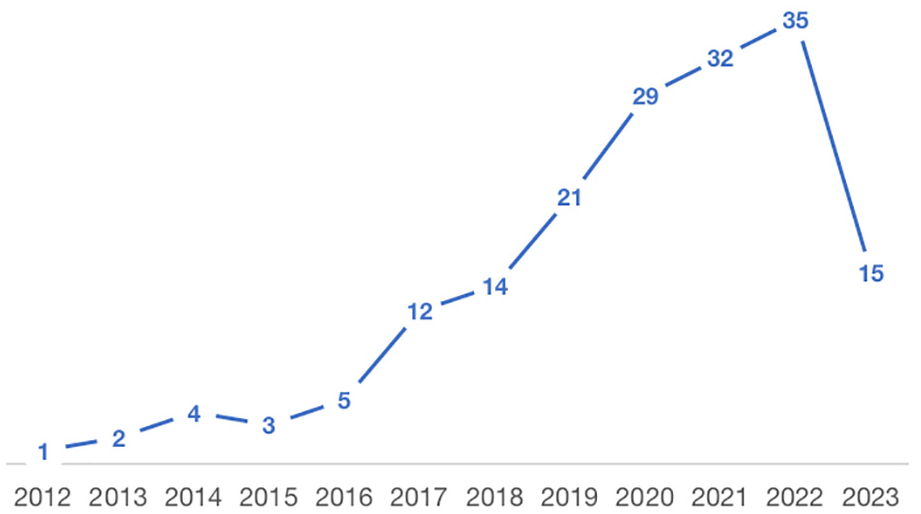
Publication years.
Main Research Institutions
The 173 articles involve 302 research institutions. We set the threshold to 3 and 5, meaning an institution must have published at least three articles and those articles must have been cited at least five times to be included in the statistics. Ultimately, 27 research institutions were retained. The top three are Politecn Milan, Univ St Gallen, and Univ Vaasa. Articles from Politecn Milan were published in Q1 journals such as Technovation, Technology Analysis & Strategic Management, Technological Forecasting and Social Change, and Journal of Business Research, with a high number of citations, indicating significant influence in the field of digital business model innovation. Table 2 displays the distribution of main research institutions, showing the number of articles and citations for each institution. The volume of articles from Politecn Milan is largely associated with the author Ghezzi, A., who has published six articles in this field, making this institution a key contributor to publications in this area.
Distribution of Main Research Institutions.

Distribution by Country
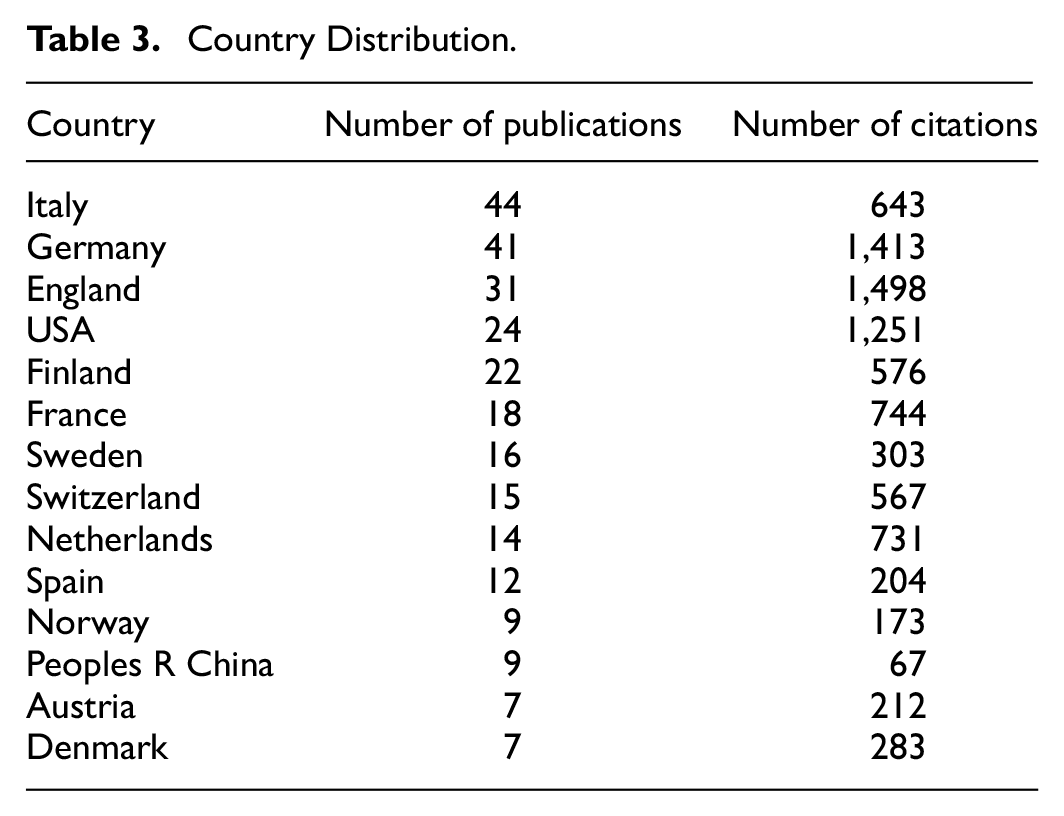
The 173 articles involve 43 countries. We set the threshold to a minimum of five articles per country and a citation count of over 10 times, resulting in 14 countries meeting the criteria. Table 3 shows the distribution of countries in this area of study. In terms of country distribution, Italy has a higher volume of publications in this field, although its impact is not as significant as that of Germany and the United Kingdom. Italy’s high publication volume is largely associated with the publication output of institutions in the region, with Politecn Milan being a major contributor to Italian publications. Germany, as an early adopter of Industry 4.0, demonstrates a distinct advantage in utilizing digital technologies. The background of Industry 4.0 has led to a significant increase in research on business model innovation.
Country Distribution.
Bibliographic Analysis
We conducted a bibliographic analysis of the final search database to identify the most influential, classic, and important journals, authors, and papers in the field through citation analysis, co-citation analysis, and bibliographic coupling analysis. Subsequently, keyword co-occurrence analysis was performed to facilitate cluster analysis of keywords. Further analysis of keyword co-occurrence enabled us to discover how keyword clusters evolve and identify emerging and trending “hot” concepts. Co-citation analysis helped us identify the most cited papers, thus aiding our understanding of the major classic papers cited in the final search database. Bibliographic coupling analysis helped identify the most influential articles.
Journal Analysis
Citation Analysis
The 173 articles spanned across 76 journals. We set the threshold to 4, meaning each journal must contain at least 4 articles, resulting in 10 journals meeting the criteria.
Co-citation Analysis
References cited in the 173 articles involved citations from 3,490 journal sources. We set the threshold to 199, resulting in 10 journals meeting the criteria.
Bibliographic Coupling Analysis
The 173 articles involved 73 journals. We set the threshold to 4, resulting in 10 journals meeting the criteria. TLS refers to link strength, indicating the number of journals that share the same references with a particular journal. A higher number signifies greater influence of the journal in the field.
The research findings indicate that the journals “Journal of Business Research,”“Technological Forecasting and Social Change,” and “Industrial Marketing Management” have the highest volume of publications and citations in this field. “Long Range Planning,”“Strategic Management Journal,”“Journal of Business Research,”“MIS Quarterly,” and “Harvard Business Review” are considered relatively classic sources for papers in this field. Bibliographic coupling analysis reveals that the top four journals with the highest link strength are “Journal of Business Research,”“Technological Forecasting and Social Change,”“Industrial Marketing Management,” and “International Journal of Innovation and Technology Management.” A comparison of the three analyses shows that papers on the impact of digital technologies on business model innovation are theoretically grounded in top-tier journals in management and strategic fields, while most papers published since 2012 are found in management journals related to industrial technology (See Table 4).
Journal Distribution.

Author Distribution
Citation Analysis
The selected literature involves 471 authors. We set the threshold to 2, meaning there are 54 authors with more than two papers. Co-citation Analysis: The articles cited in the 173 papers involve 6,734 authors, with 54 individuals cited more than 20 times. Although business model innovation and the development of digital technologies are currently in their infancy, it is evident that scholars’ interest in this field has significantly increased. Citation analysis reveals that Parida (154) and Ghezzi (265) are pioneers in this field of research. Interestingly, De Reuver, with only three relevant papers, has a citation count of 342, indicating the impact of this scholar’s papers in the field. In co-citation analysis, among the 6,734 authors cited, 54 have been cited more than 20 times. Among them, scholars like Teece (206), Zott (184), Chesbrough (145), Osterwalder (111), and Amit (106), who have made outstanding contributions to traditional business models, remain pioneers in the study of business model innovation under the influence of digital technologies. Finally, bibliographic coupling analysis shows the authors with the highest link strength, implying their higher centrality and strong integration into the citation network, namely: Parida (5,363), Ghezzi (4,883), Gebauer (3,545), and Cavallo (3,138). Through the analysis of various aspects of the authors of the article, it is found that the research scholars who have made significant contributions to the field of business model, their theories are also on the business model innovation research under the influence of digital technology. However the updating of knowledge in this field is highly variable (see Table 5).
Author Analysis.

Article Analysis
From the citation analysis, it is evident that out of the 173 papers, 10 have been cited over 150 times, confirming the increasing attention and significance of research in this field within the academic community. Through bibliographic coupling analysis and co-citation analysis, the 173 articles collectively cite 9,512 references. We set the threshold to 20, resulting in 32 references meeting the criteria. The five most highly cited references, which we consider as the main theoretical pillars in this field, are as follows:
(1) Teece DJ, 2010. Business Models, Business Strategy and Innovation. Long Range Planning (88).
(2) Zott C, Amit R & Massa L, 2011. The Business Model: Recent Developments and Future Research. Journal of Management (70).
(3) Chesbrough H, 2010. Business Model Innovation: Opportunities and Barriers. Long Range Planning (55).
(4) Foss NJ & Saebi T, 2016. Fifteen Years of Research on Business Model Innovation: How Far Have We Come, and Where Should We Go? Journal of Management (55).
(5) Zott C & Amit R, 2001. Value creation in E-business. Strategic Management Journal (53).
According to the citation analysis of articles in this field, the top 10 articles with the highest number of citations were cited among the 173 articles (Table 6).The results of citation analysis and bibliographic coupling reveal the current distribution of publications and centrality of articles in this field. TLS represents the total link strength, indicating the number of times a paper appears simultaneously with other papers, thereby reflecting its core position in the field. They are as follows: Fortune favors the prepared: How SMEs approach business model innovations in Industry 4.0 (39) Additive manufacturing for consumer-centric business models: Implications for supply chains in consumer goods manufacturing (28).
Article Analysis.

From the theoretical perspective of this field, research on the concept of business model innovation forms the basis of all related studies (Teece, 2010). This indicates that the fundamental concepts of studying business model innovation in digital contexts remain unchanged, possibly because the origin of the concept of a business model is related to e-commerce. A business model describes the content, structure, and governance of transactions to create value by exploiting business opportunities (Zott et al., 2011). The potential for value creation depends on four interdependent dimensions: efficiency, complementarity, lock-in, and novelty. Innovative business models are crucial sources of value creation for companies and their suppliers, partners, and customers, regardless of the context. In the process of enterprise innovation in business models, conflicts and obstacles still exist. Overcoming these obstacles involves conducting business model experiments, and guiding the feasibility of potential opportunities through modeling business plans/strategies, and model data (Chesbrough, 2010). The emergence of digital technologies may break these constraints, allowing companies to conduct business model experiments more rapidly, accurately, and at lower costs.
When researching the impact of digital technology on business model innovation, it’s essential to build upon existing theoretical foundations rather than overturning traditional theories. For instance, studies exploring the effects of 3D printing on business model innovation are grounded in Chesbrough’s prototype theory and the business model component models established by scholars such as Amit and Zott, and Osterwalder. These studies indicate the potential of 3D printing technology to change the way business model innovation occurs, enabling adaptive business models and introducing the “rapid prototyping” paradigm into business model innovation itself. Specifically, 3D printing technology opens up opportunities for enterprises to tap into new markets, manufacture products on demand, and reduce the risk of transitioning to other markets. It also allows companies to move upstream or downstream, granting more autonomy compared to companies relying on intermediaries for manufacturing products. 3D printing technology makes business models more modular and adaptable, enabling companies to choose narrow (focused on a specific market), wide and long (such as design, manufacturing, and distribution), or short (design only) business models based on the environment. This research establishes a unified perspective for this field and is widely cited: starting from the stages of companies adopting digital technology, it analyzes the impact of digital technology on business model components by distinguishing the degree of intervention of digital technology in management processes. Another highly cited paper in this field also adopts a business model component perspective, examining the impact of Industry 4.0 on the three elements of business models for small and medium-sized manufacturing enterprises: “value creation, value capture, and value proposition” through case studies. This indicates that the process and component perspectives are prevalent in research in this field.
Keyword Co-occurrence Analysis
Keyword analysis in this article utilized the Co-occurrence function in VOSviewer, with keywords derived from both author keywords and Keywords Plus. Keywords Plus were selected to ensure consistency in keyword categorization. Previous studies have suggested that Keywords Plus is as effective as keywords provided by authors in bibliographic analysis when examining the knowledge structure in scientific fields (Zhang et al., 2023). The adoption of Keywords Plus enables researchers to mitigate biases and risks associated with manually tagging content. To analyze the co-occurrence of keywords, charts displaying networks and keyword densities were employed.
Among 173 articles, there were a total of 889 keywords. Setting the threshold at 9, 36 keywords ultimately met the criteria. These 36 keywords were categorized into three groups (see Figure 3): drivers of business model innovation, the process of business model innovation, and the outcomes of business model innovation.

Keyword clustering results.
Cluster 1 (Blue)
Drivers of Business Model Innovation. Keywords include business model, competitive advantage, digital innovation, digital platforms, sharing economy, and strategy. In this category, digital technology plays a crucial role as a driver of business model innovation, hence the need to recognize the innovative potential brought by digital technology. The emergence of digital technology as a significant driver of business model innovation has formed a widely accepted consensus in existing research (Burström et al., 2021; Casadesus-Masanell & Ricart, 2010). Digital technology serves as a vital driver of business model innovation (Sabatier et al., 2012), while simultaneously altering the operational environment of enterprises. In the context of the digital economy, the majority of business model innovations are driven by digital technology.
(1) New Operational Environment. From an internal organizational perspective, the emergence of digital technology disrupts existing organizational structures and processes within companies (Palmié et al., 2022). With digital technology enhancing the level of information processing within enterprises, organizational structures become more decentralized and flattened (Tavoletti et al., 2021). De Silva et al. (2021) found that changes in the external operational environment of enterprises are primarily reflected in shifts in customer demands, where speed becomes one of the most crucial competitive factors rather than quality and reliability.
(2) Altering Competitive Landscape for Enterprises. Digital technology has transformed the competitive landscape for businesses. Industry competitors are leveraging digital technology for varying degrees of innovation (incremental, radical; D’Ippolito et al., 2019). When incumbents face incremental digital innovations introduced by other industry players, their strategic approach often involves mimicking the business models of companies introducing such innovations; conversely, when incumbents confront radical digital innovations within the same industry, they perceive an opportunity to fundamentally offer something new to existing markets. When incumbents encounter incremental digital innovations from different industries, they may readily adopt new technologies to meet the explicit or implicit demands of existing customers. However, when incumbents face radical digital innovations from different industries, they need to undertake revolutionary strategic responses, radically adjusting their business models. In the context of the digital economy, the majority of business model innovations are driven by digital technology. Additionally, business models also manifest in a series of structured and interdependent business activities and relationships within or between enterprises and external stakeholders, and digital technology is altering the boundaries of enterprises.
(3) Impact of Different Technologies. Existing research examines the influence of various types of digital technologies on organizational business model innovation. For instance, the roles of AI and deep learning, big data analytics in decision support (Loebbecke & Picot, 2015), AR in enhancing user experience (Rayna & Striukova, 2016), and blockchain in production processes and value chains (Schneider et al., 2020; Trabucchi et al., 2021). Analyzing the outcomes of different technology studies, the role of digital technology in business model innovation generally falls into three types. First, digital technology catalyzes business model innovation as a resource. Based on the homogeneity and programmability of digital technology, enterprises can achieve multi-channel access to information resources, improving information utilization to promote real-time sharing and interaction, and generating synergies to facilitate business model innovation (Paiola & Gebauer, 2020). Second, digital technology changes the interaction between organizations and users. Based on the connectivity of digital technology, enterprises can achieve more timely interaction with users to realize customized production. This timely feedback of customer demands increases the flexibility of enterprise production, facilitating business model innovation (Ernkvist, 2015).
(4) Digital Strategy. The restructuring or resetting of the value structure of business models is often considered a direct reflection of corporate strategy, thus strategy is an important perspective in studying corporate business model innovation. Digitization plays a central role in triggering strategic responses in certain companies (Vial, 2019). There is still debate about whether digital technology can enhance corporate capabilities or performance (Usai et al., 2021). In the digital era, business model innovation is essentially driven by internal strategic changes, whether it’s the use of digital technology or innovation in patterns driven by internal strategy (Vial, 2019).
Cluster 2 (Red)
Research on the Business Model Innovation Process. Keywords include big data capabilities, dynamic capabilities, frameworks, value capture, and value creation. Digital technology encourages enterprises to explore different avenues for value creation and facilitates experimentation with technology among enterprises, shaping innovative business models among enterprise participants in the value network. In this category, we will analyze the impact of digital technology on the business model innovation process from various perspectives.
(1) Process Perspective. Innovation driven by general technologies is generally considered a relatively static process, while innovation driven by digital technology is regarded as a dynamic and highly disruptive process (Kraus et al., 2020). Some scholars divide the business model innovation process into four steps: creation, extension, revision, and termination (Cavalcante et al., 2011). Building on this research perspective, this paper identifies three stages in the business model under the influence of digital technology.
First Stage. Evolution from product-oriented BM to “hardware +” logic-enhanced products. Companies begin offering digital products (such as product software functionalities, and smart services) and bundle them with products to enhance personalized customer experiences. They use these digital products to increase product pricing. Companies in this first stage see this “hardware +” as their single business logic. However, this modification prevents the company from overly emphasizing the technological potential of digital products rather than understanding customer needs deeply. This leads to revenue occurring only indirectly, and increased costs from device and service sales.
Second Stage. Outcome-oriented value creation. Consumers often cannot perceive the value of digital products integrated into products, so services need to be transformed into outcome-based BMs. At this stage, customer-driven digital technology applications in BMI increase revenue by attracting more customer groups and adjusting value capture models according to the situation, alternatively, by improving processes based on customer flow data to modify the profit model and increase revenue.
Third Stage. Shift toward platform logic—establishing platforms that integrate multiple logics. Platform logic is driven by the ability of hardware products to exchange data via the Internet. Companies start offering digital products (such as product software functionalities, and smart services) and bundle them with products to improve smooth and personalized customer experiences. They use these digital products to increase price premiums and/or differentiate product offerings. Companies in the first stage see this “hardware +” as their single business logic. However, due to the difficulty in forming viable revenue models, customer-driven model innovation is required. The third stage integrates the first two logics.
(2) Element Perspective. Porter and Heppelmann (2014) argues that increasingly intelligent, interconnected products are challenging the traditional logic of how companies create and capture value, offering new possibilities for business model innovation. How to profit from digitalization through business model innovation is crucial to digitalization. Existing research mostly approaches from an element perspective, understanding the process of business model innovation from the angles of value creation, delivery, and capture (Laudien et al., 2024; Mancuso et al., 2023; Schneckenberg et al., 2021).
Digital technology supports enterprises in presenting new value propositions. On one hand, companies upgrade products and services through digital technology. Mancuso et al. (2023) analyze two retailers, illustrating how they leverage digital technology’s effective synergy with their core physical resources (i.e., stores) to ensure business continuity during crises. Specifically, they extend and upgrade existing functionalities to provide services with higher value to customers. On the other hand, they enhance user engagement to increase customer stickiness. As digital technology offers new, accurate data and insights, it enables companies to understand what customers want to buy, how they prefer to pay, and use products and services. Under the influence of digital technology, companies can better provide new products, services, and solutions, even achieve personalized customization of products and services to enhance customer experiences (Ammirato et al., 2021). Additionally, Metallo et al. (2018) find the role of digital technology in attracting new customers, and facilitating companies to expand existing niche markets.
Digital technology offers more ways for enterprises to create value. The way of value creation shifts from creating value for users to co-creating value with users. Lenka et al. (2017) finds through case studies that two mechanisms, perception and response, drive the value co-creation process between companies and customers. Customers are closely integrated into the company’s processes and resources, supporting companies in responding and maintaining flexibility in dynamic business environments through interactions with customers. Mancuso et al. (2023) find that companies respond to changes in the external environment by updating digital platforms to enhance process efficiency. Big data enables process optimization, improving the overall efficiency and quality of products and services, thereby enhancing value creation efficiency (Loebbecke & Picot, 2015).
Digital technology influences the way value is delivered. Business model design supported by digital technology has a more unique architecture and higher efficiency in value delivery. Digital technology also provides new channels for interacting with customers, such as social media, providing new ways for enterprises to interact with customers. Utilizing digital distribution channels, creating and serving new customer demands, establishing new forms of customer relationships to pursue unexplored business opportunities (Eckhardt et al., 2019). Due to the increase in customer demand for online shopping brought by digital technology, customers seek speed of product delivery rather than quality and reliability, posing new demands on value delivery for enterprises. As customers are highly embedded in the value delivery process, their real-time involvement in value delivery enhances efficiency (Laudien et al., 2024).
Digital technology influences the way value is captured. Attention to the value capture aspect of digital business models is limited. On one hand, digitalization can improve internal processes, enhance cost efficiency, thereby positively impacting performance. Achieving lower operating costs through process optimization and monitoring to realize the cost-benefit of resource utilization. On the other hand, digital technology can increase revenue streams. For example, digital technology can enhance customers’ perceived value, thereby increasing profit margins. Currently, revenue models influenced by digital technology mostly rely on subscription, pay-per-use, or similar methods, where customers pay for usage or results rather than specific products. In the future, these new revenue models enabled by digital technology will offer more flexible and customized pricing, which can change over time and be based on real-time operational data. These situations also provide customers with the opportunity to choose fixed pricing, pay-per-use, or hybrid models, promoting greater value creation through increased customization and responsibility transfer.
(3) Digital Capability. The advent of digital technology has necessitated a fresh set of business competencies for innovative business model creation. Scholars such as Lenka et al. (2017), Kinkel et al. (2023), and Troise et al. (2023) coin this competency as “digital capability.” In traditional studies of business model innovation, Teece (2010) proposed the concept of dynamic capabilities, which refer to a firm’s ability to continuously adjust resources to gain competitive advantages in uncertain environments. In the digital context, dynamic capabilities remain crucial for businesses to innovate their business models. Through literature analysis, it has been observed that dynamic capabilities in digital contexts are often referred to as “digital capabilities.” This encompasses three main components: digital knowledge-sharing capability, digital business capability, and digital platform capability. Digital knowledge-sharing capability reduces a company’s reliance on key knowledge employees. Digital business capability facilitates the creation and delivery of new forms of value in the digital environment by fostering digital strategies, integration, and control. Digital platform capability refers to a company’s ability to combine IT-based resources with other internal and external resources. Digital capabilities underscore the various impacts brought about by transformation and rapid changes. They are crucial in helping entrepreneurs and small businesses recognize pertinent connections and consequences while identifying new and emerging business opportunities in dynamic markets (Kinkel et al., 2023). Lenka et al. (2017) categorizes digital capabilities into intellectual capability, connectivity capability, and analytical capability. Intellectual capability enables the collection and capture of information with minimal human intervention. Connectivity capability facilitates the connection of digital products through communication networks, enabling on-demand configuration and multi-scenario applications. Analytical capability transforms data into predictive and prescriptive insights, which can be leveraged to visualize customer value and exploit emerging opportunities more effectively.
Cluster 3 (Green)
Results of Business Model Innovation. Keywords include product innovation, digital innovation, digital transformation, business performance, small and medium-sized enterprises (SMEs), digital services, and servitization. This category primarily investigates the outcomes of business model innovation in the digital context.
(1) Types of Digital Technology Business Model Innovation. Some studies have begun to explore the various types of business models that emerge under the influence of digital technology. These include business model innovations centered around big data (Bouwman et al., 2019; Loebbecke & Picot, 2015), platform- or social media-based business model innovations (Bouwman et al., 2019; Garrido-Moreno et al., 2020), sharing-based business models (Lichtenthaler, 2017), and collaborative business models (Ritala et al., 2014). Remané et al. (2022), through a survey of 1000 venture capital-backed technology startups, identified 49 types of business model archetypes, which they categorized into three groups: suppliers of digital products and services, providers of digital business resources and capabilities, and intermediaries. Suppliers of digital products and services focus on business model types that digitize products and services using digital technology. Incorporating digital technology features into value provision increases novelty by enhancing accessibility, affordability, availability, convenience, and/or customization of products and services. Providers of digital business resources and capabilities include those enhancing enterprise products by offering IT-related infrastructure and those providing data and data analysis capabilities. Enterprises supplement their traditional value creation through activities related to data, especially data collection and analysis activities, bundling external services and integrating them into value provision, replacing the value of human capital. Intermediaries facilitate activities between participants, including service provision, sharing of goods or information, or social media content. They enable access to more targeted audiences at lower transaction costs and exhibit new forms of value acquisition by commercializing data and information, benefiting from data-driven advertising, and potentially charging fees for intermediation and additional services. Servitization is a fundamental manifestation of changes in manufacturing business logic (Linde et al., 2020). Enterprises are profoundly altering the business models of manufacturing industries, transitioning from selling products to signing advanced service contracts.
(2) Enhancing firm Performance. The objective of innovating business models within enterprises is to drive revenue growth through digital technology. For most scholars, the focus lies on how business model innovation under the influence of digital technology shapes the competitive advantage of enterprises. Schneider et al. (2020) found that digital technology profoundly impacts enterprise infrastructure management, as it enables the collection and processing of relevant data, thus rendering production processes traceable. This enhances production efficiency and facilitates continuous optimization of resources during usage, consequently boosting enterprise performance.
While the strategic shift toward digital transformation has permeated both traditional and startup enterprises, current research predominantly emphasizes efficiency gains and cost reduction through digitalization rather than revenue augmentation. Moreover, empirical studies suggest that many enterprises have yet to benefit from digitalization. This imbalance between theory and practice stems largely from managers’ inability to ascertain the growth potential that digital technology holds for their enterprises, thereby lacking the rational arrangement and allocation of organizational resources to enhance organizational agility (Björkdahl, 2020).
Subsequently, to highlight the research focus in this field, we constructed a thematic map based on key terms in the field (Figure 4). As depicted in the figure, “digital technology,”“digital transformation,”“strategy,” and “digitization” emerge as prominent keywords in this domain. Research on business model innovation triggered by digital technology primarily unfolds across three levels. Firstly, at the strategic level (Teece, 2010), which is the most extensively studied, scholars analyze the impact of digital technology on enterprise digital strategies. This level primarily delves into how digital technology influences enterprises to deliver value to customers, create value, and propose entirely new value propositions under the influence of digital technology, all aimed at securing sustainable competitive advantages for enterprises. Secondly, at the environmental level, digital technology, due to its characteristics, drives societal and process digitization, resulting in changes in the external competitive environment of enterprises, compelling them to adjust their existing business models (Brennen & Kreiss, 2016). Thirdly, at the capability level, the changing external competitive environment breeds new competitive landscapes, inadvertently propelling enterprise transformations, thereby presenting new demands for managerial capabilities and expanding the boundaries of companies (Caputo, Fiorentino, & Garzella, 2019; Caputo, Marzi et al., 2019).

Domain heatmap.
Research across these three levels inherently possesses a certain internal logic. The digitization of enterprise processes and society, along with the attributes of digital technology itself, may act as drivers for business model innovation. Digital technology influences enterprises to make adjustments, thereby implementing digital strategies. Digital strategies may also be the primary driving factors behind business model innovation. Within the interactive process between digital technology and innovation in models, the required resources and capabilities constitute important research questions in the process of business model innovation. Disruptive technologies and disruptive business models have varying impacts on the market, presenting different challenges for enterprises (Cozzolino et al., 2018).
Conclusion, future Research Direction, and Limitations
Conclusion
By comparing and analyzing the results obtained from different bibliometric methods, this paper builds an overall scientific map for the research of business model innovation under the influence of digital technology. Through the citation analysis, co-citation analysis and literature coupling analysis of journals, authors and articles, the whole picture of the research in this field is revealed. Through the co-citation analysis of literature, we reveal that the theoretical foundation of this field is based on the theory of disruptive innovation and the mediating role of business model between technology and firm performance. The bibliometric coupling shows that some of the journals with the highest link intensity, such as Journal of Business Research and Technological Forecasting and Social Change, remain the top journals for business model research. It illustrates that the top journals in this field also place the research focus in the field of business model innovation in the context of the digital environment. This study also reveals that the contributions of Teece, Zott, Chesbrough, Osterwalder, Amit and other authors are still widely stored. The literature coupling shows that the authors with the highest link strength publish in the second half of the surveyed time span. Through citation analysis, it is found that the important literature in this field was published after 2014, and most of the articles were based on the article of Baden-Fuller and Haefliger (2013).
Future Research Direction
We have generated a valuable visual representation using VOSviewer, illustrating the temporal distribution of keywords across 173 literature pieces (Figure 5). In this graph, keywords are shaded according to their scores, which are based on the average year of appearance. The color spectrum ranges from blue (earliest years) to green and yellow (most recent years). The research domain concerning business model innovation has evolved from previous focuses on challenges brought by digital technology to more specific management themes, such as digital management, value creation, service innovation, and the capabilities required by enterprises to adapt their business models to digital technological innovations.

Temporal distribution.
Drivers of Business Model Innovation
Existing research focuses on the changes in internal and external environments brought about by digital technology, discussing its impact on consumers, products, and stakeholders both within and outside organizations, aiming to discover and utilize opportunities from the impact of digital technology on enterprises (Weill & Woerner, 2015). Through analysis of relevant literature, we found that the impact of digital technology extends from the media and advertising industry to the retail, manufacturing, and service industries (Westerman et al., 2014). From the temporal distribution graph of keywords, it is evident that besides focusing on individual digital technologies, attention should also be paid to the comprehensive application of digital technologies rather than their singular effects on enterprises. Emerging technologies such as the Internet of Things, artificial intelligence, cloud computing, and blockchain are gradually being adopted by enterprises. However, research on how these technologies, when combined, create value for enterprises and enhance their competitiveness is still in its infancy. Future research needs to explore the characteristics of different digital technologies and identify which modules or elements of business model innovation are significantly influenced by different types of digital technologies, starting from these characteristics.
Process of Business Model Innovation
Although scholars have discussed how business models transform with the support of digital technology, articles examining the process and pathways of transformation through cases or empirical testing remain limited (Elia et al., 2020). However, understanding the introduction of digital technology is crucial for the research and practical significance of resetting and innovating the current value architecture used by enterprises. Currently, research on how enterprises innovate business models under the influence of digital technology primarily adopts a static perspective. The introduction of digital technology provides new opportunities for the flexible integration of external freelancers or labor forces and for cooperation and development among enterprises. Digital platforms support new, flexible inter-organizational relationships through distributed boundary resources, promoting highly distributed and automated activity coordination, creating value for consumers at extremely low or no direct cost. Currently, scholars interpret the transformation of existing business models from the perspective of a certain type of digital technology and enterprise value activities. However, questions such as when and which models will be replaced, what new models enterprises should form, and how organizational capabilities should adapt remain unanswered. Therefore, management issues related to business model innovation may become future research directions.
Results of Business Model Innovation
Digitization has brought about some benefits, such as higher efficiency, lower transaction costs, and increased customer accessibility. However, much of the research overlooks the negative impact of digital technology on business model innovation. Some scholars have begun to focus on the issue of digital paradox (Laudien et al., 2024), which becomes a hindering factor for enterprises to utilize digital technology for innovation and transformation. Existing studies indicate that implementing advanced digital technology is a cost-intensive activity. Digital investments can be costly, and due to unclear value propositions and revenue models, they are prone to triggering the digital paradox. It only makes sense when it leads to substantial growth and/or creates superior competitive advantages. On the other hand, challenges such as inadequate perceived customer value, data security concerns, and enhanced accessibility of data enable competitors and new entrants to make advancements in capturing and analyzing data, quickly outpacing incumbents in fiercely competitive landscapes. This poses challenges for organizations and businesses presented by digital technology (Hauke-Lopes et al., 2022). Therefore, recent research has examined the issue from the perspective of reviewing technological frameworks, suggesting that managers’ responses to digital technology may influence the primary factors affecting enterprises’ utilization of digital technology to innovate business models. This research explains the heterogeneity in the results of digital technology-driven business model innovation (Arnold et al., 2022).
Contributions and Research Gaps
This study contributes to both theory and methodology. The paper defines the relevant concepts of business model innovation in the digital domain, and comparative innovative methods include comparing the results of different bibliometric indicators. Analyzing journals, authors, and articles provides a comprehensive insight into the field, identifying the theoretical foundations and research paradigms in this area.
The second contribution of this paper is to sort out the field of business model innovation under the influence of digital technology. Through literature cluster analysis, this field is divided into three parts (innovation drive, innovation process, innovation result) and develop a business model innovation process model from the perspective of digital technology. Through cluster analysis of keyword co-occurrences, the study conducts a comprehensive analysis of business model innovation (BMI) under the influence of digital technology, covering three categories: the driving force of digital technology on BMI, the impact of digital technology on the BMI process, and the BMI outcomes triggered by digital technology. (1) Innovation drive consists of two parts: one is the new market created by new technologies, which requires new business models to obtain profits. Based on the availability of digital technologies, companies have opened up new ways to create and capture value. The other is the disruptive business model of other enterprises triggered by digital technology, which is different from the single-threaded impact of traditional technology on business model innovation, and the business model innovation of other enterprises as a mediating variable is a possible future research direction. (2) Innovation process: digital technology provides the possibility for enterprises to realize external economies of scale. When the existing business model is disrupted (based on technology and based on other business models), when the incumbent enterprise perceives the opportunity, it can seize the opportunity externally. Enterprises are motivated to use external resources to enter new markets save costs or improve innovation capabilities, to adjust their business models. (3) Innovation results: the mix of business models.
Finally, using VOS Viewer software, it identifies the latest research hotspots in this field and proposes a conceptual framework for future research in this area. The integration of results from different indicators reveals the past, present, and future of research on the impact of digital technology on business model innovation. The main methodological contribution of this paper is the introduction of a bibliometric approach, which determines the most influential articles in the field through citation analysis, co-citation analysis, and document coupling. In previous literature reviews, the selection of literature was subjective, whereas this paper relies on software for both literature selection and evaluation, providing an objective and fair view of the field and laying the groundwork for future research by scholars in this field.
Although we screened 173 articles in this field, we only used the Web of Science Core Collection database, which lacks attention to research in other areas. Particularly in the technical field, the significant importance of digital technology in practical applications has not been adequately represented. Additionally, we only retrieved articles in English, and the search was not comprehensive for other languages contributing to this field, especially German. Future research should gather a wider range of literature to provide a more comprehensive perspective on research in this field.
Footnotes
Acknowledgements
Open access funding enabled.

Funding
The author(s) disclosed receipt of the following financial support for the research, authorship, and/or publication of this article: Zhejiang Province Philosophy and Social Science Planning Project(24SSHZ088YB).
Declaration of Conflicting Interests
The author declared no potential conflicts of interest with respect to the research, authorship, and/or publication of this article.
Data Availability Statement
Data sharing not applicable to this article as no datasets were generated or analyzed during the current study.