




Abstract
Audiovisual Translation (AVT) studies have been among the burgeoning disciplines in translation studies. Although much progress has been made in AVT, there has been little scholarship heretofore to sketch a comprehensive understanding of the domain mapping using bibliometric analysis. Based on a total of 1,424 journal articles collected from the Web of Science Core Collection (SSCI, A&HCI, and ESCI) and Scopus from 2002 to 2022, the publication trends, research progress, research hotspots, and research frontiers were analyzed and visualized using CiteSpace and VOSviewer. The results of this study show that research on AVT has experienced exponential growth in the last two decades and is likely to follow an upward trend in the future. Topics including subtitling, dubbing, audio description, reception, and media accessibility have been frequently explored; and active researchers from Europe and Iran, as well as productive institutes in Europe, the USA, and China, with publications in influential journals, have contributed greatly to AVT studies. The historical development of AVT studies also implies an interdisciplinary trend. These findings provide insights into AVT studies, with a comprehensive overview, which is of great reference significance for researchers in understanding the past achievements of the discipline and carrying out their future research.
Plain language summary
The researchers have looked at 1,424 published articles on Audiovisual Translation (AVT) published over the past 20 years, using tools including Citespace and VOSviewer. They found that interest in AVT has been growing, and it’s likely that more research will be done in the future. The main topics researchers focused on are subtitling, dubbing, audio description, media accessibility, and reception. By analyzing authors, institutes, and countries, they identified core researchers and active institutes, but there’s room for more collaboration among them. This information is helpful for researchers worldwide looking to work together. The study also looked at influential journals and frequently-cited documents to provide a basic understanding of the field for new researchers. The research progress shows a shift in AVT studies from linguistic to cognitive and sociological levels, and from end-products to end-users. This suggests that AVT studies are interdisciplinary and gaining popularity. Future research is recommended in areas like reception studies, media accessibility, and amateur subtitling.
Keywords
Introduction
The worldwide boom of network media, as well as the development of technological devices in the 21st century, have witnessed increasing demands for the transfer of audiovisual products across languages and nations. Audiovisual translation (AVT), as one of the fastest-growing disciplines within translation studies (Bolaños-García-Escribano et al., 2021; Cintas & Szarkowska, 2020; Pérez-González, 2014), has been attracting increased academic attention and has quickly evolved into an academic discipline in the past two decades. Pérez-González (2014) highlighted the necessity of charting a map of AVT as a discipline with academic recognition, an industry of representational practice, and an interventionist practice involving audienceships. Gambier (2013) indicated that AVT has developed into an academic field as a recognized form of translation. Similarly, Chaume (2018) asserted that AVT has become a leading field and gained the right to be an independent research field as well as a mature discipline. The significant position of AVT in the field of translation studies poses questions regarding what progress has been made in AVT studies in the past, what the current situation of AVT studies is, and in which directions AVT is likely to move in the future. Therefore, a review of AVT studies is necessary to gain a better understanding of the whole discipline.
Attempts have been made to scrutinize the literature in AVT studies, as exemplified by the works of Chaume (2018), Pérez Escudero (2018), Wu and Chen (2021), and Yonamine (2022). However, prior studies have primarily focused on specific topics within AVT. For instance, Chaume (2018) provided an overview of the methodological shifts in AVT studies from the descriptive, cultural and sociological to cognitive approaches, identifying the potential research areas arising from these diverse methodological perspectives. Yonamine (2022) focused on translation strategies and linguistic aspects within subtitles, employing a qualitative approach with thematic analysis to conduct a systematic review of the domestication and foreignization of interlingual subtitling. Notably, previous studies in AVT have also been limited in terms of data inclusion. Wu and Chen’s (2021) quantitative systematic review investigated 61 experimental studies in AVT, examining publication trends, researcher scopes, research designs, and methods of data analysis and reporting. In comparison, Yonamine (2022) reviewed a smaller dataset, encompassing a total of 30 studies. The review by Pérez Escudero (2018), as the only bibliometric research on AVT so far, focused merely on AVT-oriented PhD dissertations, ignoring the published journal articles that could reflect the achievements of the discipline. These review articles, although they have contributed to AVT studies, offered a limited picture of the whole AVT field. Therefore, to help researchers better understand how AVT has evolved over the past decades and what future work should be conducted to contribute to the area of AVT, the present study adopts a bibliometric approach to perform a series of visualized analyses to review the achievements and predict the future research trends of AVT studies.
Given this, based on bibliometric data retrieved from the Web of Science (WoS) and Scopus databases from 2002 to 2022, the present study attempts to address the following research questions:
What are the publication trends and the most frequently investigated topics in the AVT field?
Which authors, institutes, countries, journals, and documents are influential and productive in the AVT field?
What are the research progress and research frontiers in the AVT field?
Bibliometric Studies in Translation Studies
Bibliometrics, a statistical analytical method for analyzing the literature in a particular field (Hood & Wilson, 2001; Sengupta, 1992), has been utilized extensively in numerous research fields for the identification of publication statistics, journals or research institutions’ impacts and achievements, academic hotspots, and future research directions. Popular bibliometric tools include CiteSpace (C. Chen, 2006) and VOSviewer (van Eck & Waltman, 2010). CiteSpace is a literature visualization software developed by C. Chen (2006), which can systematically and visually demonstrate the publications, co-citation, co-authorship, and co-occurrence of the keywords of the literature in a certain field. VOSviewer can also be used to create maps of authors or journals based on co-citation data, as well as maps of keywords based on co-occurrence data, providing an in-depth examination of bibliometric maps (van Eck & Waltman, 2010).
In the field of translation studies, researchers have adopted both tools (e.g., Dong & Chen, 2015; Du & Chen, 2022; He et al., 2022; F. Wang et al., 2019; G. Wang et al., 2022; Zhu & Aryadoust, 2023) to carry out scientometric reviews of the development and current status of specific topics or certain sub-disciplines within the translation research field both synchronically and diachronically. Using VOSviewer, Dong and Chen (2015) visualized the status and the research themes of three translation research areas, namely theoretical translation studies, translation and interpreting training, and descriptive translation studies, based on articles published in WoS from 2000 to 2015. Du and Chen (2022) combined the PRISMA guidelines and VOSviewer software to investigate the co-citation of WoS-indexed literature on political discourse in translation studies. Also with VOSviewer software, F. Wang et al. (2019) sketched a bibliometric map of the English translation of the Chinese novel The Journey to the West and studied the popular research topics, the theoretical basis, and the research questions concerning the translation of the novel based on literature collected from Chinese and international journals. He et al. (2022) used both CiteSpace and VOSviewer to compare the international and Chinese research on translation technology teaching based on papers published in the WoS and CNKI (China National Knowledge Infrastructure) databases between 1999 and 2020. Based on the articles collected from the international translation studies journals indexed in WoS, Zhu and Aryadoust (2023) used Citespace software to sketch a landscape of the development trends and patterns of international translation studies from 2001 to 2020. These studies, from different perspectives and with different focuses, have attempted to provide comprehensive maps for the sub-disciplines of translation studies or the whole translation research field. Nevertheless, there are hardly any bibliometric reviews on AVT, which would help researchers and scholars to better understand how AVT has developed and evolved over the past years.
Methods
Data Source
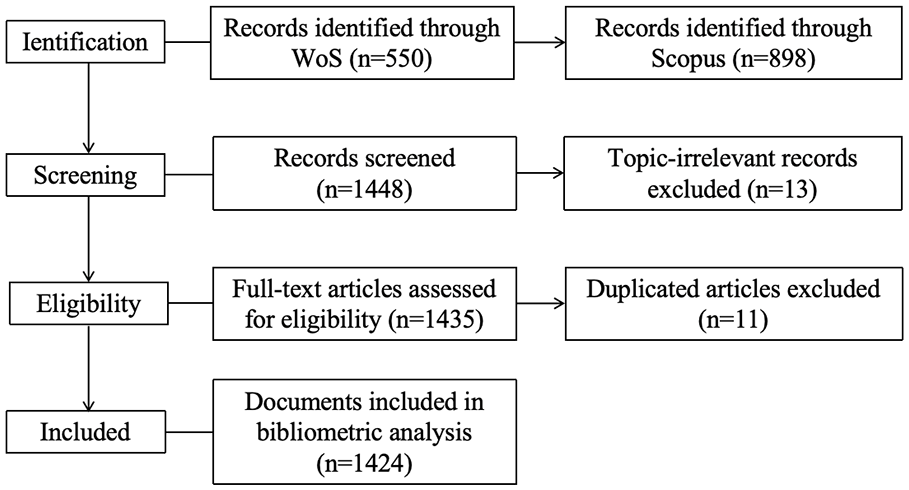
Data were journal articles retrieved from the WoS Core Collection (Social Sciences Citation Index, Arts and Humanities Citation Index, Emerging Sources Citation Index) and Scopus, which are influential citation indexes and have been the most commonly used citation databases for bibliometric research in translation studies (Alangari, 2024; Du & Chen, 2022; Huang & Liu, 2019; Liang & Xu, 2016; G. Wang et al., 2022; Zhu & Aryadoust, 2023). As over 99% of WoS indexed journals are also indexed in Scopus (Singh et al., 2021), the inclusion of the Scopus database enabled wider coverage of the published articles. Since AVT is a diverse research discipline covering various topics, the scope of AVT studies was made clear before the data collection to ensure that the articles included were relevant. Following previous researchers (Chaume, 2020; Pérez-González, 2014; Valdeón, 2022), who attempted to delimit AVT, topics including “audiovisual translation,”“film translation,”“multimedia translation,”“media translation,”“screen translation,”“multimodality translation”; “subtitling,”“revoice,”“voice-over,”“dubbing,”“danmaku,”“audio description,”“fansub,”“game localization,”“respeaking,”“SDH (subtitles for the deaf and hard of hearing),” and “accessibility” were used to retrieve the relevant literature. As “translation” is also a term frequently used in medical sciences, the research areas were restricted to “Linguistics/Applied Linguistics” and “Humanities/Social Science.” The publication period was set between January 2002 and December 2022. Following previous bibliometric studies using Citespace (e.g., Du & Chen, 2022; Huang & Liu, 2019; Wei et al., 2020; Wu, 2022), the document type was filtered as “articles,” excluding book reviews, proceedings, reports, editorials, and academic abstracts. The literature retrieval process was conducted on 1 May 2023, yielding a total of 550 published articles from WoS and 898 from Scopus as raw data. Afterward, to ensure data accuracy, a further manual data screening process was conducted, in which all data were checked via a detailed reading of the abstracts and keywords. In this process, 13 topic-irrelevant articles were removed. The articles in WoS were stored as “full record and cite references” in “plain text” format. The articles in Scopus were saved as “RIS” format and then converted into “plain text” format. Finally, with the data from WoS and Scopus being merged together and 11 duplicated records being filtered, 1,424 articles were used for data analysis, providing a sample size that is adequate for bibliometric research with Citespace (C. Chen, 2017). Following the PRISMA approach (Liberati et al., 2009), which outlines four steps for identifying and extracting data in systematic reviews (Maier et al., 2020), the data collection procedures are visually depicted in Figure 1.
PRISMA diagram.
Data Analysis
Citespace (version 6.2.R2) and VOSviewer (version 1.6.19) were used to perform data analysis and visualization. To address the first research question, the publication output analysis and keyword co-occurrence analysis were performed using VOSviewer. For the second research question, a series of co-citation analyses including authors’ collaboration networks, institutes’ collaboration networks, countries’ collaboration networks, and journal and document co-citation analyses were carried out using both Citespace and VOSviewer. To answer the third research question, a timeline of the keywords was visualized and keywords’ burstness detection was analyzed using Citespace. Following the procedures of Citespace (C. Chen, 2014), parameters were set as: time span (from January 2002 to December 2022); time slicing (1 year); selection criterion (top 50% or 10%).
Research Results
Publication Output Analysis
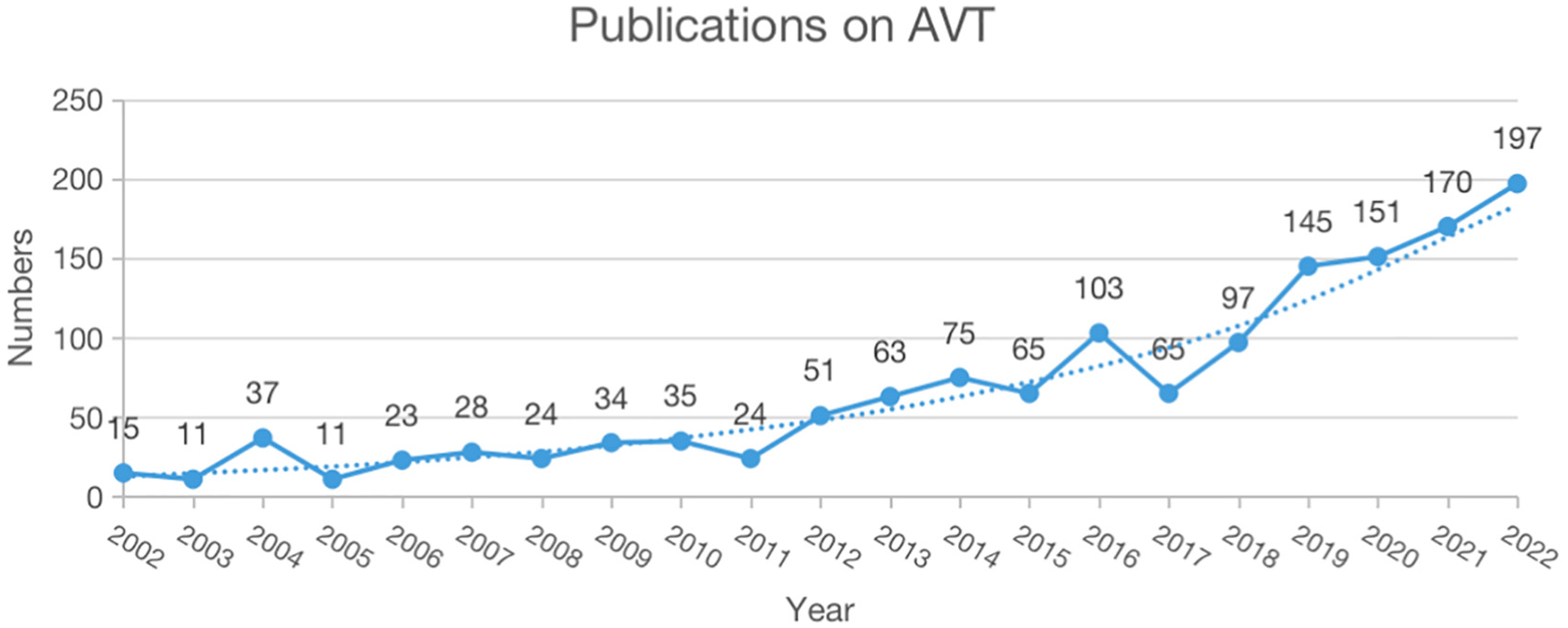
The publication trends of a discipline can be reflected by the number of published articles (Li & Zhang, 2023; Xiao & Li, 2021): therefore, the publication output analysis was conducted by calculating the number of publications concerning AVT per year. As can be seen in Figure 2, despite some slight fluctuations, the total number of publications in the field of AVT has increased over the past two decades, signifying that AVT has been attracting growing attention. A total of 1,424 articles were published from 2002 to 2022, with an average annual publication of 70 papers. According to the changing curve of the number of published articles illustrated in Figure 2, three phases of AVT studies could be identified, namely, the budding phase (from 2002 to 2011), the exploration phase (from 2012 to 2016), and the rapid development phase (from 2017 to 2022). In the first phase, research on AVT was in its initial stage, experiencing a steady development with a relatively small number of published articles: fewer than 40. During the exploration phase, research on AVT developed further, with an increasing number of published articles: from 51 to 103. Particularly from 2015 to 2016, AVT studies witnessed a rapid development within 1 year, from 65 to 103. After 2016, although AVT research experienced fluctuation in 2 years (2017 and 2018), with a slight decrease in the number of publications, the total number publications from 2017 to 2022 tripled from 66 to 197, signifying that the research on AVT has entered the rapid development phase. It is predicted that studies on AVT will continue to gain popularity and the number of publications in this field will increase in the future, as shown by the dotted blue exponential curve.
Publications on AVT from 2002 to 2022.
Keyword Co-Occurrence Analysis
As the core of a published article, keywords reveal the research’s hot topics. Hence, through the co-occurrence analysis of high-frequency keywords, the research hotspots of a certain discipline can be identified (C. Chen et al., 2012). From 1,424 documents concerning AVT studies, a total of 3,537 keywords were retrieved. After removing repetitions and merging similar items, 201 keywords that occurred at least five times were used to perform the keyword co-occurrence analysis, as visualized in Figure 3. The highest frequency keywords were “subtitling” (n = 257) and “dubbing” (n = 170), which have been the two most prevalent modalities adopted for the translation of media products (Chiaro, 2009). Other keywords with high frequency were identified, including “audio description” (n = 85), “reception” (n = 40), “media accessibility” (n = 44), “multimodality” (n = 38); “fansubbing” (n = 30), “screen translation” (n = 30), “voice-over” (n = 26) and “respeaking” (n = 20), implying hotspots that have received attention in AVT studies during the past two decades. Besides, the keywords in purple, such as “screen translation”, “anime,” and “internet telephony,” are popular research topics that were studied by researchers in the earlier years, before 2014. Keywords in green and yellow, such as “virtual reality,”“media accessibility”, “localization,” and “netnography,” were frequently explored topics in recent years (2018–2022).

Keywords with at least five occurrences.
Authors, Institutes, and Countries Co-citation Analysis
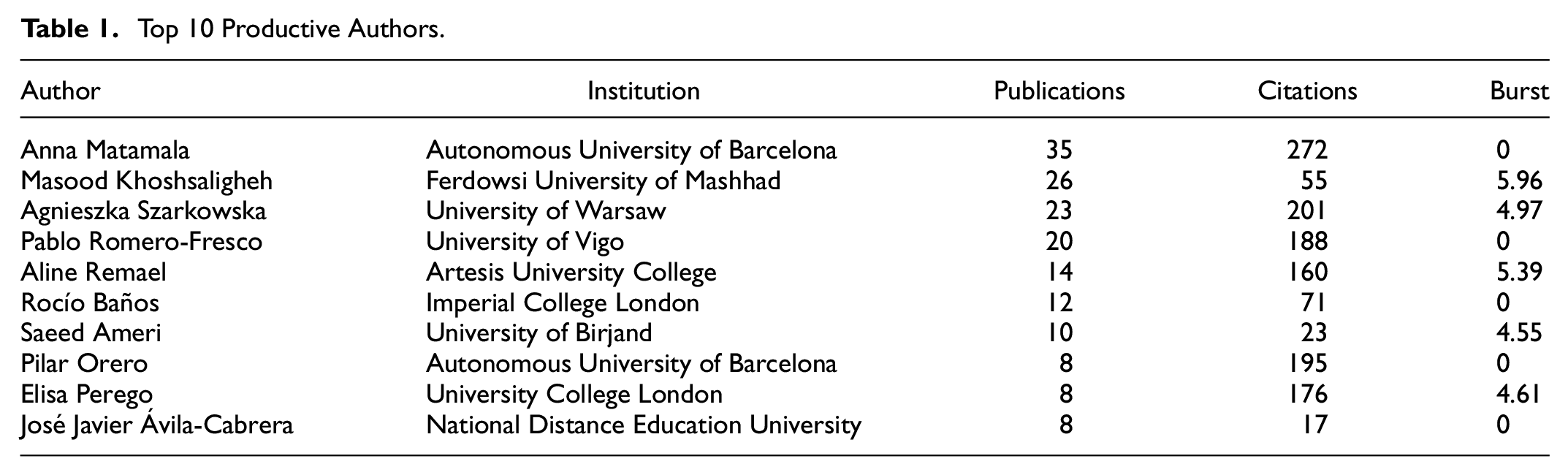
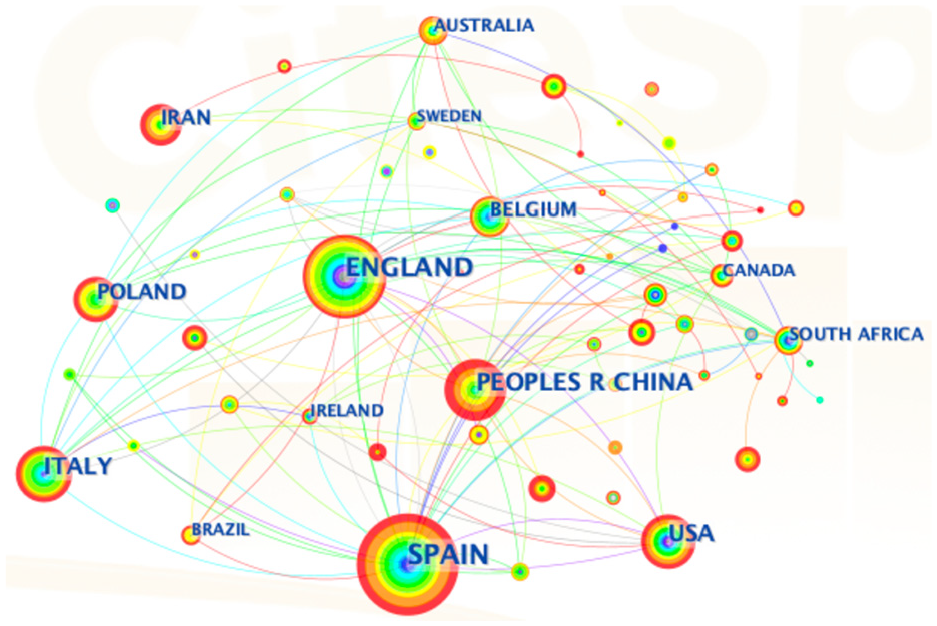
Authors from different institutes, countries, or regions often collaborate with each other in academic research. A network of co-authors thus forms when different authors and different institutions and countries or regions are affiliated with the same article (X. Su et al., 2019). The authors’ collaborative network is a key element that reflects the research competence and evaluates the developments of the discipline in the academic field (Mu & Ma, 2022; Xiao & Li, 2021). To identify the active authors, productive institutes, and leading countries that have made contributions to the AVT field, a co-authors’ network analysis, including co-authorship analysis, co-authors’ institutes network analysis, and co-authors’ countries or regions analysis, was performed. In the visualized network map, the size of nodes represents the number of publications by authors, institutions, or countries, and the curves connecting the nodes represent the intensity of their cooperation. The larger the node, the more productive the author, the institute, or the country. Through the bibliometric analysis of the published articles, active authors (Table 1), productive institutes (Table 2), and influential countries or regions (Table 3) were identified and listed. Their cooperation networks were also visualized, as illustrated in Figures 4 to 6.
Top 10 Productive Authors.
Top 10 Influential Institutes.

Top 10 Influential Countries or Regions.


Authors’ network.

Institutes’ network.
Network of countries or regions.
Regarding the active authors in the AVT field, the co-authors’ analysis shows that the most productive author is Anna Matamala from the Autonomous University of Barcelona, with 37 publications, ranking at the top of the list. Beginning in 2009, when her earliest articles can be found, Anna Matamala has been the most fruitful researcher during the past two decades, whose research covers most of the topics within the AVT field, from dubbed situation comedy, subtitling, audio-description, voice-over, and subtitling for the hard-of-hearing to film post-editing. The researcher ranking second is Masood Khoshsaligheh from the Ferdowsi University of Mashhad, with the highest burst value of 5.96, who has published 26 articles and has been the most productive author in recent years (2018–2022).
Collaborations among some of the above productive authors can also be identified, including the networks led by Agnieszka Szarkowska, Anna Matamala, and Aline Remael. Cooperation between two productive researchers from Iran—Masood Khoshsaligheh and Saeed Ameri—can also be found. Generally, the collaborative networks formed among the authors were loose and weak, as reflected by the density of the curves in Figure 4, indicating that cooperation among researchers remains to be deepened. In addition, based on Price’s (1965) law, which states that the square root of the total number of published articles in an academic field contributes half of the literature on that topic (Nicholls, 1988), the minimum number of published papers of a core author was calculated using the following formula:

Nmax represents the maximum count of published papers among all authors. M signifies the minimum number of published papers required to classify an author as core. Specifically, a core author is distinguished by having published a number of papers equal to or exceeding the specified threshold represented by M. Within the dataset examined in this study, the scholars who published the largest number of papers had 37 articles. Therefore, Nmax = 37 and M = 5. Accordingly, the core authors should be those who have published at least five articles in the AVT area. Calculating the number, the study found that 17 researchers with a total of 195 publications can be considered as the core authors, contributing only 13.6% of the literature in the AVT field. These results signify that although a small number of core authors and cooperation among some of the researchers can be observed, groups of core authors and cooperative research teams have yet to be established.
In terms of influential institutions, a total of 243 institutes all over the world contributed to the development of AVT studies (Table 2 and Figure 5). The top ten influential institutes are listed in Table 2 in terms of the number of publications. Being the most productive institute, the Autonomous University of Barcelona ranked first with 58 publications, followed by University College London and the University of Warsaw, with 30 and 29 publications respectively. Two of the three most productive authors—Anna Matamala and Agnieszka Szarkowska—belong to the two most productive institutes. As regards centrality, the most productive institute, the Autonomous University of Barcelona, is the one with the highest centrality of 0.02, followed by the University of Antwerp and the University of Vigo, both with centrality of 0.01. Besides, several institutes also show rapid growth in the AVT field, as reflected by the burst value. The University of London has the highest burst value of 6.21 from 2017 to 2019, followed by the University of Trieste, with a burst value of 5.31 from 2016 to 2018, and the University of Warsaw, with a burst value of 4.68 from 2018 to 2020. The Ferdowsi University of Mashhad and Hamad Bin Khalifa University, with burst values of 4.53 from 2018 to 2022 and 3.23 from 2020 to 2022 respectively, are the two institutes with the most rapid development in AVT areas in the recent years.
Concerning the influential countries and regions, from 2002 to 2022, a total of 83 countries or regions all over the world have made contributions to the AVT field (Table 3 and Figure 6). The influential countries are mainly in Europe, which has a multilingual environment and affluent living conditions where most people can afford translated audiovisual products as a form of entertainment (Bolaños-García-Escribano et al., 2021). Being the most productive country in the AVT area, Spain has published 281 articles, followed by England, with 195 published articles, and China, with 115. Spain and England also rank top in terms of centrality, indicating the high impact of these two countries in the AVT field. These two countries are also two representative blocks in the AVT area, where Spain is a dubbing country and England is a subtitling country (Chaume, 2020; Chiaro, 2009). Spain is also a country in high demand for voice-over translation due to the prevalence of foreign reality TV programs (Baños, 2019), which may facilitate the research in AVT in terms of data availability. Moreover, among the top ten influential countries or regions, England made the greatest progress in AVT research from 2011 to 2013 by publishing 19 articles, with the highest burst value of 3.85, followed by the USA, with a burst value of 3.84 from 2002 to 2006. Ireland and Belgium have also made great progress in the past decade, with burst values of 3.64 from 2006 to 2014 and 3.59 from 2015 to 2016, respectively.
Countries have also cooperated to contribute to the research in AVT. The network of these countries is depicted in Figure 6, where the nodes represent the frequency and the thickness of the links indicates the density of the cooperation among different countries. With a high centrality value, Spain shows a wide range of cooperation with 22 countries all over the world, and England also demonstrates extensive cooperation with 20 countries. Countries in North America and Europe have formed the closest network, in which Canada, thhe USA, Spain, England, and Italy are actively engaged. Countries in the Asia-Pacific region, such as China and Australia, have also cooperated frequently with other countries. However, the international academic cooperation among countries needs to be strengthened, as reflected by the loose network shown in Figure 6. For instance, as one of the most productive countries, with 50 publications in AVT studies, Iran has only cooperated with three other countries, namely Canada, Hungary, and Malaysia. Belgium has only cooperated with countries within Europe, while South Korea has only cooperated with countries in the Asia-Pacific region, including Australia, Japan, and China.
Journal Co-citation and Document Co-citation Analysis
Journal co-citation and document co-citation analysis allows the identification of influential journals and highly-cited references (C. Chen, 2014; X. Chen & Liu, 2020). The higher the citation frequency of a journal, the greater its significance to the research field (C. Chen et al., 2012). Similarly, the more frequently the reference is cited, the more important it is to the discipline (C. Chen et al., 2012).
Regarding the most influential journals, a total of 1,424 articles were published in 487 journals, the top twenty of which are listed in the following table (Table 4). Among all the influencing journals, Perspectives, which ranked first and published the most articles, was cited most frequently by researchers, followed by Meta, with 76 publications, and Babel, with 60 publications respectively. It can be seen from the list that the influential journals with more publications in the AVT field are also cited more frequently by researchers. It is also worth noting that the top ten influential journals are mainly dedicated to research topics and issues in the field of translation and interpreting, indicating that these journals have been the key resources used by researchers in the AVT field to explore their research interests and to acquire relevant knowledge of the discipline. Despite having a relatively low impact factor (IF < 2.0), the top ten journals remain influential in the field of translation studies. This is mainly due to their non-Open Access (OA) publication policy. Compared to non-OA articles, OA articles are typically more quickly recognized and cited by peers (Eysenbach, 2006). Besides, as translation studies is a niche academic field, traditionally being a branch within linguistics and applied linguistics, researchers in this field may publish their articles in journals in language and linguistic areas, leading to a relative low IF.
Top 20 Influential Journals in the AVT Field.

IF = Impact Factor (2021).
The most frequently-cited references were identified through document co-citation analysis and are listed in the following table (Table 5), including five books and five journal articles. All of the top ten highly-cited documents have been published in the past 15 years, with the earliest one published in 2011, indicating the booming of AVT studies. The most frequently-cited document is Tessa Dwyer’s book Speaking in Subtitles: Revaluing Screen Translation, published in 2017. In this book, Dwyer emphasizes the need to bridge the gap between theory and practice in screen translation (Longo, 2017) by analyzing the errors and misconceptions in subtitling, fansubbing, and dubbing. Luis Perez-Gonzalez’s book, titled Audiovisual Translation: Theories, Methods and Issues, published in 2014, is also cited frequently, ranking second. By exploring the theoretical framework and the research methodology of AVT, it is the first book to systematically review AVT studies as a complete discipline. Within only 3 years of its publication, Perez-Gonzalez’s book had received extensive attention from researchers in the field of translation studies. Researchers from different institutes and countries conducted book reviews to introduce Perez-Gonzalez’s work, including the reviews published in Linguistica Antverpiensia in 2015 by Nina Reviers, in Journal of Specialized Translation in 2015 by Jonathan Evans, in Perspectives in 2016 by Louisa Desilla, in Target in 2016 by Julie McDonough Dolmaya, and in Babel in 2017 by Roberto A. Valdeón. Perez-Gonzalez’s book has remained popular in the past 5 years, as reflected by the document co-citation analysis, which showed that in 1 year, from 2018 to 2019, the book was cited nine times, with a burst value of 6.40—the highest among all the documents. Another cited document with a strong burst value is Agnieszka Szarkowska and Olivia Gerber-Morón’s article, titled Viewers can keep up with fast subtitles: Evidence from eye movements, which was published in PLoS One in 2018. This experimental and empirical study, in which the authors examined viewers’ perceptions of subtitles through eye movement, has drawn great attention since its publication, as shown by the high burst value of 3.56 from 2020 to 2022. In terms of centrality, of all the highly-cited documents, the article Accessing communication: The quality of live subtitles in the UK, published by Pablo Romero-Fresco and Juan Martínez Pérez in 2016, is the most influential, with the highest centrality value of 0.38.
Top 10 Frequently Cited References in the AVT Field.

Keyword Timeline and Burstness Analysis
Keyword timeline analysis shows how the hotspots in a certain field evolve (C. Chen et al., 2012). Burst keywords are words that are used frequently and whose use increases dramatically within a certain period, indicating an abrupt change of keywords (C. Chen, 2014). Through the timeline graph, together with the detection of burst keywords, the historical development of the hot topics in the AVT field can be identified.
Through the timeline visualization created using Citespace, the keyword clusters are visualized in Figure 7. A total of 10 clusters of keywords are identified, including #0 multimodality, #1dubbing, #2 media accessibility, #3 subtitling, #4 extralinguistic translation, #5 reverse subtitling, #6 screen translation, #7 audiovisual cognition, #8 interlingual subtitling, and #9 audiovisual policies. Each of the clusters represents a research topic, as depicted by the 10 lines in the graph. Each diamond-shaped node in the horizontal lines represents a keyword within the cluster. The larger the node, the higher the frequency of use of the keyword. Keywords are marked in the year when they first appear, and the connecting line indicates the cooccurrence relationship between keywords. Through burst keyword detection, the keywords with the strongest bursts are identified and listed in Figure 8. Each blue bar in the table represents 1 year, and the red bars in bold represent the years during which keyword burstness is found.

Timeline visualization of AVT Studies.

Top 15 keywords with the strongest citation bursts.
In terms of the research development in AVT, it can be seen from the timeline graph that before 2005, AVT research was in the early stage, where clusters, including dubbing and subtitling, could be found. Within these clusters, keywords such as “translation quality” and “linguistic norms” can be found, indicating that the early studies in the AVT field mainly focused on the linguistic aspects of audiovisual products. Keywords burst analysis also shows that around 2005, “subtitling” and “dubbing” were the top keywords listed, with burst values of 3.64 and 2.48 respectively, implying the popularity of these two topics. From 2005 to 2010, clusters including multimodality and audio description began to emerge. Studies on AVT during this period demonstrate an increasing trend among researchers to adopt keywords such as “video games,”“TV serials translation,”“film narration,”“audio narration,”“multimedia translation,” and “internet,” implying that researchers on AVT had shifted their attention from studies of traditional media to multimedia products. The audiovisual products being studied in this stage increased in both number and type, ranging from movies, TV series, games, and music to internet media, which may be due to people’s multiple forms of entertainment with the prevalence of the internet in modern society.
After 2010, studies on AVT developed, as shown in Figure 7 by the densely dotted keywords and the curves that connect them. The keyword “audio description” was frequently used by researchers, with a strong burst value of 4.78, demonstrating authors’ tendencies toward research into media accessibility for blind and partially-sighted people (Fryer, 2016). Besides, from 2010 to 2015, clusters such as extralinguistic translation, reverse subtitling and audio-visual cognition began to appear. Researchers began to adopt keywords including “speech recognition,”“reception studies,”“comprehension,”“taboo language,” and “foreign language education,” signifying that AVT had changed its focus from studies of translation products to studies of end users, such as the audiences or the receivers’ perceptions of the AVT products or the acquisition of the language involved in these products. Researchers during this period also began to adopt empirical approaches such as eye-tracking and corpus-based research to investigate AVT, as shown by the prevalence of keywords such as “eye movement,”“brain mapping,”“cognitive load,”“parallel corpus,” and “audiovisual corpora.” Besides, in 2015, keywords such as “taboo language”, “manipulation,”“critical discourse” and “ideological manipulation” can be found, implying that the researchers had also begun to pay attention to the socio-cultural elements of AVT. Keyword burst analysis also shows that “taboo language” was frequently used, with a burst value of 2.86.
After 2015, research on AVT increased dramatically, as more densely diamond-shaped nodes can be seen in every cluster in Figure 7. AVT studies during this period began to demonstrate a technological shift. Inter-lingual subtitling and audiovisual policies appeared as new clusters, together with keywords such as “virtual reality,”“online game localization,”“social media,”“screen recording,”“Netflix,”“guerrilla subtitles,” and “machine translation.” Modern people’s changing habits of watching online audiovisual products on streaming platforms rather than via traditional modes have triggered the commercial upsurge of translation activities (Bolaños-García-Escribano et al., 2021), which may contribute to the new topics of AVT studies. Keywords such as “machine translation”, “adaption,”“virtual reality”, “amateur subtitling” and “media accessibility” can be found with high burst values, as shown in Figure 8. It is also worth mentioning that “media accessibility” is the keyword with the highest burst value of 4.96 and with the longest burst period—from 2018 to 2022. This may be due to the fact that, first, with the development of speech recognition technology, various online entertainment platforms such as YouTube and Netflix are able to generate subtitles automatically for people with hearing impairments (Cintas & Massidda, 2019). In addition to this technological advancement, the legislation system in countries such as the US and European countries also requires subtitle-makers to offer accessibility services to people with disabilities (Szarkowska, 2020), which may contribute to the popularity of research into media accessibility.
Generally, in the recent two decades, studies on AVT have demonstrated an interdisciplinary trend, as shown by the interlaced and overlapping curves in Figure 7. Overall, among the 10 clusters, almost all have received continuing attention in the past two decades, demonstrating the constant popularity of each sub-discipline in the field. Besides, among the top 15 keywords with strong burstness, half of them have been frequently adopted in the most recent 5 years, implying the ongoing popularity of AVT research in coming years. Concerning the research frontiers, keywords burst analysis results as presented in Figure 8 also show that topics including “media accessibility,”“film translation,”“reception studies,”“amateur subtitling,” and “cognitive load” are likely to receive much attention in coming years due to the strong burst in the recent 2 years, although they had appeared long before.
Discussion
Concerning the publication trends, the results show that research on AVT has experienced an overall upward trend over the last two decades and has increasingly aroused researchers’ interest in the field of translation studies. Comparable trends were also reported by the previous literature reviews on AVT (Pérez Escudero, 2018; Wu & Chen, 2021). Wu and Chen’s (2021) systematic review concluded that there had been a notable rise in scholarly attention toward experimental AVT research. Pérez Escudero’s (2018) bibliometric review found a substantial increase in doctoral dissertations focused on AVT from 2011 to 2017, nearly doubling the number from the preceding two decades. The current research, however, distinguishes itself from these prior studies by observing a more rapid increase in AVT publications after 2017. The increasing demand for multilingual AVT products, facilitated by improved media accessibility, alongside the globalization of media production industries and technological advancement over the past decade, have probably contributed to the growing academic and professional interest in AVT research. Based on the findings on this research trend, this study also tentatively predicts that more research will be devoted to the AVT field and more works on AVT will be published in the future, providing quantitative evidence for the argument that AVT will become a consolidated and thriving academic discipline (Bolaños-García-Escribano et al., 2021) in the field of translation studies.
In terms of research hotspots, the keyword co-occurrence analysis reveals that research on AVT has concentrated largely on the topics of subtitling, dubbing, audio description, media accessibility, and reception. The previous systematic literature review by Wu and Chen (2021) also aligns with these observations, noting that subtitling and dubbing have been the most prevalent forms of AVT products, and that AVT research has primarily centered around these two modalities. As explained by Wu and Chen (2021), the popularity of subtitling and dubbing is derived partly from their relative accessibility, large market demand, and cost-effectiveness. The popularity of audio description found in this research also corroborates the ideas of Remael et al. (2018), who pointed out that audio description as a new mode of translation has emerged with the advancement of technology and is now at the forefront of AVT studies. In comparison to subtitling and dubbing, the relatively lower emphasis on audio description can be attributed to technological and methodological challenges, including the underdevelopment of technological solutions for studying and producing audio description products, limited participation rates in empirical research, and the absence of a translation-oriented multimodal text analysis framework in AVT studies (Remael et al., 2018).
Through the collaboration network analysis of authors, institutes, and countries, the core researchers, active institutes, and influential countries and journals were identified. As the loose co-occurrence networks show, core author groups have not yet been established and cooperation among institutes and countries needs to be strengthened. These findings will be helpful for researchers from different countries and institutes all over the world in establishing academic collaborations. Investigations into the most influential journals and frequently-cited documents also reveal the basic knowledge of the discipline, which can serve as a reference to allow new researchers in the AVT field to discover interesting topics and to gain a better understanding of the knowledge of the whole discipline.
Regarding the research progress and research frontiers, the timeline visualization of high-frequency keywords and the detection of strong burst keywords show that AVT studies have experienced a shift from the linguistic level to the cognitive and sociological levels, as well as a shift from end-products to end-users, demonstrating the interdisciplinary nature of AVT studies over the past two decades as well as their increasing popularity. The visualized findings on the development of AVT studies support the assertions made by Chaume (2018), who highlighted the methodological progression within AVT studies from descriptive and cultural perspectives to cognitive approaches. New frontiers such as reception studies, media accessibility, and amateur subtitling are topics recommended for future research, particularly in conjunction with Artificial Intelligence (AI), which presents a promising avenue for further inquiry. The keyword analysis in this study indicates that a gap exists in the existing literature (see Figure 3), even though AI is nothing new in translation studies in general. With the advent of generative AI like chatGPT, AI will continue to be integrated into current translation tools or used to develop more advanced ones. As numerous studies have shown, AI-powered machine translation systems can now produce more accurate and sophisticated outputs (e.g., Farahani, 2020; Lee, 2023; Sheng & Kong, 2023). They can also help translation professionals to automate and enhance their workflows and improve efficiency (Wang & Daghigh, 2022; Wang & Jalalian Daghigh, 2023; Yanisky-Ravid & Martens, 2019). There are, however, several ethical challenges associated with the use of AI in translation workflows, including biases in machine translation models (e.g., Moorkens, 2022; Savoldi et al., 2021), distribution and commercialization of translation data, data privacy, confidentiality (e.g., Bowker, 2020; J. Su & Yang, 2023), copyright (e.g., Moorkens & Lewis, 2020), motivation and creativity (Javaid et al., 2023), and sustainability (e.g., Cronin, 2017; Moorkens, 2022; Moorkens et al., 2024). The same challenges also apply to AVT. New advancements in AI, such as neural machine translation systems, computer vision, speech recognition, or speech synthesis, are set to further complicate AVT practices. Moreover, deepfake technology is an exciting development for the dubbing industry. This software can manipulate videos, using AI, to appear as if someone is saying words they did not say. It would seem obvious that this capability could have applications in foreign-language dubbing if further refined and made commercially available (Baños & Diaz-Cintas, 2024; Bywood, 2020). As new realities emerge, new concepts follow Daghigh et al., 2018). Re-examination and re-theorization are needed for some foundational terms found frequently in AVT research. As an example, the term “translator” is questioned, and new terms such as “post-editor” and “text localizer” are proposed to better reflect the role of AVT professionals today (De los Reyes Lozano & Mejias-Climent, 2023). This also includes concepts such as dubbing and subtitling (Baños & Diaz-Cintas, 2024), authorship (Gambier, 2013), and immersion (Ameri, 2023 ), among others. This convergence between AI and AVT thus represents an exciting frontier that warrants more scholarly attention and academic research—a vision shared by scholars such as Bogucki and Diaz-Cintas (2020), Bywood (2020), and Bolanos-Garcia-Escribano and Diaz-Cintas (2020), to name just a few.
Concluding Thoughts
By utilizing bibliometric analysis and data visualization, this study aimed to investigate the past achievements, the prevailing hotspots, and the forthcoming advancements within the domain of the AVT studies. A total of 1,424 journal articles collected from the Web of Science Core Collection (SSCI, A&HCI, and ESCI) and Scopus from 2002 to 2022 were analyzed and visualized using CiteSpace and VOSviewer. During the past two decades, the exploration of topics including subtitling, dubbing, audio description, reception, and media accessibility has been a common focus in the field of AVT studies. Active researchers from Europe and Iran, along with productive institutions in Europe, the USA, and China, have made significant contributions to this field through publications in influential journals. The historical progression of AVT studies indicates a noticeable interdisciplinary trend. The insights derived from this study have given rise to precise suggestions for AVT studies, establishing a solid groundwork for scholars embarking on interdisciplinary research in AVT. Additionally, through the detailed network overview and the future development trend of AVT studies, this research not only acts as an introduction for newcomers but also encourages broader collaborative research endeavors.
Admittedly, limitations still exist due to the methods of data collection and analysis in the present research. Methodologically, bibliometric research has some general limitations. It is most effective when analyzing entities with substantial citation counts, and it tends to exhibit skewness, with the minority of cases receiving a high volume of citations, while the majority receive minimal attention (Phelan, 1999). Besides, in bibliometric studies, citation counts are highly responsive to prevailing trends in research and the distribution of citations restricts its applicability to distinguishing only the extreme cases (Lindsey, 1989). Therefore, bibliometric measures should be regarded as a valuable complement to other methods of research, rather than as a substitute (Phelan, 1999). Other supplementary methodologies, such as conducting a comprehensive literature review, can be incorporated to facilitate a profound comprehension of AVT research in the future. In addition, the research has a content limitation concerning data sources. The data sources included in the current research were English publications: therefore, future studies on AVT may benefit from including non-English publications as well. Also, as the data were collected only from the WoS and Scopus databases, published works in the AVT field in other indexes such as BITRA (Bibliography of Interpreting and Translation) and SCI (Science Citation Index) were not included. Books, theses, proceedings, and research reports were also excluded.
Footnotes
Declaration of Conflicting Interests
The author(s) declared no potential conflicts of interest with respect to the research, authorship, and/or publication of this article.
Funding
The authors disclosed receipt of the following financial support for the research, authorship, and/or publication of this article: This research was funded by Universiti Malaya Research Maintenance Fee (Project No. RMF0222-2021).

Data Availability Statement
The data that support the findings of this study are available from the corresponding author, upon reasonable request.