




Abstract
This study investigates the syntactic and semantic properties of the morpheme -men in Mandarin. Nouns suffixed with -men exhibit a range of properties typically associated with group terms in English and the “group-like comitative coordination” observed in Russian and Polish. The analysis demonstrates that -men in Mandarin functions as a group marker within the Determiner Phrase (DP). This analysis of -men as a group marker offers a coherent explanation for its core properties. Crucially, the findings of this analysis provide empirical evidence that groups are distinct from plurals and must be clearly distinguished from them, both semantically and syntactically. Furthermore, these findings offer insights into the nature of plurality-like suffixes in classifier languages such as East Asian languages, including Mandarin.
Introduction
This study presents a comprehensive analysis of the morphological phenomena observed when nouns are juxtaposed with numerals across different languages. It distinguishes between languages that integrate morphological number markings directly onto nouns and those that rely on the use of classifiers, with the latter identified as classifier languages. Some scholars (Borer, 2005; Chierchia, 1994, 1998) contend that classifier languages do not have plural markings on nouns. According to Chierchia (1994, 1998), all nouns in classifier languages are mass and inherently plural. This hypothesis posits a direct correlation between the obligatory use of classifiers with nouns and the absence of plural morphology. In Mandarin, the suffix -men indicates “more than one” and is regarded by some scholars as a plural marker (Kurafuji, 2004; Li, 1998, 1999; Li, 2020; Ueda & Haraguchi, 2008; Wu, 2019; Yang, 2005). This observation intriguingly challenges conventional assumptions and positions -men as a crucial component in the discourse on number morphology within classifier languages, thereby sparking significant scholarly intrigue.
Contrary to this prevailing perspective, this article reevaluates the properties of the suffix -men in Mandarin and proposes that it functions as a group marker realized in the DP. This analysis makes a significant contribution to the syntax and semantics of plurals and groups, as well as to Mandarin literature on the suffix -men.
The remainder of this article is organized as follows. The next section presents a critical review of the existing literature on the Mandarin suffix -men, introducing new evidence that challenges some of the foundational assumptions. Subsequently, the theoretical framework is presented, wherein -men functions as a group marker, supported by rigorous empirical data. The following section presents the findings of the analysis, illustrating how they elucidate the syntactic and semantic properties of nouns suffixed with -men. Finally, the article concludes with a summary of the key contributions and implications of this analysis.
Some Puzzles About -Men
In Mandarin, nouns, whether singular or plural, do not inherently encode number distinctions. However, the addition of the suffix -men marks plurality, signifying “more than one.” This suffix can be attached to both pronouns and common nouns, as exemplified in (1b) and (2b), respectively:
(1) a. wo
‘I’
b. wo-men
I-MEN
‘we’
(2) a. laoshi
teacher
‘(the) teacher(s)’
b. laoshi-men
teacher-MEN
‘the teachers’
The suffix -men can also be affixed to proper names, as illustrated in example (3). In (3i), XiaoQiang-men refers to Xiao Qiang and his associates, whereas in (3ii), it denotes people who have the same name or share characteristics with XiaoQiang.
(3) XiaoQiang-men
XiaoQiang-MEN
i. “XiaoQiang and others”
ii. “People who have the same name or share characteristics with XiaoQiang” (Jiang, 2017)
Another property of nouns suffixed to -men is their definite interpretation. A bare noun without -men can yield both definite and indefinite interpretations, as demonstrated in (4a). By contrast, nouns suffixed with -men can only be interpreted as definite, as illustrated in (4b).
(4) a. wo qu zhao haizi.
I go find child
‘I will go and find the/some child/children.’
b. wo qu zhao haizi-men.
I go find child-MEN
‘I will go and find the children.’ (Li, 1999)
When -men is attached to pronouns, common nouns, or proper names, the resulting structure cannot occur in a position following a numeral-classifier, as demonstrated in examples (5a–c) respectively.
(5) a. *sige ta-men
four-CL he/she-MEN
‘four them’
b. *sige laoshi-men
four-CL teacher-MEN
‘four students’
c. *sange XiaoQiang-men
three-CL XiaoQiang-MEN
i. ‘XiaoQiang and his two associates’
ii. ‘Three individuals who have the same name or share characteristics with XiaoQiang’ (Li, 1999)
When suffixed with -men, pronouns, proper names, and common nouns can be followed by a quantity expression, as illustrated in (6a–c) respectively.
(6) a. wo qing ta-men sange (haizi) chifan.
I invite them three-Cl (child) eat
‘I invited them three (children) for a meal.’
b. wo qing XiaoQiang-men/xiaozhang-men sange (ren) chifan.
I invite XiaoQiang-MEN/principal-MEN three-Cl person eat
i. ‘I invited XiaoQiang/the principal and two others (in the group) for a meal.’
ii. ‘I invited three individuals who have the same name or share characteristics with XiaoQiang/three principals.’
c. wo qing pengyou-men sange (ren) chifan.
I invite friend-MEN three-Cl person eat
‘I invited three friends for a meal.’ (Li, 1999)
Specifically, when a proper name suffixed with -men is followed by a quantity expression, two distinct interpretations emerge: one interpretation conveys “XiaoQiang/the principal and two others,” while the other signifies “three individuals who have the same name or share characteristics with XiaoQiang/three principals,” as demonstrated in (6bi) and (6bii).
Several generalizations have emerged regarding the properties of the suffix -men in Mandarin. This suffix can be affixed to pronouns, proper names, and common nouns, and has a definite interpretation. Additionally, -men cannot appear after the expression of a numeral-classifier quantity; however, it may precede such expressions. These properties of -men have provoked extensive scholarly debate. Despite the depth of these discussions, existing analyses demonstrate notable limitations in their ability to provide a cohesive account of these generalizations.
Previous Research
-Men as Both a Plural and a Collective Marker
Some scholars (Chao, 1968; Cheung, 2003; Hsieh, 2008; Norman, 1988; Yang, 2015) have offered varying perspectives on the function of the suffix -men in Mandarin. Chao (1968) and Norman (1988) posit that -men functions as a plural marker when affixed to pronouns and as a collective marker when attached to common nouns. Conversely, Yang (2015) contends that -men serves as a plural marker with common nouns, a collective marker with proper names, and can exhibit both plural and collective readings when applied to pronouns. This discrepancy raises critical questions regarding the dual interpretations of -men depending on contextual usage, particularly when it coexists with the same referent (e.g., nimen laoshimen“you, the teachers”). The absence of a unified analytical framework exacerbates the ongoing scholarly debate regarding whether -men should be classified as a plural or collective marker when applied to common nouns, proper names, or pronouns.
-Men as a Collective (or Associative) Marker
The suffix -men can be considered either a collective marker, as proposed by Iljic (1994, 1998, 2001), or an associative marker, as suggested by Jiang (2017). Both scholars contend that nouns suffixed with -men signify “the person denoted by the noun and others,” thus establishing -men as a marker of a subjective location where several individuals are grouped together relative to the speaker or some other subjective origin. However, this collective (or associative) analysis fails to explain instances where -men is attached to common nouns, such as xuesheng-men“the students.” In these cases, the suffix denotes the plurality of the person denoted by the common noun itself, rather than including others in the group.
Additionally, as Li (1999) argues, a proper name serves as a definite expression, and the suffix -men can be affixed to a proper name to denote “a collective of people anchored or defined by a particular person.” However, it remains unclear why -men is not used with definite expressions that include demonstratives.
(7) *zhege/nage ren-men
this-CL/that-CL person-MEN
‘this/that person and the others’ (Li, 1999)
Both proper names and expressions such as “this/that N” are classified as definite. However, the collective and associative analyses fail to clarify the differing acceptability of -men when used with proper names compared to its use with “this/that N.”
-Men as a Plural Morpheme
In the third analytical approach, the suffix -men is considered a plural morpheme realized in the DP, similar to the English plural suffix -(e)s. This idea was first proposed by Li (1998, 1999) and further defended by Kurafuji (2004), Yang (2005), Ueda and Haraguchi (2008), Wu (2019), Li (2020) and Kim and Meng (2021). The plural hypothesis effectively differentiates between the plural marker -(e)s in English and -men in Mandarin.
However, this plural analysis does not adequately account for several generalizations regarding the behavior of -men. For instance, Li (1999) does not consider that when -men is attached to a pronoun, it functions as a plural marker that indicates “the speaker/hearer and the dependent participants” or “the dependent participants,” rather than denoting the plurality of the pronouns. Additionally, Li (1999) fails to explore the collective meaning conveyed when -men is attached to pronouns, such as “XiaoQiang-men” which can denote “XiaoQiang and others.”
-Men as a “Maximality Operator”
The fourth analytical approach suggests that -men in Mandarin acts as a “maximality/iota operator” (Li, 2021; Liu, 2021). According to Li (2021), -men functions as a plural definite article rather than as a plural marker. Therefore, -men does not create plural entities; rather, it indicates plurality and selects the largest plural entity from a group of individuals denoted by a bare noun.
However, this analysis fails to explain the necessity of suffixing definite pronouns to -men. Adding -men to pronouns to indicate definiteness is unnecessary because pronouns are inherently definite. Furthermore, when -men is attached to a pronoun, it creates a plural entity, which contradicts with Li’s (2021) assertion that -men does not create plural entities. Additionally, the maximality/iota operator analysis fails to explain why bare nouns in Mandarin convey definite interpretations, as illustrated in (8).
(8) xuesheng lai le.
student come ASP
‘The student/students came.’
In conclusion, it is evident that a comprehensive analysis is required to account for the general characteristics of -men. Additionally, nouns marked by -men exhibit specific properties that remain unexplained in previous analyses.
New Evidence Challenging the Previous Four Analyses of -Men
This subsection presents new evidence that challenges the previous four analyses of nouns suffixed with -men.
The first piece of evidence is that nouns suffixed with -men do not exhibit the properties of their individual members. For instance, if Zhangsan, Lisi and Wangwu are the judges of a competition, and each has two children, then pingwei-men‘the judges’ includes Zhangsan, Lisi, and Wangwu, totaling six children. However, this expectation is not borne out in Mandarin, as demonstrated in (9).
(9) a. Zhangsan, Lisi, Wangwu you liangge xiaohai.
Zhangsan Lisi Wangwu have two-Cl children
‘Zhangsan, Lisi, and Wangwu each has two children.’
b. pingwei-men you liangge xiaohai.
judge-MEN have two-Cl children
‘The judges have two children.’
The truth conditions in (9a) and (9b) are not equivalent. Specifically, (9b) cannot be accepted as an entailment of (9a), since (9a) suggests that Zhangsan, Lisi and Wangwu each have two children with their respective partners, whereas (9b) implies that pingwei-men“the judges” collectively has only two children in total. This implies a truth condition distinct from that in (9a).
Under the collective, plural, and maximality/iota operator analyses, nouns suffixed with -men should exhibit the same characteristics as their individual members. However, as demonstrated in (9), this is not the case.
Another piece of evidence involves various interpretations of nouns suffixed with -men. In (10), the informants reported three distinct interpretations: (10i) each student bought a book, (10ii) the students collectively bought a book, and (11iii) one student bought a book. None of the four previous analyses adequately account for all three interpretations.
(10) xuesheng-men mai-le yiben shu.
xuesheng-MEN buy-ASP a-CL book
The students bought a book.
i. Each student bought a book.
ii. The students bought a book together.
iii. One of the students bought a book.
The plural marker analysis fails to explain the third interpretation, in which one student bought a book. The collective or associative analysis does not account for the first and third interpretations because it does not address or align with individual members. Additionally, the “maximality operator” analysis does not account for the second and third interpretations.
The third challenge arises from the unexpected reading that occurs when nouns suffixed with -men are combined with the distributive marker ge‘each’, as illustrated in examples (11a–b).
(11) a. xuesheng-men ge dai le yiping jiu.
student-MEN each bring ASP a bottle wine
‘The students each brought a bottle of wine.’
b. xuesheng-men, laoshi-men, ge dai le yiping jiu.
student-MEN, teacher-MEN, each bring ASP a bottle wine
‘The students and the teachers each brought a bottle of wine.’
In (11a), the distributive marker ge“each” necessitates the involvement of individuals, leading to the interpretation that “the students each brought a bottle of wine.” In (11b), the noun phrase xuesheng-men“the students” is coordinated with laoshi-men“the teachers,” but the distributive marker ge“each” does not apply to each individual. Instead, it applies to all students and teachers, indicating that the students collectively brought a bottle of wine, as did the teachers. Consequently, it is inappropriate to interpret this sentence as suggesting that each individual brought one bottle of wine, given that only two bottles were involved. The previous four analytical approaches discussed in the last section fail to explain why the distributive marker ge“each” can distribute to each individual in some instances (as in [11a]) but not in others (as in 11b).
In summary, this section examines four analytical approaches to the properties of -men and identifies three challenges that they do not adequately address. Consequently, a group marker analysis of -men is proposed to better explain these properties, as illustrated in the subsequent section.
Suffix -Men as a Group Marker
Properties of Plurals and Groups
Barker (1992), Landman (1989, 1996), and McNally (1993) claim that plurals and groups should be distinguished. Group terms in English and the “group-like comitative coordination” structure in Russian and Polish exhibit different semantic and syntactic behaviors compared to plurals. The distinct properties of plurals and groups are summarized in Table 1 (excluding properties irrelevant to Mandarin). These properties are typical of groups and have been empirically tested for group terms in English (Barker, 1992; Landman, 1989, 1996), for “group-like comitative coordination” structure in Russian and Polish (McNally, 1993) and for the group marker -tèiko in Yichun Dialect of Gan Chinese (Liu, 2021).
An Overview of the Comparison Between Plurals and Groups.
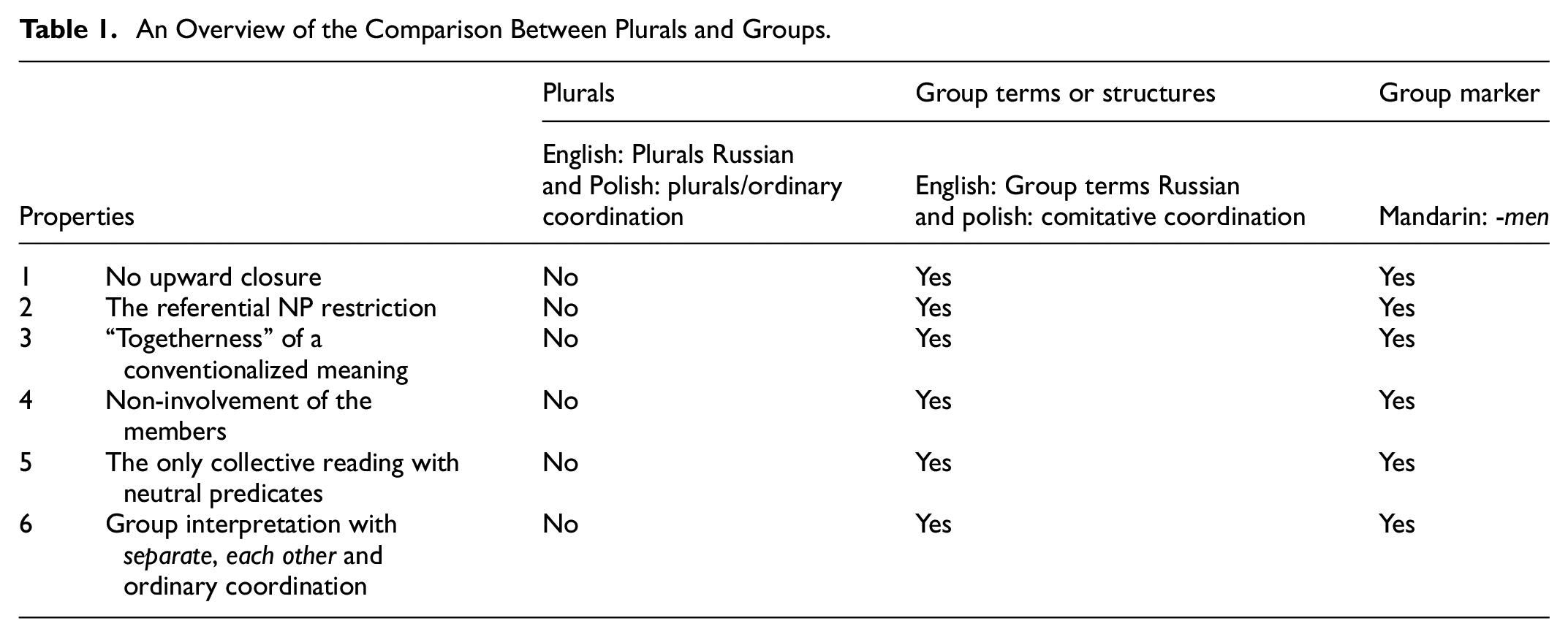
Landman (1989, 1996) posits that plurals denote a sum or a set of individual elements, whereas groups denote singletons, which comprise individual elements but function as atomic units lacking internal structure. For instance, given three individuals: a, b, and c, the respective denotations for plurals and groups are illustrated in (12).
(12) Plural: {{a}, {b}, {c}, {a, b}, {a, c}, {b, c}, {a, b, c}}.
Group: {{a, b, c}}.
Landman (1989) and Barker (1992) propose a three-step process of group formation. According to this framework, the first step is a cumulative reference, represented by the symbol *, where all syntactically plural nouns are derived through pluralization of singular nouns (Link, 1984). The second step involves the application of the iota operator, denoted as ó, to the plural predicate *P. This step corresponds to the application of a definite article the, which selects the maximum elements within a plural set. The third step involves group formation that transforms a set of individuals into a singleton, thereby effectively creating a group.
Furthermore, Landman (1989) identifies two operations: ↑ is the operation of group formation and ↓ is member specification.
(13) ↑ is a function from pure sums to groups.
1. ↓ is a function from groups to pure sums.
In (13), the ↑ operation constructs a group from a pure sum by mapping the elements of the pure sum onto a group, while the ↓ operation specifies the members of a group by mapping the group back to its constituent elements. The membership function delineates the relationship between groups and their individual members even though groups are treated as singletons that lack internal structures.
The subsequent section presents an analysis of the suffix -men in Mandarin as a group marker, demonstrating that nouns suffixed with -men exhibit properties analogous to those of group terms in English and “group-like comitative coordination” structure in Russian and Polish.
Properties of Suffix -Men as a Group Marker
This section utilizes the diagnostics summarized in Table 1 to demonstrate that the suffix -men in Mandarin satisfies the properties outlined in (1–6), which are analogous to group terms in English and “group-like comitative coordination” structure in Russian and Polish. Building on these empirical findings, the author posits that Mandarin -men functions as a group marker.
Nouns Suffixed With -Men Show No Upward Closure
According to Landman (1989, 1996) and Barker (1992), plurals exhibit upward closure by inheriting the properties of their members. In contrast, groups do not exhibit upward closure because they are independent of their members and do not possess the properties associated with those individuals. Upward closure refers to a semantic property whereby, if a predicate applies to an element of a set, it also applies to all supersets of that element. In other words, if a predicate holds for a certain quantity, it similarly holds for any larger quantity that encompasses the original one.
Nouns suffixed with -men do not exhibit upward closure and do not inherit the properties of their individual members. For instance, if Zhangsan, Lisi and Wangwu each have two children and also serve as judges, as discussed in (9) and repeated in (14), it becomes problematic to regard (14b) as the entailment of (14a).
(14) a. Zhangsan, Lisi, Wangwu you liang ge xiaohai.
Zhangsan Lisi Wangwu have two Cl children
‘Zhangsan, Lisi, and Wangwu have two children.’
b. pingwei-men you liang ge xiaohai.
judge-MEN have two Cl children
‘The judges have two children.’
In the examples, (14a) indicates that Zhangsan, Lisi, and Wangwu each have two children with their respective partners, while (14b) implies that the term pingwei-men“the judges” refers to a total of two children among them, which represents a distinct truth condition from that of (14a).
Similarly, in the examples provided in (15), Zhangsan, Lisi, and Wangwu are identified as the judges, then Zhangsan, Lisi, and Wangwu met the judges also met. However, (15a) and (15b) do not share the same truth conditions. If the judges in question were recently elected—10 years after Zhangsan, Lisi, and Wangwu first met—it cannot be inferred that (15b) is true based on (15a).
(15) a. Zhangsan, Lisi, Wangwu diyici jianmian shi zai shinian qian.
Zhangsan, Lisi, Wangwu for the first time meet be at 10 years ago
‘Zhangsan, Lisi, Wangwu first met 10 years ago.’
b. ?pingwei-men diyici jianmian shi zai shinian qian.
judge-MEN for the first time met be at 10 years ago
‘The judges first met 10 years ago.’
According to Landman (1989, 1996) and Barker (1992), groups neither exhibit upward closure nor inherit the characteristics of their individual members. Nouns suffixed with -men in Mandarin conform to this pattern.
The Referential Noun Phrase (NP) Restriction
McNally (1993) argues that, in Russian, comitative coordination—a type of group structure—primarily combines with referential NPs, whereas ordinary coordination can combine with both referential and non-referential NPs.
In Mandarin, nouns marked with the suffix -men are subject to a referential NP restriction. According to Li and Thompson (1989), a noun phrase is considered referential when it refers to an entity, whether physical, conceptual, real, hypothetical, singular, or plural. Nouns suffixed with -men are inherently referential, as they serve to identify or denote specific entities, as illustrated in (16).
(16) wo qu zhao haizi-men
I go find child-MEN
‘I will go and find the children.’
Additionally, noun phrases that fall within the scope of negative particles are used non-referentially. As illustrated in (17), nouns suffixed to -men cannot appear within the scope of negative particles.
(17) *mei you ren-men
not have person-PL
‘there is nobody’ (Iljic, 1994)
From the preceding analysis, it can be inferred that nouns suffixed with -men exhibit a referential NP restriction, analogous to that of group terms, and “group-like comitative coordination” structure in Russian and Polish.
The “Togetherness” of Conventionalized Meaning
McNally (1993) suggests that, in Russian, “group-like comitative coordination” structure “carries with it an implicature that the individuals joined in the coordination must be related or together in some highly context-sensitive sense.” This conventional implicature, characterized by the sense of “together,” is defeasible or cancellable, as demonstrated in (18b).
(18) a. Marek z Piotrem poszli do kina.
M.-NOM with P.-INSTR went-PL to movies
‘Mark and Peter went to the movies.’
b. Marek z Piotrem poszli do kina, ale nie poszli tam razem.
M.-NOM with P.-INSTR went-PL to movies but NEG went-PL there together
‘Mark and Peter went to the movies, but they did not go together.’ (McNally, 1993)
In Mandarin, nouns suffixed with -men also exhibit the property of “togetherness,” as illustrated in the examples in (19).
(19) a. xuesheng-men qu kan dianying le.
student-MEN go watch movies ASP
‘The students went to the movies.’
b. ?xuesheng-men qu kan dianying le, danshi meiyou yiqi dao.
student-MEN go watch movies ASP, but not together there
‘The students went to the movies, but did not go there together’.
In (19b), the “togetherness” associated with nouns marked by -men in Mandarin is indefeasible and extends beyond the implicature indicated by the unacceptability of (19b). Thus, nouns suffixed with -men in Mandarin not only exhibit the property of “togetherness,” but this property is also indefeasible.
Non-Involvement of the Members
Landman (1989, 1996) posits that the distinction between plurals and groups pertains to the concept of involvement. Specifically, plurals require all members to be included, whereas groups do not.
In Mandarin, nouns suffixed with -men exhibit member non-involvement, as illustrated in (20).
(20) a. xuesheng-men tuixuan Zhangsan dang banzhang.
student-MEN elected Zhangsan as monitor
‘The students made zhangsan a monitor’.
b. pingwei -men ba tade lunwen pingwei youxiu.
judge-MEN BA his paper rate excellent
‘The judges rated his paper as excellent’.
In (20a), it is plausible that some students were not involved in electing Zhangsan as the monitor, and some may have voted against him. Similarly, in (20b), it is conceivable that certain judges were not involved in rating the paper as excellent, and some may have assigned lower ratings. Consequently, decisions made by the entire group of students or judges permit non-involvement or non-conformity among individuals. This observation provides compelling evidence that -men functions as a group marker.
The Collective Reading With Neutral Predicates
According to Landman (1989), predicates can be classified into three categories: neutral, collective, and distributive. Neutral predicates apply to plurality as a whole and to each individual within that plurality, allowing for both collective and distributive readings. Collective predicates are restricted to interpreting plurality as a whole, corresponding to a collective reading. Distributive predicates target individual members of a plurality, yielding a distributive reading.
(21) a. The students carry a desk upstairs.
b. The three students earned 1 million last year. (Landman, 1989)
In examples (21a–b), the predicates “carry a desk upstairs” and “earn 1 million” function as neutral predicates, allowing for both distributive and collective readings. For instance, the sentence can imply that the students individually or collectively carried a desk upstairs or that the three students individually or collectively earned 1 million last year.
McNally (1993) further contends that a distinction exists between plurals (or ordinary coordination) and groups (or “group like comitative coordination”). When combined with a neutral predicate, plurals allow both collective and distributive interpretations, whereas groups permit only collective readings.
The collective reading associated with neutral predicates is a key factor in distinguishing plurals from groups. Nouns suffixed with -men in Mandarin also exhibit this property. As illustrated in (22a) and (22b), when a noun suffixed with -men is paired with a neutral predicate, it exclusively yields a collective interpretation rather than offering both collective and distributive readings.
(22) a. xuesheng-men tai zhuozi shanglou.
student-MEN carry desk upstairs
i. “The students carry a desk upstairs together.”
ii. *“The students carry a desk upstairs each.”
b. xuesheng-men qunian zhuan le yibaiwan
student-MEN last year earn ASP 1 million
i. “The students earned 1 million last year together.”
ii. *“The students each earned 1 million last year.”
In Mandarin, nouns suffixed with -men consistently yield collective readings when combined with neutral predicates. This provides compelling evidence that -men functions as a group marker in the language.
The Requirement of Group Interpretation With Each Other and Ordinary Coordination
Landman (1989) argues that beyond the mere sum interpretation of plurals, a group reading is essential to adequately interpret the sentence in (23).
(23) The Leitches and the Latches hate each other. (Landman, 1989)
The sentence in (23) is three-way ambiguous: The first interpretation suggests that among the individual members of the Leitch and Latch families, a considerable number of cross-family pairs hate each other. Alternatively, it could be interpreted that hate each other is distributed separately within each family, as more accurately represented as “The Leitches hate each other and the Latches hate each other.”
However, the third reading must be represented by considering the two families as two independent groups, suggesting “two families as groups” have a hatred for each other.
Similarly, when nouns suffixed with -men are combined with reciprocal expression each other, they yield a group denotation.
(24) a. laoshi-men he xuesheng-men xianghu taoyan.
teacher-MEN and student-MEN each other hate
‘The teachers and the students hate each other.’
Sentence (24) necessitates group reading, wherein the two groups—teachers and students—hate each other. In this interpretation, not every teacher or student must be involved in mutual hate. Thus, it is not about arbitrary pairs within the sum of the teachers and students who hate each other. This further substantiates the argument that the suffix -men in Mandarin functions as a group marker.
McNally (1993) observes that in ordinary coordination, groups exhibit clear non-associativity, whereas plurals display associativity. In Mandarin, when nouns suffixed with -men are coordinated with distributive markers, they manifest non-associative behavior, as illustrated in (25).
(25) a. Zhangsan he Lisi ge dai le yi ping jiu.
Zhangsan and Lisi each bring ASP a bottle wine
‘Zhangsan and Lisi each brought a bottle of wine.’
b. A-Q, XiaoQiang-men, A-hua, Xiaohong-men ge dai le yi ping jiu.
A-Q, XiaoQiang-MEN, A-hua, Xiaohong-MEN each bring ASP a bottle wine.
‘A-Q, XiaoQiang and their associates, and A-hua, Xiaohong and their associates each brought a bottle of wine.’
In (25a), Zhangsan he Lisi ‘Zhangsan and Lisi’ exemplify an ordinary coordination, indicating that two bottles of wine were brought—one by Zhangsan and the other by Lisi. In (25b), A-Q, XiaoQiang-men denote A-Q, XiaoQiang and their associates, whereas A-hua, Xiaohong-men refer to A-hua, Xiaohong and their associates. Both instances are examples of ordinary coordination. In (25b), only two bottles of wine were brought: A-Q, XiaoQiang and their associates brought one bottle together, while A-hua, Xiaohong and their associates brought the other together.
(26) a. yeye, nainai, shushu, ayi, ge dai le yi ping jiu.
grandpa grandma, uncle aunt, each bring ASP a bottle wine
‘Grandpa, grandma, uncle and aunt each brought a bottle of wine.’
b. yeye nainai-men, shushu ayi-men, ge dai le yi ping jiu.
grandpa grandma-MEN, uncle aunt-MEN, each bring ASP a bottle wine
‘The grandpas and grandmas, and the uncles and aunts each brought a bottle of wine.’
Similarly, in (26a), four bottles of wine were brought: grandpa, grandma, uncle and aunt each brought a bottle of wine. In contrast, in (26b), yeye nainai-men“the grandpas and grandmas” constitutes one group, while shushu ayi-men“the uncles and aunts” forms another group. Therefore, only two bottles of wine were brought. This further supports the notion that nouns suffixed with -men exhibit properties of groups, providing additional evidence for the characterization of -men as a group marker.
In summary, this section demonstrates that suffix -men functions as a group marker, analogous to group terms in English and “group-like comitative coordination” in Russian and Polish. This conclusion is supported by the observation that -men fulfills the properties of groups outlined in Table 1.
Findings
This section demonstrates that the group marker analysis of -men accounts for the core properties of nouns suffixed with it. These properties include definite interpretation; group formation of pronouns, proper names, and common nouns suffixed with -men; co-occurrence with classifiers; and collective and/or distributive interpretation with various predicates.
The Definite Interpretation of Nouns Suffixed With -Men
Nouns suffixed with -men convey a definite interpretation, as elaborated in (4) and reiterated in (27) for convenience.
(27) a. wo qu zhao haizi.
I go find child
‘I will go and find the/some child/children’.
b. wo qu zhao haizi-men.
I go find child-MEN
‘I will go and find the children’ (Li, 1999)
Given that definiteness is an inherent property of the DP and that nouns suffixed with -men denote definiteness, following Li (1999), it is proposed that -men functions as a group marker realized within the DP, as illustrated in (28). This analysis accounts for the distribution of -men with pronouns, proper names, and common nouns as well as a definite interpretation.
(28)

Postal (1966) and Longobardi (1994) posits that personal pronouns, as inherently definite expressions, are generated in position D.
The proposed structure accounts for the definite interpretation of -men when affixed to pronouns, proper names, and common nouns. A pronoun, base-generated in the D position, is compatible with -men, which is also realized in D, as illustrated in (29).
(29) a. wo/ni/ta-men
me/you/he (or she)-MEN
‘we/you (PL)/they’
b. [DP -men [DP D [definite] ni/wo/ta…]]
When -men is attached to common nouns, as exemplified in (30), -men functions as a group marker within the DP. In line with the feature checking mechanism in Minimalism, D contains a [+Def] feature that requires checking. The noun that also carries the [+Def] feature moves to D to check this feature. Thus, the noun xuesheng“student” undergoes head movement from N to D and is suffixed with the group marker -men, yielding a definite interpretation, as demonstrated in (30b).
(30) a. xuesheng/laoshi-men
student/teacher-MEN
‘the students/teachers’
b. [DP -men [DP D [definite] [NP N…]]]]
xuesheng <xuesheng>
A proper name suffixed with -men, as exemplified in (31), yields two possible interpretations, as outlined in (31i–ii).
(31) XiaoQiang-men
XiaoQiang-MEN
i. “XiaoQiang and his associates”
ii. “People who have the same name or share characteristics with XiaoQiang”
In (31i), the proper name, similar to a pronoun, is base-generated in D and subsequently suffixed with -men, as demonstrated in (29b). In (31ii), the proper name functions as a common noun and is initially projected as a noun phrase that moves to D, as shown in (30b).
Thus, the definite interpretation of nouns suffixed with -men is explained through the analysis of -men as a group marker.
The Formation of Group: -Men Suffixed With Pronouns, Proper Names, and Common Nouns
In Mandarin, the suffix -men can be attached to pronouns, common nouns, and proper names. Group marker analysis offers a unified account of the syntactic and semantic properties of -men across these nominal categories.
(32) a. wo/ni/ta-men
I/you/he (or she)-MEN
‘we/you (PL)/they’
b. xuesheng/laoshi-men
student/teacher-MEN
‘the students/teachers’
c. XiaoQiang-men
XiaoQiang-MEN
i. “XiaoQiang and his associates”
ii. “People who have the same name or share characteristics with XiaoQiang”
In addition to the pronouns in (32a) and common nouns in (32b), -men can attach to proper names, as illustrated in (32c). In this case, -men can denote the individual and his associates (32c-i), or can refer to several people with the characteristics or the same name as the proper name (32c-ii). The first interpretation parallels the associative reading of pronouns suffixed with -men, while the second is analogous to the plural reading of common nouns suffixed with -men.
The distribution of -men with pronouns, common nouns, and proper names can be accounted for by the group marker analysis of -men.
When -men attaches to pronouns, it refers to “the person indicated by the pronoun and associates.”Harley and Ritter (2002) propose a feature geometry framework to represent the nominal features of pronouns, as represented in (33).
(33)

The nominal features of all pronouns are anchored in the Referring Expressions node. The Participant node, along with its members, encodes the notion of “person,” specifically distinguishing first and second persons, while third person is unmarked. The Individuation node, through its feature Group and Minimal, represents the number system for pronouns, differentiating between singular and plural forms. First and second person singular pronouns, which correspond to the speaker and hearer, respectively, are active participants in discourse, whereas third person singular pronouns function as independent participants. The plural forms of these pronouns are illustrated in (34).
(34) a. wo-men (we): the speaker and the dependent participants.
b. ni-men (plural you): the hearers and the dependent participants.
c. ta-men (they): the independent participants.
The participants represented by pronouns are determined by the context of speech. Pronouns, as participants of the discourse, are salient and the interpretation of pronouns suffixed with -men can thus be misunderstood as the denotation of the focal referent (speaker/hearer) and associates.
The distribution of pronouns suffixed with -men and the formation of pronoun-men can be explained as follows: a singular pronoun denotes discourse participants, as illustrated in (35a), where the pronoun’s referents are contextually determined. For instance, consider three individuals, a, b, and c. Following Landman (1989) and Barker (1992), the first step involves a cumulative reference, denoted by the symbol *, as demonstrated in (35b). In the second step, the iota operator (ó), is applied to the plural predicate *P, yielding the maximal sum of all discourse participants, as shown in (35c). Finally, the group formation function ↑ applies, forming a group—an atom, consisting of these individuals, as demonstrated in (35d).
(35) a. [[pronoun]]: {{a}}
b. [[*pronoun]]: {{a}, {b}, {c}, {a, b}, {a, c}, {b, c}, {a, b, c}}
c. [[ó x. *pronoun (x)]]: {a, b, c}
d. [[↑ (ó x. *pronoun (x))]]: {{a, b, c}}
In Mandarin, common nouns suffixed to men are derived through similar processes. Following Li (2021), it is proposed that bare nouns in Mandarin express “general numbers,” allowing them to be interpreted as either singular or plural (Corbett, 2000; Rullmann & You, 2006). For instance, consider three individuals, a, b, and c. The denotation of the common noun xuesheng“a student/students” is shown in (36a). In the next step, the iota operator ó, functioning like the definite article the, is applied, resulting in a definite interpretation, as represented in (36b). Finally, a group is formed by applying a group formation function ↑, which converts a set of individuals into a singleton set, as shown in (36c).
(36) a. [[xuesheng (student or students)]]: {{a}, {b}, {c}, {a}, {a, b}, {a, c}, {b, c}, {a, b, c}}
b. [[ó x. xuesheng (x)]]: {a, b, c}
c. [[↑ (ó x. xuesheng (x))]]: {{a, b, c}}
Proper names suffixed with -men exhibit two distinct readings, as seen in (32c), “XiaoQiang and his associates” or “several people with the characteristics or the same name of XiaoQiang.” The first reading parallels the behavior of pronouns suffixed with -men, as shown in (35), whereas the second reading mirrors that of common nouns suffixed with -men, as shown in (36). As the group formation process has already been outlined, it is not repeated here. Consequently, analyzing men as a group marker allows for a unified account of its distribution across pronouns, proper names, and common nouns.
The Distribution of -Men With Respect to a Classifier
As indicated in (5) and reiterated in (37), when -men attaches to common nouns, proper names, or pronouns, the resulting sequence cannot occur after quantity expressions.
(37) a. *sige xuesheng-men
four-CL student-MEN
‘four students’
b. *sige ta-men
four-CL he/she-MEN
‘four of them’
c. *sige XiaoQiang-men
four-CL XiaoQiang-men
‘XiaoQiang and three others’
i. *“XiaoQiang and three others.”
ii. *“Four individuals who have the same name or share characteristics with XiaoQiang.”
Pronouns, proper names, and common nouns suffixed with -men can precede a numeral-classifier and even a following noun, as indicated in (6) and repeated in (38).
(38) a. wo qing xuesheng-men sange (ren) chifan.
I invited student-MEN three-CL person eat
‘I invited three of the students for a meal’.
b. wo qing ta-men sange (ren) chifan.
I invite them three-CL person eat
‘I invited them three for a meal’.
c. wo qing XiaoQiang-men sange (ren) chifan.
I invite XiaoQiang-MEN three-CL person eat
i. “I invited XiaoQiang and two others for a meal.”
ii. “I invited three individuals who have the same name or share characteristics with XiaoQiang.” (Li, 1999)
This distinction can be explained by the group marker analysis for -men. In the numeral-classifier N-men sequence, the numeral-classifier precedes the N-men structure. Specifically, when a noun refers to a common noun or proper name (e.g., denoting people who have the same name or share characteristics with the proper name), it is base-generated in the N position. According to Travis’s (1984) Head Movement Constraint (HMC), a head cannot move across another head. As a result, N does not move to D because of HMC, as shown in (39), and -men remains in D. This explains the ungrammaticality of the numeral-classifier N-men sequences in these cases. However, pronouns, which are base-generated in D, adjoin to -men to form the N-men sequence. As the numeral-classifier sequence is located below the D position, it cannot combine with the pronoun-men sequence, as shown in (39).
(39) [DP -men [DP D [definite] [NumP Num [CLP CL [NP N…]]]]
A common noun, pronoun, or proper name suffixed with -men can be followed by a numeral-classifier sequence. Common nouns and proper names (referring to people who have the same name or share characteristics with the proper name) are NPs headed by N. To achieve a definite reading, the noun must move to the D position. However, it is crucial to evaluate whether this movement violates the HMC given that CL and Num intervene between N and D, as shown in (40).

When a common noun, pronoun, or proper name suffixed with -men precedes a numeral-classifier sequence such as sange“three CL,” the structure remains grammatical, as shown in (38). In these cases, the noun, whether it is a common noun or a proper name (indicating people who have the same name or share characteristics with the proper name), is base-generated in NP and appears to move across the classifier head to DP, thereby seemingly violating HMC. At first glance, this appears to contradict the proposed analysis. However, building on Jiang (2017), it is argued that the post-nominal order in (38) does not violate the HMC because the noun should not be viewed as moving from a post-classifier position; instead, that position is already occupied by the noun ren“person,” as shown in (38). It is proposed that the N-men numeral-classifier (person) structure constitutes an appositive nominal phrase. This proposal is supported by the following arguments:
In the N-men Num-CL sequence, the presence of -men is obligatory. Omitting -men results in ungrammatical sentences, as shown in (41).
(41) a. wo qing xuesheng*(-men) sange (ren) chifan.
I invited student-MEN three-CL person eat
‘I invited three of the students for a meal’.
b. wo qing ta*(-men) sange (ren) chifan.
I invite them three-CL person eat
‘I invited them three for a meal’.
c. wo qing XiaoQiang*(-men) sange (ren) chifan.
I invite XiaoQiang-MEN three-CL person eat
i. “I invited XiaoQiang and two others for a meal.”
ii. “I invited three individuals who have the same name or share characteristics with XiaoQiang.” (Jiang, 2017)
Furthermore, the N-men numeral-classifier sequence utilizes numerals to convey additional information regarding the maximum number of group members. For instance, if there are five students in a classroom, it would be inaccurate to use the phrase xuesheng-men sange“three of the students” to refer to only three of the five, as shown in (41a). Similarly, if there are five other individuals in the group associated with XiaoQiang, it would also be inappropriate to use the phrase XiaoQiang-men sange“XiaoQiang and two others” to denote XiaoQiang and two others from the five, as shown in (41c).
Building on preceding observations, the author posits that the N-men numeral-classifier (person) constitutes an appositive nominal phrase, wherein the numeral-classifier functions as a distributive operator that specifies the group members. To support this analysis, the author employs the adjunction structure proposed by Del Gobbo (1999), as illustrated in (42a), for nominal appositives in Mandarin, as exemplified in (38a-c).
(42) a.

b. ni-men zhe xie haizi
you-MEN this xie children
‘those of you who are children’
c. Zhangsan zhe ge haizi
Zhangsan this CL children
‘Zhangsan, this kid’ (Del Gobbo, 1999)
Drawing on Del Gobbo’s (1999) analysis, a left-adjunction structure is proposed to account for the N-men numeral-classifier (person) sequence as illustrated in (43).
(43)

In summary, the group marker analysis of -men effectively accounts for both the occurrence and restriction of quantity phrases with a numeral-classifier sequence.
The Collective or (and) Distributive Interpretation With Different Predicates
In Mandarin, the suffix -men functions as a group marker, denoting a singleton comprising individuals. However, it is significant to note that when -men is attached to a distributive predicate, the predicate applies to each member of the group, as shown in (44).
(44) a. tongxue-men shoushang le.
student-MEN injured ASP
‘The students are injured’.
b. laoshi-men shui-jiao la.
teacher-MEN sleep-ASP ASP
‘The teachers are sleeping’.
The group and its members can be interchanged through the group formation and member specification processes. As noted in (43), the phrase N-men Num-CL (person) functions as an appositive nominal phrase, with the numerical classifier acting as a distributive operator that specifies the members of the group.
In (44), the terms shoushang“injured” and shuijiao“sleep” function as distributive predicates, which can only be applied to individuals. These distributive predicates prompt member specifications, shifting the interpretation from group to individual members.
Neutral predicates exhibit both collective and distributive interpretations. However, when nouns suffixed with -men are combined with neutral predicates, they only yield collective readings. A group, which is a singleton comprising a set of individual elements, naturally implies a collective reading when paired with a neutral predicate. Conversely, as illustrated in (44), distributive predicates require the action to be applied to individual elements, necessitating a member specification. The default collective interpretation of nouns suffixed with -men contradicts the requirements for distributive predicates. Consequently, through member specification, nouns suffixed with -men can specify individual members of the group. This explanation effectively addresses the data that challenge previous analyses of -men, as demonstrated in examples (9)–(11) and reiterated below.
(45) a. Zhangsan, Lisi, Wangwu you liangge xiaohai.
Zhangsan Lisi Wangwu have two-Cl children
‘Zhangsan, Lisi, and Wangwu each has two children’.
b. pingwei-men you liangge xiaohai.
judge-MEN have two-Cl children
‘The judges have two children’.
(46) xuesheng-men mai-le yiben shu.
xuesheng-MEN buy-ASP a-CL book
The students bought a book.
(i) Each student bought a book.
(ii) The students bought a book together.
(iii) One of the students bought a book.
(47) a. xuesheng-men ge dai le yiping jiu.
student-MEN each bring ASP a bottle wine
‘The students each brought a bottle of wine’.
b. xuesheng-men, laoshi-men, ge dai le yiping jiu.
student-MEN, teacher-MEN, each bring ASP a bottle wine
‘The students, and the teachers each brought a bottle of wine’.
In (45b), the phrase pingwei-men“the judges” denotes a group and consequently, the default interpretation is collective. This implies that all judges together have two children, which differs from (45a), where “Zhangsan, Lisi, and Wangwu each have two children.” Similarly, in (46), the default reading remains collective, as shown in (46ii). However, through the member specifications, a distributive reading is obtained in (46i). Furthermore, because nouns suffixed with -men permit the non-involvement of members, (46iii) can be derived, where individual members are not necessarily implicated. In (47a), the distributive marker ge“each” is applied to the members of xuesheng-men“the students,” leading to the interpretation that “The students each brought a bottle of wine.” In contrast, in (47b), the distributive marker ge“each” is applied to the coordinated groups: xuesheng-men“the students” and laoshi-men‘the teachers’ as a whole. Here, the group’s default interpretation remains collective, resulting in only two bottles of wine brought.
Group analysis effectively elucidates the varying interpretations of nouns suffixed with -men when combined with different predicates.
Conclusion
This study shows that the suffix -men in Mandarin functions as a group marker realized within the DP. The evidence presented demonstrates that nouns suffixed with -men exhibit a range of properties typically associated with group terms in English, as well as with “group-like comitative coordination” in Russian and Polish. Such properties encompass no upward closure, the referential NP restriction, the “togetherness” of a conventionalized meaning, non-involvement of the members, only collective reading with neutral predicates, and group interpretation with each other and ordinary coordination. The notable parallels between nouns suffixed with -men and group terms or group-like structures substantiate the argument that -men functions as a group marker in Mandarin.
This group marker analysis of -men effectively elucidates the defining properties of the suffix -men, including its distribution with pronouns, proper names, and common nouns; its definite interpretation; its co-occurrence with classifiers; and its capacity for collective or distributive interpretations with various predicates.
This study makes a significant contribution to the study of the suffix -men in Mandarin by offering a comprehensive theoretical, analytical, and empirical analysis that distinguishes it from prior literature on the subject. This analysis situates -men within contemporary theories of groups, offering both theoretical and empirical support for distinguishing groups from plurals. Furthermore, the group marker analysis of -men in Mandarin clarifies the nature of plurality-like suffixes in classifier languages, particularly in East Asian languages such as Mandarin.
