




Abstract
Knowledge on the long-term User Experience (UX) of older adults in using Home-based Intelligent Care System (HICS) is limited, even though it is imperative for older adults’ continuous use of HICS to promote their quality of life. This study aims to investigate the long-term User Experience (UX) of older adults in using Home-based Intelligent Care System (HICS), and to understand how its elements change over time and which system attributes cause these changes. Based on the Change-oriented Analysis of the Relationship between Product and User (CORPUS), the 23 older adults living alone who used the same HICS for half a year or more were interviewed through Focus Group. Conventional qualitative Content Analysis was adopted to analyze the interview data. A two-stage model of the older adults’ long-term UX was established. In Orientation stage, UX elements mainly included Usability Experience, Affect Experience, and Social Value Experience. In the Incorporation stage, there were only Usability Experience and Social Value Experience. The system attributes causing these UX elements were discussed. This study is a supplement to researches in the field of home-based senior care that only discussed the effect of HICS from static perspective, and also riches the researches of the Human-Computer Interaction field that mostly focused on the young users.
Keywords
Introduction
“Aging in Place” has become the main way for countries to deal with aging (Gibson et al., 2024; Kong et al., 2021). Among them, living alone is on the rise (Soulières & Charpentier, 2022). For instance, in China, where this study was conducted, more than 25% of adults live alone regardless of age group. By 2025, the elderly living alone in China will reach 50 million. Because of poor self-care ability, the older adults living alone lack self-rescue ability and someone can’t take care of themselves when they are hurt at home, and there is little opportunity for others to help them in time (Xu et al., 2022).
Based on Internet of Things (IoT), the Home-based Intelligent Care System (HICS) refers to the hybrid system which collect and analyze behavior data of older adults using sensors installed in his/her home. Caregivers, as the element of the system, can provide services according to the older adults’ situation identified by the system (Colnar et al., 2020; Kong et al., 2022). Therefore, HICS can improve the health status of the older users (Choi & Chlebek, 2024; Yuan et al., 2015), increase their sense of control and security (Cameron & Munyan, 2021; Nyende et al., 2023), and enhance their sense of happiness (Verma et al., 2023). But the realization of these effects should be based on the older adults’ adoption and continuous use (Wang et al., 2018).
User Experience (UX), the subjective feeling of users in using products or services (Alshammare et al., 2025), is the key factor that affects whether the older adults continue to use or not (Cechetti et al., 2019; Cheng et al., 2024). Its aspects are related to the user, the product and the context of use (Biduski et al., 2020). Moreover, The UX will change over time. The users’ subjective feelings and the reasons for these feelings are constantly changing in using the product (Horton et al., 2019). Understanding the evolution of older adults’ UX and adopting according intervention to improve their UX are great significance for continuous use of HICS, in order to promote the system’s effects.
Since UX is related to time span, longer time spans may reveal more knowledge about users’ feelings (Melo et al., 2022). However, most of existing studies regarded the older adults’ subjective feelings on HICS as a static state, and evaluate their UX at a certain node (Russell et al., 2020; Şahin et al., 2024; Sharma et al., 2022). It is not reliable to evaluate a “snapshot” of UX to represent the long-term UX, and it cannot be used to judge whether the system is successful or not (Baskan et al., 2022; Hart & Sutcliffe, 2019).
Research road maps for UX have called for UX in the longer term (Martinelli et al., 2024; Melo et al., 2022), but only a few long-term studies have been reported. And most of these long-term studies focused on young people’s UX about IT-based product, such as smart phone (Hart & Sutcliffe, 2019; Karapanos et al., 2009), software (Harbich et al., 2017; Kim et al., 2015; Yuhui et al., 2019), computer game (Cheng et al., 2024; Fan et al., 2022). At the beginning, young users’ Usability Experience and Affect Experience were identified (Harbich & Hassenzahl, 2017; Kim et al., 2015). As they continue to use the product, their Usability Experience and User Value Experience became more prominent (Fan et al., 2022; Kim et al., 2015). Regarding the waiting experience in the context of computer game, Cheng et al. (2023) gave the insights that interactive loading screen can achieve a good long-term UX. Because the UX is user-based (Yoon et al., 2020), and the older adults’ cognition and feeling on IT-based product are very different from the young people’s (Rao & Joshi, 2020). The existing conclusions on long-term UX may not be well extended to older adults. Few study has investigated the long-term UX of older adults on mobile health application. Taking the UX as a whole, the changes in older users’ UX level were assessed (Biduski et al., 2020; Locatelli et al., 2023) . But UX includes many elements, such as Usability Experience, Affect Experience, and User Value Experience (Park et al., 2013), and the dominant UX elements may be different at different stages of use. Existing studies are not a good answer to the changes of these elements.
Based on this, adopting Retrospective Interview Technique (RIT) that can collect user’s memories of UX, the study aims to investigate the long-term UX of older adults in using HICS, and to understand how its elements change over time and which system attributes cause these changes.
Methods
This study is described according to the consolidated criteria for reporting qualitative research.
Study Design
Long-term methods, such as diary studies, may provide rich insights. But such long-term studies are rare because of their expense and laborious nature. Retrospective Interview Technique (RIT), such as UX Curve, iScale, and CORPUS, is more practical (Melo et al., 2022; Mkpojiogu et al., 2022), but they may be vulnerable to memory biases. However, Karapanos et al. (2010) and Mkpojiogu et al. (2022) argued that the memories of UX were as important as the actual experiences because the memories will be reported to others, guide the users’ future behaviors, and provide important feedback for product design (Walsh et al., 2014). The retrospective method has been adopted by many studies and has achieved good results (Horton et al., 2019; Read et al., 2022; Varsaluoma & Sahar, 2014). Based on the above reasons, the retrospective method was adopted to conduct this study.
The change-oriented analysis of the relationship between product and user (CORPUS), as one of the most popular approaches in RIT, was proposed by von Wilamowitz-Moellendorff et al. (2006) for the retrospective assessment of the dynamics in UX. It was expressive in reporting the UX over time, and started by asking participants to assess the current experience of a product. Subsequently, these participants were asked to “go back in time” to compare their current perception and evaluation of the product to moment right after adopting this product (von Wilamowitz-Moellendorff et al., 2006). If the change has occurred, participants were asked to elaborate reasons that induced the changes (Harbich & Hassenzahl, 2017). The obtained data can be used qualitatively by constructing the changes and exploring the reasons for these changes. In this study, we adopted CORPUS to collecting the data about the UX of older adults.
Setting and Participation
The study was undertaken in local communities in China, and the ethics approval was obtained from Xinyang Normal University Human Research Ethics Committee. Representative interviewees were selected according to the principle of theoretical sampling (Eisenhardt & Graebner, 2007). Older participants were invited through advertising flyers written information about the study, and were given RMB 200 Yuan as honorarium after interviewed. We selected participants according to the following inclusion criteria: (1) age 60 or older, (2) living alone, (3) using home-based senior care service system for half a year or more.
It should be noted that we did not interview the elderly who refused to use the system initially or discontinued using the system for less than 6 months, because the focus of the study was the long-term user experience. In addition, in order to control the impact of differences between different care systems, we chose the older users of the same system.
Twenty-nine participants were invited, and 23 were selected as interviewees because they were the users of the same home-based intelligent senior care system operated by YK company. Appendix A presented the detail information of this company and system. Table 1 showed their demographics information, and every interviewee’s detailed information was presented in Table B1 in Appendix B.
Demographics (n = 23).
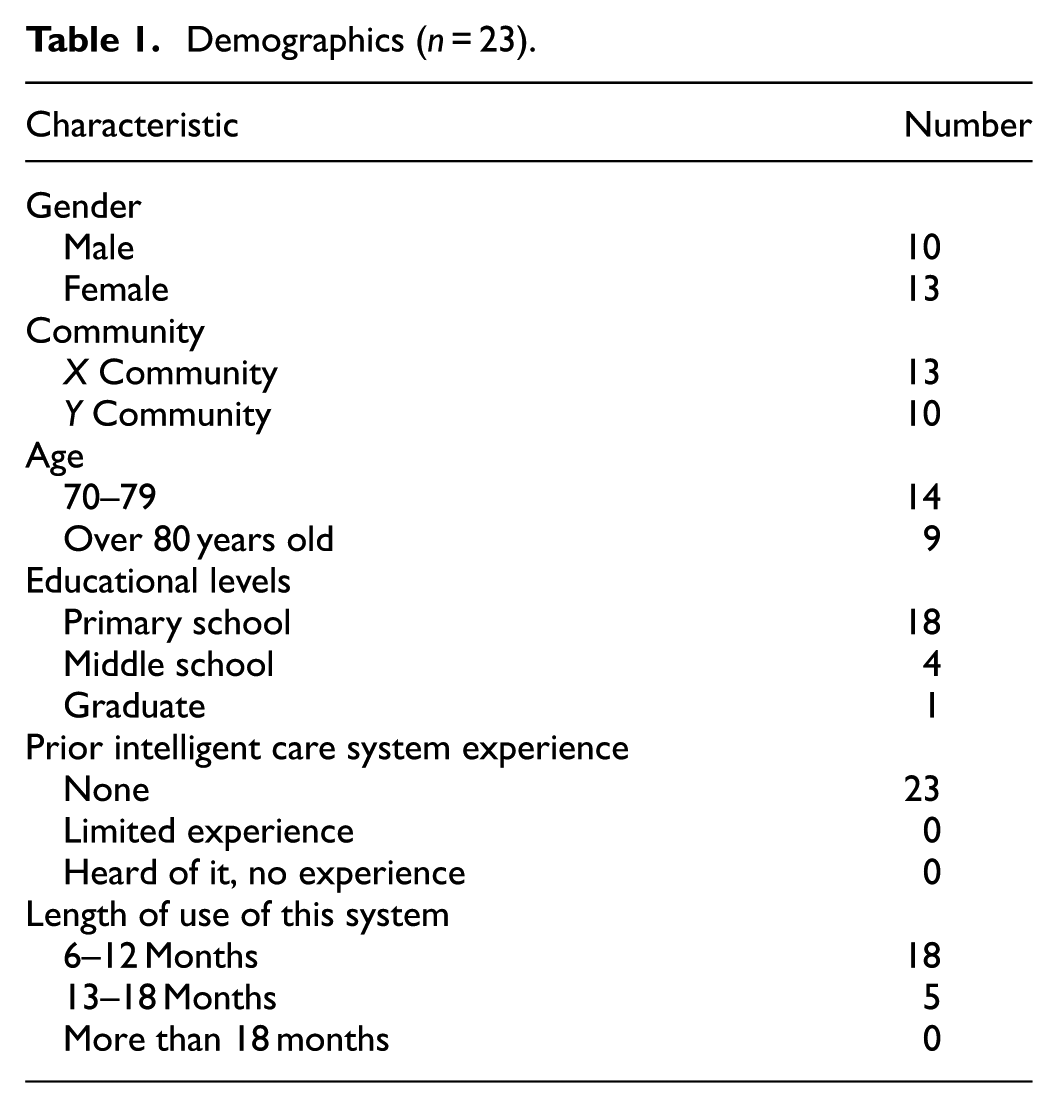
First, all participants were over 70 years old, of which nine were over 80 years old. It was also the main age range for users of HICS, because most elderly in 60s had relatively good physical functions, and they did not believe that they need the help of HICS. Second, most participants had a lower level of education, which was consistent with the social development situation in China. Third, none of the participants had used HICS before. This is also the situation of most elderly in China, because HICS had not yet been widely used. These were why the 23 participants had a certain representativeness.
On the one hand, although there were 23 participants in the study, it met the sample requirements of RIT (Karapanos et al., 2012). On the other hand, during data analysis, it was found that there were no new themes emerged in open coding when we analyzed the 18th sample data, which indicated that the data has reached saturation. Both of these indicated the data of 23 samples met the research needs.
Data Collection
Data collection occurred through semi-structure interview in Focus Group, which can stimulate memories among interviewees through discussions. The interviewees provided informed consent and were informed of the right to withdraw from the interview at any time. The first author, a male doctor, and a PhD student whose research focuses on senior care, conducted the interviews in Mandarin. The interview guide (shown in Appendix C) was constructed based on the research aim and existing literature. It was tested by a pilot interview for ability to capture information.
The formal interview was completed in four Focus Groups, and we used this guide to complete all interview to ensure the reliability of data. The two Focus Group interview, including seven and eight interviewees respectively, were conducted separately in X Community. According to the flow of CORPUS (von Wilamowitz-Moellendorff et al., 2006), the two interviewers put forward the interview questions, and the interviewee answered in turn according to their own situation. During this period, the interviewees were encouraged to discuss with each other to stimulate deeper memories. The other two focus group interview, including six and four interviewees respectively, were conducted separately in Y Community in the same way.
All interviews were recorded for about 12 hr, and 105,000 words text about every interviewee’s answers was transcribed. A confidentiality agreement was provided by the authors’ affiliation, and the interview data were processed anonymously.
Theoretical Basis
Three Stages of UX
The three stages model of UX, provided by Karapanos et al. (2009), indicated that there were three stages in the adoption of the product, named Orientation, Incorporation and Identification, and the UX elements in each stage were different. Orientation refers to the process that users learn and understand the product functions and attributes that they don’t know much. With the in-depth understanding of the product, the users’ familiarity with the product is improving. Incorporation refers to how the product becomes meaningful in users’ daily lives, and the users’ functional dependency is increasing. Finally, the product participates in users’ social interactions as communicating parts of users’ self-identity. This stage is Identification, and the emotional attachment of users is improving. The three stages model adopted by many studies is suitable for analyzing the long-term UX. Inspired by this model, we will validate distinct stages in older adults’ process of using HICS.
Elements of UX
Through survey, interview, and observation approaches, Park et al. (2013) proposed three UX elements, named Usability Experience, Affect Experience, and User Value Experience. Usability Experience was defined as the evaluation of effectiveness, efficiency, and satisfaction with which users can achieve specified goals, including Usefulness, Ease of Use as sub-elements. Affect Experience was considered as an emotion that was a consequence of interaction with product. The sub-elements of it consisted of Delicacy, Luxuriousness, Attractiveness, etc. User Value Experience referred to the judgment related to how the product was meaningful in user’s life, including some sub-elements, such as Self-Satisfaction, Sociability, Attachment, etc. Based on this element model, we will identify the elements of older adults’ UX on HICS.
Model of Product Attribute
The model of product attribute proposed by Hassenzahl (2004) has been cited in many studies. This model distinguished product attributes between two dimensions: Pragmatic and Hedonic. The Pragmatic attributes referred to the product’s characteristics to support the achievement of behavioral goals, including Simplicity, Flexibility, Learnability, etc. the Hedonic attributes referred to the product’s characteristics to have impact on the user’s emotion or social value, including two sub-elements named Stimulation Attribute and Identification Attribute. Stimulation Attribute was defined as the attributes stimulating user’s emotions and enabled user growth, such as novelty, aesthetics, etc. Identification Attribute referred to the attribute meeting the social and self-expression needs of users. Inspired by this model, we will investigate the attributes of HICS that caused the UX of older adults.
Data Analysis
Conventional qualitative Content Analysis (CA) was adopted in this study. Conventional CA was appropriate when prior theory existed but the researcher wished to stay open to unexpected themes and relate findings to existing theory only at a later stage, while it shares a similar analytical approach with Grounded Theory (Karapanos et al., 2009). Our approach consisted of three steps.
Open Coding
A detailed coding aimed at identifying key themes in data set without imposing pre-conceived categories. The first and second authors independently coded the transcribed data from each interviewee sentence by sentence. The initial codes from two researchers were compared and the inconsistent results were discussed. The codes with on agreement were excluded, and 162 loosely connected codes were saved finally. There were no new codes emerged when we analyzed the 18th interviewee data, and the data has reached saturation.
Axial Coding
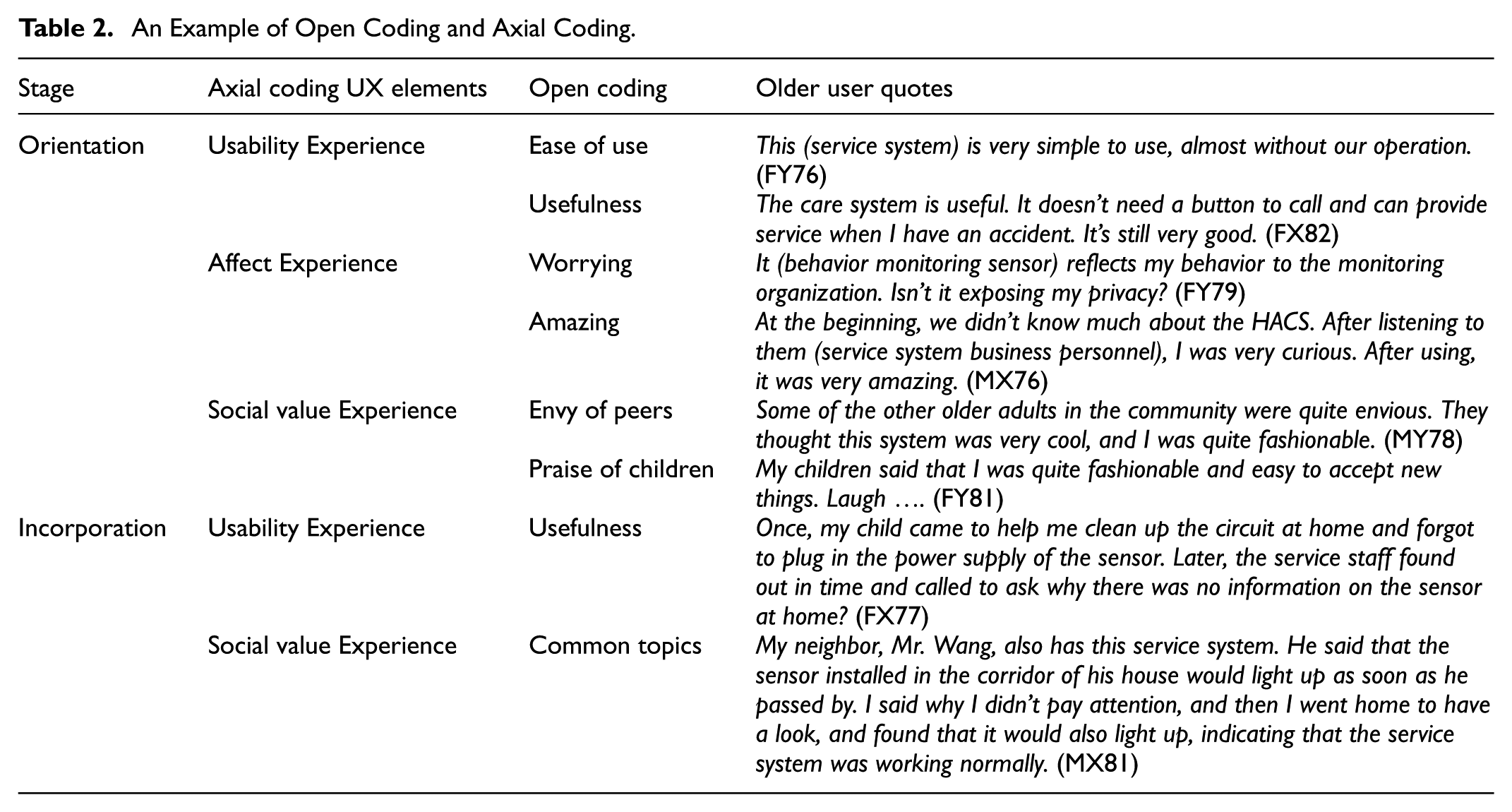
The initial set of phenomena described by open codes was categorized using axial coding. Based on the three stages of UX (Karapanos et al., 2009), some open codes were categorized into characteristics or promoting force of different stages. According to the UX element model (Park et al., 2013), the corresponding open codes were summarized into corresponding UX elements. In the same way, some open codes were categorized into the corresponding product attributes based on product attribute model (Hassenzahl, 2004). All categories were then mapped into corresponding stage themes. In the same way, the results from the two researchers were compared and discussed. An example of this process can be found in Table 2.
An Example of Open Coding and Axial Coding.
Selecting Coding
Most categories were connected based on “Human-System-Interaction” logic, and the UX model of each stage was established.
Some solutions were adopted to ensure the reliability of the study. First, the older users of the same HICS were selected as interviewees in order to remove the impact of different system. Second, the Focus Group interview was adopted to stimulate the interviewees’ deeper memories, and the cash reward was used to encourage interviewees to cooperate actively. Third, the data was coded by two researchers independently and the results were compared and discussed in order to weak the bias from the researchers. And the design, methods, analyses, and results were all discussed within the research team.
Results
Two stages, including Orientation and Incorporation, were identified. And the UX model of each stage, consisting of UX elements and system attributes causing these elements, was established.
Orientation and Older Adults’ UX Model
According to the element model of UX and product attribute model, we established the older adults’ UX model of Orientation stage (see Figure 1).

The older adults’ UX model for Orientation stage.
Orientation Stage
Orientation stage refers to the process of learning and understanding product functions and attributes that users did not know much. With the continuous interaction between users and products, their understanding of products was constantly improving. First of all, almost all the older users did not understand the functions and attributes of this HICS. They said that this kind of “high-tech” care system has never been seen before, or “even never thought of it.” Although some servicers gave a detailed introduction to the older adults before the installation and use, most of them said they did not understand at all. They just had a “general impression,” such as “don’t worry about damage or battery replacement.” Secondly, after the installation and use, the older adults gradually understood the functions and potential risks of the HICS. With the continuous use of the system, the older adults’ understanding was gradually deepening. At the same time, the they also had some concerns about the potential risks, such as privacy security, radiation security. As the they had more familiarity with HICS, the use of the system will gradually transition to the next stage. At the same time, some UX elements changed with the deepening of the older adults’ familiarity. For example, the safety concern will gradually fade. Therefore, we believed that the older adults’ familiarity with HICS was the driving force of UX’s change.
Older Adults’ UX Elements
Usability Experience refers to the user’s evaluation about the efficiency and effectiveness of a product to help him/her achieve a certain goal (Park et al., 2013). In this study, the Usability Experience of the older adults in the Orientation stage included some elements, such as ease-of-use and usefulness. HICS used non-intrusive devices to monitor the older adults’ home-based behavior, almost without operation. Therefore, although the older adults did not know much about the system, they also had a very obvious ease-of-use experience, as shown in the following quote:
It (HICS) has been used for half a year, and there have been no problems or failures. (MX80) In the past year of use, I don’t need to maintain it, it’s very convenient. (FY76)
Usefulness refers to the user’s evaluation of a product to help him/her achieve a certain goal. In the Orientation stage, with the increase of older adults’ familiarity with the system, they showed Usefulness experience, as illustrated by the following quote:
Once, I felt a bit uncomfortable in the morning and was lying in bed. At noon, the staff called to inquire about my situation. It can really identify problems and provide services. (FX77)
Affect Experience refers to the user’s emotional reaction of the interaction between they and product (Park et al., 2013). In this study, the Affect Experience of older adults in Orientation Stage mainly included Amazing and worry about safety. For the most older adults, this HICS was very novel, and was the specific application of the current more cutting-edge technology. Therefore, the they showed an “amazing” experience, as shown in the following quote:
I remember that it was the first week after installation, and the staff gave me feedback on my activities at home this week. It clearly describes the rules of my activities. It’s amazing. (FY76) It can collect and analyze our behavior through several sensors, it’s really amazing. (MX80)
However, Because the HICS used sensors to collect home-based behavior of the older adults, they worried that their privacy may be exposed. In addition, because the sensors were close to their life, the older adults also had concerns about the safety problems caused by the radiation, as illustrated by the following quote:
Does the sensor on the mattress radiate the body? Because it is under the body. (FY75) I won’t be seen by them when I’m at home, will I? (MX76)
Social Value Experience refers to users’ evaluation of the degree to which products meet their social needs (Park et al., 2013). In this study, the Social Value Experience of the older adults in the Orientation stage mainly included the envy of peers and the praise from their children. The older users of the HICS will talk about the system with their peers, which made them be considered as a fashion elderly and caused the envy of the peers. Some older adults also told their children about the installation and use of the HICS, and their children showed praise, thus bringing Social Value Experience to them, as shown in the following quote:
I heard my neighbor Lao Zhang and his friend said that I was using an automated service system, which is very technological. (MX81) My children said I used modern products ahead of them. (FX82)
System Attribute
The Pragmatic attribute refers to the product’s characteristics supporting the achievement of behavioral goals (Hassenzahl, 2004). The different combination of Pragmatic attributes were the antecedents of the older adults’ Usability Experience and Affect Experience.
The Pragmatic attributes causing “ease of use” experience were simple operation and simple maintenance. This HICS reduced the older users’ operation as far as possible, which reduced the obstacles for they to use the system. In addition, the system reduced the power of the sensor and increased the battery life to simplify the maintenance work. These brought the older adults an easy-to-use experience.
The Pragmatic attributes that caused “usefulness” experience were comprehensive functions, user support and offline service station. The HICS can provide corresponding service for the older adults with the help of non-intervention sensors, which brought “usefulness” experience to the older adults. User support refers to the support services that the older adults get in using the care system, such as answering questions, after-sales service, etc. These services can help the older adults understand the system better and faster, thus bringing “usefulness” experience to the older adults. Because many services provided from HICS were offline services, the offline service station had a great impact on the “usefulness” experience of the older adults, as illustrated by the following quote:
I asked them (system service personnel) about this (service system), and a young man explained it for a long time. I understand a little bit. There is an offline service station in changhewan, which is very close to our community. There are people on duty to monitor, and there are service personnel who can provide services quickly. I feel very reliable and the system is very useful. (FY75) Their offline service station is very close to our community and can quickly provide on-site services. (MX77)
The “safety worry” experience as one element of Affect Experience was also caused by Pragmatic attributes. As mentioned above, the concerns of older adults mainly came from privacy and radiation. Therefore, in the system’s design, measures should be taken to ensure privacy and radiation security.
Stimulation Attribute is defined as the attribute stimulating user’s emotions and enabled user growth, such as novelty, aesthetics, etc. (Hassenzahl, 2004). In the Orientation stage, different combinations of Stimulation attributes were the antecedents of Affect Experience and Social Value Experience of the older adults.
The Stimulation attribute that caused “Amazing” experience, one element of Affect Experience, was Novelty. Novelty can often arouse the user’s curiosity. When interacting with it, the user will have amazing emotional reaction. Most of the older adults were curious about the sensor devices and Internet of things, so the novelty of the HICS caused the older adults amazing “emotional” experience. The Stimulation attribute that caused Social Value Experience was Fashion. As the HICS was the specific application of modern new technology, it had a strong sense of the times. On the one hand, other older adults will envy the older adults who have installed and used the system; on the other hand, the children of the older adults will think that their parents are trendy and “keeping pace with the times,” so that the older adults had Social Value Experience.
Incorporation and Older Adults’ UX Model
In the same way, we built older adults’ UX model in Incorporation stage (see Figure 2).

The older adults’ UX model for Incorporation stage.
Incorporation Stage
Incorporation stage refers to the process that users integrate products into their daily life. As users integrate products with their life better, their acceptance or dependence on products are constantly improving. At the beginning, the older adults would feel that the HICS was a “foreign body,” and felt uncomfortable with the “foreign body” in home. However, as interacting with the system more and more in their life, the older adults gradually accepted it. Next, with the improvement of the acceptance, the older adults regarded it as a part of life, just like TV or refrigerator, and integrated it into their own lives, as shown in the following quote:
The one (sensor) on the mattress felt a little nervous at the beginning. Now it’s a long time and I don’t feel it. Maybe I’m used to it. (FX77) If you don’t mention it, it’s like we don’t know the existence of intelligent home care service system. It’s hidden in our lives. (MY80)
With the increasing acceptance of HICS, the use of the system will transition to the next stage. At the same time, some UX elements also changed. Therefore, in the Incorporation stage, we believed that the older adults’ acceptance of the HICS was the driving force for the change of UX.
Older Adults’ UX Elements
The Usability Experience of the older adults in the Incorporation stage was mainly reflected in the usefulness evaluation. As the older adults gradually integrated the HICS into their daily life, they will pay more and more attention to whether the system can actively alert and provide services when their home-based behavior was abnormal, as illustrated by the following quote:
Last month, I went on a tour, and there was no one at home for half a month. These sensors will not send out activity signals. This situation should be abnormal for the system. But no one reminded me, no one provided me with service. So I feel that the service system is useless. (FY76) Once, my child came to help me clean up the circuit at home and forgot to plug in the power supply of the sensor. Later, the service staff found out in time and called to ask why there was no information on the sensor at home? (MX81)
The Social Value Experience of the older adults in the Incorporation stage was mainly reflected in the degree that the HICS met their social need, such as forming a common topic. The older users of the HICS discussed the system with each other, forming a common topic among them, which met their social needs to a certain extent, as shown in the following quote:
When having questions about the system, those neighbors come and ask me. Many times, I’m not sure, so we discuss it together or ask the staff. (MX76) Sometimes, we talk about our views and feelings about the system. (FY79)
System Attribute
In the Incorporation stage, the attribute of HICS that caused the older adults’ UX was Pragmatic, including Signal Feedback, Information Feedback, and Service Feedback. Signal Feedback refers to the working signal given by the sensors. Because these devices almost did not need be operated, the older adults cannot determine whether these devices are working without working signal feedback, as illustrated by the following quote:
The sensor installed in the corridor will flash when people walk by, indicating that it records a behavior, and I know it is still normal. (FY79)
Information Feedback means that the HICS regularly feeds back the behavior information to the older adults and their families, including normal feedback under normal conditions and abnormal alarm under abnormal conditions. Service Feedback refers to the provision of corresponding services to the older adults when the abnormal home-based behavior is found and the causes are determined, as shown in the following quote:
(service system) connects some service units in the community. When the service system finds some abnormal conditions, these service units can provide corresponding services nearby. (FX81)
These three Pragmatic attributes were the antecedents of Usability Experience and Social Value Experience. When the service system formed a common topic among the older users, they often discussed it, such as whether the sensor works normally, whether it receives information feedback, whether it provides corresponding services, etc.
Discussion
UX Evolution Stages
This study investigated older users’ long-term UX of HICS, and clarified the evolution of their UX into two stages: Orientation and incorporation stage. Karapanos et al. (2009) proposed that the user’s familiarity with the product was constantly improving in Orientation stage, and the dependency on the product was increasing in Incorporation stage. Finally, in Identification stage, Users’ emotional attachment to the product was increasing. Similarly, this study also found the older user’s familiarity with the system was improving in Orientation stage. However, the difference is that in the Incorporation stage, what the older user increased is not the dependence, but the acceptance. The reason for this difference may be that users have different initial attitudes toward products. Karapanos et al. (2009) focused on the younger users and Apple mobile phone. In which these users have a high acceptance of the product. But in this study, the older users were suspicious of the HICS initially, and their acceptance was worrying (Rao & Joshi, 2020). Moreover, this study did not find Identification stage, which indicated that the older users only saw the system as a tool to assist in daily life and had not developed emotional attachment. The reason may be that the older users’ dependence on this system was not enough.
UX Elements of Older Users
This study found that there were different UX elements in different stages. At the beginning of the use stage, the user mainly displayed Usability Experience and Affect Experience (Biduski et al., 2020; Harbich & Hassenzahl, 2017; Kim et al., 2015). Similar to them, this study also found these conclusions. But different from them, this study found that the older users also showed Social Value Experience, such as envy from other older people and praise from their children. In Incorporation stage, Karapanos et al. (2009) proposed that the Usability Experience was the main element of UX, and Kim et al. (2015) believed that User Value Experience played a major role. But in this study, we found that the UX of older users included not only Usability Experience, but also Social Value Experience as one sub-element of User Value Experience. The reason for these differences may be the difference of users. Karapanos et al. (2009) and Kim et al. (2015) both focused on young users, who often show Social Value Experience when they identified with products. This study focused on the older people users, who will experience Social Value in the process of understanding and accepting products, such as showing off to their children in order to get praise (like child), and making complaints among older people users.
In addition, in Park et al. (2013)’s UX element model, there was no Affect Experience related to security. But in this study, we found that the older people’s emotional response to system security (such as privacy security, radiation security, etc.) was more obvious in Orientation stage, and this worry disappeared in the next stage. The reason for this difference may also be the difference of users. Park et al. (2013) was aimed at general users, who had more knowledge about mobile phones or software, and thought that there were almost no privacy and radiation problems. This study focused on the older people users. They had a low understanding of the service system, and were more sensitive to security issues.
System Attribute
This study gave insights about the system attributes causing the older users’ UX. For young users, only the product’s non-Pragmatic attributes had important impact on their UX in the early stage (Cheng et al., 2024; Hasan & Gope, 2013; Park, 2013). But in this study, it was found that Pragmatic attributes always had important impact on UX over time. The reason may be that the elderly value pragmatic attributes more than young people when first introduced to a product.
In addition, in Hassenzahl (2004)’s product attribute model, the attributes involved were the characteristics of the product itself, not the characteristics of services connected to the product. But in this study, we found that the attributes of other service resources connected to the HICS, such as service timeliness and service content compliance, will also have a significant impact on the UX. Similarly, it was found that the lack of “professional support” was the factor bothering older users when using the health APP (Amagai et al., 2022; Locatelli et al., 2023).
Conclusion
Theory Contribution
On the one hand, this study investigated older users’ long-term UX of HICS and the reasons for UX elements’ evolution, which expanded the researches in the field of home-based senior care that only discussed the effect of HICS from a static perspective (Russell et al., 2020; Şahin et al., 2024; Sharma et al., 2022). From a dynamic perspective, Biduski et al. (2020) demonstrated that the most satisfying experiences occurred at the beginning of the use. Locatelli et al. (2023) investigated the trend of UX taking the UX as a whole. As a supplement, this study found that Usability Experience, Affect Experience, and Social Value Experience have changed with using HICS.
On the other hand, this study focused on older users and clarified the differences of UX between them and young users, which riches the studies of HCI field on a certain extent, that mostly focused on young user. At the beginning of use, the young users mainly displayed Usability Experience and Affect Experience (Harbich et al., 2016; Karapanos et al., 2009; Kim et al., 2015). But this study found that the older users also showed Social Value Experience. For young users, only the product’s non-Pragmatic attributes had important impact on their UX in the early stage (Cheng et al., 2023; Hasan & Gope, 2013; Park, 2020). But for older users, it was found that Pragmatic attributes always had important impact on UX over time.
Moreover, this study extended Hassenzahl (2004)’s product attribute model by adding “Service attribute” which is the characteristics of services connected to the product.
Practical Implication
This study can help system designers understand the system attributes that can bring good UX to the older users clearly, such as simple operation and maintenance, signal and information feedback. At the same time, designers should pay more attention to the Service Attributes of the HICS, such as setting up offline service stations nearby and providing corresponding services in time.
This study can also help system operators and caregivers understand the evolution of older adults’ UX, and take corresponding measures for UX management. For example, in Orientation stage, it is necessary to provide user support as far as possible to help older adults better understand the system. At the same time, the older users should be encouraged to introduce care system to their peers to increase their Social Value Experience. in Incorporation stage, the older users should be often organized to discuss about the use of the system.
Limitations
The limitation of simple. We interviewed 23 older users of HICS, which met the sample requirements of RIT, but we can’t guarantee that the model fully reflects the changes of the UX. In the future, more users of this system can be studied. In addition, we used the HICS operated by YK company as a case, and the respondents were all Chinese. It might be useful to discuss the other systems and the other cultural context for generalization of the findings .
The limitation of theoretical basis. We chose Karapanos et al. (2009)’s experience model, Park et al. (2013)’s experience element model and Hassenzahl (2004)’s product attribute model as the theoretical framework, and got relatively rich conclusions, but other interesting findings may be showed from different theoretical basis.
The limitation of research method. Due to the limitation of resources, we used CORPUS to collect data. Although it has shown good results in existing studies, and we adopted Focus Group to encourage elderly people to discuss with each other in order to stimulate their memories, there is inevitably memory bias. In addition, before the interview, we took anonymous measures to dispel the concerns of the elderly. In the interview, we designed the interview outline to avoid involving the privacy of the elderly as much as possible. After the interview, we gave cash rewards to the elderly who actively cooperated. But self-selection bias, and risk of socially responding may still exist. Future research can use real-time tracking methods (such as Daily Report Method) to solve these problems.
Footnotes
Appendix A
Appendix B
Detailed Information of Interviewee.

| No. | Interviewee | Gender | Community | Age | Educational level | Prior experience of HICS | Length of using HICS (months) |
|---|---|---|---|---|---|---|---|
| 1 | MX71 | Male | X | 71 | Primary school | None | 7 |
| 2 | MX73 | Male | X | 73 | Middle school | None | 9 |
| 3 | MX74 | Male | X | 74 | Primary school | None | 16 |
| 4 | MX76 | Male | X | 76 | Graduate | None | 9 |
| 5 | MX80 | Male | X | 80 | Primary school | None | 16 |
| 6 | MX81 | Male | X | 81 | Primary school | None | 7 |
| 7 | FX72 | Female | X | 72 | Middle school | None | 12 |
| 8 | FX73 | Female | X | 73 | Primary school | None | 16 |
| 9 | FX77 | Female | X | 77 | Primary school | None | 9 |
| 10 | FX80 | Female | X | 80 | Primary school | None | 7 |
| 11 | FX81 | Female | X | 81 | Primary school | None | 12 |
| 12 | FX82 | Female | X | 82 | Primary school | None | 10 |
| 13 | FX83 | Female | X | 83 | Primary school | None | 10 |
| 14 | MY71 | Male | Y | 71 | Middle school | None | 12 |
| 15 | MY76 | Male | Y | 76 | Primary school | None | 12 |
| 16 | MY78 | Male | Y | 78 | Middle school | None | 15 |
| 17 | MY80 | Male | Y | 80 | Primary school | None | 7 |
| 18 | FY72 | Female | Y | 72 | Primary school | None | 9 |
| 19 | FY75 | Female | Y | 75 | Primary school | None | 7 |
| 20 | FY76 | Female | Y | 76 | Primary school | None | 10 |
| 21 | FY79 | Female | Y | 79 | Primary school | None | 10 |
| 22 | FY81 | Female | Y | 81 | Primary school | None | 15 |
| 23 | FY82 | Female | Y | 82 | Primary school | None | 9 |
Appendix C

Ethical Considerations
This study was conducted with the approval of the ethics committees of Xinyang Normal University (202301009).
Funding
The authors disclosed receipt of the following financial support for the research, authorship, and/or publication of this article: This work was supported by the Philosophy and Social Science Foundation of China under Grant (number 23BGL301).
Declaration of Conflicting Interests
The authors declared no potential conflicts of interest with respect to the research, authorship, and/or publication of this article.
Data Availability Statement
The data that support the findings of this study are available on request from the corresponding author. The data are not publicly available due to privacy and ethical restrictions.