




Abstract
The study aims to explore the interrelationships between translation learning belief, learning strategy use, learning engagement, anxiety, and their effects on learning performance at the higher education level in China. We administered a questionnaire to 339 undergraduates (148 males and 191 females). Results showed that: (a) female students had more positive learning beliefs, and higher engagement, as well as higher translation test scores than their male peers; (b) students at high English level possessed higher translating test and self-rating scores but less anxiety than those students at a low level; (c) translation learning belief, strategy use, and learning engagement positively predicted learning performance while anxiety negatively predicted translation learning performance; (d) strategy use had a partial mediating effect on the relationship between learning belief and learning engagement; and (e) strategy use and learning engagement played a complete mediating role in the relationship between learning belief and performance. Educators should be aware of the interrelationship between these learner variables and the significant mediating role of learning strategy and engagement.
Many variables have been claimed as possible characteristics of individuals that will affect how successful individuals will be at learning a foreign language (Gardner et al., 1997). Over the past few decades, a growing number of studies have investigated foreign language learning beliefs (Alhamami, 2019; He et al, 2021), language learning strategy (Amini et al., 2020; Habok & Magyar, 2018; Rahimi & Allahyari, 2019; L. J. Zhang et al., 2019; Zhao & Liao, 2021), learning engagement (Baek & Lee, 2018; Bergdahl et al., 2020; Bond & Bedenlier, 2019; Bond et al., 2020; Soffer & Cohen, 2019; Wang & Hofkens, 2020; Xie et al., 2020; Yun & Park, 2018), and learning anxiety (Aydın, 2018; Cassady & Finch, 2020; Chang & Lin, 2018; Elgendi et al., 2021; Liao & Wang, 2018; Tsai & Lee, 2018; X. M. Li et al., 2020). Although some of the relationships between these variables have been investigated in learning English as a foreign language (EFL) or learning English as a second language (ESL), few of them have focused on investigating these learner factors simultaneously in translation teaching in China. Therefore, this study takes an integrated view of the relationship between students’ learning beliefs, strategy, engagement, anxiety as well as learning performance, and determines their relationship using a structural equation modeling approach. The study aims to explore the relationship between the above learner factors and their predictive effect on Chinese university students’ translation learning performance. To achieve the purpose of this research, the following research questions are formulated to guide the current study:
RQ1: What are the relationships between the learner factors of language learning beliefs, learning strategy, learning engagement, and anxiety.
RQ2: How do the above learner factors influence translation learning performance?
Theoretical Background
In translation learning, although the same teaching materials and the same teaching methods are used, the learning effects of students are often quite different. The main reason for this phenomenon is the individual differences of translation learners, including translation learning beliefs and learning strategies, learning engagement, and affection. In the field of translation teaching research, it is necessary not only to study traditional teaching methods but also to cover learner factors so as to teach students in accordance with their individual difference and improve the effect of translation teaching (Wu, 2018), which can be categorized into learner-centered education. Learner-centered education is defined by McCombs and Whisler (1997) as “The perspective that couples a focus on individual learners with a focus on learning.” The core of learner-centered education is the belief that humans make sense or make meaning out of information and experience in their own way. The theoretical foundations of this belief stem from cognitivism and constructivism. Cognitivist theory such as the mental model considers that internalization of incoming information largely depends on individual learners and is affected by learners’ prior experience and knowledge (Johnson-Laird,1983). Constructivists such as Piaget and Vygotsky state that knowledge is constructed while learners are engaged in social interaction on the learning topic. Kiraly (2000) argues that the social constructivist approach is particularly well-suited to the training of translators since translator competence can be seen as “a creative, largely intuitive, socially-constructed, and multi-faceted complex of skills and abilities.”
Research Aim and Hypotheses
This study is aimed at investigating the interrelationships among EFL translation learning beliefs, learning strategy use, learning engagement, anxiety, and learning performance of university students in the Chinese context.
Language Learning Beliefs
Language learning belief refers to a system of perception formed by students through their experience or the influence of others in the process of language learning (Wen, 2001). Studies on language learning beliefs began with early research on individual differences and attempted to detect differences between successful and less successful learners (Ellis, 1999; Horwitz, 1999; Robert & Barry,1986). Many language learning researchers conceived that learners’ belief plays a critical role in their behaviors (Amuzie & Winke, 2009; Horwitz, 1988, 1999; White, 1999), which include learning engagement. Understanding learner beliefs about language learning is essential to understanding learner strategies (Horwitz, 1999). While the importance of learners’ beliefs in the language acquisition process is generally recognized (Simon & Taverniers, 2011), few studies have focused on how learners’ beliefs affect learning performance.
Horwitz (1999) pointed out that there may exist significant within-group differences in language learning beliefs, which can be explained by learning context and individual characteristics. Yang (1999) argued that learners’ beliefs might lead to their use of learning strategies. Other researchers observed that learners’ beliefs about language learning were significantly correlated with the use of language learning strategies (Tang & Tian, 2014; Wen, 2001; Wenden, 1987).
Based on the proceeding discussion, we proposed that:
Learning Strategy
Language learning strategies are techniques that individuals use to help them learn second language (L2) materials and improve their skills (Gardner et al., 1997). Oxford (1990) groups learning strategies into six categories, which include memory, cognitive, compensation, metacognitive, affective, and social strategy. The use of language learning strategies differs from learner to learner and from task to task, and it interacts with other variables such as anxiety, and outcome (Lu & Liu, 2015). By researching language learning strategy use and other learner factors, we can better understand its role in language learning (Macaro, 2006). Fang et al. (2018) found that social presence affects learning engagement. Y. Li et al. (2021) pointed out that students’ social regulation strategies which refer to students’ strategic efforts to control their learning process relate to their learning engagement. Kim et al. (2021) noted that student’s self-regulated learning strategies are associated with their video engagement in a video-based asynchronous online course. Hu et al. (2020) suggested that learning strategy is positively related to learning engagement (r = .21).
According to these studies, we may presume that learning strategy is related to learning engagement.
Learning Engagement
Academic engagement refers to the quality of student’s involvement in their school’s academic coursework, curriculum, programs, and activities that support learning and achievement (Wang, & Hofkens, 2020). Students need to engage to learn (Bergdahl et al., 2020). Some researchers argued that students with higher levels of engagement tend to have better performance and achievement (L. Q. Dong, 2021; Guo, 2018; Hu et al., 2020; Kuh, et al., 2007; Soffer & Cohen, 2019; Wang et al., 2019; Xie, et al., 2020; S. Zhang et al., 2017).
According to the above discussion, we propose that:
Anxiety
Anxiety is the subjective feeling of tension, apprehension, nervousness, and worry associated with an arousal of the autonomic nervous system (Spielberger,1983). Foreign language anxiety (FLA) has been a focus of research in foreign language (FL) learning since the early 1970s (Noroozi et al., 2020). Previous studies demonstrated that FLA was significantly negatively correlated with self-perceived competence or English performance and achievement (Botes et al., 2020; Chow et al., 2018; Guo, 2018; Jiang & Dewaele, 2020; Liu, 2022; Sparks et al., 2018; Zaccoletti et al., 2020; X. Zhang, 2019).
Based on these studies, we propose that:
Methodology
Participants
A questionnaire survey was conducted at a comprehensive university in east China. Participants were 339 undergraduate students (148 males and 191 females) who attended the optional course English Translation. These students were all EFL learners and their mean age was 19.62 (SD = 1.17).
Instruments
This study used the following two instruments to collect data that would reflect beliefs, strategies, engagement, and performance of Chinese university students’ translation learning: an online questionnaire and a translation test.
Online Questionnaire
The first part of the questionnaire collected students’ background information such as student number, age, gender, major, and whether passed College English Test-Band6 (CET-6, a standard test designed to check Chinese non-English major college students’ English level) or not. The second part consists of four scales with 29 items and was measured with a seven-point Likert scale from 1 “strong disagreement” to 7 “strong agreement.” The third part asked students to rate their English translating level. Since all the participants were EFL learners whose first language is Chinese, all the items in the survey were developed in Chinese.
A full version of the questionnaire is included in the Supplemental Appendix in both Chinese and English. Cronbach’s α for all the four scales indicated an acceptable level of reliability.
Translation belief scale (Cronbach’s α = .78). Students’ translation belief was measured by a scale based on The Beliefs About Translation Learning Inventory (BATLI; Wu, 2018), which was a shortened version consisting of six items. An example item from the subscale is “I think the bilingual ability is very important in translation learning.” A high score reflects a positive attitude.
Translation learning Strategy scale (Cronbach’s α = .77). Students’ strategy use for translation learning was measured by a scale adapted from Strategy Inventory for Translation Learning (SITL) (Wu, 2018), which was a shortened version including five items. An example item from the subscale is “I often seek help from my English teacher or classmates of translation class.” A high score reflects the use of more translation learning strategies.
Translation learning Engagement scale (Cronbach’s α = .85). Students’ translation learning engagement was measured by the self-designed Engagement Inventory for Translation Learning containing 13 items including affective, cognitive, and behavioral engagement. An example item from the subscale is “I am always very attentive in translation class.” A high score reflects more engagement in translation learning.
Translation Anxiety scale (Cronbach’s α = .82). Students’ anxiety in translation class was measured by the self-designed Anxiety Inventory in Translation Class containing five items. An example item from the subscale is “I am very nervous when doing translation practice in class.” A high score reflects a considerable level of anxiety in translation class.
Self-rating of translation level. The self-rating measurement was a 10-point Likert scale in the third part of the questionnaire, in which “1” symbolizes the lowest level and “10” symbolizes the highest.
Test (Final Test of Translation Course)
Translation Performance
Translation performance comprises the translation final test score and students’ self-rating of their translation proficiency level in the third part of the online questionnaire. The total score of the final translation test was 100 points and the time was confined to 120 minutes.
Procedure
First, the author uploaded the composite questionnaire to an online survey tool (http://www.wjx.cn/) and obtained a quick response code. Second, the researchers explained the purpose of the study and obtained the consent of the participants following the ethical research standards of the university. Thirdly, the participants were informed to complete the online questionnaire and were told that their answers to the questionnaire would not affect their scores in the course. Finally, participants’ final translation test scores were collected as part of their translation performance.
Data Processing and Analyses
SPSS 26 was used to conduct a common method bias test, independent sample t-test, Spearman correlation analysis, and scale reliability analysis on the data. Structural equation modeling with AMOS 24 was used to test the validity and reliability of the questionnaire items in the hypothesized model and calculate the path coefficients.
Results
Exploratory Factor Analyses of the Questionnaire
Since two scales were adapted from the original ones and the other two scales were self-designed, we firstly performed the Exploratory Factor Analyses (EFA) to establish the factor structure of the questionnaire. The principal component analysis as the extraction method with the rotation method of varimax was used.
Four factors with 16 items in total remained in the questionnaire (KMO = 0.826). The four factors were “translating belief” (four items, Cronbach’s α = .74), “translating strategies” (three items, Cronbach’s α = .77), “translating engagement” (four items, Cronbach’s α = .75), and “translating anxiety” (five items, Cronbach’s α = .82), presenting acceptable credibility of the measurement.
Common Method Bias Test
The Harman single factor test was conducted, and the three factors’ eigenvalue was >1. The first factor accounted for 26.51% of the total variation, <40% of the critical value, indicating that there was no serious common method bias in this study (Podsakoff & Organ, 1986).
Independent Sample Test
T-tests were used to determine if there were differences in the means for all variables of different English proficiency levels. Since the numbers of the samples were different, Hedges’ effect size g was used to determine if the mean differences were practically significant. Table 1 shows that there was a gender difference in translation learning beliefs, learning engagement, and translation test scores. The average translation learning belief, engagement, and test scores of female students were significantly higher than those of male students, although all the Hedges’g effect sizes were small.
Comparison of Gender on Translation Learning Belief, Engagement, and Test Score.

Note. g = 0.2 (small effect size), g = 0.5 (medium effect size), g = 0.8 (large effect size).
p < .01. ***p < .001.
Then students were divided into high and low English proficiency groups according to whether they had passed the CET-6 test or not. Table 2 showed that students with high EFL proficiency levels had significantly higher translation test and self-rating scores but felt less anxiety than those with low EFL levels. All the three Hedges’g effect sizes were medium.
Comparison of English Proficiency Level on Anxiety, Test, and Self-Rating Score.

Note. g = 0.2 (small effect size), g = 0.5 (medium effect size), g = 0.8 (large effect size). SD = standard deviation; MD = mean difference.
p < .001.
As for major differences, the t-test did not yield significant differences between sciences students and liberal arts students on all the variables (p > .05).
Correlation Analysis
Means, standard deviations, and bivariate correlations for translating anxiety, belief, strategy use, learning engagement, translation test, and self-rating scores are presented in Table 3. The skewness and kurtosis coefficient of all variables were also shown. All the absolute value except the test score is <1, indicating that the test score is not approximate to normal distribution. Therefore, Spearman Correlation analysis was administered.
Descriptive Statistics and Correlation of Main Variables.

Note. N = 339; SD = standard deviation.
p < .01.
Results of the analysis presented in Table 3 showed that most of the independent variables were significantly correlated with students’ translation test scores and self-rating scores. The result indicates that translation anxiety was negatively related to translation test scores and self-rating scores. Translation belief was positively related to strategy, engagement, and self-rating score. Translation learning strategy was positively related to engagement and self-rating scores. Learning engagement was positively related to test and self-rating scores. Translation test score was positively related to self-rating score. Hypothesis 1, hypothesis 2, hypothesis 3, and hypothesis 6 are all confirmed by the result.
Confirmatory Factor Analysis of the Questionnaire
We then utilized Confirmatory Factor Analysis (CFA) to further validate the instrument of measuring translation belief, strategy, engagement, and anxiety. After the CFA, 15 items were remained in the finalized instrument with 4 items in the scale of translation belief, learning engagement, and anxiety respectively, and 3 items in the scale of learning strategy (see Table 4).
The Coefficient for the Measurement Model.

p < .001.
We further measured the internal consistency reliability, convergent validity, and discriminant validity of the constructs in our model. The results in Table 4 showed that the composite reliability of every construct ranged from .746 to .822, surpassing the .7 CR threshold value (Fornell & Larcker, 1981) and giving proof of internal consistency reliability. Furthermore, the factor loadings of all items in the model were significant (p ≤ .001). In the meantime, the average variance extracted (AVE) of all the four constructs ranged from .425 to .538, higher than or close to the .5 AVE threshold value (Fornell & Larcker, 1981) and therefore the convergent validity was acceptable. In addition, Table 5 revealed that the estimated intercorrelations among almost all the four constructs were less than the square roots of the AVE in each construct, and this indicates that the discriminant validity is acceptable (Hair et al., 2006).
Discriminant Validity of the Constructs.

In addition, following the principles of applying structural equation modeling in educational research, the structural modeling results (χ2/df = 2.034, CFI = 0.932, IFI = 0.933, TLI = 0.919, SRMR = 0.058, RMSEA = 0.055, GFI = 0.928, and AGFI = 0.903) also indicate that the hypothesized model fit the data well.
A path analysis was conducted to determine the causal relationships between the learner variables and translation performance. Figure 1 shows that students’ translating performance was significantly positively predicted by their learning belief, strategy, engagement, and negatively predicted by anxiety (β = −.43, p < .001). Learning engagement was significantly positively predicted by translating learning belief (β = .44, p < .001) and learning strategy (β = .54, p < .001). Translating learning strategy was significantly positively predicted by learning belief (β = .38, p < .001). Learning performance was not significantly directly predicted by learning belief (p = .909).

Results of five variables and translation performance path analysis (standardized coefficients).
Then we examined possible indirect effects of learning belief on learning engagement and performance by using the bootstrapping procedure implemented in AMOS 24. We followed the suggestions of Hayes (2009) and calculated the confidence interval of the lower and upper bounds to test whether the indirect effects were significant. The result from an analysis with 5,000 bootstrapped samples in Table 6 revealed the existence of a partially mediating effect of translating learning strategy between learning belief and learning engagement (unstandardized indirect effect = 0.401, Z > 1.96, unstandardized direct effect = 0.85, Z > 1.96, unstandardized total effect = 1.251, Z > 1.96) and a completely mediating effect of translating learning strategy and engagement between learning belief and learning performance (unstandardized indirect effect = 1.812, Z > 1.96, unstandardized direct effect = 0.092, Z < 1.96, direct effect was not significant, unstandardized total effect = 1.904, Z > 1.96). Hence hypothesis 4 and hypothesis 5 are confirmed.
Unstandardized Indirect, Direct, and Total Effects of the Hypothesized Model.

Note. N = 339.
p < .05. **p < .01. ***p < .001.
We examined the moderating effect of gender by path analytic method, which has been shown to have the greatest statistical performance (MacKinnon et al., 2002). The first- and second-stage moderated mediation model of strategy’s mediating role in the relationship between learning belief and learning engagement was tested and the test involved estimating the following two equations:


It is always preferable to measure the effect of the independent variable on the dependent variable by unstandardized regression coefficients (Baron & Kenny, 1986). The result of the first- and second-stage moderated mediation model in Table 7 showed that: gender did not moderate the belief—strategy path (a3 = 0.149, p > .05); gender moderated the strategy—engagement path (b4 = 0.289, p < .01).
Coefficient Estimates for the First- and Second-Stage Moderation Model.

p < .05. **p < .01. ***p < .001.
The moderating effect of gender in the mediation model was further analyzed by a simple slope test. The result in Figure 2 showed that compared with female students, male students’ translation learning strategy had a more significant predictive effect on learning engagement: Simple slope (male) = 0.5, p < .001, Simple slope (female) = 0.235, p < .001. It indicates that with the increase in translation learning strategy use, both male and female students had a significant increase in learning engagement. Compared with female students, male students had a larger increase.
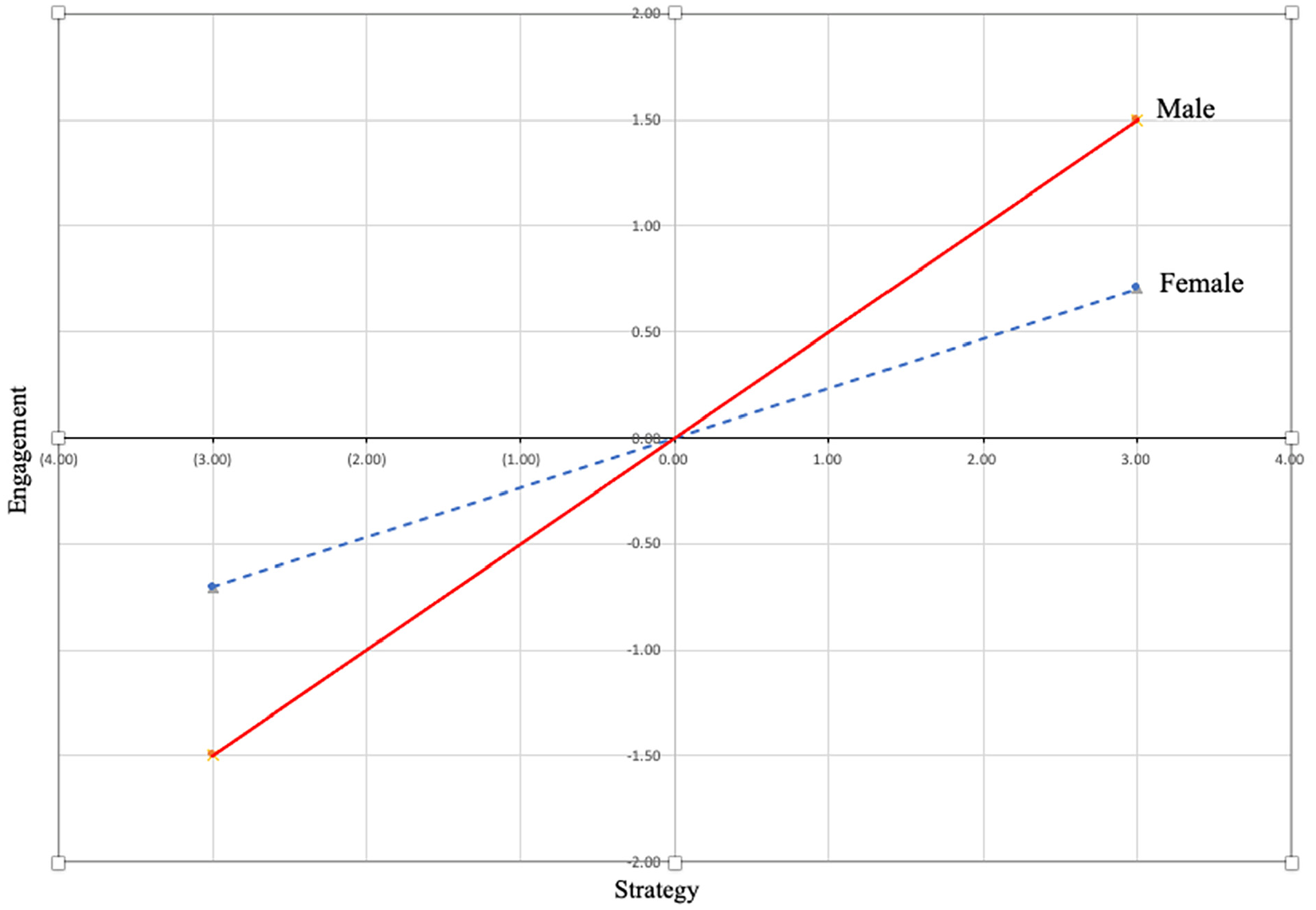
The moderating effect of gender on learning strategy and engagement.
The above result proved that the translation learning strategy had a partially mediating effect between translation belief and learning engagement. The mediating role of learning strategy between translation belief and learning engagement was moderated by gender, and the moderating effect occurred in the second half of the path.
The first- and second-stage moderated mediation model of engagement’s mediating role in the relationship between learning belief and learning performance was also tested and the test involved estimating the following two equations:


The result of the first- and second-stage moderated mediation model showed that: Gender did not moderate the belief—engagement path (c4 = 0.03, p > .05) or the engagement—performance path (d5 = 0.071, p > .05).
Discussion
The present study investigated the relationship between individual factors such as translation learning belief, strategy use, learning engagement, anxiety, and learning performance as well as the effect of individual factors on translation learning performance. The results of the study indicate that translation beliefs, strategy use, engagement, and anxiety accounted for a total of 39% of the variation in translation performance. The correlation between anxiety and performance was −.43 (p < .001), which is close to X. Zhang’s (2019) finding of r = −.34 (p < .01) and Botes et al.’s (2020) finding of r = −.39. We may conclude that the emotional aspect of language learning plays a significant role in FL learning and English teachers should try every means to create a learning atmosphere that can make students less anxious. In addition, translation belief and learning strategy accounted for 67% of the variation in learning engagement. Translation belief accounted for 15% of the variation of translation learning strategy. Translation learning belief and strategy positively predict learning engagement. Translation learning strategy plays a partially mediating role in the relationship between translation learning belief and learning engagement. This finding is strikingly similar to the one by Smit et al. (2017), who discovered that motivational strategies acted as a mediator between motivational beliefs and engagement in learning. The overall findings of this study provide suggestions to help foreign language teachers better understand the interrelationship between the above learner factors and learning performance, so that classroom instruction can be more effective and productive than before.
On top of the above results, we drew some additional conclusions from the research. One is that those female students had a more positive learning belief as well as more learning engagement and higher translation test scores than their male peers. This result is consistent with the research findings of Bacon and Finnemann (1992) and Tang and Tian (2014) that female students had more positive learning attitudes than male ones.
The other finding is that students at the high level of EFL proficiency have better translation performance and feel less anxiety than students at the low level. There is no significant difference in all the variables in this study between sciences students and liberal arts students.
Limitations and Implications
The findings of the research offer some pedagogical and research implications. Nonetheless, the research reflects certain limitations that should be taken into consideration. First, although the sample size includes 339 non-English major undergraduates, the present study was conducted only in one university in east China. The variations in educational resources in other universities in China or other countries may lead to different results. Accordingly, participants in this study may not represent the full spectrum of undergraduates who learn EFL translation. Hence, a larger sample size that involves a broad context is needed in future research. Second, this study only conducted cross-sectional data analysis. Other scholars may consider conducting longitudinal studies to better explore the temporal and dynamic relations among learning beliefs, learning strategies, engagement, anxiety, and learning performance.
This study may shed light on the interrelationship among Chinese non-English major undergraduate students’ translation learning beliefs, use of learning strategy, learning engagement, translation anxiety, and their learning performance. It added empirical evidence to the still limited literature of important predictors of translation learning performance for EFL learners. Since learning beliefs will affect learning strategies, EFL instructors should take effective measures to foster learners’ positive beliefs which will help students use more effective learning strategies, so that learning beliefs may have a positive impact on learning performance through the mediation role of learning strategies. An early assessment of students’ language learning beliefs and learning strategy use is quite necessary so that instructors can be aware of students’ learning beliefs and direct their instruction of language learning strategies more properly. Instructors should also conduct learning strategy training for learners to facilitate students’ learning engagement. Meanwhile, it is suggested that English teachers try their best to create a friendly and well-organized translation learning atmosphere and offer concrete suggestions for attaining translation confidence to lower students’ anxiety and increase their engagement in translation practice, which is conducive to improving students’ learning performance. To eliminate or reduce the negative impact of anxiety on performance, instructors should identify the most anxious students and offer special help to them and share learning experiences with them (Liu, 2022). A comparison of the means for all factors revealed that female students possessed a more positive learning belief as well as more learning engagement and higher translation test scores than their male peers. Therefore, instructors in second language learning should take the gender difference into consideration rather than ignore it.
Supplemental Material
sj-docx-1-sgo-10.1177_21582440231181435 – Supplemental material for Effect of Learner Factors on Chinese Undergraduates’ Translation Learning Performance: A Moderated Mediation Model
Supplemental material, sj-docx-1-sgo-10.1177_21582440231181435 for Effect of Learner Factors on Chinese Undergraduates’ Translation Learning Performance: A Moderated Mediation Model by Chenjuan Jiang in SAGE Open
Footnotes
Acknowledgements
The author would like to thank Jingxian, Xie, Min Chen, and Ge Bai, who helped to collect the data as well as the students who participated in the study. Heartful thanks also goes to Professor Xinxin Wu for her helpful suggestions in improving the questionnaire questions and proofreading.
Declaration of Conflicting Interests
The author declared no potential conflicts of interest with respect to the research, authorship, and/or publication of this article.
Funding
The author disclosed receipt of the following financial support for the research, authorship, and/or publication of this article: Research on online and offline integration of English learning performance based on learning behavior analysis JG2021078.
Ethical Approval
An ethics statement is not applicable.

Supplemental Material
Supplemental material for this article is available online.
References
Supplementary Material
Please find the following supplemental material available below.
For Open Access articles published under a Creative Commons License, all supplemental material carries the same license as the article it is associated with.
For non-Open Access articles published, all supplemental material carries a non-exclusive license, and permission requests for re-use of supplemental material or any part of supplemental material shall be sent directly to the copyright owner as specified in the copyright notice associated with the article.
