




Abstract
This research delves into the factors and considerations influencing the public’s adoption of interactive intelligent health promotion equipment. Utilizing the DEMATEL method, the study investigates the interrelations and significance of various decision criteria, laying groundwork for future initiatives promoting such equipment. The objective is to bolster interest in recreational sports, enhance physical well-being, and alleviate healthcare burdens. The study identifies eight primary factors: economic traits, personality traits, communication behavior, relative advantage, compatibility, complexity, observability, social support, and peer relationships. Through comprehensive analysis, both direct and indirect impacts of these factors are examined, along with the computation of key indicators. Findings suggest that, among individuals with exercise habits, personality traits and the perceived benefits of the product are pivotal in determining their adoption of interactive intelligent health promotion equipment. Within personality traits, comfort emerges as the most influential criterion, tending to influence other factors. Similarly, in the relative advantage category, personalization stands out as the primary sub-criterion with a ripple effect on other aspects. Further ANP analysis of DEMATEL findings highlights economic characteristics as the most weighted among individuals with exercise habits, followed by personality traits.
Introduction
With advancements in living conditions, survival rates across all age groups have increased, while mortality rates have declined (Jasilionis et al., 2023; C. S. Lin et al., 2018). However, average life expectancy merely reflects medical advancements and mortality trends. Despite a decrease in mortality rates among the elderly, the prevalence of chronic illnesses is escalating (Meng et al., 2024; Schoeppe et al., 2016), shifting health concerns from infectious diseases to lifestyle-related non-communicable diseases (NCDs) and age-related degenerative conditions (L. S. Chang et al., 2020; Goyal & Rakhra, 2024). Regular, moderate leisure exercise has been proven beneficial for physical well-being and mortality reduction (Huai et al., 2016; Trajković et al., 2023).
In recent years, digital health technologies have increasingly demonstrated their vital role in managing chronic diseases, particularly by enhancing patient engagement and improving health outcomes (Nittas et al., 2023; Okolo et al., 2024). Arana-álvarez et al. (2023) further highlight that mobile health applications serve as effective tools for promoting healthy habits in younger populations, which may contribute to the prevention of chronic illnesses later in life. The Centers for Disease Control and Prevention (CDC) previously noted in its “Healthy People 2010” report that chronic diseases related to insufficient physical activity and poor nutrition incur significant healthcare costs—estimated at $750 billion annually (Lo & Hsu, 2010). This has fueled a global shift toward computing comprehensive health indicators to better assess and enhance public health (Wang et al., 2018).
Leveraging artificial intelligence for chronic disease prediction based on lifestyle data is emerging as a vital approach in health management (Modi et al., 2023). Thompson (2019) notes the global sports technology market’s substantial size of approximately $872 billion, with trends such as wearable devices, high-intensity interval training, group training programs, weight training, personal trainers, sports medicine, weight management, elderly exercise, health management, and professional coaching courses dominating the fitness industry. Particularly since the end of 2019, the COVID-19 pandemic has disrupted outdoor activities and leisure sports centers worldwide for nearly 3 years. In Taiwan, about 30,000 campus and corporate sports competitions, routine professional baseball games, international competitions, major sports events, and over 7,000 sports businesses in our country have been impacted by domestic and international epidemic control measures (Kao, 2020). The pandemic has fundamentally altered lifestyles, leading to home-based exercise and fitness becoming a new norm (Liang et al., 2022).
Interactive intelligent health promotion equipment, offering unrestricted operation in terms of time and space and unaffected by weather and venue constraints (Pan et al., 2024), has witnessed increased interest in sports participation (M. Y. Lin et al., 2010). It can serve as a tool to promote recreational exercise at home. Utilizing high-tech motion sensors and wireless transmission systems, interactive intelligent health promotion equipment achieves virtual reality and human-computer interaction modes, combining fitness and entertainment effects (Z. Chen et al., 2021; H. E. Chen & Chen, 2007). This highlights the potential of using interactive intelligent sensor gaming equipment to address public health promotion challenges. The successful application of interactive intelligent health promotion equipment in sports depends on user acceptance (Yin et al., 2022). This study aims to explore the criteria and key factors influencing the public’s adoption of interactive intelligent health promotion equipment, offering insights into its continued use for sports activities and the pursuit of a healthier lifestyle in the future.
Literature Review
Multi-Criteria Decision-Making (MCDM)
Decision-making is recognized as a multifaceted process (Taherdoost & Madanchian, 2023; Sahoo et al., 2024), where accurate, scientific, and timely decisions are pivotal for the success or failure of advanced technologies and ongoing projects (Chowdhury & Paul, 2020). As the number of decision criteria increases, decision-making becomes more intricate, requiring the human brain to simultaneously consider multiple parameters to determine the optimal course of action, thereby enhancing the complexity of decision problems (Kahraman, 2020).
Decision criteria are fundamental elements in the decision-making process (Siksnelyte-Butkiene et al., 2020). Consumer decision-making is influenced by individual variances and environmental factors, leading to the utilization of diverse evaluative criteria (Blackwell et al., 2006). The complexity of the world, the existence of multiple standards, data intricacies, and environmental factors pose challenges in decision-making. Therefore, the adoption of decision-making techniques and methodologies becomes imperative (Sahoo & Goswami, 2023). Multi-Criteria Decision-Making (MCDM) demonstrates remarkable evaluation capabilities by integrating both objective survey data and expert subjective judgments in complex environments. Through expert interviews with a small sample size, MCDM can furnish decision-makers with valuable insights to formulate optimal strategies (Kumar et al., 2017). MCDM has been widely employed in various evaluation and selection scenarios, aiding in resolving decision issues such as classification, ranking, and selection (Alwedyan, 2024; Kou & Lin, 2014). Its systematic and standardized decision-making process has garnered widespread recognition, offering benefits such as problem identification and comprehension, quantitative data gathering, analysis employing appropriate scientific models, alternative solution construction, serving as the foundation for objective decision-making, and providing decision-makers with reference points (Mahmud et al., 2016). MCDM provides a structured approach that simultaneously incorporates decision criteria, benefit-cost information, and decision makers’ perspectives to select the optimal alternative from a list of choices (Emovon & Oghenenyerovwho, 2020; Kpadé et al., 2024).
Decision Making Trial and Evaluation Laboratory (DEMATEL) Analysis Method
The Decision Making Trial and Evaluation Laboratory (DEMATEL) is a method commonly utilized in multi-criteria decision analysis to address intricate problems and examine the complex interrelations among different management issues (Braga et al., 2021; Tamura & Akazawa, 2005). Decision outcomes often hinge on decision-makers’ ability to discern the causal relationships within the problem, which can be intricate and not readily apparent (Büyüközkan & Çifçi, 2012; Singh et al., 2021). DEMATEL assists in delineating decision problems by elucidating relationships between dimensions and factors, thereby facilitating the identification of viable solutions (Bali et al., 2023; Jou & Yuan, 2014).
Employing graphical representation, DEMATEL illustrates cause-and-effect relationships among criteria, aiding in identifying the core of the decision problem and establishing a structured model (Al-Mawali, 2023). Its computational foundation rests on matrix correlation theory, which quantifies the interdependence relationships between criteria, thereby simplifying decision problems (Kuan et al., 2012; R. Singh et al., 2023). Through DEMATEL’s structured model, decision-makers can classify evaluation criteria into dispatching factors (influencing other factors) and receiving factors (being influenced), gaining insights into the strength of relationships between factors and assisting in strategy formulation (Tamura & Akazawa, 2005). DEMATEL has been proven effective in addressing complex cause-and-effect structural problems and is increasingly applied in various fields by scholars to analyze and evaluate multi-criteria decision problems, owing to the growing complexity of the social environment.
Analytic Network Process (ANP) Analysis
The Analytic Hierarchy Process (AHP) is a methodology utilized in multi-criteria decision-making to systematically break down complex decision problems into distinct criteria that serve as judgment bases, thereby addressing uncertainty and facilitating resolution (Bozanic et al., 2023). This approach assigns importance to criteria and organizes them hierarchically, utilizing pairwise comparisons to establish relative importance ratios (Šostar & Ristanović, 2023). Subsequently, it ranks each criterion, using these rankings to guide optimal solution selection (Saaty, 2004). However, AHP’s assumption of independent criteria at each level confines its applicability to hierarchical relationships only, imposing limitations on its scope (Yu et al., 2021).
The Analytic Network Process (ANP) builds upon the strengths of AHP while offering a more comprehensive model framework for decision problem resolution (Mahmud et al., 2016). Unlike AHP, ANP acknowledges the potential dependencies and feedback relationships between criteria and alternative solutions, thus not presuming independence among criteria at each hierarchy level (Saaty, 2004). ANP recognizes the existence of mutual influence relationships between criteria, departing from strictly linear top-down or bottom-up influences. It operates on a network concept without hierarchical distinctions among criteria (M. C. Lee, 2010).
The ANP decision framework comprises two components. The first component is the control hierarchy, delineating the hierarchical relationship between criteria and sub-criteria (Daimi & Rebai, 2023). This hierarchy encompasses elements influencing the system, such as objectives, decision criteria, and sub-criteria. Criteria are influenced solely by objective elements, and they operate independently of each other, with their weights often determined through AHP. The second component is the network level, encompassing all controlled groups or components and forming a network structure of mutual influence among groups (Saaty, 2004). In this study, the Analytic Network Process serves as the theoretical foundation for understanding the key factors and their prioritization in the public’s utilization of interactive intelligent health promotion equipment.
Research Method
Research Design
This research utilizes a quantitative questionnaire survey as the primary data collection method. The questionnaire design for the initial DEMATEL stage draws inspiration from Rogers (1995) Innovation Diffusion Model, focusing on factors influencing consumers’ pre-decision knowledge and persuasion stages. Additionally, it integrates Holak’s (1988) New Product Adoption Model, with “Consumer Characteristics,”“Product Innovation Traits,” and “Environmental Variables” serving as the primary framework as indicated in Table 1. After synthesizing relevant literature, the questionnaire content is formulated, with operational definitions provided for each variable as follows:
(1) Consumer Characteristics: This pertains to the extent to which an individual’s acceptance of using interactive intelligent health promotion equipment is shaped by factors such as related costs, acceptance of innovative products, and received information sources.
(2) Product Innovation Traits: This encompasses an individual’s perception of the inherent characteristics of using interactive intelligent health promotion equipment that influence their adoption decision, including factors like relative advantage, compatibility, complexity, trialability, and observability.
(3) Environmental Variables: This considers whether an individual’s decision to use interactive intelligent health promotion equipment is influenced by factors such as satisfaction with support and assistance from social network members (e.g., family and friends), as well as the impact of shared values, life experiences, and lifestyles among peers.
Framework and Questionnaire Content.

The first phase of the DEMATEL questionnaire structure comprises two major sections: socioeconomic background and decision factors. The socioeconomic background section covers respondents’ demographic information, including gender, age, education level, occupation, frequency of fixed weekly exercise, and average monthly expenditure on exercise-related expenses. The decision factors section evaluates aspects related to the use of interactive intelligent health promotion equipment, segmented into eight variables: economic traits, personality traits, communication behavior, relative advantage, compatibility, complexity, observability, and social support and peer relationships, with a total of 36 questions. The questionnaire employs a pairwise comparison scale design using DEMATEL methodology, following the scoring scale used by Shieh et al. (2010) to assess the degree of influence between criteria, categorized into four levels: 0—No influence, 1—Slight influence, 2—Moderate influence, 3—Significant influence, with positive and negative signs indicating the direction of influence.
The second phase of the ANP questionnaire structure also includes two main parts: socioeconomic background and decision factors. The socioeconomic background section encompasses respondents’ demographic details, such as gender, age, education level, occupation, frequency of fixed weekly exercise, and average monthly expenditure on exercise-related expenses. The decision factors section evaluates aspects related to the use of interactive intelligent health promotion equipment, based on the findings of the DEMATEL study, further categorized into four variables: economic traits, personality traits, relative advantage, and observability, comprising a total of 13 questions. The questionnaire utilizes an ANP pairwise comparison scale design, referencing Saaty’s (2004) comparison scale, which assigns research comparison scales into nine levels: 1—Equally important, 3—Slightly more important, 5—Somewhat more important, 7—Very much more important, 9—Absolutely more important, with intermediate values of 2, 4, 6, 8, and inverse numbers indicating varying degrees of preference for one indicator over another.
To ensure the comprehensiveness and appropriateness of the questionnaire items in this study, we examined the validity of the factors measured by the questionnaire, assessing the accuracy of the measurement. Content validity was used as the measurement approach. The questionnaire items in this study were developed based on relevant literature and were revised with reference to previous researchers’ measurement items. The final set of items was further validated by two experts with professional knowledge, ensuring that the questionnaire possesses a considerable degree of content validity. For the ANP questionnaire, consistency was tested using the CR (Consistency Ratio) value.
Study Participants
This research focused on individuals who engage in regular exercise or fitness activities and have either used or purchased home fitness equipment. An online survey was conducted, with detailed explanations provided for each decision criterion along with examples to help respondents understand the questionnaire’s purpose and structure. For the DEMATEL study, 100 questionnaires were distributed, and after excluding 24 invalid responses, 68 valid responses were obtained, resulting in a 68% response rate. For the ANP study, 55 questionnaires were distributed, and 48 valid responses were collected after excluding six invalid responses, yielding a response rate of 87.27%. Convenience sampling was used for data collection.
Data Analysis
Descriptive statistics analysis was employed to organize and encode the collected data, utilizing EXCEL software for analysis. Frequency distribution and percentage analysis were conducted to examine the sample distribution of personal background data, allowing the calculation of mean and standard deviation for each research variable.
Calculation of DEMATEL Analysis
The Decision Making Trial and Evaluation Laboratory (DEMATEL) method calculates the influence between criteria by analyzing their mutual relationships. Using matrix correlation theory, DEMATEL quantifies cause-and-effect relationships, simplifying complex social environments. This approach helps identify key criteria for improvement or performance enhancement. The calculation process involves the following steps (Shieh et al., 2010):
Establishing Pair-Wise Comparison Scale
DEMATEL uses pairwise comparison questionnaires for the main and sub-criteria, developed from the literature review. These questionnaires include explanations of terminology and examples for each criterion to facilitate respondents’ understanding of the questionnaire’s purpose and structure. The questionnaires primarily focus on pairwise comparisons of interactions between main and sub-criteria.
Establishing Direct-Relation Matrix
By averaging expert opinions, a direct-relation matrix is formed to represent the influence between criteria. For n criteria, a direct-relation matrix A (n × n) is obtained as per formula (1), where aij represents the degree to which criterion i influences criterion j, resulting in the direct-relation matrix A.

Calculating Normalized Direct-Relation Matrix
The direct-relation matrix is normalized by multiplying matrix A by s, resulting in the normalized matrix X, as shown in formulas (2) and (3):


Attaining the Total-Relationship Matrix
After obtaining the normalized direct-relation matrix X, the total-relationship matrix T is obtained using formula (4), where I is the identity matrix.

Calculating Prominence and Relation
tij represents an element in the total-relationship matrix T. Formula (5) is used to sum the elements in the rows of the total-relationship matrix to obtain Di, and formula (6) is used to sum the elements in the columns to obtain Rj.


Where Di represents the total sum of elements for which element i is the cause, including both direct and indirect influences, and Rj represents the total sum of elements for which element j is the result. When i = j, the sum of the row and column (Di + Rj) represents the total extent to which element i influences and is influenced, known as prominence. On the other hand, the difference between the column and row (Di − Rj) is used to classify the criteria into cause group or effect group. If the result of (Di − Rj) for a particular element is positive, it belongs to the cause group. Conversely, if the result is negative, the element belongs to the effect group.
Establishing Causal Diagram
Using D + R as the horizontal axis and D − R as the vertical axis, mark the coordinates with the obtained (Di + Rj) and (Di − Rj). To emphasize significant causal relationships, values in the total-relationship matrix (T) are deleted if they are smaller than the arithmetic mean, serving as a threshold value. Elements greater than the threshold value are selected to draw the causal diagram, as shown in Figure 1. Drawing the causal diagram simplifies complex causal relationships graphically, assisting decision-makers in selecting appropriate decision solutions based on criteria classification.

The DEMATEL map (Machado et al., 2021).
ANP Computational Analysis
ANP is a theory used for multi-criteria decision-making, where relative priority sequences of criteria are derived from individual judgments or actual measurements, representing relative influence relationships (Saaty, 2004). The application of ANP can be divided into several steps (Asadabadi et al., 2019), as explained below:
Model Development
The ANP model is built based on the causal diagram from the DEMATEL analysis to identify criteria affecting decision objectives.
Determining the Pairwise Comparisons Matrix
After establishing the model framework, expert questionnaires are used for pairwise comparisons of criteria. Using formula (7), the comparison values form matrix A, where aij represents the relative importance of criterion i compared to criterion j. Pairwise comparisons are categorized into external (importance within the same group) and internal (influence within the group) relationships.

Preference Integration
Since decision-making involves a group, each respondent has different perceptions of the problem, resulting in different pairwise comparison values. Saaty (2004) suggests integrating the perceptions of importance using geometric mean. After obtaining the integrated pairwise comparisons matrix, the maximum eigenvalue λmax and its corresponding eigenvector W are calculated using formulas (8) to (10).



Additionally, λmax needs to be tested for consistency using the consistency index (CI) formula in Equation 11 and the random index (RI) in Equation 12), as shown in Table 2, to calculate the consistency ratio (CR) to determine if the results are consistent. When CR ≤ 0.1, the results are considered consistent; otherwise, if CR > 0.1, it indicates inconsistency, necessitating a reassessment of the problem and pairwise comparisons.


Random Index.

Source. Saaty (2004).
Calculating the Supermatrix Formation
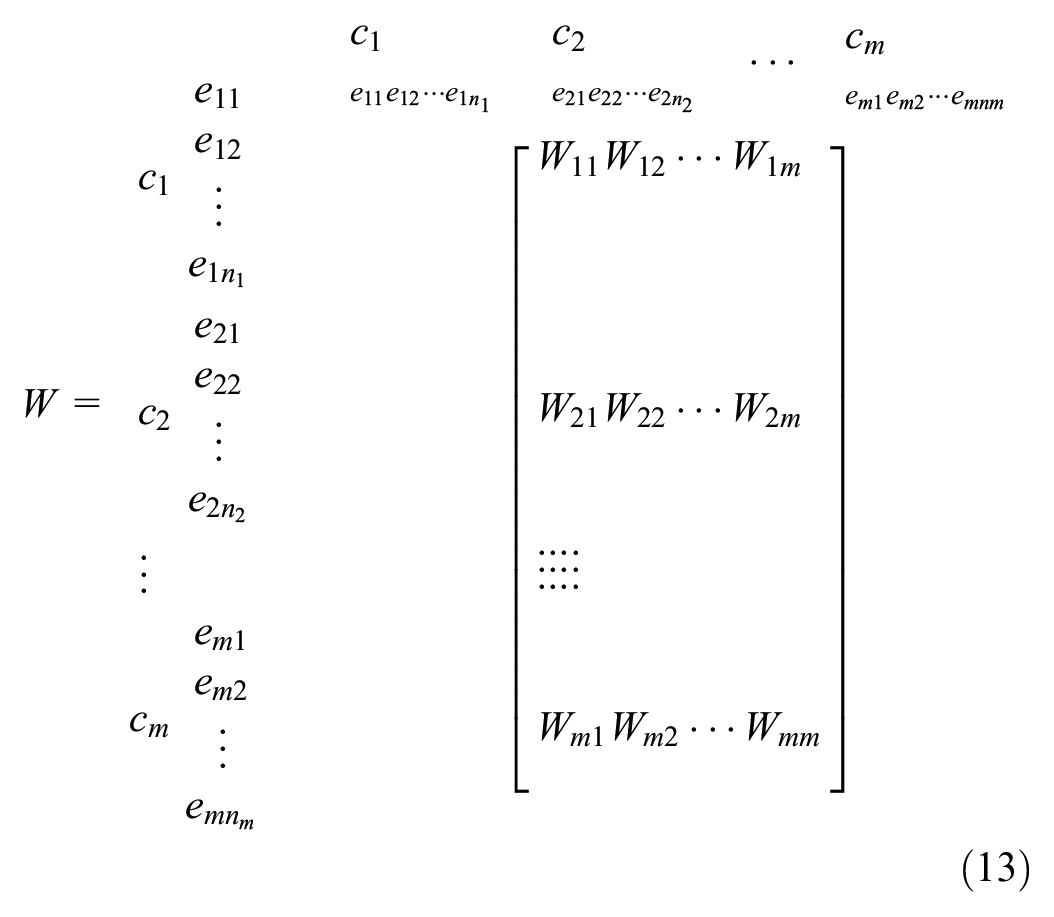
The supermatrix consists of multiple submatrices, each containing pairwise comparison relationships between group elements and other elements. Each submatrix combines the eigenvectors of pairwise comparisons and the weights of the submatrix to form the supermatrix. The supermatrix, represented as W, where Cm represents the m cluster, emn represents the n element under m cluster, and Wij represents the main eigenvector influencing the comparison between the i group element and the j group. If Wij is 0, it indicates no dependency relationship.
The ANP process uses three matrices: the unweighted supermatrix, the weighted supermatrix, and the limit supermatrix. The unweighted supermatrix integrates eigenvectors from pairwise comparisons. It is then multiplied by the eigenvector from the criteria’s comparison to create the weighted supermatrix. If dependencies exist, repeated multiplication of the weighted supermatrix leads to the limit supermatrix, as shown in formula (13).
Choosing the Optimum Criterion
After multiple iterations of the supermatrix calculation, the obtained weight values can be used as the basis for prioritizing the selection of target criteria. This study can identify the weights of decision criteria for the public’s selection of interactive intelligent health promotion equipment based on the results.
Research Results
DEMATEL Method Results
Description of Background Variables
The questionnaire for this study garnered responses from 68 individuals who engage in regular exercise. The participants’ personal background information covers six main categories: gender, age, education level, occupation, weekly exercise frequency, and monthly expenditure on exercise-related items. Here are the analysis findings: Among the respondents, 52 are female (76.47%), and 16 are male (23.53%). The majority of participants fall within the 31 to 40 age group, comprising 32 individuals (47.06%). The next largest group is the 21 to 30 age bracket, with 24 individuals (35.29%). Regarding occupation, the highest number of participants are in military or public service roles, totaling 32 individuals (47.06%), followed by 16 individuals in the manufacturing sector (23.53%). In terms of education, the majority have attained a university degree, with 36 individuals (52.94%), while 28 individuals have postgraduate qualifications or higher (41.18%). Regarding weekly exercise frequency, the most common category is 1 to 2 times per week, with 32 individuals (47.06%), followed by 3 to 4 times per week, with 28 individuals (41.18%). Regarding monthly expenditure on exercise-related items, the highest proportion spend NT$500 or less and NT$501 to 1,000, with 24 individuals (35.29%), followed by 12 individuals spending NT$1,001 to 2,000 (17.65%). Detailed data are shown in Table 3.
Basic Data Analysis of Background Variables in the DEMATEL Questionnaire.

Analysis Results of Main Criteria
To investigate the interrelationships among the decision factors influencing the utilization of interactive intelligent health promotion equipment, an analysis was conducted to examine the mutual influence among the eight primary criteria using the DEMATEL methodology. The outcomes of the comprehensive relationship matrix analysis for these criteria are presented in Table 4. To streamline the analysis, a threshold value was determined by averaging all relationship values in the comprehensive matrix, resulting in a threshold of 0.4804. This threshold helped filter out relationships with lower impact levels, focusing only on those significantly contributing to the decision-making process. The mutual influence relationships among the eight key criteria are illustrated in Figure 2. Upon reviewing the analysis findings, it becomes apparent that personality traits and relative advantages emerge as central factors, while compatibility and complexity serve as driving forces. Additionally, communication behavior and social support with peer relationships are identified as independent factors, whereas economic traits and observability are regarded as influenced factors.
Total Impact Relationship Matrix of Eight Main Criteria.
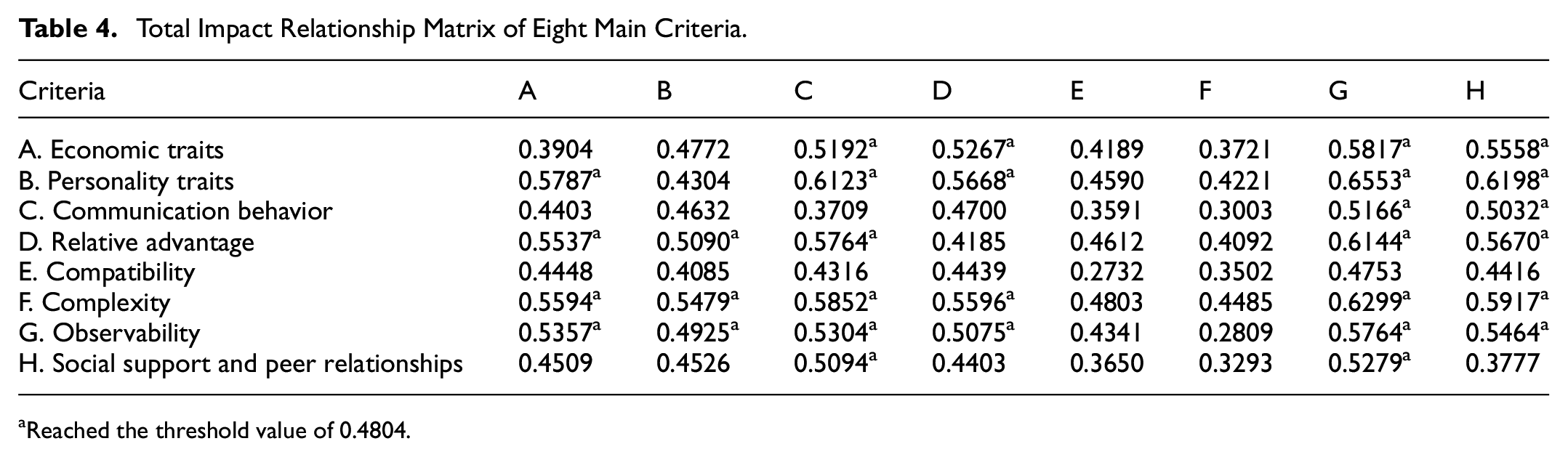
aReached the threshold value of 0.4804.

Causal relationship chart of the eight major criteria.
Results of Sub-criteria Analysis
Each of the eight sub-criteria underwent a total-relationship matrix analysis, and relationships with lower impact among the criteria were omitted based on the threshold value to focus only on significant influences on decision-making. The mutual influence relationships for each sub-criterion are illustrated in Figures 3 to 10. The results were used to identify causal relationships among the factors of each sub-criterion, and the importance and classification of sub-criteria are presented in Table 5.

Causal diagram of the economic traits sub-criteria.
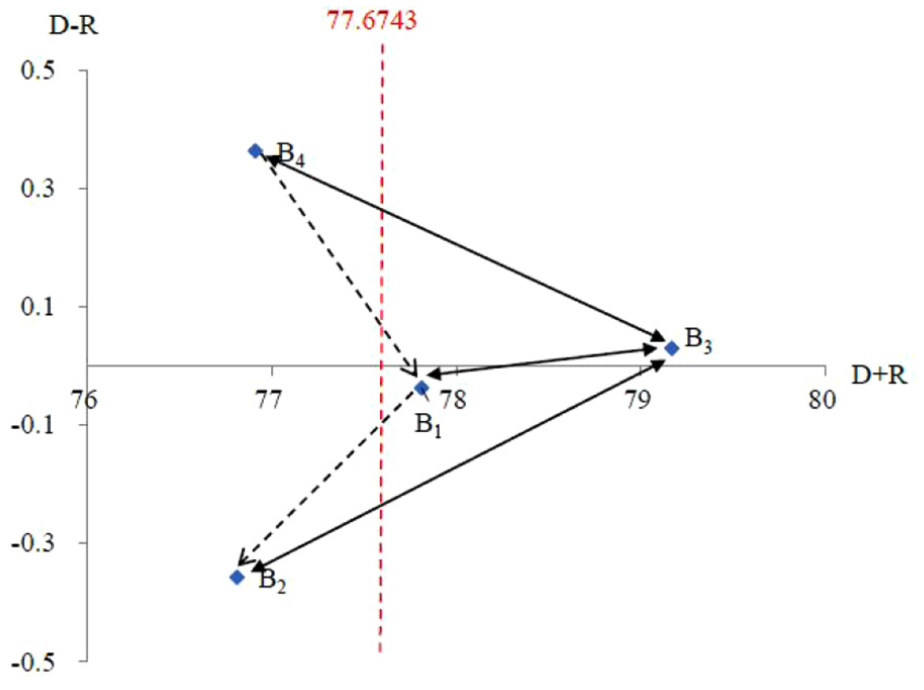
Causal diagram of the personality traits sub-criteria.

Causal diagram of the communication behavior sub-criteria.

Causal diagram of the relative advantage sub-criteria.

Causal diagram of the compatibility sub-criteria.

Causal diagram of the complexity sub-criteria.
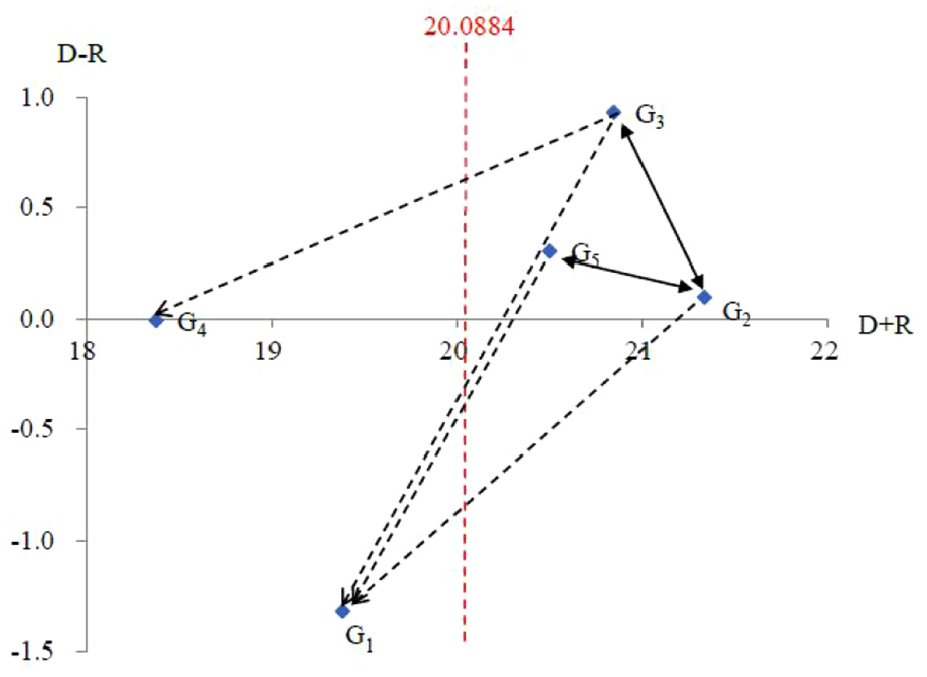
Causal diagram of the observability sub-criteria.

Causal diagram of the social support and peer relations sub-criteria.
Criteria Importance and Classification.

From the analysis results, in the Economic Traits sub-criterion, the threshold value was determined to be 2.0650, with an average D + R value of 20.6498. Money cost and information collection cost were identified as factors inclined to influence other criteria, while time cost, physical effort cost, and psychological effort cost were factors inclined to be influenced by other factors. In terms of importance, physical effort cost was identified as the most crucial sub-criterion, followed by time cost, psychological effort cost, and money cost, with information collection cost being the least important item.
In the Personality Traits sub-criterion, the threshold value was determined to be 9.7093, with an average D + R value of 77.6743. Comfort and safety were identified as factors inclined to influence other criteria, while optimism and innovation were factors inclined to be influenced by other factors. In terms of importance, comfort was identified as the most crucial sub-criterion, followed by optimism and safety, with innovation being the least important item.
In the Communication Behavior sub-criterion, the threshold value was determined to be 1.9698, with an average D + R value of 19.6980. Advertising content, product website, and endorser were identified as factors inclined to influence other criteria, while social word of mouth and trial experience were factors inclined to be influenced by other factors. In terms of importance, advertising content was identified as the most crucial sub-criterion, followed by social word of mouth, endorser, and trial experience, with the product website being the least important item.
In the Relative Advantages sub-criterion, the threshold value was determined to be 2.2960, with an average D + R value of 22.9600. Brand, convenience, and personalization were identified as factors inclined to influence other criteria, while interactivity and diversity of choice were factors inclined to be influenced by other factors. In terms of importance, personalization was identified as the most crucial sub-criterion, followed by diversity of choice, convenience, and interactivity, with the brand being the least important item.
In the Compatibility sub-criterion, the threshold value was determined to be 3.8337, with an average D + R value of 30.6697. System compatibility and habit were identified as factors inclined to influence other criteria, while application scope and sensorial operation were factors inclined to be influenced by other factors. In terms of importance, system compatibility was identified as the most crucial sub-criterion, followed by habit and sensorial operation, with application scope being the least important item.
In the Complexity sub-criterion, the threshold value was determined to be 3.3873, with an average D + R value of 27.0986. Installation steps and operational rules were identified as factors inclined to influence other criteria, while operational interface and goal difficulty were factors inclined to be influenced by other factors. In terms of importance, operational interface was identified as the most crucial sub-criterion, followed by operational rules and installation steps, with goal difficulty being the least important item.
In the Observability sub-criterion, the threshold value was determined to be 2.0088, with an average D + R value of 20.884. User effectiveness, product performance, and health management tools were identified as factors inclined to influence other criteria, while functional communicativity and entertainment were factors inclined to be influenced by other factors. In terms of importance, user effectiveness was identified as the most crucial sub-criterion, followed by product performance, health management tools, and functional communicativity, with entertainment being the least important item.
In the Social Support and Peer Relationships sub-criterion, the threshold value was determined to be 6.8543, with an average D + R value of 54.8345. Friend and family support and actual usage by friends and family were identified as factors inclined to influence other criteria, while friend and family evaluations and social activities with friends and family were factors inclined to be influenced by other factors. In terms of importance, actual usage by friends and family was identified as the most crucial sub-criterion, followed by friend and family support and social activities with friends and family, with friend and family evaluations being the least important item.
Analysis of Analytic Network Process (ANP) Results
Construction of ANP Model
Based on the DEMATEL analysis results, criteria that have little or no influence on other criteria are removed to simplify the ANP model framework and identify the true decision factors affecting consumers. Therefore, factors with low relevance or importance to other criteria identified by DEMATEL analysis are eliminated. Compatibility is removed as it lacks causal relationships with other criteria. Complexity, having a single-line relationship with other criteria and low correlation, is also removed. Communication behavior and social support and peer relationships are independent factors with relatively low correlation, thus eliminated. Hence, this study conducts ANP analysis on four criteria: economic traits, personality traits, relative advantage, and observability.
In the economic traits criterion, information collection cost has a single-line impact relationship with other sub-criteria and the lowest correlation among criteria, hence removed. In the personality traits criterion, innovativeness is an independent factor with the lowest correlation among criteria, hence removed. In the relative advantage criterion, interactivity is an independent factor with a single-line relationship with other criteria, hence removed. Branding has no significant causal relationships with other sub-criteria and is thus eliminated. In the observability criterion, functional communicability and entertainment are independent factors with single-line relationships with other criteria, hence removed. The results are used to construct the ANP analysis model as shown in Figure 11.

ANP model architecture diagram.
Description of Background Variables
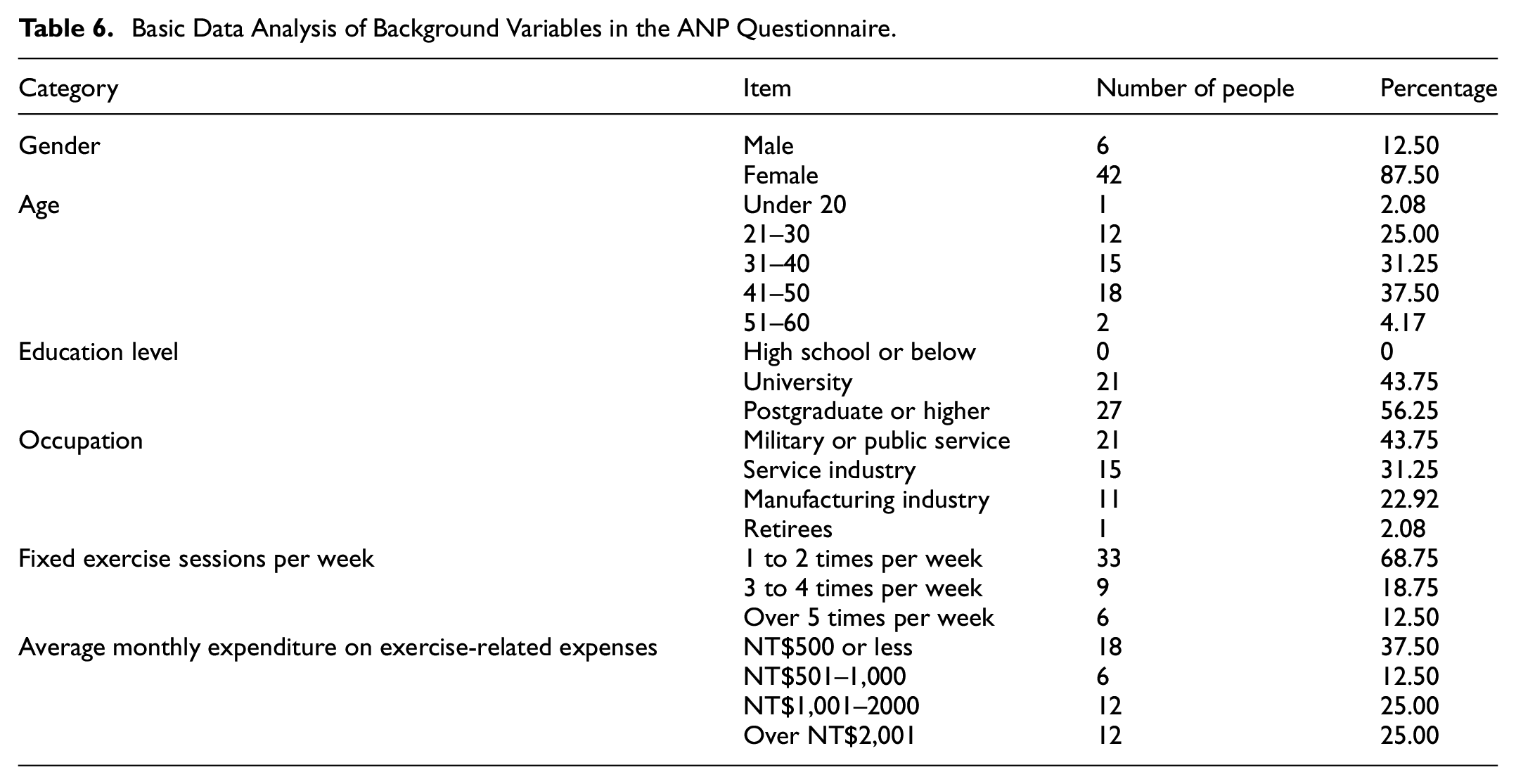
The effective sample size of the survey in this study was 48 individuals with exercise habits. The personal background variables of the sample were divided into six categories: gender, age, education level, occupation, number of fixed exercise sessions per week, and average monthly expenditure on exercise-related expenses. The analysis results are as follows: Gender was predominantly female, with the highest ratio being 42 individuals, accounting for 87.50%, while males were 6 individuals, accounting for 12.50%. The age group was mainly between 41 and 50 years old, with the highest ratio being 18 individuals, accounting for 37.50%, followed by 31 to 40 years old with 15 individuals, accounting for 31.25%. The occupation was primarily in the military or public service, with 21 individuals, accounting for 43.75%, followed by the service industry with 15 individuals, accounting for 31.25%. Education level was highest for those with postgraduate degrees or above, totaling 27 individuals, accounting for 56.25%, followed by undergraduate degrees with 21 individuals, accounting for 43.75%. The number of fixed exercise sessions per week was highest for 1 to 2 times, with 33 individuals, accounting for 68.75%, followed by 3 to 4 times with 9 individuals, accounting for 18.75%, and over 5 times with 6 individuals, accounting for 12.50%. The average monthly expenditure on exercise-related expenses was highest for NT$500 or less, with 18 individuals, accounting for 37.50%, followed by NT$1,001 to 2,000 and over NT$2,001, each with 12 individuals, accounting for 18.75%, followed by NT$501 to 1,000 with 6 individuals, accounting for 12.50%. Detailed data are shown in Table 6.
Basic Data Analysis of Background Variables in the ANP Questionnaire.
Integration of Sample Preferences and Consistency Testing
The responses from the 48 valid questionnaires were integrated using Excel and the relational data were inputted into the Super Decisions software for structure building and computational analysis. The values of each pairwise comparison matrix were obtained through geometric mean calculation, and consistency testing was conducted. The results are shown in Table 7. When CI < 0.1 and CR < 0.1, it indicates that the pairwise comparison matrix is consistent. The CI values of each pairwise comparison matrix in this study ranged from 0.0000 to 0.0609, and the CR values ranged from 0.0000 to 0.0958, all of which are less than 0.1, passing the consistency test.
Consistency Testing of Pairwise Comparison Matrices of Decision Criteria.

Limiting Supermatrix
The calculation process of the supermatrix involves three stages: the unweighted matrix, the weighted matrix, and the limiting supermatrix. The unweighted matrix is obtained by integrating the original pairwise comparison eigenvectors into one large matrix. Then, by multiplying the unweighted matrix by the eigenvectors obtained from the pairwise comparison matrix of the evaluation criteria, the weighted matrix is formed. If there is interdependence between the evaluation criteria, the matrix will converge to a fixed and unchanging limiting value after multiple self-multiplications, resulting in the limiting supermatrix, as shown in Table 8.
Limiting Supermatrix.

Choosing the Optimum Decision Criteria
The weights of decision criteria based on the results of the supermatrix formation for all samples are organized and sorted into Table 9. From the results of all samples, it is evident that Economic Characteristics are the most important decision criteria for individuals in using interactive smart health promotion equipment, with a weight of 0.3538. Personality Traits follow closely with a weight of 0.2293. Relative Advantages is the least important criterion, with a weight of 0.1869. Among the sub-criteria, Time Cost is identified as the most critical sub-criterion (weight: 0.1185), followed by User Experience (weight: 0.1081), Physical Effort Cost (weight: 0.1033), Comfort (weight: 0.1006), and Psychological Effort Cost (weight: 0.0840).
ANP Decision Criteria Weight Assessment Results.

Monetary Cost (weight: 0.0480) is the least important sub-criterion, followed by Optimism (weight: 0.0523), Variety of Choices (weight: 0.0559), Product Performance (weight: 0.0575), and Health Management Tools (weight: 0.0644).
Discussion
This study integrates the DEMATEL and ANP methods to gain insights into public preferences for interactive health promotion equipment. The DEMATEL findings reveal that personality traits and perceived relative advantages are the primary factors influencing the usage of this equipment among individuals with exercise habits. Additionally, compatibility and complexity are identified as driving factors, whereas economic traits and observability serve as influenced factors. Factors such as communication behavior, social support, and peer relationships emerge as independent influences. Notably, personality traits and perceived relative advantages are crucial in the decision-making process. Previous studies (Nittas et al., 2023; Seyed Esfahani & Reynolds, 2021) have highlighted that the stability of personality traits and the perception of relative advantages significantly affect the adoption of innovative products.
Within the personality trait category, comfort emerges as the most significant factor, emphasizing the importance of user comfort in promoting equipment usage. Personalization is highlighted as a key aspect within the relative advantage category, stressing the need for customization to enhance user experience. These findings align with the results of Yin et al. (2022), indicating that the successful application of interactive intelligent health promotion equipment in sports is closely related to user personality traits.
The ANP analysis further prioritizes economic traits as the highest-weighted criteria, followed closely by personality traits. This suggests that cost-related factors—such as time investment, efficiency of use, and physical effort—are pivotal in consumer decision-making. Although financial considerations may not be a primary concern for individuals already engaged in fitness activities, factors like time investment and effectiveness of use are of greater significance. Companies should leverage these insights to develop products that address the needs of consumers seeking effective home-based exercise solutions, ultimately promoting the adoption of interactive health equipment.
Conclusion
This study confirms that interactive intelligent health promotion equipment offers significant potential for enhancing home-based physical activity, especially in a post-pandemic world where home exercise has become a key trend. By understanding the factors that drive consumer decision-making, such as personality traits, perceived relative advantages, and economic considerations, companies can develop more effective strategies to promote these technologies. This, in turn, could help foster healthier lifestyles and improve public health outcomes.
The findings reveal that while cost factors, particularly time and effort, are crucial, personalization and comfort also play key roles in consumer preferences. As more individuals seek efficient, home-based exercise options, these insights can guide the development of interactive equipment that meets consumer needs for convenience, comfort, and efficiency. Importantly, the ability to customize exercise experiences to suit individual preferences may serve as a significant selling point for providers.
From a practical perspective, companies should prioritize enhancing features that directly cater to the consumer’s desire for personalized, cost-effective, and efficient workout solutions. Given the increasing emphasis on health promotion and the integration of digital technologies into fitness, businesses could focus on the development of equipment that allows for real-time feedback, social connectivity, and adaptability to different fitness levels. By offering these features, providers could increase market penetration and adoption rates, ultimately improving the health outcomes of their users.
This study also contributes to the literature on technology adoption in health promotion, particularly by integrating DEMATEL and ANP methodologies to analyze consumer behavior. It advances the understanding of how personality traits, relative advantage, and economic considerations influence the adoption of innovative health promotion technologies, providing a framework for future research into similar technological adoptions across various fields.
Several limitations were present in this study. The sample size was limited, and the participants were primarily individuals who already engage in fitness activities. This could restrict the generalizability of the findings to a wider audience. Additionally, the study focused on self-reported data, which may be subject to bias. Future research should include a larger and more diverse sample to capture a broader spectrum of consumer preferences. Expanding the research to include individuals who are new to exercise or who have different fitness levels would provide more comprehensive insights.
Future studies should also investigate the long-term effects of using interactive intelligent health promotion equipment, particularly in terms of sustained exercise habits and health outcomes. Additionally, researchers could explore the impact of digital health promotion tools on different demographic groups, including older adults and individuals with chronic health conditions, to determine how these technologies can be tailored to specific populations. Exploring the role of social support and digital community-building in promoting consistent usage could also offer valuable insights into how technology can enhance public health initiatives on a larger scale.
Footnotes
Declaration of Conflicting Interests
The author(s) declared no potential conflicts of interest with respect to the research, authorship, and/or publication of this article.
Funding
The author(s) disclosed receipt of the following financial support for the research, authorship, and/or publication of this article: The National Science and Technology Council of Taiwan for supporting this research under grant number: NSTC 112-2221-E-507-006.

Data Availability Statement
The data that support the findings of this study are available from the corresponding author upon reasonable request.