




Abstract
To manage the process of human-machine safety collaboration in the context of intelligent construction of coal mines and prevent the occurrence of human-machine interaction accidents. This study explores the variables affecting human-machine safety collaboration in coal mines and analyzes the causal relationships and mechanisms of action among the variables. This study adopts DEMATEL-ISM method to analyze the causal relationship between factors affecting human-machine safety collaboration. In addition, the research further identifies key influencing factors from a series of factors, establishes a hierarchical structure model among factors, and understands the interaction mechanism between factors. We reviewed the existing research and found that the Delphi method is used to construct a system of influencing factors of human-machine safety collaboration in coal mines, including miners, intelligent systems, management, group, and the environment. According to the calculation results of DEMATEL, the key factors affecting human-machine safety collaboration behavior are determined as follows: safety education and training, human-machine interaction experience, ease of use, and safety leadership. The ISM method divides the influencing factors into five levels, and the direct and indirect factors affecting human-computer interaction are determined. This study constructs a system of influencing factors of human-machine safety collaboration in coal mines. It uses the DEMATEL-ISM method to determine the key factors affecting human-machine safety collaboration in coal mines and the interaction mechanism between the factors. The research results can provide a theoretical basis and methods for preventing coal mine safety accidents and improving human-machine safety collaboration in coal mines.
Keywords
Introduction
The energy distribution of China’s rich coal and lack of oil and gas determines that coal mines will remain China’s primary energy source. Coal mine safety is essential for energy security (Shen et al., 2019). Since the 21st century, coal mining equipment and technology have been greatly improved by improving China’s scientific research capabilities. The transformation from mechanization and personnel reduction to intelligent personnel reduction has been realized (K. Zhang et al., 2022). The coal mine human-machine collaboration system is complex, with dynamic, hazardous, and non-linear characteristics composed of safety-related elements such as natural conditions, intelligent equipment, management system, and personnel (H. Chen et al., 2012; X. Chen & Qiao, 2021). Under the background of intelligent production, it has the characteristics of solid machine dominance, difficult communication between employees, high requirements for equipment operators, and complex human-machine interaction (Qin et al., 2020). Once a safety accident occurs, it will cause incalculable damage to workers’ life safety and various intelligent equipment. The occurrence of coal mine safety accidents is not a single factor but multiple factors interrelated and interacting (L. Cheng et al., 2021). Therefore, in the intelligent construction stage of coal mines, the factors that lead to the occurrence of human-machine safety collaboration accidents are identified, and the interrelatedness and mechanism of action of the influencing factors are analyzed from a system perspective to prevent coal mine safety accidents that are prone to occur or likely to occur.
There are few studies on human-machine safety collaboration in coal mines. The predecessors’ research on human-machine safety collaboration behavior is primarily concentrated in the field of autonomous driving (J. Liu et al., 2022), engineering construction (Milazzo et al., 2021), aerospace (Lim et al., 2018), medical and healthcare (Abdelaal et al., 2020), industrial engineering (Yilma et al., 2019). Research has focused on the impact of human cognition (Neu et al., 2018), human-machine interaction interface design (Pizzagalli et al., 2021), and human-machine safety distance (Bi et al., 2022) on human-machine safety collaboration from three aspects: human(Kari & Steinert, 2021), machine (Pizzagalli et al., 2021), and environment (Xu & Wang, 2020), while the management factors less attention has been paid. Most of the research in the field of human-machine safety in coal mines is from the perspective of machines, such as human-machine interface design (Mgbemena, 2020) and intelligent monitoring and alarming (L. Ma & Chen, 2021). In the context of intelligent construction of coal mines, achieving optimal system performance depends on improving technical components and the interaction between humans and automated systems (Sanchez, 2009). Therefore, the human factor is also decisive in the human-machine collaboration system (Galin & Meshcheryakov, 2019). Due to its special team operation method in the coal mine field, the group’s unsafe behavior and the leader’s unsafe supervision will also significantly impact the unsafe human-machine collaboration (Miao et al., 2020). Therefore, this study combines previous investigations on human-machine safety collaboration and the current stage of coal mine production to investigate the influencing factors of human-machine safety collaboration in coal mines from five aspects: individual miners, intelligent system, group, management, and environment.
An in-depth understanding of accidents’ causal factors and mechanisms is essential for coal mine safety risk prevention and system safety. The standard methods used by scholars at this stage to investigate the causal mechanisms of accidents include structural equations (Fu et al., 2023), Bayesian networks (S. Li et al., 2022), N-K models (Qiao, 2021), and explanatory structural models (ISM) (J. Zhang et al., 2019). Although these methods analyze the causal mechanisms of accidents from a system perspective, structural equation models and Bayesian network models analyze the role of a single factor in the system from the perspective of importance. They cannot fully reflect the interactions of accident causal factors. The N-K model can analyze the factors based on mathematical statistics and the evolutionary process of gene combinations. Although it can accurately reflect the interactions between factors, this method requires a large amount of objective data to make a reliable analysis of the interactions between factors, and it has not been long since the intelligent construction of coal mines, so it cannot provide a large amount of data for analysis. DEMATEL can identify and analyze the factors within a complex network and clarify the causal relationships of complex systems through directed graphs. ISM can divide a complex system with a complex structure and unclear logic into several related subsystems and construct a multi-layer recursive structure model, thus delineating the influence paths and hierarchy between factors (Attri et al., 2013). The combined DEMATEI-ISM approach has been more widely used in exploring the causal relationships and mechanisms of action among factors.
Scholars have researched the inducing factors of coal mine safety production(Kong et al., 2022; Zou et al., 2020). However, there still needs to be more research on the causative factors of human-machine safety collaboration in coal mines and the mechanism of action between the various factors. Advances in technology have increased the complexity of human-machine collaboration systems, and insufficient understanding of the influencing factors of complex systems and the mechanisms of action of the factors may lead to increased system risk and the level of safety of the system in coal mine safety management systems. Therefore, this study analyzes the influencing factors and the mechanism of action of factors that affect human-machine safety collaboration in coal mines in the context of intelligent construction of coal mines. This study first identified the influencing factors of human-machine safety collaboration using a literature review and Delphi method identification. The influencing factors are analyzed by the DEMATEL method, the causal relationship between the influencing factors is obtained, and the key influencing factors of human-machine safety collaboration are determined. A hierarchical structure model of human-machine safety collaboration is established using the ISM method. We can clearly understand the direct and indirect factors that affect human-machine safety collaboration in coal mines and the relationship between various factors. The research results can provide a reference for preventing coal mine safety accidents and improving human-machine safety collaboration in coal mines.
Analysis of Influencing Factors of Human-Machine Safety Collaboration Behavior in Coal Mines
Theoretical Framework of Coal Mine Human-Machine Safety Collaboration System
The main idea of human-machine collaboration (HMC) is to combine the flexibility, wisdom, and problem-solving ability of humans with the precision and adaptability of the machine so that human and machine can adapt to each other, share knowledge and make joint decisions to accomplish tasks in the process of collaboration. Human-machine collaboration refers to the characteristics of human and machine in physical collaboration or non-contact collaboration to accomplish complex tasks through direct human-machine interaction, where physical collaboration refers to conscious contact and force exchange between human and machine, and non-contact collaboration mainly refers to human-machine information exchange through direct communication (voice and gesture) or indirect communication (intention recognition, facial expression) (Hentout et al., 2019). Therefore, this paper defines safe, collaborative human-machine behavior in coal mines as the behavior of miners and intelligent systems to jointly accomplish production tasks through physical or non-contact collaboration under environmental and management factors with safety constraints.
Identifying factors affecting human-machine safety collaboration in coal mines is also a process of comprehensively identifying safety risks in coal mines. Factors affecting safety and health, such as people, intelligent systems, and environmental factors, should be considered (X. Wang & Zhang, 2022). This study reviews the existing research, and the initial dimensions affecting human-machine safety collaboration in coal mines are preliminarily explored, as shown in Table 1.
Dimensions of Human-Machine Safety Collaboration.

Most existing studies on human-machine security synergistic factors are discussed from the four dimensions of the human-machine-management-environment. Its unique team operation method in the coal mines will lead to unsafe behaviors between teams. It will also impact human-machine safety collaboration (Yu et al., 2019). Based on this, this study will explore the influencing factors of human-machine safety cooperative behavior in coal mines from five dimensions: miners, intelligent systems, management and group factors, and the external environment.
The triadic interaction determinism closely links human behavior, the actor’s internal factors, and the actor’s environment and constructs a model of the interaction of behavior, internal factors, and external environment (Bandura, 1977), as shown in Figure 1. Goodhue and Thompson believe that the positive impact of technology requires good technical task fit. When technology conforms to the task characteristics it aims to support, it will improve overall performance and performance. They put forward the task technology fit model through empirical research, as shown in Figure 2 (Goodhue & Thompson, 1995). The task technology fit model explains well that the fit of coal mining tasks with intelligent systems and the fit of miners with intelligent systems will affect miners’ use of intelligent systems and will have an impact on the performance of human-machine collaboration in coal mines. The triadic interaction determinism clarifies the influence of environmental factors, such as group and management factors, on individual behavior. Based on the above analysis, this paper constructs the theoretical framework diagram of coal mine human-machine safety collaboration behavior, as shown in Figure 3.
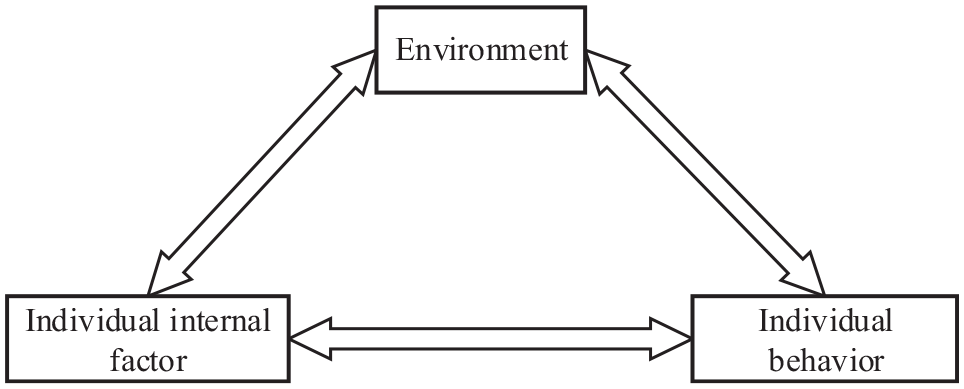
Triadic interactive determinism model.

TTF Model.
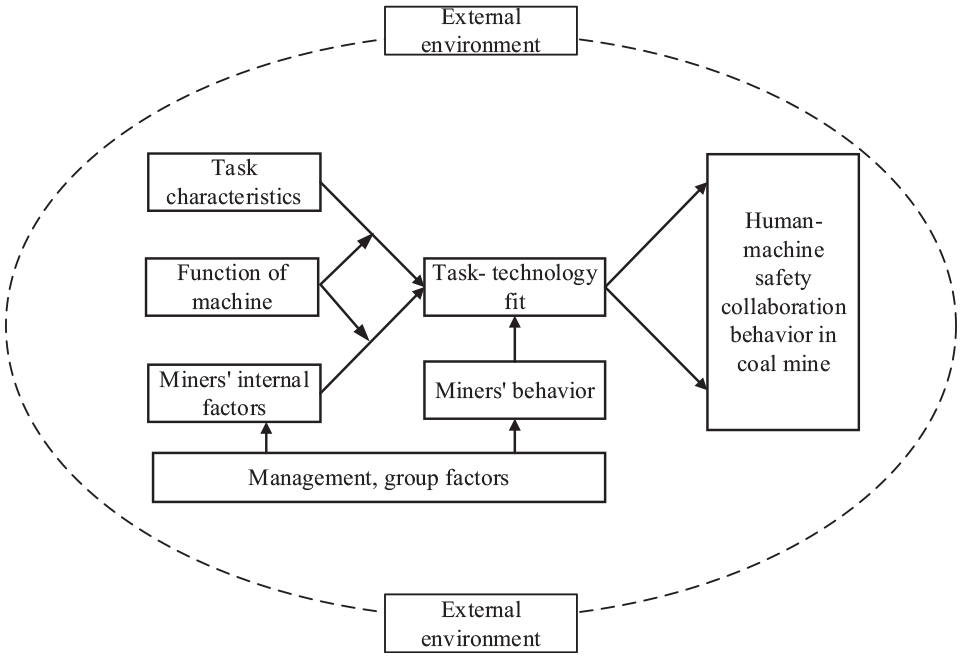
The theoretical framework of human-machine safety collaboration in the coal mine.
Determination of Influencing Factors of Human-Machine Safety Collaboration Behavior in the Coal Mine
Since scholars have paid relatively little attention to the influencing factors of human-machine safety collaboration in coal mines, in this paper, we searched the literature with three groups of keywords: “human-machine collaboration” and “influencing factors,”“human-machine collaboration,” and “coal mine safety,” and “coal mine safety” and “influencing factors.” This study screened the original literature on human-machine safety cooperation in coal mines. It explored the influencing factors from five aspects: miners, intelligent systems, management, groups, and external environment, as shown in Table 2.
The Original Literature on the Influencing Factors of Human-Machine Safety Collaboration in Coal Mines.

Through a literature search, scholars at this stage have primarily focused their research on the influencing factors of human-machine collaboration in the fields of automatic driving, human-machine interaction, and intelligent manufacturing, and less research has been conducted on the influencing factors of human-machine safety collaboration behavior under the intelligent construction of coal mines. For the research on the influencing factors of human-machine safety collaboration, previous authors have mainly explored three aspects: human, machine, and environment. From the human factors, employee capabilities (automation acceptance, operational skills, adaptability, situational awareness) and employee traits (trust, interpersonal characteristics) affect human-machine safety collaboration. Regarding intelligent system factors, attributes of intelligent systems (transparency, ease of use, reliability) and physical characteristics are highly relevant to human-machine safety collaboration. The environmental characteristics mainly include the human-machine interaction context (natural environment, workspace) and the interaction process (team communication, organizational norms, and safety culture). Previous research provides a reference for exploring the factors influencing human-computer safety collaboration behavior in coal mines. Due to its particular shift work style in the coal mining field, the safety climate and norms within the group and the leader’s safety management can also significantly impact human-machine safety collaboration. This paper, based on previous research, will investigate the influencing factors of human-computer safety collaboration behavior in coal mines by considering group (such as safety atmosphere, safety norms) and management factors (such as safety education and training, safety supervision, safety incentives) in conjunction with the actual intelligent production of coal mines.
By summarizing the original literature table of influencing factors of human-machine safety collaboration in coal mines, this paper preliminarily identifies 30 influencing factors from five aspects of miners’ factors: intelligent system, management, group, and environmental factors, as shown in Table 3.
Table of Initial Influencing Factors.

In addition, this study combines the interview data to improve the system of influencing factors of human-machine safety collaboration. We invite 10 experts with rich theoretical knowledge and practical experience in coal mine safety as consulting objects. They are from China Pingmei Shenma Group Pingmei No. 4 Mine, Pingmei No. 10 Mine technicians, engineers, and university professors.
The interviews were conducted in two forms telephone interviews or face-to-face questions, and the recordings obtained from the interviews were converted into texts. We chose semi-structured interviews to keep the interviews focused and to provide space to explore new relevant issues that arose during the interviews (T. Li et al., 2021). The content analysis method was used to analyze the original declarative sentences of the respondents. Under the premise of ensuring the integrity and mutual exclusivity of the semantic units, a total of 320 initial declarative sentences were obtained. After coding the original declarative sentences, 38 ambiguous and unanswered sentences were deleted, and 282 sentences with independent meaning were obtained.
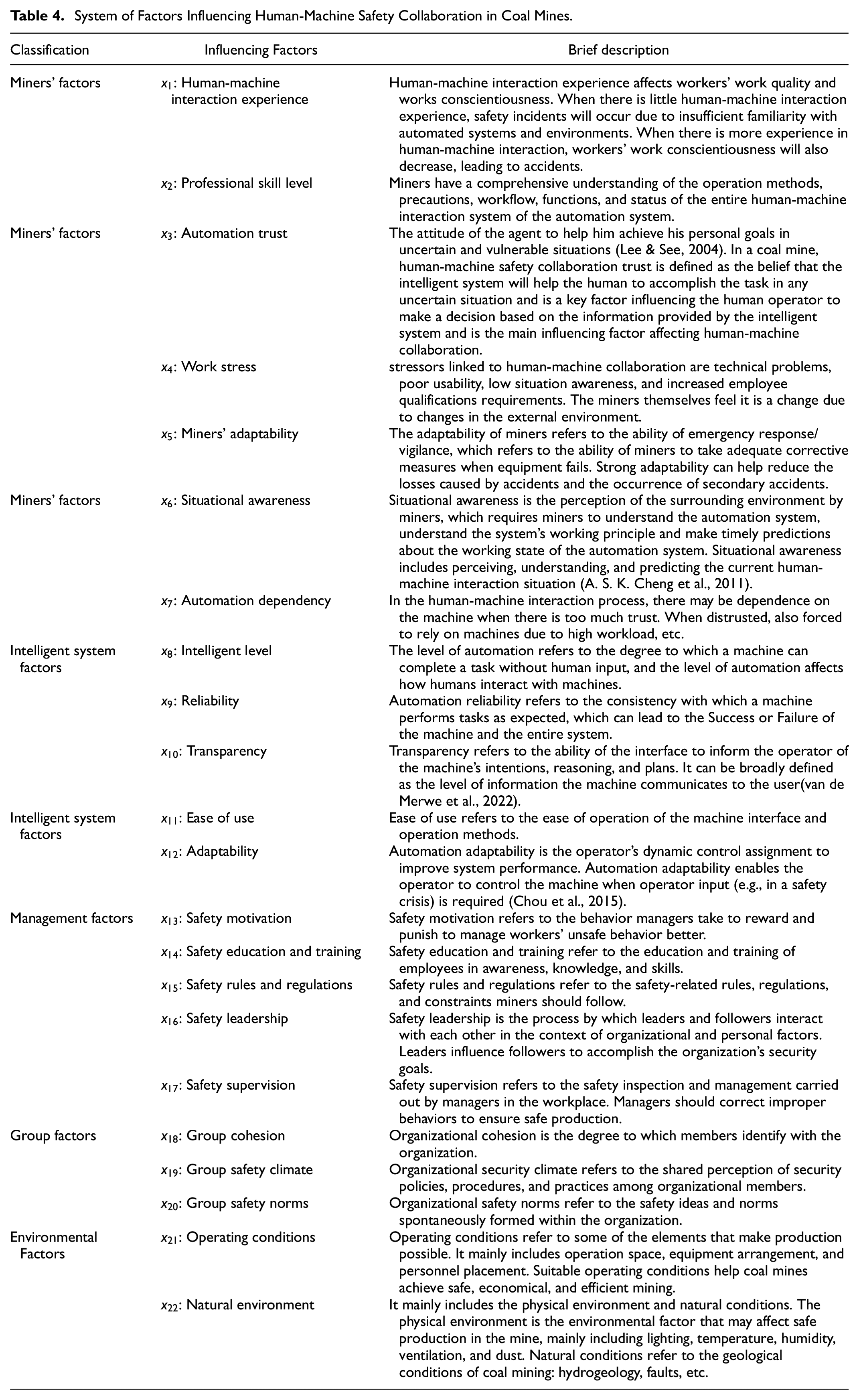
Adjust the initial influencing factors according to expert opinion. Cognitive burden and task complexity are summed up as work stress, and miners’ risk perception and situational awareness expressions overlap, so risk perception is deleted. Equipment design overlaps with ease of use and intellectual level representations, so equipment design is removed. Interpretability and transparency are combined into transparency. Leadership and coordination ability are summarized as safety leadership, and management regulations and measures are summarized into safety rules and regulations. Group pressure and individual factors of miners have overlapping expressions of work pressure, so the factor of group pressure is deleted. Summarize the workspace layout and operating environment into operating conditions. After preliminary identification and expert revision, this paper finally extracted 22 influencing factors, as shown in Table 4.
System of Factors Influencing Human-Machine Safety Collaboration in Coal Mines.
Methodology
DEMATEL-ISM Model Overview
Decision-Making Trial and Evaluation Laboratory (DEMATEL)can combine expert experience and knowledge to identify and analyze factors in complex networks (Fontela et al., 1974). Interpretative Structural Modeling Method (ISM) can divide a complex structural system into several related subsystems, construct a multi-layered hierarchical structure model, and divide the influence paths and hierarchical structures among factors (Attri et al., 2013). This study selects the DEMATEL-ISM integration method to explore the influencing factors of human-machine safety cooperative behavior in coal mines. The method can clearly describe the importance and interaction mechanism of various factors. The hierarchical structure model of coal mine safety production established based on this method can provide a basis for accident prevention measures.
DEMATEL-ISM Steps
Based on DEMATEL-ISM to analyze the mutual influence relationship between the influencing factors of human-machine safety collaboration in coal mines, it can be divided into the following steps:
The influencing factors are determined. Based on the literature and Delphi method, determine the factors affecting human-machine safety collaboration in coal mines
Building a Direct Impact Matrix
Build a comprehensive impact matrix


(4) According to Equations 3–6, the factor influence degree



(5) Build the reachability matrix

where

(6) Build a hierarchical model. According to the established reachability matrix, a hierarchical structure model is established. The reachable set



The factors that satisfy Equation 11 are the first-level factors of the system and are also the direct reasons that affect human-machine safety collaboration. Delete the elements of the first layer, continue to calculate according to Equation 11, analyze the system layer by layer, and obtain the hierarchical table of factors.
Data Analysis and Results
Data Collection
For the 22 factors affecting the human-machine collaboration system in coal mines, the experts who participated in the interviews in Chapter 2.2 were invited to fill in the questionnaire. Among the 10 experts, 3 technicians of intelligent, comprehensive mining face, 4 front-line miners, and 3 experts and scholars in this field were invited to judge the relevance of the constructed index system. The three technical staff of the intelligent integrated mining face were invited to participate in the intelligent transformation of coal mining enterprises for a long time. They have rich theoretical and practical experience in the technologies used in the intelligent construction of coal mines and the situation of coal mining sites. The 4 front-line miners have been engaged in coal mining for a long time and already have 4 years of working experience in intelligent, comprehensive mining face, and fully understand the factors that affect the safety of the coal mine system. Three professors in the field of coal mine safety are familiar with the unsafe behavior of intelligent mining faces in coal mines and have been actively involved in scientific research related to coal mine safety management for the past 10 years and have rich experience in coal mine safety management. The 10 experts invited in this paper have strong theoretical and practical experience, which can ensure the reliability and validity of the data. The scales of the relationship measurement between factors are shown in Table 5.
Factors Affecting Relationship Measurement Scale.

Study Results
According to steps (2) to (3), the comprehensive influence matrix
Factor Influence Degree, Influenced Degree, Central Degree, Reason Degree.


Cause and effect diagram of influencing factors.
Hierarchical Table.


Multi-layer hierarchical interpretation strucsture model.
Analysis of Study Results
Factor Causality and Importance Analysis
According to the requirements of DEMATEL’s classification rules and the action mechanism of factors, the causal relationship between factors can be determined by reason degree. The resultant factors change with the state’s improvement and the causal factors’ restructuring. The regulation of the causal factors can spread the regulation effect to all levels of the influencing factors through the correlation path, producing a large and benign regulation effect. As can be seen from Table 6, the order of the absolute values of the outcome factors is
The inter-influence relationship between factors can be illustrated by the degree of influence and the degree of being influenced. The degree of influence refers to the influence of the factor on other direct and indirect influences; the degree of being influenced refers to the influence of all other factors on the factor. The factors that have a high impact are
Hierarchical Structure Analysis
There is a complex relationship between the factors influencing human-machine safety collaboration behavior. In the ISM model, the factors at the first level include automation trust, miners’ adaptability, automation dependency, group cohesion, and natural environment, which are the most direct factors influencing human-machine safety collaboration behavior. The factors at the second, third, and fourth levels are indirect factors that affect human-machine safety collaboration, mainly including:
Discussion
According to DEMATEL’s research results, most of the 11 resulting factors are related to individual miners and work groups, which are greatly affected by other factors. The regulation of the resulting factors often immediately improves the human-machine cooperative safety behavior level. Most of the 11 factors are related to the environment and intelligent systems. Although these factors cannot directly affect the human-machine safety collaboration behavior in the coal mine, the intervention of these factors can spread the regulation effect to all levels of the influencing factors through the correlation path and produce an extensive range and long-term conditioning effect. Three factors with high impact are related to intelligent system factors, indicating that intelligent system factors can influence other factors to improve the level of human-machine safety collaboration behavior. Improving these factors helps form a positive cycle to achieve a higher level of safety.
Identifying and determining the key influencing factors of human-machine safety collaboration in coal mines is crucial for managing and preventing coal mine safety accidents. In the DEMATEL method, the critical factor not only requires its Centrality to be high but also requires it to be a causal factor (Du & Li, 2021). Therefore, the key factors can only be selected from the causal factors and ranked according to the Centrality:
Combined with the identified key factors and their levels, we find that the key factors of the accident-causing system are distributed at all levels, indicating that factors of different levels should be considered in coal mine safety management. According to the ISM model, reliability, transparency, and ease of use are the most profound factors affecting human-machine safety collaboration in coal mines. These factors related to the intelligent system are not affected by other factors. They will not directly lead to the occurrence of unsafe cooperative behavior. However, they can lead to unsafe cooperative behavior by affecting other factors, which is the most fundamental cause of safety accidents. Therefore, we should pay attention to the impact of intelligent system factors on human-machine safety cooperative behavior. The second, third, and fourth level are essential for human-machine safety collaboration. Most of these factors are related to management and group factors, which are not only affected by the most profound factors but also affect the direct factors. Although there is no direct impact on human-machine safety collaboration behavior, they play an essential role in the system. Automatic trust, miner adaptability, automation dependence, group cohesion, and natural environment these factors at the first level are direct factors affecting human-machine safety collaboration. Although these factors can not affect other factors, these factors are easy to perceive and intervene in the occurrence of safety accidents. Focusing on direct factors can effectively reduce the frequency of safety accidents.
According to the discussion of DEMATEL-ISM research results, the factors related to miners directly affect human-machine safety collaboration in the coal mine. The factors related to the intelligent system are the most profound factors affecting human-machine safety collaboration. Yang and Fa confirmed that the environment, mechanical equipment and information technology, and the unsafe behavior of miners are the direct causes of coal mine safety accidents by analyzing the literature from 2010 to 2020 (L. Yang et al., 2021) and the coal mine safety accidents from 2010 to 2020 (Fa et al., 2021). Unlike the previous research results, this paper believes that the miners’ behavior is the direct cause of the accident, and the intelligent system factor is the indirect cause of the human-machine safety accident. This may be because, before 2020, the intelligent construction of coal mines is in the infancy stage, and the reliability and stability of the intelligent system are not enough, so the mechanical equipment is the direct cause of the accident. However, with the intelligent construction of coal mines in recent years, many new intelligent equipment, sensors, and automatic controllers appear in the production process, the intelligent level of equipment is gradually improved, the intelligent system has been self-management, equipment stability and reliability are greatly improved, the probability of accidents is significantly reduced. The unsafe behavior of individual miners mainly causes the accident of human-machine collaboration in the coal mine.
This paper focuses on the problem of human-machine safety collaboration under intelligent coal mine construction. Based on the task technology fit theory and the ternary interaction determinism, this paper profoundly explores the factors that affect human-machine safety collaboration behavior in coal mines according to literature research and expert interviews and uses the DEMATEL-ISM method to make clear the causal relationship between influencing factors and the action path of each factor. This paper makes up for the need for previous research on the antecedent variables of human-machine safety collaboration behavior in the coal mine and the complex interaction between factors. It lays a foundation for further research on human-machine safety collaboration behavior in the coal mine, which has important theoretical significance. In addition, China’s intelligent coal mine construction process is still in the initial stage. Due to the influence of many factors in the practice process, the intelligent construction process of coal mine enterprises is hindered. Systematic analysis of the factors affecting human-machine safety collaboration behavior in the coal mine is conducive to promoting the intelligent coal mine construction process and has important practical significance.
Conclusion
This study identified 22 influential factors affecting human-machine safety collaboration behavior through literature analysis and the Delphi method. The key factors affecting human-machine safety collaboration behavior and the influence relationship between the factors were explored using the DEMATEL-ISM method. Through the DEMATEL model, we calculated each factor’s causality and centrality, obtained 11 causal factors and 11 consequential factors that influence human-machine safety collaboration behavior, and ranked the influence of these influential factors. The analysis of the DEMATEL model identified the key factors influencing human-machine safety collaboration behavior as safety education and training, human-machine interaction experience, ease of use, and safety leadership. Managers can reduce coal mine safety accidents through timely interventions on critical factors. The factors affecting human-machine safety collaboration behavior were divided into five levels using the ISM method. The inter-influence relationship between the influencing factors was analyzed to obtain the indirect and direct factors affecting human-machine safety collaboration behavior.
This paper focuses on the changes in human-machine collaboration in the coal mine under the background of intelligent construction. It explores the variables that affect human-machine safety collaboration behavior in the coal mine under the new form of human-machine interaction. Most existing research on coal mine safety focuses on miners’ safety or unsafe behaviors and seldom explores the factors affecting coal mine safety from the perspective of human-computer interaction. In this paper, the miners and intelligent equipment in the intelligent mining face of coal mine are taken as the research object and based on the theory of task technology matching and three-way interaction determinism, the factors affecting human-machine safety collaboration are explored from the aspects of individual miners, intelligent system, management, group, and environment. In addition, this paper uses the DEMATEL-ISM method to explore the causal relationship and interaction mechanism among factors, which provides a new perspective for coal mine risk prevention and safety management.
This study still needs some improvement, first, in the data processing. Data determination is mainly based on the personal experience, knowledge, and professional judgment of decision-makers, which has a particular subjectivity. Therefore, when the model is applied in practice, the results may be different due to the difference in the personal level of decision-makers. In the follow-up study, the sample size can be expanded, and coal mining enterprises of different regions and scales can be selected as far as possible to investigate to enhance the applicability of the conclusion. In addition, if time and cost permit, long-term tracking research can be conducted on enterprises to enhance data reliability. Secondly, this paper focuses on qualitatively analyzing the influencing factors of human-machine safety in coal mines. Although it reflects the law of interaction relationships within the system to a certain extent, it does not conduct a quantitative analysis of the interaction relationship between factors. In future research, the network analytic hierarchy process (ANP) can be used to explore the weight of each factor. On this basis, future research can also use multi-agent simulation or system dynamics method to explore the dynamic action mechanism of various factors on human-machine safety collaboration in the coal mine.
Footnotes
Acknowledgements
We are very grateful to the technicians, engineers, and professors of the University of China Pingmei Shengma Group for their help in obtaining the data. At the same time, we would also like to thank the authors of the references in this paper, whose research has provided the research basis for the writing of this paper.
Declaration of Conflicting Interests
The author(s) declared no potential conflicts of interest with respect to the research, authorship, and/or publication of this article.
Funding
The author(s) disclosed receipt of the following financial support for the research, authorship, and/or publication of this article: This work was supported by the National Natural Science Foundation of China (71573086) and the Graduate Student Innovation Project of North China University of Water Resources and Electric Power (YK-2021-119), Major Project of Applied Research in Philosophy and Social Science of Henan Higher Education Institution (2018-YYZD-10), Research on Deepening Industrial Open Development and Institutional Innovation in the Context of Henan Free Trade Zone Experimental Zone Version 2.0 A (2022-ZM-T06-01 )and Innovation Team of Network Public Opinion and Social Governance of North China University of Water Resources and Electric Power(01).

Data availability Statement
Data sharing not applicable to this article as no datasets were generated or analyzed during the current study