




Abstract
Flexible employment has attracted widespread attention in the era of the digital economy. However, there is still a debate among recent studies on whether the advancement of digital economy promotes flexible employment as a preferable option. This paper utilizes data from the China Labor-Force Dynamics Survey (CLDS) and the China Family Panel Studies (CFPS) to examine the effects of the digital economy on flexible employment. The findings indicate that the development of the digital economy significantly enhances the willingness of workers to choose flexible employment. The underlying mechanisms differ among workers with varying motivations. Specifically, the growth of the digital economy enhances some workers’ perception of job autonomy, prompting them to actively choose flexible employment arrangements. Conversely, it may increase the likelihood of others passively choosing flexible employment due to an enhanced perception of fairness. The positive effects of the digital economy on flexible employment vary by gender, age, education level, and job type. This study also finds that the digital economy contributes to increased satisfaction with flexible employment arrangements. The conclusions of this study hold important theoretical and practical value for understanding the psychological perceptions of flexible employees in the new era and for grasping the new opportunities of flexible employment.
Plain language summary
In today’s digital age, many people are talking about flexible jobs, like gig work, where you can choose your hours and tasks. Some experts think the digital world makes these jobs more popular, but others aren’t so sure. This study looks at surveys from China to see how the digital economy is changing the way people feel about flexible work. The study found that as the digital economy grows, more workers want to have flexible jobs. But why they want these jobs can be different. Some people like the freedom and control it gives them, so they choose flexible work on purpose. Others might feel it’s fairer to have a flexible job, even if it’s not their first choice. The study discovered that the digital economy’s impact on flexible employment varies among different groups defined by gender, age, education level, and job type. Finally, the study indicates that the digital economy is contributing to increased satisfaction with flexible employment. This study’s findings are really important. They help us understand how people think and feel about their flexible jobs in today’s world. Plus, they point out new chances for people to find flexible work that suits them.
Keywords
Introduction
The digital economy has profoundly reshaped the landscape of labor markets, with flexible employment experiencing rapid global expansion (Becchetti et al., 2024; Olaniyi et al., 2024). This trend, driven by intense market competition and rising labor costs, began in developed nations such as the United States and European countries in the 1980s, when corporations began outsourcing non-core functions to workers in developing countries. In the 21st century, the emergence of platform-based companies such as Uber, Lyft, and Take Eat Easy, leveraging new internet platform models, has generated a substantial number of new flexible employment opportunities (Baber, 2024). Data from the World Employment Confederation shows that the penetration rate of flexible employment in developed countries such as the United States, France, and the United Kingdom is between 2% and 3%, generally higher than the global average of 1.6%. Analogously, in recent years, there has been a notable increase in the diversity of flexible employment forms and categories within China’s labor market, indicating a significant shift in employment paradigms. Data released by the National Bureau of Statistics of China shows that by the end of 2021, the number of flexible employees in China reached 200 million, accounting for nearly one-third of the total employed population. Data from the “Annual Report on the Development of China’s Sharing Economy (2021)” shows that the number of platform employees in 2020 was 6.31 million, an increase of 1.3% over the previous year. The proliferation of flexible employment spans diverse sectors from the sharing economy to remote work, from platform-based drivers and food delivery workers in the service sectors to freelancers and consultants in the technology and creative industries, representing a novel phenomenon in contemporary labor markets (Alacovska et al., 2024; Newlands, 2024; Wu & Huang, 2024).
As the digital economy flourishes and digital technologies becomes ubiquitous, scholarly attention has been drawn to the potential impact of these trends on workers’ inclination toward flexible employment opportunities. However, the digital economy’s ambivalent effects on the flexible workforce have sparked widespread debates and generated paradoxes. On the one hand, modern information networks and communication technologies are recognized as driving forces behind new forms of flexible employment, with digital workers, gig workers, and platform workers representing emerging paradigms of labor (Goel et al., 2024; Schor et al., 2020). Platform-mediated employment models, empowered by digital technology, go beyond the constraints of traditional fixed work arrangements and employer relationships (Dunn et al., 2023). Flexible workers can engage in multiple platform-based jobs simultaneously, participating in work in greater freedom (Mäntymäki et al., 2019). For some, the platform economy also represents a new lifestyle (Blaising et al., 2021). These workers can flexibly arrange their schedules to achieve a desired work-leisure balance, independently choose work they are interested in, autonomously plan their career development, and derive value and enjoyment from their occupations (Angelici & Profeta, 2024). In addition, task automation emerges as a novel feature of flexible employment. Platform workers leverage real-time data analysis capabilities of online algorithms and sophisticated optimization methods to reduce the costs associated with information retrieval (Kekevi & Aydin, 2022). They gain access to extensive customer data and collaborate with intelligent tools to streamline task execution (Coombs et al., 2020). These technological advancements contribute to enhancing the productivity and earnings of flexible workers.
On the other hand, some scholars pessimistically argue that digital technology innovations, despite creating new opportunities, have also engendered apprehensions that put flexible workers in dilemmas. One strand of studies focuses on the relationship between flexibility and autonomy, juxtaposing them with critical debates on algorithmic control (Shibata, 2020; Zhao & Wu, 2023). Although flexible employment provides workers with temporal and spatial freedom, algorithm technology enables real-time tracking and recording the entire labor process, including task allocation, completion, and performance evaluation (Curchod et al., 2020). This intensive monitoring erodes the fundamental autonomy that flexible employment purportedly offers, leading to the autonomy paradox (S. Liu et al., 2021; Rogiers & Collings, 2024). A second group of studies focuses on the instability of flexible employment and the potential threats and challenges it may pose. In the platform economy, the pursuit of high flexibility often comes at the cost of significant uncertainty in income and job security. For instance, research on the Uber platform in the United States reveals that high utilization rate of vehicles contributes to higher hourly earnings for Uber drivers (Hall & Krueger, 2018). Nevertheless, the absence of labor contract protections exposes them to various operational expenses and deprives them of social insurance benefits (O’Donovan & Singer-Vine, 2016). Other studies acknowledge that platform workers may encounter potential economic challenges, such as inadequate labor rights and psychological strains (Beigi et al., 2022; Gussek et al., 2023).
While existing literature highlights the dual effects of the digital economy on flexible employment, there is a lack of research exploring why workers remain engaged in flexible employment despite its potential drawbacks. Some scholars argue that within the sharing economy, workers’ interpretations of platform characteristics and their experiences with algorithmic control, along with their responses to these experiences, plays a significant role (Bellesia et al., 2023). The perceptions held by workers themselves regarding the impact of digital technologies constitute a crucial consideration that should not be overlooked. This paper adopts laborer perception perspective to examine the impact of the digital economy on flexible employment and aim at answering the following research questions: What is the relationship between the digital economy and flexible employment? What are the key perceptions among workers that aligns with this economic shift, and how do these perceptions motivate them to choose flexible employment models?
To answer these questions, we categorize workers’ motivations for choosing flexible employment into active and passive dimensions. Combining data from the China Labor Dynamics Survey (CLDS) and the China Family Panel Studies (CFPS), this paper primarily uses a multilevel probit model to derive the following main findings:
The digital economy is indeed promoting the prevalence of flexible employment. It influences workers’ choices through distinct motivational pathways. For those actively seeking flexible employment, the digital economy bolsters their sense of autonomy. Conversely, for those who choose flexible employment more passively, the digital economy enhances their perception of fairness. These divergent mechanisms collectively render flexible employment a more appealing option.
This study makes the following contributions to the field. First, this study adopts the perspective of worker perceptions to explain how the growth of the digital economy inherently drives a substantial number of workers toward the gig and platform economies. While current literature has extensively discussed the opportunities and constraints that digital technology brings to flexible employment (He et al., 2021; Rogiers & Collings, 2024), it has often neglected a deeper exploration into why the favorable outcomes of flexible employment is particularly appealing to certain individuals. This article employs the subjective feelings of workers as a mechanism to enhance understanding of how flexible employment has become a favored profession among job seekers. Second, the study considers the heterogeneity of motivations, encompassing both proactive and passive aspects. By exploring the motivations behind different groups’ preferences for flexible employment, we can more effectively determine if the extensive deployment of digital technology meets the diverse expectations of workers regarding flexible jobs. This study considers those who enter flexible employment involuntarily, contributing to policy recommendations aimed at enhancing social welfare and mitigating the potential dark side of the digital economy.
The remainder of this paper is structured as follows: Section II presents literature review and derives our main hypotheses. Section III outlines the empirical framework of this study. Section IV presents the empirical analysis. Section V offers further analysis, and Section VI concludes the paper.
Literature Review and Research Hypotheses
Digital Economy and Emerging Flexible Employment Market
The digital economy, a novel economic paradigm, traces its origins to the advent of networked intelligence in the 1990s (Pan et al., 2022). It is defined as a new economic form that takes digital knowledge and information as key factors of production, with digital technology serving as the core driving force and modern information networks as an important carrier (China Academy of Information and Communications Technology [CAICT], 2024). As the information technology revolution deepens, advancements in big data, artificial intelligence, and cloud computing are increasingly shaping the digital economy, propelling it forward as a dynamic and transformative force (Guo et al., 2023). This shift propels economic transformation (Goldfarb & Tucker, 2019), including industrial upgrades and the rise of innovative business models, culminating in the emergence of a new labor market (Teece, 2018).
Fueled by digital technology as a driving force, the gig and platform economies are rapidly growing and creating many new job types. Flexible employment is now a big part of the dynamic workforce landscape. Theoretically, technological change reshapes the organization of production, which in turn affects the labor processes and employment structures (Didier, 2024). Digital technology facilitates the creation of a platform-mediated labor market system, leading to the integration of the labor processes with intelligent tools, and consequently generating new flexible employment models characterized by flexibility, virtualization, and digitalization (Angelici & Profeta, 2024). Additionally, digital platforms directly connect supply and demand, fostering decentralized production models through on-demand manufacturing and personalized customization (Lehdonvirta, 2018). The modular division of labor disrupts the traditional, fixed linkage between workers and jobs, ushering in a task-oriented employment model (Rogiers & Collings, 2024). This shift leads to the emergence of online tasking, demand-based matching, and other innovative forms of employment. An important condition for workers to choose flexible employment is the continuous increase in the number of flexible employment opportunities. These changes collectively broaden the range of career choices for workers, thereby promoting the widespread adoption and development of flexible employment models. Therefore, this paper proposes the following Hypothesis 1:
The Dilemma of Choosing Flexible Employment
The concept of flexible employment has not yet been fully appreciated, but it generally refers to employment arrangements that do not rely on traditional full-time employment relationships (He et al., 2021). As the digital economy evolves, flexible employment has expanded to not only traditional forms such as part-time, temporary, seasonal, and flexible work but also new employment forms within the platform economy, including online task, remote work, freelancing, and crowdsourcing. This model offers substantial flexibility in terms of time, location, and job content, aligning with the contemporary workforce’s desire for greater autonomy in their work (Vallas & Schor, 2020).
Flexible employment allows workers to overcome the limitations of traditional employment models, enabling them to arrange their work according to their own circumstances and preferences. By leveraging digital technology, the work of flexible employees can be divided into discrete tasks. They receive remuneration by completing tasks initiated by clients with needs, ensuring high efficiency and quality output during the execution of work (Sutherland & Jarrahi, 2018). In addition, the integration of automation and intelligent technologies in workflow processes liberates digital laborers from repetitive and tedious tasks, allowing them to focus their energy and cognitive resources on more challenging work (Autor et al., 2024). This shift grants flexible workers greater autonomy, enabling them to interact directly with clients and enhancing their work experience (Jia et al., 2024). Moreover, flexible employment presents workers with complex and evolving tasks. This dynamic workplace enhances their engagement and stimulates their curiosity to explore new and unfamiliar territories (Gregory & Sadowski, 2021). The shift from passive task execution to proactive problem-solving not only boosts job satisfaction but also fosters a sense of achievement, making flexible employment an appealing option for workers.
For workers seeking to enhance productivity and income through flexible work arrangements or pursue continuous professional advancement, flexible employment offers a novel alternative. However, there is a theoretical discord concerning whether the digital economy truly encourages this employment model. Skeptics contend that the digital economy could potentially lead workers into vulnerable circumstances within the realm of flexible employment.
Firstly, the high degree of flexibility in flexible employment comes with inherent instability and uncertainty. Research indicates that reduced job instability can adversely affect workers’ health and well-being (Urbanaviciute et al., 2019). The dynamic and unpredictable nature of the digital economy complicates the prediction of market trends and economic shifts, further amplifying uncertainty in the work environment. Gig workers, with their non-traditional work patterns, often face volatile client demand (Blaising & Dabbish, 2022), resulting in inconsistent income streams and underscoring the precariousness of their employment. Meanwhile, in the new employment paradigm, the boundaries of labor relations are increasingly blurred. The transition from traditional, long-term employment models to short-term, task-based models, and flexible collaborations implies that workers may serve multiple employers concurrently or sequentially. Under these circumstances, the rights of workers may not be well protected (Bellesia et al., 2019). Consequently, flexible workers may face heightened challenges regarding economic stability, job security, and access to social benefits.
Secondly, technological control places workers in a disadvantaged position. Labor process theory emphasizes how employers establish control over workers to maximize the value created by their labor (Omidi et al., 2023). Through task management and algorithmic oversight, gig workers face significant surveillance pressures (Pun et al., 2020). While ostensibly in control of their employment, they may have limited freedom due to their reliance on the technology. Wood et al. (2019) argues that the persistent control by algorithms over when, where, and how gig workers perform their tasks contradicts the flexible and autonomous work ethos promoted by online labor platforms. Additionally, there is a lack of computational transparency (Curchod et al., 2020). Blaising et al. (2018) indicates that workers in the online labor market lack information about reasons for rejection or failure, successful experiences of other online workers, client expectations, and the calculation of algorithmic scoring, leading to unstable working conditions. Other studies have corroborated the sense of fear and frustration that workers feel when dealing with algorithms (Beigi et al., 2022; Gussek et al., 2023).
Thirdly, workers in the gig economy often find themselves caught in a cycle of constant work. The theory of resource depletion suggests that persistent job stress and energy investment can lead to exhaustion of individuals’ psychological resources, consequently impacting their well-being (Hobfoll et al., 2018). The erosion of work-life boundaries in the gig economy often results in professional obligations encroaching on personal time. Driven by the platform economy, workers experience pressure to continually respond to task notifications, while surges in client orders deprive them of autonomy in task selection (Lang et al., 2023). This scenario can precipitate a state of compulsory continuous work. As task demands increase, workers may experience identity strain and emotional exhaustion, potentially adversely affecting their physical and mental health.
Digital Economy and Laborer Perceptions
As discussed, the existing literature reveals a paradoxical discourse regarding whether the digital economy encourages workers to choose flexible employment. However, these studies neglect the subjective perceptions of workers and the positive experiences they gain in flexible employment. The core proposition of this paper is that the perceptions, influenced by the development of the digital economy, vary according to distinct motivational drivers. These differentiated perceptions are the key mechanisms to reveal the workers’ propensity for flexible employment.
Workers’ decisions to engage in flexible employment are shaped by their perception of opportunities and constraints within the digital economy landscape. Technology affordances, defined as the potential actions and benefits offered by a technology, can be experienced differently by individuals based on their interests and motivations (Bellesia et al., 2023). Specifically, workers’ willingness to choose flexible employment varies, driven by both proactive and reactive motivations. Some individuals may actively seek flexible employment, motivated by the desire for flexibility, self-determined, or career advancement (Klein et al., 2024; Shukla & Shaheen, 2024). On the other hand, those who choose flexible employment reactively may have limited options and might accept job opportunities that do not optimally aligns with their interests or career aspirations (Newlands, 2024). Subsequently, we will explore the potential mechanisms that influence these groups’ choices regarding flexible employment.
Proactive Selection of Flexible Employment: Perception of Autonomy
Work Arrangements Autonomy
Work arrangements encompass the planning of working time, task frequency, and work sequencing (De Spiegelaere et al., 2016). Workers who actively seek flexible employment are more vulnerable to the negative impacts of boredom and repetitive work. With the application of automation technology and artificial intelligence, the essence of work has been redefined, and many routine tasks have been replaced by automation (Autor et al., 2024). Workers are liberated from the constraints of traditional work patterns and are now free to embrace more challenging endeavors (Wilson & Daugherty, 2018). Under such changes, they have greater autonomy in arranging complex tasks, allowing them to tackle the most challenging work first. This helps them conserve cognitive, psychological, and emotional resources, focusing on higher-level tasks, which in turn boosts their job enthusiasm (Jia et al., 2024). Consequently, as the digital economy evolves, workers who proactively choose flexible employment can experience work arrangements autonomy, especially for complex tasks, thereby reducing the risk of burnout and preserving motivation. This positive experience further drives their preference for flexible employment.
Work Intensity Autonomy
Work intensity includes work load or work effort (Lopes et al., 2014). Individuals who proactively choose flexible employment are often attracted to jobs that offer a high level of challenge, which typically require an environment that fosters freedom and creativity (Jia et al., 2024). However, if the work process is subject to constant, stringent monitoring, it can stifle creativity and create a sense of oppression that may deter their preference for such jobs. The advancement of digital technology has led to the decentralization of work models, empowering workers with more control in their economic interactions (Blaising & Dabbish, 2022). While this self-control right does not necessarily reduce the intensity of work and workers might decide to invest more effort to achieve their goals, this autonomy allows them to experience the freedom of managing their own work. Self-regulation in work can ignite intrinsic motivation and enhance job enthusiasm (Fishbach & Woolley, 2022). Even if they may choose to increase their workload, having control over the intensity of their labor can bring a sense of achievement and satisfaction (Fleischer & Wanckel, 2024), attracting workers to flexible employment.
Work Content Autonomy
Work content is mainly related to skills development, career management, and personal goals (Lopes et al., 2014; Pichault & McKeown, 2019). Research has indicated that empowerment, which decentralizes power to the lowest organizational levels to increase intrinsic motivation at work (Orhan et al., 2021), notably enhances workers’ self-efficacy when they can autonomously determine their work content (Fani et al., 2024). According to self-determination theory, individuals possess an inherent need for control and choice over their actions (Shuck et al., 2011). While autonomy over work intensity and hours satisfies this need, autonomy of work content takes it a step further by allowing workers to execute tasks based on their own insights and judgments. This autonomy type closely links to individual intrinsic motivation and personal growth objectives, underscoring the worker’s role as an insider (Klein et al., 2024). As previously discussed, the development of the digital economy has transformed the attributes of tasks, resulting in a surge in unconventional and creative work. Creativity inherently demands autonomy, enabling workers to self-regulate, perceive the significance of their work content, and fully engage their enthusiasm and creativity (D. Liu et al., 2016). This enhances a sense of satisfaction, competence, and belonging in their work (Scharp et al., 2022). It is precisely the significant influence of job content autonomy on workers’ intrinsic motivation that propels them to actively and willingly select flexible employment models.
Passive Selection of Flexible Employment: Perception of Fairness
The choice of flexible employment is sometimes not voluntary but forced by the underdevelopment of the market and the insufficient absorption capacity of the formal employment sector (Burtch et al., 2018). This form of employment often attracts groups on the fringes of society, such as migrant workers and laid-off workers, who typically have lower levels of human capital and skill sets (Newlands, 2024). Opting for flexible employment is often a necessity for a means for them to cope with financial pressures and provide economic support for their families. Although this type of work may lack stability and social security, it at least offers these groups a viable path to change their current situation and improve their lives (Chen et al., 2019).
Within the context of digital economy, these groups, despite being subject to algorithmic control and required to comply with platform directives during their work processes, which can lead to overwork, may consider this alignment with their perspective on benefits. The compensating wage differential theory suggests that the market should offer compensation to workers who are employed in less favorable working conditions (Rosen, 1974). These laborers prioritize their basic needs for survival and are more focused on the total earnings over a longer period, being less sensitive to the precise control that digital technology exerts over the labor process (Ault & Spicer, 2024). They engage in self-exploitation, forgoing job security and safety, in exchange for higher earnings. Although the working conditions may not be ideal, they can create better living conditions through flexible employment (G. Huang et al., 2020), thereby perceiving a sense of fairness.
While reliance on digital technology may potentially diminish workers’ autonomy, their perspective on technology is not necessarily pessimistic. Digital platforms aggregate a vast amount of information, facilitating real-time matching between tasks and workers, significantly reducing the cost of information acquisition for laborers (Kekevi & Aydin, 2022). The exponential growth in customer volume effectively breaks down barriers to market entry for them. Moreover, the platform economy is characterized by sharing, allowing workers to share resources and information, lowering the skill threshold and addressing the uneven distribution of resources (Goldfarb & Tucker, 2019). It is precisely because of technological tools that they perceive a more equitable range of employment opportunities in the platform economy, thereby enhancing their confidence in choosing flexible employment.
Based on the above analysis, we present Figure 1, which illustrates the theoretical framework, and propose the following hypothesis:

Theoretical framework.
Data Sources, Variable Definitions, and Empirical Models
Data Sources
This paper selects the China Labor Dynamics Survey (CLDS) as the main source of microdata. The CLDS is survey data from the Social Science Survey Center of Sun Yat-sen University. The survey targets the labor force aged 15 to 64 and covers 29 provinces, municipalities, and autonomous regions in China. This study uses data from the three periods of 2012, 2014, and 2016. To enhance the robustness of the research findings and address potential issues of result contingency associated with the CLDS surveys, this study also incorporates data from the China Family Panel Studies (CFPS). The CFPS is a nationwide longitudinal survey conducted every 2 years by the China Social Survey Center at Peking University, covering 25 provinces (municipalities, autonomous regions). This paper integrates data from five rounds of CFPS surveys conducted between 2010 and 2018 (2010, 2012, 2014, 2016, and 2018). Drawing on relevant literature (Gong et al., 2023), the use of the CFPS dataset with a longer time span significantly increases the sample size, mitigates the impact of sample selection bias or short-term fluctuations, and allows for more effective control of potential confounding factors. Therefore, the CFPS surveys not only provide an alternative sample source for this study but also extend the temporal coverage. Using this sample for robustness tests is well-founded and helps verify whether the research findings remain consistent across different conditions, thereby enhancing the robustness of the results.
As for the calculation of the core explanatory variable—the level of digital economy, it mainly relies on macro data. The collection of relevant macro data comes from various official statistical databases, including the “China Statistical Yearbook,” the “China Electronic Information Industry Statistical Yearbook,” the “China Science and Technology Statistical Yearbook,” and the “Report on the Index of Provincial Enterprise Operating Environment in China.”
Variable Definitions
Explanatory Variables
The explanatory variable of this paper is the development index of digital economy. China Academy of Information and Communications Technology divides the development index of China’s digital economy into basic indicators, industry indicators, integration indicators, and environmental indicators in the “2019 China Digital Economy Development Index” report, evaluating the level of digital economy development in 31 provinces, municipalities, and autonomous regions nationwide (excluding Hong Kong, Macao, and Taiwan regions). Therefore, there is a certain reference basis for constructing the digital economy index at the provincial level. Following the approach of J. Wang et al. (2021), this paper constructs indicators from four aspects: the carriers of digital economy development, digital industrialization, industrial digitalization, and the development environment of digital economy, and uses entropy weight method to construct a standard digital economy development index, detailed indicators are shown in Table 1.
Digital Economy Index.

Explained Variable
Drawing from existing literature, flexible employment primarily falls into one of the following categories: first, informal employment arrangements; second, flexible forms of employment (e.g., He et al., 2021; Xing & Qiu, 2024). Thus, this article defines flexible employment in the CLDS database as including situations without a fixed employer, without a fixed workplace, non-full-time, short-term contracts, labor dispatch, part-time positions, and without labor contract.
Furthermore, we categorize workers’ job selection attitudes into two types: proactive and reactive. Drawing on current research, a proactive attitude indicates an individual’s drive and pursuit of goals within their career choices. In contrast, a reactive attitude is more indicative of an individual’s adjustment to external circumstances and the satisfaction of fundamental needs (Parker et al., 2010). In CLDS survey, the question “What is the significance or value of your current job to you?” is posed. Respondents are asked to rate various job motivations on a scale from 1 to 5, where 1 signifies “not at all applicable” and 5 signifies “completely applicable.” Scores for “earning respect,”“interest,” and “utilizing one’s abilities to the fullest” are used to gage the proactive job selection tendency. Conversely, scores for “making a living,”“finding psychological solace,” and “meeting more friends” are used to gage the reactive job selection tendency. We then compare the total scores of these two tendencies. If the total score for the proactive tendency exceeds that of the reactive tendency, it is classified as proactive job selection and is assigned a value of 1. If the total score is lower to that of the reactive tendency, it is classified as reactive job selection and is assigned a value of 0.
Mediating Variables
The mediating variable is the perception of work autonomy. Job autonomy is the extent to which employees can independently decide on the activities they perform in their jobs, as measured by their self-reported assessment of decision-making freedom at work (Zhao & Wu, 2023). According to the questionnaire compiled by Jønsson and Jeppesen (2013), job autonomy includes “to what extent the scheduling of work progress is determined by oneself,”“to what extent the content of work tasks is determined by oneself,” and “to what extent the workload/intensity of work is determined by oneself.” The categories in the CLDS survey are consistent with this, also asking about the content of work tasks, the scheduling of work progress, and the intensity of work. In this paper, answers of “completely determined by oneself,”“partially determined by oneself,” and “completely determined by others” are assigned values of 3, 2, and 1, respectively. The larger the value, the stronger the perception of job autonomy by workers.
Another mediating variable is the perception of fairness. Consistent with the methodology from Qian et al. (2023), we use the following question to measure fairness, “Do you think your current living standards are fair in comparison to your efforts?” 1 represents completely unfair, 5 represents completely fair, and respondents score on a scale of 1 to 5. This question measures people’s perception of fairness regarding the outcomes of their efforts.
Control Variables
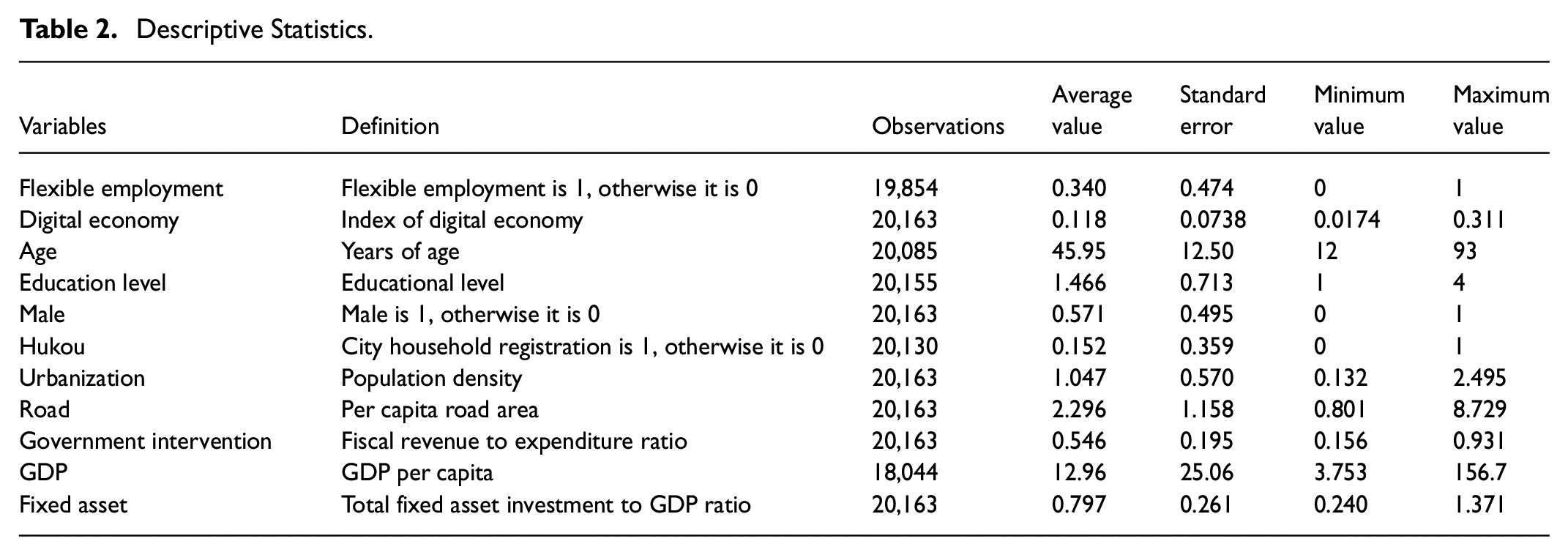
Drawing on previous research (e.g., X. Wang et al., 2024), our study uses a range of standard control variables to capture characteristics at the individual and provincial levels. The empirical design encompasses individual factors such as age, gender, household registration, education level. We control for province-level factors, including urbanization level, regional economic development level, government intervention, fixed asset investment, and road infrastructure. Descriptive statistics of variables are shown in Table 2.
Descriptive Statistics.
Empirical Models
This paper primarily investigates the impact of the digital economy on workers’ choice of flexible employment. Flexible employment is a binary choice variable. To address the concern that individual-level variation moderates the effect of provincial-level variation, this paper employs multilevel probit model to explore whether the development of digital economy significantly increases workers’ willingness to choose flexible employment. The model specification is as follows:

Where
This paper examines the impact of digital economic development on perception of fairness and autonomy, respectively, to verify the mediating mechanisms of different job selection perspectives. The perception variables are discrete, for which we employ an ordered probit regression. The model is as follows:

By constructing model (2), further confirmation is provided on whether the core explanatory variable
Empirical Results
Baseline Regression Results
Table 3 reports the direct impact of the digital economy on workers’ choice of flexible employment. As shown in Column (1), the estimation results without including control variables. In Column (2), we add individual and provincial level control variables. These variables are relatively exogenous. The estimated coefficient of the digital economy variable remains significantly positive at the 1% level. Considering the influence of time changes in panel data estimation, Column (3) to (5) further include time fixed effects. In addition, in Column (4), we introduced additional control variables to avoid omitted variable bias, in Column (5), we also incorporate province fixed effects. As shown in Table 3, the coefficient of digital economy is significant at the 1% level. These results indicate that the development of digital economy can enhance the tendency of workers to choose flexible employment.
Baseline Regression Results.

Note. Robustness standard deviations are in parentheses.
*, **, and *** denote significant at the 10%, 5%, and 1% levels, respectively.
This result is consistent with the viewpoint that the digital economy fosters flexible employment. The swift advancement of digital technology, particularly the proliferation of the internet and smart devices, has significantly propelled the emergence of the platform economy. As a key driver of flexible employment, the platform economy creates an array of new job opportunities, including freelance related to digital industry roles, as well as new positions in the digital transformation of industries like food delivery personnel and ride-hailing drivers (Alacovska et al., 2024; Chen et al., 2019). These innovative employment forms provide workers with a broader set of career options and more adaptable working arrangements, satisfying the employment demands of various demographic groups, then improving the possibility for choosing flexible work. Therefore, Hypothesis 1 of this article is confirmed.
Endogeneity Treatment
This paper sequentially adopts instrumental variable method and multi-period DID to reduce endogeneity-induced bias. Drawing on the practices of Nunn and Qian (2014) and Q. Huang et al. (2019), this paper uses the interaction term between historical postal quantities and internet investment in the previous year as instrumental variables for two-stage least squares regression. This choice of instrumental variable is theoretically consistent with the requirements of relevance and exogeneity. From the perspective of relevance, the distribution and development of post offices in various regions to some extent affect the subsequent distribution and development of landline telephones. Furthermore, the distribution of landline telephones also affects the internet penetration rate in various regions, thereby influencing the level of digital economic development. From the perspective of exogeneity, the role of post offices in today’s society is increasingly weak, and they basically do not directly affect workers’ preferences for flexible employment.
Subsequently, this paper empirically tests the relevance and exogeneity of instrumental variables. In Table 4, Column (1) and (2) report the results of the relevance and exogeneity of the instrumental variable method. The result in Column (1) shows that the coefficient of historical postal quantities is significantly positive at the 1% level, with a value of .0438, indicating that the number of post offices significantly promotes the development of the digital economy. Therefore, the relevance of the instrumental variables is verified. The result in Column (2) shows that after adding instrumental variables to the baseline estimation model, the coefficient of instrumental variables becomes insignificant. This indicates that after controlling for the digital economy variable, the effect of instrumental variables on flexible employment is not significant. Its influence on individuals’ willingness to participate in flexible employment must therefore indirectly affect the level of individual participation in flexible employment through the channel of influencing the development of the digital economy, satisfying the exogeneity requirement of instrumental variables.
Endogeneity Treatment Regression Results.

Note. Robustness standard deviations are in parentheses.
*, **, and *** indicate significant at the 10%, 5%, and 1% levels, respectively.
Furthermore, the F-statistic in Table 4 is 1,256, greater than the value of 10. The Cragg-Donald Wald F-statistic is 1,032, much larger than the critical value of 16.38 corresponding to a 10% tolerance for distortion, indicating that the instrumental variables are not weak. The Kleibergen-Paap rk LM statistic passes the test for instrument variable identification at the 1% significance level. This result indicates the rationality of selecting the historical postal quantity as an instrumental variable. After verifying that the instrumental variables meet the basic requirements, Column (3) reports the results of the second stage of instrumental variable method. The results show that the coefficient of the fitted value obtained by regressing the instrumental variable on the index of digital economic development is significantly positive, consistent with the baseline estimate. Based on this, this paper further uses the LIML model to conduct a robustness test for the estimation results of the 2SLS model. Column (4) results show that in the estimation results of the LIML model, the regression coefficient and significance level of the impact of the digital economy on flexible employment are remarkably similar to those of the 2SLS model, indicating that the estimation results of the instrumental variables are robust, and there is no interference from weak instrumental variables, making the instrumental variable test results credible.
At the same time, considering that instrumental variables cannot completely solve the endogeneity, this paper also selects the “Broadband China” pilot policy as a quasi-natural experiment (Tian & Zhang, 2022). Column (5) results show that the “Broadband China” pilot has increased the likelihood of workers choosing flexible employment. The results in Table 4 indicate that after addressing the endogeneity bias, the results remain robust.
Robustness Test
Table 5 reports the results of robustness checks. First, the quality issue of the CLDS survey database. Considering that our selected CLDS data spans from 2012 to 2016, this paper uses the five rounds of the China Family Panel Studies (CFPS) from 2010 to 2018 for the study. As column (1) shows, the coefficients of the digital economy variables are significant at the 5% level.
Regression Results of Robustness Test.

Note. Robustness standard deviations are in parentheses.
*, **, and *** indicate significant at the 10%, 5%, and 1% levels, respectively.
Second, alternative indicators of the digital economy. Large measurement errors can severely affect the accuracy of the results. This paper employs the approach of Yang and Jiang (2021) to remeasure the provincial digital economy development index, focusing on the two typical characteristics of digital economy growth: digital industrialization and the digitization of industry. At the same time, due to the small number of samples at the provincial level, the captured development index of the digital economy may be too macro. In order to more meticulously verify the research conclusions, this paper refers to the method of Zhao et al. (2020) to verify the impact of the city-level digital economy development index on the choice of flexible employment. Columns (2) and (3) in turn confirm that the findings are robust.
Third, alternative indicators of flexible employment. This paper also examines whether workers have signed a labor contract. Workers without a signed labor contract are considered flexibly employed. In addition, considering that entrepreneurship is also a type of flexible employment, this paper further measures self-employment. In columns (4) and (5) we can find that the effect of digital economy on both employed flexible employment and self-employed flexible employment is significant at 1% level.
Fourth, there is a certain lag for the digital economy to truly take effect. This paper uses the digital economy development index with a one-period lag to test whether, after a period of time, the role of the digital economy is truly released and whether it will have an impact on flexible employment. Column (6) shows that after accounting for the lagged effects on digital economy development, the result remains robust.
Fifth, we re-estimate the baseline using a probit model, and add standard errors clustered to the province. The results in column (7) show that the impact of the digital economy on flexible employment remains significant at the 1% level.
After evaluating the potential biases mentioned above, the results still show significant positive effects, which further confirms the robustness of the baseline estimation regression results in this paper. Consequently, the empirical analysis of this paper validates the positive impact of the digital economy on flexible employment, preliminarily addressing the theoretical tension on whether the development of digital economy can attract more people to engage in flexible employment. At the same time, it suggests a potential trend: with the rapid growth of digital economy, flexible employment may become one of the main employment models in China.
Further Analysis
Mechanism Analysis: Laborer Perceptions
The baseline estimation provides causal identification of objective outcomes. To enrich our understanding of the underlying mechanisms, this paper categorizes workers’ job selection perspectives into active and passive. Within this classification, we identify two mechanisms mentioned in the theoretical section: perceived autonomy and perceived fairness. First, we verify the possible mechanisms of the proactive job selection group. The empirical results in Table 6 indicate that digital economy has a positive and significant impact on three dimensions: work arrangement autonomy, work intensity autonomy, and job content autonomy. However, Column (4) in Table 6 shows that the development of digital economy has not significantly impacted the perception of fairness among proactive job seekers. Second, we verify the possible mechanisms of the passive job selection group. Columns (1) to (3) in Table 7 show that the development of digital economy does not significantly affect these workers’ autonomous perception. Column (4) in Table 7 empirically proves that the development of digital economy is significantly and positively correlated with the perception of fairness among the passively employed workforce. Therefore, the digital economy development generates distinct channels to attract workers with varying job selection attitudes toward flexible employment. The channels through which the digital economy development influences proactive job seekers are through perceived autonomy, while for passive job seekers, it is through perceived fairness. Thus, Hypothesis 2 is validated.
Regression Results of Mechanism Test for Proactive Job Selection Motivation.

Note. Robustness standard deviations are in parentheses.
*, **, and *** denote significant at the 10%, 5%, and 1% levels, respectively.
Regression Results of Mechanism Test for Passive Job Selection Motivation.

Note. Robustness standard deviations are in parentheses.
*, **, and *** denote significant at the 10%, 5%, and 1% levels, respectively.
A possible explanation is that proactive job seekers typically pursue autonomy and a sense of personal achievement in their career development, valuing opportunities where they can realize personal value (Diaa et al., 2024). The development of the digital economy has provided them with greater autonomy, and they have a profound sense of the enhancement in their self-directed status brought by new work modes and platforms (Shukla & Shaheen, 2024). Compared with others, this group is less likely to face discrimination in the job market, often equipped with higher education, specialized skills, or rich resources, placing them in an advantageous position. They seldom encounter unfair pay, unequal promotion opportunities, or other forms of workplace injustice.
Passive job seekers typically belong to more vulnerable groups, and their choice of flexible employment is often due to a lack of better employment opportunities (Newlands, 2024). For these workers, the primary goal is to ensure their basic living needs are met rather than pursuing career development or personal achievement (Chen et al., 2019). They may be more willing to accept certain working conditions, even if it means sacrificing a certain level of autonomy, such as flexibility in work hours and location, or diversity in job content. When the development of digital economy can provide them with opportunities to improve their economic situation and reward their efforts, this financial improvement brings them great satisfaction.
To sum up, compared to the past, the development of the digital economy now offers a variety of employment channels. These channels not only attract individuals with different job selection perspectives to the flexible job market but also evoke positive psychological perceptions among them. Whether they are proactive job seekers pursuing autonomy or passive job seekers focused on fairness, flexible employment may emerge as a favorable option for their future, potentially transforming their means of subsistence and lifestyle.
Heterogeneity Analysis
To capture the nuanced positive impact of the digital economy on flexible employment, we conducted a heterogeneity analysis from two dimensions: personal attributes and occupational characteristics. Personal attributes include fundamental traits such as age and gender, while occupational characteristics encompass factors like education level and the nature of work (manual or intellectual labor). By categorizing in this manner, we can more precisely grasp the trends and features of flexible employment among different groups under the influence of the digital economy.
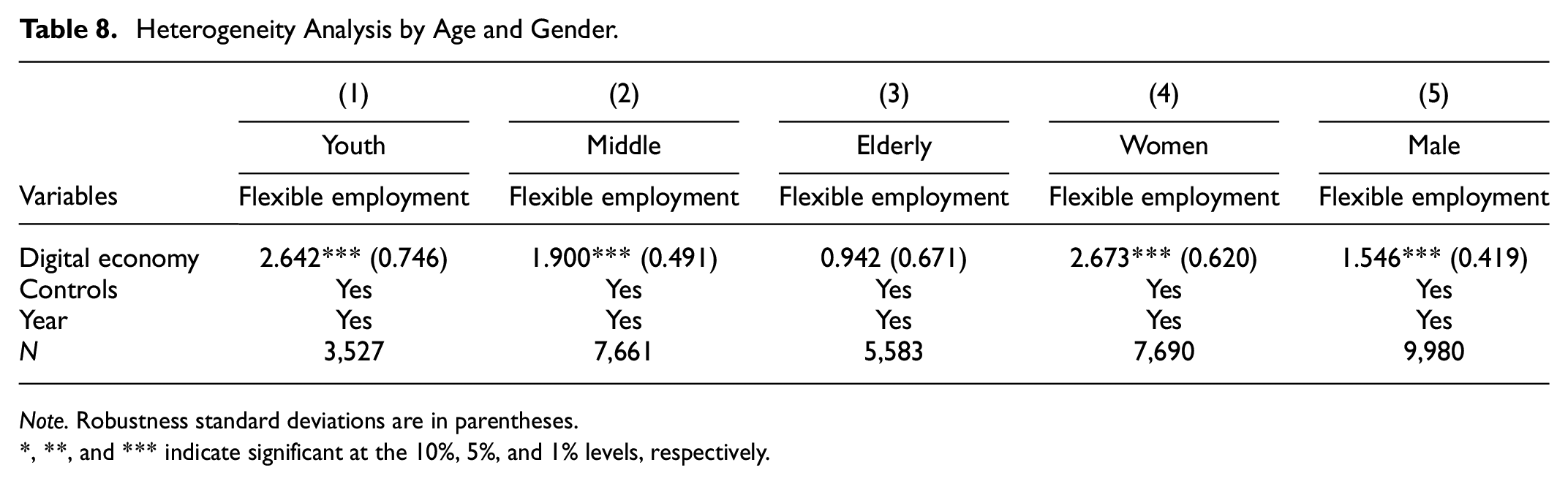
First, this article categorizes age into three groups: the youth group (16–35 years old), the middle-aged group (36–50 years old), and the elderly group (51–70 years old). Columns (1) to (3) in Table 8 examine the heterogeneity in the impact of digital economy on the likelihood of workers choosing flexible employment across different age groups. The results show that the impact effect on young and middle-aged people is positively significant at the 1% level, with young people having a greater likelihood of choosing flexible employment, with a coefficient of 2.642. However, the digital economy does not significantly affect the probability of elderly people choosing flexible employment. This is because the employment concepts of the new era’s youth have changed, they no longer regard stability as the sole goal for job selection and are more willing to pursue meaningful or challenging work (Barhate & Dirani, 2022). Meanwhile, some middle-aged job seekers may confront greater economic pressure, and flexible employment offers them more online tasks to earn extra income (Wu & Huang, 2024). In contrast, the instability of flexible employment makes it difficult for many elderly people to quickly adapt to this employment model (Blaising & Dabbish, 2022). Columns (4) and (5) further test the heterogeneity by gender, and the results indicate that the digital economy coefficient is significant at the 1% level for both men and women. However, the marginal estimated coefficient for women is 2.673, which is much larger than that for men.
Heterogeneity Analysis by Age and Gender.
Note. Robustness standard deviations are in parentheses.
*, **, and *** indicate significant at the 10%, 5%, and 1% levels, respectively.
This is because that it allows women to continue working after childbirth, adjust their work commitments as family responsibilities increase, and ultimately achieve a better balance between work and life (Angelici & Profeta, 2024).
Table 8 reports on the heterogeneity of skill levels and industries. Drawing on the research by Graetz and Michaels (2018), this study categorizes skill levels based on educational attainment. Specifically, Individuals with a junior college degree or higher are designated as possessing high skill levels, those with high school or middle school degrees are categorized as medium skill level, and those with only primary school education or less are classified as low skill level.
Columns (1) to (3) in Table 9 indicate that digital economy is more likely to influence workers with low and middle skill levels to opt for flexible employment, with no significant impact on those with high skill levels. This is because digital jobs lower the entry barriers (Goel et al., 2024), and medium and low-skilled workers are more sensitive to the increase in job opportunities compared to their high-skilled counterparts. Columns (4) and (5) in Table 9 show that digital economy has significantly enhanced both the physical and intellectual tasks. However, it is noteworthy that digital technology has particularly empowered intellectual work, with an impact twice as significant as that on physical labor. It is that the impact of digital technology on the nature of work has been particularly profound, with many routine and procedural tasks being replaced by intelligent machines. Workers are increasingly required to take on non-routine tasks, necessitating the development of non-cognitive skills and the ability to collaborate with artificial intelligence (Autor et al., 2024).
Heterogeneity Analysis by Education Level and Work Characteristics.

Note. Robustness standard deviations are in parentheses.
*, **, and *** indicate significant at the 10%, 5%, and 1% levels, respectively.
To sum up, in the face of the emergence of a multitude of new flexible employment opportunities, women will have more chances to leverage their strengths in the future. Young and middle-aged people are no longer confined to the notion of seeking stable jobs. Low and medium-skilled workers become the primary group entering the realm of flexible employment. As digital technology continues to advance, flexible employment is increasingly likely to permeate creative and challenging intellectual work. Thus, flexible employment is taking on new characteristics and a fresh appearance.
Employment Quality: Satisfaction With Flexible Employment
After confirming the positive impact of digital economy on the expansion of flexible employment, we are also concerned about the satisfaction of workers with flexible jobs, further examining the quality of flexible employment. According to the CLDS questionnaire, respondents are asked to evaluate their job situation to test their satisfaction with various aspects of work. As shown in Table 10, the development of digital economy enhances the overall job satisfaction of flexible workers, specifically in terms of income, ability and skill utilization, and respect given by others for their work. Satisfaction with the work environment and job security is not significant. These results are consistent with theoretical analysis. The development of the digital economy has broadened the channels for workers to improve their human capital, allowing them to achieve considerable benefits through effort, and this type of work is more prestigious than traditional informal work (Jin & Lyu, 2024; Rogiers & Collings, 2024). However, in terms of job security and environmental protection, the development of digital economy has not improved the current situation for flexible workers (Bellesia et al., 2019).
Impact of Digital Economy on Work Satisfaction.

Note. Robustness standard deviations are in parentheses.
*, **, and *** indicate significant at the 10%, 5%, and 1% levels, respectively.
Conclusion, Policy Implications, and Research Limitations
Conclusion
In the burgeoning digital economy, we witness the continuous emergence of new industries, business models, and forms. These developments are reshaping the landscape of employment, giving rise to diverse flexible employment. Reviewing the existing literature, the impact of the digital economy on flexible employment is theoretically tense. On the one hand, as the digital economy permeates work, workers gain increased flexibility and autonomy in decision-making, collaborating with intelligent tools to focus on meaningful tasks (e.g., Autor et al., 2024; Gregory & Sadowski, 2021). On the other hand, flexible workers may fall into the autonomy paradox, under tight algorithmic surveillance, with their work under stricter control (e.g., Omidi et al., 2023; Pun et al., 2020). They may also face job instability, environmental insecurity, and compromised social welfare, leading to physical and psychological harm (e.g., Bellesia et al., 2019; Blaising & Dabbish, 2022). This paper, from the perspective of workers’ perceptions, delves into how the digital economy entices individuals to opt for flexible employment. The main findings are as follows:
First, as the digital economy evolves, the inclination of workers to choose flexible employment options increases. Furthermore, the channels through which this impact effect occurs vary across different groups. Specifically, we categorize the willingness to choose flexible employment into two types: voluntary and involuntary. The job selection perspectives of these groups significantly influence their psychological dynamics. With the advancement of the digital economy, those who genuinely choose flexible employment in pursuit of value and personal interests in their work notably perceive an increase in job autonomy. In contrast, those who are compelled to choose flexible employment due to survival concerns are more likely to experience a sense of enhanced fairness amidst technological change; they feel that their efforts can be rewarded. These distinct positive psychological perceptions drive their choice of flexible employment.
Second, this article provides a more detailed portrayal of the positive characteristics through which the digital economy impacts flexible employment. Women, young people, and those with middle skills are more actively embracing the opportunities of the flexible employment era. Additionally, this study reveals that the development of digital economy has significantly enhanced the demand for mental labor in flexible employment, outweighing the demand for physical labor. This conclusion indicates that the nature of flexible employment is undergoing a transformation, breaking free from the stereotypical image with low ability requirements, and evolving toward more sophisticated and complex job requirements.
Thirdly, the growth of digital economy has enhanced overall satisfaction with flexible employment, encompassing aspects such as income, skill utilization, and respect from others. This indicates that today’s flexible employment not only provides material fulfillment but also increasingly enriches spiritual satisfaction. However, the development of digital economy has not significantly impacted satisfaction with the work environment or job security, suggesting that technological advancements have yet to alleviate some of the long-standing concerns associated with flexible employment.
Policy Implication
Based on the above analysis, this paper proposes the following policy recommendations. Firstly, the government should bolster its digital infrastructure and harness technologies such as big data and AI to foster the emergence of new business models. By integrating more platform dynamics into the future labor market and developing the gig economy, a variety of innovative flexible employment opportunities can be created across different sectors. Meanwhile, the government should enhance its focus on protecting the rights and interests of new types of flexible workers, and take a series of measures to ensure that they are effectively safeguarded in terms of working environment, job safety, and labor rights.
Secondly, companies should transform their organizational structures, substantially empowering employees with autonomy. To achieve this, companies need to create an environment where employees can have greater levels of control and the freedom of decision-making over work tasks and schedule based on their individual career plans and interests. For some workers, companies must not overlook the importance of tangible rewards. They should devise incentive systems that are aligned with contributions, ensuring that these groups recognize their efforts can lead to an improved standard of living.
Thirdly, companies should eliminate various forms of bias, including gender and skill discrimination, thus provide more flexible employment opportunities for women and low-to-medium skilled workers. Additionally, companies need to undergo digital transformation to create more flexible job positions that involve intellectual labor, offering a wider range of employment options for employees with diverse backgrounds and skill levels.
Research Limitations
In this study, we examine the positive effects of the digital economy on flexible employment. However, future research is necessary to critically explore the complexities of algorithms and the dark side of the platform economy, as well as their dynamic impacts on workers. This includes an assessment of job stability and occupational safety, consideration of psychological health and job satisfaction, as well as an analysis of career advancement opportunities. In addition, future research should focus on how the digital economy affects the work-life balance of workers, labor market mobility, and long-term career development prospects. The multidimensional analysis will help us better understand the welfare status of flexible workers, providing a more precise and complete basis for suggesting policy. This will promote the healthy development of the flexible employment market and the substantial improvement of workers’ welfare.
Footnotes
Acknowledgements
The authors gratefully acknowledge the helpful comments of the editor and the anonymous reviewers who provided valuable input and comments that have contributed to improving the content and exposition of this paper.

Ethical Approval
This article does not contain any studies with human participants performed by any of the authors.
Author Contributions
Yuanyuan Li: Conceptualization, Methodology, Supervision, Funding acquisition, Writing-Original Draft; Zuomiao Xie: Formal analysis, Writing-Review & Editing; Zhangjing Tui: Methodology, Writing-Review & Editing; Donghyup Woo: Writing-Review & Editing
Funding
The author(s) disclosed receipt of the following financial support for the research, authorship, and/or publication of this article: This work is financially supported by the Graduate Research and Practice Projects of Minzu University of China (BZKY2024140).
Declaration of Conflicting Interests
The author(s) declared no potential conflicts of interest with respect to the research, authorship, and/or publication of this article.
Data Availability Statement
The data that support the findings of this study are available from the corresponding author upon request.