




Abstract
This study investigated the factors associated with cyber dating abuse (CDA) among college students in South Korea. In order to shed light on this relatively understudied area concerning social and health issues, the study analyzed data from a convenience sample of 199 undergraduate students enrolled in a medium-sized Korean university. The findings showed that over the past 12 months, 52.5% of male and 51.4% of female students experienced CDA, while perpetration rates stood at 37.3% for males and 46.4% for females. Binomial logistic regression analyses revealed that students who had experienced partner abuse were more likely to be victims of CDA (IRR = 1.640; CI [1.108, 2.428]), as were those who had perpetrated physical or psychological abuse against their partners in person (IRR = 2.740; CI [1.456, 5.153]). Furthermore, users of online dating services were three times more likely to experience CDA than non-users (IRR = 3.008; CI [1.326, 6.822]). Perpetrating offline partner abuse (IRR = 3.572; CI [1.770, 7.210]) and using online support networks to resolve conflicts in romantic relationships (IRR = 2.734; CI [1.294, 5.778]) were significantly linked to CDA perpetration. These findings underscore the prevalence of CDA victimization and perpetration among college students in South Korea. Therefore, colleges and universities must implement effective prevention programs targeting cyber dating abuse or strengthen existing IPV prevention programs.
Plain language summary
The internet and other new technologies have made life more convenient, but they can also be used to harm others. Sometimes, those who suffer the most are victims of those they trust the most: their boyfriends and girlfriends. For a long time, researchers have studied abusive behaviors in face-to-face interactions. However, more recently, they have studied how online harmful behavior can cause harm even without the need for any physical contact. This study looked at how common online abuse is among dating college students in South Korea. It found that many students engage in these behaviors. How common is it? Why does it happen? How can we prevent it? These are some of the questions that we tried to answer. We found that many students engage in these behaviors or experience them. One significant reason was that students who are abusive online frequently had done the same in person toward their partners or had experienced abuse from them. Using dating apps and discussing relationship problems online also proved problematic. The study identifies colleges as crucial venues for educating students about the risks of online abuse, how to prevent it, and how to respond effectively.
Introduction
As internet usage becomes ubiquitous, smartphone ownership has experienced rapid growth globally. According to the Pew Research Center’s survey (Silver, 2019), over half of the world’s five billion mobile device owners use smartphones. South Korea stands out as one of the leading countries in this trend, with a majority of its residents connected to the internet. For instance, over 90% of adults in South Korea own mobile devices, and 95% are smartphone users. This widespread penetration of smartphones has made mobile applications and social media indispensable in Korean daily life, including interpersonal relationships (Park & Lee, 2014; Shim et al., 2013).
Unfortunately, with the surge in smartphone and social media usage, cyber violence—defined as behaviors of harming and harassing others verbally or through images in cyberspace (Prot et al., 2017)—has also seen a significant increase in recent years in South Korea. According to the 2020 Cyber Violence Survey (Jung et al., 2020), 40.9% of adults surveyed, drawn from a sample of 1,500 adults in their 20s and 50s, reported perpetrating cyber violence in 2020, up from 32.5% in 2019 and 24.1% in 2018. In addition, 62.7% of adults experienced cyber violence in 2020, an increase from 48.5% in 2019 and 36.8% in 2018 in South Korea. Verbal violence emerged as the most common type of violence, with stalking accounting for 19% of cyber violence perpetration. Over 71% of cyber violence victims were targeted by friends and acquaintances. These findings suggest that cyber violence is a widespread and serious societal issue, particularly experienced by younger users in friendship or acquaintance relationships, including those in dating relationships. Despite its gravity, cyber violence occurring between dating partners, called “Cyber Dating Abuse (CDA)” in this study, has received limited attention from scholars in South Korea. Thus, further research is needed to understand the risk factors for CDA and devise prevention strategies for future perpetration and victimization.
This study aims to investigate CDA by analyzing data collected from a sample of undergraduate students in South Korea. It builds upon previous research, which relied primarily on data from Western countries and samples of adolescents, leaving a gap in understanding CDA among college students (Kim & Ferraresso, 2023). This study seeks to fill this gap by focusing on this age group, which, as noted by Gover et al. (2008), represents an ideal population for investigating behaviors in romantic relationships (including violent behaviors and attitudes toward them). First, this study assesses the prevalence of CDA perpetration and victimization among college students who were in a romantic relationship at the time of the survey or had been within the last 12 months. It also explores differences based on gender and the type of abuse, such as cyber-psychological aggression, cyber-sexual aggression, and cyber-stalking aggression. Furthermore, drawing on previous literature, the study examines the risk and protective factors for dating violence in the digital realm, including the relationship between CDA and traditional intimate partner violence (IPV).
Literature Review
Numerous theories and theoretical frameworks have been employed to elucidate CDA, such as social learning theory (Van Ouytsel et al., 2020), routine activity theory, life routine activity theory (Melander & Hughes, 2018; Van Ouytsel et al., 2018), and feminist theory (Lazarus et al., 2022). While these theories offer valuable insights into CDA, the phenomenon itself is multifaceted, and no single theory or framework can fully account for its correlates. Consequently, this study explores a range of factors identified in previous research rather than adhering to a single theoretical approach.
Prior research has identified various factors associated with CDA. First, studies have shown that conservative gender role values and attitudes can predict CDA perpetration (Cava et al., 2020). Cava et al. (2020) found that Spanish adolescents with sexist attitudes were more likely to engage in cyber dating abuse. For instance, research has shown that strong endorsement of stereotypical gender role beliefs can predict an increased likelihood of cyber dating abuse perpetration (e.g., digital monitoring and control behaviors for girls and hostile digital behaviors for boys) among high school students in the United States (Reed et al., 2021). Furthermore, Martinez-Pecino and Durán (2019) found in their study among Spanish college students that males’ hostile sexism strongly correlated with cyberbullying of their girlfriends. Additionally, studies (Villora et al., 2019a, 2019b) have explored the relationship between conformity to traditional masculine and feminine gender norms and CDA perpetration and victimization among adult samples. Although not statistically significant, a positive relationship between the two variables suggests that a higher level of gender-role conformity could be associated with a higher level of CDA.
Second, research exploring the link between technology-based dating abuse and face-to-face dating abuse (offline dating violence) also provides valuable insights into this phenomenon. Many studies have identified a strong relationship between the two, suggesting that offline violence between partners can predict abuse through technology and vice versa. For instance, Marganski and Melander (2018) found that in-person physical, sexual, and psychological intimate partner violence (IPV) is associated with cyber aggression victimization among college students. Similarly, Watkins et al. (2022) examined the relationship between cyber IPV perpetration, physical and sexual IPV, and alcohol use among college students. They found that cyberstalking IPV was associated with sexual abuse perpetration and found an interaction between cyberstalking and alcohol use that could predict physical IPV. These findings lead to the following hypothesis:
H2a: Korean college students who engage in offline dating violence are more likely to experience CDA victimization and perpetration.
H2b: Korean college students who experience offline dating violence are more likely to experience CDA victimization and perpetration.
Third, several factors identified as risk factors for CDA, as discussed earlier and below, have also been recognized as risk factors for face-to-face partner violence (Hébert et al., 2019; Kim, 2019). Interestingly, one such factor associated with offline dating abuse that has not been extensively examined in relation to CDA is social support. Previous studies suggest that supportive social networks, including friends, family, and acquaintances, can help prevent dating/intimate partner violence (Kim, 2017; Kim & Sung, 2016; Richards et al., 2014). However, aggressive social networks can encourage men to use violence, thereby becoming a risk factor (Raghavan et al., 2009). Similarly, Richards et al. (2014) investigated the impact of parental and peer support on dating violence among female adolescents in a longitudinal study. They found that adolescents with higher levels of peer social support at Time 1 were less likely to experience dating violence perpetration (physical and emotional) and victimization (emotional) at Time 2. However, no significant relationship was observed between parental social support and dating violence perpetration or victimization. Additionally, online supportive social networks were identified as protective factors (Kim, 2017). Kim (2017) found that Korean immigrant women with more extensive online and offline social networks were less likely to be victims of IPV. Given the close association between offline and online dating violence, it is reasonable to conclude that social support networks, both online and offline, also play a role in CDA. This leads to the third hypothesis:
H3: Korean college students’ (online and offline) social support networks are strongly associated with lower levels of CDA victimization and perpetration.
Several studies have identified a wide range of online and offline activities associated with CDA. For instance, engaging in risky offline behaviors, such as lifetime sexual activity or intercourse, is linked to CDA victimization and perpetration among teens (Van Ouytsel et al., 2017; Zweig et al., 2014) and college students (Bennett et al., 2011). Similarly, engaging in risky online activities, such as talking to strangers or sharing personal information, is also linked to CDA (Van Ouytsel et al., 2017). Moreover, research points to a close relationship between the amount of time spent on certain social and interactive activities online and the risk of CDA. According to Van Ouytsel et al. (2017), the frequency of using multiple social media platforms is a significant predictor of CDA victimization among adolescents. This is in addition to other risky online behaviors, such as talking to strangers or sharing personal information, and the length of the relationship. This leads to the fourth hypothesis:
H4: Korean college students who engage in risky online and offline behaviors are more likely to experience CDA victimization and perpetration.
Finally, investigating the impact of demographic characteristics on CDA has yielded mixed results in prior studies. For instance, some recent studies suggest that young individuals are more likely to experience CDA, although this finding is inconclusive (Borrajo et al., 2015; Caridade et al., 2019; Marganski & Melander, 2018). This might stem from their greater online presence and engagement in various online activities (Marganski & Melander, 2018), which increases their exposure and proximity to potential offenders compared to older individuals (Arenas-Carbellido et al., 2020). Similarly, the role of gender in CDA has been examined with varying results. Some studies (Caridade et al., 2019; Kim & Ferraresso, 2023; Reed et al., 2021; Smoker & March, 2017) indicate that males are more likely to perpetrate CDA, while others suggest that women are more likely to perpetrate certain forms of CDA. However, several studies have reported no gender differences in victims or perpetrators (Caridade et al., 2019; Kim & Ferraresso, 2023; Reed et al., 2021; Smoker & March, 2017).
Present Study
Despite the growing body of criminological literature on cyber dating abuse, many questions remain about this form of aggression facilitated by digital and information communication technologies and the factors associated with it. Furthermore, it is uncertain whether these factors also influence Asian college students and young adults, as most empirical research has been conducted in European and North American countries (Afrouz & Vassos, 2024; Kim & Ferraresso, 2023; Li et al., 2023). As a first step in understanding CDA in an Asian context, this study investigates the prevalence and gender differences in CDA victimization and perpetration, as well as three subtypes of CDA—cyber-psychological aggression, cyber-sexual aggression, and cyber-stalking aggression. The study was guided by a primary research question: Are the risk and protective factors identified in previous research (specifically offline dating violence, conservative gender role values, support networks, online dating, and sexual promiscuity) significantly associated with CDA victimization and perpetration when controlling for other relevant variables such as gender, age, and internet usage?
Methods
Sample and Procedure
Cross-sectional data for this study were collected from a convenience sample of college students enrolled in social science majors at a medium-sized university in the Seoul Metropolitan Area of South Korea. At the beginning of the Spring 2021 semester, with permission from the undergraduate coordinator of each of the nine programs within the School of Social Science, an initial invitation to complete the survey was sent via the program bulletin board and a mobile instant messaging (MIM) group chat room used by each program’s student representatives. Three follow-up messages were sent before the end of the semester, reminding students about the survey or prompting them to complete it if they had only partially answered it. The survey was administered using the web-based platform Qualtrics.
The study was presented to students as an investigation into the impact of information and communication technologies (ICT) on dating relationships rather than a survey on victimization and perpetration experiences. This approach was taken to avoid recruitment bias. Prior research on partner violence shows that some victims may not identify as such, especially in cases of emotional abuse or non-physical injuries, or due to the gendered construction of intimate partner violence (McAulay, 2023; Powell & Henry, 2019; Vranda et al., 2018). Similarly, perpetrators of dating violence may downplay the severity of their actions or blame their partners, thus not seeing themselves as “real abusers” (Dardis et al., 2017; Price & Byers, 1999).
All potential participants were informed about the voluntary and confidential nature of the survey. After signing the informed consent electronic form, participants could complete the survey, which consisted of 48 questions and took approximately 20 min to finish. A total of 445 undergraduate students, representing approximately 20% of all social science students, completed the survey. The largest group of respondents consisted of criminal justice majors (35% of the respondents), while the rest were from other majors. However, for the current study, over half of the respondents (55.3%) were excluded because they reported not having been in a romantic relationship in the past 12 months. Consequently, the final sample comprised 199 college students who were either in a romantic relationship or had been in one within the previous 12 months, all of whom were South Korean nationals.
Measures
Dependent Variables
The analysis included two dependent variables, CDA victimization and perpetration, assessed using the Korean version of the Cyber Aggression in Relationships Scale (CARS) developed by Watkins et al. (2018). In the current study, the 34 items of the CARS (17 items on cyber dating aggression victimization and 17 on cyber dating aggression perpetration) were used to create the two dependent variables, namely CDA victimization and CDA perpetration. Each dependent variable was cumulative, comprising 17 items on a 7-point Likert scale measuring CDA experience and perpetration in the prior 12 months (ranging from 0 “this has never happened” to 6 “this has happened more than 20 times”). The CARS allows for the separate assessment of three sub-types of cyber-dating abuse—cyber-psychological aggression, cyber-sexual aggression, and cyber-stalking aggression. Cyber-psychological aggression comprises five items and includes actions to threaten, insult, or embarrass a partner, such as posting hurtful content on social media or sharing embarrassing information via text message or social media. Cyber-sexual aggression consists of four items, including behaviors such as sending unwanted explicit content or pressuring a partner to send nude or explicit pictures. Finally, cyber-stalking aggression includes 8 items focusing on the use of digital technologies and online platforms to monitor a partner, such as using GPS tracking or checking their email without permission. The internal consistency of the CARS and its strong reliability across gender and ethnic groups have been confirmed in various previous research studies (e.g., Cantu & Charak, 2022; Damra et al., 2023; Fernet et al., 2023; Trujillo et al., 2020; Watkins et al., 2022).
In our study, Cronbach’s alpha values for all subscales ranged from .6 to .8, indicating acceptable levels of reliability (Hair et al., 2010). The only exception was the subscale measuring the perpetration of cyber-psychological aggression (α = .24). However, rather than indicating the weakness of this subscale, the low internal consistency may be due to the small number of items and the highly skewed responses, as certain types of abuse were rare (e.g., using social media to insult the partner or sharing private or embarrassing information without permission) (Nunnally & Bernstein, 1994). Moreover, we decided not to remove items with skewed distributions to achieve higher internal consistency. Retaining these items allowed for a more comprehensive measurement of CDA victimization and CDA perpetration and ensured the comparability of our findings with previous and future studies (Ryan, 2013; Sieving et al., 2001).
Independent Variables
Offline (face-to-face) dating violence was one of the independent variables, and derived from the short form of the Revised Conflict Tactics Scales (CTS2) developed by Straus and Douglas (2004). Three of the five subscales originally included in the CTS2 were used in this study for a preliminary assessment of the prevalence of psychological dating violence (e.g., insulting, swearing, shouting, or yelling at the partner), physical dating violence (e.g., pushing, shoving, or slapping a partner), and sexual dating violence (e.g., using threats of violence to coerce the partner into sex) occurring in the physical world. Each subscale included two items measured on a 7-point scale ranging from 0 (never happened in the last 12 months) to 6 (20 times or more in the last 12 months), with an additional response option of 7 (not in the last 12 months, but did happen before). Next, each item was dichotomized into 0 (never experienced) or 1 (occurred at least once in the past year). Recoded values were summed to create a cumulative variable measuring offline dating violence victimization and perpetration.
Another main variable of interest was gender role beliefs, derived from the Short Version of the Gender Role Beliefs Scale (GRBS) developed by M. J. Brown and Gladstone (2012). This 10-item scale assesses adherence to sex-stereotyped gender roles on a 7-point scale ranging from strongly disagree (1) to strongly agree (7). Specifically, five items focused on the endorsement of feminist beliefs about women’s role in society (e.g., “Women should have as much sexual freedom as men” or “Women with children should not work outside the home if they don’t have to financially”). The other five items asked about the degree of belief in traditional chivalrous attitudes toward women, encompassing acts such as whether it is acceptable for a man to swear in front of a lady or if a man should pay when dining with a woman. The Cronbach’s alpha coefficient for these 10 items was .668.
Two measures of informal social support were created to assess access to social support networks when dealing with problems in a romantic relationship. A continuous variable measured the size of the interpersonal supportive social network by combining the total number of social networks available to respondents, including parents, other relatives, and friends. The respondents could also list any other individuals or groups not included in the list that served as sources of social support. One survey question asked participants whether they relied on an online support network such as chats, blogs, or social media to help them navigate relationship challenges. Based on their responses, a dichotomous variable was created and coded as yes (1) or no (0) to measure online social support.
Covariates
Additionally, individual-level risk and protective factors were taken into consideration in the analysis. These factors comprised the amount of time spent online, the use of internet dating services in the last 12 months, and the lifetime number of sexual partners. First, time spent online was measured on a 5-point scale indicating average daily internet use (1 = less than 1 hr, 2 = 1–2 hr, 3 = 3–5 hr, 4 = 6–10 hr, and 5 = more than 10 hr). Second, respondents were asked if they had used a dating website to find a partner in the previous year (0 = no, 1 = yes). Third, “sexual promiscuity” was measured as a continuous variable reflecting the total number of sexual partners respondents had throughout their lives. Finally, the analysis controlled for gender (0 = female, 1 = male) and age, a continuous variable. It was measured as the respondent’s age at the time of the questionnaire.
Analytic Plan
To test the research hypotheses, we used negative binomial regression models. These statistical models were chosen because the two dependent variables, CDA victimization and CDA perpetration, were count variables that did not follow a normal distribution. Furthermore, an initial examination of these variables confirmed overdispersion, as indicated by variances exceeding their means. Based on these preliminary findings, a negative binomial regression model was preferred over a Poisson model, which can also be used for non-normal count outcome variables. In order to corroborate these assumptions, we compared the fit of the Poisson and negative binomial models for both dependent variables using a likelihood ratio test. This test confirmed that the negative binomial models were a better fit for our variables (CDA victimization: chibar2 = 465.80, Prob ≥ chibar2 = 0.000; CDA perpetration: chibar2 = 424.92, Prob ≥ chibar2 = 0.000). Additionally, we assessed the performance of the negative binomial models against the Poisson model using the Akaike information criterion (AIC) and Bayesian information criterion (BIC). Smaller AIC and BIC values in both negative binomial models further supported their selection (CDA victimization: AIC = 822.0598, BIC = 861.5795; CDA perpetration: AIC = 721.8726, BIC = 761.3922).
Consequently, two negative regression models were executed in Stata 13 to test the relationship between the outcome variables and offline dating violence while controlling for all previously listed variables of interest.
Results
Prevalence Rates
First, our study assessed the overall prevalence of CDA among Korean college students in our sample and investigated gender differences by CDA subtype (see Table 1). Slightly over 50% of both male and female college students reported experiencing at least one act of CDA in the last 12 months. The most frequently reported form of victimization was cyber-stalking aggression (41.7%), followed closely by cyber-psychological aggression (33.2%). Cyber-sexual aggression was the least reported (5.5%). Overall, the rates of past-year exposure to all types of CDA were similar between female and male students, with no statistically significant gender differences. Regarding CDA perpetration, nearly half (43.7%) of students reported engaging in at least one CDA in the past 12 months. The prevalence rates of the three CDA perpetration subtypes generally mirrored those of CDA victimization, except for cyber-sexual aggression. Cyber-stalking aggression was the most frequently reported behavior (35.7%), followed by cyber-psychological aggression (28.1%) and cyber-sexual aggression (4.5%). Interestingly, the rate of male students who engaged in cyber-sexual aggression was 10.5%, double that of female students for the same type of CDA. This was the only form of cyber dating abuse where gender differences were significant (χ2 = 6.193, p = .013).
Prevalence (%) of Cyber Dating Abuse (Victimization and Perpetration) and Cyber Dating Abuse Subtypes.

p < .05. **p < .01. ***p < .001.
Descriptive Statistics
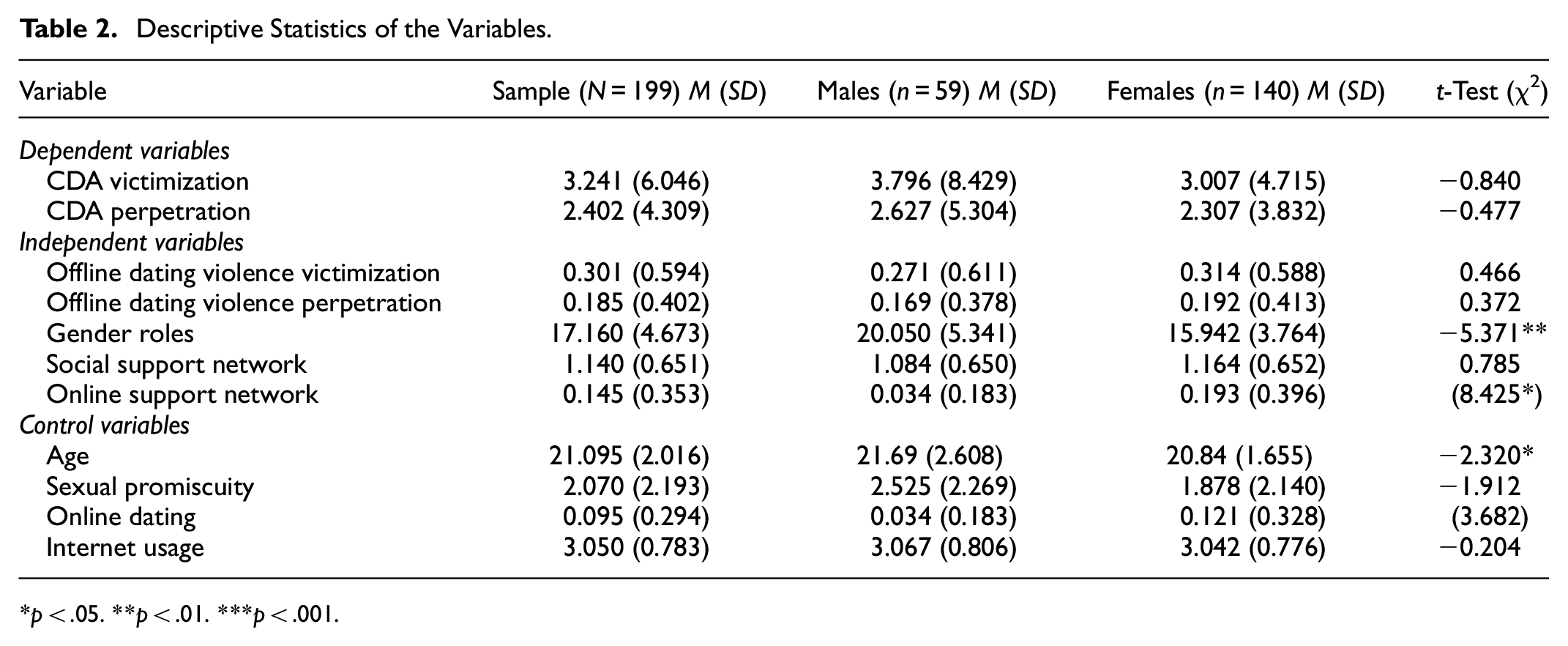
Table 2 presents the descriptive statistics for all study variables, including gender differences. The average age of participants was 21.1 years, with male students being significantly older than female students (t = −2.320, p = .023). The frequency of CDA experiences (M = 3.796 for males vs. 3.007 for females) and CDA perpetration (M = 2.627 for males vs. 2.307 for females) did not show significant gender differences (t = −0.840, p = .401 and t = 0.466, p = .633, respectively). On average, respondents reported experiencing 0.3 acts of cyber aggression in the past year compared to 0.185 acts of offline dating violence perpetration, with no significant gender differences found with respect to offline dating violence (t = −0.466, p = .641 and t = 0.372, p = .709, respectively). Furthermore, male students scored significantly higher on the Gender Role Beliefs Scale (M = 20.050) compared to female students (M = 15.942), indicating stronger adherence to stereotypical gender norms among male students (t = −5.371, p = .000). In terms of seeking support for problems in dating relationships, both male and female students reported relying on an average of one interpersonal support network, such as family, friends, or others in person (t = 0.785, p = .433). However, compared to male students, a significantly larger proportion of female students (19.3% vs. 3.4%) sought advice online for relationship problems (χ2 = 8.425, p < .004). Regarding online activities, no significant gender differences were found in the amount of time spent online (t = −0.204, p = .838). However, approximately 12% of female students reported using online dating applications or services in the previous 12 months, compared to only 3.4% of male students (χ2 = 3.682, p < .055). The average number of sexual partners during one’s lifetime was around two for the entire sample, slightly higher for male students (2.53) than female students (1.88), with t-test statistics approaching significance only at p < .1.
Descriptive Statistics of the Variables.
*p < .05. **p < .01. ***p < .001.
Factors Associated with Cyber Dating Abuse
Table 3 presents the results of the first negative binomial regression model, examining the impact of traditional dating violence and the control variables on CDA victimization. The analysis confirmed that experiencing partner violence in the physical world was significantly associated with a higher likelihood of experiencing cyber abuse. College students who reported higher exposure to offline abusive behaviors from their partners (IRR = 1.640, p = .013) or engaged in higher rates of abusive behavior toward their partners (IRR = 2.740, p = .002) were also more likely to report higher levels of CDA victimization. Additionally, those who used online dating platforms were three times more likely to be victimized than those who did not (IRR = 3.008, p = .008). Although significant only at the .1 level, sexual promiscuity was positively associated with a modest increase in cyber abuse, with each additional sexual partner corresponding to an 11% higher likelihood of experiencing cyber abuse (IRR = 1.111, p = .056). Conversely, age was negatively associated with the outcome variable, indicating a decreased likelihood of victimization (IRR = 0.895, p = .082). Interestingly, individuals with access to larger supportive social networks tended to have higher rates of victimization (IRR = 1.378, p = .088). However, this variable only approached statistical significance at the p < .1 level. Neither the other variables of interest nor demographic indicators had a statistically significant effect on the outcome variable.
Negative Binomial Regression Model for Cyber Dating Abuse Victimization.

*p < .05. **p < .01. ***p < .001.
The second negative binomial model assessed the impact of the same variables included in the previous model on CDA perpetration (Table 4). Results suggest that college students who had engaged in more acts of offline dating violence were also more likely to use online tools for partner abuse (IRR = 3.572, p = .000). However, unlike the previous model, offline dating violence victimization did not predict the perpetration of cyber dating abuse (IRR = 1.275, p = .317). Similar to Model 1, age displayed a negative association with the outcome variable, though only significant at the .1 level (IRR = 0.863, p = .071). Surprisingly, reliance on online social support networks was positively associated with the outcome variable, indicating that college students who sought online resources to address relationship issues also reported a higher incidence of cyber violence towards their partners (IRR = 2.734, p = .008). None of the other variables included in the model exhibited a significant effect on the outcome variable.
Negative Binomial Regression Model for Cyber Dating Abuse Perpetration.

*p < .05. **p < .01. ***p < .001.
Discussion
The current study contributes to the growing body of empirical research on cyber dating abuse and marks the first investigation of its kind in South Korea, representing an important initial step in exploring this issue in the Asian region. First, the study examined prevalence rates and gender differences for CDA and its three sub-types using the Cyber Aggression in Relationship Scale (Watkins et al., 2018). Descriptive statistics revealed relatively high overall rates of CDA victimization (51.8%) and CDA perpetration (41.7%) within our sample. While direct comparisons with previous studies are challenging due to methodological differences, diverse measurement instruments used to measure cyber dating abuse, and different timeframes considered (e.g., current relationship, previous 12 months, lifetime), our findings suggest that the overall prevalence rates among Korean college students appear consistent with several prior empirical studies conducted in other countries (e.g., Borrajo et al., 2015; Burke et al., 2011; Caridade et al., 2020; Lachapelle et al., 2022; Marganski, 2013). Moreover, they align with the average prevalence rates observed in Li et al’s. (2023) meta-analysis of 44 studies on CDA among emerging adults, which reported rates of 43.4% for CDA perpetration and 44.6% for CDA perpetration.
Another objective of this study was to investigate whether CDA exhibited gender-specific behavior and if gender influenced patterns of online dating abuse. Except for harmful sexually aggressive behaviors via electronic media, there were no significant gender differences observed in the exposure to and engagement with CDA and its subtypes. Prior research suggests that unlike psychological abuse and controlling behaviors facilitated by digital technologies, cyber sexual aggression is predominantly perpetrated by men (e.g., Henry et al., 2019; Reed et al., 2021; Zweig et al., 2013). As C. Brown et al. (2022) posit, masculinity could play an important role in explaining digital sexual abuse, with perpetration potentially serving as a mechanism to reinforce and maintain a strong masculine social standing. The internalization of gender-specific expectations among men and women influences the patterns of cyber-sexual abuse and its impacts. For instance, while women may succumb to the pressure of sending and receiving explicit images (H. Choi et al., 2016; Stonard et al., 2017), the perception that such behavior contributes to gaining popularity and social capital among peers may normalize cyber sexual abuse for young men (Burén et al., 2022; Stonard, 2019).
Finally, to contribute to understanding the origins of cyber dating abuse, the study examined theoretically relevant risks and protective factors associated with this phenomenon. In line with prior research (e.g., Borrajo et al., 2015; Caridade et al., 2020; Zapor et al., 2017; Zweig et al., 2013), this study confirmed a link between offline and online dating violence. These findings may not appear surprising, given that existing empirical research consistently indicates a significant association between abusive behaviors in physical settings and those facilitated by electronic means (Rodríguez-deArriba et al., 2024). Although this study did not specifically test the reciprocal nature of the phenomenon, the observed significant relationship between perpetrating offline dating violence and CDA victimization suggests that offline and online dating aggression may be bidirectional. Given the extensive research on gender symmetry in partner violence, particularly among demographics like students with stronger gender equality attitudes (Archer, 2018), and previous findings on the overlap between online and offline IPV, further studies should examine this aspect of dating violence to develop more nuanced prevention and intervention initiatives. Furthermore, the correlation between both online and offline abusive behaviors lends weight to the notion of potential overlap between the two phenomena, as previous research suggests individuals in romantic relationships may engage in both online and offline aggression or experience partner abuse in both domains (e.g., Espino et al., 2022; Lapierre & Dane, 2020). Nevertheless, research on the theoretical construct of cyber dating abuse remains limited, necessitating further research to determine whether CDA is merely an extension of offline dating abuse (i.e., an act of aggression resembling traditional partner abuse but perpetrated using electronic means) or represents a standalone phenomenon, with perpetrators who may not otherwise engage in face-to-face acts of partner abuse (Hinduja & Patchin, 2021).
Interestingly, reliance on online support networks was found to significantly predict higher levels of CDA perpetration. College students who sought advice from online social networks for relationship issues were nearly three times more likely to be victimized than those who did not. This finding may partly stem from the nature of the survey question, which asked whether students had turned to online informal support networks for assistance with their dating relationship issues, not whether they received helpful assistance. Additionally, the survey did not specifically inquire about the nature of advice received in these Internet communications. For instance, online forums were found to provide a space for users to share advice on handling relationship issues such as infidelity, ranging from marriage counseling to initiating divorce proceedings (Bellini et al., 2021). However, some online forums are also populated by individuals who endorse or even encourage offline partner abuse and CDA, potentially sharing experiences, tools, and tactics to control or harm a partner (Chatterjee et al., 2018; Tseng et al., 2020). From a social learning perspective, such online spaces can foster social networks where partner abuse is learned and normalized. Raghavan et al. (2009) found that men in communities with high levels of violence and connections to violent peers are more likely to perpetrate partner violence. Similar dynamics may be at play in virtual environments, such as some online forums that provide opportunities to interact, communicate, and actively participate in discussions with other potential abusers. Some users might even exploit these forums to manipulate individuals seeking informational and emotional support or advice for constructive resolution of relationship issues into perpetrating harm against their partners (Tseng et al., 2020).
The use of online dating services emerged as a significant predictor of CDA victimization. In South Korea, where traditional courtship once revolved around familial arrangements or chance encounters (Bonilla-Zorita et al., 2021), online dating has become an increasingly common and accepted way to find a partner. Over the last decade, a growing body of research has highlighted the dangers associated with online dating (see Filice et al., 2022). For instance, from the perspective of lifestyle-routine activities theory, online dating services increase the risk of victimization by providing a likely offender with more avenues to identify and target potential victims (Pooley & Boxall, 2020). Also, considering the sheer amount of personal information often shared on a dating profile, it is inevitable that potential predators will take advantage of it to select potential targets and gain their trust. Furthermore, even without detailed information on profiles, users frequently divulge personal details to strangers soon after initiating communication on these platforms (Fansher & Eckinger, 2021). In such situations, individuals seeking genuine relationships via online platforms may become targets for perpetrators, particularly women. These offenders might deceive potential victims by feigning authentic feelings and offering promises of love and romance (Marcum, 2007). Moreover, the secretive use of online dating applications by individuals already in romantic relationships can trigger abusive responses from jealous partners who perceive their partner’s use of dating applications as an act of infidelity (E. P. H. Choi et al., 2018).
Policy Implications
Dating violence in South Korea has been on the rise, with the number of suspects increasing from 8,951 in 2020 to 13,939 in 2023, with a significant portion (36.8%) in their 20s. These alarming statistics call into question the effectiveness of current measures to prevent dating abuse. Effective prevention requires the active involvement and collaboration of all relevant stakeholders. However, considering that most Korean youth are enrolled in universities during their 20s, it is imperative that academic institutions play a key role in providing dating abuse prevention programs. Korean universities are legally required to provide sexual misconduct prevention training to all employees and students. However, these programs are often delivered in a brief, web-based format with passive content delivery. While existing research suggests that online intervention programs can be as effective as in-person programs (e.g., Jouriles et al., 2018; Kleinsasser et al., 2015), Acquaviva et al. (2023) found that the majority of students in their sample expressed a preference for face-to-face programs. However, universities often lack the financial and human resources to provide in-person training. Some scholars suggest that counseling centers can be crucial in facilitating sexual violence prevention education (Acquaviva et al., 2023). Government and university administrators should mobilize the resources necessary to increase the number of counseling organizations on college campuses, address understaffing issues, and improve the independent status of counseling centers within the organizational structure of universities (Kang & Lee, 2022). Moreover, considering the high prevalence of CDA among college students, it is imperative to adopt prevention programs that target partner abuse through electronic media. Programs similar to Developing Healthy and Egalitarian Adolescent Relationships (DARSI) and Date-e Adolescence, which aim to reduce peer and teen dating violence, including CDA, should be adapted to and implemented in higher education institutions. These programs should raise awareness about CDA (e.g., Dank et al., 2014), promote gender equality, challenge attitudes that justify partner abuse (Miller & McCauley, 2013), and improve skills needed to deal with situations conducive to (online or cyber) IPV, such as perceived threats to the relationship due to jealousy or perceived infidelity (Borrajo et al., 2015).
Collaboration between the government, college administrators, and academics will be crucial for these programs to succeed. This partnership will not only enhance existing prevention programs but also ensure that these programs undergo thorough assessment, given the limited evaluation of cyber dating abuse prevention programs targeting college students.
Limitations and Future Studies
This study has certain limitations that warrant attention. First, the small sample size may limit the generalizability of the findings to the larger Korean student population. Moreover, the small sample size might have limited our ability to identify important relationships that a larger sample might have uncovered. In part, the low response rate can be attributed to limited access to school facilities and the inability to administer a paper-based survey due to the abrupt cancellation of in-person courses during the COVID-19 pandemic. Furthermore, the online questionnaire was completed by a significantly higher proportion of female students (70%) than males. However, previous studies (Kraft & Wang, 2010; Patchin & Hinduja, 2006) have found that females are more likely to participate in online surveys. Future studies can replicate this study with a larger, more representative sample of Korean college students.
Another limitation was the absence of questions regarding sexual orientation in the survey. The experiences of dating violence among sexual minorities have traditionally been overlooked in criminological research in South Korea. Therefore, future studies should include a more representative sample to examine differences in dating violence experiences between LGTBQ students and those in heterosexual relationships.
Furthermore, like much of the existing research on CDA, this study used a cross-sectional design (Caridade et al., 2019), limiting our ability to infer the temporal precedence and causation between offline and online dating abuse. Therefore, the possibility that CDA preceded offline partner violence cannot be excluded. Moreover, it is possible that individuals turn to online dating services when leaving an abusive partner or after the abusive relationship has ended (E. P. H. Choi et al., 2018). Hence, longitudinal studies are needed to test assumptions about the directionality of variables.
Finally, survey constraints limit our ability to interpret some results. This study does not investigate the mutual nature of CDA and its initiation. Qualitative research would be a valuable tool to understand the context of CDA, the dynamics leading to partner abuse, and the responses to it.
Conclusion
Cyber dating abuse is a serious social and health issue of our times. However, there is a paucity of studies on this issue, especially outside of Western countries. This study investigated the prevalence rates of CDA victimization and perpetration among college students in South Korea. Additionally, it identified the factors associated with CDA through a multifaceted theoretical framework. Male and female college students reported high rates of cyber-stalking and cyber-psychological aggression, with no significant gender differences found. Although cyber-sexual aggression rates were lower, male students engaged in cyber-sexual aggression significantly more than female students. A central finding of the study concerned the association between online and offline forms of partner abuse. These results underscore the importance of longitudinal studies to examine the chronicity of CDA and in-person dating violence and to disentangle patterns of bi-directionality or mutuality of abuse in romantic relationships. Based on the present findings, and considering the higher proportion of young adults found to be the main perpetrators of dating violence, higher education institutions should enhance existing dating violence prevention programs while also collaborating with experts to implement programs specifically targeting partner abuse in the virtual context.
Footnotes
Declaration of Conflicting Interests
The author(s) declared no potential conflicts of interest with respect to the research, authorship, and/or publication of this article.
Funding
The author(s) received no financial support for the research, authorship, and/or publication of this article.

Data Availability Statement
Data sharing not applicable to this article as no datasets were generated or analyzed during the current study.