




Abstract
This article uses survey data from the China Health and Retirement Longitudinal Survey (CHARLS2015) to test whether the educational level across three generations are transmitted within families and whether number of grandparents’ children influences these intergenerational transmissions in China. We obtain evidences that the educational level across three generations is transmitted within families, grandparents’ education has a direct and indirect effect on grandchildren’s education. After rigorous robustness tests, the results remain still valid. Educational intergenerational transmission from grandparents to grandchildren is partly explained by parental education. By gender heterogeneity analysis, we find there are son preferences on education three-generational transmission in China. Our results also show that number of grandparents’ children reduces educational association between grandparents and grandchildren. These findings show that different family structures have led to different educational transmission trajectories for families across multi-generation, which is an important factor giving rise to education inequality. This finding not only provides a new explanation for the complexity of family educational transmission mechanisms but also offers an important variable consideration for understanding the roots and persistence of educational inequality. Understanding how the number of grandparents’ children affects educational transmission provides insight into the mechanisms behind the formation of educational inequality and offers theoretical support for improving the equitable distribution of educational resources.
Plain language summary
The purpose of this study was to investigate whether educational levels across three generations are passed down in families, and whether the number of children that grandparents have affects this transmission in China. The study used survey data from the China Health and Retirement Longitudinal Survey (CHARLS2015) to analyze the intergenerational educational transmission. The results of the research indicated that educational levels are transmitted within families for three generations, and that grandparents’ education has a direct and indirect effect on their grandchildren’s education. The education transmission from grandparents to grandchildren is partly affected by parental education. The results also showed that there are son preferences for education in three-generational transmission in China. The study concluded that different family structures lead to different educational transmission trajectories, which contribute to education inequality. However, there are limitations to this study, as it only uses data from one survey, and the impact of other factors on intergenerational transmission was not explored.
Keywords
Introduction
The traditional two-generation model of intergenerational transmission focuses on the educational outcomes of parents and their children. It is well-established in the literature that there is a positive correlation between the educational attainment of parents and their children (Havari & Savegnago, 2013; Holmlund et al., 2011; Huang, 2013). Therefore, it logically follows that the education of grandparents may also influence the education of their children—the parents. This raises the question of whether the education of grandparents can affect the education of their grandchildren. If this is the case, limiting the analysis to two generations may not fully capture the phenomenon of intergenerational transmission (Andersen et al., 2021). Such an approach may also underestimate the persistence of intergenerational transmission and overlook the effects of grandparents and other members of the extended family (Jæger, 2012; Mare, 2011; Pfeffer, 2014; Solon, 2014).
Since Robert Mare’s 2010 presidential address at the Population Association of America, which called for multi-generational empirical research on social stratification (published as Mare, 2011), a large body of research on three- or multi-generational studies has emerged, focusing on topics such as income, education, social status, and health (Andersen et al., 2021; Chan & Boliver, 2013; Daw & Gaddis, 2016; Hertel & Groh-Samberg, 2014; Jæger, 2012; Lindahl et al., 2015; Mare, 2014, 2015; Møllegaard & Jæger, 2015; Pfeffer, 2014; Solon, 2014). A recent systematic review of the literature reports that 69 articles on the socioeconomic characteristics of grandparents and their impact on grandchildren’s educational outcomes address six key issues (Anderson et al., 2018). Two of the most important questions in this body of research are whether grandparents’ education influences the education of grandchildren independently of parental characteristics and the mechanisms through which grandparents’ education affects grandchildren’s educational outcomes.
Research on the role of grandparents’ education in grandchildren’s educational outcomes has produced mixed results, possibly due to variations in models, measures, data, countries, and historical contexts. Anderson et al. (2018) report that 58% of the 69 studies analyzed found an educational association between grandparents and grandchildren, even when controlling for parental characteristics. However, other studies have found that this association disappears after adjusting for parental education and characteristics (Bol & Kalmijn, 2016; Warren & Hauser, 1997). This raises the question of what mechanisms are involved in the educational transmission from grandparents to grandchildren. Some researchers have proposed mechanisms such as compensation and augmentation, as well as grandparents’ lifespan (Chiang & Park, 2015; Daw et al., 2020; Ferguson & Ready, 2011; Jæger, 2012; Zeng & Xie, 2014; Ziefle, 2016). Others suggest that family structure may serve as a mechanism for transmitting education across generations (Daw & Gaddis, 2016; Jæger, 2012; Sheppard & Monden, 2018; Song, 2016). To further explore these mechanisms, we use the China Health and Retirement Longitudinal Study (CHARLS2015) to examine whether educational transmission across three generations occurs within families, and whether family structure (i.e., the number of grandparents’ children) serves as an underexplored mediator in the literature, potentially reducing the educational association between grandparents and grandchildren. Understanding how the number of grandparents’ children affects educational transmission provides insight into the mechanisms behind the formation of educational inequality and offers theoretical support for improving the equitable distribution of educational resources.
Our study yields three main findings. First, we find a significant association between grandparents’ education and their grandchildren’s education in China, even after controlling for parental education and other characteristics. However, we also find that this association is partly explained by the educational attainment of the parents. Second, our heterogeneity analysis reveals a preference for sons in China, as grandparents’ education has a stronger influence on grandsons’ education than on granddaughters’. Moreover, grandparents’ education is relevant for grandchildren’s education only when the first generation (parents) is paternal. Third, we find that the number of grandparents’ children dilutes the educational association between grandparents and grandchildren. This mediating effect suggests a new mechanism of educational intergenerational transmission that may be unique to China, reflecting its distinct cultural values.
The marginal contributions of this study are as follows: First, this paper extends the study of intergenerational educational transmission (from grandparents to parents, and from parents to children) to include transgenerational transmission (from grandparents to grandchildren). This extension serves as an important complement to the existing literature on educational transmission. Current research in China primarily focuses on the intergenerational relationship between parents and children (i.e., two generations), while studies on transgenerational educational transmission from grandparents to grandchildren remain relatively scarce and are mostly based on research in Western industrialized countries. Using data from three generations in China, this paper examines the educational relationships among grandparents, parents, and children, covering both intergenerational and transgenerational transmission. This not only contributes to the existing research on educational transmission but also enables a more comprehensive, in-depth, and sustained exploration of educational transmission within Chinese families. Additionally, the study explores gender differences in the educational transmission process, offering new insights into gender equality and women’s education.
Second, over the past century, China has undergone dramatic political, economic, and social changes. Studying the intergenerational transmission of education across three generations in Chinese families, deeply embedded in China’s tumultuous development, helps us understand how educational transmission functions in a society marked by rapid upheavals rather than gradual changes. This study also provides comparative evidence for international research in this field. Moreover, China’s unique family culture and lifestyle (such as intergenerational caregiving and multiple generations living under one roof) are likely to result in different degrees and mechanisms of intergenerational educational transmission compared to other countries. These findings can offer empirical support for the formulation of educational policies, particularly in areas related to educational equity and resource allocation.
Finally, previous studies have generally examined the effects of one- and two-parent households (Song, 2016), spousal education (Daw et al., 2020), extended family members (Jæger, 2012), and the number of grandchildren (Sheppard & Monden, 2018) as mechanisms for transmitting education across generations. In this study, we introduce the number of grandparents’ children as a new transmission mechanism: the number of grandparents’ children mediates the educational association between grandparents and grandchildren. This finding not only provides a new explanation for the complexity of family educational transmission mechanisms but also offers an important variable for understanding the roots and persistence of educational inequality.
Background and Hypotheses
The importance of grandparents in China is well-known. Due to the Hukou system, housing shortages, and the high labor force participation rate among women, grandparents often take on the responsibility of caring for their grandchildren. As a result, grandparents invest their limited resources—such as time, energy, and money—to support their grandchildren. According to Bourdieu and Passeron (1990), these resources, which include cultural, material, and social capital, can positively influence children’s educational outcomes. Recent literature has demonstrated that grandparents’ resources can enhance children’s educational attainment (Hällsten, 2014; Jæger, 2012; Møllegaard & Jæger, 2015), and that grandparents’ educational background also affects their grandchildren’s education (Chiang & Park, 2015; Daw & Gaddis, 2016; Daw et al., 2020; Ferguson & Ready, 2011; Kroeger & Thompson, 2016; Song, 2016; Song & Mare, 2017; Wightman & Danziger, 2014; Zeng & Xie, 2014; Ziefle, 2016). One explanation for this is that grandparents influence their grandchildren’s education by providing motivation, encouragement, supervision, and discipline regarding schoolwork (Bengtson, 1975; Chen et al., 2011; King & Elder, 1997).
Educational Transmission Across Three Generations
In an influential article, Anderson et al. (2018) report that 58% of the 69 studies analyzed show a direct effect of grandparents’ socioeconomic characteristics on their grandchildren’s education, even after controlling for parental characteristics. Similar results have been found in prior studies conducted in the United States (Daw & Gaddis, 2016; Daw et al., 2020; Ferguson & Ready, 2011; Kroeger & Thompson, 2016; Song, 2016; Song & Mare, 2017), Germany (Ziefle, 2016), Europe (Deindl & Tieben, 2017; Sheppard & Monden, 2018), Australia (Hancock et al., 2016), Denmark (Møllegaard & Jæger, 2015), Chile (Celhay & Gallegos, 2015), and Sweden (Lindahl et al., 2015). However, some studies have reported that the effects of grandparents disappear when controlling for parental characteristics (Bol & Kalmijn, 2016; Warren & Hauser, 1997). Two influential studies, using different datasets from China, report that grandparents directly influence their grandchildren’s educational attainment in rural China (Zeng & Xie, 2014) and Taiwan (Chiang & Park, 2015). Unlike these studies, we use different models, measures, methods, and data to test whether grandparents’ education affects their grandchildren’s education, both with and without controlling for parental characteristics. Therefore, this analysis remains necessary in the context of China.
Heterogeneity by Gender
Different social norms and cultural attitudes lead to distinct gender roles (Farré & Vella, 2013; Moen et al., 1997). In Asian countries like China, there is a clear preference for sons when it comes to education. Some studies have found that men tend to have higher levels of education than women (Barro & Lee, 2013). However, it remains unclear whether this son preference extends to the intergenerational transmission of education. Earlier studies on three generations focused solely on the paternal line (Chan & Boliver, 2013; Hertel & Groh-Samberg, 2014). In recent years, research has expanded to include the maternal line. For example, Kroeger and Thompson (2016) find a strong association between the education of grandmothers and their granddaughters, while Hancock et al. (2016) report that the education of either paternal or maternal grandparents is relevant for grandchildren. Celhay and Gallegos (2015) suggest that grandsons benefit from both grandparents within the patrilineal lineage. However, Bol and Kalmijn (2016) found no significant difference in the estimated effects across paternal and maternal grandparents. These mixed results prompt us to examine an additional key question: whether the effects of grandparents on educational intergenerational transmission vary by gender in China.
Mechanisms of Educational Intergenerational Transmission
Parental Education as a Mediator
If effects of grandparents are found, one might question the usefulness of parents’ education in understanding the educational association between grandparents and grandchildren. The presence of a mediating effect of parents’ education would help explain the continuity of education between grandparents and grandchildren, as well as the persistence of educational inequality within families. Previous studies have employed interaction analyses, in which grandparental education interacts with parents’ education to reflect the moderating effect of parental education. For example, Jæger (2012) proposes the compensation hypothesis, suggesting that grandparents with higher education intervene to provide resources for their grandchildren when parental resources are deficient. Some studies have supported this hypothesis (Deindl & Tieben, 2017; Wightman & Danziger, 2014). In contrast, Chiang and Park (2015) support the augmentation hypothesis, proposing that grandparents with high education levels influence their grandchildren’s education when parents’ education is also high. However, Ziefle (2016) supports both the augmentation and compensation hypotheses, which may explain the moderating effect of parental education. In this study, we use a mediating effects analysis to test whether the educational intergenerational transmission from grandparents to grandchildren is partly explained by parents’ education, and to what extent the effects of grandparents are mediated by parents’ education.
Family Structure as a Mediator
The most important aspect of our study is the mechanism of family structure as a mediator in educational intergenerational transmission, which has received far less attention than the moderating effect of family structure. When serving as a mediator, family structure explains the indirect effect of grandparents on grandchildren’s education. Previous studies have generally examined the mediation or moderation effects of family structure as a mechanism in transmitting education across generations. For example, Song (2016) finds that one- and two-parent households moderate the direct effects of grandparents’ education as an important factor. Daw et al., (2020) propose that educational intergenerational transmission from grandparents to grandchildren is partly mediated by the spousal education of the middle generation. Jæger (2012) studies the effects of extended family members’ (grandparents and aunts and uncles) socioeconomic characteristics on grandchildren’s educational success. Sheppard and Monden (2018) argue that family size (i.e., the number of grandchildren) does not moderate grandparents’ direct effects. In this study, we aim to test whether a new mechanism—the number of grandparents’ children—mediates the educational association between grandparents and grandchildren. We seek to understand why the number of grandparents’ children may mediate this educational association.
The resource dilution hypothesis argues that as finite parental resources are divided among more children, each child receives less (Blake, 1986). A body of literature reports a negative correlation between the number of parental children and children’s educational outcomes (Black et al., 2005; Gibbs et al., 2016; Lao & Dong, 2019; Lao & Lin, 2022; Marteleto, 2010). With regard to grandparents, it is worth exploring whether this dilution effect can be applied to their mechanisms as well. Clearly, as the number of grandparental children increases, the number of grandchildren increases, and the finite grandparental resources may be spread thin, leading to less time, fewer economic resources, and less encouragement for each grandchild. Additionally, grandchildren may compete with their siblings and cousins for time, money, and attention from grandparents. Zhong and Dong (2018) find that there is an educational crowding effect among siblings, suggesting that resource dilution may affect the degree to which grandparents influence their children and grandchildren, depending on the number of grandparents’ children. This raises the question of whether an increase in the number of grandparental children is associated with a reduction in the association between grandparents’ education and grandchildren’s education.
Methodology
Data and Variables
Data
Our data comes from the China Health and Retirement Longitudinal Survey (CHARLS), conducted by the National Development Research Institute at Peking University. The survey focuses on collecting information about individuals and families aged 45 years and older, covering 28 provinces, 150 counties, 450 villages, and 10,229 households. The data includes information on variables such as individual education level, health status, work, retirement and pensions, income, and consumption. CHARLS 2015 not only contains information on the educational and individual backgrounds of the respondents but also on their parents’ and children’s backgrounds, making it suitable for studying intergenerational issues involving the three generations of “grandparents-parents-grandchildren.”
However, some sensitive variables related to intergenerational educational transmission mechanisms (such as income, wealth, and occupation) may have inaccurate or missing data, as respondents may provide incomplete or imprecise information due to subjective or external factors. For example, variables such as parents’ income and occupation have smaller sample sizes (with some questions missing, such as parents’ educational expectations) and are difficult to accurately identify.
The respondent in CHARLS 2015 represents the middle generation (G2) in our study. This generation reports on the highest level of education attained by their children (G3), themselves (G2), and their parents (G1). To create a multigenerational sample, we link the families of the CHARLS 2015 respondents with those of their parents and children. We exclude children who were still studying or under 18 years old at the time of the survey, as they may not have had the opportunity to make decisions about their schooling. Additionally, we remove samples where the age difference between any two generations is less than 15 years. The final analytical sample includes 3,804 children, for whom we have complete data on education, individual characteristics, and family background.
Variables
Our dependent and independent variables are measured by educational level. These variables are derived from the responses provided by the G2 respondents to the following questions: “What is the highest level of education you have completed?,”“What is the highest level of education your biological father and mother have completed?,” and “What is the highest level of education [child’s name] has completed?” The response scale ranges from 1 to 9, with the following categories: 1 = No formal education (illiterate), 2 = Did not finish primary school, 3 = Elementary school, 4 = Middle school, 5 = High school/Vocational school, 6 = Two-/Three-Year College/Associate degree, 7 = Four-Year College/Bachelor’s degree, 8 = Post-graduate/Master’s degree, 9 = Post-graduate/Doctoral degree/Ph.D.
We include several individual and family background characteristics as control variables in our analysis. Specifically, we control for gender (1 = male, 0 = female) and hukou type (1 = Agricultural Hukou, 0 = Non-agricultural Hukou) for G1, G2, and G3. In addition, we control for marital status (1 = Married, 0 = Other) for G2 and G3. Other control variables include the number of children in G1’s family and the number of children in G2’s family (1 = One-child, 0 = Other).
Analytical Strategy
In this study, we employ the linear regression model to investigate the intergenerational transmission of education. Linear regression has become a commonly used method for analyzing educational attainment (a continuous variable) due to its suitability for handling continuous variables, ease of interpretation, and robustness. Specifically, we first test a two-generation model to examine whether there is a significant association between G1 education and G2 education, as well as between G2 education and G3 education. Next, we extend the analysis to a three-generation model to explore whether G1 education is related to G3 education, both with and without controlling for G2 education and relevant characteristics.
We also include several individual and family background variables as control variables in our models, including gender (coded as 1 = male, 0 = female) and hukou type (coded as 1 = Agricultural Hukou, 0 = Non-agricultural Hukou) for G1, G2, and G3. Additionally, we control for marital status (coded as 1 = Married, 0 = other) for G2 and G3, as well as the number of G1 children and the number of G2 children (coded as 1 = One-child, 0 = other). Thus, the specification is as follows:


where
Secondly, we explore gender-specific effects by dividing our full sample into two subsamples based on the gender of G2 and G3.
Thirdly, to examine the mediating role of the number of grandparents’ children or parental education in explaining the association between G1 education and G3 education, we add the number of G1 children to Model (1),
Result
Descriptive Statistics
Table 1 presents the distribution of variables in our analytical sample, which includes 3,804 G1-G2-G3 triads with valid data on all measures. On average, the G1 generation has 2.1 years of schooling, and their average educational level is 1.7, with 32.9% being male and 87.2% coming from agricultural hukou families. The average age of this generation is 81.43 years, and they have an average of 4.26 children. The G2 generation has an average of 6.1 years of schooling, and their average educational level is 3.04, with 83.3% coming from agricultural hukou families, 48.6% being male, and 89.6% being married. The average age of this generation is 56.09 years, and 10.3% of G2 individuals have one child. Finally, the G3 generation has an average of 10.0 years of schooling, with an average educational level of 4.41. Of this generation, 77.9% come from agricultural hukou families, 53.4% are male, and 74.7% are married. The average age of the G3 generation is 30.33 years.
Descriptive Statistics.

Table 2 presents the descriptive statistics by gender, while Figure 1 illustrates the distribution of educational attainment by gender. The data indicate that the education level of G1 is notably lower than that of G2 and G3. Specifically, among G1, females have lower education levels than males. However, this gender gap in education is smaller in G2 and is fully eliminated in G3. This trend reflects improvements in gender equality in contemporary China, particularly since the implementation of the Compulsory Education Law, which mandates that all citizens complete at least 9 years of schooling.
Descriptive Statistics by Genders.


Distribution of education by gender.
Educational Transmission Across Three Generations
Table 3 presents the estimates of the transmission of education between G1, G2, and G3. All models show a statistically and substantively significant association. Model (1) estimates the association between G1 education and G2 education, indicating that an additional level of G1 education is associated with an increase of 0.2454 in G2 education. Model (2) estimates the association between G2 education and G3 education. According to Model (2), each one-level increase in G2 education corresponds to a 0.2514-level increase in G3 education. Models (3) and (4) estimate the association between G1 education and G3 education, without and with controlling for G2 education, respectively. The estimated coefficient of 0.0987 in Model (3) is about half the size of the coefficient in Model (4). Finally, Model (5) shows that controlling for G2 education and other characteristics, an additional level of G1 education is associated with a 0.0402 increase in G3 education, which is about half the size of the coefficient in Model (3). These results demonstrate that educational transmission occurs across three generations and that G1 education has both direct and indirect effects on G3 education. This suggests that the traditional two-generation model underestimates the persistence of intergenerational transmission.
Educational Intergenerational Transmission Across Three Generations.

Note. All regressions are estimated by ordinary least squares (OLS). Model (1): controls for age, age square, gender hukou type, and age cohort effect of G2 and G1, Controls for number of G2 children, marital status of G2. Model (2): Controls for age, age square, gender, marital status, and age cohort effect of G3 and G2, Controls for number of G2 children. Model (3): Controls for age, age square, gender, hukou type, and age cohort effect of G1and G3, Controls for marital status of G3. Model (4): adds G2 education to Model (3). Model (5): adds G2 education, age, age square, gender, hukou type, marital status, and number of G2 children, age cohort effect for G2 to Model (3). Each term between brackets () corresponds to the standardized coefficients. Cluster-corrected standard errors in parentheses.
p < .1. **p < .05. ***p < .01.
Robustness Test
Next, we examine the robustness of the intergenerational transmission of education by altering the measurement of key variables, employing different estimation methods, and using alternative data. Panel A in Table 4 presents the regression results using years of schooling as the measure of education (we convert the highest educational level for all generations into years of schooling based on the required number of years for each level). In Panel B, we estimate education by categorizing responses into nine levels and use ordered logistic regression (Ologit) estimation. In Panel C, we use the China Family Panel Studies (CFPS 2014–2018) to estimate the results of intergenerational education transmission between G1, G2, and G3.
Robustness Test.

Note. All regressions are estimated by OLS besides Panel B, which uses OLOGIT regression. All models controlling for variables are as same as Table 3. Each term between brackets () corresponds to the standardized coefficients. Cluster-corrected standard errors in parentheses.
p < .1. **p < .05. ***p < .01.
Columns (1)-(6) in Table 4 show that the association of intergenerational transmission remains significant, with all coefficients for the two key variables being significantly positive (p < .01). These results are entirely consistent with the baseline regression presented in Table 3. The evidence suggests that the conclusion regarding the intergenerational transmission of education within Chinese families is highly robust.
Heterogeneity by Gender
Table 5 presents the results of the heterogeneity analysis by gender. We divide our full sample into two subsamples, male and female. Models (1) and (2) divide the full sample into two subsamples based on the gender of grandchildren (grandsons and granddaughters in G3), while Models (3) and (4) divide the full sample into two subsamples based on the gender of grandparents (grandfathers and grandmothers in G1). Model (1) shows that grandparents’ education has a positive association with grandsons’ education only. This finding suggests a stronger son preference for educational intergenerational transmission between G1 and G3 in China. Model (3) shows that the educational association between grandparents and grandchildren is significant only when the first generation is paternal.
Heterogeneity by Gender.

Note. All regressions are estimated by ordinary least squares (OLS). All models controlling for variables are as same as Model (5) in Table 3. Each term between brackets () corresponds to the standardized coefficients. Cluster-corrected standard errors in parentheses.
p < .1. **p < .05. ***p < .01.
These results are contrary to previous studies. For example, Hancock et al. (2016) find that the education of both paternal and maternal grandparents is relevant for grandchildren. Kroeger and Thompson (2016) and Celhay and Gallegos (2015) report a significant educational association between grandmothers and granddaughters. However, Celhay and Gallegos (2015) suggest that grandsons benefit from both grandparents within the patrilineal lineage.
The possible explanations for these findings include the following two aspects: First, son preference is deeply embedded in Chinese social and cultural values (Gupta et al., 2010), resulting in grandparents passing down their educational resources primarily to male descendants. Second, China has a strong family-oriented culture and a traditional value of respecting elders and loving children. As a patriarchal society, China places a higher status on grandfathers within the family. Therefore, the educational beliefs and expectations of grandfathers have a greater influence on grandchildren than those of grandmothers.
Mechanism Analyses
Number of G1 Children as Mediation
As we add the number of G1 children to Table 3, the coefficients of the association between the number of G1 children and G2 and G3 education are presented in Models (1) to (5) in Table 6. These results show a negative association between the number of G1 children and both G2 and G3 education. Specifically, as the number of G1 children increases by one unit, it reduces G2 education by 0.0612 educational levels (Model 1), G3 education by 0.0305 educational levels (Model 2), G3 education by 0.046 educational levels (Model 3), and G3 education by 0.0246 educational levels (Model 5), all else being equal. These results suggest that the number of G1 children reduces intergenerational educational transmission across three generations.
Regression Analyses Adding Number of G1 Children.

Note. All regressions are estimated by ordinary least squares (OLS). All models controlling for variables are as same as Model (5) in Table 3. Each term between brackets () corresponds to the standardized coefficients. Cluster-corrected standard errors in parentheses.
p < .1. **p < .05. ***p < .01.
Robustness Test
Columns (1) to (6) in Table 7 show that the number of G1 children reduces the association of educational intergenerational transmission, with all coefficients for the three key variables being significantly positive (p < .01). These results are fully consistent with the baseline regression presented in Table 6.
Regression Analyses Adding Number of G1 Children (Robustness Test).

Note. All regressions are estimated by OLS besides Panel B, which uses OLOGIT regression. All models controlling for variables are as same as Table 3. Each term between brackets () corresponds to the standardized coefficients. Cluster-corrected standard errors in parentheses.
p < .1. **p < .05. ***p < .01.
KHB Decomposition.
To illustrate the extent to which educational intergenerational transmission between G1, G2, and G3 is partly explained by the number of G1 children or G2 education, we use the KHB method (Karlson et al., 2012; Kohler et al., 2011) to estimate the indirect effects and the corresponding percentage mediated in the models presented in Table 8. This method is useful for both linear and nonlinear models.
KHB Decomposition.

Note. Controlling for variable is the same as the corresponding Table 3. Each term between brackets () corresponds to the standardized coefficients. Cluster-corrected standard errors in parentheses.
p < .1. **p < .05. ***p < .01.
Table 8 applies the KHB method to examine the extent to which the number of G1 children mediates the educational association between G1, G2, and G3. The results reveal that the total effect, direct effect, and indirect effect are statistically significant at conventional levels, suggesting that the number of G1 children is a significant mediator of the educational association between G1, G2, and G3. The number of G1 children reduces the educational association between G1 and G2 by 3.63% (Model 1), and the association between G2 and G3 by 1.64% (Model 2). When Model (3) does not incorporate G2 education and other characteristics, the number of G1 children reduces the effects of grandparents by 7.78%. When Model (5) controls for G2 education and characteristics, the number of G1 children reduces the effects of grandparents by 7.15%. These findings support the conclusion that the number of G1 children explains part of the educational association between G1 and G3. Specifically, the educational association between G1 and G3 is reduced in families where the number of G1 children increases. Model (5) shows that 57.02% of the total effect is due to G2 education. These results indicate that G2 education plays an important mediating role in the relationship between G1 and G3 education, helping to explain the continuity of education between G1 and G3.
Mechanism Analyses of Number of G1 Children as Mediation
Limited by the data, this study only examines the mechanism through which an increase in the number of G1 children can reduce the intergenerational educational association between G1 and G3. Grandparents’ resources are limited, and raising additional grandchildren divides those resources. As the number of G1 children increases, the number of grandchildren also increases, and grandparents’ resources (time, energy, money, etc.) are diluted among the grandchildren, resulting in each grandchild receiving less. Thus, the number of G1 children reduces the effects of grandparents on grandchildren’s education.
Tables 9 and 10 illustrate the mechanism by which an increase in the number of G1 children leads to a decrease in the grandparents’ effects. Model (1) demonstrates that the number of G1 children has a positive impact on the number of G2 children, meaning that as the number of G1 children increases, the number of G2 children also increases. Model (2) shows a negative association between G3 education and the number of G2 children, indicating that grandchildren from larger families tend to have lower educational levels. Model (1) in Table 10 uses the KHB approach to show that the number of G2 children reduces the educational association between G1 and G3.
Mechanism Analyses of Number of G1 Children as Mediation.

Note. All regressions are estimated by ordinary least squares (OLS). Model (1): Controls for age, age square, gender, hukou type, and age cohort effect of G1, G2 and G3, Controls for marital status of G3 and G2. Model (2): adds number of G2 children to Model (1). Each term between brackets () corresponds to the standardized coefficients. Cluster-corrected standard errors in parentheses.
p < .1. **p < .05. ***p < .01.
Number of G2 Children as Mediation.
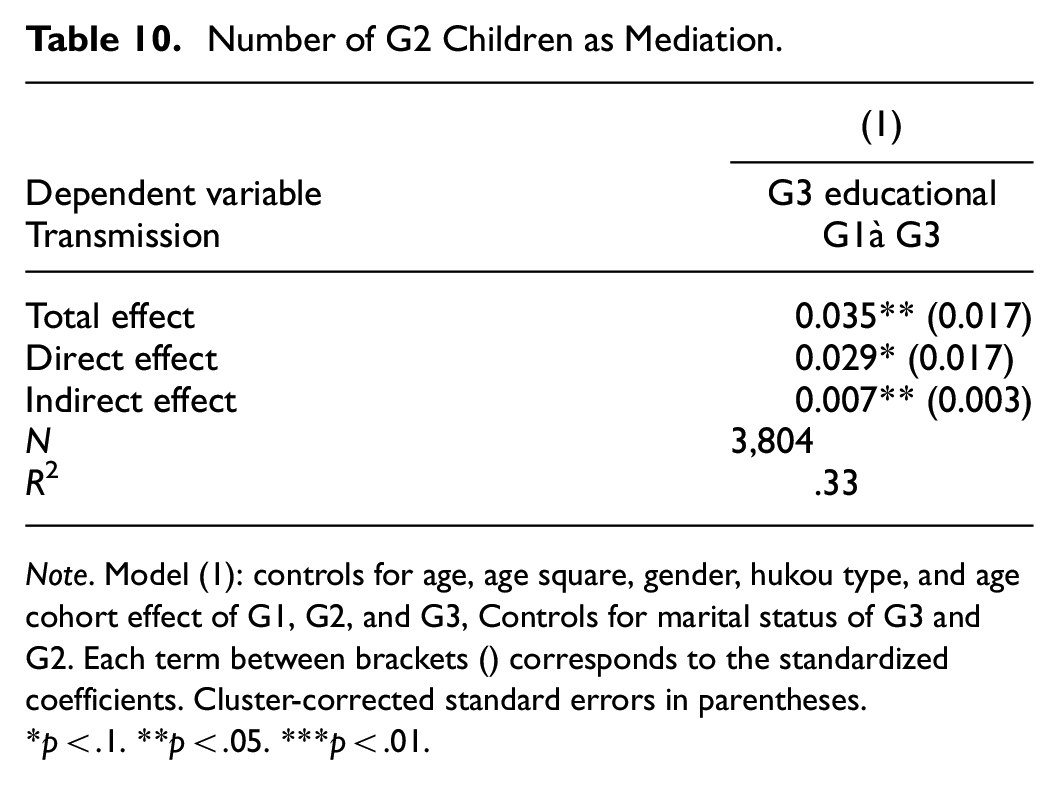
Note. Model (1): controls for age, age square, gender, hukou type, and age cohort effect of G1, G2, and G3, Controls for marital status of G3 and G2. Each term between brackets () corresponds to the standardized coefficients. Cluster-corrected standard errors in parentheses.
p < .1. **p < .05. ***p < .01.
The results above indicate that the dilution hypothesis can be applied to explain why the number of G1 children reduces the effects of grandparents. First, the core of the resource dilution theory lies in the limitation of available resources. In families with multiple children, grandparents’ time and financial resources must be distributed among several children and their grandchildren. For instance, when grandparents have multiple children, they may need to allocate resources across each child’s family, which can lead to insufficient investment in each grandchild. Compared to grandparents with only one child, those in larger families may provide less financial support, academic guidance, and emotional support to each grandchild (Black et al., 2005; Gibbs et al., 2016).
Secondly, as the number of G1 children increases, competition and a “crowding effect” may emerge among grandchildren, where they compete for the grandparents’ attention, emotional support, and financial assistance. This competition could reduce the educational influence that grandparents have. A study by Zhong and Dong (2018) found that an “educational crowding effect” among siblings also exists in intergenerational relationships, further supporting the applicability of the resource dilution theory.
Other Potential Mechanisms
Table 11 presents the results for additional potential mechanisms. We examine the number of G2 children, G2 income, G2 social networks, and the working nature of G2 parents as mediating factors. The findings suggest that the number of G2 children, G2 income, and G2 social networks play significant roles in shaping educational outcomes. Specifically, the concept of resource dilution explains the negative relationship observed in column (1), where an increase in the number of G2 children reduces the resources available to each child, such as parental time investment. In contrast, an increase in G2 income reflects a growth in family resources, which, in turn, enhances the intergenerational transmission of education. This effect is similarly observed with G2 social networks, which can facilitate access to additional resources and opportunities.
Another Potential Mechanisms.

Note. All regressions are estimated by OLS besides Panel B, which uses OLOGIT regression. All models controlling for variables are as same as Table 3. Each term between brackets () corresponds to the standardized coefficients. Cluster-corrected standard errors in parentheses.
p < .1. **p < .05. ***p < .01.
Discussion and Conclusion
Discussion
The existing literature on the influence of grandparents’ education on their grandchildren’s educational outcomes has produced mixed findings. Our study aims to test whether educational attainment is transmitted across three generations within families, using survey data from the China Health and Retirement Longitudinal Survey (CHARLS 2015). The results reveal that education levels are indeed transmitted across generations, with grandparents’ education having both direct and indirect effects on their grandchildren’s educational outcomes. These findings align with recent studies conducted in China (Chiang & Park, 2015; Zeng & Xie, 2014), and contribute to the growing body of evidence on the role of grandparents in shaping educational trajectories.
The mechanism behind this intergenerational transmission lies in grandparents’ use of their limited resources—such as time, energy, and money—to support their grandchildren’s education. In China, it is well known that grandparents often play a crucial role in raising their grandchildren. They not only live with them but also bear significant responsibility for their care (Chen et al., 2011). According to the 2016 China Family Development Report, 41.1% of grandparents take on a substantial part of raising their grandchildren. Data from the China Family Panel Studies (CFPS) conducted in 2014 and 2016 further highlight that 33% of grandparents and 34% of grandmothers are actively involved in child-rearing. Zeng and Xie (2014) also found a strong association between the education levels of co-resident grandparents and their grandchildren’s education, with the effect of co-resident grandparents’ education nearly as significant as that of parents. Grandparents influence their grandchildren’s education by providing motivation, encouragement, supervision, and discipline for their schoolwork (Bengtson, 1975; Chen et al., 2011; King & Elder, 1997).
Our results indicate that grandparents’ education has both direct and indirect effects on their grandchildren’s education, with parental education mediating a significant portion of this influence. This is consistent with the compensation hypothesis proposed by Jæger (2012), which suggests that grandparents with higher education may provide resources to compensate for any deficiencies in parental education. However, our findings also support the augmentation hypothesis (Chiang & Park, 2015), showing that grandparents’ education enhances the educational outcomes of grandchildren when parents are also highly educated. This dual effect—compensation and augmentation—highlights the nuanced role of grandparents in educational transmission, which varies depending on the educational context of the immediate family.
In addition to analyzing intergenerational transmission of education, we conducted tests to detect any gender-based differences and found that grandsons are more influenced by their grandparents’ education. These findings indicate a stronger son preference for intergenerational educational transmission in China. One possible explanation for this discrepancy is the predominance of patrilineal family structures in China, where grandparents tend to favor the educational needs of grandsons over those of their granddaughters. Additionally, son preference is deeply embedded in Chinese social and cultural values (Gupta et al., 2010), which results in grandparents passing down their educational resources primarily to male descendants. While paternal grandparents’ education affects their grandchildren’s education, this finding contradicts earlier studies (Hancock et al., 2016; Kroeger & Thompson, 2016). A possible explanation for the observed results is that China’s strong family-oriented culture and traditional values of respecting elders and cherishing children contribute to the influence of grandparents on their grandchildren’s education. As a patriarchal society, China places a higher status on grandfathers, whose educational beliefs and expectations are more likely to shape the educational outcomes of grandchildren than those of grandmothers. This highlights the role of gender in shaping intergenerational educational persistence and underscores the patterns of educational transfers within Chinese families. At the same time, our data reveal a notable gender gap in educational attainment among the first generation (G1), where females have lower education levels than males. However, this gender gap diminishes significantly in the second generation (G2) and is fully eliminated in the third generation (G3). This trend reflects broader improvements in gender equality in contemporary China, particularly following the implementation of the Compulsory Education Law, which mandates 9 years of schooling for all citizens. These shifts indicate that the influence of gender on educational outcomes has reduced significantly over time, contributing to more equitable intergenerational educational transmission. These results highlight the role of gender in shaping intergenerational educational persistence and illuminate the patterns of educational transfers within Chinese families.
Our study also shows that, even after controlling for parental education, grandparents’ educational levels have a significant impact on their grandchildren’s education. However, approximately 60% of the grandparents’ indirect influence can be attributed to the educational level of the parents. This suggests that parental education plays a critical mediating role in the transmission of educational attainment from grandparents to grandchildren. These results challenge the traditional two-generation model of educational transmission, which often overlooks the significant role grandparents play. By highlighting the importance of grandparents’ education, we offer a more comprehensive understanding of the persistence of educational disparities across generations.
Additionally, we employed the KHB mediation analysis method to uncover a new mechanism of three-generational educational transmission involving the number of grandparents’ children. Our findings suggest that the influence of grandparents on their grandchildren’s education is reduced by about 10% with an increase in the number of grandparents’ children. To explain this, we propose the concept of “resource dilution.” This mechanism operates by increasing the number of grandchildren as the number of grandparents’ children grows. With more grandchildren to support, the resources available to each grandchild are diluted, thereby reducing the overall impact of grandparents on their grandchildren’s education. This idea of resource dilution, first proposed by Blake (1986), extends beyond parental family size to the number of grandparents’ children. As the number of children increases, grandparents’ limited resources are spread more thinly, leading to less investment in each grandchild’s education. Moreover, grandchildren may compete with their siblings and cousins for the attention, time, and financial support provided by their grandparents. These results suggest that the number of grandparents’ children is negatively correlated with the educational outcomes of grandchildren.
Our study introduces a novel mechanism in the educational transmission process, highlighting the role of the number of grandparents’ children in mediating the educational association between grandparents and grandchildren. This concept of resource dilution is consistent with findings from Marteleto (2010) and Gibbs et al. (2016), who report negative correlations between family size and children’s educational outcomes. We contribute to the existing literature by applying this concept to the context of grandparental influence on grandchildren’s education, showing that as the number of grandparents’ children increases, the impact of grandparents on their grandchildren’s educational outcomes decreases.
When comparing our findings to international studies, we observe that the mechanisms of educational transmission can vary significantly across different cultural and societal contexts. For instance, while our study demonstrates a strong mediating role of parental education in China, research from Western countries such as the U.S. (Daw et al., 2020) and Germany (Ziefle, 2016) may reveal different dynamics due to variations in family structures, gender roles, and educational systems. These differences emphasize the importance of considering cultural contexts when analyzing intergenerational educational transmission.
Policy Implications
Based on the findings of our study, there are several policy implications that can be drawn to address educational inequality across generations in China. Firstly, the gender preference observed in the educational transmission highlights the need for policies that promote gender equality in education. This could involve targeted programs to encourage the education of girls and women, ensuring that resources are allocated equitably regardless of gender.
seondly, the dilution effect of the number of grandparents’ children on educational attainment indicates that family planning policies should consider the educational implications of family size. Policies that support smaller family sizes, such as China’s current relaxation of its one-child policy, could indirectly benefit educational attainment by concentrating resources on fewer children.
Lastly, the mediating role of parental education underscores the importance of continued investment in adult education and lifelong learning. Policies that facilitate access to education for adults can help break the cycle of low educational attainment and contribute to intergenerational mobility.
Limitations
Despite our efforts, our research is subject to certain limitations due to data constraints. First, we did not control for the economic, cultural, and social capital of parents and grandparents in our study. Although Møllegaard and Jæger (2015) argue that the economic and social capital of grandparents does not have a positive effect on their grandchildren’s education, it may still influence the impact of grandparents in China. Second, to better understand why an increase in the number of grandparents’ children can decrease the intergenerational association between grandparents and grandchildren, a more comprehensive dataset should include variables such as the time spent by grandparents reading to their grandchildren, money saved for their grandchildren’s educational future, and the frequency of conversations about studying. Examining such factors would enable us to explore the mechanisms underlying this relationship more effectively. These limitations highlight the need for further research in this area to address these crucial issues.
In conclusion, the intergenerational transmission of education within families is one of the key drivers of educational inequality. Our study reveals that various family structures contribute to this issue by increasing educational disparities across multiple generations. For instance, families with different numbers of grandparents’ children exhibit diverse educational mobility trajectories across generations. Our findings not only confirm that the traditional two-generation model of intergenerational transmission underestimates the persistence of educational intergenerational transmission, but also expand our understanding of the broader phenomenon of educational transmission, inequality, and multi-generational social transmission.
Footnotes
Declaration of Conflicting Interests
The author(s) declared no potential conflicts of interest with respect to the research, authorship, and/or publication of this article.
Funding
The author(s) disclosed receipt of the following financial support for the research, authorship, and/or publication of this article: This research is supported by the National Social Science Fund of China (Grant no. 23BJY124). This research is supported by Guangdong Office of Philosophy and Social Science (Grant no. GD21YSH04) and Guangzhou Office of Philosophy and Social Science (No. 2022GZQN33). This study is supported by the Jiangmen Office of Philosophy and Social Science (Grant no. JM2024C127). This research is supported by the Research Center of Agricultural Products Circulation in GBA.

Data Availability Statement
The datasets generated during and/or analyzed during the current study are available from the corresponding author on reasonable request.