



Abstract
We examined the effects of childhood exposure to gender-based violence (GBV) on the risk of GBV polyvictimization among women in the Dominican Republic. Logistic regression analyses were used to estimate risks of three types of GBV (emotional, physical, and sexual), and polyvictimization, experiencing two or more GBV types. GBV in adulthood is associated with forced sex before age 15, entry into sexual intimacy in early adolescence, and witnessing fathers beating mothers. Polyvictimization is associated with all three types of GBV in childhood but was particularly high for women who were forced to have sex before age 15. Our data reveal appreciable risks of polyvictimization, signaling a wider field of childhood victimization and adulthood (re)victimization experiences. Childhood exposure to GBV is as important of a predictor of adulthood GBV as more common determinants such as relational, economic, and sociocultural characteristics. Women who had a sexual relationship in early adolescence or witnessed their father beating their mother, report higher levels of polyvictimization. The risk profile of sexual violence in adulthood shows a risk profile different from risks of emotional and physical violence.
Plain language summary
We examined the effects of childhood exposure to gender-based violence (GBV) on the risk of intimate partner violence among women in the Dominican Republic. Statistical analyses estimated the risks of emotional, physical, and sexual violence, and the risk of experiencing two or more violence types. We find that GBV is associated with forced sex before age 15, entry into sexual intimacy in early adolescence, and witnessing fathers beating mothers. Experiencing several types of GBV is highest among women who were forced to have sex before age 15. Our data reveal appreciable risks of multiple forms of GBV. The risk profile of sexual violence in adulthood shows a risk profile different from risks of emotional and physical violence.
Keywords
Introduction
Polyvictimization is an individual’s experience of cumulative exposures to multiple types of interpersonal violence, including intimate partner violence. Polyvictimization is a relevant research focus because it is relatively common (Devries et al., 2019), highlights the complexity of victimization (C. Kim et al., 2023a), and reveals the cumulative and enduring effects of the multiplicity, severity, frequency and duration of exposures to interpersonal violence (C. Kim et al., 2023b; Méndez-López et al., 2021). Studies of polyvictimization in childhood, including gender-based violence (GBV), document that polyvictimized children have significant risk for interpersonal violence victimization and perpetration in adulthood. Research tends to focus on physical or sexual violence in adulthood with much less attention to polyvictimization in adulthood.
Quantitative studies of GBV in adulthood typically focus on cross-sectional survey measures of relational, economic and sociocultural characteristics of women who experience GBV from their intimate partners. Cross-sectional survey data rarely provide life course correlates of GBV such as childhood exposures or multiple types of interpersonal violence. There is a clear gap in social science health research that links GBV polyvictimization in adulthood to GBV polyvictimization in childhood. Attention to GBV across the lifecourse sheds light on how childhood trauma extends a long arm of risk into adulthood, effects that cumulate into higher risk of GBV polyvictimization in adult women. The purpose of this research is to examine how GBV in childhood affects the risk of GBV polyvictimization in adult women in the Dominican Republic.
Gender-Based Violence Among Women in the Dominican Republic
Violence against women and children in Latin America and the Caribbean is endemic, which refers to the high prevalence of multiple and overlapping forms of violence, including interpersonal violence, school and community violence, and child neglect and maltreatment. Risk of childhood and adulthood polyvictimization is appreciably higher in an endemic violence context, normalizing the use and acceptance of violence to resolve interpersonal conflicts (Auyero & Berti, 2015; Delaney, 2023; Menjívar, 2011; Voith, 2019; Weitzman et al., 2024). Women in Latin America and the Caribbean live through appreciable concurrent experiences of physical, emotional and sexual abuse, and other forms of victimization such as stalking (Bott et al., 2012; Flake & Forste, 2006; Gage, 2005; W. Kim et al., 2024). There is a high prevalence of sexual and physical abuse, and researchers often combine these two types of victimization in their analyses (W. Kim et al., 2024). Common correlates of GBV, such as relational characteristics, sociocultural factors, and economic precarity, may intersect to prompt higher prevalence of GBV polyvictimization.
The Dominican Republic ranks third in Latin America and the Caribbean in prevalence of women reporting recent physical abuse and third in prevalence of recent sexual abuse by a current or former partner (Bott et al., 2012). The Dominican Republic is the only country in the region in which women’s reports of physical violence increased and sexual violence did not decline in recent years (Bott et al., 2019; Centro de Estudios Sociales y Demográficos (CESDEM) y Macro INC, 2008). GBV polyvictimization rose in the bateyes (former government-owned sugar plantations) and urban areas in the Dominican Republic between 2007 and 2013, whereas prevalence levels remained approximately comparable in rural areas (Centro de Estudios Sociales y Demográficos (CESDEM) y ICF International, 2013a, 2013b). In 2013, prevalence of emotional violence (32%) and sexual violence (6%) was highest in urban areas, whereas prevalence of physical violence (24%) was highest in the bateyes (Centro de Estudios Sociales y Demográficos (CESDEM) y ICF International, 2013a, 2013b).
In middle-income societies such as the Dominican Republic, women experience high levels of GBV as women gain newly expanding economic, political, and social independence in societies with cultural traditions rooted in masculinity (Caridad Bueno & Henderson, 2017). Conventional theorizing of GBV in adulthood centers on relational, economic, and sociocultural risk factors. For example, the household bargaining model explains that women who have a higher quality and quantity of economic resources from their productive activities have more relational power derived from a viable “exit option” of economic independence from an abusive partner which suggests a lower risk of GBV in adulthood (Caridad Bueno & Henderson, 2017). In contrast, the male backlash model explains that, in patriarchal societies, women who have more economic resources than their partners prompt masculine insecurity as men are unable to adequately perform the household breadwinner role embedded in local conventional gender norms (Caridad Bueno & Henderson, 2017). Whether women’s economic independence is a protective factor or risk factor depends on women’s social class and the type of GBV (Caridad Bueno & Henderson, 2017). The household bargaining model better fits the GBV experience of asset-rich women and better predicts physical violence, whereas the male backlash model better fits the GBV experience of poorer women and better predicts sexual violence. We contend that conventional theorizing should be expanded to include indicators of exposures to interpersonal violence across the life course which may operate independently but synergistically with relational, economic and sociocultural risk factors. In the next section, we specifically elaborate on childhood exposures to GBV.
Childhood Exposure to Gender-Based Violence
Consequences of GBV polyvictimization in childhood include the intergenerational transmission of violence as children directly experience GBV, learn local gender norms and romantic interaction repertoires, and audition strategies to manage interpersonal conflicts through power, and exercise of verbal and physical aggression. Greater understanding of the role that childhood exposures to violence play in women’s risk of GBV polyvictimization suggests public health attention to childhood GBV as foundational to the health and well-being of women and children. We note that a modest majority of women exposed to childhood GBV do not experience GBV polyvictimization in adulthood, signaling developmentally appropriate growth in resiliency (Fuller-Thomson et al., 2023).
All types of childhood GBV trauma matter, including direct experience with GBV (i.e., forced sex or unwanted early sexual initiation) as well as witnessing parental domestic violence. Data from the United States indicate that each type of childhood GBV is associated with a higher risk of victimization or perpetration of other forms of interpersonal violence (e.g., bullying, elder abuse, sibling violence; Finkelhor et al., 2007). The prevalence, determinants, and consequences of GBV polyvictimization in childhood has a relatively long research history in the United States, including documentation of how childhood polyvictimization exerts a cumulative effect on GBV victimization and perpetration in adulthood (Kimber et al., 2018; Schuster & Tomaszewska, 2021). These findings have been replicated internationally (Gage & Silvestre, 2010; Guedes et al., 2016; Song et al., 2022). Two of the most common and overlapping forms of childhood polyvictimization are child abuse or neglect concomitant with witnessing parental domestic violence (Guedes et al., 2016; Kimber et al., 2018; Schuster & Tomaszewska, 2021). As among women, GBV polyvictimization in childhood intersect with common correlates of all types of victimization, such as sociocultural and economic factors. We contend that this evidence supports our inclusion of women’s childhood exposures to GBV into models that also include women’s relational, economic, and sociocultural characteristics.
Violence against children in Latin America and the Caribbean, particularly GBV, is appreciable in its volume and variety (Devries et al., 2019; Fry et al., 2021), but explicit research focus on polyvictimization, the cumulative burden of all forms of violence experienced, is relatively new (Caballero-Dominguez et al., 2022; Méndez-López et al., 2021; Peña Cárdenas et al., 2022). Recent research shows that polyvictimized children in Latin America and the Caribbean have higher risks of multiple forms of victimization in adulthood, signaling that polyvictimization may be a profoundly severe and lifelong limit on overall health and well-being (C. Kim et al., 2023a). The complexity introduced by GBV polyvictimization in childhood and adulthood in the Dominican Republic calls attention to documenting lifecourse trajectories of GBV polyvictimization, but also to practitioners’ efforts to provide quality therapeutic care and policymakers’ efforts to design and implement effective prevention and safety programs (Viswanathan et al., 2016).
Hypotheses
GBV polyvictimization in childhood and adulthood intersect through their shared risk factors and social norms, co-occurrence in families and households, intergenerational transmission, and compounding and cumulative effects across the life course (Guedes et al., 2016). Documenting the intersections of GBV polyvictimization in childhood and adulthood allows a more nuanced understanding of how childhood exposure to violence may elevate a women’s risk of multiple forms of GBV. A more nuanced understanding of the intergenerational transmission of risk for family violence reveals opportunities to build effective multidimensional and gendered antiviolence programs and policies across the life course but particularly in adolescence. Our research intends to evaluate the contributions of childhood exposures to GBV relative to the more conventional correlates of women’s relational, economic, and sociocultural characteristics.
We propose the following hypotheses:
All types of childhood GBV will be associated with higher odds of all types of GBV in adulthood.
All types of childhood GBV will be associated with GBV polyvictimization.
Materials and Methods
Data and Sample
Data for this research are drawn from two separate cross-sectional surveys that are pooled together: the 2013 Demographic and Health Survey (DHS) survey of the Bateyes Estatales of the Dominican Republic (Centro de Estudios Sociales y Demográficos (CESDEM) y ICF International, 2013a) and the 2013 DHS survey of the nation (Centro de Estudios Sociales y Demográficos (CESDEM) y ICF International, 2013b). The DHS program, funded by the U.S. Agency for International Development (USAID), has provided technical assistance for developing, fielding, and analyzing health and population surveys to more than 90 countries over the past 40 years. Using standard design procedures and methods across countries provides validated measures of domestic violence and its correlates that are comparable across countries. Consequently, a sturdy demographic literature on domestic violence has evolved that allows stronger international comparisons of conceptual frameworks such as household bargaining, male backlash, and childhood exposures to GBV.
Bateyes are rural former government-owned sugar plantations, wherein Haitians were recruited to provide labor. Many Haitian migrants settled permanently in the bateyes, remaining after the sugar cane industry privatized. There are now several generations of Dominican-born Haitians in the impoverished bateyes, refreshed by much smaller flows of continued Haitian immigration. DHS surveys residents of bateyes separately from residents of urban and other rural areas, therefore pooling both surveys provide a more rounded population-level analysis. Research on bateyes consistently documents the concentration of Haitian-Dominicans in bateyes who experience high levels of antihatianism, poverty, morbidity, and mortality (Pirela & Silvestre, 2013; Simmons, 2010; Suiter, 2017).
Face-to-face interviews were used to collect household surveys, surveys of women between the ages of 15 and 49, and surveys of men between the ages of 15 and 59. Most surveyed women were selected to complete a violence module, interviewed by women but only if the interview could be completed privately and without interruption of husbands, boyfriends, or partners. Despite these precautions, we recognize that stigma and survey bias may yield underreporting of GBV. This would be consequential if underreporting is correlated with independent variables leading to a loss of their significant associations with GBV and polyvictimization.
Women who were currently or formerly married or living with a partner were asked questions primarily about violence perpetrated by their current or most recent partner. The ever-partnered women who experienced intimate partner violence reported how frequently this occurred in the last 12 months. In the Bateyes and ENDESA data, around 90% of lifetime and 12-month prevalence levels of sexual or physical violence among women occurred to ever-partnered women. Therefore, we restricted the analytical sample to the 1,143 women in the bateyes and the 5,769 women in the ENDESA who were ever-partnered.
Measures of Gender-Based Violence
Women report on both lifetime and recent experiences with physical, sexual and emotional violence from an intimate partner. Recent experience (coded as 1) is defined as having often or sometimes experienced violence in the past 12 months, whereas women who had never experienced violence or whose experience is more than 12 months prior to the interview are coded as 0. We center our attention on recent experience to more closely align the dynamics of GBV and relationship stability, especially among the younger cohorts of women.
Emotional violence is defined as having been insulted, humiliated or threatened by a partner. Physical violence is defined as having been pushed, slapped, punched, pulled, dragged or kicked, strangled or burned, or threatened with a weapon. Sexual violence is defined as having been forced to have sex or engage in unwanted sexual acts. Polyvictimization is an ordinal variable coded 1 for women who reported no violence, coded 2 for women who reported emotional violence only, coded 3 for women who reported both emotional and physical violence, and coded 4 for women who reported all three types of violence.
Women who report being younger than age 15 when they first had sexual intercourse are defined as having early sex. Women who report that they had ever been forced, before age 15, to have sex by anyone are defined as having been sexually abused as a child. GBV in childhood also includes indirect experience through witnessing fathers ever beating a woman’s mother.
Control Variables
We consider how the effect of GBV exposure in childhood on GBV polyvictimization in adulthood may be conditioned on relational, sociocultural and economic characteristics. (See Table 1) Marital status is partitioned into the currently-partnered (married, cohabitating), unpartnered (widowed, divorced), and unpartnering (separated). Age ranges from 15 to 49. Women who reside in bateyes are residents are primarily of Haitian descent, approximately 16% of the analytic sample. Some small portion of women who reside outside bateyes in rural areas or in the urban areas of the Dominican Republic may be of Haitian descent, but the vast majority are non-Haitian Dominicans. Haitian immigrants (nearly 7% of the analytic sample) may reside in the bateyes or outside the bateyes, with most non-bateyes residents living in urban areas. The majority of women in the pooled sample are Dominicans in urban areas (58.6%) or rural areas (24.9%).
Descriptive Statistics.

Source. Demographic and Health Survey, Dominican Republic, 2013 and Dominican Republic Bateyes, 2013.
Economic factors that may condition exposure to GBV are women’s levels of education, work status, and wealth, affording them both less traditional gender norms and economic independence from partners. Educational level is divided into (1) less than primary schooling (0–4 years completed); (2) primary school (5–8 years completed); (3) secondary school (9–12 years completed); and (4) postsecondary school (13+ years completed). Women who ever worked in the past 12 months are coded as working. We used the DHS-constructed measure of household wealth, dividing wealth into quintiles ranging from poorest (coded as 1) through richest (coded as 5).
Procedures
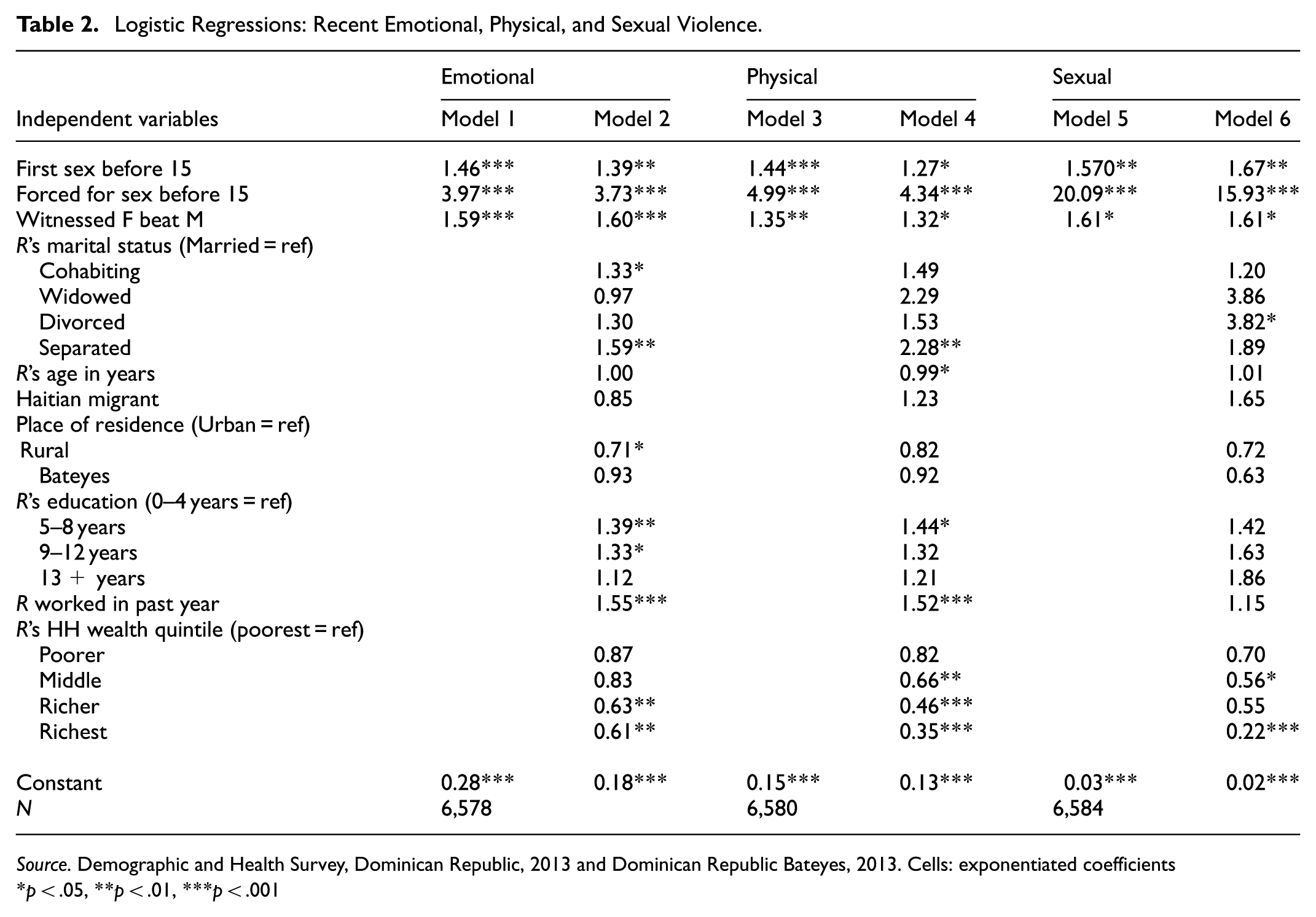
The first step in our analysis was to show the distributions of each of the variables used in the study (see Table 1). Next, we estimated a pair of logistic regression models for each type of gender-based violence experienced (emotional, physical, sexual). The first model in each pair of models includes childhood exposure to violence; control variables are added in the second model (see Table 2). For the final step in our analysis, we estimated the effects of childhood exposure to violence and control variables on polyvictimization. Since our measure of polyvictimization is an ordered outcome, we use generalized ordinal logistic regression (GOLR) which is a variation of ordinal logistic regression (OLR).
Logistic Regressions: Recent Emotional, Physical, and Sexual Violence.
Source. Demographic and Health Survey, Dominican Republic, 2013 and Dominican Republic Bateyes, 2013. Cells: exponentiated coefficients
p < .05, **p < .01, ***p < .001
OLR is a type of regression analysis used to model the relationship between a set of independent variables and an ordinal response variable, which has an order or ranking. Unlike traditional logistic regression, which models binary outcomes, OLR accounts for the ordered nature of the response variable. This is achieved by modeling the probability of each possible outcome as a function of independent variables. The model is typically estimated using maximum likelihood estimation and can be used to gage the probability of a case falling into a particular category or ranking.
One of the advantages of OLR is that the model estimates a single coefficient for each independent variable that expresses the likelihood of in a particular outcome category. However, OLR assumes that the effects of each independent variable are proportional with respect to each adjacent category of the dependent variable (also known as the proportionality assumption). Because the models we estimate for polyvictimization violated the proportionality assumption, we opted to use GOLR, a variation of OLR (Williams, 2006). The GOLR algorithm tests each independent variable for violation of the proportionality assumption. If the variable does not violate the assumption, the algorithm estimates a single coefficient for that independent variable (similar to OLR). If the variable does violate the assumption, the algorithm provides separate estimates for the effect of the independent variable on each category of the dependent variable (similar to multi-nominal logistic regression). The algorithm we used to fit the GOLR model is GOLOGIT2, a user-written program developed by Richard Williams (Williams, 2016). Examples of the application of this algorithm can be found in sociology (Arroyo & Peek, 2015), education (Liu & Koirala, 2012), and medicine (Saffari et al., 2015) among other fields. Data were weighted and the estimates were adjusted for complex survey design structures using Stata 14.
Results
More than a quarter of women report GBV in the preceding 12 months (28.1%), with 12.4% experiencing two or more forms of GBV (See Table 1). Approximately 25% of the women in the sample experienced emotional violence in the previous year, the most common form of GBV. Approximately 14% of the women experienced physical violence and 4% experienced sexual violence in the previous year. Nearly a quarter of women (23.1%) first had sex before they were 15 years old. Less than 1% had forced sex before the same age. About 15% of women witnessed their mother beaten by their father.
The majority of women are currently married or cohabiting (75.4%). A small proportion of women are widowed or divorced (about 3%), but an appreciable proportion of women are currently separated (21.9%). The mean age of women is in her early 30s. Haitian immigrant women comprise 6.9% of the women in the sample. A small majority of women (58.9%) reside in urban areas, followed by residence in non-bateye rural areas (24.6%). More than a fifth of women (16.5%) reside in bateyes.
Education is widely dispersed with approximately 20% of the sample with very low levels of completed education and approximately 20% with very high levels of education. Slightly more than half of the women are employed for pay outside the home and nearly half of the women occupy the two poorest wealth quintiles.
Types of GBV in Adulthood
All forms of GBV in childhood are associated with appreciably higher odds of experiencing emotional, physical, or sexual violence in the preceding 12 month (see Table 2). The odds ratios remain high and significant while controlling for relational, sociocultural, and economic correlates. Women who were forced to have sex in childhood have more than 3 times the risk of experiencing emotional violence, 4 times the risk of experiencing physical violence, and a stunning 16 times higher risk of experiencing sexual violence in adulthood. Women who had intimate sexual relationships in early adolescence or who witnessed their father beating their mother had about 1.5 times the risk of experiencing emotional or sexual violence in adulthood, and 1.3 times higher risk of experiencing physical violence from an intimate partner.
Women who are cohabiting have higher risks of emotional violence whereas divorced women have higher odds of recent sexual violence from an intimate partner. Women who are currently separated have higher odds of emotional and physical violence than women who are currently married. Separation is a clear signal of current and unresolved relational discord, although this mechanism unlikely explains the higher risk of emotional violence for cohabiting women. Older women are less likely to experience recent physical violence, but age is unassociated with risks of recent emotional or sexual violence. Women in urban areas have a higher risk of emotional violence than those in rural areas, but equivalent risk to women in bateyes. Neither place of birth nor place of residence are associated with risks of physical or sexual violence.
Women who completed primary or secondary schooling have higher odds of emotional and physical violence compared to women who have little or no formal schooling. Women in the highest and lowest segments of the education distribution have comparable levels of GBV of all types. Working women are more likely to experience emotional or physical violence. The educational and employment status distribution of risk of emotional or physical violence is consistent with male backlash theory. But level of education and employment status are unassociated with sexual violence, suggesting that male backlash theory has less explanatory power for sexual violence than for emotional and physical violence experiences in adulthood. The wealth index reveals that women in the lowest quintiles have equivalently higher risks of all three types of GBV, consistent with the household bargaining model.
Polyvictimization
The odds ratios of experiencing multiple forms of GBV in the past 12 months are presented in Table 3. Model 1 examines the relationship between GBV in childhood and polyvictimization among adult women. All forms of GBV in childhood are associated with women’s appreciably higher odds of experiencing polyvictimization in the preceding 12 months. Women who had a sexual relationship in early adolescence were 1.55 times as likely to be in a higher versus lower polyvictimization category. Similarly, women who witnessed their father beating their mother were also more likely (OR = 1.50) to be in a higher polyvictimization category. Having forced sex before 15 had differential effects on polyvictimization: women who reported early forced sex were 3.7 times more likely to report emotional violence only, were 6 times more likely to report emotional and physical violence and were 20 times more likely to report all three types of GBV.
Generalized Logistic Regression: Polyvictimization.

Source. Demographic and Health Survey, Dominican Republic, 2013 and Dominican Republic Bateyes, 2013. Cells: exponentiated coefficient.
1 = no violence, 2 = emotional violence only, 3 = emotional and physical violence, 4 = emotional, physical, and sexual violence.
p < .05, **p < .01, ***p < .001.
In Model 2, control variables were added. The size of the effects of childhood GBV on polyvictimization was attenuated slightly but the pattern of significance remained. We observe a complex relationship between marital status and polyvictimization. Compared to married women, women who were cohabiting at the time of the survey were more likely to report higher levels of polyvictimization. Although women who reported being divorced or widowed were no more likely than married women to experience emotional and physical violence, the odds of experiencing all types of violence, including sexual violence, were approximately four times greater for widowed or divorced women compared to married women. Women who reported being separated at the time of the interview were 59% more likely to report recent emotional violence and twice as likely to report multiple forms of GBV. Polyvictimization does not vary by age.
Rural Dominicans have lower odds of polyvictimization, whereas women in bateyes, Haitian immigrants, and urban Dominicans have comparable odds. Higher odds of polyvictimization are observed among working women, and those who have completed primary or some secondary schooling, compared to women with the lowest levels of education, indicative of evidence in support of the male backlash model. The odds of recent polyvictimization declines steadily with rising wealth levels, consistent with the household bargaining model.
Discussion and Conclusions
The purpose of this research is to estimate the effects of childhood exposure to GBV on GBV and polyvictimazation in adulthood. Our hypothesis that all types of childhood GBV would be associated with each type of GBV in adulthood is supported. Our hypothesis that all types of GBV in childhood would be associated with GBV polyvictimization in adulthood is supported. These effects remain large even with statistical controls of the more common relational, sociocultural, and economic determinants of GBV among women.
GBV in childhood, especially sexual violence before age 15, carries higher risk of individual and multiple types of GBV in adulthood, signaling an intergenerational transmission of interpersonal and family violence (C. Kim et al., 2023b; Méndez-López et al., 2021). Although childhood sexual abuse occurs relatively infrequently in women’s lives, it has a profoundly deep, negative, and enduring impact, evident on its strong association with all forms of GBV and polyvictimization experienced in adulthood. The association of childhood sexual violence with adulthood sexual violence reveals that risks of sexual violence to girls and women are likely to occur repeatedly across the life course. The association of childhood sexual violence with other forms of GBV, and polyvictimization, further demonstrates its widespread damage to women’s well-being (W. Kim et al., 2024). Our research also demonstrates the utility in disaggregating analyses by type of childhood and adulthood GBV.
A key limitation of this research is that a lack of complete and comparable data render unsatisfying measurement of the type of GBV in childhood and its severity and duration, identification of the relevant developmental window at the time(s) of the abuse, and specification of mediating and moderating factors (Brassard et al., 2020; Lee et al., 2023). A more granular specification of the data will prove useful to researchers intent on documenting victimization across the life course and to clinicians who provide trauma-based care to better prevent, diagnose, and treat children directly and indirectly exposed to interpersonal violence.
Cultural mechanisms of intergenerational transmission of normative interpersonal violence are gendered, whereby boys replicate the traditional male attitudes and behaviors of dominance and superiority over women, and girls replicate the traditional female attitudes and behaviors of subordination and inferiority of women (Bott et al., 2012; Flake & Forste, 2006; Gage, 2005; W. Kim et al., 2024). In gender-traditional or patriarchal communities, women may accept GBV as normative and justifiable resolutions to relational conflicts (Auyero & Berti, 2015; Delaney, 2023; Menjívar, 2011; Voith, 2019; Weitzman et al., 2024). As countries move from low-income status to middle-income status, societies and communities adapt unevenly to changing cultural norms (Caridad Bueno & Henderson, 2017). Changes in cultural gender norms traditionally follow advances in female education, consequently gender role innovators in more gender-traditional and patriarchal communities live in risk of conflict with more traditional normbearers, thus paradoxically raising risks of GBV. It may be normative for girls in patriarchal societies to have sex early in adolescence, including entering into child marriages. Extending girls’ education provides an alternative role for young adolescents and their eagerness to attend school and seek economic independence may increase their risk of GBV because they resist forming romantic relationships through coercive control. Concomitantly boys also adapt to new behaviors of their girl peers and siblings, resulting in new relationship strategies.
GBV exposure in childhood is a critical determinant of GBV and polyvictimization in adulthood, statistically outperforming the common relational, sociocultural and economic determinants of GBV in adulthood. For example, sociocultural variables and age effects are unusually mild or absent on predicting all types of GBV and polyvictimization. Conventionally, marital status and economic determinants are associated with higher prevalence of all forms of GBV and polyvictimization. Data on the effects of level of education and employment status support the male backlash model with higher levels of emotional and physical abuse and polyvictimization (Caridad Bueno & Henderson, 2017). Data on the effects of wealth support the household bargaining model as all types of GBV and polyvictimization are less prevalent among women in higher wealth quintiles (Caridad Bueno & Henderson, 2017).
Marital dissolution is evidently associated with experiencing GBV polyvictimization: women who reported being divorced, widowed, or separated were also more likely to experience multiple types of violence. Closer interpretations are merely suggestive due to a second key data limitation. GBV was based on violence experienced by an intimate partner in the past year, therefore the relative temporal order of changes in marital dissolution and victimization cannot be established making it difficult to develop a causal explanation linking these phenomena. It is possible that interpersonal violence precipitated marital separation or divorce, or possibly even widowhood. Alternatively, the circumstances leading up to and following marital dissolution may increase women’s vulnerability to victimization. Future research that includes more precise temporal measurement of both interpersonal violence and the family and household context in which GBV occurs is necessary to more fully grasp the complexity of this relationship.
Our data demonstrate that there are appreciable risks of polyvictimization, signaling a wider field of childhood victimization and adulthood victimization experiences than typically studied in violence against women and violence against children research. More research is needed to determine whether these shared risks are additive or multiplicative in nature. In addition, we expect that research on the consequences and sequelae of polyvictimization will show an exponentiated effect on all facets of women’s well-being and likely ossify the intergenerational transmission of family violence. We conclude that types of GBV in childhood have independent and compounding effects on types of GBV in adulthood. Reducing GBV in childhood not only improves the lives of children, but it also reduces the intergenerational transmission of GBV into adulthood.
Footnotes
Author Note
On behalf of my research team, I write to submit our original research article (Effects of childhood exposure to gender-based violence on polyvictimization of IPV in the Dominican Republic) for review in your journal. All authors have read and approved the manuscript. I delineate our individual contributions here.

Ethics Considerations
This study was exempt from ethics review as it is a secondary analysis of publicly available data.
Author Contributions
Barbara Zsembik was responsible for the conceptual design of the research project, the acquisition and interpretation of data and statistical analyses, and drafting the research report.
Julia Arroyo contributed to the conceptual design of the research project and drafting the research report, and shared responsibility for acquisition and interpretation of data and statistical analyses. Chuck W. Peek contributed to the conceptual design of the research project and drafting the research report, and shared responsibility for acquisition and interpretation of data and statistical analyses. Antionette McFarlane contributed critical review of the research project for important intellectual content and extended the body of research literatures considered in conceptual framing.
Funding
The authors received no financial support for the research, authorship, and/or publication of this article.
Declaration of Conflicting Interests
The authors declared no potential conflicts of interest with respect to the research, authorship, and/or publication of this article.
Data Availability Statement
Data sharing not applicable to this article as no datasets were generated or analyzed during the current study.