




Abstract
The research aims to uncover the violation of employment rights of professional basketball players, their experiences related to legal proceedings resulting from this, and their views on unionization. In this regard, a basic qualitative research design was preferred. The respondents were 42 Turkish basketball players in the Turkish professional basketball leagues, selected through criterion sampling. A semi-structured interview schedule was used as the data collection tool. Individual interviews and focus group discussions were utilized during the data collection process. Qualitative content analysis was applied in the data analysis process. The findings are divided into three themes: violation of employee rights, legal process, the unionization idea. Under the theme of employee rights violation: there are categories such as violation of the remuneration right, disregard for the athlete and discrimination. The legal process theme consists of two categories: reasons to avoid the legal process and reasons for taking legal action. The theme of the unionization idea is divided into two categories: positive opinions and negative opinions. Respondents’ employment rights were found to be violated. Due to the pressure exerted by employers on athletes, respondents are hesitant to take legal action and unionize for fear of being subjected to mobbing. It has been concluded that unionization is not possible due to the lack of solidarity among professional basketball players. However, if it were to happen, it would increase solidarity and eliminate the power imbalance between employees and employers.
Plain language summary
Introduction: Unions are crucial organizations to protect and promote employee rights. Employees can defend their rights more effectively through trade unions in cases such as non-payment of wages, discrimination, and abuse. The unions established in different branches and countries in professional sports aim to protect and improve athletes’ rights. In Türkiye, professional basketball players do not have unions. Therefore, their views on unionization and their experiences of employment rights violations are essential. Aim: To learn the opinions of professional and non-unionized Turkish basketball players toward unionization and the employment rights violations they have experienced. Method: Forty-two professional Turkish basketball players were interviewed. Respondents were asked about their views on unionization and the violations of employment rights they had experienced. The respondents’ responses were audio-recorded and transcribed into written text, and the responses were coded and categorized. Results: Respondents were underpaid or late paid and abused by their employers. Rookie-veteran, local-foreign, and political view discrimination were identified. Despite employment rights violations, the respondents do not apply to the legal process due to mobbing concerns. Respondents’ opinions on unionization were divided into two: positive and negative. Among the positive views, the idea that trade unions can solve the power imbalance between employees and employers came to the fore. On the negative side, the respondents stated that employers would mob athletes in case of unionization attempts and that solidarity among athletes is insufficient. Conclusion: Respondents were found to be economically and psychologically exploited, and there was no strong tendency toward unionization. In future research, targets have been set to identify the problems experienced as laborers by professional athletes from different cultures and branches.
Introduction
Since the means of production became subject to private ownership, there have been social and economic inequalities and struggles for rights between capital owners and the proletarian classes that provide production. Rousseau (2011) expressed this process as follows: As societies develop, the distribution of private property and labor among individuals allows the exploitation of workers. Subsequently, workers strive to combat this inequality by fighting against the capital owners. However, capital owners, in the name of establishing equality, create a political society, which results in a lasting regime of oppression and inequality. Due to the inherent nature of the capitalist economic system, capital owners primarily focus on making more money and generating more profit. This behavior leads to various risks for employees, including low wages, job insecurity, disregard for workers’ health and safety, and lack of social security.
These risks and labor rights violations are also present in professional sports. As with commodities sought for consumption, sports have undergone a process of commercialization and have found their place within the capitalist economic system (Andrews, 2004; Collins, 2013). Rowe (1998) explains the emergence of the sports industry as an extension of the commodification of civil life and the penetration of capital into the realm of culture. While being an instrument of social change, sport has also changed and evolved itself in the process. With the rise of professional sports in the 1960s, the demand for qualified sports labor increased among clubs. Afterward, sports labor condemned to regulated labor markets similar to slave labor conditions. Few elite athletes had access to high wages and benefits, while others struggled with low wages and job insecurity (Biyanwila, 2018; Rhoden, 2006).
Today, the sports industry has expanded to cover a wide range of production and consumption areas, including sports clothing, sports technologies, betting, sports tourism, national and international sports events, mega organizations, video games, sponsorships, broadcasting and image rights (Andon & Free, 2019; Sage, 2004). At the center of all these industrial instruments are professional athletes, who work in repetitive and prescribed ways in the service of the owners of capital (Rowe, 1998) and provide the primary product.
When we think of professional athletes, the first image that may come to mind is those earning millions of dollars, driving luxury cars, living in extravagant homes, and traveling by private jets. However, the reality is not always like this in every circumstance. Especially in undeveloped or developing countries, the economic and social opportunities offered to athletes are much more limited than in developed countries, causing muscle migration similar to the “brain drain” in third-world countries. For athletes who cannot participate in migration, this means more struggle under stiff conditions in order to continue their careers (Andreff, 2004; Andreff & Szymanski, 2006; Magee & Sugden, 2002Simiyu Njororai, 2010).
In Türkiye, where the research was conducted, basketball is the second most popular sport after football. In the Euroleague, the highest level organization of men’s European basketball on a club basis, Turkish teams have participated in 7 of the last 7 Final Fours and won 3 championships (Euroleague Basketball, 2022). In women’s basketball, there is a Turkish team at the top of the European club rankings, and Türkiye ranks first in the country rankings (FIBA Basketball, 2023). Contrary to this situation, which can be considered successful from a sporting point of view, there are adverse data regarding the employment rights of athletes. Between 08.06.2021 and 24.05.2023, the FIBA Basketball Arbitration Tribunal ruled that clubs from different countries did not fulfill their wage payment obligations to their athletes. In 24% of these cases, Turkish basketball clubs were in the lead. The fact that FIBA has 254 national federations under its organization and that a quarter of the cases related to wage payment disputes involve Turkish clubs alone indicates to an unfavorable situation in this context. Another remarkable point is that all of the lawsuits against the wage debts of Turkish basketball clubs were filed by non-Turkish basketball players (Basketball Arbitral Tribunal, 2023). Therefore, not only Turkish professional basketball players have problems with the payment of their wages, they also experience obstacles in resorting to legal remedies. When the situation of workers in the country is considered from a broader perspective, Türkiye ranks among the 10 worst countries in the world regarding labor rights, trade union rights and freedoms (ITUC Global Rights Index, 2023). When we gathered all these data together, we were motivated to research the situation of professional Turkish basketball players regarding employee rights and their views on unionization as a non-unionized occupational group. In this context, firstly, the violation of employee rights in professional sports and the unity of professional athletes worldwide, and then the literature on employee rights and unionization in Türkiye will be examined.
Violation of Employee Rights in Professional Sports and Unity in Professional Athletes
Professional athletes have short careers. They are constantly under pressure to succeed. There are always risks of injury, and when their careers end, they face the challenge of finding alternative employment. Considering these factors, professional sports differ from many other sectors in terms of their internal dynamics and functioning (Dabscheck, 2004). However, as seen in other sectors, similar violations of rights and exploitation of workers also exist in sports.
One of the most critical points in the distinction between amateur and professional sports is that professional athletes take their branches as their profession and make a living. Therefore, their contractual wage rights are at a critical point. The late or incomplete payment of wages by the employer is a violation of workers’ rights. Especially in sub-elite professional sports, professional athletes’ payment rights are frequently and continuously violated (Ames, 2016).
Due to the competitive nature of professional sports, the sports culture can sometimes revolve solely around winning. This can increase the possibility of exploitation and discrimination against professional athletes (Tuakli-Wosornu et al., 2021). Examples of abuse commonly encountered in sports include verbal abuse, scapegoating, threats, the use of physical force causing injuries, imposing training loads unsuitable for physical conditions, and making athletes practice when injured (Grange & Kerr, 2010; Roberts et al., 2020; Stirling & Kerr, 2008).
In addition to violating payment rights and exploitation, discrimination is a form of violation of rights encountered in professional sports. Some of them that we encounter are racial discrimination, ethnic discrimination, religious discrimination, gender discrimination, and age discrimination (Dutta et al., 2021; Evans et al., 2020; Farrington et al., 2012; Hartmann, Manning, & Green, 2022; Kahn, 1991; Wong, 2010).
For workers, one of the most crucial tools in the fight for their rights since the Industrial Revolution has been labor unions. The situation is similar in professional sports as well. Like workers in different branches of business who earn their living by selling their labor in the capital system, it has become inevitable for athletes to unionize to secure their rights and ensure professional solidarity. Like traditional unions, athlete unions aim to improve and defend their members’ economic and social rights and legitimize these gains on legal grounds through collective bargaining agreements (Hill & Taylor, 2008). When we consider that sport can be defined as an ongoing struggle in which individual and collective actions are blended with economic, political, and cultural forces (Sugden & Tomlinson, 2013), the inevitability of professional sport-union movement can be understood more clearly.
In many Organization for Economic Co-operation and Development (OECD) countries, various sectors have witnessed practices aimed at union busting (Fairbrother & Yates, 2003). In different sectors around the world, a policy of non-unionization is pursued by providing certain advantages to non-union workers. Through these practices, the reasons for unionization are sought to be eliminated. Unlike non-unionization, in the anti-unionism approach, employers try to deprive workers of their fundamental rights through pressure and threats. The aim of both approaches, one moderate and the other aggressive is to prevent union activities (Dundon, 2002; Fiorito, 2002). Lazar (2022) stated that unions are losing power globally and that the reasons are neoliberalism, austerity, financialization, and the increase in the proletarian population. However, in unionization in sports, especially in some team sports, the opposite trend has been observed due to the effects of professionalism and industrialization. Notably, professional athletes who earn relatively low wages compared to the short average duration of their careers have succeeded in increasing minimum wage standards in collective bargaining agreements (Dabscheck, 2011).
In basketball, which is the main focus of the research, the most effective and well-established union organization is The National Basketball Players Association (NBPA), which was founded in 1954. Since its establishment, it has secured significant rights for National Basketball Association (NBA) players, such as retirement plans, allowance, minimum wages, and health benefits. Currently, these rights are protected through the Collective Bargaining Agreement (2023). In addition, the NBPA has used the instrument of protest, one of the most effective methods in the struggle for rights and labor against racial discrimination (Hartmann, 2022). In order to draw attention and contribute to the Black Lives Matter movement, NBA players have participated in public demonstrations (Deb, 2020) and short-term wildcat strikes (Martin et al., 2020).
The Euroleague Players Association was established in 2018 in European basketball, based in Frankfurt. The goal is to define the frameworks of contracts for professional basketball players through the Euroleague Framework Agreement (2022), secure their individual and collective rights, improve their working conditions and job security, and protect athletes from exploitation.
Employee Rights and Unionization in Türkiye
In Türkiye, Turkish athletes who are part of the professional basketball leagues do not have any labor unions to represent them if they are not part of a team in the Euroleague. Additionally, the situation regarding labor rights and unions in Türkiye does not appear favorable.
Unlike Western countries that led the Industrial Revolution, Labor rights in Türkiye were not obtained due to the labor class’s struggle. They were gradually granted under conditions deemed suitable by political authorities (Mahiroğulları, 2011). In this regard, the 1980 military coup was a turning point. After the coup, increased privatization, subcontracting, informal labor, and legal regulations that limited the influence of unions have diminished the power and effectiveness of the unions. Unions have transformed into “yellow unions” that avoid the fight for labor rights and strikes and cannot achieve any gains (Koç, 2007). Currently, it is observed that only 7% of workers are covered by collective labor agreements, and Türkiye ranks at the bottom among OECD countries. Regarding union rights, labor rights, and freedoms, Türkiye is considered one of the 10 worst countries in the world (ITUC Global Rights Index, 2023).
In the case of Türkiye, research on labor rights and union activities mainly focuses on the traditional working class (Danış, 2016; Kalaycıoğlu et al., 2008; Ş. Öztürk, 2021; Uçkan Hekimler & Kağnıcıoğlu, 2009; Yılmaz, 2015). Few studies on athletes’ employment rights and unionization have focused on amateur and professional football (Atalay, 2012; Aydın et al., 2017; Cengiz et al., 2021; P. Öztürk & Koca, 2020). Other studies on this issue for professional athletes have evaluated the situation through legislation and legal practices (Aydos, 2013; Küçükgüngör, 1998; Öztuna, 2016). In this context, the first objective of the research is to shed light on the experiences of professional basketball players in Türkiye regarding the violation of their employment rights and legal processes. Unrepresented in the labor class, professional basketball players without unions (Edelman, 2016) and exploring their opinions on unionization constitute the second objective of the research. This study, which focuses on professional Turkish basketball players in an adverse climate regarding employee rights and union activities, is thought to contribute to the field.
Method
Basic qualitative research design, one of the qualitative research methods, was used in the research. This design was preferred because qualitative research models are thought to be valuable and practical in discovering how individuals experience something in their social world, what their views are, and their natural perspectives in situations where problems are not yet understood or adequately defined (Hancock et al., 2001).
The respondents are 19 female and 23 male Turkish basketball players selected by criterion sampling, one of the purposeful sampling methods. There are 4 leagues for men and 3 for women at the senior level under the organization of the Turkish Basketball Federation. In the top 2 leagues for men and women, it is obligatory to have a contract between the clubs and the athletes by the legislation. In other leagues, a contract is not obligatory. Therefore, these leagues are recognized as professional leagues. Basketball players in professional leagues are considered professional athletes; they establish an employment relationship with the clubs through a contract, are considered workers according to the Labor Law, and have the right to unionize. In this context, the respondents consist of professional basketball players with at least one entire season of experience in professional leagues. Data saturation was the basis for determining the number of respondents. The respondents’ demographic information is provided below.
A semi-structured interview schedule was used as the data collection tool. To confirm the content validity of the interview schedule, it was reviewed by four expert faculty members in the field. As a result of expert opinions, the sentence structure of 2 questions was changed. It was concluded that the questions used in the pilot interviews with three different respondents were clear and understandable. The interview schedule started with closed-ended questions to obtain demographic information, such as age, number of seasons spent in top-level competitions, and the number of seasons in professional leagues. Subsequently, in a semi-structured format supported by follow-up questions, respondents were asked about economic and social rights violations they experienced in the clubs they were part of, their experiences in legal processes, and their views on unionization in Turkish basketball.
Individual and focus group interviews were conducted in the data collection process. Individual interviews were carried out with 18 respondents from the respondents, and focus group interviews were conducted with 24 respondents. Focus groups consisted of 6 respondents each. Individual interviews lasted an average of 39 min, while focus group interviews lasted 68 min. The use of audio recordings was preferred due to its ability to allow the interviewer to focus entirely on the respondent and to provide a more impartial and less intrusive method (Yeo et al., 2014). Demographic information of the respondents is given in Table 1.
Demographic Information of the Respondents.

The data analysis process involved the use of qualitative content analysis. Initially, respondents’ identities were encrypted as R1-R42. The data obtained through audio recordings were transcribed into text. In the subsequent step, irrelevant parts of the texts outside the research topic’s context were removed to reduce the data. Finally, data assignments were made to themes and categories, revision checks were performed for the codes, findings were described, and interpretations were made. For each code, direct quotations from respondent statements, which were assumed to have a high representational value, were included.
Ethical Considerations
Before the interviews, the respondents were briefed about the subject and content of the research. The respondents were informed that they were free to leave the interview any time, take a break, and refuse to answer the questions they did not want to. A voluntary consent form was signed, which included the information that voice recordings would be made during the interviews and that the names of the respondents would be kept confidential. After the data obtained through voice recordings were transcribed into text, they were presented to the respondents, and their approval was obtained.
Results and Discussion
The data obtained from the respondents were divided into three themes due to the applied analysis. These are identified as the violation of labor rights, the legal process, and the idea of unionization. Categories related to these themes were classified, and direct quotations from respondent statements, assumed to have a high representational value, were included in the obtained codes.
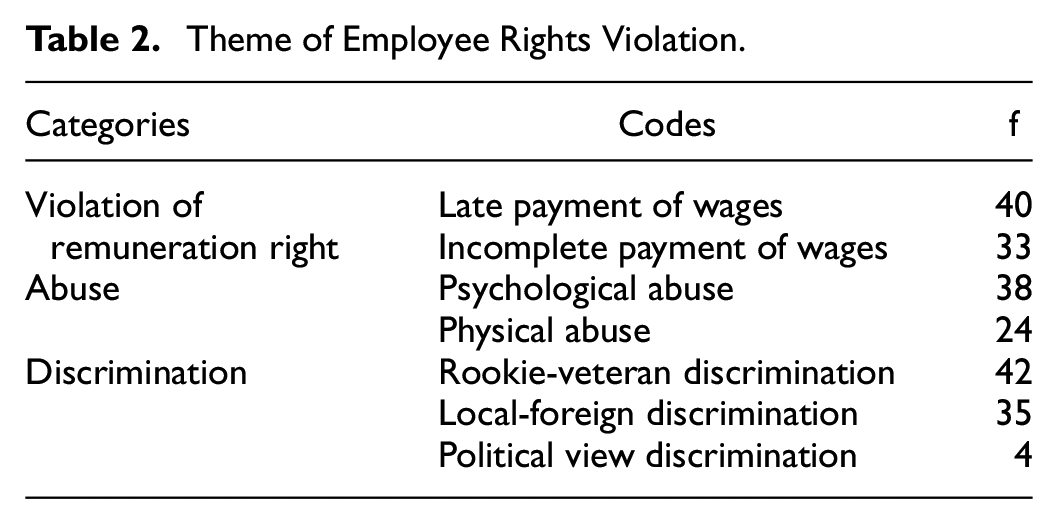
The results of the Employee Rights Violation theme are presented in Table 2.
Theme of Employee Rights Violation.
Category: Violation of Remuneration Right
Code: Late payment of wage R28: “In our clubs, there is this kind of thinking: ‘Let’s delay the player’s salary for 2-3 months so that they play more passionately and make more effort to get the remaining money. After all, they cannot complain anywhere…’ This is a mistaken approach. Athlete psychology does not work that way, but for years, most managers could not understand this.”
Code: Incomplete payment of wage R31: “I have experienced this situation in most of the seasons… I have played for six teams in my professional career, and I had money left in four. I have never been able to receive the full payment I deserved. For example, we signed a 10-month contract, but I have only received my salary for seven months when the season ends. Most clubs are like this.”
According to the respondents’ statements, the violation of remuneration rights occurs as delayed payment and incomplete payment of salaries. The statement by R28, “After all, they cannot complain anywhere…” is significant. Professional basketball players can apply to the Turkish Basketball Federation in case of a remuneration rights violation and request sanctions against the club. However, the employer fails to fulfill its obligation with the certainty that the athlete cannot exercise this right. Depending on the nature of the legislation, its applicability, and the accepted management approach, the power and authority possessed by the employer can be used to restrain the worker’s reactions and to keep them silent (Donaghey et al., 2019).
In another study, it was observed that Turkish professional football players in the lower leagues also could not receive the wages agreed upon in their contracts; yet, there is no professional solidarity among the football players, and they cannot raise their voices on this issue since they felt ineffectual (Şaşmaz Ataçocuğu & Zelyurt, 2016). Furthermore, Subiyanto (2020) stated in an example from Indonesia that although workers “rights are regulated by law, employers continue to violate workers” rights through pressure and intimidation. Notably, according to the ITUC Global Rights Index (2023) prepared by the International Trade Union Confederation, Indonesia is among the countries where labor rights are not adequately protected, similar to Türkiye.
Category: Abuse
Code: Psychological abuse R10: “Particularly among young players, the number of basketball players who have not experienced psychological abuse is very low. I, too, was subjected to this during those years, both by the senior players on the team and the coaches: constant swearing, humiliation, torment. There were many nights when I could not sleep from crying, and I even contemplated quitting basketball. One day, I mustered the courage to tell the club president. However, the president dismissed me, saying, "These things are common in this business, don’t mind it." Thanks to my family and close friends on the team I could get through those times.”
Code: Physical abuse R1: “Most of the time rookie players are subjected to physical abuse by veterans. They want you, as a young player, to be their servant, and if you resist, this turns into physical violence. They have seen it this way from their elders, and the sad part about it is that the coaches, managers, and everyone accepts this situation… This is a very unhealthy culture.”
In the category of disregard of athletes, two different codes were identified: psychological abuse and physical abuse. It is observed that both psychological and physical abuse are commonly inflicted on young athletes by veteran athletes and coaches. One disagreeable aspect is that everyone, including employers, normalizes this situation. However, when looking at the literature, in many different sports, especially in the acceptance phase of rookie athletes within the team, they are subjected to physical and psychological abuse by veteran athletes, and this is accepted as a typical situation in sports culture (Bryshun & Young, 1999; Waldron & Kowalski, 2009).
Athletes may desire to be accepted within the team and be perceived as a part of the organization for a successful career. They may think they will lose their purpose in life if they quit sports. This situation can lead athletes to overlook the abuse. On the other hand, in a sports environment where abuse is tolerated and normalized, and a culture of silence prevails, athletes who are subjected to abuse may likely think that their complaints will not be taken seriously throughout the process or that they will face even more abuse as a response from the other party (Dabscheck, 2004; Jacobs et al., 2017; Sojo et al., 2016; Waldron et al., 2011).
Behaviors that involve psychological abuse such as verbal abuse, bullying, and threats are considered by some in professional sports as disciplinary measures or methods to enhance an athlete’s performance (Barry et al., 2016). However, it should be noted that athletes subjected to psychological and physical abuse can suffer injuries, depression, marginalization, and trauma (Stafford et al., 2015).
On the other hand, rewards in sports are unique. Winners become famous, achieve higher status, receive cash prizes, and their achievements become a source of national pride and glory. In contrast, the punishment for failure can be severe, including job loss, public shame, and damage to one’s reputation. The winner-takes-all reward system can lead coaches and athletes to use any means necessary to achieve results, including methods of abuse (Frank & Cook, 2013).
However, one of the primary obligations of employers is to protect their athletes from abuse, regardless of who is doing it to whom. Another obligation of employers is to ensure that the athlete’s health is not put at risk and that the employee’s occupational health and safety are ensured. While contact sports inherently involve elements that risk athletes’ health, employers should adhere to occupational health and safety principles and take an approach to minimize risks (Windholz, 2015).
Category: Discrimination
Code: Rookie-veteran discrimination R34: “This is an unwritten rule. Coaches and management have different approaches to young players compared to the experienced ones. For instance, the wishes of young players are often not taken seriously because they do not have much influence on the team. There is little tolerance for young players who perform poorly in a game or two. Young players are expected to show unwavering obedience and not falter. However, they do not receive any respect. In many ways, I can say that we have much less credit.”
Code: Local-foreign discrimination R14: “There is always this foreigner worship in our people. It was the same in the teams I played. The manager would always cater to their needs first. The masseur would take them for a massage first. If there were a financial issue, their salaries would be paid first when the team had money. Birthdays were celebrated before training, and they received gifts from the management while, no one even knew about our birthdays. If you miss a shot in a game, you hear immediate criticism, but when the foreigner scores zero, the coach does not say a single word… I’ve seen such discriminatory attitudes in every team I have been to.”
Code: Political view discrimination R41: “I had the possibility of transferring to a team… First, we met with the coach of that team and reached an agreement. I was waiting for news from the club management about the contract. A week later, they called and said the transfer was canceled. The reason is: I have made social media posts criticizing the government. They check the social media of the person they will bring to the team first, instead of looking at the statistics andcareer. Are you recruiting a politician or a basketball player to your team?”
According to the experiences shared by the respondents, in the category of discrimination, three codes were identified: rookie-veteran discrimination, local-foreign discrimination, and political view discrimination. As seen above, discrimination against athletes due to their age and experience level is one of the entrenched assumptions in sports culture. However, employers responsible for the physical and mental health of all team personnel, including young athletes, must be conscious of this issue.
Local/foreign discrimination is remarkable in terms of its happening. Racial discrimination generally occurs against members of racial minorities in society or within organizations (Deitch et al., 2003; Harrison, 2013; Hirsh & Kornrich, 2008; Offermann et al., 2014; Triana et al., 2015). However, the findings of this study indicate the opposite. Discrimination is observed to take place against Turkish athletes, who are the majority in the organization. R14 described this situation as “xenophilia.”
Another code obtained in the discrimination category is political view discrimination. In merit-based work environments, the assessment of an individual’s political beliefs should not take precedence; instead, their suitability for the job and their abilities should be evaluated (Cooper, 2018; Egeberg et al., 2019; Jackson, 2007; Li & Gore, 2018). However, in societies experiencing political polarization, discrimination based on beliefs and opinions is commonly encountered in various aspects of life, including recruitment processes (Dettrey & Campbell, 2013; Lauka et al., 2018; Uslu, 2022).
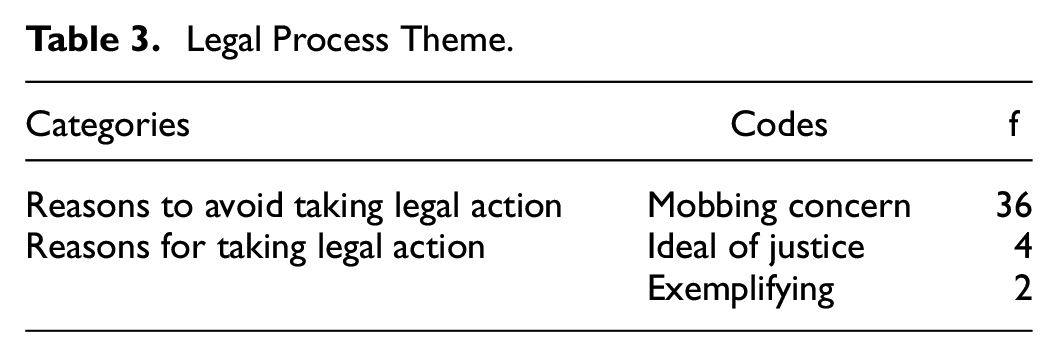
The results of the Legal Process theme are presented in Table 3.
Legal Process Theme.
Category: Reasons to avoid taking legal action
Code: Mobbing concern R31: “You get flagged immediately. Mobbing starts right away. You do not stand a chance. Even though you have every right to do so, if you complain to the federation and take it to court, you will hardly find a new club to join after all. Due to the‘If this player has an issue with me, he/she will assert their rights and they will cause me problems’mentality of club presidents, no one wants to transfer a basketball player who seeks their rights. We have legal rights, but it does not work that way in practice, as you can see.”
As indicated in the category of labor rights violations, respondents have faced unpaid wage rights, harassment, and discrimination. They can file complaints and take legal action against these violations. However, a significant part of the respondents refrained from taking legal action due to the fear of mobbing. According to the statement of R31, one of the most significant factors contributing to this situation is the fear of being unable to find a new job. They are concerned about being recognized as a player who causes problems for employers by asserting their rights. Employees should be aware of their rights and have the consciousness to take action to use these rights. For this purpose, a work environment where they can make their voices heard is necessary. However, employment regulations that do not consider power imbalances in the employment relationship and encourage employees to act individually lead to their voices being administratively silenced (Bales et al., 2018; Lopez-Andreu & Jamalian, 2021).
According to the research by Pollert and Charlwood (2009), the most common method employees resort to in resolving issues with employers is informal communication with the employer. The least preferred method is taking legal action, often due to the lack of results. Furthermore, there is the potential for legal processes to result in favor of the employer and for the employer to retaliate. Research conducted in Türkiye also supports this situation. Accordingly, the rate of those who do not trust the judicial system is 69% (Çamurcu, 2022). Therefore, in cases where employees believe their rights have been violated, they may prefer making informal agreements with the employer instead of filing a lawsuit (Basok et al., 2014; Kirk, 2018).
Employers using pressure or threats to deter an employee from seeking justice by following the legal process have been described as labor exploitation in research on the related subject (Aytaç & İlhan, 2008; Scott, 2017).
Category: Reasons to take legal action
Code: Ideal of justice R23: “I have always seen this in my family, and it is my nature too; I cannot tolerate injustice. I cannot sit silently. This trait has caused me much trouble, but at least my conscience is clear. When I do not see good intentions on the other side, I resort to every possible means to seek justice, and I have done the same in the past.”
Code: Exemplifying R20: “We, the players, always hesitate and fear when it comes to standing up for our rights. We have been subdued; that is the situation. I used to be like that when I was a younger player… But over time, as the number of injustices I encountered has increased, I told myself there has not been a senior figure to guide and inspire us. Maybe now, I can encourage the younger ones to stand up for their rights. That is why, I am initiating the legal process right away. How many more years am I going to play anyway… It is better than sitting quietly.”
The number of respondents who choose to initiate legal proceedings for the violations of their rights they have suffered is relatively less. The reasons for this choice seem to be based on personal principles rather than organized and collective action. It is known that seeking rights under the umbrella of a union, professional solidarity organizations, or different civil society organizations leads to more positive and effective results for individuals. Most respondents without such organization tend to avoid legal processes, and the few who pursue their rights legally may have this as a reason.
In the literature, it is observed that seeking rights through associations, unions, professional solidarity organizations, or different civil society organizations tends to yield more positive and effective results for individuals (Guillaume, 2018; Mészáros, 2013; Millward et al., 2001; Özkul, 2017; Ralchev, 2004; Sarı, 2017).
The results of the Unionization Idea theme are presented in Table 4.
Theme of Unionization Idea.

Category: Positive opinions
Code: Solution to the power imbalance R14: “When you look at it, there is a clear hierarchy between the clubs and us… If the clubs do not give us contracts, or if they do not want us on their team, we cannot do this job. That is why sometimes we compromise more than we should. But I believe things would balance out a bit if there were a union where basketball players unite.”
The findings suggest that respondents perceive themselves as weak as their employers perceive, and due to job insecurity, they compromise their rights. The power imbalance between the club and the athlete can be considered a manifestation of the asymmetric relationship between workers and employers in the current global order. The lack of state-guaranteed labor rights through legislation, the lack of practical enforcement, or even the inadequacy of professional organization and solidarity when the state does enforce protective legislation can all lead to a disruption of this power balance in favor of employers. In this regard, while a hierarchical structure between workers and employers is standard, it is believed that establishing organizations to promote professional solidarity could be beneficial in eliminating elements susceptible to employer exploitation within this vertical structure. Durkheim (2013) has emphasized that strengthening professional and inter-professional solidarity through corporate organizations can prevent class-based divisions and facilitate communication between workers, employers, and the state to achieve common societal interests.
Code: Positive impact on solidarity between athletes R16: “The solution to most of the issues we face with these clubs is simple: unity makes strength. It is that simple. I believe we can achieve this under the umbrella of a union. If we act in everyone’s best interest, people will support each other.”
R16’s statement “unity makes strength” stands out as a finding summarizing the function and purpose of unions. It can be considered a hopeful approach, believing that professional solidarity can be achieved through establishing a union and that problems with employers can be solved. Similarly, in Marx and Engels (2012) slogan, “Proletarians of all countries, unite!” they hoped to liberate the working class from its chains. Today, the working class has not been able to achieve this. Nevertheless, research shows that unions continue their efforts and struggles to promote and increase solidarity (Holgate, 2021; Rosetti, 2019).
Code: Advantages of collective bargaining agreement R42: “I closely follow the NBA. The players’ union is very effective in them. They sit down with club owners and negotiate until they reach an agreement… They state their demands for each player in the league and get them… We must start doing these things too; we have fallen far behind in everything.”
From the perspective of trade union activities, collective bargaining agreements are the most effective instruments that can benefit workers. It is known that collective bargaining agreements provide economic and social benefits to workers (Dickens, 2000; Villanueva & Adamopoulou, 2022). The NBPA that R42 appreciates and mentions is indeed an exemplary player association. Under the scope of a collective bargaining agreement, the NBPA actively works to protect and improve the rights of active players in the league and provides significant social and economic benefits for post-career life (Collective Bargaining Agreement, 2023). For many industries, a CBA for athletes with short and risky careers is highly valuable and essential for athlete rights.
Category: Negative opinions
Code: Mobbing concern R31: “Forget about establishing a union; when the idea is heard, the clubs immediately start mobbing against us. It does not suit their interests… Then most basketball players lose their courage. Especially young basketball players never dare.”
The concern about mobbing, the only reason respondents avoid taking legal action against rights violations, also appears here. It is noteworthy that athletes whose rights are currently violated and who are exposed to mobbing types such as abuse and discrimination are worried about being subjected to mobbing. It can be thought that athletes also normalize and accept the current situation and mistreatment.
R31 mentioned that employers would display obstructive behavior, and young athletes, in particular, would refrain from unionizing. According to Dabscheck (1996), young athletes may prioritize fitting in with the team and being accepted. In such a situation, they might overlook workers’ rights issues, making it more challenging to involve them in union organizing.
Employers’ negative attitudes toward employee unions and their efforts to discourage unionization have been a common issue for a long time in various industries worldwide (Fairbrother & Yates, 2003). Additionally, respondents’ fear of mobbing if they attempt to unionize demonstrates that employers exhibit an anti-unionism approach rather than non-unionism. This approach is driven by employers’ desire to create a more easily exploitable and vulnerable workforce.
Code: Lacking solidarity between athletes R8: “There is absolutely no unity among basketball players. Even players on the same team are undermining each other… To establish a union, we would need to bring together a significant portion of professional basketball players, which is very difficult… I believe we do not have that culture of solidarity; everyone is only thinking of themselves.”
According to the respondents, one of the obstacles to unionization in Turkish basketball is the need for more solidarity among athletes. P8 points out that professional basketball players prioritize their individual interests over collective benefit, making unionization difficult. High-level competition exists in professional sports, not only between teams but also among the players within a team. A successful career requires proving oneself, establishing a place in the industry, and maintaining it. All of this may lead to an individualistic approach. However, such a work environment reduces the likelihood of unionization. As Ang and Fredriksson (2018) mentioned, in a climate where personal interests are prioritized over the majority’s benefit, collective actions like unionization are more challenging to realize.
Conclusion
This research examined professional basketball players’ experiences regarding the violation of employment rights and related legal processes and their views on unionization. We were motivated to conduct this research to determine whether the adverse conditions for labor rights in Türkiye and the weakness in unionization are reflected in professional basketball. The findings show that athlete workers in professional basketball, as in many other sectors, are economically and psychologically exploited. Although employers are obliged to take care of their employees and treat them equally, it has been observed that they do not fulfill their legal and moral responsibilities.
Despite all these negativities, the fact that athletes hesitate to claim their rights and the lack of interest in unionization shows that a climate of fear has been created for professional basketball players. This situation also prevents collective initiatives to break the domination of employers on sports laborers. In a country ranked 117th in the rule of law index (World Justice Project, 2023) and 103rd in the democracy index (The Economist, 2023) and considered as an authoritarian regime, this situation is seen as unfavorable but usual. We can say that a despotic labor regime, a form of labor control that does not respect workers’ rights and where coercion prevails over consent (Burawoy, 1985), is embodied in professional Turkish basketball.
The proposition that “professional Turkish basketball players could establish a union and solve all their problems” is unrealistic. Under the given circumstances, unionization will not be easy. However, the statement made by P42 while admiring the NBPA summarizes the situation well: “…we are far behind in everything.” Therefore, raising awareness and knowledge levels regarding players’ rights is essential. Practices to increase the professional solidarity of basketball players should be implemented. Unionization should be promoted, and it should be acknowledged that professional athletes are also wage laborers. Civil society organizations should play an active role in these matters.
The degree of commodification and exploitation of athlete labor depends on the approach of the state and regulatory authorities such as sports federations (Biyanwila, 2018). For this reason, The Turkish Basketball Federation, especially as a regulatory and supervisory body, should be sensible about player rights. Practices that protect employers will provide more opportunities for rights violations and exploitation. Employers and club management should be educated and informed not only about athlete rights but also about human rights. They should move away from a management approach that sees athletes as mere production tools and commodities and abandon the “winner takes all” mentality.
We are aware of several limitations of this study. The research utilized a qualitative design and was conducted with 42 respondents. Therefore, it does not have the adequacy to represent the population. Although there were respondents from both genders in the study, the unique dynamics, problems, and labor relations of men’s and women’s basketball were not evaluated in terms of gender. This issue can be emphasized in future research. Respondents are limited to Turkish basketball players. It will be essential to evaluate the views and experiences of foreign athletes who have experienced a different culture and took part in Turkish professional basketball leagues regarding the violation of employee rights and unionization. On the other hand, the study is limited to basketball, which is a team sport. The current issue can be studied in future research on professional athletes in individual sports where intra-sectoral interaction is more limited, and sports organizational forms are more minimal.
Footnotes
Authors’ Note
This research is produced from Can Çavin Ötkan’s PhD dissertation titled “Labour Relations and Union Phenomenon in Turkish Basketball from the Athlete’s Perspective.”
Declaration of Conflicting Interests
The author(s) declared no potential conflicts of interest with respect to the research, authorship, and/or publication of this article.
Funding
The author(s) received no financial support for the research, authorship, and/or publication of this article.
Ethical Approval
The Ethics Commission approval required for the research was obtained in accordance with the decision number E.619516 dated 09.03.2023 of Gazi University Ethics Commission. The interviews were taped, coded, and stored in accordance with research ethics regulations.

Data Availability Statement
The data that support the findings of this study are available from the corresponding author upon reasonable request.