




Abstract
Political scientists have long considered ideology, partisanship, and constituency in determining how members of the United States Congress make decisions. Meanwhile, psychologists have held that personality traits play central roles in decision making. Here, we bridge these literatures by offering a framework for modeling how personality influences legislative behavior. Drawing from experimental economics and neuropsychology, we identify core cognitive constraints for the “Big Five” personality model, parameterizing them in ways useful for crafting formal models of legislative behavior. We then show one example of the applicability of this framework by creating a formal decision-theoretic model of constituency communication. We show that when there exists uncertainty over the true state of the world, personality traits have more influence on individual decisions.
Keywords
Introduction
You can have every e-mail I’ve ever sent. I’ve never sent one.
During an appearance on NBC’s Meet the Press about the scandal surrounding Hillary Clinton’s use of a private email server, Senator Lindsey Graham (R–SC) dropped a bombshell on the political world and revealed he does not use email. While the response to his disclosure was swift, and much of the mainstream media responded with disdain and chagrin (e.g., Politico referred to Senator Graham as a founding member of the “Luddite Caucus”; French, 2015)—other Senators came out of the woodwork and defended his decision. His colleague and fellow Republican, Senator Richard Shelby (R–AL), claimed that “[t]he best thing is person-to-person like I’m talking to you. To my staff, talk to them on the phone but also notes. Hand notes. I write a lot. I’ve been here a while; I’m a little older than y’all” (French, 2015).
However, Senator Shelby’s support notwithstanding, the story soon broadened to cover Senators’ use of communications technology more generally. Senator John McCain (R–AZ) revealed that, while he does not use email frequently, he uses Twitter to communicate with his constituents. Senator Cory Booker (D–NJ), one of the youngest Senators, concurred and mentioned he also uses Instagram and Facebook, noting that “with one push of a button I can communicate with hundreds of thousands of my constituents through social media platforms” (French, 2015). Octogenarian Senator Chuck Grassley (R–IA) is also active on social media, tweeting about anything and everything from constituent service to congratulating local sports teams and even chronicles of his daily exploits. For example, on November 3, 2014, Senator Grassley tweeted “Windsor Heights Dairy Queen is good place for u kno what” to his followers. 2
This variation in social media use across legislators of all ages suggests the decision of how best to reach out to constituents is not simply explained by generational differences. Legislators’ choices of how best to do so and what issues to emphasize are summarized by what Fenno (1978) calls home style. Here, we analyze home styles, focusing on when and why some legislators adopt new methods of reaching out to constituents, and why others never do so.
One possible way to explain the heterogeneity in behavior of members of Congress (and, more broadly, elites in general)—even among those with similar policy preferences and backgrounds—might be to focus on heterogeneity in their personalities. There exists a long history of scholarship emphasizing the role of members’ personalities and other individual characteristics (e.g., Barber, 1965; Caldeira & Patterson, 1987; Dietrich, Lasley, Mondak, Remmel, & Turner, 2012), and personality has been proffered as one explanation for why certain members become “show horses” and other members become “work horses” (e.g., Matthews, 1960; Payne, 1980).
Relatedly, personality psychologists have accumulated copious amounts of information about how stable and persistent individual differences capture myriad human behaviors, and they have developed and proposed several trait taxonomies in attempts to hierarchically organize them. Importantly, they have coordinated upon a five-factor structure for personality traits that have become broadly accepted as characterizing the most important dimensions of individual difference (Eysenck, 1992; John, Naumann, & Soto, (2008). Although they may not represent the “true” structure of personality, these traits—Extraversion, Agreeableness, Openness [to Experience], Conscientiousness, and Neuroticism (sometimes reverse-coded as Emotional Stability)—capture many important individual differences (Costa & McCrae, 1992); this taxonomy also has the strength of research connecting it with lower level traits, other taxonomies, and other phenomena including leadership ability, academic and job performance, and health outcomes (Judge, Erez, Bono, & Thoresen, 2002; McCrae & John, 1992; Ozer & Benet-Martinez, 2006). Importantly, this approach offers the promise of identifying enough fundamental individual differences to provide systematic characterizations of individuals’ persistent unique qualities, while reducing them to few enough in number to be tractably translated into the language of formal modeling, making them accessible to scholars of Congress (and institutions more broadly).
Political scientists and economists have incorporated many individual differences into theoretical models that appear related to the Big Five, while stopping short of developing a general purpose theoretical framework for modeling personality. Discounting is an essential element of the Rubinstein bargaining model (1982), and differences in time preferences between individuals influence the outcome of negotiations. In addition, there have been many attempts to consider the effects of loss aversion, gain sensitivity, reference points, and risk preferences (Berejikian, 2002; Butler, 2007; Levy, 1997). In addition, there has been formal examination of the role social preferences play in politics; for example, consider the impact of heterogeneous lying aversion on strategic communication (Minozzi & Woon, 2013). All of these attempts to consider more nuanced individual differences in politics could potentially be brought together with a behavioral modeling framework for the Big Five personality traits.
In a recent book, Ramey, Klingler, and Hollibaugh (2017) did just this, developing a framework for incorporating personality into models of elite behavior. Here, we leverage their framework and develop a decision-theoretic model of the decision to adopt a new form of communication technology and allow personality to play important roles. Before doing so, however, we review the literature and show how, within their framework, each of the Big Five traits can be connected to nonideological preferences and beliefs identified by experimental economists and variations in brain structure identified by neuropsychologists, demonstrating that formal parameters empirically supported by personality measures may plausibly influence decisions made by legislators. 3 Following this, we discuss the model, analyze its results, and discuss potential avenues for future research.
The Big Five and Modeling Individual Differences
Although a full-fledged recapitulation of Ramey et al.’s (2017) is beyond the scope of this article, a brief overview will help us to better ground our decision-theoretic model in the next section. Importantly, Ramey et al.’s (2017) goal was to demonstrate the relevance of personality in examining decision making in Congress specifically, and institutions more generally; in doing so, they drew from the experimental economics and neuropsychology literatures to obtain parameters correlated with the Big Five that are important to political decision making and can be translated into terms scholars can incorporate into models of institutions. However, doing so required the characterization of the traits as single—mathematically modelable—concepts.
4
This enterprise has a long history in both economics and psychology: [P]ersonality traits impose constraints on agent choice behavior. More fundamentally, conventional economic preference parameters can be interpreted as consequences of these constraints. For example, high rates of measured time preference may be produced by the inability of agents to delay gratification, interpreted as a constraint, or by the inability of agents to imagine the future. (Borghans, Duckworth, Heckman, & Weel, 2008, p. 977)
In addition, neuropsychology has made significant strides in characterizing differences in neurochemistry, brain region volume, and resting state brain activity associated with the Big Five (Adelstein et al., 2011; DeYoung et al., 2010; Wacker, Chavanon, & Stemmler, 2006). Accordingly, Ramey et al. (2017) identified core cognitive constraints captured through the Big Five factors by focusing on the biological differences in brain functioning that neuropsychology has associated with each trait, characterized each trait in terms of a constraint, and expressed those constraints in terms of modeling parameters. These constraints influence behavior in systematic and modelable ways, but are dependent on the contexts of the models themselves. Drawing on a simple framework of legislative utility, Ramey et al. (2017) identify useful approximations of each core cognitive constraint’s influence, with the resulting framework directing the incorporation of each trait’s core cognitive constraint into formal models of institutions. In the present case, we leverage this framework to develop a model of constituency communication; this is an ideal tactic to examine, because of the roles played by multiple personality traits and the relative ease of modeling.
Openness [to Experience]
Openness is associated with desires to explore and imagine new situations and ideas, as well as an appreciation for aesthetic beauty, intellectual pursuits, tastes for novel experiences, and tendencies for creativity and imagination (Borgatta, 1964; Tupes & Christal, 1992). This trait has found applications within political science, with a positive association between Openness and ideological liberalism (Alford & Hibbing, 2007; Barbaranelli, Caprara, Vecchione, & Fraley, 2007); similarly, more Open individuals are less likely to hold racial prejudice, authoritatian beliefs, homophobic attitudes, or stigmatize people with AIDS (Cullen, Wright, & Alessandri, 2002; Duriez & Soenens, 2006; Flynn, 2005; McCrae et al., 2007; Stenner, 2005).
In addition, it is associated with several related cognitive functions, such as reduced latent inhibition—that is, blocking irrelevant stimuli from consciousness (Peterson & Carson, 2000)—as well as resting state functional connectivity (RSFC) activity with areas of the prefrontal cortex (PFC) associated with working memory (DeYoung, Shamosh, Green, Braver, & Gray, 2009; Sutin, Beason-Held, Resnick, & Costa, 2009). More Open individuals have increased RSFC in parts of the brain associated with imagination, as well as pattern recognition and apophenia, the detection of patterns in meaningless data (Adelstein et al., 2011). Increased dopaminergic activity in Open individuals in the PFC reduces latent inhibition and maintains working memory, and further increases motivation for intellectual exploration (DeYoung et al., 2011). Increased intellectual exploration along with greater perception and working memory all serve to combine in powerful ways to both drive and equip Open individuals for cognitive exploration. Therefore, Openness’s core cognitive constraint is a compulsion to gather and process information.
Conscientiousness
Conscientious individuals have been described as being hardworking, responsible, and prudent (VandenBos, 2007), and tend to be more driven, goal-oriented, uptight, better organized, and have more willpower (Ozer & Benet-Martinez, 2006). Given its association with duty, order, and discipline, Conscientiousness has had clear hypothesized relationships with temperamental and ideological conservatism (Mondak, Hibbing, Canache, Seligson, & Anderson, 2010), and investigation has found evidence in favor of an association with ideological conservatism (Stenner, 2005). One might also think the link with duty might drive Conscientious individuals to be more civically engaged, though findings here are mixed (Bekkers, 2005; Gerber, Huber, Doherty, & Dowling, 2011).
Physiologically, Conscientiousness is correlated with the volume of the middle frontal gyrus in the left lateral PFC, a portion of the brain “involved in maintaining working memory and the execution of planned action” (DeYoung et al., 2010, p. 826) and linked with abilities to plan and follow complex rules (Miller & Cohen, 2001). Examination of RSFC revealed an association between Conscientiousness and parts of the brain associated with planning for the future (Adelstein et al., 2011). Overall, Conscientiousness has strong links with parts of the brain associated with self-control, planning, and execution of planned action. This evidence suggests the core cognitive constraint of Conscientiousness is an increased capacity to realize planned future outcomes.
Extraversion
Extraversion is associated with activity of many kinds, as Extraverts are more sociable, talkative, assertive, and energetic; the trait is also associated with positive outlooks on life. That it has been easy to find connections between political activity and Extraversion is thus unsurprising; for example, Extraverts are more likely to become active contributors to voluntary associations (Bekkers, 2005). In addition, political psychologists have found evidence that voters evaluate leaders at least partially on the basis of their Extraversion, as they show preferences for more sociable individuals (Caprara, Schwartz, Capanna, Vecchione, & Barbaranelli, 2006). Although some studies suggest Extraversion is associated with conservatism, the results are not robust (Barbaranelli et al., 2007); Riemann, Grubich, Hempel, Mergl, & Richter, 1993).
Psychologically, one major theory argues. Extraverts have more dopamine terminals than introverts, and a prevailing theory suggests these terminals support coding stimuli in terms of reward, which drives behavior to approach stimuli as sources of potential reward (Depue & Collins, 1999; Fischer, Wik, and Fredrikson, 1997). In addition, Extraversion has been associated with the size of the medial orbitofrontal cortex, which codes the reward value of stimuli, sensitivity to reward, and the extinction of fear responses (Adelstein et al., 2011; DeYoung et al., 2010); relatedly, Extraverts have lower threshholds of reward needed to take given actions, broader abilities to find rewards for stimuli, and easier conditioning to associated stimuli with reward (Depue & Fu, 2013). Therefore, through dopaminergic activity and the orbitofrontal cortex, Extraversion’s core cognitive constraint is sensitivity to and fixation on prospective reward.
Agreeableness
Agreeableness is described as being linked with altruism (DeYoung et al., 2010) and tendencies to trust others, cooperate, and act unselfishly (John, Robins, & Pervin, 2008; VandenBos, 2007). Generally, it is associated with pro-social attitudes and other-minded thinking, suggesting many applications in political behavior; to wit, Agreeableness is associated with a stronger psychological sense of community, which can serve as a basis for political trust and economic liberalism (Gerber et al., 2011; Lounsbury, Loveland, & Gibson, 2003). Agreeableness can be conceptually connected to tolerance, which is supported by findings that it is negatively associated with racial prejudice, negative attitudes about diversity, and stigmatizing people with AIDS (Duriez & Soenens, 2006; McCrae et al., 2007; Strauss, Connerley, & Ammermann, 2003). In line with Agreeable individuals’ inclinations to be concerned about others, the trait is associated with distaste for political discourse and political competitiveness (Hibbing & Theiss-Morse, 2002). Voters also seem to value Agreeableness in their elected officials (Caprara et al., 2006).
Agreeableness has been found to be positively associated with the volume of the posterior cingulate cortex, an area of the brain involved in the process of understanding other individuals’ beliefs (DeYoung et al., 2010; Saxe & Powell, 2006). In addition, the ability to understand others’ beliefs is part of the theory of mind capability thought to be essential in the ability to act altruistically (de Waal, 2008). The larger posterior singulate cortex has been associated with empathy, and Agreeable individuals have higher measured resting state activity in the posterior cingulate cortex as well (Adelstein et al., 2011). As Agreeable individuals have increased capacities to interpret the beliefs and motivations of others and experience empathy, Agreeableness’ core cognitive constraint appears to be a capacity for altruism.
Neuroticism/Emotional Stability
Neuroticism is associated with high levels of anxiety, depression, impulsiveness, and vulnerability to stress; related traits include external locus of control, high irritability, and a sense of vulnerability to external conditions (John, Robins, & Pervin, 2008). Neurotics tend to have low self-esteem and are unstable, withdrawn, easily angered, and difficult to motivate. However, unlike other Big Five traits, there are fewer clear connections between Neuroticism and various political phenomena. One possible connection is an association between Neuroticism and ideological severity, as individuals who are less well adjusted (as Neurotics tend to be) should be more easily drawn into fanatical positions (Soldz & Vaillant, 1999). However, other research has found strong and consistent relationships between Neuroticism and ideological liberalism (Gerber et al., 2011; Gerber, Huber, Doherty, Dowling, & Ha, 2010, Mondak, 2010). In addition, Neurotics may have less stable political attitudes and more uncertainty about the attitudes they do have (Mondak et al., 2010). Psychologists have argued Neurotics experience variability and “mental noise” in their cognitive operations, and this may cause additional uncertainty and instability in their responses (Robinson & Tamir, 2005).
More Neurotic individuals have been found to have larger mid-cingulate gyri, a region of the brain associated with the detection of error and pain (DeYoung et al., 2010); larger mid-cingulate gyri may be associated with higher sensitivities to possibilities of error and negative outcomes (Eisenberger and Lieberman, 2004). A broader theory of Extraversion and Neuroticism has argued that Neuroticism is a biochemically induced counterpoint to Extraversion, and as Extraversion is associated with a fixation on reward, Neuroticism is associated with a fixation on negative outcomes (DeYoung & Gray, 2009; Gray & McNaughton, 2003). In the lab, Neurotics are prone to behavioral inhibition through passive avoidance and freezing, presumably due to their fixation on threat and negative outcomes (DeYoung & Gray, 2009). If Neurotics are preoccupied with error and threat, absent some shock, the best way to avoid negative outcomes and stress would be to withdraw and maintain the status quo. Whether it is through sensitivity to error, stress avoidance, or a tendency to negative self-evaluation and rumination, Neuroticism’s core cognitive constraint is a sensitivity to and fixation on prospective negative outcomes. 5
A Framework for Political Choice
Having briefly described how the Big Five traits translate into core cognitive constraints, we outline Ramey et al.’s (2017) framework for incorporating personality into models of institutions. Given the present focus on the United States Congress, a general model of legislative utility is first considered; it considers utility in terms of that derived from policy, from holding office (including both reelection and influence within Congress), and leisure. Importantly, this model has been used to motivate much Congressional research over the past half-century, and it has been modified in various ways over time (Calvert, 1985; Fenno, 1973; Mayhew, 1974). Every action legislators may take has policy and office implications, and after weighing the different sources of utility, legislators compare the expected utilities of possible actions to determine the optimal course of action. Note that this model can be extended by incorporating the core cognitive constraints that characterize each trait, and this is outlined in the following paragraphs.
The utility gained from winning future office incorporates any policy utility that may be obtained by holding it (Mayhew, 1974). Conscientiousness’ core cognitive constraint is a capacity to realize planned future outcomes, and less Conscientious individuals should derive lower levels of utility from future policy gains they can neither imagine nor obtain through planned actions. This arises as a smaller discount factor for future utilities, be they from office, policy, or other sources. This modeling decision is supported by attempts to link personality with measures of time preference. Experimentally, higher scores on Conscientiousness are associated with lower discounting of future payoffs; indeed, “conscientiousness is particularly implicated in the ability to make sacrifices now for rewards later” (Daly, Harmon, & Delaney, 2009, p. 3). Therefore, the model is expanded to include motivation to hold office, enact policy, leisure, and time preferences.
A second necessary component is utility gained from the well-being of others. Agreeableness is strongly associated with the capacity for empathy and development of theory of mind that enables individuals to understand the incentives of others and act altruistically (Adelstein et al., 2011; de Waal, 2008). As Agreeableness is a top-level trait, we must consider the impact of every action on the well-being of others. This has support in models of legislative utility that put weight on selfless statemanship, as well as the idea of the “welfare of the nation” apart from policy and office goals (Cavanagh, 1982; Uslaner, 1996). More Agreeable individuals with higher capacities for empathy and understanding others are capable of deriving more utility from others. Therefore, the consideration of utility is expanded to include motivation to hold office, enact policy, leisure, and act according to the norms of selfless statesmanship, all subject to discounting.
The core cognitive constraint of Openness—a compulsion to gather and process information—has both direct and indirect effects on behavior. Foremost, any action that provides information, experience, or learning will likely provide additional utility to more Open members. 6 A second implication is more useful for modeling the utility of political elites, as situations with multiple possible outcomes require individuals to devote cognitive resources to the imagination (and retention) of alternative scenarios—such as policy outcomes—and Open individuals pay fewer costs for the collection and retention of this information. Thus, Openness is associated with higher utilities for convex combinations of outcomes, and reduced risk aversion by implication (Borghans et al., 2008; Pratt, 1964). Therefore, after considering Openness, utilities can be modeled as being affected by four motivations (policy, office, leisure, and statesmanship) which may be transformed by time or risk preferences.
Extraversion has connections with sensitivity to reward and fixation on positive incentives (Derryberry & Reed, 1994; DeYoung, 2014), resulting in a direct parameterization as higher weights on potential rewards when calculating expected utilities. This implies that Extraverts will persistently overestimate the successes they expect in contests, offering a more useful alternative application of the parameter as a subjective resource in contest success functions (Pearce-McCall & Newman, 1986). Therefore, after accounting for Extraversion, utilities are derived from policy, office, leisure, and statesmanship motivations, which may be altered by biased expectations of success and preferences over risk and time.
The sensitivity to negative outcomes underlying Neuroticism implies a parameterization of the trait as greater weights on potential losses, which is supported by Neuroticism’s association with sensitivity to error (DeYoung et al., 2010). Greater weights on potential losses implies a preference for a “safe” status quo to avoid making errors; this is supported by the finding that Neurotic individuals experience indecision when forced to decide between conflicting goals (DeYoung & Gray, 2009; Gray & McNaughton, 2003). 7 This “freezing” effect can be modeled with an inhibition parameter in the utility function for legislative actions that represent decisions not to decide, such as voting present, or not taking action, such as missing votes or not introducing legislation. 8 Therefore, after accounting for Neuroticism, utilities are derived from policy, office, leisure, and statesmanship motivations, which may be altered by biased expectations of success and failure and preferences over risk and time.
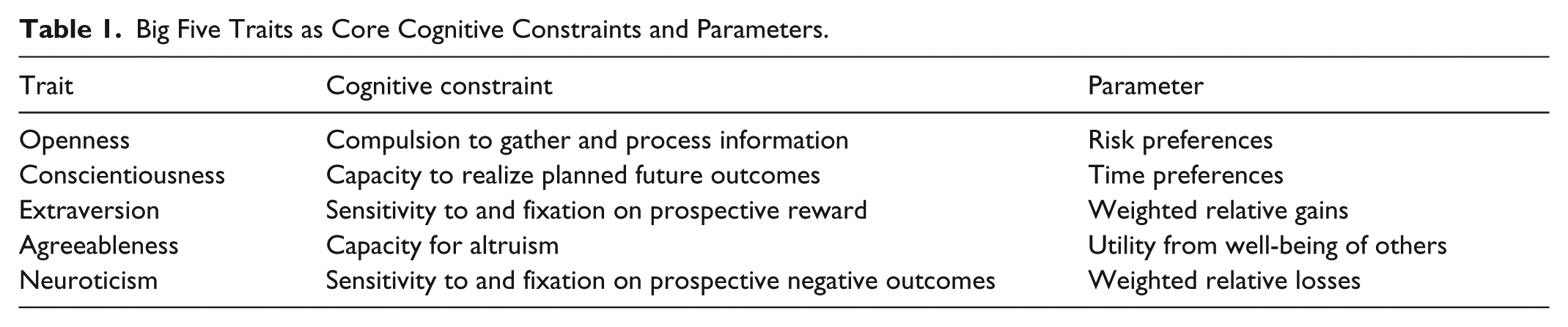
All core cognitive constraints described in Ramey et al.’s (2017) framework, as well as the associated parameters, are summarized in Table 1. This framework allows for the incorporation of the Big Five traits into models of elite decision making. In the next section, we incorporate four out of the five traits, Openness, Conscientiousness, Extraversion, and Neuroticism, into a decision-theoretic model of technological adoption when the quality of the technology is uncertain, with communications technology as the motivating case.
Big Five Traits as Core Cognitive Constraints and Parameters.
A Model of Constituency Communication
Twitter debuted in 2006 and allowed users to send “tweets,” short messages limited to 140 characters. 9 By 2014, the number of active Twitter users in the United States was estimated to be around 45 million (Ribiero, 2014). In its early days, few American politicians viewed Twitter as a valuable means for connecting with their constituents. Because of the rarity of major elected officials on Twitter, people took notice when, in April of 2007, then-Senator Barack Obama registered a public Twitter account and issued his first tweet.
While then-Senator Obama became quite popular and would go on to lead a successful presidential campaign, few of his fellow legislators felt that his Twitter presence was so indispensible to his success that they ended up following suit—at least until after he became President. Using data from Chi and Yang (2010), Figure 1 shows the percentage of members of the House with active Twitter accounts during Twitter’s early days—2007 to 2010. While the percentage with accounts grew over this period, it was not until 2009—after Senator Obama became President Obama—when it rose precipitously, though we can see that as late as mid-2010, only about 40% of Representatives were on Twitter.

Twitter adoption by house members (2007-2010).
Why did some legislators adopt Twitter while others did not? And among those who did, what explains when they adopted it? More generally, why do legislators vary at the rates and speeds at which they adopt new technologies for constituency communication? As mentioned, even the now-ubiquitious technology of email is not yet fully adopted. Extant research on technology adoption and usage among American politicians has examined how both demographics and partisanship affect the decision of politicians to adopt and use such technologies (Gulati & Williams, 2015; Vaccari & Nielsen, 2013). While these factors undoubtedly matter, it seems obvious that even more fundamental factors associated with both the politicians and the technology itself—for example, risk, patience, prospective rewards, and/or negative outcomes—matter as well, perhaps even more so.
To answer these questions, we model the decisions of legislators with respect to communications technology adoption, therein incorporating the Big Five model described above. Like investing in a start-up company, adopting a new technology requires time and energy. Moreover, as the technology is new, adoption may bring gains or losses. On the upside, if the medium proves to be adopted by the public at large, the legislator will be rewarded for being “ahead of the curve.” These rewards could be electoral—for example, young and tech-savvy voters might jump on his or her electoral bandwagon—or they could come in the form of prestige from their foresight. For example, in the 2008 Presidential campaign, then-Senator Obama assembled a team of technological “wizards” to develop sophisticated models of voter turnout. While the class of traditional consultants scoffed at this decision initially, Obama’s success vindicated the risks and countless politicians tried desperately to copy his approach. 10
Of course, there are potential losses as well. If the new medium proves to be a dud, the legislator might suffer a loss in prestige. Furthermore, the time and effort invested will be seen as wasted. In addition, it is possible that constituents who prefer more traditional forms of political communication may retaliate against the incumbent electorally. Thus, the question of who adopts is really about the relative emphasis on the prospective rewards and negative outcomes for doing so.
To formalize this, we introduce a simple model based on the logic described by Ramey et al. (2017). Assume a set of legislators

The updated belief for the mean is, similarly, a precision-weighted average of the prior and the observed signals to date (hereafter simply referred to as the “mean”):

Note that as
We assume

where
As noted, when


The upper limit is always positive and the lower is always negative. Thus, when the number of signals is sufficiently large, decisions will be based solely on the sign of the mean signal received to date. This is because, in the limit, all legislators will join when the mean signal is positive, and none will join when the signal is negative (see Note 15). Proposition 1 and Corollary 1 are thus derived.
These results suggest that in the current Twitter environment, when many legislators have joined and there are millions of members, the number of existing signals is high and the role of personality in determining whether to join now is small. However, in the early days of any new technology, including Twitter, the number of existing signals will be small.
We can examine how the perceived benefits vary as the number of signals increases. Figure 2 presents the results of a simulation with six parameter profiles: (a) The legislator is Open and minimally Extraverted and Neurotic (

Simulated instantaneous benefits of adoption.
We first focus on the outermost panels. Although difficult to see due to the large degree of overlap (which is by design), all three Neurotic profiles overlap when the latent value of the technology is low (leftmost panel;
Things look different when the value of the technology is ambiguous (middle panel;
We can also look at the effects of Extraversion and Neuroticism. Those who are more Extraverted, as they overweight the potential rewards from the new technology, see higher perceived benefits across the board. Those who are more Neurotic, as they focus more on the potential negative outcomes, generally see lower perceived benefits; the one exception to this dynamic is in the early stages when less Open individuals (those with high
However, while these results are intriguing, their applicability is somewhat limited, as the adoption decision incorporates expectations about what the future might hold. Indeed, we are arguably more interested in whether a legislator will adopt today or delay until later when the informational environment will be more useful. That said, this depends on whether waiting will improve the estimate of the value of the technology via additional signals. Suppose that with probability
In the event the legislator observes a new signal tomorrow, we need to compute what his or her expected utility would be given the information available today. Thus, we recompute the expectations over future signals conditional on the available information available at present, obtaining


The expectation of the value tomorrow is simply today’s estimate. For the variance, as it is independent of the signal and only depends on
Thus, legislator

where
We assume legislators discount the future at a rate

where

The difference in the variances is always negative, as the variance tomorrow will always be less than today. The term involving the differences in probabilities that the value of the technology is positive or negative will vary in sign according to the signals observed to date. If the signals to date are negative, the term will be negative, thus making the entire derivative negative. This is sensible, as the legislator’s signals to date are not good and the she or he knows that waiting will lead to less variance. However, as mentioned when the signals to date are positive,
For the risk-aversion factor,

Regardless of the value of
Adjusting the sensitivity to reward and negative outcomes also has important and intuitive effects on the net benefits. Differentiating with respect to


Note that
Last, what happens when we adjust the prior precision,

Here, much hinges on

Note that

holds, increases in Conscientiousness reduce the relative benefits from adoption today. This will always be true if
The interactions between Conscientiousness and the other parameters should also be noted. As the right-hand side is always positive, increases in
Conversely, when

This makes sense; we assumed the legislator’s prior for the true value of
Overall, the results line up with the proposed framework. Recall that Extraversion and Neuroticism are related to sensitivity to rewards and negative outcomes, respectively. Specifically, Extraverts are more sensitive to rewards than introverts and Neurotic legislators are more sensitive to negative outcomes than those who are more Emotionally Stable. In our model, the parameters
Going further, it seems natural to think that, as information is revealed, the risks associated with adopting the new platform will dissipate. Recall that
Discussion and Next Steps
Our findings highlight an opportunity to enrich models of elite behavior with parameterizations of cognitive constraints informed by personality. Psychology is accumulating evidence that the traits discussed here are particularly important, and we can apply the clarity of formal modeling to develop theories about how cognitive constraints affect behavior. We see no reason why this framework is only applicable to legislators, and we believe it can be applied to create models of the presidency, bureaucracy, and judiciary, and even international relations.
The model described herein could even be extended to a number of legislative decisions that involve uncertain investments with learning, including the decision to make endorsements or cosponsor. These decisions could affect the utilities of others, offering an opportunity to incorporate Agreeableness and ensure that each of the Big Five traits are considered. For example, the decision to endorse candidates might also include a term capturing the degree to which potential endorsers weigh united partisan fronts versus their own preferences; this would be another way to incorporate Agreeableness into the model. In addition, given the ability to estimate personality traits of elites from speech (Hall, Hollibaugh, Klingler, & Ramey, 2017; Ramey, Klingler, & Hollibaugh, 2016; Ramey et al., 2017), these models can even be brought to bear on data. While we should expect contextual variables such as age, length of tenure, district population density, Internet adoption, and Twitter adoption to be associated with the use of Twitter by members of Congress, we should also still expect the underlying preferences captured by measures of the Big Five to have a significant relationship.
Overall, focusing on elites’ personalities offers new insights into why politicians vary in how they pursue their goals. We believe personality trait measures capture underlying cognitive constraints associated with officeholders’ decisions to choose certain political tactics in a manner conducive to formal modeling. Our findings suggest voters have reason to pay attention to representatives’ personalities, and suggest additional work to connect personality with specific legislative actions are needed. This will significantly enrich our understanding of how citizens, elected officials, and policy interact.
Footnotes
Appendix A
Appendix B
Acknowledgements
Support through Agence Nationale de la Recherche–Labex Institute for Advanced Study in Toulouse is gratefully acknowledged. The authors thank Ken Benoit, Matt Blackwell, Richard Bonneau, Drew Dimmery, Conor Dowling, Michael Gill, Andy Harris, Pablo Hernandez-Lagos, John Jost, Slava Mihkaylov, Jeff Mondak, Jonathan Nagler, David Nickerson, Elena Panova, John Patty, Michael Peress, Dave Primo, Molly Roberts, Larry Rothenberg, Maya Sen, Jo Silvester, Arthur Spirling, Karine van der Straeten, and participants at the 5th Annual Text as Data Conference and the Rooney Center for the Study of American Democracy for comments and feedback. All remaining errors are our own.
Authors’ Note
Author order was decided by a round-robin matching pennies tournament. All contributed equally to the article.
Declaration of Conflicting Interests
The author(s) declared no potential conflicts of interest with respect to the research, authorship, and/or publication of this article.
Funding
The author(s) received no financial support for the research, authorship, and/or publication of this article.
Notes
Author Biographies
 ).
).
).
).