



Abstract
Researching social interactions within advisory boards, our study focuses on a family-holding company’s strategy formation process. Applying Strategy-as-Practice (S-as-P) within a Structurationist perspective, we analyzed practitioners’ strategic conduct. Through 1 year of non-participation observation, interviews and document analysis, we uncovered complex social dynamics and paradoxical behaviors, emphasizing structural properties influencing strategic formation. Our contribution lies in a model proposing four propositions for future S-as-P studies in advisory boards within Structuration Theory. This research sheds light on discrepancies between formal practices and actual social behaviors, enhancing transparency in corporate dynamics, which often remain obscure.
Plain language summary
Keywords
Introduction
The intricate dynamics of social interaction of advisory boards in family-holding companies during the strategies formation process present a compelling backdrop for examining how organizational strategies are formed and implemented. The scholars have examined the roles of advisory boards about their potential and the challenges they face in aligning decisions with organizational interests highlighting the significant impact of conflicts and misalignment on organizational outcomes (Amis et al., 2020; Veltrop et al., 2021; Vieira, 2020). On the one hand, they have noted important studies about conflicts, their disruptive results and their collective impact on the alignment or misalignment of decisions on the advisory boards with the organization’s interests (Amis et al., 2020; Heemskerk, 2019; Veltrop et al., 2021; Vieira, 2020; among others). On the other hand, Boivie et al. (2016) and Hirigoyen and Laouer (2013) delineated intrinsic barriers at the individual, group and firm levels including cognitive limitations, bounded rationality, groupthink and social loafing which may compel directors to act in ways misaligned with the organization’s goals. Nevertheless, there are few studies about how the practitioners (consultants, directors, owners, among social actors) of organizations socially interact during the practices of strategy formation and, mainly, to understand the complex tensions, relations and unexpected behaviors that can generate conflictual context in decisions process to provide strategies adjustment for the future of these organizations.
The complexity and characteristics of social practices between practitioners (owners, external consultants, and other contextual organizational actors) in a board member of a family-holding company present a compelling backdrop for examining strategic conduct and structural duality within organizational settings. The duality of structure concept proposed by Giddens (1984, 1979) is central to this investigation which emphasizes the interplay between agency and structure in shaping organizational practices. This study builds upon the lenses of Strategy as Practice (Whittington, 2015) and delves into the social interactions and practical consciousness of advisory board members during strategy formation processes (Rouleau & Cloutier, 2022).
The research problem explains the complex interplay between strategic conduct and the duality of structure within family-holding companies, particularly focusing on advisory boards. Despite existing literature highlighting the challenges and conflicts inherent in the oversight and decision-making processes of advisory boards, there remains a significant gap in understanding how the social interactions and power dynamics among board members, including owners and external advisors, influence the strategic formation process. The advisory board is responsible for determining the direction for new challenges such, that is, growth perspectives and performance improvement. However, some social actors of these advisory boards, mainly owners or/and directors from different families, act paradoxically (many times in conflictual ways), contrary to the interests of the organization so that their interests of dominance and power can prevail.
The research problem was articulated as: How do the social practices and structural properties of advisory board members in family-holding companies impact the strategic formation process, given the inherent tensions between their interests in the detriment of the organization’s interests?
This study aimed to analyze the complexity and characteristics of social practices that occurred between practitioners (owners, external consultants and other contextual organizational actors to research) in a board member of a holding—analysis of strategic conduct—in recursive relations with the structural properties of organization—duality of structure—for the social and administrative practices during organizational strategy formation. The research problem explains how the recursive strategic conduct of the board members influences the structural context of the organization during the meetings of strategy formation in a holding company. Ultimately, this research aims to shed light on the barriers that hinder effective board monitoring, provide insights into alternative strategic practices, and inform policymakers on addressing the fundamental limitations of boards of directors, thereby contributing to a more robust and effective organizational strategy formation process.
The study was conducted at a large family-holding company that has an annual turnover of U$1BI, and approximately 6,400 employees and its operational structure is made up of factories, retail stores and services in several regions of Brazil. A qualitative research approach with methods of non-participant observation, video and audio recording, document analyses and in-depth interview was used for 1 year at all the board meetings for Strategy organization discussions. The board was composed of representatives of the two families (owners and directors) and two external advisers. The main purpose of these meetings was the formation of strategies for future organization path adjustment of the family holding company.
The empirical results showed the complexity and characteristics of social resources of the organizational structure the owners used through their agency power toward their interests (practical consciousness) during the formation strategy process. Even when their interests were contrary to the objectives of the holding and the advisory board (that they constituted), it was observed that the owners often acted contrary to the external advisers’ proposals regarding the suggestions of social and administrative practices that could promote the strategies of the organization (manipulation). Although it is reasonable to assume that the interests of the owners are the solutions to the organization’s future performance issues, when the actions proposed by the advisers’ conflict with their immediate interests, they behaved paradoxically (conflict way) disregarding the possibilities of implementation or even discussion of these actions (manipulation practices). As a contribution, from the results of this study, we present a model in which the propositions seek to direct future studies of S-as-P in the family (and/or non-family) business with the assumptions of Structurationist Theory. The managerial contribution was that the findings can be used in practice to make corporate dynamics more explicit and more transparent, which often still appear obscure, especially in family business.
Our study necessarily has limitations. The microscope analysis we describe was carried out during the meetings of a single advisory board, and so the generalizability of our findings remains to be explored. It is possible, for example, that the different structures (non-family organizations) and/or different board compositions (high executives and external consultants without owner participants) can generate a different context of influence on structural recursiveness affecting the strategy formation process.
The organization of this study is as follows: Besides this introduction, Section 2 presents the theoretical background. Section 3 brings the research context and method presenting the empirical setting, data collection and analysis procedures. Section 4 describes the results that support Section 5 where we discuss the findings and we present our model with propositions. Finally, Section 6 concludes the paper with final considerations, boundaries of the study and proposals for research directions.
Background
Strategy as Practice in the Structuration Perspective and Analyses of Strategic Conduct
There are few studies about how the practitioners (consultants, directors, advisory board, and owners) of organizations socially interact during the practices of strategy formation and, mainly, to understand the complex tensions, relations and unexpected behaviors in decisions process to provide strategies adjustment for the future of these organizations (Åberg et al., 2019; Alpenberg & Scarbrough, 2021; Madison et al., 2016; Rouleau & Cloutier, 2022; Whittington, 2015).
Andersson (2020) argued that the practice of strategy can be understood through different lenses and styles, each reflecting a distinct aspect of the multifaceted work of strategists. Whittington (2015) said that no direct definition of the profession of strategist exists, but described how strategists operate and influence organizations based on different strategic approaches. Therefore, Strategy as Practice contributes to the improvement of knowledge in the field of business strategy, providing the categories and levels of analysis regarding the suggested studies of practitioners, praxis (practice), practices (i.e., the work, tools, workers, directors, consultants, professors, researchers, and students of Strategy) in organizations with a sociological view (Marietto & Serra, 2019).
Pozzebon and Pinsonneault (2005) warned that the empirical work in the structuration perspective is challenging due to the difficulty in engaging research methods to the highly abstract theory, some suggestions for studies of S-as-P using the structuration perspective were offered by Whittington (2015). For S-as-P, structuration theory offers researchers several attractive elements, such as a) attention to micro-sociological details; b) sensitivity to the institutional context; and c) openness to change. To better understand these attractive elements, Elbasha and Wright (2017) described a phenomenon sometimes referred to as “micro-myopia” where empirical researchers focus primarily on what managers are observed doing, without sufficiently considering how broader macro-structures influence these actions. This narrow focus limits the depth of insights that researchers can generate, as it isolates practices and praxes from their wider institutional contexts (Seidl & Whittington, 2014; Vaara & Whittington, 2012). In other words, empirical investigators often focus exclusively on what managers are observed doing, with less attention to how broader macro-structures influence their actions. This narrow approach limits the depth of knowledge and insights that researchers can develop, as it examines practices and praxis in isolation from their broader institutional contexts (Elbasha & Wright, 2017). Our study proposes to advance this epistemological barrier by describing the interrelationships between social agents of family advisory boards with structural elements in the phenomena’s potency (instant it occurs) in their day-to-day practices during strategy formation.
The S-as-P researchers will find analysis of Strategic Conduct useful in the phenomenon of the Duality of Organizational Structure. The social phenomenon refers to the interaction between the formal structure (rules, policies, and established systems) and the informal structure (practices and non-codified interactions) within an organization The formal structure represents the path the organization is designed to function and the way strategic decisions are officially made and implemented. On the other hand, the informal structure is made up of the daily practices, behaviors and relationship networks that influence how the strategy is actually practised. So, the duality of organizational structure implies that the strategy is continuously built and rebuilt through everyday practices that reflect the tension between formally established strategic practices and the informal dynamics that influence strategy formation and implementation in organizations. This means that the strategy is constantly evolving and is not just a product of initial planning (Giddens, 1984; Whittington, 2015).
The central dimension of Structurationism is “Practice,” that is, social practice ordered through time-space. The main arguments relied on understanding the activity of social actors as the central objective of social analysis. The development of the concepts of Structure, Duality of Structure and Agency was intrinsically important to the study of the practice of strategic action (Alpenberg & Scarbrough, 2021; Giddens, 1979, 1984; Whittington, 2015). The structure, in Structurationism, comes to be understood as an emerging property of simultaneously observed continuous action: (a) as an ongoing flow of action and (b) as a set of traditions and/or institutionalized forms that simultaneously permit and restrict this action.
The emphasis is on the interaction that occurs between both (action and structure) over time. Through this interaction, called Structuration (Giddens, 1979), institutional practices influence human actions which, in turn, reaffirm or modify the institutional structure. Thus, the study of Structuration comes to investigate how the institutional territory and the realm of action configure one another (Jepperson & Meyer, 2021). For Structuration Theory, the Duality of Structure is always the main base for the continuation of social reproduction over space-time. In turn, it assumes the reflexive monitoring of agents in the durée of daily social activity. This means that structural property is essential for action, at the same time that it is produced or reproduced by this action. Here, this action resorts to the capacity of human agency of the social actors embedded in the daily technical and institutional context of their work activities by a practical consciousness (Giddens, 1984).
A complementary notion of the duality of structure is the view of the competence of social actors. To Giddens (1984), all agents are socially competent. The central idea is reflexivity: It is the capacity of human beings to be more reflexive, to think about a situation, is the capacity to change it. Therefore, the concepts of duality of structure and competent agents are interrelated. The path to structuration, of interpreting the interaction between structure and practices (through practical consciousness), requires competent and reflexive actors.
Giddens (1984) highlighted that before ascending to a methodological analysis of the duality of structure, an analysis of strategic conduct is necessary. By this term, the author understands that the focus is on how social actors are supported in structural properties for the constitution of social relations. As there is a difference of emphasis, there is no dividing line that separates both types and each of them is, in principle, completed by a concentration on the duality of structure. In other words, strategic conduct analysis means giving primacy to the discursive and practical consciousness and control strategies within defined contextual limits. Strategic conduct is understood in the ramified senses of the terms, conditions and consequences of an action. The analysis places in suspension the prerogatives and institutional elements and focuses on the conduct of interaction between agents in space and time regarding their day-to-day practices. All social interaction is expressed in (and through) the contextualities of bodily presence. When passing from an analysis of strategic conduct to the recognition of a duality of structure, we have to begin by cautiously advancing from within to outside space and time. We need to attempt to see how the practices followed in a given range and contexts are implemented in broader spheres of time and space to attempt to discover their relations with institutionalized practices (Giddens, 1984). The theoretical framework representing the analytical assumptions is demonstrated in Figure 1.

Cognitive map of key constructs and analytical lenses.
In organizational studies, there is no sufficient evidence of how social actors act in organizations monitoring this strategic conduct or how they use the rules and resources during the structuration process. With the help of S-as-P analytical elements (practices, praxis and practitioners) we can connect with Structurationist assumptions of analyses of strategic conduct to show: how the social actors (practitioners) in a business board influence the structural context during the organizational structuration process?
We were interested in discovering how the social actors (external advisers and owners of the organization) embedded in a technical-institutional environment (large family holding direction) recursively appropriated and interacted with structural elements in their day-to-day practices in space and time in the formation of organizational strategies of the holding company.
Research Context and Method
The Empirical Setting: The Social Characteristics of a Family Holding Advisory Board
We selected the context of the advisory board of a family holding for our study because it provides an institutional and technical environment in which the professional knowledge of practitioners plays a significant role in shaping the strategy of their firm (Strike et al., 2018), so enabling us to focus on social actors whose work might clearly display elements of everyday strategy work (e.g., Vaara & Whittington, 2012). Furthermore, the characteristics and elements of the investigated organization highlighted contexts particularly pertinent to studying the strategic conduct of practitioners. The intention was to open another “crack” in the black box of border strategic work (Strike et al., 2018; Whittington, 2015).
We conducted the study over approximately 1 year (2018–2019). It is a large company with an annual turnover of 1 billion dollars and nearly 6,400 employees. Its operational structure was composed of factories, retail stores, and services in several regions of Brazil. It offers a wide range of products in several sectors. Table 1 shows the gross income and the general business by sector of the holding company.
Sectors and Gross Income of Holding Company.

Source. The authors.
It is a family company, as it is controlled by two families, in the second generation. The father of the current president was the founder of the organization. His family owns 74% of the shares. Another family owns the remaining shares (24%) and is represented by the vice-president (VP). For research contextualization, the vice president was the nephew of the founder, the son of a sister of the founder, who was the president’s aunt, and, for this reason, he was not part of the same current group family that had a large part of share. Finally, 2% was composed of individual shareholders (not involved with the business).
The owners and their relatives hold another role in the company. Thus, in addition to being part of the advisory board, they also act in operational daily management positions in different areas of the company. The organization’s growth has been significant in recent years. It resulted in the decision by the owners to create an advisory board to guide future strategies. Two external consultants were selected to act as external board advisers. We can see the advisory board composition and social codification for analyses in Table 2.
Advisory Board Social Composition.

Source. The authors.
Data Collection
For the data collection we follow Leppäaho et al. (2015) suggestions that a more extensive application of interpretive procedures “would permit greater sensitivity to individual voices (e.g., those of family owners) and their contexts (e.g., FB organizational idiosyncrasies) within the family business literature.” Our first data collection method was non-participant observation. One author of this study attended 10 formal Advisory Board meetings as a non-participant observer. The main purpose of these meetings was to debate mid and long-term holding company strategic actions. He was allowed to record in audio and video two meetings (June/19; July/19) and the audio files were transcribed. The first meeting resulted in 3 hr and 36 min of recordings, and the second in 2 hr and 21 min and generated 86 pages of simple space transcriptions. The other eight meetings were analyzed by observer annotations and by the analysis of document content. In terms of relevant documents, this study had access to the minutes of all 10 formal meetings of the advisory board of the organization.
We also conducted an in-depth interview with the external consultant in charge of the strategies of the advisory board of the holding company. The interview was opportune due to the possibility of temporal and factual contextualization of the events that were captured in the audio and video recordings of the meetings. The interview lasted 42 min. An audio recording was made using a cellular phone. The interview followed the rigors described above (Guion et al., 2011), with open-ended and semi-structured questions. Despite the open-ended questions containing words like how, where, why, who, when, and other elements, on several occasions, questions emerged from the answers provided by the interviewee, which enabled the adequate fit of longitudinal characteristics of the phenomena in question"
Our choice for these methods was based on the assumptions of Liu and Maitlis (2014) and Jarzabkowski et al. (2013). They argued that these methods analyze human interactions and more securely establish the inseparability of discourse, artifacts and body by appropriating complementary modes of communication such as language, gestures, looks, expressions and even the use of material objects in social activity. Thus, we examined the temporally and spatially located sequential episodes of strategy formation meetings on the holding company characterizing the members and their social behaviors on the advisory board. The aim was to capture the interaction and orchestration of speech (discourse), artifacts (tools) and orientations (bodies) of the actors socially embedded in the technical and institutional context during the social interaction events on different planes (T1 + T2 + T3…). Therefore, these different forms of analysis can be linked, lending the study greater reliability and rigor in the potential interpretation of the analysis of the phenomena detected as they occurred (Marietto & Maccari, 2015).
Data Analysis
The qualitative analysis is interpretive, and this study involves the microscopic analysis of recorded pieces, annotations and perceptions of observer and document analyses of human activities and interactions during organizational phenomena. As researchers, we follow steps that can be undertaken to ensure the consistency of interpretations looking for regularities in the data through time. The analysis went through several interrelated steps that allowed us to examine, in detail, the strategic conversations and the tensions of interactions of social actors of the advisory board during the meetings (Jarzabkowski et al., 2013, 2021; Liu & Maitlis, 2014).
Video-ethnography
The first step was to verify and analyze the discursive and argumentative regularity of the social interaction of the advisory board individuals. For this purpose, audio and video recordings of two formal meetings were made by a member present at both meetings, involving the owners of the holding company, the advisory board and the external consultants at the head office of the group. The sole purpose of these meetings was to debate mid and long-term strategic actions for the organization. The notes and perceptions of non-participant observers were separated and coded as soon as possible from the end of each meeting according to the topics covered during the meetings. The analyses of notes and perceptions of the observer were opportune due to the possibility of temporal and factual contextualization of the events that were captured and would later make the connection with the audio and video recording and document analyses of the meetings.
Participants’ social behaviors were also coded. The interactions between each member of the advisory board were noted and we classified by regularity (frequency) of each kind of social behavior: Who (dis)agrees with whom; Why to agree or disagree; In which subject do they (dis)agree; What kind of social argument, based on elements of structuration perspective, was developed between the members; What kind of tools (power point, internet, formulary, cellular, laptop, among others) the individuals used to help the interaction; among other issues
During the temporal sequence of meetings, the observer realized that some themes gained relevance and became the focus of deeper and more heated interactions among the participants. This significant increase in argumentation among the advisory board members on the subject of the results of the Holding; Absence of Strategic Planning; and Risk to the Holding; motivated us to request permission to video and audio record the next meeting (Jun/19). The meeting was recorded and due to the dynamic unfolding (conflictual) of the issues and the interactions between the members we requested permission to record the next meeting (Jul/19) too. They allowed us and the meeting was recorded too.
The entire content of the recordings was reviewed twice so that sections containing human activities and interactions considered relevant to the study could be marked and categorized (Liu & Maitlis, 2014; Streeck & Mehus, 2005). This stage required more than 70 hr of analysis over 2 months. Specific attention was paid to the points and occasions marked for a more thorough and detailed analysis of the interactions. The conversations and interactions between Advisory Board individuals were analyzed. From the declarations and verbal (and at times non-verbal) interactions of one individual, we sought to list the reactions of the other individuals in question. This process occurred from the analysis of the audio and video recordings and the annotations of the observer during the meetings. These analyses potentially enable a detailed examination of strategic conduct in real-time of the participants at the meeting as the events occurred. These microanalyses also allowed observation of the social tools or artifacts, (“Practices” in S-as-P—Jarzabkowski et al., 2013; Rouleau & Cloutier, 2022; and “Resources” in Giddens, 1979, 1984) used by the different social actors in their micro contexts of participation in the meetings that transfigured as their technical and institutional environments of action. In other words, the microanalyses provided a detailed view of the knowledgeability, practical consciousness, capability and power of agency, intentionality, shared meanings, and motivation, among other elements, present in the strategic conduct embedded in the social system of the controlling group of the holding company (Giddens, 1984). An excerpt of the ethnographic analysis is shown in Figure 2.
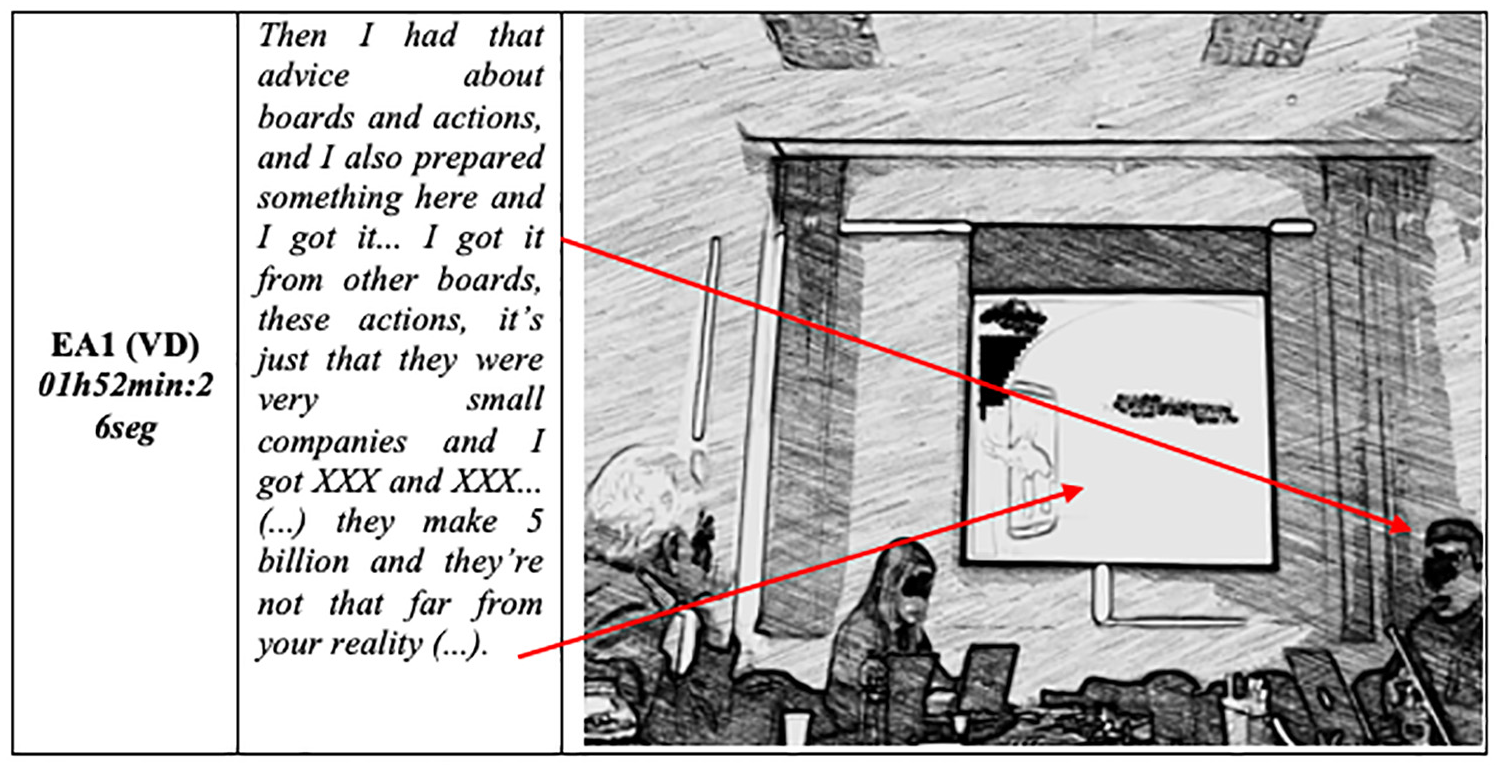
Excerpt of the ethnographic analysis I.
Analysis of Document Content
The second step was the analysis of document content to link and verify the longitudinal context of meetings. In terms of relevant documents, this study had access to the minutes of all 10 formal meetings of the advisory board of the organization. These minutes refer only to the meetings concerning proposals for the formation of strategies. They cover approximately 1 year, during which there were months in which more than one meeting was called while in others no meetings took place. Other documents that were provided were PowerPoint presentations used during meetings. The six files received also portray the longitudinal development of the meetings and provide an opportunity to compare and schematize the details that were selected in other analyses used in this study. This once again enabled and assured the longitudinal perspective of the phenomena.
To coding these documents were analyzed during the examination and organization of the material based on their successive and systematic readings, using analytical criteria in line with the theoretical assumptions of this study for the characterization, description, examination of recurring themes, encoding, interpretation and inferences (when necessary). The paragraphs of the documents that described an action that was performed, recommended, or instituted as relevant to the context of the study were highlighted. These highlighted paragraphs were then reread and organized into a matrix of relevance and convergence with the subjects identified in the analyses.
Thirteen subjects were considered relevant. This matrix followed the temporal character of the meetings and the how frequently and intensely the subjects were debated. This intensity was classified on a five-point scale, with 1 being low intensity of debate and 5 being high intensity. When the subject was not addressed at the meeting in question, a 0 was awarded. To evaluate the intensity, we counted the number of times words about the subject were repeated and the physical space they occupied in the minutes. For example, in the item “Absence of Strategic Planning,” the number of times the words “strategic planning,” “planning” and “strategy” were included in the minutes was considered and the physical space they occupied in the minutes (e.g., 3 of the 7 pages of the minutes). Finally, the sum of the scales was calculated, and the subjects were classified, considering the highest scores attributed to the sum. The results are shown in Table 3. The temporal characteristic of the documents was fundamental for demonstrating and verifying the veracity of some of the facts highlighted in the notes and perceptions of non-participant observers and audio and video records. In other words, the document analyses served as a source of data and at the same time sources of verification and triangulation of the data, lending greater rigor and reliability to the study.
Classification Matrix of Document Analysis.

Source. The authors.
In-Depth Interview
In the final step, the interview was also analyzed microscopically in two stages (Figure 3): Stage 1: The entire content of the recording was reviewed twice to mark the sections that contained arguments that refined and complemented the contexts of the themes and events (Guion et al., 2011). These categorizations were coded and interrelated for the temporal contextualization of the phenomena and to verify the veracity (or otherwise) of the episodes highlighted by other individuals at the meeting for the Strategy formation of the holding company; Stage 2: After marking and categorizing the points of interest in the conversation, it was possible to return specifically to the points and occasions highlighted in the video-ethnography for a more thorough and detailed analysis of the interactions. Thus, it was possible to connect, link and interpret them, attributing temporal and contextual specificities to episodes that, without this analysis of the interview, would remain “loose” concerning the theoretical propositions of the study.

Theoretical and methodological trajectory.
Findings
Analysis of Strategic Conduct in a Family Business Board
Expectations of the Social Positions of the Practitioners
The expectations of the social positions of the Practitioners on the board of the holding company translated into the interrelations between the social positions on the board. The positions of vice president (VP) or external advisor 1 (EA1), for example, generated expectations of social conduct during and even outside the holding of company meetings. The owners of the holding company knew exactly what led them to establish an advisory board: the current administrative and economic conditions and the organization’s need for survival.
During the in-depth interview with the external advisor 1 regarding Strategy and in the related excerpts of the minutes of meetings, the allegations of considerable growth for the organization, possible loss of control and lack of strategic planning showed discursively the consciousness of the owners and external advisers of the motives and intentions behind the creation and operation of the board.
However, among the motives for the contextual actions of the owners embedded in the episodes of the board meetings, there is also resistance to the ideas. Paradoxically, the ideas emerge with contextual urgency, given that bad results for different businesses were shown or reported in the meetings as a lack of synergy between businesses. These ideas were often rejected or not desired by the protagonists themselves. In the in-depth interview and the document analysis (Table 3), in many forms and contexts, there was often mention of setbacks and arguments, mostly between the vice president and external advisors. The VP and minority shareholder and the external advisors, mainly the external advisors 1 are protagonists in most of the conflicts. Looking more closely, we found that the interactions of other social actors, such as the president, relatives, and other members of the board, appear to be “palliative” or less confrontational than the interactions between the advisors and vice-president.
An analysis of the reflexive monitoring of the actions of the vice president was supported as the deliberate or intentional character of human behavior, considered within the flow of activity of the agent. This monitoring could be seen in several passages of the document analysis. For instance, when EA 2 says that the holding company has no strategic planning (second in classification in Table 3), the reaction of the VP is perceived in what he says rather than the proposition itself. There is a dialectic of control of social power exercised by the social actors. The discursive and practical reaction of discomfort on the part of the vice president appears to be rooted in the external structural elements that focus on his role.
In theory, one might expect that this should be the work of the vice-president of a holding company, to prepare and monitor strategic planning. As he was a vice president, despite being a minor shareholder with 24% of the shares, his social role is defined by structural elements beyond the company’s wall. From a VP of a holding company, at the business market level, he is expected to have in-depth knowledge of the characteristics and elements of the business in which he is socially embedded. Other skills expected from a vice president include decision-making, political and economic awareness, and academic qualifications.
By observing the data, we can establish the reflexive and knowledgeable capability of the social actors, the external advisers, and the vice-president. These social actors rely on structural properties outside of the holding company to validate (or not) their arguments. The current internal structure of the organization seems to be outside the expected social and operational administrative standards. The perspective of the performance (or the performance itself) of the social role of the vice-president of the holding company is affected by (and is affecting) the structure of the organization. There is a perceived recursive movement in this dialectic of social expectations.
Paradox of the Dialectic of Control of the Practitioners
The analysis of the video ethnography enabled observation of other motivational and social elements of the strategic conduct of the practitioners. The data showed how the practitioners handle the dialectic of control. In other words, it is how the less powerful administer resources to exercise control over the contextual power. The structural properties embedded in the technical and institutional environment of the board recursively influence, and are influenced by, the actions of the practitioners.
The video-ethnography data (e.g., Figure 2) were rich enough to show how external adviser 1 developed his practices and praxis (practice) in the social performance of his functions. The data showed that EA 1 used PowerPoint presentations that sought structural information outside of the holding company. Relying on legitimate administrative structural properties developed by other organizations reflects practical and discursive consciousness, in addition to the rationalization of action expected in the ongoing development of the social roles of the external advisers about the administrative goals of the holding company. The external adviser appears to attempt to perform their social roles with the central objective of “oxygenizing” the organization with new ideas for its survival (motivation of action). A specific example was that EA 1 used resources and rules that are available in external administrative structures to propose actions for future decisions by members of the board. By relying on administrative procedures already legitimized by other organizations, the adviser sought to influence the distribution of resources, as they ought to be allocated. In this particular case, he proposed the rules for the circulation and allocation of these resources through the social structure of the holding company. The central issue for the owners was that EA 1 was talking about a resource of power, specifically the power of decision of the owners and their families.
We identified an immediate and shared pattern of adverse reactions on the part of the owners regarding this proposal. The “deafening silence” and looks of amazement in the video-ethnography procedure as the advisor operationalized his work tools to continue the presentation of his idea. Perhaps, the most interesting finding of this study lies in the total social complicity of interaction (group manipulation) on the part of all the owners present at the meeting, and the complicity in their reactions. In other stages of the data analysis, great interactivity was observed between the VP and the EA 1. However, here the social resources to divert attention to another subject outside the scope, the silence or even the disdain shown to EA 1 through the difficulty he experienced in returning to the subject appear to have been shared by all the social actors. In other words, the owners seem to have shared the same meanings and used the same structural policies virtually arranged in the technical and institutional environment of the board’s meeting, when the structural change that lay in the subject of "power of decision” was raised.
Figure 4 is an excerpt of an analysis of this event. In this moment VP was trying to discourage the EA 1 and EA 2 proposition around resource allocation.

Excerpt of the ethnographic analysis II.
The owners, when necessary, are aware of and use social rules and resources in the virtual structure of the holding company to exercise power and control over the external advisories. We understand this as personal manipulation to the detriment of the organization’s interests.
Analysis of the Duality of Structure in a Family Holding
Duality Between the Actions of the Advisory Board and the Institutional Properties of the Organisational Field
Our data showed that the owners of the company used resources and rules within their grasp to affirm their authority (to manipulate) in contexts that were judged as inadequate and exposed by the external advisers at meetings. Although their claims over these resources and rules were legitimate, paradoxically, the owners have the external advisers as sources of resources from a broader social and administrative sphere. The legitimacy of the rules and resources of the owners is also guided by a wider social sphere of the business context. This means that both the social actors (owners and external advisors) are mirrored in external business contexts that are granted institutional legitimacy to justify the use of social rules and resources in interrelations during meetings. These resources and rules are made available regionally (place) in organizations with social and administrative routines (time) that are recognized as legitimate. Likewise, the wider business market provides the symbolic and cultural attribute that the external advisers are agents prepared to lead organizations in times of social and administrative transformation. In other words, there is a reproduction of the characteristics and external institutional norms that directly and indirectly affect the structure of the board of the holding company.
It is the degree of adjustment, irrespective of the perspective of the practitioners, with the social and institution influences spatially and temporally distant from the vaster business market that translates the notion of duality of structure in the organization. It is the recursiveness of the practices of the practitioners, through human agency observed and analyzed during meetings of the board that recreates the conditions of their social and administrative activities through their reflexive involvement in these actions. This recursive movement assumes that one aspect (the ordering or recursive structuration of practices) assumes the other (reflexive monitoring of conduct), thus constituting the fundamental theorem of structuration theory: the duality of structure. In other words, it is the dynamic of the articulation between action and institution that enables structural and institutional elements to be seen beyond their restrictive and stable facet, as a process in constant change, a dynamic durability of structure, to compensate for change and stability. This requires a temporal model of recursiveness of the structuration process at the holding company.
Discussion and Contribution
Table 4 was created to understand the main findings of the study, their evidence and their relationships with theoretical propositions developed.
Summary of Discoveries.

Source. The authors.
First, our findings revealed that the governance dynamics within the holding company’s advisory board were characterized by a complex interplay between social roles, power structures, and external influences. The establishment of the advisory board was driven by the company’s growth and the owners’ recognition of the need for strategic planning to ensure the organization’s survival. However, the interactions between key actors, particularly the vice president and external advisers, reveal underlying tensions and resistance to change (Amis et al., 2020; Heemskerk, 2019). The vice president’s role, shaped by external expectations, often conflicts with the strategic input of external advisers, leading to a dialectic of control where power is negotiated through both explicit and subtle means (Veltrop et al., 2021; Vieira, 2020). The use of external administrative practices by the advisers, aimed at bringing new perspectives to the company, was met with resistance from the owners, who asserted their control through social rules embedded within the organizational structure (Boivie et al., 2016; Heemskerk, 2019; Hirigoyen & Laouer, 2013). This dynamic highlighted the duality of structure in the organization where internal and external influences continuously shaped and reshaped the actions and decisions of the board members (Giddens, 1984; Jepperson & Meyer, 2021; Whittington, 2015). The findings suggested that the board’s effectiveness was hindered by the personal interests of the owners, who prioritized maintaining control over the strategic advice provided by the external advisers, potentially to the detriment of the organization’s long-term interests.
Second, the finds, also, revealed how the social agents performed these complex relations during the board meetings. The strategic formation process within the advisory board was influenced by a dynamic interaction between the social practices of the board members and the structural properties of the organization (Giddens, 1984; Rouleau & Cloutier, 2022; Vaara & Whittington, 2012). The owners utilized available resources and rules to assert their authority, yet these actions were simultaneously influenced and legitimized by broader social and administrative norms from the external business context. This duality of structure, where external institutional norms and internal practices continuously influence each other, reflects the ongoing process of change and stability within the organization (Giddens, 1984; Jepperson & Meyer, 2021; Whittington, 2015). The recursive nature of these practices, as observed in board meetings, underscores the need for a temporal model that accounts for the evolving interaction between action and institutional structures, as both adapt to and shape each other over time.
Model of Propositions Linking S-as-P and Structurationist Theory
This study contributes to advancing the application of analyses of strategic conduct and duality of structure, being applied to the analytical categories provided by Strategy as Practice during a structuration process of the advisory board of an organization. We elaborated a model of propositions, Table 5, originating from the results of the study and theoretical assumptions that we expect will help future research.
Propositions Concerning the Interaction of S-as-P and Structurationist Theory Elements.

Source. The authors.
From Proposition 1, the expectations regarding social positions of the practitioners assumed that the social actors act under the social expectations of their roles in the organization (Giddens, 1984). Through the suspension of the institutional attributes of their positions and the surrounding institutional environment, the analysis of strategic conduct showed the agency of the owners (Giddens, 1979, 1984; Whittington, 2015), often paradoxically, going against the decisions that focus on the adjustment of the organization.
The different social and technical practices of these social actors (Rouleau & Cloutier, 2022) end up having an impact on the process of structuring the holding company (Proposition 2). If the central goal was the adjustment of the company, their practices tend to be contrary to this goal, or at least different from the institutions socially reproduced in a global aspect of the organizational field (DiMaggio, 1991). This type of action tends to be perceived in detail through the longitudinal analysis of the interaction between agents in space and time. It is expected that the social structure composed of all social individuals tends to move in a direction to reproduce the structural elements through the suspension of institutional attributes (Giddens, 1984). The result of this recursive movement between the social agency of the individual and structure tends to be the return to expected practices or, by different results, the legitimation of new practices, even the paradoxical practices.
At another point in the analysis (Proposition 3), during the episode of actions for decision-making, the use of the rules and resources of agents (social manipulation) against the interests of the adjustment of the organization becomes clear. The shared meaning of the loss of power becomes central to the agents and the behavior expected from their social position in the organization once again becomes paradoxical and contradictory (manipulation behavior). This inference becomes more paradoxical and complex if observed within the context of the duality of the actions of the board and the strategic activities in the organizational field (Giddens, 1979, 1984; Whittington, 2015).
Finally, in Proposition 4, we realized the reflexive capability of the social actors using structural properties in the structure of the holding in the recursive adaptation of strategic practices. These structural properties tend to be elements externally localized on the organizational reference field. The strategies of structuration process of an organization depend on the level of adjustment of agency power of social individuals. It is the social structure that restricts and allows, at the same time, the paradoxical owner’s practices (Giddens, 1984; Rouleau & Cloutier, 2022; Whittington, 2015).
Conclusion and Directions for Future Research
In this study, we have examined how advisory board members in family-holding companies used their agency power (by analysis of strategic conduct) and structural properties in interaction with the organizational structure (Duality of Organizational Structure) to, paradoxically, influence their interests (recursiveness) in detriment of organizations interests. The study concluded that the interactions and power dynamics within the advisory board of the family-holding company were heavily influenced by both internal organizational structures and external institutional norms. The duality of structure was evidenced in how the practitioners—owners, vice-president, and external advisers—navigated and exercised control through these structures. The vice president, despite his minority shareholder status, was expected to uphold strategic planning and decision-making, yet his actions were influenced by external structural expectations. Meanwhile, the external advisers tried to use administrative practices legitimized outside the organization to influence decision-making, but found resistance from the owners that utilized social rules to maintain control. This recursive interaction, between internal and external structures, highlighted the complexity of governance in family businesses, where the balance between control and adaptability is constantly negotiated.
As research’s theoretical contributions, we highlight (i) the possibility of filling a gap identified in the field literature that aims to offer a substantive contribution, from our propositions to theorizing the relations between the daily practices of social actors in the organizations (S-as-P dimensions) and the duality of the organizational structure present in the temporality of the recursive movements of the actions of the decision, sometimes paradoxical and complex, when what is at stake is the long-term adjustment of organizations versus personal owners interests; (ii) another gap was to show through the analysis of strategic conduct which elements of rules and resources presents in the organizational structure the social actors used in the constitution of structuration process to influence their personal and organization interests (manipulation).
The managerial contribution of this study was to identify and describe the gaps between the formal discourse of organizational actors and their real social behavior during the structuration of the organizational process. Although it may seem trivial and has already been discussed in other works about disruptive and conflictual board social behavior, so far, we are not familiarized with any empirical work that has “surgically” pointed out the elements present in the internal and external structure of organizations and how it influences and legitimize the paradoxical social behavior of boards members. We understand that the knowledge and identification of these structural elements can help managers minimize and/or avoid paradoxical behaviors in the composition and execution of advisory boards during the formation of organizational strategies. In addition, it can be used in practice to make corporate dynamics clearer and more transparent, which often still appear obscure, especially in family business. Increasing transparency in corporate decisions could provide greater involvement of stakeholders and consequently increase investment.
We suggest that future studies address the structural analysis of boards in family and non-family organizations. The aim is to accumulate knowledge on the strategic activities of these practitioners (CEOs, Directors, TMTs, advisors, and external consultants) to construct a theoretical framework focusing on a sociological vision of these practitioners. It would also be interesting, if the possibility arose, to conduct a comparative study in organizations that do not have a family structure or family structure with an advisory board completely professionalized (without the presence of the owners). Also, we can speculate that advisory boards with greater monitoring of their decisions (transparency) can be investigated. Perhaps the increases of monitoring lead the social agents, independent of their social roles in an advisory board, to use structural properties differently.
Footnotes
Declaration of Conflicting Interests
The author(s) declared no potential conflicts of interest with respect to the research, authorship, and/or publication of this article.
Funding
The author(s) received no financial support for the research, authorship, and/or publication of this article.
Ethical Approval Statement
Ethics statement (including the committee approval number) for animal and human studies: In this study, ethical committee approval was not required.
ORCID iDs

Data Availability Statement
Data sharing not applicable to this article as no datasets were generated or analyzed during the current study.