




Abstract
Reading comprehension is one of the significant cognitive abilities that students develop during their early school years. The existing literature supports that explicit reading strategies can improve students’ reading comprehension. The present study investigated the effect of reciprocal teaching on reading comprehension among grade 7 students in English subject. The study is quantitative in nature, and the pretest-posttest nonequivalent control group design (PPNCGD) was used to meet the desired objectives. The sample comprised of 90 students of two intact classes of Grade 7 studying English in a public sector girls’ secondary school. Data were collected using a reading comprehension test (RCT) during pre and post-tests. Using SPSS, we applied independent and paired sample t-tests. Cohen’s d was used to estimate the magnitude of the treatment effect. The results revealed that reciprocal teaching practices have a statistically significant positive effect on the Grade 7 students’ reading comprehension in English. Based on the study’s results, we provided important implications for educators, students and teacher training institutions.
Plain Language Summary
This study looked at how reciprocal teaching affects reading comprehension in Grade 7 English students. Researchers tested this method in a public girls’ school with 90 students. The study used a pre-test and post-test design to measure improvement. Statistical tests showed that students who experienced reciprocal teaching improved significantly in their reading skills. The study suggests that this approach could help teachers, students, and teacher trainers enhance reading comprehension.
Keywords
Introduction
Reading comprehension represents the fundamental cognitive skill that students grasp during primary, elementary and secondary education (Brevik, 2019; García-Madruga et al., 2013; Mafarja et al., 2023; Schunemann et al., 2013). It is a complex interaction of various cognitive processes that enables the reader to construct meaning from text (Aktaş, 2025; Gruhn et al., 2020; Perfetti & Stafura, 2014). Being able to analyse a text and comprehend the substance of content remains a key to academic performance in school, and it also represents an essential prerequisite for deep-rooted learning throughout the life span (Hakkarainen et al., 2013; Schunemann et al., 2013; Wu & Chen, 2018). Similarly, reading comprehension is critical to acquiring creative thinking skills and allows the expression and communication of ideas across the globe (Mafarja & Zulnaidi, 2022; Saaverda, 2019).
Fostering students’ reading comprehension ability is important to transmit the reading into knowledge accumulation, productivity and performance of an individual (Amjad et al., 2022). However, reading comprehension is more than the capacity of word recognition and spelling correctly. It involves a complex interaction of several abilities, broadly categorised as learners’ lower-order and higher-order skills (Aktaş, 2025; Perfetti & Stafura, 2014). The lower-order comprehension abilities refer to the knowledge at the lexical level vocabulary of words, while higher-order abilities require input from lower-order comprehension abilities, and it entails competence in sentences and text (Huang, 2024).
The reading comprehension of primary and secondary school students is very poor in lower-income and middle-income developing countries (The World Bank, 2019). In South Asian countries, including Pakistan, nearly 58% of middle and secondary school students struggle with basic reading comprehension (The World Bank, 2019). Pakistan’s educational policies and assessment procedures emphasise grades as a single performance measure for teachers and students at the school level (Naviwala, 2019). Moreover, grade-based incentives encourage students and teachers to concentrate on the outcome rather than the learning process. Emphasising reading outcomes, such as grades, over developing genuine reading comprehension skills is a major factor reinforcing reliance on rote learning (Naviwala, 2019). This focus encourages students to memories content rather than deeply understand and analyse it (Huang, 2024; Komariah et al., 2015; Naviwala, 2019; Teevno & Raisani, 2017). It is argued that teachers have often criticised rote learning for fostering mechanical reproduction of information, promoting shallow learning and encouraging passive, uncritical learning habits (Bhattacharya, 2022). This approach typically centres around memorising standardised chunks of information, which limits opportunities for deeper exploration and critical thinking. As a result, students may miss out on developing analytical skills and understanding concepts more meaningfully, as rote memorisation prioritises recall over comprehension and synthesis (Hay, 2007; Pande & Relia, 2020).
To develop students’ reading comprehension ability, explicit instruction in different situations is required to improve reading skills and autonomy (Amin et al., 2024). Research has indicated that reading strategies profoundly impact students’ reading comprehension (Afflerbach et al., 2008; Huang, 2024; Mafarja & Zulnaidi, 2022). Thus, knowledge of different reading comprehension strategies and their use in a specific situation is a valuable skill that helps the reader become an independent learner (Cervetti & Pearson, 2023; Mafarja et al., 2023; Pressley & Gaskins, 2006). The reading strategies are cognitive routines, techniques and procedures to construct meaning from text. They can refer to cognitive and meta-cognitive strategies that help readers monitor the errors and their failure to comprehend and improve the reading process (Dole et al., 2009; Huang, 2024).
Students enrolled in public sector schools in Pakistan cannot apply the meta-cognition strategies while reading (Teevno & Raisani, 2017). As a result, students with poor reading skills at the primary, elementary and high school levels manage to pass exams and progress to college. However, they often continue these ineffective reading habits into their university years, perpetuating the problem without significant improvement in higher-order abilities of comprehension skills (Bailey, 2009; Gruenbaum, 2012).
The most important instructional practice, based on cognitive strategies and explicitly designed to foster reading comprehension, is reciprocal teaching (Aktaş, 2025; Dole et al., 2009; Mafarja & Zulnaidi, 2022; Oo et al., 2021). Reciprocal teaching is an instructional framework pioneered by Palinscar and Brown (1984) that entails cognition and meta-cognition comprehension monitoring strategies (Lentillon-Kaestner & Roure, 2024; Mafarja et al., 2023).
Existing literature provides evidence supporting the effectiveness of reciprocal teaching in enhancing reading comprehension (Aktaş, 2025; Castek & Beach, 2013; Chang & Lan, 2021; Chatoupis & Vagenas, 2018; Mafarja & Zulnaidi, 2022; Mandel et al., 2013; Schunemann et al., 2013; Yang, 2010). In addition, Slatter and Hortsmen (2002) also assessed the effect of reciprocal teaching on readers’ cognitive ability. The results of their study indicated that reciprocal teaching was very helpful in avoiding cognitive failure while reading. Several studies report the positive effect of reciprocal teaching also on the academic performance of struggling readers in different cultural contexts (Aktaş, 2025; Gruenbaum, 2012; Okkinga et al., 2018). More recently, Aktaş (2025) found a positive effect of reciprocal teaching on reading comprehension skills and extrinsic reading motivation in the cultural context of Turkey. Similarly, Oo et al. (2021) found evidence for the effectiveness of reflection-based reciprocal teaching on reading comprehension in the case of Myanmar. However, no study investigated the effect of reciprocal teaching strategies on students’ reading comprehension in the Pakistani cultural context. Furthermore, most existing evidence is based on studies using true experimental designs with small groups of students with limited basic reading skills, often isolating these students from the whole classroom setting. Considering these implications and methodological gaps, the current study adds to the literature by evaluating the effectiveness of reciprocal teaching in a whole-class setting. Since reciprocal teaching is rooted in cooperative learning, we incorporated small groups within the whole-class environment. This broader application allows for a more comprehensive understanding of how these strategies can be scaled for diverse classroom environments in Pakistan, providing valuable insights for educators and policymakers seeking to enhance reading comprehension at a larger scale. The study’s focus on girls’ higher secondary schools highlights the potential impact of reciprocal teaching on female students in a society where gender disparities in education persist. Analysing the effectiveness of student-centred approaches like reciprocal teaching for girls can help promote equitable learning opportunities. The study’s main objective is to investigate the effect of reciprocal teaching on the reading comprehension of Grade 7 students in English.
Literature Review
Theoretical Background
Reading comprehension is widely recognised as a complex, purposeful activity that involves extracting and constructing meaning through interaction with written language (Guo et al., 2024). It encompasses two essential learning processes: First, extracting explicit information from the text, which includes identifying relevant details and understanding vocabulary and second, making an inference from the information to understand the meaning of texts (Acosta & Ferri, 2010; Guo et al., 2024). This process requires a combination of cognitive skills (e.g. vocabulary and decoding abilities) and mental resources (e.g. attention, memory and prior knowledge). The construction-integration model of Kintsch (1998) provides a detailed framework for understanding the multifaceted nature of reading comprehension. According to this model, comprehension emerges from the interaction between the text base and the reader’s prior knowledge and experiences. Similarly, the Direct and Inferential Mediation (DIME) model proposed by Cromley and Azevedo (2007) highlights the interconnectedness of various skills in reading comprehension. This model identifies vocabulary, background knowledge, reading strategies, word reading and inference-making as essential comprehension components. It emphasises the mediating role of inference-making in linking these variables to the overall comprehension process.
Cognitive models such as these define reading comprehension processes and provide insights into effective instructional methods. Research suggests teaching cognitive strategies can significantly improve students’ comprehension skills (Dole et al., 2009). The goal is to equip students with the tools employed by proficient readers, thereby enabling them to become ‘strategic readers’ (Leahy, 2006).
One effective method for promoting reading comprehension is reciprocal teaching, which integrates the explicit instruction of reading strategies with scaffolding and guided practice. This approach aligns with research emphasising the importance of modelling, direct strategy instruction and guided application (Pressley & Gaskins, 2006). It leverages this principle by fostering interactions among peers and between students and instructors, facilitating learning through shared expertise and support. Integrating cognitive models, such as the Construction-Integration and DIME models, with reciprocal teaching offers a powerful approach to enhancing reading comprehension. Focusing on explicit strategy instruction, scaffolding and collaborative learning helps students develop the cognitive tools necessary for constructing meaning from texts, ultimately transforming them into more proficient and confident readers.
Reciprocal Teaching
Reciprocal Teaching consists of four comprehension strategies to improve reading comprehension (Aktaş, 2025; Mafarja et al., 2023; Mafarja & Zulnaidi, 2022). It works as a dialogue between student and teacher. Dialogue is structured using four key comprehension strategies: generating questions, summarising, predicting and clarifying. These strategies are designed to actively engage students and enhance their reading comprehension (Lentillon-Kaestner & Roure, 2024; Pilonieta & Medina, 2009). Reciprocal Teaching is based on conversations between teachers and students before, during and after reading. Ketch (2005) claimed that conversation is crucial for developing critical thinking. Students need to discuss with others to think more about the text. This discussion-driven comprehension strategy aims to understand the meaning of the text (Chen et al., 2023; Mafarja & Zulnaidi, 2022; Palinscar & Brown, 1984). In reading studies that employ reciprocal teaching strategies, children’s development is influenced by their own experiences and the contributions of peers and teachers, who serve as key stakeholders in the process (Aktaş, 2025). This strategy is rooted in Vygotsky’s theory of social interaction, which guided us that thinking and discussion are essential for the learning process (Foster & Rotoloni, 2005; Oo et al., 2021). In other words, he explained that children can successfully tackle challenging tasks through collaboration with peers or adults. Vygotsky (1978) social constructivism theory aligns well with reciprocal teaching, as this approach operates within the framework of cooperative learning methods.
This approach incorporates scaffolding activities and the theory of the zone of proximal development to support students, emphasising the crucial role of adults and more knowledgeable peers in fostering children’s learning and development (Doveston & Lodge, 2017; Okkinga et al., 2018; Pilonieta & Medina, 2009). Vygotsky (1978) functionally linked the concept of scaffolding to his theory of the zone of proximal development. This zone represents the gap between the level a student can achieve independently and the higher level of development they can reach with assistance from others (Cervetti & Pearson, 2023). Similarly, Foster and Rotoloni (2005) argued that group instruction is very important for students. It helps them to exchange their ideas by giving and taking responses from other classmates when they are in a group before and after reading. Students will start to internalise these strategies when they consistently hear the thoughts of their peers and start to use them during their independent reading. The teacher will model the strategy for students to make them more comfortable and familiar (Doveston & Lodge, 2017).
Methodology
Research Design
The current study was quantitative, and one of the quasi-experimental designs, the ‘pretest-posttest nonequivalent control group design’, was used to test the influence of reciprocal teaching strategy on Grade 7 students’ comprehension. This design was used considering its broader implications in such contexts. The true experimental design necessitates random subject selection for experimental and control groups, disrupting whole classes and disturbing the class schedule. As a result, due to the anticipated difficulty in gathering dispersed subjects in one place, the school administration did not allow the use of a true experimental design for the study. In psychology and the social sciences, quasi-experimental design is frequently employed for experiments. The experimental design of the study is presented in Table 1
Pre-test and Post-test Non-equivalent Control Group Design.

Controlling the Threats to Validity
The simultaneous removal of all threats to internal validity is impossible, but a maximum number of threats to internal and external validity can be successfully managed (Fraenkel et al., 2011). In the Pretest-Posttest Nonequivalent Control Group Design, there are two possible threats to internal validity: differential selection and statistical regression. Moreover, the Pretest-treatment interaction is a threat to the external validity of this design (Gay et al., 2012).
The differential selection of participants is the main threat to internal validity in quasi-experimental and non-equivalent control group designs. To avoid selection bias, we took pre-tests from all sections of the seventh-grade students in the selected school classes with a small initial difference in the pre-test scores. However, treatment was assigned randomly to the group. We selected a girls’ school to eliminate the confounding variable of gender, and the age of pupils in both experimental and control groups was nearly the same. Moreover, we utilised the same length of teaching time, same reading materials, same tests and the same classroom setting to prevent any threats to the internal validity. To avoid the threat of statistical regression researchers confirmed through pre-tests that participants did not possess extremely low or extremely high scores in both intact classes. The pretest-treatment interaction is a threat to the external validity of this design (Gay et al., 2012). However, the pre-test treatment interaction threatens external validity in studies involving subjective measures such as attitude scales or the variables measured on ordinal scales (Gay et al., 2012). However, they have minimal impact on objective tests like reading comprehension. Hence, the pre-test treatment interaction is not an issue in the reading comprehension test.
Participants and Setting
A public sector higher Secondary School for Girls in District Muzaffarabad was selected for intervention through convenient sampling. The sample school is representative of the population of typical public sector schools in Pakistan, with big class sizes, somewhat larger room sizes, and the majority of students coming from low to medium socioeconomic and educational backgrounds. The study’s sample included all pupils from two intact seventh-grade classes studying English at a Government Secondary School for Girls. There were four sections of the seventh class. There were 45 students in each group. In experimental research, meaningful inferential statistics requires a minimum of 15 subjects in each group to compare the mean difference between the groups (Borg & Gall, 1984), and a class size of 45 students provides a reasonable degree of freedom for applying inferential statistics.
Intervention
In line with Oczkus (2013), a thorough study of reciprocal teaching strategies helped us to implement reciprocal teaching practically in the classroom during the treatment. To implement the reciprocal teaching strategy in the classroom, we designed lesson plans from the chapters of an English textbook for class seven. The lesson plans were designed and guided by Oczkus (2013). All features and dimensions of reciprocal teaching were incorporated into lesson plans. Two English teachers validated lesson plans. All worksheets, four-door charts, fab four mats and lists for pre-test and post-test were prepared before starting the intervention. A four-door chart is a graphic organiser divided into four sections, each representing one of the reciprocal teaching strategies: predicting, questioning, clarifying and summarising. Students use it to record their thoughts and responses while engaging with a text. A Fab Four Mat is a collaborative tool that outlines the four strategies of reciprocal teaching .it provides spaces for predicting, questioning, clarifying and summarising, helping students work individually or in groups to practice these skills systematically.
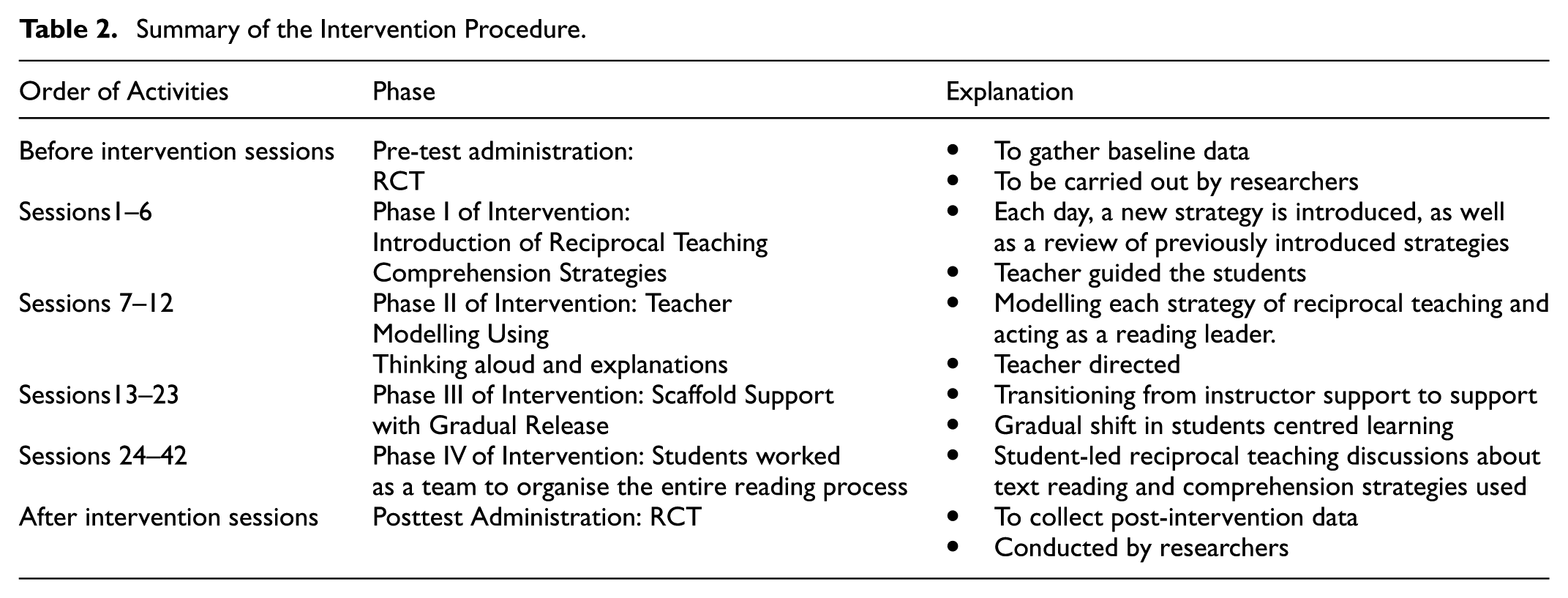
The students taught with reciprocal teaching were divided into eleven heterogeneous groups. According to Wang (2013), ‘heterogeneous grouping is more common in elementary schools’. Each group comprised four students, whereas the students taught with the traditional grammar-translation methods were taught as a whole class. To execute the intervention properly and for balance teams, the reciprocal teaching group’s students were divided into high, medium and low achievers based on their pre-tests. The 11 students with the highest, 11 with the lowest and the 22 with medium scores were identified as high, low and medium achievers. Then, according to the most generally utilised team formation one high, two medium and one low achiever were randomly assigned to each team. The 45 students were divided into 11 teams (10 groups with four members each and one group with five members). The procedure for the whole intervention is summarised in the following Table 2.
Summary of the Intervention Procedure.
Research Instruments
We constructed a reading comprehension test (RCT) to assess pupils’ reading comprehension abilities. This test was based on knowledge and comprehension levels of Bloom’s taxonomy of educational objectives. The test was planned by preparing the table of specifications. There are some standardised tests for testing the comprehension ability of students, such as the Cloze test. However, these tests are primarily designed for students studying English as a first language (Singer, 2007). Moreover, these tests emphasise word recognition and vocabulary instead of the overall comprehension ability of the students (Shanahan et al., 1982; Singer, 2007). Hence, we developed reading RCT instead of standardised tests. Assessing text comprehension often involves asking questions, including true or false, multiple-choice and why questions (Brown, 2013). The comprehension test consisted of six short passages, and 30 MCQ items followed the passages. One mark was allotted to each MCQ, and the total marks were 30. With the special assistance of class teachers, the researchers constructed the tests. Pre-tests and post-tests were constructed after a detailed study of the different procedures and practices of test development (Gellert & Elbro, 2013). To align the comprehension test with the national curriculum level, passages were selected from chapters of the Azad Jammu and Kashmir Textbook of English for seventh graders.
The pre-test and post-test were the same; however, the post-test had a different item arrangement. Furthermore, the pre-test results were not shared with the subjects because this practice could affect their performance in the post-test. Utilising the same items ensures that the pre-test and post-test measure the same skills and knowledge, clearly comparing students’ progress. This approach allows for precise evaluation of the improvement attributable to the intervention, as it eliminates variations caused by differing test content. The reading comprehension test was administered in their regular classroom following the instructions for administering the test. Overall reading comprehension test was comprised of 30 items. These thirty objectives were prepared from six lessons of the VII textbook. Three lessons were selected from the topics covered by the students in the classroom, while the remaining three were selected from the content not covered by the learners in the classroom.
The validity of the CRT was established prior to data collection. Initially, a pool of 60 MCQs was developed to develop the comprehension test. The experts evaluated the content validity of the 60-item reading comprehension test. The study’s supervisor and four field professionals were among the experts: An associate professor at the Department of English, University of Azad Jammu and Kashmir, the subject teacher, with an M.Phil. in English and 20 years of experience in teaching English at an elementary and secondary level and mainly two elementary English language teachers who have been teaching English to Grade 7 for last 5 years. The panel of subject matter experts evaluated each item. Based on their ratings, items identified as having high ambiguity, being double-barreled, using jargon, or being overly lengthy were removed from the assessment. Due to experts’ evaluative validity, about 12 items were deleted from the initial test.
If reading passages is tough, students cannot activate their prior knowledge and become phrase-dependent. As a result, it is critical to ensure that a passage is of a suitable difficulty level for the students being evaluated and includes contextually relevant content (Sasaki, 2000). In this regard, item analysis is the most appropriate technique to check the difficulty level and discrimination power of the different multiple-choice questions of the reading comprehension test. The item analysis is the most important phase of the test development process, as item retention and item elimination are mostly based on the item analysis (Danuwijaya, 2018; Mehta & Mokhasi, 2014). As a result, item analysis was utilised to assess the difficulty level and discrimination power of the reading comprehension test’s multiple-choice questions. Using items analyses, only those multiple-choice questions with a discrimination power greater than .3 and an item difficulty index between .37 and .62 were selected for the final test. This criterion is based on the existing literature on the item analysis for the retention of items in a test (see, for instance, Danuwijaya, 2018; Mehta & Mokhasi, 2014). The 18 items were removed from the reading comprehension test because these items did not satisfy the criteria of item difficulty and item discrimination to retain an item in a test. Hence, 30 multiple-choice questions were selected for the final reading comprehension test. This final version of the test was administered as a pre-test and post-test to assess the reading comprehension of the experimental and control groups.
To ensure reliability, the comprehension test was pilot-tested on 45 students apart from the subjects of the study but with the same features and studying in Grade 7 under similar conditions. The reliability of the instrument was investigated by using Cronbach’s Alpha. If the coefficients yield more than .7, the test is regarded as acceptable, and if the coefficients yield more than 0.8, the test is rated very good (Madan & Kensinger, 2017; Tavakol & Dennick, 2011). The Cronbach Alpha reliability coefficient of the final comprehension test reveals that the comprehension test was internally consistent. The result of the Cronbach Alpha reliability coefficient of the final comprehension test is reported in Table 3.
Cronbach Alpha Values for Reading Comprehension Test.
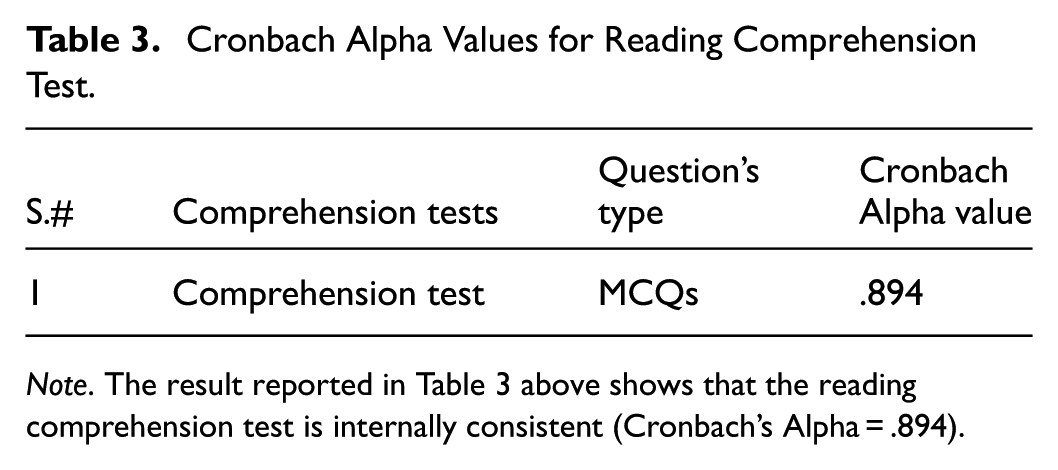
Note. The result reported in Table 3 above shows that the reading comprehension test is internally consistent (Cronbach’s Alpha = .894).
Findings
After collecting data, it was screened out for missing values. Then, it was analysed using SPSS (Statistical Package for Social Sciences) version 27. The data’s normality was tested before employing independent and paired-sample t-tests to make the study’s findings more reliable. The K-S and S-W tests were applied to evaluate the normality assumption of the data acquired in the pre-test and post-test. The results of the normality tests are reported in Table 4.
Tests of Normality for Pre-test and Post-test Scores.

Table 4 shows that both tests used to check the normality of data are statistically insignificant (p > .05). Hence, we fail to reject the null hypothesis of the normality of the data. Hence, our data of pre-test scores is approximately normally distributed. Similarly, results for post-test scores reported in Table 1 again confirm that the chosen sample is again normally distributed as both tests fail to reject the null hypothesis of the normality of data (p > .05). Hence, our data of post-test is also approximately normally distributed.
To test the mean difference between the pre-test and post-test of the experimental group, the paired-sample t-test was used. Hence, within groups, normality is also important. Within groups, normality tests are reported in Table 5.
Tests of Normality for Pre-test and Post of Experimental Group.

The results reported in Table 5 again confirm that the distribution of the chosen sample is not significantly different from the normal distribution in both the pre-test and post-test of the experimental group. This is evident from the fact that we fail to reject the null hypothesis of the normality of the data (p > .05) for both the pre-test and post-test of the experimental group. These results allowed us to use an independent t-test to test the difference.
The results reported in Table 6 show that, on average, participants who were taught with reciprocal teaching (M = 18.36, SD = 2.61) and those who were taught with traditional grammar translation method (M = 18.69, SD = 2.92) are approximately similar or close to each other. The results reported in the above table also reveal that the mean difference of pre-test scores for experimental and control groups was statistically insignificant t (88) = .54, p = .589. Therefore, we fail to reject the null hypothesis. These results support the claim that both groups had equivalent reading comprehension before the experiment.
Results of Independent Sample t-test for the Difference in Mean Scores of Reading Comprehension in Pre-test.

The independent sample t-test was used to compare the mean difference in post-test reading comprehension scores for the experimental and control groups. Table 7 reports these results.
Results of Independent Sample t-test for the Difference in Mean Scores of Reading Comprehension in Post-test.

The results reported in Table 7 show that the mean score on the post-test for the experimental group—the group that was taught with reciprocal teaching (M = 23.96, SD = 2.03) was greater than the mean score on the post-test for the control group (M = 20.41, SD = 3.92). The results further reveal that the mean difference of post-test scores between the two groups was statistically significant t (88) = 5.26, p = .001, with a large size effect based on Cohen’s d estimate (1.24). Therefore, the null hypothesis was rejected. Moreover, it may be safely concluded that the students who were taught with reciprocal teaching strategies, on average, performed better in reading comprehension than those students who were instructed with conventional teaching practices.
Discussion
Reading comprehension is a fundamental cognitive skill critical to academic success, particularly in the context of students in primary and secondary education. However, in Pakistan, students face unique challenges in reading and comprehending text due to their limited exposure to English. Most public sector schools emphasise grades and use outdated instructional practices for teaching the subject of English that encourage rote memorisation (Gulzar & Qadir, 2010; Kazi & Iqbal, 2011; Teevno & Raisani, 2017). The educational policies and assessment procedures focusing on grades further encouraged teachers and students to use rote memorisation as a strategy (Kazi & Iqbal, 2011; Teevno & Raisani, 2017; Warsi, 2004). This study explored the effectiveness of reciprocal teaching, a strategy emphasising collaborative learning and dialogue on reading comprehension, particularly among Urdu-speaking students, to provide insights within a distinct linguistic and cultural context.
Reciprocal teaching is an instructional practice pioneered by Palinscar and Brown (1984). The link between reciprocal teaching and reading comprehension has been excessively investigated in the existing literature. However, this study is based on a sample of Urdu-speaking students; hence provides an opportunity to explore the effectiveness of reciprocal teaching in a different language and cultural context. The study’s results reveal a positive and statistically significant effect of reciprocal teaching on the students’ reading comprehension. These results are consistent with existing literature. Most of the existing studies find a statistically significant positive effect of reciprocal teaching on the reading comprehension of primary, elementary and secondary students (Gruenbaum, 2012; Mandel et al., 2013; Okkinga et al., 2018; Tseng & Yeh, 2018). More recently, Aktaş (2025) found a positive effect of reciprocal teaching on reading comprehension skills and extrinsic reading motivation in Turkey’s cultural context. Similarly, Oo et al. (2021) find evidence for the effectiveness of reciprocal teaching on reading comprehension in Myanmar.
One plausible explanation for the observed improvement is the collaborative nature of reciprocal teaching, which fosters student engagement and active participation. Using strategies such as summarising, questioning, clarifying and predicting, students may develop higher-order cognitive skills that contribute to better comprehension (Okkinga et al., 2018; Tseng & Yeh, 2018). Furthermore, the interaction between students and teachers during the reciprocal teaching sessions might have created a more inclusive and supportive learning environment, often absent in traditional rote-based instructional methods (Aktaş, 2025).
Despite the positive results, several questions remain unanswered. For instance, which specific elements of reciprocal teaching were most impactful in improving comprehension skills? Did students find certain strategies, such as questioning or summarising, more beneficial than others? Additionally, the study’s design did not investigate how different student groups—such as low achievers or students with varying English proficiency—responded to reciprocal teaching, leaving potential differential impacts unexplored.
Conclusion
The study’s findings reveal that students taught using the reciprocal teaching method outperformed those taught using conventional methods in reading comprehension. This demonstrates that student-centred teaching practices, such as reciprocal teaching, significantly impact reading comprehension in English. Furthermore, the results confirm that reciprocal teaching is an effective instructional strategy for improving the reading comprehension skills of Grade 7 students in English.
The study also provides additional evidence for the success of reciprocal teaching in Urdu-speaking linguistic and cultural contexts, further validating its applicability in diverse classroom settings. These findings strengthen the case for reciprocal teaching as a practical and effective method for enhancing reading comprehension, especially in multilingual environments.
Based on these findings, it is recommended that teachers incorporate reciprocal teaching into their instructional practices as a proven method for improving reading comprehension at the elementary level. Teacher training programs should integrate reciprocal teaching into their curricula, ensuring that pre-service teachers have the skills to implement this strategy effectively. Additionally, professional degree programs in education should emphasise reciprocal teaching as a core instructional approach for reading comprehension.
Educational management should organise workshops and training sessions for in-service teachers to facilitate the adoption of reciprocal teaching in classrooms. These efforts will ensure teachers are well-prepared to apply this method and enhance student learning outcomes. By embedding reciprocal teaching into pre-service and in-service teacher education, educational institutions can promote more effective and student-centred instructional practices.
Limitations and Future Direction
In the present quantitative study, we used a ‘pretest-posttest nonequivalent control group design’. However, quasi-experimental designs can estimate internally valid and unbiased causal effects for various educational interventions (Gopalan et al., 2020). However, lack of randomness is a major limitation of this design and unobserved confounding factors simultaneously changing at similar times can affect the outcomes. Hence, future research should use a true-experimental design to investigate the influences of reciprocal teaching on reading comprehension, especially in the Pakistani cultural context. Additionally, integrating classroom observations or student feedback into the research design could provide deeper insights into the teaching dynamics and areas for further improvement. Similarly, since the present study focuses on a sample from public sector girls’ higher secondary schools, future research should explore and compare the performance of male and female students in reciprocal teaching contexts.
The study has important implications for teachers, students and teacher training institutions. For instance, teachers should incorporate this interactive, student-centred approach into their instructional practices to foster deeper understanding in students. By using reciprocal teaching, educators can move beyond rote memorisation and promote active engagement with texts. As reciprocal teaching encourages collaboration, discussion and self-reflection, helping students develop the skills necessary to understand and analyse complex texts. Similarly, institutions should train prospective teachers in the design and implementation of these strategies, ensuring they are equipped to enhance students’ reading comprehension skills effectively
Footnotes

Funding
The authors received no financial support for the research, authorship and/or publication of this article.
Declaration of Conflicting Interests
The authors declared no potential conflicts of interest with respect to the research, authorship and/or publication of this article.
Data Availability Statement
Data is available and can be submitted upon a reasonable request due to data privacy.