



Abstract
In the real world, environmental and social risks coexist, and the interactions among these multiple risks necessitate research on risk perception in a multi-risk context. This study aims to explore how the public perceives multiple risks and to investigate perception differences based on sociodemographic factors. Based on the classification of the United Nations Office for Disaster Risk Reduction, 14 risks were investigated through a web-based survey of 1,035 individuals from South Korea. We employed a latent class model (LCA) to identify confounding sources among risk perceptions and utilized multinomial logistic regression to examine factors influencing risk perception dimensions. Cognitive and affective risk perceptions were found to be higher for climate change and global warming, air pollution, destruction of biodiversity and the environment, economic crisis, recession, low fertility, aging of society, and depopulation. Women, residents of Gwangju, Jeolla, and Jeju, and college-educated participants were more sensitive to cognitive risk perception. Those aged 30 to 39 and of lower economic status were more sensitive to affective risk perception, whereas men were less sensitive. Cognitive and affective risk perceptions were distinct but correlated. These findings provide insights for improving decision-making in crisis situations by informing the government and policymakers about public priorities. Specifically, by identifying demographically sensitive subgroups, the study can contribute to enhance risk communication strategies.
Introduction
There is growing recognition that risks frequently coexist with other environmental and social threats, and these threats can interact to intensify one another within multi-risks (Kappes et al., 2012; Sullivan-Wiley & Short Gianotti, 2017). Natural disasters such as floods, landslides, and earthquakes occur concurrently (Shah et al., 2023). Environmental and social risks often interact, with one facilitating the other (Sullivan-Wiley & Short Gianotti, 2017). As the world’s population grows, and mobility and communication technologies improve, multiple risks can quickly become pervasive and affect large populations simultaneously (Choi et al., 2021). For example, several countries, including South Korea, experienced the COVID-19 pandemic accompanied by the risk of economic crisis (Jeong et al., 2020; Noy et al., 2020). Therefore, applying the concept of multiple risks to real-world risk-related research is imperative (Khan et al., 2020).
The United Nations Office for Disaster Risk Reduction (UNDRR) divided multiple risks into several categories (Murray et al., 2021), and a research has categorized the interrelationships between multi-risks into five: triggering, change condition, compound, independence and mutually exclusive (Tilloy et al., 2019). The impact of risk on social, political, and economic dimensions can vary depending on risk perception (Burns & Slovic, 2007). However, how the general public perceives multiple risks remains unclear. While recent studies have described multiple risks classifications in geography, urban planning, and safety, there is a lack of research on how different risks are perceived, as they focus on the significance, characteristics, interactions, impacts, and frequency of risks (Hariri-Ardebili, 2020; Kappes et al., 2012). Furthermore, studies on multiple risk perception have primarily been confined to natural hazards (Brown et al., 2021; Kappes et al., 2012; Papagiannaki et al., 2019), and have tended to analyze each risk individually, resulting in a lack of integrated approach (Shreve et al., 2016).
Previous studies have primarily focused on risk perceptions from either a cognitive (Sullivan-Wiley & Short Gianotti, 2017) or affective perspective (Cullen et al., 2018). However, as suggested by dual process theory, risk perception in response to external stimuli is a complex process involving the interaction of cognitive evaluations and emotional responses (Epstein, 1994; Slovic & Peters, 2006). This means that, alongside cognitive assessments of risk, emotional reactions—such as anxiety or fear—must also be considered. Research in Australia has demonstrated that a dual processing model, which incorporates both cognitive and affective risk perceptions, can effectively predict risk responses to flooding (Altarawneh et al., 2018). Similarly, studies on public health disasters, such as MERS-CoV outbreak, have examined the interplay between affective and cognitive risk perceptions to better understand the mechanisms behind public risk perception (Jang et al., 2020). Despite these efforts to apply dual process theory to natural disasters, public health issues, and disaster preparedness, previous studies have often investigated individual risks in isolation. Therefore, there is a pressing need for comprehensive research that integratively considers both cognitive and affective dimensions in the context of multiple risks.
In real-world contexts characterized by the coexistence of multiple risks, it is imperative to establish response priorities based on perceiver characteristics. Risks recognized by perceivers differ based on demographic characteristics, value orientations, and levels of domain-specific knowledge and understanding (Siegrist & Árvai, 2020). The EU’s guidelines on risk assessment techniques, ISO IEC 31010, emphasized the significance of acknowledging human factors such as socioeconomic status, ethnicity, culture, and gender when evaluating risks (ISO, 2019). Research on risk perception has identified differences influenced by various factors, including gender (Alsharawy et al., 2021; Brown et al., 2021; Cullen et al., 2018; Gustafson, 1998; Khan et al., 2020; Papagiannaki et al., 2019), age (Carstensen et al., 2020; Cullen et al., 2018; Pearman et al., 2021), political ideology (Bruine et al., 2020; Calvillo et al., 2020; Jang et al., 2020), education level (Cullen et al., 2018; Reed-Thryselius et al., 2022; Yu et al., 2020), and socioeconomic status (Dosman et al., 2001; Reed-Thryselius et al., 2022). Additionally, connections have been reported with religion (Chilanga et al., 2022; Krok et al., 2022), individualism, optimism, and information accessibility (Cullen et al., 2018). Notably, gender has been recognized as a crucial factor in risk perception, with findings indicating that women generally assess risks more highly than men (Alsharawy et al., 2021; Cullen et al., 2018). Furthermore, the disparities in risk perception linked to political ideology became particularly evident during the pandemic, where liberals tended to perceive risks as greater than conservatives (Bruine et al., 2020; Calvillo et al., 2020; Jang et al., 2020). These differences can lead to divisions among community members in the face of external threats, exacerbating social unrest during crises. Despite several studies examining the association between risk perception and sociodemographic characteristics, the association between multiple risks and the cognitive and affective perceptions associated with sociodemographic factors remain largely underexplored. In South Korea, prior research (Jang et al., 2020; Jeong et al., 2020) has primarily focused on single risks, underscoring the need to investigate how various risks are perceived and how these perceptions differ based on sociodemographic factors.
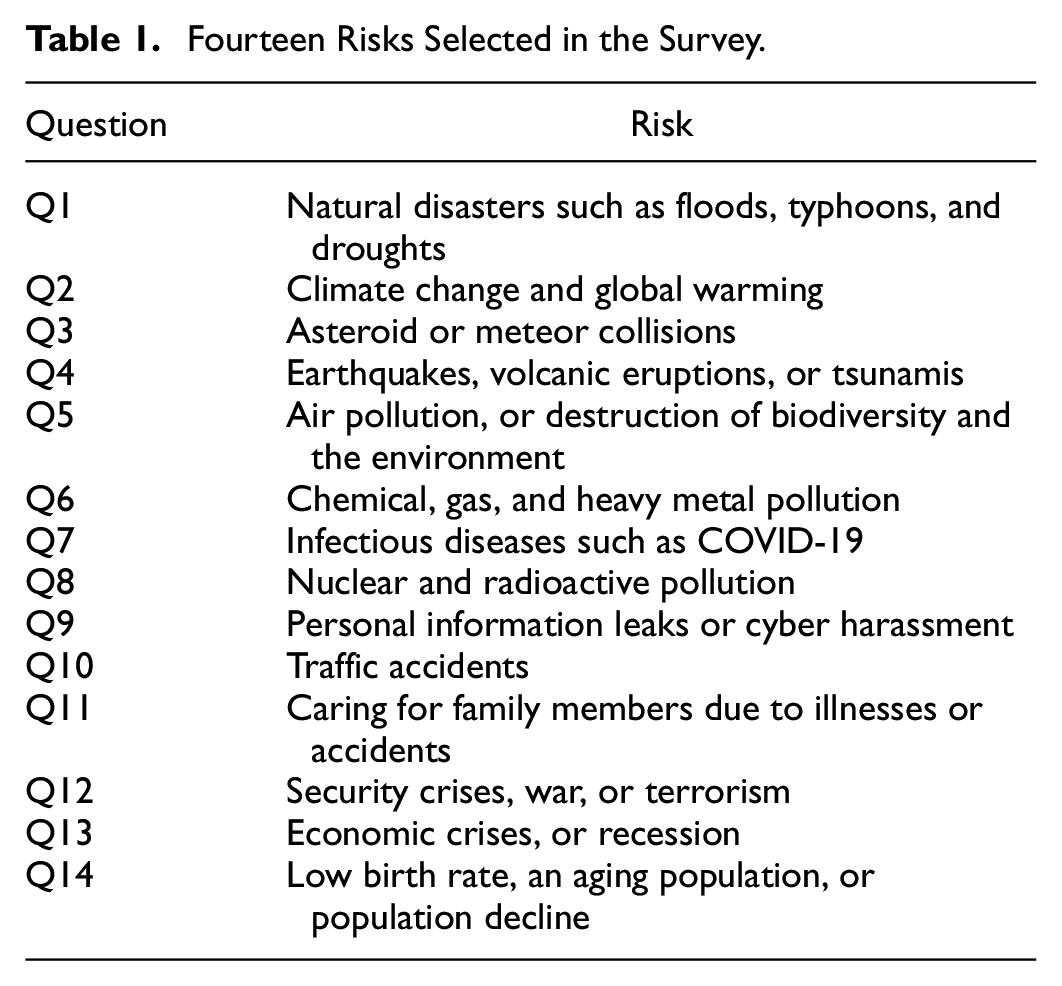
We examined the risk perceptions of 14 multi-risks, including natural disasters and man-made risks, using exploratory methodology such as latent class analysis (LCA) (Meyer & Morin, 2016). The perceptions of the general public to multiple risks were investigated by examining the interaction of multiple risks as a whole, including (1) natural disasters such as floods, typhoons, and droughts; (2) climate change and global warming; (3) asteroid or meteor collisions; (4) earthquakes, volcanic eruptions, and tsunamis; (5) air pollution, and destruction of biodiversity and the environment; (6) chemical, gas, and heavy metal pollution; (7) infectious diseases such as COVID-19; (8) nuclear and radioactive pollution; (9) personal information leaks, cyber harassment; (10) traffic accidents; (11) caring for family members due to illnesses or accidents; (12) security crises, war, and terrorism; (13) economic crises, recession; and (14) low birth rate, aging populations, and population decline.
This study hypothesizes that:
H1: Multiple risks can be grouped according to the level of cognitive and affective risk perception.
H2: Being female older is associated with higher risk perception in situations where multiple risks are considered simultaneously.
Thus, this study aims to conduct an exploratory analysis of multiple risks by classifying 14 different risks based on their levels of risk perception. Additionally, it seeks to identify specific population groups that may be particularly vulnerable to risk perception when multiple risks are considered simultaneously.
Methods
Study Design and Population
Data were obtained from a cross-sectional survey conducted August 23–31, 2022. Participants were selected from a probability-based Gallup research panel after stratification by gender, age, and province such that the sample reflected the characteristics of adults in South Korea. A total of 1,035 participants aged 19 years and older were included, with a response rate of 45.7%. The self-administered web-based survey was conducted by Gallup Korea, an affiliate of Gallup International.
Following several discussions, the authors selected 14 major risks based on the eight risk clusters presented in the 2020 UNDDR report, with additional consideration of the Korean social context. Cognitive and affective risk perception scores were recorded for each of the 14 risks, as summarized in Table 1. Cognitive perception was evaluated on a 4-point scale using the question, “How likely are you to be harmed by each of the following?” A score of 4 indicated “not at all likely,” 3 indicated “not very likely,” 2 indicated “somewhat likely,” and 1 indicated “very likely.” Affective perception was rated on a 4-point scale using the question, “How worried are you that you might be harmed by each of the following?” A score of 4 indicated “not worried at all,” 3 indicated “not very worried,” 2 indicated “a little worried,” and 1 indicated “very worried.” In addition to the risk perception scores, data were collected on demographic factors, including each individual’s residential area, gender, age, household economic status, average household income per month, educational attainment, employment, religion, and political ideology. The employment variable was excluded because our preliminary analysis suggested a possible pattern only for farming, forestry, and fishing jobs, for which the sample size was too small to draw statistically meaningful conclusions.
Fourteen Risks Selected in the Survey.
Demographic Factors
The distribution of participant characteristics is shown in Supplemental Table S1 We investigated eight demographic factors, including age, gender, economic status, education, religion, residence, and political ideology, which were found to be related to risk perception in previous studies and consist of Gallup Korea’s basic statistical survey items. The administrative divisions of South Korea are divided into eight cities (Seoul, Incheon, Dajeon, Sejong, Busan, Deagu, Ulsan, Gwangju) and nine provinces (Gyeonggi, Chungbuk, Chungnam, Gangwon, Jeonbuk, Jeonnam, Gyeongbuk, Gyeongnam, Jeju). Based on population and geographic proximity, Jeonnam and Jeonbuk are grouped together as Jeolla, and Chungnam and Chungbuk as Chungcheong. Thus, we divided the residential areas into six categories based on geographic cultural proximity, and population: Seoul, Incheon/Gyeonggi, Daejeon/Chungcheong/Sejong/Gangwon, Gwangju/Jeolla/Jeju, Daegu/Gyeongbuk, and Busan/Ulsan/Gyeongnam.
Age (in years) was divided into 18–29, 30s, 40s, 50s, 60s, or older. Participants rated their household economic status across five levels: upper, upper middle, middle, lower middle, and lower. Average household income per month (in 10,000 won, or approximately $8 in US dollars) was divided into below 200, 200−299, 300−499, 500−699, and 700+. Education was divided into two categories using tertiary education as a criterion. Religion was classified into four categories (Buddhism, Protestantism, Catholicism, and no religion). Political ideology was categorized using the three-level spectrum of conservative–neutral–liberal. After a close examination of the unreliable inputs, we concluded that their removal did not distort the overall pattern, thereby establishing an effective sample size of 976 in the subsequent analysis.
Analysis
We first examined the distributions of response rates for the 14 questions regarding the cognitive and affective risk perceptions associated with multiple risks. The paired sample Wilcoxon signed rank test was conducted to verify the significance of the locational discrepancy between the cognitive and affective perception scores using Bonferroni adjusted p-values. The correlation structures within and between the two dimensions of risk perception were investigated based on pairwise Spearman’s correlation coefficients for the 28 (=2 × 14) questions.
To verify our research hypothesis H1, we adopted the latent class model (LCA) to identify the confounding sources among risk perceptions based on the clustering of participants. LCA is an individual-centered that differentiates potential classes based on the characteristics of specific variables reported by individuals and characterizes them with different sets of parameters (Meyer & Morin, 2016). The analysis results were used to group the multiple risks based on the class probabilities. The study population was divided into four latent classes based on the Bayes information criterion. Detailed information on LCA is provided in the Supplementary Material.
Multinomial logistic regression was employed, with class membership determined by the posterior probability of the LCA. This approach enables us to identify the factors that significantly affect the two dimensions of risk perception, thereby validating hypothesis H2. The regression model was adjusted for residential area, gender, age, household economic status, household income, education, religion, and political ideology. The coefficients and associated p-values were calculated to examine the effects of the covariates on the log odds.
Results
Distributions of Risk Perception Scores
Risk perception was rated on a 4-point scale; however, in the subsequent analysis, the scores of 3 and 4 were combined into category 3 to guarantee the stable estimation of the parameters because the proportions of response 4 were too small, except for Q3 (asteroid or meteor collisions; around 2.5% on average). The three resulting categories 1, 2, and 3 represent high, middle, and low-risk perceptions, respectively. The sample proportions for the categories are summarized in Table S2 in the Supplementary Material. As shown in Supplemental Table S2, cognitive risk perceptions were higher (scores closer to one) than the corresponding affective risk perceptions, except for Q8 (nuclear and radioactive pollution) and Q11 (caring for family members due to illnesses or accidents).
Spearman’s rank correlation coefficients were calculated to examine correlation structures within and between the two dimensions of risk perception. Pairwise correlation coefficients were obtained for all 378 pairs consisting of 28 questions. Supplemental Figure S1 summarizes the result using the correlation matrix, showing that all the pairwise coefficients were positive, which indicated that all the responses to the questions were positively correlated.
Based on the interpretability of the model and the overall fit assessed using the Bayes information criterion, the number of latent classes was set to four. Figures 1 and 2 show the plots of the class conditional probabilities for each latent class at the cognitive and affective levels, respectively. Each group of red bars represents the conditional probabilities by the latent class of response 1 (high-risk perception). Supplemental Tables S3 and S4 present the exact values of the probabilities. Our results indicated that risk perception increased from latent classes 1 to 4, with class 1 having the lowest risk perception and class 4 having the highest risk perception.

Estimation of the latent class model for the cognitive risk perception.

Estimation of the latent class model for the affective risk perception.
The conditional probabilities summarized in Tables S3 and S4 in the Supplementary Material can be used to characterize the questions associated with higher risk perception across the population and examine the middle classes, 2 and 3. At the cognitive level, Q2 (climate change and global warming), Q5 (air pollution, destruction of biodiversity, and environment), Q13 (economic crises, and recession), and Q14 (low birth rate, aging population, and population decline) were associated with high-risk perception for classes 2 and 3. In addition, Q1 (natural disasters such as floods, typhoons, and droughts), Q7 (infectious diseases such as COVID-19), and Q9 (personal information leaks and cyber harassment) were associated with high-risk perception for class 3. The cognitive and affective results differed only in that Q9 was replaced by Q11 (caring for family members due to illnesses or accidents) at the affective level. The results support our research hypothesis H1 that multiple risks can be grouped according to the level of cognitive and affective risk perception. Probability values of latent classes represent the severity of the multiple risks at the perceiver’s level across the population; correspondingly the hierarchy of the risk sources based on priority is summarized in Table 2.
Hierarchy of Risk Sources Based on the Prioritization Determined by the Class Conditional Probabilities Obtained in the Latent Class Model.

Note. Q1 = natural disasters such as floods, typhoons, and droughts; Q2 = climate change and global warming; Q3 = asteroid or meteor collisions; Q4 = earthquakes, volcanic eruptions, or tsunamis; Q5 = air pollution, or destruction of biodiversity and the environment; Q6 = chemical, gas, and heavy metal pollution; Q7 = infectious diseases such as COVID-19; Q8 = nuclear and radioactive pollution; Q9 = personal information leaks or cyber harassment; Q10 = traffic accidents; Q11 = caring for family members due to illnesses or accidents; Q12 = security crises, war, or terrorism; Q13 = economic crises or recession; Q14 = low birth rate, aging population, or population decline.
The multinomial logit model was fitted to the class membership determined by the posterior probability with eight demographic factors as covariates. We chose latent class 3 as the baseline category and measured the regression coefficients for the log odds of classes 1, 2, and 4 against class 3. Tables 3 and 4 contain the estimates of the effect parameters and corresponding p-values for the cognitive and affective perceptions, respectively, calculated based on the three-step estimation approach (Weller et al., 2020).
Coefficient Estimates and Their Standard Errors (in Parentheses) for the Multinomial Logit Model in Which the Predicted Latent Class Variable for Cognitive Risk Perception Is Regressed on a Set of Demographic Factors.

p-value < .05. **p-value < .01. ***p-value < .001.
Coefficient Estimates and Their Standard Errors (in Parentheses) for the Multinomial Logit Model in Which the Predicted Latent Class Variable for Affective Risk Perception Is Regressed on a Set of Demographic factors.
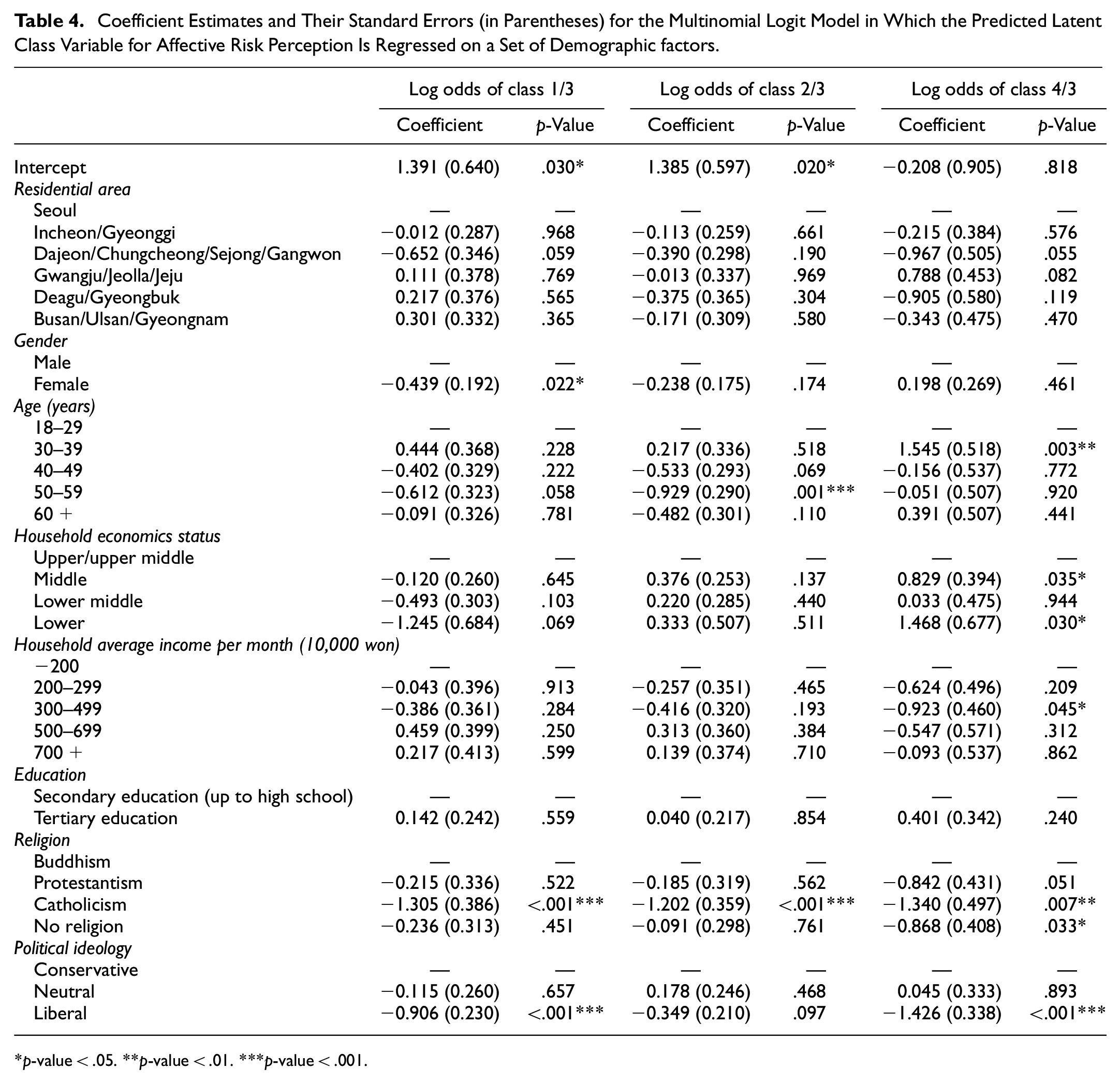
p-value < .05. **p-value < .01. ***p-value < .001.
The regression results revealed interesting patterns of class-moving factors (from the middle classes 2 and 3 to both sides, 1 and 4 in particular). First, we consider the results for cognitive perception. Individuals living in Gwangju, Jeolla, and Jeju regions were more likely to belong to class 4, whereas those living in Busan, Ulsan, and Gyeongnam were more likely to belong to class 1. Because only seven participants lived in Jeju, the first regional effect was mostly due to Gwangju and Jeolla. Women had significantly lower odds of belonging to class 1 and higher odds of belonging to class 4 than classes 2 and 3. Although the age variable seemed to be significant to some degree, a close examination of the signs of the coefficients with a baseline change confirmed that age did not possess a clear linear pattern for risk perception. The only exception was that individuals aged ≥60 were more likely to belong to class 1. The odds of individuals belonging to class 1, compared to classes 2 and 3, decreased with household economic status. This effect was most pronounced in the lower economic status group. Individuals with higher average household income were less likely to belong to classes 3 and 4. The effect was far greater for average incomes ≥50,000 won. Tertiary education had a significant positive effect on the odds of belonging to class 4. Further, on close inspection, we concluded that religion did not have a statistically significant linear effect on cognitive risk perception. Individuals with liberal political tendencies were less likely to belong to classes 1 and 2.
The effects of the covariates on risk perception were less clear at the affective level. The regression results implied that residential area, income, and education did not have a significant effect on affective risk perception. The odds of belonging to class 1, compared with classes 2 and 3, decreased significantly for women. Similar to the case of cognitive perception, age, in general, did not have a linear pattern of effect on affective risk perception; the only exception was that individuals aged 30 to 39 years were more likely to belong to class 4. Examination of the regression results with a change in the baseline implied that the odds of individuals belonging to class 1 against class 2 decreased in proportion to the household economic status. Conversely, the odds of individuals belonging to class 4, compared to classes 2 and 3, increased as economic status decreased. This effect was greatest for the lower economic status group. As in the case of cognitive perception, religion did not have a statistically significant linear effect on affective risk perception. Political ideology also did not have a linear effect since the odds of individuals belonging to classes 1 and 4 decreased simultaneously with increasing liberal political tendencies.
The analysis results provide evidence in support of hypothesis H2. In addition, Supplemental Table S5 summarizes the coefficients estimated for 28 separate logistic regression models (with high risk perception as response 1) for a complete understanding of the effects of the covariates. Examination of the signs and p-values of the estimates helped us understand why certain covariates were statistically significant in the latent class model.
Discussion
This study is the first exploratory study to examine multiple risks simultaneously, including economic and social risks as well as natural disasters, across two dimensions: cognitive and affective risk perceptions considering the effects of sociodemographic factors. The main contribution of our analysis lies in the establishment of a framework within which the perceptions of multiple risks can be analyzed simultaneously. Among the 14 multiple risks, two social and two environmental risks were perceived as high in both cognitive and affective risk perception. There was no significant difference in the level of risk hierarchy perceived by the public, either affectively or cognitively. The effect of sociodemographic factors such as age, income, education, and political ideology was different for cognitive and affective risk perception.
Specifically, among the 14 multiple risks examined, we revealed that climate change, global warming (Q2), air pollution, destruction of biodiversity and the environment (Q5), economic crises, recession (Q13), low birth rate, aging population, and population decline (Q14) were perceived as relatively higher risk both cognitively and affectively. The Korean public perceived environmental (Q2, Q5), economic (Q13), and social risks (Q4) as the most serious. In this study of South Koreans, social and environmental risks were perceived as high, whereas war and accidents were perceived as low risk, similar to Yang’s (2015) findings. According to the theory of the availability heuristic, individuals may develop biased judgments that lead them to believe that events they are frequently exposed to are more likely to occur (Keller et al., 2006). As a result, individuals may have a heightened awareness of environmental issues such as global warming and air pollution—topics that they encounter more frequently—compared to less common events like wars or accidents, which have a more direct impact on their lives. Additionally, the severity of these crises may further amplify public perception. Climate change is considered one of the most serious global crises, to the extent that it has recently been renamed the “climate crisis” (Guterres, 2019). The risk of air pollution and destruction of biodiversity, either as a cause or consequence of the climate crisis, is also widely acknowledged. In the context of South Korea, the challenges posed by high levels of particulate matter (PM2.5) and climate anomalies resulting from warming (Office for Government Policy Coordination & Korea Meteorological Administration, 2023) position climate and environmental issues as the most pressing concerns faced by the country. In addition, the pandemic-related recession has raised concerns about an economic crisis both domestically and internationally (J. Lee & Yang, 2022). South Korea has the lowest fertility rate in the world (0.78, 2022), far lower than that of other countries (Ahn, 2023). Furthermore, South Korea is aging faster than Japan’s super-aged society. Therefore, low fertility and an aging society are considered significant risks in South Korea (Kim & Kim, 2020).
Consistent with existing research on the effects of gender, age, and education, the present study showed how gender, age, and education specifically affect cognitive and affective risks perception. In this study, women reported higher risk perceptions in both cognitive and affective risk perceptions. Our findings were consistent with those of previous studies that found gender to be an important factor in risk ratings across various risks (Brown et al., 2021; Gustafson, 1998). Recent studies indicate that women are more inclined to perceive risk and they are reported to have higher risk perceptions and more tend to behave in more preventive ways (Alsharawy et al., 2021; Cullen et al., 2018). In case of age, the present study indicates that those over 60 years old perceived lower cognitive risk and those 30 to 39 years old perceived higher affective risk. These results suggest how to understand the contradictory findings that 20-year-olds have lower risk perception than 30-year-olds and that risk perception decreases with age. A previous study has shown that people in their 20s are less likely to perceive the risk of coronavirus than people in their 30s (Wise et al., 2020). The finding that older age is associated with lower risk perception is consistent with previous studies (Cullen et al., 2018; Kellens et al., 2011; Siegrist & Árvai, 2020; Sullivan-Wiley & Short Gianotti, 2017). Previous studies conducted during the pandemic found that physically vulnerable older adults reported more emotional resilience despite their health vulnerabilities (Carstensen et al., 2020; Pearman et al., 2021). These findings for older age suggest that the cumulative experience and problem-solving skills acquired with age may lead to a stronger sense of possible controllability over risks. Based on previous studies and the results of this study, it can be interpreted that the effects of cognitive risk perception and affective risk perception may vary depending on age. Furthermore, the study showed that people with higher levels of education reported higher cognitive risk perceptions. This finding could be explained by the fact that some previous studies have reported that higher levels of information about risks are associated with higher risk perception (Yu et al., 2020). Expressly, higher education facilitates the possibility of greater proximity to information about risks, and the more information a person has about risks, the more likely they are to perceive them as real risks. Increased risk perception based on accurate information may also be adaptive, as it promotes proactive and preventive behavior (Ning et al., 2020).
The current study indicates that the influence of regional political identity and religious characteristics could also affect cognitive risk perception. In South Korea, regional political identity affects the evaluation of government competence. Gwangju and Jeolla provinces, considered relatively progressive, are still attached to the opposition party (the Democratic Party), whereas provinces such as Deagu, Gyeongbuk, Busan, Ulsan, and Gyeongnam, considered relatively conservative, are the support bases of the governing party, the People Power Party (C.-H. Lee, 2006). Perceived government performance is related to competence-based trust, which is in turn closely associated with risk perception (Jang et al., 2020). Residents of the opposition party region (Gwangju, Jeolla) have greater doubts regarding the government’s capabilities and are more sensitive to various risks. Residents of the Busan, Ulsan, and Gyeongnam areas were more likely to be generous in their competence-based trust in the current government (Jang et al., 2020; C.-H. Lee, 2006). Interestingly, religion was also associated with high cognitive risk perception as well as low perception; that is, Protestantism was significantly observed in both sensitive and insensitive risk-perceiver groups in South Korea. These results were only found for Protestants, not other religions, which may imply that the relationship between risk perception and specific faiths differed according to the national context (Chilanga et al., 2022; Krok et al., 2022). However, further research is needed to determine why Protestantism in South Korea seems to be associated with risk perception in both directions.
The academic and practical implications of the study’s findings are as follows. From an academic perspective, the study categorizes multiple risks and presents a hierarchy of these risks. Additionally, since the study revealed distinctions and correlations between cognitive and emotional risk perceptions across multiple risks rather than a single risk, it reinforces the dual-process theory (Epstein, 1994; Slovic & Peters, 2006). Based on this exploratory study of multiple risks, future research should analyze the underlying pathways and mechanisms of risk perception. The findings offer critical insights for government and policymakers when facing multiple risks simultaneously in real-world situations. By identifying four highly recognized risks in South Korean society, the study reveals the issues that the public considers more urgent during periods of overlapping multiple risks. Understanding what issues the public perceives as most urgent can inform the prioritization of responses and highlight social urgency in disaster and crisis situations, thereby playing a crucial role in decision-making for government and policymakers. Furthermore, by identifying demographically sensitive subgroups to risks, the study points to groups that require strengthened risk communication. During crisis response, government and risk communication officials should consider the characteristics of these demographic groups and not overlook the importance of emotional responses based on affective perception, alongside factual data closely related to cognitive perception.
Limitations and Suggestions
The current study’s simultaneous consideration of multiple risks is meaningful. However, more sophisticated research designs and statistical analyses are required to further analyze the simultaneous relationship between multiple risks. Repeated measures of multiple risk factors can illuminate the prioritization of multiple risks in the general population. Second, our results do not reflect how the relationship between sociodemographic factors and risk perceptions changes over time. Respondents’ perceptions of each risk will likely change according to the continuous variations in their viewpoints. Third, the modified UNDRR risk classification framework was not validated. Fourth, media exposure was not investigated at the time of the survey; however, it is easy for the general public to perceive the risks reported in media, such as newspapers, more sensitively. Finally, since it was difficult to find a theory or model for multi-risk perception, this study exploratively applied the dual process theory of risk perception. This study contributes to further research on multi-risk perception, resulting in an evidence-based model or framework.
Conclusion
Our study attempted to classify risks according to priority based on the perceivers’ characteristics and reveal the sociodemographic sensitivity of multi-risk situations. We found that both cognitive and affective risk perception are relatively higher in climate change and global warming; air pollution, destruction of biodiversity and the environment; economic crises, recession; and low fertility, aging society, and depopulation. Sociodemographic factors such as gender, age, education, economic status, residential area, and religion were associated with risk perception, as in previous studies. However, the specific relationship between sociodemographic factors and risk perception differed across cognitive and affective dimensions. Examining the public’s perceptions of multiple risks will enable the development of content and direction for risk-related communication, public education, and social campaigns. From an academic perspective, the study categorizes multiple risks and presents a hierarchy of these risks. During crisis response, government and risk communication officials should consider the characteristics of higher-risk perceivers in practical respect. In conclusion, this study’s strength lies in considering various risks such as natural disasters, environmental problems, and accidents simultaneously. Considering that risks are experienced simultaneously in real life, it is meaningful and important to consider multiple risks. Therefore, it is suggested that future studies can be based on this study and provide practical suggestions and implications.
Supplemental Material
sj-docx-1-sgo-10.1177_21582440251321269 – Supplemental material for Comparison of Multi-Risk Perceptions and Sociodemographic Characteristics in South Korea: Cognitive and Affective Dimensions
Supplemental material, sj-docx-1-sgo-10.1177_21582440251321269 for Comparison of Multi-Risk Perceptions and Sociodemographic Characteristics in South Korea: Cognitive and Affective Dimensions by Ryemi Do, Kwan-Young Bak, Seung Yeon Lee, Myoungjee Jung, Seoyeon Kim, Deok Hyun Jang, Yookyung Eoh and Won Mo Jang in SAGE Open
Footnotes
Authors’ Contributions
Ryemi Do: Conceptualization, Methodology, Validation, Writing-original draft, Writing-review and editing. Kwan-Young Bak: Conceptualization, Formal analysis, Methodology, Validation, Visualization, Writing-original draft, Writing-review and editing. Seung Yeon Lee: Conceptualization, Validation, Writing-review and editing. Myoungjee Jung: Conceptualization, Validation, Writing-original draft. Seoyeon Kim: Formal analysis, Methodology, Validation, Visualization, Writing-original draft, Writing-review and editing. Deok Hyun Jang: Conceptualization, Data Curation, Investigation, Methodology, Validation, Writing-original draft, Writing-review and editing. Yookyung Eoh: Conceptualization, Methodology, Supervision, Validation, Writing-original draft, Writing-review and editing. Won Mo Jang: Conceptualization, Methodology, Supervision, Validation, Writing-original draft, Writing-review and editing.
Declaration of Conflicting Interests

Funding
The author(s) disclosed receipt of the following financial support for the research, authorship, and/or publication of this article: The work of Kwan-Young Bak was supported by the National Research Foundation of Korea (NRF) grant funded by the Korea government (MSIT) (No. RS-2024-00342014).
Ethical Approval
This study was reviewed and approved by the Institutional Review Board (IRB) of the Seoul Metropolitan Government-Seoul National University Boramae Medical Center (IRB No. 07-2023-29). The IRB also approved the waiver of the need for informed consent because of the analysis of anonymized pre-survey data.
Data Availability Statement
Data from this study cannot be publicly shared because we have used third-party data from Gallup Korea and are not entitled to share the data. Gallup Korea has ownership of the data, and those interested can contact them for the results of the survey. However, access to the raw data is only provided to researchers conducting a joint study with a Gallup Korea researcher. Detailed data approval procedures are carried out in accordance with Gallup Korea’s internal guidelines. More information is available at
Supplemental Material
Supplemental material for this article is available online.
References
Supplementary Material
Please find the following supplemental material available below.
For Open Access articles published under a Creative Commons License, all supplemental material carries the same license as the article it is associated with.
For non-Open Access articles published, all supplemental material carries a non-exclusive license, and permission requests for re-use of supplemental material or any part of supplemental material shall be sent directly to the copyright owner as specified in the copyright notice associated with the article.
