




Abstract
Memorable tourism experience is regarded as an important concept in understanding tourists’ travel experiences; however, emotional solidarity toward local residents and its influence on volunteer tourists has not been studied in the field of volunteer tourism. To fill this research gap, this study proposes a theoretical model that integrates emotional solidarity (which consists of three dimensions: feeling welcomed, emotional closeness, and sympathetic understanding), with memorable tourism experience and destination loyalty. The results show that volunteer tourists’ perceptions of emotional closeness and sympathetic understanding with residents directly affect tourists’ loyalty to the destination. In particular, the relationships involving volunteer tourists’ feeling welcomed by residents, emotional closeness, and sympathetic understanding with residents, and destination loyalty were all mediated by memorable tourism experience. This study contributes to the revitalization of volunteer tourism by examining the impact of emotional factors developed with local residents on the tourism experience of volunteer tourists while visiting the area.
Introduction
Tourists are not only pursuing leisure, but also real experiences. Nowadays, many tourists, especially the younger ones, desire to choose a form of tourism that can give them a unique high-value experience, such as living like a local, having deeper integration into the culture and making the world different (Wyse Travel Confederation, 2016). In order to meet these needs, volunteer tourism, as a new tourism paradigm, appeared in the tourism market (Wearing, 2003; Wu et al., 2018).
Volunteer tourism (VT) was a primarily European phenomenon, then expanded to a variety of countries including the United States and Australia, growing to also include Asian and African participants (Alexander, 2012; Lo & Lee, 2011). The VT industry experienced significant growth since 1990, and the participation and research of VT had increased exponentially in the past 30 years (Kim & Cuskelly, 2017). VT has become an industry worth billions of dollars in which people feel they can make a difference, becoming popular in the process as tourists see it as an excellent opportunity to experience various cultures and gain personal development. In Western countries, the operation of VT relies more on non-governmental organizations (NGOs), while in China, VT relies more on commercial platforms (Yang & Tong, 2017). Every year there are about 1.6 million volunteer tourists around the world; they come from different origins, but the majority are female, students, have completed a college education, and are aged between 19 and 26 (Bargeman et al., 2018; Thrive Global, 2017). Meanwhile, some volunteer tourism organizations (VTOs) have grown on an impressive scale. For instance, from 1971 to 2018, Earthwatch Institute (2020) recruited more than 100,000 volunteers in 1,400 research projects in over 120 countries, devoting 10 million hours to scientific fieldwork. In addition, as one of the world’s most trusted VTOs, International Volunteer HQ (IVHQ, 2020) has recruited 113,255 volunteers since 2007 traveling to more than 50 destinations for childcare, teaching, medical and healthcare, wildlife and animal care, and construction and renovation volunteer projects. As one of China’s most popular VTOs, Gapper (2020) has recruited 79,609 volunteer tourists traveling to Asia, Africa, and Oceania. Another famous Chinese VTO, Oriental Connect International Volunteer Association (OCIVA, 2020), has about 7,000 volunteer tourists annually. Due to the benefits of longer vacations and more spending to the local economy (Academia, 2020), more research has been called for to better understand the VT phenomenon, especially among young tourists. In fact, with the cooperation of local communities, NGOs, and destinations, a variety of projects have been carried out, promoting the development of VT worldwide (Voluntourism.org, 2018). This growth in the industry and along with existing research results certainly merit further study.
VT is becoming increasingly popular around the world (Conran, 2011; Keese, 2011) with tourists who want to immerse themselves in local culture, establish deeper relationships with local communities, and contribute to community development and nature conservation (Ong et al., 2011; Ooi & Laing, 2010; Sin, 2009). Defined as using free time and income to travel to help others in need (McGehee & Santos, 2005), it is positioned in the range of alternative tourism. Brown and Morrison (2003) said that the main reason why VT had increased in recent years was that mass tourism had brought various negative effects to tourism destinations which included traffic, environmental, and economic impacts as well as cultural influences and commercialization. Therefore, it is useful to develop VT given the positive benefits it has, such as bringing a sense of achievement for the public good and solving the feeling of burnout for people who work hard. Different from mass tourism, this form of tourism is believed to provide an authentic, creative, and mutually beneficial relationship between tourists and residents (McIntosh & Zahra, 2007), which suggests that increased interaction between volunteer tourists and residents can promote the development of cross-cultural communication, and positive emotions which can reduce tension and improve global peace (Freya, 2003). Thus, VT is regarded as sustainable tourism, which has the potential to build up alternative and positive relationships between volunteer tourists and destination residents (McIntosh & Zahra, 2007). Despite the essence of VT, few studies have investigated the destination loyalty (DL) of volunteer tourists, although the competence to retain tourists is vital for volunteer tourism organizations and destination management organizations. By studying volunteer tourists’ DL, they can find the significance of effective marketing strategies and innovative service design, which is of great importance for retaining existing volunteer tourists (Lee et al., 2013).
Tourist experience is essential to the nature of the tourism and hospitality industries. It does not take place in a vacuum state, many plans are required at the destination level with individual services (Cetin et al., 2017).
With the intensification of competition, it is more recognized that destinations need to create and provide memorable tourism experiences (MTEs) for tourists in order to improve their competitiveness (Neuhofer et al., 2012, 2015). When tourists determine to travel and look for information to choose a destination, they often look back on past experiences. Internal information searches are likely to be the first step in the process of tourists searching for information (Chandralal & Valenzuela, 2013; Kim, 2014). In recent years, MTE has attracted the attention of researchers and practitioners. Researchers believe that MTE is an excellent predictor of future behavior and stands as a new benchmark in tourism (Chandralal et al., 2015; Kim et al., 2012; Neuhofer et al., 2014).
Meanwhile, MTE is both an opportunity and challenge for destination management organizations, marketers, and practitioners as it is an indispensable driver of DL (Barnes et al., 2016; Chandralal & Valenzuela, 2013). With competition among destinations becoming increasingly fierce, tourism authorities and government officials are devoting more energy and resources to improving tourist loyalty. In recent years, tourist DL has become one of the most popular research topics in the tourism and hospitality literature (Gursoy et al., 2014; Meleddu et al., 2015; Prayag et al., 2015). As some scholars have pointed out, the antecedents of loyalty have been studied extensively, among which MTE is one of the most important (Ribeiro et al., 2018).
Given the high level of MTE offered to tourists, further intentions can be predicted (George, 2010). It is crucial to understand the degree to which MTE of tourists is enhanced by relationships with residents in the destination to encourage future visits. This relationship transformed through emotional feelings can be analyzed by constructing emotional solidarity (ES), which includes feeling welcomed, emotional closeness, and sympathetic understanding (Woosnam et al., 2009). Research in sociology, social psychology, and anthropology (Clements, 2013; Ferring et al., 2009) have recognized the essence of the concept of ES to explain other constructs. According to Woosnam and Aleshinloye (2013), it is possible to explain the intention of revisiting by examining the relationship between ES of tourists and DL. Some scholars (e.g., Zhang et al., 2014) proposed that one way to study the role of ES in explaining tourists’ MTE and DL is through the development and testing of integrated models. However, so far, works focusing on the ES of tourists have only considered the loyalty to the destination, and none is about tourism experience (e.g., Ribeiro et al., 2018; Woosnam & Aleshinloye, 2013) or integrating a model that combines the ES of tourists and residents, which calls for further study of potential relationships. In this process, developing and testing a mediation model will allow the theoretical correlation between variables to be improved and contribute to further theory development ultimately. In addition, such research is likely to have an impact on management to ensure that destination management organization officials continue to pay attention to the relationship between tourists and residents since it may translate into revisits.
The main purpose of this study is twofold. Firstly, exploring the effect of ES components on MTE and DL in the context of volunteer tourism. Secondly, investigating the possible mediating effect of MTE on the relationship between ES components and DL. This is important since no research has built a model that integrates ES as an antecedent of MTE and DL, explored the mediating role of MTE between ES and DL, or referred to volunteer tourists’ MTE. Therefore, the research will contribute to knowledge by enriching the theoretical and relevant industrial implications, as well as by providing practical and useful guidelines for decision makers.
Literature Review
Volunteer Tourism
The term “volunteer” originated in Western countries and was introduced in China in the early stage of reform and opening up in the 1990s (Cai, 2010). In 1994, the China Youth Volunteer Association (China’s first official volunteer organization) was established, marking the beginning of volunteer service in China; but the concept of volunteering had not been widely accepted in China until 2008 when the Beijing Olympic Games were held and the Wenchuan Earthquake occurred (Qi, 2020). While Volunteer tourism (VT) was first developed by the voluntary service of social work, which was generated by the idea that tourism could have a positive impact on the destination through volunteer activities to directly support the development of the destination community (Sin, 2010). McGehee and Santos (2005) defined VT as a kind of tourism in which people give their time and money unconditionally to help others, which can meet the tourists’ needs of self-challenge and self-realization. Wearing (2003) defined VT as one type of alternative tourism that helps community development, scientific research, and ecological restoration through the use of holidaymakers who voluntarily fund and work on social and conservation projects; yet VT could also serve as a development strategy to guide sustainable development and support natural resource quality. Thus, VT is seen as beneficial for both tourists and residents because it brings reconciliation, cross-cultural understanding, and global citizenship between the two groups (McIntosh & Zahra, 2007; Sin, 2010; Woosnam, 2011b). Meanwhile, VT has much in common with other types of alternative tourism, such as cultural tourism, eco-tourism, scientific tourism, and backpacker tourism, which promote the sustainable development of local communities in terms of motivation and cooperation between tourists and residents (McIntosh & Zahra, 2007; Ooi & Laing, 2010). It is regarded as the central mode of alternative tourism by a variety of scholars (e.g., McIntosh & Zahra, 2007).
However, VT is still a little different since there is no direct financial incentive for tourists to participate as volunteers in community development projects and nature conservation projects. Some scholars also distinguished VT as volunteer tourists involved in spending a lot of time and money on volunteer work (Palacios, 2010). Much literature also points out that VT is a representative form of niche tourism (Callanan & Thomas, 2005), which covers a wide range such as various long- or short-term plans, task-based services such as public welfare and education, or to assist environmental research and cultural exchange (McIntosh & Zahra, 2007). According to Brown and Morrison (2003), VT can be divided into two types: one is service-oriented VT, the other is to travel with some “micro-service”. Gao (2010) separated VT based upon four types of organization which includes government, nonprofit organizations, voluntary associations, and mixture (shown in Table 1). Wearing and Neil (2000) described VT as having three aspects: (1) the experience of VT is combined with personal cognition, (2) the VT experience may bring benefits to both the public welfare and the served areas, and (3) VT experiences can re-establish self-cognition through social communication. Amin (2013) believed that volunteering could promote public welfare and generate self-cognition of participants. Gazley (2001) mentioned that VT could bring self-fulfilling experiences and short-term public benefits. Lepp (2008) thought that VT could provide participants with the opportunity for cross-cultural communication, promoting public concern about global issues and imbalances. According to the definitions and information provided by these scholars, the authors believe that VT is a special type of tourism wherein tourists are willing to use their holidays to strive for the common good through service and the result can be beneficial for both tourist and residents.
The Dimensions of Memorable Tourism Experience in the Literature.

In contemporary China, the most vital driving force behind the rise of VT is the government (Cui, 2009). By establishing national monitoring systems as a policy, the government legitimized grassroots voluntary organizations, created volunteer programs, and organized top-down campaigns to promote volunteer tourism (Xu, 2017). Specific to the tourism field, there are many local concepts of volunteer tourists, such as lv xing yi gong (travelling volunteers), ke zhan yi gong (volunteers in the inns), and lv you zhi yuan zhe (tourism volunteers) (Qi, 2020). Although there were written reports about VT activities in earlier times, academic research on VT in China started in 2007, and the number of articles published each year is relatively small, with less than 19 articles each year (Li, 2019). Through a systematic study of the database of China National Knowledge Infrastructure (CNKI), much Chinese literature on volunteering and VT was found. Scholars have focused mainly on volunteer service (e.g., Chen & Gao, 2006; Pu & Zhu, 2017), youth/university students volunteering (e.g., Deng et al., 2015; Tao, 2018; Wang, 2007), volunteering and core socialist values (e.g., Cai, 2010; Qin, 2018), motivation of VT (Chen & Chen, 2011; Lo & Lee, 2011; Wu et al., 2018; Zong, 2012), and VT mode (Dai, 2009).
Memorable Tourism Experience
The global economy is changing from a service economy to an experience economy (Pine & Gilmore, 1998) and tourism seems to be considered as an experience intensive service (Cetin & Bilgihan, 2016). This information naturally aroused people’s focus on consumer experience and triggered the growth of research about tourist experiences. Researchers explored the nature of tourist experiences and categorized them from the perspectives of sociology, phenomenology, anthropology, psychology, and consumer behavior. In the service literature, Cetin (2020) found that customer experience is a significant antecedent of satisfaction and loyalty of customers. Cetin et al. (2017) also confirmed that tourists who experienced supra-destinations showed higher levels of tourists satisfaction, intention to revisit the destination, and quality of experience than those who visited infra-destinations. In the field of marketing, the concept of tourist experience has evolved from an early focus on quality of experience and satisfaction experiences to more recently focusing on memorable tourism experiences (MTEs) as well as extraordinary experiences. Tourist experience and MTE are two interrelated concepts but differ in connotation and extension (Zhang et al., 2017).
Tourist experience is defined as the subjective psychological state that participants feel when they encounter the service (Otto & Ritchie, 1996). It is generally accepted that tourists’ understanding of products, activities, and tourist destinations are subjective (Knobloch et al., 2017). MTE is defined as tourist experiences that are remembered and recalled positively after the event (Kim et al., 2012). Even if in the same place, tourists may do the same thing, but they will have different experiences, because their emotions and feelings at a specific moment influence their understanding of the experience. Even if tourists said that they had a good time in their experiences, it did not mean that all of them had the same existence and memorable experiences (Ylanne et al., 2005). MTE is important because only the experience that is remembered can influence the decision of tourists in the future (Kim et al., 2010). When making decisions, tourists depend on experiences and memories before planning future trips (Lehto et al., 2004; Wirtz et al., 2003). Ritchie and Crouch (2011) emphasized that destination competitiveness comes from such memorable experiences. Table 1 shows the dimensions of MTE in the literature.
Kim et al. (2012) summarized 19 empirical components that have been identified by various researchers for understanding tourism experiences: hedonism, happiness, pleasure, relaxation, involvement, social interaction, personal relevance, sense of separation, escaping pressure, stimulation, spontaneity, meaningfulness, knowledge, intellectual cultivation, challenge, adventure, refreshment, novelty, and timelessness. Kim and Ritchie (2014) proposed seven dimensions of MTE, including hedonism, involvement, meaningfulness, refreshment, knowledge, novelty, and social interaction, all of which can affect tourists’ willingness to revisit. Each of these seven dimensions is discussed in more detail in the literature. Otto and Ritchie (1996) proposed that both tourism products and tourist services are abundant for hedonic purposes. Hedonism is considered to be an exhilarating pleasurable sensation (Dunman & Mattila, 2005). Tung and Ritchie (2011a) found that great mood and feelings are associated with happiness and excitement, explaining the nature of MTE. The second dimension is involvement, that is, the degree to which an individual participates in the tourism experience (Kim et al., 2012). Pine and Gilmore (1998) suggested that encouraging customer involvement would effectively deliver MTEs, pointing out that when customers find themselves participating in these events, it is more likely for them to have memorable experiences. Meaningfulness refers to the sense of value or importance of doing something in travel and tourism activities, such as finding physical, emotional, or spiritual satisfaction through travel, rather than pursuing simple escape or an empty pursuit of authenticity (Callanan & Thomas, 2005). It is more likely for today’s tourists to seek unique and meaningful tourism experiences that meet their needs and desires (Mahdzar, 2018). The next dimension is refreshment, or relaxation, referring to the condition of being refreshed, best described as an essential part of tourism activities (Howard et al., 1993). For instance, LeBlanc (2004) indicated rest and relaxation to be one of the main reasons that tourists attend special events and festivals. Tung and Ritchie (2011b) proposed that knowledge experiences, including information, facts, or experiences that an individual recognizes, are a vital element of MTE. Another dimension of MTE is novelty, which is the new psychological feeling generated by having a fresh experience (Farber & Hall, 2007) and encountering various styles of travel (Chandralal & Valenzuela, 2013), which is a significant part of MTE. Finally, social interaction, an impression of local people and personal experience of local culture (Kim et al., 2012), is considered as an important motivational factor for tourism. For example, understanding local culture through learning local residents’ lifestyles and local languages can significantly promote MTE (Tung & Ritchie, 2011a).
Emotional Solidarity
Emotional solidarity (ES) was first proposed by Durkheim (1915/2001). He claimed in his book The Elementary Forms of the Religious Life, which was a work about the essence of social mechanisms, that religion is an important force for social stability from the perspective of a social system, because all religions play an important role in achieving attachment between individuals in a community through providing two basic interdependent attributes that are derived from shared behavior and shared beliefs. The interdependent parts of the religious system, shared behaviors, and shared beliefs are interconnected and generate a sense of solidarity among community members, leading to social integration and stability.
According to Durkheim (1915/2001), rituals bring individuals of a community to act together. For instance, in their church service, people prayed, bowed, or stood at the same time when necessary. Through shared behavior, individuals found collective thoughts and emotions, leading to an impact on their society. Similarly, through teaching members that a certain number of basic ideas govern all intellectual life such as cause, class, personality, space, substance, and time, religions produce a common state of belief or opinion in society. Later, Collins (1975) identified interaction in religion as a third element in promoting emotional solidarity, saying that specific forms of social interaction designed to evoke emotion could generate a strong sense of faith and solidarity in the communities participating in these rituals.
Over the years, ES has taken a variety of forms of concepts in research about sociology, political studies (Woosnam, 2008), personal emotional connection in religion (Fish, 2002), family relationships (Merz et al., 2009), and most recently, tourism (Woosnam & Norman, 2010). Wearing and Wearing (2001) argued that solidarity can be regarded as one person’s identity with another, which helps to strengthen the bonds between these individuals. Lowenstein and Daatland (2006) proposed that ES is an emotional relationship, and measured it through the degree of compatibility, communication, and emotional closeness. Perhaps the most widely accepted concept of ES is the emotional bond that people experience with others, described by perceived levels of emotional closeness and contact (Hammarstrom, 2005).
ES has become popular with the development of an affective solidarity scale proposed by Gronvold (1988). In the scale, five items including affection, understanding, trust, respect, and fairness were used to measure this concept, but through the limitations associated with measures of single items, alternative scales for ES have been formulated, which is mainly due to the idea that a single metric does not always capture the nature of complex constructs (Netemeyer et al., 2003). Woosnam and Norman (2010) developed the emotional solidarity scale (ESS) of the relationships between tourists and residents in a destination. Methodically, the scale was tested at multiple sites, and the ESS proved to have high reliability and validity regarding the psychometric characteristics. The ESS consists of three elements and corresponding items: feeling welcomed, emotional closeness, and sympathetic understanding, which are shown in Table 2. Nowadays, the ESS is comparatively new, having rarely been utilized in conjunction with other structures related to the field of tourism.
The Evidence of Emotional Solidarities From Volunteer Tourism Studies.

Destination Loyalty
Nearly a century has elapsed since Copeland (1923) published his seminal book about consumer buying habits, which inspired loyalty research across a wide range of disciplines and fields. Although tourism is consolidated as a research area, conceptually, destination loyalty (DL) is embedded in the broader product and service literature (McKercher & Guillet, 2011). Loyalty is often seen as the repeated purchase behavior affected by the customer’s favorable attitude or emotional commitment (Haywood-Farmer, 1988). According to Sun et al. (2013) and Yoon and Uysal (2005), DL is a strong indicator of success in tourism and hospitality literature. In the tourism literature, DL is defined as the level of tourists’ willingness to revisit the destination or the level of tourists’ sense of the destination as a recommended location (Oppermann, 2000). Loyalty has been extensively studied in the marketing field, and recent research on tourism literature has grown exponentially (Yoon & Uysal, 2005). It has become popular due to the recognition that it is a strong indicator of a destination’s tourism success.
In the tourism and hospitality literature, DL is considered as an extension of customer loyalty in the tourism field (Baloglu, 2001). So far, researchers have conceived of loyalty from an attitudinal approach, a behavioral perspective, or a combination of the two (Patwardhan et al., 2019; Zhang et al., 2014). The attitudinal approach refers to tourists’ willingness to revisit and recommend, and psychological commitment (Zhang et al., 2014). The behavioral approach is characterized by consumption behavior, such as the order or probability of purchase. However, the measurement lacks a conceptual perspective and fails to reveal preexisting variables that affect customer loyalty (Yoon & Uysal, 2005). Some scholars have suggested that DL be measured in terms of both attitudinal and behavioral approaches (Gursoy et al., 2014; Zhang et al., 2014). Zhang et al. (2014) believed that tourists who show loyalty to specific destinations or attractions may have positive perceptions of these places.
Chen and Gursoy (2001) proposed that the combination of attitudinal loyalty and behavioral loyalty reflects a stronger performance of loyalty. It is obvious that loyal customers will buy the same products repeatedly. However, even if a tourist has had an extraordinary experience in a particular tourist destination, there may be no repeat purchase at the tourist destination (Gursoy et al., 2014). Although, the intention to revisit and the advice of others are the most common measures of tourist loyalty (Oppermann, 2000; Sun et al., 2013), DL might not require individuals to revisit the same destination. Yet, attitudes have been shown to be related to behavior. Although it is essential to stress that a tourist may exhibit a favorable attitude toward one destination, it is not due to extreme attitudes toward other destinations (Chen et al., 2014). Thus, as some scholars (e.g., Gursoy et al., 2014; Zhang et al., 2014) have suggested, it is necessary to consider DL from both attitudinal and behavioral approaches.
The Relationship Between Emotional Solidarity and Destination Loyalty
Emotional solidarity (ES) has been studied in the tourism literature for explaining the relationship between tourists and destination residents (Woosnam et al., 2015). Woosnam and his colleagues completed research which included host and guest representatives, to determine various degrees of ES. Woosnam’s (2011b) research established and tested the theoretical framework of ES, which according to Durkheim’s prior work served to significantly predict the structure through shared beliefs, shared behaviors and interactions. Most of the studies on ES in the field of tourism involve resident samples (Woosnam, 2011b; Woosnam et al., 2009; Woosnam & Norman, 2010), while only a few woks (e.g., Woosnam, 2011a; Woosnam & Aleshinloye, 2013) focused on the ES between tourists and residents. Moreover, most existing studies collected data from only one destination, making it difficult to compare them with other destinations. Often, solidarity is seen as the result of other constructs, especially in current studies about gerontology and family (e.g., Silverstein et al., 2012) and is rarely used to explain other measures (Woosnam, 2012).
ES has been regarded as one of the most significant non-economic constructs used to explain destination loyalty (DL) (Ribeiro et al., 2018), as well as image of the destination (Zhang et al., 2014), overall satisfaction (Lee & Beeler, 2009; Prayag & Ryan, 2012), and place attachment (Lee et al., 2012; Prayag & Ryan, 2012). Woosnam and Aleshinloye (2013) signified that the degree of relationship between the ES of tourists and destination residents might influence the willingness to revisit. More recently, Woosnam et al. (2021) suggested that ES dimensions can explain variance in DL (36.4%). Research conducted by Ribeiro et al. (2018) showed that there is a big difference in DL between “feeling welcomed” and “sympathetic understanding” (two of the three items of ES) which is consistent with Joo et al.’s (2020) research that studied South Korean tourists and found that ES dimensions may function differently in terms of triggering further changes in DL. Tasci et al. (2022) investigated domestic and international visitors to a city (Antalya) in Turkey, and revealed that place-oriented concepts are better predictors of DL than people-oriented concepts which include ES. Stylidis et al. (2020) studied Serbian visitors who had visited Greece and found that different groups showed dissimilar ES and diverse levels of DL. Although recent research involving ES in the tourism literature has focused on how tourists view the construct, previous works concentrated primarily on the residents. Meanwhile, most research on the relationship between residents and tourists was conducted in an international condition. Future research can demonstrate the use of an emotional solidarity scale in different contexts. Given the gaps in the literature, the following hypotheses are proposed:
The Mediating Role of Memorable Tourism Experience
The relationship between emotional solidarity and memorable tourism experience
It can be said that the closer a person is to another person, the more memorable experiences he or she would have with that person. So far, however, tourists’ emotional solidarity (ES) with destination residents has not been used to explain memorable tourism experiences (MTEs) in research. In addition, in many recent tourism studies, MTE has been identified as important in the decision-making process of potential and repeat tourists (George, 2010; Reisinger & Mavondo, 2006). What is missing from this discourse, however, is information about the role of ES with local residents in helping to shape tourists’ perspectives about MTEs in the destinations. Therefore, the following hypotheses are proposed:
The relationship between memorable tourism experience and destination loyalty
Chen and Tsai (2007) pointed out that tourists tend to choose a tourism destination to visit and conduct subsequent evaluation which will lead to destination loyalty (DL) in the future. The following assessments are based on tourism experiences, identifying value and integrating tourist satisfaction. Several studies have shown that the satisfaction of memorable experiences is the main reason for DL (Chi & Qu, 2008; Jang & Feng, 2007; Oppermann, 2000). In short, positive, enjoyable, and memorable experiences are often thought to affect tourist satisfaction and DL.
In previous studies, the effects of MTEs on various factors have been examined, including behavioral intention, revisit intention as well as DL. For instance, Tsai’s (2016) study showed that MTE has direct and indirect effects on the regulation of behavior intention through place identity. Semrad and Rivera (2016) found that MTEs have a significant impact on Internet Word of Mouth (IWOM) Marketing. Manthiou et al. (2016) studied the influence of theme park tourist experience on loyalty; results indicated that experience indirectly affects loyalty through satisfaction and recall. Barnes et al. (2016) suggested that long-term memory experiences have the strongest effects on DL. However, Chandralal and Valenzuela (2013) explored the consequences of MTEs through in-depth interviews; results indicated that 27 out of 35 respondents said they had neither revisited the destinations nor would they revisit there in the near future, and MTEs only had an effect on positive word-of-mouth, but had no significant influence on DL. The main reason is that tourists want to experience new destinations when they travel for leisure. This may rely on the destination since some places are considered as a once-in-a-lifetime destination. Although most research agrees that MTE is an essential factor affecting behavioral intention, the influence mode may be different (Zhang et al., 2017). Thus, the following hypotheses are proposed:
Proposed framework
Based on the literature review above, 13 hypotheses were developed, constructing an integrative model (Figure 1). The model suggests that volunteer tourists’ emotional solidarity (ES) with residents may have a significant impact on their memorable tourism experiences (MTEs) with the destination and in turn, it serves as an antecedent of destination loyalty (DL). The model also proposes that MTE may act as an antecedent and mediator of tourists’ DL.

Hypothesized model.
Methods
Construct Measurement
The survey instrument was comprised of five sections to investigate: (1) travel situation, (2) emotional solidarity (ES), (3) memorable tourism experience (MTE), (4) destination loyalty (DL), and (5) socio-demographic characteristics. Part 1 learned about the travel situation of volunteer tourists, aiming to help them recall their past experiences to answer the following questions more accurately. Part 2 was comprised of the 10-item emotional solidarity scale (ESS) developed by Woosnam and Norman (2010) to measure the three dimensions of ES, including feeling welcomed, emotional closeness, and sympathetic understanding. In part 3, the measurement of MTE, using Kim’s 7 dimensions and 24-item scale to examine hedonism, involvement, meaningfulness, refreshment, knowledge, novelty, and social interaction was utilized (Kim et al., 2012). In part 4, DL, was measured by five items (Patwardhan et al., 2019). The last part included questions concerning demographic characteristics of respondents, such as gender, age, education level, and monthly income. All the items from part 2 to part 4 were measured using a five-point Likert scale. Respondents were asked to rate constructs on a scale from strongly disagree to strongly agree. Table 5 lists all the items.
Sample and Data Collection
Since the first author had joined in some volunteer associations (e.g., Teach For China, an educational nonprofit organization; AIC-Aichuang, a youth community consisting of people who love volunteering and experiencing new things; Dalian Charity Federation in Liaoning Province, China; SII [Surrey International Institute] Volunteer Station in DUFE [Dongbei University of Finance and Economics], also in Liaoning, China) and participated in the activities held by these associations, and also because SII had its own volunteer programs that involve various activities in China, it was easy for the first author to find people who had participated in volunteer tourism before. The survey was carried out with Chinese participants and used the snowball method. The target population was tourists who had gone for volunteer tourism within China and abroad in the past 2 years, and the questionnaire was translated into Chinese for the participants to fill in. To ensure the accuracy of the target population, there was a screening question at the beginning of the questionnaire, which was “Have you ever gone for volunteer tourism in the past 2 years?” Since the target sample were in various cities in China and abroad, and due to the serious conditions due to COVID-19, the questionnaires were distributed on Sojump, and the first author contacted the target population directly and asked for their help for finding more people from the target population to sample. In this way, 689 participants filled in the questionnaire online, and 663 completed questionnaires were returned in sum. After removing the invalid questionnaires, 403 valid ones were used; the valid percentage was 60.78%.
Data Analysis
Data were analyzed using SPSS 23.0, AMOS 24.0 and Mplus 8.0 for descriptive and inferential analyses as well as determining the overall fit of the measurement. To test whether the indirect path is mediated by memorable tourism experience (H4), PROCESS Model 4 with bootstrap 95% bias-corrected confidence intervals (CI) was utilized. Before testing the hypotheses, it was necessary to check the normality of the data and common methods variance (CMV). Since skewness and kurtosis might influence the analysis of variances and covariances when using SEM, the normality of the data was assessed by examining their values, which are shown in Table 5. As suggested by West et al. (1995), a skewness value lower than 2 and a kurtosis value lower than 7 indicate the normality of data, thus, the results showed that the data sustained the normality condition, which was suitable for using the maximum likelihood estimation in SEM. The self-administered questionnaire using the same instrument increased the risk of CMV. In this case, a single Confirmatory Factor Analysis (CFA), was completed based upon the recommendation made by Baldauf et al. (2009), testing whether the single factor model could account for the variance of all the data. The 39 items were loaded into a single-factor model and the results of a chi-square test showed that the fitting degree of the single-factor model was significantly lower than that of the proposed three-factor model, which alleviated the concern of CMV on this study.
Results
Sample Characteristics
Descriptive statistics of the sample (see Table 3) demonstrated that 63.77% of respondents (N = 403) were female and 36.23% were male. Generally, the age of most respondents was between 18 and 35 years old, accounting for 85.61% of participants. For education level, 93.3% of respondents were in the education level of college degree and above. Most respondents (50.37%) had a monthly income of less than USD $450. Most participants (78.66%) had their most recent volunteer tourism (VT) within China, 78.17% participated with friends or volunteer groups, and most joined in activities like voluntary teaching (50.12%), community assistance (32.75%), and environmental or ecological protection (33.00%). Most respondents (82.88%) stayed within 2 weeks where they were a volunteer tourist and 78.91% took part in volunteer tourism just once or twice.
Demographic Characteristics of Respondents.

CFA and Hypotheses Testing
To measure the reliability of the emotional solidarity scale (ESS), memorable tourism experience scale (MTES), and destination loyalty scale (DLS), a confirmatory factor analysis (CFA) was conducted. Although ESS, MTES, and DLS have shown good characteristics in previous work (e.g., Patwardhan et al., 2019; Woosnam et al., 2015), it is always necessary to pass the measurement model through CFA before conducting structural model analysis. Therefore, absolute model fit (e.g., RMSEA and SRMR) and incremental fit, such as in CFI, TLI, GFI, and IFI were considered. The acceptable fit for absolute fit indices is indicative of coefficients less than .08, while the coefficient of the incremental fit indices should be greater than .90 (Hair et al., 2014; Hu & Bentler, 1999). The results of CFA for the 10-item ESS showed that the three-factor structure is adequate for the data, as well as the 24-item MTES with 7 factors and 5-item DLS (see Tables 4 and 5). Reliability for each scale was acceptable, with Cronbach’s alpha values ranging from .806 to .931, surpassing the acceptable level of .70.
Descriptive Statistics.
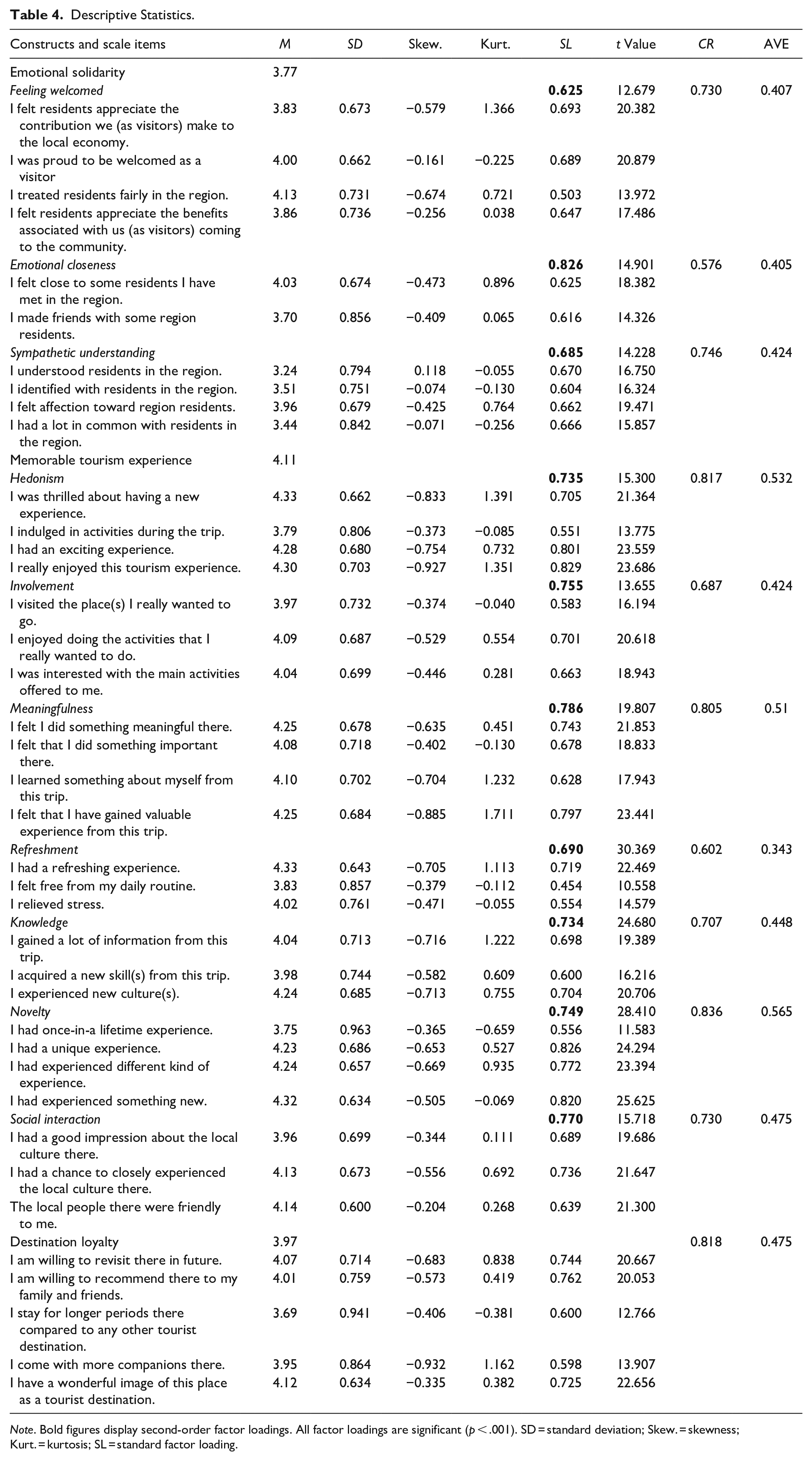
Note. Bold figures display second-order factor loadings. All factor loadings are significant (p < .001). SD = standard deviation; Skew. = skewness; Kurt. = kurtosis; SL = standard factor loading.
Confirmatory Factor Analysis—Index.

Note. ESS = emotional solidarity scale; MTES = memorable tourism experience scale; DLS = destination loyalty scale.
To evaluate the structural validity of the emotional solidarity scale (ESS), memorable tourism experience scale (MTES), and destination loyalty scale (DLS), the procedures suggested by Fornell and Larcker (1981) were used. As presented in Table 5 and Figure 2, the standard factor loading for each item was equal to or greater than 0.454 (ranging from 0.454 to 0.829) and were significant (p < .001), which loaded on the proposed constructs. For all ESS, MTES, and DLS factors, average variance extracted (AVE) should be higher than .5, but .4 is considered acceptable, because Fornell and Larcker (1981) noted that if AVE is less than .5, but composite reliability (CR) is higher than .6, the convergent validity of the construct is still adequate. Furthermore, the squared root of AVE of each construct was larger than the coefficient between the construct and others (see Table 6), providing strong support for the convergent validity of all factors.

Confirmatory factor analysis—coefficients.
Validity Assessment Criteria and Inter-Construct Correlation.
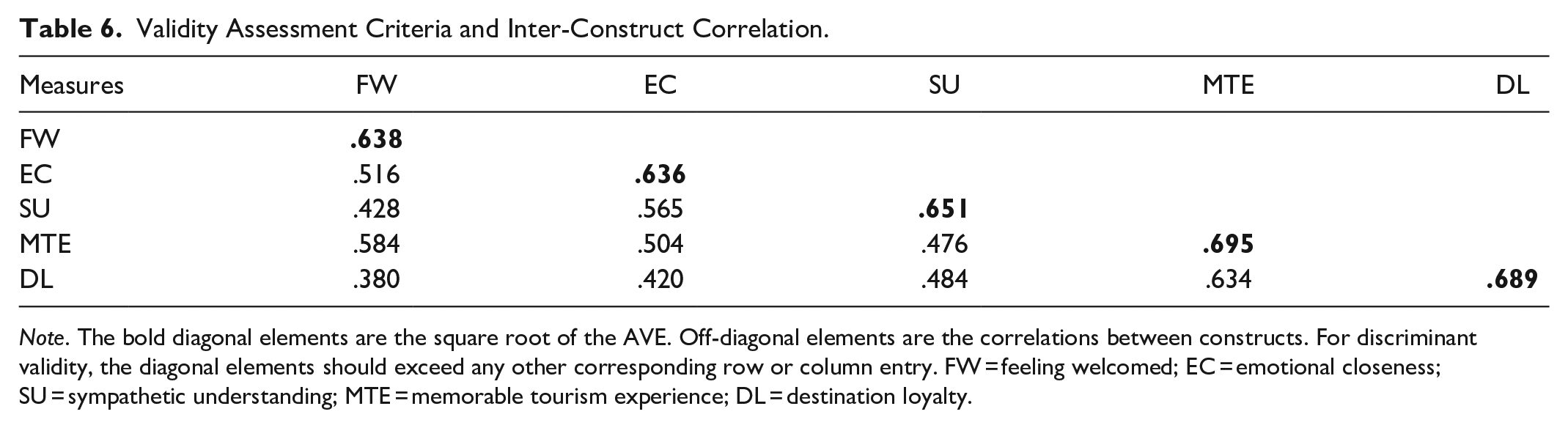
Note. The bold diagonal elements are the square root of the AVE. Off-diagonal elements are the correlations between constructs. For discriminant validity, the diagonal elements should exceed any other corresponding row or column entry. FW = feeling welcomed; EC = emotional closeness; SU = sympathetic understanding; MTE = memorable tourism experience; DL = destination loyalty.
To test the hypotheses proposed before, structural equation model (SEM) was conducted. In examining the direct impacts within the variables and the indirect impacts of emotional solidarity factors (H4) (feeling welcomed, emotional closeness and sympathetic understanding) on destination loyalty via tourists’ memorable tourism experience, the bootstrapping method was used. It is considered to be superior to the Sobel test because it is robust in testing mediating effects according to the research of Montoya and Hayes (2015), using 5,000 iterations and a 95% confidence interval (Shrout & Bolger, 2002). When the 95% confidence interval does not include zero, both the direct and indirect effects are significant according to the bootstrapping method (Hayes, 2015). To assess the direct and indirect effects with bootstrapping, the PROCESS macro was used (model 4; Hayes, 2013).
As depicted in Table 7, 12 hypotheses were supported, whereas Hypothesis 1a was rejected. Regarding the relationship between emotional solidarity (ES) as well as its three factors and destination loyalty (DL), only ES itself and two of its factors, emotional closeness and sympathetic understanding, had a direct effect on DL. Therefore, Hypothesis 1 (β = .21, t = 4.23, p < .01, 95% CI [0.11, 0.30]), Hypothesis 1b (β = .13, t = 3.05, p < 0.01, 95% CI [0.05, 0.22]), and Hypothesis 1c (β = .24, t = 5.55, p < .01, 95% CI [0.15, 0.32]) were each supported, while Hypothesis 1a was an exception as it was not supported (β = .02, t = 0.32, p = .75, 95% CI [−0.08, 0.11]). The second hypothesis (H2) and the three corresponding sub-hypotheses presented that volunteer tourists’ ES with destination residents would positively influence tourists’ memorable tourism experiences (MTEs). Hypothesis 2 (β = .64, t = 16.58, p < .01, 95% CI [0.56, 0.71]), Hypothesis 2a (β = .58, t = 14.40, p < .01, 95% CI [0.50, 0.66]), Hypothesis 2b (β = .50, t = 11.67, p < .01, 95% CI [0.42, 0.59]), and Hypothesis 2c (β = .48, t = 10.84, p < .01, 95% CI [0.39, 0.56]) were all supported. Findings supported Hypothesis 3 as well, confirming that tourists’ MTE with the destination had a positive relationship with DL (β = .50, t = 10.23, p < .01, 95% CI [0.41, 0.60]).
Structural Model Parameter Estimates and Bootstrapping Methodology for Mediating Effects.

Note. ES = emotional solidarity; DL = destination loyalty; FW = feeling welcomed; EC = emotional closeness; SU = sympathetic understanding; MTE = memorable tourism experience; CI = confidence interval.
p < .01.
After establishing the direct effects, indirect effects were then verified. The indirect effects of emotional solidarity (ES) on destination loyalty (DL) (β = .32, SE boot = .04, 95% CI [0.25, 0.39]), feeling welcomed on DL (β = .37, SE boot = 0.05, 95% CI [0.28, 0.46]), emotional closeness on DL (β = .29, SE boot = 0.03, 95% CI [0.22, 0.35]), and sympathetic understanding on DL (β = .25, SE boot = 0.03, 95% CI [0.20, 0.31]) via memorable tourism experience (MTE) were all significant. As zero was not included in the 95% confidence intervals, it provided support for H4, H4a, H4b, and H4c. The findings indicate that MTE not only has a direct positive impact on DL, but also meditates the relationship between ES factors and DL. The final model is shown in Figure 3.

Confirmed model.
Discussion and Conclusion
This study aimed to develop a theoretical and integrated model to support the progress of tourism planning and management. So far, emotional solidarity (ES) has been regarded minimally as an antecedent of other measures in the tourism literature (Lai & Hitchcock, 2017; Woosnam, 2012; Woosnam et al., 2015). The results of this study present the predictive ability of ES in tourist behavior models. In particular, the proposed integration framework demonstrates the direct relationship between (1) tourists’ ES and destination loyalty (DL), (2) ES and memorable tourism experience (MTE), (3) MTE and DL, and (4) the mediating role of MTE between ES and DL. The results confirm that ES between volunteer tourists and residents is a significant predictor of DL, either directly or indirectly through MTE (i.e., mediation).
Several insights can be extracted from the current research. Through the structural equation model (SEM), the ES between volunteer tourists and residents, especially emotional closeness and sympathetic understanding, have a positive impact on DL (Hypothesis 1b and Hypothesis 1c), which is consistent with Woosnam and Aleshinloye’s (2013) research that signified the degree of relationship between the ES of tourists and destination residents might influence the willingness to revisit. Although feeling welcomed is an essential factor in understanding the ES between tourists and residents (see Woosnam & Aleshinloye, 2013), it is not a significant direct predictor of DL (Hypothesis 1a). However, through the mediating role of MTE, feeling welcomed has an indirect positive effect on DL. A plausible explanation may be related to the nature of this special group. Compared with general tourists, volunteer tourists spend relatively more time at their destination and have more connections with residents since they do various volunteer activities there. Thus, emotional closeness and sympathetic understanding seem more vital for their loyalty since they spend more time and develop intimate relationships, giving them sufficient motivation for revisiting and recommending. Feeling welcomed is not as strongly valued as they could have the same feeling in other places. Meanwhile, volunteer tourists travel with friends or volunteer groups most of the time. In this way, determining the destination is a complex process, which may influence their DL in a behavioral sense. Nevertheless, the higher degree of feeling welcomed by residents contributes to giving tourists more MTEs, resulting in higher DL. In general, ES between volunteer tourists and residents may both promote potential changes in attitudes of tourists toward local cultures and communities and bring about a unique tourism experience (Yu & Lee, 2014). In addition, a destination where the residents show a pro-tourism attitude and ES with tourists will potentially increase the likelihood of further visits (Chandrashekaran et al., 2007; Zhang et al., 2006).
Theoretical Implications
Huang and Hsu (2009) proposed that the complexity of tourist behavior involves more than linear relationships between behavioral determinants and the final behavior, the relationship between behavioral antecedents can have an indirect effect on final behaviors through a mediating variable. The main contribution of this study is to identify the role of MTE in the relationship between tourists’ ES and DL and enrich the literature about volunteer tourism. In addition, the research is the first to establish a model that integrates ES as an antecedent of MTE and DL. Furthermore, along with exploring tourists’ expenditures and sense of security and satisfaction in destinations (Ribeiro et al., 2018; Woosnam et al., 2015), the current study emphasizes that ES can be used to explain the variance of MTE and DL for a particular group, volunteer tourists, which is not in the literature. Therefore, this study is the first attempt to fill a gap in the tourism literature.
Meanwhile, in studying tourism, since tourists always want to explore new destinations, the antecedents of tourists’ DL may differ from general marketing. Although they are satisfied with a particular destination, they may not return and choose a new one for travel. Only the destinations that offer MTEs can attract more repeat tourists. Similarly, destinations that do not create MTEs may not attract tourists to visit again. The results of this research support this argument. The findings of this study are consistent with that of Barnes et al. (2016), Manthiou et al. (2016), Tsai (2016), and Zhang et al. (2017), suggesting that MTE is a good predictor of behavioral intention. This result makes a contribution to understanding the antecedent variables of DL.
In all, the causal model of ES- MTE- DL is supported well by this study, which confirms the affection-behavior model in the area of tourism as well. MTE is a mediator between ES and DL. ES influences DL via the mediating effect of MTE. In destination competition, it is very useful and beneficial to understand both the antecedents and consequences as well as the essence of MTEs.
Practical Implications
MTE is seen as a foundation for the competitiveness and sustainability of a destination since it influences future destination choices. If tourism destinations can provide MTEs for tourists, it is more likely for tourists to revisit. For a number of tourism destinations, returning tourists constitute a huge market segment since they are inclined to stay longer at one destination and be more satisfied because of their past experiences and realistic expectations; thus, they require far lower costs than first-time tourists through positive word of mouth (Lau & McKercher, 2004; Lehto et al., 2004; Oppermann, 2000; Zhang et al., 2014). In addition to research that promotes existing loyalty formation, this study provides insights for destination marketing organizations (DMOs), marketers, and practitioners. Thus, figuring out the factors that increase the willingness of volunteer tourists to revisit is vital to help the public authorities and DMOs achieve sustainable tourism development, and help the destinations currently committed to developing volunteer tourism gain success.
For practitioners, it seems reasonable to focus on maximizing the level of memorable tourism experience (MTE) for tourists, which will increase their loyalty effectively contributing to a significant effect on the economic growth and competitiveness of the destination. This study found that emotional solidarity (ES) between volunteer tourists and residents affected MTE and destination loyalty (DL). For the destinations that develop volunteer tourism, managing tourist experiences with the destination is essential if DMOs, marketers, and practitioners want tourists to revisit and recommend the destination to potential tourists. The emotional closeness and sympathetic understanding between tourists and residents are conducive to more MTEs for tourists and could enhance their loyalty to the destination. The results present the positive correlation between ES factors and MTE directly or indirectly which may determine the loyalty of volunteer tourists. To increase tourists’ destination loyalty, enhancing tourist experiences and bringing about more MTEs are necessary. Marketers and practitioners should begin by considering how to provide tourists with more experiences that involve hedonism, involvement, meaningfulness, refreshment, knowledge, novelty, and social interaction. For example, tourist operators can hold some events related to the local culture, such as an exhibition about folk customs and culture, and can call on tourists to participate in helping with the events. In this way, tourists may have new, refreshing and unique experiences (hedonism, refreshment, and novelty), be thrilled about having a new experience (involvement), feel that they are doing something meaningful there (meaningfulness), experience new cultures (knowledge) and have a chance to closely experience the local culture as well (social interaction). Furthermore, forming and strengthening the emotional solidarity between volunteer tourists and destination residents is essential as well. Local governments are supposed to consider using marketing planning methods to help tourists form ES with the residents. Additionally, they should encourage residents to get along well and communicate more with tourists, providing a friendly and intimate environment (in order to develop emotional closeness and sympathetic understanding). In this way, tourists are likely to have more emotional solidarity with residents as well as MTEs and consume more during the stay.
Limitations and Directions for Future Research
Similar to other studies, this one has limitations. The results of this study require careful interpretation for a number of reasons. This study is the first to use emotional solidarity (ES) as an antecedent for memorable tourism experience (MTE). Additionally, the emotional solidarity scale (ESS) and memorable tourism experience scale (MTES) were used for the first time among volunteer tourists. The results do not allow for the model’s universality outside the volunteer tourism group. Future research can seek to replicate this model in other tourist groups, which may help to cross-validate the current findings.
Data of the proposed model was cross-sectional and correlated, and inferences of causality are prohibited within the model. Meanwhile, all predictors and outcome variables came from similar groups and preliminary explanations were provided. By using longitudinal analysis, further research can address the limitations to capture and control for differences between variables and causal direction. Furthermore, common methodological bias may be a limitation of the study (Podsakoff et al., 2003). Further studies should obtain measurements of predictors and outcome variables from separate samples, which may provide more reliable results.
The AVE values in most constructs were relatively low. While Fornell and Larcker (1981) indicated that if AVE is less than .5, but composite reliability is higher than 0.6, the convergent validity of the construct can be adequate. The composite reliability of the emotional closeness variable is slightly lower than the acceptable range. However, this study has meaningful academic significance as the first attempt to study the relationship between volunteer tourists and local residents by applying the concept of emotional solidarity to volunteer tourism. Therefore, follow-up studies are needed to further examine this issue and may serve to explain why in this study, AVE values among constructs was a shortcoming.
Footnotes
Declaration of Conflicting Interests
The author(s) declared no potential conflicts of interest with respect to the research, authorship, and/or publication of this article.
Funding
The author(s) received no financial support for the research, authorship, and/or publication of this article.
