




Abstract
This study explores the impact of the interplay and congruence between effectuation and causation on the fundraising opportunities, successes, and total funding amount for startups. The motivation behind this research lies in the need to understand how different decision-making logics influence startup performance, especially in environments characterized by uncertainty. Effectuation, which focuses on leveraging current means and adapting to changing circumstances, contrasts with causation, which emphasizes goal-driven planning and resource allocation. This study aims to identify the relative value of each approach and determine whether a balanced use of both can enhance startup outcomes. The research utilizes data collected from 304 South Korean startup founders through a two-stage survey, supplemented by financial performance data from 2019 to 2022. Using response surface analysis, this study examines the independent and interactive effects of effectuation and causation on fundraising outcomes. The findings indicate that while the causation approach increases the number of fundraising opportunities, the effectuation approach is more effective in converting these opportunities into successful investments. Furthermore, a congruence effect was found between the two logics, with balanced use resulting in enhanced fundraising opportunities. However, this congruence effect did not translate to the number of successful investments or the total funding amount. These findings contribute to entrepreneurship literature by providing empirical evidence on the complementary roles of effectuation and causation. Practically, the results offer startup founders insights into selecting and balancing decision-making approaches to maximize fundraising opportunities and success in uncertain business environments.
Plain language summary
The effectuation and causation approaches are two different methods for establishing and developing business objectives. These approaches are based on different assumptions, which may result in varying levels of performance. We explore how the decision-making styles of founders, whether effectuation-oriented or causation-oriented, impact their ability to secure investment, the number of successful fundraising attempts, and the amount of funds raised. We discovered that effectuation has a positive and independent impact on the number of successful fundraisers. On the other hand, causation has a positive and independent impact on investment opportunities. Additionally, when effectuation and causation are combined, they have a positive impact on the number of fundraising opportunities, but not on the number of successful fundraisers or the amount raised. We also discovered that causation and effectuation logic work together to increase fundraising opportunities, resulting in a matching effect. It’s important to differentiate between the types of performance that are best served by effectuation and causation, as some are more influenced by the perspectives and routines inherent in the two contrasting decision-making processes. This paper offers both theoretical and practical perspectives on how effectuation and causation interact in the context of fundraising.
Keywords
Introduction
Startup founders often face highly uncertain market and business environments as they identify business opportunities, make decisions, and strive to launch and grow. The environment and characteristics of new markets are difficult or nearly impossible to predict, making it difficult for founders to set clear and definite business goals from the outset. In addition, entrepreneurs must formulate business strategies, develop products and services, and go to market with very little reliable information and knowledge.
Entrepreneurship research has accumulated theories and knowledge about two different venturing approaches or processes that can help entrepreneurs set goals and make rational decisions during the startup and growth process: effectuation and causation. The effectuation approach considers the current resources and means as a given situation or limitation and tries to select and achieve the best among the feasible performance alternatives (Sarasvathy, 2001). The causal approach, on the other hand, considers a specific outcome or goal to be achieved as a given condition and focuses on the process of selecting the necessary resources and means to achieve it (Berends et al., 2014). The basic principle of effectiveness is to actively explore and adapt to an uncertain future rather than to predict it, while the principle of causation implicitly assumes that the future, such as the market or business environment, is somewhat predictable so that optimal decisions can be made by analyzing relevant information (Yu et al., 2018). Therefore, the effectuation process identifies the resources and means at hand and then sets goals that can be achieved based on them, whereas the causal process first sets goals and then looks for resources to achieve them (Sarasvathy, 2001). The research stream on effectuation and causation has moved from conceptual and case-based discussions to a rapidly growing body of empirical research on the individual effects and roles of the two approaches and their complementarities. However, there are still few empirical studies that analyze and compare the impact of effectuation and causation approaches on startups’ fundraising opportunities, success, and financial growth.
As neither the effectuation nor the causation approach is always a superior or more effective logic, the literature debates the relative value and role of the two approaches in the startup creation and growth process. Some literature argues that an effectuation-oriented approach contributes to performance by overcoming resource constraints, reducing downside risk, and finding new opportunities to shape the future with investors (Smolka et al., 2018). On the other hand, it is also argued that a causation-oriented approach contributes to performance because it encourages action and commitment toward goals, strengthens legitimacy through business plans, and facilitates the acquisition of entrepreneurial resources (Cai et al., 2017; Yu et al., 2018).
Meanwhile, empirical studies on the impact of effectuation and causation on startup performance have not reached consistent conclusions regarding the positive or negative effects with statistical evidence (Cai et al., 2017; Shirokova et al., 2021; Smolka et al., 2018). Rather, there are mixed findings that vary considerably depending on the type or class of outcome, the context and sampling of the study, statistical methods, and measurement instruments (Agogué et al., 2015). These results suggest that different outcomes may perform relatively well depending on the nature and characteristics of the mechanisms through which effectuation and causation act on outcomes (Peng et al., 2020). Futterer et al. (2018) find that effectuation is effective in industries with relatively high growth rates, while causation is effective in industries with low growth rates. According to Reymen et al. (2017), in new ventures, the logic of effectuation is often used to create a value proposition for a specific customer group, while the logic of causation is used to define the components of the business model around the value proposition. However, the symmetrical nature of the two decision-making processes and their differentiated roles are not yet well understood in terms of which types of outcomes or contexts in which they are more effective in organizations.
In recent years, a growing body of research has shown that the decision-making logics of effectuation and causation are not mutually exclusive alternatives and that applying both logics can enhance entrepreneurial performance (Braun & Sieger, 2021; Chandler et al., 2011; Perry et al., 2012). Although the essence of synergy is simultaneous interaction, previous studies have mainly shown that it is comprehensively effective when the logic of effectuation and causation is applied in different contexts, such as depending on the growth stage or separately to tasks suitable for each decision logic. In other words, the logic of effectuation and causation can be more beneficial when separately utilized in terms of temporal or spatial manner than when applied collectively. Reymen et al. (2017) suggested that effectuation logic is mainly used to generate actionable value propositions in the early stages, and the use of causation logic tends to increase in later stages when uncertainty is reduced. However, it is also expected to have complementary synergy when applying both processes simultaneously. Some of the literature suggests that the simultaneous use of both logics leads to a positive interaction, which has synergistic effects on the entrepreneurial process (Andries et al., 2013; Laskovaia et al., 2017; Smolka et al., 2018). Smolka et al. (2018) explored the interrelationships between causation and effectiveness and found that ventures could benefit from using these two entrepreneurial logics together. This study also attempts to fill this research gap by analyzing the concurrent interactions between the levels at which entrepreneurs implement these two decision-making logics.
There has been an increasing discussion of the interaction between effectiveness and causality in recent years, however, we still do not know much about how entrepreneurs can reconcile the inherently different principles of effectuation and causation to create harmony and synergies. As a way to analyze interactions, the literature mostly uses the traditional statistical framework of moderation analysis. Recently, there has been an increasing use of response surface analysis using polynomial regression to analyze how the degree of congruence or incongruence between two constructs affects the outcome variable (Kim, 2023; Shanock et al., 2010). Traditional moderation or interaction analysis does not address the comprehensive and overall form of the interaction and shows only the projection of interaction on the two-dimensional space. However, response surface analysis can overcome the limitations of traditional interaction analysis by fully representing the interaction effects between effectuation and causation on fundraising outcomes in three-dimensional spaces (Edwards, 1994). The response surface analysis examines whether the degree of congruence of effectuation and causation is related to an outcome variable, fundraising outcomes in our case. In addition, the response surface analysis can provide insight into how the combination of effectuation and causation can achieve optimal or maximum performance, going beyond a simple analysis of interaction effect. It can also offer a powerful alternative approach for researchers to formulate and test various hypotheses about patterns of congruence (Humberg et al., 2019). However, no study has fully analyzed the interaction of the alternative approaches of effectuation and causation from the perspective of congruence.
The objectives of this study are, first, to test the independent effects of the decision-making principles of effectuation and causation on startup investment and growth. Second, we examine whether there is a comparative advantage in the way the two approaches work on startup performance. Third, we test whether there is a congruence effect in the interaction of effectuation and causation on startup investment and growth. This study will be able to explain how the level of implementation of effectuation and causation affects investment and growth in startup firms. In addition, the results of this paper can provide a theoretical contribution to the interaction between effectuation and causation in the context of entrepreneurship. It will also provide practical insights into the process by which startup founders choose an appropriate decision-making process and achieve their goals step by step under the constraints of initial conditions.
Theoretical Background and Hypothesis Development
Effectuation and Causation process
Effectuation is a set of purposeful ideas that seek to improve the current state of individual lives and the world through the creation of firms, products, markets, services, and innovation (Read et al., 2009). According to effective reasoning, people believe that the future is fundamentally unpredictable, but that it can be controlled, and its problems solved through human action. They believe that if we can shape the future, we don’t need to worry or struggle to predict it, determine the perfect time to start, or find the best opportunities (Ali et al., 2023). They also believe that the environment can be shaped through our choices and that goals are the result of a process, created through stakeholder engagement and negotiation, rather than an existing order that is predetermined and difficult to change. According to effectuation logic, when a venture or startup starts a business, it starts with the few means or resources it has at hand and sets tentative goals with a level of loss in mind that it can afford (Perry et al., 2012). Startup founders familiar with the logic of effectuation accept changes in the circumstances and environment surrounding the business as a given but transform and adapt to unfavorable conditions or changes in circumstances to suit themselves whenever possible. They build partnerships with people who can buy into the idea of the business, not just the current members. As the founders interact with their partners, the goals of the business gradually take shape, and new means and goals are created based on the resources and perspectives added during the interaction. This process is repeated over and over again as the business progresses, so effectuation is not a one-time action applied at the beginning of a business, but a logic and process that continues to evolve as the startup grows (Sarasvathy, 2001). Through this process, customers and revenue are acquired early, appropriate loss levels are set, risks are shared or transferred, and new information is utilized to find new and useful market opportunities.
On the other hand, the theoretical foundation of the causation process is based on the rational decision-making perspective of neoclassical microeconomics (Chandler et al., 2011). The rational decision-making perspective refers to the idea that a decision maker has all the available information and viable options relevant to the decision, calculates the expected utility of each option, and makes a rational choice based on this information (Egidi et al., 1992). Much of the entrepreneurship literature starts from a causal approach based on rational decision-making, and the discovery of business opportunities requires a rational exploratory process of identifying and analyzing alternatives: analyzing the market environment to identify appropriate products and services, setting bold business goals for market creation and growth, and formulating implementation alternatives while defining the organization and resources to achieve the goals. Thus, the causation process, in contrast to the effectuation process, is the process of establishing business goals through an analysis of the competitive environment based on the predicted future, selecting means and resources to achieve the goals, and carrying out the business faithfully to the original plan while avoiding uncertainty and risk. In other words, entrepreneurial opportunities are preferably identified from the environment and logic of the market rather than one’s own ability and willingness, and entrepreneurs with good search and economic analysis skills are more likely to obtain entrepreneurial rents (Casson & Wadeson, 2007). The fact that the business plan, which consists of environmental analysis, strategy formulation, business model formulation, and economic analysis, plays a very important role in the practice of entrepreneurship is an indication that the causal approach fits relatively well with the current institutional environment of neoclassical economics (Kuratko, 2005). Thus, many books and courses on entrepreneurship focus on the process and methods of business plan development, and in effect, implicitly endorse the causation approach.
Effectuation, Causation, and Fundraising Opportunities
The previous section on effectuation theory suggests that the logic of effectiveness and the logic of causality have fundamental differences in the way they develop businesses and utilize resources, which may lead to different perspectives on the opportunities and amount of financing a business needs. In this section, we hypothesize that entrepreneurs who follow a causation logic will pursue financing opportunities more than entrepreneurs who follow an effectuation logic. Entrepreneurs who follow the causation process or logic first derive the amount of investment needed for each stage of their business plan. They then look for venture investors including angel investors, venture capitalists, and accelerators, and actively participate in meetings and gatherings with them to increase their chances of attracting investment (Aljalahma & Slof, 2022). Entrepreneurs who are familiar with the causation process should actively introduce and promote their business plan to a large number of potential investors in the capital market, rather than relying on their personal connections to raise funds. Therefore, it is necessary to fully utilize all available investment opportunities, including pitch decks, demo days, and investment meetings (Banerji & Reimer, 2019). Meanwhile, having access to many opportunities and a variety of investors during the process of raising funds can provide additional access to investment opportunities as well as the resources and information necessary for the success of the startup business (Davidsson & Honig, 2003). In addition, investors are more likely to be willing to endorse and support entrepreneurs who are already known through multiple channels, and founders can also obtain information and methods on how to run a startup business (Agrawal et al., 2015; Hor et al., 2021). In other words, the more attempts to make contacts for investment and the wider the range of contacts, the more opportunities for fundraising, and the higher the likelihood that fundraising opportunities will be converted into success (Zhang, 2010). Prior research on entrepreneurship has shown that the wide and diverse social network of start-up founders can also significantly impact start-ups’ financing opportunities and success (Hite & Hesterly, 2001; Pirolo & Presutti, 2010). On the other hand, entrepreneurs who are faithful to the effectuation process or logic first derive ideas based on their own resources and gradually develop products or services, so the amount of initial capital required is not so large. However, effectuation-driven founders tend to be reluctant to establish many relationships with investors in the market who are only interested in economic purposes because founders tend to run the business together with their stakeholders, even when raising external investment is necessary for the concrete and full-fledged realization of the business. They are more likely to receive support for investment or business operations through personal connections such as friends, family, and acquaintances who are close to the entrepreneur (Bhagavatula et al., 2010; Lans et al., 2015). This type of entrepreneur, thus, does not pursue all available external investment opportunities and has fewer contacts and pitch meetings with external investors than causation-driven entrepreneurs. Based on the above discussion, we formulate the following hypothesis.
Hypothesis 1: Startup founders who pursue causation have more fundraising opportunities than those who pursue effectuation.
Effectuation, Causation, and Fundraising Successes
Entrepreneurs who favor the effectuation process or logic first generate ideas and develop small-scale experimental products or services based on their own resources. However, as entrepreneurs’ own resources are quickly exhausted, they need external investment to realize their business (Maitlo et al., 2020. In the beginning, their personal connections, such as friends, family, and acquaintances can provide opportunities for investment or support in running a risky business (Bhagavatula et al., 2010). Friends and acquaintances who are personally and strongly networked with the founder are more willing to invest and more likely to connect with other investors than those who are externally and weakly networked (Lans et al., 2015). Founders can now increase their chances of attracting outside investment based on seed funds raised from acquaintances. In addition, founders who are familiar with the effectuation process will be more likely to secure smaller investments from many investors rather than large investments from a few, as they can be able to afford to lose money if the business fails (Sarasvathy, 2001). The effectuation-centric founders can also adapt to changes in the environment, interact with investors, and strengthen the investors’ commitment. Further, founders who prefer the effectuation logic are more willing to adjust the business direction to meet the different needs and conditions of investors and develop the business with them (Read et al., 2009). Prior research argued that effectuation principles also enable founders to seize opportunities as they emerge, making them more attractive to investors who value flexibility, adaptability, and co-creation (Fisher, 2012). Thus, effectuation-oriented founders can enjoy more fundraising successes than those who prefer the causation logic. On the other hand, causation-focused founders often pursue publicly accessible funding opportunities, but these are typically highly competitive. Furthermore, causation-driven founders need relatively large investments to realize their business plans, but it’s not easy to find the right investors based on initial business plans. Therefore, causation-driven founders are less likely to be able to convert fundraising opportunities into success. Chandler et al. (2011) suggested that causation logic may be perceived as rigid and less responsive to the unpredictable nature of startups, which can hinder fundraising successes, especially in dynamic markets. To summarize, founders who prefer the effectuation logic are more likely to succeed in raising funds than those who prefer the causation logic. Based on the above discussion, we formulate the following hypothesis.
Hypothesis 2: The effectuation approach of founders can increase the number of fundraising successes more than the causation approach.
Effectuation, Causation, and Fundraising Amount
Entrepreneurs who follow the causation process and logic first analyze the market environment and competition to define the target market and derive new products and services based on the characteristics of customers in the market (Berends et al., 2014). Based on the target market demand and products, they establish a competitive strategy and create a business plan by predicting investment costs, sales, and profits. Once the business plan determines the amount of investment required by each growth stage, entrepreneurs search for venture capitalists, such as angel investors, venture capitalists, and accelerators, and engage in activities that attract investment. It is important for these entrepreneurs to actively introduce and promote the business plan to potential investors in the capital market rather than raising funds through their personal network. Investors in the capital market evaluate the capabilities of the founder and the feasibility of the business plan to determine whether and how much to invest, and it is important to perform due diligence to monitor the implementation of the plan after investment. For entrepreneurs and investors alike, success in the early stages of a business is often measured by rapid growth with significant market share, which means that the amount of investment required in the early stages of an entrepreneur’s business is relatively larger than those of effectuation-oriented entrepreneurs (Cai et al., 2017). For entrepreneurs and investors based on causation logic, thus, it is important to raise timely and enough funds from the beginning of the business to grow rapidly in a short period of time and preempt the market. Therefore, even though causation-oriented entrepreneurs are less likely to be successful in raising investment, the amount of investment they raise can be larger than that of effectuation-oriented entrepreneurs (Yu et al., 2018). On the other hand, because effectuation-oriented entrepreneurs are better suited to small, frequent investments, the total amount of investment they attract can be smaller than that of causation-oriented entrepreneurs. Sarasvathy (2001) argued that effectual entrepreneurs often receive larger investments due to their ability to engage key stakeholders early, leading to long-term support and cumulative investments. Dew et al. (2009) and Fisher (2012) also highlight that effectual entrepreneurs often attract a more diverse set of investors over time due to their evolving and adaptable business model, leading to higher cumulative funding. To summarize, the total amount of fundraising required by entrepreneurs based on causation logic is larger than those required by entrepreneurs who are faithful to the effectuation logic.
Hypothesis 3: The causation approach of founders can increase the total amount of fundraising more than the effectuation approach.
Congruence Between Effectuation and Causation
The effectuation logic and causation logic are implemented through processes based on contrasting assumptions and guiding principles, but both can contribute to organizational performance if they consist of a coherent combination of practices. Meanwhile, congruence or fit refers to the degree to which tasks, people, structures, and culture coexist harmoniously and consistently with each other in an organization (Nadler & Tushman, 1980). An organizational system works efficiently and effectively when the elements of business management consistently fit together to facilitate the achievement of organizational performance. Based on this concept of congruence or optimal combination, the effectuation logic and causation logic can have a synergistic positive impact on organizational performance when effectuation and causation logic are paired together and show a congruent relationship (Delery, 1998). In the previous section, we argued that both effectuation logic and causation logic have consistent positive effects on organizational performance, albeit through different mechanisms. Some prior research has also argued for a positive interaction between effectuation and causation logic based on their complementarity (Laskovaia et al., 2017; Reymen et al., 2017). We hypothesize, thus, that there is a congruence effect between the two logics, such that founders who utilize both approaches similarly outperform those who do not. That is, fundraising outcomes will be higher when the implementation level of effectuation and causation logic is similar to each other compared to when the implementation level of both logic is not congruent with each other.
We attempt to clarify the meaning of the congruence hypothesis using Figure 1, which shows perfect congruence with a hypothetical response surface. The mechanism of congruence can be explained by using the line of incongruence (LOIC) depicted in Figure 1 as a line running from the left corner to the right corner of the contour plot in the bottom plane. The effect of congruence means that the more congruent the implementation of the two logics, the more performance increases, and conversely, the more incongruent the implementation of the two logics, the more performance decreases. That is, the surface above the line of incongruencein Figure 1 should have an inverted U-shape and the surface along the line of incongruence should not have a slope to ensure no discrepancy between effectuation and causation. We assume that the alignment of effectuation and causation logic will lead to higher performance than if they are not aligned or fitted because both logics have complementary advantages in increasing performance. Meanwhile, the response surface above the line of congruence (LOC) in Figure 1 is constant with no slope, meaning that if the levels of effectuation and causation are the same, the outcome is the same in all combinations of effectuation and causation. We can call this a congruence effect in a strict sense with flat ridge (Humberg et al., 2019). In Figure 1 for example, when the values of effectiveness and causality are both 0, the performance level is 10, and when the values of effectiveness and causality are both 10, the performance level is also the same as 10. However, we expect the response surface on the line of congruence to have a positive slope because the effectuation and the causation logic can have a main effect on fundraising outcomes as we argued in the previous sections. This fit with a rising ridge can be called a congruence effect in a broad sense. That is, the combined effect of effectuation and causation logic is more positive at higher levels of congruence than at lower levels of congruence. Based on this discussion, we formulate the following hypothesis.
Hypothesis 4: There is a congruence effect in the combination of effectuation and causation logic, such that the number of fundraising opportunities is maximized when the level difference or discrepancy between the two logics is minimized.
Hypothesis 5: There is a congruence effect in the combination of effectuation and causation logic, such that the number of fundraising successes is maximized when the level difference or discrepancy between the two logics is minimized.
Hypothesis 6: There is a congruence effect in the combination of effectuation and causation logic, such that the fundraising amount is maximized when the level difference or discrepancy between the two logics is minimized.

A hypothetical response surface plot between effectuation and causation on an outcome.
Data and Method
Data
This study conducted a preliminary survey of 30 companies that participated in the startup support programs of the Korea Venture Business Association (KOVA) and the Korea Credit Guarantee Fund (KODIT) in the first quarter of 2020. Then, we generated a list of about 1,000 companies listed in the Korean Startup Investment Database, which is maintained by the information service agency, The VC. These selected startups have less than 30 full-time employees and have been in business for less than 10 years. We cross-validated this list with the company database of the Korea Rating and Data, which is one of the largest credit information service companies in South Korea. The criteria for selecting sample companies were first, they were venture/startup companies that were founded before mergers and acquisitions or going public, and second, the founder was the head of the company. The first survey was conducted in the first quarter of 2020 on the general status of the firms, including indicators to measure the usage of effectuation and causation logic of the founders. The second survey was conducted 6 months later on the same startups to investigate the number of fundraising successes and fundraising amount. We examined the financial data from 2019 to 2022 including assets and revenues of startups in 2023. In the first survey, over 500 questionnaires were distributed to the target samples, and 350 responses were returned in the second survey. The final sample of 304 startups was used to analyze the effects on the fundraising successes and amount after excluding missing values and outliers. Table 1 shows the sample distribution of 304 startup firms by industry sectors and firm age groups.
Sample Distribution by Industry Sectors and Age Groups of Startup Firms.

Variable
We construct our variables using the measures proposed by Brettel et al. (2012) for the sub-dimensions of effectuation and causation. The indicators and measurement items that construct the variables of effectuation and causation, as well as the composite reliability and average variance extracted, are presented in Table 2.
Factor Analysis Results for the Indicators of Effectuation and Causation.

Note. C.R. means Composite Reliability and AVE means Average Variance Extracted.
p < .1. *p < .05. **p < .01. ***p < .001.
The effectuation principle was measured using two items for each of the four indicators or sub-dimensions: means-driven, affordable loss, partnerships, and flexibility or acknowledging the unexpected. For example, the dimension of means-driven was measured with two items: “The venture was started based on the available means and resources at the time of startup” and “The venture’s business goals were set based on the available means and resources.” The composite reliabilities of the items comprising each sub-dimension were all greater than or equal to 0.7. The causation principle was measured using two items for each of the four sub-dimensions: goals-driven, expected returns, competitive market analysis, and overcoming the unexpected. The composite reliabilities of the items comprising each sub-dimension were all greater than 0.72. Meanwhile, we believe that the sub-dimensions such as means-driven collectively form effectuation, and the sub-dimensions are not necessarily independent from each other and conceptually compatible or highly correlated, which shows that the formative models are better suited as a method for factor analysis (Diamantopoulos & Winkhler, 2001). Following previous studies that argued for the appropriateness of formative models to analyze the factor structure for effectuation and causation principles (Chandler et al., 2011; Futterer et al., 2018), this paper used the formative model under the Partial Least Squares Structural Equation Modeling (PLS-SEM) framework to verify the reliability and validity of the two constructs.
Table 3 shows the results of the formative factor analysis of effectuation and causation, which demonstrated all the significant factor loadings at the p < .001 level, showing their reliability and validity (MacKenzie et al., 2011). The VIFs that indicate the degree of measurement overlap between the sub-dimensions were all less than 2, confirming that there was no problem due to duplication between indicators within each dimension of effectuation and causation (Hair et al., 2021). The effect sizes of each sub-dimension are all greater than 0.02, indicating practical significance (Cohen, 1992). The variables of effectuation and causation were constructed by normalizing each sub-dimension with the formula of (X-Xmin)/(Xmax-Xmin) to transform the data to be within the range of [0 1] and averaging each sub-dimension. In addition, the variables of effectuation and causation were mean-centered to mitigate multicollinearity in statistical analysis.
Results of Formative Factor Analysis for Effectuation and Causation.

The number of funding opportunities was measured by asking founders to sum up the number of times they contacted investors to pitch their business plan for investment since the company was founded. The number of fundraising successes was measured by asking how many times founders were successful in raising investment out of the number of funding opportunities. The total fundraising amount was measured in million South Korean Won using the question that asked the total amount of successful fundraising since the firm was established.
We used six control variables that may affect the relationship between founders’ effectuation and causation logic and firm performance: Industry sector, founder’s age, career years before startup, the number of Employees, founder’s education level, and startup-founding experience. First, we controlled for the effect of industry sectors by categorizing startup firms into four industries: manufacturing, distribution, biotech and medical, and general services. Second, we controlled for the effect of the founder’s age as it may affect investment attraction and financial performance. Third, the effect of whether the founder had run a startup before starting their current firm was controlled with a binary variable. Fourth, the size of the startup firm was measured by the number of employees. Fifth, we control for the effect of the founder’s education level, measured in five levels from high school graduation to doctorate. Sixth, the effect of whether the founder had founded and operated a startup prior to founding their current firm was controlled using a binary variable.
Results
Table 4 shows the means, standard deviations, and correlation coefficients with the significance of the variables used in the statistical analysis of this study. We used the polynomial regression analysis method to test the congruence between the effectuation and causation logic. The polynomial regression models to estimate the coefficients to formulate the test statistics and criteria to examine the congruence effects are as follows.

Descriptive Statistics of Variables With Correlation Matrix.
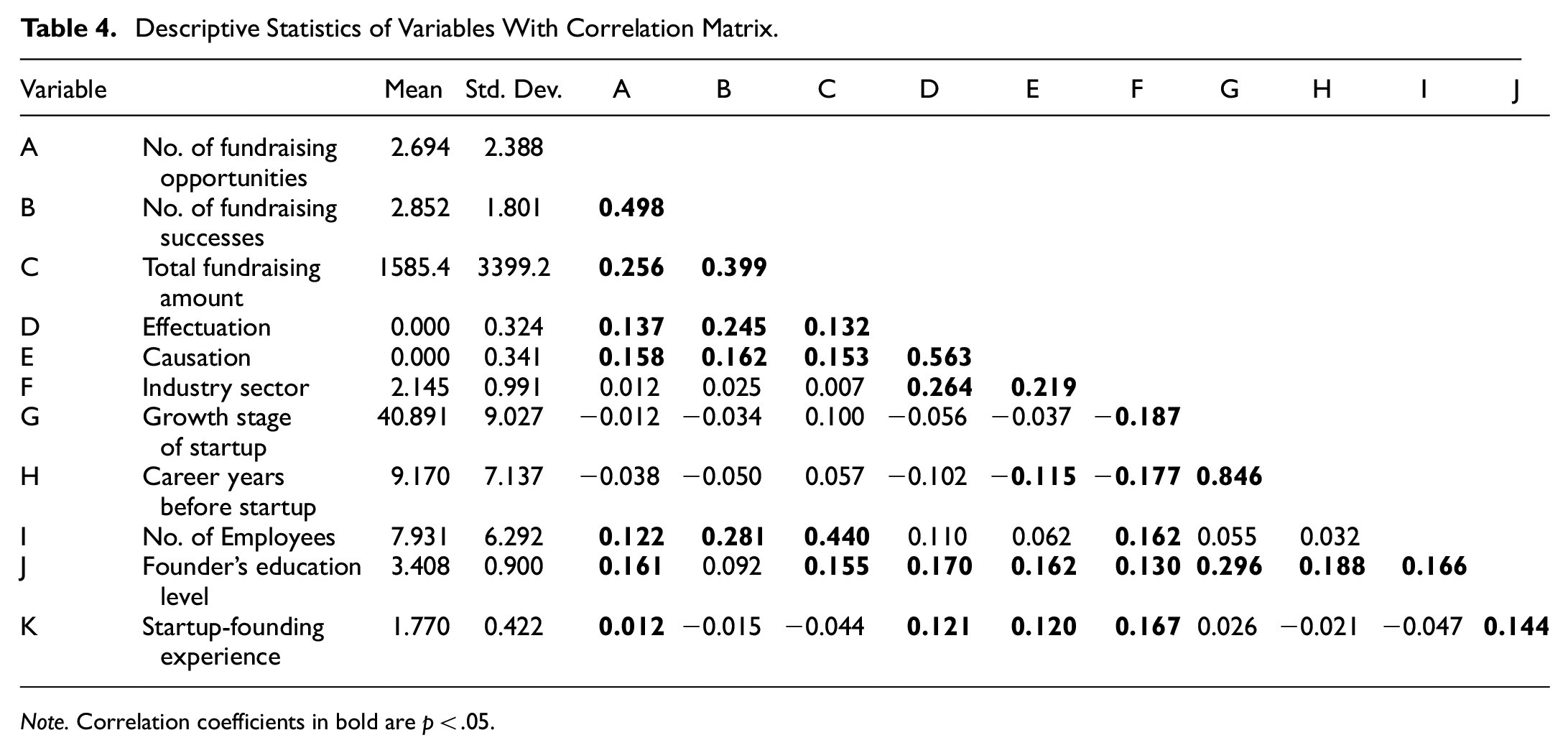
Note. Correlation coefficients in bold are p < .05.
where Z is the outcome such as fundraising opportunities, and x and y are the effectuation and causation indices. We checked the distribution of three dependent variables to apply accurate regression analysis methods and confirmed that the distribution of all dependent variables had strong skewness. As a method of implementing regression analysis, we thus applied the generalized structural equation model to respond to various distributions of dependent variables. This method can provide the additional benefit of increasing the accuracy of estimating standard errors of coefficients by separating the measurement errors of dependent variables. Considering the skewness of dependent variables, this study applied the gamma distribution as the probability distribution and the logarithm as the link function to all models (Ng & Cribbie, 2017). In addition, we applied robust standard errors to test the significance of the regression coefficients to mitigate the potential bias caused by heterogeneity and to increase the accuracy (Imbens & Kolesar, 2016). For examining the congruence using response surface analysis, we follow the discussion and recommendations of Humberg et al. (2019) and Yao et al. (2023) for the formulas and notation of test statistics and criteria for a statistical test of the congruence effect.
Table 5 analyzes the effect of effectuation and causation logic on fundraising opportunities using the structural model of generalized structural equation modeling. We modeled and hierarchically analyzed the effects of effectuation and causation on fundraising opportunities from Model F1 to Model F5, and the results are shown in Table 5. First, Model F1 showed the effect of effectuation on fundraising opportunities in the absence of the effect of causation. Model F2 analyzed the effect of causation on fundraising opportunities in the absence of the effect of effectuation. Model 3 used the variables of effectuation and causation together to compare the effect size between them. Using the coefficients of effectuation estimated in Model F1 and Model F3, we checked whether the effectuation has an independent and additive effect on fundraising opportunities. We also examined the independent and additive effects of causation by comparing the coefficients of causation estimated in Model F2 and Model F3. In Model F4, square terms of effectuation and causation were added to the configuration of Model F3. In Model F5, the interaction term between effectuation and causation was added to the configuration of Model F4. The coefficients of effectuation and causation estimated in Model F5 were used to calculate test statistics to verify the effect of congruence in Table 8.
Polynomial Regression Results of Effectuation and Causation on Fundraising Opportunities.
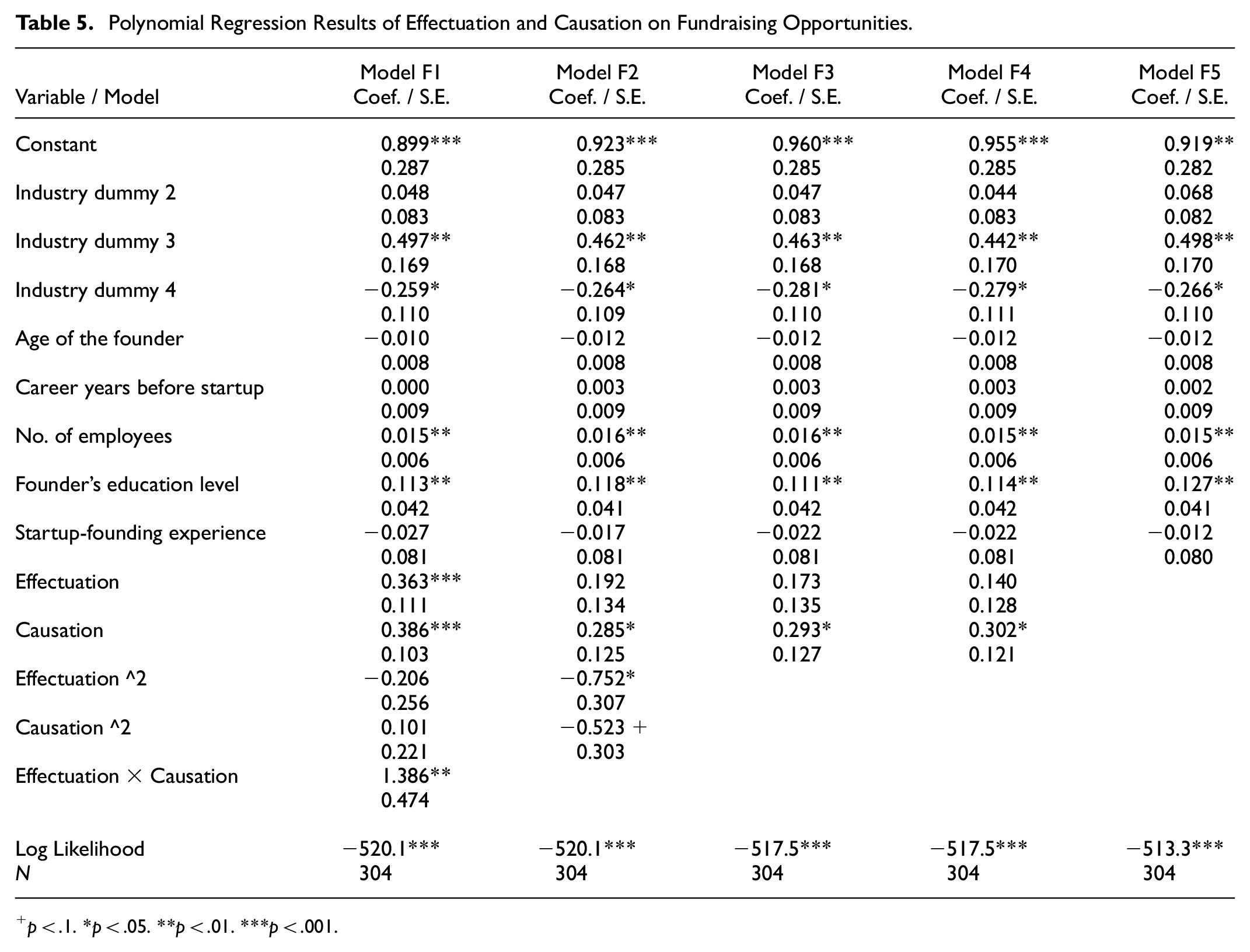
p < .1. *p < .05. **p < .01. ***p < .001.
In Model F1 of Table 5, the coefficient of effectuation is significant at the p < .001 level, and the coefficient of effectuation is not significant in Model F3, which shows that there is no evidence of an independent and additive effect of effectuation on fundraising opportunities. The coefficient of causation is significant at the p < .001 level in Model F2, and the coefficient of causation is also significant at the p < .05 level in Model F3. These results demonstrate that the causation logic has an independent and additive effect on fundraising opportunities. In Model 3, we verified whether the difference between the coefficients of the causation and the coefficients of the effectuation was significant. The test result was not significant at p < .05 level, and thus Hypothesis 1 was not supported. Meanwhile, the interaction term between causation and effectuation was significant at the p < .01 level in Model F5, meaning that the two logics are synergistic with each other for fundraising opportunities. The response surface shown in Figure 2 exhibits that the first principal axis of the response surface matches the line of congruence (LOC), and the surface above the line of incongruence (LOIC) has an inverted U-shape. However, the response surface above the line of congruence increases as both effectuation and causation increase, which shows the linear level effect of effectuation and causation on fundraising opportunities. Table 8 summarizes the statistical test results for the congruence hypothesis on the fundraising opportunities, the number of fundraising successes, and the fundraising amount. Based on the combined results of the six test statistics, we conclude that the congruence effect between effectuation and causation on fundraising opportunities exists in terms of the exact correspondence effect, which supports Hypothesis 4. In addition, the linear level effect, meaning that the congruence effect when both effectuation and causation are high is larger than the congruence effect when both variables are low was also supported.

Response surface plot between effectuation and causation on the fundraising opportunities.
Table 6 analyzes the effect of effectuation and causation logic on fundraising successes using the structural model of generalized structural equation modeling. The configuration method and content of each model from Model S1 to Model S5 are essentially the same as those used in Table 4, except that the dependent variable has been changed to the fundraising successes. In Model S1 of Table 6, the coefficient of effectuation is significant at the p < .001 level, and the coefficient of effectuation is also significant in Model S3, which shows an independent and additive effect of effectuation on the number of fundraising successes. The coefficient of causation is significant at the p < .001 level in Model S2, and the coefficient of causation is not significant in Model S3. These results demonstrate that the causation logic has no independent and additive effect on the fundraising successes. In Model 3, we tested whether the difference between the coefficients of the effectuation and causation was significant. The result of the one-sided test on this difference was significant at the level of p < .05, supporting Hypothesis 2. The interaction term between causation and effectuation was significant at the p < .05 level in Model S5, showing a mutual reinforcement effect between them for fundraising successes. The response surface shown in Figure 3 shows that the first principal axis of the response surface matches the line of congruence, but the surface above the line of incongruence does not have an inverted U-shape, but a flattened shape. However, the response surface above the line of congruence increases as both effectuation and causation increase. Based on the combined results of the six test statistics in Table 8 for the congruence hypothesis, we conclude that the congruence effect between effectuation and causation on fundraising successes does not exist, even though the linear level effect was found, which does not support Hypothesis 5.
Polynomial Regression Results of the Effectuation and Causation on the Fundraising Successes.

p < .1. *p < .05. **p < .01. ***p < .001.
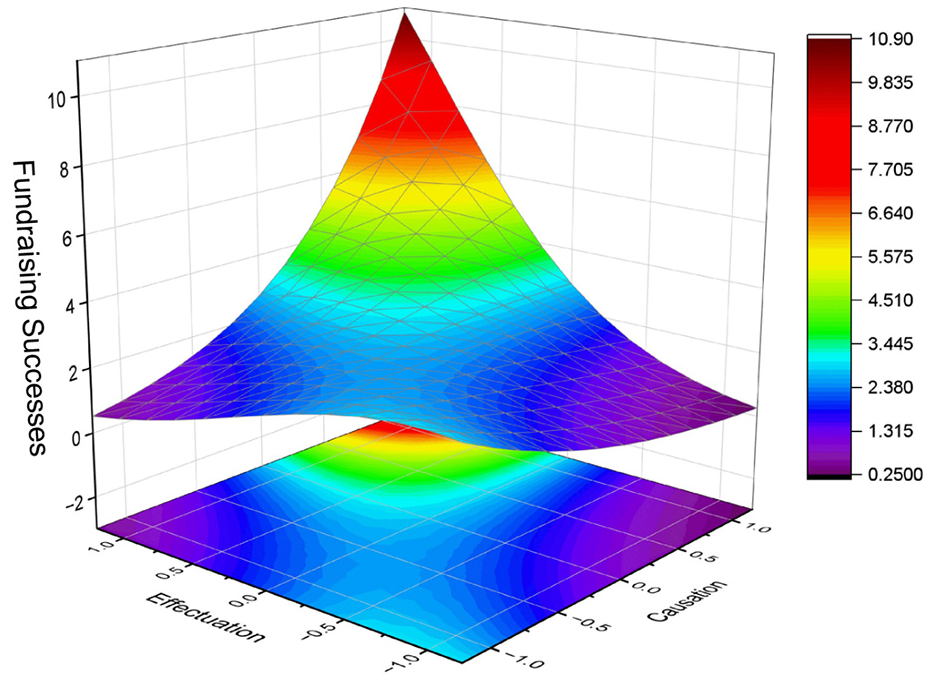
Response surface plot between effectuation and causation on the fundraising successes.
Table 7 analyzes the effect of effectuation and causation logic on fundraising successes using the structural model of generalized structural equation modeling. The configuration method and content of each model from Model A1 to Model A5 are essentially the same as those used in Table 4, except that the dependent variable has been changed to the fundraising amounts. In Model A1 of Table 7, the coefficient of effectuation is significant at the p < .001 level, and the coefficient of effectuation is also significant at the p < .05 level in Model A3, which shows an independent and additive effect of effectuation on the fundraising amount. The coefficient of causation is significant at the p < .001 level in Model A2, and the coefficient of causation is also significant in Model A3. These results demonstrate that the causation logic has an independent and additive effect on the fundraising amount. In Model A3, we tested whether the difference between the coefficients of the causation and effectuation variable was significant. The test result on this difference was significant at the level of p < .05, and thus Hypothesis 3 was not supported. Furthermore, the interaction term between causation and effectuation was not significant in Model A5. The response surface shown in Figure 4 shows that the first principal axis of the response surface matches the line of congruence, but the surface above the line of incongruence does not have an inverted U-shape, but a flattened shape. However, the response surface above the line of congruence increases as both effectuation and causation increase. Based on the combined results of the six test statistics in Table 8, we conclude that the congruence effect between effectuation and causation on fundraising amount does not exist, even though the linear level effect was found, which does not support Hypothesis 6.
Polynomial Regression Results of the Effectuation and Causation on the Fundraising Amount.

p < .1. *p < .05. **p < .01. ***p < .001.

Response surface plot between effectuation and causation on the fundraising amount.
Statistical Test Results for Congruence Hypothesis on the Fundraising Opportunities, Successes, and Fundraising Amount and Using Surface Response Analysis.

Note. LOIC: line of incongruence; LOC: Line of congruence.
p < .1. *p < .05. **p < .01. ***p < .001.
Discussion
Results and Implications
The theoretical and practical implications and contributions of this paper for research in the entrepreneurship and effectuation fields are summarized as follows. First, we found that causation logic has an independent and additive effect on the number of fundraising opportunities, but effectuation logic does not have those effects. This finding suggests that founders who adhere to causation logic have a higher chance of getting fundraising opportunities because they compete in open capital markets to secure investment, even if the probability of success is low. However, we did not find evidence that the causation logic raises more fundraising opportunities than the effectuation logic. Previous studies in entrepreneurship have demonstrated that a founder’s social network increases a startup’s chances of accessing financial resources (Agrawal et al., 2015; Lans et al., 2015). This study shows that the opportunities to attract investment can also vary depending on the founder’s decision-making logic categorized into the effectuation and causation principles. Further, this paper contributes to the literature by revealing that entrepreneurs who are faithful to causation logic are trying to realize business opportunities by pursuing relatively more financing opportunities.
Second, we find that the causation and effectuation logics interact positively to increase fundraising opportunities. This finding suggests that the two logics are complementary as they have similar mechanisms to increase fundraising opportunities. Furthermore, we verified that there is a congruence or matching effect between causation and effectuation on fundraising opportunities. This result indicates that when the level of causation and effectuation are similar to each other, the opportunities to realize investment increase compared to the case when the level of causation and effectuation are different from each other. We also found that the number of fundraising opportunities increases linearly as the level of both causation and effectuation increases. Taken together, these findings suggest that the causation and effectuation logic are complementary and synergistic in increasing fundraising opportunities without experiencing tension or conflict. That is, the higher the level of both logics, the greater the congruence effect on fundraising opportunities, meaning that founders need to use causation and effectuation logics in a balanced way to maintain complementarity for maximizing fundraising opportunities. Prior research suggests that causation and effectuation do not always cause tensions or conflict against each other, nor do they always work synergistically (Laskovaia et al., 2017; Reymen et al., 2017). This study builds on this literature by demonstrating that causation and effectuation logic are complementary and fit each other concerning the number of fundraising opportunities. We add new evidence to the literature by showing that the two logics can interact synergistically on startup outcomes in terms of increasing fundraising opportunities. Further, this study contributes to the literature by demonstrating that when entrepreneurs have similar orientations toward effectuation and causation, they may have more funding opportunities than when there are differences between their decision-making orientations.
Third, effectuation logic has an independent and additive effect on the number of fundraising successes, while causation logic does not. These findings suggest that founders who adhere to the effectuation logic are more likely to attract diverse investors and evolutionarily develop their business model while being conscious of the losses they can afford. On the other hand, we find that effectuation logic leads to more successful fundraising than causation logic, suggesting that the mechanism by which effectuation logic translates opportunities into fundraising success is stronger than that of causation logic. Research in entrepreneurship has consistently demonstrated that founders’ tendencies for effectuation and causation each have a positive impact on startup outcomes (Cai et al., 2017; Chandler et al., 2011). Our study extends this literature by showing that effectuation logic is more likely to convert fundraising opportunities into success than causation logic. This finding implies that entrepreneurs who are effectiveness-oriented are more likely to achieve incremental growth through successful financing.
Fourth, a positive interaction between the causation and effectuation logic on fundraising successes was found, but with no congruence effect. This result suggests that indiscriminately balancing between causation and effectuation logic and simultaneously pursuing two logics for all funding opportunities does not increase the success rate of fundraising. Rather, for fundraising opportunities that are approached by the effectuation logic, one may continue to reinforce the effectuation behavior to ensure fundraising successes, and for opportunities approached by the causation logic, one may continue to reinforce the causation behavior to succeed in fundraising. Meanwhile, entrepreneurs can synthesize their experiences and accumulate knowledge to increase the likelihood of fundraising success, regardless of whether they use the logic of effectuation or causation in each case. In this way of reconciliation, fundraising success with one logic increases the likelihood of success with the other logic, which reinforces each other’s success with complementarity (Galkina et al., 2022). In addition, the number of fundraising successes may not decrease significantly if the level of causation and effectuation differs from each other. However, as the level of both causation and effectuation increases, the number of fundraising successes increases on account of the synergy between them. Our findings that effectuation and causation logic can both influence fundraising success in their own ways and at the same time be complementary have new implications for research on effectuation.
Fifth, both the effectuation and causation logic have independent and additive effects on the amount of funding raised. Summarizing the study findings on the success and amount of fundraising, we learned that founders who follow the effectuation logic can raise a relatively large amount of funding through a small number of successful funding opportunities. It also implies that founders who follow the causation logic often secure relatively small amounts of investment through many successful investment opportunities. This study suggests that both the effectuation and causation logic have independent effects on the amount of investment raised through their respective characteristics and processes. Further, we believe that this study contributes to the literature by suggesting that the decision-making principles of effectuation and causation are not complementary regarding the amount of successful funding.
Sixth, there is no positive interaction between the effectuation and causation logic on the amount of fundraising, suggesting that the mechanisms by which the two logics increase the amount of fundraising are operating independently of each other. Further, the congruence between causation and effectuation was not verified, suggesting that there is virtually no difference in the impact on the amount of fundraising when the levels of causation and effectuation are similar to each other and when the levels are different. This result implies that there is no matching effect between causation and effectuation with respect to the amount of fundraising and that the amount is increased by focusing on areas where each logic works relatively better. This also implies that differences in levels between causation and effectuation do not lead to a significant decrease in the amount of fundraising. However, when the level of both causation and effectuation increases, the amount of investment increases according to their respective mechanisms without a complementary relationship between them. A growing number of studies have explored the possible conflicts or synergies that may arise when applying effectuation and causation logic simultaneously (Galkina et al., 2022; Smolka et al., 2018). However, to the best of our knowledge, no study has utilized the concept of congruence to closely analyze the interaction and fit between the two logics, and we believe that this study contributes to the body of knowledge on the roles of the effectuation in entrepreneurship.
Practical implications and suggestions for startup founders and venture capitalists are proposed below. The effectuation and causation approaches are based on different assumptions in business goal setting and development, which may lead to the presence of relatively favorable types of performance. This study demonstrates that effectuation has an additive and independent effect on the number of investment successes, while causation has an additive and independent effect on investment opportunities. Furthermore, effectuation and causation have an additive effect on the number of investment opportunities, but not on the number and amount of successful investments. Depending on the perspective and routine inherent in effectuation and causation, there are performance types that contribute relatively more, so it is important to distinguish the performance types where effectuation and causation can be best exerted. Based on our findings, we suggest that causation is best suited to the type of industry where explicit scientific and technological knowledge is used, for instance, to preempt potential benefits by filing patents early and getting to market quickly. On the other hand, we believe that effectuation is best suited for industries that provide incremental and evolutionary products and services based on tacit, field-oriented knowledge and capabilities gained through trial and error. In addition, causation is suitable for developed countries and regions where the venture capital market is relatively well developed and the market for ICT-based products and services is easy to develop. On the other hand, effectuation is more suitable for middle-income countries and regions where the venture capital market and product market are not mature enough. In summary, effectuation and causation are not mutually exclusive or alternative decision-making approaches. Rather, there may be relatively more suitable fundraising patterns, products, and growth paths depending on the level of effectuation and causation orientation. This study provides practical insights and guidance for both effectuation- and causation-oriented startup founders on how to attract investment based on their decision-making logic.
Limitations and Future Research
The limitations and future research directions of this paper are as follows. First, this study analyzed the effect of founders’ effectuation- and causation-oriented decision-making on the opportunities of raising investment, and the number and amount of fundraising successes. However, we do not examine the effects of the two logics on the operational performance of startups, including innovation. Further research is needed to investigate the different effects of effectuation and causation in different contexts of entrepreneurial operations. Second, our conclusion on the congruence effects between effectuation and causation is limited to the fundraising outcomes. Future research should explore the possibility of congruence effects in the operational or financial performance of firms, for example. Third, while we analyzed the relative effects of and interactions between effectuation and causation, we did not examine the possibility that these relationships may vary under different conditions. In other words, the relationship between effectuation and causation on firm performance may vary depending on the firm’s capabilities, industry sectors, and competitive environment. Future research can add theoretical and practical suggestions on how startup firms should operate and how they should grow by analyzing how the interactions between effectuation and causation can be moderated by internal and external conditions. Fourth, the sample firms studied in this paper include startups across all industries, and the effects of effectuation and causation, and interactions or congruences between them, may vary depending on the industry sectors. Subsequent papers need to verify whether the conclusions of this paper may differ depending on the characteristics of the industry sectors.
Footnotes
Declaration of Conflicting Interests
The author(s) declared no potential conflicts of interest with respect to the research, authorship, and/or publication of this article.
Funding
The author(s) received no financial support for the research, authorship, and/or publication of this article.
