




Abstract
Metadiscourse analysis reveals the way writers engage with different texts and communicate with each other. Examining these linguistic resources is important because they play a vital role in maximizing the learning experiences of students in the Master’s program in Accounting. Yet, there is a lack of research investigating these features in a key topic in the Principles of Finance course: management reports that encompass tables and graphs. This study explores the use of metadiscourse markers in three multimodal management reports written by 10 international Master’s of Accounting students. It employs Hyland and Tse’s model and Hyland’s model for the multimodal analysis of metadiscourse markers in finance texts. The findings show a high frequency of interactive and interactional markers in the orthographic texts compared with a lack of implicit interactive markers and a high frequency of implicit interactional markers in the tables and graphs. Implications for the teaching of English for Business Purposes (EBP) are discussed.
Keywords
Introduction
Metadiscourse analysis facilitates the development of a well-structured message that engages readers and exhibits the writer’s stance toward propositions and the audience of the text. Metadiscourse analysis offers useful insights into the social interaction between writers and readers. Examining these linguistic resources is important because they play a vital role in maximizing the participants’ learning experiences in a Principles of Finance course. The participants are 10 first-year international Master’s of Accounting students enrolled at an Australian University. There is, to the best of my knowledge, a lack of research investigating metadiscourse features in multimodal budgeting reports that encompass tables and graphs. With the exception of Alyousef and Picard’s (2011) study, no other investigations have been made in exploring the use of metadiscourse features in tertiary multimodal business courses. Garzone (2009) noted that “so far, contributions from linguists specifically dealing with multimodality in business discourse have been relatively few” (p. 156). This qualitative study is of interest as most international English as a Second or Foreign Language (ESL/EFL) students in Australia and elsewhere are enrolled in business programs (Alyousef & Picard, 2011).
This article explores the use of metadiscourse markers in a key topic in the Principles of Finance course, namely, management reports utilizing capital budgeting techniques. The study employs Hyland and Tse’s (2004) and Hyland’s (2005a, 2010) models for the multimodal analysis of textual and interpersonal metadiscourse features because they suit the context of the study and have been used in similar studies of metadiscourse.
Literature Review
As the present study construes writing as a set of socially situated engagements between the writer and the reader, I present a review of the literature that takes this view into account. As Hyland and Tse (2004) argued, “all metadiscourse is interpersonal in that it takes account of the reader’s knowledge, textual experiences, and processing needs” (p. 161). Alyousef and Picard (2011) explored the epistemological effects of wikis on six first-year Master of Commerce accounting students’ learning. They investigated the students’ use of metadiscourse markers in an Intermediate Financial Reporting (IFR) task. The findings showed that the use of interpersonal metadiscourse features varied in the wiki discussion pages versus the report, indicating the students’ awareness of their audience and the different genres, although the textual features of the wiki discussion pages resembled those of the report.
Text-based studies of metadiscourse in business texts have been confined to academic research articles (Cao & Hu, 2014; Dueñas, 2007, 2010; Hyland, 2005c; Hyland & Tse, 2005a, 2005b; Khedri, Heng, & Ebrahimi, 2013; Murillo, 2012; Pooresfahani, Khajavy, & Vahidnia, 2012; Sultan, 2011), master’s theses and dissertations (Hyland, 2004; Samraj, 2008), and workplace contexts (Bargiela-Chiappini, 2009; Camiciottoli, 2010, 2011; Carrió-Pastor & Calderón, 2015; Hyland, 1998a). Cao and Hu (2014) compared the use of interactive metadiscourse markers in 120 quantitative and qualitative research articles across three social science subfields: applied linguistics, education, and psychology. The findings showed cross-paradigmatic and cross-disciplinary differences in the occurrence of frame markers, code glosses, transitions, endophorics, and evidentials. Whereas Dueñas (2010) found a similar frequency of attitude markers in American Business Management and local Spanish research articles, Murillo (2012) found that the use of code glosses in L1 Business Management research articles is more likely to be adapted in L2 English texts written by L1 Spanish academics. The findings in the former contrastive study reflect a common set of disciplinary values that could be shared by scholars from these two cultural contexts.
In her book The Handbook of Business Discourse, Bargiela-Chiappini (2009) reviewed a range of business discourse studies in workplace settings. Hyland (1998a), for example, investigated the rhetorical effects of metadiscourse in CEO’s letters and directors’ reports. Camiciottoli (2011) analyzed the speech of company executives in quarterly earnings conference calls to understand the strategic usage of ethics-related language. The findings showed that the executives strongly focused on trustworthiness and commitment to moving forward by employing a variety of ethics-related terms. Carrió-Pastor and Calderón (2015) compared the use of boosters in a corpus of 100 emails written in English by Spanish and Chinese groups working in an export company. The findings showed that although some boosters (know, confirm) were used more frequently by the two groups, there was a cultural variation in the use of these devices: Spanish writers of English showed a preference for greater assertiveness (must) when communicating in business English.
Although management reports utilizing capital budgeting techniques are one of the most commonly used methods in finance courses, there is a lack of text-based investigation that explores and analyzes the interactive and interactional metadiscourse markers in students’ multimodal management reports utilizing capital budgeting techniques.
Before providing an overview of metadiscourse models, it is worth reviewing the fundamental concepts that underlie the terms “capital budgeting techniques” and “management reports.”
Capital Budgeting Techniques and Management Reports
Capital budgeting is also known as capital investment appraisal. It is the “process in which a business determines which project is worth pursuing” (Alyousef, 2013, p. 21), such as the replacement of machinery, products, and plants. Capital resources help in establishing benchmarks and guidelines, which assist analysts in budget development. It also helps clarify funding constraints. As a result, future cash flows (CFs), both inflows and outflows, are estimated to decide the economic feasibility of a prospective investment. The feasibility study is presented in a management report.
A management report, therefore, determines what projects will yield the most return over an applicable period of time. The major capital budgeting decision criteria are net present value (NPV), internal rate of return (IRR), multiple internal rates of return (MIRR), and payback period (PP). PP refers to the time it takes to recover the costs of an investment (Brigham & Houston, 2009). NPV and IRR are the two most widely used measures of project worth. NPV is used to determine how much value an investment adds to a company. NPV is equal to the Present Value (PV) of an investment in “today’s dollars” of the future net CFs, discounted the cost of capital. IRR is an estimate of the required rate of return that forces the PV of inflows to equal the cost and the NPV to equal zero; any project should be avoided if the cost of capital exceeds this rate. The analysis of mutually exclusive projects with unequal lives could be adjusted through one of the following two techniques: the equivalent annual annuity (EAA) model or the Replacement Chain approach. When comparing investments with unequal lives, the one with the higher EAA should be chosen. Finally, a sensitivity analysis is applied to assess the riskiness of CFs. Sensitivity analysis focuses on analyzing the effects of changes in key variables (that may be influenced by market conditions) on the project’s IRR or NPV. Scenario analysis (Brigham & Houston, 2009) allows for a change in “more than one variable at a time, and it incorporates the probabilities of changes in key variables” (p. 378) that may be influenced by market conditions, such as sales price, variable cost per unit, number of units sold, and fixed operating costs.
As the article aims to investigate the way international postgraduate business students construct cohesive and coherent texts, it is pertinent to provide an overview of metadiscourse.
Metadiscourse
Metadiscourse facilitates the development of a well-structured (or organized) message that engages readers and exhibits the writer’s stance toward propositions and the audience of the text. Metadiscourse signals a writer’s social presence in a text although it does not add any external informational content. As Hyland (2010) stated, through metadiscourse analysis, we can “access the ways that writers and speakers take up positions and align themselves with their readers in a particular context” (p. 127). The social interaction between writers and readers is revealed through metadiscourse analysis. Thus, this type of analysis reveals the way in which students engage with different texts and communicate with each other. Examining these linguistic resources is important because they play a vital role in maximizing the participants’ learning experiences in Principles of Finance courses.
The present qualitative study is framed by Hyland and Tse’s (2004) and Hyland’s (2005a, 2010) models for the analysis of metadiscourse features in texts. The study extends the models to include orthographic texts and a range of visual artifacts (tables and graphs). These models assume two main categories for metadiscourse that recognize the organizational and evaluative features of interaction, respectively: interactive (or textual) resources and interactional (or interpersonal) resources (see Table 1).
Hyland and Tse’s (2004) and Hyland’s (2005a, 2010) Models of Metadiscourse.

Source. Adapted from Hyland and Tse (2004) and Hyland (2005a, 2010).
Whereas the interactive category refers to “the writer’s management of information flow” to help guide the reader through the text, the interactional category refers to the writer’s “explicit interventions to comment on and evaluate material” (Hyland & Tse, 2004, p. 168) to engage the reader in the argument. The two categories draw on Halliday’s (1994) three language metafunctions, which simultaneously construe meaning ideationally, interpersonally, and textually, although Hyland prefers to draw a clear-cut line between those aspects that help organize coherent meaning and those that extend the writer’s stance toward the text.
Interactive markers are subcategorized into transitions, frame markers, endophoric markers, evidential markers, and code glosses. Transitions link ideas in the text through the use of conjunctions and adverbial and prepositional phrases. Frame markers are further classified into announcers (propose that, aim to), sequencers (first, next), topicalizers (e.g., let’s turn to, in regard to, concerning), or discourse-labels (to sum up, to conclude thus far). Whereas endophorics refer to other parts of the text, evidentials introduce information from other texts. Finally, code glosses are used to expand the propositional meaning. A code gloss device is used to “relate a text to its context by taking readers’ needs, understandings, existing knowledge, intertextual experiences, and relative status into account” (Hyland, 2007, p. 284). Following Hyland (1998b), parentheses and colons were annotated as instances of code glosses in the analysis because much of the reformulation and exemplification of propositional meaning is implemented through these visual markers.
Interactional markers are subcategorized into hedges, boosters, attitude markers, engagement markers, and self-mentions. Hedges and boosters “indicate the degree of commitment, certainty and collegial deference a writer wishes to convey” (Hyland, 1999, p. 8). Hedges fall into two overlapping categories: low-value subjective modalization (“the leasing scenario might increase the cash inflows”) and low-value modulated operators expressing choice (“there are many factors that might influence the leasing scenario”), possibility (“this factory could not be sold”) and quality (“the advance technology would cost $3 million”). Attitude markers express a writer’s affective attitude toward propositions and the audience of the text. Engagement markers are used to “explicitly address readers, either by selectively focusing their attention or by including them as participants in the text through second person pronouns, imperatives, question forms and asides” (Hyland, 2010, p. 129). Finally, self-mentions suggest the author’s presence through the explicit use of first-person pronouns and possessives.
Method
The choice of research paradigm is influenced by the worldview of the researcher and by the research itself. This qualitative study is concerned with describing and interpreting the socially situated multimodal academic literacy and numeracy metadiscoursal representations in a Principles of Finance course. This course is one of the foundation courses that Master of Commerce Accounting program students need to take. The strategy of inquiry is a sociosemiotic design because it encompasses the analytical interpretive approach, which is concerned with discourses, discursive knowledge, and experiences (Alyousef & Mickan, in press), wherein metadiscursive features are used as interpretive and social resources.
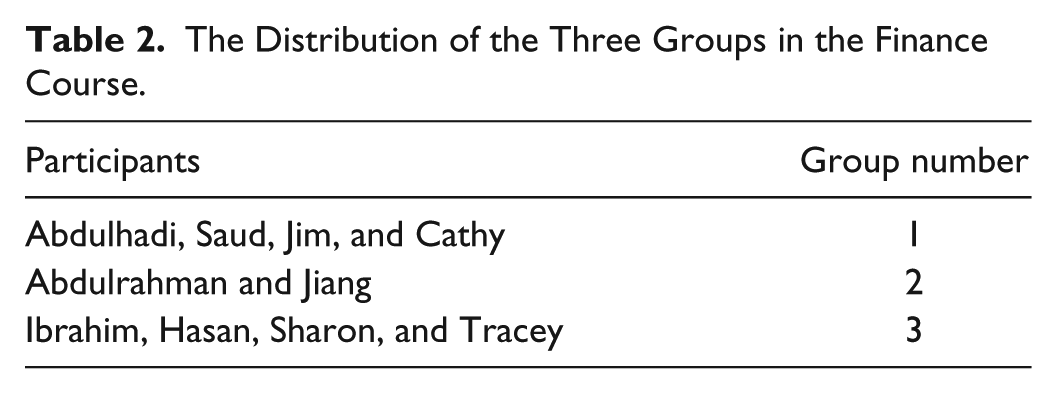
Following the approval of my research project and the granting of ethical approval, I individually approached the students in person during one of the social meetings and introduced myself, my research topic, its duration, aims, and data collection procedures. All the participants showed their willingness to participate in the research by signing the Consent Form after reading the Student Information Sheet, in which I introduced myself and the research I was conducting, when I would start collecting data, and what information I was collecting for my research. The corpus consisted of three group assignments written in English (7,844 words) by a total of 10 students, Group 1 (2,473 words), Group 2 (1,975 words), and Group 3 (3,386 words), excluding the cover sheet, table of contents, and appendices. Each of the three groups comprised two to four students. For the purpose of anonymity, the students were assigned pseudonyms, as displayed in Table 2.
The Distribution of the Three Groups in the Finance Course.
As stated earlier, the study employed Hyland and Tse’s (2004) and Hyland’s (2005a, 2010) models for the investigation of the distribution and nature of metadiscourse markers in the tertiary multimodal business finance texts that encompassed the multimodal texts considered in this study. The models seem to be suitable for the purpose of this study because they reveal the way students use the (a) interactive markers to make their texts more cohesive and (b) interactional markers to signal their interpersonal stance toward both the propositional content and the audience of the text. Therefore, a multimodal analysis of the interactive markers reveals the typical organizational features of the texts, whereas an analysis of the interactional markers provides insights related to the writer–reader relationship. Lea and Street (2006) argued that multimodal analysis reveals the range of meanings expressed in learners’ activities and genres. As the three texts included financial tables, instances of implicit metadiscourse markers were manually coded. Students’ intuitive understandings or the intended reading paths (Van Leeuwen, 2005) of the statistical graphs were transcribed to annotate the frequency and the nature of the metadiscourse markers. Then, a percentage was calculated for each subcategory by dividing the subtotal number of occurrences of each subcategory by the total number of occurrences of the overall category and then multiplying this number by 100. The result yields the frequency of occurrence of each subcategory per the total instances of its overall category. The percentage total of the subcategories adds up to 100%. The use of numerical/quantitative data in this study aims to make statements such as “higher,” “fewer,” and “most” more precise. Moreover, to ensure accurate comparisons between the interactive and interactional metadiscourse markers in each text type (or genre), instances per 100 words were calculated by dividing the total number of occurrences by the total number of words and then multiplying this number by 100.
To achieve reliability in annotating the metadiscourse markers, two reliability procedures were followed: iteratively cross-checking the meaning of the codes and revising the annotations with a fellow linguist.
The study results will be presented in the following section.
Results
This section presents the nature of the three assignment task sheets and the findings of the metadiscourse analyses.
Social Purpose of the Assignment Task Sheets and the Three Groups’ Management Reports
The social purpose of the three multimodal tasks was to evaluate the best investment alternative through the application of capital budgeting techniques and to present the findings in the form of a management report. The assignment task made up 15% of the total grade for the course. Because each group was enrolled in this course in different semesters, each of the three task sheets had a different scenario and word limit (see Table 3).
The Requirements of the Three Assignment Task Sheets.

Although the three groups had different assignment task sheets, they are comparable because the main topics underlying the tasks were similar, except for the second part of the Group 1 task sheet (portfolio management), which was excluded. The Group 1 task sheet required students to adopt the role of the CEO of Voortco, a leading maker of electric and acoustic guitars, and to determine the best choice from three investments options: continuing with business as normal, upgrading existing equipment, or discontinuing use of current equipment and building a new production line. The Group 2 task sheet required the students to evaluate whether it is worthwhile to install tanning equipment in a full-service salon and day spa, and if they determine that it is worthwhile, they should decide which of the two types of tanning equipment, the Dome Unit or the Tanning Bed, is more suitable. The Group 3 task sheet included one case study. The scenario in the task was to choose one of three alternatives: (a) closing one of two factories in Australia and relocating its operations to Thailand, (b) installing a new Information Technology (IT) system for the two factories, and (c) developing new product designs and improving quality control.
Based on the course objectives, the purpose of the three tasks was to display the students’ knowledge and understanding by
applying the fundamental theoretical aspects of financial management within the accounting profession and
understanding modern finance theory to make sound financial decisions in the ever-changing information and communication industry
To successfully write a management report utilizing capital budgeting techniques, the students were expected to engage in interdiscursive literacy and numeracy practices resulting from the use of accounting and finance discourses. Conceptual knowledge was constructed through the ongoing situated social literacy practices that the three groups engaged with to make meaning through the analysis of the given scenarios. As Pardoe (2000) argued, although aspects of experience “may represent merely one set of practices among many” (p. 130) within the profession, explicitly attaching a particular activity or experience to a particular professional scenario is central to students’ understanding of the profession. The students were required to not exceed the 2,000 word limit, excluding appendices. Nevertheless, Groups 1 and 3 significantly exceeded the maximum word limit.
The tables/graphs and the text constituted the multimodal tools that the students needed to employ to successfully accomplish the task (see Table 4).
A Pivot Table of the Three Groups’ Reports.

All three groups used tables as tools to clarify their calculations for the investment proposals and to facilitate comparability among the investment proposals in each scenario. However, Group 1 used tables and graphs excessively compared with the other two groups. This may explain why Group 1 exceeded the required number of words by 25%. Group 2’s grade for this report was the highest, 88 out of 100, compared with 72 and 78 for Group 1 and Group 3, respectively.
Having provided an overview of the social purpose of the three multimodal tasks and having described the key features of the three groups’ management reports, I will next present the findings of the metadiscourse analyses.
Metadiscourse Analyses
The frequency of metadiscourse devices in the orthographic texts and the multimodal tables and graphs in the three groups’ reports revealed their importance in management reports utilizing capital budgeting techniques.
As stated earlier, the multimodal texts were analyzed for the use of implicit metadiscourse markers of the three groups’ intuitive verbal interpretations (or readings) of the graphs. Considering the text length restriction in each assignment, the metadiscourse analysis of the orthographic texts showed a higher frequency of interactive markers (4.21 markers per 100 words) than interactional markers (3.42 markers per 100 words) across the three reports. The results also showed a high frequency of implicit interactional markers (23.34 markers per 100 words) compared with a lack of implicit interactive markers (0 markers per 100 words) in the tables and graphs.
The frequency of the interactive and interactional metadiscourse markers in the orthographic texts and the tables and graphs is listed in Table 5.
The Frequency of Interactive and Interactional Metadiscourse Markers in the Orthographic Texts (5,606 Words) and the Tables and Graphs (2,228 Words).

The metadiscourse analysis of the interactive markers revealed that transitions (or logical connectives) ranked the highest across the three orthographic texts, followed by code glosses and the frame markers: “first, second, third, fourth, and finally.”
On the other hand, [Interactive: Transition] it is suggested [Interactional: Engagement Marker] that changes in the weighted average cost of capital (WACC) and the cost of the machine do not significantly affect NPV. (Group 1’s text) However, [Interactive: Transition] because project lives are different and they are mutually exclusive, the regular NPV . . . (Group 2’s text) In this report, first, [Interactive: Frame Marker] in order to help the Rubber Man Ltd to analyze the cash flow several assumptions are mentioned. Second, [Interactive: Frame Marker] three proposals are analyzed by the incremental after-tax net operating cash flow. (Group 3’s text) For example, [Interactive: Code Gloss] Incremental Adelaide factory leasing revenue and incremental cost saving are . . . (Group 3’s text)
Both Group 1 and Group 2 extensively employed the punctuation mark colon and the abbreviation “i.e.,” as instances of code glosses because much of the reformulation and exemplification was implemented through these visual markers, as shown below: i.e., [Interactive: Code gloss]mezzanine finance are tax deductible/3.5. Leasing cost: [Interactive: Code gloss]. (Group 1’s text) Working Hours: [Interactive: Code gloss]/ . . . i.e., [Interactive: Code gloss] @ 3% p.a. (Group 2’s text)
Evidentials and endophorics rarely occurred in the three orthographic texts.
Leasing cost is expected [Interactional: Engagement Marker] to rise according to [Interactive: Evidential Marker] the inflation rate of 3.5%. (Group 1’s text) Operating cash flows are calculated and represented in the table below. [Interactive: Endophoric Marker]. (Group 1’s text) According to [Interactive: Evidential Marker] the base case financial results, a) Revenue from tanning business as computed above. [Interactive: Endophoric Marker] b) Revenue from sale of bottles as computed above. [Interactive: Endophoric Marker]. (Group 2’s text) According to [Interactive: Evidential Marker] the economic downturn, the company decides to make an investment decision for company’s future development/The financial management goal is to increase owners’ wealth (Ross, Thompson, Christensen, Westerfield, & Jordan, 2007). [Interactive: Evidential Marker]. (Group 3’s text)
The analysis of interactional metadiscourse markers in the three orthographic texts revealed that hedges occurred most often, followed by engagement markers (44.80% and 34.37%, respectively), whereas only hedges (100%) were used in the tables and the graphs.
Operating cost is assumed [Interactional: Engagement Marker] to remain constant at 1.2 million into the foreseeable future. (Group 1’s text) For this, we [Interactional: self-mention] would have [Interactional: Hedge] to compute the projected operating cash flows . . . (Group 2’s text) Therefore, [Interactive: Transition] proposal 2 could [Interactional: Hedge] support the company to achieve their goal by totally $ 254 k to shareholder wealth/Therefore, [Interactive: Transition] this report would [Interactional: Hedge] recommend [Interactional: Engagement marker] that the company should [Interactional: Engagement Marker] accept proposal 2. (Group 3’s text)
All three groups used the engagement markers “assumed,” “forecasted,” “require,” “expected,” “regarded,” “should be,” and “must” to strongly emphasize their point of view. They also used “may,” “could,” “would,” and “possible” to express their arguments to the reader with appropriate caution. Attitude markers, self-mentions, and boosters rarely occurred in the three orthographic texts. Self-mentions included verbs expressing material (compute, take, play) and mental (ignore) processes, as in the following examples taken from Group 2’s text: For this, we [Interactional: self-mention] would have [Interactional: Hedge] to compute the projected operating cash flows . . . We [Interactional: self-mention] take the latest balance sheet of the firm and . . . , but we [Interactional: self-mention] should [Interactional: Engagement Marker] not ignore that the project’s lifetime plays a major role in NPV calculation . . . As we [Interactional: self-mention] see in the table [Interactive: Endophoric Marker], a change in revenue of the most likely case, 70%, caused the NPV to change/but we [Interactional: self-mention] should [Interactional: Engagement Marker] not ignore that the projects lifetime are playing a major role in NPV calculation . . . According to [Interactive: Evidential Marker] the base case financial results, For our calculation purposes, we [Interactional: self-mention] assume [Interactional: Engagement Marker] revenues from tanning to grow in line with inflation
Group 2 established a rapport with the readers and showed consideration for their fellow members through the use of the first-person plural pronoun “we.”
As the variables IRR and NPV in the sensitivity analysis graph may be influenced by market conditions (such as sales price, variable cost per unit, number of units sold, fixed operating costs, and WACC), interpretations of the three groups’ graphs showed that they typically used the hedge marker “would be” for the increase/decrease in predictions of revenues because the estimates may not always be “true” as other external factors may also affect the business environment. Group 1, for example, assumed that revenues would increase or decrease to the extent of 30%. The green slope can be interpreted as “If the sales price is set 30% above its expected price, the NPV would be [Interactional: Hedge] + 9,000,000” (see Figure 1).

The sensitivity analysis graph in Group 1’s text.
The graph above shows that the NPV was very sensitive to changes in Sales and cost of good sold (COGS), fairly sensitive to changes in WACC, and not very sensitive to changes in Machine Cost. For example, the Sales slope can be intuitively interpreted in natural language as “sales will probably deviate highly from the original estimates” and “Machine Costs will probably not deviate from the original estimates.”
Discussion of the Findings
The results of the metadiscourse analysis showed that the orthographic texts in the three management reports combined interactive metadiscourse markers (e.g., transitions, code glosses, and frame markers; 4.21 markers per 100 words) and interactional metadiscourse markers (e.g., engagement markers, hedges, and self-mentions; 3.42 markers per 100 words). This result indicates that the orthographic texts contained features that resembled both formal written academic discourse and spoken-like discourse. The findings also showed a high frequency of implicit interactional markers (23.34 markers per 100 words) compared with a lack of implicit interactive markers (0 markers per 100 words) in the tables and graphs.
Whereas the interactive markers transitions (or logical connectives) and code glosses ranked the highest in the three orthographic texts (2.96 markers per 100 words), evidentials and endophorics rarely occurred (0.66 markers per 100 words). Hyland (1999) also reported a high incidence of logical connectives and code glosses and few instances of evidentials and endophorics in marketing textbooks. All of the three groups used the evidential marker “according to” to support their arguments. Group 3 also used evidentials to refer readers to the references they used in the report. Writers use these tools as a means to express obligation and to objectively disguise or mitigate their commands or propositions. Similarly, the interactional markers self-mentions, boosters, and attitude markers rarely occurred (0.71 markers per 100 words) in the three orthographic texts. This seems to be natural as these markers are more characteristically found in face-to-face communication or informal email exchanges. Only Group 2 preferred to use the interactional device self-mentions, reflecting their preference in resisting the typical formal academic discourse features valued by most instructors through their use of the first-person pronoun “we.” The formal-like academic language in Group 2’s text paralleled the spoken-like features that made the text more informal, emotive, and personal. Only this group used personal pronouns that engaged the readers by including them as participants. This may either reflect that the group wanted to personalize their text or that they intended to show their increased level of certainty as these pronouns are commonly used in scholarly academic writing. This finding is in line with the findings of Alyousef and Picard’s (2011) study, which highlights ESL business students’ awareness of their audience. It is also in line with the findings of Hyland’s (2005b) study, which showed that although “expert writers” use personal pronouns and interjections to claim affinity with their audience, students tend to underuse these features. The finding, however, contrasts with Yeung’s (2007) claim that the use of first-person pronouns “does not seem to be a defining characteristic of business reports as claimed” (p. 177). Yeung (2007) found that although writers occasionally used this authorial presence resource in business reports, its “occurrence appears to be correlated mostly with the descriptions of methods of investigation” (p. 174) for the purpose of projecting professionalism. Similarly, Hyland (2005b) argued that because academic assessment genres are “influenced by the dominant ideologies of the genre they are employing” (p. 14), they lack the writer–reader equality found in peer-oriented research papers.
The analysis of interactional markers showed that although hedges ranked the highest of all interactional markers in the orthographic texts (44.80%), they were even more extensively used in the tables and graphs (100%). As hedges were mainly used to present the groups’ predictions of increases/decreases in revenues in the sensitivity analysis graphs, we can conclude that a statistical graph is imbued with a degree of certainty or usuality because its underlying theoretical construct is based on presumptions rather than abstract “truths.” This finding is in line with Hyland’s (1999) study, which showed that this marker was highly used in marketing research articles. The result also supports Hyland and Tse’s (2004) study of academic writing. Similarly, the finding extends Hyland and Tse’s (2004) claim that hedges constitute the highest frequency of occurrence among all interactional markers. The Master’s of Accounting students appear to have been enculturated into the discourse of their community of practice. The most commonly used type of interactional metadiscourse markers in Group 1’s text was engagement markers (It is suggested . . .); the most commonly used type in Group 2’s text was self-mentions (but we should not ignore . . .), and the most commonly used type in Group 3’s text was hedges (Therefore proposal 2 could [Interactional: Hedge] support the company).
Conclusion and Implications
This article focused on the use of metadiscourse markers in the Principles of Finance multimodal management reports, which encompassed orthographic texts and tables and graphs. The results of the study showed a high frequency of interactive markers (4.21 markers per 100 words) and interactional markers (3.42 markers per 100 words) across the three orthographic texts compared with the high frequency of implicit interactional markers (23.34 markers per 100 words) and the lack of implicit interactive markers (0 markers per 100 words) in the tables and graphs. The students used formal academic discourse and spoken-like interactional metadiscourse markers. The findings reflect the students’ awareness of the academic nature of this type of writing. The Master’s of accounting students’ use of the various metadiscourse markers highlights their awareness of their audience and the special and particular organization of metadiscourse features in management reports. The findings in Hyland’s (1999) study of marketing textbooks agree with the results presented here, suggesting that the students have been enculturated into the business discourse of their community of practice. It should be noted, however, that this interpretation reflects only a subset of the full range of the writers’ intentions and experiences. As Denzin and Lincoln (2000) argued, paraphrasing Guba (1990), “reality can never be fully apprehended, only approximated” (p. 14). Moreover, the analysis of the implicit metadiscourse markers in the statistical graphs is limited to the interpretations of the participants in this study. As only three group assignments were used in the present study, further investigations need to include a larger corpus.
The pedagogical implications for the use of metadiscourse markers in tertiary business multimodal reports are drawn from the findings and the literature. The metadiscourse analysis of visual artifacts (tables and graphs) extends Hyland and Tse’s (2004) and Hyland’s (2005a, 2010) models for the analysis of a range of multimodal texts. The findings indicate the importance of metadiscourse in Master’s-level finance discourse. As the use of metadiscourse markers plays a vital role in maximizing students’ learning experience, it can be emphasized by drawing students’ awareness to the writing process, particularly in English for Business Purposes (EBP) courses. Tutors can use exemplar workplace business texts to introduce the different metadiscourse subcategories and the uses of each. For example, students need to learn that although endophoric markers are used to refer to information in other parts of the text, evidentials refer to sources of information outside of the text. These resources play a vital role in constructing well-organized texts. As the values of financial variables in the sensitivity analysis graphs, such as IRR and NPV, are imbued with a degree of certainty or usuality, the hedge marker “would” is typically used in the reading of these graphs when referring to their values. Students need to learn the special and particular metadiscourse features of the multimodal graphs and tables in management reports. Finance learners can engage their readers in the argument either by “selectively focusing their attention” through the use of engagement markers such as “consider,” “note,” “assume,” “regard,” “forecast,” or “recommend” or by “including them as participants in the text through second person pronouns, imperatives, question forms and asides” (Hyland, 2010, p. 129). Finally, management reports extensively employ code glosses and, in particular, colons because much of the reformulation and exemplification is implemented through these visual markers. If these implications were made explicit, students’ learning experiences and their understanding of meaning-making resources could be greatly enhanced and, in turn, affect their communication skills in and beyond university.
Footnotes
Acknowledgements
This author expresses his appreciation to the Deanship of Scientific Research at King Saud University and the Research Center at the Faculty of Arts for funding the current article.
Declaration of Conflicting Interests
The author(s) declared no potential conflicts of interest with respect to the research, authorship, and/or publication of this article.
Funding
The author(s) disclosed receipt of the following financial support for the research and/or authorship of this article: The author extends his appreciation to the Research Centre at the Faculty of Arts and the Deanship of Scientific Research, King Saud University, for funding this research study.