




Abstract
This qualitative case study aimed to examine pre-service teachers’ and teacher educators’ interactions during their English grammar lessons via the WhatsApp platform. The Community of Inquiry (CoI) model was employed to categorize the WhatsApp interactions based on social, cognitive and teacher presences. Participants wrote their reflections for an in-depth understanding of the phenomenon that is being investigated. The cognitive, social and teaching presences were evident during their interactions on the WhatsApp platform. Among them, cognitive presence was identified to be the most common interaction. Participants used the WhatsApp platform to explore and integrate ideas related to English grammar. The platform also allowed them to construct sentences based on the rules and knowledge gained during their interactions. The teacher acted as a facilitator assisting learners rather than passively teaching learners the “correct” way to learn the English language by creating opportunities for learners to notice grammatical rules. For social presence (SP), the use of emoticons was dominant. The reflective writing demonstrated positive learning experiences. The study concluded that WhatsApp has the potential to be a worthwhile platform for English grammar learning if instructors are able to optimize the features offered in an application for effective interactions and collaborative dialogues.
Introduction
Mobile Assisted Language Learning (MALL) initiatives are gaining momentum in the educational context and are considered one of the prevailing e-learning initiatives (Shadiev et al., 2018). MALL can be differentiated from Computer Assisted Language Learning (CALL) based on some unique features such as portability, continuity and spontaneity of access and interaction across different contexts (Kukulska-Hulme & Viberg, 2018). With MALL, learners are experimenting new ways to seek knowledge by learning in various context involving social and content engagement (Jeno et al., 2019).
According to Kartal (2019) MALL was proposed as a way for higher education institutions to keep up with technological advances in education and opportunities for language practice for learners both in and outside the classroom. One of the most popular uses of MALL is using a smartphone with WhatsApp installed. Researchers seem to converge on the strengths of WhatsApp, which include constructive interactions (Annamalai, 2019; 2018; Ashiyan & Salehi, 2016) and the opportunity to study anytime and anywhere across a variety of learning contexts (Balcı & Kartal, 2021; Benson & Voller, 2014).
It offers not only quick interaction and exchange of multimedia but also permits visual, verbal and acoustic elements. For these reasons, Yus (2011) illustrates that WhatsApp is an opalized text with emoticons and typographic alterations replacing body language that is missing while interacting in the virtual environment (Maíz-Arévalo, 2017).
Numerous research studies have also revealed the widespread use of WhatsApp in language instruction. For example, to enhance vocabulary skills (Bensalem, 2018), oral skills (Andújar-Vaca & Cruz-Martínez, 2017), writing skills (Fithriani et al., 2019), to learn a language beyond the classroom (Tragant et al., 2021), and to build language learners' confidence (Sockett, 2014).
Although efforts have been devoted to illustrating the use of WhatsApp in an educational context, García-Gómez (2020) has highlighted that interacting effectively via WhatsApp constitutes a complex and confusing representational ground. This coincides with the fact that, in terms of teaching, researchers and practitioners are constrained by the limited pedagogical examples and guides in the learning context (Dar et al., 2017; Zulkanain et al., 2020). Furthermore, technology implementation studies are often “technocentric” and ignore the intricate relationship between other factors, overlooking the complexities surrounding concepts such as mobile devices and “mobile learning” (Wright & Parchoma, 2011). Also, dominant theories related to technology such as the Technology Acceptance Model (TAM) and Unified Theory of Acceptance and Use of Technology (UTAUT) are solely focused on technology aspects (Lyytinen & Damsgaard, 2001), and they failed to provide evidence of other aspects related to online teaching and learning activities. Therefore, the current study intends to fill this gap by examining the interactions on the WhatsApp platform during English grammar lessons.
The Community of Inquiry (CoI) model was employed to understand instructor and students interactions. In this light, the present study was undertaken to answer the following research question:
What are the pattern of interactions that enhance English grammar learning on the WhatsApp platform?
What are the pre-service teachers experiences of using WhatsApp for English grammar learning?
In answering the research questions, we investigated how pre-service teachers interpreted their experience in English language learning. Finally, the online archives will be examined to indicate the instances of negotiation of ideas, knowledge, instructions, formal and informal interactions linguistically to enrich the context of the investigation.
Literature Review
Social Constructionism Theory
Social constructionism (SC) was introduced by Shaw (1996), detailing the importance of social interactions and materials from the construction of artefacts. According to Papert (1993), Information and Communication Technology (ICT) aligns well with the demands and needs of the digital natives and computational culture, which focuses on meaningful artifacts for acquiring knowledge. The theory challenges the notion that educators should impose knowledge and support the idea that individuals understand the world through social interactions and negotiations with others.
The aim of the research is not to produce static knowledge but to open up to new knowledge and ideas of what is possible and practical (Gablin, 2014). Meaning in SC is viewed as a product of social, discursive and symbolic practices and not as an object itself (Cojocaru & Bragaru, 2012). In the words of Hoffman (1991), social constructionism can “replace the objectivist ideal with a broad tradition of ongoing criticism in which all productions of the human mind are concerned” (p. 1). From a social constructionist perspective, language does not only connect people but humans “exist” in language.
Therefore, the focus is on social interactions where language is developed, sustained and abandoned, inform that constructionism is a principle for curriculum design, materials development, and classroom practice (Rüschoff & Ritter, 2001).
Hence, current researchers are convinced that the use of WhatsApp can be grounded under constructionism theory and shared artefacts can be developed if certain procedures are followed. Parmaxi et al. (2013) found that the theory would inform us of the importance of social technologies to prepare activities in groups for interaction and construction of sharable artefacts. This firmly supports the aim of this study to examine the use of WhatsApp under the theory of constructivism by asking a group of ESL pre-service teachers to construct artefacts using WhatsApp collaboratively. The researcher intends to use the WhatsApp platform as a way of knowledge sharing, to encourage students to learn, discover and build new ideas and knowledge.
Community of Inquiry Model
The CoI model is a widely accepted model established based on the social constructivism theory with three interrelated components: cognitive presence (CP), teaching presence (TP) and SP(SP). One of the main reasons for the model to be successful over the past two decades is that “it builds upon two ideas that are essential in higher education community and inquiry” (Garrison & Vaughan, 2008, p. 9).The three presences are pertinent in creating and maintaining a learning community that develops learners’ educational experience (Garrison, Cleveland-Innes & Fung, 2010).
Garrison et al. (1999, p.89) define CP as the “most basic to success in higher education” and emphasize students’ capacity to construct meaning by exercising critical thoughts and to be intellectually engaged. Garrison et al. believe that gaining significant deep learning requires a high level of CP and that questioning, exploring, integrating, and sharing are key components of that presence. CP is measured by four phases, Triggering Event, Exploration, Integration and Resolution. It discusses learners’ ability to construct knowledge (Garrison et al., 2001). The various stages of an inquiry cycle involve finding information, considering different viewpoints and arriving at conclusions perspectives, which are essential to stimulating CP (Hilliard & Stewart, 2019; Swan et al., 2008).
SP is linked to learners’ capacity to “project their personal characteristics into the community, thereby presenting themselves to the other participants as real people” (Garrison et al., 2001, p. 89). Affective Communication, refers to the ability to express emotions and feelings related to the educational experience (Garrison et al., 2001, which promotes a sense of inclusion and a fosters a safe environment and supportive learning environment. For example, by recognizing and valuing students’ personal experiences by reducing social isolation. Open Communication, on the other hand, involves acknowledging, complimenting, and responding to others’ questions (Garrison, 2017). Cohesiveness encompasses a commitment to the purpose of CoI and plays a crucial role in optimizing the quality of learning (Garrison, 2017).
SP develops sufficient trust for interactions and collaboration to take place. The act of trusting the group members is essential when they are asked to share their ideas and comment on each other’s work (Corbett et al., 2014). In this way, students experience active learning. The development of CP is directly influenced by SP, serving as a mediator between teaching and CP (Armellini & De Stefani, 2016). In using the WhatsApp platform, the researchers intend to examine interactions related to SP given the absence of face-to-face interaction is missing. Therefore, it is pertinent to understand how virtual interactions can compensate for the lack of student-student and student-teacher interaction.
Teaching presence (TP) refers to the design of the educational experience through learning activities, assessments, and the facilitation of learning through discourse. TP is comprised of three components: Instructional Design and Organization, Discourse Facilitation, and Direct Instruction (Anderson et al., 2001). Design and organization refer to the structures and curricula that teachers use to design procedures using online tools, (a) set time constraints, (b) enforce appropriate behavior when interacting in a virtual environment, and (c) provide feedback on the work at hand (Garrison, 2017).
Direct instruction shows how teachers identify and correct misconceptions and impart information from a variety of sources (Garrison, 2017). Facilitating Discourse supports the educators’ role in assisting students in creating personal meaning and forming their understanding. According to Cheng (2022), TP includes all the activities that instructors incorporate in a class to promote learning, such as giving feedback and motivating students.
Understanding the three presences of the CoI model establishes and sustains a purposeful learning community that guides educators to online pedagogical practices (Akyol et al., 2009a). This study contextualizes the research under the CoI model by considering concepts, such as interactions and collaboration among peers and educators. The WhatsApp platform permits learners to share their knowledge with peers and instructors through their postings on the platform. Comments from the teacher and peers are disputed and argued, which prompts critical thinking and leads to independence in thinking. In such a situation, constructivist learning takes place and critical thinking occurs to discover new knowledge. This is precisely what Swain and Watanabe (2013) has pointed out in second language learning, which highlights the importance of collaborative dialogue in facilitating second language acquisition, where speakers interact and are involved in problem-solving and knowledge creation. Therefore, investigating students' interactions in the WhatsApp platform in this study can foster a positive language learning environment.
Review of Related Studies on WhatsApp
There has been a myriad of studies that documented WhatsApp as an effective teaching tool in language learning. For example, a mixed-method study by Balci and Kartal (2021) used a vocabulary revision technique termed “peer chain” to investigate the vocabulary learning of students. The study reported that the students had a positive perception of the technique compared to paper-based word cards for language learning. A quasi-experimental study conducted by Hani (2014) found that students felt WhatsApp was entertaining rather than learning and there was a significant improvement in vocabulary learning. Similarly, Ashiyan and Salehi (2016) found that WhatsApp is a worthwhile platform that influences the acquisition of new collocation of Iranian EFL learners. A content analysis study conducted by Saritepeci et al. (2019) demonstrated that WhatsApp supported active learning, enhanced student-teacher interactions and motivated the students. Cetinkaya (2017) opined that using the WhatsApp is convenient, allows effective interaction, is cost-free, reliable and safe environment (Cetinkaya, 2017). The blended learning approach with a combination of traditional classroom teaching and WhatsApp works well together (Annamalai, 2019; Yavuz, 2016). Most of the aforementioned studies on WhatsApp and language learning highlighted the use of WhatsApp and offer the possibility of using this technology as a reinforcement to traditional classroom instruction (So, 2016). While the above-mentioned studies reported positive learning outcomes of WhatsApp for academic purposes, other studies revealed otherwise. Bani-Hani et al. (2014) reported that social media such as WhatsApp can be distracting since students tend to check informal interactions and are not engaged in classroom interactions. According to Kim et al. (2014), instant messages like WhatsApp seem to have lower levels of cognitive interactions.
For these reasons, researchers have expressed the need for more studies on WhatsApp and language learning (García-Gómez, 2020; Saritepeci et al., 2019). These researchers have called for more studies on the successful implementation of WhatsApp from an educational and pedagogical perspective. The most frequently repeated dissatisfaction was limited to studies investigating deep learning (Saritepeci et al., 2019). Furthermore, Tragant et al. (2021) highlighted that examining chats in mobile-mediated communication has been limited. It remains unclear whether findings from other contexts and settings are generalizable to Malaysian contexts.
Methodology
This study uses a constructivist approach, centered on describing the students’ interactions and reflections on the use of WhatsApp in English language grammar learning. Consequently, the learners became the meaning makers and direct contributors to the objective of this study. Therefore, this study utilized a qualitative case study in which online interaction and reflection were collected, analyzed and integrated to give in-depth evidence for the case being investigated (Creswell & Plano Clark, 2018, p. 116).
Participants
Using purposive and convenience samplings, 31 pre-service teachers were selected from the foundation program for Mathematics and Science will be sitting for their MUET. MUET is a language proficiency test that measures English language skills for students who are enrolled at the pre-university level in Malaysia It is administered and supervised by the Malaysian Examination Council (MEC). Purposive sampling was employed to identify ‘information rich participants’ and “those from which one can learn a great deal about issues of central importance to the purpose of the inquiry” (Patton, 2002, p. 230) The teacher educator who initiated the WhatsApp tasks, is an experienced EFL teacher educator for the past 30 years.
Research Procedure
The study was conducted for 8 weeks to prepare the pre-service teachers for the Malaysian University English Test (MUET). There are four components in the MUET paper: listening, reading, writing and speaking skills. Since the grammar component is crucial for enhancing the four skills, a WhatsApp group was created for students to improve their English grammar level before the MUET examination.
In this study, students experienced full online instruction. Interactions were conducted via WhatsApp. The student coordinator of the subject created a WhatsApp group and invited the lecturer teaching the group and all members of the class to join the group. The lecturer explained the purpose of the WhatsApp group from the onset of the interaction, which was to make it an interactive platform for the students to practice using English. There were no ground rules as the main purpose was to provide students with an avenue to practice English. Nevertheless, they were reminded to try to use the correct punctuation marks in their messages.
Research Instruments Online archives
The online archives were collected from 31 pre-service teachers. To manage the online archive data, the following process was adhered to. First, the WhatsApp chats were exported to word documents from the cell phone, and all online messages were numbered according to CP, TP and SP. This was done manually. The messages that were not related to the three presences were highlighted in red. The themes were derived through the deductive method and the codes were combined to reach the main themes.
Braun and Clarke’s (2006) thematic analysis were employed to discover, analyze, interpret, and report on the online archives. Thematic analysis has six steps: (a) becoming familiar with the data and transcribing all data; (b) generating codes; (c) classifying codes into the theme; (d) reviewing and refining themes; (e) concisely defining and naming themes; and (f) producing a descriptive, analytical, and argumentative narrative report from emerging themes.
Reflective Writing
Reflective writing was conducted to gather information about participants experiences which can enrich the qualitative data (William & Katz, 2001). The participants were asked to reflect on their entire experiences with WhatsApp. This reflection aimed to understand participants' ability to understand TP, CP, and SP. Before the reflective writing, students were briefed on the definitions and elements of all three presences. The following questions guided them to reflect on their experience.
Did you feel the teacher’s presence in the online lesson today?
Did the online learning experience involve the actual SP that you would experience in a normal face-to-face classroom?
Did the online learning experience lead to the CP you would experience in a normal face-to-face classroom?
What is your experience in using WhatsApp for English language learning?
Two experts from the field of Education and English validated the reflection questions. Their comments were related to sentence structure and changes were made to the questions before the actual study was conducted. The reflective writing was also analyzed based on Braun and Clarke’s (2006) thematic Deductive analysis based on CP, SP and TP was employed to explain the presences, and direct quotes from participants were provided.
Trustworthiness of the Qualitative Data
An investigator triangulation (Guba & Lincoln) was used to analyze the online archives and the reflective writing. Transferability was achieved when the participants and settings were explained. Data were coded by independent coders separately and the consistency ratio was calculated. Miles and Huberman’s (1994) inter-rater reliability was employed, and it was calculated. Inter-rater reliability for the interactions and reflective writing was obtained using a raw percentage, as suggested by Miles and Huberman (1994). To ensure the findings are valid, Miles and Huberman state that there must be an agreement of 70% among the coders. The agreement was calculated as 85% for the online archives and 90% for the reflective writing. Further, data collection tools and research procedures were explained systematically.
Findings
The following section shows the interaction patterns that were categorized based on CP, SP and TP. The online interactions were analyzed in terms of the number of occurrences for the descriptors of social, teaching and CPs by tasks. A total of 322 messages (67 from the teacher educators and 255 from pre-service teachers) were gathered till the end of the course.
Numerical Distribution of Cognitive Presence.
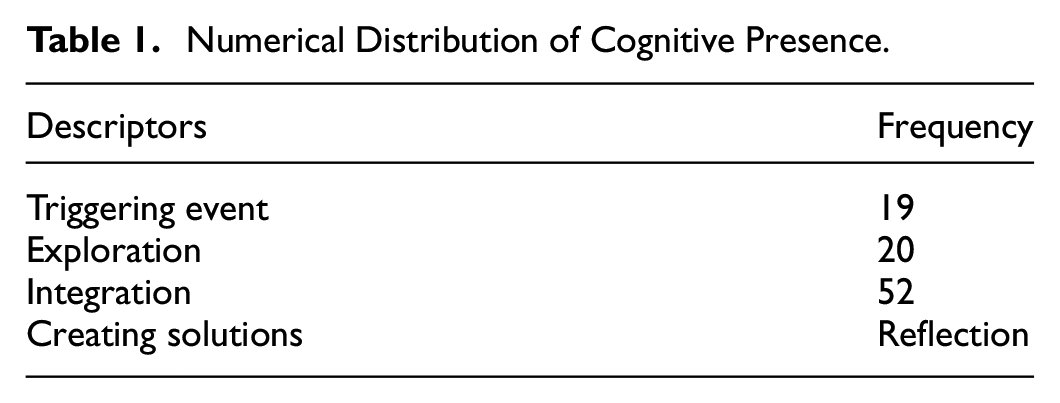
The instructor as well as students initiate the Triggering Event by sharing links, web resources and information. Learners explore and integrate ideas and knowledge acquired to further achieve the resolution phase. Students used the WhatsApp platform to apply what they have learned. The Integration Phase happens when students start constructing sentences. The following figures illustrate participants’ and teacher educators’ discussions related to CP. Figure 1 illustrates the discussion related to the use of modal verbs and Figure 2 illustrates the discussion related to the use of articles in English grammar. Participants used a variety of techniques to trigger the thinking process. The students initiated the triggering event by stating “we will solve the problem.” (Figure 1), “hello everyone ‘a,’‘an,’ and ‘the’ are articles,”“Can you explain how you use them” (Figure 2) and “What about university”? (Figure 3). Triggering Event provided a challenge or question for the students, enabling them to move on to the exploration and integration phases. In the exploration phase, exchanging information was identified. One of the students shared important information about grammar rules allowing participants to collaborate and exchange ideas to reach a solution (Figure 2). In Figure 1, the exploration phase starts when students explore the web resources given by the instructor. This prompted another constructive question related to, “what is rule no 3.” Another example of the exploration phase is when students shared rules related to using the article “a.” One of the participants said “use ‘a’ before words that start with a consonant sound ” (Figure 2). By understanding the grammatical rule, students moved to the integration phase and further constructed sentences based on the grammatical rules.
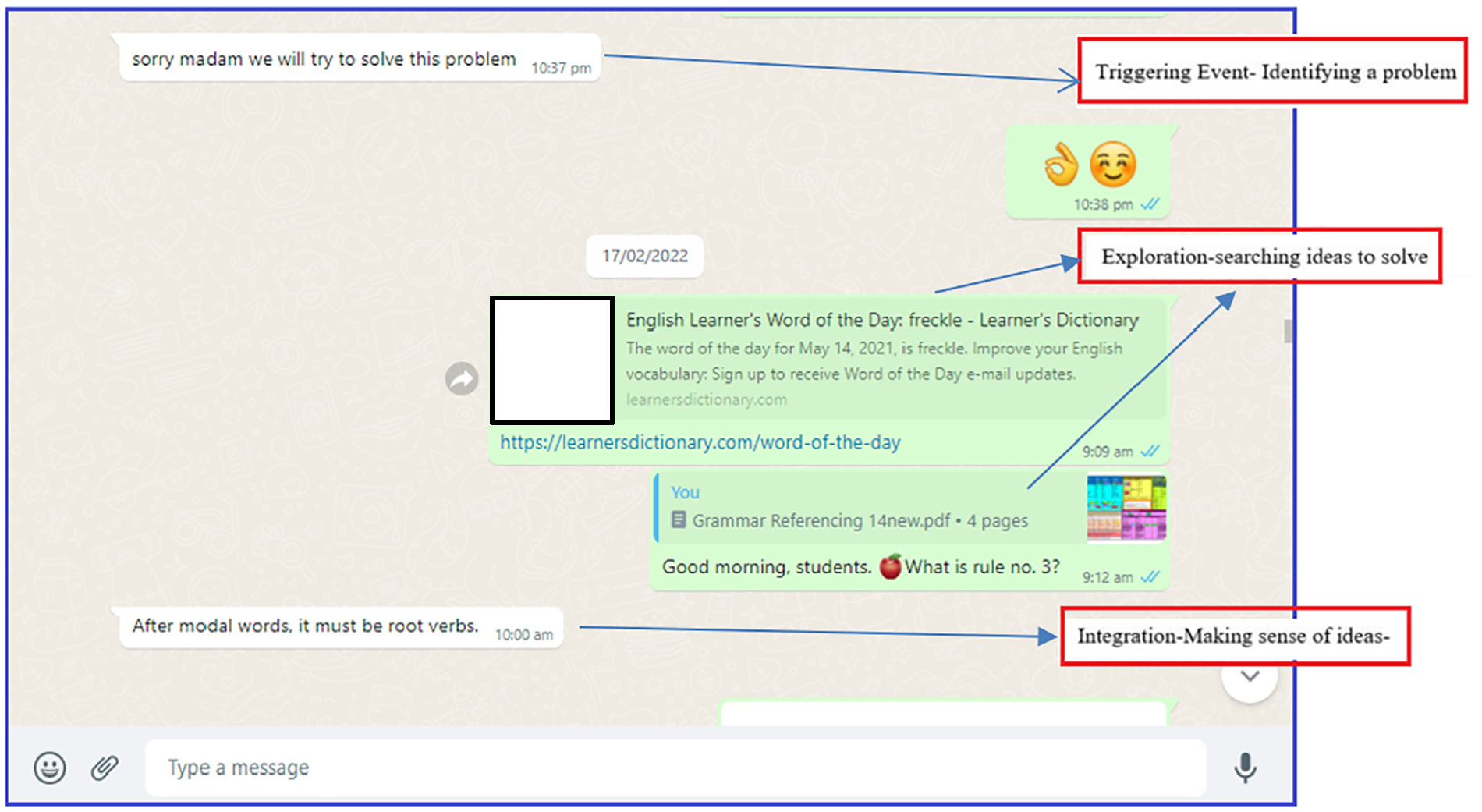
Interaction related to the cognitive presence (modal verbs).

Interaction related to the cognitive presence (modal verbs).

Interaction related to cognitive presence (nouns).
In Figure 3, Exploration Phase is evident when one of the students mentioned that “because it is read as yuniversity- starts with a consonant ‘y’.” Further, Integration Phase is demonstrated when the nouns were written with correct articles (i.e., “a university, a European and a uniform”). Creating a resolution category suggests new insights into learning and this is evident in students’ reflection on the use of WhatsApp and the three presences.
The reflection data themes enhanced and supported CP through four facets: (a) web resources (b) video and voice calls (c) quick response (d) frequent interaction. The excerpts from the reflective writing were used as they were expressed. Therefore, grammatical and syntax errors are evident in the following excerpts.
Web Resources
Participants in this study acknowledged that the various materials such as graphics (PE1, PE5, PE8), grammar tips (PE2, PE3, PE7) and web resources improved their language (PE10, PE11, PE12). For example, “it helps me to improve my grammar. This is because my lecturer gave us graphics related to grammar, modals, verbs and adjectives via WhatsApp. With these materials we can refer to the example and explore more to improve our grammar” (PE 12). They were able to explore and integrate ideas with the use of online dictionaries and other web resources. PE2 stated, “I think WhatsApp is helpful to learn language because if I do not understand the phrase or any words, I can search the dictionary and the web-resources suggested by the lecturer for the correct answer. So, it is making the process of learning English much easier.” PE 10 detailed that: I have learned a lot from using grammar learning through WhatsApp. Madam [instructor] send us an online pdf grammar attachment containing various grammar that will make it easier for me to make references. The attachment teaches me the difference between who and whom, how to use each modal verb like could, may, and should and much more.
P13 concluded that “we as students respond to questions and experience 21st-century activity to develop critical thinking skills.” The web resources allowed me to learn grammar easily without confusion. I also know the do’s and don’ts to avoid grammatical errors. (PE11). Some of the information relates to “higher order thinking and make me think outside the box” (PE3).
Video Calls/voice calls
Participants opined that the “voice call helped to learn certain pronunciation and to construct certain sentences. Such application helped me to learn English effectively” (PE4). PE7 realized that “video conversation helped to understand and apply grammatical rules better.” According to PE8, “instead of giving the feedback through message, we also can make voice recording to give feedback. By doing this practice, I can enhance my writing and speaking skills in the English language.”
Frequent Interactions
Participants also realized that “when the teacher asks a question, we are able to interact and respond. We are able to think critically” (PE2).
Similarly, PE (10) detailed that: I have learned a lot, such as the use of correct words when interacting with others. Also, the punctuation in the sentence and the use of tenses in the writing. If my sentence is incorrect, the teacher will correct it for me.
The interactions allowed the participants to gain relevant information related to English grammar to enhance learning. PE10 asserted that “I feel engaged and able to interact with the lecturer, friends and content via WhatsApp because they respond immediately in the learning process.”
Teaching Presence
TP entailed Instructional Design and Organization, Facilitating Discourse and Providing Direct Instruction. The category related to Focus Discussion on Specific Issues has the highest interactions and the lowest interactions are related to establishing parameters, utilizing the medium effectively, and confirming understanding through assessment feedback. Table 2 shows the categories and subcategories for TP. As a subject matter expert, the teacher infused instruction by setting the titles and providing ideas and suggestions for them to understand grammatical rules. Overall, the data demonstrated that the teacher educator could retain the students’ attention, motivation and engagement by reading and responding to their questions and comments frequently.
Numerical Distribution of Teaching Presence.

In Figure 4, Facilitating discourse, was evident when the teacher identifies areas of agreement and said that “it starts with a ‘a’ vowel sound” and prompted students to interact. To draw in participants and to prompt discussion the teacher instructed the students to “record yourself reading the words please. Then you will understand the vowel sounds.” The teacher also further prompted that students by stating that “use the audio recording here” and “I am waiting and You need to read it out to be able to hear the vowel sounds.”
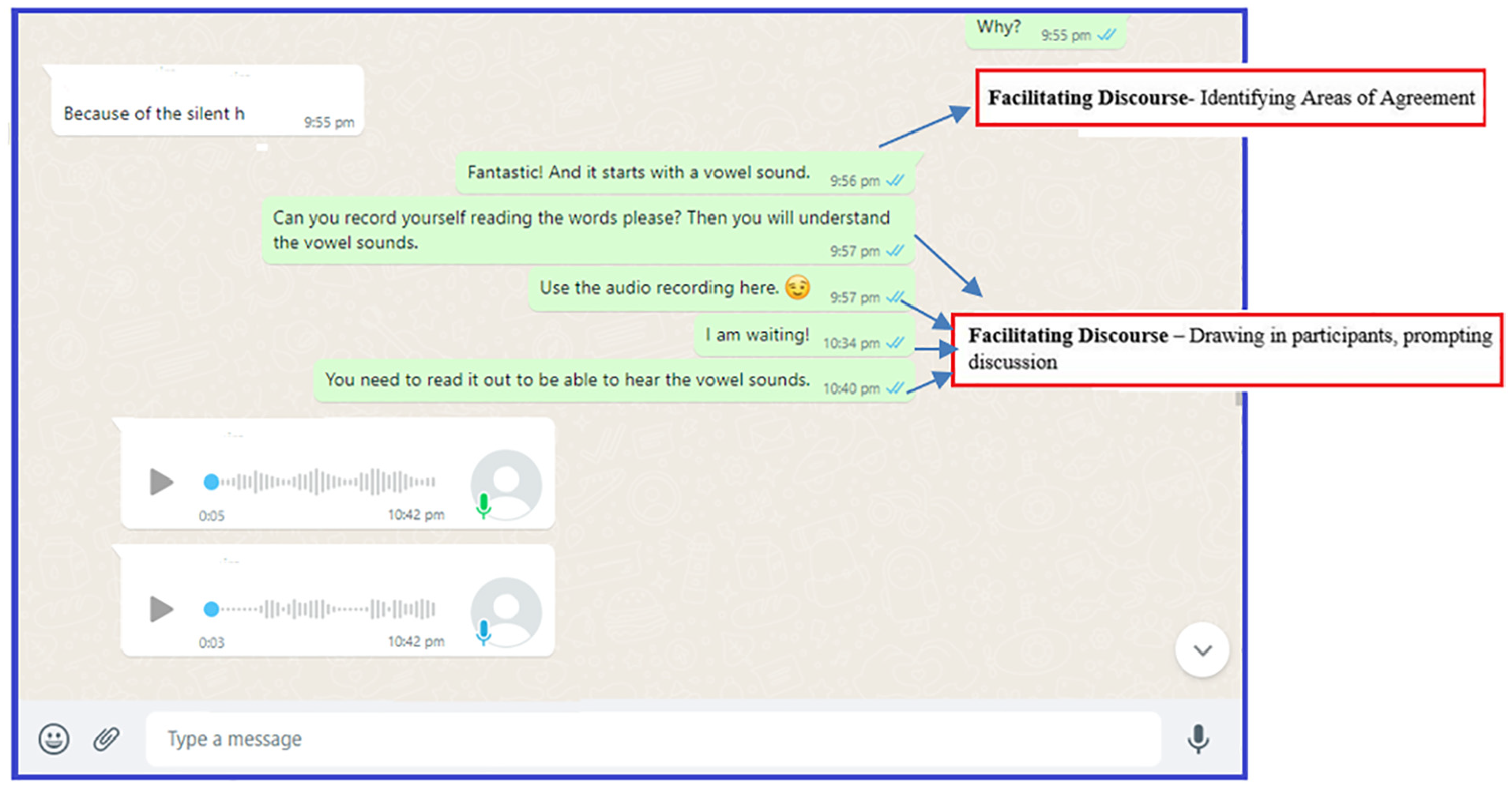
Interactions related to facilitating discourse.
In Figure 5, the teacher gave direct instructions by presenting the content “ For Topic no5, make a sentence please.” She further summarizes the discussion and said that “remember the adjective is before nouns…Gorgeous girls not girl gorgeous. In Figure 6, teacher related to Instructional Design and Organization by setting the curriculum. The teacher started the interaction with “Good afternoon, everyone. Hope you are ready for the workshop” The teacher further established netiquette by stating that “Please respond to Pn Vimala when she asks questions.” More examples related to Direct Instruction and Instructional Design were evident in Figure 7.

Interactions related to direct instruction.
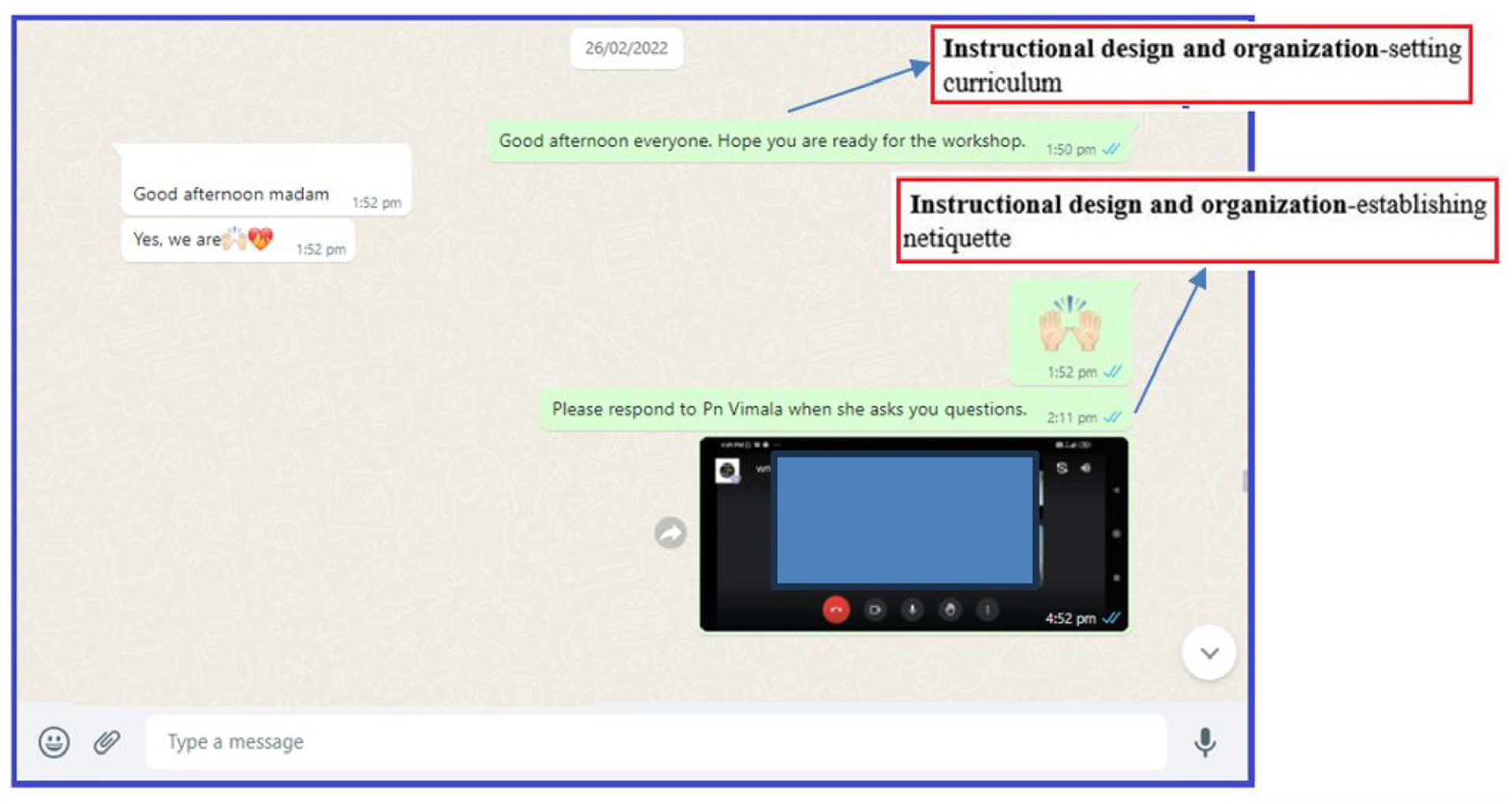
Interactions related to instructional design and organization.

Interactions related to direct instruction and instructional design and organization.
The following section illustrates the themes that have been derived from the students’ reflection. The sub-themes are effective instruction and guidance and flexibility in receiving instruction.
Effective Instruction and Guidance
As for TP, the participants appreciated the effective guidance given by the teacher educator. The lecturer constantly reminded her students of important due dates and events. For example, “the teacher always reminds us of lecture notes, schedule and assessments” (PE8). Also, PE2 added that “teachers keep giving us notes so we can easily download the notes direct from the phone.” The lecturer “often guide me and advise me on how I can solve the problem” (PE3). The teacher has systematically organized her teaching activities for students to experience positive learning outcomes. The feedbacks given by the instructor seemed to motivate students to continue learning. One of the students demonstrated that: My lecturer always gave us feedback when we answer the questions. She also praised us when we get right answers and she correct our mistakes immediately when our answers are wrong. I feel comfortable learning with my lecturer. She motivates us that we can excel in our MUET examination (PE12)
PE6 claimed that the lecturer is always guiding the students and never left the class without providing additional information. In her words: Every class is very interesting and highly interested and anticipated because Madam always ensures that the class lessons are interesting. For example, if a discussion begins to slow down, madam always asks more questions to ensure that we are always thinking and actively participating in class.
Flexibility in Receiving Instructions
Participants highlighted the teachers' effort to encourage constructive discussions at any time without time and space constraints. PE11explained that “lecturer always keep updating us anytime, day and night. So, we can learn any time anywhere.” Similarly, PE7 said that: when the lecturer asks questions my friend and I can share our answers via WhatsApp group immediately (PE3). Participants appreciated “when teacher is available to respond immediately via WhatsApp” (PE4). PE5 concluded that “teacher and students can learn anywhere and anytime.
Social Presence
SP was less common compared to CP and TP. Most of the interactions were related to emoticons. Table 3 illustrates the categories and related to SP. The highest interactions were related to greetings and the lowest interactions were related to humor.
Numerical Distribution Social Presence.

Emoticons liven up interactions and seem to convey humor, appreciation and greetings (Figures 8–10). Participants reported that they shared jokes and emoticons during their lessons to facilitate socialization. Also, students were always encouraged to show appreciation once the class is over with clap-hand emoticons (Figure 8). Greetings seem to be common with the use of emoticons. Figure 8 illustrates compliment such as “excellent.” Students positive emotions were demonstrated with the use of “Thank you” and “welcome.”. Greetings were also evident when students posted images of “Good night” (Figure11). Figure 11 illustrates jokes that the participants posted to liven up the interactions.

Social Presence related to interactive.

Social Presence related to affective (affective emotion).

Social presence related to affective (use of humor).

Social presence related to cohesive (greetings).
The findings from the online archives related to SP were further triangulated with the participants’ reflections in the following section. The themes that emerged from the reflection were complements, humor and greetings.
Complements
The pre-service teachers responded with praises, emoji, stickers and gifs to make the group more amicable. Since the learning is taking place in the virtual environment clap hands emoticons were used once the class ends. For example, “My lecturer usually asks us to clap our hands after doing some activities. When students answer the questions correctly, we turn on our mics and make big applause (PE1). Similarly, P6 mentioned that “All of us are sporting and give responses during the lecture time. For me, the part that all of us been engaged is the clap hand party.”
Humor
Students highlighted that the teacher shared jokes and humor that made the learning environment more relaxed. The teacher acknowledges the students’ presence and makes the class feel happy and relaxed. For example, lecturers keep making fun activities and some funny jokes which engage students in this lesson (PE5) and teachers send us pictures of something that make us laugh. We also greet the teachers and friends in the WhatsApp group during the class (PE3). Also, students highlighted jokes shared with other students. For example, “we share jokes and simple greetings with other students (PE7).”
Greetings
Personal greetings are crucial for fostering a positive learning environment in the classroom. Participants highlighted emoticons related to “greetings were used more frequently in their interactions” (PE7, PE9). Personal greetings play an important role in creating a positive learning climate in a classroom setting.
The theme that emerged from the reflection and was not able to fit into any of the three presences is discussed in the following section.
Flexible Learning Environment
With WhatsApp, participants could learn at their leisure time, without time and space constraints. According to PE8 “WhatsApp allowed students to keep track of their notes and refer to chats and modifications made.” This is because “the memories can be stored in the phone” (PE9) and “notes given in WhatsApp help me to do revision in grammar book at my own pace” (PE11). Students highlighted the importance of “voice recording to give feedback” (PE7). While doing this practice “I can enhance my grammar skills ins ie English”.” (PE8). PE12 felt it is “easy to refer back all the chats and the correction given by the teacher” (P12). Figure 12 illustrates the sub- themes and themes.

Themes and sub-themes.
Discussion
The present study sought to understand how interactions via WhatsApp support English grammar learning to prepare students for the MUET examination. From the perspective of Social Constructionism Theory, the participants of this study demonstrated that social interactions via WhatsApp platform allowed them to learn, discover and build knowledge. WhatsApp supports student-student and student-instructor interactions to establish an intimate learning environment for English grammar learning. Most prior studies have also affirmed the significance of WhatsApp in language learning (Andujar -Vaca & Cruz- Martnez, 2017; Bensalem, 2018; Fithriani et al., 2019; Sockett, 2014). Generally, the findings indicated that WhatsApp is a quick way of responding and giving feedback and this is consistent with the studies by Annamalai, (2018; 2019), Bouhnik and Deshen (2014), Rambe and Chipunza (2013). Interpreting using Swain’s (2000) idea of interactions and collaborative dialogue in second language learning, the present study has proven that interactions on the WhatsApp platform have enhanced English grammar learning.
The highest interactions on the WhatsApp platform were related to CP. This is followed by TP and SP. Concerning CP, the teacher educator tends to encourage students to explore ideas and knowledge so that they are actively engaged and cognitively stimulated. To achieve this, the teacher educators posted challenging questions. Such attempts are consistent with the literature which argues that initiating the thinking (triggering) involves posing a challenging questions and giving students the chance to work together to develop solutions (Garrison, 2017). The exploration phase involves the online exploration of web resources on grammatical rules. As students moved on to the integration phase, they were constructing sentences (based on grammatical rules). Overall, the finding is consistent with the findings of other studies that curiosity and interest in finding information will stimulate CP (Garrison et al., 2001; Swan et al., 2008; Hilliard & Stewart, 2019). The resolution phase in this study can be attained by having students reflect on or share their newly acquired information while interacting with peers and instructors. Teacher educators’ reflection indicated that web resources, voice calls, video calls and frequent interaction enhanced their grammar learning. The students' reflection is consistent with how the CoI framework defines this phase, where learners "apply newly acquired information to educational environments” (Garrison & Arbaugh, 2007).
Factors related to chat-based language and abbreviations were not found in the interactions. This implies that students and lecturers are aware of the e-learning environment. The WhatsApp platform creates active learning and student-centred learning environments enabling students to take responsibility for their learning. Similarly, the students’ reflections indicated positive experiences with the three presences of the CoI model. Obviously, the interactions via WhatsApp for English grammar learning allowed a paradigm shift from passive learning to active learning.
With regard to TP, the teacher educator was actively encouraging and scaffolding participants’ ideas to extend learning. The teachers' efforts should be appreciated for changing their role from correctors to become a facilitator of interactions. The teacher educator responded well in attending to individual ideas and meaning making. The WhatsApp platform was used to encourage students to think critically and for collaborative dialogues to take place. We believed that this allowed correct learning method through practical interaction and collaboration, just as suggested by the CoI model. Themes related to effective instruction and flexibility in receiving instructions were also evident in pre-service teachers reflection. Such outcomes are possible as technology tools constantly connect educators and learners and allow ubiquitous learning that encourages learners-centred approaches that fit the current learning paradigms (Boulton & Cobb, 2017). According to Singh and Richards (2006), teaching should make learners understand the values and assumptions in the methodologies and the materials used in teacher pedagogical practices.
With SP, most interactions were related to humor, greetings and appreciation. Similar themes were also evident in pre-service teachers reflection. This implies that students were comfortable and responded to their peers and instructors. The findings mirror Rambe and Chipunza’s (2013) idea that WhatsApp provides an opportunity to express their ideas in a safe and low-anxiety environment. Emoticons were used widely. Emoticons represent a number of categories and indicators of SP. According to Maíz-Arévalo (2017), the use of emoticons in chats has been identified to compensate for the lack of body language when they interact in the virtual environment. It is suggested that SP in an online learning environment enhances realness and, in turn, has a relationship with CP and TP (Armellini & De Stefani, 2016).
Implication, Limitation, and Conclusion
Higher institutions and policymakers have tried a number of times to limit educators’ use of social media in the educational context (Carpenter et al., 2020). Such policies frequently need to pay more attention to how educators can use social media for teaching and learning activities. The present study shows how educators can use the CoI model to guide English grammar teaching on the WhatsApp platform. The current study’s findings contribute to the field of English language learning and the development of teaching approaches for remote teaching and learning. All in all, using WhatsApp seems to be an interesting and worthwhile pedagogical resource for language learning with effective interaction as suggested by the Social Constructionism Theory and CoI model. The interactions were effective and productive for students to learn English beyond the classroom walls.
There are a few limitations in this study that researchers and practitioners should take note of. This study did not address learner presence, a criticism made against the framework by Rourke and Kanuka (2009) and Shea et al. (2013). However, we agree with Akyol et al. (2009b) that the “character of the educational transaction” is relevant in the framework and our study. Due to the small sample size comprising only 31 pre-service teachers in Malaysia, the findings may need to be more generalizable to other settings. Recruiting more participants over an extended period could improve the results’ generalizability.
Footnotes
Acknowledgements
The authors are highly grateful to all the associated personnel that helps in the completion of this study.
Authors contributions
All authors were involved in research design, implementation of the study, data gathering, data analysis, and writing of the manuscript. All authors approve submission of the manuscript for publication consideration. All authors read and approved the final manuscript.
Declaration of Conflicting Interests
The author(s) declared no potential conflicts of interest with respect to the research, authorship, and/or publication of this article.
Funding
The author(s) received no financial support for the research, authorship, and/or publication of this article.
ORCID iDs

Data Availability Statement
We would have loved to share the data however, the data is primary in nature and the authors do not wish to share the data as this may breach participant confidentiality. The data that supports the findings of this study are available from the corresponding author upon reasonable request.