




Abstract
This study employed a mixed-methods design to investigate the experiences of ESL students during their English language learning interactions through the WhatsApp platform. The primary objective was to examine the presence of social, cognitive, and teaching presences in the WhatsApp interactions using the Community of Inquiry (CoI) model. A survey was administered to 349 undergraduate students in Malaysia to collect the quantitative data, which was then triangulated through interviews with 20 students. The interviews were categorized based on Braun and Clarke’s reflective thematic analysis. The survey related to social presence indicates a strong interaction among students and a notable decrease in students’ inclination for informal and humorous social interactions with their teachers. The findings related to teaching presence view instructors as actively engaging students in their learning process. However, they also pointed out that out less sharing of critical knowledge is taking place. On the other hand, the cognitive presence category was associated with the development of meaningful interaction The educational implications seek to provide guidance to educators and institutions on maximizing the utilization of WhatsApp, for the learning of English as a Second Language (ESL). This involves considering the social, cognitive, and teaching presences highlighted in the study.
Introduction
MALL refers to utilizing mobile devices like smartphones and tablets to facilitate language learning. initiatives (Shadiev et al., 2018). The widespread availability of these devices has increased the accessibility, flexibility, and personalization of language learning. Studies in MALL delve into the effective integration of mobile technologies into language learning settings. One of the most popular use of MALL is a smartphone with the installation of WhatsApp. WhatsApp, a popular instant messaging app, has gained significant attention as a tool for language acquisition (Annamalai, 2019; García-Gómez, 2022; Kumar et al., 2020). It can be appropriately categorized within the domain of social media owing to its ability to facilitate instant communication, group engagements and the sharing of multimedia content.
It offers a convenient and cost-effective method of language learning that fits well with the modern-day learner’s lifestyle. Various studies have demonstrated the extensive usage of WhatsApp in language education. For instance, Bensalem (2018) employed the platform to enrich vocabulary proficiency, Andújar-Vaca and Cruz-Martínez (2017) to enhance oral skills and Fithriani et al. (2019) to improve writing skills. Additionally, Tragant et al. (2022) reported the use of WhatsApp to facilitate language learning beyond traditional classroom settings, while Sockett (2014) found that the platform helped to foster learners’ confidence in language acquisition. A number of studies reported that WhatsApp can be disruptive and unsuitable for facilitating profound academic discussions (Altaany, 2015; Mwakapina et al., 2016). The app is primarily perceived as a social media platform more suitable for informal communication and social interaction (Altaany, 2015; Mwakapina et al., 2016). According to Igbafe and Anyanwu (2018), students who participated in an empirical study reported a decrease in attention and concentration after using the WhatsApp application, resulting in an adverse impact on their academic performance.
Despite previous attempts to demonstrate the application of WhatsApp in an educational milieu, García-Gómez (2022) has noted that using WhatsApp to interact effectively can be a challenging and perplexing experience. This observation aligns with the dearth of pedagogical models and guidelines available to researchers and educators in the instructional context (Zulkarnain et al., 2020).
Realizing this, the current study examined the online interactions on the WhatsApp platform for English language learning. The study specifically focused on social, cognitive, and teaching presences, using the framework of Community of Inquiry (CoI) developed by Garrison et al. (2000). The CoI model offers a valuable framework for researchers in higher education to explore the cognitive, social, and teaching aspects contributing to effective learning experiences. Understanding how online interactions via WhatsApp can enhance English language learning has significant implications for increasing access to language education and promoting language learning beyond traditional classroom settings. Also, investigating online interaction in WhatsApp for English language learning also has practical implications for teachers and learners. The emphasis on university-level students is essential due to the distinct challenges and opportunities inherent in higher education. University students are anticipated to participate in critical thinking, independent inquiry, and collaborative learning, underscoring the particular relevance of the CoI model. Additionally, with the growing integration of online and blended learning environments in higher education, it is imperative to comprehend how the CoI elements manifest in these settings to enhance teaching and learning practices. By understanding the factors that contribute to successful MALL experiences, teachers can design more effective online courses and activities that maximize student engagement and learning outcomes. Similarly, learners can use insights from this research to optimize their own learning experiences and develop strategies for engaging with their peers and instructors in a way that supports their language learning goals. Overall, investigating online interactions based on the CoI model for English language learning in the WhatsApp platform is an important area of research that can provide valuable insights for language teachers, learners, and researchers.
The research questions for this study are:
To what extent does the items related CoI model were evident in the WhatsApp interaction to enhance English language learning?
What are the learners’ experiences of WhatsApp in English language learning?
Literature Review
A widely used framework for creating and facilitating online learning experiences is the Community of Inquiry (CoI) (Garrison et al., 2000). The model is centered on the three interdependent elements: social presence, cognitive presence, and teaching presence (Garrison et al., 2000). The model contends that a successful online environment demands the development and maintenance of the three elements.
Social Presence
Social Presence is composed of three essential elements: Cohesiveness, Open Communication, and Affective Communication (Rourke et al.,1999). Affective Communication pertains to the expression of emotions and feelings related to the educational experience, and it facilitates an inclusive and supportive learning environment by acknowledging and valuing students’ personal experiences and reducing social isolation (Garrison et al., 2000). Open Communication involves responding to others’ inquiries and feedback, while Cohesiveness pertains to a shared commitment to the purpose of the Community of Inquiry (CoI) and its critical role in enhancing the quality of learning (Garrison, 2017).
According to the CoI model, social presence refers to how well students can build relationships with and interact with their instructors and peers (Rourke et al., 1999). It has been discovered that social presence has a significant role in fostering learner satisfaction, engagement, and motivation. In the virtual environment, social presence is the extent to which students feel socially and emotionally connected to other students (Castellanos-Reyes, 2020; Chen, 2022). Interactions can be difficult in online situations because students are unfamiliar with peers. This necessitates meaningful communication between students and their peers in the virtual environment (Shea et al., 2022). Therefore, informal communication makes it easier for them to develop learning possibilities (van der Meer et al., 2021). Social presence is important to increase learners’ engagement and positive learning experiences (Smidt et al., 2022).
Teaching Presence
teaching presence is comprised of three components: instructional design and structure, facilitating discourse, and direct instruction. According to Chen (2022), teaching presence includes all the activities that instructors incorporate in a class to promote learning, such as giving feedback and encouraging learners. Setting up the curriculum, specifying how long students may learn (time limits), and determining how to effectively use the online medium are all part of instructional design and structure (Shea & Bidjerano, 2009). Facilitating discourse refers to how productive discourse is sparked when it comes to meaningful discourse. For example, how educators recognize agreements and disagreements and include students in the learning process. The last component of teaching presence has to do with direct instruction, which teachers can improve by delivering content, concentrating on conversations, summarizing understanding, and addressing technical difficulties. Therefore, teachers need to take the responsibility to improve online interaction between online students as part of their instructional presence. They must come up with strategies to encourage learning for all students involved, to include students in meaningful interactions with one another and to encourage in-depth comprehension.
Cognitive Presence
According to Garrison and Arbaugh (2007), cognitive presence plays a critical role in promoting students’ exploration, understanding of learning materials, and problem-solving abilities. They assert that deep learning that leads to meaningful outcomes requires a considerable level of cognitive presence. They argue that questioning, exploring, integrating, and sharing are the key components that make up cognitive presence. Cognitive presence can be evaluated based on four phases, namely the Triggering Event, Exploration, Integration, and Resolution phases, which reflect the learner’s ability to construct knowledge (Garrison et al., 2000). To stimulate cognitive presence, various stages of an inquiry cycle, including finding information, considering different viewpoints, and arriving at conclusions, are crucial (Hilliard & Stewart, 2019; Swan et al., 2008).
The CoI model is a tried-and-true framework for creating and guiding successful online learning experiences. The approach offers advice on various instructional tactics and activities and highlights the value of encouraging social, cognitive, and teaching presence. While the Community of Inquiry (CoI) model has demonstrated its effectiveness in online learning environments, it has also been subject to criticism concerning its applicability and limitations in certain contexts (Xin, 2012). Therefore, further research is necessary to deepen our comprehension of the CoI model, as findings differ based on the setting, content, and organization of online teaching and learning activities.
Studies Related to WhatsApp
In the following section, the existing body of literature surrounding WhatsApp will be discussed. The studies discussed will provide a comprehensive foundation for the current study and identify the research gap that this study will address.
Rambe and Chipunza (2013) conducted a study that revealed that students perceived WhatsApp as a platform that allowed them to participate in discussions and articulate their viewpoints in a low-stress setting. The students felt that this digital medium provided them with more opportunities to express themselves compared to face-to-face interactions. Similarly, a study by Castrillo et al. (2014) demonstrated the efficacy of WhatsApp in enhancing the communicative competence of students. Despite the presence of linguistic errors, the participants were able to comprehend the messages conveyed and express themselves adequately. Andujar and Salaberri-Ramiro (2021) reported on an intervention meant to extend formal language learning outside the classroom. In this case, the intervention involved posing and answering questions from a list of topics in a WhatsApp group. Upon examination of the timing of messages, these authors observed the coexistence of two modes: asynchronous conversations, which promoted negotiation of meaning, and synchronous conversations, which promoted spontaneity and naturalness, thus serving as a good mirror of students’ linguistic competence.
García-Gómez (2020) presented a cross-cultural comparative analysis of the personal beliefs held by British and Spanish university students concerning the efficacy of using WhatsApp to complete group tasks outside of the classroom. The findings indicated that the lack of pragmatic competence among participants hinders effective communication. These pragmatic shortcomings have a detrimental effect on interpersonal relationships and lead students to develop negative attitudes toward WhatsApp as a learning tool. Tragant et al. (2022) investigated the changes in student participation in a WhatsApp group over time. The authors found that most of the messages in the group were generated by the students as part of teacher-assigned tasks, allowing them to practice the language and engage in real communication. However, the level of student participation decreased gradually as time passed. The study concluded that WhatsApp can be an effective tool for enhancing students’ engagement and language learning, particularly if it is utilized in a structured manner and supported by educators.
While prior studies have explored the role of WhatsApp in facilitating communication among students and teacher, there remains a lack of empirical studies that investigate the interactions based on CoI model particularly examining the cognitive, social, and teaching presences. A few studies have examined the influence of this tool on teacher-student interactions and the ways in which it can be used to support formal instruction. Thus, there is a need for further research that addresses these gaps and provides insights into the optimal use of WhatsApp in English language learning contexts.
Despite the growing body of research on the use of WhatsApp interaction in language learning, there remains a lack of empirical studies that investigate the interactions based on CoI model particularly examining the cognitive, social, and teaching presences. Given the unique cultural, linguistic, and educational context of Malaysia, there is a pressing need for research that explores the interactions and the use of WhatsApp platform for teaching and learning. Therefore, there is a research gap that needs to be filled by conducting empirical studies on the use of WhatsApp in the CoI model in the Malaysian setting.
A study in the local context by Binti Mistar and Embi (2016) indicated WhatsApp can play a crucial role in facilitating language acquisition and improving the English language proficiency of students. Annamalai (2019) conducted a qualitative study that explored the perceptions of undergraduate students regarding the use of WhatsApp as a tool for communication and collaboration in a blended learning environment. The study found that students perceived WhatsApp as a useful tool for communication and collaboration with their peers and instructors. However, the study did not apply the CoI model to analyze the interactions that took place on WhatsApp. On the other hand, Kumar et al. (2020) explored the effectiveness of using WhatsApp in a flipped classroom approach for teaching undergraduate engineering students. However, these studies did not explicitly apply the CoI model to analyze the interactions that took place on WhatsApp. Therefore, the research gap lies in the application of the CoI model to WhatsApp-based learning environments. The CoI model is a widely used theoretical framework that describes the process of online learning and the interaction between cognitive, social, and teaching presences. Therefore, this study fills the gap by applying the CoI model to analyze the interactions that take place on WhatsApp and provide a deeper understanding of the factors that contribute to successful learning interactions in WhatsApp-based learning environments for English language learning.
Methodology
In this study, a mixed-methods approach was utilized, which involves gathering and analyzing both quantitative and qualitative data. This method provides a comprehensive and detailed understanding of the practical situation being studied (Creswell & Plano Clark, 2018). The explanatory mixed method design is employed when there is a requirement for the quantitative data to be interpreted by the qualitative data (Cresswell & Plano Clark, 2018). In this study, the initial phase involves gathering descriptive quantitative data without hypotheses and testing. This phase aims to obtain an overall understanding of students’ experience related to teaching, cognitive and social presences, serving as a foundation to guide the subsequent qualitative research.
In the first phase, a survey was conducted with 349 students to collect quantitative data on learners’ use of WhatsApp for English language learning based on cognitive, social, and teaching presences. The gender distribution encompassed 140 male participants, constituting 40%, while the female participants numbered 209, representing 60% of the total sample. The sampling technique employed for the survey was convenience sampling. Convenience sampling involved selecting participants based on their accessibility and willingness to participate in the study. The participants were enrolled in a Malaysian public university’s General English language course for the final semester of 2021 with an age range from 22 to 26 years old. The are the undergraduate students with who were eager to share their experiences relevant to the purpose of the study and were easily accessible to the study’s primary author.
Malaysia is a multiracial country, with students representing various ethnic backgrounds, including Malay (190), Chinese (100) and Indian (59). The teacher educator who introduced the WhatsApp assignments has been an English as a Foreign Language (EFL) teacher educator with 30 years of experience. The research spanned 8 weeks and aimed to equip pre-service teachers for the Malaysian University English Test (MUET), which comprises listening, reading, writing, and speaking sections. Recognizing the significance of grammar in enhancing these skills, a WhatsApp group was established to help students elevate their English grammar proficiency in preparation for the MUET exam. Students have no prior experience using WhatsApp for English language learning. The interactions on the WhatsApp lasted for 8 weeks. Participants were instructed on the nature of the study and given confidentiality and anonymity.
In the second phase, semi-structured interviews were conducted with a subset of survey participants who expressed interest in participating in the interview. After the data from the questionnaire were analyzed, an email was sent to all the participants who had completed the survey whereby the participants were enquired if they would be interested to participate in interviews to gain an in-depth understanding of the use of WhatsApp in the English language Twenty-five individuals were willing to engage in this study. Nonetheless, only 20 students were chosen based on data saturation for interviews (Howitt, 2011).
Data Analysis
To create the questionnaire, Google Forms was employed, and its URL was distributed among the target population. The questionnaire items were designed using a five-point Likert scale (Never, Seldom, Sometimes, Frequently, and Always) and were reviewed by two experts in education technology and the English language to enhance its face validity. The instrument consisted of two sections. The first section, Section A, aimed to gather demographic data from the participants, such as their age and gender. Section B, gathers information related to participants’ experience related to cognitive, social, and teaching presences. Both instruments (questionnaire and interview) were constructed based on literature and previous studies. The instruments were validated by two researchers in the field of educational technology—one from the same university as the researchers and the other from a different local public university. They agreed that all the items in the respective constructs of the questionnaire are valid and reflect the notion of social, teaching, and cognitive presences. They also agreed that the items are easily understood as they are direct and simple and do not include double-barrel items. Statistical analysis was carried out using IBM SPSS Statistics Version 27.0. The researchers employed descriptive statistics to examine participants’ responses. The reliability of the questionnaire was measured by Cronbach’s coefficient alpha for each construct with an internal consistency of .81.
The qualitative data from the interviews was analyzed using thematic analysis to identify the recurring themes and patterns in the participants’ responses. Each participant’s interview lasted between 30 to 40 minutes and was meticulously recorded and transcribed verbatim. Follow-up questions were asked when further explanation was needed from the participants, especially the questions of “How?” and “Why?” The following section illustrates the interview questions:
Can you describe how your interactions facilitate meaningful discussions in the WhatsApp group to enhance cognitive engagement (an individual’s mental processes in learning)?
How do you ensure that the interaction in the WhatsApp group promote active, constructive, and interactive learning?
3. Can you explain with examples how the instructor provides clear instructional guidance and direction in your courses?
4. In what ways do you encourage and facilitate interpersonal interactions in the WhatsApp group
5. Can you share examples of strategies you use to create a supportive WhatsApp learning community?
Braun and Clarke’s (2021) recent six phase data coding were employed. This method is a systematic, flexible, and recursive approach that allows researchers to identify patterns, themes, and meaning in data. It involves a six-step process that includes: (1) data familiarization and writing familiarization notes; (2) systematic data coding; (3) generating initial themes from coded and collated data; (4) developing and reviewing themes; (5) refining, defining, and naming themes; and (6) writing the report (Braun & Clarke, 2021, p. 4).
The first step of the process involves becoming familiar with the data by reading and re-reading it to gain a thorough understanding of its content. Following this, the data is systematically coded by labeling segments of data with descriptive or interpretive words or phrases. Once codes are generated, researchers begin to identify patterns, connections, and relationships between codes to identify potential themes. The identification of themes is an iterative process that involves constantly moving back and forth between the data and the emerging themes until a final set of themes is developed.
After identifying the themes, the researchers review and refine them by checking for internal coherence, relevance, and distinctiveness. Themes are defined and named based on their meaning and relationship to the data and are supported by verbatim quotes or excerpts from the data. Finally, the researchers produce a report of the analysis, which includes a detailed description of the research process, the identified themes, and their relationship to the research question.
Two coders were trained to classify interaction patterns using the Community of Inquiry model. They received guidance on code definitions to ensure consistent application, promoting a shared understanding of the codes among all coders (Miles & Huberman, 1994). This standardized approach bolstered their confidence and facilitated swift coding (Miles & Huberman, 1994). Additionally, a third coder served as a “tie breaker” when needed.
Integration of Quantitative and Qualitative Data
We utilized a mixed-methods research design, where surveys gathered quantitative data and interviews collected qualitative data. The integration of these data sets occurred during the interpretation phase, allowing for a comprehensive understanding of the research question by comparing and merging findings. Triangulation, a methodological strategy corroborating findings from different sources, was employed to enhance overall study validity. Despite our intention to triangulate for a robust analysis, it is important to recognize that some disparities between quantitative and qualitative data arose. These variations were mainly linked to participant responses, differing perspectives, or unexpected patterns identified during analysis. To address these inconsistencies, we employed an iterative process. Initially, we revisited the raw data to ensure accuracy. Furthermore, a constant comparative analysis was conducted, systematically comparing quantitative and qualitative findings to identify points of convergence and divergence. In cases of persistent inconsistencies, follow-up interviews and member checking were carried out to clarify and validate interpretations. This iterative approach not only bolstered the internal validity of our study but also contributed to a more nuanced comprehension of the research phenomenon.
Findings
Table 1 demonstrates students’ experience related to teaching presence during their interactions while on the WhatsApp platform. Overall, it is evident that the students perceive a significant degree of involvement and interaction with their instructors, as indicated by the predominantly upper-intermediate level of agreement across various items. The item “be involved in active learning with my teacher” which stands out with the highest score (M 3.76, STD 0.944). This implies that students feel actively immersed in the learning process, viewing their instructors as facilitators of interactive and participatory learning experiences. This outcome underscores the potential of the WhatsApp platform to cultivate active learning environments, thereby enhancing the overall educational encounter.
Items Related to Teaching Presence.

Nevertheless, it is imperative to recognize the variability in scores among different items, with the item “share critical knowledge with my teacher” registering the lowest score (M 3.26, STD 1.12). This indicates a need for improvement in fostering knowledge-sharing dynamics between students and teachers on the WhatsApp platform.
Addressing this aspect has the potential to contribute to a more comprehensive and efficacious teaching presence, ensuring effective communication and sharing of critical knowledge within the virtual learning setting.
The qualitative data from interviews supported the quantitative data. The qualitative data provided a detailed account of students teaching presence. The following section discusses the themes. survey findings were further triangulated with the interview themes.
Effective Guidance and Engagement With Course Materials
Participants highlighted that “teachers are able to send and receive instant messages related to assignment” (W1), “voice notes” (W2, W3), and “multimedia files” (W5, W6, W7, W10) that help students to enhance their English language learning. For example, W1 states that “teachers will send notes and assignment of English subject and students will read to gain better understanding.” W17 revealed that “since we have the lecturer in our group, we discuss on the topic that we learn and summarise the topic together.” W19 opined that “the Group chat allowed to students to gain better understanding of certain topics especially their final year project.” This is because “teacher always help in providing notes and to announce anything important related to assignment in WhatsApp groups.” W20 detailed that:
My English teacher always discusses about our learning and the topic of the day on WhatsApp, and we are required to use the English Language.
Reach Out to the Instructor Effectively
The most common types of communication that took place on WhatsApp were asking “questions about assignments” (W2), and “getting feedback on their work” (W3), W9 said “I mainly use video call of WhatsApp to seek new ideas from my teacher as it allows my teacher to give better explanation.” Furthermore, W9 felt that: “we can ask anything to our lecturer via WhatsApp and they will usually reply to it quite fast.”
WhatsApp enables students to have direct and personal interaction with their instructors, which enhances the quality of the learning experience. For example, W4 said that WhatsApp allows learners to connect with their instructors “to seek help when the question requires very specific answers” (W4). Other participants added that: “the instructors are part of the WhatsApp group, therefore we discuss on the topic that we learn and summarise the topic together” (W15), “any questions based on our task or assignment we will communicate in WhatsApp frequently” (W3) and “able to get quick response from teachers” (W3). Such interactions allowed them to “clear doubts about lessons through WhatsApp and have a meaningful discussion with teachers” (W12).
W17 elaborated that:
WhatsApp texting is used to ask about assignments, seek new ideas, seek critical knowledge, and seek alternative views from the instructor. It was successful as the instructor responded to each question asked and gave their point of view. At the same time, the instructor will explain about how to complete assignments given to students and what should be done to gain extra credit.
This can be particularly valuable in an online learning environment, where learners may struggle to build a sense of community and engage in meaningful collaboration. Additionally, WhatsApp can provide instructors with insights into how learners are collaborating and engaging with one another, which can inform instructional decisions and improve the overall quality of the learning experience.
Table 2 illustrates the mean and standard deviation data for social presence which provides valuable insights into the varied nature of student interactions in the WhatsApp group. The highest score is associated with the item “interact socially with my peers” (M 4.04, STD 0.987), indicating a strong and interconnected engagement among students. This underscores the significance of peer-to-peer interactions, signifying active involvement in social exchanges and contributing to a positive and collaborative learning environment. Conversely, the lowest score is linked to the statement “share memes with my teacher” (M 2.32, STD 1.321). This outcome suggests a relatively diminished inclination among students for informal and humorous social interactions with their teachers. These findings illuminate the intricate landscape of social presence within the learning environment. The emphasis on robust peer interactions serves as a positive indicator of a socially dynamic educational atmosphere.
Items Related to Teaching Presence.
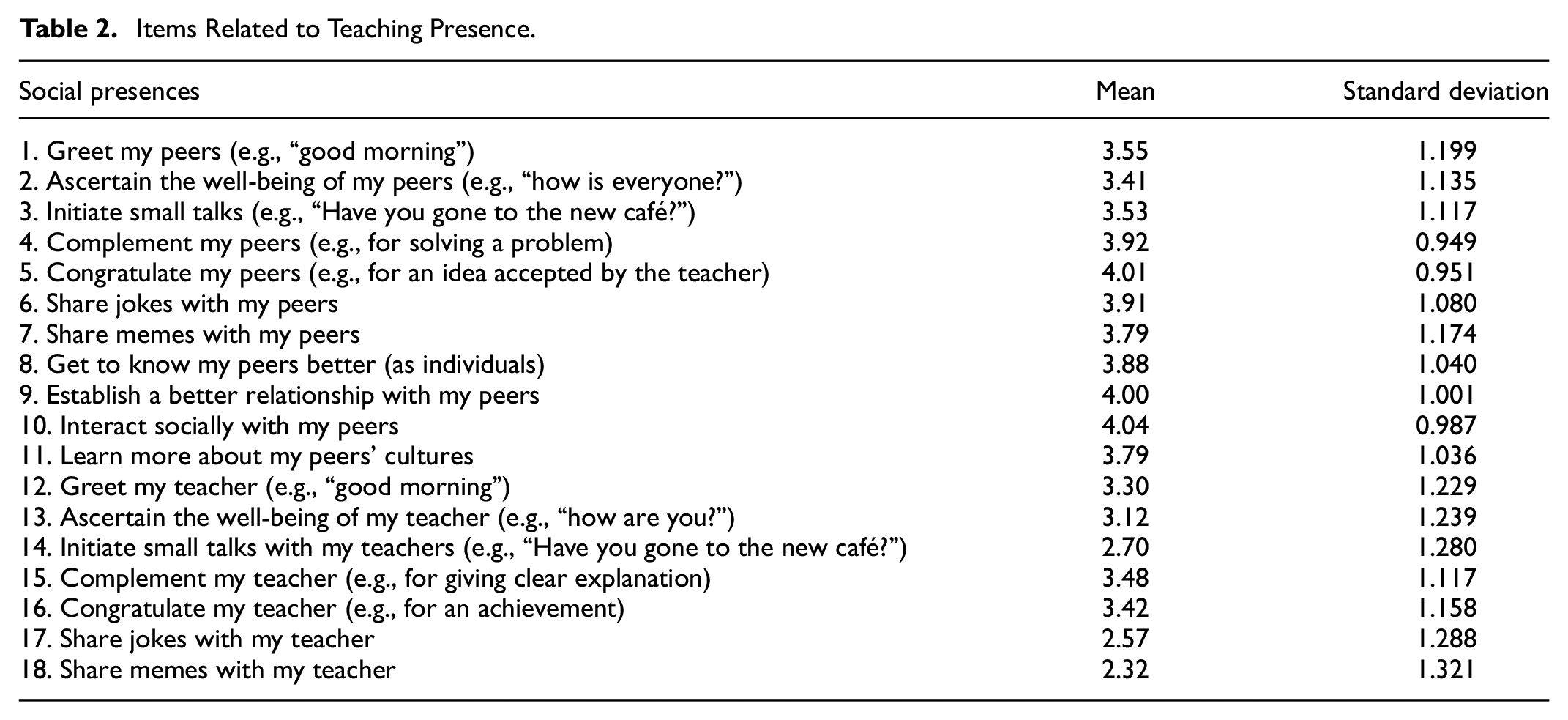
The qualitative data provide a detailed account of social presence during the participants’ interaction on the WhatsApp platform.
Friendly and Welcoming Learning Environment
Participants used WhatsApp to foster social presence cues, such as using “emojis” (W5, W8. W13) and “GIFs” (W11, W16, W18). There were always “greetings” (W1, W5), “sharing tik tok with friends” (W15). Participants explained that “for daily conversation as we can’t converse physically, so we do it virtually” (W13). W5 expressed that “we can share our photos, we interact more through WhatsApp, we had a few times of video call to share our problems as online classes is tiring for us” (W14). The findings obviously indicated that participants used WhatsApp for “informal language such as short forms and emoticons to communicate to create a stress-free environment for my group to communicate” (W19).
Exchange of Various Culture
The exchange of various cultures was evident in the interviews. W7 said “we can learn more about my peers’ culture.” Such interactions enhance social presence by fostering a sense of community and inclusivity, by incorporating diverse cultural perspectives during the WhatsApp interaction, learners can gain a deeper understanding of different ways of life, values, beliefs, and practices. For example, “I often chat with my classmate who is a Malay. From chatting, I could be able to know more about her personality and her cultures” (W13).
This can help promote mutual respect, tolerance, and empathy, while also facilitating critical thinking and creativity. Another example of an exchange of culture is demonstrated by W12 “when I celebrate any festival, I will take picture and share it with my peers, and they do so when they celebrate any festive season. By doing this, we get a chance to learn about each other’s culture in detail” (W13). Similarly, W10 expressed that “asking my Indian friend regarding Karnan, from the Epic of Mahabrata.”
Received Personalized Support
Social presence plays a vital role in supporting social and emotional learning, particularly in online learning environments. Online learning can often be an isolating experience, especially for learners who are used to traditional classroom settings. Many of the participants acknowledged that their personalized interactions alleviate such feelings of isolation by providing opportunities for learners to connect with others and practice essential interpersonal skills. W2 reasoned that “interactions through WhatsApp make our bond stronger as we constantly keep checking up on each other.” This is because“we always share our story or daily life to each other” (W7). The resulted in “closer friends and we know a little bit about each other and looking forward to work with them again” (W8). W10 explained that:
I get to know my teacher more personally as an individual by viewing her WhatsApp status as she posts a lot about her family, peers, her success in work, and motivational quotes. I could figure out her character that she is a very caring and loving person towards her family and a motivated person who is responsible in life.
W9 felt that the platform was worthwhile during an emergency. In his words:
when we wanted to work on our assignments, one of the team members informed that he/she can’t make since her daughter was admitted to the hospital. I asked whether she was able to complete the assignment. How’s the child’s condition and ask whether he/she needs any help to complete the assignment.
Cognitive Presence
Table 3 demonstrates the mean and standard deviation (STD) for cognitive presence. Notably, the item “provide meaningful instructions for learning” emerges with the highest score (M 3.93, STD 1.042), indicating a strong consensus among students that instructional materials and guidance provided by instructors are perceived as clear and valuable. On the other hand, the lowest score is associated with the item “engage us (learners) in learning using various pedagogies” (M 3.77, STD 1.030). This suggests a slightly lower level of agreement among students regarding the incorporation of diverse teaching methods to actively engage them in the learning process.
Items Related to Cognitive Presence.
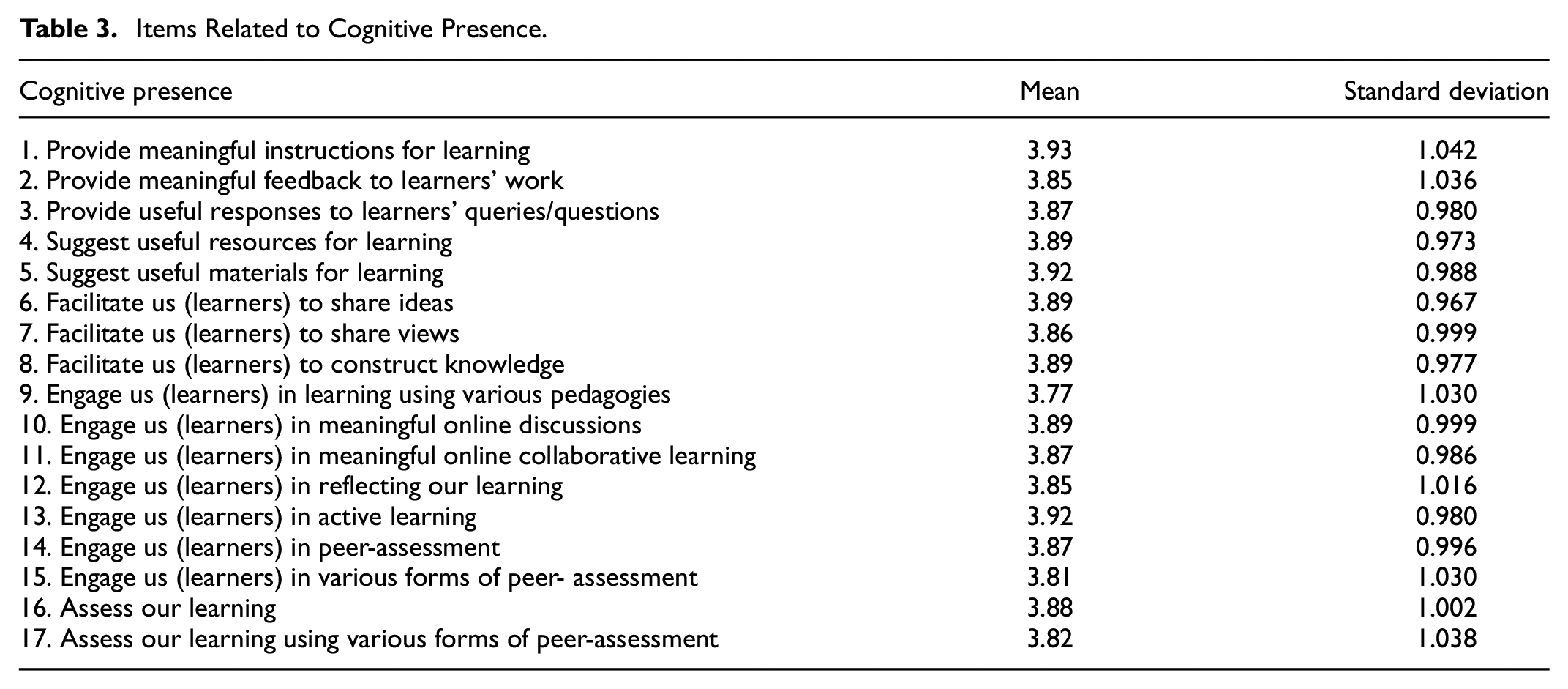
The survey is further triangulated with the qualitative data from the interview.
Development of Meaningful Interaction
Text messaging, voice notes, and videos uploads become easier with the WhatsApp platform. Therefore, WhatsApp facilitates effective communication between learners and instructors. This increased communication led to the creation of cognitive presence. One of the participants highlighted “I will discuss with my friend to do something that we didn’t understand through video call in WhatsApp” (W5). W17 reported “I love helping my friends and teammates whenever they needed help. I always share my resources to them and have discussion together to gain better understanding on the assignment given.”
W10 reasons,
As I mentioned earlier, our tutor asked us to post our questions related to our English assignment so everyone could evaluate and assess as well as check our contributions. It was a useful experience.
Quote similarly, W12 said that:
We do a lot of group discussions online. We shared ideas through WhatsApp on many things such as our assignments.
Participants stressed the crucial role played by the instructor for meaningful cognitive interactions to take place. W15 explained:
Teachers are always ready to answer our queries instantly when communicating through WhatsApp. Even additional study materials are sent via WhatsApp to gain knowledge.
The WhatsApp platform helps students enhance their cognitive presence by allowing users to engage in an active conversation and respond to ideas and opinions as they come up. These WhatsApp features encourage users to engage in collaborative learning, where they can work together to solve problems and learn from each other. Through this collaborative process, cognitive presence is enhanced, and users can develop critical thinking skills. Therefore, WhatsApp provides a convenient and efficient way for students to ask questions, receive feedback, and share resources with their instructors to enhance their cognitive process. Table 4 illustrates that learners have applied the knowledge acquired and indicated improvement in their English language learning skills.
Items Related to Language Skills.

Discussion
Interpreting using the CoI model, the present study has demonstrated that social, teaching, and cognitive presences have the potential to enhance English language-based activities by facilitating meaningful interaction and engagement among students. The three presences can be achieved via the WhatsApp platform for English language learning. According to Smith (2016) in a Community of Inquiry (CoI), learning and interaction are such that the thoughts of each participant are influenced by the thoughts of other members engaged in the conversation or discourse. WhatsApp provides more possibilities for practice, encourages active learning, interaction and collaboration, and aids language learners in identifying their inadequacies. This active engagement via WhatsApp helps learners to deepen their understanding of the material and develop critical thinking skills. The majority of previous studies have also validated WhatsApp’s importance in language learning (Andújar-Vaca & Cruz-Martínez, 2017; Fithriani et al., 2019; García-Gómez, 2022; Sockett, 2014).
The findings of the survey indicates that the students perceive a significant degree of involvement and interaction with their instructors, as indicated by the predominantly upper intermediate level of agreement across various items related to teaching presence. This implies that students feel actively immersed in the learning process, viewing their instructors as facilitators of interactive and participatory learning experiences. Nevertheless, it is imperative to recognize the score for the item “share critical knowledge with my teacher” registering the lowest score.
This indicates a need for improvement in fostering knowledge-sharing dynamics between students and teachers on the WhatsApp platform. Addressing this aspect has the potential to contribute to a more comprehensive and efficacious teaching presence, ensuring effective communication and sharing of critical knowledge. The utilization of a range of communication methods, such as voice notes, multimedia files, and instant messages, has become a potential avenue for establishing a direct and personal link between educators and students.
Teaching presence, as discussed in the present study, is supported by the CoI model’s emphasis on effective facilitation by instructors. Garrison et al. (2001) argue that teaching presence involves designing and facilitating educational experiences, directing cognitive processes, and supporting a social environment conducive to meaningful learning. The positive experience of students regarding their interaction with instructors in the study aligns with the CoI model’s expectations for effective teaching presence.
The survey findings related to social presence reveal that students perceive their instructors on WhatsApp as more than just disseminators of information; rather, they view them as facilitators of interactive and participatory learning experiences. The students’ sense of being actively immersed in the learning process reflects positively on the instructional strategies employed on WhatsApp, contributing to a dynamic and participative educational encounter. This aligns with the broader educational goals of fostering engagement and interaction, ultimately enhancing the overall quality of the learning experience on the WhatsApp platform. Social presence motivates students by instilling a sense of accountability and assistance. Learners are more likely to remain involved in the course if they perceive that their efforts are recognized and they are a member of a community. The qualitative findings indicate that compliments, emojis and sharing of photos via WhatsApp reduce feelings of loneliness and promote social and emotional learning by providing students with opportunities to interact with others and develop interpersonal skills. The utilization of a range of communication methods, such as voice notes, multimedia files, and instant messages, has become a potential avenue for establishing a direct and personal link between educators and students. These strategies can assist teachers in providing students with a more engaging, encouraging, and inclusive learning environment. van der Meer et al. (2021) found that informal communication facilitates the creation of learning opportunities for individuals. Ultimately, promoting social contact and cross-cultural interchange can make online learning for students more pleasurable, inclusive, and fulfilling. It can stimulate the development of essential skills such as communication, teamwork, and intercultural competence, as well as a sense of community. Studies have also documented that, social presence is essential for students to participate in classes and remain mentally engaged (Butnaru et al., 2021).
The high score in the survey for “provide meaningful instructions for learning” highlights the effectiveness of instructional content, implying that students find clarity and relevance in the guidance provided by their instructors. This positive response is crucial for cognitive engagement, as clear instructions contribute significantly to comprehension and knowledge retention. However, the lower score for “engage us (learners) in learning using various pedagogies” signals an area for potential improvement. While the cognitive presence is evident, students express a desire for a more diverse range of pedagogical approaches to enhance their learning experiences. This finding suggests an opportunity for instructors to explore and implement a variety of teaching methods, fostering a more dynamic and engaging cognitive environment.
The qualitative findings found that the WhatsApp platform enhances cognitive presence by enabling users to engage in active conversation and respond to emerging ideas and perspectives. Participants can send and receive messages in real-time, which makes communication more dynamic and engaging. The instructors used various online materials to achieve the triggering phase. Also, interaction and collaboration allowed the exploration as well as the integration phase to take place. The findings of this study have demonstrated that meaningful interactions with group discussion and video calls have prompted participants to go through the triggering event, exploration and integration phases. According to Kovanović et al. (2015), students who actively participate in online discussion are more likely to achieve higher levels of cognitive presence Such efforts are congruent with the literature, which asserts that initiating thought (triggering) involves raising difficult questions and providing students with the opportunity to collaborate on developing solutions (Garrison, 2017).
WhatsApp enables one-on-one communication between students and teachers, which can foster a relationship based on mutual respect and trust. Furthermore, WhatsApp can give students more freedom in terms of when and how they connect with course materials and lecturers. When learning online, students could have conflicting demands on their time and need more flexibility in their schedules. During such situations, engaging students in various course materials and teachers reaching students for support can be helpful. According to Singh and Richards (2006), teaching should make learners understand the values and assumptions in the materials used in teacher pedagogical practices.
The finding from the survey indicated the students have indicated that they have improved listening speaking reading, writing, and vocabulary skills. Applying Swain’s (2000) concept of interactions and collaborative dialogue in the context of second language acquisition, this research demonstrates that engaging in interactions on the WhatsApp platform has positively impacted the process of learning English grammar.
It can be concluded that it is pertinent to encourage the practice of all three presences on the WhatsApp platform. This facilitates interaction between learners in various roles and collaborative knowledge creation.
Conclusion
The findings from this mixed-methods study on the experiences of ESL students using WhatsApp for English language learning interactions provide valuable insights that can inform and improve the experiences and outcomes of university students both in Malaysia and worldwide. This study fosters a supportive online community for ESL students to enhance teaching, social and cognitive presences. Recognizing the decrease in inclination for informal and humorous social interactions with teachers. The study encourages a balanced approach where students feel comfortable engaging both socially and academically with instructors.
Future studies should delve deeper into specific aspects, such as the reasons behind the decrease in informal social interactions with teachers. the study’s sample size and consider expanding it to ensure greater diversity and generalizability of findings.
In conclusion, WhatsApp has the potential to improve cognitive, teaching, and social presences in the learning environment. The research provided in this critical discussion suggests that WhatsApp can enhance discussion and collaboration among learners. Consequently, educators may explore incorporating WhatsApp into their teaching practices to boost the learning outcomes of their students. However, the study’s limitations, including the sample size and the context of the study, should be considered when generalizing the results. Further research in diverse settings is recommended to validate the findings of this study. Future studies should consider a broader range of higher education institutions in Malaysia and other Europe, Middle East, and South Asian countries. Also, the use of WhatsApp can be used in other social science and science courses.
Footnotes
Declaration of Conflicting Interests
The author(s) declared no potential conflicts of interest with respect to the research, authorship, and/or publication of this article.
Funding
The author(s) received no financial support for the research, authorship, and/or publication of this article.

Data Availability Statement
Research Data is available upon request.