




Abstract
This study explores the relationship between seating quadrants and student performance, including the role of classroom type in the quadrant effect. Data collected from 131 classes taught at 17 colleges of Northwest A&F University in China were analyzed using the ordinary least squares method. The results revealed that where a student sat in a classroom always had a significant effect on their performance. Classroom type also played an important role in students’ academic performance, specifically, the longer the depth of the classroom, the more obvious the quadrant effect. Additionally, different classroom utilization schemes resulted in different student densities in the classrooms, further affecting students’ academic performance. The higher the student density, the better the academic performance. We thus propose that the classroom utilization schemes should be in line with the matching relationship between student density and the classroom and that students be taught in small classrooms as much as possible.
Plain language summary
Purpose: to explores the relationship between seating quadrants and student performance, including the role of classroom type in the quadrant effect. method: Data collected from Northwest A&F University in China, and were analyzed using the ordinary least squares method. conclusions: where a student sat in a classroom always had a significant effect on their performance; Classroom type also played an important role in students’ academic performance; different classroom utilization schemes resulted in different student densities in the classrooms, further affecting students’ academic performance. Implications: the classroom utilization schemes should be in line with the matching relationship between student density and the classroom and that students be taught in small classrooms as much as possible. limitations: Replication of this study in other higher education institutions is necessary to test and compare the findings.
Keywords
Introduction
Higher education institutions are experiencing greater accountability demands for better student outcomes and increasing pressure to prepare their students for post-academic work (LaCroix & LaCroix, 2017). Since student performance is an important indicator of the success of student training in higher education institutions, any relevant factors that may affect student performance deserve attention. Classroom seating location is one such factor believed to influence students’ learning performance (Haghighi & Jusan, 2012). Generally, in higher academic institutions, classroom seating locations are self-selected by students instead of being assigned by teachers. Clément and Bukley (2017) examined the consistency of classroom seating among college students and found that when students are free to choose their seats, they always tend to occupy the same seats over time; consequently, any behaviors and personal characteristics associated with seating location should be fairly stable. Understanding how students’ choice of seating quadrant in different types of classrooms influences their performance, and to accordingly build an environment and institutional arrangements more conducive to student performance, is an essential aspect of successful talent cultivation.
Therefore, in recent years, a large number of educational researchers have paid attention to the impact of seating location on student performance. For example, Marshall and Losonczy-Marshall (2010) found that students’ grade point average decreases as they sit farther from the front of the classroom. Among the possible reasons for this finding is that classroom participation varies greatly with seating. The location of students in a classroom typically determines the number of interactions they have with teachers, with greater interaction eventually improving student learning (Bossér & Lindahl, 2019). Ideally, to improve teacher–student communication and interaction, seating locations and arrangements in classrooms should be flexible and change periodically during instructional time; however, this is not easily achieved in universities with predominantly rows-and-columns classrooms.
Two prevailing hypotheses, related to environmental determinism and self-selection, explicate the effects of seating location on academic performance. Environmental determinism states that the environment or the compelling area, the action quadrant itself, has a positive academic impact on students, regardless of their previous academic performance; perhaps the function of environment lies in the fact that seating location in a classroom can affect students’ attitudes (Shernoff et al., 2017), attendance (Ibáñez et al., 2019), and learning activities (Shimada et al., 2018). In contrast, the self-selection hypothesis states that students who do well academically in a course tend to position themselves in certain high-profile areas or action quadrants near the front of the classroom (İnan-Kaya & Rubie-Davies, 2022). It is believed that the students’ personal traits in achievement motivation may be involved in disposing them toward choosing to sit in the front or back of the classroom (Shernoff et al., 2017). Both these hypotheses have been tested, revealing that when seating is self-selected, student behaviors are consistent with the self-selection hypothesis, whereas when students are randomly assigned a seat, the environmental hypothesis holds true (Norazman et al., 2019).
With the exception of a few studies, most have found student achievement to not be significantly altered by seating location (Navarro Jover & Martínez Ramírez, 2018). For most examined characteristics, it was usually the students seated in the front who performed better than those seated in the back. Nevertheless, these studies fail to go beyond the two ends of the academic spectrum (Waktola, 2015). Regarding both the action quadrant and moderate interaction seats (Hirano et al., 2017), students seated on the window and door side are often overlooked in academic research. Furthermore, although prior research has provided theoretical and empirical evidence on seating location affecting student performance, mainstream research tends to primarily focus on self-selection, which suggests that personality traits are related to seating choice and that such traits may actually fuel a student’s seating choice (Hemyari et al., 2013; McGowan et al., 2017), without taking into account the fact that seat selection is a result of the combined effect of the individual student’s internal factors and the classroom environment.
Shaping the classroom environment is the responsibility of the university’s management department. Exploring the influence of the classroom environment on college students’ performance can provide valuable reference information for classroom construction and management decisions. In the present study, we focus on environmental determinism by examining the impact of classroom size and seating location on undergraduates’ performance. Our aim is to provide support to teaching management activities such as classroom construction and classroom use scheme design.
Materials and Methods
Empirical Strategy
Despite extant research, the relationship between students’ academic performance and their seating location remains unclear. Moreover, if this relationship exists, a large number of students in a classroom would mean more students sitting farther from the teacher. Therefore, it is also important to determine what the optimal number of students in a classroom is for overall student achievement. In the case of student self-selection, the available seats for students are limited to those in the classroom; we can thus change the classroom size to adjust the distance between the students and the teacher.
In addition, it is imperative to identify what kind of classroom is most effective for an overall improvement in student performance. The standard classroom arrangement of student seats placed in straight rows facing the teacher is common to most classrooms and is, in fact, a necessity in many large ones. Since all the desks face the same direction, such an arrangement can position a student closer to the instructor, making it easier to see and hear them. Seating proximity to the instructor can encourage attentive behavior, classroom engagement, and discussion participation (Meeks et al., 2013). Even though undergraduates tend to occupy the same locations over time, they cannot possibly take the same seats every time. Their choice however is relatively stable, that is, they will steadily choose a certain range of seats. We thus divided the classroom into different quadrants and analyzed student performance in different quadrants to shed light on the above topics (Figure 1).

Diagram of classroom quadrant.
First, we determined whether a student’s academic performance was different across different classrooms and quadrants, and which quadrant would benefit a student’s academic performance. We used the final exam score and the comprehensive assessment score of students as indicators of their academic performance, followed by an analysis of variance (ANOVA) to determine whether the means of the final exam scores and the comprehensive assessment scores of students within one quadrant are different from those of students within other quadrants.
The ordinary least squares regression was employed to identify performance score gaps between different classroom locations. Academic performance is a function of multiple factors, including seating location and other unobserved variables. The dummy variable LOC is the core variable that indicates the different quadrants in a classroom. Apart from that, equation (1) includes student characteristics (i.e., gender and length of attendance at school); class characteristics (i.e., lesson attributes, number of classes accommodated, and the type of classroom); and teacher characteristics, which are represented by vector X (gender, teacher’s length of service, and academic rank).

In fact, as each classroom may not always be of the same size, its quadrant size may differ even with the same location. For example, a small classroom may be equal to the quadrant size of a large classroom. In the case of the latter, more students can be accommodated, with more seats to choose from. We used equation (2) to isolate the effects of different types of classrooms and quadrants on students’ academic performance:

Where, α, β, γ, δ1, δ2, δ3, and δ23 represent the coefficients of the relevant variables in both the equations respectively, X is the vector of control variables, and η is the coefficient vector of X. Table 1 lists the definitions of all the variables included in both the above equations.
Variables’ Definition and Basic Statistics.

In the current study, we eliminated variables with tolerance values of less than 0.42 based on the multicollinearity diagnosis. Therefore, there is no perfect multicollinearity among the regressors included in the following models. Finally, all the parameters were estimated using SAS 9.6 software.
Data Collection
Information regarding students’ seating location in the classroom and their course grades was collected. While it is easy for a student to remember their grades, they may have difficulty remembering where exactly they sat in the classroom. Therefore, we requested the teaching supervision department and the student record file storage department of the university, respectively, to view the videos of students in class and their course grades. We then invited the student class leaders to match the seat and grade information of each student through the video and grade files.
Usually, data regarding student grades, class recordings, and course information are not made public, with different management departments in charge of different data but alike in their unwillingness to provide these data. For this reason, we applied to the different management departments of Northwest A&F University in China to obtain the data and videos we needed, promising to use it for research purposes only and to keep the personal information of the sample students confidential forever. After obtaining the required data from the relevant offices, the survey team member randomly selected classroom surveillance videos from different grades and majors, marked and partitioned the seating locations of the students based on the surveillance, and exported information about the teachers and course attributes from the school’s background system. Subsequently, to confirm the student information obtained from monitoring, we entrusted the class committee of each class to identify the students through monitoring, so that they could match them to their seats. After the matching process, students were anonymized, and the construction of the research database was completed after removing abnormal samples.
A total of 3,082 valid sample data were obtained, involving 32 public courses and 18 professional courses, among 131 classes taught in 17 institutions. The student sample included freshmen (9.2%), sophomores (32.3%), and juniors (58.5%); the class size included small (25) and large classes (142). The teaching staff included teaching assistants (2.6%), lecturers (33.4%), associate professors (61.4%), and professors (2.6%). These 50 courses selected for the study were taught by 39 teachers, with a teaching experience of between 3 to 35 years; other personal information of these teachers was also available on the university’s official website.
Data Description and Variables
Students’ Characteristics
For students’ academic performance, prior studies used yearly and final degree marks calculated based on the weights attached to different modules, to reflect undergraduate achievement (Crawford & Wang, 2015). This study used final exam and comprehensive assessment scores of each course as indicators of academic performance. Final exam scores refer to test paper grades, while comprehensive assessment scores are calculated by summing the student’s attendance, class quizzes, final exam grades, and group work scores according to the different weights defined by the teacher.
Others student characteristics included length of attendance at school (in years) and gender. We explored differences in performance and distribution of students by gender in different quadrants. The length of attendance at school depends on the year of enrolment. We later show evidence that the effects of individual differences on students enrolled in different academic years are variable and dependent on the seating location in the classroom.
Seating Location
Seedling-style is a common seat partitioning method used in university classrooms. Scholars usually research relative topics by dividing the research groups in several of the following ways: by rows; by using adjacent rows, 1 to 3, in a large classroom as a research quadrant; by considering being equidistant to the multimedia screen equipped in a large classroom as the same partition (Joshi et al., 2020); or by block cutting the classrooms equally into a nine-square grid (Waktola, 2015). For this study, considering classroom seats and architectural factors, such as doors, windows, and heating, as influencing students’ academic performance, we combined the row-based partitioning and block-based partitioning methods to divide seating quadrants as shown in Figure 1. Based on these quadrants, we determined the percentage of students of different genders in each quadrant. Table 2 presents these results, which indicate that the male and female sample sizes were almost equal, with both the absolute number and the relative number showing obvious gender seat selection differences. Of the total sample, 25.6% students sat in Z1, 19% sat in Z2, 18.5% sat in Z3, and 36.9% sat in Z4. Male students preferred to sit in Z4, whereas female students mainly chose to sit in Z1.
Percentage of Students of Different Genders in Different Quadrants.

In addition, we checked whether the classroom size or student density in a classroom or quadrant can affect student performance; the small classroom was taken as the reference. Generally, student density is calculated as the number of classes accommodated in a classroom to the size of the classroom. While small classrooms cannot accommodate several classes, a large classroom can be arranged for only one small-sized class. In the samples we surveyed, common subjects with higher credit weights were often taught in more than two classes at the same time in the same classroom to ease the teacher’s workload. Therefore, the number of classes in the same classroom varied from 1 to 5. Almost all classrooms in the sample were arranged in a three-column manner, with different variations in the depth of the classroom, that is, the number of rows of seats. We divided the classrooms into three types: large (lecture hall with more than eight rows), medium (medium-sized classrooms with eight rows), and small (small classrooms with less than eight rows), based on the eight-line standard since an eight-row classroom was the most common type of classroom in the dataset.
Other Characteristic Variables
Factors other than student and class characteristics may also affect students’ course grade, such as lesson attributes, gender of the teacher (Lee et al., 2019), and the teacher’s length of service (Gutsu et al., 2020). Scholars have also argued for the relationship between academic rank and student evaluation scores (Bianchini et al., 2013). This study thus used the following variables in estimated models: teachers’ gender, length of service and academic rank, and lesson attributes. Variable definitions and basic statistics for these variables are summarized in Table 1.
Results
Impact of Seating Location on Students’ Academic Performance
To check whether the means of the students’ academic performance were significantly different among the different classroom quadrants, a 4 × 1 (Z1 vs. Z2 vs. Z3 vs. Z4) ANOVA was conducted on the average final exam grade and comprehensive assessment score for the 4 quadrants. Figure 2 demonstrates that there were significant differences in students’ academic performance between the quadrants, both in terms of final grades (F = 58.09, p < .001) and comprehensive assessment scores (F = 57.39, p < .001). The white squares inside the box represent the mean scores of students in the different quadrants, which show the distribution of mean scores from high to low from quadrants Z1 to Z4, even though the mean score of quadrant Z2 was almost equal to that of quadrant Z3. Specifically, compared to quadrant Z4, each of the other groups averaged a certain number of points higher, with such a score gap ranging from 3 to 8 points. For both assessment programs, quadrant Z4 always had the largest outliers in the low score quadrant. Even though moderate and high scores did exist, largest outliers made it difficult for quadrant Z4 to outperform the other quadrants on average.

Impact of seating location on student academic performance.
Figure 3 presents the difference in students’ academic performance within different quadrants with respect to gender. Girls always performed better than boys in all the quadrants both in terms of final grades and comprehensive assessment scores. The overall trend however did not change, with the average performance of both boys and girls decreasing from quadrant Z1 to quadrant Z4. Traditional academic gender stereotypes assume that men perform better than women in science and technology, however, in this study, girls surpassed boys in all aspects, including school enrolment, achievement, and graduation rates (DiPrete & Buchmann, 2013).

Analysis of variance (ANOVA) of students’ performance by gender in different quadrants.
Impact of Student Density Within Quadrants on Students’ Academic Performance
In a larger classroom, a student can choose seats relatively freely, but in a smaller or more crowded classroom, they face limited seating space and are forced to choose a certain seat. While we can arrange one or several classes of students to take a class in a large classroom, we cannot arrange more students to take a class in a small classroom. Arranging a class of students in a large classroom means low student density in that classroom. If there is a relationship between student density in a classroom and academic achievement, classroom design and arrangement are expected to matter considerably.
We used equations (1) and (2) to isolate the effect of factors, including student density, on academic performance. The estimated parameter values are shown in Table 3. While many valuable variables are included in every model, only those relevant to this study are shown here. For student characteristics, the mean final grades and comprehensive assessment scores of male students were always lower than those of female students in all the models, which was consistent with the results of the ANOVA.
The Effect of Seating Space on Student Achievement.

Significant at 0.01 level; **significant at 0.05 level; *significant at 0.1 level.
For the three classroom types, lecture halls (large classroom) had the lowest average scores, whereas small classrooms had the highest average scores. This phenomenon can be interpreted in terms of the larger classrooms always having greater vertical depth; a student is more likely to choose a seat farther out in a large classroom than in a small classroom, thereby making it more difficult for them to obtain a high score. Student density was significantly and positively correlated with achievement, and with a fixed number of seats, the average student achievement increased with an increase in the number of students in the classroom. This seems inconsistent with our initial hypothesis that smaller class sizes and smaller number of students would lead to better grades, but the interaction term between density and classroom type in Model 2 provides an explanation for this contradiction. For example, for each unit increase in student density compared to a lecture hall, the average final grade in a small classroom will increase by 6.24 points, while the average final grade in a medium-sized classroom will decrease by 6.57 points. It appears that the density effect positively improves performance in small classrooms, though this effect is reversed in medium-sized classrooms.
Table 4 presents results from the quantile regression of equation (1) at the 10th, 25th, 50th, 75th, and 90th percentiles. The estimated results of variable LOC revealed a consistent trend from the lower to the higher decile, as the location gap favoring quadrant Z1 diminished. Specifically, the achievement gap between each district and the benchmark group decreased, changing from 9.5 to 4.0 points to 3.8 to 3.0 points. In addition, for final exam scores, compared to the benchmark group, quadrant Z2 surpassed quadrant Z1 as the region with the highest average score in the 90th quantile. From the perspective of student density, studying in classrooms with a certain density is conducive to improving the performance of all types of students, but it will have a positive impact on students with better grades. Judging from the impact of classroom type on student performance, students in small classrooms always improve rapidly and significantly, compared with large-sized classrooms, as the order quantile decreases. Although the effect on student achievement is positive for medium-sized and larger classrooms, the effect gap between the two types of classrooms decreases as the ordinal quantile decreases.
Location Gaps for Students at Different Distributions—Results From Quantile Regression.

Note. SE in parentheses. Results are shown at the 10th, 25th, 50th, 75th, and 90th percentiles.
***Significant at 0.01 level; **significant at 0.05 level; *significant at 0.1 level.
Location Effects in Different Types of Classrooms
Mean scores of students within quadrant Z1 were always higher than those of students in other quadrants, in any classroom. However, classroom size varies in every university. In this study, in several instances, the size of quadrant Z1 in a large classroom was equal to the size of an entire small classroom. This begs the question of whether a small classroom or quadrant Z1 improves students’ academic performance. We compared the difference in mean scores between quadrant Z1 of the lecture hall classrooms, the remaining whole of the medium-sized classrooms, excluding quadrant Z4, and the small classrooms (without any quadrants); the results are shown in Figure 4. The ANOVA results revealed a significant difference between the three mean scores. Even with the large standard error, the small classroom was beneficial in improving students’ academic performance in their final exams, as well as their comprehensive assessments.
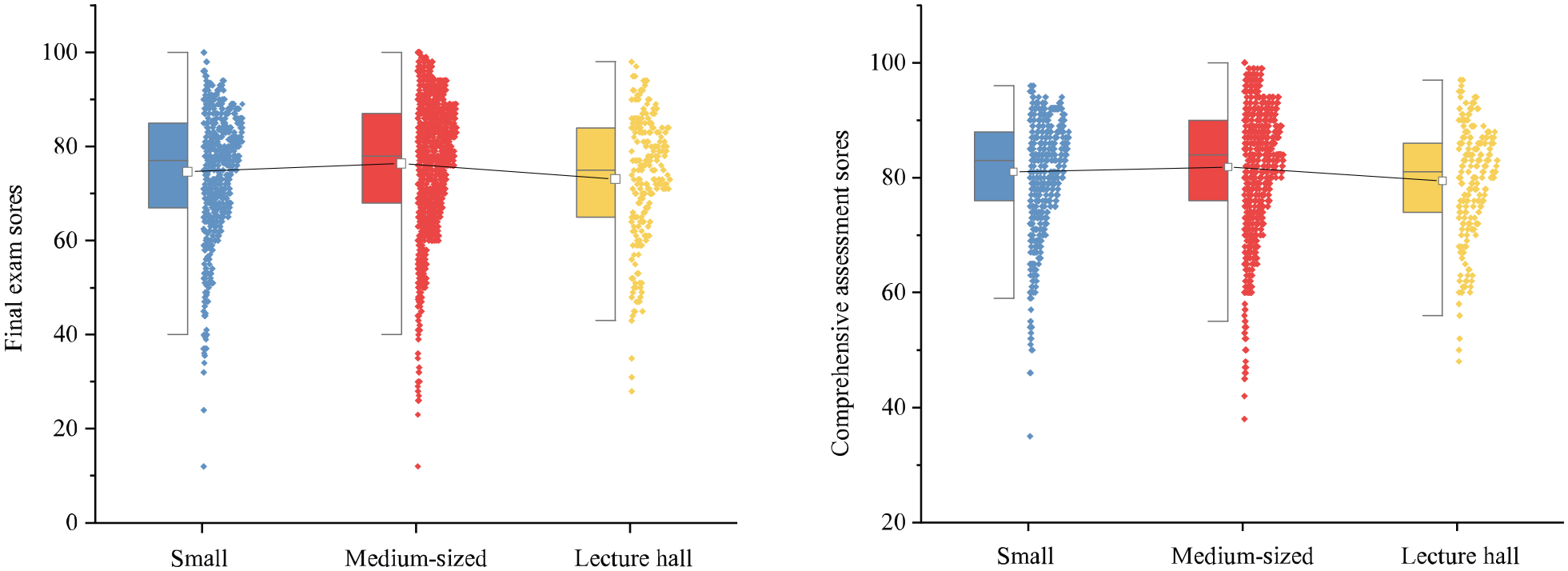
Location effects in different types of classrooms.
However, Table 5 shows the multiple comparisons between the mean grades of the three groups. We used Fisher’s least significant difference, Bonferroni, and Dunnett’s tests, all of which showed that there was no longer a significant difference between the mean grades in quadrant Z1 of the lecture hall classroom and the small classroom (without any quadrants). In terms of final grades as well, there was no significant difference between the mean grades in the quadrant of the small classroom (without any quadrants) and the quadrant of the medium-sized classroom, excluding quadrant Z4.
Location Effects in Different Types of Classrooms-Results From Multiple Comparisons.

The mean difference is significant at the 0.05 level.
Dunnett t-tests treat one group as a control, and compare all other groups agains.
These results emphasize the fact that environmental similarities in local spaces lead to the same results.
Discussion
Even though college students are free to choose their seats in the class, the spatial location of the seats they choose in the classroom is often stable. We uncovered a link between seating location and academic performance based on classroom quadrant and grade comparisons. Our results are consistent with those of past studies that course grade decreases as distance from the instructor increases toward the rear; the fact that quadrant Z1 came out on top in all classrooms supports another view that a front-center seat facilitates more achievement, positive attitudes, and participation (Vander Schee, 2011). This phenomenon can also be explained by the action quadrant theory, which states that students in the front and center of the classroom tend to interact more with the teacher than do those on the sides or back of the classroom (İnan-Kaya & Rubie-Davies, 2022). However, it is reasonable to assume that teachers care more about students in the front and middle rows and that such students find it easier to hear and concentrate. Since these effects persist even in lecture situations, where teachers presumably do not initiate verbal interactions with students, proximity to the teacher can increase eye contact and more opportunities for non-verbal communication (Howe et al., 2019).
Nearly every instructor knows that the most engaged and successful students tend to sit at the front of the class while the weakest students tend to sit at the back (Navarro Jover & Martínez Ramírez, 2018). Moreover, students sitting in the back of the classroom report lower engagement, attention, and quality of classroom experience (Shernoff et al., 2017). To increase the classroom participation of students in the back row of a large classroom and to enable them to clearly view what the teacher is teaching, some administrators have equipped large classrooms with multimedia screens. However, even with the multiple multimedia electronic projection screens, the quadrant effect is still exacerbated by the increased depth of the classroom, which affects students sitting in the back row. This is because in a classroom where the teacher is restricted to the podium, the optimal distance for listening is limited to the teacher and the students in the center-front quadrant, while the distance between the teacher and the students in the back-row quadrant gets farther apart. The multimedia electronic projection screen does not completely replace the teacher’s lecture since students who are far away from the teacher will find it more difficult to hear the teacher, and the students in front of them are more likely to distract them.
Most of the earlier findings about the relationship between seating location and academic performance are more likely to be observed in larger classrooms. That being the case, we go further to explore whether the classroom size influenced students’ course grade. The increasing number of rows of seats in the lecture hall amounts to a constant nesting of equal-sized small classrooms into the back quadrant, while the quadrant effects of the small classrooms themselves are superimposed as the lecture hall seats extend toward the back, thus exacerbating the effects on the differences in student performance at different locations. Students’ seat selection in the classroom will be affected by the classroom size. For students who like to sit in quadrant Z4, sitting in Z4 of a small classroom is equivalent to sitting in quadrant Z1 of a large classroom, therefore, classroom size also affects student performance. Parker et al. (2011) determined whether students were forced in the front or back from their preferred seating, and whether being forced to a side aisle seat affected their final grade outcome. The results indicate that forcing students further forward in the room tends to override the negative effect of a back preference. Thus, forcing students to move forward by reducing classroom size can influence performance, particularly for average students, despite student perceptions to the contrary (Vander Schee, 2011). In any case, small classrooms are more conducive to the overall improvement of student achievement.
Typically, although the number of seats in a classroom is fixed, the number of students taking classes in it varies according to office arrangements. It often happens that a large classroom that can accommodate more students has very few students in class. In this study, we attempted to understand how student density in a classroom affects student achievement. The findings revealed that in small classrooms, an increase in student density contributed to higher grade point averages, while in medium-sized classrooms, grade point averages decreased as student density increased. In small classrooms, where the row-by-row seating layout limits physical interaction between students, the increased density does not create a feeling of crowding, instead it shapes a tight, focused learning atmosphere in a small quadrant. However, medium-sized classrooms have longer depths than smaller classrooms, and it is harder for teachers to keep an eye on the back rows of seated students. Because of an enhanced sense of openness, students no longer feel the pressure to learn urgently but are more likely to feel secluded and safe in the expanded group, thus relaxing their focus on the classroom. As a result, in medium-sized classrooms, the increase in density results in a decrease in learning capacity (Vo et al., 2021).
Although several studies have demonstrated significant performance impact factors, the difference in classroom size itself has raised many controversies about the educational consequences. The main reason for disagreement is the conflict between, on the one hand, the common assumption among teachers, parents, and school governors (Gobena, 2014) that smaller classes provide a more productive educational environment than larger classes, and, on the other hand, the unwillingness of government agencies and other policy makers, as well as some researchers (Li & Konstantopoulos, 2016), to agree that class size by itself is one of the main determinants of educational progress. Some argue that the effects of class size reductions are modest and that there are other more cost-effective strategies for improving educational standards (Harfitt & Tsui, 2015).
Owing to the important policy and practical implications of the topic, there have been efforts to investigate the link between class size and educational performance (Wang & Calvano, 2022). An overview of this entire analysis illuminates some quadrants with a little controversy: it is generally felt that smaller classes allow a better quality of teaching and learning, while it is also argued that proximity effects have not been observed in research classrooms (Parker et al., 2011). More specifically, an inverse relationship between distance from the instructor and course average is more likely to be observed in relatively large classrooms (Chan et al., 2021; Zomorodian et al., 2012) than in small classrooms (Navarro Jover & Martínez Ramírez, 2018). However, the research evidence is usually based on class sizes typically experienced in the authors’ own countries, and average class sizes can vary greatly between countries. Because the concept of class size is very subjective, little attention has been paid to the differences in classroom student density caused by the problem of matching class size to classroom space size.
Conclusions and Policy Implications
Conclusions
The present study explored the effects of seat selection on student performance in a major Chinese university. Findings revealed that: (a) seating location had a significant effect on student performance, with students sitting in the central or forward quadrants outperforming those sitting in other areas; (b) classroom type also played an important role in students’ academic performance, specifically, the longer the depth of the classroom, the more obvious the quadrant effect; and (c) different classroom utilization schemes would result in different student densities in classrooms, further affecting students’ academic performance. Thus, the classroom utilization schemes should be in line with the matching relationship between student density and the classroom. The closer the number of seats is to the number of students, the better the final course performance of the students will be.
Practical Implications
This study offers several implications for policymakers and educators interested in the role of higher education in enhancing talent development. First, students should be arranged to take classes in small classrooms as much as possible, which will help shorten the distance between students and teachers. Accordingly, when designing classroom spaces, we should try to avoid designing narrow and long classrooms, while simultaneously innovating the seating arrangement of the lecture hall instead of sticking to the tradition of ranks and columns. Second, to improve teacher–student distance skills, regular teacher training is necessary to enhance higher education teaching methods and strengthen teaching skills. The training curriculum should encourage instructors to move around the classroom more, rather than focusing the class’s attention on the podium position. Moreover, instructors must adapt their teaching methods based on the density of students in the class, such as using multiple physical interactions and cooperative group presentations in larger classrooms. Further research is also necessary to design timely educational interventions when back-row student clustering and achievement slippage are identified.
Limitations
The findings of this study must be viewed cautiously due to possible limitations. Accurate community representation may present a point of caution as, although Northwest A&F University is a major agricultural university in China, it may not be representative of the classroom design in all Chinese universities. Replication of this study in other higher education institutions is necessary to test and compare the findings. Furthermore, all the classrooms surveyed in this study were three-columned, since classrooms that had changed their three-columned layout due to adjustments in the placement of multimedia equipment were excluded from our analysis, thus introducing an additional bias.
Footnotes
Acknowledgements
The authors would like to thank the other members of the research team: Meiwen Wang and Yumeng Yang. The authors would also like to thank the editors and anonymous reviewers for their comments on earlier drafts of the article.
Authorship contribution statement
Siyu Yu: Data curation; Formal analysis; Methodology; Software; Writing - original draft;
Xiaoyue Zhang: Investigation; Data curation; Formal analysis; Funding acquisition;
Rong Tao: Investigation; Conceptualization; Data curation;
Wanyu Huang: Investigation; Conceptualization;
Jiangsheng Chen: Conceptualization; Formal analysis; Funding acquisition; Methodology; Project administration; Supervision; Validation; Writing - review & editing;
Xieyu Xiao: Conceptualization; Formal analysis; Methodology.
Declaration of Conflicting Interests
The author(s) declared no potential conflicts of interest with respect to the research, authorship, and/or publication of this article.
Funding
The author(s) disclosed receipt of the following financial support for the research, authorship, and/or publication of this article: This work is supported by the National Training Program of Innovation and Entrepreneurship for Undergraduates from the Ministry of Education of the People’s Republic of China (Grant Number: 202110712093); The sixth batch of scientific research projects in the education and teaching category from the Chinese Agricultural Society (Grant Number: PCE1810).

Data Availability Statement
Research data can be available from corresponding author.