




Abstract
The manner in which activities are now conducted online has largely transformed as a result of the prevalent digitally rich environment. With the evolution of the Internet, channels utilized for knowledge and information sharing have also changed. Both organizations and individuals have largely benefited from the use of various Web 2.0 features. Innovative interaction channels are now available, and the concept is increasingly being applied to other areas. Social networking opportunities have increased manifold, and different kinds of web technologies are being utilized for communication. The online community has also embraced the multi-interactive dimension of Web 2.0, as inherent in various blogging activities. This study analyzed why people choose to engage in web technologies such as blogging. As the growth of web technology is rather parallel with that of digital marketing, the research also focused on how these aspects can enhance marketing strategies in the future. The results of the study have various implications, as marketing is significantly influenced by blog readers’ level of engagement, including word-of-mouth marketing, purchasing decisions, and even brand building. Both awareness and trust play significant roles in the process, and they are often utilized to justify the risk inherent in the online environment.
Keywords
Introduction
With the passage of time, the number of bloggers and number of blogs have significantly increased. This is in line with increased online readership largely resulting from the current digitally rich environment. Internet users utilize the Internet to stay up-to-date, and the Internet is transforming the manner in which information and knowledge are shared and transferred. Moreover, as a result of the e-Commerce boom, the importance of digital marketing has grown substantially. The numbers of online media channels and Internet penetration have also increased as a result of these changes.
The word “blog” was first introduced in the 1990s. Later, in 1997, John Barger used this term in an article about robot wisdom. John Barger is regarded as a father of blog (Garden, 2011). By definition, a blog is a type of website that uses blog creation software such as WordPress to create or maintain its content (Juettemeyer, 2008). One of the most rapidly increasing media forms of Internet publication and communication is the Weblog (blog) (Singh et al., 2008). These are different from other web pages in terms of their content and format. The concept involves the creation of collective intelligence through sharing, writing, and uploading different experiences (Sigala, 2012). Previously, Chen and Lin (2015) reported that blogs and social media shifted traditional methods of marketing because they can be broadcasted with great speed and do not have geographical limitations. A basic difference between blog and website is found in Gussif Marketing group (2014), who claimed that blogging creates content that lives on own website. And social media engages with people about content (Gusiff, 2014).
For blog readers, blogs have become particularly important and an integral part of their lives. Thus, organizations are increasingly exploring ways in which these blogs can be better utilized to drive business. For instance, in Asian regions, each blog’s uniqueness was used by Google and eventually tied with the AdSense product to ensure that online ads were effective. Because it is provisioned by Google, AdSense is considered to be both trustworthy and reliable. With the rapid increase in social networking websites, various organizations such as iProperty, BFM, Foldees, Secret Recipe, and Air Asia are placing a greater focus on their Web 2.0 standing in terms of marketing. Various Internet shoppers with similar interests have also been grouped together as a result of social networking and blogs, making it comparatively easier to identify target customers.
In the prevalent economic and business climate, organizations are increasingly seeking to decrease costs while also ensuring maximum functionality. In 2007, the rise of blogging was a massive social phenomenon, as it allowed individuals to directly compete with large organizations in regard to a publishing platform. With the passage of time, blogs have become an integral aspect of the media mix. For all organizations, blogosphere, referring to a blog collection, has become imperative for marketing. Dwyer (2007) claimed that a human element is added to the organization through blogging, which eventually enhances the customers’ affective commitment. Moreover, information gathering is also greatly facilitated.
Internet Users
Social interactions persist to be the most remarkable activities in cyberspace. For instance, in Malaysia, about 60.6% of the population exploited the voice or video calls services over the Internet comparing to 32% in 2016, and 96.5% of individuals employed free-text messaging services over the cyberspace. Furthermore, the online social life was the most preferred option among individuals with percentage reach up to 85.6%.
Recently, the media streaming or “over the top” (OTT) services over the Internet has become a popular among various individuals. A number of factors play a crucial role in increasing this direction such as decreasing mobile data cost of multimedia and social activities and offering faster data speed over advanced network technologies. Statistics showed that the usage time of streaming and downloading various media over the cyberspace has raised by 7.6% from 2016. For instance, playing web video has exceeded existence media services offered by YouTube or Facebook. Ordinary users succeed to stream various media using OTT platforms such as Netflix and Tonton (Table 1).
Internet Usage.

Research must assess why blogs (9.8%) have not gained proportional growth in popularity, in contrast to the enhanced levels of online engagement. The question of whether individuals or companies perceive blogs to be viable marketing instruments must be analyzed. For instance, while nearly 6.2 million people currently use Facebook in the country, there are only around 100 popular blogs and 500,000 bloggers. This statistic can be used to highlight the notion that the Web 2.0 environment is not being adequately utilized by citizens at present.
Blogging
Smeltzer (2008) stated that blogging in Malaysia entails a rather democratic appeal for two primary reasons. First, in contrast to other websites, blog sites allow citizens to engage in the creation, maintenance, and updating of blogs through various software. Second, blogs also greatly facilitate interaction between the readers of the blog and the host and thus permit multi-dimensional discussions. Blogging is often associated with empowerment because it allows citizens to openly articulate their ideas and opinions. Moreover, it also connects citizens’ virtual lives and real lives.
At present, approximately 500,000 bloggers are operating in the county. Thus, it has one of the highest ranks in terms of bloggers, following the countries within the European Union and Indonesia (The Star, 2008). Dr. Abu Hassan Hasbullah, a lecturer at Universiti Malaya’s Media Department, believes that blogs have played a crucial role in transforming the perceptions of individuals (Asia-Pacific Institute for Broadcasting Development, 2016). Research carried out by the university indicates that approximately 70% of overall election results were influenced by such blogs, demonstrating the power of this crucial instrument. The support from blog readers has also been substantial, allowing bloggers to successfully manage and run their blogs. Considering the number of bloggers present in the region, this research focuses on how Web 2.0 can be further utilized to achieve a large advantage.
Blogs in the country are subject to many rules and regulations, which are presented in Table 2.
Rules and Regulations for Blog use.

Source. Ahmad et al. (2011).
Many successful bloggers write exclusively in their mother language; for the sake of the comprehension of all readers, only blogs with contents in English are presented here. The top 10 blogs are presented below in Table 3.
Top 10 Blogs in the Region.

Source. ASEAN UP (2017).
This research focuses on the blog visitors’ phenomenon before and after the adoption of blogs. Moreover, it highlights the reasons why blogs are read so widely in the country and these blogs’ impact on consumer purchasing decisions. The research primarily focuses on the various factors that affect blog readership and the decisions that customers make as a result of reading such blogs.
First, with the increased number of online readers, increased subscriptions pertaining to broadband services, and the increased number of blogs, how users perceive these blogs must be analyzed. The results of this research can help organizations and individual bloggers better understand the impact that blogs have on online readers, readers’ subsequent levels of engagement, and how the market is currently segmented.
Second, it is widely believed that having a Web 2.0 features and functionalities incorporated in blogs is crucial in ensuring the success of a blog. The new system is heavily dependent on whether it is accepted by the user. In contrast to traditional information retrieval blogs, current blogs provide customers with an interactive platform that can be utilized for social networking, information sharing, and gaining product knowledge. The usage measurements used in this research are the amount of time spent in blogs and the frequency of visits. Given the limited scope of the study, we used the frequency and duration variables from the works of H. P. Lu and Lee (2010) in regard to blog stickiness.
Finally, this research asks whether duration and frequency lead to purchase decision, electronic word of mouth (eWOM), and brand building among users who experience blogs more frequently and spend more time on the blogs.
Theoretical Foundation and Hypothesis Development
The theoretical basis of this research is the Technology Acceptance Model (TAM) (Davis et al., 1989). Introduced by Davis, this model is currently one of the most extensively utilized models for explaining user acceptance behavior. The theory behind the model is oriented toward addressing how technology is accepted and utilized by individuals. The model itself revolves around social psychology, particularly the Theory of Reasoned Action (TRA) (Fishbein & Ajzen, 1975). The TRA asserts that attitudes are influenced by beliefs, which eventually influence intentions and, thus, behavior (Ma & Liu, 2004). TRA is used by TAM as a theoretical background for indicating the various linkages inherent between two key aspects, users’ attitude toward the technology and the perceived usefulness (PU) and convenience of utilizing that technology. This was included as the basis for this study because it helps to highlight and analyze the factors that essentially drive blog readership. However, critical examination of TAM by Legris et al. (2003) indicates that other components do not need to be incorporated to better explain the adoption of information technology (IT). Therefore, two essential constructs from the original TAM have been incorporated into this research, PU and perceived ease of use (PEU). Furthermore, two additional constructs, namely, awareness and trust, have also been included to better reflect blog adoption. Constructs of TAM were also used as predictors of micro-blog users in China in Wang’s (2012) study. The recent works of Suksa-ngiam and Chaiyasoonthorn (2015) in Thailand also reported significant fit of TAM in social media research.
In regard to blog engagement, where brand building, eWOM, and purchasing decisions influence predicted outcomes, efforts were made to utilize relationship marketing (RM) and other marketing theories presented in earlier studies. Christopher et al. (1991) defined the six-market model of RM while also highlighting that marketers primarily focus on establishing and nurturing mutually advantageous relationships across different domains. This could be further extended to referral markets, recruitment, employees, supplier alliances, and, most importantly, customers. The major reason for associating RM with the study was to adjust the research model in regard to the predicted outcomes pertaining to blog utilization. As initially predicted, purchasing decisions, eWOM, and brand building are all significantly influenced by customer engagement. Moreover, the success of online banking, online investment initiatives, and direct selling of offerings such as insurance, automobiles, and books through the Internet has also further enhanced consumer interest. RM has also significantly grown because marketers have increasingly maintained relationships with customers (Sheth & Parvatiyar, 2000).
Mulki and Stock (2003) discussed various environmental factors, which have contributed to the present status of RM. For instance, organizations in developed economies are moving toward services while adopting different information technologies. These organizations now have a global perspective while also being information and niche oriented (Grönroos, 1994; Sheth & Parvatiyar, 1995). The theory assumes that through the development of responsiveness, trust, and commitment, the customer eventually becomes loyal to the organization and engages in activities such as repeat purchases, constructive feedback, and increased transactions. Moreover, psychological commitments in terms of an ongoing relationship and positive WOM regarding the firm are also enhanced (Dann, 1997). eWOM was extensively analyzed by Cheung et al. (2008), specifically in regard to information adoption in an online consumer community.
Antecedents of Blog Usage
PEU
The TAM assumes that positive attitude is directly affected by the perceived ease of usage, which refers to the degree to which the user considers the technology to be hassle-free. Davis et al. (1989) suggested that users’ belief that the technology does not require significant effort contributes to ease of usage. If customers believe that their performance would also be enhanced as a result of using the technology, the technology is likely to be perceived as useful. Various studies incorporating the TAM have suggested that perceived ease of usage directly affects the attitudes, preferences, and willingness of customers (J. C. C. Lin & Lu, 2000; Ramayah, 2006). It can be assumed that people will more frequently visit and spend more time on blogs that are easier to use. Thus, we propose the following hypotheses:
H1: PEU is positively related to duration of blog usage.
H2: PEU is positively related to frequency of blog usage.
PU
The definition of PU in virtual communities provided by H. Lin (2007) has been adopted in this study. The definition revolves around users’ ability to acquire services and information, share experiences, and experience an enhanced level of performance as a result of information exchange. Usage intentions are directly affected by the PU of the system, as indicated by earlier studies (Davis et al., 1989; Venkatesh, 1999). The usage and acceptance of the virtual learning environment in the context of China were analyzed by Van Raaij and Schepers (2008). The results indicated that the usage of virtual learning environments (VLE) is directly influenced by the PU of these environments. Other studies have suggested that behavioral intentions are positively correlated with level of PU (Davis et al., 1989; M. K. Lee et al., 2005; Pavlou, 2003; Venkatesh & Davis, 1996). The literature implies that higher level of PU of a blog will lead to higher levels of frequency and time spent on the blog. Thus, our hypotheses are as follows:
H3: PU is positively related to duration of blog usage.
H4: PU is positively related to frequency of blog usage.
Trust
For both marketing and e-commerce, the trust of the customer is considered to be imperative. Trust indicates customers’ positive attitude toward online purchasing (Pavlou & Gefen, 2004). In the context of the rapidly evolving Web 2.0 environment, all types of communication should entail trust to succeed. Many studies have indicated that a number of qualitative aspects must be included in communication to invoke trust. Although trust is defined differently in different IS studies, an overall construct that involves the customers’ belief in the actions taken by the trustee (Pavlou, 2003; Pavlou & Gefen, 2004) has been provided by various studies. Studies on technology have generally suggested that trust is essential to long-term technology utilization (Ribbink et al., 2004). Thus, in this research, trust was considered as the willingness to believe in the other involved party (Alzahrani et al., 2012; Mcknight & Chervany, 2001). McKnight et al. (2002) indicated that e-commerce strongly relies on trust to succeed, specifically in regard to online vendors. Moreover, Pavlou (2003) found a positive correlation between PU and trust. On the basis of these studies, our hypothesis can be stated as follows:
H5: Trust has a positive relationship with PU of blogs
When customers’ level of trust level is high, they might be more inclined to take greater engagement risks. For example, if customers trust a particular vendor, they are likely to purchase products from him or her. Customers believe that the vendor will deal with them fairly rather than taking advantage of them (Geyskens et al., 1996). In making a purchase decision, a customer trusts another customer rather than the organization (K. T. Lee & Koo, 2012). In the context of the Internet, a website represents an institution. Thus, institution-based trust can be recognized as website-based trust, as suggested by Zha et al. (2013). Thus, we formulate the following hypotheses:
H6: Trust is positively related to duration of blog usage.
H7: Trust is positively related to frequency of blog usage.
Awareness
Awareness is defined as the very first stage in the learning process regarding new ideas, services, or products. This stage is when customers have received communication regarding new innovative products that have taken place, but they have not yet made a definitive opinion about them (Barron, 2000). Organizations use websites to achieve various strategic priorities. T. S. Teo and Tan (1998) stated that such priorities consist of creating a global electronic presence, extending companies’ market share, exploring new opportunities, improving customer service, and generating online sales. The social presence of various websites was analyzed by Simon (2000), who concluded that consumer-oriented, information-rich websites reduce ambiguity. Moreover, customers are encouraged to purchase products with lower levels of post-purchase dissatisfaction. The presence of these blogs and websites now comes to the attention of customers, who continuously utilize a product, idea, or service. Rogers and Shoemaker (1971) stated that customers undergo a comprehensive process entailing confirmation, decision, persuasion, and knowledge. Product rejection or adoption is determined once the customer becomes aware of the existence of the offering (Rogers and Shoemaker, 1971). Moreover, awareness must also be considered a determining factor in the lack of technology adoption specifically in the case of e-commerce in developing economies (Kshetri, 2008; Molla & Licker, 2005). Customers’ lack of knowledge and awareness regarding the benefits of e-commerce and their inherent lack of confidence in the vendors have hindered the growth of e-commerce in such economies (Rao, 2003). Creating awareness can be much more easily achieved over a longer time period because learning is more effective with repetition and reinforcement (Panchal et al., 2012). L. C. Lu et al. (2014) explained that scholars tend to consider awareness to be a component of trust because the reliability of well-known brand is greater than that of an unknown brand. Thus, we hypothesized the following:
H8: Awareness has a positive relationship with trust in a blog
Anticipated Outcomes of Blog Usage
Frequency of web usage led to a better understanding of portal acceptance in a research study conducted by Pynoo et al. (2012). Users who have been utilizing the Internet for a significant amount of time are rather more aware of various websites. Numerous studies have analyzed the connection between information system usefulness, post-adoption information system usage, and the customer’s level of experience with using the Internet (Johnson et al., 2003; Karahanna et al., 1999). Furthermore, the blog–user relationship is positively enhanced by increased time spent reading blogs. Danaher et al. (2006) reported that advertising click-through rates also benefit from longer visit durations and raise customers’ intentions to revisit the site. Outcomes are expected to be more in line with the time spent reading the blog. Therefore, this study focuses on the results of such engagement and how it contributes to brand building, eWOM, and purchasing decisions.
Purchasing decision
Purchasing decisions are affected by blogs more than by social networks, as indicated by some recent studies. Purchase decisions are significantly affected because customers consider blogs to be trusted resources, where additional communication can also be carried out (Chen & Lin, 2015). The purchase decision phenomenon entails various stages, for instance, the recognition of the need, information searching, and evaluation of alternatives, purchasing decision, purchasing, and post-purchase evaluation (Kotler and Keller, 2006). This study utilized the marketing definition of purchasing decision, which indicates the various choices the customer needs to make before purchasing an offering (Barron, 2000). This purchase decision-making process follows various stages, namely, requirement recognition, information gathering, and subsequent purchase behavior (Ives & Learmonth, 1984). Loyalty to any specific blog influences users to make purchasing decisions (Ho & Lee, 2015).
Napier Marketing Group (2015) claimed that the influence of blogs on blog readers is indicated below: 21% in terms of making a decision about an offering, 19% in terms of defining the choices, 19% in terms of receiving support and solutions, 17% in regard to discovering offerings, 14% in regard to receiving an assurance about a purchase, 13% in terms of inspiring a purchase, and approximately 7% in regard to executing a purchase. User-generated content, for instance online reviews, is now extensively utilized by customers. This is specifically the case with regard to making any significant investment or purchase decisions. Therefore, the following hypotheses can be posed:
H9: Duration (TO DO) is positively related to the purchasing decision
H10: Frequency is positively related to the purchasing decision
eWOM
The definition provided by Hennig-Thurau et al. (2004) has been adopted in this study. This definition suggests that eWOM involves positive statements that individuals make in regard to blogs, companies, or even products. As a result of the Internet, these statements are now available to society. Blogs play a crucial role in organizations’ or individuals’ regular interaction with customers. Richins and Root-Shaffer (1998) claimed that buying decisions are significantly influenced by conventional WOM. However, the Internet has played a radical role in transforming our lifestyles. Keller (2009) identified that customers tend to read others’ experiences, reviews, and opinions regarding products when they browse purchasing offerings online. Internet companies should particularly focus on eWOM because all successful brands have been utilizing this strategy, for instance, Yahoo!, Google, Amazon, and eBay. One example is eBay, which eventually became successful through providing a positive platform to customers to purchase and sell products. Purchase intentions and WOM intentions should be enhanced by blog sources (e marketer, 2008). A number of studies have indicated that consumer behavior is positively affected by WOM. eWOM may reach customers via email, chat rooms, blogs, or websites (Hennig-Thurau et al., 2004). Chatterjee (2001) argued that a significant amount of WOM communication is available online in contrast to similar kinds of information found offline. Research carried out by Khammash and Griffiths (2011) highlights how exposure to positive reviews contributes to a number of different motives, including the motive to decrease risk in buying decisions and to seek unique customer experiences. eWOM has increased because of the large quantity of web blogs (Xiang & Gretzel, 2010). Therefore, we hypothesized the following:
H11: Duration is positively related to eWOM.
H12: Frequency is positively related to eWOM.
Brand building
Brands allow customers to readily differentiate the offerings of an organization. For this research, brand building is more oriented toward enhancing brand equity as a result of customer engagement (Business Dictionary). A number of organizations possess a single brand under which different products have been classified, while other organizations establish different brands for different products. The reasons behind this are numerous and manifold (Craig & Douglas, 2000). Because the Internet provides a significant number of opportunities to better understand customer preference and market perception, customers are now more inclined to more openly share their opinions regarding companies, brands, and products. Moreover, suggestions for improvement are also often provided (Medcalf, 2008). To address customer requirements in such an evolving marketplace, organizations need to continuously re-architect, re-invent, and re-imagine their online marketing communication strategies (Earl, 2000). The benefits of blogs for brand building in the tourism sector were investigated in a study conducted by Hede and Kellett (2012).
Through blogs, readers are attracted to the topic being discussed. With the passage of time, various key messages are communicated to these customers, enhancing customers’ perception of the company. As a result, customers’ are more likely to purchase products or services from a company that they believe is credible (Lima, 2008).
Brands play a crucial role in customer engagement, which eventually contributes to brand loyalty. Customers utilize blogs to reflect on their brand experiences, including both positive and negative experiences. Customers are empowered by organizations when they are given a significant role in the gradual development of the brand, and this eventually leads to building customer loyalty and product ownership (Nardini, 2005; Woffington, 2006). Given the competitive context, appropriate blogging can help an organization frame itself in a positive light for customers. The image of the company is strengthened, and trust and loyalty are fostered through such blogs. Companies need to co-create unique experiences with customers to become successful. Various media services tend to deliver messages through blogging. This also contributes to building goodwill, discovering potential business areas, improving customer relationships, enhancing brand reputation, recruiting competent employees, weathering crises and developing customer support (Andersson et al., 2007).
Brand building is greatly facilitated by business blogs. While providing customers with an opportunity to voice their opinion, such blogs allow organizations to address their customers’ brand expectations. An organization can largely establish its web presence because new blogs provide new entry points for acquiring customers. An increased level of traffic indicates higher acquisition rates for the company. Moreover, the impact of such online conversations is far-reaching. Organizations should focus on initiating these conversations and eventually sustaining them to provide potential customers with more opportunities to learn about the brand (Gunelius, 2010). Therefore, the following hypotheses are proposed:
H13: Duration of time spent on a blog is positively related to brand building.
H14: Frequency of blog use is positively related to brand building.
Theoretical Framework and list of hypotheses
Our research model is shown in Figure 1.
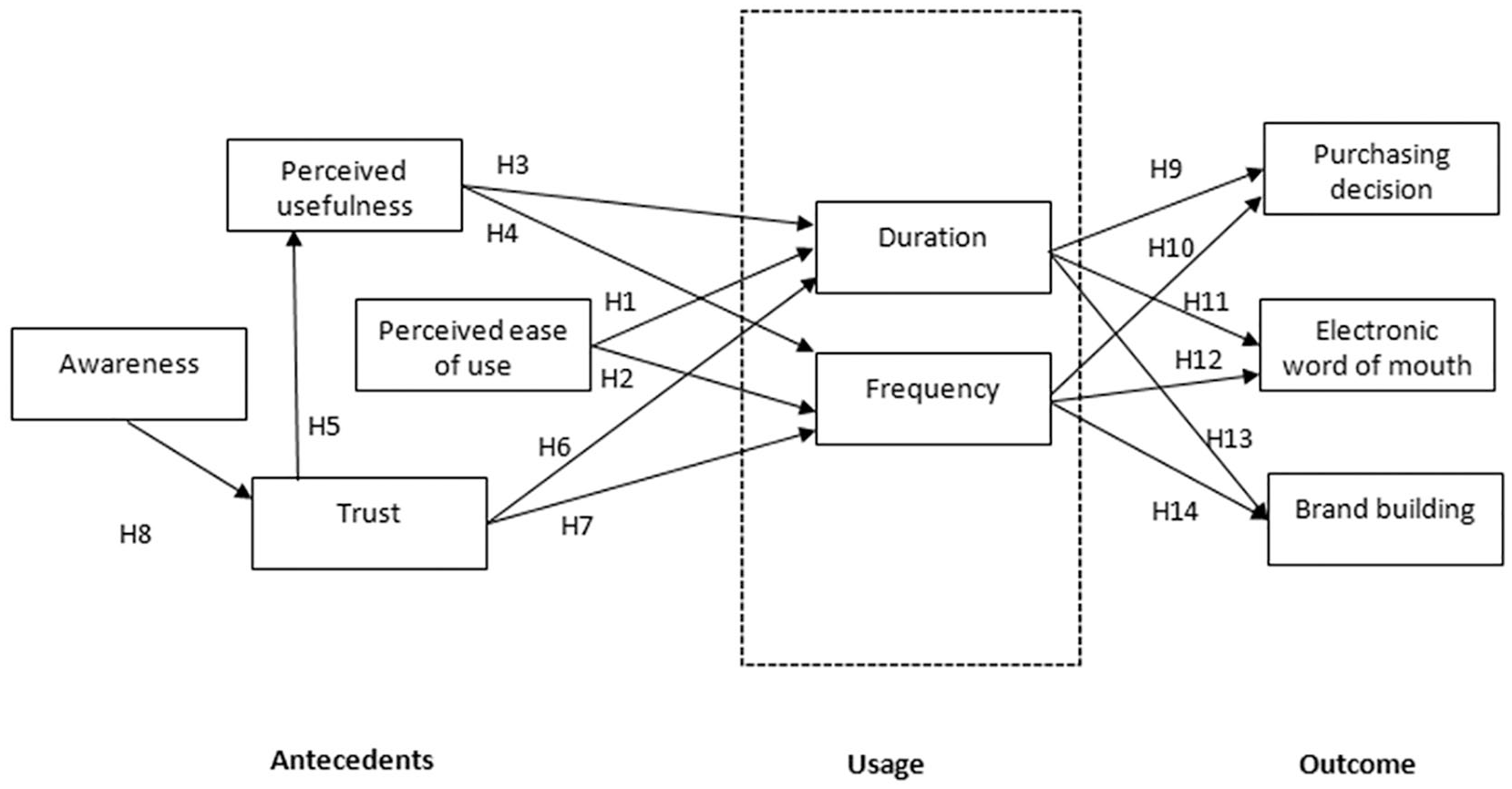
Research model.
Methodology
This research is correlative in nature. It examines the value of independent variables with regard to blog usage. This study was conducted in a non-contrived setting (natural environment). The variables were neither controlled nor manipulated. The unit of analysis consisted of blog readers.
Population and Sample Size
Blog readers represented the study’s population. The selection criterion for the sample was individuals actively involved in blogging, blog posting, or blog reading. Roscoe’s Rule of Thumb was utilized to determine the study’s sample size (Sekaran, 2003). Thus, for this particular research, 10 multiplied by 38 items resulted in an appropriate sample size of 380 participants. Convenience sampling was utilized to collect the data in the context of various cost and time constraints. Although a number of limitations are inherent in the sampling methods in regard to the generalization of the results, we can safely deduce that the entire population is adequately reflected.
Measures
The instruments utilized to measure the constructs were established through the adoption and adaption of prevalent validated scales. Although the questions asked in the research were derived from translated questions, guaranteeing validity and reliability, other vital concepts were incorporated to select questions regarding brand building. This was carried out in consideration of the works done in earlier studies. A number of revisions were performed to optimize the utilization. Various literatures were reviewed to select these instruments, which were adapted to better reflect blog usage.
The survey questionnaire (printed version) included 38 questions on 9 variables. Among them 19 items were asked to the respondents to assess trust, awareness, PU, and PEU and another 13 items were asked to understand the extent of purchasing decision, eWOM and brand building intention. Likewise, respondents were asked to report their duration and frequency of blog visit using 6 items (See Table 4).
Constructs, Items and Sources of the Questionnaire.

Results
Of the 380 questionnaires that were distributed to the participants, 252 responses were received, resulting in a 66% response rate. However, additional responses were removed during the data cleaning process as a result of inconsistent responses and incomplete values. Thus, the final number amounted to 245, slightly decreasing our response rate to 65%.
Demographic Information
The demographic information of our respondents is provided in Table 5.
Demographic Profile.

The respondents’ frequency distribution indicates that 58.37% of the participants were female and 41.63% were male. Considering age, approximately 28.57% of the respondents were younger than 25 years old. Approximately 37.96% were in the 25 to 35 age bracket, while 28.98% were in the 36 to 45 age bracket. Only approximately 4.49% of the respondents were over 45 years of age. With regard to education, respondents possessed tertiary education. Overall levels of education were also comparatively high, with 61.22% of the respondents having a bachelor’s degree, 27.76% possessing a diploma, and 10.61% having a master’s degree. Some of the most common professions included technical, clerical, and administrative, contributing to approximately 31.84% of the sample. Management and supervisory roles amounted to approximately 16.73% and 21.63% of the entire sample, respectively.
Additional profiling revealed that approximately 60% of the respondents actively posted in blogs. The most commonly reported level of engagement was 1 to 5 hr, with 40% of respondents reporting this level. Of the respondents, 36.4% spent roughly 5 to 10 hr engaged with blogs. With regard to the frequency, approximately 26.12% of the respondents read blogs at least once per day, while 37.14% read blogs 4 to 5 times per week. Of the participants, 19.59 read blogs 2 to 3 times per week, while 17.14% of the respondents read blogs once per week. More than half the respondents (148 of the 245 participants) were active social network users.
Measurement Model
Since data were collected using a single source, we first tested the issue of Common Method Bias by following the suggestions of Kock and Lynn (2012) and Kock (2015) by testing the full collinearity. In this method, all the variables will be regressed against a common variable and if the VIF ≤ 3.3 then there is no bias from the single source data. As can be seen from Table 6, all the VIFs were all lower than 3.3 thus single source bias is not a serious issue with our data.
Full Collinearity Estimates.

Note. eWOM = electronic word of mouth; PEU = perceived ease of use; PU = perceived usefulness.
We first assessed the validity and reliability of the measures following the suggestions of Alzahrani et al. (2012), Hair et al. (2019), and Ramayah et al. (2018) by calculating the loadings, average variance extracted (AVE), and composite reliability (CR) using the software SmartPLS 3.2.8 (Ringle et al., 2015). All the loadings were greater than 0.5, AVE greater than 0.5, and CR greater than 0.7 thus confirming the validity and reliability of the instruments used in this study (see Table 7).
Measurement Model.
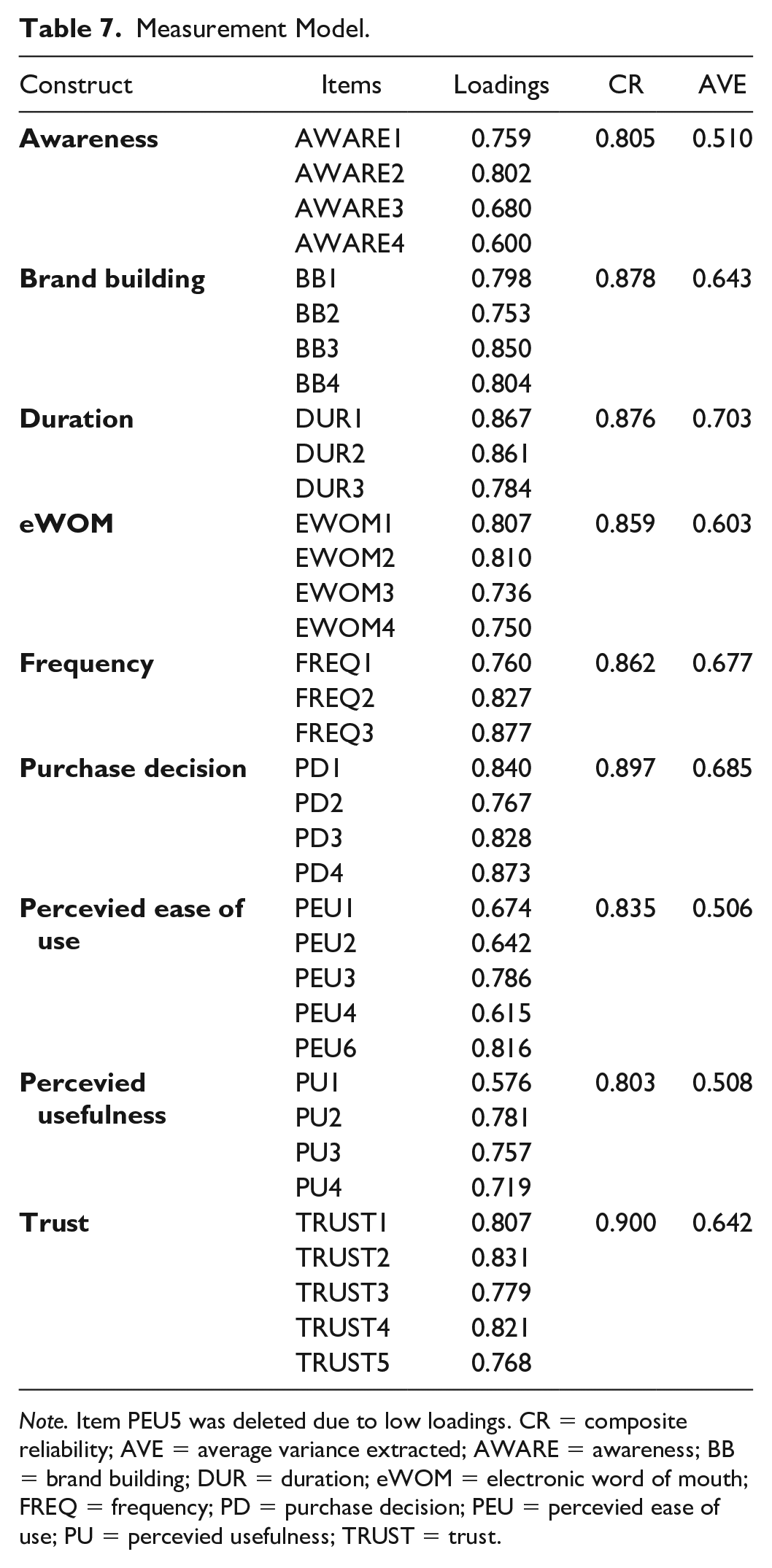
Note. Item PEU5 was deleted due to low loadings. CR = composite reliability; AVE = average variance extracted; AWARE = awareness; BB = brand building; DUR = duration; eWOM = electronic word of mouth; FREQ = frequency; PD = purchase decision; PEU = percevied ease of use; PU = percevied usefulness; TRUST = trust.
Then, we proceeded to test the discriminant validity of the measurement was assessed using the more recent recommendations of Henseler et al. (2015) and Franke and Sarstedt (2019). They have suggested to assess discriminant validity by using the heterotrait-monotrait (HTMT) ratio of correlations. The HTMT values should be ≤ 0.85 to indicate discriminant validity. As shown in Table 8, the values of HTMT were all lower than 0.85
Discriminant Validity (Heterotrait-Monotrait Ratio).

Note. eWOM = electronic word of mouth.
Structural Model
To assess the structural model Hair et al. (2019) suggested looking at the R2, beta and the corresponding t-values via a bootstrapping procedure with a resample of 5,000. The results are shown in Table 9.
Hypotheses Testing.
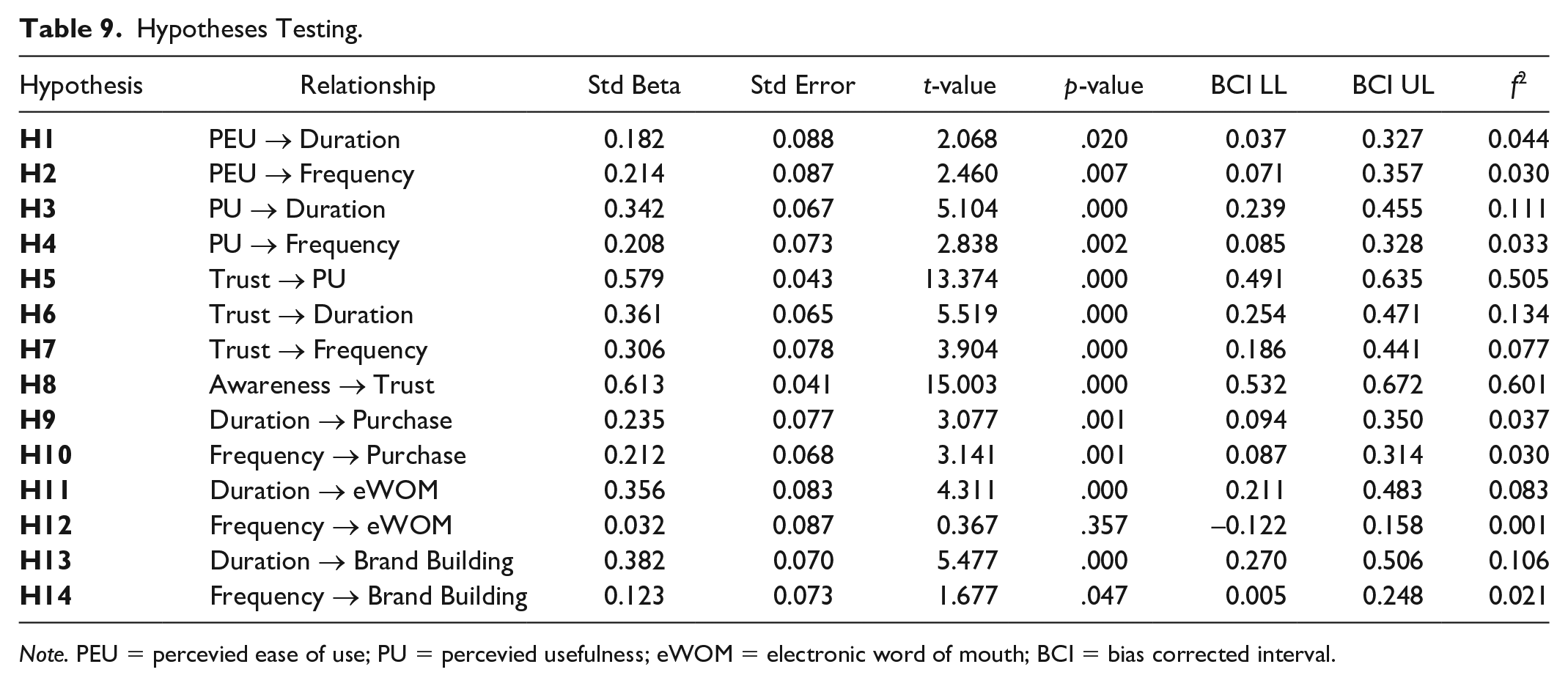
Note. PEU = percevied ease of use; PU = percevied usefulness; eWOM = electronic word of mouth; BCI = bias corrected interval.
The findings shows that PU and PEU were positively related to Duration and Frequency thus giving support to H1, H2, H3, and H4. Trust was also positively related to PU, Duration and Frequency thus H5, H6, and H7 are also supported. Awareness was positively related to Trust supporting H8. The in sample prediction quality measured by R2 which ranged from .143 to .375 and predictive relevance measured by Q2 ranging from 0.073 to 0.249 (Q2 > 0 indicates predictive relevance) were all acceptable (see Figure 2).

Results from hypotheses testing.
Discussion
Our final research model showed that when users perceive that the technology is hassle-free, they have a comparatively higher probability of engaging with the technology. The deduced results are in line with Davis et al. (1989), Igbaria et al. (1997) and T. Teo (2009), indicating that PEU significantly determines system usage and PU.
For H3 and H4, PU is positively related to both duration and frequency. The duration and frequency of visiting the blogs are both positively affected by PU. This idea was based on the notion that users are likely to use the blog if they it perceived it to be useful. The results of this study suggest that there are indeed connections between usage and PU. These results are in line with those of Davis et al. (1989), Igbaria et al. (1995) and Van Raaij and Schepers (2008).
For H5, H6, and H7, the relationship appeared to be that a higher level of trust has a positive effect on PU, duration, and frequency. From these findings, we can deduce that as the number of visits increases, the time spent on blogs also increases. The findings are in alignment with those presented by Gefen et al. (2003), Jarvenpaa et al. (1999) and McKnight and Choudhury (2006), which state that customers have positive feelings about a company as a result of the company website. These studies can be further extended to blogs because they are now considered the human side of the organization (Dwyer, 2007).
For the relationship between awareness and trust (H8), there is a significant positive relationship between awareness and trust in blog usage. This is further validated by Gefen and Straub (2003), who confirmed that social presence is a necessary condition for the development of trust within an online environment. Rogers and Shoemaker (1971) stated that the adoption or rejection of an innovation begins when the consumer becomes aware of the product. Safeena et al. (2011) found support for this statement in their studies that found that consumers’ reluctance to adopt a system is due to unawareness.
The results for duration (H9) for frequency (H10) show a positive relationship. This indicates that for both aspects, increased time spent and increased visits eventually contribute to customers’ purchasing decisions. These findings are also in alignment with the studies carried out by Danaher et al. (2006), which suggested that longer duration of visits encourage users to return to blogs. Johnson et al. (2003) noted that blog–user relationships are enhanced as a result of readers’ increased time spent on the blog. Bhatnagar and Ghose (2004) and Danaher et al. (2006) reported that advertising click-through rates also greatly benefit from customers’ visit duration. As customers’ engagement increases, their likelihood to return to the blog increases. This positively affects purchasing decisions and also depends on the kind of blogs being utilized.
For the relationship between duration spent on blog and eWOM (H11), the results support the increased time spent on a blog contributes to eWOM. Individuals planning to initiate their own blog should include appealing content on the blog, irrespective of whether the blog is designed for business or personal use. This would lead to customers staying at the blog longer (Chen et al., 2014). For H12, the relationship was not significant suggesting that blog visits do not result in message diffusion regarding blog content. This result is rather inconsistent with previous findings that suggested that individuals may spend a greater amount of time based on the recommendations of others. Individuals typically revisit blogs to engage in discussions on various topics. This notion is also supported by Olsen (2007), who suggested that individuals tend to repeat previously performed behaviors.
For H13 and H14, duration and frequency was positively related to brand building. There is strong evidence that both hypotheses are supported, indicating that in regard to blog utilization, frequency and duration have positive impacts on brand building. Thus, organizations and individuals who want to start online businesses should note that simply establishing a blog is insufficient. Rather, content that attracts customers to spend more time on these blogs and to visit them more often should be added. Guernsey (2000) also supported this notion, stating that blogs serve as WOM for the organization. Individuals’ information sharing regarding brands on blogs results in a rather conducive environment for customers. Such aspects allow others to benefit from learning more about the brand. From a strategic perspective, readers or users with similar interests are grouped together by a blog, allowing companies to target a particular niche market segment. Brand micro-blogs must provide valuable information and services if they want their followers to continue to follow those (Zhao et al., 2016).
The focus of this research was analyzing the various aspects that contribute to technology adoption. All three constructs explained a high percent of variance. Technology usage is likely to be higher as long as usefulness and trust play a defining role. However, awareness explains approximately 57.3% of variance in technology adoption. With regard to the association between blog utilization and purchase decisions, brand building, and eWOM, positive correlations were observed. These aspects were measured in consideration of frequency and duration; however, the spread of messages was not found to be substantial.
The effect sizes (f2) which measures the substantive significance are shown in Table 9. They ranged from as low as 0.030 (H2 and H10) to as high as 0.601 (H8). The interpretation follows Cohen (1988) which says that 0.02 (small effect), 0.15 (medium effect), and 0.35 (large effect). Out of the 14 hypotheses tested, there were 11 with small effect sizes and 2 with large effects sizes.
Implications
This section highlights the study’s implications from theoretical and managerial perspectives. In terms of the former, the study findings further validate the critical reviews and recommendations made by Legris et al. (2003), who claimed that other components need to be included in TAM to provide a comprehensive picture of IT adoption. In specific, aspects related to social change and human processes must be taken into account. Trust and awareness play vital roles in the adoption of Web 2.0 technology. Only awareness eventually leads to adoption. TAM primarily focuses on PU and PEU. Irrespective of the fact that both variables played substantial roles, the impact of trust should not be disregarded. Engagement levels are comparatively higher when individuals perceive that the technology is beneficial. In the multi-dimensional environment of Web 2.0, characterized by rapid diffusion and penetration of information, trust is a crucial aspect. Individuals might be hindered from adopting or trying new systems if they lack trust.
This study provides various valuable insights, particularly regarding the areas of Web 2.0 that both organizations and individuals should consider. From the results, we can deduce that trust and awareness greatly contribute to blog utilization. From a marketing perspective, blogs can be used as vital instruments because the frequency of visits and time spent on blogs seem to positively correlate with purchasing decisions and brand building. Organizations can use this mechanism as part of their overall marketing strategy, while individuals can utilize it to augment their incomes. Such interactive platforms allow customers to voice their concerns and eventually send comments and feedback to customers. As approximately 60% of respondents are active on social media, organizations and individuals can also utilize this particular instrument to market to their target market.
Limitations and Future Research
Irrespective of the study’s benefits, a number of limitations are inherent in the research and must be addressed. First, the results cannot be extensively generalized to users of web technology because only blog readers have been included in this research. Second, blog readers were included in this research irrespective of the kind of blogs they read. Thus, exact engagement cannot be assessed. Furthermore, the research does not provide precise information about how these blogs can be utilized based on the blog types. Finally, as a result of various resources and time constraints, a sample of only 245 participants was studied, which greatly limits our ability to generalize the results. Future studies can further build on this research by including different type of blogs or blog readers. Moreover, other markets might also be assessed. The model can further be improved through incorporating other aspects while utilizing information from the prevalent literature. For blogs to succeed, customers must exhibit a repeated behavioral pattern. Thus, these aspects should be the prime attention of future studies. Additional scales need to be developed to assess awareness because very little literature was available on this topic. This suggests that the instruments available to study this topic might not have been able to completely incorporate the constructs/variables that were analyzed. The primary focus was on the positive outcomes of blog engagement; thus, future studies should focus on the negative aspects of engagement.
Conclusion
The research findings suggest that the factors influencing blog engagement should be understood and acknowledged to enhance the success of blogs. Because blogging is increasingly gaining popularity, the platform should be utilized by both individuals and organizations to achieve the maximum benefit. Moreover, the costs involved in maintaining a blog are comparatively low. With the increased number of online users present, specifically in regard to social networking, a platform is already available for advertising these blogs. Mediums such as Twitter and Facebook could be utilized for this purpose. Last but not the least, because of blogs’ simplicity, they provide rather holistic access to the world, which is a significant advantage in itself.
Footnotes
Acknowledgements
The authors extend their appreciation to the Deanship of Scientific Research at King Saud University for funding this work through Research Group No. RG-1438-070.
Authors’ Note
The author Ramayah is now affiliated to Internet Innovation Research Center, Newhuadu Business School, Minjiang University, Fuzhou, Fujian, China, Department of Management, Sunway University Business School (SUBS), 5, Jalan Universiti, Bandar Sunway, Selangor, Malaysia, and Faculty of Accounting and Management, Universiti Tunku Abdul Rahman (UTAR), Cheras, Selangor, Malaysia.
Declaration of Conflicting Interests
The author(s) declared no potential conflicts of interest with respect to the research, authorship, and/or publication of this article.
Funding
The author(s) disclosed receipt of the following financial support for the research, authorship, and/or publication of this article: This study was funded by the Deanship of Scientific Research at King Saud University through research group No. RGgrou-1438-070.
