



Abstract
Customer purchase intention in online shopping stores can be influenced by electronic word of mouth (eWom) communication generated by the comments of consumers on social networking sites. However, the adoption of eWom information by consumers is influenced by various factors. This study investigates the mechanism through eWom antecedents influence eWom adoption and consumer purchase intention. The study also examines how eWom adoption mediates the impact of antecedents of eWom adoption (Quality, Consumer Attitude, Credibility, Usefulness, Needs, and Adoption) on customer’s purchase intention. Using the hypothetic-deductive approach, the current study used a cross-sectional self-administered survey to collect data from a convenience sample of university students residing in Karachi. The SmartPLS software was used to analyze the collected data. Study findings reveal that all predictors of eWom adoption are significant. It was also found that eWOM adoption mediates the impact of eWom antecedents on consumer purchase intention. The results provide significant implications for website designers and digital marketers. For marketers working with social media, the findings of this study are encouraging. Marketers can use these findings to develop viral marketing campaigns and encourage customers to contribute useful and credible eWom that could improve the customers’ purchase intention.
Keywords
Introduction
Over the past few decades, the world of communication has changed significantly. We have witnessed the birth and rise of new communication channels that have given rise to eWom information (Bilal et al., 2020; Cheung & Thadani, 2012). Use of Social Networking Sites (SNSs) is on the rise. This increased use has fueled the SNS user growth. At the same time, the growing number of SNS users has resulted in increased electronic word-of-mouth (eWOM). The eWom can be used by consumers to share their opinions and experiences related to various products/services with their friends or other consumers that share similar interests. Companies can also access this eWom information without any limitations (Gupta & Harris, 2010; Hajli, 2018; Seifert & Kwon, 2019). In fact, an increasing number of brands are now relying on social media to increase interactions with customers and increase sales of their products/services.
For consumers, social media is a source of numerous convenience services along with visual facilities such as videos, pictures (Kaplan & Haenlein, 2010). The substance of these audio and visual aids on SNS could be commercial (related to products and services) or non-commercial. Favorable or unfavorable opinions of current users, ex users, non-users, and potential users of brand can easily be shared through eWOM on SNS (Hennig-Thurau et al., 2004). Hence, it becomes a valuable prospect for sharing views related to products (Chu & Kim, 2011). According to current studies, consumers increasingly prefer SNS to gain detailed information about the brands, which are new to them (Schivinski & Dabrowski, 2016). Thus, SNSs are considered as the very important source of eWOM information.
An increasing number of companies are making large investments on their social media marketing efforts in a bid to generate more customer eWom through activities such as attracting consumers to brand posts, setting up eWom sharing corners for consumers, and sharing brand-related posts by the recommenders. However, one ambiguity remains that is, what is the mechanism through which the consumers transfer eWom to other consumers in order to influence their consumption behavior (Kapoor et al., 2020).
According to Teng et al. (2014), consumer can change their preferences and purchase behavior provided the eWom is persuasive. There exist many antecedents of persuasive eWom such as Information Quality, Attitude towards Information, Information Credibility, Information Usefulness, Need for Information, & Information Adoption. Chu and Kim (2011) suggest that effects of eWom may change from one eWom platform to another such as SNSs. In practice, the research studying the links between antecedents of eWOM on SNSs and consumer purchase intention is still in its nascent stage and there exist limited number of studies. This is despite the fact that eWom on SNSs can have potential effect on consumer interactions on SNSs. The available individual-level studies lack agreement with regard to the influence of eWOM (See-To & Ho, 2014; Zhu et al., 2016). This lack of agreement has resulted in significantly limited conclusive findings about the effects of eWom (Cheung & Thadani, 2012; Kim et al., 2019). There is a need to develop new and comprehensive research models to provide a consolidated understanding of the mechanism through which eWom influences consumer purchase intention.
One fundamental consequence of digesting eWom information is the consumer’s decision of whether to adopt eWom information or not. This adoption of eWom information helps consumer makes an informed purchase decision (Erkan & Evans, 2016; Fan & Miao, 2012; Lee et al., 2020; Zangeneh et al., 2014). Our understanding of how antecedents of eWom affect purchase behavior is still limited because the existing empirical findings are limited. This leads us to believe that causal link between antecedents of eWOM in SNSs and purchase intention can be either direct or indirect. In addition, it can be mediated by eWom adoption. To date, this research issue has received little attention. Therefore, this study seeks to examine the mechanism by which eWOM antecedents influence adoption of eWOM and purchase intention. The context of this study was consumers of online shopping in Pakistan. To accomplish the purpose of this study, we established two research questions. First, which antecedents of eWom adoption influence eWom adoption? Second, does eWom adoption mediates the relationship between antecedents of eWom and purchase intention. Based on literature review, we were able to describe six antecedents of eWom. We then performed an empirical analysis of both the direct and the mediation effects of antecedents of eWom upon purchase intention.
This study provides both theoretical and practical contribution. From a theoretical standpoint, this study will contribute to enhance our existing knowledge of the mediating role of eWom adoption in the relationship between antecedents of eWom and purchase intention. Practically, online businesses can use the findings of this study to enhance their eWom activities on SNSs. The enhanced eWom activities would help strengthen their brands and ultimately result in greater sales.
Literature Review
Antecedents of eWom Adoption
To achieve the objectives of this study, we used Information Adoption Model (IAM), which explains the users’ acceptance behavior (Ma & Liu, 2005). The IAM model is the extension of well-researched model of Theory of Reasoned Action (TRA) that postulates that two major factors influence the consumers purchase decision. These factors are consumer’s attitude and subjective norms. Here consumer attitude is referred to as the perceived favorable or unfavorable attitude toward performing behavior and subjective norms are referred to as perceived social pressure on an individual while performing behavior (Fishbein & Ajzen, 1975). When a consumer digests eWom, the natural consequence is the decision whether or not use this information to make an informed purchase decision (Erkan & Evans, 2016; Fan & Miao, 2012). Moreover, IAM explains how eWom or computer-generated communication possibly affects the consumers purchase decision.
The way consumers adopt information to create intentions toward performing any behavior or adopting any new or old technology, in the same manner they develop intentions toward the acceptance of any idea (regardless its new or old) or behavior (Anubhav & Satish, 2016). According to Sussman and Siegal (2003), the same factors, which are responsible for the intention formation of an individual for performing any action, can be used for the acceptance of advice. The information adoption model primarily supports in getting the in-depth insight about how the intentions are built through the message received via eWom communication. The IAM identifies various potential antecedents of eWOM message adoption by customers. Based on a critical examination of previous studies, this study has identified the following antecedents of eWom adoption in relation to information acceptance and intention to use eWom: Attitude towards Information (ATI), Information Usefulness (IU), Information Adoption (IA), Information Quality (IQ), Information Credibility (IC), and Needs of Information (NOI).
ATI and eWom adoption
ATI is considered as one of the vital factors that influences consumer perception about eWOM information through social media. Limited literature is available that analyzes the influence of consumer attitude to SNS eWOM information on purchase intention. TRA describes attitude as one of the key predictors of one’s behavioral intentions. According to Prendergast et al. (2010) and Tutko (2019), the adoption of eWom information and purchase intention are both considered behavioral intentions. As such, a positive consumer attitude can have positive impact on both adoption of eWom information and purchase intention. However, attitude towards information is used as one of the determinants of eWom adoption within the context of this study. Therefore, we propose the following hypothesis.
H1: The attitude towards information has a significantly positive effect on eWom adoption.
IU and eWom adoption
According to one definition, Information usefulness is the perception of people that they can enhance their performance by using new information (Nabi & Hendriks, 2003). Consumers, in general, prefer to use the information, which, in their opinion, can be useful to meet their objectives. Therefore, one important driver of eWom information adoption is whether the information is useful or not (Cheung et al., 2008; Hussain et al., 2018; Ismagilova et al., 2020; Lee & Hong, 2019; Lee & Koo, 2015). Customer’s confidence as well chance of adoption of information is increased when the information is useful (Khwaja et al., 2020; Nabi & Hendriks, 2003). Consumers perceive that information usefulness will increase their performance (Bailey & Pearson, 1983; Cheung et al., 2008). On the other, it has been observed that consumers who are interested in eWom communication are the potential customers having online purchase intentions. Therefore, we propose the following hypothesis.
H2: The Information Usefulness has a significantly positive effect on eWom adoption.
IA and eWom adoption
Information adoption by consumers can be influenced by many factors. One of the most significant factors is usefulness of information. Consumers adopt only information, which they found relevant and useful for them. Therefore, usefulness of information is a significant predictor of the adoption of eWom (Cheung & Thadani, 2012; Daowd et al., 2021; Erkan & Evans, 2018; Lee & Shin, 2014; Park et al., 2019; Sussman & Siegal, 2003). According to Nabi and Hendriks (2003), there is a high probability that consumers will adopt information confidently provided the information is useful for consumers. Subsequently, the consumer’s purchase intention is influenced by adoption of information. This is specifically true for the information provided on SNS. Therefore, we propose the following hypothesis:
H3: The Information Adoption has a significantly positive effect on eWom adoption.
IQ and eWom adoption
According to Yeap et al. (2014), quality of information is the power of words used in conveying the real essence and meaning of the message. The increase in internet usage by the consumers allows anyone anywhere to share their opinions and reviews about any product. This freedom makes the quality of information a question mark in the minds of the consumers. This ambiguity has created a trouble in evaluating the quality of the information for a number of customers (Danniswara et al., 2020; Filieri & McLeay, 2013). The influence of information quality on eWom was studied previously by many researchers (Byung-Kwan & Hyang-Sook, 2020; Cheung & Thadani, 2012; Ukpabi & Karjaluoto, 2018). According to Park et al. (2007), quality of product reviews on SNS is a significant factor that influences consumer’s purchase intention. Therefore, we propose the following hypothesis.
H4: The Information Quality has a significantly positive effect on eWom adoption
IC and eWom adoption
Information credibility is the consumer’s perception reliability and trustworthiness of the information received from a sender (Awad & Ragowsky, 2008). Every consumer has different perception about the message he/she received and this variability in the message makes its credibility uncertain. Awad and Ragowsky further suggest that credibility of the information is the most significant element in the purchase decision-making process. Available literature also suggests that a relationship exist between online consumer buying intention and information credibility (Dou et al., 2012; Martínez et al., 2020). Consumer decisions, particularly related to their purchase intentions are influenced greatly by the information credibility. As such, information credibility is considered a significant determinant of eWom adoption by consumers.
H5: The Information Credibility has a significantly positive effect on eWom adoption
NOI and eWom adoption
NOI is another significant predictor of adoption of eWom. NOI is also a significant influencer of consumer’s purchase intention (Torres et al., 2018). In literature, the need of information concept is used in various contexts specifically as “advice seeking” (Wolny & Mueller, 2013). According to Flynn et al. (1996), consumers curiously looking for information generally have greater needs of information due to which they keep on looking for information from numerous people specially while making any purchase decision. Moreover, needs of information can also tell us that consumers looking for information on social networking sites found it more useful (Gupta et al., 2020). Therefore, we propose the following hypothesis.
H6: The Needs of Information has a significantly positive effect on eWom adoption
The Mediating Effect of eWOM Adoption on Purchase Intention
Available literature provides evidence to support the notion that eWom adoption plays a very important role in determining consumer purchase intention. Erkan and Evans (2016) suggest that adoption of eWom information available on SNS can help convert purchase recommendations into actual purchase. Viral messages that consumers regard highly useful can contribute toward strengthening consumer’s purchase intention toward products marketed on social networking sites (Gunawan & Huarng, 2015; Madli et al., 2018). NOI is another significant determinant of eWom information. NOI strongly influences consumer’s purchase intention. It can be said that influence of antecedents of eWom information enhance consumer purchase intention with mediation through eWom adoption. Therefore, we propose the following hypothesis.
H7. The adoption of eWOM by consumer mediates the influence of eWOM predictors on consumer’s purchase intention.
Figure 1 shows the research framework used in this study.

Research framework.
Research Methodology
Research Instrument Development
The various items of measurement used in the research instrument were adopted from the available literature. Table 1 lists these items and their sources. A five-point Likert scale was used. In order to ensure the respondents actually read the research instrument carefully and then respond, both constructive and adverse questions were included in the research instrument (Saunders, 2011). Convenience sampling technique was applied for data collection. This technique is efficient and effective with respect to the time, effort, and money spent on data collection. Data was collected from 384 university students in Karachi. The reason behind choosing this age group is that according Global Digital Report on latest statistics, 89% of the frequent SNS users belong to the age group of 18 to 29 years (Closson & Bond, 2019). Some researchers argue that student samples do not provide enough validity and generalizability of results. In some studies, however, the use of student sample was considered acceptable and even desirable. This was especially true when students were the major consumer segment of the product/service studied (Yoo & Donthu, 2001).
Instrument Measurement.

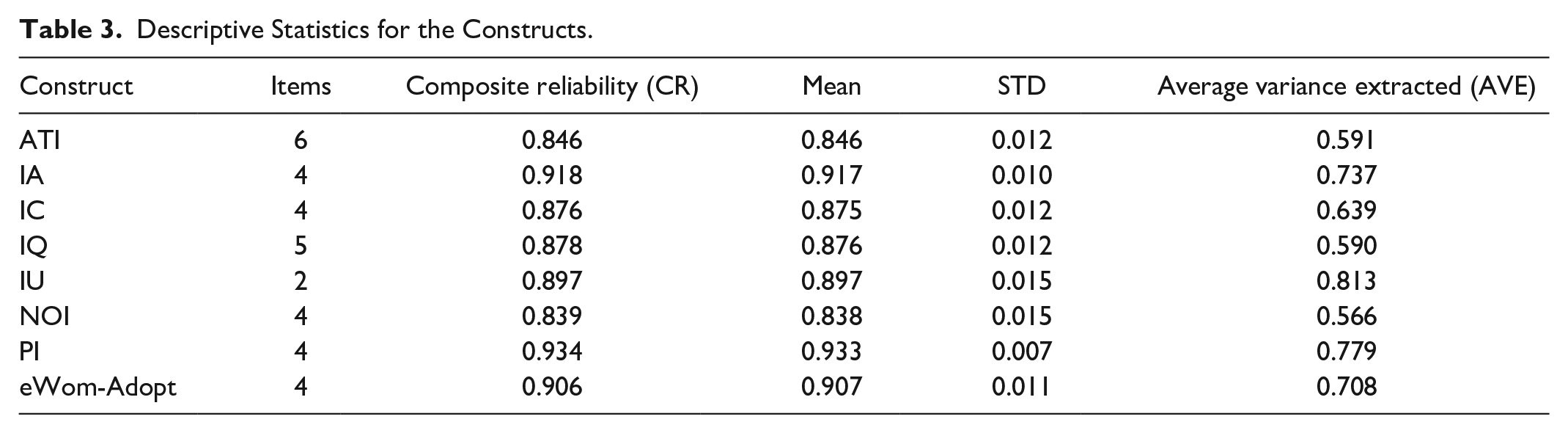
The model was tested to ensure that it meets various criteria of research instrument reliability/validity. These criteria include criteria for instrument reliability and convergent/discriminant validity of the instrument. Table 3 shows the results of this testing. The values of composite reliability vary from minimum 0.839 to maximum 0.934. The values of AVE vary from minimum 0.591 to maximum 0.813. The values of factor loadings vary from minimum 0.456 to maximum 0.911. Hence, all criteria for instrument reliability/validity were met successfully.
Data Collection
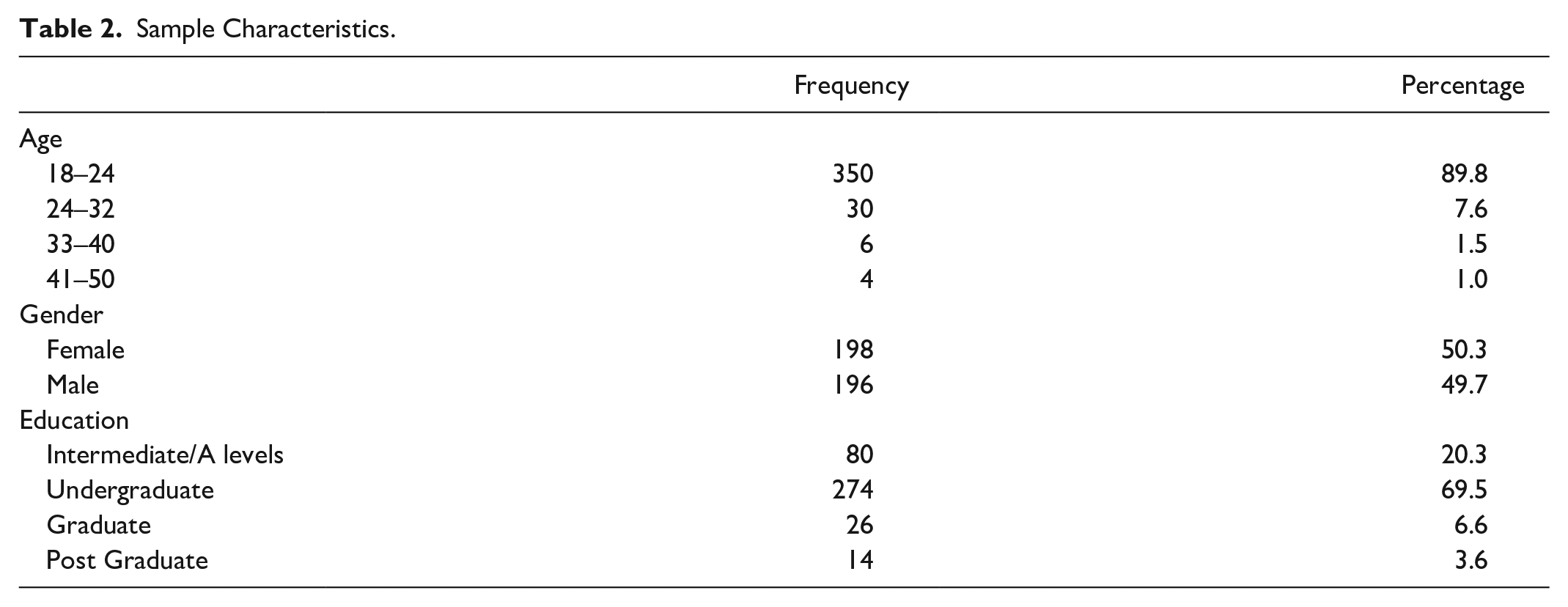
To conduct the empirical investigation for validating hypotheses and theoretical model this study collected data using a self-administered questionnaire. This method provided several benefits. Data collection for larger samples is quiet a task therefore questionnaires are considered as most important tool for gathering data (Saunders, 2011). Efficient and effective data collection tool can save a lot of time and money thus questionnaire design perfectly suits the aim of the study (Bryman & Bell, 2011).Questionnaire expedites the research process by providing convenience to participants, as they can answer questions quickly and easily and researcher, who can do the coding for analysis rapidly (Gray, 2014). The measurement items used in the questionnaire were adapted from existing consumer behavior and e-commerce literature (Cheung et al., 2008; Chu & Kim, 2011; Coyle & Thorson, 2001; Fang, 2014; Park et al., 2007; Prendergast et al., 2010). The number of respondents participated in the study was 384. The gender wise distribution was 198 female and 196 male. The maximum number of respondents belonged to age group of 18 to 24 years while most of the respondents completed undergraduate education. Table 2 depicts the sample characteristics.
Sample Characteristics.
Data Analysis
Data analysis was performed to serve two purposes. First, we had to ensure that various measures used in our research instrument were reliable and valid. Second, we needed to assess various hypothesized relationships of the research model. To serve these two purposes, this study used a two-step process suggested by Anderson and Gerbing (1988) and Chin and Newsted (1999). The first step involved the analysis of the measurement model and the second step was assessment of the hypothesized relationships in the model.
Measurement model assessment
In order to establish whether our measurement model was adequate or not, we used various established criteria of reliability and convergent/discriminant validity. To establish the reliability of the research instrument, CR statistics was calculated. Looking at Table 3, we can see that all CR values surpass the threshold value of 0.7. To establish whether our research instrument exhibits convergent validity, we utilized two criteria as proposed by Fornell and Larcker (1981). According to the first criteria, all values of all factor loadings should be above 0.7. These values should be significant and should load on their respective constructs. Looking at Table 3, we can see that this criterion was met. According to the second criteria, the value of AVE for each construct should surpass 0.5. Looking at Table 4, we can see that this criterion was met. Therefore, both criteria of convergent validity of research instrument were satisfied.
Descriptive Statistics for the Constructs.
Measurement Scale Results.

To establish whether our research instrument exhibits convergent validity, we utilized two criteria as suggested by Chin (1998) and Fornell and Larcker (1981). In the first step, we calculated the cross-factor loadings of all items. All cross-factor loadings were larger for their measurement item than on any other construct. Second, we calculated the value of the square root of the AVE from each construct. Each value surpassed the correlation between the respective construct and other constructs. Hence, both criteria of discriminant validity were satisfied (See Table 5).
Correlation among Constructs and the Square Root of the AVE.

Note. The italic numerals along the diagonal represent the square root of AVE.
Harman’s one-factor test (Podsakoff et al., 2003) was used to detect any possible common method bias in our study. All seven factors in our model accounted for 78% of total variance. Among all seven factors, the share of largest factor in the total variance was only 23.28%. Hence, no general factor exists and we can safely assume there exist no common method bias.
To assess the degree of multicollinearity in our model, we used two criteria. First, we calculated variance inflation factor (VIF) for each construct. Hair et al. (2009), suggested that to ensure non-existence of multicollinearity, the VIF value for each construct should be 3 to 5. All calculated VIF values for our model ranged from 1.478 to 2.756. A condition number is defined as condition number = sqrt (largest eigenvalue)/sqrt (smallest eigenvalue). For a model that exhibits no significant multicollinearity problem, the value of condition number should be less than 10. In our study, the value of condition number was 2.23. Hence, we were safe to assume that there were no significant multicollinearity problems in our dataset.
Structural model assessment
We used the technique of structural equation modeling to test the hypothesized relationships in our model. We used bootstrapping method in SmartPLS program to determine the path estimates and other important statistics of our research model. Table 6 shows the path coefficients of our structural mode. All the path coefficients were significant.
Path Coefficients of the Structural Model.

The values of R2 for all predicted variables were greater than .5. This indicates that that predicted variables had substantial level of explanation (Schroer & Hertel, 2009). Table 6 shows the interrelationships among constructs. The empirical results indicate that the ATI (γ1 = .177, p < .005), IA (γ2 = .455, p < .001), IC (γ3 = .095, p < .05), IQ (γ4 = .035, p < .05), IU (γ5 = .064, p < .05), and NOI (γ6 = .219, p < .00) significantly influence eWom adoption. Therefore, hypotheses H1 to H6 are supported. The empirical results indicate that the eWom-Adopt (γ7 = .303, p < .005) significantly influence purchase intention. Therefore, hypotheses H7 is supported.
Discussion
The positive and significant impact of Attitude towards information shows that adoption of eWom information is favored by consumers who exhibit positive sentiment for eWOM information. Looking at the structural model results, the path coefficient was 0.177 and significant, implying that eWom recipients were inclined to adopt information contained in eWom messages provided their attitude toward eWom was favorable. This result is consistent with the literature (Lee & Shin, 2014; Park et al., 2007).
Consistent with the literature, usefulness played a significant role in adoption of eWOM information by consumers in the context of social media (Chu & Kim, 2011; Sussman & Siegal, 2003). Looking at the structural model results, the path coefficient was 0.064 and significant. As such, usefulness was the second least important determinant of eWom adoption. Based on the research findings, respondents believed that usefulness of eWom posted by people was least important in making decision to adopt eWom information. A possible explanation may be that despite increased social media use in developing countries (such as Pakistan), consumers still do not consider usefulness of eWom as an important factor in their decision to adopt eWom information provided it is useful.
In terms of information quality, based on the structural model results, the path coefficient was 0.035 and it was significant. However, information quality was the least significant determinant of eWom adoption. This finding was surprising because literature supported a significant role of information quality in consumer’s decision to adopt eWom information (Cheung & Thadani, 2012; Olshavsky, 1985; Rieh, 2002; Sussman & Siegal, 2003). The possible explanation for this is that the concept of quality of information is still new for consumers in Pakistan. The consumers have understanding of the concept of quality when it comes to products/services. However, the concept of quality of information is still new for these consumers. Due to this lack of understanding, they do not consider it as an important factor in their decision to adopt eWom.
The eWOM information credibility is defined as the extent, to which one perceives the recommendation as believable, true, or factual (Tseng & Fogg, 1999). In terms of Information credibility, the results indicate that information credibility was a significant factor in consumer’s decision to adopt eWom information. This means that if Pakistani online consumers think that the eWom information is credible, they will make purchase decision based on the eWom information, which they believed. The online shopping environment in Pakistan is characterized by a significant lack of trust between buyer and seller. This finding shows that Pakistani consumers find eWom information as a useful risk mitigation tool in online shopping. This finding also suggests that online businesses in Pakistan need to develop strategies targeted to gain credible eWom for their products/services to strengthen their brands and achieve greater sales.
In terms of Needs of Information, the literature has provided conflicting evidence where some studies found a significant relationship between Needs of Information and eWom adoption (Chu & Kim, 2011; Hennig-Thurau et al., 2004) while some studies did not find a significant relationship between Needs of Information and eWom adoption (Wolny & Mueller, 2013). The results of this study indicate that consumers considered Needs of information as a significant factor in their decision to adopt eWom information. Based on the structural model results, the path coefficient was 0.219 and it was the third most significant determinant of eWom adoption. This means that Pakistan consumers who need eWOM information prefer this information to be adoptable. Consistent with previous literature (Flynn et al., 1996), it also means that consumers who have high needs of information tend to search for information from others when they are in a purchase decision-making process.
Consistent with the previous literature (Cheung & Thadani, 2012; Cheung et al., 2008; Iyengar et al., 2009; See-To & Ho, 2014; Wallace et al., 2009; Wang et al., 2012), this study also found that adoption of eWom information available on SNS is a significant determinant of eWom adoption.
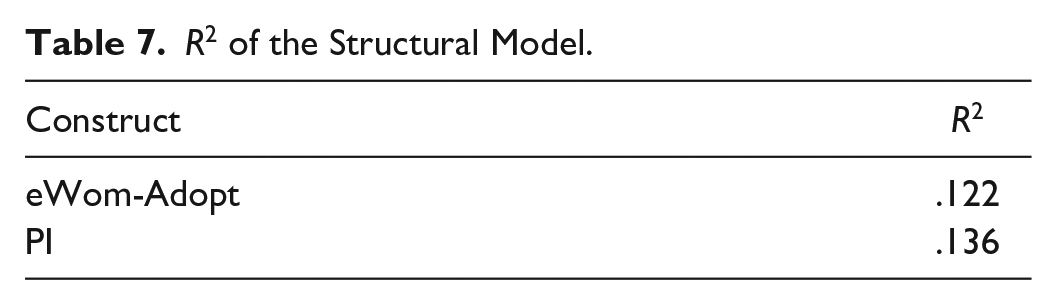
An analysis of the values of all path coefficients of unmediated structural model showed that ATI, IA, and NOI had significant positive relationship with results with purchase intention. However, we could not find a significant influence either IQ, IU, or IC. The R2 for purchase intention was .122 reflecting that the variation in the eWom antecedents explains 12.2% of the total variance of consumer purchase intention. An analysis of the values of all path coefficients of unmediated structural model showed that all eWom antecedents had a positive and significant impact on eWom adoption (see Table 6). However, none of the eWom antecedents showed a direct influence on purchase intention. Lastly, we found a significant positive impact of eWom adoption on purchase intention (beta = .303, t-statistic = 7.305, p < .000), which is necessary to support the hypothesis regarding the indirect impact of eWom antecedents on purchase intention by means of eWom adoption. R2 for purchase intention was .136, which is greater than .122 found in the unmediated model. In terms of R2, we found that R2 increased from .122 in the unmediated model to .136 in the mediated model, which implies that the mediated model has a better fit than the original model (See Table 7). We further examined the mediation effect of eWom adoption following the Baron and Kenny (1986) steps. The results showed complete mediation for all eWom antecedents. These results demonstrate that eWOM adoption mediates the link between eWOM antecedents and consumer purchase intention. Hence, hypothesis 7 is supported. This finding is in line with the findings of Tien et al. (2019) who found that eWOM adoption was a full mediator of the link between eWOM usefulness (a eWom antecedent) and purchase intention. The empirical finding of this study that is, information adoption is a key mediator, would help advance our understanding of the causal linkage between consumer persuasion and consumer decision-making. In this linkage, eWom adoption plays a significant role in creating the impact that eWOM has on consumer purchase intention. This finding indicates that eWom on SNSs has great business value. Brand managers need to capitalize on this value by engaging in eWom on SNSs. This would help companies increase consumer’s purchase intention toward their products/services.
R2 of the Structural Model.
Theoretical Implications
The main achievements, including contributions may be summarized as follows. This study provides a comprehensive theoretical model examining the role of eWom adoption in the impact of eWom adoption antecedents on consumer’s purchase intention. This can be considered a significant step forward in our understanding of an integrated IAM model and TRA model. The model developed in this study is an extension of IAM model that helps understand how information adoption in eWom messages can mediate the influence of antecedents of eWom adoption on consumer’s purchase intention. The relationships identified in this study are a significant addition in related literature. IS researchers can find this extended IAM model particularly helpful in building new models analyzing the impact of information adoption on consumer’s behavioral intention. Another significant contribution is the combined analysis of eWom antecedents and consumer’s behavior toward eWom adoption. Future studies can build on a more comprehensive understanding of relationship between consumer’s behavior toward eWom information and eWom antecedents. Finally, this study also contributes by providing better understanding of consumer’s behavior toward eWom information and its subsequent impact on their purchase intention in the perspective of social networking sites. This knowledge is helpful for researchers who are studying consumer’s purchase intention in various research settings. The findings of this study contribute to the eWom literature. The findings provide support to the argument advanced by researchers who advocate the significant role of eWom on social media in influencing the consumer’s purchase intention (Cheung & Thadani, 2012; Chu & Choi, 2011; Moran & Muzellec, 2017).
Managerial/Practical Implications
Marketers can use findings of this study to understand the impact of eWom on SNS on consumer’s purchase intention. The study highlights not only the significant antecedents of eWom information on SNS but also the mediating role played by eWom information adoption on consumer’s purchase intention. Marketers consider social networking sites very important because these sites not only have a very large number of consumers but also serve as a great platform for eWom (Canhoto & Clark, 2013). Equipped with a better understanding of eWom information dynamics in the context of social networking sites, marketers can develop more appropriate strategies for effective utilization of eWom for marketing their products/services.
Limitations and Areas of Future Research
This study used a convenient sample and data was collected from university students residing in one city that is, Karachi. As such, the results of this study may not be generalizable for the whole population. Another limitation was that this study focused on only one SNS that is, Facebook. Therefore, this study does not provide a comparison of consumer behavior toward adoption of eWom information to make purchase decision on different SNS. Future studies may include other social networking sites. Although the theoretical constructs of the model exerted explanatory power in the study, future studies may also extend this study’s model by inclusion of more variables, such as loyalty and social presence. Future research may also use this model in different research contexts. In this study, we have underpinned the potential mediating role of six eWom predictors as a whole. As there is more than one predictor of eWOM, such whole may consist of very different constructs and relationships. Future studies may refine the model of this study to analyze the individual eWom predictor relationship with purchase intention.
Footnotes
Declaration of Conflicting Interests
The author(s) declared no potential conflicts of interest with respect to the research, authorship, and/or publication of this article.
Funding
The author(s) received no financial support for the research, authorship, and/or publication of this article.
Ethics Statement
This study is in full compliance of research ethics norms, and more specifically the codes and practices established in the SAGE OPEN Statement of Ethical Practice and Policy.
