




Abstract
The purpose of this study is to explore the evolving research landscape on the role of Generative Artificial Intelligence (GAI) in enhancing the effectiveness of electronic word of mouth (eWOM), focusing on key trends, influential studies, and emerging themes. This study employs a bibliometric analysis using data from the Web of Science (WoS) and Scopus databases. A total of 625 articles published between 2010 and 2024 were analyzed. Various bibliometric techniques were used to identify key research themes, influential journals, and the geographic distribution of research on GAI and eWOM. The findings reveal a rapid growth in research on GAI and eWOM, with significant contributions from China and the United States. Key themes include customer satisfaction, AI-driven decision-making, and sentiment analysis, highlighting GAI’s role in enhancing eWOM effectiveness. This study offers a unique bibliometric analysis of GAI and eWOM, providing new insights into the research landscape and highlighting emerging trends, key contributors, and critical areas for future exploration.
Plain Language Summary
This study looks at how research has changed over time in the area of Generative Artificial Intelligence (GAI) and its role in making electronic word of mouth (eWOM) more effective. eWOM refers to the opinions and reviews people share online about products and services, which can influence others’ decisions. GAI, such as ChatGPT and other advanced AI tools, is increasingly being used to generate content that shapes these online conversations. To understand the development of this research field, the study analyzed 625 academic articles published between 2010 and 2024. The data came from two major academic databases—Web of Science and Scopus. Using bibliometric analysis, a method that studies patterns in academic publications, the researchers identified important topics, leading journals, and countries that have contributed most to this area. The results show that interest in GAI and eWOM has grown quickly in recent years. Researchers from China and the United States have made the largest contributions. The main research topics include how GAI can improve customer satisfaction, support better decision-making, and help analyze online opinions using sentiment analysis. This study is the first to provide a detailed overview of the research trends connecting GAI and eWOM. It highlights important developments and suggests areas that future researchers might explore further. By mapping the current state of research, this work helps scholars, marketers, and technology developers better understand how GAI can be used to enhance the impact of online reviews and digital word of mouth.
Introduction
In the digital age, eWOM has emerged as a powerful force in shaping consumer behavior and influencing brand perceptions (Haq et al., 2024). The eWOM refers to informal communication among consumers via digital platforms such as social media, online reviews, blogs, and forums, where individuals share their opinions, experiences, and recommendations about products and services (Mukhopadhyay et al., 2023). Unlike traditional word-of-mouth (WOM), eWOM can reach a global audience instantly and remains accessible online, making it a crucial component in consumers’ decision-making process. With the advent of generative artificial intelligence (GAI), the landscape of eWOM is undergoing a profound transformation in marketing research (Amos & Zhang, 2024).
GAI, which encompasses advanced machine learning models like ChatGPT-4, can create human-like text, images, and even videos based on the data it is trained on Shahzad, Xu, An, and Asif (2025). This technology is increasingly being utilized in various sectors, including marketing, customer service, and content creation, to generate personalized and contextually relevant content at scale. Incorporating GAI into eWOM processes presents opportunities and challenges, fundamentally altering how consumers generate, disseminate, and perceive information (Perez-Castro et al., 2023).
The impact of generative AI on eWOM can enhance the volume and diversity of online content by enabling the automated generation of reviews, recommendations, and social media posts (Baabdullah, 2024). This can lead to increased available information, potentially making it more challenging for consumers to discern authentic opinions from AI-generated content (J. H. Kim et al., 2023; Shahzad, Xu, An, Zahid, & Asif, 2025). Similarly, GAI can amplify the reach and influence of eWOM by creating highly personalized and targeted content that resonates with specific consumer segments, thereby increasing engagement and conversion rates (Wu et al., 2024).
However, the integration of GAI into eWOM also raises significant ethical concerns. The potential for AI-generated content to be used deceptively, such as creating fake reviews or manipulating public opinion, poses a threat to the trustworthiness and credibility of eWOM (Pocchiari et al., 2025). As consumers increasingly rely on online information to make purchasing decisions, the ability to distinguish between genuine and AI-generated content becomes crucial in maintaining the integrity of eWOM (Koc et al., 2023; Liu et al., 2024). On one hand, AI-generated content can help brands maintain a consistent online presence and engage with consumers more effectively. The use of AI in generating reviews and opinions raises ethical concerns about transparency, authenticity, and consumer trust (J. Kim et al., 2023).
While extensive research (Brüns & Meißner, 2024; Donthu, Kumar, Pandey, et al., 2021) has been conducted on the influence of eWOM on consumer behavior, there is a significant gap in understanding how generative AI impacts the effectiveness of eWOM. Therefore, we conducted a comprehensive bibliometric analysis that synthesizes the scholarly literature on how the presence of AI-generated content affects consumer perceptions through eWOM. This study aims to explore the impact of GAI on eWOM, focusing on its implications for the broader digital marketing ecosystem. By examining both the opportunities and challenges presented by this emerging technology, the study seeks to address the following research questions (RQs);
This study’s structure is set up as follows: The literature on GAI and eWOM is reviewed in Section 2. The bibliometric techniques, including data collection and analysis, are covered in Section 3. The results of the bibliometric study are presented and discussed in Section 4, and a summary of the key findings, their consequences, and recommendations for further research are provided in Section 5.
Literature Review
eWOM and Its Impact on Consumer Behavior
Electronic word of mouth (eWOM) plays a pivotal role in influencing consumer behavior, particularly in digital spaces like social media and online reviews. Studies have shown that positive eWOM increases consumer trust, enhances credibility, and boosts purchase intentions, whereas negative eWOM can cause hesitation or avoidance of products (Mukhopadhyay et al., 2023; Wen & Wang, 2020). The effectiveness of eWOM is largely shaped by the perceived trustworthiness of the source, with consumer-generated content often being more credible than anonymous online reviews (Islam et al., 2024; Pocchiari et al., 2025).
The Role of Generative AI in eWOM
Generative artificial intelligence (GAI), especially advanced models like ChatGPT, is revolutionizing the way eWOM content is generated. GAI allows businesses to automatically produce human-like text, images, and videos, mimicking natural consumer expressions (Borghi & Mariani, 2024; Shahzad, Xu, An, Asif, & Javed, 2025). While this capability enhances content production, it also raises concerns about the authenticity of AI-generated eWOM. AI-generated content can influence consumer perceptions, either positively or negatively, depending on its integration within the eWOM ecosystem (Gooljar et al., 2024).
Personalization and Targeting in AI-Driven eWOM
AI-driven eWOM provides a significant advantage by enabling hyper-targeted personalization based on user data and preferences. This personalization can improve engagement rates by tailoring content to individual consumer segments (Jo & Park, 2024). However, this approach also risks creating echo chambers where consumers only encounter content that aligns with their existing beliefs, limiting exposure to diverse perspectives (Praveen et al., 2024). AI’s ability to fine-tune content has transformed marketing strategies, but it brings with it challenges related to content diversity.
Ethical Concerns and the Authenticity of AI-Generated eWOM
With the rise of GAI in eWOM, significant ethical concerns have emerged, particularly around the authenticity and trustworthiness of AI-generated content (Shahzad et al., 2024). The ease of producing fake reviews or manipulating public opinion presents a serious challenge for consumers who rely on eWOM for making informed decisions (J. H. Kim et al., 2023). The ability to distinguish between human and AI-generated content is becoming increasingly difficult, threatening the integrity of eWOM platforms (Pocchiari et al., 2025). To mitigate this, some platforms are developing AI-based detection tools, though the challenge remains unresolved.
Regulatory Considerations for AI in eWOM
As the use of GAI in eWOM grows, there is a pressing need for regulatory frameworks to govern its ethical use. Researchers suggest that businesses should be transparent about AI’s role in content creation to ensure the credibility of eWOM and protect consumer trust (Wu et al., 2024). These regulations aim to balance the advantages of personalized communication with the need for authenticity and transparency. As AI continues to evolve, these frameworks play a crucial role in maintaining the integrity of online consumer interactions (Gharib et al., 2019).
AI and eWOM: Opportunities and Challenges
The integration of GAI into eWOM offers considerable benefits, such as improved personalization, content engagement, and efficiency in generating large volumes of content (Liu et al., 2024; Söderlund, 2024). However, these opportunities come with challenges related to trust, authenticity, and ethical concerns. As AI-generated content becomes more prevalent, the potential for deception increases, calling for a balance between technological advancements and consumer protection. The future of AI in eWOM depends heavily on evolving consumer perceptions and regulatory measures (Pocchiari et al., 2025).
Transparency and Consumer Trust in AI-Generated eWOM
One of the critical factors affecting the success of AI-generated eWOM is transparency. As AI tools become more sophisticated, consumers must be informed when content is AI-generated to maintain trust (Baabdullah, 2024). Research emphasizes the need for clear labeling of AI-generated content and suggests that businesses disclose their use of AI to preserve credibility and foster consumer confidence in online reviews and opinions (Perez-Castro et al., 2023).
The Future of AI-Driven eWOM: Technological and Ethical Inferences
Looking forward, the combination of GAI and eWOM presents both exciting opportunities and significant challenges. The technological advancements in AI continue to enhance consumer engagement and personalized marketing (Shahzad et al., 2024). However, ethical dilemmas such as misinformation, manipulation, and the potential loss of authenticity must be addressed through stricter regulations and ethical guidelines (Liu et al., 2024; Söderlund, 2024). The evolution of GAI and its influence on eWOM undoubtedly shape the future of digital marketing and consumer trust.
Methodology
A Preferred Reporting Items for Systematic Reviews and Meta-Analyses (PRISMA) flowchart is shown in Figure 1 to demonstrate the methodical approach used in the selection of the publications for the present study. It provides a graphic representation of the identification, screening, eligibility evaluation, and inclusion processes that were carried out to choose articles for analysis by preset standards. Bibliometric analysis is one of the popular and trustworthy methods for assessing and classifying large amounts of scientific information (Shahzad et al., 2025). This approach seeks to comprehend the relationships between references in scholarly publications and to offer a comprehensive synopsis of the most current developments in a field of active or expanding research (Del Gesso et al., 2024; Donthu, Kumar, Pandey, et al., 2021).

PRISMA flowchart.
Selection of Tools
A specialist program called VOSviewer (version 1.6.20) is frequently utilized in bibliometric analysis (Leydesdorff et al., 2013). We employed “VOSviewer” (Eck & Waltman, 2009) for network analysis to address the RQ2, RQ3, and RQ5, and “Biblioshiny” (Aria & Cuccurullo, 2017) or descriptive analysis to address the RQ1 and RQ4. The feature-rich spreadsheet program according to Del Gesso et al. (2024) Microsoft Excel was necessary for a variety of data management tasks, including formatting, table creation, statistical computations, and creating graphs and charts that illustrate research results.
Selection of Databases
We obtained all relevant publications for this study from the prestigious academic databases WoS and Scopus. The aim of this data collection was to produce a comprehensive and robust dataset that represented the latest scholarly contributions to our field of study. The majority of bibliometric analyses use WoS and Scopus (Mongeon & Paul-Hus, 2016). However, we selected both datasets for our bibliometric study. The following justifies the selection of WoS: it is one of the largest databases available, containing the finest research in a variety of academic subjects from 1900 to the present, guaranteeing the quality of the items that are indexed (Rey-Martí et al., 2016). The primary source of reference data for practitioners conducting literature reviews is the database (Mazzi et al., 2016). However, Scopus offers several advantages, such as: being the largest collection of peer-reviewed literature; decreasing the likelihood that papers will be misplaced during a search; being easily accessible; providing data visualization and analysis capabilities; permitting a range of file formats for sample downloads; and offering a variety of data (González-Zamar et al., 2020).
Selection of Keywords
For this study, we employed a carefully structured set of keywords to extract relevant publications from WoS and Scopus, focusing on the intersection of GAI and eWOM. The search terms encompassed key concepts such as “Generative AI,”“Artificial Intelligence,”“AI-generated content,”“Deep learning,” and “Natural language processing” to capture research related to AI-driven content generation. These terms were combined with eWOM-related keywords like “Online reviews,”“User-generated content,” and “Social media influence,” aiming to include studies on how AI impacts online peer-to-peer communication and digital consumer interactions. Furthermore, terms like “Effectiveness,”“Customer perception,” and “Message credibility” were included to focus on the impact of AI-generated content on consumer trust, brand awareness, and overall eWOM effectiveness. This comprehensive keyword strategy ensured a comprehensive exploration of how GAI influences consumer behavior through eWOM.
Data Harvesting Methods
In this study, we employed a systematic data extraction and screening process from both the WoS and Scopus databases, focusing on publications from 2010 to 2024. Using a comprehensive set of keywords related to GAI and eWOM, we searched within “titles, abstracts, author keywords, and keywords plus” to capture relevant articles for bibliometric analysis. The initial search in WoS resulted in 603 documents. We applied two inclusion/exclusion criteria, first removing document types such as proceeding papers, review articles, early access publications, book chapters, editorial material, and retracted publications. This left 377 articles. In the second step, only articles written in English were retained, resulting in a final dataset of 377 documents. Similarly, in Scopus, the initial search retrieved 992 documents. After excluding conference papers, reviews, book chapters, and other non-relevant documents, we retained 519 articles. The second criterion excluded articles in languages other than English (e.g., Chinese and French), resulting in a final dataset of 511 documents for analysis (see Figure 1). This rigorous selection process ensured that only high-quality, relevant literature aligned with the study’s focus on AI-driven eWOM was included, enabling a thorough bibliometric analysis.
Removing Duplicates
After retrieving 377 articles from the WoS and 511 articles from Scopus, we merged both datasets using RStudio to ensure comprehensive coverage of the relevant literature. During this process, we identified and removed 263 duplicate entries, resulting in a final dataset of 625 unique, peer-reviewed articles. This refined dataset formed the basis for our bibliometric analysis, enabling us to systematically examine the research landscape on GAI and eWOM across diverse academic sources. The merging and de-duplication process ensured that our analysis was both robust and representative of the most relevant and impactful studies in this area.
Analytical Strategies
To address the research questions in this study, we employed various analytical strategies using bibliometric techniques. For RQ1, we analyzed the annual production, citations per article, and gathered main information about the data to assess the overall growth and impact of publications in the field. For RQ2, we applied the citation analysis technique to identify the most influential articles within the dataset. For RQ3, we used bibliographic coupling to examine how journals are interconnected based on shared references (Donthu, Kumar, Mukherjee, et al., 2021). This approach allowed us to identify which journals are more closely related in terms of the references they cite, helping to uncover clusters of journals that contribute to similar research areas. To address RQ4, we performed a corresponding authors’ countries analysis to highlight the geographical distribution and collaboration patterns in the research. Finally, for RQ5, we conducted a co-occurrence of keyword analysis to uncover the key thematic areas and emerging trends in the literature related to GAI and eWOM. These techniques provided a comprehensive understanding of the field and offered insights into its development and focus areas.
Findings
Annual Scientific Production (Response to RQ1)
Table 1 provides a detailed overview of the key characteristics of the data used in the bibliometric analysis. The dataset spans from 2010 to 2024, encompassing a total of 625 articles published across 348 journals, reflecting a significant annual growth rate of 45.84%. On average, each article received 19.73 citations, indicating moderate influence within the field. The analysis also identified 1,972 Keywords Plus and 1,985 Author’s Keywords (total 3,957 keywords), highlighting the diversity of topics covered in the literature. The dataset includes contributions from 1,741 authors, with 25 single-authored articles, suggesting that the research in this area is predominantly collaborative. On average, each article has 3.71 co-authors, with 23.84% of the articles involving international co-authorship, pointing to a strong trend of global collaboration in the field. This data provides a comprehensive view of the research landscape, showing rapid growth and a highly collaborative international research community.
Main Information About Data.

Figure 2 provides an overview of the annual distribution of articles published from 2010 to 2024, along with the corresponding citation per article for each year. The number of published articles increased dramatically over time, particularly from 2019 onward, reflecting growing interest in the research topic. In 2011, only one article was published, which achieved a remarkably high 136 citations per article, likely indicating an early seminal work in the field. Similarly, in 2012, 4 articles were published, each receiving 111.75 citations on average, showing a strong impact during the early stages of research in this area. As the field matured, the number of publications grew steadily, with 40 articles in 2019 and a sharp rise to 138 articles in 2023. However, the citation per article trend shows a decline over time, from 68.92 in 2015 to 1.22 in 2024, indicating that while more research is being published, newer articles may not yet have had sufficient time to accumulate citations. This is common in bibliometric studies, where recent publications often exhibit lower citation counts due to the lag time in citation accumulation. The high citation rates in earlier years, combined with the substantial rise in article production from 2020 onward, underscore the increasing academic interest in the field and the initial foundational impact of early studies.
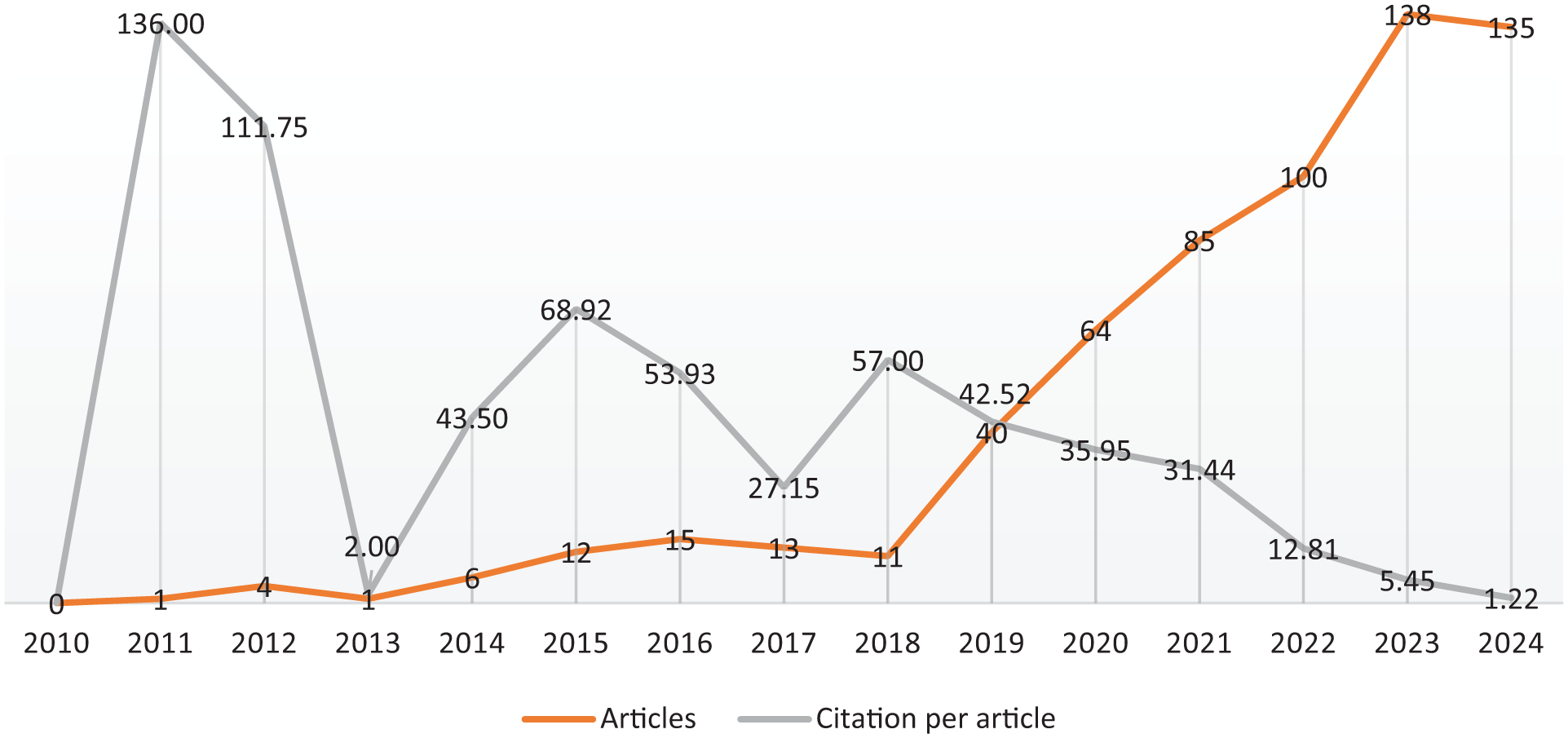
Annual scientific production and citation per article.
Most Influential Articles (Response to RQ2)
Table 2 and Figure 3 present the most influential articles in this study. The top five include Dwivedi et al. (2021), with 2,500 citations, setting key research directions for digital and social media marketing. Berger et al. (2020) with 684 citations, it explores the use of text for marketing insights. Ghose et al. (2012) cited 675 times, contributes to designing hotel ranking systems using user-generated content. Crawford et al. (2015) with 565 citations, it discusses detecting review spam through machine learning. Li and Xie (2020) cited 324 times, examines how images influence social media engagement. The other articles include Syam and Sharma (2018) discussing AI in sales (300 citations), Lappas et al. (2016) on the impact of fake reviews on hotels (284 citations), Ma et al. (2018) using deep learning for hotel reviews (278 citations), Balahur & Turchi (2014) focusing on sentiment analysis (259 citations), and Ahani et al. (2019) analyzing customer satisfaction through online reviews (252 citations). These works contribute to various aspects of AI, marketing, and consumer behavior.
Most Influential Articles.


Network and density visualization of most influential articles.
Most Productive Journals (Response to RQ3)
Table 3 highlights the most productive journals contributing to research on GAI, eWOM, and related topics. IEEE Access leads with 17 articles and an average of 14.18 citations per article, showing significant contribution but moderate citation impact (IF: 3.4). The Journal of Retailing and Consumer Services follows closely with 14 articles and a higher average citation rate of 20%, indicating its strong influence in consumer-focused research (IF: 11). The Journal of Business Research stands out with 12 articles and a notable 40.58 average citations, reflecting its critical role in advancing business research (IF: 10.5). Decision Support Systems and Electronic Commerce Research and Applications from the Netherlands also play vital roles, especially Decision Support Systems, which has the highest average citations (54.60) per article among the top contributors (IF: 6.7). In addition, journals like the International Journal of Hospitality Management (UK) and Tourism Management (UK) highlight the growing intersection of AI and tourism studies, both boasting strong citation metrics. This study reveals that while a variety of journals across different fields are publishing on this topic, business, e-commerce, and hospitality management journals are particularly prominent.
Most Productive Journals.

Most Productive Countries (Response to RQ4)
Table 4 showcases the most productive countries based on the number of articles published by corresponding authors in the field of GAI and eWOM research. China leads with 183 articles, accounting for 29.3% of the total, with a high proportion of single country publications (SCP) at 144, while 39 are multiple country publications (MCP), representing 21.3% of its output (see Figure 4). The United States follows with 85 articles (13.6%), with 20% of its work being collaborative across countries (MCP). India ranks third with 68 articles (10.9%), with 91.2% of its publications being single country studies, indicating lower international collaboration. Other notable contributors include Spain (32 articles) and Korea (30 articles), both showing a significant proportion of multiple country collaborations, at 28.1% and 30%, respectively. The United Kingdom has a smaller volume (20 articles) but boasts a high 45% multiple country collaboration rate. Malaysia and Iran stand out for their high levels of international collaboration, with MCP percentages of 58.3% and 55.6%, respectively. These findings highlight China and the United States as leading contributors, with varying degrees of international collaboration across other productive countries.
Most Productive Corresponding Authors’ Countries.


Most productive corresponding authors’ countries.
The Predominant Research Themes or Topics (Response to RQ5)
In response to RQ5, a co-occurrence keyword analysis was conducted to identify predominant research themes. A threshold of 10 occurrences per keyword was set, and out of 3,957 keywords, 80 met the threshold (Figure 5). These keywords were grouped into three distinct clusters, representing dominant research themes within the body of literature.
Cluster 1 (Red in Figure 5), which includes keywords like artificial intelligence, eWOM, consumer reviews, credibility, customer satisfaction, trust, perceptions, and user-generated content, focuses on the evolving role of AI-driven technologies in shaping consumer experiences and behavior in digital environments. A central theme of this cluster is “how AI influences online consumer engagement,” particularly through the amplification of eWOM and the generation of user-generated content that impacts purchase decisions and brand trust (Mustak et al., 2024).

Network and density visualization of co-occurrence of keyword analysis.
In this context, GAI plays a key role in analyzing consumer feedback, personalizing communication, and even creating synthetic reviews or recommendations that mimic genuine customer interactions. As AI systems become more adept at producing and curating content, businesses can harness GAI to enhance the credibility and trustworthiness of online reviews, improving customer satisfaction (Amos & Zhang, 2024). The interplay between AI-driven sentiment analysis and eWOM underscores the importance of maintaining transparency and trust to avoid potential ethical concerns related to fake reviews or manipulated content. This study highlights the crucial role of GAI in transforming how consumers perceive and interact with digital content, shaping their purchasing decisions in increasingly sophisticated ways.
Cluster 2 (Green in Figure 5) encompasses keywords like artificial intelligence, machine learning, natural language processing (NLP), deep learning, online reviews, fake detection, recommendation systems, and sentiment classification. The primary theme of this cluster is “AI and machine learning applications in decision-making and e-commerce systems.” This analysis emphasizes the role of advanced AI technologies like deep learning and NLP in transforming online review systems, social networking, and electronic commerce. A key focus is developing and integrating machine learning algorithms and recommendation systems that predict customer preferences, provide personalized recommendations, and classify sentiment in online reviews. Fake detection is particularly important in this cluster, as AI tools are used to identify fraudulent reviews, ensuring the integrity of online platforms.
Moreover, convolutional neural networks (CNNs) and feature extraction techniques enhance the performance of systems aimed at improving decision-making and sales forecasting in e-commerce. These technologies allow businesses to make data-driven decisions based on insights derived from large volumes of consumer data, enhancing the overall user experience and trust in digital platforms. AI-driven predictive models also support e-learning systems, making them more adaptive and personalized. This cluster highlights the increasing sophistication of AI in automating and refining online consumer interactions.
Cluster 3 (Blue in Figure 5) revolves around keywords such as big data, sentiment analysis, social media, opinion mining, NLP, Twitter, and topic modeling. The primary theme of this cluster can be identified as “big data analytics and social media sentiment in the context of human perception and communication.” This cluster highlights the growing importance of social media platforms (e.g., Twitter) in shaping public opinion and analyzing user-generated content. Sentiment analysis and opinion mining are central to this theme, as they help organizations and researchers gage public perception on various issues, particularly during crises like COVID-19.
Big data plays a crucial role in this cluster by enabling the processing of vast amounts of information generated on social media platforms. Tools such as NLP and topic modeling are employed to classify and analyze user sentiments, opinions, and trends, providing actionable insights for businesses, governments, and researchers. The use of machine learning further enhances the accuracy of sentiment classification and topic extraction, making it easier to predict public reactions and adapt strategies accordingly.
Discussion and Conclusion
This study comprehensively explores the most significant themes and trends in the intersection of GAI, eWOM, and consumer behavior within digital marketing. By analyzing influential articles, productive journals, key countries, and keyword clusters, we have gained meaningful insights into how these themes converge to shape the current research landscape.
First, the keyword analysis revealed that GAI and eWOM are central to the evolving dynamics of online consumer engagement. The findings highlight how AI-driven tools are transforming eWOM through advanced sentiment analysis, NLP, and deep learning techniques (Yeo et al., 2022). This aligns with studies that emphasize AI’s role in analyzing large-scale consumer reviews, improving recommendation systems, and enhancing the credibility of online platforms (Brüns & Meißner, 2024; Wang et al., 2024). As GAI continues to evolve, its integration with eWOM is expected to grow, influencing how businesses respond to customer feedback and enhance user experiences.
The cluster analysis reveals key insights into GAI’s role in shaping consumer engagement. Cluster 1 emphasizes GAI’s impact on customer satisfaction, reviews, and trust, highlighting how personalized AI-driven content and review management enhance credibility and user trust in e-commerce and hospitality. Cluster 2 focuses on GAI’s technical foundations, such as machine learning, deep learning, and natural language processing, underscoring its importance in decision-making, fake detection, and predictive accuracy through data mining and forecasting. Cluster 3 showcases GAI’s broader applications in big data analysis and social media sentiment, especially on platforms like Twitter. Tools like sentiment analysis and topic modeling help businesses and governments respond to public perception shifts, particularly during crises like COVID-19. These insights affirm GAI’s growing role in providing real-time, actionable insights across industries.
The most productive journals reflect the prominence of GAI and eWOM research in various fields, including e-commerce, hospitality, and decision support systems. Leading journals like the “Journal of Business Research” and “Decision Support Systems” emphasize GAI’s transformative impact on decision-making processes and customer satisfaction. This indicates that GAI’s application in enhancing consumer experiences and decision-making is a dominant focus across multiple disciplines. In terms of most productive countries, China and the United States lead in GAI research, which aligns with their global leadership in GAI technology development and implementation. The significant contribution from China reflects the country’s ongoing efforts to dominate GAI research and innovation, particularly in areas such as natural language processing and machine learning.
The study offers several key insights. First, GAI’s integration with eWOM platforms is no longer a trend but a necessity for businesses looking to harness the power of consumer feedback and improve service delivery. The relationship between GAI and eWOM is particularly important for industries like hospitality and e-commerce, where online reviews play a crucial role in shaping customer trust and purchase decisions. As GAI continues to advance, its ability to filter out fake reviews, enhance recommendation systems, and analyze large datasets will be pivotal in ensuring the integrity and effectiveness of eWOM platforms.
Second, this research highlights the importance of big data and social media sentiment in shaping consumer perceptions and behaviors. Companies that leverage GAI to monitor and analyze social media trends will be better equipped to anticipate consumer needs and adapt their strategies in real time. This is especially relevant in times of uncertainty, such as the COVID-19 pandemic, where consumer behavior can shift rapidly and unpredictably. Finally, the findings suggest that future research should focus on further integrating GAI with eWOM, particularly in enhancing consumer trust and personalization. As GAI technologies evolve, there is potential to develop more sophisticated systems that can provide hyper-personalized content and real-time responses to consumer feedback. This could revolutionize how businesses engage with their customers, leading to improved satisfaction and loyalty.
Theoretical Implications
The theoretical implications of this study highlight the evolving role of GAI in consumer behavior and decision-making frameworks. This study contributes to the literature by extending the understanding of eWOM within the context of GAI. While traditional eWOM theories emphasize consumer-generated content as a driver of trust and influence, the integration of GAI introduces a paradigm shift by blurring the boundaries between human-authored and machine-generated communication. This challenges long-held assumptions regarding source credibility and authenticity in information exchange, suggesting the need for new theoretical models that incorporate AI as both a producer and mediator of eWOM content.
This study reinforces the relevance of personalization and targeting theories in digital marketing by demonstrating how GAI enables hyper-customized communication strategies. Existing models of consumer persuasion and engagement typically assume human effort in tailoring content; however, the scalability of AI-driven personalization requires reconceptualization of theories surrounding message relevance, consumer attention, and the formation of trust. The findings suggest that personalization, while theoretically linked to increased engagement, must now be balanced with theories of echo chambers and selective exposure, as AI can intensify filter effects that restrict consumer access to diverse perspectives.
Finally, the research highlights the need to integrate ethics and transparency considerations into theoretical frameworks addressing consumer trust in digital communication. The possibility of deceptive AI-generated reviews or manipulative content questions the adequacy of classical trust-based models of eWOM, calling for expanded theoretical perspectives that account for algorithmic agency and regulatory interventions. By foregrounding ethical dilemmas alongside technological opportunities, the study establishes a foundation for future theories that move beyond consumer–consumer interactions toward models that incorporate consumer–AI–platform dynamics, thereby reshaping the conceptual landscape of digital marketing and communication studies.
Practical Implications
The practical implications of this study on GAI and eWOM are significant in the context of digital marketing and consumer behavior. First, the findings demonstrate that the integration of GAI into eWOM processes can greatly enhance content personalization and engagement. By automating the generation of reviews, recommendations, and social media posts, businesses can efficiently produce tailored content that resonates with specific consumer segments. This can improve customer satisfaction and drive higher conversion rates, as AI-generated content becomes increasingly relevant and personalized. Companies can leverage these capabilities to boost their online presence and foster stronger relationships with their target audiences.
However, the study also highlights critical challenges that businesses and consumers must navigate. As GAI-generated content becomes more prevalent, the potential for deceptive practices, such as the creation of fake reviews or manipulative content, increases. This undermines the authenticity of eWOM and may lead to consumer distrust. In response, businesses must adopt strategies to ensure transparency, such as clearly labeling AI-generated content and providing consumers with the ability to distinguish between human and AI-driven opinions. These actions are essential to maintaining the credibility and trustworthiness of online reviews and recommendations, which are key components of the consumer decision-making process.
The ethical concerns raised by the study also point to the need for regulatory frameworks to govern the use of GAI in eWOM. Without proper oversight, the misuse of AI to manipulate public opinion could result in negative consequences for both businesses and consumers. Developing regulations that promote transparency, authenticity, and ethical content creation will be crucial in maintaining a balance between the benefits of AI-driven eWOM and the protection of consumer trust. As the technology continues to evolve, the implications of GAI on digital marketing and consumer behavior require ongoing attention and adaptation to ensure a positive and ethical online environment.
Limitations and Future Research Directions
Despite offering valuable insights into the role of GAI and its applications across various domains such as customer engagement, sentiment analysis, and decision-making, this study has several limitations. Firstly, the analysis primarily focuses on published academic literature, potentially excluding relevant insights from industry reports, case studies, and other forms of gray literature that could provide a more practical perspective. Secondly, the study’s reliance on co-occurrence of keywords and bibliometric methods may overlook the relationships between emerging GAI technologies and their specific applications in real-world business contexts. Furthermore, while the study captures broad trends, the rapid evolution of GAI, particularly in areas like natural language processing and deep learning, may mean that recent breakthroughs and applications are underrepresented. Thirdly, a limitation of this study is its reliance on bibliometric analysis, which is constrained by the availability and accuracy of the data from indexed journals and articles. Fourthly, this bibliometrics approach may not fully capture emerging trends, informal publications, or gray literature, potentially limiting the comprehensive understanding of generative AI and eWOM in marketing beyond the scholarly publishing ecosystem. Lastly, we used Biblioshiny in our study, which incorporates functions similar to those of Citespace and LDA, enabling in-depth analysis of literature characteristics. However, we acknowledge that our analysis primarily relied on VOSViewer. Future research could benefit from utilizing the latest features of Citespace or LDA methods for more comprehensive bibliometric analyses.
Future research could incorporate industry data and case studies to address these limitations to provide a more comprehensive view of how GAI technologies are being applied and evolving in practice. Longitudinal studies could track the changing landscape of GAI’s role in areas like e-commerce and hospitality, offering insights into its long-term effects on consumer behavior and business performance. Additionally, future research should focus on empirical investigations exploring the impact of Generative AI on customer satisfaction and sentiment analysis in eWOM, particularly examining the effectiveness of AI-driven decision-making across different cultural contexts and industries. Exploring how GAI interacts with other emerging technologies like blockchain or IoT could also offer a deeper understanding of its holistic impact across sectors. Future research on generative AI and eWOM in marketing could explore how generative AI models can be optimized to enhance personalized eWOM strategies for different cultural contexts. Additionally, studies could investigate the impact of generative AI-driven eWOM on consumer decision-making and brand loyalty in emerging markets. Exploring the ethical implications and trust-building mechanisms in AI-generated eWOM content presents another promising research direction.
Footnotes
Acknowledgements
The authors thank the editors and anonymous reviewers for their valuable feedback on improving the quality of this work.

Ethical Considerations
Not applicable, as this study did not involve any human/animal data or pictures.
Consent to Participate
Not applicable, as this study does not contain human participants and does not require consent.
Author Contributions
All authors contributed equally to this work.
Funding
The authors disclosed receipt of the following financial support for the research, authorship, and/or publication of this article: This research received funding support from (1) National Natural Science Foundation of China (No. 62566031). (2) Key Research Base Project of Humanities and Social Sciences in Universities of Jiangxi Province (No. JD24031).
Declaration of Conflicting Interests
The authors declared no potential conflicts of interest with respect to the research, authorship, and/or publication of this article.
Data Availability Statement
Data will be made available on request.