



Abstract
Depending upon Paulo Freire’s notion of critical consciousness (CC), this study investigates how the comparative analysis of traditional and non-traditional European fairy tales could impact the development of critical consciousness in pre-service English teachers and how they can use this skill for social change in their professional lives. Data were collected using narrative frames and semi-structured interviews at a university in the west of Türkiye as tools to investigate the experiences of 22 pre-service teachers taking the Discourse Analysis and Language Teaching course during the fall 2022 to 2023 semester. The thematic analysis of the qualitative data revealed an overarching theme, development of critical consciousness, and three sub-themes: development of critical thinking and reading skills, development of social awareness for gender equality through socio-political development, and an awareness of using gender-sensitive language. The results rest on the assumption that the development of critical consciousness through literary texts empowers the process of becoming a critical teacher who can liberate his/her students from social injustices by taking critical actions for a more egalitarian world.
Keywords
Introduction
It may not be misleading to claim that the world is far from advancing gender equality, as no country has fully attained it (Beidas et al., 2022; Beloskar et al., 2024; Laursen & Austin, 2020; Peng et al., 2024; Rosa & Clavero, 2022). In 2015, highlighting gender-related challenges such as underrepresentation in leadership roles, and gender-based violence, the United Nations (2015) declared gender equality as one of the 17 goals introduced for the 2,030 Agenda for Sustainable Development Goals (SDGs). At number 5 (SDG 5), there is gender equality to empower all women and girls. However, according to the Sustainable Development Goals Report, although there are some positive results for gender equality, there is still much to be done by the governments (United Nations, 2023). Referring to the Agenda of the Launch of UNESCO in Action for Gender Equality 2022–2023 (UNESCO, 2023a), UNESCO director-general Audrey Azoulay states, “This publication tells us how far we have come; but, more fundamentally, it warns us of the many efforts we still have to make. Let’s not wait 300 more years to react” (UNESCO, 2023b). To this end, promoting gender equality should be crucial for higher education institutions, particularly teacher education programs, as social transformation depends on teachers’ liberating actions.
Advancing gender equality is a fundamental human right and should be a priority in teacher education programs. Teachers play a crucial role in social transformation and must have a deep understanding of gender power dynamics, as their social identities can influence their professional identities. Therefore, it is essential for pre-service teachers to possess the necessary knowledge and skills to promote the well-being of their students and create a more equitable world (Bosio & Torres, 2019). In line with this, educational institutions are increasingly recognizing the importance of acknowledging social and global injustices and taking steps to promote social change (Bosio & Gaudelli, 2018; Bosio & Schattle, 2017; Bosio & Torres, 2019; Torres & Bosio, 2020; Yemini et al., 2018). However, pre-service teacher education programs have given little attention to integrating socio-cultural issues into the curriculum (Chikoko et al., 2011). Gendered power relations and gender equality can be identified as examples.
Paulo Freire’s concept of “conscientization,” critical consciousness (1970), can be a powerful lens and tool to empower the 21st-century teachers, who should be global teachers and advocates of social equality. Critically conscious teachers can have the potential to create a transformative, multicultural learning environment that respects differences and individual rights through collaborative action with students for social equality (Bosio & Torres, 2019; Tarozzi & Torres, 2016; UNESCO, 2014). Therefore, pre-service teacher education programs should develop curriculums to cultivate critical consciousness in future educators. The development of critical consciousness will enable the educators to liberate themselves and their students from systematic inequity, social injustices, and gendered power relations for a more egalitarian world (Freire, 1970/2005a, 1973/2005b).
Deriving inspiration from Paulo Freire’s concept of critical consciousness from his works The Pedagogy of Oppressed (1970) and Education for Critical Consciousness (1973), this study is driven by the comparative analysis of traditional and non-traditional European fairy tales from a feminist lens. The main focus of the study was critical pedagogy, which offers both the researcher and the participant a critical perspective for shaping learning by understanding themselves and others, including the dynamics of the world they live in, in order to promote social change (Sleeter & McLaren, 1995). While constructing and questioning knowledge, critical pedagogy helps educators encourage learners to support critical thinking and an awareness of social issues as social identities (Brooks & Brooks, 1999). Freire’s concept of critical consciousness (1970), as a pedagogical lens, is particularly well-suited to the current study to promote an understanding of the role of teacher identity as a social and professional being.
In alignment with these, the objective of the research was to encourage the participants, via the course content, to follow the three steps of the critical consciousness cycle: critical analysis, sense of agency, and critical action to significantly advance gender equality in and through educational practices (Watts et al., 2011). The research sought to answer the following three research questions:
What is the impact of the teaching practices within the course content on the critical analysis skills of pre-service EFL teachers?
How do pre-service EFL teachers’ attitudes and perceptions evolve regarding gender and gender equality?
How do the pre-service EFL teachers’ experiences with the course lead them to take critical action for social change?
Literature Review
Theoretical Background
There have been several studies that have highlighted the essential skills of a 21st-century teacher (Darling-Hammond, 2006; Kuloğlu & Karabekmez, 2022; Martinez, 2022). It’s important to note that being a part of the 21st-century world can also be considered as a source for these findings. As members of the 21st-century, we know that the world is much more chaotic than it used to be and full of social injustices that require transformers to challenge problematic issues. Therefore, it is crucial to emphasize the need for stronger and more effective practices to overcome systematic inequities. In relation, teacher education programs are becoming increasingly significant in challenging and altering problematic issues of contemporary society, as teachers who have a deep awareness of social inequalities can have the power to transform future generations (Hill-Jackson & Lewis, 2023; Weinberg et al., 2020). In order to bring about social change, it is essential to encourage the development of teachers who are critically conscious.
Conceptualized by the Brazilian educator Paulo Freire, the concept of critical consciousness or “conscientization” refers to the idea of developing critical awareness of our social realities through reflection and action (Freire, 1970/2005a). The term was coined by Freire while teaching illiterates in Latin America. As Freire was observing the lives of the poor peasants, he identified their situation through the concept of “the theme of silence” (1970/2005a, p. 106). His observations made him realize that unequal social relations resulted in a “culture of silence” (Shaull, 1970/2005, p. 30). According to Freire, this culture of the oppressed can never have the power to liberate themselves from systematic oppression unless they take action against it.
Analyzing the lives of the oppressed inspired Freire to apply his theories to the field of education. By critically examining the prevailing educational philosophy, which, according to Freire, led to “silence and indifference” in classes (Freire, 1970/2005a, p. 116), he emphasizes the significance of educators or individuals possessing critical consciousness to liberate the masses from oppression. Against what he called the “culture of silence” (Shaull, 1970/2005, p. 30), Freire proposes “a truly liberating education” (1970/2005a, p. 35) that can bring about change in the world. Instead of being immersed in the “culture of silence” (Shaull, 1970/2005, p. 30) as a result of the “banking concept of education” (Freire, 1970/2005a, p. 72), Freire proposes a new educational practice known as “problem-posing education” (1970/2005a, p. 84). According to Freire, education should serve as a tool to empower educators and students to realize the cultural and social realities of their world. He identifies that kind of awareness as the process of critical consciousness (Freire, 1970/2005a), which promotes action against oppressive systems.
In recent years, critical consciousness has become a significant subject area in education (Andrews et al., 2019; Bernal-Munera, 2023; Patel, 2019; Seider & Graves, 2020) as it empowers individuals to understand social realities and take critical actions to effect social change (Freire, 1970/2005a, 1973/2005b). Critical consciousness can be regarded as an essential skill for 21st-century citizens as it enables individuals to “read the world” and “rewrite the world” (Freire, 1970, as quoted in Torres & Bosio, 2020, p. 107). From this perspective, the cultivation of critical consciousness proves to be a potent and invaluable asset within teacher education programs. Critically conscious pre-service teachers can build a connection between awareness of social issues and active participation in social change. In line with this, fostering the development of critical consciousness in pre-service teachers can increase awareness of social injustices in schools and society (Bosio, 2023; Jones, 2019; Mustafaa & Martinez, 2023).
Pre-service teachers with critical consciousness can implement inclusive and equitable instructional practices for students of diverse backgrounds and a supportive learning environment. Furthermore, critical consciousness can help upcoming teachers acknowledge each student’s value and develop teaching methods that encompass diverse cultural backgrounds and perspectives, encouraging student empowerment.
Critical consciousness plays a crucial role in developing a deep understanding of the social realities that influence daily life and education. It helps to enhance critical thinking and reading skills, enabling pre-service teachers to encourage their students to question and analyze socio-political issues. By emphasizing critical consciousness in pre-service teacher education, future educators can become catalysts for change by gaining the essential knowledge and skills to question and analyze socio-political issues. Prioritizing the development of critical consciousness skills in pre-service teacher education curricula is essential for actively engaging, raising awareness, and acting sustainably.
Methodology
Context and Participants
Türkiye is a country with substantial socio-cultural and socio-political differences between the rural and urban areas. However, this gap among the regions regarding socio-political and socio-cultural realities, including gender equality, has been narrowing in recent years, specifically in metropolitan areas (see Turkish Statistical Institute, 2022). Aligned with the Sustainable Development Goal 5 (SDG 5) to empower all women and girls, Türkiye has come a long way toward attaining societal gender equality. Türkiye has made considerable progress in achieving gender equality, and higher education institutions can play an active role in inspiring pre-service teachers to become change agents for taking action for gender equality.
The participants of the current study were 22 pre-service English teachers (11 women and 11 men). Their ages ranged from 19 to 41. Of these, 9 were fourth-grade students, and 13 were second and third-grade students. Their first language was Turkish, with most having 1 to 4 years of teaching experience in private courses or as part-time English language teachers. This cohort group was chosen for the current study to evaluate how the course content would influence their development of critical consciousness as pre-service teachers with working experiences, aligning with the study’s research questions.
The members of the cohort, who came from different geographical regions of Türkiye, brought a unique perspective to the study. With the exception of one male student, all participants had taken the course “Discourse Analysis and Language Teaching” for the first time. The members had never studied comparative fairy tale analysis or children’s literature. They were explicitly informed about the nature of their voluntary participation, with the freedom to withdraw from the study at any point. They were explicitly informed that participation in the study would not affect the grading process.
At the beginning of the study, most participants did not feel comfortable. They kept the study at a distance as almost all of the students faced a course content related to the analysis of gendered power relations through fairy tales for the first time. To reassure the participants, the pre-service teachers were informed that the data collected would not be shared publicly by anyone under any circumstances. Once they were informed, I realized that they felt comfortable and relaxed, and this immediately affected the impact of their participation in the course. Their body language and facial expressions displayed their increased comfort, especially during the semi-structured interviews.
As the number of participants was limited, I could understand their anxiety about the data collection and analysis procedure as it was the first time they were encountering course content related with the integration of issues such as societal gender roles. To protect their anonymity, they were asked to use pseudonyms when filling out the narrative frames, and they all signed consent forms. To provide confidentiality, the term “Respondent” was used to refer to the members of the cohort. Student excerpts and semi-structured interviews were not corrected grammatically to preserve originality.
Course Structure
During the fall of 2022 to 2023, the elective course “Discourse Analysis and Language Teaching” was the setting of the study. Each course consisted of 2-hr lectures taught by me as the researcher of the study. The 14-week course aimed to develop critical consciousness in pre-service English teachers and raise awareness of gendered power relations in social and professional life. To achieve this, we used traditional and non-traditional European fairy tales for discourse analysis. The main idea behind choosing literature circle activities (LC) for the course content was to use literary texts to promote the pre-service teachers’ critical thinking and reading skills (Daniels, 2002). Participating in literature circle activities could also enhance the language proficiency of pre-service teachers. This is because the cohort members would have the opportunity to share their opinions on the literature being discussed and analyze social issues, such as societal gender roles, when comparing the selected texts. The primary goals of the course structure were to raise awareness of gendered power dynamics and encourage the participants to take action for social equity. The 10-week course structure is shown in Table 1.
The 10-Week Course Structure.

The course discussion topics in the first week were “What is gender?” and “The role of societal gender roles in literary works.”Butler’s (1999) seminal work Gender Trouble. Feminism and the Subversion of Identity was analyzed. In the second week, we analyzed the main points of Woolf’s (1929/2015) A Room of One’s Own and Gilman’s (1898/2018) Women and Economics. In the third week, we were ready to work on Marcia Lieberman’s article Someday My Prince Will Come: Female Acculturation of Fairy Tales (1972). We took notes, used the board, and discussed the main arguments. During discussions, I observed the participants debating with each other and took notes.
I especially paid close attention to their ideas about the representation of gender roles in fairy tales and social life. In the fourth and fifth weeks, we dived into feminist literary criticism that deepened our understanding of how gendered power relations are constructed and portrayed in the selected fairy tales we would study. We explored the different waves of feminism, focusing on gender roles, stereotypes, and the representation of women in various cultural and social contexts. The course content aimed to propose a new perspective on gender stereotypes in society. Throughout the courses, I was committed to connecting the texts we read with how the course content transformed their perceptions of their professional identities as future educators. The syllabus was designed to cultivate an awareness of gendered power dynamics in professional and cultural life, and the literary works they would utilize in their language teaching.
By the sixth week, we were ready to deconstruct De Beaumont’s (1756/2019) Beauty and the Beast. This fairy tale was chosen for its depiction of Beauty, who embodies the traditional European archetype of a silent, passive, weak, and submissive female, waiting to be rescued as her only “asset is beauty” (Lieberman, 1972, p. 385). The seventh and eighth weeks turned into a revolutionary shift for the students, as unlike De Beaumont’s traditional European fairy tale, we delved into Pitré’s (1875/2017) Catarina the Wise, whose protagonist is a teacher.
In this study, traditional fairy tales, such as those from the Brothers Grimm, de Beaumont, or Anderson, refer to the tales that begin with “once upon a time” and always end with the phrase “lived happily ever after.” These tales typically feature a male hero who is active, bold, and physically strong, ready to rescue either the beautiful princess or the poor but beautiful girl. The archetypal female character signifies a lack of physical activity, helplessness, and captivity. On the other hand, a non-traditional fairy tale in this study refers to Giuseppe Pitré’s Sicilian folk tales and postmodern fairy tales, in which the female character is the hero, who has the potential to shape and transform her story. The non-traditional fairy tale hero is an intelligent female character who rebels against the patriarchal order and resists suppression. She is the one who can change the ending of the story as opposed to the submissive female characters in the traditional fairy tale canon, making a fascinating evolution in these narratives.
Catarina, as a non-traditional character, is a teacher; who relies on herself and rejects the traditional construction of gender roles that portray women as helpless beings. She challenges and subverts these gender roles as well as the societal place of women. The protagonist devitalizes the hegemonic structure of classical European fairy tales and determines her own destiny. She is not the princess waiting to be rescued, but rather the Amazon woman who moves from one place to another and is a teacher. This character was chosen for the study to demonstrate the potential for promoting gender equality in social life.
In the ninth and tenth weeks, we embarked on a comparative analysis of selected fairy tales, exploring how Beauty and Catarina respond differently to gender power relations in society. To promote a deeper and more critical learning experience, Bloom’s Taxonomy (Bloom, 1956/1983) was used. To encourage high-order reading and thinking skills, we followed the six levels: remembering, understanding, applying, analyzing, evaluating, and creating (Anderson & Krathwohl, 2001). By the final week, the members of the cohort were ready to generate new ideas at the highest level of Bloom’s synthesis and take action, mirroring the last step of Freire’s critical consciousness cycle (El-Amin et al., 2017). The final weeks of the 14-week course included the comparative analysis of other fairy tales. Throughout the semester, we engaged in assignments, discussions, group activities, reading of the selected works, and a collaborative action research project.
Data Collection
Stories have the power to create social change and transformation, as the story of each of us can create a butterfly effect in society. In this qualitative study, narrative frames were used to explore the experiences and practices of pre-service teachers (Barkhuizen, 2008; Clandinin & Connelly, 2004). The narrative frame has the power to provide a critical lens as it depends upon a reflexive analysis of participants’ lived experiences through storytelling. In the current study, narrative inquiry involves analyzing personal narratives through written accounts, observations, or interviews to comprehend how the lived experiences shape the understanding of oneself and the world.
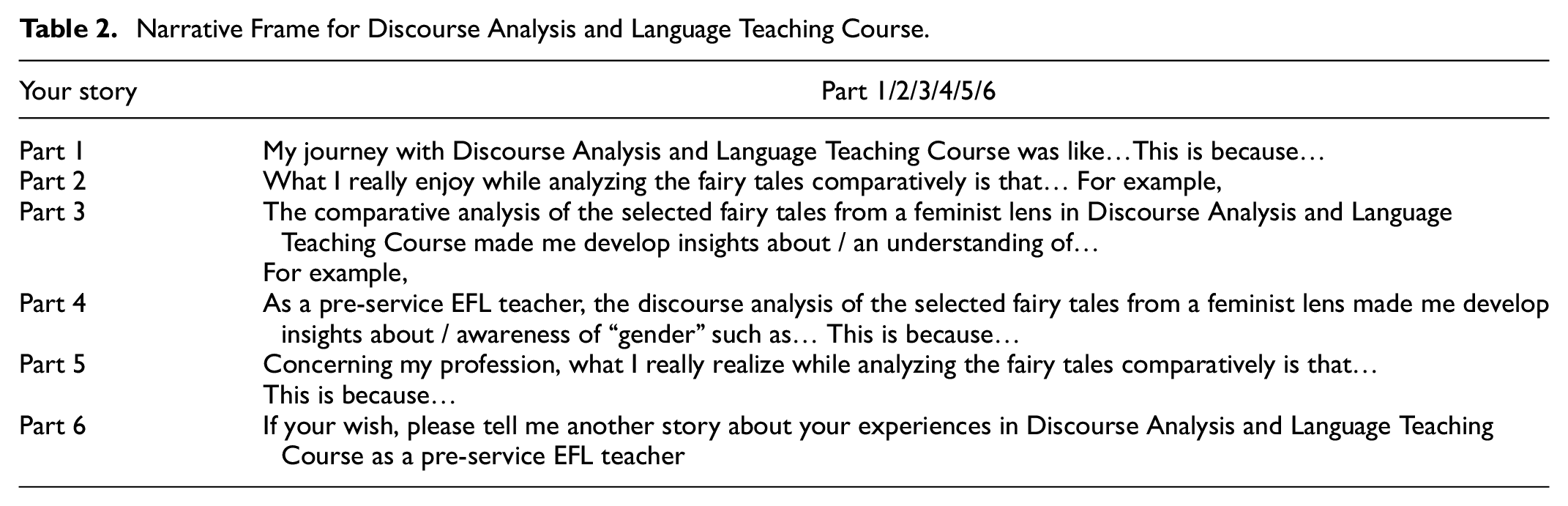
As underlined by Barkhuizen and Wette (2008), narrative research has no clear definition. It primarily utilizes narrative materials (Lieblich et al., 1998) to delve into the practices of the participants in a particular context, analyzing their experiences and interpretations (Freeman, 2002). Understanding the participants’ experiences through their own stories encourages the researchers’ reflexivity, which is a key advantage of narrative research. For the current study, I designed a single template based on an open-ended approach, consisting of five sentence starters “to limit the quantity of writing” (Barkhuizen & Wette, 2008, p. 376). The template encapsulated “the template of starters, connectives, and sentence modifiers” to help the participants reflect on their experiences flexibly (Wray & Lewis, 1997, p. 47). Narrative frame for discourse analysis and language teaching course is shown in Table 2.
Narrative Frame for Discourse Analysis and Language Teaching Course.
In addition to narrative research, semi-structured interviews were conducted to collect data. Using open-ended questions and topics, I aimed to guide the conversations. The semi-structured interview questions are as follows:
Do you think the course content altered your perceptions of gender and gender power relations in society?
Let’s talk about your perceptions of traditional and non-traditional fairy tales.
In what ways do you think Beauty and Catarina reflect societal gender roles?
What are your thoughts about your experiences of Discourse Analysis and Language Teaching Course as a teacher self?
In what ways did the course content alter your perceptions of your profession and society?
In what ways do you think the course content altered your perceptions of a 21st-century teacher?
Having been allowed flexibility and adaptability, the participants were free to express themselves, which yielded detailed insights. Throughout the process, effective listening and participant-centeredness were key. Prior to the actual interviews, I meticulously pilot-tested the interview guide with a colleague, ensuring the reliability and validity of the data collection process. As the members of the cohort consisted of a small number of participants, narrative inquiry and semi-structured interviews offered an in-depth analysis of the participants’ experiences and stories (Golombek & Johnson, 2004; Pavlenko, 2002; Riessman, 1993). Instructions were given to the participants, and ethical issues were explained again. They were administered the consent forms, and they filled in the frames.
Data Analysis
The narrative frames and interviews were analyzed using thematic analysis as its key concern is flexibility (Braun & Clarke, 2006). While analyzing the qualitative data, I first familiarized myself with the narrative frames and semi-structured interview transcripts. I then proceeded to code, identifying meaningful units of information and organizing relevant sections of the data to highlight key ideas or concepts. Potential themes were identified, and the connections and relationships were explored to reach the overarching theme and sub-themes. The data was read and reread, ensuring the identification of key concepts. The themes were revised and finally clarified, and the findings were documented coherently, encapsulating the participant excerpts from the qualitative data, all supported by evidence.
Investigator triangulation was employed in the study harnessing the power of multiple conclusions (Denzin, 1978). An instructor from the same department independently analyzed the data, not to narrow the breadth of our results, but to broaden them. This approach of gathering multiple observations enriched the study as the previous experiences can directly impact the data analysis procedure, which can be identified as one of the weaknesses of qualitative research design. The peer debriefer then coded the data set independently, seeking a logical and meaningful pattern in the data. This process was repeated until a consensus was reached (Joffe, 2011).
The thematic analysis of the qualitative data set (Braun & Clarke, 2006) revealed an overarching theme addressing the development of critical consciousness and three sub-themes. The participants, whose reflections were instrumental in this analysis, indicated the development of critical consciousness under three sub-themes: development of critical thinking and reading skills, development of social awareness of gender equality through socio-political development, and an awareness of using gender-sensitive language. Table 3. below depicts the overarching theme, the sub-themes, and the codes that emerged.
The Overarching Theme, Sub-themes, and Codes Emerging From the Study.

The identified themes were relevant to the research questions and reflected through the aforementioned student excerpts, which were not corrected or altered to preserve originality. Analyzing the qualitative data was more challenging than it sounded, as the participants generally expressed their ideas implicitly. Hence, I meticulously scrutinized the written reflections and semi-structured interviews in great detail, thoroughly analyzing the data with the peer debriefer to gain valuable insights.
Researcher Positionality
Before presenting the findings, it is important to note that I, as the researcher of the study, have an academic background in gender, feminism, and societal gender roles as I hold M.A., and Ph.D. degrees in American Studies, with a strong focus on gender theories. With over 10 years of experience as a student and more than 18 years as an instructor, I am deeply familiar with the research context having studied gender and societal gender roles in literature and education for more than 20 years. Furthermore, I have involved in several research projects with pre-service EFL teachers. The peer debriefer involved in the study has more than 20 years of teaching experience and is also an expert in qualitative and quantitative research design within the same ELT department.
I acknowledge that my positionality influenced the course design and the implementation of the research to some extent. The literary analysis of the selected fairy tales inspired me to apply a transformative pedagogy in a pre-service teacher education program as I believe that comparative literature is a powerful tool to create change agents in society. Therefore, the comparative analysis of the same fairy tales that I analyzed in my literature article (Kumlu, 2020) was at the center of the curriculum. Feminism was the lens through which the research was conducted, and I chose secondary sources to integrate feminist literary criticism and gender theories into the curriculum that had the power to alter the perceptions of the students about gender equality. My understanding of the world, researcher identity, and experiences affected the course design. However, it is crucial to note that I positioned myself as an observer with an emic and etic perspective throughout the semester, ensuring the objectivity of the research.
Results
The thematic analysis of the qualitative data aims to explore the impacts of the lens of comparative literature on pre-service EFL teachers’ critical analysis skills, sense of agency, and their reflections on critical action. The qualitative data results showcased a substantial improvement in the participants’ critical thinking and reading skills, which empowered their critical analysis skills as the first step of the critical consciousness cycle. Secondly, the rich insights gathered from the semi-structured interviews and the stories of the student teachers reported that the lens of comparative literature positively influenced the participants’ attitudes and perceptions regarding gender and gender equality. This aligns with the second step of the critical consciousness cycle, which demonstrates the development of a sense of agency. Thirdly, the data analysis indicates that the participants developed a sense of agency and the ability to take critical action as a result of the development of their critical thinking and reading skills. This, in turn, supported them in completing the critical consciousness cycle.
What is the Impact of the Teaching Practices Within the Course Content on the Critical Analysis Skills of Pre-service EFL Teachers?
The thematic analysis of the data aims to explore the impact of the course content and the lens of comparative literature on pre-service EFL teachers’ critical analysis skills. The analysis of the data set revealed that the course content and the comparative literary analysis of Beauty and Catarina had a significant positive impact on the participants’ critical thinking and reading skills, demonstrating the substantial progress made by the participants.
Development of Critical Thinking and Reading Skills
A significant majority of the participants, 10 student teachers, indicated that the course content empowered them to develop a “critical lens.” The analysis of the data highlights that engaging with the selected texts through feminist literary criticism dramatically improved the participants’ critical analysis skills. They described developing critical analysis skills as looking through a critical lens. For instance, one of the participants, Respondent 4, expresses his/her journey with the following words:
The comparative analysis of the fairy tales helped me to find a deeper meaning. Seeing and understanding other aspects made me powerful. Different interpretations are possible when I have the critical lens to think and read critically.
Another point to mention is that the participants articulated the significance of their development of critical thinking and reading skills for a future educator, as mentioned by another student teacher, Respondent 20:
Understanding more than I see, understanding more than I read, seeing more than the text tells me was a surprising experience. I realized that I had not read and interpreted the texts I read or the things I watched critically. A teacher without critical reading and thinking skills might be really dangerous. I was surprised how blind I was.
Most participants have similar views on the significance of having a critical lens for a pre-service teacher. The analysis of the data appears to support the idea that based on their engagement with the course content, a significant majority of student teachers describe their experiences and emotions with the term “blindness.” While they were describing their internal feelings about their perceptions of critical analysis skills, many described themselves as metaphorically blind prior to their experiences on the course. This is in line with Respondent 2’s comments on the issue, “The course made me aware of my blindness. I learned to question what I read and think critically. Looking behind the words and looking at secret messages in the texts was eye-opening.” The participants revealed that their experiences with the lens of comparative literature led to personal growth, providing an alternative perspective to critically engage with their readings. Like Respondent 2, many student teachers described their journey of developing critical thinking and reading skills as “eye-opening.” For instance, Respondent 13 also underlines, “The analysis of the texts was extremely entertaining and eye-opening.” One of the participants defines his/ her journey with the following words:
Before this course, I read a text now I see and understand, analyze it. My experience of analyzing the texts was eye-opening. I realized that I was blind and deaf to what I read and see. (Respondent 1)
The majority of the participants described the improvement of their critical analysis skills as an enlightening experience. Likewise, Respondent 8 makes the same assertion, “I could analyze symbols, metaphors and the language better than before. I realized that I was blind to language. As a teacher thinking and reading critically will help me a lot.” It is crucial to underline that the respondents built a symbiotic relationship between critical thinking and reading skills and their professional lives. Similarly, Respondent 17 establishes a connection between his/her development of critical analysis skills and becoming a teacher:
I should not bring any fairy tale or any document to class and I should make students think over sentences and be aware of right and wrong. Also I should teach them how to develop critical consciousness and to read and think critically.
It should be noted that reflecting on their journey in discourse analysis and language teaching course, the participants have similar points of view on the symbiotic relationship between critical thinking and reading skills and the idea of becoming a good teacher:
Before the course I was just reading or watching something. I was not thinking critically. I realized that I did not even know how to develop critical consciousness. After the course I learned how to read critically. I can see the truths behind the texts. To become a good teacher all these are essential. (Respondent1)
The analysis of the data supports the impact of comparative literature on the development of participants’ critical thinking and reading skills. It reflects their ability to critically analyze what they see and read as future teachers. The respondents agreed that critical analysis is a significant component of becoming a good teacher. In alignment with this, one of the student teachers is concerned about the danger of a teacher’s lack of critical thinking and reading skills:
The secret messages in fairy tales surprised me a lot. If the stories are not analyzed critically, this can cause a danger for the teacher and the students. We should have the ability to question and analyze what we read. (Respondent 4)
Regarding critical reading and thinking skills, most of the student teachers indicated an inextricable bond between the ability to think and read critically and the necessary knowledge and skills to choose appropriate materials in EFL classes as future educators. Many of the student teachers voiced similar opinions on the issue. For instance, Respondent 6 states:
Choosing the appropriate materials in class needs critical reading skills. Our job is to make our students not to be affected by the texts they read. Critical thinking skills is a must for a good teacher and for students.
The statement above underscores the pivotal role of the course in shaping the participant’s understanding of critical analysis.
Most participants emphasized the course’s impact on improving critical thinking and reading skills, essential for teachers to select appropriate materials for their classes. Their engagement with Catarina’s story and the discourse analysis empowered eight participants to describe their development of critical analysis skills as an “eye-opening” experience, which is the first step of the critical consciousness cycle:
I was blind and someone magically cured my blindness and my blind state of mind. As a teacher I should be careful about choosing the materials in class. Going through all the stories and taking a deep dive into them. It was rather informative and eye opening. (Respondent 11)
Another student teacher also makes the following statement, revealing that his/her engagement with comparative literature encouraged him/her to identify the process of becoming a good teacher as the process of becoming a critical reader and thinker.
When I become an EFL teacher, I will teach my students these secret messages and make sure that they won’t be affected by those messages. I will try to tell my students that not all fairytales are innocent and they should read them through a feminist lens as a young learner. I will teach my students Catarina. (Respondent 18)
It’s worth noting that many of the student teachers found the course to be a transformative experience, describing it as eye-opening and enlightening. In a similar vein, Respondent 7 claims that the course was instrumental in developing their critical consciousness:
The course was an interesting road. First I was scared about the content of the course but in time I got used to it and started to enjoy it. I did not know that I was blind to thinking critically. At the end of the semester I feel that I have developed a critical lens. I felt enlightened. It is a bit difficult to confess it but it shocked me how narrow-minded I am. The course helped me to think and read critically and develop critical consciousness.
The analysis of the data underlines that the course played a significant role in developing critical analysis skills of student teachers.
At the beginning of the semester, many student teachers found the syllabus scary, as it required them to engage in discourse analysis of the selected texts. Similar to Respondent 7, Respondent 15, for instance, credits the course for equipping them with the skills for critical thinking and reading, “I learned how to read a text critically and how to think critically. It surprised me how blind I was.” Similar to Respondent 15, many students underlined the link between critical analysis skills and becoming a good teacher:
Before the course I was just reading or watching something. I was not thinking critically. I realized that I did not even know how to develop critical consciousness. After the course I learned how to read critically. I can see the truths behind the texts. To become a good teacher all these are essential. (Respondent 1)
The majority of the participants felt comfortable expressing their transition from blindness to gaining a new perspective, which helped develop their critical analysis skills.
As per the study’s initial research question, the data analysis showed that looking at the course content through the lens of comparative literature helped the participants develop their critical thinking and reading skills, the first stage of the critical consciousness cycle that forms the basis of this study. Critical analysis, as the first step of the cycle, is achieved by the student teachers, most of whom described their emotions and feelings about the course as eye-opening. The significant majority of the respondents frequently stressed that the comparative literary analysis of Beauty’s and Catarina’s stories helped them become aware of the significance of critical analysis skills as future educators. In alignment with this, they identified critical analysis as an essential skill for a teacher.
How Do Pre-Service EFL Teachers’ Attitudes and Perceptions Evolve Regarding Gender and Gender Equality?
The second research question aims to explore how the attitudes and perceptions of pre-service teachers regarding gender and gender equality evolve during the course. This section provides an analysis of the data obtained from the semi-structured interviews and the participants’ stories. Its goal is to unveil the impact of Catarina and Beauty’s stories on the participants’ reflections regarding societal gender roles as future educators. The data analysis indicated that the student teachers developed social awareness of gender equality through socio-political development.
Development of Social Awareness for Gender Equality Through Socio-Political Development
The analysis of the data highlighted that a significant majority of the student teachers became aware of the structural oppression against female characters and gender inequality in the tales. The analysis of the written reflections revealed that upon recognizing the systematic oppression of female characters in stories, eight student teachers began to acknowledge gender as a “cultural construction.” For instance, upon comparing the stories of Catarina and Beauty, Respondent 12 expressed how he/she was impressed by the critical lens:
The lesson gave me a critical lens, without this critical lens we are bound to repeat our faults. Instead of expecting the same things I was able to alter my perceptions and take action for social equality. The roles attributed to woman are created by the society but I can shape my choices.
It is essential to point out that the participants also gained the ability to transform systematic oppression into a liberating action as they built a link between fairy tales and social life. Similarly, Respondent 1 underlines, “I thought that Beauty and the Beast was an innocent story. But now I know what it actually conveys to us.” The data shows that the participants’ growth in critical thinking and reading skills has enhanced their comprehension of gender disparities in narratives and daily life. This is in line with Respondent 14′s comments on the issue:
The language used in fairy tales somehow shaped the world we interpret. I realized that as a teacher I have the power to affect my students in a positive way. So it is so important to read comparatively because without it we only have one lens. A really informative experience for me. The roles attributed to men and women are culturally constructed but as a teacher I can change them. Women should be encouraged to realize their power.
Equally important is their connection between gender inequality in fairy tales and the notion of gender in social life as future educators. Similar to the other four student teachers, one of the participants mentions, “I was shocked by the unconscious messages that shape our lives. Women and men should be equal and I can do something for that. Certain roles are expected from women and men but this is not true” (Respondent 10). The word “actually” is important as it signifies the realities that student teachers become aware of gender disparities after engaging with the lens of comparative literature. Concurring with this, a student teacher emphasizes:
I should not bring any fairy tale or any document to class and I should make students think over sentences and be aware of right and wrong. And also I should teach them how to develop critical consciousness and critical reading skills so that they can realize that we are all equal. (Respondent 9)
The data analysis demonstrated that the feminist approach and the lens of comparative literature empowered student teachers to critically analyze the stories of Beauty and Catarina. The data analysis showcased that the participants experienced socio-political development as they became aware of how societal gender roles are designed to serve the dominant discourse through the language used in fairy tales. The semi-structured interviews and written reflections demonstrated the participant’s ability to engage critically with the texts, thereby fostering their sense of agency. In line with this, one of the participants mentions the following:
I realized that fairy tales are used as a tool to maintain status quo. Women are as strong and free as men and we should be aware of our power to support equal opportunity for all. We can either be the passive Beauty or the teacher Catarina who fights for her choices. (Respondent 14)
Reflecting on their course journey, the majority of participants gained an empowering sense of agency, enabling them to take control of their actions as future educators and as active contributors to society. The data analysis suggests that student teachers gained awareness of gender inequality in fairy tales, encouraging them to act responsibly. A significant number of students, six students, expressed surprise at the language used in the tales, emphasizing the word “shocked.” The data analysis indicates that the participants share similar viewpoints on socio-political development:
The language used in fairy tales somehow shaped the world we interpret. I realized that as a teacher I have the power to affect my students in a positive way. So it is so important to read comparatively because without it we only have one lens. A really informative experience for me. The roles attributed to men and women are culturally constructed but as a teacher I can change them. Women should be encouraged to realize their power. (Respondent 14)
The participants’ socio-political development is reflected through their critical social analysis, which enabled them to recognize and analyze gender inequality in social life, as reflected through the discourse used in the tales. The results obtained from the thematic analysis of the data indicated that the student teachers experienced the second step of the critical consciousness cycle, which is a sense of agency.
The data analysis highlighted that the participants became conscious of the social inequality represented in the tales. The pre-service teachers, in their quest to understand their role in social change, were struck by the role of fairy tales in perpetuating gender inequality. This realization emphasized the importance of critical analysis in education and boosted their confidence in future roles as educators.
How Do the Pre-service EFL Teachers’ Experiences With the Course Lead Them to Take Critical Action for Social Change?
The third research question seeks to investigate how the lens of comparative literature affects the participants’ critical actions in creating social change. The thematic analysis of the semi-structured interviews and the stories revealed that the course guided pre-service teachers through a critical consciousness cycle. The analysis of the data demonstrates that the student teachers described using gender-sensitive language as a critical action for social transformation. The analysis of the data clearly demonstrates that the participants underwent a significant shift in their perceptions and attitudes regarding gender and gender equality, contributing positively to social well-being. This aligns with the participants’ experience of observing different possibilities through the lens of comparative literature and how they critically analyzed gender and societal gender roles as future educators.
An Awareness of Using Gender-sensitive Language. The thematic analysis, which involved [specific process], of the qualitative data obtained from the stories of the participants and semi-structured interviews revealed that the student teachers’ engagement with the lens of comparative literature fostered them to analyze societal gender roles critically and empowered them to develop a sense of power which led them to commit to taking a critical action for social change.
In line with the analysis of the data, the majority of the pre-service teachers identified using gender-sensitive language as a critical action for social change. For instance, Respondent 1 comments:
We, as teachers, simply need to teach our students to be fair and equal but as teachers we should be the leaders. In my classes I will no longer use “she washed the dishes” or “she cooks” but I will always use the use of language for the benefit of equality. Catarina was a brand-new step for me.
The data analysis demonstrates the powerful impact of integrating a feminist approach and the lens of comparative literature into the curriculum. The data appears to support the idea that this approach empowers students to gain a deeper understanding of gender roles in fairy tales and their relevance in social and professional contexts, especially as they prepare for careers in education. For instance, Respondent 7 draws attention to the interconnection between Catarina’s self-reliance as an educator, the Respondent’s prospective role as an educator, and his/her ability to exert critical action:
Catarina was a brand-new step for us. I could see how the language we use can change society. As a future-teacher I have decided to encourage social equality for both men and women. I will not use the words businessman or chairman or mankind in my classes. I now realize the power of my profession and I will not simply be a traditional individual who just teaches grammar. I have promised myself to change something.
It should be noted that the participants’ experiences throughout the course demonstrated how their perceptions evolved toward gender equality and their profession. As Respondent 9 indicates, he/she decides to use his/her experience in an effective way to promote social change:
I was not aware of the fact that I had been using sexist language. What we think is related to what we say so as a teacher the discourse and the expressions I will use in class should support equality for women. I do not want to raise Beast’s and Beauty’s, I want to raise Catarina’s and father’s like hers who support education, freedom for all women. If I want to become a teacher, first I should be aware of the power of the language I use. To be honest, I was not even aware of the power of children’s literature upon us.
The majority of respondents acknowledged the crucial link between teaching as a transformative profession and leveraging language as a powerful tool to drive change for women. This is in line with Respondent 15′s perception of the issue, “In my classes I should ensure that women and men are presented equally in all the examples, worksheets or the language I use. To prevent suppression of women I should teach them the story of Catarina not the beautiful and passive princesses.” It should be underlined that the student teachers proposed using gender-sensitive language as a tool to surpass the limits of societal gender roles on behalf of women. This indicates that after they became aware of the power of language, they began to build a link between the use of language and gender disparities. Consequently, they began to identify gender-sensitive language as a critical action for social change.
The respondents agreed that they became aware of the power dynamics working against gender equality. It should be noted that the participants’ improved critical thinking and reading skills led to developing a sense of agency, which encouraged them to become aware of their responsibility to take critical action. For instance, one of the student teachers indicates, “As a man I was not aware of the fact that the language we use has such an effect upon social equality. I will always use gender-sensitive language in my classes to change society. Social equality can be possible on condition that teachers take an active part in the process” (Respondent 3). The analysis of the data demonstrated a substantial improvement in pre-service teachers’ perceptions of the power of their role and their sense of responsibility to take a critical action:
I was astonished to realize that I did not know the power of language. And imagine, I am going to be a language teacher. I understand that my role is really really important. Deconstructing the fairy tales gave me the power to question the words we use and the world we live in. I know that I can alter the perceptions of my students as a role model who raises self-confident and self-reliant women like Catarina. (Respondent 17)
Similar to Respondent 17, another student teacher claims:
As a teacher I now realize that I can either encourage silent and passive Beauty’s or Catarina’s who are working women and who can resist suppression. I will not use gender-specific pronouns in my classes. I will always give importance to use; she achieves, she works, she is strong and she can make her choices etc..
The thematic analysis of the qualitative data illuminated how pre-service teachers’ perceptions of gender-sensitive language evolve as a critical action to promote characters like Catarina, who can transcend societal gender roles. It is crucial to note that the analysis of the data set revealed a substantial improvement in the critical analysis skills of the students and its substantial contribution to the participants’ sense of agency and their commitment to take critical action. The data analysis emphasizes that all these steps illustrate the participants’ adherence to the critical consciousness cycle.
As the participants advanced through the critical consciousness cycle, they gradually became more attuned to the social injustices prevalent in fairy tales. This growing awareness culminated in a significant change in the student teachers’ perspectives on gender, with them now recognizing it as a cultural construct that disadvantaged female characters in fairy tales.
By comparing the stories of Beauty and Catarina, they gained insight into gender inequality, emphasizing the significance of comparative literature in understanding social issues. The analysis of the data revealed that using a comparative lens changed their understanding of gender equality and how they perceive gender.
Discussion
The current global challenges of the health crisis, war, climate change, and immigration emphasize the urgent need to revamp pre-service teacher education, incorporating new perspectives that integrate pre-service teachers into real-world social contexts. Teacher education classrooms should be spaces where pre-service teachers can actively promote positive change rather than passively receive information like fairy tale princesses. A transformative comparative analysis was carried out on selected traditional and non-traditional European fairy tales as part of the study’s objective. This powerful tool for empowerment enabled participants to develop critical consciousness, and the findings revealed several implications for practice, inspiring hope for potential positive impacts.
Training in comparative literature fostered the development of critical thinking and reading skills in pre-service teachers, enabling them to adopt a critical lens instead of being metaphorically blind. This critical lens refers to a perspective that questions and analyzes information rather than accepting it at face value, which is why the participants primarily identified the absence of that critical perspective as “blindness.” Most of them underscored the reality that they had not been aware of their limitations of having a critical lens to analyze the target language in the texts, let alone re-reading the world. The research findings highlight the importance of developing a critical perspective, describing it as an “eye-opening” experience. In light of these findings, critical consciousness emerges as a transformative pedagogy that has the potential to empower pre-service teachers with an authentic voice. This highlights the crucial importance of fostering critical consciousness in teacher education programs (Acquah & Commins, 2015; Gay & Kirkland, 2003; Hackett et al., 2022; Minott & Minott, 2023; Nicoson et al., 2024; Waghid, 2024). The study suggests that developing critical consciousness is crucial in teacher education to promote a more transformative pedagogy.
The research findings revealed that by understanding the language of inequality, the feminist literary analysis of the selected fairy tales enhanced the participants’ socio-political development (SPD) and their awareness of gender equality. The data analysis showcased that the development of critical consciousness impacted the sense of agency of the pre-service teachers by analyzing the language used in the selected fairy tales, empowering the participants to develop social awareness of gender equality through socio-political development. First, the participants became aware of the existing social inequities in fairy tales. Then, they connected the history of fairy tales to the history of societal gender roles, leading to an understanding of the process of oppression. Finally, they suggested developing awareness to combat oppression, showing socio-political progress among the participants.
The findings underscore the bond between critical consciousness and social justice awareness as a critical component of teacher education (Conlin et al., 2021; Hernández et al., 2005; Mosley et al., 2021; Thomas, 2024; Riegle-Crumb et al., 2023). The research findings identified, amongst others, the significance of the transformative potential of comparative literature as a change agent. After the comparative analysis of the selected works, the participants frequently used the words “shocked” and “surprised” to define their process of becoming aware of the power of language for an egalitarian world. For instance, they had a profound realization, identifying gender as a “cultural construction” in social life. Significantly, most of them raised the matter of the difference in the representation of female roles in the selected fairy tales. They defined the roles attributed to men and women as socially constructed models, and many believed that using transformative language both in classes and in social life is essential to invoke change.
While most participants established a connection between their sense of agency and their profession, they also interpreted their socio-political development as a bridge between critical analysis and civic engagement (Watts & Flanagan, 2007). The data appears to support that sense of agency, a crucial component of becoming a teacher in the 21st-century world, contributes to the political self-efficacy of pre-service teachers (Crabtree & Stephan, 2023; Cureton, 2024; Patka et al., 2024). For example, when the cohort members became aware of the language of oppression used by society in fairy tales, they felt empowered to challenge gender inequality (Ginwright, 2010). In line with this, the data analysis indicates that the curriculum played a significant role in fostering critical analysis skills among the participants. This development, which incorporates critical pedagogy as a transformative tool for social change, encouraged the participants to take action against the system of oppression as a form of critical action (El-Amin et al., 2017; Watts et al., 2011).
There is a symbiotic relationship between social transformation and teachers. Regarding this as the starting point for the current study, fairy tales such as Beauty and the Beast and Catarina the Wise were used as powerful instruments to adopt a gender-responsive pedagogy. The analysis of these fairy tales was a literary strategy to usher in social change, as the world depicted in traditional fairy tales is one of the gravest kinds of gender inequality. As reflected in Beauty and The Beast, the portrayal of the passive female character calls for a gender-biased social life. On the other hand, Catarina the Wise was used to promote women’s empowerment and to react against Beauty’s story. The data analysis demonstrates that the comparative lens empowered the participants to take critical action.
As the last step of the critical consciousness cycle, the participants proposed a socio-political action to empower themselves as social agents. The feminist literary analysis of the selected texts prompted the participants to recognize and analyze gender disparities in social life. The passive, beautiful princesses reflect the girls in schools who are less active than boys, like in the fairy tales (Ridgers et al., 2012). Ridgers’ example from physical education is sufficient to illustrate the gender-related barriers in social life; girls should play with dolls, they should not move, they should be beautiful and silent, and they should remain static like a Barbie doll to be pretty. On the other hand, boys are encouraged to be bold and active to be considered real men, but are discouraged from showing any sign of vulnerability.
It is crucial to re-evaluate the influence of traditional fairy tales on societal expectations for gender roles, particularly those about men and women. Characters like Rapunzel, Cinderella, and Sleeping Beauty often depict women as passive individuals who need to be rescued, mirroring the expected behavior of girls in society. These stories perpetuate the notion that women should be passive and stay home, often in the kitchen, much like Cinderella among her cinders. Cinderella is not only found in fairy tales but in real-life settings where women are expected to remain passive receptacles of information. This is why promoting gender consciousness has gained momentum in teacher education (Brunet, 2023; Mojica, 2023; Riegle-Crumb et al., 2023; Salvador-Garcia, 2023; Witt & Cuesta, 2014).
Integrating critical consciousness into pre-service teacher education programs can have a positive impact on society. For example, after completing the curriculum, the majority of participants in the study became aware of their social context. The student teachers chose to propose an alternative action rather than accept gender power dynamics, and they decided to use gender-sensitive language in their future classes to take critical action for social equity. During the semi-structured interviews, the body language and gestures of the participants indicated that this action helped them develop self-reliance and an awareness of their power as teachers. Most participants ensured that women and men must be represented equally in the instructional materials and in the language they use as teachers.
Almost all participants expressed that they would no longer use examples such as “she washes the dishes” or “she cooks” but would instead use “he cooks” or “he cleans the house.” They believe that gender inequality especially begins within the home, as they frequently associated household activities with the female world. Conversely, they associated business life with the male world, which is why they underlined the utmost importance of using the words businesswomen or chairwomen instead of businessman or chairman during the courses. They highlighted that, in classes, using stereotypical characteristics should be avoided to prevent the reinforcement of gender-related barriers. The data analysis reveals that using gender-sensitive language is seen as an action plan for teachers, as they believe that gender-sensitive language can change the world. For many, a changed mindset is a must for social change.
Many participants acknowledged the underestimated impact of fairy tales in social life and the education system. They connected their use of gender-sensitive language in classes to their understanding of language’s power and their role as teachers. They saw themselves as leaders capable of driving social change. The study also highlighted how the participants chose to address gender disparities through the use of inclusive language for social equality in classes.
Freire argues that classroom is the place where social change begins (Freire, 1970/2005a), and the findings revealed that the pre-service teachers viewed the relationship between themselves and their students as a democratic one, which is the signal of the conscientization process. In alignment with this, preparing pre-service teachers for the social realities of the 21st-century world should become a paramount of the curriculums of teacher education programs as social transformation can only occur when social realities become part of the classroom environment (Janks, 2014; Jiménez & Gutiérrez, 2019). Social change can be brought about when educators are able to identify and address systems of inequality.
Conclusion
Limitations and Implications
This research has some limitations. Firstly, the number of participants in the qualitative study is relatively small. The study examines the viewpoints of 22 pre-service English teachers, which may limit the generalizability of the findings. For further studies, it would be valuable to choose a larger size of pre-service teachers for a more comprehensive understanding of the phenomena. Secondly, analyzing the causes of the lack of gender consciousness could provide valuable insights into further studies. Analyzing the socio-political and socio-cultural realities that affect the acquisition of critical consciousness and its implementation would also be valuable.
In the current study, the socio-political elements that might impact the gender consciousness of the participants are not analyzed or discussed in the course. However, as pointed out by Jameson (1988), “… there is nothing that is not social and historical-indeed, that everything is "in the last analysis" political” (p. 20). In this study, following a Jamesonian concept of “the political unconscious,” literature was used as “a socially symbolic act” (1988) and as a medium to become aware of the socio-political realities of the world in an indirect way. The current study aimed to foster the participants’ critical consciousness skills that would work as an instrument to make them aware of the socio-political realities of their world, and the findings indicate that the course design helped them achieve this, marking a significant milestone in my research journey. Hence, the lack of analysis of gender consciousness and socio-political realities did not affect the study. However, for future studies, the socio-political impacts on the gender consciousness levels of the participants can be analyzed using gender consciousness scales or questionnaires that can highlight the effects of political realities on their perceptions.
In addition, this study examines the development of critical consciousness in a relatively small group. It would be valuable to expand the research beyond Turkish pre-service English teachers in Türkiye to include a more balanced representation of culturally diverse participants. Lastly, although the qualitative data analysis encourages discussion and flexibility, the researcher has the potential to bring her experiences and worldviews that may affect the findings. As a researcher, my post-structuralist stance has had a significant impact on the study. The research was inspired by the idea that there is no absolute truth, but many truths that are in a constant state of flux, shaped by the cultural and political forces under the control of the dominant power. In my view, the language employed in traditional fairy tales serves as a tool of the dominant patriarchal power, as evidenced in the discourse of the Brothers Grimm, Anderson, and Jeanne Marie Le Prince De Beaumont. However, I argue that language is not fixed and can be easily reshaped by a new power structure. This led me to propose the language used in Catarina the Wise as an alternative lens, illuminating the active, independent, influential female character who is a teacher, in contrast to Beauty. Furthermore, Derrida’s concept of the interpretation of language as an unreliable concept (Bertens, 2001) and the formation of language through power structures informed my use of comparative literature. I used this tool to foster the participants’ critical analysis skills, encouraging them to compare and contrast different texts and worldviews.
Notably, Foucault’s concept of power has potentially shaped the course design in a significant way. For Foucault, “Power is everywhere; not because it embraces everything, but because it comes from everywhere” (Foucault, 1998, p. 93). Like Foucault, I believe that language has always been used as an instrument to construct knowledge and truths about societal gender roles, and it has been used by the powerful to suppress the less powerful ones. Drawing from my experiences as a female academic, power comes from everywhere, and fairy tales are one of the most overlooked sources. My worldview reflects the idea that traditional European fairy tales have been used as an instrument of suppression. Aligned with this, the texts integrated into the curriculum were carefully and consciously chosen to ignite the participants’ awareness of the power of critical analysis skills to challenge the language used by the dominant power structures in all aspects of life. Hence, the selected texts could have had a profound impact on how the participants interpreted societal gender roles, as they frequently used similar phrases and sentence structures to those in the works we analyzed and the language I used in class.
No matter how the researcher triangulates the data, the findings may vary from one researcher to another as the data depends upon texts. For further studies, investigator triangulation can include three or more researchers to stimulate multiple perspectives. It would also be valuable to analyze the difference between the perceptions of female and male participants in further studies. While the study has its limitations, it carries the potential to inspire transformative pedagogies in teacher education programs. One of its key impacts is its ability to illuminate the human side of pre-service teacher education, a facet often overlooked by professionals and the curriculum. This human side encapsulates the process of creating change agents through reflective dialogs on societal gender roles, discourse analysis, and gender inequality in education. The study also emphasizes the importance of knowledge and skills development through curriculum design. It serves as a bridge between comparative literature and discourse analysis, offering a powerful tool for promoting social change in teacher education.
The research design of the current study, acting as a conduit for the process of becoming a teacher, has the potential to influence society at large. The consciousness-raising pedagogies employed during the course’s implementation can foster an inclusive and peaceful classroom environment and social life, thereby contributing to a more harmonious society. The use of comparative analysis of traditional and non-traditional fairy tales, a powerful tool to decenter gender inequality, and the study’s exploration of the impact of patriarchal language in the classroom environment and social life, in the context of social justice, can potentially lead to societal transformation.
Last but not least, the current study, which was conducted using a qualitative approach involving in-depth interviews and thematic analysis, passes the borders of the dualistic binary of the roles attributed to men/women and encourages teachers to become social beings by developing an authentic voice. As a result, the most powerful side of the study is its impact on illuminating the human side of pre-service teacher education as opposed to traditional methods that support future teachers to be passive receptacles of information. The study can empower other researchers to focus more on the impacts of the lack of critical consciousness skills and gender awareness among pre-service teachers and the lack of critical pedagogy and literature courses in the curriculum. Furthermore, the course design, developed using a comparative analysis of children’s literature, can be an exemplary model for the other instructors’ use of comparative children’s literature in pre-service teacher education, as the research on this subject is relatively limited in number.
Footnotes
Declaration of Conflicting Interests
The author declared no potential conflicts of interest with respect to the research, authorship, and/or publication of this article.
Funding
The author received no financial support for the research, authorship, and/or publication of this article.

Data Availability Statement
Data sharing not applicable to this article as no datasets were generated or analyzed during the current study.