




Abstract
The paper examined the relations among problem solving, automaticity, and working memory load (WML) by changing the difficulty level of task characteristics through two applications. In Study 1, involving 68 engineering students, a 2 (automaticity) × 2 (WML) design was utilized for arithmetic problems. In Study 2, involving 76 engineering students, a 2 (automaticity) × 2 (WML) design was used for linear algebra tasks. In both studies, there were statistically significant main effects and interaction effects of automaticity and WML on the variable of response time, concurring with the cognitive load theory. The simple effect of WML rendered a larger effect size under the conditions with low automaticity. When the testing condition was easy but contained more steps, the students were more accurate, and response times were faster. When the testing condition was difficult but contained fewer steps, the students were less accurate, and response times were slower. The findings underscore the important role of automaticity in helping engineering students bypass the limits of working memory.
Introduction
Cognitive Load Theory
Cognitive load theory (CLT), first introduced in the literature in the 1980s, was based on a model of human cognitive architecture to develop principles and strategies for instructional designs (Paas et al., 2003; Sweller, 1994; van Merriënboer & Sweller, 2010). CLT argues that human cognitive architecture comprises three components: memory systems, learning processes, and cognitive loads associated with memory systems (Oviatt, 2006; van Merriënboer & Sweller, 2010). Memory systems hold limited working memory and unlimited long-term memory that retains knowledge in the form of schemas used in the learning process.
Working memory is considered the interim storage and processing of data during complex cognitive activities (Wen, 2016). It is also best understood as a system used for temporary storage and manipulation of information (Allen et al., 2006; Wen, 2016). According to Wen (2016) and Elshout-Mohr and van Daalen-Kapteijns (1987), this system allows individuals to complete complex cognitive tasks, including reasoning, learning, and comprehension. However, since working memory is devoted to short-term storage and processing, its capacity is assumed to be limited and could be easily overwhelmed by tasks that have a high cognitive load (Baddeley, 1986, 1992, 2002, 2012; Elshout-Mohr & van Daalen-Kapteijns, 1987; Imbo & Vandierendonck, 2007).
In contrast, long-term memory is considered to be relatively unlimited and holds information over extended periods, such as the lifetime of an individual (Mujtaba & Kennedy, 2005). Unlike the limited capacity of working memory, long-term memory is not tied to immediate awareness; thus, long-term memory is believed to be unlimited (Mujtaba & Kennedy, 2005; Sweller et al., 1998). Due to its limited scope, this paper does not provide further details about these types of memory systems or the duration and capacity of long-term memory.
As Paas and Ayres (2014) noted, information in long-term memory is assumed to store in the form of cognitive schemas, whereby multiple elements of information are chunked into categories that have specific functions. Schemas refer to a type of mental concept or cognitive heuristic (i.e., rules that make assumptions about specific situations, allowing for the ability to make instantaneous judgments) that enhance human understanding of the environment. These mental concepts help individuals recognize and develop an understanding of complex ideas and objects, which range from identifying animals, people, and objects in the immediate surroundings to processing other forms of information, such as what to do or expect during a repeated activity (Gilboa & Marlatte, 2017).
Schema construction, whereby incorporating lower-level schemas into higher-level schemas creates complex schemas, is a key component of learning and skill development (Gilboa & Marlatte, 2017; Paas & Ayres, 2014). Although one of the primary functions of schemas is to organize and store information in long-term memory, they also play a leading role in reducing working memory load (WML). This is possible because working memory treats each schema, regardless of its complexity and size, as a single element; thus, through schemas, significant amounts of information are in the working memory process as a single item of information. Therefore, once an individual engages in enough practice, learning, and repetition of a cognitive task, the individual can carry out the task without extensive cognitive effort. Thus, the task no longer places high demands on the limited working memory capacity (Sweller et al., 1998). Researchers refer to this process as automation; as Gilboa and Marlatte (2017) suggested, schema automation (i.e., automaticity) and working memory are among the most influential factors determining the successful completion of mental arithmetic.
Relevance to College Engineering Students
There are different plausible reasons for undergraduates leaving science, technology, engineering, and mathematics (STEM) programs, such as students’ experiences with course instruction, over-packed curricula, class climate, and student’s ability to perform well (Fairweather, 2008; Seymour & Hewitt, 1997; Watkins & Mazur, 2013). Research investigating attrition trends in STEM undergraduates has led to the recommendation that institutional administrators invest in improving faculty members’ teaching skills, among other remedies (Xu, 2016). Instruction that facilitates better student performance can play a pivotal role in attrition. If students believe they are learning and performing well, they may be more inclined to persist in STEM courses (Lichtenstein et al., 2007). Students who feel frustrated or defeated in the learning process might be less successful in mastering new materials (Bransford et al., 1999; Lichtenstein et al., 2007). This lack of mastery is problematic for retention, as STEM students’ academic achievement and self-perceived math and science abilities have been consistently associated with attrition in STEM programs (Jackson et al., 1993; LeBold & Ward, 1988).
Engineering educators often observe that engineering students with low academic achievement tend to be slow in processing and less flexible with strategy selection during problem solving (Wang et al., 2018). Utilization of effective strategies and attainment of high levels of automaticity on basic operations appear to be important for engineering students, as engineers are essentially problem solvers and often deal with analytical, computational, experimental, and design work that eventually leads to solutions for complex operations (Mourtos et al., 2004). In an independent sample of 385 undergraduate engineering students, a lack of skills related to problem solving was found to be a substantial challenge (Alkandari, 2014). Problem-solving processes involve the use of multiple strategies in which working memory and schema automaticity play a critical role (Kalaman & Lefevre, 2007; Wang et al., 2018).
According to research based on CLT (Paas et al., 2003), human cognitive architecture has been reported to contain limited working memory with a capacity of 4 ± 1 elements of novel information and a duration of about half a minute (Baddeley, 1986; N. Cowan, 2001). When dealing with familiar information that has become automatized cognitive schemas stored in long-term memory, the limits of working memory are reduced in the dimensions of capacity and duration (Paas & Ayres, 2014). Because a schema can be considered as a single element of knowledge by working memory and is used unconsciously after reaching the level of automaticity, the limitations of working memory are largely reduced in advanced learners when their cognitive processing is based on previously learned information that has already been stored in long-term memory (Sweller et al., 2011). When individuals can directly retrieve information from long-term memory (i.e., the individual reaches a high automaticity level), the working memory is free to handle more complex tasks.
To foster learning of complex tasks, CLT researchers aim to optimize the relations between limited working memory and unlimited long-term memory, given that automatized schemas are reported to be stored in long-term memory. On one side, CLT researchers are interested in germane cognitive load, which is concerned with learner characteristics (Sweller, 2010). It refers to the working memory resources that the learner activates to deal with the intrinsic cognitive load associated with the learning materials. On the other side, CLT researchers focus on obtaining instructional control of cognitive load by developing learning materials that replace unproductive WML with productive WML. For the purpose of learning and instruction, CLT researchers have focused on examining task characteristics to a larger extent, with the goal to optimize learning through manipulation of instructional design (Paas & Ayres, 2014).
The Role of Working Memory Load (WML) in Mathematics Problem Solving
For problem solving, humans activate multiple strategies to obtain solutions for complex tasks. There is an assumption that participants respond more slowly and make more errors under task conditions in which math problems have larger numbers (the problem-size effect) and in which the problems require carrying (demand more working memory resources; DeStefano & LeFevre, 2004). When the demands on working memory are altered, the participants respond accordingly. For example, studies have shown that adults make fewer mental calculation errors when problems are presented consistently in a written format (Adams & Hitch, 1997), suggesting that written problem presentation is an external memory that can reduce the WML when solving arithmetic problems. Similarly, WML decreases when the presentation of addition tasks is at a similar difficulty level, and children’s performance improves (Adams & Hitch, 1997). Young learners were more accurate and responded faster under the conditions in which WML was low compared to those in which WML was high (Ding et al., 2017; Liu et al., 2017). In adult learners, college engineering students demonstrated faster responses under the conditions in which WML was low (Wang et al., 2018). Therefore, WML affects arithmetic performance among both adults and children.
The Role of Automaticity in Mathematics Problem Solving
Many factors contribute to the execution outcomes of human performance on math problems. One of the core factors is whether the individual can comprehend the problems and apply appropriate strategies. Young learners often progress from using rudimentary strategies, such as unitary counting, to more advanced strategies, such as direct retrieval of math facts (Downton, 2008). More advanced students demonstrate superior strategy flexibility and higher accuracy rates with direct retrieval and executing algorithm strategies (Zhang et al., 2014). According to CLT, humans possess very limited working memory to process mental activities that require consciousness; however, their long-term memory is relatively unlimited in storing facts and schemas (Paas et al., 2003). Through repetition and practice, humans can attain high levels of automaticity of math facts without activating cognitive processing at the conscious level, a process also termed direct retrieval (Geary, 2011; Shrager & Siegler, 1998). For students who attain schema automation of many elements of basic math facts, such basic schemas can form large operation units that help the students perform faster and more accurately on more complex math problems (Logan & Klapp, 1991; Wilkins & Rawson, 2011). For example, given a problem of 25 × 12, students can use a regular algorithm approach to attain the results. Alternatively, students can utilize an established schema of 25 × 4 × 3, in which 25 × 4 leads to 100 and 100 × 3 leads to the result of 300, so that most learners achieve a high level of automaticity (e.g., the product is a multiple of 100; Wilkins & Rawson, 2011).
The Interaction Between WML and Automaticity
The interaction effect between automaticity and WML has been examined in the context of mental multiplication among elementary school students (Ding et al., 2017). It was reported that the effect of WML was larger when the tasks were associated with a low level of automaticity. In Wang et al. (2018), the interaction effect between automaticity and WML was examined in the context of statics or structural analysis engineering tasks among a group of college engineering students. The interaction effect was statistically significant on the measure of response time (i.e., how fast the participants could provide an answer), but non-significant on the measure of accuracy. We are interested in exploring such an interaction effect in the contexts of multiplication and algebra that are frequently used by college engineering students.
Purpose of the Study
Despite the importance of working memory and automaticity identified above, the roles of working memory and automaticity in determining successful completion of math problems have not been systematically examined in an adult population, especially with engineering students, although there are a few empirical studies focusing on young learners (Ding et al., 2017; Liu et al., 2017). In addition, numerous empirical studies have examined the role of working memory and automaticity through the lens of individual characteristics (e.g., Lee & Kang, 2002; LeFevre, 1998; Tronsky, 2005). Thus, the present study aimed to assess WML and automaticity through the manipulation of task characteristics, such as alternating the features of the learning materials administered.
The primary purpose of this study was to explore the roles of automaticity and WML in the process of problem solving with college engineering students through task characteristics in two applications. According to CLT, when tasks have high demand on WML, individuals’ efficacy in problem solving is largely decreased. In contrast, automatic retrieval of schemas from long-term memory largely reduces the demand for WML and the steps needed for operations, leading to superior performance outcomes. Thus, we hypothesized that participants would perform more accurately and faster under testing conditions that allowed a high level of automaticity than they would under testing conditions that allowed a low level of automaticity (Hypothesis 1). We hypothesized that participants would perform more accurately and faster under testing conditions with fewer steps than they would under testing conditions with more steps (Hypothesis 2). Very few previous studies have examined the interaction effect between automaticity and WML (Ashcraft et al., 1992; Tronsky, 2005), and they examined WML through the lens of individual characteristics. In the present study, we alternated the difficulty levels of automaticity and WML by manipulating the task characteristics. We hypothesized that there would be a significant interaction effect between automaticity and WML (Hypothesis 3). In particular, we expected that the effect of WML would be more substantial when the tasks were associated with a lower level of automaticity. We also expected that the effect of automaticity might be more profound when the tasks were associated with high WML. In Study 1, we recruited college engineering students to work on multiplication tasks. In Study 2, we recruited college engineering students to work on linear algebra tasks. Linear algebra is the branch of mathematics concerning important topics used in science and engineering areas, such as linear equations, vectors, and matrices. In colleges and universities, it is often taught as a separate course or as an important component in closely related courses, such as numerical analysis, engineering mechanics, computer applications, and algorithms. We examined whether our hypotheses could be validated in both mathematics domains, one involving more generic math problems and the other involving more advanced math problems.
Method
Design
We aimed to examine how engineering students responded differently to four testing conditions; thus, we selected a within-subjects repeated measures analysis of variance (ANOVA) design. We ran a power analysis on repeated measures ANOVA with four testing conditions: a power of 0.80, an alpha level of .05, and a medium effect size (f = 0.25). The analysis yielded a sample size of a minimum of 24 participants who would repeatedly take the testing items under all testing conditions (Faul et al., 2013). In Study 1, we utilized a within-subjects 2 (automaticity: simple-step products were multiples of 10 vs. those that were not multiples of 10) × 2 (WML: two steps vs. three steps) design for multiplication tasks. In Study 2, we utilized a within-subjects 2 (automaticity: simple-step products were multiples of 10 vs. those that were not multiples of 10) × 2 (WML: two steps vs. three steps) design for linear algebra tasks. The linear algebra tasks involved matrix and vector calculations that were broken down into multiple simpler arithmetic tasks. The factor of WML had two levels, including two steps or three steps of calculation. The factor of automaticity had two levels, including simple-step products that were or were not multiples of 10. We recorded students’ response time and accuracy. The participants were not allowed to use the calculator during the testing. All participants who were interested in the studies signed off informed consent forms. They were informed that the studies were completely voluntary, there were no direct incentives, and the testing results were not related to any of their coursework. The studies were approved by Institutional Review Board at Manhattan University. Debriefing was provided to individuals who might be interested in such a service.
Participants
We recruited two independent samples of college engineering students from a private university in which 30% of the total student population was from minority backgrounds. In Study 1, the participants were 68 college engineering students, of which 59 (86.76%) were males and 9 (13.24%) were females. In Study 2, the participants were 76 college engineering students, 54 (71.05%) males and 22 (28.95%) females. Two samples of participants were recruited in different semesters and they attended different classes. There were no overlaps in the samples across Study 1 and Study 2.
Measures and Procedures
Two-Digit Multiplication (Study 1)
Study 1 used a 2 × 2 design; thus, there were four testing conditions (see Table 1). According to the testing items used by Ding et al. (2017), 24 two-digit multiplication items were generated based on six original testing items (see Table 1). Four testing conditions included (1) problems with high automaticity and low WML requirement (e.g., 25 × 2 × 7), (2) problems with high automaticity and high WML requirement (e.g., 25 × 10 × 25 × 4), (3) problems with low automaticity and low WML requirement (e.g., 25 × 7 × 2), and (4) problems with low automaticity and high WML requirement (e.g., 25 × 9 × 25 × 5). All participants completed all of the 24 testing items, and getting each item correct was awarded 1 point. The internal consistency coefficients (Cronbach’s α) ranged from .62 to .83. Sample items are presented in Table 1.
Samples of Multiplication Problems and Linear Algebra Problems Used During Testing (Study 1 and Study 2).

Note. WML = working memory load; RT = response time; (1), (2), (3), and (4) = conditions 1, 2, 3, and 4.
Linear Algebra (Study 2)
Study 2 used a 2 × 2 design; thus, there were four testing conditions (see Table 1). We designed 24 linear algebra items based on six original testing items, and getting each item correct was awarded 2 points. Four testing conditions included (1) problems with high automaticity and low WML requirement, (2) problems with high automaticity and high WML requirement, (3) problems with low automaticity and low WML requirement, and (4) problems with low automaticity and high WML requirement. The internal consistency coefficients (Cronbach’s α) ranged from .67 to .83. All problems were randomly presented to the participants to avoid an order effect. Sample items are presented in Table 1.
For both Study 1 and Study 2, the questions associated with each condition were randomly presented to the participants to avoid an order effect. The participants might receive a condition (1) question sheet on day one and then a condition (3) question sheet on day two until they finished all four conditions question sheets. Accuracy was recorded for each problem, and response time was recorded for each worksheet. For convenience, most participants completed the worksheets in regular classroom settings with the assistance of research assistants. A few participants could not make the group-based test administration, so they made individual appointments with the researchers to finish the worksheets.
Results
Study 1
We ran descriptive statistics of participants’ response time and accuracy on multiplication problems (Table 2). In terms of accuracy, Condition 1 yielded the highest accuracy rate (96.32%), and Condition 4 yielded the lowest accuracy rate (84.07%). Students’ accuracy rate was higher on Condition 3 (94.61%) than on Condition 2 (90.93%). Regarding response time, Condition 1 yielded the shortest response time (49.90 s), and Condition 4 yielded the longest response time (195.91 s). Students performed faster on Condition 2 (70.06 s) than on Condition 3 (113.19 s). The response time for the four conditions followed the order of 1 < 2 < 3 < 4.
Descriptive Statistics of Accuracy and Response Time Across Four Conditions (Study 1).
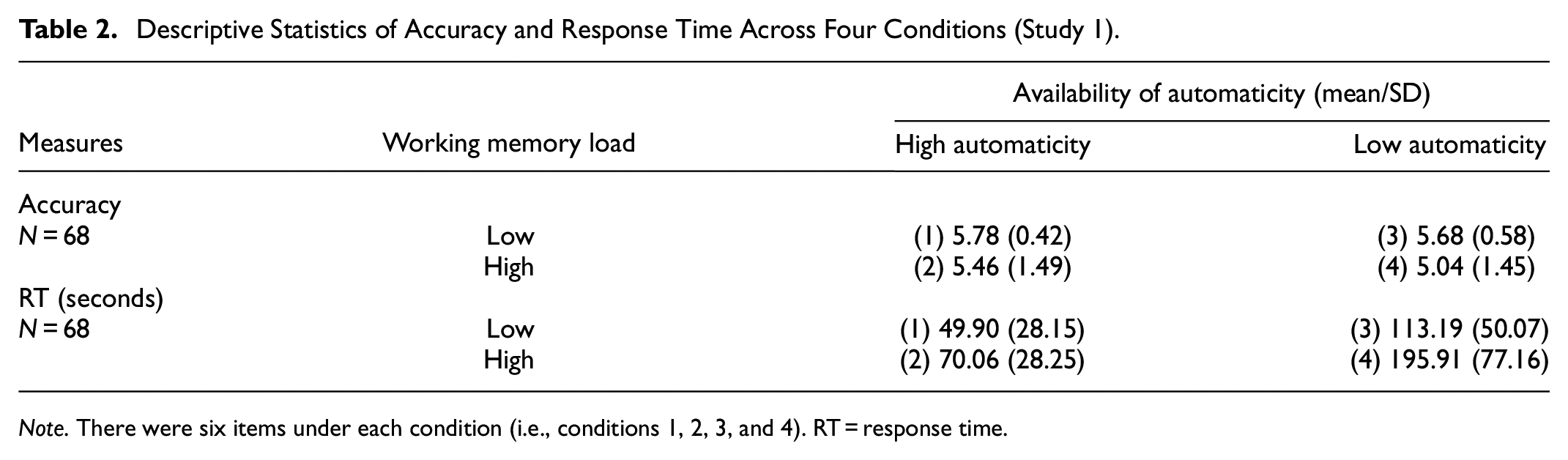
Note. There were six items under each condition (i.e., conditions 1, 2, 3, and 4). RT = response time.
Repeated measures ANOVA results (see Table 3) indicated that the main effects of automaticity and WML on the measure of accuracy were significant. The interaction effect between automaticity and WML was not significant. The main effects of automaticity and WML on response time were significant. On the measure of response time, there was a significant interaction effect between automaticity and WML.
Results of Effects of Working Memory Load and Availability of Automaticity on Multiplication Accuracy and Response Time (Study 1).

Note. WML = working memory load.
p < .05. **p < .01. ***p < .001.
An analysis of the simple effect of WML on the measure of accuracy was conducted (see Figure 1). Under conditions with high automaticity, Conditions 1 and 2, the simple effect of WML did not yield a significant result, F(1, 67) = 2.79, p > .05, η2 = .040. Under the conditions with low automaticity, Conditions 3 and 4, the simple effect of WML yielded a significant result, F(1, 67) = 10.99, p = .001, η2 = .141. An analysis of the simple effect of WML on the measure of response time was also conducted (Figure 2). Under conditions with high automaticity, Conditions 1 and 2, the simple effect of WML yielded a significant result, F(1, 67) = 37.61, p < .001, η2 = .360. Under conditions with low automaticity, Conditions 3 and 4, the simple effect of WML also yielded significant results, F(1, 67) = 113.76, p < .001, η2 = .629. The simple effect of WML rendered larger effect sizes for the conditions with low automaticity for the measures of both accuracy and response time.
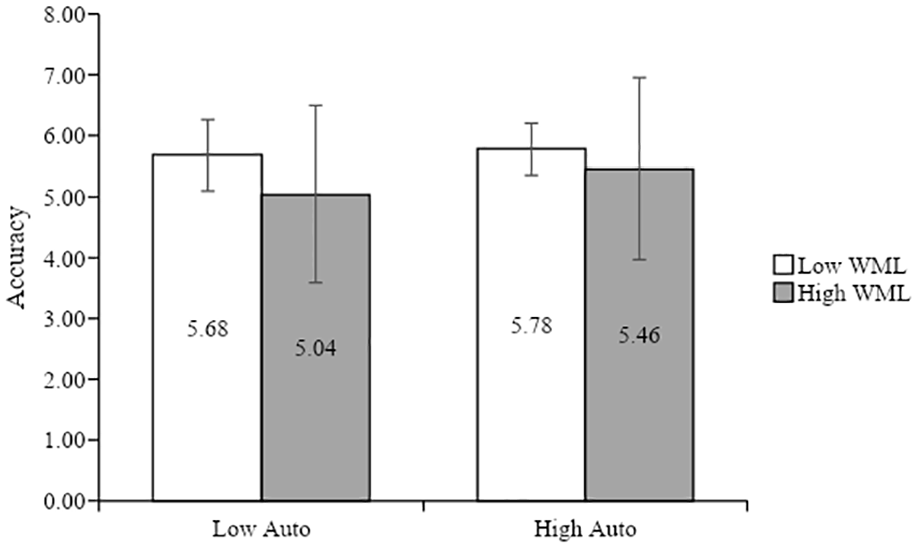
Effects of working memory load and automaticity on multiplication accuracy (Study 1). High auto = high automaticity; low auto = low automaticity; high WML = high working memory load; low WML = low working memory load; (1), (2), (3), and (4) = conditions 1, 2, 3, and 4. Under conditions 1 and 2, the simple effect of WML was not statistically significant, F(1, 67) = 2.79, p > .05, η2 = .040. Under conditions 3 and 4, the simple effect of WML was statistically significant, F(1, 67) = 10.99, p = .001, η2 = .141. Under conditions 1 and 3, the simple effect of automaticity was not statistically significant, F(1, 67) = 1.59, p > .05, η2 = .023. Under conditions 2 and 4, the simple effect of automaticity was statistically significant, F(1, 67) = 6.31, p < .05, η2 = .086.

Effects of working memory load and automaticity on response time (Study 1). High auto = high automaticity. Low auto = low automaticity. High WML = high working memory load. Low WML = low working memory load. RT = response time (measured by seconds). (1), (2), (3), and (4) = conditions 1, 2, 3, and 4. Under conditions 1 and 2, the simple effect of WML was statistically significant, F(1, 67) = 37.61, p < .001, η2 = .360. Under conditions 3 and 4, the simple effect of WML was statistically significant, F(1, 67) = 113.76, p < .001, η2 = .629. Under conditions 1 and 3, the simple effect of automaticity was statistically significant, F(1, 67) = 195.21, p < .001, η2 = .744. Under conditions 2 and 4, the simple effect of automaticity was statistically significant, F(1, 67) = 209.43, p < .001, η2 = .758.
An analysis of the simple effect of automaticity on the measure of accuracy was conducted (see Figure 1). Under conditions with low WML, Conditions 1 and 3, the simple effect of automaticity did not yield a significant result, F(1, 67) = 1.59, p > .05, η2 = .023. Under the conditions with high WML, Conditions 2 and 4, the simple effect of automaticity yielded a significant result, F(1, 67) = 6.31, p < .05, η2 = .086. An analysis of the simple effect of automaticity on the measure of response time was also conducted (Figure 2). Under conditions with low WML, Conditions 1 and 3, the simple effect of automaticity yielded a significant result, F(1, 67) = 195.21, p < .001, η2 = .744. Under conditions with high WML, Conditions 2 and 4, the simple effect of automaticity also yielded a significant result, F(1, 67) = 209.43, p < .001, η2 = .758. The simple effect of automaticity rendered larger effect sizes for the conditions with high WML on the measures of accuracy.
Study 2
We ran descriptive statistics of participants’ response time and accuracy on linear algebra problems (Table 4). On the measure of accuracy, Condition 1 yielded the highest accuracy rate (92.32%), and Condition 4 yielded the lowest accuracy rate (81.80%). Students had a higher accuracy rate on Condition 2 (91.34%) than on Condition 3 (84.10%). The accuracy for the four conditions followed the order of 1 > 2 > 3 > 4. In terms of response time, Condition 1 yielded the shortest response time (2.12 min), and Condition 4 yielded the longest response time (6.81 min). Participants responded faster on Condition 2 (2.40 min) than on Condition 3 (4.25 min). The response time for the four conditions followed the order of 1 < 2 < 3 < 4.
Descriptive Statistics of Accuracy and Response Time Across Four Linear Algebra Conditions (Study 2).

Note. There were six items under each condition (i.e., conditions 1, 2, 3, and 4). Response time was based on minutes. For each item, a perfect score was 2 points.
We ran a repeated measures ANOVA (see Table 5). On the measure of accuracy, the main effect of automaticity was significant, and the main effect of WML was not significant. The interaction effect was not significant. On the measure of response time, the main effects of automaticity and WML were significant. The interaction effect between automaticity and WML on the measure of response time was significant.
Results of Effects of Working Memory Load and Availability of Automaticity on Linear Algebra Accuracy and Response Time (Study 2).
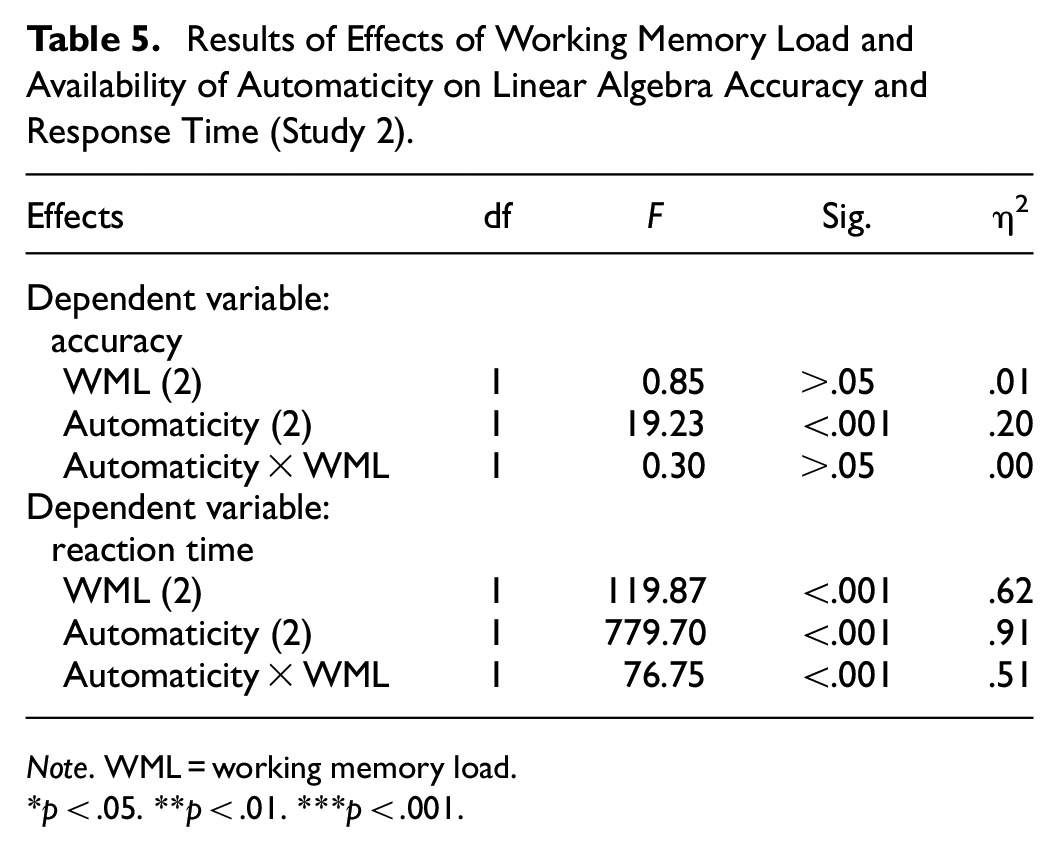
Note. WML = working memory load.
p < .05. **p < .01. ***p < .001.
On the measure of accuracy, we ran an analysis to examine the simple effect of automaticity and WML (see Figure 3). Under Conditions 1 and 2, which were the conditions with high automaticity, the simple effect of WML was not significant, F(1, 75) = 0.23, p > 0.05, η2 = .003. Under Conditions 3 and 4, which were the conditions with low automaticity, the simple effect of WML yielded a non-significant result, F(1, 75) = 1.06, p > .05, η2 = .014. An analysis of the simple effect of automaticity on the measure of response time was also conducted (Figure 4). Under Conditions 1 and 2, for those with high automaticity, the simple effect of WML yielded a significant result, F(1, 75) = 7.28, p < 0.01, η2 = .088. Under Conditions 3 and 4, for those with low automaticity, the simple effect of WML also yielded a significant result, F(1, 76) = 115.71, p < .001, η2 = .607. The simple effect of WML rendered larger effect sizes for the conditions with low automaticity for the measures of both accuracy and response time.

Effects of working memory load and automaticity on linear algebra accuracy (Study 2). High Auto = high automaticity. Low auto = low automaticity. High WML = high working memory load. Low WML = low working memory load. (1), (2), (3), and (4) = conditions 1, 2, 3, and 4. Under conditions 1 and 2, the simple effect of WML was not statistically significant, F(1, 75) = 0.23, p > .05, η2 = .003. Under conditions 3 and 4, the simple effect of WML was non-significant, F(1, 75) = 1.06, p > .05, η2 = .014. Under conditions 1 and 3, the simple effect of automaticity was statistically significant, F(1, 75) = 12.53, p < .001, η2 = .143. Under conditions 2 and 4, the simple effect of automaticity was statistically significant, F(1, 75) = 15.98, p < .001, η2 = .176.

Effects of working memory load and automaticity on linear algebra response time (Study 2). High auto = high automaticity. Low auto = low automaticity. High WML = high working memory load. Low WML = low working memory load. RT = response time (measured by minutes). (1), (2), (3), and (4) = conditions 1, 2, 3, and 4. Under conditions 1 and 2, the simple effect of WML was statistically significant, F(1, 75) = 7.28, p < 0.01, η2 = .088. Under conditions 3 and 4, the simple effect of WML was statistically significant, F(1, 76) = 115.71, p < .001, η2 = .607. Under conditions 1 and 3, the simple effect of automaticity was statistically significant, F(1, 75) = 210.15, p < .001, η2 = .737. Under conditions 2 and 4, the simple effect of automaticity was statistically significant, F(1, 75) = 491.78, p < .001, η2 = .868.
An analysis of the simple effect of automaticity on the measure of accuracy was conducted (see Figure 3). Under conditions with low WML, Conditions 1 and 3, the simple effect of automaticity yielded a significant result, F(1, 75) = 12.53, p = 0.001, η2 = .143. Under the conditions with high WML, Conditions 2 and 4, the simple effect of automaticity yielded a significant result, F(1, 75) = 15.98, p < .001 η2 = .176. An analysis of the simple effect of automaticity on the measure of response time was also conducted (Figure 4). Under conditions with low WML, Conditions 1 and 3, the simple effect of automaticity yielded a significant result, F(1, 75) = 210.15, p < 0.001, η2 = .737. Under conditions with high WML, Conditions 2 and 4, the simple effect of automaticity also yielded a significant result, F(1, 75) = 491.78, p < .001, η2 = .868. The simple effect of automaticity rendered larger effect sizes for the conditions with high WML on the measures of accuracy and response time.
Discussion
In both studies, a within-subjects 2 (automaticity) × 2 (WML) design was utilized. There are some general findings. First, testing conditions that allowed high automaticity yielded better execution outcomes, and the effects were more profound in problems of greater complexity (Study 2). The participants were generally more accurate and faster on the conditions with high automaticity than they were on the conditions with low automaticity. Second, for the measure of response time, testing conditions with low demands on WML yielded better execution outcomes. The participants were generally faster on the conditions with fewer steps than they were on the conditions with more steps. Third, in both studies, there was an interaction effect between WML and automaticity on the measure of response time. The WML rendered a larger effect size when the conditions had low automaticity. In other words, when the tasks were fairly easy (the participants established automaticity with the tasks), more or fewer steps had a limited effect. However, when the tasks were difficult (the participants did not have a high level of automaticity with the tasks), more steps (demanding more WML) largely slowed down the participants. The automaticity rendered a larger effect size when the conditions required high WML. In other words, when the tasks required a high level of WML, the automaticity (i.e., the participants were very fluent with the math facts) became more important for problem solving. Fourth, the simple effect results indicated that the role of automaticity is more important in the more complex context of linear algebra than in the context of simple multiplication.
The Role of Automaticity in Mathematics Computation
The findings suggest that automaticity is important not only for young learners who are still in the process of mastering basic mathematic facts (Ding et al., 2017; Liu et al., 2017) but also for college engineering students whose day-to-day learning largely involves math computation (Wang et al., 2018). Math achievement has important implications for students of all majors and goals (Bremer et al., 2013). Bremer et al. (2013) examined the academic outcomes of students within a community college system and found that students who entered college with higher math placement scores were more likely to persist through college to completion even when compared to those with high reading and writing abilities. Additionally, poorer math achievement scores prior to entrance in college had disproportionately negative relationships to overall GPA, whereas the same was not true for students with weaker entering reading and writing abilities.
Research on math strategies use reveals that retrieval, defined as having pre-existing knowledge of the answer or the result of intermediate math operations and retrieving it from memory, is the most effective strategy because it is quick, accurate, and does not require the use of working memory resources (Fürst & Hitch, 2000; Lefevre et al., 1988; Logie et al., 1994). In other words, direct retrieval of math facts as a final answer or the result of intermediate math operations is a quick method for reaching an answer to a presented problem, whereas multi-step problems have a high demand on WML, leaving fewer working memory resources available for other tasks, namely understanding the materials (Fürst & Hitch, 2000; Logie et al., 1994). Retrieval (retrieving automatized schemas or facts) is preferred as it is faster, more accurate, less error-prone, and less demanding on working memory resources than any other available strategy and is thus optimal for all simple and even complex arithmetic (Campbell & Alberts, 2009; Imbo & Vandierendonk, 2008). Moreover, the lack of retrieval skills in even basic arithmetic is often associated with poor math achievement (R. Cowan et al., 2011). The highlight of our study is that we tackled automaticity and WML through task characteristics, which are under the instructors’ instructional control. Findings in Study 1 and Study 2 confirmed that engineering students were more accurate and responded faster under testing conditions with high automaticity. The findings suggested that the role of automaticity is more profound when problems are more complex.
According to schema theory (Chi et al., 1982), schemas are stored in long-term memory and provide a mechanism for humans to organize and store knowledge. In addition, schemas reduce WML. Although working memory is limited in the number of elements (novel information) it can hold, the size, complexity, and sophistication of elements are not limited (Sweller et al., 1998). Automation is an important element in schema construction. All information can be processed consciously or automatically (van Merriënboer & Sweller, 2010). Conscious cognitive processing occurs in working memory, which can simultaneously hold only a limited number of elements. Automatic processing can bypass the limits of working memory and is essentially different from conscious processing. Typically, humans achieve automaticity after practice, rehearsal, and repetition. After sufficient practice, humans can carry out procedures (e.g., computation, driving, hiking) with minimal conscious effort. For example, most mature learners can read fluently without conscious processing of the curves, strokes, and sounds of letters. Such mature learners have achieved a high level of automaticity at the word level. However, young learners might have to consciously sound out each vocabulary word (e.g., “butterfly” could be broken into bu-tter-fly for processing) to comprehend the meaning of each word. If young learners in this scenario do not reach a high level of automaticity at the word level, reading becomes a tedious and laborious process.
Our findings were more consistent on the measure of response time and less consistent on the measure of accuracy, which concurs with a previous study (Ding et al., 2019). Our findings also suggest that automaticity plays a more profound effect on problems with greater complexity (Study 2). Under non-timed testing conditions, some students continued to work out accurate solutions when the problems became increasingly difficult; thus, the measure of accuracy reflected a small range of variance among the participants. However, when problems allowed a low level of automaticity, all participants were slowed in the problem-solving process, reflected in the response time. In an engineering instructional and learning setting, examinations are likely to be timed, and the problems are complex. It is critical to develop automaticity of basic concepts to perform familiar tasks fluently and errorlessly. As suggested by Sweller (2010), it is important that assessments are designed to evaluate the essential learning components that they intend to evaluate (e.g., intrinsic cognitive load) and are not burdened by unnecessary constructs (e.g., extraneous cognitive load).
The Role of WML in Mathematics Computation
Working memory is thought to be equivalent to consciousness (Sweller et al., 1998). Research has found that humans can hold about seven elements of information at one time if they simply hold such information without further processing (Miller, 1956). When the tasks involve cognitive activities, such as organizing, comparing, contrasting, processing, and manipulating new information, the capacity of working memory is reduced to 4 ± 1 elements of novel information (Baddeley, 1986; N. Cowan, 2001). The human limits on working memory have implications for instructional design. Conscious cognitive activities can overwhelm working memory unless the knowledge is pre-learned and becomes automatized schemas or memorized facts. In contrast, long-term memory is relatively unlimited and can hold schemas, facts, and procedural knowledge.
Early studies examined the differential abilities of chess grandmasters and less skilled players, with the notion that chess involves a great deal of problem solving. A series of studies (e.g., Barfield, 1986; Chase & Simon, 1973; De Groot, 1966; Sweller & Cooper, 1985) confirmed that the main factor that distinguished chess grandmasters and naïve players was not knowledge of general and sophisticated problem-solving strategies, but the automatic retrieval of large amounts of domain-specific problem states and the moves associated with such problem states. In other words, chess grandmasters have developed direct retrieval of an enormous number of automatized schemas of board configurations (which are not available to naïve players). In contrast, novel players must engage in complex reasoning activities to figure out such board configurations, and these cognitive activities can overwhelm working memory. The automatic recognition of thousands of board configurations largely reduces WML in grandmasters. Naïve players do not have access to board configurations that skilled chess players have mastered; thus, they must engage in complex reasoning. When grandmasters and naïve players were asked to reproduce random configurations, there were no group differences, suggesting that grandmasters were not better than naïve players at utilizing working memory to tackle random information, and both groups had very limited working memory (Chase & Simon, 1973). Ding et al. (2017) explored the effect of automaticity and WML in mental arithmetics skills in elementary school students. The findings indicated that the simple effect of WML was larger than the conditions with low automaticity, concurring with the findings in the present study. Humans’ working memory is simply not capable of handling complex reasoning that involves a large number of novel elements. Instructional designs should help learners transform novel elements of information into familiar elements of information and should be presented in a way that does not impose extraneous WML.
Interaction Between Automaticity and WML
The findings revealed a significant interaction effect between automaticity and WML, concurring with previous studies (Ding et al., 2017; Wang et al., 2018). The combination of relatively less familiar information and increased WML will likely be detrimental to the problem-solving process. Thus, it is not surprising that the participants performed worse on Condition 4 when both dimensions of the tasks were difficult. When only one dimension of the tasks was difficult, as in Condition 2 or Condition 3, the engineering students did consistently better with Condition 2 than with Condition 3 in the more complex context of linear algebra (Study 2). Under Condition 2, the problems allowed a high level of automaticity but had more steps. Our findings suggest that when participants had easy access to automatized math facts (products were multiples of 10) stored in long-term memory, more steps were not detrimental to their performance. Such findings concur with the literature that direct retrieval leads to faster and more accurate responses and activates fewer working memory resources (Ashcraft & Fierman, 1982; Tronsky, 2005), and the role of automaticity is more pronounced in more complex mathematical contexts. On the other hand, when the participants encountered math facts that were not automatic for them, even fewer steps (two-step calculation) did not help to offset the burden on working memory (Condition 3), supporting the notion that humans’ working memory is very limited, whereas long-term memory is relatively unlimited.
Roles of Automaticity in Algebra and Multiplication
In multiplication, the effect of automaticity was insignificant under the conditions with low WML. In other words, when the problems required fewer steps, and they were simple multiplication, the role of automaticity was less important. The effect of automaticity was consistently important in linear algebra questions, no matter whether the questions required fewer steps or more steps. Based on the effect sizes, it is notable that the effect of automaticity is more important in the more complex context of linear algebra than in the context of simple multiplication. Because engineering is far more complex than the sample problems shown in the linear algebra study (Study 2) and multiplication study (Study 1), the differentiated role of automaticity might be meaningful for engineering educators in the context of more complex subject matter.
Education Implications
Our findings suggest educational implications for engineering educators by highlighting the importance of automaticity of basic math factors in engineering learners, concurring with findings in younger learners (Ding et al., 2017; Ding et al., 2019; Liu et al., 2017). The apparent restriction of working memory indicates that cognitive structures other than working memory must play a critical role in human’s problem solving. According to Sweller et al. (1998), the seat of human intellectual skills might be more reliant on long-term memory, which has the capacity to hold and store an unlimited number of schemas, factors, and procedural knowledge, rather than working memory. If instructional designs require learners to engage in complex problem-solving processes that involve combinations of unfamiliar elements (i.e., learners are not familiar with each singular learning element), the learning process is likely to be deficient. Thus, engineering educators should stress the importance of helping engineering students to become familiar and automatic with basic elements involved in the learning, freeing students’ working memory resources to process the combinations of these basic elements. It should be noted that engineering learners are often confronted with complex problems that consist of multiple unfamiliar components. At some point, part of engineering education has to involve training the ability to parse the complex system into smaller elements that require low WML and have high automaticity.
According to CLT (Sweller et al., 1998; Paas et al., 2003), although the number of elements is limited for working memory, the sophistication, complexity, and size of elements are not limited. Engineering instructors might need to actively seek instructional approaches that develop and form schemas to incorporate a large amount of information. Through pragmatic learning, students can acquire a large array of related elements that can be held in memory and considered as a single entity of information. In our linear algebra study, when the students were able to fluently process sub-elements (i.e., digits) or lower-level schemas (i.e., single-step calculation) that were incorporated in the high-level schemas (i.e., multi-step calculation), the sub-elements and lower-level schemas no longer required a large amount of working memory. A good engineering example is a large structural system that can be solved via multiple simpler substructures. After students can fluently analyze smaller basic structures, they can efficiently break down and analyze large complex structures. For engineering educators, on the one hand, it is critical to stress students’ automaticity of basic concepts through teaching, rehearsal, and practice. Any higher-level problem solving is built on the foundation of fluent corporation of lower-level elements. On the other hand, instructors should actively categorize, summarize, and classify knowledge into highly sophisticated and complex schemas, helping the learners reduce WML.
Second, the engineering students in our study responded differently to four testing conditions, although all tasks were developed based on the same original problems. In other words, when the structural features of WML and automaticity were altered, students responded differently. When translated to the field of instructional design, instruction should facilitate generalization. The same problem scenario might need to be presented by alternating different aspects of the tasks. Using an arithmetic example, 25 × 18 could be calculated by using a regular algorithm, using a multiplication associative property 25 × 2 × 9, or using a multiplication distributive property (25 × 20)–(25 × 2). In engineering applications, a large complex engineering system can often be broken down into smaller subsystems in different ways, which can be exploited in teaching. Problems presented through multiple problem formats will enhance students’ strategy flexibility and the ability to utilize effective strategies according to the nature of the problem.
Third, early studies with chess grandmasters and naïve players indicated that grandmasters were superior in memorizing and retrieving board configurations that were taken from real games, but they were not superior in memory of random configurations that were not used in real games (Chase & Simon, 1973; De Groot, 1966). The working memory capacities of grandmasters were not better than those of naïve players, but they outperformed naïve players in their long-term memory of automatized board game configurations (e.g., as many as 100,000 such configurations) and could reproduce such configurations accurately and rapidly (Chase & Simon, 1973). The implication for the field of instructional science is that engineering educators should not only enhance general problem-solving skills but also facilitate engineering domain-specific knowledge acquisition. For example, working memory capacities in structural analysis skills of civil and mechanical engineering students need to be enhanced in various engineering mechanics and structural design courses since those are domain-specific subject areas taught by engineering educators.
Conclusion and Limitations
There are some limitations of the present study. First, our participants were recruited from one private university in the Northeastern United States. The findings in the present study might have limited generalization to college engineering students in other geographical regions of the United States. Second, we held the assumption that if we presented the problem in a forced problem format (e.g., 15 × 4 × 3), the participants would execute the operations according to the problem format imposed or vice versa. If a participant mentally converted the problem of 15 × 4 × 3 to 15 × 3 × 4, we did not have an approach to examine which participant followed and which participant did not follow the imposed problem format. Third, the effects of automaticity and WML were more consistent on the measure of response time but less consistent on the measure of accuracy. In other words, although the participants slowed down under more difficult testing conditions, many of them might continue to execute the operations correctly. Multiplication problems, regardless of alterations through the number property rules, are still fairly automated tasks for most undergraduate engineering students. It should be noted that the tasks chosen for this study are significantly less complex than most of the tasks encountered by engineering students. Future researchers might want to incorporate more complex math problems in order to ensure substantially differentiated responses on the measure of accuracy. Fourth, there might be item-level effects, such as some specific items might be harder than others to solve. Future researchers might consider using missed effect models in which both the random effects of the participants and items can be modeled by entering trial-level data.
Despite the shortcomings, the present study’s findings are useful both theoretically and practically. First, we controlled the difficulty levels of automaticity and WML through the perspective of task characteristics, which could be manipulated according to the purpose of instruction. Previous studies often focused on individual characteristics, which are less likely to be altered through instructional modifications. Our findings support the principles suggested by CLT that learning can be optimized by efficiently using the relations between limited working memory and unlimited long-term memory that can hold an enormous number of automatized schemas. Second, our findings revealed a significant interaction effect between automaticity and WML. The effect of WML rendered a larger effect size when the participants encountered problems that they were unfamiliar with (low level of automaticity). In other words, when the learning content is relatively unfamiliar, more demand on WML is detrimental. When it is translated into instructional design, engineering educators might consider exploring methods to substitute productive WML for unproductive WML. Possible approaches could be systematic teaching to help students apply strategies to simplify problems, utilization of a series of practices and worked examples to enhance generalization and development of a learning environment in which students can achieve high levels of automaticity on basic elements of the learning content in order to achieve fluent incorporation of all levels of learning elements. Finally, we examined our hypotheses in both multiplication and linear algebra tasks, and the findings were similar to some degree but also reflected some differences in easy arithmetic versus complex mathematical context. One application involved more generic math problems, and one involved more advanced math problems relevant to domain-specific knowledge in engineering. Our findings suggest that when examining human cognition in engineering students, future researchers should not only include the generic domain of knowledge but also incorporate engineering-specific (domain-specific) knowledge because the ultimate goal for engineering instruction should be enhancing domain-specific knowledge acquisition.
Footnotes
Acknowledgements
Thanks to Agnes DeRaad for editorial support. Thanks to the anonymous reviewers for their helpful and constructive comments. Data are not made available publicly due to policy restrictions set by Institutional Review Board, however they could be provided upon individual requests.
Declaration of Conflicting Interests
The author(s) declared no potential conflicts of interest with respect to the research, authorship, and/or publication of this article.
Funding
The author(s) disclosed receipt of the following financial support for the research, authorship, and/or publication of this article: This project was partially supported by a Proof of Concept and Research Grant from the Graduate School of Education at Fordham University to Yi Ding.
Ethical Approval
This study closely followed all ethical standards established by the Institutional Review Board at the researchers’ universities.

Data Availability Statement
Due to privacy concerns mentioned in the IRB protocol, the data associated with this study cannot be provided to the public without the supervision of the researchers. However, individual researchers who are interested in obtaining access to the data for individual use are encouraged to contact the corresponding author.