



Abstract
Augmented Reality (AR) technology has improved the dissemination of cultural heritage. The existing research predominantly focuses on technical presentation and user experience. However, the underlying mechanisms driving user adoption remain underexplored, especially in craftsmanship-related intangible cultural heritage (ICH) AR games. Specifically, there is a notable gap in the theoretical modeling of the relationship between perceptual factors and cognitive processing pathways. This study integrates the Technology Acceptance Model (TAM) and Cognitive Load Theory (CLT) and develops a conceptual framework linking perceived dimensions, cognitive load, and behavioral intention. The model incorporates four key perceptual constructs—immersion, visual appeal, interactivity, and learning friendliness—and investigates their influence on user adoption behavior. Empirical data were collected from 412 valid questionnaire responses, supplemented by 12 in-depth semi-structured interviews with experienced users. Structural Equation Modeling (SEM) was used to validate the model and test the hypotheses. The results indicate that perceived ease of use and usefulness significantly affect users’ intention to adopt. At the same time, visual appeal and interactivity indirectly influence behavioral intention through reductions in cognitive load and function as a partial mediator. This study contributes to the theoretical extension of TAM and CLT in multi-sensory cultural experience environments and provides actionable design strategies for interface aesthetics, interactive logic, and content structuring in craftsmanship ICH AR games. It supports the effective dissemination and sustainable transmission of intangible cultural heritage in the digital era.
Keywords
Introduction
Driven by the dual forces of the information age and technological advancement, intangible cultural heritage (ICH) transmission modes are undergoing profound transformations. The widespread application of digital media and information and communication technologies has enhanced cultural dissemination efficiency and offers diverse and innovative pathways for displaying and preserving ICH (Davis, 1989); Hung et al. (2013). Integrating augmented reality (AR) technology has effectively overcome traditional craftsmanship transmission’s spatial and temporal limitations (Dong et al., 2006). It enables the users to experience cultural content through immersive and interactive experiences (Nizar et al., 2018). Compared with conventional approaches such as on-site observation or static exhibitions, AR significantly enhances user participation and deepens the experiential dimension through improved interactivity and visual representation.
Although the application of augmented reality (AR) technology in cultural heritage dissemination has gained increasing scholarly attention (Ch’ng et al., 2019), systematic investigations into user adoption behavior within the specific context of craftsmanship-based ICH remain limited. In particular, a notable gap exists in both theoretical modeling and empirical validation. The existing studies primarily focus on technical implementation and display outcomes or general interaction design in broader cultural heritage settings (Wang et al., 2025). Insufficient efforts are devoted to theoretical modeling and quantitative validation of user behavior based on specific perceptual dimensions. Literature suggests that visual appeal and immersive experiences can enhance user satisfaction. However, there is still no empirical evidence on how these perceptual features influence adoption intentions through cognitive load mechanisms. Moreover, although Technology Acceptance Model (TAM)-based studies have emphasized the roles of perceived usefulness and perceived ease of use (Davis, 1989), they often overlook the disruptive effects of multi-sensory immersion, cultural complexity, and information overload on cognitive processing (Magalhães et al., 2024). This gap is particularly evident in the digital dissemination of Chinese craftsmanship ICH, where AR games are emerging as novel carriers. However, how visual presentation and interactive design regulate the cognitive load and subsequently shape user behavioral intentions remains theoretically underdeveloped.
This study proposes an integrated framework that combines the Technology Acceptance Model (TAM) with Cognitive Load Theory (CLT) to examine the relationships among perceptual dimensions, cognitive load, and users’ adoption intentions. This research is the first to structurally embed CLT into the TAM pathway by constructing a “perception–cognitive processing–intention” mechanism chain, thereby extending the applicability of TAM in culturally rich contexts. Focusing on craftsmanship-based ICH AR games—a digital application characterized by high operational complexity and cultural immersion—this study addresses a critical void in the literature on intangible cultural heritage (ICH) game-based dissemination. By introducing four key perceptual variables—visual design, immersion, interactivity, and learning friendliness—the study enriches the structural dimensions of TAM within a multimodal cultural experience environment. Empirical validation using survey data and structural equation modeling (SEM) confirms the proposed relationships among variables, offering theoretical insights and practical guidance for designing and promoting AR-based ICH experiences.
Literature Review
The Role of Digital Technology in Craftsmanship-Based Intangible Cultural Heritage (ICH)
Among the diverse categories of intangible cultural heritage, craftsmanship-based ICH is often perceived as “ancient” or “detached from contemporary life,” largely due to limited public access to relevant information, contributing to information asymmetries and cognitive biases. In reality, traditional craftsmanship represents the culmination of historical techniques. It embodies collective memory, cultural values, and aesthetic systems. It reflects specific communities’ lifestyles, social identities, and symbolic expressions (Chen et al., 2024). Through craft artifacts and production processes, cultural meanings are transmitted and continue to influence contemporary design and aesthetic practices. However, compared to other forms of ICH, craftsmanship-based heritage faces more significant preservation challenges. It typically requires organic materials susceptible to environmental degradation, intricate handcrafting processes, and skilled practitioners. These factors contribute to difficulties in preservation (Cai et al., 2024), replication (Zabulis et al., 2020), and generational transmission (Yang et al., 2022). The application of digital technologies has opened new pathways for safeguarding craftsmanship-based ICH. Recent research has increasingly focused on how 3D modeling, virtual reality (VR), and augmented reality (AR) can reconstruct complex craft processes and cultural contexts. For instance, Liu (2022) demonstrated how 3D modeling and virtual exhibition technologies could effectively restore intricate craft procedures, offering a methodological foundation for digital preservation. Building on this, Qiu et al. (2024) explored the applicability of 3D virtual simulation in reconstructing historical techniques, highlighting its potential for both knowledge retention and cultural representation.
With the growing application of augmented reality (AR) technology in cultural heritage preservation, its potential for cultural representation in craftsmanship-based intangible cultural heritage (ICH) has become increasingly evident. Compared with traditional exhibition methods, AR technology transcends spatial and temporal constraints and enables users to intuitively perceive complex craftsmanship’s operational logic and cultural context through high-fidelity visual reconstruction and contextualized interaction (Soto-Martin et al., 2020). This enhances the “perceptibility” of ICH while offering a more immersive and engaging reproduction of cultural authenticity. Some scholars argue that AR should not be regarded as a “virtual substitute” that undermines authenticity; instead, it functions as a “cultural mediator” (Marto et al., 2018). It can dynamically and interactively present craft processes that are otherwise difficult to access or preserve. Such mediation facilitates both experiential understanding and re-contextualized dissemination. Through virtual interaction with traditional craft procedures, users acquire knowledge and establish emotional connections with the cultural essence—what (Marto et al., 2018) term “participatory authenticity,” which is difficult to achieve through conventional means. Moreover, research has shown that when AR systems integrate appropriate contextual cues—such as traditional terminology, material information, and procedural sequences—they can effectively retain craftmanship’s original logic and aesthetic traditions. This allows for the “digital reenactment” of cultural authenticity in a way faithful to heritage values (Xu, 2018).
Therefore, AR technology preserves and enhances the traditional character of intangible cultural heritage (ICH), offering a more impactful channel for its dissemination. By presenting craftsmanship-based ICH in visually compelling and culturally rich ways, AR allows this form of heritage to enter the public sphere with renewed relevance and vitality. As a result, AR serves as a powerful medium for sustaining the cultural life of traditional crafts in contemporary contexts.
The Current State of User Willingness to Adopt AR Technology in Craftsmanship Intangible Cultural Heritage Games
User’s intention to use is the behavioral motivation triggered by an individual’s attitude toward a specific technology or product. In the context of AR-based intangible cultural heritage (ICH) games focused on traditional craftsmanship, such intention influences the depth of user engagement and continuity of use. It plays a critical role in the effective dissemination and sustainable transmission of traditional craft culture. With the growing adoption of AR in ICH preservation practices, scholars have begun to examine its influence on user adoption behavior from multiple perspectives. Bekele et al. (2018) suggest that integrating AR with 3D modeling, virtual reality, and audio feedback helps create a multi-sensory interactive environment, significantly enhancing users’ immersive experience and participation. Hamari et al. (2014) further highlight that combining AR and gamification increases user satisfaction and supports the cognitive dissemination and global learning of ICH content.
In existing studies, visual appeal, interactivity, and ease of use are key perceptual factors influencing users’ intention to adopt AR applications. Based on the Technology Acceptance Model (TAM), Tom Dieck and Jung (2017) argue that users are initially drawn to the visual presentation of AR applications and then evaluate the ease of operation and interactive functionality—factors that form the cognitive basis for their intention to use. This finding further confirms the applicability of TAM in the context of digital ICH dissemination. Meanwhile, immersion is a critical variable shaping user behavior. Yovcheva et al. (2012) found that highly immersive audio-visual environments significantly enhance users’ learning efficiency and overall satisfaction. Similarly, the empirical study by Kysela and Štorková (2015) shows that improved immersion and interactivity increase user engagement and promote their continued intention to use. These studies offer a solid theoretical foundation for the design of AR-based ICH games, underscoring the pivotal role of immersive experiences and interactive mechanisms in stimulating user adoption.
While existing studies have validated the applicability of the Technology Acceptance Model (TAM) in intangible cultural heritage (ICH), significant theoretical limitations remain. Specifically, prior research often overlooks how certain technological features—such as visual presentation and immersion—affect users’ cognition and adoption behaviors in the digital dissemination of craft-based ICH. Meanwhile, Cognitive Load Theory (CLT) has been validated in educational psychology (Kirschner, 2002). However, its application in digital cultural heritage remains limited, particularly in explaining how technical design can be leveraged to reduce users’ cognitive load.
This study integrates TAM and CLT for the first time to address these gaps. It introduces novel perceptual variables—visual appeal, interactivity, and immersion—to investigate their effects on users’ cognitive load and intention to use AR-based ICH technologies. This theoretical integration and variable innovation enriches the conceptual depth of TAM in the digital heritage context and extends the applicability of CLT to cultural domains. The proposed framework offers a more comprehensive foundation for both theory and practice in the design and dissemination of digitally mediated craft-based ICH experiences.
Theoretical Framework and Research Hypotheses
Technology Acceptance Framework for Emerging Technologies
The Technology Acceptance Model (TAM) was proposed by Davis and is grounded in the Theory of Reasoned Action. It has been widely used to examine users’ willingness to adopt information systems or emerging technologies. The model centers on two core constructs—Perceived Ease of Use (PEOU) and Perceived Usefulness (PU)—which reflect users’ cognitive evaluations of a technology’s utility and usability (see Figure 1). According to TAM, users are more likely to develop a favorable usage intention when they perceive technology as easy to operate and effective in accomplishing specific tasks (Marangunić & Granić, 2015). This study focuses on craft-based intangible cultural heritage (ICH) augmented reality (AR) games involving complex operations, high-fidelity visual presentation, and strong interactivity. In such environments, users’ evaluations of system usability, interaction quality, and learning support are critical to their acceptance decisions. Thus, PEOU and PU serve as key variables for capturing users’ cognitive processing in this high-sensory, multi-task setting—well aligned with the core logic of TAM (Davis, 1989). The Unified Theory of Acceptance and Use of Technology (UTAUT) emphasizes social influence and performance expectancy (Williams et al., 2015). Meanwhile, TAM offers more explanatory power in scenarios characterized by individual cognitive engagement than organizational or socially driven adoption. UTAUT is better suited for contexts with strong social norms or institutional control (Chang, 2012). However, it may fall short in unpacking the psychological mechanisms underpinning users’ responses to sensory load, interactivity, and immersion in AR-based ICH applications. Therefore, TAM is deemed more appropriate for the theoretical development and empirical analysis in this study.

Technology acceptance model (TAM).
The TAM model is well-suited for structural modeling in such contexts, and its high degree of extensibility also allows for incorporating individual user characteristics, thereby enhancing its explanatory power regarding behavioral intention (Koronios & Kriemadis, 2018). However, early studies on user adoption of emerging technologies often relied solely on the original TAM framework, neglecting the moderating effects of individual differences on technology acceptance. For instance, Agarwal and Prasad (1999) examined how personal innovativeness and prior technology experience influence users’ behavioral intention within the TAM framework, highlighting the significance of user-specific traits. Similarly, Sun and Zhang (2006) demonstrated that individual characteristics exert a notable moderating effect in TAM-based models, significantly shaping users’ intention to adopt new technologies. Mun and Hwang (2003) extended the TAM by incorporating psychological factors such as self-efficacy and learning goal orientation, identifying their pivotal roles in technology acceptance to address this issue. Lin (2007) further integrated user characteristics into TAM to explore gender differences in perceived usefulness and ease of use. The findings show that gender significantly influenced users’ behavioral intention toward technology adoption.
This study adopts the Technology Acceptance Model (TAM) as the theoretical foundation to explore the key external variables influencing users’ intention to adopt intangible cultural heritage (ICH) AR games. As a form of traditional cultural transmission, craftsmanship-based ICH is characterized by highly contextualized operations and multisensory interactions. Users must engage with the essence of ICH through multiple perceptual channels. According to the TAM proposed by Davis (1989), perceived usefulness (PU) and perceived ease of use (PEOU) are the primary determinants of users’ adoption intentions. In ICH AR applications, PU reflects the practical value of skill knowledge transmission and cultural understanding, whereas PEOU pertains to users’ expectations for intuitive interfaces and seamless interaction. Therefore, perceptual factors are critical in shaping users’ acceptance of such technologies (Wen et al., 2023). This study follows the core logic of TAM and incorporates individual difference variables to analyze how these external factors influence users’ perceptions and behavioral decision-making. By extending the TAM framework, the research aims to uncover deeper mechanisms underlying users’ technology acceptance and adoption of ICH AR games, thereby providing theoretical support for the digital preservation and broader dissemination of traditional craftsmanship.
Identification and Analysis of User Perception Factors in AR Games for Craftsmanship Intangible Cultural Heritage
To comprehensively identify the key factors influencing users’ behavioral intention, it is essential to consider the complexity of user experience beyond traditional literature review. This study adopts a feature identification approach to extract perceived characteristics—“performance attributes”—from the users’ perspective in craftsmanship-based ICH AR games. These attributes serve as empirically grounded variables that provide a more nuanced analysis of user behavior and adoption intention. The data collection strategy integrates online user reviews and offline in-depth interviews to enhance the richness and validity of the findings. This dual-source method captures users’ original evaluative frameworks regarding ICH AR games, providing a deeper understanding of the core perceptual factors that shape their engagement and intention to use.
First, user reviews of four representative AR-based cultural heritage games—domestic and one international—were extracted from major online platforms using a Python-based web crawler (see e.g., Figures 2–5). After cleaning and filtering, 524 comments were collected, with 312 valid entries retained for analysis. Subsequently, two domestic craftsmanship-related ICH AR games were selected as test cases. A total of 24 participants (12 females and 12 males) were invited to engage in gameplay sessions, followed by approximately 25-min semi-structured interviews. The interviews focused on participants’ perceptions, emotional responses, and usage experiences. All sessions were audio-recorded with prior consent. Finally, a cross-validation approach was applied to triangulate insights from the online review data and the offline interview transcripts. This ensured data accuracy and internal consistency, providing a robust foundation for subsequent variable extraction and statistical modeling.

“Virtual tour of Dun Huang”—Experience of the mural restoration AR interactive game project.
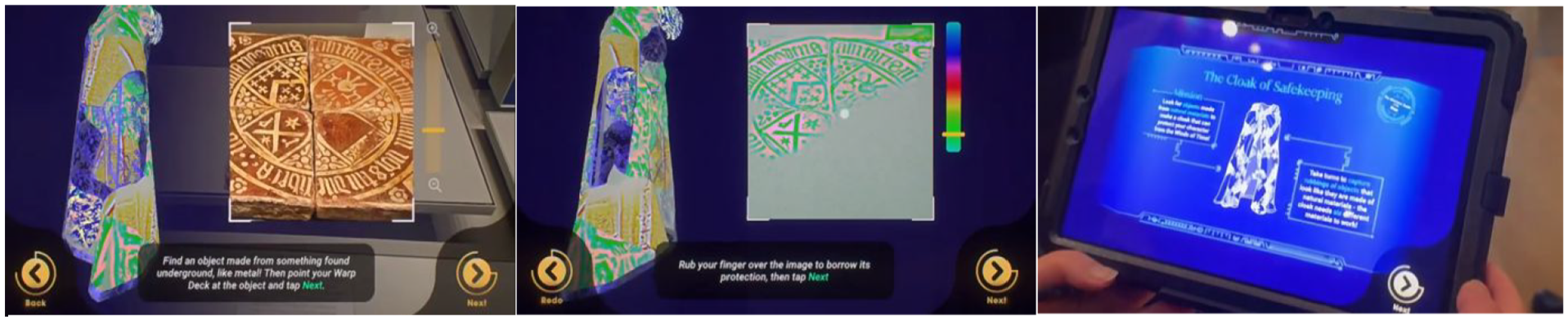
Experience of the British Museum AR interactive game project.

AR project of the German Ceramics Museum.

The ARuite Dazaifu Government Office Project in Japan.
Based on the coding framework of grounded theory, this study systematically identified and analyzed key user perception factors related to AR-based intangible cultural heritage (ICH) craftsmanship games. Open coding and axial coding procedures were applied to extract research variables. Using NVivo 11, 40,536 words of valid textual data were coded and processed to refine core concepts. During the initial classification and open coding phase, the interview and review texts were examined line by line, focusing on themes related to user experiences in craftsmanship ICH AR games. A total of 17 initial concepts were identified and grouped into 8 subcategories. Each subcategory was defined using representative user expressions to capture different dimensions of the AR experience. In the pattern recognition and theme abstraction phase, these subcategories were further synthesized into four major categories: immersion, learning friendliness, interactivity, and visual design. Through axial coding, the eight subcategories were reorganized and conceptually integrated into three higher-level dimensions, reflecting the perceptual structure of users in AR-based ICH experiences. Five reserved transcripts were re-coded using the same approach to ensure theoretical saturation. Saturation was achieved when no new categories emerged. The resulting categories represent the core perceptual factors influencing user adoption of AR technology in ICH contexts. A detailed summary of the coding results and category structure is presented in Table 1.
User Perception Factor Extraction (Coding Results).

The above research identified four key user perception factors in craftsmanship-related intangible cultural heritage (ICH) AR games: immersion, learning friendliness, interactivity, and visual design. While these dimensions have been preliminarily established, their specific manifestations within AR game environments and their critical roles in shaping users’ intention to adopt such technologies warrant further empirical investigation and theoretical elaboration.
Constructing a Theoretical Model of User Willingness to Use AR Technology in Craftsmanship Intangible Heritage Games
In identifying user perception factors, users’ evaluations were primarily focused on the external features of craftsmanship-oriented ICH AR games. An in-depth analysis of the user feedback corpus extracted/revealed four key perceptual dimensions: immersion, learning friendliness, interactivity, and visual design. These factors reflect users’ direct experience with the AR application’s interface, interaction, and cultural presentation and serve as critical variables in shaping their adoption behavior.
User behaviors and expectations have undergone substantial changes (Davis, 1993). The Technology Acceptance Model (TAM) has been extensively applied across various technological domains (Verbeek & Slob, 2006). However, Sweller (1988) argues that while TAM effectively captures the influence of perceived usefulness and ease of use on user intention, its explanatory power may be limited in cognitively demanding and complex technology contexts. Scholars such as Mayer and Moreno (2003) have introduced Cognitive Load Theory (CLT) to address this limitation, highlighting the significant role of mental effort in users’ information processing and decision-making. Sweller (2011) further classified cognitive load into three types: intrinsic load (determined by task complexity), extraneous load (arising from the mode of information presentation), and germane load (related to motivation and cognitive effort). AR technologies often incorporate multimodal elements such as images, animations, and sound effects for digital heritage dissemination. If not properly designed, such features may increase users’ extraneous cognitive load, thereby impairing comprehension and diminishing adoption intention. As a result, CLT has been increasingly adopted in digital user experience research as a complementary framework to better explain users’ cognitive processing in multimedia-rich environments.
Previous studies have shown that AR technology creates immersive virtual environments and facilitates complex information visualization, content structuring, and the contextual presentation of learning materials—thereby reducing users’ cognitive load and improving comprehension and learning efficiency (Schnotz & Kürschner, 2007). Empirical evidence by Buchner et al. (2022) suggests that users accessing operational information via AR interfaces experience significantly lower cognitive load than those using conventional interfaces. Similarly, Cheng (2017) confirms that applying/using/incorporating AR in cultural knowledge learning can effectively mitigate cognitive burden and enhance learning outcomes. Mokmin et al. (2024) further argue that when users experience reduced cognitive load, they are more likely to enter a state of focused attention, filter out irrelevant information, and achieve higher task performance. As a result, cognitive load has increasingly been incorporated into the Technology Acceptance Model (TAM) as a key psychological mechanism to explain users’ internal information processing and behavioral motivation (Cheng, 2017). Therefore, this study integrates TAM and Cognitive Load Theory (CLT) to systematically examine the formation mechanism of users’ adoption intention in intangible cultural heritage (ICH) AR games. Specifically, it develops a “perception–cognition–behavior” framework to capture how user-perceived characteristics influence cognitive load and, in turn, shape behavioral intention.
Based on the Technology Acceptance Model (TAM), this study integrates Cognitive Load Theory (CLT). It introduces immersion, learning friendliness, interactivity, and visual design as external variables to construct a theoretical model of users’ behavioral intention toward AR-based intangible cultural heritage (ICH) games (see Figure 6).

Theoretical model of user willingness to use AR technology in craftsmanship intangible heritage games.
Hypotheses on Influencing Factors
Immersion (IM)
Immersion is a critical perceptual dimension in AR experiences. Steuer et al. (1995) defined immersion as the user’s perceived ability to become absorbed in a virtual environment and disconnect from the real world, underscoring its central role in virtual interaction. Fernandes et al. (2023) further conceptualized a framework for immersive environments, emphasizing users’ psychological responses and the depth of engagement during interaction. Building on this, Steed et al. (2016) integrated immersion into the cognitive load framework, highlighting its capacity to reduce extraneous load and enhance cognitive processing efficiency. Han et al. (2021) empirically supported this perspective, demonstrating that immersion facilitates a balanced cognitive load, reduces distraction and stress, and improves information processing. In such states, users derive enjoyment from the virtual environment and gain a deeper understanding of cultural content through moderated cognitive effort. In ICH AR games, immersion is pivotal in shaping user experience and intention. Therefore, the following hypothesis is proposed:
H1a: Immersion positively affects the perceived usefulness of intangible cultural heritage (ICH) AR games.
H1b: Immersion positively affects the perceived ease of use of ICH AR games.
H1c: Immersion positively affects users’ perceived cognitive load in ICH AR games.
Learning Friendliness (LF)
Learnability refers to the degree to which a system facilitates efficient information acquisition and comprehension by reducing users’ cognitive load and optimizing the learning environment (Nelson & Erlandson, 2008). Zhonggen et al. (2019) argued that minimizing redundant information can enhance users’ focus on core content, thereby avoiding information overload. Building on this, Hamari et al. (2014) suggested that learnability can increase users’ engagement and usage intention when integrated with gamified system design. Huang et al. (2023) further demonstrated that streamlined interfaces and simplified interaction processes significantly reduce users’ cognitive load, enhancing perceived ease of use. In ICH AR applications, a high degree of learnability may help users concentrate more effectively on comprehending and appreciating complex craft knowledge. This, in turn, can positively shape their perceptions of system functionality and usability. Within the TAM framework, learnability may indirectly influence users’ behavioral intention through its impact on perceived ease of use and perceived usefulness. Accordingly, the following hypotheses are proposed:
H2a: Learnability positively affects the perceived usefulness of ICH AR games.
H2b: Learnability positively affects the perceived ease of use of ICH AR games.
H2c: Learnability negatively affects users’ cognitive load in ICH AR games.
Interactive (IN)
Interactivity is a critical dimension of user experience. It enhances user engagement by increasing operational feedback and participation depth, potentially stimulating interest in cultural content and motivating learning (Kim et al., 2012). Winograd and Flores (1986) emphasized that interaction between users and computer systems shapes users’ cognitive processes but is also influenced by users’ cognitive states. This bidirectional relationship is unavailable in augmented reality (AR) environments, where interaction directly affects the fluidity of user operations and the formation of emotional connection with the virtual content. Lin et al. (2024) further demonstrated when integrated with gamified learning mechanisms, AR technology fosters cultural heritage education by actively guiding users to explore cultural knowledge, enhancing learning engagement and comprehension. In craft-based ICH AR games, increased interactivity improves users’ sense of control and feedback, which may reduce cognitive load and improve attentional focus. These findings suggest that interactivity influences behavioral participation and may mediate context perception and information processing. Accordingly, the following hypotheses are proposed:
H3a: Interactivity positively affects the perceived usefulness of ICH AR games.
H3b: Interactivity positively affects the perceived ease of use of ICH AR games.
H3c: Interactivity negatively affects users’ cognitive load in ICH AR games.
Visual (VI)
Augmented Reality (AR) technology in intangible cultural heritage (ICH) games leverages 3D modeling and immersive interaction to offer users a more engaging and realistic cultural experience. Among these elements, visual interface design is pivotal in shaping users’ sense of immersion and cultural perception. High-fidelity imagery and interactive visual effects enhance user engagement and facilitate focus on cultural content. Skulmowski and Xu (2022) stated that effective information presentation can significantly reduce cognitive load and improve information processing efficiency in complex learning environments. Further, Breves and Stein (2023) found that high-quality virtual imagery captures users’ attention, simplifies comprehension, and stimulates engagement motivation. Similarly, Slater and Sanchez-Vives (2016) emphasized that visual stimuli and interactive experiences in AR environments are key determinants of user satisfaction and continued usage intention. In a related context, Koronios et al. (2016) examined the impact of brand visual identity on fan purchasing behavior. They highlighted that users’ cognitive evaluations of visual recognition and emotional attitudes significantly influence their behavioral motivations—an insight that is equally applicable to users’ acceptance of interface design and cultural content in AR games. Accordingly, this study proposes the following hypotheses:
H4a: Visuality positively influences the perceived usefulness of craftsmanship-based ICH AR games.
H4b: Visuality positively influences the perceived ease of use of craftsmanship-based ICH AR games.
H4c: Visuality positively influences the cognitive load of craftsmanship-based ICH AR games.
The Mediating Role of Perceived Ease of Use (PE)
Within the Technology Acceptance Model (TAM), perceived ease of use (PEOU) is one of the key determinants influencing users’ willingness to adopt a given technology. It is defined as the degree to which an individual believes using a particular system would be effort-free (Davis, 1989). PEOU directly enhances user acceptance and indirectly influences usage intention by improving perceived usefulness (PU). Prior studies have demonstrated that systems designed with ease of use in mind reduce user’s cognitive resource consumption during task performance, thereby improving user experience and engagement (Coblenz, 2021). Thielsch and Niesenhaus (2017) further emphasized that excessive cognitive load can distract attention and impair the overall experience, whereas high PEOU supports task focus and enhances immersion. Moreover, empirical research has extensively validated the relationship between PEOU and PU. Xie et al. (2022) noted that operational simplicity increases users’ willingness to engage and enhances their evaluation of the system’s effectiveness, fostering sustained use behavior. In craftsmanship-based intangible cultural heritage (ICH) AR games, simplifying user interactions and complex cultural content can effectively reduce cognitive barriers, enhance the quality of cultural experiences, and foster stronger learning motivation and adoption intention. Based on the above reasoning, the following hypotheses are proposed:
H4: Perceived ease of use positively influences perceived usefulness.
H5: Perceived ease of use positively influences cognitive load.
The Impact of Perceived Usefulness (PU), Perceived Ease of Use (PE), and Cognitive Load (CL) on User Adoption Intention
In studies on user technology adoption behavior, perceived usefulness (PU) and perceived ease of use (PEOU) remain the core constructs of the Technology Acceptance Model (TAM). Existing research has consistently shown that users’ value judgments regarding new technologies significantly influence their behavioral intentions (Koronios et al., 2015). Davis (1993) emphasized that PU and PEOU play critical roles in shaping users’ attitudes toward technology use and willingness to adopt it. Wu and Wang (2005) further argued that PU, compared to PEOU, exhibits greater explanatory power in predicting behavioral intention. According to Bazelais et al. (2018), PU encompasses perceived improvements in task efficiency and enhancements in users’ overall experience, while PEOU reflects the influence of interface usability and operational simplicity on behavioral outcomes (Venkatesh & Davis, 1996). Optimizing interface design and interaction flows can improve PEOU and motivate user engagement in craftsmanship-based ICH AR applications. At the same time, cognitive load (CL), as a key psychological factor influencing information processing, has emerged as an important supplementary construct in explaining adoption behavior. Gunaratne et al. (2020) noted that excessive cognitive demand could impair users’ attention and reduce their willingness to engage, whereas reducing cognitive load can enhance users’ focus and satisfaction with cultural experiences (Chen et al., 2024). Therefore, in craftsmanship-oriented ICH AR games, CL may directly impact users’ behavioral intention and serve as a potential mediator or moderator in the relationship between PU, PEOU, and usage intention. Accordingly, the following hypotheses are proposed:
H6: Perceived usefulness significantly influences users’ usage intention.
H7: Perceived ease of use significantly influences users’ usage intention.
H8: Cognitive load significantly influences users’ usage intention.
Theoretical Model Integration
This study develops a comprehensive research model tailored to the application characteristics of craftsmanship-based intangible cultural heritage (ICH) AR games. As illustrated in Figure 7, the model incorporates eight core constructs: immersion, learning friendliness, interactivity, visuality, perceived usefulness, perceived ease of use, cognitive load, and usage intention. The model is designed to systematically explore the relationships between users’ perceptual factors and their technology adoption behaviors. This framework proposes 12 research hypotheses to empirically examine the pathways through which AR technology influences users’ intention to use ICH gaming experiences.

The research model of factors influencing user willingness to use AR technology in craftsmanship intangible heritage games.
Research Methodology
Questionnaire Design
The questionnaire used in this study consists of two sections: (1) demographic information of the respondents and (2) measurement scales for the research constructs. All constructs were measured using adapted items from previously validated scales to ensure the reliability and validity of the instrument. A back-translation procedure was employed to translate the items into Chinese to enhance linguistic equivalence and cultural appropriateness. Multiple items were used to measure each construct to minimize measurement errors associated with single-item scales. Immersion was measured using three items adapted from Witmer and Singer (1998) to assess users’ immersive experience within the virtual environment. Learning friendliness was evaluated based on the Keller (1987) scale, which captures users’ perceptions of content comprehensibility and instructional support. Interactivity was measured using three items derived from Rodríguez-Ardura and Meseguer-Artola (2013) to reflect the degree of user interaction with the system or content. Visuality was assessed using the aesthetic evaluation tool Lavie and Tractinsky (2004) developed, capturing users’ subjective perceptions of the system’s visual presentation. The core TAM variables, perceived usefulness (PU) and perceived ease of use (PEOU), were measured using four items, each using Van der Heijden (2004) scale. Cognitive load was measured using four items adapted from Hart and Staveland (1988) research. It assesses the mental effort experienced during system operation. Usage intention was evaluated using four items adapted from Hsu and Lin (2015) user adoption scale.
All items were rated on a five-point Likert scale ranging from 1 (“strongly disagree”) to 5 (“strongly agree”). The specific items for each construct are presented in Table 2.
Scale Variables and Item Setting.

Questionnaire Distribution and Retrieval
Data for this study were collected through an online questionnaire survey conducted between October and November 2024. The target respondents were Chinese users with prior experience with craftsmanship-based ICH AR games. The questionnaire was distributed using snowball sampling, resulting in 412 valid responses. It had an effective response rate of 80.9%, which meets the recommended sample size requirements for structural equation modeling (SEM). Since snowball sampling may lead to sample clustering within specific social circles or interest groups, the research team adopted a diversification strategy to select initial seed participants. Distribution channels were expanded through ICH cultural communities, online forums, and university communication networks to broaden the sample regarding age range and geographic coverage, thereby mitigating potential self-selection bias. The collected responses were cleaned prior to analysis to ensure data quality. Invalid questionnaires were excluded from the final dataset, such as those completed in an unreasonably short time, those exhibiting highly repetitive answer patterns, or those submitted from duplicate IP addresses.
A mixed-methods approach was adopted, combining both quantitative and qualitative analyses to enhance the explanatory power of the study. For the quantitative component, descriptive statistics were conducted using SPSS 27.0. Among the respondents, 63.8% were female, and 78.2% held an associate degree or above. Notably, 61.4% of the participants were between 18 and 32 years old, and young adults were identified as the primary user group. This demographic trend is likely attributable to their higher level of digital literacy and habitual use of online platforms for information. Additionally, it reflects the questionnaire’s online distribution method. These findings suggest that the design and promotion of craftsmanship-based ICH AR games should pay particular attention to the preferences and feedback of younger users (Table 3).
Detailed Information of Respondents.

To further validate and complement the quantitative results derived from the structural model, the study conducted semi-structured, in-depth interviews with 12 randomly selected experienced users of AR-based ICH games. Each interview lasted approximately 30 min. The interview guide was structured around three core themes:
(1) Users’ subjective experiences of immersion and visual feedback when engaging with AR-based ICH content;
(2) Users’ perceptions of cognitive load, operational challenges, and learning during the interaction process;
(3) Users’ expectations and concerns regarding the authenticity of craftsmanship, cultural representation, and sustained engagement with the platform.
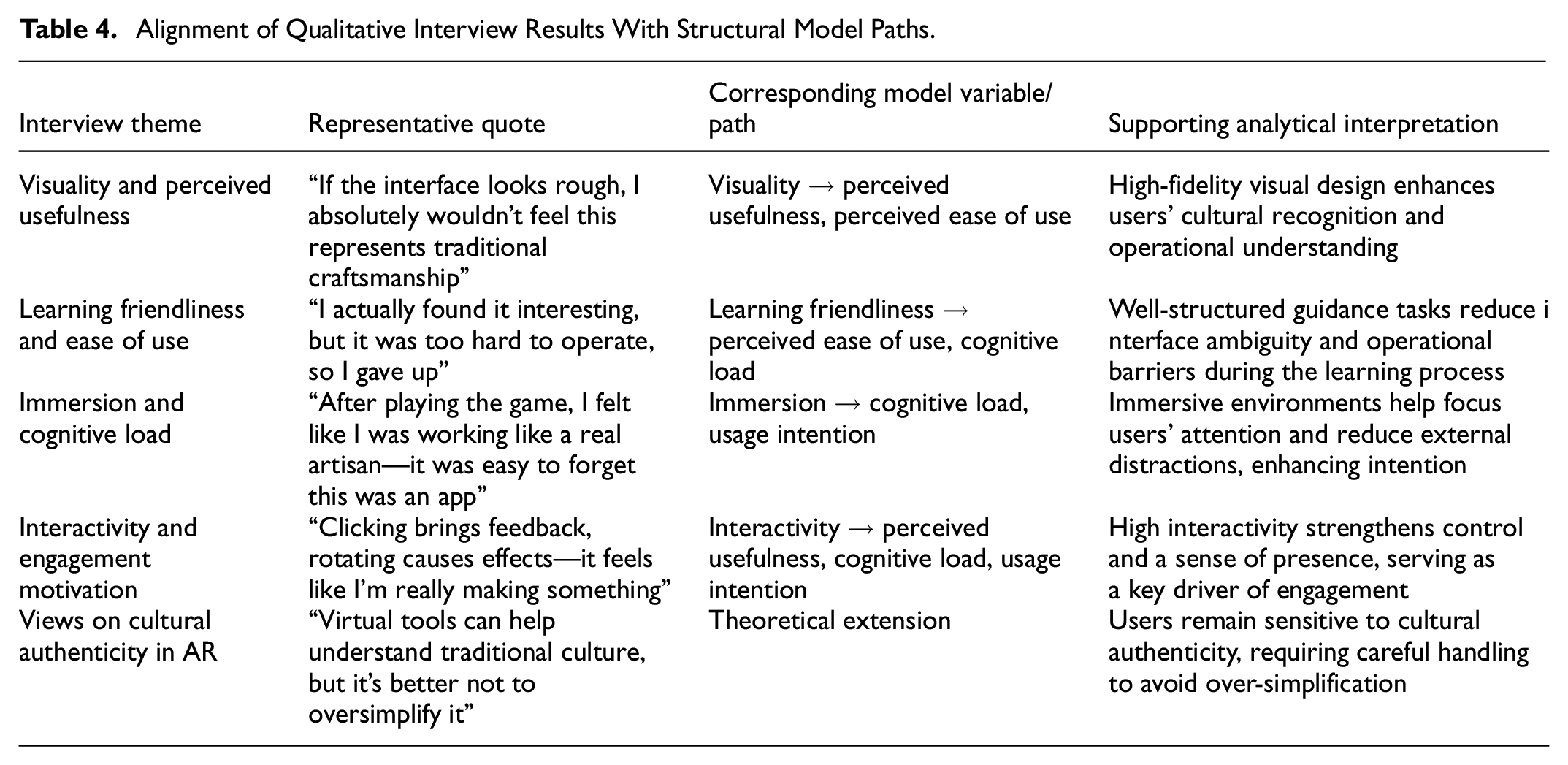
All interviews were audio-recorded with the participant’s consent and transcribed for analysis. A thematic analysis approach was employed to conduct preliminary coding and categorization to identify key perceptual dimensions and shared user feedback. The qualitative findings were integrated into the model development and discussion sections as complementary evidence. They were cross-validated with the results of the quantitative path analysis (see Table 4), enhancing the research findings’ depth and theoretical robustness.
Alignment of Qualitative Interview Results With Structural Model Paths.
Model Evaluation and Hypothesis Testing
Reliability and Validity Assessment
Based on 412 valid responses, this study used SPSS 27.0 to calculate Cronbach’s α values for each measurement construct. The overall scale yielded an α value of .919, while the eight latent variables demonstrated α values ranging from .816 to .862—all exceeding the commonly accepted threshold of .70—indicating satisfactory internal consistency and reliability of the instrument. However, some scholars have noted that excessively high α values (e.g., >.90) may signal potential redundancy among measurement items (Tavakol & Dennick, 2011). Therefore, future research is encouraged to refine and streamline item design to enhance the structural validity and practicality of the measurement instrument.
During the confirmatory factor analysis (CFA) phase, AMOS software examined the measurement structure comprising 8 latent constructs and 28 observed items (see Table 5). AMOS was selected as the analytical tool for structural equation modeling (SEM) due to its user-friendly graphical interface, which facilitates testing complex theoretical models and mediating effects. Moreover, its covariance-based estimation approach is well-suited to research contexts with a clearly defined theoretical framework and a large sample size (n > 200). The CFA results demonstrated that the average variance extracted (AVE) values for all eight constructs exceeded the threshold of .50, and composite reliability (CR) values were above .70, indicating strong convergent validity of the measurement model. In addition, following the Fornell–Larcker criterion (Fornell & Larcker, 1981), the square roots of the AVEs for each construct were greater than their respective inter-construct correlation coefficients, providing evidence of satisfactory discriminant validity (see Table 6).
Relationships Between Observed Variables and Latent Variables.

Fornell–Larcker Discriminant Validity Matrix.
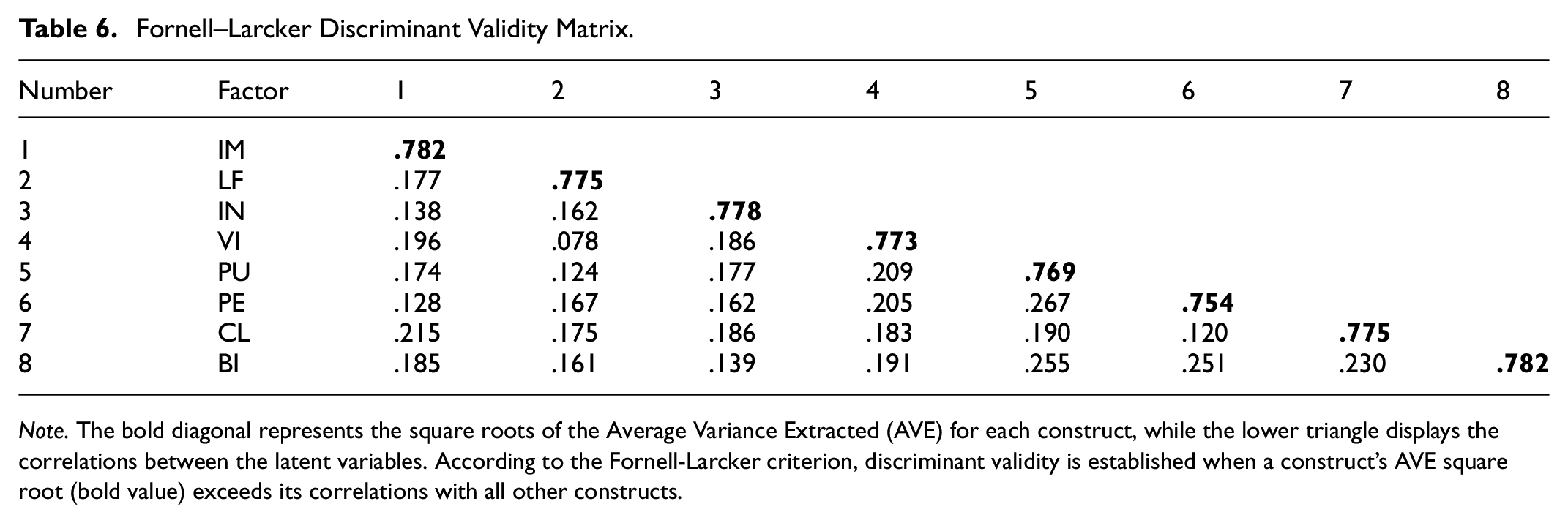
Note. The bold diagonal represents the square roots of the Average Variance Extracted (AVE) for each construct, while the lower triangle displays the correlations between the latent variables. According to the Fornell-Larcker criterion, discriminant validity is established when a construct’s AVE square root (bold value) exceeds its correlations with all other constructs.
Fit Results and Hypothesis Testing
The structural equation model was employed to test the hypothesized framework of user adoption intention, using data from 412 valid responses. Model fit was assessed using AMOS 27.0, and the results indicated a satisfactory fit between the theoretical model and the empirical data (see Table 7). Regarding absolute fit indices, the chi-square to degrees of freedom ratio (CMIN/df) was 1.200, within the acceptable range of 1 to 3. The root means square error of approximation (RMSEA) was .022, below the threshold of .05. The goodness-of-fit index (GFI = .933) and the adjusted goodness-of-fit index (AGFI = .919) exceeded the recommended cutoff value of .80. Regarding incremental fit indices, the normed fit index (NFI = .922), the comparative fit index (CFI = .986), and the incremental fit index (IFI = .986) were all above the commonly accepted threshold of .90, indicating strong model performance. For parsimonious fit, the parsimonious goodness-of-fit index (PGFI) was .766, which exceeds the minimum acceptable value of .50. These results suggest that the proposed structural model demonstrates fits well with the observed data. The standardized parameter estimates for the hypothesized paths are illustrated in Figure 8.
Fit Test Results of Main Indicators.


Test results of hypotheses for user willingness mode.
The results of the structural model are presented in Table 8. In the table, the “Estimate” values represent the standardized path coefficients between latent constructs and can be used to assess the relative influence among variables. The data show that visuality has a positive and statistically significant effect (p < .05) on all three associated latent variables, indicating a strong positive influence. Accordingly, the empirical data supports hypotheses H4a, H4b, and H4c. In addition, the path coefficients from immersion, learning friendliness, interactivity, and visuality to cognitive load are positive and statistically significant at the p < .05 level, supporting hypotheses H1c, H2c, H3c, and H4c. Furthermore, immersion, learning friendliness, interactivity, and perceived ease of use all positively and significantly affect perceived usefulness, confirming hypotheses H1a, H2a, H3a, and H4. Finally, the path coefficients from perceived usefulness, perceived ease of use, and cognitive load to usage intention are all positive and highly significant (p < .001), supporting hypotheses H6, H7, and H8.
Fit Results of the Theoretical Model and Hypothesis Testing.

Note ***indicates p< 0.001.
Results Discussion
Review of Key Findings
This study’s results indicate that the key factors influencing users’ intention to adopt AR technology in craftsmanship-based ICH games include immersion, learning friendliness, interactivity, visuality, perceived ease of use, perceived usefulness, and cognitive load. These results validate/confirm/endorse the proposed hypotheses.
Comparative Analysis With Existing Research
Some of the findings of this study are consistent with previous research. Specifically, the significant effects of perceived ease of use and perceived usefulness on users’ intention to adopt AR technology align with the core propositions of Davis (1989) classic Technology Acceptance Model (TAM). Similarly, the importance of visuality and interactivity in shaping user experience echoes the conclusions of Tom Dieck and Jung (2017). However, this study also diverges from existing literature in several important ways. While prior studies such as Hamari et al. (2014) have primarily focused on the general benefits of AR and gamification for user satisfaction and learning outcomes, they have paid relatively little attention to the psychological mechanisms through which specific AR features—such as visual design and interaction patterns—affect adoption decisions via cognitive load. Therefore, this study integrates Cognitive Load Theory (CLT) with the TAM framework. Empirical analysis reveals how visual and interactive elements influence users’ adoption intentions by modulating their cognitive load, extending the theoretical scope of traditional technology acceptance models. Moreover, building on the work of Kysela and Štorková (2015) and Huang et al. (2023), this study further identifies and validates the roles of immersion and learning friendliness as additional perceptual dimensions influencing user acceptance. The introduction and empirical verification of these new dimensions enrich the theoretical framework of user perception research and offer more comprehensive and actionable insights for designing AR applications in craftsmanship-based ICH.
The roles of perceived usefulness and perceived ease of use in shaping users’ intention to adopt craftsmanship-based ICH AR games are consistent with Davis’s (1993) findings. However, this study further uncovers the critical influence of visuality on these traditional TAM variables. It extends the existing model by addressing a key theoretical limitation—namely, the model’s overemphasis on system functionality while overlooking the role of specific technological features. This finding suggests that aesthetic and perceptual design elements should be more explicitly integrated into future extensions of the TAM framework.
In contrast to prior studies, this research finds that immersion does not significantly enhance perceived ease of use. One possible explanation is that the complex interaction scenarios typical of craftsmanship-based AR games may increase users’ cognitive load, diminishing the expected benefits of immersion as posited by traditional experiential theories. Furthermore, the immersive experience may be constrained by technical factors such as device performance, network stability, and scene loading speed. These interruptions can disrupt users’ engagement with the virtual environment, weakening their perception of the system’s ease of use.
Theoretical Contributions and Model Innovation
At the theoretical level, this study advances the integration and extension of the Technology Acceptance Model (TAM) and Cognitive Load Theory (CLT) within digital cultural heritage. While TAM, as a foundational theory in information systems research, has been widely employed to examine the adoption of emerging technologies, existing studies in cultural contexts—particularly those related to craftsmanship-based ICH—tend to remain at a macro-level focus on perceived usefulness and perceived ease of use, with limited exploration of how specific perceptual dimensions (e.g., visual design, interaction mechanisms, and immersive experience) shape users’ behavioral pathways. This study incorporates four key variables—immersion, learning friendliness, visuality, and interactivity—based on the interactive characteristics of AR applications in the ICH context to address this gap. Doing so enriches the TAM framework’s structural adaptability and explanatory power in multi-sensory cultural experience environments, offering a more nuanced theoretical model for understanding user adoption behavior in digitally mediated heritage experiences.
On the other hand, although Cognitive Load Theory (CLT) has been widely applied in educational psychology and task performance research, its application in digital cultural heritage communication remains nascent. This study structurally incorporates CLT into the TAM framework by introducing cognitive load as a mechanism mediating between perceptual dimensions and usage intention. In doing so, it constructs a psychological mechanism chain of “perceptual dimensions → cognitive load → adoption intention,” revealing the cognitive processing logic that underlies user behavior within dual contexts of cultural immersion and technological interaction. The findings are further supported by Mokmin et al. (2024), who demonstrate that cognitive load is critical in assessing users’ readiness to engage with information technologies and significantly influences their behavioral decision-making. Similarly, the results align with Chen et al. (2024), who identified the mediating role of cognitive load in AR-based virtual cultural heritage experiences. Together, these findings provide deeper psychological insight into AR technology adoption behaviors and expand the theoretical boundary of CLT by validating its applicability in multi-sensory, culturally intensive environments.
Triangulation of Quantitative and Qualitative Findings
This study conducted a supplementary analysis based on semi-structured interviews with 12 participants and the structural equation modeling (SEM) results to enhance the explanatory depth of the research findings. The interview data supported the theoretical assumptions embedded in the model and offered more profound insight into users’ experiential mechanisms related to key perceptual dimensions, including visuality, interactivity, learning friendliness, and immersion. Specifically, many participants emphasized the realism of visual presentation as a crucial factor in helping them understand the complexity of craftsmanship and cultural detail, reinforcing the significant positive influence of visuality on both perceived usefulness and perceived ease of use. One interviewee stated, “If the interface looks rough, I don’t feel it really represents traditional craftsmanship.”
In discussions about learning friendliness, several users reported that clear navigation guidance and task structuring helped them comprehend intricate craft processes, reducing confusion and operational fatigue. These insights support the proposed pathway in which learning friendliness influences usage via its impact on cognitive load. Moreover, immersion and interactivity were frequently cited as key to enhancing experiential fluency and cultural engagement. One participant remarked, “When I tap something and it makes a sound or changes, it feels like I’m really operating a traditional craft.” This feedback highlights the motivational value of interactive feedback mechanisms and further substantiates the mediating role of interactivity in linking cognitive load and behavioral intention.
Practical Implications and Design Optimization Recommendations
This study proposes concrete design optimization strategies grounded in empirical findings and illustrated through representative domestic and international case studies to enhance user adoption of craftsmanship-based ICH AR games, thereby improving the practical applicability of the research.
First, in terms of visual interface design, it is essential to incorporate traditional aesthetic elements—such as regional color palettes, craft motifs, and cultural symbols—to enhance the interface’s cultural recognizability and emotional resonance. For example, the “Jingdezhen Pottery AR Experience” project employs 3D modeling to meticulously recreate key processes such as throwing, trimming, and glazing while integrating classic porcelain patterns and traditional ceramic terminology. This approach allows users to engage in immersive operations while gaining a more holistic understanding of ceramic culture. Similarly, the “Fresco AR Restoration” project utilizes high-resolution imagery and contextual embedding techniques to superimpose historical frescoes onto their original architectural environments. This method guides users to comprehend the artwork’s religious function and aesthetic value within their authentic spatial context, enhancing cultural presence and historical immersion.
Second, regarding interaction design, emphasis should be placed on intuitive operations and streamlined workflows to lower the technological barrier, allowing even novice users to engage in simulated craftsmanship experiences. The operational process may be enhanced by incorporating haptic feedback and guided task instructions, enabling users to progressively adopt the logic of the craft through multi-sensory engagement while fostering curiosity and exploratory motivation. Moreover, interaction difficulty should be moderately adjustable, and personalized learning pathways should be offered to accommodate users’ diverse needs, increasing sustained engagement and promoting cultural identification.
Finally, the content architecture should be enriched with contextual craft-related information, such as the names of tools, procedural steps, sources of raw materials, and quotations from master artisans. By parallel integration of technical processes and cultural context, the experience can form a complete cultural transmission loop, ensuring skill simulation and value interpretation.
These practical strategies enhance the user experience and provide actionable guidance for implementing ICH-related AR products’ design and cultural value realization in real-world applications.
Cultural Adaptability and Implementation Challenges
This study is primarily based on data collected from Chinese users. However, the acceptance of AR technology may vary considerably across different cultural contexts. In particular, users’ cultural expectations regarding the authenticity of intangible cultural heritage (ICH) can differ by region. For example, users in some East Asian countries emphasize preserving ICH authenticity and traditional values, whereas users in Western countries may be more receptive to technologically mediated cultural integration and innovation. Accordingly, the cross-cultural dissemination of AR applications should consider users’ cultural acceptance psychology and value orientations. Failing to address such cultural differences may result in technology adoption barriers arising from misaligned perceptions of cultural authenticity. Future research should explore comparative, cross-cultural studies to understand better how AR-enabled heritage experiences can be adapted to diverse global audiences while maintaining cultural sensitivity and relevance.
Economic factors may significantly constrain the widespread adoption of AR technology. While AR offers enhanced user experiences, it requires more advanced hardware, stable network environments, and robust technological infrastructure compared to traditional presentation methods. As a result, users in economically underdeveloped regions or those with limited financial resources may face access barriers due to the high cost of devices and inadequate digital infrastructure. These limitations could hinder the practical application of AR in the digital dissemination of intangible cultural heritage. Therefore, future efforts to promote craftsmanship-based ICH AR games should explore low-cost technological solutions or develop adaptable application models that align with varying economic conditions. Such strategies would help improve the accessibility and inclusiveness of AR technology, enabling a broader range of users to benefit from immersive heritage experiences.
While this study highlights the positive effects of visuality and interactivity on users’ acceptance of AR-based ICH games, the potential impact of AR technology on heritage authenticity and traditional integrity should not be overlooked. Digital presentations’ visual immediacy and entertainment value may inadvertently dilute traditional craftsmanship’s cultural depth and authentic essence (Zhu et al., 2023). Therefore, in practical applications, it is crucial to ensure cultural sensitivity in AR design, avoiding an overemphasis on sensory stimulation that may compromise the core values of ICH. Several measures can be considered to address this concern: First, the design process should involve close collaboration with ICH practitioners, ensuring that the digitized representations accurately reflect the procedural and cultural nuances of the craft. Second, a heritage expert review mechanism should be established to evaluate the cultural appropriateness of AR content prior to dissemination. Third, through moderate interactivity and story-driven scene construction, users should be guided to fully grasp the cultural context of the ICH practices, thereby preventing the loss of traditional meaning due to excessive gamification or entertainment-driven design. These strategies will help balance technological innovation and cultural preservation, reinforcing the cultural mission of digital ICH dissemination through AR.
Conclusion
This study offers concrete optimization strategies for designing digital cultural heritage platforms by analyzing key factors’ relationships and their layered influence on users’ behavioral intentions. The proposed model and corresponding recommendations enhance the appeal and dissemination effectiveness of craftsmanship-based ICH AR games and support the digital transformation of traditional craft heritage. Furthermore, it helps foster more profound cultural identification and emotional fulfillment for users within digitally mediated cultural environments.
The theoretical contributions of this study are twofold:
(1) It is the first to integrate the Technology Acceptance Model (TAM) with Cognitive Load Theory (CLT) in the context of craftsmanship-based ICH AR games. It clarifies cognitive load’s mediating role in the adoption process, thereby TAM’s theoretical scope.
(2) The study introduces novel perceptual dimensions—including visuality, interactivity, immersion, and learning friendliness—which enrich the theoretical framework of user experience research in digital cultural heritage.
In terms of practical value, the study offers:
(1) Concrete design optimization strategies for craftsmanship-oriented ICH AR games, with particular emphasis on improving visual and interactive design;
(2) Practical guidance for enhancing immersive cultural experiences by reducing cognitive load, thereby contributing to more effective digital dissemination of intangible cultural heritage.
In addition, this study proposes concrete recommendations for optimizing user experience in craftsmanship-based ICH AR games. It provides practical guidance for designing and promoting related platforms. However, the real-world implementation of such applications still faces significant challenges, including high development costs, shortages of skilled professionals, and burdensome content maintenance. It is recommended that cultural institutions collaborate with universities and technology enterprises to explore cost-sharing mechanisms to address these issues. They must actively seek government or cultural funding to support the standardization and sustainable development of relevant technological solutions. This study also has several limitations. First, the sample was primarily obtained through online snowball sampling. Although the research team employed diversification strategies, the respondents were predominantly young, digitally literate Chinese users, which may limit the generalizability of the findings to users of different age groups, cultural backgrounds, or levels of digital proficiency. Second, the study focused on selected cases of craftsmanship-based ICH AR games without covering broader categories of ICH or cross-cultural dissemination contexts. Future research should consider expanding the sample scope to include users from multiple regions and cultural settings and adopt experimental tracking and multi-method triangulation to deepen the understanding of perceptual and behavioral differences across user groups. These efforts would enhance the research findings’ external validity and practical applicability.
Footnotes
Acknowledgements
The authors would like to thank all the participants in this study for their time and willingness to share their experiences and feelings.

Ethical Considerations
This study involved data collection through anonymous surveys, ensuring that no personally identifiable information was recorded or stored. Participants were informed about the purpose of the research and provided their consent to participate voluntarily. As the data are fully anonymized and do not involve sensitive or identifiable information, ethical approval from an institutional review board was not required.
Author Contributions
Shiwen Lai: Conceptualization, developed the core idea for the study, integrating the research framework of the Technology Acceptance Model (TAM) and Cognitive Load Theory (CLT) to analyze user intentions. Data Collection, led the design and distribution of the user perception survey and ensured the quality and completeness of the data collected. Writing—Original Draft, prepared the initial drafts of the manuscript, particularly focusing on the introduction, literature review, and discussion sections. Visualization, designed the figures and tables summarizing the results and theoretical model. Qingfeng Zhang: Supervision, oversaw the research process, provided guidance throughout the study, and ensured alignment with the research objectives. Project Administration, coordinated all aspects of the project, including collaboration between authors and submission preparation.
Funding
The author(s) disclosed receipt of the following financial support for the research, authorship, and/or publication of this article: This study was supported by 2025 Research Grant from Kangwon National University.
Declaration of Conflicting Interests
The author(s) declared no potential conflicts of interest with respect to the research, authorship, and/or publication of this article.
Data Availability Statement
The datasets generated during and/or analyzed during the current study are available from the corresponding author on reasonable request.