




Abstract
Creative thinking shares many characteristics with traditional complex tasks. We investigated whether implicit theories of creativity would affect creative thinking in a way similar to the impact of implicit theories of intelligence on academic tasks. We altered participants’ theories of creativity to be either more incremental or more entity-like. We also examined the impact of working memory (WM) and cognitive load on creative thinking. Cognitive load fully mediated the relationship between implicit theories and creative thinking, with more incremental beliefs linked to lower cognitive load. In addition, cognitive load partially mediated the relationship between WM and creative thinking. Our results support prior research showing that creative thinking draws on cognitive mechanisms similar to those utilized by other complex tasks, but the impact of implicit theories on creative thinking differs from their effect on traditional academic tasks.
Introduction
Creativity refers to thoughts, answers, or products that are both original and useful (Guilford, 1950; Mednick, 1962; Sternberg, 1985). Recently, individual differences in cognitive ability, long known to affect problem-solving and performance on other complex cognitive tasks (Conway & Engle, 1996; Seyler, Kirk, & Ashcraft, 2003), have been linked to creative performance (Chein & Weisberg, 2014; Lee & Therriault, 2013; Lv, 2015; Silvia & Beaty, 2012; Wechsler et al., 2018). Increasingly, creative thinking activities are being conceptualized as complex tasks that require executive processes such as task switching, decision making, and inhibition (Benedek, Franz, Heene, & Neubauer, 2012), which have typically been examined in the context of traditional analytic tasks (Sternberg, 2006).
Success on complex cognitive tasks is influenced by a variety of social and cognitive factors, including beliefs about whether ability can be improved or is fixed (implicit theories; Blackwell, Trzeniewski, & Dweck, 2007; Paunesku et al., 2015), the cognitive load (or mental effort) experienced during tasks (Rosen & Engle, 1997; Sweller, 2011), and individual differences in working memory (WM; Conway & Engle, 1996; Engle, 2002). Although the impacts of WM and cognitive load on complex tasks such as mathematical problem solving (Ayres, 2006a; Beilock & DeCaro, 2007) and retrieval fluency (Rosen & Engle, 1997; Schelble, Therriault, & Miller, 2012) have been studied extensively, their relationship with creative thinking is less clear, particularly in the case of cognitive load. Similarly, the role of implicit theories (i.e., beliefs about the malleability of particular abilities) has been studied primarily in the context of traditional academic tasks (Chen & Pajares, 2010; Job, Dweck, & Walton, 2010; Rattan & Dweck, 2010), and rarely examined in relation to creative thinking. Therefore, we examined how implicit theories of creativity contribute to creative thinking, taking into account individual differences in cognitive load and WM.
Cognitive and Behavioral Consequences of Implicit Theories
Decades of research in social, personality, and more recently, cognitive psychology have demonstrated the influence of implicit beliefs on how individuals process and react to information from their environments (Dweck & Leggett, 1988; Hong, Chiu, Dweck, Lin, & Wan, 1999; Kelly, 1955; Whitehead, 1938). Muis (2007) suggested that the beliefs individuals hold about the limits, source, and nature of knowledge “serve as inputs to metacognitive processes” (p. 183). That is, implicit beliefs influence higher-order processes involved in learning activities, including but not limited to effortful monitoring of comprehension, application of strategies, and persistence (Dweck, 1999; Dweck, Chiu, & Hong, 1995).
The term “implicit theories” has been used to describe individuals’ beliefs or concepts of creativity (e.g., Lim & Plucker, 2001; Lim, Plucker, & Im, 2002; Runco & Bahleda, 1986; Sternberg, 1985), and also the malleability of a particular skill or ability (Dweck, 1999). The present study draws from Dweck’s (1999) implicit theories of intelligence, which fall into two broad categories: entity beliefs (the belief that intelligence is innate and immutable) and incremental beliefs (the belief that intelligence can be developed or changed). Beliefs students hold about the nature of intelligence may influence their approach to challenging tasks, their goals (Grant & Dweck, 2003), and their interpretation of their own performance. Specifically, entity beliefs about intelligence have been linked to lower effort when students are faced with challenges or negative feedback, higher performance goals to showcase ability or to avoid negative judgments, and negative attributions for failures; whereas students who hold incremental beliefs about intelligence demonstrate greater effort to overcome challenges and develop adaptive behaviors (e.g., learning strategies) when faced with failure (Cain & Dweck, 1995; Dweck, 1991; Heyman, Dweck, & Cain, 1992). However, others have found no relationship between implicit theories and response to task difficulty (Li & Bates, 2017). The contradiction of these more recent results with past work on implicit theories suggests a need to further investigate the effect of implicit theories on student behavior.
Implicit theories may also affect complex task performance. Some studies demonstrate that students holding incremental beliefs about intelligence perform better on academic tasks than those with entity beliefs (Bergen, 1991; Blackwell et al., 2007). Under experimental conditions, different implicit theories lead to corresponding consequences in academic performance, judgments of others, and self-evaluation (e.g., Chen & Pajares, 2010; Heyman et al., 1992; Job et al., 2010; Rattan & Dweck, 2010). For example, exposing students to incremental theories of intelligence may reduce anxiety during intelligence tasks (Da Fonseca et al., 2008). However, recent investigations of implicit theory interventions have detected weak impacts on performance (Sisk, Burgoyne, Sun, Butler, & Macnamara, 2018) or, in the case of one large study of university students, a slight negative impact (Bahník & Vranka, 2017). Therefore, before suggesting that implicit theory interventions could benefit additional domains (e.g., creative thinking), it is important to determine whether incremental beliefs have a positive impact on performance in that domain, and whether they influence other factors known to affect performance.
Recently, incremental views of creativity have been linked to adaptive achievement goals and higher self-efficacy (Puente-Díaz & Cavazos-Arroyo, 2017). Given the growing evidence that creative thinking is dependent upon complex cognition (Lee & Therriault, 2013; Lv, 2015; Silvia & Beaty, 2012) and the impact of implicit beliefs on other types of cognitively demanding tasks (e.g., Dweck & Leggett, 1988; Kelly, 1955), we posit that individuals’ implicit theories of the nature of creativity may also influence variables associated with creative thinking performance. For example, individuals who view a creative task as challenging may approach or experience the task differently if they hold entity beliefs than if they hold incremental beliefs (i.e., if they see creativity as a “gift” or innate, rather than as a skill that can be improved). Furthermore, like intelligence, many commonly held assumptions about creativity are untrue (Plucker, Beghetto, & Dow, 2004), and some of these beliefs may be harmful to creative thinking. For example, the “you have it or you don’t” view of creativity is akin to entity beliefs about intelligence, which some have shown to be detrimental to academic work (Cain & Dweck, 1995; Paunesku et al., 2015). Studies of beliefs about creativity (as a fixed or malleable trait) indicate that people hold entity-like beliefs, that is, creative individuals are creative because of some gift or inherent special ability, rather than the result of practice (Sternberg & Lubart, 1996, but see Daly, Mosyjowski, Oprea, Huang-Saad, & Seifert, 2016). Incremental beliefs are associated with putting forth much effort on challenging tasks, whereas entity beliefs may lead to less effort due to viewing performance outcomes as the result of a preexisting, unchangeable trait (Hong et al., 1999).
Altering Implicit Theories
Due to the potential negative consequences (Cain & Dweck, 1995; Crum, Salovey, & Achor, 2013) and inaccuracies (Plucker et al., 2004; Sternberg & Lubart, 1996) that characterize some implicit theories, finding ways to change individuals’ implicit theories may be advantageous. Fortunately, brief interventions are capable of influencing both mindsets and related outcomes (Yeager & Walton, 2011). Researchers have successfully altered participants’ implicit theories of a variety of characteristics, including intelligence (Blackwell et al., 2007; Rhew, Piro, Goolkasian, & Cosentino, 2018), stress (Crum et al., 2013), personal attributes such as aggression (Yeager, Trzensnieweski, & Dweck, 2013) and body weight (Burnette, 2010). Both one-time interventions (Burnette, 2010; Chiu, Hong, & Dweck, 1997; Crum et al., 2013; Nussbaum & Dweck, 2008) and those delivered over several sessions (Blackwell et al., 2007; Yeager et al., 2013) have successfully altered implicit theories, as well as motivation (Rhew et al., 2018), behaviors (Sriram, 2014; Yeager et al., 2013) and outcomes (Blackwell et al., 2007; Crum et al., 2013) associated with those beliefs. For example, Aronson, Fried, and Good (2002) instructed participants to write letters describing intelligence as malleable, which significantly and positively affected GPA, compared with a control group. Similarly, participants who read a brief article describing personal traits as either fixed or malleable displayed significantly different judgments of others’ behavior (Chiu et al., 1997). We used a similar intervention in the present study to alter participants’ implicit theories of creativity.
WM and Creative Thinking
Executive functions, including but not limited to WM, updating, and inhibition, play important roles in creative thinking (Beaty, Silvia, Nusbaum, Jauk, & Benedek, 2014; Benedek, Jauk, Sommer, Arendasy, & Neubauer, 2014; Lee & Therriault, 2013) and creative problem solving (Chein & Weisberg, 2014; Lv, 2015; Silvia & Beaty, 2012). Individuals with higher WM are more successful at retaining relevant information in their short-term stores, inhibiting irrelevant information, and updating the contents of WM (Conway & Engle, 1994). Creativity engages both inhibition (Benedek et al., 2012) and disinhibition (Dietrich & Kanso, 2010). During creative thinking tasks, numerous original ideas must be produced (a process facilitated by disinhibition) and evaluated (a process facilitated by inhibition). The dual process of generating a large number of divergent ideas (fluency), followed by an inductive process of selecting high-quality ideas (i.e., providing responses high in originality) draws upon WM (Gilhooly, Fioratou, Anthony, & Wynn, 2007; Lee & Therriault, 2013; Silvia & Beaty, 2012). This notion is also supported by evidence that early in the creative process, cognitive disinhibition is predominant, whereas later, high inhibition is more common (Cheng, Hu, Jia, & Runco, 2016). However, some forms of creativity, such as fluency, may not benefit from controlled processing (Barr, Pennycook, Stolz, & Fugelsang, 2015). Similarly, activities designed to “broaden” attention do not appear to benefit analytic thinking, but do improve creative thinking (Liu, 2016), and some evidence suggests that higher WM is not advantageous during some types of creative thinking tasks (Van Stockum & DeCaro, 2013). Therefore, it is important to continue examining this relationship, as well as to measure the impact of WM on creative thinking when considering other individual differences known to affect complex task performance, such as cognitive load.
Cognitive Load and Complex Tasks
Cognitive load, often measured as “mental effort” (Paas, 1992), refers to the cognitive resources needed to perform a task. It is a key consideration in understanding how particular tasks tax an individual’s WM during the learning process. Generally, learners who report high mental effort during complex tasks are more likely to perform poorly (Redifer, Therriault, Lee, & Schroeder, 2016; Sweller, 1994). As with any task, during creative thinking, intrinsic cognitive load exists due to the difficulty of the task itself, but additional load (i.e., extraneous load that is not related to the task itself) could be induced by factors within and outside the person completing the task (Paas, Tuovinen, Tabbers, & Van Gerven, 2003; Sweller, 2011). Because creative thinking shares many characteristics with other complex cognitive tasks that are detrimentally affected by increased cognitive load, it is reasonable to expect that increased cognitive load would have a detrimental impact on creative thinking.
WM and Cognitive Load
Efficient use of cognitive resources is limited by WM capacity (Mayer & Moreno, 2003; Paas et al., 2003) and also influenced by other factors such as an individual’s characteristics and existing knowledge, as well as any new information or task-specific features they encounter (Paas et al., 2003; Wouters, Paas, & van Merriënboer, 2009). Students who view a task as requiring greater mental effort may approach a complex task differently than students who view the task as easy. Individuals with greater WM capacity have more attentional capacity to devote to complex tasks; thus, an individual with high WM may experience less cognitive load (i.e., find the task less difficult) than an individual with low WM. The established relationships between WM and performance on complex tasks (Geary, Frensch, & Wiley, 1993; Linderholm & van den Broek, 2002; Schelble et al., 2012), and between cognitive load and complex task performance (Beilock & DeCaro, 2007; Paas et al., 2003), support this idea. Thus, individuals with fewer attentional resources (i.e., lower WM) are likely to perceive a complex task as requiring more mental effort than those who possess more attentional resources. Examining the WM–cognitive load relationship in the context of creative thinking tasks is particularly important, because of the paucity of research on cognitive load and creative thinking, and also because, for some creative thinking tasks, high WM may not be advantageous (Van Stockum & DeCaro, 2013). Thus, it is important to determine whether the usual advantages afforded by high WM and low cognitive load are present during creative thinking tasks and whether higher WM is associated with lower cognitive load during creative thinking.
Implicit Theories and Cognitive Load
Entity beliefs are associated with negative emotions and increased anxiety during goal-related activities. Instructors who express entity beliefs about academic ability to students decrease students’ motivation and expectations for their own performance (Rattan, Good, & Dweck, 2012). Entity beliefs are also associated with increased procrastination (Howell & Buro, 2009), negative emotions (Burnette, Boyle, VanEpps, Pollack, & Finkel, 2013), and self-handicapping (Rhodewalt, 1994; Steel, 2007). Holding entity beliefs about one’s ability to succeed at a particular task may focus students’ attention on factors they cannot control and impair self-regulation (Howell & Buro, 2009), which could make the task seem more difficult. Entity theories of creativity, then, may induce extraneous cognitive load during creative thinking. Furthermore, if creative tasks draw on the same cognitive resources as traditional academic tasks (Ayres, 2001; Leutner, Leopold, & Sumfleth, 2009; Sweller, 1994), increased cognitive load due to entity beliefs about creativity may have a negative impact on creative thinking. However, given that entity beliefs are not always harmful (Li & Bates, 2017), and investigations of individuals’ beliefs about the mutability of creativity are fairly recent (Royston & Reiter-Palmon, 2017), it is important to determine how implicit beliefs of creativity (i.e., whether creativity is fixed or malleable) factor into creative thinking.
Based on the premise that implicit theories of creativity have the potential to affect cognitive load during creative tasks, encouraging individuals to hold incremental views of creativity may be one way to support students’ performance in the face of increased cognitive load, due to incremental views’ emphasis on embracing challenges and not fearing failure. Entity beliefs, however, may increase the mental effort required during creative thinking in a way that does not facilitate creative thinking performance. That is, if a student believes that creativity is fixed and cannot be improved, the student may feel doomed to fail, perceive the task as difficult, and see no reason to put forth effort. In the present study, we investigated whether exposing students to incremental or entity views of creativity would affect their implicit theories of creativity, as well as whether these implicit theories would affect cognitive load during creative thinking tasks, and consequently, creative thinking performance.
The Combined Relationships Among Implicit Theories, Cognitive Factors, and Creative Thinking
Given the impacts of cognitive load and WM on complex tasks and the similarity of the demands of creative thinking tasks to other complex tasks (Beaty & Silvia, 2012; Benedek et al., 2012; Benedek et al., 2014; Nusbaum & Silvia, 2011; Lee & Therriault, 2013; Silvia, 2015), links among WM, cognitive load, and creative thinking are likely. Although disinhibition may benefit creative thinking initially (Cheng et al., 2016), as the process of ideation progresses, disinhibition can allow task-irrelevant material to increase cognitive load (Cheng et al., 2016; Cools, 2008; Dreisbach & Goschke, 2004). Here, WM can serve as a control mechanism to focus attention and resources toward systematically selecting high-quality ideas (Nijstad & Stroebe, 2006). Therefore, in the later stages of creative thinking, negotiating the numerous ideas generated (fluency) requires focus (cognitive control), updating, and inhibition (Baas, De Dreu, & Nijstad, 2008; Nijstad, De Dreu, Rietzschel, & Baas, 2010). Thus, WM resources must be shifted between generating ideas (fluency) and determining their appropriateness (i.e., whether they are original). Taken together, it is conceivable that both WM and cognitive load affect creative thinking performance (De Dreu, Nijstad, Baas, Wolsink, & Roskes, 2012). In fact, De Dreu et al. (2012) found that musicians who completed an insight task under high cognitive load demonstrated less creative insight. In the same study, those with higher WM produced more creative musical improvisations. We expected a similar relationship between cognitive load and creative thinking in the present study.
Finally, to our knowledge, the relationship between implicit theories of creativity and cognitive load during creative tasks has not been studied. However, in light of the impact of implicit theories on self-regulation (Bråten & Strømsø, 2005; Burnette et al., 2013) and anxiety (Burnette et al., 2013; Da Fonseca et al., 2008), a relationship between implicit theories and cognitive load during creative tasks is probable. Given the cognitive demands and constraints of creative thinking tasks (i.e., not only generating ideas, but doing so in a novel, unusual, and useful way), the impact of extraneous cognitive load on creative thinking performance may be similar to its negative impact on other cognitively demanding tasks. Determining how implicit theories influence cognitive load during creative tasks (while taking other individual differences, such as WM, into account) may provide new information about the role of cognitive load in creative thinking. We expected entity beliefs to lead to greater cognitive load than incremental beliefs during creative tasks, and greater cognitive load was expected to hinder creative thinking.
The Present Study
The purpose of the present study was twofold: First, we experimentally investigated whether exposing students to entity or incremental views of creativity would influence their implicit theories of creativity, as it has in past studies of implicit theories of intelligence (Bergen, 1991; Hong et al., 1999), as well as whether those beliefs would affect creative thinking performance. Second, we examined the theoretical relationships between implicit theories, WM, cognitive load, and creative thinking performance. We adapted Bergen’s (1991) method of altering students’ implicit theories of intelligence (using articles that endorsed entity vs. incremental views of the origins of creativity) to alter students’ theories of creativity. Creative thinking was measured using fluency (i.e., number of ideas) and originality (i.e., how uncommon ideas were) ratings on divergent thinking (unusual uses and metaphor) tasks (Goff & Torrance, 2002; Silvia & Beaty, 2012).
Participants exposed to an article describing creativity as malleable were expected to report more incremental theories of creativity than they did prior to the article, and those who read an article describing creativity as fixed were expected to report more entity-like beliefs. Based on Hong et al.’s (1999) findings, we expected students exposed to incremental beliefs about creativity to perform better on creative thinking tasks than students exposed to entity beliefs. Individuals with higher WM were expected to perform better on creative thinking tasks, but we hypothesized that cognitive load would mediate this relationship: Those with higher WM were expected to report less cognitive load, and less cognitive load, in turn, was expected to predict better creative thinking. Although incremental implicit beliefs of creativity should improve performance, we expected a similar mediation effect: Cognitive load was expected to mediate the influence of implicit theories on creative thinking performance, with more incremental theories predicting lower cognitive load, and lower cognitive load predicting better creative thinking performance.
Participants
A total of 397 undergraduate students participated in both studies. Participants included freshmen, sophomores, juniors, and seniors (mean year in college = 1.65, SD = 1.0), and the mean age of participants was 19.5 years (SD = 3.02). The sample was 73.6% White, 16.1% African American, 3% Latino/Hispanic, 1.3% Asian, 3.4% of participants indicated multiple races/ethnicities or selected “other,” and 2.5% provided no response. The mean GPA of participants in the sample was 2.86 (SD = 0.87). The sample was 71% female. Participants received course credit for the online portion of the study along with additional course credit and US$15 for participation in the in-person portion of the study.
Materials
Implicit theory of creativity articles
Bergen’s (1991) implicit theory of intelligence articles were modified to develop articles promoting either an entity or incremental view of creativity. For example, the incremental article statement regarding creativity, “Gardner’s studies show that a person’s level of motivation can have a profound effect on creativity. He found that creative children placed in ‘dull’ environments tended to become less creative unless they were motivated to learn,” was the result of replacing “intelligence” and “intelligent” with “creativity” and “creative,” respectively, in the original incremental statement regarding intelligence. The entity article statement, “current research shows that almost all of a person’s creativity is either inherited or determined at a very young age” was the result of replacing “intelligence” with “creativity” in Bergen’s original article. Both articles described a highly creative child and then summarized research suggesting that creativity was the result of genetics (entity article) or the result of experience, and could be improved (incremental article). The articles appeared to be from Psychology Today, and were titled, “The Origins of Creativity: Is the Nature-Nurture Controversy Resolved?” Each article was two single-spaced pages long, organized in columns in traditional magazine format.
Implicit theories of creativity scale
The theories of intelligence scale (TIS; adapted from Dweck et al., 1995) was adapted to measure implicit theories of creativity rather than intelligence (see Appendix A). For example, the item, “You have a certain amount of intelligence and you can’t really do much to change it” was changed to “You have a certain amount of creativity and you can’t really do much to change it.” Of the total 16 items, nine items were statements endorsing the entity view of creativity (e.g., “You have a certain amount of creativity, and you can’t really do much to change it”) and seven items were statements that endorsing the incremental view of creativity (e.g., “You can always substantially change how creative you are”). Each item was rated on a 6-point Likert-type scale, ranging from 1 (strongly disagree) to 6 (strongly agree). Similar modifications of the TIS have been used to examine beliefs about social stereotyping (Levy, Stroessner, & Dweck, 1998). Our adapted measure of implicit theories of creativity demonstrated acceptable internal reliability (Cronbach’s α = .746) in line with published alpha coefficients for other measures of individual differences in values and beliefs (Peterson, 1994). Higher scores on the implicit theories of creativity scale indicate more incremental beliefs about the nature of creativity.
The metaphor task
The metaphor task prompt included instructions about the definition of a metaphor and asked participants to generate creative metaphors about either the worst food they had ever eaten or the most boring class they had ever attended (Silvia & Beaty, 2012). Participants were given 5 min per prompt to generate as many metaphors as they could.
The unusual uses task
The unusual uses task prompt asked participants to generate as many unusual uses as they could for a household object (Goff & Torrance, 2002). Participants were given 3 min for each unusual uses prompt (e.g., “You will be provided with a common household object. Try to come up with as many creative and unusual uses as possible for the given object. Object: wooden pencil”).
Responses on the metaphor and unusual uses tasks were scored for fluency (total number of responses per prompt) and originality (score ranging from 1 = not creative to 5 = very creative, see Goff & Torrance, 2002; Silvia & Beaty, 2012) by two trained raters. Interrater reliability for the ratings of each task was high (Cronbach’s α of .80 or above). The snapshot scoring method (Silvia, Martin, & Nusbaum, 2009; Silvia et al., 2008) was used to score the originality of participants’ responses on the unusual uses and metaphor tasks. This subjective scoring method involves providing one score for each participant’s set of responses. The snapshot scoring method demonstrates high interrater reliability (Silvia et al., 2008) and construct validity (Silvia et al., 2009). Sample responses for the metaphor task and unusual uses task can be found in Appendix B.
Cognitive load
After each task, participants rated the mental effort required of the task on a scale ranging from 1 (not difficult) to 7 (very difficult; Ayres, 2006b). Subjective cognitive load reports are valid (Ayres, 2006b) and reliable measures of mental effort; evidence of convergent, construct, and discriminant validity has been reported (Ayres, 2006b; Paas et al., 2003; Paas & van Merriënboer, 1994). Self-report measures of cognitive load are sensitive to changes in task difficulty and are often used during complex tasks when dual-task methodology would not be feasible (DeLeeuw & Mayer, 2008).
WM task
WM was measured using the automated Symmetry Span (SymSpan) task (Unsworth, Redick, Heitz, Broadway, & Engle, 2009). The SymSpan is a reliable and valid measure of complex WM span (Unsworth et al., 2009). The SymSpan consists of 12 trials during which participants assess the symmetry of a series of matrices. After choosing “yes” or “no” for symmetry, a 4 × 4 grid containing a red box appears (the participant’s task is to remember the position of the red box). After several combinations, participants view a blank grid and must recall the box positions in correct order from the previous grid screens. Trial length ranges from two to five symmetry-memory matrices per trial. SymSpan scores consisted of total number of correct box positions recalled, and SymSpan score was treated as a continuous variable in all analyses.
Procedure
After providing informed consent, participants completed the implicit theories of creativity scale online using Qualtrics survey administration software. One week later, participants completed the remainder of the study in person. They were randomly assigned to read the incremental theories of creativity article, the entity theories of creativity article, or a control article about sea otters (Roediger & Karpicke, 2006) for 6 min. After reading the article, participants completed a brief questionnaire that included items to ensure that they attended to and understood the article (e.g., “In the space below, please briefly describe the main points of the article(s) you read”). Next, participants completed a paper-and-pencil version of the implicit theories of creativity scale. After the article and questionnaire tasks, participants completed a metaphor task and an unusual uses task. Participants were given 3 min for each unusual uses and metaphor prompt. The order of the tasks was counterbalanced. After each task, participants rated the mental effort associated with the task. Following the creative thinking tasks, participants completed the SymSpan task and provided demographic information.
Analyses
A power analysis showed that approximately 54 participants were needed per condition to detect a .70 or medium effect size at a .05 significance level. There were 135 participants in the entity article condition, 132 participants in the incremental article condition, and 130 participants in the control article condition. A one-way mixed ANOVA was used to compare differences in implicit theories of creativity between article groups before and after exposure to the theory of creativity articles. ANCOVAs were conducted to compare differences in participants’ creative thinking by article condition (entity vs. incremental vs. control). Assigned article was the independent variable, and WM and cognitive load were included as covariates in the ANCOVAs to examine their effects on unusual uses and metaphor fluency and originality scores.
Finally, a structural equation model (SEM) was estimated to explore the relationships between implicit theories, cognitive load, WM, and creative thinking using Mplus 7.11 (Muthén & Muthén, 1998-2011). The fit of the SEMs were evaluated based on the following recommended cut-off criteria: root mean square error approximation (RMSEA) ≤ 0.08, comparative fit index (CFI) ≥ 0.90, and standardized root mean square residual (SRMR) ≤ 0.06 (Hu & Bentler, 1998, 1999); Although a probability value of α = .05 for the chi-square (χ2) test statistic is also reported, because χ2 is sensitive to sample size and model complexity, goodness of fit indices were used to determine model fit (Kline, 2015). A Monte Carlo simulation power analysis using hypothesized variable relational values indicated that a sample size of 200 demonstrated adequate power (> .9 on all parameters) in respect to the SEM model. Specifically, this simulation included a standardized indirect effect of .06, which translates to approximately 16% of the variance explained in the latent dependent variable, all regressive paths were specified at .3, and all factor loadings were specified at .6 for the latent variable (Wolf, Harrington, Clark, & Miller, 2013). Thus, our sample size of 397 was sufficient for the SEM.
Results
Article manipulation changed students’ theories of creativity
Prior to reading the implicit theory of creativity articles, there were no significant differences in students’ theories of creativity among the three randomly assigned entity, incremental, and control groups, F(2, 392) = .80, p = .45. A mixed ANOVA revealed that, after reading the implicit theory of creativity articles, students’ implicit theories of creativity changed in the expected direction, F(2, 374) = 22.87, p < .001,
Implicit Theories of Creativity Scale Scores Before and After Exposure to Entity, Incremental, or Control Theories of Creativity Articles.

Higher scores indicate more incremental theory of creativity.
Impacts of theories of creativity and cognitive variables on creative thinking
Although exposure to entity or incremental beliefs through the theory of creativity articles significantly changed students’ theories of creativity, this pattern did not carry over to creative thinking: Assigned article did not significantly affect unusual uses fluency, F(2, 370) = .26, p = .77; originality scores, F(2, 370) = .50, p = .61; metaphor fluency, F(2, 375) = .99, p = .37; or originality scores, F(2, 375) = .04, p = .96. Thus, the hypothesis that more incremental theories of creativity would lead to better creative thinking was not supported. WM did not have a significant impact on unusual uses fluency, F(1, 370) = 3.86, p = .05,
Cognitive load had a significant negative (β = −.57) impact on unusual uses fluency, F(1, 370) = 30.11, p < .001,
Creative Thinking Task and Cognitive Load Scores Among Article Groups.
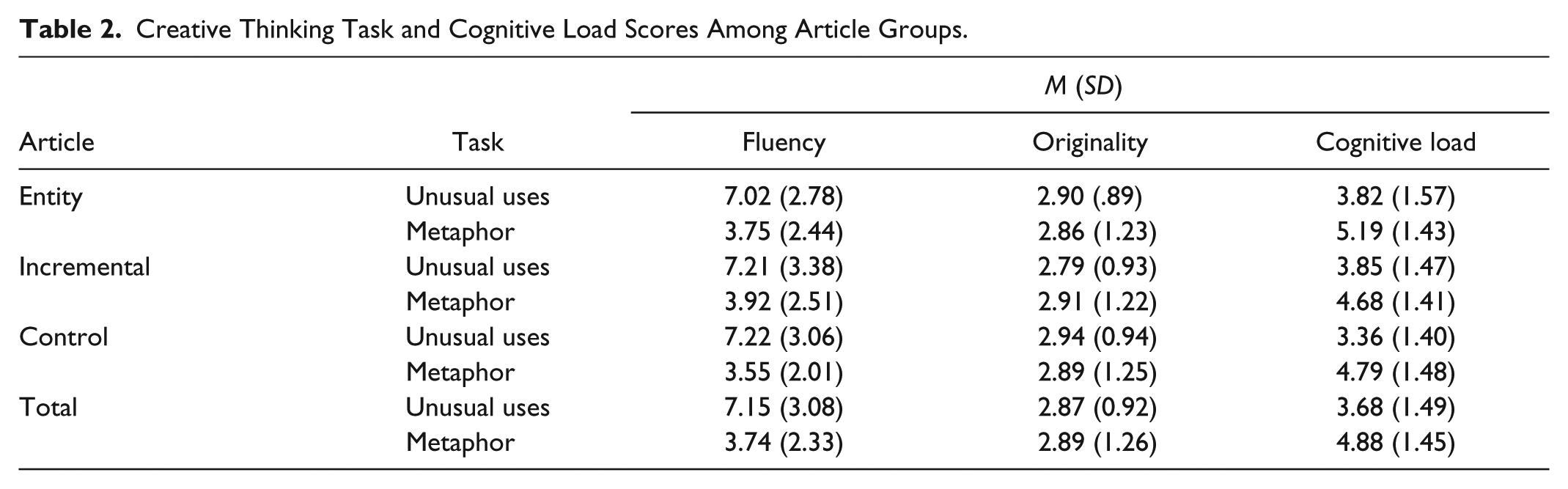
Similar to previous interventions for intelligence (Bergen, 1991; Hong et al., 1999), instructing students to read a brief article indicating that a personal attribute (in this case, creativity) was either fixed or malleable was effective in altering students’ theories of creativity to be either more entity-like or more incremental. However in this study, altering students’ theories of creativity did not affect creative thinking performance.
Next, SEM was used to investigate the influence of students’ implicit theories of creativity (after exposure to the theories of creativity articles) on creative thinking and cognitive load, the influence of WM on creative thinking and cognitive load, and the influence of cognitive load on creative thinking. Descriptive statistics for variables included in the path analyses are presented in Table 3.
Correlations Among Observed Variables.

Note. WM = working memory; Met = metaphor task; UU = unusual uses task.
p < .05. **p < .01.
Path analyses examining the relationships among implicit theories of creativity, WM, cognitive load, and creative thinking scores
In the SEM, creative thinking was specified as a latent variable, indicated by fluency and originality scores on the unusual uses and metaphor tasks. Implicit theories of creativity were specified by the sum of ratings on the theory of creativity scale (after exposure to the theory of creativity articles), WM was specified by the total score on the SymSpan task, and cognitive load was specified by the mental effort rating. The fit statistics of all models tested are presented in Table 4.
Model Fit Statistics.

Note. CFI = comparative fit index; RMSEA = root mean square error approximation; SRMR = standardized root mean square residual; WM = working memory.
First, a test of the measurement model (latent creative thinking variable, indicated by four scores) showed good fit to the data (RMSEA = .098, CFI = .959, SRMR = .031). Direct paths from implicit theories of creativity and WM to creative thinking performance were tested separately in Models 1 and 2. WM was a positive and significant predictor of creative thinking (β = .148, p = .020); as expected, participants with higher WM demonstrated better creative thinking performance. Contrary to our hypothesis, implicit theories of creativity did not significantly predict creative thinking (β = .044, p = .490).
Model 3 tested direct and indirect effects of implicit theories on creative thinking, including cognitive load as a mediator. The direct path from implicit theories to creative thinking was weak and nonsignificant (β = .011, p = .862). The direct path from implicit theories to cognitive load was negative and significant (β = −.187, p = .001), and the direct path from cognitive load to creative thinking was also negative and significant (β = −.180, p = .012). The indirect path from implicit theories to creative thinking was positive and significant (β = .034, p = .033). This indicates a full mediation of the effect of implicit theories on creative thinking through cognitive load; as expected, holding more entity-like theories of creativity was associated with higher cognitive load, which was in turn related to poorer creative thinking performance.
Model 4 paralleled Model 3, but also tested the direct and indirect paths from WM to creative thinking, including cognitive load as a mediator. The direct path from WM to creative thinking was positive and significant (β = .130, p = .044). The direct path from WM to cognitive load was negative and significant (β = −.108, p = .044), and the direct path from cognitive load to creative thinking was also negative and significant (β = −.171, p = .015). The indirect path from WM to creative thinking was not significant (β = .018, p = .109). This indicates that, unlike its relationship with implicit theories of creativity and WM, cognitive load did not fully mediate the relationship between WM and creative thinking. Instead, WM directly predicted creative thinking, supporting the hypothesis that higher WM would be associated with better creative performance.
Finally, Model 5 specified the complete mediation model (Figure 1). Based on the results of the previous models, WM was specified as a predictor of both cognitive load and creative thinking, and implicit theories of creativity were specified as a predictor of cognitive load only. Cognitive load was specified as a mediator between the two predictors and creative thinking. Both implicit theories and WM were negative significant predictors of cognitive load (β = −.180 and –.107, p = .002 and .041, respectively), supporting the hypotheses that more entity-like beliefs and lower WM would be associated with more cognitive load during creative thinking tasks. Both WM and cognitive load were significant predictors of creative thinking (β = .139 and –.167, p = .034 and .020, respectively), indicating, as expected, that higher WM and lower cognitive load during creative thinking have a positive impact on creative thinking performance. The indirect path from implicit theories to creative thinking was positive and significant (β = .030, p = .031), whereas the indirect path from WM to creative thinking was not significant (β = .018, p = .115). Taken together, these results indicate that WM and cognitive load directly predict creative thinking: Higher WM and lower cognitive load were associated with better creative thinking performance, whereas the effect of implicit theories on creative thinking was fully mediated by cognitive load.

Relationships among implicit theories of creativity, working memory, cognitive load, and creative thinking.
Unlike previous studies of the relationship between incremental beliefs about intelligence and academic performance (Hong et al., 1999), students’ implicit theories of creativity did not have a direct relationship with their creative thinking performance. However, implicit theories of creativity had a direct impact on cognitive load during creative thinking tasks. Endorsing more incremental views of creativity (i.e., believing that creativity can be improved) was associated with lower cognitive load. Lower cognitive load was associated with better creative thinking performance. As expected, higher WM was associated with superior creative thinking. WM also predicted the level of cognitive load participants reported; greater WM capacity was associated with finding creative thinking tasks less effortful (i.e., lower cognitive load).
General Discussion
Implicit Theories of Creativity Do Not Directly Affect Creative Thinking Performance
Altering students’ theories of creativity to be more or less incremental is possible through a brief intervention. As with previous work on theories of intelligence (Bergen, 1991; Hong et al., 1999), students who read an article supporting one of these views reported theories of creativity that coincided with the views to which they were exposed. However, unlike similar interventions for traditional academic tasks using theories of intelligence, students’ theories of creativity did not affect their creative thinking: Students with more incremental views were no more creative in their responses than those with less incremental (more entity-like) beliefs, considering both the criteria of quantity (fluency) and quality (originality).
One possible reason for this finding is that, despite reporting belief changes that coincided with the articles they read, students only superficially accepted the views to which they were exposed. An alternate, and in our opinion, more plausible explanation is that the cognitive load imposed by drawing participants’ attention to beliefs about the nature of creativity had a more detrimental impact on creativity than the beliefs alone (and in fact, the article students read had a direct impact on their cognitive load during creative thinking). Those exposed to entity views learned that they have all the creativity they will ever have, and they cannot improve it. Although those in the incremental group read that creativity could be improved, in the brief time they spent in the laboratory performing creative tasks, they did not have the opportunity to improve their creative skills. In other words, even students who were convinced that creativity could be improved might have believed themselves to be at a disadvantage if they did not already view themselves as creative. In fact, during one of the creative thinking tasks, those exposed to incremental beliefs reported higher cognitive load than those who read a control article. Thus, a brief intervention, even though it significantly altered implicit theories, may not have been sufficient to improve performance in an area where entity views are not only common (Sternberg & Lubart, 1996), but may not have been previously challenged. Our results, combined with existing literature demonstrating weak (Sisk et al., 2018) or even detrimental (Bahník & Vranka, 2017) impacts on performance, warrant a more critical look at the outcomes of implicit theories, and whether or not they predict actual performance outcomes.
Cognitive Load Fully Mediates the Relationship Between Implicit Theories of Creativity and Creative Thinking Performance
A noteworthy result of the present study is the impact of (and on) cognitive load. Our results indicate that, although relatively small in magnitude, cognitive load negatively affects creative thinking in a manner similar to its effect on other types of complex tasks. Cognitive load mediated the relationship between implicit theories of creativity and creative thinking: Less incremental beliefs (or more entity beliefs) were associated with greater cognitive load, and greater cognitive load predicted worse creative thinking performance. Implicit theories did not directly affect creative thinking performance, but instead, had a small impact on the cognitive load participants experienced during creative thinking tasks. Cognitive load fully mediated the relationship between implicit theories and creative thinking, suggesting that holding entity beliefs about creativity (and presumably, attending to them during creative thinking tasks) may result in inefficient use of attentional resources, making creative thinking more effortful.
The results of the present study indicate that altering implicit theories of creativity may not have the desired effect on creative thinking (i.e., improved performance). Contrary to evidence that incremental theories of intelligence have a positive impact on academic performance (Blackwell et al., 2007; Paunesku et al., 2015), we found that altering implicit theories, although it had a small impact on cognitive load, did not directly influence creative thinking. This may seem counterintuitive given the cognitive mechanisms shared by creativity and intelligence (Beaty & Silvia, 2012; Benedek et al., 2012; Benedek et al., 2014; Lee & Therriault, 2013; Nusbaum & Silvia, 2011; Silvia, 2015), however, it is important to note that not all studies of implicit theories of intelligence have found that incremental beliefs improve performance (e.g., Bahník & Vranka, 2017). The impact of implicit theories on self-regulation, attentional control (Howell & Buro, 2009), and emotions (Burnette et al., 2013) may explain the mediating role of cognitive load in the implicit theories–performance relationship in the present study. Implicit theories affect individuals’ approaches to demanding tasks. Thus, individual differences in attention to and emotional response to one’s own implicit theories during a task may influence how impactful implicit beliefs are on performance.
WM Has a Small, Positive, and Direct Impact on Creative Thinking
Our results provide further support for the idea that higher WM capacity allows for consideration of a greater number of possible answers, facilitating the ability to weed through uncreative choices until a novel, creative response is found (Beaty et al., 2014; Lee & Therriault, 2013). WM is known to affect inhibition and is particularly important for tasks that require effortful search of long-term memory (Conway & Engle, 1994) and fluency in generating many exemplars from a specific category (Rosen & Engle, 1997; Schelble et al., 2012). WM has been previously found to affect inhibition during creative tasks (Benedek et al., 2012). The impact of WM resources on inhibition during creative thinking tasks (e.g., recalling past uses of objects or previously heard metaphors to rule them out as possible creative responses) may have a particularly notable impact on originality. Participants who had more difficulty inhibiting unhelpful information (such as common uses for the household object presented, or commonly heard metaphors) likely produced less creative responses. Successful creative thinkers produced more original responses—that is, uncommon answers. Originality requires ignoring the most obvious solutions, and instead making uncommon connections. Thus, the demands of tasks requiring both fluency and originality may share characteristics with task switching (another WM-dependent ability), such as alternating between retrieving, evaluating, and generating ideas.
The findings of the present study, which showed a small negative, but statistically significant influence of WM on cognitive load, are in contrast to the view that the greater attentional capacity associated with higher WM leads to a narrow focus, hindering insight problem solving (Van Stockum & DeCaro, 2013). This discrepancy may be due to the characteristics of different types of creativity measured in different studies—insight tasks require more convergent thinking toward a single correct solution; whereas divergent thinking tasks (like those used in the present study) encourage the generation of many solutions. Generating many responses, while also evaluating the originality of those responses places great demands on attentional resources; our results indicate that those with higher WM were better equipped to perform this type of creative thinking task.
Incremental Theories of Creativity and Higher WM Are Associated With Lower Cognitive Load, and Lower Cognitive Load Leads to Better Creative Thinking
Both WM and implicit theories influenced the cognitive load participants experienced during creative tasks. However, cognitive load fully mediated the relationship between implicit theories of creativity and performance, but WM continued to have a direct relationship with creative thinking even when the influence of WM on cognitive load was included in the model. Thus, participants’ attentional resources (WM) and ideas about what causes someone to be creative or not creative influenced how difficult they found creative tasks. The relationship between WM and cognitive load is not surprising; having fewer attentional resources is likely to make a task that requires complex cognition seem more difficult. WM’s direct relationship with creative thinking is supported by previous studies (Chein & Weisberg, 2014; Lee & Therriault, 2013); the present study provides additional evidence of this relationship.
Implicit theories did not have a direct impact on creative thinking, but did affect cognitive load during creative thinking. Holding a fixed view of creativity was associated with reporting that creative thinking tasks were more difficult, and when they seemed more difficult, participants performed worse. We interpret this as another form of attentional resources affecting complex task performance; participants whose attention was directed toward their entity-like beliefs about creativity while they were trying to be creative may have experienced extraneous load, such as negative emotions or simply distraction, which impaired their success during creative tasks. Although it was not measured in the present study, we suspect that participants were actively attending to their beliefs about the nature of creativity (implicit theories) during the creative thinking tasks, as these tasks took place immediately after the article manipulation and creative beliefs survey, and participants were instructed to produce creative responses during the creative thinking tasks. In addition, our SEM of the relationships among beliefs, WM, cognitive load, and creative performance provides preliminary evidence of a significant direct pathway suggested by existing literature, but the correlational nature of the SEM limits our ability to establish causal effects.
Conclusion
Creative thinking is influenced by cognitive factors that also influence performance on traditional academic tasks, including WM capacity and cognitive load. Altering students’ beliefs about the malleability of creativity does not appear to affect their creative thinking performance. However, whether students believe that creativity is malleable or fixed affects the cognitive load they experience during creative thinking tasks, and this cognitive load had a small negative impact on creative thinking. The results of the present study illustrate the role of attentional resources during creative thinking, and provide preliminary evidence of the impact of cognitive load on creative thinking performance. Finding ways to reduce extraneous cognitive load may be an avenue to improving creative thinking. Future research should examine students’ implicit theories of creativity as they relate to other individual differences that may affect creative thinking. Researchers may also wish to examine the impact of implicit theories on cognitive load during other complex tasks.
Footnotes
Appendix A
Appendix B
Declaration of Conflicting Interests
The author(s) declared no potential conflicts of interest with respect to the research, authorship, and/or publication of this article.
Funding
The author(s) disclosed receipt of the following financial support for the research, authorship, and/or publication of this article: This work was supported by a Western Kentucky University Research and Creative Activities Program Award (13-8012).
