



Abstract
This study aimed to develop Turkish Teacher Candidates’ Self-Efficacies to Use Listening Strategies Scale. Therefore, the study was designed in sequential explanatory design, and sequential timing has been followed. First, the interview study was conducted with 40 participants, and the qualitative data were analyzed through content analysis. Subsequently, an item pool was designed via the findings obtained from the qualitative findings and literature review. Afterward, the draft form was applied to Turkish teacher candidates and 345 valid forms were obtained. As a result of the exploratory factor analysis conducted for the data obtained, we determined that the items were collected in four factors in total. The Cronbach’s alpha coefficient was calculated as .927 for the scale. Confirmatory factor analysis was performed in the last stage, and finally, we found that all factors are statistically significant and the obtained model has a good fit. In addition, we determined that the qualitative findings have chronological categorization and the quantitative findings have thematical categorization. This means that thematic categorization to the listening strategies can be more appropriate for listening skills. Consequently, the scale can be used in determining the self-efficacy perceptions of Turkish teacher candidates to use listening strategies. Furthermore, the scale can contribute to similar studies in the literature.
Keywords
Introduction
Listening is a process in which a listener is not only a passive character but also an active character with cognitive, affective, and psychomotor skills (Anderson & Lynch, 2008; Karadüz, 2010). Listening is a skill that includes the effort of understanding (Özbay, 2015), as well as the processing and use of information (Aytan, 2011). In the process of listening comprehension, listening strategies play a positive role (Siegel, 2015), and, on the contrary, listening skills and strategies are still neglected points that were not deeply researched (Doğan & Özçakmak, 2014). The insufficiency of studies also increases the need for new studies on listening strategies in the teacher candidates’ education (Karagöz et al., 2017).
Listening strategies that can be defined as any plan that listeners improve their comprehension or listening performance (Rost & Wilson, 2013) are important elements for improving the listening process (Türkel, 2012). Listening strategies are reported in different classifications, but when the classifications are compared, we can see that the chronological based on the process is the most used classification type as pre-listening, listening, and post-listening strategies in Turkish Education (Yazıcı & Özden, 2017; Kurudayıoğlu & Kiraz, 2020). However, inside of these processes, Turkish teacher candidates use cognitive, socio-effective, and body language strategies (Karadüz, 2010). Furthermore, this result is consistent with the recommendation of the classification as metacognitive, cognitive, and socio-effective strategies (O’Malley et al., 1989). Furthermore, a range of metacognitive and cognitive listening strategies was identified by Vandergrift (1997). Classifications combined with chronological-based and cognitive-based strategies also suggested in this period (Bacon, 1992).
The use of relevant strategies has been studied with different subgroups. Awareness of metacognitive strategies can positively affect the listening comprehension (al-Alwan et al., 2013; Coşkun, 2010) and a significant amount of correlation between metacognitive strategies and emotional intelligence (Alavinia & Mollahossein, 2012). There is a serious relationship between listening anxiety and listening strategies (Golchi, 2012). Teaching metacognitive strategies can positively affect the target groups’ listening comprehension skills (Katrancı & Yangın, 2013; Schunk & Rice, 1984). Finally, metacognitive strategy instruction can provide self-efficacy for listening skills (Rahimirad & Zare-ee, 2015). Although there is a tendency to classified listening strategies with the chronological-based approach in Turkish Education (Yazıcı & Özden, 2017; Kurudayıoğlu & Kiraz, 2020), we can see that functional-based classifications are preferred in the mentioned studies.
Turkish teacher candidates, because of the reasons such as “don’t have a rich environment for listening activities” (Rost & Wilson, 2013), are not able to improve their skills for using listening strategies (Karadüz, 2010). In addition, inside of lessons, they usually apply to passive listening that prevents themselves from becoming active participants in the listening process (Tabak, 2013). Furthermore, inside of the listening process, distraction, boring, being unbiased, and antipathy against the speaker create psychological problems, and some candidates have hearing problems on the physiological side (Emiroğlu, 2013). Furthermore, because of the type of language, listening purposes, and contexts in which listening occur (Anderson & Lynch, 2008), Turkish teacher candidates’ listening process can be difficult. There is a need for studies on which listening strategies can be used to solve the specified problems (Epçaçan, 2013). This need coincides with the studies conducted on different target audiences and emphasizes the importance of listening strategies and self-efficacy for listening against problems encountered during the listening process (Graham, 2006, 2011; Graham & Macaro, 2008).
Listening to self-efficacy refers to listeners’ capability to successfully listen (Smith et al., 2011). Studies that were made for exploring the relationship among the listening strategy, listening comprehension, and self-efficacy indicate a significant correlation (Kassem, 2015; A. Rahimi & Abedini, 2009). In addition, students who use listening strategies effectively can show higher self-efficacy in listening skills, listening achievement, and comprehension (Graham, 2007). Furthermore, there is also a positive and significant relationship between listening self-efficacy and metacognitive awareness of listening strategies (M. Rahimi & Abedi, 2014). Studies conducted on listening shows that not only in Turkish Education (Doğan & Özçakmak, 2014) but also in other research areas (Raoofi et al., 2012), listening self-efficacy is a less studied variable.
In the 2018–2019 academic year, 19,113 Turkish teacher candidates continue their formal education programs in Turkish Language Teaching and this number constitutes 8.84% of the total 216,015 students studying in the faculty of education within the same year (Council of Higher Education, 2019b). Among the teacher candidates, Turkish teacher candidates have a significant ratio. In this respect, the development of the mother tongue skills of Turkish teacher candidates will be beneficial for the development of the language skills of Turkish learners as mother tongue. The development of language skills finds its place in the teachers’ general professional competency framework as “Uses Turkish following the rules and effectively” (Ministry of National Education, 2019). Listening Education, Human Relations and Communication, and Inclusive Education courses are included in the Turkish Language Teaching undergraduate program to provide the expected competencies at the level of listening skills (Council of Higher Education, 2019). However, the studies on listening skills are insufficient, and neglect of listening skills continues to date (Doğan & Özçakmak, 2014). About the mentioned data, examining the listening skills of Turkish language teacher candidates who have a significant ratio among the prospective teachers will help the teachers to achieve the targeted gains in line with their general professional competencies.
The focus of the present article is on the measurement of the prospective Turkish teachers’ self-efficacies to listening strategies. Many scales have been developed in the literature on listening skills. Especially, because of the importance to create an active listening process, different kinds of scales were developed in different areas such as active listening in medical consultations (Fassaert et al., 2007), active empathetic listening (Drollinger et al., 2006), and metacognitive awareness in listening (Vandergrift et al., 2006).
Purpose of the Study
Based on the findings, the development of the self-efficacy scale for the use of listening strategies of Turkish teacher candidates can provide a pool of data in the development of the skills to use listening strategies. Furthermore, it can contribute to the development of listening skills. Moreover, in this research, we studied for the development of Turkish Teacher Candidates’ Self-Efficacies to Use Listening Strategies Scale. The problem sentences that constitute the objectives of the research can be expressed as follows:
What is the study group’s self-efficacy for listening strategies?
Is the measurement tool developed to cover the parameters obtained as a result of qualitative examination valid and reliable?
Method
In this study, the research process has begun with the literature review, which aims to develop the self-efficacy scale for Turkish teacher candidates’ listening strategies. Considering that the obtained data pool would be inadequate during the development of the scale, a more open and inclusive research process was needed. As a result of the literature review, it was decided that only a quantitative research design did not correspond to the aims of the study. Therefore, the study was designed in a mixed method to obtain more in-depth and explanatory results (Creswell, 2009, 2012, 2017; Creswell & Clark, 2015; Lisle, 2011; Morse, 2003; Özden & Durdu, 2016; Punch, 2016).
For these reasons, we decided to use the explorer sequential pattern. In line with this pattern, we aimed to collect and analyze qualitative data first. Afterward, in the second stage, following the hypothesis, sentences created through quantitative research were examined (Creswell, 2009; Creswell & Clark, 2015).
Qualitative Stage
Participants
The first stage of the study was designed in a case study model and we aimed to determine the self-efficacy of the Turkish teacher candidates who make up the study group for the listening strategies used in the listening process. The framework of the case is to reveal the self-efficacy of the study group for the strategies they use in listening processes. About this purpose, the semi-structured interview method that allowed the researchers to gather in-depth data (Yıldırım & Şimşek, 2016) was chosen. Questions of the semi-structured interview form were designed with three questions that we are gathering information about listening strategies that are used as pre-listening, listening, and post-listening in line with the literature of Turkish Education (Yazıcı & Özden, 2017; Kurudayıoğlu & Kiraz, 2020). Thanks to that, we wanted in-depth data about the entire listening process. Although Tabak (2013) states that there is no significant difference among grade levels of Turkish teacher candidates’ listening, the Listening Education course that can affect their self-efficacy for using listening strategies is in third grade (Council of Higher Education, 2019). In addition, for gathering in-depth data from the research groups, we decided to involve all grades inside of research process. Finally, we decided to use a purposive sampling method that can allow the researcher to specific study units (Yin, 2011).
We received the verbal consent of the participants. Afterward, the qualitative phase of the study was carried out in Yıldız Technical University Turkish Language Teaching Undergraduate Program. The study group consisted of 10 students from the first grade, nine students from the second grade, 11 students from the third grade, and 10 students from the fourth grade. The interviews were recorded with a voice recorder and decoded. During the interview process, the participants in the study group were informed about the listening strategies, and at the same time, it was ensured that the prior knowledge levels were increased through additional materials and information on the subject, if necessary.
Data collection, analysis process, and reliability of findings
In the first step of the study, interviews were conducted with the study group, which collected qualitative data. While preparing the interview questions, the literature review was made, and after the draft questions were prepared, a field expert was consulted. After this step, the interview form was completed. To create a data pool and to obtain in-depth data from each of the class levels, 10 students from the first grade, nine students from the second grade, 11 students from the third grade, and 10 students from the fourth grade were interviewed, and the data were collected.
The data obtained from the interviews were analyzed by content analysis in the NVivo program. The degree of the findings’ reliability was determined by expert opinion. In this process, the following formula was utilized, and a success requirement of over 70% was sought (Miles & Huberman, 1994):

Quantitative Stage
Research universe and sample group
The development of a valid and reliable scale depends on the sample size. Gorsuch (1983) states that there should be at least five participants per variable, and there should be at least 100 participants for each analysis. Bryman and Cramer (1999) argue that, although there is a factor analysis with less than 100 participants, it is appropriate to have at least 100 participants for each analysis. Büyüköztürk (2002) argues that as a general rule, the sample size should be 5 times the number of variables. There are 36 items in the application form of the research.
In this research, every member of the Turkish teacher candidates’ population has an equal and independent chance of being selected and there is no intent to describe specific subgroups. That is why a simple random sampling method (Fraenkel et al., 2012) was used to obtain the sample. To reach a sufficient number of participants, a total of 345 valid forms, 160 participants from Yıldız Technical University Turkish Language Teaching Program, and 185 participants from the Marmara University Turkish Language Teaching Program were obtained. During the application process, we received the verbal consent of the participants.
Research process
In the study, after the literature review, we found that no assessment tool makes Turkish language teacher candidates directly as the target group. Later, we tried to answer the question: “Is the assessment tool developed to cover the parameters obtained as a result of qualitative examination valid and reliable?”
For finding an answer to this question, first findings of the qualitative data reorganized in line with the chronological-based approach (Yazıcı & Özden, 2017; Kurudayıoğlu & Kiraz, 2020) via quotations that were taken from interviews. At this point, we take into account the classifications of O’Malley et al. (1989), Vandergrift (1997), and Bacon (1992). Especially, Bacon’s (1992) approach is more suitable for the construction of draft items because of the chronological-based and cognitive-based strategies together. In addition, although we analyzed qualitative data in three main themes, we take into consideration that our subcategories also coincide with active listening strategies that can be summarized in eight main categories: planning, focusing attention, monitoring, evaluating, inferencing, elaborating, collaborating, and reviewing (Rost & Wilson, 2013). Finally, we examined sample scale development studies that involved listening strategies (Drollinger et al., 2006; Fassaert et al., 2007; Vandergrift et al., 2006), and designed our draft item form with taking these studies as an example.
After the organization of the draft item form, whether the content of the items is a representative sample from the domain (Fulcher & Davidson, 2007) was tested by Lawshe’s analysis formula: content validity ratio (CVR) = (Ne – N/2)/(N/2) (Lawshe, 1975). In assigning experts for Lawshe’s analysis, we sought that experts worked in the field of measurement and evaluation and have knowledge in this area. Finally, we obtained our application form that consists of 36 items. With the completion of the data collection process, explanatory factor analysis with Varimax rotation was made to reveal the theory and infrastructure under the 36 items (Tabachnick & Fidell, 2007; Thompson, 2004). To find the internal consistency coefficient (Büyüköztürk, 2002/2018; Özdamar, 2015), Cronbach’s alpha values calculated for each dimension and the total scale. Then, factor-based discriminatory procedures were followed with an independent-sample t test (Kelley, 1939). Finally, to determine whether the fit indices are acceptable, confirmatory factor analysis was conducted (Erkorkmaz et al., 2013).
Results
Qualitative Results
As a result of the interviews with the students, the data in the interview were collected under three themes. Following the interview form, the findings were categorized into three main themes as pre-listening listening strategies, listening strategies used during listening, and listening strategies used after listening. In the last stage of the qualitative research part, prospective Turkish teacher candidate’s self-efficacy to use listening strategies modeled based on qualitative findings which were created by open coding (see Figure 1).

Listening strategies.
As a result of content analysis which was made by open coding, we determined that listening strategies in which participants consider themselves sufficient consist of three themes. About these findings, listening strategies were divided into themes with a process-based perspective. The categories included in each theme are presented below (see Figure 2).

Strategies that Turkish teacher candidates consider themselves self-sufficient before listening.
The number of strategies that participants in the study group deemed sufficient to use themselves before listening consists of 15 main categories. The Guessing category has Guessing the Main Idea, Associating With the Author, Guessing Content, and Reasoning subcategories. The Note Taking category has Creating Summary, Concept Map, and Taking Notes of Keywords subcategories. The Preparation category has Material Preparation, Physiological Preparation, and Mind Preparation subcategories. Finally, the Making Associations category has one subcategory as Associating With Daily Life.
In line with the findings, participants make their guesses to find the main idea of their listening. Furthermore, they consider themselves sufficient for making associations between their listening and the sender. Furthermore, they also consider themselves sufficient to guess the context of messages that they listen to. Finally, before listening, they consider themselves sufficient to reasoning about the message that they listen to. Based on the detailed findings of the Guessing category, we can say that the study group largely uses the strategies about guessing.
Another main category that is used by participants is Taking Notes. In line with the findings of this part, participants consider themselves sufficient in noting keywords, and they usually use this strategy to improve the efficiency of their listening. Some of the participants emphasized that making a concept map according to their former learnings about the messages would help to a better understanding of the listening process. Finally, in line with former learnings, making a summary is a beneficial strategy to create a better listening process.
In addition, when they prepare for listening to come, participants consider themselves sufficient for providing necessary materials such as a pencil, notepaper, a recorder, and so on. Furthermore, they adjust their sitting and choose the appropriate body position to take notes as physiological preparations. They also clear their minds to gain a better listening process before listening. Finally, inside of the main categories which have subcategories, Making Associations has one category as Associating With Daily Life. This category means that participants consider themselves capable of associating the messages they get with daily life thanks to their former learnings.
The other main categories have no subcategories. According to these findings, participants consider themselves sufficient in making research, constructing necessary perceptions, organizing the listening environment as suitable to their needs, constructing their focus according to type, preparing questions to the speaker, interpreting the messages, matching the messages’ notions with their minds via their active vocabulary, concreting the message, planning to their listening, and managing their prejudices to messages before the listening process. Conclusively, participants of the qualitative research part widely use the listening strategies before the listening process (see Figure 3).

Strategies that Turkish teacher candidates consider themselves sufficient in the listening process.
In this part of the study, as a result of content analysis, 20 main categories were determined through the open coding process. Among these categories, Focus on Listening, Taking Note, and Types of Listening have their subcategories. Other main categories have no subcategories.
The Focus on Listening has only Focus on the Keywords subcategory. This category means that participants focus on the keyword in a listening process. They also believe that this strategy makes their listening more efficient.
Taking Note category has more subcategories than any other main categories. According to the findings that were obtained via content analysis, participants consider themselves sufficient in underlining the written forms of listening messages. They are also able to take notes by message type, making schematics which is appropriate to the message, noting the names inside of the message, taking notes by summarizing, creating concept maps, irregularly note-taking, noting key points, taking notes with personal expressions, illustrating their listening, taking notes with keywords, noting the unknown words, taking notes without changing the listening messages, taking notes, noting the main idea of listening messages, and continuously note-taking.
Types of the listening category have four subcategories as aesthetic listening, empathic listening, passive listening, and active listening. Participants use aesthetic listening for obtaining pleasure from their listening. Among the other subcategories, active listening has its subcategories as body language and asking questions. Participants are capable of asking planned or unplanned questions, and they can also ask questions by the type of listening messages. They also use their body language to making their listening processes more effective.
The reasoning is used by the participants throughout the listening process. Some of the participants stated that sometimes they are making interferences about listening messages. When they listen, they also code the messages to their minds. Furthermore, they can associate listening messages with their sender and make connotations. Like the strategies which can be used before listening, participants can organize their environment inside of listening. Furthermore, they share learned information with others and make research via different research tools, such as the internet, inside of listening.
About findings, we determined that participants usually imagine what they listen to throughout the listening and create a description in their minds. In addition, they make interpretations and concretizations. When participants need materials, they can use it, such as a pencil, notepaper, recorder, and so on. Finally, they can plan their listening, associate them with daily life, and focus on by type (see Figure 4).
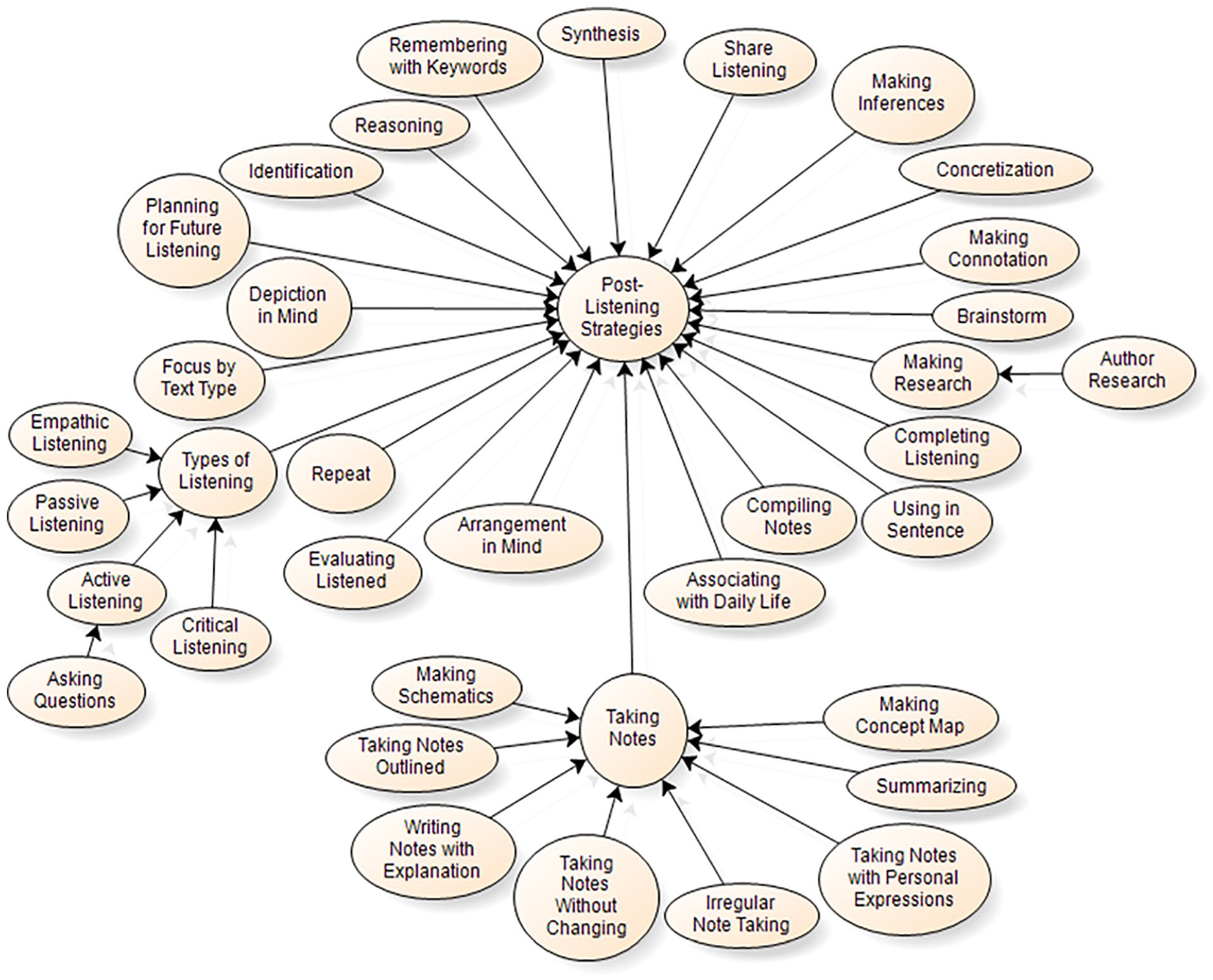
Post-listening strategies that Turkish teacher candidates consider themselves sufficient.
The post-listening strategies consist of 22 main categories. Among these categories Types of Listening, Note Taking, and Making Research categories have their subcategories. The other 19 categories have no subcategories.
Types of the Listening category have four subcategories, such as Empathic Listening, Passive Listening, Active Listening, and Critical Listening. Participants individually stated that they sometimes use these listening types as a strategy to make their listening process more efficient. In addition, the Active Listening category has an “asking questions” subcategory. As a difference, critical listening is used by participants after they listen. In summon, participants of this study use different types of listening depends on conditions.
Taking Notes category has seven subcategories. This category means that participants make schematics, take outlined notes, add them explanations, and they can also take notes without any change. Furthermore, they can take irregular notes and notes with personal expressions. They can summarize a listening message after the listening process, and make a concept map.
Among the categories which have subcategories, Making Research category has only one subcategory as Author Research. This category means that participants make researches about the sender of the listening messages. Participants stated that they gain a deep review of the listening messages thanks to this research. Finally, participants consider themselves sufficient in the other main categories, and they use them to gain a better listening process in the post-listening part.
Reliability level of qualitative findings
In the final part of the qualitative stage, we consulted a field expert to determine the reliability of qualitative findings. Eight of 108 categories took corrections, and categories took final forms as a result of this process. Finally, we found that the reliability ratio of findings is 92.59%, and determined that these findings are reliable (Miles & Huberman, 1994). Afterward, the qualitative stage was completed. Based on the literature review and the qualitative findings that were gained via content analysis, a draft item form was prepared.
Quantitative Results
Data collection tool
Self-Efficacy Scale for Listening Strategies of Turkish Teacher Candidates was used as a data collection tool in this stage of research. After the data collection process, we analyzed the quantitative data in line with quantitative analysis methods. The development process of the scale is presented below.
Forming of item pool
To reveal the measurement tool that will be developed to cover the parameters obtained as a result of the qualitative examination, a pool of 50 items was created first from the categories and quotations obtained from the focus group interviews. Lawshe’s (1975) analysis was completed with seven experts from two educational sciences and five Turkish educational fields. Based on the results obtained from Lawshe’s analysis, we gave the final form to the item pool as 36 items (see Table 1).
Lawshe’s Analysis Results.

Note. CVR = content validity ratio.
The x symbol means that there is no problem with this item’s application to the target group. In addition, CVRs were presented inside of the table. According to Lawshe’s (1975) CVR, the acceptable threshold is equal or above from .70. As a result of the analysis, we eliminated 14 items with expert opinion, and 36 items were formed with the application form; 29 items took 1 point and approval of all experts. Afterward, we included the other seven items in the application form as a result of the approval of most experts. At this stage, corrections for non-consensus items were completed following expert opinions. Finally, we eliminated 14 items from the draft form and applied the application form to 345 participants from Yıldız Technical University Turkish Education Department Undergraduate Program and Marmara University Turkish Education Department Undergraduate Program.
Data analysis
After the formation of the draft form, we obtained 345 valid forms from the participants and analyzed the data with SPSS and AMOS program. Kaiser–Meyer–Olkin (KMO) test, Bartlett’s test, Varimax rotation technique, and explanatory factor analysis were used to analyze the data, which were gained by the application process. Subsequently, item-total and item-remainder correlations were examined, Cronbach’s alpha coefficient was calculated, and confirmatory factor analysis was performed.
Results of validity analysis
To measure the validity of the 36 items obtained through Lawshe’s analysis and to develop a theory based on the structure of the items and to reveal the relationship between the factors for the analyses to be carried out in the next steps, we carried out exploratory factor analysis with Varimax rotation to reveal the theory and infrastructure under the 36 items used in the application process (Tabachnick & Fidell, 2007; Thompson, 2004). As a result of the KMO and Bartlett’s test performed to determine the suitability of the data for factor analysis, we found that KMO = .931 and Bartlett’s value was significant (χ2 = 3,200.888, p < .0001). In line with the obtained data, we concluded that the sample size and structure were factorable. In the first stage, the results obtained by calculating the communalities obtained through principal components analysis were reported (see Table 2).
Communalities.

When the extraction values of the items are examined, we determined that all of them are higher than .30 and the highest extraction value is .766. Due to the high values obtained, we continued factor analysis without the elimination of any item. Afterward, the variance ratio and the findings of factor analysis were presented below (see Figure 5 and Table 3).
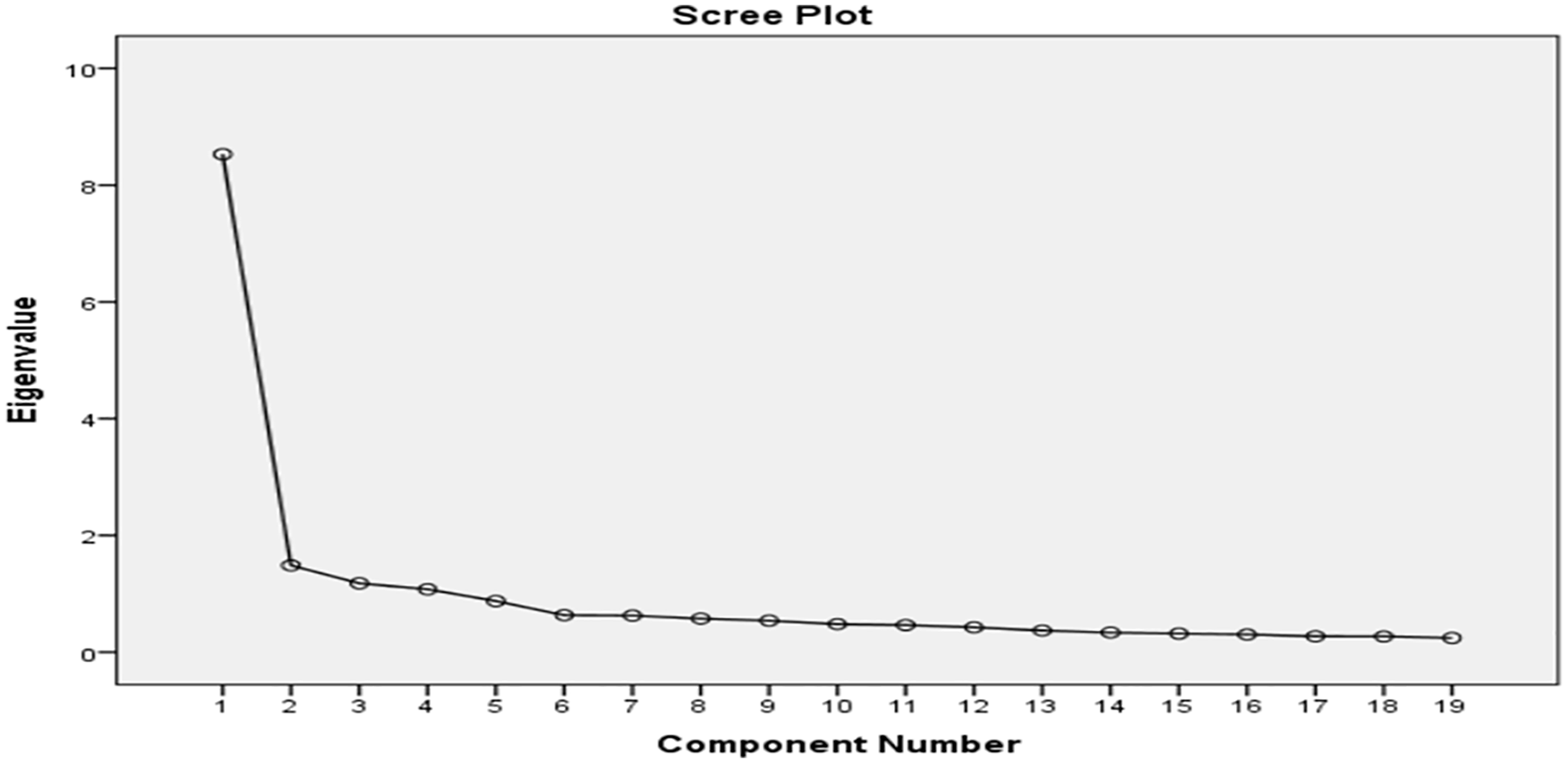
Scree Plot.
Component Analysis.
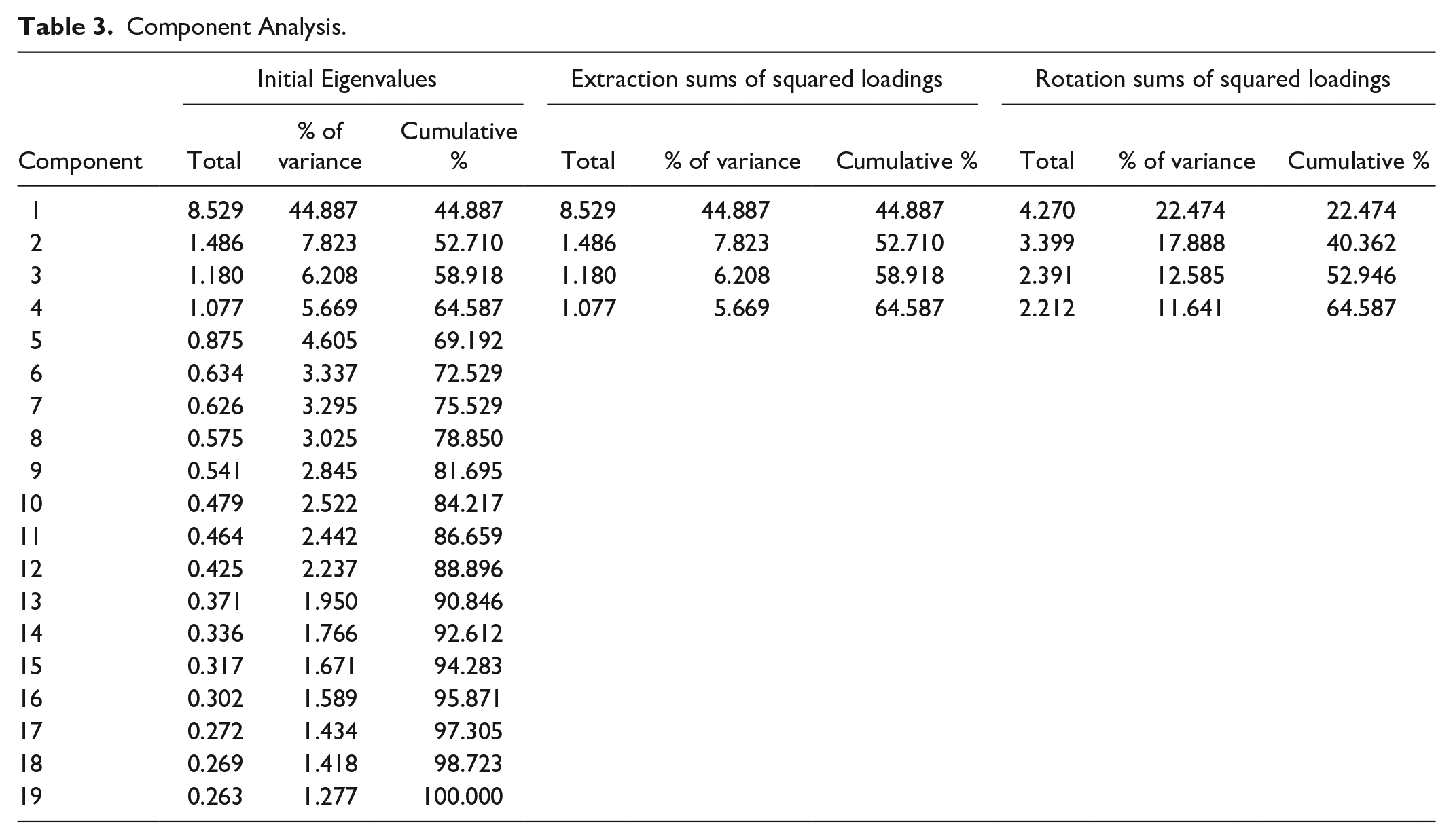
We determined that the scale has a four-factor structure with factor analysis made with principal components analysis based on Eigenvalue 1. The first of these factors explains 22.474% of the total variance, the second explains 17.888%, the third explains 12.585%, and the fourth explains 11.641%. Four factors explained 64.587% of the total variance of the scale. The analyses were carried out with the obtained multifactor structure (see Table 4).
Rotated Component Matrix.

When we look at the item which was obtained by Varimax rotation, there is no item lower than .30. Items 15, 22, 10, 31, 20, 35, 30, 28, 4, and 5 took values from more than one factor. Even so, the difference between them is not less than .10. Because of that, we decided to keep items at the factor where the most value was taken. Finally, we presented factors that were obtained and items of factors in Table 5.
Factors and Items of the Factors.

About these findings, the cognitive processes factor in listening is composed of seven items (21, 15, 13, 22, 10, 31, and 20), the metacognitive listening factor is composed of five items (34.36, 35, 30, and 28), the preparatory factor for listening is four items (1, 2, 4, and 5), and note-taking factor in listening consists of three items (16, 18, and 19). There is no inverse item on the scale. The scale consists of 19 items.
In the naming of the factors, we examined items of each factor and then we made the final decision for all factors; therefore, it was decided that to name the first factor as the cognitive process, the second factor as the metacognitive listening, the third factor as preparation to listening, and the fourth factor as the taking notes in listening. As a result, the increase in the scores related to that factor and the increase in the total score were evaluated as positive self-efficacy perceptions of Turkish teacher candidates to use listening strategies. After this stage, we passed the new stage of analyzing to determine the reliability of the scale. To determine whether the items in each sub-dimension and the scale explain a homogeneous structure, the Cronbach’s alpha value is presented in Table 6.
Factors and Items of the Factors.

The internal consistency coefficient of the scale is quite high. The alpha values are as follows: for the first sub-dimension of the scale, α = .900; for the second sub-dimension, α = .842; for the third sub-dimension, α = .766; for the fourth sub-dimension, α = .756; and for the total scale, α = .927. According to Büyüköztürk (2002/2018), an alpha value greater than .70 is necessary for the scale to be accepted as reliable. According to Özdamar (2015), the scale of .60 < α < .70 is sufficiently reliable. Therefore, the scale was found to be reliable. After the analysis, factor-based discriminatory procedures were performed, and 27% of the lower and upper parts of the scale were compared with independent-samples t test (Kelley, 1939). The results of the analyses were presented in Tables 7 and 8.
Independent-Samples t Test Results to Determine the Distinctiveness of Scale Items.

Independent-Samples t Test Results to Determine the Distinctiveness of the Scale Scores.

To determine whether there is a significant difference between the arithmetic means of the upper 27% and lower 27% groups, we found that the difference between all groups was statistically significant. The results show that scale total and factor scores are distinctive (p < .001). Afterward, to determine whether there is a correlation among factors, we made Pearson’s correlation analysis and presented the results in Table 9.
Correlational Findings Among the Factors and Scale.

As a result of Pearson’s correlation analysis, there are significant correlations among factors and total scale. These findings indicate that factors of the scale are related and they measure the same structure (see Figure 6 and Table 10).

Confirmatory factor analysis results of the scale.
Confirmatory Factor Analysis Indexes for Model Fits.

Note. GFI = goodness-of-fit index; CFI = comparative fit index; RMSEA = root mean square error of approximation.
As a result of the analysis data, the χ2/df value is below 5. This means that the fit indices are acceptable. Goodness-of-fit index (GFI) value is .903, and this also means that there is an acceptable fit. Furthermore, the comparative fit index (CFI) value is .919 and the root mean square error of approximation (RMSEA) value is below 0.08. Finally, the fit indices revealed that the scale has a good fit (Erkorkmaz et al., 2013).
Discussion
In this research, we developed a measurement tool to cover the parameters obtained as a result of qualitative analysis. The 50-item draft form prepared to determine whether the measurement tool is valid and reliable was presented to the opinion of seven experts and turned into a 36-item application form by Lawshe’s analysis. After removing 14 items from the application form and preparing the application form, 345 valid forms were obtained from the participants who continued their student life in 2018 to 2019 at Yıldız Technical University and Marmara University Turkish Teaching Undergraduate Programs. As a result of the exploratory factor analysis conducted for the data obtained from these forms, 19 items remained and the scale was determined to have a four-factor structure. Cognitive process factor consists of seven items (21, 15, 13, 22, 10, 31, and 20), metacognitive listening consists of five items (34, 36, 35, 30, and 28), preparation to listening consists of four items (1, 2, 4, and 5), and taking notes in listening consists of three items (16, 18, and 19). In addition, we calculated Cronbach’s alpha reliability coefficient to all factors of the scale and the scale itself. Finally, after the analysis process, we made confirmatory factor analysis and completed the analysis process. The conclusions were presented below:
About the Eigenvalue in the self-efficacy scale of Turkish teacher candidates to use listening strategies, the total variance explained by four factors is 64.587%. As a result of the Varimax rotation technique, the items are sufficiently distinctive. Factor loads of items vary between .468 and .766.
We named the first factor as “cognitive processes in listening,” the second factor as “metacognitive listening,” third factor as “preparation to listening,” and the fourth factor as “taking notes in listening.”
To the first factor (cognitive processes in listening), the Cronbach’s alpha value is .900. To the second factor (metacognitive listening), the Cronbach’s alpha value is .842. To the third factor (preparation to listening), the Cronbach’s alpha value is .766. To the fourth factor (taking notes in listening), the Cronbach’s alpha value is .756. To the scale itself, the Cronbach’s alpha value is .927. Calculated Cronbach’s alpha values are higher than .70. This means that the scale and its factors are consistent and reliable.
The analyses showed that for all items, factors, and total scores of the scale, there is a statistically significant difference. The factors and total scores of the scale are distinctive. This is means that the scale can be used as a reliable tool.
As a result of item-total and item-remaining analyses, correlations of all items in the scale were found to be significant. Therefore, we determined that all the items of the scale are in the same structure.
The fit indices obtained as a result of confirmatory factor analysis revealed that the scale has a good fit.
Cognitive processes in listening are tied to memory and information processing (Hauser & Hughes, 1988). Seven items of this factor represent the side of the cognitive process for listening strategies. In the former researches, metacognitive listening’s sub-dimensions were revealed as problem-solving, planning and evaluation, mental translation, person knowledge, and directed attention (Vandergrift et al., 2006). The quantitative results of this research have similar findings. In addition, in line with Turkish teacher candidates’ note-taking strategies (Tabak & Karadüz, 2015), a similar factor structure was constructed via the analysis process.
Unique to this study is suggesting a thematic approach to the classification of prospective Turkish teachers’ self-efficacy perceptions to use listening strategies. The qualitative findings of the study show differences when we compare them with quantitative findings. In the qualitative stage, listening strategies have three themes as the strategies used before, during, and after listening in line with related literature (Yazıcı & Özden, 2017; Kurudayıoğlu & Kiraz, 2020; Doğan, 2016). This stage is evaluated with a chronological-based approach. Contrarily, after the quantitative process that was conducted by explanatory factor analysis which was made to explore the dimensions underlying the data (Field, 2009), the functional side of listening strategies came forward. Thanks to this result, we suggest that functional classifications for further researches on listening strategies could create more useful data to a researcher. Finally, this result can also be interpreted, as functional-based classifications (O’Malley et al., 1989; Vandergrift, 1997) should not be neglected, whereas chronological-based classification is widely used in Turkish Education (Yazıcı & Özden, 2017; Kurudayıoğlu & Kiraz, 2020).
Limitations and Recommendations for Future Research
The scale can only be used for determining prospective Turkish teachers’ self-efficacy to use listening strategies. However, according to the research findings, the self-efficacy scale of Turkish teacher candidates to use listening strategies is a valid and reliable scale, and the scale can be used to measure prospective Turkish teachers’ self-efficacy perceptions about the strategies they use in listening processes. Besides, it can be used to determine which variables the Turkish teacher candidates’ self-efficacy toward the strategies they use in their listening processes depend positively or negatively. The scale can contribute by providing a data pool in the investigation of variables that affect self-efficacy perceptions toward listening strategies and variables that may affect related self-efficacy perceptions as an independent variable.
The scale can be a helpful tool for enlightening the Turkish teacher candidates’ positive self-efficacy perceptions (Kurudayıoğlu, & Kana, 2013). Because of the listening skills’ positive role for listening comprehension (Siegel, 2015), listening skills neglection (Doğan & Özçakmak, 2014) indicates the need for further researches on Turkish Education. Teachers’ general professional competency framework highlights the importance of using language skills effectively for teacher candidates (Ministry of National Education, 2019). In addition, Listening Education, Human Relations and Communication, and Inclusive Education courses (Council of Higher Education, 2019) need new educational models for improving listening skills. The development of this scale could provide valuable data sources for the necessary activities and educational models. In addition, because of its target group, the scale can provide in-depth data for not only the Turkish teacher candidates but also the different groups that are relevant to Turkish teacher candidates. Finally, our scale has the potential for being valid and reliable in different teacher candidate groups. Thanks to this potential, in our future researches, we wanted to test our scale whether it is valid and reliable for different teacher candidate groups. These potential researches can also be considered as valuable options for further researches. Finally, this scale can support the next researches to fill the lack of necessary studies on listening self-efficacy (Roofi, Tan & Chan, 2012).
Footnotes
Appendix
Turkish Teacher Candidates’ Self-Efficacies to Use Listening Strategies Scale.

| Factors | Order in the scale | Order in the application form | İtems | 1 | 2 | 3 | 4 | 5 | 6 | 7 |
|---|---|---|---|---|---|---|---|---|---|---|
| Preparation to listening | 1. | 1. | Dinleyeceğim bir metnin konusunu önceden biliyorsam metinle ilgili araştırma yapabilirim. |
|||||||
| 2. | 2. | Dinleyeceğim içerikle ilgili ön bilgilerimi kontrol ederim. |
||||||||
| 3. | 4. | Dinleme öncesinde kendimi fizyolojik (uyku, açlık vb.) olarak dinlemeye hazırlayabilirim. |
||||||||
| 4. | 5. | Dinleme sırasında bana gerekli olacak dinleme öncesinde materyalleri hazırlayabilirim. |
||||||||
| Cognitive process | 5. | 10. | Dinlemekte olduğum bir metinle ilgili çıkarımda bulunabilirim. |
|||||||
| 6. | 13. | Dinleme sırasında dinlediğim metnin kahramanlarına yönelik empati kurabilirim. |
||||||||
| 7. | 15. | Dinlemekte olduğum metni günlük hayatla ilişkilendirebilirim. |
||||||||
| 8. | 20. | Dinlemekte olduğum metni kendi ifadelerimle not alabilirim. |
||||||||
| 9. | 21. | Dinlemekte olduğum metni zihnimde canlandırabilirim. |
||||||||
| 10. | 22. | Dinleme sonrasında dinlediğim metne yönelik muhakeme yapabilirim. |
||||||||
| 11. | 31. | Dinleme sonrasında dinlediğim metni günlük hayatla ilişkilendirebilirim. |
||||||||
| Taking notes | 12. | 16. | Dinleme sırasında ek materyallerden faydalanabilirim (postit, küçük not kâğıtları ve benzeri). |
|||||||
| 13. | 18. | Dinlemekte olduğum metinde anlamını bilmediğim kelimeleri not alabilirim. |
||||||||
| 14. | 19. | Dinleme sırasında metni kavram haritası, şema, resim, tablo vb. görselleştirmeler kullanarak not alabilirim. |
||||||||
| Metacognitive listening | 15. | 28. | Dinleme sonrasında dinlediğim metnin estetiki unsurlarını bulabilirim. |
|||||||
| 16. | 30. | Dinlediğim metinden aldığım ön bilgilerle gelecekteki dinlemelerimi planlayabilirim. |
||||||||
| 17. | 34. | Dinleme sonrasında dinlediğim metinden hareketle yeni bir metin üretebilirim. |
||||||||
| 18. | 35. | Dinleme sonrasında dinlediğim metni zihnimde düzenleyebilirim. |
||||||||
| 19. | 36. | Dinlediğim metni farklı bir türe uyarlayabilirim (örneğin şiiri düz yazı olarak ifade etme vb.). |
Declaration of Conflicting Interests
The author(s) declared no potential conflicts of interest with respect to the research, authorship, and/or publication of this article.
Funding
The author(s) received no financial support for the research, authorship, and/or publication of this article.
