




Abstract
The understanding of good governance (GG), which was put into practice in the 1980s and gained global popularity rapidly, started to be discussed for Northern Cyprus (NC) in the 2000s. This research aims to analyze the implementation of GG principles and, the data was collected primarily from employees of the six municipalities of NC. GG as perceived by employees who are providers of local services and the factors that affect the perception of GG are analyzed with structural equation modeling. Findings indicate that there are differences in the perception of GG among the municipalities. Structural equation model shows that education and income level of employees has an impact on the perceived GG. This shows that financial status of the municipalities affects good governance indicators. As a result, it is important for the local governments to solve their financial problems while implementing good governance practices.
Introduction
The prominence of decentralization in terms of democratic participation has further increased the importance of local governments. Local governments are units such as provinces, districts, and municipalities which represent a movement from the center to the local in the realization of public services. The fact that Northern Cyprus (NC) is an underpopulated country located on a small island with limited geography is also reflected in the local government structure of municipalities. Small geographical area and limited number of municipalities do not mean that there are no problems in terms of local governments in NC. Administrative and financial problems of municipalities are constantly on the agenda, and local government reform, which has been discussed for a long time, has become an ongoing debate. Although it is known that there are problems in the functioning of municipalities, and this situation is constantly brought up by different parties, it should be noted that there is a scarcity of scientific studies. Therefore, this research aims to contribute to the literature by analyzing the perception of municipalities in NC by the employees in terms of administration. In this sense, perception analysis will be conducted to see whether the governance approach, which came to the fore in public administration and private sector after 1980 at global level, is applied by NC municipalities.
Management is the most fundamental factor affecting success for both public agencies and private sector institutions. For this reason, adopting a management approach that will respond to the changing needs of the developing world is critical for the local governments to satisfy the needs of residents. With these developments, it has become important to adopt the understanding of good governance, which has a global application and is being developed on a daily basis. The understanding of “good governance (GG)” has become even more important with the fluctuations in the global economy and the pandemic, COVID-19, which has had a global influence. The effectiveness of the management is accepted as an important factor in overcoming the economic and social problems. These realities prove that it is essential for the local governments as well as central governments to adopt the criteria of accountability, transparency, efficiency, and openness, which are the main principles of GG (Hood, 1995). United States of America and New Zealand are the first countries that adopted GG practices after 1980s, but almost all developed and democratic countries in today’s world are following the same path. After 1980s, with the conditional “Structural Adjustment Programs” imposed on developing countries, The World Bank and International Monetary Fund played an important role in the popularization of GG (Smouts, 1998; Vyas-Doorgapersad & Aktan, 2017).
Northern Cyprus (NC), a country which is not internationally recognized, cannot benefit from financing opportunities provided by International Organizations through Structural Adjustment Programs. Access to finances for NC is offered by Türkiye through structural adjustment programs, which is more or less the case in the rest of the world (Özyigit & Eminer, 2021). Adopting the understanding of public reform and good governance was introduced in NC with the Structural Adjustment Programs, which was the case in many other countries. On the other hand, willingness to follow the developments in the world and especially in EU requires adapting good governance principles for NC. However, there are debates and doubts about the implementation of good governance principles as political decision makers hesitate to implement public administration reforms (İşçioğlu, 2017). In this vein, this research aims to analyze the implications of good governance (GG) for NC municipalities. That’s why, the research problem was defined as to understand the impact of GG including its’ dimensions (as transparency, accountability, participation/inclusion, and effectiveness) on the development of the functioning of municipal employees’ perception of GG. As the main expectation from GG is satisfaction of locals and better service quality, this research collected data from municipal employees as providers of public services to determine their awareness about GG. The plan of the research was to find out the GG as perceived by municipalities and the differences among them through obtaining such data.
Literature Review
The concept of governance is as old as management which first emerged in the UK (Peters & Pierre, 1998; Stoker, 1998). The field of contemporary public administration seems to favor principles of New Public Management and Governance (Rhodes, 1977), and the dynamic nature of the governance process has been considered among the most critical and debated topics in public management research (Beshi & Kaur, 2020). People hold their government responsible for prioritizing the public’s interests (Farazmand, 2017). With the transformation of the traditional and historical role of the state, the interest of the majority has become the fundamental concept of democratic governance (Grimmelikhuijsen et al., 2013).
Developments in social life greatly affect the perception of satisfaction of municipal employees. Three theories were effective in revealing the importance of employee satisfaction. The first of them is the “Two Factor Theory” (Herzberg et al., 1959). They defined that internal and external factors affect employees’ perception of satisfaction at the work. While evaluating internal factors in individual and organizational structure, they discussed the issue that environmental effects also affect external factors. The second theory is Adams’ (1963)“Equity Theory”. He revealed that employees compare the wages they received among themselves and that employees are happier if people doing the same job received the same wage. The last theory is Maslow’s (1987)“Hierarchy of Needs”. He revealed that the level of performance and satisfaction will increase by meeting the “Material, Social, and Spiritual” needs for motivation of employees. Depending on the three theories, this study will reveal how much the needs of the employees are met in the municipality where they work, what their priorities are in ensuring job satisfaction, and will also determine whether there are differences depending on the municipality where they work in.
Governments enhance public trust by executing their strategies and policies efficiently (Houston & Harding, 2013). Thus, GG practices are seen as a mixture of accountability, responsiveness, and transparency to satisfy citizens (Mansoor, 2021). It is through these dimensions that GG becomes distinguishable.
The World Bank introduced GG to address poverty in African countries. The concept later became a conventional principle of democratic governance. Accordingly, once steps are taken to ensure development, governance is also employed to implement “Structural Adjustment Programs” (Smouts, 1998). The World Bank describes GG as “the use of political power in managing problems of a country” and emphasizes that governance crisis is the reason for underdevelopment (World Bank, 1989, p. 60). Governance includes the creation and implementation of specific strategies (Taylor, 2016), and examples of ways to develop and implement policies are public consultation, lobbying, public-private partnerships, contractual arrangements, and delegated authority, to name a few.
GG signifies a linear relationship between development and democracy. It entails transparency and accountability of public expenditures, reduction of waste, and transferring resources to imminent needs in health and education (Kersbergen & Waarden, 2004).
Transparency, accountability, participation/inclusion, and effectiveness are the building blocks of good governance in public administration. Since the outcome-oriented perspective focuses on results, process, and output-oriented approaches relate to how, and especially how well, governance systems work (Taylor, 2016).
Sound governance systems require transparency, accountability, respect for human rights and the rule of law, a robust civil society, popular participation, a free press, efficiency, and social sanctions for trespasses. In local government, GG indicates the capacity to conduct constitutionally assigned functions efficiently and effectively (Uddin, 2013). Furthermore, GG sets standards to meet for transparency and accountability as a means of responding to the local needs and issues with a higher degree of participation in local matters (Adebisi, 2012). Thus, local governments are expected to respond to the immediate needs of their constituents and carry out their duties responsibly and transparently.
When decision-making processes follow rules and regulations (da Cruz et al., 2016), freely available and accessible information influencing those decisions is a pre-existing requirement (Porumbescu et al., 2021). Transparency and accountability are interrelated concepts as transparency signifies information disclosure (Grimmelikhuijsen & Meijer, 2014), accountability and responsiveness (Bovens, 2007). Transparency encourages participation and, when successful, reinforces accountability toward citizens (Bauhr & Grimes, 2017; Hood, 2010; Porumbescu & Grimmelikhuijsen, 2018). Although international scholars diverge on interpretations of “good governance (GG)”, there is consensus on the core elements, which are transparency, accountability, participation, and the rule of law (Zhang, 2006). While institutional analyses may enable effective accountability (Bovens et al., 2008), translating government transparency at national level into government accountability in local governments is often overlooked (Aleksovska et al., 2020). However, these concepts complement each other. Local government reforms gained momentum in Türkiye in the 2000s. This new approach, manifested in the new Municipal Law No. 5393, integrates relevant stakeholders and public participation to ensure good governance (Keleş, 2012). The new municipal law allows non-governmental organizations and private sector representatives to take part in city councils. Sözen and Algan (2009) stressed the importance of participatory and multi-actor management in municipalities to pursue good governance.
Management of municipal reform affects decisions of elected bodies, citizens, chambers, trade associations and non-governmental organizations as partners, and decision-making and good governance principles has been accepted in several countries. Although the Code of Good Governance was accepted in Cyprus in 2002 (Aguilera & Cuervo-Cazurra, 2009), it was not until 2006 when a law on the right to information was passed in Northern Cyprus. With this law, access to public information and documents in various administrative units was granted based on the “principles of equality, impartiality, and openness required by democratic and transparent management” (Information Retrieval Act, 2022).
In democratic public administration theory, GG has been equated with public participation in developing and implementing public policies (Berner et al., 2011). Dahl (1994) argued that higher public participation inspired democratic countries to adapt to their external environment and served to avoid authoritarian regimes. Public participation was institutionalized in the 1970s in the form of legal requirements for consultation and participation during policy development and obtaining post hoc feedback from the public (Taylor, 2016). According to the United Nations Development Program (UNDP), good governance is defined as a process of decision making and implementation (Sheng, 2009), which ensures that corruption is prevented and voices of minorities are heard, ultimately responding to current and future needs of society (Graham et al., 2003). It comprises principles including legitimacy and voice, accountability, direction, fairness, and performance (Pomeranz & Stedman, 2020). GG is considered a complex process, including all groups and citizens, adopting and mediating their differences, and adhering to obligations and legal rules. The process of GG promotes the rule of law and objective implementation of laws, and as such, GG and democracy support each other (Ramzy et al., 2019).
In terms of service quality, GG in local governments should meet citizens’ expectations (de Graaf & van Asperen, 2018). The increase in local participation has improved decision-making mechanisms and enabled the development of multi-actor management among stakeholders. Strategic planning is also essential in achieving targets in an environment with mutual trust. Houston and Harding (2013, p. 55) defined trust as “a willingness to rely on others who have the capacity to take our interests into account and make effective decisions”. However, trust is seen as a complex, ambiguous, and multifaceted concept by most scholars who view it as difficult to examine and conceptualize (Grimmelikhuijsen et al., 2013; Van der Meer, 2010). Trust in local government refers to people’s expectations regarding the performance of their political leaders as they accept, commit to, and fulfil their responsibilities (Cheema, 2011). In other words, local government performance evaluation is based on trust (Yang & Holzer, 2006). Trust in government refers to the expectations of citizens related to the type, interactions and operation of government and how political leaders and civil servants respond to those expectations (Beshi & Kaur, 2020). Trust in government is essential for the objective and effective functioning of public entities (Jung & Sea, 2012), and it is fundamental in framing the quality of the relationship between citizens and their governments (Porumbescu, 2015). Christensen and Laegreid (2005) claimed that there is a positive relationship between public trust and satisfaction in the context of citizens and local government: increases in the quality of public services delivery lead to more satisfied citizens who are likely to put trust more in their local government. Beeri et al. (2019) argued that higher performance is guaranteed with citizen trust in government and vice versa, and that satisfaction with and trust in government are requisites for good governance. Satisfaction with the local government reflects the quality of the services delivered to citizens. Trust is a central concept which can be attributed to cultural settings and fluctuates more significantly than local government satisfaction.
Governance is also a term used for structure and functions of governments at all levels in reacting to the shared vision and problems of citizens by meeting their expectations in the best possible way (Griffin, 2010). According to Kaufmann et al. (2010, p. 56), “governance is practices, customs, organizations, and values through the exercise of power involving the government selection and accountability procedure, replacement of government, rights for citizens, and implementation of government policies”. Indicators of GG are interrelated such as being fair and predictable, which ensures the development of economic and social interaction. GG in public life takes place at four levels, namely public sector, private sector, non-governmental organizations, and individual.
There is no single, agreed-upon definition of GG in the literature that applies to all situations (Jameel et al., 2019) as it is a complex concept with various features and elements like accountability, transparency, and responsiveness (Qudrat-I Elahi, 2009). Accountability can be understood as governments taking responsibility for their actions and decisions (Shafritz et al., 2016). It is defined as maintaining transparency through public and open channels of communication with citizens and actors of local governments (Nicholl, 2006). Accountability and transparency require local officials to follow rules and regulations and respect laws (Yaghi, 2008).
Transparency is related to the clarity and accessibility of government information in the public’s interest (Mimicopoulos et al., 2007). Perceived responsiveness is seen as “the belief that government officials care about and listen to what their citizens have to say” (M. R. Anderson, 2010, p. 64). Transparency is defined as being open and transparent and providing adequate information for evaluating the quality and implementation of actions of local governments (Sheng, 2009). Transparency is expected to enhance government performance by inspiring officials to improve their effectiveness and efficiency.
Transparency is structured through mandatory requirements to report feedback to processes as an essential element of accountability. Thus, accountability is secured by providing avenues for investigating public complaints, providing protection for whistle-blowers, and advocating for rights of citizens adversely affected by government policies (Taylor, 2016). Transparency influences citizens’ expectations of government performance and their self-perception as principals, thus enhancing accountability in local governments. Ingrams et al. (2020) propose that transparency outcomes may positively affect citizens’ trust in local government bodies and throughout political processes. Transparency creates positive or negative effects on citizens and offers opportunities for accountability measures (Cucciniello et al., 2017; Kosack & Fung, 2014). Citizens are less likely to report problems and voice criticism when the information is not publicly available. This may result in four contextual conditions where transparency may amplify accountability: the social context, the regulatory context, political polarization, and finally, the nature of the institutional context (Porumbescu et al., 2021). The professionals tested these aspects for the municipalities in the Northern Cyprus based on the following hypotheses:
Hypothesis 1: Transparency has a positive and significant effect on perceived GG.
Hypothesis 2: Accountability has a positive and significant effect on perceived GG.
Hypothesis 3: Participation and inclusiveness has a positive and significant effect on perceived GG.
Hypothesis 4: Efficiency has a positive and significant effect on perceived GG.
Hypothesis 5: Demographics has a significant effect on perceived GG.
Literature review showed that some researches focused on the relation between age and GG. Brahmbhatt and Shem (2021) found out in their research that people are more likely to adopt or ask for transparency, accountability, inclusiveness, and effectiveness as they grow older. Ellickson and Logsdon (2002) analyzed the relation between demographic factors and GG indicators. They found weak but significant relationship between age and GG perception. Pabuçcu and Kırçoğlu (2018) also found significant relation between perceived GG of public employees and their age.
Gender is also considered as a factor on perceived GG. According to Rüzgar (2020) there is no significant difference according to gender in perceived GG. The researches on the relation between gender equality and governance revealed that there is difference in participation in GG in favor of men (Bussmann, 2007).
Most of the researches on the impact of education on perceived GG found positive relation. Two well-known studies by Ellickson (2002) and Ellickson and Logsdon (2002) identified weak but significant impact of education on GG. Pabuçcu and Kırçoğlu (2018) analyzed the impact of education for different GG indicators. They found that there is weak relation between education and GG, but concluded that income has positive and significant impact on transparency, accountability, and participation/inclusiveness. According to the literature, the professionals also developed sub-hypotheses for the Hypothesis 5 as follows;
Hypothesis 5a: Age Efficiency has a positive and significant effect on perceived GG.
Hypothesis 5b: Gender has a significant effect on perceived GG.
Hypothesis 5c: Education levels have a positive and significant effect on perceived GG.
Hypothesis 5d: Employees’ professional background has a positive and significant effect on perceived GG.
Hypothesis 5e: Employees’ income has a positive and significant effect on perceived GG.
Hypothesis 5f: Employment of which municipality has a positive and significant effect on perceived GG.
Research Methodology
The research included testing the hypotheses quantitatively with the primary data collected. Although there is no universally accepted sample size for structural equation modeling (SEM) analysis (Bentler, 1990; Fan et al., 1999). Accordingly, the professionals aimed to collect data from all employees of six municipalities by using the face to face questionnaire survey. The number of municipal employees was obtained by the all Mayors as 500 and the feedback of questionnaire was 69.4%. As a result, 347 valid and filled questionnaire forms were obtained from municipal employees where work for the six biggest municipalities (Nicosia, Famagusta, Kyrenia, Guzelyurt, Iskele, and Lefke) in Northern Cyprus (NC). Before collecting the data, a pilot study was conducted with 35 municipal employees to understand if the data collection instrument was reliable and valid. After the reliability was obtained significantly (α = .927, p < .05), the questionnaire was submitted to the six biggest municipalities in NC for taking their administrative permission to carry out survey. After getting permission to carry survey, the pollsters visited to the municipalities for conducting face to face survey with employees.
The questionnaire consists of two parts. The first part includes demographics questions such as; age, gender, educational level, income and where s/he lives and employed. The second part consists of four dimensions of GG as; transparency; accountability, inclusiveness and participation, and effectiveness. In the second part of questionnaire, the employees respond the questions based on the 5 (five) Likert scale (1: I strongly disagree—5: I strongly agree). According to literature, the most 10 (ten) important and popular questions were chosen for each dimension of GG, and the validity is examined by the pilot study before proceeding the objected sample size. The number of sample for each municipalities was obtained homogeneously.
Transparency, accountability, inclusiveness and participation are accepted as essential indicators to examine the perception of GG by municipal employees. Age, gender, profession, education, income, and the respective municipality of the employees were accepted as independent variables and their impact on the perception of GG was measured. The study used SEM to analyze the impact of independent variables on the dependent variable. It is a statistical technique that can reveal the relationship between multiple independent and dependent variables at once (J. C. Anderson & David, 1988). Figure 1 illustrates the conceptual model that shows the SEMs for the variables of this research.

The proposed conceptual model.
SEM is preferred as it can be applied to reveal more complex and multiple relationships compared to other impact measurement techniques (Hair et al., 2021). In their detailed study on SEM, they defined it as “second generation multivariate data analysis technique”. SEM is also a method that can be used by different statistical package programs. AMOS (analysis of a moment structures) software was employed in this research to analyze the collected data. The reason for which SEM is used instead of first generation multivariate data analysis techniques such as multi-regression is also explained by Hair et al. (2021). This technique often gives more realistic results because it includes the error term in the model, taking into account that the variables can be measured incorrectly (Haenlein & Kaplan, 2004).
In order to test the hypotheses and the theoretical model including endogenous and exogenous variables, the AMOS program was used to create a structural equation model of this research, and the goodness of fit results of the model were analyzed. Then, the relationship between the variables and the mediation effect were examined by drawing a path diagram and performing a path analysis.
Results
Although the primary purpose is to test the hypotheses using SEM, the professionals started with reliability test, and then chose Cronbach Alpha which measures the internal consistency of a scale. A Cronbach Alpha value above .70 shows that the scale is reliable in general. The scale of this research was tested, and the result of the Cronbach Alpha test determined as .927 by a high reliability (p < .05). Furthermore, it is conducted multivariate normality and homogeneity tests and agreed to continue with running SEM.
Demographic distribution of the respondents shows that the majority (51%) of the participants are women. Most of the employees are young; the distribution of participants by age shows that 35 to 44 age group is the most populated one with 45.8% and that 25 to 34 age group includes almost 18% of the sample. Education level, which is another variable, is high among the respondents: 55% of them are university graduates and almost 30% has high school degrees. Income was also examined as another important variable for perceived good governance, and 65.7 % respondents stated that they earned more than 7,000 TL (760$ in 2021 October, when the questionnaire was finalized) while 9% of the respondents received minimum wage, and almost 25% earned an income between minimum wage (470$ in 2021 October) and 760$ (according to the date of the Central Bank of NC).
The constructed structural equation model is shown in Figure 2 that the overall fit statistics exhibit an acceptable significant goodness of fit (χ2 = 46.925, df = 17, p < .01).
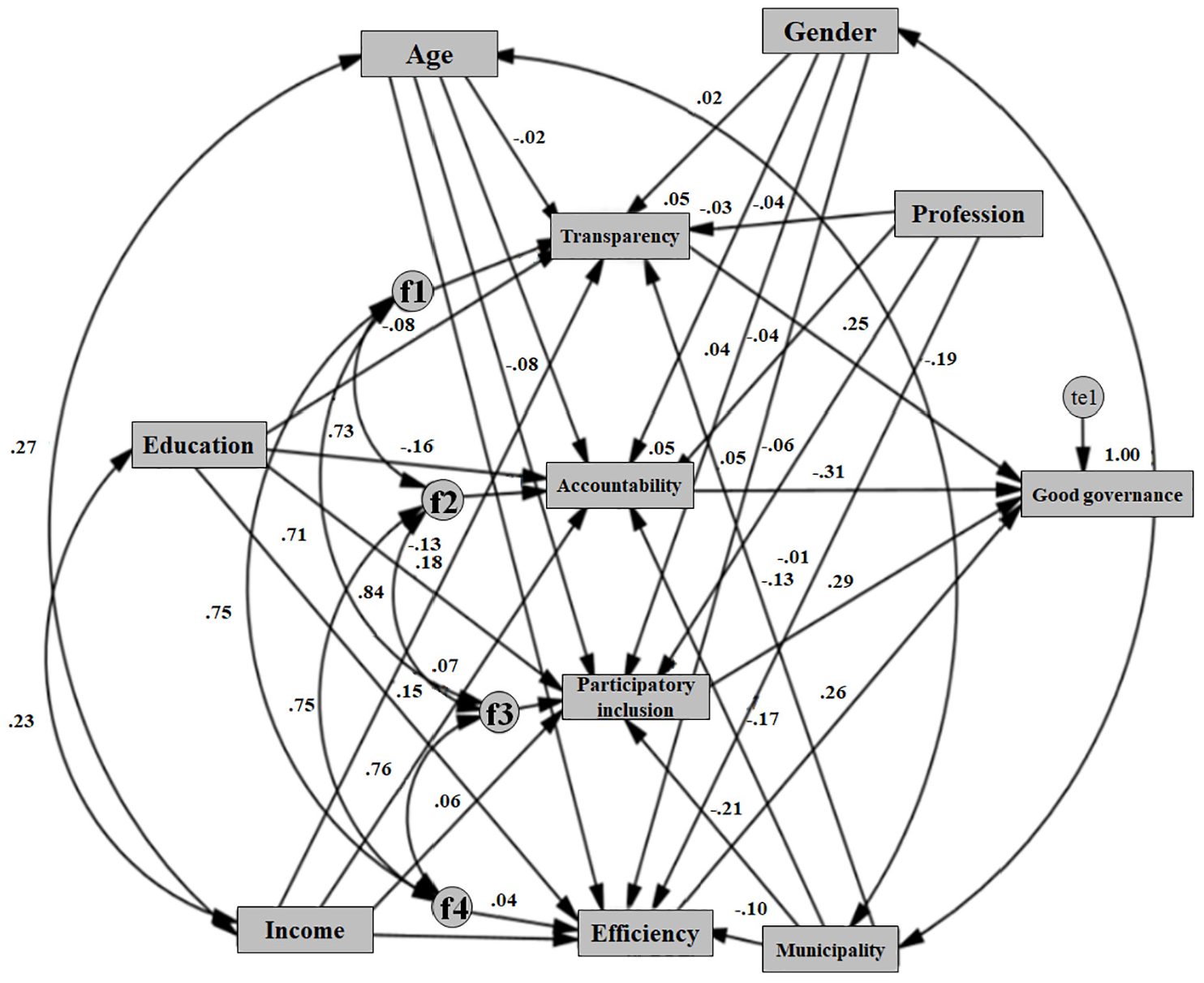
Result of SEM.
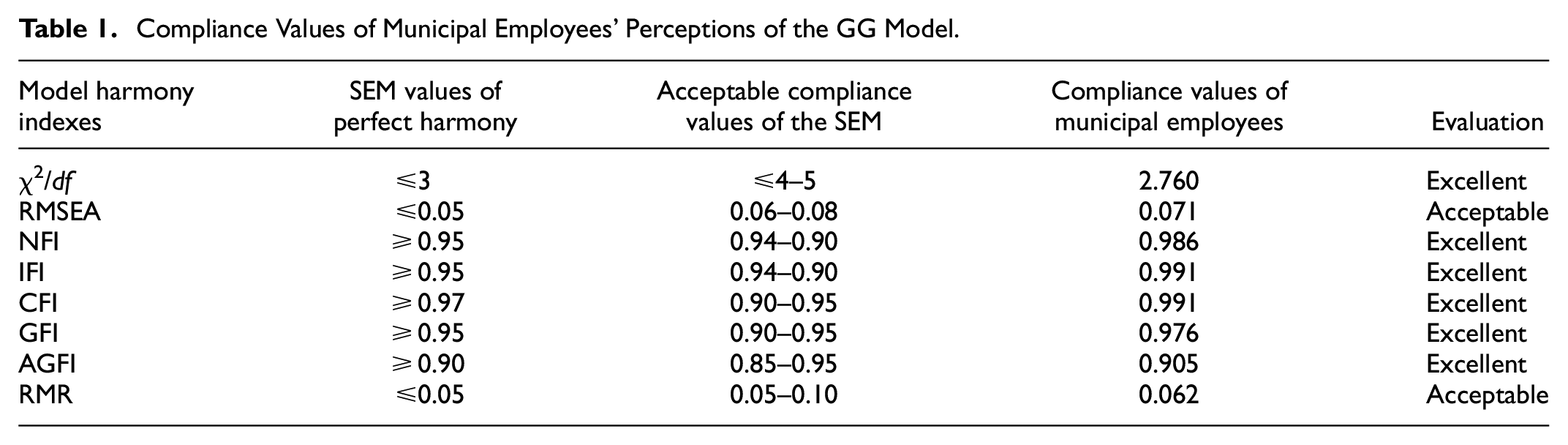
Compliance values of the model for GG perception of municipality employees is obtained as follows: χ2/df = 2.76, RMSEA = 0.071, NFI = 0.986, IFI = 0.991, CFI = 0.991, GFI = 0.976, AHFI = 0.905, RMR = 0.062. Table 1 shows the results of compliance values. It is understood that the path coefficients are statistically significant. It is also observed that goodness of fit is achieved for the structural equation model of the GG perception of municipal employees.
Compliance Values of Municipal Employees’ Perceptions of the GG Model.
The findings of the SEM analysis are given in Table 2. The results indicate that age has a weak and negative impact on perceived transparency (β = −.023), accountability (β = −.067), participation/inclusiveness (β = −.075) as p > .05. On the other hand, age has a very weak but positive impact on perceived effectiveness (β = .007) as p > .05. Gender of the employees has a weak and positive effect on perceived transparency, accountability, and participation/inclusiveness, while its impact on effectiveness is weak but negative (β = .024, .031, .038, −.049; p > .05). The profession of the employees affects perceived transparency, accountability, participation/inclusiveness, and perceived effectiveness (β = −.04, −.045, −.064, −.006; p > .05). The education level of the employees negatively affects the transparency at a weak level (β = −.083; p > .05) and lower level of education has a negative impact on accountability (β = −.162; p < .05). Education level also has a weak level of negative impact on participation/inclusion (β = −.127; p < .05). As the education level increases, the perception of effectiveness decreases (β = −.149; p < .05).
Path Analysis Results of the Municipality Employee GG Perceptions Model.

Note. Standardized estimates (β); non-standardized estimates (estimate β).
p < .001.
As the income level increases, also does the level of perceived transparency (β = .18; p < .05). Lower income has a positive impact on accountability (β = .069; p > .05). Income level affects participation/inclusion positively at a weak level (β = .061; p > .05). As the income level increases, so does the perception of efficiency (β = .039; p > .05).
Employees from six different municipalities has different perceptions on transparency (β = −.127; p < .05). Municipalities affect accountability, and the perceptions of accountability change negatively according to respective municipalities (β = −.17; p < .05). Individual municipalities affect the perception of participatory inclusiveness, and the perception of participatory inclusiveness of the employees changes negatively with municipalities (β = −.213; p < .001). The municipality affects the perception of efficiency; the perceptions of efficiency also change negatively depending on respective municipalities (β = −.105; p < .05).
Based on these findings, the model analyzed the impact of perceived transparency, accountability, participation/inclusiveness, and effectiveness on perceived GG. Table 2 indicates that an increase in the perception of transparency of the employees increases the perception level of GG (β = .245; p < .001). As the perception of accountability of municipal employees increases, their perception of GG improves moderately (β = .309; p < .001). As the perception of participation/inclusion increases, so does the perception of GG (β = .288; p < .001). The perception of GG of the municipality employees increases with their perception of efficiency (β = .259; p < .001). These findings show that if perception on transparency, accountability, participation/inclusion, and effectiveness is positive, GG perception will be positive as well. In the light of these findings, it can be argued that the factors that affect GG indicators have gained importance. After explaining the testing of hypotheses, more detailed discussions is given below.
Hypothesis Testing
In this research, hypotheses obtained from the literature were tested by SEM. The last hypothesis was tested by using demographic factors as an influencer on GG. Table 2 shows in detail that demographic factors have an impact on perceived transparency, accountability, participation/inclusion, and effectiveness. Coefficients have to be taken into consideration so that the proposed hypothesis can be accepted or rejected. Table 3 gives a summary of first main hypothesis with the results of sub-hypotheses.
Test Results of Hypotheses

According to Table 3, first hypothesis was accepted that transparency has a positive and significant effect on perceived GG (p > .05). Similarly, other hypotheses were accepted that accountability, participation/inclusion, and efficiency have a positive and significant impact on perceived GG (all p > .05). In addition, estimated coefficient shows that perceived accountability has the strongest impact on perceived GG (β = .309) followed by perceived participation/inclusion (β = .288). According to demographics of employees for the final hypothesis, education and employed municipality have a significant impact on perceived GG (all p > .05). On the other hand for the other sub-hypotheses; age, gender, education level, and income do not change perception on GG because their impact is weak and insignificant (all p > .05). Furthermore, only education level has significant impact on perceived accountability, participation/inclusion, and efficiency. As education level increases, the perception on the GG indicators decreases. Income is a significant determinant for transparency, but it does not affect other GG indicators.
Discussions
Several researches discussed the impact of GG awareness of employees on job satisfaction (Lakshika & Priyanath, 2018; Nmai & Delle, 2014; Sandika et al., 2016). It is accepted that the motivation levels of the employees are high in the municipalities where the perception of GG is positive. For this reason, the professionals tried to find out which factors have an impact on GG perception of municipal employees in Northern Cyprus. Undoubtedly, municipal employees have an important role in the implementation of GG.
Similar to other researchers, the results of the analyses show that demographic factors do not have a significant impact on the perception of GG (Biricikoğlu, 2011). Ellickson and Logsdon (2002) found a weak correlation between demographic factors and perceived GG practices. Other researchers found conflicting results on demographic factors (Medina & Schneider, 2018; Pabuçcu & Kırçoğlu, 2018). In this research, there was not determined any strong and significant relation for the age and gender variables. However, education level of municipal employees has a weak but significant impact on accountability, participation/inclusion, and effectiveness. High level of education is effective on GG practices. On the other hand, education has a significant impact on accountability and the negative beta values indicate that higher education correlates with lower perceptions of GG because of the socioeconomic structure of the employees. Although education indicates a statistical significance on accountability, it shows that there are more complex relationships between them. Due to, since the municipalities, which are public institutions, employ personnel with political appointments in establishing their administrative structure, the impact of administrative and political relations on the emotions of the employees is inevitable in this study. This reveals the fact that local governments should be improved administratively and politically. Similar results were reached by Bell et al. (2019). Thus, it can be said that activities should be conducted to improve the education level of employees in municipalities. On the other hand, income level has a positive and significant impact on the perceived transparency of public employees. In recent years, there has been a wage payment problem in some of the local governments of Northern Cyprus. Accordingly, it can be concluded that the payments of the municipal employees should be more sensitively attended.
There was no significant difference in perceived GG levels among these six municipalities located in a small geography. This can be explained by the homogeneous structure of the society and demographic similarities. On the other hand, the SEM model shows that perceived transparency, accountability, participation/inclusiveness, and effectiveness have significant impact on perceived GG. These findings are supported by several researches in the literature (Beeri et al., 2019; Cucciniello et al., 2017; Kosack & Fung, 2014) and indicate the importance of transparency, accountability, participation/ inclusiveness, and effectiveness on perceived GG. The impact is significant but not strong, implying that municipal administrations should aim to create accountable, transparent, participatory, and effective administrations by including into the system employees, who are part of the implementation. There are researches which point out that perceived transparency has a positive impact on accountability (Ingrams et al., 2020). This explains the similar perception findings of GG indicators. Although this research does not analyze the relationship between GG indicators, such an analysis can be recommended for further studies. As GG is important for residents of the municipalities, another research can be conducted on analyzing the GG as perceived by locals.
Conclusions
This research assessed the perceptions of municipal employees as an important factor in ensuring good governance (GG). While only education and income have a limited effect among demographic factors, it has been revealed that, GG indicators are significant, albeit weakly, in the perception of GG. It can be concluded that education level of employees has to be considered by administrators as a factor on GG practices. On the other hand, income level has an impact on transparency, and other researchers found out that transparency and accountability practices are interrelated. Thus, if municipal administrators are to develop GG practices, they should take income level of the employees into consideration.
A statistically significant relationship was found between GG, which is one of the dependent variables, and individual GG parameters. Although the results show that the employees have a positive perception of GG, it is revealed that the GG perception of the employees has not reached the desired level. Local government administrators should take this finding into account in their efforts to improve the perception of employees on GG. Otherwise, developing GG practices in Northern Cyprus will prove a serious challenge. Finally, a comparative study between the GG in the public and business areas may be considered for future study.
Footnotes
Declaration of Conflicting Interests
The author(s) declared no potential conflicts of interest with respect to the research, authorship, and/or publication of this article.
Funding
The author(s) received no financial support for the research, authorship, and/or publication of this article.
Ethical Approval
It is uploaded as supplementary document.

Data Availability Statement
The authors have not permission to share research data.