




Abstract
Today’s agriculture, food, and natural resources (AFNR) sectors face many wicked problems like climate change. Addressing these complex problems will require people to have both social and technical knowledge. However, having knowledge is insufficient. Individuals must be able to think about things as they occur in complex systems. Systems thinking has been proposed as a way of tackling complex problems. The purpose of this study was to determine if there is a continuum of systems thinking paradigms, beyond the hard systems thinking and soft systems thinking dichotomy proposed by Checkland. A novel research method called Q methodology was used, which included two steps: (a) the collection of data that forms the Q-sorts and (b) the by-person factor analysis of the Q-sorts. Overall, the findings from this study support the idea that systems thinking occurs on a continuum which includes (a) Hard systems thinking, (b) HARDsoft systems thinking, (c) SOFThard systems thinking and (d) Soft systems thinking. HARDsoft and SOFThard systems thinking were newly discovered in this research. The four systems thinking paradigms identified in this study better reflect the nuances and complexities that are associated with human thought and can provide a more specialized approach to solving complex issues.
Introduction
The world is facing the challenge of producing fifty percent more food than current production levels to meet projected population growth (Food and Agriculture Organization [FAO], 2018). However, food security issues involve a complex mixture of ecological, political, economic, and social dynamics (Lehtonen et al., 2019). To address issues facing the agriculture, food, and natural resources (AFNR) systems, individuals need to have both social and technical knowledge since the social complexity coupled with the technical difficulties of problems is characteristic of wicked problems (Camillus, 2008).
Wicked problems are difficult to address because they lack clarity in both their aims and solutions due to the synchronized nature of the problem(s) and solution(s) (Head & Alford (2013; Rittel & Webber, 1973). Head and Alford noted that institutional complexity and scientific uncertainty, coupled with the social complexity of various individuals’ interests and values, contribute to addressing wicked problems. As a result, it is challenging to find an optimal solution that satisfies all involved in addressing wicked problems (Checkland, 1985; Ison, 2017). Lehtonen et al. (2019) argue that due to the interconnected phenomena surrounding wicked problems, new learning and thinking strategies are needed. However, there is a lack of holistic understanding of the world because of the separation of natural sciences and social sciences (Lehtonen et al., 2019).
Orgill et al. (2019) note that a linear and reductionist perspective is the dominant mode of thinking because it allows individuals to reduce complex problems into easily understandable components. However, linear thinking is no longer a practical option in this turbulent, unpredictable global world to address complex problems (Costigan & Brink, 2015). A holistic approach is needed to address issues of complexity, such as achieving global food security or environmental sustainability (West et al., 2014). Ison (2008) writes that many people have some level of awareness of the interconnected nature of systems. However, despite this awareness, most people are not intuitive systems thinkers, and knowing a system is not the same thing as systems thinking (Schaffernicht, 2005). This may be because utilizing a holistic approach is contrary to humans’ natural inclination to use linear thinking (de Langhe et al., 2017). A challenge then is determining how to develop this crucial higher-order thinking skill that is needed to solve complex problems (Akcaoglu & Green, 2018).
Systems thinking has been proposed as a solution for addressing issues of complexity as it is considered a model for thinking differently (Cabrera et al., 2008; Plate, 2010). Systems thinking takes on a new approach to looking at the world because it looks at the interrelationships between parts related to the whole (Trochim et al., 2006). While most people are linear thinkers who use step-by-step [linear] approaches to addressing issues, systems thinkers understand interconnections that make up a holistic view (Ison, 2008).
Systems thinking was initially conceived “as a set of interacting or interdependent parts forming a complex whole” (Stalter et al., 2016, p. 324). However, Grohs et al. (2018) note that systems thinking developed in multiple academic fields and professions, making it challenging to define a universally acceptable definition. Hammond (1997) noted that the development of systems thinking involved a sizable diversity of perspectives and ideological interpretations of systems. These different viewpoints evolved due to underlying epistemologies about defining and interpreting systems (Ison, 2008). For example, General Systems Theory (GST) was first designed by von Bertalanffy (1972) and was strongly influenced by the field of mathematics. Nevertheless, GST was considered too limiting because of its focus on modeling, which obscured the context of the situation (Rountree, 1997). As Zexian and Xuhui (2010) noted, GST’s abstract mathematical modeling of the world was not reflective of real-world problems. As a result, Checkland (2005) distinguished two types of systems thinking, hard and soft systems thinking, to address these differences. However, some scholars believe that systems thinking should not be viewed as a dichotomy between hard and soft, but rather as a continuum of cognitive paradigms (Randle & Stroink, 2018). However, there is a lack of research regarding the perspective that systems thinking should be viewed as a continuum.
Literature Review
Hard and Soft Systems
Checkland (2005) noted that GST needed to be refined and expanded to address the different epistemologies surrounding the conceptualization of systems. He proposed two types of systems thinking, hard systems thinking (HST) and soft systems thinking (SST). Zexian and Xuhui (2010) state that HST is founded on positivistic epistemologies, focusing on solving problems. However, as far back as 1973 Rittel and Webber argued that the positivist paradigm could not be applied to open societal problems. Checkland (1981) argued that systems thinking needed to evolve to address this disconnect, which formed the basis of SST. SST began to gain traction when people realized that real-world problems contained an element of human interference (Tsouvalis & Checkland, 1996). SST addresses the interpretive element of human activity (Zexian & Xuhui, 2010) and focuses on understanding systems instead of developing models (Ison, 2008). The distinction between HST and SST may no longer be clear cut though, since Grohs et al. (2018) note that there is a blurring of lines between natural and social sciences due to the growing complexity of problems facing the world.
Thinking Systems Thinking Paradigm(s)
Schaffernicht (2005) argues that systems thinking forms from the implicit integration of experiences, which influences the development of mental models. These mental models may then influence, and be influenced by, an individual’s view of the social and natural world (Randle & Stroink, 2018). This perspective shifts systems thinking from competency-based thinking and instead views systems thinking as a paradigm (Grohs et al., 2018). According to Willis (2007, Chapter 1), a paradigm is “a comprehensive belief system, world view, or framework that guides research and practice in a field” (p. 8). By viewing systems thinking as a paradigm, there is the implication that various beliefs and philosophies of systems thinking underlie the paradigm. Shannon-Baker (2016) argues that paradigms are not static, unchanging entities, and this could be extrapolated to consider that individuals’ views of systems thinking are also not static. Therefore, research should be conducted to determine if there is a continuum of systems thinking paradigms. This research has the potential to cause us to reconsider our views on systems thinking, which could have implications for how we seek to help people develop the capability to be systems thinkers.
Purpose and Research Question
The purpose of this study was to determine if there is a continuum of systems thinking paradigms, beyond the HST and SST dichotomy proposed by Checkland (2005). An single research question guided this study:
Are there different systems thinking typologies (i.e., the q-sort factor load) that reflect different systems thinking paradigms?
Methodology
General Overview of Q-Methodology
Q methodology is an approach that is qualiquantology, which is a hybrid approach between qualitative and quantitative research (Stenner & Stainton Rogers, 2004). Invented by William Stephenson, Q methodology was designed to act as a bridge between qualitative and quantitative research by utilizing statistical procedures to reveal subjectivity (Brown, 1996). Traditional R methodological approaches do not reflect specific individuals’ personal characteristics, which precludes the ability to understand an individual holistically (Watts & Stenner, 2012). Q methodology inverts the factorial analysis and “involves a by-person factor analysis to identify groups of participants who make sense of (and who hence Q’ sort’) a pool of items in a comparable way” (Watts & Stenner, 2005, p. 68). In essence, Q methodology is an approach that assists in gaining access to subjective views in a scientific manner (Stenner et al., 2003). Eden et al. (2005) conclude the Q methodology demonstrates that numbers can be used in a qualitative setting which is echoed by Baker et al. (2006) who write that this approach combines “in-depth subjectivity of qualitative approaches with the mathematical techniques associated with factor analysis” (p.3).
Q methodology is characterized by two main features: (a) the collection of data that forms the Q-sorts and (b) the by-person factor analysis of the Q-sorts (Watts & Stenner, 2012). The following steps are utilized to perform a Q methodological study: (a) develop the concourse, (b) develop the Q-set, (c) select the P-set, (d) Q-sorting, and (e) analysis and interpretation (Van Exel & De Graaf, 2005). The first four steps comprise the collection of data with the fifth step involving the by-person factor analysis. It is important to remember that the variable within the Q methodological study is each participant with the viewpoints of the participants needing to be captured in relation to the subject matter (Watts & Stenner, 2005).
Concourse Development and Selecting the Q-Set
Before any Q methodology, the concourse needs to be established, as it forms the basis of the statements that are used in the Q sort (Brown, 1996). Concourse theory posits that a concourse involves statements (not facts) that are used to communicate a perspective on a topic (Stephenson, 1979). According to Watts and Stenner (2005), the “concourse is to Q set what population is to person sample (or P set)” (p. 34) as it involves all the statements from which the final Q set is derived. For this study, the concourse was developed from phenomenological interviews and focus groups involving College of Agricultural and Life Sciences faculty at the University of Florida. Two hundred sixty-six statements were derived from both sets of data to form the concourse. This concourse was used to create the Q-set.
A Q-set is a subset of the concourse that is designed to narrow the number of statements for participants to sort. According to Watts and Stenner (2005), a Q-set must be representative of a broad range of opinions within the concourse and needs to avoid bias toward a specific opinion. From the two hundred and sixty-six statements in the concourse, 47 statements were selected to form the Q-set. Four theoretical categories were developed to ensure that the selected statements provided a broad range of opinions. The theoretical categories were: general systems thinking (12 statements), hard systems thinking (11 statements), soft systems thinking (12 statements), and a blend of hard and soft systems thinking (12 statements). The statements were randomly numbered to prevent participant bias. A researcher from [university] reviewed the Q-sort for validity.
The P-set
According to Watts and Stenner (2005), it is usual for Q methodological studies to involve strategic sampling to find relevant viewpoints on the subject matter. Herrington and Coogan (2011) state that some of those interviewed to develop the Q-set should also be involved in the Q sort. The participants who participate in the Q-sort are known as the P-set, and according to Baker et al. (2006), this number varies depending on the type of study, although Valenta and Wigger (1997) note that this number is usually small. The P-set of this study consisted of thirteen participants affiliated with the [department]. Participants needed to have a teaching appointment of at least 30 percent.
Administering the Q-sort
Once the Q-set and the P-set were established the administration of the Q sort was conducted. Data were collected face-to-face with participants manually manipulating the statements which were printed on small pieces of paper. Participants received the Q-set in the form of random numbered statements printed on a separate card. A sheet with sorting instructions is called a condition of instruction (Brown, 1996). This study asked participants to rank the statements from strongly disagree to strongly agree to form a semi-normal distribution (Valenta & Wigger, 1997). Participants were instructed to initially sort the statements into three piles: those statements seen as agreeable, those statements seen as disagreeable, and a third pile of statements that were seen as neutral. Participants then sorted the statements so that they aligned with the condition of instruction by placing each statement into a corresponding box. The researcher recorded the Q-sort of each participant and conducted a follow-up interview immediately upon the completion of the Q-sort to explore why participants sorted the statements, particularly focusing on the extremes.
Data Analysis
To detect patterns and connections that would otherwise have been passed over by nonstatistical methods, Q methodology utilizes quantitative data reduction in the form of correlation and by-person factors analysis (Valenta & Wigger, 1997). By-person factor analysis involves looking at the person as opposed to traits or variables and correlates people based on those who have similar opinions (Valenta & Wigger, 1997). Individual’s rank order of the statements was converted into numerical data and then uploaded to Ken-Q Analysis Desktop Edition (KADE, https://shawnbanasick.github.io/ken-q-analysis/); an open-source application used to analyze Q methodology data (Banasick, 2019). Once data was inputted, KADE produced a correlation matrix, in which each participant’s array of statements was intercorrelated with everyone else’s. The correlation matrix was then subjected to a factor analysis to determine which data arrays are highly correlated, which in turn determines the factors.
Q Sorts to Factors
Centroid factor analysis is the preferred method of Q methodologists to conduct factor analysis because it provides the researcher with an opportunity to explore and analyze the data as opposed to principal component analysis (Watts & Stenner, 2012). Principal components analysis derives a single mathematical best solution; therefore it approaches the analysis from a mathematical analysis as opposed to a theoretical analysis (Watts & Stenner, 2012). While principles component analysis is the most common factor extraction method (Akhtar-Danesh, 2017), Brown (1980) states that in Q methodology it is better to rotate factors judgmentally using theoretical rather than mathematical criteria. For these reasons, centroid data analysis was chosen to conduct the factor analysis.
In determining the number of factors to extract, Brown centroid factors were chosen as opposed to other methods such as Horst 5.5 centroid factors and using a factors eigenvalue (EV). The latter two use statistical and objective criteria for determining factor extraction, however, Brown (1980) argues that a combination of theoretical and statistical considerations needs to be employed. Brown centroid factors utilize the magic number seven to start as a ballpark for possible factors to extract, with the researcher then using their ruminations to determine which factors are to be kept.
Factors to Factor Arrays
The correlation between a Q-sort and the factor itself is called a factor loading (Akhtar-Danesh, 2017). Those individuals who load into a factor have similar opinions that differentiate themselves from the others who load into different factors. Each factor is interpreted based on its distinguishing statements, and statements with high or low factor scores. Distinguishing statements usually define the uniqueness of each factor.
However, unrotated factors (i.e., the factors that emerged from the extraction process) are usually not meaningful or easily interpretable (Akhtar-Danesh, 2017). Thurstone (1947) was instrumental in developing a process known as factor rotation, which creates simple structures that are easily interpretable by rotating factors about their origin. Thurstone (1947) felt that without factor rotation, the extracted factors lacked psychological salience since they were mathematical constellations with arbitrary dimensions. It was only after the factors were rotated that group cohesion presented itself (Veenman, 2005).
Factor rotation converts the factor loadings into a spatial concept that allows the researcher to visually analyze the data. For example, in Figure 1, individuals three, one, and ten share similar opinions due to their close grouping. However, participants eleven and eight are much further away, representing a divergence of views on the subject under investigation.

Example of a factor rotation of Factors 4 and 6.
Factor rotation is also utilized to determine how closely the individual Q-sort aligns with the factor viewpoint. Using Figure 1 as an example, individuals eleven and five’s Q-sort are almost directly on top of the axis of factor six, indicating that their viewpoints closely approximate the viewpoint of the factor. In contrast, individuals six and eight’s viewpoints are closely approximate the viewpoint of factor four due to how close they are to factor four’s axis. Theoretically, a Q-sort could land exactly on a factor’s axis, meaning the Q-sort’s viewpoints are the same as the factor’s viewpoint. If this occurs, the Q-sort’s configuration can be utilized to fully understand the factor’s viewpoint since they are the same. When this does not occur, the researcher is responsible for determining which Q-sorts are close enough to be considered an approximation of a factor’s viewpoint. Referring to Figure 1, the researcher needs to decide if individual ten’s Q-sort should be considered part of factor four. If the researcher decides that figure ten is close enough to be included in the factor with individuals six and eight, then they need to decide if individuals one, three, and seven should also be included. Watts and Stenner (2012) argue that all significantly loading Q sorts should be utilized to create factor estimates. However, Brown (1980) is more flexible, for a factor to be considered reliable it needs to include at least two Q-sorts, although three or more is preferred.
To conduct factor rotations, by-hand factor rotation, and Varimax rotation are two approaches that can be used. Varimax rotation involves the use of statistical criteria while by-hand rotation involves the researcher determining where to place each factor. Watts and Stenner (2012) recommend that both approaches should be utilized because they are complementary since they have opposing strengths and weaknesses. The researcher conducted a Varimax rotation and then rotated the factors by hand based on the recommendation by Watts and Stenner (2012). Factor arrays involve configuring a single q-sort that represents a factor’s viewpoint (Watts & Stenner, 2012). This is done by converting the z scores of each item into a single factor array, demonstrating the holistic aspects of Q methodology.
Factor Arrays to Factor Interpretation
According to Stenner et al. (2003), factor interpretation “takes the form of a careful and holistic inspection of the patterning of items in the factor arrays” (p. 2165). A crib sheet requires the researcher to engage in the data consistently with each factor. through forced engagement of every item in the factor array (Watts & Stenner, 2012). The researcher created a crib sheet for each factor, which included the following components, (a) the highest and lowest ranked statements within the factor are listed, and (b) listing the statements that ranked highest and lowest relative to other factors.
Results
The factor matrix (see Table 1) was analyzed to identify defining sorts, based on a significance level of p < .05. Defining sorts are identified as those that load significantly, within at least one factor. The sorts of all thirteen participants were considered defining, as each one had a significant load in one factor. There were no defining sorts that loaded on factor three, so it was excluded from the analysis. An analysis of the data yielded four factors: (a) Hard Systems Thinkers (Factor 1), (b) HARDsoft Systems Thinkers (Factor 2), (c) SOFThard Systems Thinkers (Factor 3), and (d) Soft Systems Thinkers (Factor 4).
Factor Matrix with Demographics of Participants and Defining Sorts.
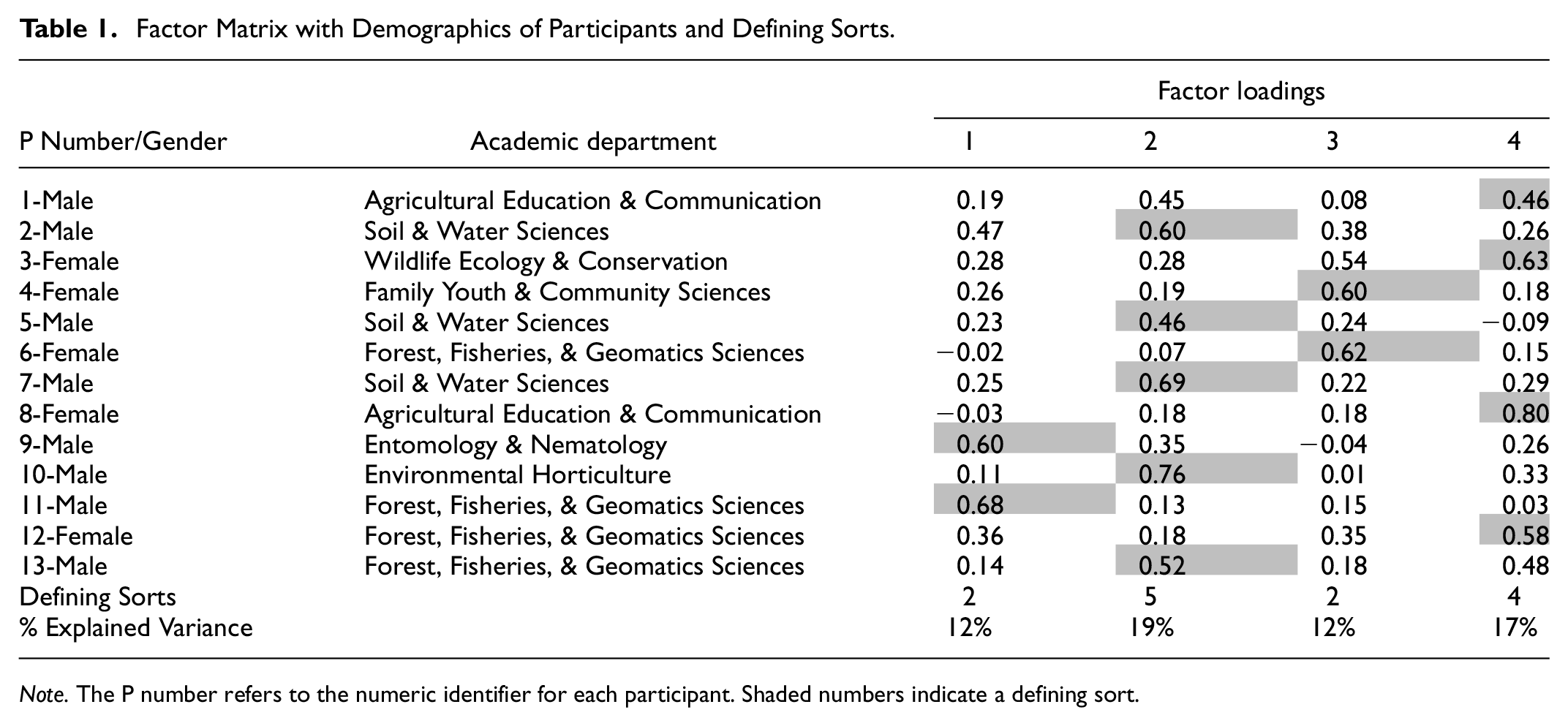

Note. The P number refers to the numeric identifier for each participant. Shaded numbers indicate a defining sort.
Data analysis involves analyzing the statement and its Q-sort value, which is represented throughout the text by (statement numbers, and Q-sort value). For example, a hypothetical statement numbered 50 with a Q-sort value of −4 will be represented in the text as (50, −4). While the statement numbers will not change, the Q-sort value does change depending on the Factor. One further note is that the Factors will be presented by system thinking typology rather than numerical order, for readability.
Factor 1: Hard Systems Thinkers
Two participants are significantly associated with Factor 1, which explains 12% of the study variance. Both participants were male and represented the following departments, (a) Entomology & Nematology (participant 9), and (b) Forest, Fisheries, & Geomatics Sciences (participant 11). Table 2 displays the distinguishing statements for Factor 1, which is termed Hard systems thinkers. This viewpoint represents individuals who align strongly with a hard systems thinking paradigm. Participants valued keeping the systems as simple as possible, even at the expense of leaving out details or human perspectives (40, 4, and 22, 3). Participants also supported the notion that it is fine to focus on specific subsections of a problem (34, 4, and 31, −2), and this approach could effectively address the problem under investigation. Additionally, participants have a firm belief that the world can be structured, which aligns with positivist perspectives.
Distinguishing Statements in Factor 1.
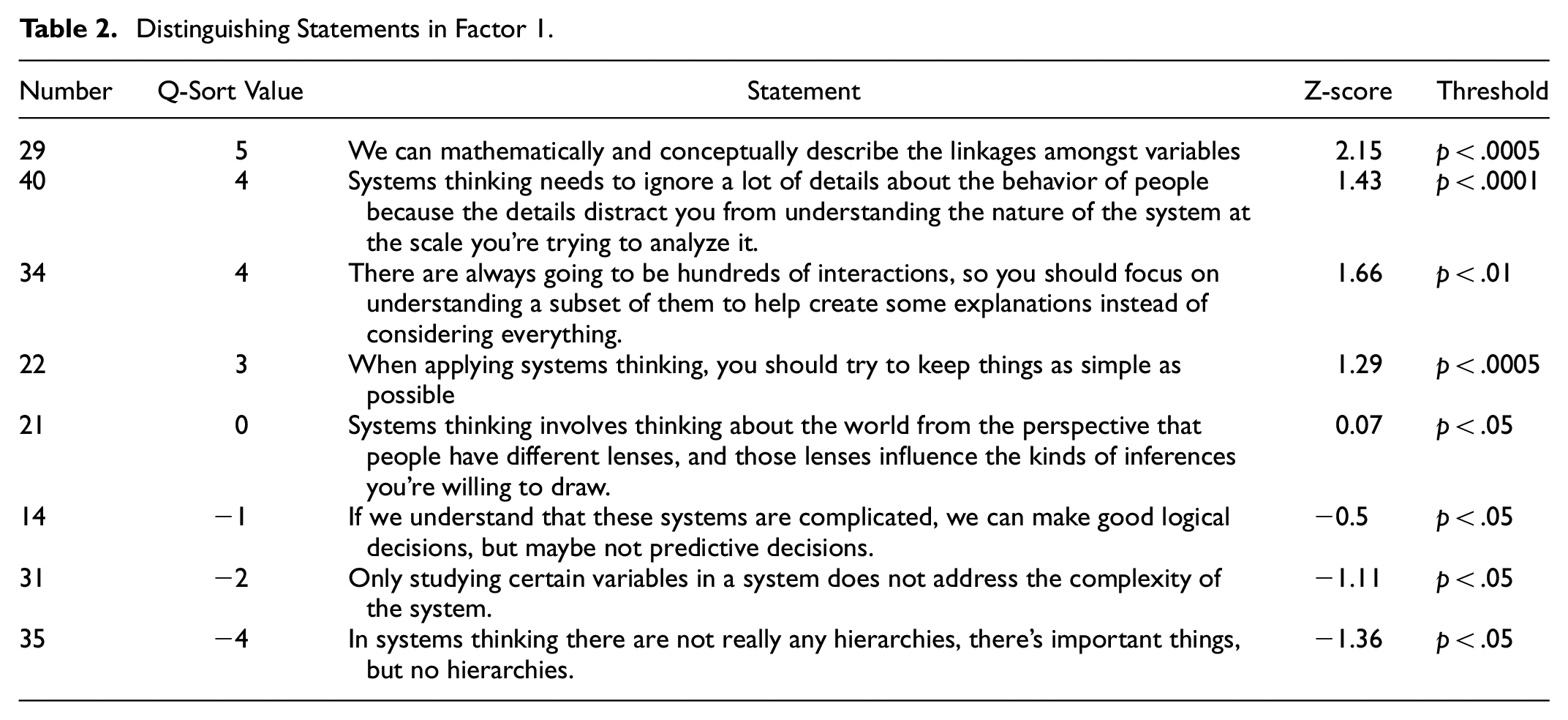
Analysis of the crib sheet (see Table 3) further reinforces the view that participants in Factor 1 align with concepts associated with hard systems thinking. Hard systems thinking aligns with ideas that systems thinking should be goal-focused (37, 5), that the world can be structured and modeled (47, 2), and that systems thinking should focus more on problems and less on issues (18, 4, and 35, −4). Participant Eleven stated in a follow-up interview “a key aspect of systems thinking is being able to discriminate between key details and distractions,” implying that models should only focus on specific details. In addition, those who have a hard systems thinking paradigm believe that systems thinking needs to be able to make predictions, which is why it is important to be able to mathematically quantify systems components.
Factor Interpretation Crib Sheet for Factor 1 (Hard).

Factor 2: HARDsoft Systems Thinkers
Five participants are significantly associated with Factor 2, which explains 19% of the study variance. All participants were male, and represented the following departments, (a) Environmental Horticulture (participant 10), (b) Forest, Fisheries, & Geomatics Sciences (participant 6), and (c) Soil & Water Sciences (participants 2, 5, and 7). Participants in this factor share a viewpoint that represents individuals who align with a hard systems thinking paradigm but also value a blending of hard and soft systems thinking. Hard systems thinking is typically associated with post-positivistic thinking, with an objective toward solving and predicting issues. Table 4 shows the distinguishing statements associated with Factor 2, termed HARDsoft Systems Thinking Paradigm. Participants indicated they associate systems thinking with mathematical models (29, 1) and have an underlying view that systems thinking can be utilized to make predictions (11, 1). It should be noted though that participants in Factor 2 also believe that systems thinking can be utilized more abstractly to understand the world (37, −2), which aligns with a soft systems thinking perspective.
Distinguishing Statements in Factor 1 (HARDsoft).
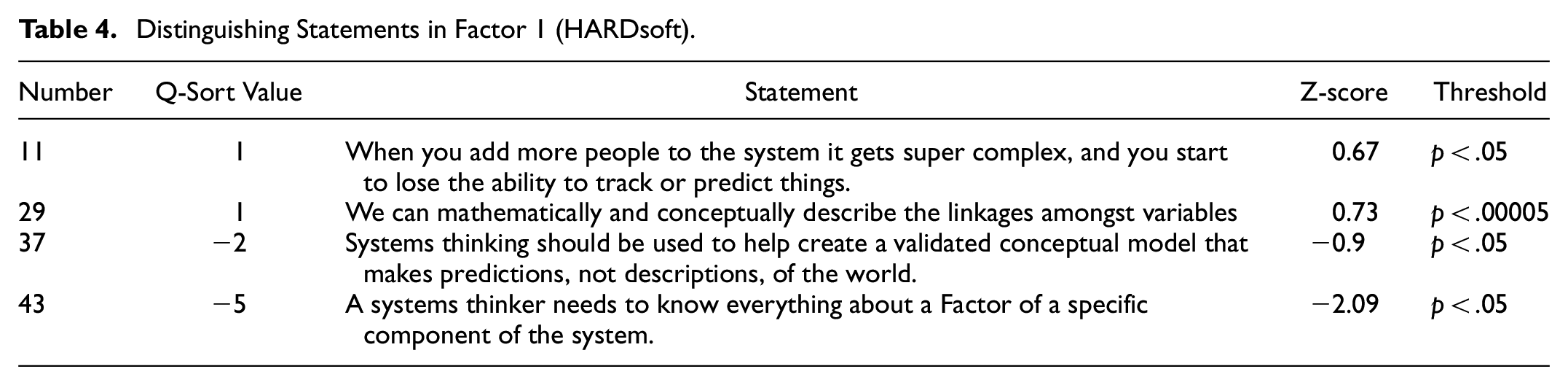
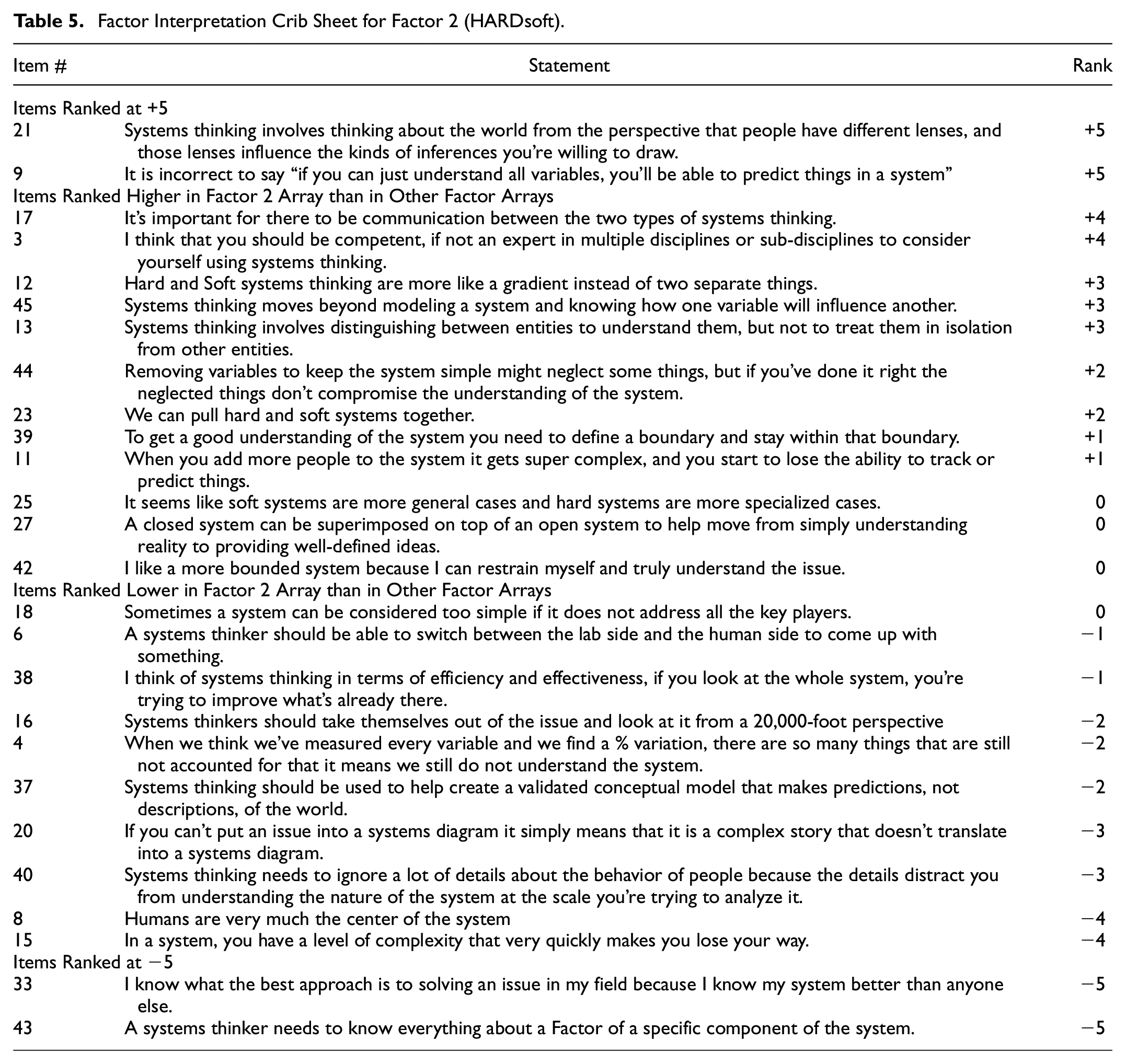
However, it is also important to analyze the crib sheet (see Table 5), because, although the statements were not considered distinguished, they include statements of interest and provide further information on the factor characteristics. A component of hard systems is the idea that boundaries can and should be set with the goal of reducing the complexity of the system, and this was evident by the support of statements that reflected this belief (44, 2), (39,1), (11,1), and (42,0). Although many statements did reflect hard systems, participants acknowledged the influence of varying perspectives when making inferences (21, 5). In a follow-up interview, one participant said, “you have to have some understanding of the types of systems you are working with, which means you have to set boundaries.” However, he also noted he does not know of any systems that have not been influenced by humans in some respect and therefore he needs to at least consider the human element. Another participant strongly felt that “humans are an important part and influence on systems, but they are not at the center of systems” and should be viewed as a connected part but not the whole part of the system.
Factor Interpretation Crib Sheet for Factor 2 (HARDsoft).
Factor 3: SOFThard Systems Thinkers
Two participants are significantly associated with Factor 3, which explains 12% of the study variance. Both participants were female and represented the following departments, (a) Family Youth & Community Sciences (participant 4), and (b) Forest, Fisheries, & Geomatics Sciences (participant 6). Table 6 displays the distinguishing statements for Factor 3, termed the SOFThard Systems Thinking Paradigm. This viewpoint represents individuals who align with a systems thinking paradigm that supports the blending of soft and hard systems thinking but aligns more closely with the soft systems thinking perspectives. Participants were in strong agreement that systems thinking should be utilized to gain a better understanding of problems as opposed to solving them (2, 5), which aligns with soft systems thinking. They believed almost as strongly though that hard and soft systems thinking perspectives need to be valued (32, 4), but were also clear that they did not think an individual needed to use both at the same time to solve a problem (26, −4).
Distinguishing Statements in Factor 3 (SOFThard).

An analysis of the crib sheet (see Table 7) reveals that there is strong support for the idea that the world reflects an integration of hard and soft systems thinking which supports the need for interdisciplinary work (1, 5, and 2, 5). Interestingly though, participants did rank lower than the other factors the belief that you can pull the two systems together (23, −1) and the need to communicate between the two systems (17, −1). Participants also felt that the focus of systems thinking was not to simplify complex systems through mathematical modeling and that all perspectives need to be considered (7, 1), (34, −4), (41, −4), and (47, −3). However, they did identify with hard systems thinking concepts in that they felt that systems thinking should look at efficiency (38, 1) and that human behavior can be studied by using variables (10, +3). A key differentiation though is that SOFThard system thinkers do not believe that structural equation modeling can provide a holistic picture (47, −3), as one participant noted in a follow-up interview, “modeling predicts the past, but it will fail in predicting the future.” Based on these results, participants in Factor 3 closely align with soft systems thinking but do agree with hard systems thinking perspectives as well.
Factor Interpretation Crib Sheet for Factor 2 (SOFThard).

Factor 4: Soft Systems Thinkers
Four participants are significantly associated with Factor 4, which explains 17% of the study variance. One participant was male, and three participants were female, and represented the following departments, (a) Agricultural Education & Communication (participants 1 and 8), (b) Forest, Fisheries, & Geomatics Sciences (participant 12), and (c) Wildlife Ecology & Conservation (participant 3). Table 8 displays the distinguishing statements for Factor 4, termed Soft Systems Thinking Paradigm. This viewpoint represents individuals who align with soft systems thinking perspectives. Participants in this factor shared the view that humans were very much at the center of the system (8, 1) and that systems thinkers needed to be knowledgeable not only on the lab side but also on the human side to be successful (6, 2). Participants did not agree with the idea that systems needed to be bound (42, −4) or that people should work in isolation (3, −5) to solve problems.
Distinguishing Statements in Factor 4 (Soft).

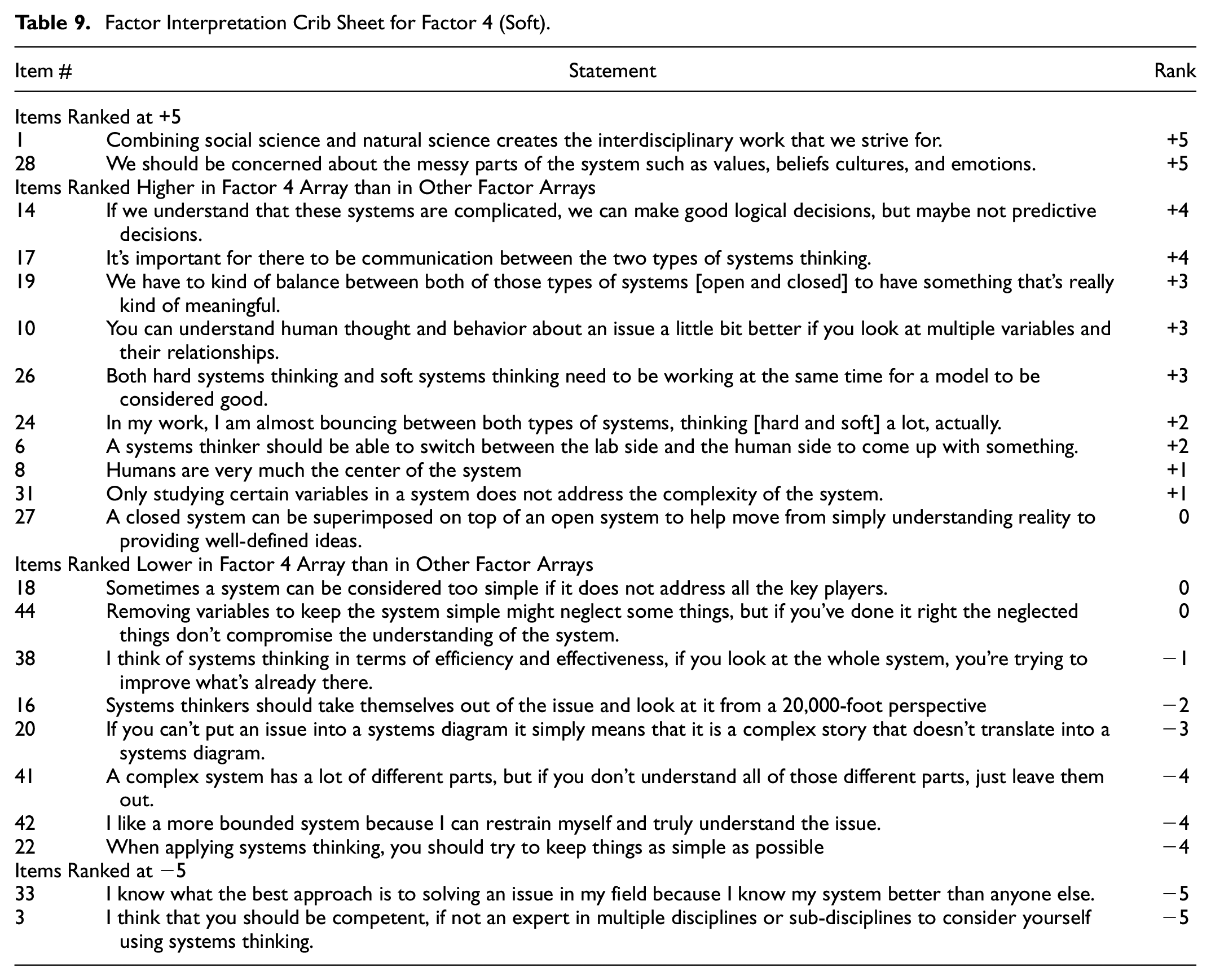
The statements from the crib sheet (see Table 9), indicate there is clear support for considering and seeking out different perspectives and beliefs when using systems thinking (1, 5), (28, 5), (17, 4), (19, 3), and (26, 3). Participants did not agree with the idea that systems thinkers needed to remove themselves from the issue they are studying (16, −2) or that simplifying systems is necessary (41, −4 and 22, −4). As one participant in Factor 4 stated, “we want complex stories and messy parts, because the predicting and modeling can only go so far because we are human.”
Factor Interpretation Crib Sheet for Factor 4 (Soft).
Conclusions and Discussion
This research sought to determine if different systems thinking typologies exist. Overall, the findings from this study support the idea that there are different types of systems thinking paradigms and that these are determined by the following typologies, (a) Hard systems thinking, (b) HARDsoft systems thinking, (c) SOFThard systems thinking and (d) Soft systems thinking. Hammond (1997) found that as different disciplines adopted systems thinking, each discipline brought its own ideological interpretation of systems and its own perspectives. These differing viewpoints of systems thinking have coalesced into typologies that form systems thinking paradigms. Paradigms are defined as frameworks, beliefs, or worldviews that guide people through their research and practices (Willis, 2007, Chapter 1). Certain beliefs about systems thinking can be grouped to form philosophical typologies that underlie each paradigm. The results of this Q-method support Randle and Stroink’s (2018) idea that systems thinking should be viewed as a continuum of paradigms. Using Checkland’s (2005) differentiation between hard and soft system thinking as opposing ends of the continuum, two additional paradigms were identified, HARDsoft and SOFThard (see Figure 2).

Continuum of systems thinking paradigms.
Discussion
Individuals who have a Hard Systems Thinking Paradigm share viewpoints that are consistent with the positivistic views of systems thinking. These individuals view systems thinking in terms of modeling and structuring and look to simplify systems to increase efficiency and effectiveness (von Bertalanffy, 1972). Hard systems thinkers are less concerned about the human perspective and are comfortable removing different components of the system, provided that the removal does not fundamentally change the overall structure of the system (Hammond, 1997). In addition, those who have a hard systems thinking paradigm believe that systems thinking needs to be able to make predictions, which is why it is important to be able to mathematically quantify systems components.
Individuals who have a HARDsoft Systems Thinking Paradigm share many characteristics with hard systems thinkers; however, they are more willing to acknowledge the role of human perspectives and interactions in their systems. Just as with hard systems thinkers, HARDsoft systems thinkers have an underlying belief that systems thinking should be utilized to make predictions, which is done through mathematical modeling (Zexian & Xuhui, 2010). However, they also indicated that they were willing to consider that systems thinking could be utilized to make descriptions of the world (Mulej et al., 2004). They also acknowledged that human perspectives could influence the inferences they can draw and therefore these perspectives need to be acknowledged. HARDsoft systems thinkers are willing to collaborate with others, but overall believe that to be competent in systems thinking the onus is on the individual to be knowledgeable in multiple areas.
SOFThard systems thinkers have a systems thinking perspective that while aligning with soft systems thinking, also includes the belief that systems do contain structures that can be modeled. The latter is a hard systems perspective; however, there are some fundamental differences in modeling that differentiate SOFThard systems thinkers from HARDsoft and Hard systems thinkers. SOFThard systems thinkers do not believe that models should be utilized to make predictions of the world, with one participant stating in a follow-up interview “modeling predicts the past, but it will fail in predicting the future,”Checkland (1981) echoed this idea when he stated that systems thinking needed to evolve to reflect that the world was not testable physical reality. SOFThard systems thinkers believe that modeling should be utilized to show connections between components, which are useful when participating in interdisciplinary work. SOFThard systems thinkers place a greater emphasis on collaboration and interdisciplinary work but compared to soft systems thinkers they are less likely to communicate and seek to pull natural and social sciences together. Huutoniemi et al. (2010) found many researchers aim to solve specific problems in a pragmatic or conceptual sphere and therefore prefer to work with adjacent disciplines as opposed to true interdisciplinary work. SOFThard systems thinkers may prefer to work with adjacent disciplines as opposed to attempting to combine two opposing philosophical viewpoints, which may explain why they ranked pulling hard and soft systems together lower.
Soft systems thinkers have a paradigm that fully embraces that systems thinking needs to include the human component to understand the system holistically. They tend to reject bounding systems because doing so may exclude different perspectives and viewpoints. As Caulfield and Maj (2001) noted, soft systems thinking is often viewed as the ideal approach to solving ill-defined problems because it considers the unpredictability of people.
As a result of this underlying belief, soft systems thinkers are more likely to work with both social scientists and technical scientists because they disagree with the notion that systems can be looked at in isolation from other perspectives. One area that the soft systems thinking paradigm diverges from the other paradigms is their belief that systems do not need to be simplified or modeled. Soft systems thinkers may be more willing to work with the other three paradigms because they believe that there needs to be a diversity of thought to understand the issue(s) under investigation. However, willingness may not translate into collaboration because Soft systems thinking typologies may be too different to effectively work with other paradigms. Since Soft systems thinking is focused on integrating divergent opinions to learn more about the problem (Monat et al., 2020), other systems thinking paradigms may be uncomfortable with the notion that divergent opinions should not be viewed as disrupting but rather valuable.
The four systems thinking paradigm represents a continuum of various systems thinking typologies. Checkland’s (2005) differentiated between hard and soft systems thinking to refine systems thinking to better reflect the real world. However, this delineation may be closer to linear thinking and reductionist thinking than being a true reform of systems thinking, because it confines systems thinking into two categories. The four systems thinking paradigms identified in this study better reflect the nuances and complexities that are associated with human thought and can provide a more specialized approach to solving complex issues. Previous research has focused on systems thinking competency and skill development but shifting toward viewing systems thinking as a paradigm can open new doors of research and better equip future generations to address wicked problems. Overall, the discovery of a systems thinking continuum contributes to our understanding of this phenomenon and should lend itself to guiding future work in this area.
Recommendations
This research is exploratory, and therefore further research is needed to determine the validity of the findings. The recommended sample size for Q sorts ranges widely from one individual to twice the number of people as there are statements (Watts & Stenner, 2012). Although the sample size in this study is acceptable, the small size could have impacted how the participants loaded into the factors. As a result, there is an increased risk that a few individual sorts could have an outsized influence on the factor loadings. In addition, this study operates under the assumption that the sample is representative of the population and that the statements used in the Q-sort are accurate reflections of system-thinking perspectives. It is recommended that this study be replicated with additional samples.
Furthermore, research should be conducted to determine if specific formative experiences that promote systems thinking development have an impact on which paradigm is formed. Research should also investigate how these experiences, or their outcomes, can form system thinking typologies. It is also recommended to explore how these systems thinking paradigms can be utilized to increase interdisciplinary work and collaborations. Kirton’s (1976) innovation-adaptor model should be considered as a framework for exploring if knowledge of the different systems thinking paradigms can influence group dynamics and collaborative work. It is also suggested that a systems paradigm inventory be created to assess where on the continuum of systems thinking paradigms an individual may be. The results of this study should also be disseminated to prompt discussion around the implication of multiple systems thinking paradigms.
Footnotes
Declaration of Conflicting Interests
The author(s) declared no potential conflicts of interest with respect to the research, authorship, and/or publication of this article.
Funding
The author(s) received no financial support for the research, authorship, and/or publication of this article.

Data Availability Statement
Data sharing not applicable to this article as no datasets were generated or analyzed during the current study.