



Abstract
This study aimed to understand better how Koreans in their 30s to their 50s perceive the word kkondae using Q-methodology, a research method that reveals the subjectivity of individuals. “Kkondae” traditionally refers to condescending older people and reveals changes between generations in Korean society. Our research results showed four types of perceptions. Type 1 participants believe kkondae are people who wield authority based on age. Type 2 participants see kkondae as people who mistakenly believe their own experiences can be generalized. Type 3 participants view kkondae as self-centered and closed-minded people who think they are superior, while Type 4 participants perceive kkondae as people who lord over others as part of hierarchical relationships. Consequently, the four types of perceptions of kkondae demonstrate that the reasons and ways of expressing conflict situations between groups are changing in Korean society.
Introduction
The Korean newspaper, Chosun Ilbo, published an interesting article on September 25, 2019, stating that the day before, the BBC selected the word “kkondae” as its official “word of the day” on its Facebook page. In addition, The Economist (2019) also introduced the word kkondae in its Asia column on May 30, 2019. The interest in the recently coined term shown by another international media outlet intrigued Koreans who had already been using the word habitually to express discontent toward a particular person. Still, the interest shown by international media further raised awareness of kkondae among Koreans. International news outlets showed interest in the word kkondae because it seemingly reflects the cultural issues or conflicts between generations in Korea’s rapidly changing society. Kkondae, as defined by outsiders (i.e., the BBC and The Economist, respectively), is “an older person who believes they are always right and you are always wrong,” or a “condescending geezer” (Banyan, 2019; Chosun Ilbo, 2019).
Ultimately, kkondae seems to have become a prominent term to express the generational conflict in Korean society. The Economist’s explanation for the word’s creation is also interesting, as it argued that the younger generation is engaged in rebellious behaviors against Korea’s oppressive hierarchical and authoritarian culture (Chosun Ilbo, 2019). Thus, the term kkondae is supposed to demonstrate a change in response toward the inappropriate, illogical, and high-handed behavior exhibited mainly by the older generation by progressing from having negative views to acting against them.
However, conflict situations between groups are not limited to generational differences. People acquire the cultural values of the society in which they are born and raised through social interactions (Brunner, 1987). Because of this kind of social interaction, there are specific “cultural contents” at a given point in time (Patil, 2014). These cultural contents explain why people born in different periods can show different attitudes, values, and mindsets when faced with the same situation. For example, Heong and Yazdanifard (2013) describe the cultural characteristics of the Traditional and Silent generations (before 1946), Baby Boomer generation (1946–1964), and Generation X (1964–1979), and link people’s birth years with changes in culture. Some scholars argue that each generation has unique characteristics, whereas others maintain that individuals are in generic categories (Adams, 2000; Mitchell et al., 2005; Murphy et al., 2004; Patil, 2014; Wong et al., 2008). An individual’s exposure to various cultures that are part of the same generation depends on the age of people they encounter in their lives (Adams, 2000). For example, those who define themselves as Generation X may have grown up influenced by parents born in the Traditional and Silent generations or the Baby Boomer generation. Moreover, the younger colleagues at their workplaces may be from Generation Y and their kids from Generation Z. Ultimately, individuals can deviate widely from the people they associate with across the generations they encounter, rather than merely having their cultural characteristics defined by their age group (Deal, 2007). This interaction makes it difficult to conclude that the term kkondae generally reflects solely generational conflicts, demonstrating more complex underlying factors.
The analyses of the meaning of the word kkondae by foreign news outlets are essentially observations of changes and trends in Korean society from the outside. Consequently, they may be more objective than Koreans due to differences in perceptual processes influenced by culture (Nisbett & Miyamoto, 2005). The word kkondae spoken in Korea is an informal term. Its meanings in the Korean dictionary include “old beggar,” “old man,” and “stubborn teacher” (Kim, 2016; National Institute of Korean Language, 2020). The exact etymology of this term is unclear. However, it is evident that the cultural idea behind this term has existed historically in Korean culture and that the recently emerged social interest brought this term to the forefront.
In the past, there were discussions reminiscent of kkondae while explaining the unique characteristics of Korean culture in the context of conflicts between generations against the backdrop of authoritarianism or hierarchical Confucian culture, or the sense of entitlement in those with superior economic levels and social positions (Choi et al., 2000; Min, 1989; Yoon & Han, 2008). However, since the mid-2010s, the kkondae discourse started expanding to increasingly complex associations with class, generation, and information “structurally” linked to power under the consciousness of authority and a sense of rank. The association also includes the sub-part of exchange relations, and the intimacy between the parties sending and receiving messages concerning emotions at the “conscious” level, and the symbol of the process of content delivery (Ah, 2020; Kim, 2016, 2017; Min, 2019). Moreover, studies specifically mentioning the term kkondae also began to arise during this time.
One study examined the scale of disposition toward kkondae in authoritarianism and social prejudice in Korean society. The study showed that authoritarianism and social prejudice are characteristics of kkondae (Seo et al., 2018). Other studies view the competitive social environment and communication problems, not time, as reasons for the birth of “young kkondae” (Kim, 2016, 2017). These studies provide diverse meanings rather than such dictionary definition, which focuses on “older people” such as “old beggar” or “old man.” Many studies about kkondae include the consciousness of authority, a sense of rank, the awareness of superiority, and a sense of entitlement in Korean society. The image of kkondae, recently expanded to youth, is a problem of intercultural communication, unlike previous studies’ descriptions. These results demonstrate the complexity and continual changes in the interpretation of kkondae.
Since modernization, Korean society’s values changed from traditional collectivism and authoritarianism to individualism and democratic equality (Son & Kang, 2019). Thus, it is challenging to create a complete consensus between the perspectives of outsiders and insiders. Koreans may sympathize with the definitions of kkondae from outsiders; however, they may also feel that these definitions do not accurately reflect their meaning of the word. Therefore, Koreans may or may not agree that kkondae points to a generation gap or conflict, and there might be individual differences in how Koreans interpret the word. Accordingly, this study explores the framework of the word kkondae and whether the term expresses a generational conflict and/or is a matter of individual differences, as suggested by Koreans’ perceptions, by identifying the different types of perceptions and examining their characteristics.
Research Methodology
Q-methodology is a research approach that incorporates quantitative and qualitative methods to “discern people’s perceptions of the world from the vantage point of self-reference” (Kil et al., 2020; McKeown & Thomas, 2013, p. 1). Q-methodology allows a better understanding of intra- and inter-individual differences from a scientific perspective. This study applied Q-methodology to perceptions of subjective experiences regarding kkondae. As shown in Figure 1, this study first created a Q-concourse, selecting Q-statements, and a P-sample. Then, we collected data through Q-sorting and analyzed and interpreted the results using the QUANL program (https://qmethod.org/resources/software/). The quantitative aspect of Q-methodology, involving factor analysis, identified a limited number of types representing various viewpoints on kkondae (Crosse, 2019). The resulting qualitative investigation of these different types offered a better way to understand how individuals think about the term “kkondae” (Crosse, 2019).

Research Process.
Q-Concourse
Q-concourse is “the flow of communicability surrounding any topic” in “the ordinary conversation, commentary, and discourse of everyday life” (Brown & Brown, 1993, p. 94). In other words, it is a compilation of all the possible statements regarding a subject “obtained in several ways: interviewing people; participant observation; popular literature, like media reports, newspapers, magazines, novels; and scientific literature, like papers, essays, and books” (Van Exel & De Graaf, 2005, p. 4).
For this study, the researchers interviewed at least one participant in each age group ranging from teens to 50s to obtain a representative Q-concourse. More specifically, we interviewed two participants in their teens, three in their 20s, three in their 30s, two in their 40s, and two in their 50s. We also conducted a semi-structured survey of 60 university students at D University. The interview and survey questions included the following: “Are you familiar with the term ‘kkondae’?”, “How would you define ‘kkondae’?” “What do you think about ‘kkondae’?” “How do you feel about ‘kkondae’?” The researchers also used the keyword “kkondae” to find opinions posted online on the Korean search portal Naver and relevant news articles. The data from these sources created the statements for the Q-concourse.
Q-set
A Q-set is a broadly representative sample consisting of Q statements widely different from one another and selected from the Q-concourse (Brown, 1980). Kim (2008) provided five points about selecting and writing Q statements. First, the statements must be related to the research topic. Second, the expressions should be self-referential so that research participants can indicate what they perceive. Third, the researchers should make sure that the statements are understandable to the participants doing the Q-sorting. Fourth, each statement should contain one thought. Finally, researchers should avoid any contrary statements.
Q-sets from the same Q-concourse can vary depending on the researchers, structures, and participants. According to Van Exel and De Graaf (2005) and Brown and Brown (1993), this is not an issue of concern because the goal is to achieve a Q-set representing a broad range of opinions on the topic. Regardless of the chosen Q-set, the Q-sorting process ultimately provides meaning (Brown & Brown, 1993; Watts & Stenner, 2005). Furthermore, comparative studies indicated that different Q-sets could eventually lead to the same conclusions (Thomas & Baas, 1992). For this study, we selected a total of 33 of the most widely representative Q-statements about kkondae, as shown in Table 1.
Q-statements.

P-sample
A P-sample consists of theoretically relevant participants and includes well-informed individuals aware of the issue (Brown, 1980; Grimsrud et al., 2020). It creates different types of perception, considered sufficient for comparison. However, it is a small sample, usually between 10 and 100 people (Paik & Kim, 1998). According to Hylton et al. (2018), a P sample “does not require demographic representativeness because it is not aiming at making demographic generalizations” (p. 3). Moreover, the number of participants is less significant than who they are (Brown, 1978). Therefore, as illustrated in Table 2, this study’s P-sample included 19 Korean working adults ranging in age from 30s to 50s familiar with the term “kkondae.” We chose this age group because researchers consider this group the most exposed and relevant to the term kkondae. For example, in Korean society, in family relations, adults in their 30s to 50s play the role of parents for their children’s generation and support their elderly parents (Kang, 2005). In social relations, they are also the generation experiencing the role of subordinate and superior.
P-sample (P).

We provided the participants in this study an explanation of the study’s aims and procedures before obtaining their signed informed consent to participate before collecting data.
Q-sorting and Analysis
The process of classifying the Q-statements is called Q-sorting. More specifically, it is “a modified rank-ordering procedure in which stimuli [Q statements, in the case of this study] are placed in an order that is significant from the standpoint of a person operating under specified conditions” (Brown, 1980, p. 195). We gave the participants three sheets (Supplemental Appendix 1). The first sheet consisted of 33 statements organized into separate boxes to cut out and create the Q-statement cards for sorting. The second sheet is the Q-sort table, a predetermined distribution pattern with a 9-point rating scale from the most agreeable (+4) to the most disagreeable (−4). We instructed the participants to place the corresponding Q-statement cards on this table based on their agreement level. After classifying all the Q-statements cards through Q-sorting, we directed participants to use the blank table on the third sheet to write their reasons for their two most agreeable and two most disagreeable Q-statements.
For analysis, we coded the P-sample responses from Q-sorting using the nine-point rating scale. For example, the most disagreeable statements (−4) were scored with 1 point, the neutral (0) with 5 points, and the most agreeable statements (+4) with 9 points. Then, we entered the data into the QUANL program for Q Principal Component Factor Analysis, which allows us to find the perception types, correlations, weighting factors, and z-scores for all the statements.
To find the number of types (factors), we conducted variance analysis. We entered the number of factors (3–10) into the coding text file and selected the number of factors with the highest cumulative variance score (Chang et al., 2005; Han et al., 2000). A correlation is a numerical measure of the degree of agreement between two types of perceptions (Kline, 1994). A high correlation coefficient signifies a strong relationship between the two types (Kim, 2008). A weighting factor is a numerical measure of the level of representativeness for the P-sample within each type (Kim, 2008, p. 183). We loaded the z-scores for all the statements to analyze their significance. All statements with z-scores with an eigenvalue of ±1.000 or more are meaningful. We then analyzed all these results along with the written reasons for an in-depth interpretation.
Research Results
Analysis of the Results
As Table 3 shows, the results produced four types. The eigenvalues of each type were as follows: Type 1 (6.3466), Type 2 (2.5651), Type 3 (1.5762), and Type 4 (1.1276)—the cumulative variance was 0.6113.
Variance Analysis.

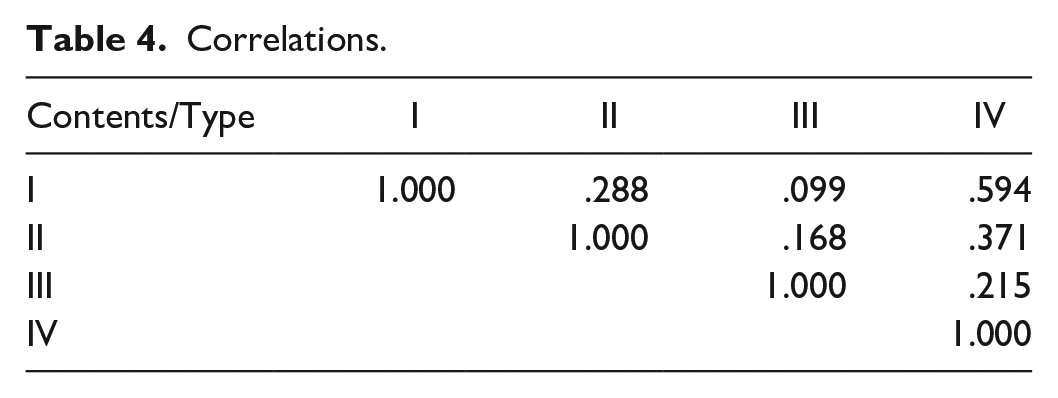
As Table 4 shows, the correlations were .288 for Types 1 and 2, .099 for Types 1 and 3, .594 for Types 1 and 4, .168 for Types 2 and 3, .371 for Types 2 and 4, and .215 for Types 3 and 4. Type 1 and Type 4 showed the highest degree of correlation.
Correlations.
Characteristics Regarding Perception
Weighting factors (P-value)
The weighting factors are in Table 5. The highest values were P3 (2.4879) in Type 1, P17 in Type 2 (2.4855), P10 (1.2963) in Type 3, and P2 (1.6437) in Type 4.
P-sample (P) Weights.

Type 1: Those who believe that Kkondae are “People Who Wield Authority Based on Age.”
As shown in Table 6, Type 1 strongly agrees with Q2, “Someone who demands something of other generations based on the criteria set by their generation” (z = 1.82). Their agreement was confirmed by their responses to Q1, “A person who demands you to do something based on a generalization of their personal experiences” (z = 1.64), and Q10, “Someone who makes other people uncomfortable because they are trying to judge others from their standards” (z = 1.46). On the other hand, the statements that Type 1 participants most strongly disagreed with were Q33, “People who have had this characteristic since childhood” (z = −1.95), and Q12, “Someone stuck in the past” (z = −1.51).
The Statements of Type 1 and z-Scores (>±1.00).

The statement that showed the most significant difference in agreement for Type 1 compared to other types was Q4, “Someone who reflects the authoritarian characteristics exclusive to Korean culture” (d = 2.116). On the other hand, the biggest differences in disagreement were Q12, “Someone stuck in the past” (d = −1.948), and Q19, “Someone who is stuck in their thinking and beliefs, regardless of age” (d = −1.757) (Table 7).
The Statements of Type 1 Different From the Other Types and z-Scores (>±1.00).

P3, the P-sample with the highest weighting factor in Type 1, believes that “kkondae are people who do not ask or listen to others, demand things of others unilaterally, believe wrongly that age equals great wisdom, and thinks that age equals authority, while treating younger people with disdain.” P5 also stated that “kkondae created the generational conflict [in Korean society] and is something that does not exist in other countries. I think that the older generation is demanding that the younger generation follow their way of thinking.” P16, meanwhile, stated, “I feel that people naturally show tendencies associated with being a kkondae as they get older” (Table 5).
For Type 1 participants, age is an essential factor in their kkondae image. They do not believe that kkondaes’ behavior is about upbringing or nostalgia. Instead, they think that kkondaes use age as power and expect everyone to listen to them. Moreover, Type 1 participants want to ignore the high-handed demands of kkondae but believe that they must accept kkondae if they live in Korea. This belief demonstrates that they may feel victimized and helpless as they cannot avoid such people.
Type 2: Those who believe that Kkondae are “People Who Mistakenly Believe Their Experiences can Be Generalized.”
As shown in Table 8, Type 2 showed the most agreement toward Q19, “Someone who is stuck in their thinking and beliefs, regardless of age” (z = 1.64). Further, they agreed with Q14, “Something that occurs when people do not try to understand each other enough” (z = 1.50) and Q1, “A person who demands you to do something based on a generalization of their personal experiences” (z = 1.43). On the other hand, the statement that Type 2 participants most strongly disagreed with was Q23, “Someone who wants compensation for the bad things they suffered in the past and takes out their anger on others” (z = −2.07). They also strongly disagreed with Q11, “Someone who demands someone to do something they do not want to do just for fun” (z = −1.90), Q22, “Someone who makes life hard for those under them” (z = −1.69), and Q6, “Someone who forces another person to do something they do not want to do” (z = −1.10).
The Statements of Type 2 and z-Scores (>±1.00).
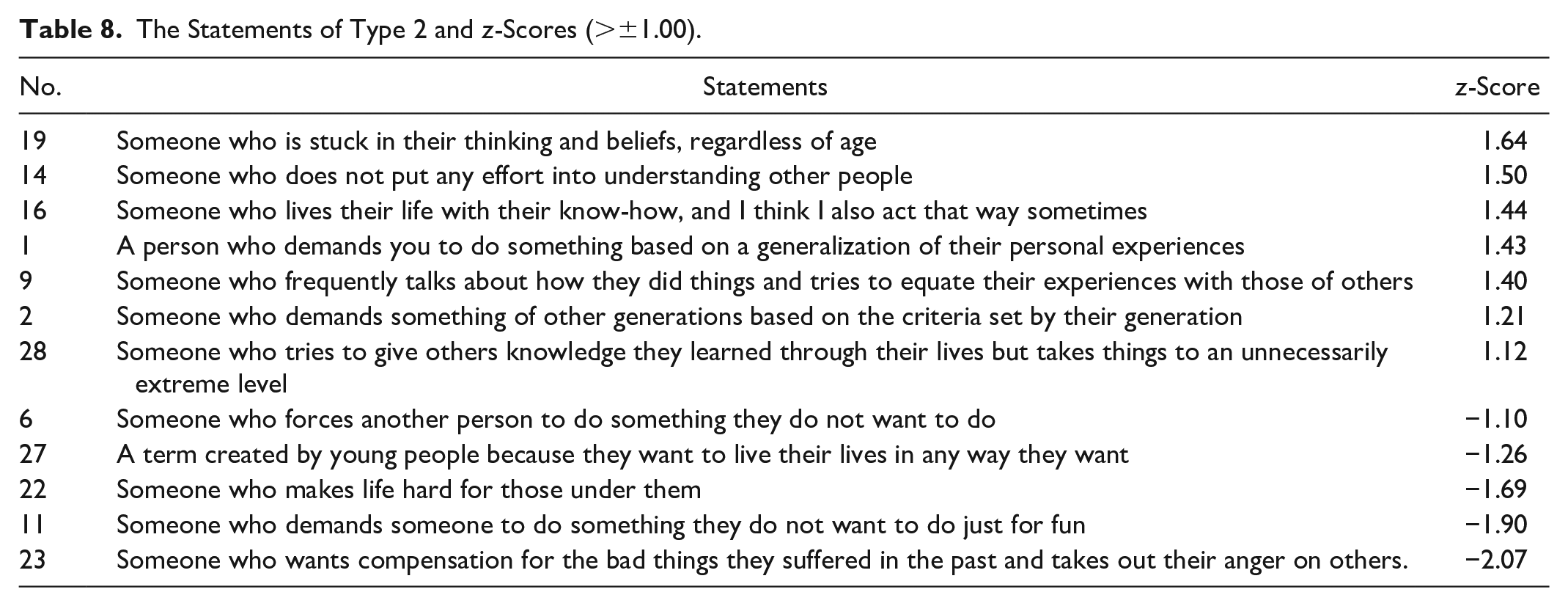
The statements that showed the most significant difference in terms of agreement for Type 2 compared to other types were Q14, “Someone who does not put any effort in understanding other people” (d = 1.604), and Q8, “The younger the kkondae is, the more of a problem they are” (d = 1.029). Q16 responses best reflect Type 2 participants’ emotions toward kkondae: “Someone who lives their life with their know-how, and I think I also act that way sometimes” (d = 1.469). They showed the most considerable difference in terms of disagreement with Q22, “Someone who makes life hard for those under them” (d = −1.176), and Q6, “Someone who forces another person to do something they do not want to do” (d = −1.380) (Table 9). P17, who had the highest weighting factor among Type 2s, stated that:
The Statements of Type 2 Different From Other Types and z-Scores (>±1.00).

If you understand others, then you will not continuously nag or try to teach them things, but kkondae are people who are so stuck in their thinking and beliefs that they end up saying merely the same things [over and over again].
P18 also stated that: “Kkondaes can be young or old. The problem starts when they are unable to understand themselves about where their own narrow frame of mind comes from.” P9 added to this: “kkondaes look exclusively to the past. I also did the same, but then I realized I was a kkondae, and I reflected on it.” P6 stated that: I think that kkondae are simply people who are closed-minded and difficult to be around, but it is difficult to say that they are intentionally taking out their anger on others. Young people can be even more of a problem if they have that kind of close-mindedness (Table 5).
Type 2 participants believe that kkondaes are not wicked people but simply immature, inappropriate, and illogical. They generalize their value systems based on past experiences to express, recommend, or even force it on others. Due to such a stubborn way of thinking, they feel that kkondaes do not make any effort to listen to others or change their attitudes.
Type 3: Those who believe that Kkondae are “People Who Think They are Superior and are Self-centered and Closed-minded.”
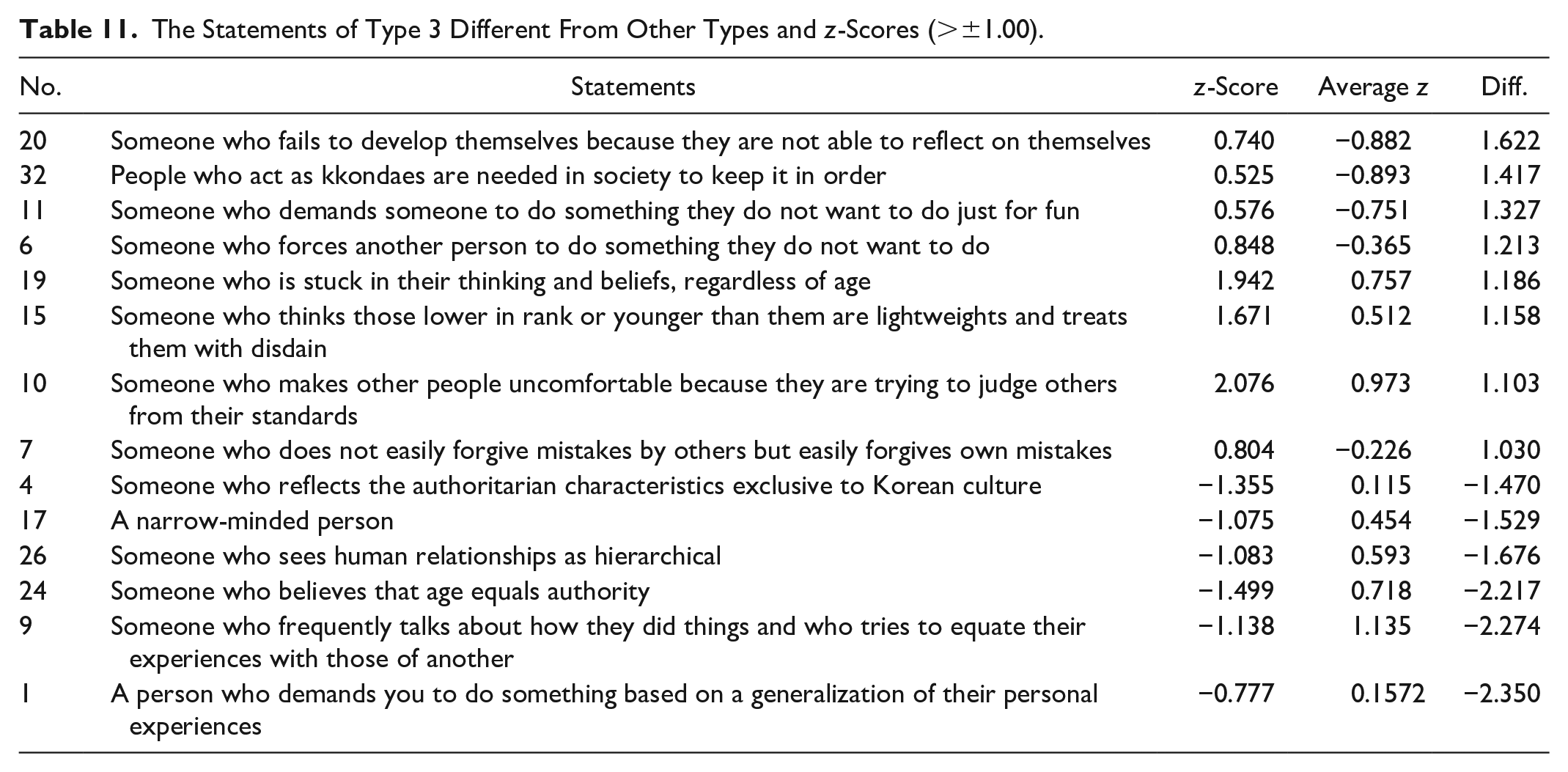
As shown in Table 10, Type 3 participants showed the most agreement with Q10, “Someone who makes other people uncomfortable because they are trying to judge others from their standards” (z = 2.08), and Q19, “Someone who is stuck in their thinking and beliefs, regardless of age” (z = 1.94). On the other hand, Type 3 participants disagreed with Q33, “People who had this characteristic since childhood” (z = −2.08), Q24, “Someone who believes that age equals authority” (z = −1.50), or Q1, “A person who demands you to do something based on a generalization of their own personal experiences” (z = −1.35).
The Statements of Type 3 and z-Scores (>±1.00).

The statement that showed the most significant difference in terms of agreement for Type 3 compared to other types was Q20, “Someone who fails to develop themselves because they are not able to reflect on themselves” (d = 1.604), followed by Q11, “Someone who demands someone to do something they do not want to do just for fun” (d = 1.327), Q6, “Someone who forces another person to do something they do not want to do” (d = 1.213), and Q19, “Someone who is stuck in their thinking and beliefs, regardless of age” (d = 1.186). The biggest differences in terms of disagreement were Q9, “Someone who frequently talks about how they did things and tries to equate their experiences with those of another” (d = −2.274), followed by Q24, “Someone who believes that age equals authority” (d = −2.217), Q26, “Someone who sees human relationships as hierarchical” (d = −1.676), Q17, “A person who is narrow-minded” (d = −1.529), and Q4, “Someone who reflects the authoritarian characteristics exclusive to Korean culture” (d = −1.470) (Table 11).
The Statements of Type 3 Different From Other Types and z-Scores (>±1.00).
P10, who had the highest weight among Type 3s, provided a summary of this thinking: Kkondae think and act in a self-centered way, and this makes others uncomfortable. They have no interest in anything other than themselves. They were not born kkondae; I think that they were influenced by their social environment to become that way.
P1 stated that “Kkondaes apply their standards to others and characteristically make others uncomfortable” (Table 5).
Type 3 participants perceive kkondae as “people who think they are superior and who are self-centered and closed-minded.” This type had an image of kkondae as someone who thinks their standards, beliefs, and values are the best. Also, their view of “kkondae” focuses on personal characteristics. That is, they recognize that these individuals reflect immature characteristics concerning their character.
Type 4: Those who believe that Kkondae are “People Who Lord Over Others as Part of Hierarchical Relationships.”
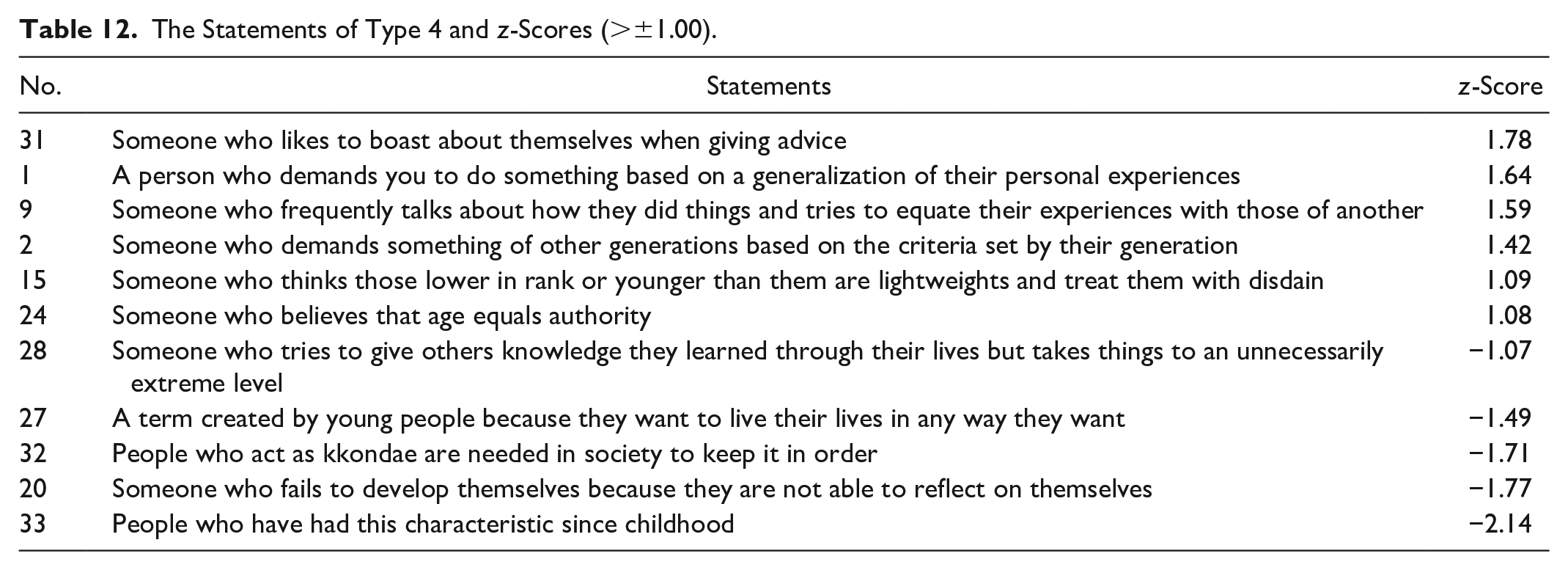
As shown in Table 12, Type 4 strongly agreed with Q31, “A person in authority who demands weaker parties follow their values” (z = 1.78), Q1, “A person who demands you to do something based on a generalization of their personal experiences” (z = 1.64), Q15, “Someone who thinks those lower in rank or younger than them are lightweights and treats them with disdain” (z = 1.09), and Q24, “Someone who believes that age equals authority” (z = 1.08). However, the most disagreeable statement for them was Q33, “People who have had this characteristic since childhood” (z = −2.14), followed by Q32, “People who act as kkondae are needed in society to keep it in order” (z = −1.71), and Q28, “Someone who tries to give others knowledge they learned through their lives but takes things to an unnecessarily extreme level” (z = −1.07).
The Statements of Type 4 and z-Scores (>±1.00).
The statement that showed the most significant difference in terms of agreement for Type 4s compared to other types was Q9, “Someone who frequently talks about how they did things and tries to equate their experiences with those of another” (d = 1.604). Type 4 participants also agreed with Q21, “Someone who gets angry when people do not do things the way they like” (d = 1.137), and Q31, “A person in authority who demands weaker parties follow their values” (z = 1.023). The biggest differences in terms of disagreement were Q20, “Someone who fails to develop themselves because they are not able to reflect on themselves” (d = −1.718), followed by Q32, “People who act as kkondae are needed in society to keep it in order” (d = −1.709) (Table 13).
The Statements of Type 4 Different from Other Types and z-Scores (>±1.00).

P2, who showed the highest weighting factor among Type 4 participants, confirmed this: Kkondae are unable to recognize that other people’s thinking or experiences may be different. I think that their belief that they are always right and demand others to think the same is a form of violence. From their position of lording over others, they do not consider the thoughts of others and believe that everyone else must follow their lead.
P13 stated that “the culture of kkondae has those in positions of authority demand those under them to take on their values, which makes things hard for those underlings.” P12, meanwhile, stated, “Kkondae are people who unilaterally demand that others follow their thinking or arguments” (Table 5). Thus, the image of kkondae held by Type 4 participants is not that of someone who behaves a certain way because of a generation gap, mistaken thinking, or close-mindedness; instead, kkondaes lord over others for nefarious aims.
Type 4 participants perceive kkondae to be people who lord over others as part of hierarchical relationships. Type 4s believe that kkondae think of themselves as higher than others and want others to carry out their wishes. They think that kkondaes’ feelings of privileged status lead them to disdain others and make forceful demands. They also perceive “kkondaes” as very aggressive. The study also showed that they perceive kkondaes as unnecessary because their behaviors make others quite uncomfortable. Based on these contents, Type 4s perceive the behaviors of “kkondaes” as a kind of social violence.
Consensus Items
Consensus items indicate the common ground between all factors. Table 14 shows the consensus factors in each type.
Consensus Items.

Discussion
This study used Q-methodology to gain a better understanding of Koreans’ differences in perceptions of the new word “kkondae,” suspected of representing recent changes in the relationships between generations in Korean society. The results of this study show that there are four types of perceptions of kkondae.
Type 1 participants expressed frustration and annoyance, whereas Type 2 participants voiced discomfort and pity. Type 3 participants expressed burden and unpleasantness, and Type 4 participants expressed a sense of unfairness and anger. Type 1 participants described kkondae as those who cause generational conflicts. However, Types 2, 3, and 4 participants perceived kkondae as only being able to communicate unilaterally; they did not believe that the term primarily described a generational conflict.
Type 1 participants (those who believe that “kkondae are people who wield authority based on age”) believe that kkondaes are unique to Korean culture, which has long had a hierarchical system based on age. This type also accepts that the kkondaes’ age justifies their authority to make forceful demands. Thus, they view kkondae as a word symbolizing the generational conflict in Korean society. However, studies before the mid-2010s view authoritarianism and rankism as the causes of generational conflicts (Choi et al., 2000; Min, 1989). As such, Type 1 views kkondaes, traditionally recognized as having the characteristics of authoritarianism and rankism, as causing generational conflicts.
Unlike Type 1 participants, Type 2 participants (those who believe that kkondaes are “people who mistakenly believe their experiences can be generalized”) do not focus on “older age.” They think that kkondaes are incapable of understanding the cultural differences between them and those they encounter and that kkondaes equate their culture with others. Some Type 2 participants perceive kkondaes as older people, but they do not think age is the problem. Instead, their problem relates to the traits of closed-mindedness and outdatedness, which are often associated with older age.
Choi et al. (2015) found that Korean college students do not perceive their relationships with the elderly generation as confrontational but positively evaluate the elderly’s contribution to society. This optimistic viewpoint means that reinterpretation of the conflicts between generations is necessary to understand that conflicts do not solely arise from generational stereotypes influenced by age prejudice and discrimination (Kim, 2014). These stereotypes validate Type 2’s view that kkondaes are not the cause of generational conflicts. That is, they broke away from the existing perception of “kkondae” as “being old” and see kkondaes as those who are immature, inadequate, and irrational with immature communicative competency.
Type 3 participants (those who believe that kkondaes are “people who think they are the best and are self-centered and closed-minded”) focus on the characteristics of kkondaes that make others uncomfortable through unreasonable demands based on their standards, values, and thinking. Type 3 participants, in contrast with Type 1 participants, do not believe that kkondaes are a unique trait of Korean culture. Instead, they think that kkondaes are immature personality formed by environmental influence. Like Type 2 participants, the Type 3s believe that kkondaes generalize everything based on their standards. They also think that kkondaes can make others uncomfortable or disdain others if it does not suit the kkondaes’ standards, values, and thinking. Interestingly, this was the only type to strongly agree with Q32, “People who act as kkondae are needed in society to keep it in order.” This finding demonstrates that Type 3 seems to view specific kkondaes as different from others and feels that some kkondaes are necessary evils in society.
Type 4 participants (those who believe that kkondaes are “people who lord over others as part of hierarchical relationships”) focus on the idea that kkondaes show disdain for others because of feelings of superiority regardless of their status, social class, or age. According to Type 4 participants, kkondaes hope that others follow their orders in situations where they feel they are hierarchically superior and become angry when their demands are not accepted. In this respect, Type 4 participants represent the conflicts between Korean society classes, which developed into a capitalist society after modernization (Jeon, 2006; Seo et al., 2018).
Korean adults’ perceptions of kkondaes reveal a variety of conflicts. For example, Type 1 participants display the generational conflicts in Korean society from rankism and authoritarianism formed with Confucian values (Choi et al., 2000; Min, 1989). Type 4 participants reveal that the conflicts between classes originated in the gap between the rich and the poor or between educational backgrounds formed in dynamic development in the industrialization era (Jeon, 2006). In addition, Type 3 and Type 2 participants display changes in Korean society since globalization. Concretely, Type 3 participants demonstrate the conflict between cultures that came from the self-culture-centered sense of superiority formed in accepting cultural diversity. Type 2 participants reveal conflicts due to a lack of communication competency (Kim, 2016, 2017; Park, 2010).
Implication
One implication of this study is its interpretation of conflicts on Confucian values, cultural forms, and communication in Korean society. This interpretation expands the kkondae concept to provide attention to the direction of change. According to Triandis and Gelfand (1998), society’s individualism and collectivism constructs may be horizontal or vertical. As for Korea’s culture changes trajectory, vertical individualistic cultural values exist along with vertical collectivist cultural values. Recently, Korean society has been facing a demand for horizontal individualistic cultural values. On reviewing recent discussions about kkondae, it appears that Koreans frequently recognize the collision between various cultures as the main reason for conflicts such as social discrimination, selfishness, and abuse of power. In the current Korean society that seeks to accept cultural diversity through multicultural policies, the expansion of the concept in this direction indicates that the intercultural competence fitting globalization is also important beyond the traditionally established values of Confucianism (Bennett & Bennett, 2004; Min, 2019; Park, 2010). Also, the concept of kkondae may continue to expand in Korean society because, in situations and contexts where democratic communication cannot occur, Korea’s public will show their demand for democratic communication by expressing their dissatisfaction toward the objects that cause the situations and contexts. Therefore, future studies should investigate the continual changes in Korean society and the corresponding changes in individual perceptions of this concept. Other research may include exploring the causes of differences in perception by expanding the idea of kkondae through quantitative studies and identifying differences in directions demanded by individual groups.
Conclusion
Based on this study’s results, “kkondae” is a diverse concept in Korean society. Although the word kkondae reveals generational conflicts traditionally, it is also a word that expresses social conflicts within Korea. It reflects the impact of rapid economic development after industrialization, the conflicts between cultures accepting cultural diversity after globalization, or the problems arising from failure to adapt to cultural diversity. In the background of the different concepts of kkondae, Korean society requires changes that move toward diversity and allow the establishment of a democratic consciousness to play a significant role.
Supplemental Material
sj-docx-1-sgo-10.1177_21582440211056608 – Supplemental material for A Study on Koreans’ Perception of the Word Kkondae
Supplemental material, sj-docx-1-sgo-10.1177_21582440211056608 for A Study on Koreans’ Perception of the Word Kkondae by Hyang-suk Bu and Song Yi Lee in SAGE Open
Footnotes
Declaration of Conflicting Interests
The author(s) declared no potential conflicts of interest with respect to the research, authorship, and/or publication of this article.
Funding
The author(s) received no financial support for the research, authorship, and/or publication of this article.

Supplemental Material
Supplemental material for this article is available online.
Data Availability Statement
The datasets generated during and/or analyzed during the current study are available from the corresponding author on reasonable request.
References
Supplementary Material
Please find the following supplemental material available below.
For Open Access articles published under a Creative Commons License, all supplemental material carries the same license as the article it is associated with.
For non-Open Access articles published, all supplemental material carries a non-exclusive license, and permission requests for re-use of supplemental material or any part of supplemental material shall be sent directly to the copyright owner as specified in the copyright notice associated with the article.
