




Abstract
This research rigorously examines the determinants shaping undergraduate student outcomes within two small private Thai universities, specifically Asia-Pacific International University and Krirk University. The emphasis on small private universities is deliberate, given their heightened vulnerability to institutional instability. This susceptibility primarily stems from their intrinsic characteristics: limited enrollment capacities, significant dependence on sustained student persistence, and tuition revenue for operational continuity. Utilizing a quantitative approach, the study surveyed 371 students and analyzed the data using a mediated structural equation model (SEM). This model delineates relationships between key independent variables—academic integration, instruction, emotional distress, institutional support, satisfaction, and social integration—and student outcomes, namely student persistence, voluntary withdrawal, and institutional transfer. Academic integration directly affected satisfaction (β = .214) and indirectly influenced persistence (β = .138). Emotional distress significantly affected institutional transfer (β = .454) and voluntary withdrawal (β = .51). Furthermore, a substantial relationship was observed between instruction and academic integration, with a β value of .849. These findings offer invaluable insights into the multifaceted dynamics potentially influencing student experiences and decisions in the context of small private Thai universities. Institutions seeking improved retention rates should note the importance of balancing academic and social elements in an integrated environment.
Introduction
Over the past 40 years, higher education has shifted its core ideological paradigm to adjust to neoliberalism market reforms. In the past, most universities provided a public good, a service that the government heavily subsidized through direct payments and grants. Beginning in the mid-1970s, austerity economic reforms and deregulation pivoted the US higher education market toward a commodified education system (Hunt, 2012). Governments sought to improve institutional quality through capitalistic market forces, allowing students a more comprehensive range of services while incentivizing institutions to adapt to market demands (Scott & Asavisanu, 2021). The outcome varies from country to country, but existing universities now face the reality of a fiercely competitive marketplace where each institution must compete with numerous organizations domestically and abroad. Many traditional universities struggle to recruit and stay financially solvent due to increasing demands for specialized programs, shifting sociopolitical norms, and rising competition from alternative education providers (Scott & Asavisanu, 2021). Retention becomes increasingly crucial for universities to achieve institutional objectives (Haverila et al., 2020).
Most universities depend on tuition revenue as their principal operational income; thus, maximizing enrollment and minimizing attrition become the predominant institutional economic model. Student retention maximizes financial stability, as recruiting new students is more fiscally taxing (Miller, 2022). A student’s retention for an entire 4-year program produces the same income revenues as the enrollment and subsequent dropout of four students after their first year of study (Hossler & Bean, 1990). Student attrition also impacts an institution’s non-tuition revenue from student enrollment. Housing fees, food and drink, and on-campus spending can exceed tuition revenue (per student); thus, student attrition, especially early in the program, can be costly for an institution (Schuh, 2005). Institutions that retain students benefit from improved reputation and prestige, as prospective students associate the institution’s image with their future earning potential (Elliott & Healy, 2001; Spearman et al., 2016), improving the recruitment capabilities of the institution. Budget constraints limit administrators’ integration of intervention strategies with overly narrow approaches or the lack of long-term initiatives (Scott & Guan, 2023). The examination needs to be specific but narrow enough, focusing on dynamic factors that impact student success from the perspectives of the student and the institution.
Background of Study
In late 2018, former Prime Minister Prayut Chan-o-cha promoted the ambitious 20-year reform strategy “Thailand 4.0,” targeting economic growth by offsetting industries impacted by an aging population. The strategy encourages innovation and research-oriented studies, leading Thailand to become a knowledge-based society (Buasuwan, 2018). To achieve the desired knowledge-based society, Thai higher education institutions (HEIs) must incorporate modern student-centric, passion-driven pedagogical approaches emphasizing real-world problem-based curricula. The broad outlines suggested in the policy seek to shed the reputation that the Thai education sector is outdated and substandard. Although the framework promotes quality, scant details about how quality assurance will be assessed and how institutions overwhelmed with financial instability will afford the required changes.
Thai HEIs, especially smaller institutions, face growing challenges in an increasingly saturated and hyper-competitive education sector. A rapidly aging society with a decreasing student population has forced numerous HEIs to reconceptualize their institutional designs to cope with declining domestic enrollment, high academic withdrawal, and increasing operational costs. Excessive supply in Thai higher education, coupled with heightened international competition, has compelled Thai HEIs to adopt a market-driven approach, competing for a limited pool of individuals who behave more as consumers than traditional students. Many small Thai private institutions face insolvency as potential students integrate a market-driven approach to their HEI selection process, forcing institutions to decrease per-student tuition revenue while increasing their per-student marketing costs (Scott, 2021; Scott & Mhunpiew, 2021). Cost-cutting strategies to maintain institutional financial viability have reduced program quality (Fry & Bi, 2013) and decreased student academic and social integration (Tangcharoen et al., 2019). As students fail to form a solid institutional identity, the value of their experience deteriorates (Lerdpornkulrat et al., 2018), leading to students reevaluating their institutional choice and potentially increasing their dropout risk (Kerby, 2015).
Through institutional transfer or voluntary withdrawal, student dropouts are a loss of investment by the institution and the student. A high number of student dropouts is an enormous waste of administrative resources, finances, and time, potentially decreasing budget allocation in future fiscal periods (Rujichinnawong, 2018). These shortfalls have a knock-on effect on existing student services and program quality, leading to negative factors that could instigate further student attrition and institutional economic strain. Thai private institutions are facing the arduous task of adhering to relatively austere internal policies; thus, efficient allocation of resources that maximize service offerings that encourage student recruitment and persistence must be prioritized (Rattanamanee et al., 2018). Thai private institutions face unique challenges, differing from public institutions because of their government grant allocation. Detailed examination of the current conditions to determine the dominant factors leading to student withdrawal in small Thai private HEIs and the relationship each aspect has on the increased risk of student dropout is necessary for an efficient, targeted approach to improving student persistence to be further examined.
Study Aim
This research investigates the factors influencing undergraduate student outcomes, focusing on student persistence, voluntary withdrawal, and institutional transfer at two small private universities in Thailand (Asia-Pacific International University and Krirk University). Employing a mediated structural equation model (SEM), the study examined predefined independent variables, including academic integration, instruction, emotional distress, institutional support, satisfaction, and social integration. These small private universities, characterized by their limited enrollment capacities, are chosen for their increased vulnerability to institutional instability. This is primarily due to a significant dependence on high levels of student persistence and tuition revenue for operational continuity.
Utilizing a mediated SEM enables the exploration of complex relationships among the selected independent variables and their effects on student outcomes. This robust statistical technique allows for investigating direct and mediated influences, thereby providing a comprehensive understanding of the variables contributing to or deterring student persistence, voluntary withdrawal, or institutional transfer. Anticipated findings from this rigorous quantitative analysis are intended to provide small private educational institutions in Thailand with empirically supported insights. These insights are envisioned to be instrumental in formulating strategic initiatives to reduce student attrition rates, thus contributing to enhanced student success and institutional stability.
Theoretical Framework
A triad of theoretical models provides the principal structure for this study’s foundation and design: Astin’s (1993) theory of student involvement or I-E-O model (input-environment-output model), Bean’s (1981) model of student attrition, and Tinto’s (1993) student integration model (SIM). The three theoretical models, supplemented by regionally specific literature, describe how various factors interact and influence students’ decision-making processes regarding their academic outcomes. The conceptualization of each model perceives students as the authority in the attrition/persist outcome selection. Student decisions are generated from a complex interaction of internal and external conditions that continuously influence student perceptions throughout their academic career.
The constructs in this study closely align with these theoretical frameworks. Academic integration is pivotal in Tinto’s Student Integration Model (1993), which emphasizes the importance of students engaging with academic systems through their performance and interactions with faculty. Astin (1993) underscores the role of academic environments, noting that involvement in academic activities is crucial for educational outcomes. Although Bean (1981) does not explicitly use academic integration, he addresses related concepts through organizational variables like curriculum quality and faculty interactions, which affect student retention.
Institutional support is a key component in Astin’s (1993) model, viewed as an environmental factor influencing student involvement and success through support services and mentoring. Bean similarly highlights institutional support as impacting student attitudes and retention decisions. Tinto (1993) implicitly acknowledges institutional support as it aids academic and social integration. Satisfaction is central in Bean’s (1981) model and is seen as an attitudinal variable affecting students’ persistence or withdrawal. It reflects students’ evaluations of their experiences and impacts their retention. Astin (1993) views satisfaction as an outcome influencing affective and behavioral changes, while Tinto (1993) links satisfaction to successful academic and social integration.
Social integration is crucial in Tinto’s (1993) framework, highlighting the importance of personal relationships and a sense of community for student persistence. Astin (1993) emphasizes social engagement and peer interactions as vital for student involvement, while Bean (1981) reflects social integration through organizational and environmental variables that shape social experiences and attitudes. Voluntary withdrawal is linked to insufficient integration in Tinto’s (1993) model, why students leave due to a lack of connections. Bean (1981) ties withdrawal to negative evaluations and unmet expectations influenced by various factors, including external opportunities. Astin (1993) suggests that a lack of engagement and perceived value can lead to withdrawal.
As Tinto (1993) suggests, institutional transfer occurs when students seek better alignment with their goals due to a mismatch with institutional offerings. Bean (1981) views transfer decisions as influenced by dissatisfaction and external opportunities. For Astin (1993), transfer reflects a reevaluation of involvement and alignment with the institution. Instruction quality is a significant factor in Astin’s (1993) model, impacting student involvement and outcomes. Bean (1981) includes it as part of organizational variables affecting attitudes and persistence, while Tinto (1993) sees instruction as contributing to academic integration, influencing student connection and support.
All three theories focus on persistence, emphasizing factors such as integration, support, and satisfaction that encourage students to continue their education. In Tinto’s (1993) model, emotional distress can hinder academic and social integration, affecting persistence. Astin (1993) recognizes its impact on involvement and outcomes, while Bean (1981) notes that emotional distress influences attitudes and withdrawal potential if support is lacking.
Although these theoretical models are robust and widely accepted, their direct application to Thai private universities requires careful consideration. In this study, the constructs and measures of these models have been adapted based on existing Thai literature to ensure that they accurately reflect the specificities of the Thai educational landscape. This adaptation process involves tailoring the items for the constructs to capture better the unique dynamics and challenges faced by students in Thai private universities. By grounding the models in the context of Thai higher education, this study aims to provide a more relevant and accurate analysis of student outcomes, thereby offering valuable insights deeply rooted in the local educational context.
Research Questions
A series of research questions have been formulated in alignment with the study’s overarching aim to develop a statistically robust and reliable model for identifying undergraduate students at heightened risk of dropout within small private universities in Thailand. These questions are constructed to scrutinize the relationships between predefined independent variables—namely Academic Integration, Instruction, Emotional Distress, Institutional Support, Satisfaction, and Social Integration—and student outcomes. The specific research questions are as follows:
What is the relationship between measures of academic integration, instruction, emotional distress, institutional support, satisfaction, and social integration and the likelihood of student persistence within these institutions?
What is the relationship between measures of academic integration, instruction, emotional distress, institutional support, satisfaction, and social integration and the risk of voluntary withdrawal from these institutions?
What is the relationship between measures of academic integration, instruction, emotional distress, institutional support, satisfaction, and social integration and the risk of institutional transfer to other educational establishments?
Literature Review
Challenges for Private Thai Universities
Private universities in Thailand form a significant portion of the higher education landscape, constituting about a third of all Thai universities. However, student enrollment figures represent a smaller share, accounting for only 15% of undergraduate admissions (Ministry of Higher Education Science Research and Innovation [MHESI], 2022). Among these private institutions, the scale varies considerably. Of the 41 private universities recorded, more than half (21) are classified as small, with an undergraduate enrollment of 3,000 or fewer students. Remarkably, within this subset of small private universities, an overwhelming majority (16 out of 21) cater to a student population of fewer than 1,500 undergraduate students (MHESI, 2022).
The landscape has grown more complex over recent years. Public universities have broadened their academic horizons, introducing various programs (Scott & Asavisanu, 2023; Scott & Mhunpiew, 2021). This expansion has inadvertently encroached upon the domain of private universities, intensifying the competition between the two. Given this overlap in program offerings, prospective students find fewer distinguishing features to differentiate between public and private institutions. Furthermore, the demographic challenge exacerbates the situation for private entities. With dwindling student populations, private universities face a fierce battle to attract a diminishing pool of applicants. Their primary challenge is differentiation. Unable to set their programs apart from similar ones offered by public universities, these private institutions struggle to capture the direct interest of students. Without this interest, they find themselves in a precarious position, unable to compete head-to-head with their public counterparts. This situation leaves them with limited options, often compelling them to poach students from other private universities, effectively cannibalizing within their sector.
The outlined challenges faced by private Thai universities underscore the urgency of understanding and addressing factors that influence student retention and dropout rates. Considering these institutional struggles, particularly in the face of intense competition and shifting demographics, it becomes crucial to delve into specific aspects of the student experience that contribute to their decisions to persist or withdraw from their studies. This necessitates examining various constructs such as academic integration, instruction quality, emotional distress, institutional support, student satisfaction, and social integration. Each of these factors plays a pivotal role in shaping students’ educational journey in these private institutions. The following sections of the literature review explored the current understanding of these constructs and their impact on student dropout rates. The analysis drew from qualitative and quantitative academic and gray literature research, such as Thai dissertations—in English and Thai. While systematic reviews and meta-analyses were considered for insights, the study prioritized original data to avoid misinterpretation. This approach allows for a nuanced understanding of the context by engaging with primary sources and empirical evidence from the Thai context.
Academic Integration
This study defines academic integration as a student’s active engagement in university life’s educational aspects, including participation in learning processes and advancing their intellectual growth. Research has sought to understand the relationship between this integration and student retention or dropout rates. Asavisanu (2017) found that students with high academic involvement were less likely to drop out, though the significance of the findings was weak. Similarly, Tangcharoen et al. (2019) identified a negative link between academic integration and dropout rates but lacked solid statistical backing.
Pitanupong et al. (2020) highlighted an interesting trend among clinical and pre-clinical students. Many considered leaving their programs due to increasing academic challenges and a perceived mismatch between their program and their personal or professional goals. External pressures, such as family expectations, often influence these choices over genuine interest.
Wareebor et al. (2020) pinpointed academic integration as a critical indicator of student persistence. The study argued that students who were aware of their academic strengths and committed to improving them persisted more in their studies. This was echoed by Prakitpong (2016), who found a positive relationship between academic engagement and educational commitment. Educators acknowledged the significance of academic integration, noting that students who do not adapt to academic rigors face challenges. Research by Compan and Apibunyopas (2019) at Walailak University reinforced academic integration’s role in dropout determinants. Engaged students, active in discussions and fulfilling academic requirements, tended to persist in their studies. However, disconnection from course content, especially in early program years, could weaken this integration.
Instruction
Instructors serve as the primary interface between students and their academic institutions. Their instructional methods, behavioral attributes, and teaching quality are pivotal in student integration, academic success, institutional prestige, and student retention (Rujichinnawong, 2018). Rattanamanee et al. (2018) emphasize that the role of educators is multifaceted. They must deeply understand their student body to tailor learning objectives, engage with pertinent content, and cater to diverse student requirements. Establishing relationships that invigorate a student’s desire to learn is paramount, given the myriad expectations they are to satisfy (Rattanamanee et al., 2018; Rujichinnawong, 2018).
Rujichinnawong (2018) identified that students who either transferred or left educational institutions did so, to an extent, due to negative experiences with instructors, especially those who displayed a lack of empathy. Such unfavorable interactions and students’ hesitance in approaching instructors have sometimes culminated in students exiting programs (Rattanamanee et al., 2018). Moreover, students’ intention to persist in their academic journey is influenced by the relevance and importance they attach to course content (Lerdpornkulrat et al., 2018). If students deem content nonessential in the context of their personal and professional aspirations, a sense of detachment might ensue. Such separation, exacerbated by unstimulating content, can precipitate diminished academic outcomes and reduced contentment. Specifically, courses that do not sufficiently engage students have reported higher absenteeism and inferior exam results (Boonprasom & Sanrach, 2019). Compounding these challenges, a lack of coordination among departmental faculty can burden students with excessive assignments, further eroding their academic satisfaction and prompting them to reconsider their educational paths (Pitanupong et al., 2020).
Emotional Distress
In this study, emotional distress pertains to students’ adverse emotional responses during academic or social interactions. Such distress can arise from intense feelings of anxiety, stress, depression, or fear triggered by negative experiences or a series of events. Students who already grapple with mental health issues or have limited coping mechanisms often find themselves at a disadvantage when starting university, making their integration into the academic environment even more challenging without proper institutional support (Sosu & Pheunpha, 2019; Rujichinnawong, 2018).
Research by Sosu and Pheunpha (2019) reveals that students with borderline academic results and a weak support system are notably more prone to discontinuing their undergraduate studies, with a significant number dropping out in the second year. This high attrition rate is primarily attributed to students’ emotional challenges in adjusting to the academic milieu, and these challenges tend to compound as they advance in their studies (Wareebor et al., 2020), culminating in emotional crises in some instances. Universities play a pivotal role in this adjustment process by crafting environments conducive to academic growth and fostering an ethos of critical thinking.
Rujichinnawong (2018) emphasizes institutions’ profound influence in facilitating student adjustment. Institutions can either alleviate student anxieties by offering robust administrative and faculty support or exacerbate them through restrictive policies and insufficient understanding of psychological needs. Particularly for students who move a significant distance away from home for their studies, the university often becomes their primary source of support. A perceived absence of mental health resources from the institution can amplify student anxieties and redirect their discontent toward the university environment. Building on this, Özgan and Akşab (2018) argue that students trying to assimilate into university life who feel their needs are unmet or overlooked tend to quickly distance themselves, leading to potential estrangement from the institution.
Institutional Support
In this study institutional support refers to the assistance universities provide to aid students in their academic and social adjustment, enhancing their academic achievements and intellectual growth. Research by Rattanamanee et al. (2018) and Pheunpha (2020) observed that many incoming students require explicit guidance in their educational journey. They frequently turn to instructors, advisors, or designated institutional support groups for clarity. Institutions that promptly recognize at-risk students and craft tailored support systems can significantly bolster student success rates compared to those without such support.
The nature of the relationship between an institution and its students has a profound correlation with students’ level of social interaction, engagement in academic activities, and affinity toward the institution (Prakitpong, 2016). Lerdpornkulrat et al. (2018) posits that if students discern that an institution is attuned to their needs and is committed to assisting them in realizing their educational objectives, such students are more inclined to remain enrolled. However, the efficacy of institutional support is not solely dependent on the will to assist. However, it is also profoundly influenced by the policies, leadership dynamics, and management involvement at the higher echelons of the academic institution. While universities are expanding services on campuses, there is a palpable need for more integrated administrative oversight to maximize the benefits of these offerings (Boonprasom & Sanrach, 2019).
Rattananuntapat (2015) observes that administrative management in many Thai institutions faces challenges, including soaring demand for support, unfavorable staff-to-student ratios, and evolving evaluation mechanisms instituted internally and by the government. It has been observed that some Thai universities cluster diverse services under limited personnel, which can impede availability and diminish the quality of interactions. Taros and Phusee-om (2020) have linked many university dropouts to this lack of streamlined institutional support and limited avenues for meaningful consultation. Lerdpornkulrat et al. (2018) stress that when students sense limited opportunities for interaction with administrative personnel, it correlates with a heightened risk of discontinuing their studies.
Satisfaction
Student satisfaction is a subjective evaluation of educational observations and experiences against presumed outcomes. Satisfaction is when the student perceives conditions (academic, institutional, and social) meet or exceed their pre-conceived expectations (justified or otherwise). The short-term nature of satisfaction means students continuously evaluate and modify their feelings based on the current conditions they experience. Increased competition among higher education institutions has required universities to respond more to students’ wants. Satisfaction is significantly correlated with student development, engagement, social integration, and overall academic performance while negatively associated with dropout risk (Compan & Apibunyopas, 2019). Students who have their expectations met or exceeded are more driven to persist and appreciate the education they receive and the opportunities it will provide (Compan & Apibunyopas, 2019).
Demands by students for improved instructor communication, more substantial student support through administrative service offerings, and real-world emphasis on class content significantly impact student performance and persistence (Prakitpong, 2016; Rujichinnawong, 2018). Students are inclined to select programs or institutions for reasons other than interest, pleasing parents, or prospects of financial rewards in the future. The lack of initial interest can lead to dropout tendencies early in a student’s post-secondary experience as they fail to connect with the content (Pitanupong et al., 2020). In a drive to increase enrollment, institutions focus on creating programs and training instructors to meet student needs; yet, considerably less emphasis is placed on ensuring prospective students’ expectations reasonably align with the institution. Thai institutions prioritize enrollment more than student capability. Institutions that accept all enrollees and fail to convey program needs to prospective students often sacrifice academic quality to satisfy students (Rujichinnawong, 2018), which is not maintainable in the long term.
Social Integration
Social integration, as understood in the academic context, revolves around students immersing themselves into the university environment through peer interactions and participation in extracurricular activities. The theoretical underpinnings of social integration in Thai academic research predominantly stem from Tinto’s SIM and Bean’s model of student attrition. In a study conducted by Asavisanu (2017), it was observed that social integration emerged as a potent predictor for academic persistence, especially in international universities. This finding underlines the critical role of exchanging ideas and alleviating academic pressures through communal interactions. Compan and Apibunyopas (2019) also shed light on the inverse relationship between participation in extracurricular activities (a proxy for social integration) and student attrition rates. Building a sense of community within the university and fostering interactions with peers and instructors outside the academic setting protects against student dropout.
Prakitpong's (2016) research provides an intriguing perspective by suggesting that while social integration is pivotal for a student’s intent to continue their education, its significance is more pronounced in private universities. One of the primary benefits of social integration is the creation of academic support networks where students can collaborate, share ideas, and encourage each other to overcome challenges. Tangcharoen et al.’s (2019) research corroborates this sentiment, emphasizing the positive correlation between students' social integration and their ability to remain academically engaged, manage anxieties, and establish a solid allegiance to their university. However, it is essential to note that while a correlation exists, Tangcharoen et al. (2019) found no definitive causative relationship between social integration and student retention or dropout. Prakitpong (2016) further delves into the nuances of social groups and their influence on student behaviors. Students naturally gravitate toward groups that resonate with their interests and values. If these groups emphasize academic success and maintain a positive affiliation with the university, they can augment students’ educational experiences. Conversely, involvement with groups engaged in counterproductive behaviors, such as excessive drinking or gambling, can derail a student’s focus and academic pursuits.
The outlined challenges faced by private Thai universities underscore the urgency of understanding and addressing factors that influence student retention and dropout rates. In light of these institutional struggles, particularly in the face of intense competition and shifting demographics, it becomes crucial to delve into specific aspects of the student experience that contribute to their decisions to persist or withdraw from their studies. This necessitates comprehensively examining various constructs such as academic integration, instruction quality, emotional distress, institutional support, student satisfaction, and social integration. Each of these factors plays a pivotal role in shaping students’ educational journey in these private institutions. The following sections of the literature review explores the current understanding of these constructs and their impact on student dropout rates, drawing from relevant research findings within the Thai context and broader educational studies.
Methodology
Study Design
This study incorporated a causal-comparative cross-sectional quantitative research design to examine undergraduate dropout risk in private Thai universities. A causal-comparative method was selected as the research explores the cause of dropout risk (institutional transfer and voluntary withdrawal) and persistence by examining identified factors experienced by undergraduate students. Using a comprehensive model with numerous mediating factors allows the disaggregation of complex student experiences into discernable variables. These variables can be systematically controlled and compared, thereby mitigating undue complications. Essentially, the inherent versatility of this approach fosters a nuanced understanding of student experiences, proficiently managing the associated complexity.
The study incorporated multiple triangulations to increase the confidence in the finding’s validity. Multiple triangulations in this study encompassed both theoretical and environmental triangulation. Theoretical triangulation through the use of multiple theoretical models (Astin’s (1993) I-E-O model, Bean’s (1981) model of student attrition, Tinto’s (1993 student integration model) to formulate the research aims and analyze results from multiple lenses. The study’s investigation of various theoretical models further incorporates triangulation as it seeks to confirm or contrast predictive characteristics of student dropout risk from differing viewpoints. Environmental triangulation included data from two small Thai private universities. Although the population target remained the same, undergraduate students, the locational difference between the institutions furthered the robustness of the data collected. Environmental triangulation is crucial in identifying contrasting conditions in similarly structured institutions, as these locations may influence (positive or negative) student dropout risk and behavior.
Study Population
The population under focus in this research encompasses undergraduate students, both domestic and international, enrolled in private Thai universities. An undergraduate student, within the context of this study, is delineated as an individual engaged in an academic program initiating with entry-level diplomas or concluding with bachelor’s degrees. Emphasis has been placed on the student body of Asia-Pacific International University (APIU) and Krirk University (KRU). Enrollment statistics affirm that APIU accommodates 900 students, while KRU holds a student body of 1,400, as documented by MHESI (2022)
APIU and KRU maintain a commendable standing among Thai private universities in Thailand. Their reputation offers a benchmark for assessing conditions across the country’s broader spectrum of 21 small private universities. Attracting accurate and representative results necessitates a rigorous approach to determining the appropriate sample size. Based on the sample size calculation methodology proposed by Krejcie and Morgan (1970), a response from at least 330 participants is imperative to ensure a 95% confidence interval. Notably, this stipulated sample size surpasses the foundational threshold for Structural Equation Modeling (SEM) of 200 participants, as advocated by both Kline (2016) and Hoyle (1995). This increases the reliability of research outcomes by decreasing the chance of encountering false negatives in fit indices. Efforts were made to maximize inclusion from each institution to ensure diverse educational insights that reflect APIU and KRU’s educational conditions.
Instrument, Distribution, and Analysis
The questionnaire comprised fifty-three items derived from the referenced theories and regional literature. It included four demographic items: gender, age, home region, and study major. Thirty-one items pertaining to the six independent variables, with the remaining eighteen relating to the three dependent variables. The items were presented in both standard and reverse wordings. A 5-point Likert scale was applied, where standard-worded items ranged from 1 (disagree) to 5 (agree) and reverse-worded items from 1 (agree) to 5 (disagree). Demographic items were formatted as multiple-choice questions.
The questionnaire was translated into Thai and simplified Chinese (Mandarin) using the back-translation method to cater to diverse linguistic needs. Including the Thai language version aligns with the context of Thai private universities. A Mandarin version was also provided due to a substantial Mandarin-speaking student body in many Thai private institutions. During the 2023 summer semester, the questionnaires were distributed in print to potential respondents in their classes. An information page was provided detailing the study’s objectives and ethical considerations. Respondents were assured confidentiality and anonymity, with data collected without personal identifiers. The study items, the corresponding variables, and their related questions can be found in Appendix 1.
The responses were manually entered and cross-checked by other researchers to ensure accuracy and reliability. This process helped to maintain the integrity of the data and findings presented in the study. For data analysis, IBM’s SPSS V26 was used for descriptive statistics, reliability, and validity testing, while the AMOS V26 software facilitated path analysis. The analysis included various goodness of fit tests to structure a Structural Equation Model (SEM).
Research Approval
The research and its instrument were presented for examination to Assumption University’s Institutional Review Board (IRB). Following a comprehensive evaluation by the IRB, the study was endorsed on 26 April 2023. Understanding the relevance of the research’s context—undergraduate dropout risks in Thai private universities—it was deemed necessary to engage with the Association of Private Higher Education Institutions in Thailand (APHEIT). After presenting a formal request to APHEIT on 27 April 2023, approval was received from Dr. Sanee Suwandee, the Secretary-General of APHEIT, on 2 May 2023.
Research requests were subsequently sent to APIU and KRU on 16 May 2023. APIU’s Ranking, Research, and Development Committee (RRDC) reviewed the proposal on 24 May 2023. By 25 May 2023, conditional approval was provided, with the specific condition being a modification to the gender question in the questionnaire. The amendment, in line with the Seventh-day Adventists’ principles, required the gender question to remain binary. After these modifications were implemented, approval was confirmed. KRU followed a departmental approval route. The Department of Asian Studies, the English Language Department, and KRU’s International College granted their permissions on 22, 23, and 25 May 2023, respectively.
Findings
Response Rate
APIU recorded a response rate of 97.5% (234 of 240). Of these, 88.8% (213) of the responses were included for analysis. A 9.0% (21) omission rate was identified, which was directly attributed to single-response bias. This type of bias arises when respondents consistently select identical answers throughout the questionnaire without paying attention to each item’s content. At APIU, most respondents showed either moderacy response bias (consistent selection of middle-scale answers) or extreme response bias (uniform selection of extreme-scale answers). In contrast, KRU reported a response rate of 93.0% (172 of 185). Despite the slightly lower response rate, KRU had a higher inclusion rate of 90.8% (168) and a considerably lower omission rate of 2.3% (4). The 381 responses exceeded the minimum thresholds Krejcie and Morgan, Kline, and Hoyle proposed, indicating the population size is appropriate for SEM analysis.
Demographic Profile
Analyzing the data from Table 1, most respondents identified as female at 64.6%, while males accounted for 34.6%. Only 0.8% identified as other genders. The age distribution was predominantly within the 18 to 23 years range, with 21-year-olds being the most represented at 23.4%. Geographically, international students comprised 26.8% of the sample, showcasing the universities’ international appeal. Among domestic respondents, those from the central region led with 21.3%. The least represented were from the West at 0.8%. Concerning academic majors, nursing students comprised 45.4%, followed by those in business, management, and economics at 24.7%. Languages/linguistics and education stood at 6.3% and 5.8%, respectively, while all other majors constituted 17.8%.
Respondents Profiles.

Normality of Variables
When employing parametric statistical methods, the assumption of normality is crucial. Normality becomes especially pivotal in SEM as a well-fitting model ideally sources from normally distributed data (Kumar & Upadhaya, 2017). Non-normal data could distort outcomes and elevate the potential for erroneous rejections. In this study, skewness and kurtosis were employed to evaluate the normality of each variable. Though criteria for normality vary among researchers, the requirements outlined by George and Mallery (2020), where a value within ± 2 is deemed acceptable and within ±1 is seen as excellent, served as the guiding principle for this analysis. The skewness for the variables ranged from −0.12 to −0.66, resulting in relatively symmetrical data. The kurtosis values ranged from −0.59 to 0.75 (Table 2), resulting in a reasonably mesokurtic distribution for all variables. Based on the acceptable range of ±2 for skewness and kurtosis, the data meet the normality assumption.
Normality Distribution.

Model Design
The study employed an SEM with six independent variables and three dependent variables. Rather than focusing solely on direct effects, the model was designed to explore potential mediating pathways. Analyzing mediation can provide insights into the latent processes in educational research, which remain concealed in direct-effect models. For instance, while academic integration (AI) has direct paths to emotional distress (ED), satisfaction (SAT), and social integration (SI), indirect effects elucidate potential mediating relationships. By prioritizing mediation, the study aimed for a more comprehensive understanding of variable relationships in small Thai private university contexts. The model is presented in Figure 1.

Study model.
Reliability and Validity
The internal consistency reliability of each construct was evaluated using Cronbach’s alpha. A commonly referenced threshold in academic literature is .7 (Hair et al., 2019). In this study, the alpha values ranged from .758 to .932. Convergent validity was explored through composite reliability (CR) analysis and average variance extracted (AVE) within confirmatory factor analysis. Hair et al. (2019) set a CR criterion greater than 0.7 for internal consistency. The instrument’s CR in this research varied between 0.807 and 0.931, exceeding this threshold. For convergent validity, an AVE greater than 0.5 for each construct is deemed satisfactory (Hair et al., 2019). The study’s constructs had AVE values from 0.507 to 0.66 (Table 3).
Reliability and Validity Tests.

Note. CR = composite reliability; AVE = average variance extracted; MSV = maximum share variance; ASV = average shared variance.
Discriminant validity employed three metrics: maximum shared variance (MSV), average shared variance (ASV), and the Fornell-Larcker criterion. As per Hair et al. (2019), discriminant validity for an instrument is achieved when AVE > MSV > ASV. All constructs met these criteria (Table 3). Fornell and Larcker (1981) posited that valid discrimination is observed when the square root of AVE surpasses all construct correlations. Data in Table 4 confirmed that the squared AVE of all constructs exceeded their respective correlations, meeting discriminant validity criteria.
Fornell-Larcker Criterion.
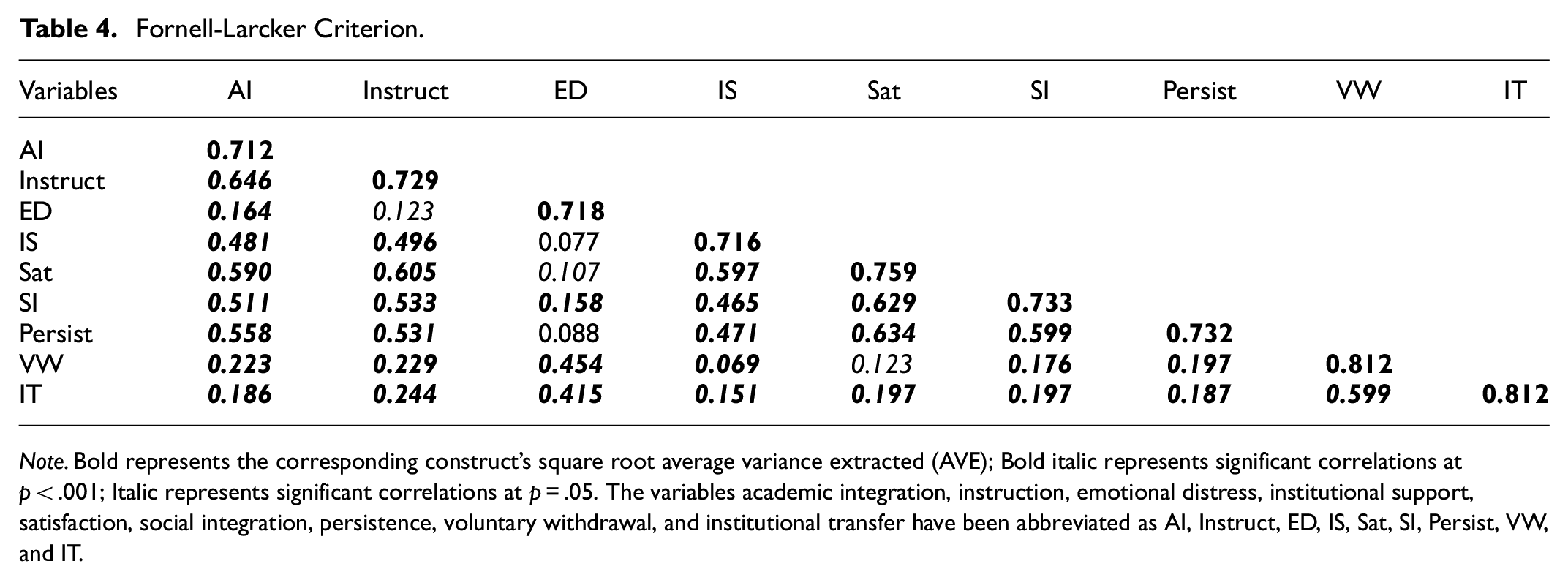
Note. Bold represents the corresponding construct’s square root average variance extracted (AVE); Bold italic represents significant correlations at p < .001; Italic represents significant correlations at p = .05. The variables academic integration, instruction, emotional distress, institutional support, satisfaction, social integration, persistence, voluntary withdrawal, and institutional transfer have been abbreviated as AI, Instruct, ED, IS, Sat, SI, Persist, VW, and IT.
Model Fit Indices
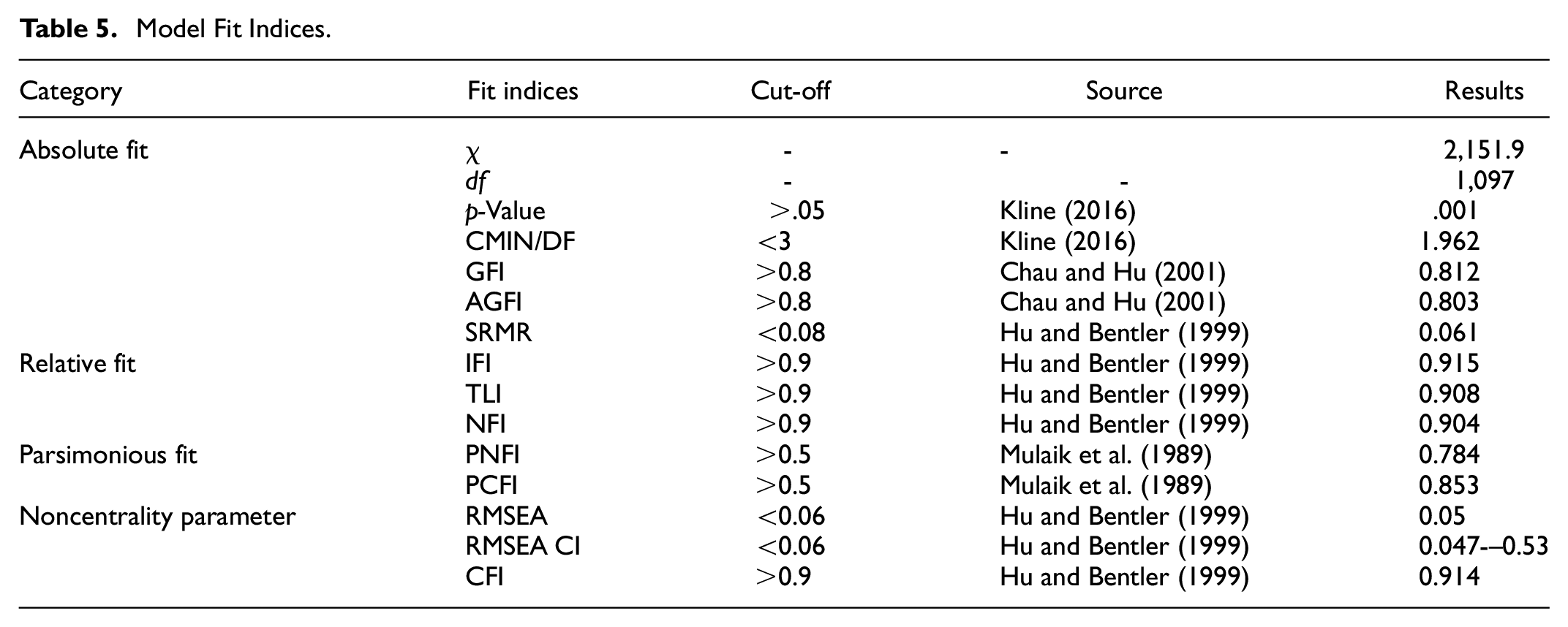
In SEM, it is imperative to conduct a series of model fit assessments to ascertain the suitability of the proposed model. This research undertook various model fit evaluations, focusing on absolute, relative, parsimonious, and noncentrality-based fit. Table 5 delineates the outcomes of each model fit index, their respective statistical benchmarks, the origins of these benchmarks, and the study’s subsequent determinations. While most model fit results aligned with or surpassed the stipulated standards for model acceptability, the chi-squared test did not. This incongruence with the chi-square criteria was anticipated, as it often misaligns in practical scenarios due to its heightened sensitivity to extensive sample sizes (N > 200; Babyak & Green, 2010). When setting aside the chi-square goodness-of-fit, the outcomes from the remaining model fit evaluations suggest the study’s model is appropriate.
Model Fit Indices.
Path Analysis
In analyzing the causal relationships between various factors and dependent outcomes, Table 6 provides details regarding the direct, indirect, and total effects of the factors within the designed model. For direct effects, the relationship between academic integration and satisfaction proved significant and positive (β = .214, p = .008). This finding underscores that enhanced academic integration is associated with heightened satisfaction levels among students. Conversely, emotional distress showed a significant positive association with both institutional transfer (β = .454) and voluntary withdrawal (β = .51). These relationships suggest that students are more inclined to transfer or withdraw from the institution as emotional distress intensifies.
Path Analysis..
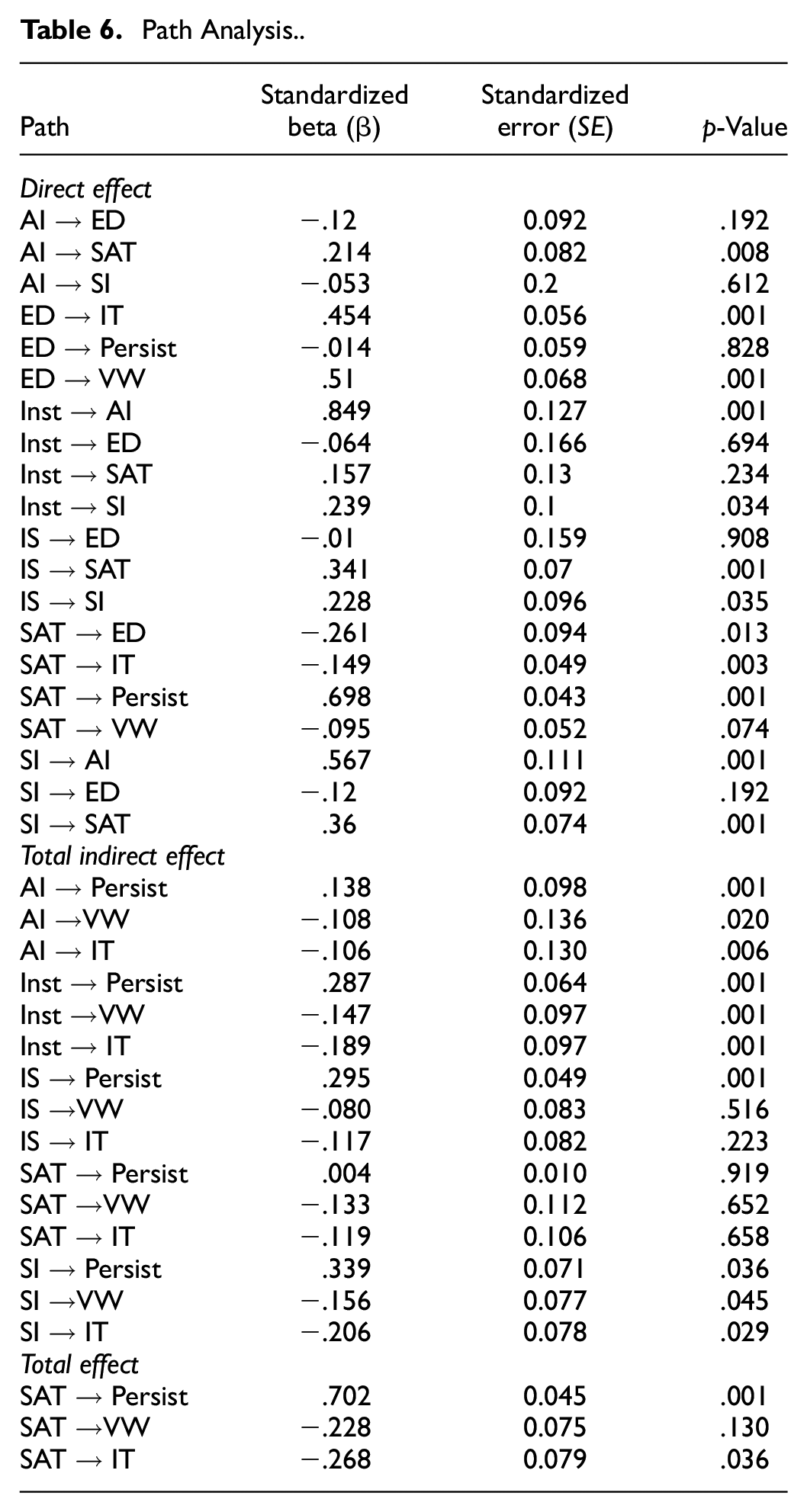
Institutional support profoundly influenced academic integration, evidencing a robust positive relationship (β = .849, p = .001). Such a relationship emphasizes the central role of institutional support in reinforcing academic integration. Further, institutional support was also linked positively and significantly with social integration (β = .239, p = .034), indicating that ample institutional support can significantly foster social ties and communal bonds among students.
Considering the indirect effects, academic integration positively influences persistence (β = .138). The value of institutional support surfaced again in its discernible effects on persistence (β = .287) and its mitigating impact on both voluntary withdrawal (β = −.147) and institutional transfer (β = −.189).
Regarding total effects, the influence of satisfaction was salient, particularly on persistence (β = .702) and institutional transfer (β = −.268, p = .036). However, some relationships that were anticipated to be significant did not meet this threshold. For instance, the direct relationships between academic integration, emotional distress, and social integration were not significant. Similarly, the direct effect of institutional support on emotional distress and satisfaction remained non-significant. A detailed SEM path diagram representing the significant direct effect paths according to the findings is provided in Appendix 2.
Discussion
Academic Integration
Understanding student experiences and identifying dropout risk involves a key focus on academic integration. The positive direct effect of academic integration on satisfaction (β = .214) found in this study highlights the significance of holistic experiences over mere academic metrics in driving student satisfaction. This finding is intriguing when juxtaposed with previous research, such as Asavisanu (2017) and Tangcharoen et al. (2019), where the correlation of academic integration with dropout risk was not substantial. This divergence might be due to the changing student expectations and academic environment landscape. Additionally, this study’s lack of a significant relationship between academic integration and emotional distress contrasts with Sukthong (2019), suggesting complex interactions and potentially unique factors at play in the context of a Thai university.
Sukthong’s study focused on Chiang Mai Rajabhat University (CMRU), a larger institution with more than 11,000 registered students. Sukthong (2019) noted that some students struggled with engaging with their courses due to class size and their limited ability to form bonds with classmates and faculty, leading to anxiety and emotional discomfort. In contrast, the smaller scope of APIU and KRU may allow for better individualized support, reducing distress and enhancing academic integration. This study highlights the significant influence of institutional support (β = .849, p = .001) on student academic integration, underscoring the importance of personalized attention and resources in fostering student satisfaction and well-being.
Emotional Distress
While noted as influencing academic outcomes, emotional distress shows complex interactions in this study. The significant correlations with institutional transfer (β = .454) and voluntary withdrawal (β = .51) echo the findings of Wareebor et al. (2020) and Sukthong (2019), who recognized its role in student disassociation. However, the lack of significant correlation with persistence introduces a novel perspective, potentially indicative of effective emotional support strategies within the studied institutions. This could range from comprehensive counseling services to peer support systems, highlighting student resilience.
Further exploration of the literature reveals varying impacts of emotional distress on student experiences. Sosu and Pheunpha (2019) and Rujichinnawong (2018) discuss the critical role of family and institutional support in mitigating distress, while Sukthong (2019) emphasizes the changing nature of student dependency from family to institution. These insights suggest that emotional support from family and institutions plays a nuanced role in student well-being. The potential of these support systems to adapt and address the emotional needs of students, especially in transitioning from family to university life, becomes crucial. This calls for a more tailored approach to emotional support, acknowledging the diverse sources and implications of distress among students.
Instruction
Instruction plays a pivotal role in shaping student learning experiences and outcomes. The relationship between instruction and academic integration (β = .849) found in this study underscores the critical influence of teaching quality and instructional methods. This aligns with Rujichinnawong’s (2018) emphasis on the role of educators. The study’s findings present some notable differences. The absence of significant direct effects between instruction and emotional distress and satisfaction deviates from the findings of Pitanupong et al. (2020), which focused on medical students at the Prince of Songkla University (PSU), a large national university in Southern Thailand. Their analysis suggested that instruction significantly impacts students in high-demand programs, both positively and negatively, due to the intense enrollment competitiveness and the program’s large size.
In contrast, the population in this study includes a more diverse range of programs at APIU and KRU, smaller private institutions where the educational dynamics may differ. These differences could be attributed to evolving student expectations, diverse instructional methodologies, or unique student-instructor dynamics. The varied program inclusion and smaller institutional settings may influence students’ emotional distress and satisfaction in distinct ways. This highlights the importance of context in understanding the relationship between instruction and student outcomes and underscores the need for ongoing adaptation and responsiveness in instructional approaches within Thai private universities.
Institutional Support
Institutional mechanisms play a vital role in shaping student experiences and outcomes. This study’s positive relationship between institutional support and satisfaction (β = .341) is consistent with Rujichinnawong’s (2018) findings, underscoring the importance of support systems in facilitating student adjustment and success. However, the non-significant relationship between institutional support and emotional distress found here offers a distinct perspective from Sukthong’s (2019) research, which emphasized the critical role of institutional health service support. This difference suggests that while the need for institutional support is universally recognized, its effectiveness and impact can vary greatly depending on the nature and quality of the support provided and the specific institutional context.
Satisfaction
Satisfaction is a complex and multifaceted construct in the educational context, often serving as a critical indicator of academic outcomes. This study’s findings on the significant role of satisfaction in influencing persistence (β = .698) align with the research of Asavisanu (2017) and Compan and Apibunyopas (2019), who highlighted the multifaceted nature of factors influencing student satisfaction. However, the nuanced perspective on satisfaction’s relationship with institutional transfer suggests that student decision-making processes are influenced by a complex array of factors extending beyond immediate academic experiences. This indicates the necessity for a broader approach to understanding and addressing student needs to enhance satisfaction and retention.
Social Integration
Social integration’s impact on academic outcomes is well-recognized, but its manifestation can vary across educational contexts. The strong relationship found in this study between social integration, academic integration (β = .567), and satisfaction (β = .36) highlights the interconnected nature of these domains. While this finding aligns with the broader scholarly consensus, the strength of these relationships in the Thai university context suggests an enriched interplay between academic and social aspects. This emphasizes the strategic importance of fostering cohesive and supportive environments within academic institutions to enhance academic and social integration, ultimately contributing to improved student outcomes.
Comparing the Study’s Model With Core Theoretical Models
The study’s model, designed to examine student persistence and dropout risk, integrates key elements from Astin’s (1993) I-E-O model, Bean’s (1981) model of student attrition, and Tinto’s (1993) Student Integration Model (SIM), offering a comprehensive perspective on student decisions in higher education. This comparison highlights the similarities and differences between the study’s model and these foundational models.
Astin’s I-E-O Model categorizes the student experience into input, environment, and outcome stages. While Astin’s environment element broadly covers social dynamics and personal health, the study’s model delves deeper into specific relationships. The direct effect of academic integration on satisfaction (β = .214, p = .008) highlights how engagement in academic activities enhances student satisfaction, a nuance beyond Astin’s broader categories.
Bean’s Model of Student Attrition emphasizes mediation through academic, social, and environmental factors. This study’s model enhances Bean’s framework by providing a more detailed examination of influences, such as the significant impact of institutional support on academic integration (β = .849, p = .001) and social integration (β = .239, p = .034). While Bean’s model focuses on external elements like finance, this study distinguishes between internal and external influences, such as the risk of institutional transfer due to emotional distress (β = .454) and voluntary withdrawal (β = .51). The model’s incorporation of student satisfaction, not explicitly addressed in Bean’s model, underscores its empirical significance, as evidenced by satisfaction’s strong influence on persistence (β = .702, p < .001).
Tinto’s Student Integration Model is similar to this study’s model, as both frameworks comprise stages leading to outcomes. However, Tinto’s general departure decision may lack the specificity of this study’s focus on dropout nuances. While Tinto emphasizes pre-entry attributes, this study’s model introduces constructs addressing student and institutional responsibilities, highlighting both constructs’ roles in shaping student experiences. This model clarifies distinct paths for satisfaction and emotional distress, capturing nuanced student experiences. The indirect effect of academic integration on persistence (β = .138, p < .001) further illustrates how specific factors contribute to student outcomes beyond Tinto’s broader constructs.
The study’s model builds on these foundational models by integrating and expanding upon their constructs, offering an analysis of student persistence and dropout risk. The model’s detailed path analysis provides empirical evidence supporting the theoretical insights while adapting them to the specific context of private Thai universities. This comprehensive approach enhances understanding of the complex factors influencing student decisions and highlights areas for targeted intervention.
Study Limitations
This research, centered on two small private Thai universities with undergraduate enrollments below 1,500, has inherent limitations. While statistically rigorous, the selected sample of 381 students may not fully represent the diverse experiences and perspectives within such institutions. The findings may not be generalizable for all small private universities in Thailand. The findings, anchored to a specific point in time, might not capture potential longitudinal shifts in student attitudes or evolving institutional practices and methodologies. The finite timeframe and resources typical of research also inevitably influenced this study’s depth, breadth, and methodological choices. While our cross-sectional design primarily offers correlational insights, SEM helps explain potential causal pathways within the data. Future studies should consider a more comprehensive selection of small private universities to enhance generalizability. Moreover, adopting a mixed-methods approach, combining quantitative analyses with qualitative insights could further enrich our understanding of the intricate factors influencing student outcomes in these educational settings. Future studies can prioritize specific programs within institutions for clearer reflection and analysis.
Implications and Recommendations
In the context of Thai private universities, the significance of academic integration in enhancing student satisfaction, as revealed by this study, cannot be overstated. This finding suggests a need for educational environments that prioritize interactive and engaging learning experiences. For instance, problem-based learning and collaborative projects can actively involve students in their academic journey, boosting their integration and overall satisfaction. Additionally, incorporating feedback mechanisms, where students can express their views on course content and teaching methods, can further this goal.
The study’s revelation about the impact of emotional distress on student dropout rates calls for immediate attention to mental health support systems within these universities. Establishing accessible counseling services, stress management workshops, and peer mentoring programs can provide students with the necessary resources to navigate their emotional challenges. For example, peer support groups can offer a platform for students to share experiences and coping strategies, fostering a supportive community. Moreover, integrating mental health awareness into the curriculum can destigmatize seeking help and encourage a more proactive approach to mental well-being.
The significant correlation between instructional quality and academic integration underscores the need for faculty development and training. Programs focusing on pedagogical skills, empathetic communication, and student engagement strategies are essential. Such initiatives could include workshops on active learning techniques or integrating technology in teaching, thus enhancing instructional quality. Regular student feedback on teaching methods could provide instructors with insights into their effectiveness and areas for improvement, fostering a more student-centered learning environment.
Lastly, the role of institutional support in shaping student experiences is critical. This encompasses academic guidance, career counseling, financial advising, and social integration efforts. For instance, career workshops that align academic programs with real-world applications can enhance the relevance of education for students. Social events, clubs, and organizations facilitate interactions and build a sense of community, which is crucial for student retention. These initiatives, grounded in the study’s findings, aim to create an educational environment that supports students academically and attends to their holistic development.
Conclusion
This study rigorously analyzed the relationship between six independent variables and their impact on student outcomes, such as persistence, voluntary withdrawal, and institutional transfer in small private Thai universities. The prominence of academic integration, institutional support, and social integration in influencing the likelihood of student persistence unveiled the critical intersections of these variables with the educational journey. Institutions aiming for higher retention rates must heed these findings, underscoring the importance of creating an integrated academic environment that prioritizes academic and social dimensions.
The study’s spotlight on emotional distress as a determinant of voluntary withdrawal underscores the need for mental well-being support in academic settings. This revelation prompts a call to action for universities to strengthen their student support mechanisms, ensuring that students’ emotional and psychological needs are adequately addressed. Additionally, when studying the reasons behind students transferring institutions, findings strongly show that satisfaction and quality of instruction are critical factors. This indicates that students are not simply receiving education but actively assessing their academic experience, and the quality of instruction is a crucial factor in their decision to continue or transfer elsewhere.
The findings invite a deeper exploration into educational theories such as student engagement and motivation, which would offer valuable frameworks for understanding and enhancing student experiences. This study’s insights suggest broader applicability, informing educational practices beyond Thai private universities and contributing to the global student retention and satisfaction discourse. Collectively, these findings urge small private universities in Thailand to reevaluate and bolster their strategies, ensuring a holistic academic experience that attends to students’ multifaceted needs and challenges.
Footnotes
Appendix
Study Items, Constructs, and Related Questions.


|
Note. Red text indicates reverse coded questions.
Acknowledgements
N/A
Declaration of Conflicting Interests
The author(s) declared no potential conflicts of interest with respect to the research, authorship, and/or publication of this article.
Funding
The author(s) received no financial support for the research, authorship, and/or publication of this article.
Ethics Statement
Study approved by Assumption University Institutional Review Board – April 26, 2023
Study approved by the Association of Private Higher Education Institutions in Thailand (APHEIT), Dr. Sanee Suwandee, the Secretary-General of APHEIT – May 2, 2023

Data Availability Statement
Data sharing not applicable to this article as no datasets were generated or analyzed during the current study.